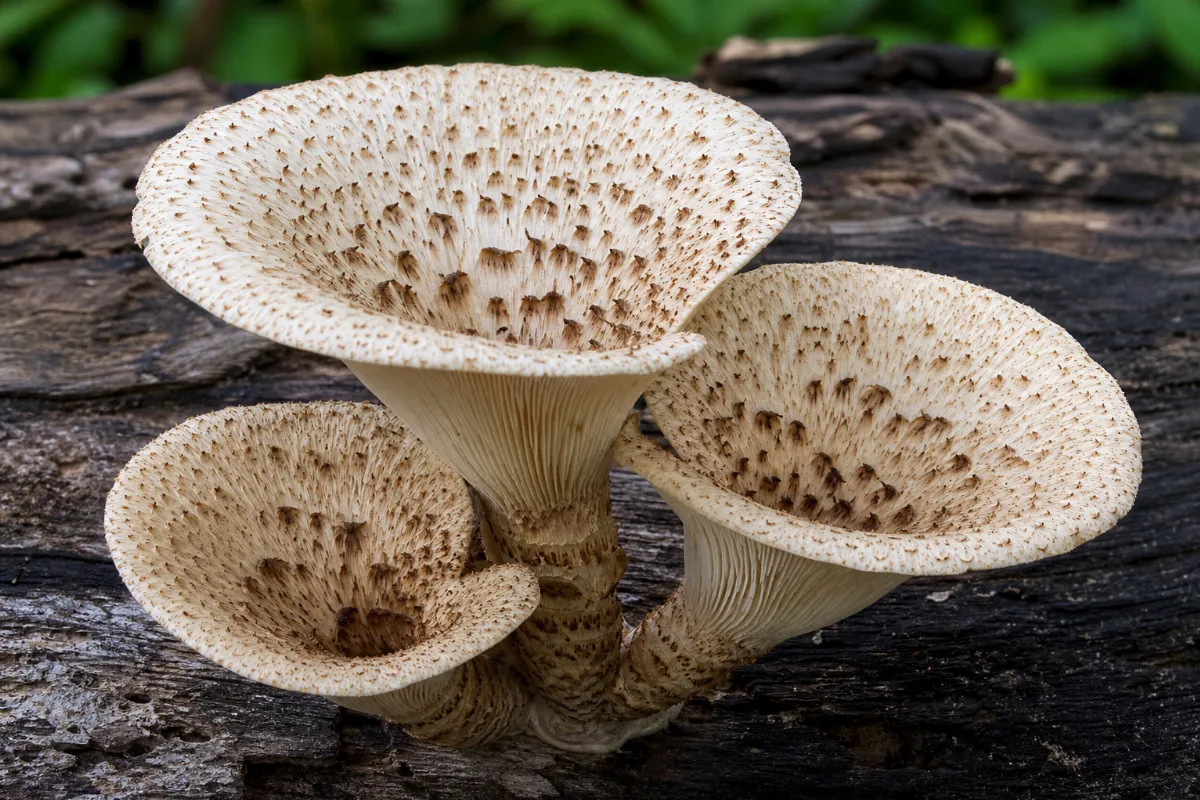
Mushrooms · Culinary and medicinal mushroom
Scaly lentinus
Lentinus squarrosulus · also called Hed Khon Khao (Thai), Ero atakata (south-eastern Nigeria)
Scaly lentinus is a tough, wood-rotting mushroom eaten in tropical Africa and Asia and used in some traditional medicine. The health research is lab work and rat studies, and we found no study in people. A boiled extract raised liver enzymes in rats. Do not mix it up with Lentinus sajor-caju or the farmed oyster sold as Pleurotus sajor-caju.
General information, not medical advice. Last substantive update · Not medically reviewed. A named clinician has not signed off on this page. How this page is made
About Scaly lentinus
Scaly lentinus (Lentinus squarrosulus) is a tough-fleshed, wood-rotting mushroom eaten in tropical Africa and Asia, and used in some traditional medicine. It is a fungus in the bracket-fungus family, not a plant. The research is almost all laboratory work: food analyses, test-tube gut fermentation, and extracts tested on cells or rats. We found no study in people. A short rat study found higher liver enzymes with a boiled extract.
What it is, and the name mix-up
GBIF lists Lentinus squarrosulus Mont. as an accepted species in the family Polyporaceae. It is a wood-rotting fungus with a tough fruiting body. Papers call it Hed Khon Khao in Thailand and, in south-eastern Nigeria, by names such as Ero atakata.
Lentinus sajor-caju is a separate accepted species. Many older papers use the name Pleurotus sajor-caju for a farmed oyster mushroom, which a 2016 DNA-based paper places in Pleurotus pulmonarius, the phoenix oyster. Because of this, always check which mushroom a study or label means. GBIF also lists scaly lentinus as a synonym of a subspecies of tiger sawgill, so older papers may blur those too.
Food and traditional use
In a survey of 160 people in the Congo rainforest it was one of five wood-decaying mushrooms mostly valued for food. Across three regions of Nigeria, interviewees listed it among the main edible, medicinal and dual-use mushrooms; mushrooms were sun-dried and eaten with fufu or gari, in soup, or cooked with meat or vegetables. A paper from Gabon says it is widely used there for cooking and medicine, and a Cameroon survey lists it among mushrooms used as medicine.
A Nigerian paper says it is used in folk medicine for ulcer, anaemia, cough and fever. These are traditions and beliefs, not evidence that it works.
As a food
We found no official nutrient table. In one Thai powder, per 100 g dry weight, there was about 30 g protein, 55 g carbohydrate, 2 g fat, 29 g beta-glucan and 37 g neutral detergent fibre. A Chinese strain had 26 percent protein, and an Indian wild sample 19 g per 100 g. A Chinese paper also found savoury glutamate-like amino acids.
These are values for single samples, on a dry basis. A cooked serving holds far less, and a compound being present is not a health effect.
What the research shows
Digested powder and crude polysaccharides fed friendly gut bacteria in test-tube models. Extracts neutralised free radicals in chemical tests. Peptides killed lung cancer cells in dishes, purified sugars activated mouse immune cells, and extracts blocked sugar- and fat-digesting enzymes in tubes. In rats, a mycelium extract raised blood antioxidant capacity and healed induced stomach ulcers faster.
None of this has been tested in people. Many substances do well in a dish or a rat and then fail in people, and extracts and purified parts are not like a cooked meal. One animal pain test found no pain relief from this species when four other mushrooms had it.
Mushroom, mycelium and extract are different
The food is the fruiting body. Researchers also grow the mycelium in the laboratory and make water extracts, crude polysaccharides, peptides or purified sugars. In a cell test of allergy, only the mycelium polysaccharides had an effect, not the fruiting body ones. We read nothing on any commercial capsule, powder or mycelium-on-grain product. Ask a pharmacist before using one.
Legal and regulatory status
We found no statement about this mushroom from EMA, EFSA, FDA, WHO or NCCIH, and a search of the NCBI Bookshelf (which holds LiverTox and LactMed) found nothing. Those other sites were not searched one by one. Rules differ by country and change.
At a glance
Traditional uses history, not proof
- Eaten as a food in Nigeria, the Congo and Gabon, often dried and cooked in soups or with meat or vegetables.
- Listed as a traditional medicine in Cameroon and Nigeria (ulcer, anaemia, cough and fever are named in one paper).
Studied for research
- As a food (protein, fibre, beta-glucan), low
- Feeding gut bacteria (laboratory), insufficient
- Antioxidant activity (chemical tests and rats), very low
- Stomach ulcers (rats), very low
- Immune cells and cancer cells (dishes), very low
- Sugar and fat enzymes, allergy cells, skin peptides, insufficient
- Pain relief (animal test), against
- Any effect in people, insufficient (no human study)
Main compounds
- Beta-glucans (fibre-like sugars)
- Polysaccharides (long sugar chains)
- Protein and small peptides
- Phenolic compounds
- Savoury amino acids (glutamate-like)
Common forms
- Fresh or cooked mushroom (food)
- Sun-dried mushroom
- Dried powder
- Water extracts and purified sugars or peptides (research only)
- Laboratory mycelium extracts (research only)
Research links: Gut fermentation of the powder, 2022 (open access) · Nutrition of three domesticated mushrooms, 2015 · Rat toxicity of a boiled extract, 2019 (open access) · Prebiotic potential of crude polysaccharides, 2024 (open access) · The Pleurotus sajor-caju naming question, 2016 · GBIF record for scaly lentinus · Research Library · Genes & Biomarkers Library
What it is and its history
- Accepted scientific name
- Lentinus squarrosulus
- Naming authority
- Mont. (GBIF). Many papers write it as (Mont.) Singer.
- Synonyms
- Pleurotus squarrosulus (Mont.) Singer; Lentinus tigrinus subsp. squarrosulus (Mont.) Pilat, 1936; Pocillaria squarrosula (Mont.) Kuntze; Lentinus bavianus Pat.; Lentinus subnudus Berk.; Lentinus lobatus Berk. & Broome
- Common names
- Scaly lentinus (English); Hed Khon Khao (Thai (romanised, as written in a 2021 paper)); Ero atakata (South-Eastern Nigeria (as written in a 2019 paper))
- Family or group
- Polyporaceae (the bracket-fungus family), a fungus, not a plant
- Classification
- Fungi > Basidiomycota > Agaricomycetes > Polyporales > Polyporaceae > Lentinus > Lentinus squarrosulus
- Native range
- Papers in this review cover Nigeria, Gabon, Cameroon and DR Congo in Africa, and Thailand, India, Bangladesh and Pakistan in Asia.
- Habitat
- A wood-rotting fungus. A Pakistani study collected it under a mulberry tree; a Congo survey calls it one of five wood-decaying species appreciated as food.
- What it looks like
- Fruiting body: Papers describe a tough fruiting body. No detailed description was read.
- Cultivation
- Grown in trials on substrates such as wheat straw with tea waste after spawn on sorghum (Pakistan). Its rapid mycelial growth is noted by rat-study authors.
- Harvest and processing
- In the Nigerian survey, mushrooms in general were sun-dried, sometimes washed first, and cooked in soup, with meat or with vegetables.
- Look-alikes and adulterants
- Name: Lentinus sajor-caju (a separate accepted species in GBIF); Note: GBIF lists Pleurotus sajor-caju as a synonym of this name, not of scaly lentinus. A Nagaland paper in this review lists Lentinus sajor-caju and Lentinus squarrosulus as different mushrooms.; Name: The cultivated strain called "Pleurotus sajor-caju" in many papers; Note: A 2016 DNA-based paper says this widely farmed strain is a tropical form of Pleurotus pulmonarius (see phoenix oyster) and not Lentinus. Oyster-mushroom papers under that name are not about scaly lentinus.; Name: Lentinus polychrous; Note: A close relative studied alongside it in Thai papers. Not the same species.; Name: Tiger sawgill (Lentinus tigrinus); Note: GBIF lists scaly lentinus as a synonym of a subspecies of it (Pilat 1936), so older papers may blur the two. See the tiger sawgill page.; Name: Wild mushrooms in general; Note: No identification source for the public was read. Do not eat a wild mushroom unless an expert has identified it.
- Sustainability and conservation
- Not assessed in the sources read.
Traditional use and history history, not clinical proof
| Tradition or era | Documented use | Source |
|---|---|---|
| Food in tropical Africa and Asia | A Congo survey of 160 informants names it among five wood-decaying species mostly appreciated for food. Across three regions of Nigeria, interviewees named it among the most important edible mushrooms and also among the principal medicinal and dual-use ones. A Gabonese paper says it is widely used there for cooking and medicine. | p29433575 |
| Traditional medicine in Nigeria and Cameroon | A rat-toxicity paper says it is used in ethnomedicine for ulcer, anaemia, cough and fever, and a Cameroon survey lists it among mushrooms used as medicine. A Nigerian survey lists uses for mushrooms in general (skin problems, fever and measles, diabetes, high blood pressure, blood tonic), not for this species alone. A traditional use is not proof that it works. | p29609649 |
| First description | GBIF gives the original publication as Montagne, 1842, in Annales des Sciences Naturelles, Botanique. | s-gbif-lentinus |
Traditional use shows how it was used. It does not show that it works or is safe today.
What is inside, and how it may work
What it contains and how those compounds act in cells and animals. Laboratory and animal mechanisms are not proven effects in people.
Main compounds
| Compound | Family | Where it is concentrated | Activity studied | Level of evidence |
|---|---|---|---|---|
| Beta-glucans (beta-(1,3)(1,6)-glucan) | polysaccharide | Fruiting body 29.49 g per 100 g dry matter in one Thai powder (as reported) | Fibre-like sugars that gut bacteria ferment. A purified glucan activated mouse immune cells in a dish. Laboratory only. 4 6 | Laboratory research |
| Crude polysaccharides (hot-water extract) | polysaccharide | Fruiting body extract Yield 6.77 g per 100 g dry fruiting body; 293.68 mg polysaccharide per g of extract (one wild collection) | Supported probiotic growth and resisted simulated digestion. Laboratory only. 19 20 | Laboratory research |
| Heteroglycan (galactose, fucose, glucose) | polysaccharide | Fruiting body hot-water extract | Activated mouse immune cells in culture, per the authors. 5 | Laboratory research |
| Protein and peptides | peptide | Fruiting body About 30 g protein per 100 g dry matter in one Thai powder; 26.32 percent in a Chinese strain (basis not stated) | Partly purified peptides killed lung cancer cells in dishes, and hydrolysate peptides blocked tyrosinase in a tube. Laboratory only. 4 24 21 10 11 | Laboratory research |
| Phenolic compounds | phenolic | Fruiting body extracts Rich in total polyphenols but poor in flavonoids in Gabonese extracts; levels differ by extract | Antioxidant activity in chemical tests. Laboratory only. 18 1 2 | Laboratory research |
| Flavour amino acids and nucleotides | amino acid | Fruiting body 10.68 percent monosodium glutamate-like and 9.25 percent sweet amino acids; flavour nucleotides 1.01 per mille (Chinese strain) | Give savoury taste. Not a health effect. 24 | Compositional analysis |
| Other compounds found by gas chromatography | mixed | Boiled water extract | The rat-toxicity paper lists 1-tetradecene, a fumaric acid ester, 9-eicosene, phytol and others. Their health meaning is not shown. 23 | Compositional analysis |
Mechanisms, receptors and pathways
| Target or pathway | Gene or receptor | What was found | Level |
|---|---|---|---|
| Cell-death pathway | Bcl-2, BAX, c-FLIP | Partly purified peptides lowered Bcl-2 and c-FLIP and raised BAX in lung cancer cells, per the authors. 21 | Laboratory research |
| Integrin survival signals | Integrins, FAK, Src, Akt, p53, Mcl-1 | A peptide lowered these survival signals in cisplatin-treated lung cancer cells. 10 | Laboratory research |
| Immune cell activation | Macrophages, spleen cells, thymus cells | Purified glucans activated these mouse cells in culture; the receptor is not shown in the abstracts. 6 5 | Laboratory research |
| Gut bacterial fermentation | Short-chain fatty acids | Bacteria fermented the digested powder and extracts, making acids and shifting bacterial groups in stool samples in a vessel. 4 20 | Laboratory research |
| Inflammation signals in the stomach | IL-1 beta, NF-kB | Lower levels went with ulcer healing in rats given a mycelium extract, per the authors. 12 | Animal research |
| Digestive enzymes | Alpha-glucosidase, lipase, tyrosinase | Extracts or peptides blocked these enzymes in tubes. 1 11 | Laboratory research |
Absorption, metabolism and elimination
- Absorption
- A rat study showed antioxidant capacity rising in blood after a mycelium extract, which the authors read as absorption. Nothing was measured in people.
- Distribution
- Not found in the sources read.
- Metabolism
- Not found in the sources read.
- Elimination
- Not found in the sources read.
- Bioavailability
- Not established.
Isolated compounds versus whole extracts
Nearly all the biological research uses extracts, purified sugars or peptides, or laboratory mycelium, tested on cells or in tubes. The one rat safety study used a boiled extract of the dried wild mushroom. No study tested the cooked food in people. Fruiting body and mycelium also differ: in a cell model of allergy only the mycelium polysaccharides had an effect. Results from one form cannot be assumed for another.
Nutritional composition
We found no official nutrient table for this mushroom. One Thai powder held, per 100 g dry matter, 30.12 g protein, 55.50 g carbohydrate, 2.29 g fat and 37.26 g neutral detergent fibre. A Chinese strain had 26.32 percent protein and an Indian wild sample 18.77 g protein per 100 g. These are single samples on a dry basis, so they cannot be read as per-serving values.
1 low certainty5 very low certainty4 not enough evidence1 evidence against
What was looked at
The 11 benefits and uses checked for Scaly lentinus, each with how strong the evidence is. Tap one to open it.
- As a food (what samples contained)Low certainty
- Feeding gut bacteria (laboratory)Not enough evidence
- Antioxidant activity in chemical testsVery low certainty
- Antioxidant status (rats)Very low certainty
- Stomach lining protection (rats)Very low certainty
- Immune cell activation (cells)Very low certainty
- Cancer cells in dishesVery low certainty
- Sugar and fat enzymes (test tube)Not enough evidence
- Allergy-type cell test: fruiting body versus myceliumNot enough evidence
- Skin pigment enzyme and peptides (test tube)Not enough evidence
- Pain relief (animal test)Evidence against
Lab markers tracked in the studies
Protein and fibre content of dried fruiting bodyShort-chain fatty acids in stool fermentationBifidobacterium and Bacteroides in fermentationDPPH and ABTS radical scavengingUlcer healing rate (rat stomach)Blood antioxidant capacity (CUPRAC)Lung cancer cell viabilityLipase inhibitionMast-cell degranulation (beta-hexosaminidase)
What is Scaly lentinus good for?
The uses people ask about and how strong the evidence is for each. For nearly all of them the evidence is lab or animal work only. Read this together with the Safety tab.
Benefits, one by one
Each card is a research question, not a promise. Tap a goal to filter. Open a card to see the studies, doses and limits.
As a food (what samples contained)
Low certaintyAnalyses of dried scaly lentinus report a lot of protein and fibre and a large share of beta-glucan, a fibre-like sugar. These are measurements of single samples, not of a serving, and they differ a lot between papers.
4 studiesDried powder and fruiting bodies. Per-100 g figures are dry weight, n…
Studies, doses and limits
What the trials found
No human trial of eating or taking this mushroom was found. Contents were measured only in laboratories.
Results
A Thai powder had 30.12 g protein, 55.50 g carbohydrate, 2.29 g fat, 29.49 g beta-glucan and 37.26 g neutral detergent fibre per 100 g dry matter. A Chinese strain had 26.32 percent protein. An Indian wild sample had 18.77 g protein per 100 g (for the variety) and 10.66 percent ash. A Pakistani study found wild and farmed strains rich in minerals, with no figures in the abstract.
Effect sizes as reported
Protein ranges from about 19 to 30 percent between samples; no official nutrient table was found
Why this rating
Several independent laboratory analyses agree that protein and fibre are substantial, but amounts differ by sample, dry or fresh basis and method. No official nutrient table exists.
Form and dose studied
Dried powder and fruiting bodies. Per-100 g figures are dry weight, not a serving.
Who was studied
Samples from Thailand, China, India and Pakistan
Limits
Composition is not a health effect. Wild and farmed mushrooms differ, and water is removed in dried samples. Cooked mushrooms were not analysed in the papers read.
Why researchers looked
It is a common cooked mushroom in Africa and Asia, so people want to know what is in it.
Traditional use
Eaten as a food in tropical Africa and Asia (surveys in Nigeria, the Congo and Gabon). Listed as a traditional medicine in Cameroon and Nigeria.
Proposed mechanism Compositional analysis
Not applicable; this is food composition.
A proposed mechanism does not show that the effect happens in people.
No safety data for eating it. See the Safety tab.
Feeding gut bacteria (laboratory)
Not enough evidenceIn test-tube models, digested mushroom powder and its crude polysaccharides fed friendly gut bacteria and shifted the bacteria in human stool samples. Nobody has tested this in people.
3 studiesA digested powder and hot-water crude polysaccharide extracts. Not th…
Studies, doses and limits
What the trials found
No human trial of eating or taking this mushroom was found. The only human material was stool from five healthy volunteers fermented in a vessel.
Results
Powder residue after simulated digestion raised Bacteroides, Bifidobacterium and short-chain fatty acids and lowered the Firmicutes to Bacteroidetes ratio in all five stool samples. Crude polysaccharides from wild and cultivated mushrooms supported probiotic growth and raised Bacteroides and Parabacteroides in fermentation; one study also saw Fusobacterium rise.
Effect sizes as reported
Bacterial shifts in a laboratory model; no health outcome
Why this rating
Three laboratory studies from related groups, no people eating anything. Bacterial counts in a vessel do not show better digestion or health.
Form and dose studied
A digested powder and hot-water crude polysaccharide extracts. Not the same as eating the mushroom.
Who was studied
Stool samples from five healthy adults (one study); wild and cultivated mushrooms from Thailand
Limits
No outcome in people. Some bacterial changes (for example more Fusobacterium) are not clearly good.
Why researchers looked
Mushroom fibres and glucans resist digestion and reach the large bowel, so researchers ask whether they act as prebiotics.
Traditional use
No traditional use for gut health was found in the sources read.
Proposed mechanism Laboratory research
The fibre-like sugars pass through digestion and are fermented by gut bacteria, making short-chain fatty acids. This is the authors' reading of the test-tube result.
A proposed mechanism does not show that the effect happens in people.
No safety data. See the Safety tab.
Antioxidant activity in chemical tests
Very low certaintyExtracts and crude polysaccharides from the mushroom neutralised free radicals in chemical tests. That is a tube result and does not show an antioxidant effect in the body.
4 studiesCrude polysaccharide extracts and alcohol or water extracts. Not the …
Studies, doses and limits
What the trials found
No human trial of eating or taking this mushroom was found. All results are chemical assays.
Results
At 3 mg per mL, cold-water and hot-water polysaccharides scavenged about 79 percent of DPPH and 97 to 99 percent of ABTS radicals. A Thai extract matched ascorbic acid in DPPH. A Gabon extract scored only low to moderate (index 0.12 to 0.6). A new variety from India scored with EC50 values of 314 to 933 ug per mL.
Effect sizes as reported
Strong in some extracts, weak in others, depending on the extract
Why this rating
Chemical assays only; results differ by extract. A tube test says little about the body.
Form and dose studied
Crude polysaccharide extracts and alcohol or water extracts. Not the food as eaten.
Who was studied
Fruiting bodies from Thailand, Gabon and India (laboratory)
Limits
No animal or human outcome in these papers. See b_body for a rat study of a mycelium extract.
Why researchers looked
Mushrooms are rich in phenolic compounds and glucans, which often score well in simple antioxidant tests.
Traditional use
No traditional context was found beyond general food use.
Proposed mechanism Laboratory research
Chemical radical-scavenging assays (DPPH and ABTS); no body mechanism is shown.
A proposed mechanism does not show that the effect happens in people.
No safety data. See the Safety tab.
Antioxidant status (rats)
Very low certaintyA water extract of laboratory-grown mycelium raised blood antioxidant capacity in healthy rats. Effects on other markers were mixed. It is a mycelium extract, not the mushroom.
1 studiesWater extract of laboratory-grown mycelium. Not the fruiting body tha…
Studies, doses and limits
What the trials found
No human trial of eating or taking this mushroom was found. Rats only.
Results
After 28 days, blood CUPRAC rose at both dose levels, glutathione peroxidase rose in blood and liver at the lower dose, xanthine oxidase fell at the higher dose, and protein oxidation markers did not change.
Effect sizes as reported
Higher blood antioxidant capacity in healthy rats; mixed on the rest
Why this rating
One rat study of a mycelium extract from related researchers; healthy animals.
Form and dose studied
Water extract of laboratory-grown mycelium. Not the fruiting body that is eaten.
Who was studied
Healthy rats
Limits
A rise in an antioxidant test is not a health benefit.
Why researchers looked
Researchers asked whether antioxidants from the extract are absorbed and have effects in a living animal.
Traditional use
No traditional context was found.
Proposed mechanism Animal research
Higher glutathione peroxidase and lower xanthine oxidase were seen; the authors do not show how.
A proposed mechanism does not show that the effect happens in people.
No human safety data.
Stomach lining protection (rats)
Very low certaintyIn rats with induced stomach ulcers, a mycelium extract protected the stomach lining and sped healing in one study. Nothing in people.
1 studiesWater extract of mycelium.
Studies, doses and limits
What the trials found
No human trial of eating or taking this mushroom was found. Rats only.
Results
Healing was 82, 90 and 100 percent at 24, 48 and 72 hours, and stomach protection was better than with the drug cimetidine.
Effect sizes as reported
High healing rate in treated rats; no numbers for untreated rats in the abstract
Why this rating
One rat study of a mycelium extract; the abstract does not give the ulcer model or number of rats.
Form and dose studied
Water extract of mycelium.
Who was studied
Rats with induced stomach ulcers
Limits
Rat stomach results do not carry over to people with ulcers, who need a doctor.
Why researchers looked
The mushroom is used in folk medicine for ulcers, according to the authors of a Nigerian safety paper, so the claim was tested in rats.
Traditional use
A Nigerian paper says it is used in folk medicine for ulcer, anaemia, cough and fever.
Proposed mechanism Animal research
The authors link the effect to lower IL-1 beta and NF-kB (inflammation signals).
A proposed mechanism does not show that the effect happens in people.
No human safety data.
Immune cell activation (cells)
Very low certaintyPurified sugars from the mushroom activated mouse immune cells in a dish. This is a chemistry result and does not show better immunity in people.
2 studiesPurified polysaccharides, not the whole mushroom.
Studies, doses and limits
What the trials found
No human trial of eating or taking this mushroom was found. Cell culture only.
Results
A purified glucan gave best activation of immune cells at 10 ug per mL, and a second purified heteroglycan also activated them, per the authors.
Effect sizes as reported
Cells activated; no numbers in the abstract for the second study
Why this rating
Two chemistry papers from the same group using cells; no animals or people.
Form and dose studied
Purified polysaccharides, not the whole mushroom.
Who was studied
Mouse immune cells in culture
Limits
Activation of cells does not show better health. More immune activity can also be unwanted, for example with autoimmune disease or a transplant.
Why researchers looked
Mushroom glucans are often tested for immune effects.
Traditional use
No traditional immune use was found in the sources read.
Proposed mechanism Laboratory research
Activation of macrophages, spleen cells and thymus cells in culture; the pathway is not shown in the abstracts.
A proposed mechanism does not show that the effect happens in people.
No human safety data. See the Safety tab.
Cancer cells in dishes
Very low certaintyPeptides from the mushroom killed human lung cancer cells in dishes and made the chemotherapy drug cisplatin work better there. This is not a treatment and has not been tried in people.
2 studiesPartly purified peptides, not the mushroom.
Studies, doses and limits
What the trials found
No human trial of eating or taking this mushroom was found. Cell dishes only.
Results
Partly purified peptides killed three lung cancer cell lines. A purified peptide used before cisplatin increased cell death in lung cancer cells but not in skin or kidney cells.
Effect sizes as reported
Cell death in dishes; no animal or human result
Why this rating
Two cell-line papers from Thai groups, with no animals or people.
Form and dose studied
Partly purified peptides, not the mushroom.
Who was studied
Human lung cancer cell lines
Limits
Many substances kill cancer cells in a dish and then fail in people. This does not mean the mushroom treats or prevents cancer.
Why researchers looked
Many mushroom compounds are screened against cancer cell lines.
Traditional use
No traditional cancer use was found in the sources read.
Proposed mechanism Laboratory research
Lower Bcl-2, higher BAX and lower integrin survival signals in cancer cells, per the authors.
A proposed mechanism does not show that the effect happens in people.
Do not use any mushroom product alongside cancer treatment without telling your cancer team.
Sugar and fat enzymes (test tube)
Not enough evidenceIn enzyme tests an extract blocked alpha-glucosidase and lipase, but far more weakly than a drug. This is not a test of eating the mushroom and not a diabetes or weight claim.
2 studiesTwo laboratory extracts.
Studies, doses and limits
What the trials found
No human trial of eating or taking this mushroom was found. Enzyme tests only.
Results
The water extract blocked lipase with an IC50 of 22.28 ug per mL (orlistat 2.28). The chloroform-methanol extract blocked alpha-glucosidase more. Alpha-amylase blocking was very low or absent.
Effect sizes as reported
Some enzyme blocking, about ten times weaker than the drug for lipase
Why this rating
One enzyme study; no cells, animals or people.
Form and dose studied
Two laboratory extracts.
Who was studied
Enzyme assays and brine shrimp
Limits
An enzyme test does not show lower blood sugar or weight.
Why researchers looked
The mushroom is used locally for metabolic complaints, the authors say, so enzyme tests were run.
Traditional use
Nigerian survey respondents named diabetes among conditions for which mushrooms are used (all species together).
Proposed mechanism Laboratory research
Blocking of digestive enzymes in a tube.
A proposed mechanism does not show that the effect happens in people.
No human safety data.
Allergy-type cell test: fruiting body versus mycelium
Not enough evidenceIn a cell model of allergy, polysaccharides from the fruiting body did not significantly cut histamine-type release, while those from the mycelium did. It shows the two are different.
1 studiesCrude polysaccharides from fruiting body and from mycelium
Studies, doses and limits
What the trials found
No human trial of eating or taking this mushroom was found. Cell model only.
Results
Fruiting body polysaccharides: no significant reduction. Mycelium polysaccharides: up to 23 percent less release.
Effect sizes as reported
Up to 23 percent (mycelium); not significant (fruiting body)
Why this rating
One cell experiment, abstract only.
Form and dose studied
Crude polysaccharides from fruiting body and from mycelium
Who was studied
Rat mast cells with human gut cells
Limits
Not allergy treatment. No one should use it for allergies.
Why researchers looked
Researchers looked for natural anti-allergy compounds.
Proposed mechanism Laboratory research
Release of beta-hexosaminidase from mast cells, a marker of allergic degranulation.
A proposed mechanism does not show that the effect happens in people.
No human safety data.
Skin pigment enzyme and peptides (test tube)
Not enough evidenceSmall peptides from the mushroom blocked tyrosinase, an enzyme in skin pigment, in a tube. Nothing was tested on skin.
1 studiesProtein hydrolysate from fruiting body
Studies, doses and limits
What the trials found
No human trial of eating or taking this mushroom was found. Tube and computer work only.
Results
Both mushroom hydrolysates blocked tyrosinase about as well as kojic acid; L. squarrosulus was the stronger antioxidant and was not toxic to the cells tested.
Effect sizes as reported
Comparable to kojic acid in a tube
Why this rating
One tube study, abstract only.
Form and dose studied
Protein hydrolysate from fruiting body
Who was studied
Enzyme and chemical tests
Limits
Not a skin treatment.
Why researchers looked
Tyrosinase blockers are searched for in skin-lightening products.
Proposed mechanism Laboratory research
Hydrogen bonding of a peptide (LILGGSSS) to the enzyme was modelled by computer.
A proposed mechanism does not show that the effect happens in people.
No human safety data.
Pain relief (animal test)
Evidence againstIn an animal pain test, the other four wild mushroom extracts clearly helped, but scaly lentinus did not reach the same effect.
1 studiesMethanol extract of fruiting body
Studies, doses and limits
What the trials found
No human trial of eating or taking this mushroom was found. One animal test.
Results
The authors say every extract except L. squarrosulus showed potential pain relief.
Effect sizes as reported
No pain-relief signal for this species
Why this rating
One small test of a methanol extract; shown as a null result.
Form and dose studied
Methanol extract of fruiting body
Who was studied
Animal writhing test
Limits
One small test; absence of an effect in it is not conclusive.
Why researchers looked
Wild mushroom extracts were screened for pain relief.
Proposed mechanism Animal research
Not applicable.
A proposed mechanism does not show that the effect happens in people.
No human safety data.
Connections to the rest of health
How Scaly lentinus connects to the rest of our health knowledge graph. Every link says what kind of connection it is. A safety link (for example to the liver) is a warning, not a benefit. A study that merely mentions a topic never creates a benefit link.
Explore every connection: goals, body systems, organs, symptoms, genes
A. Wellness goals
| Connected to | Kind of connection | Evidence status | Context | Studies |
|---|---|---|---|---|
| Gut Health | Low certainty | As a food (what samples contained): Analyses of dried scaly lentinus report a lot of protein and fibre and a large share of beta-glucan, a fibre-like sugar. These are measurements of single samples, not of a serving, and they differ a lot between papers. | 4 24 2 8 | |
| Gut Health | Not enough evidence | Feeding gut bacteria (laboratory): In test-tube models, digested mushroom powder and its crude polysaccharides fed friendly gut bacteria and shifted the bacteria in human stool samples. Nobody has tested this in people. | 4 19 20 | |
| Microbiome Balance | Not enough evidence | Feeding gut bacteria (laboratory): In test-tube models, digested mushroom powder and its crude polysaccharides fed friendly gut bacteria and shifted the bacteria in human stool samples. Nobody has tested this in people. | 4 19 20 | |
| Healthy Aging | Very low certainty | Antioxidant activity in chemical tests: Extracts and crude polysaccharides from the mushroom neutralised free radicals in chemical tests. That is a tube result and does not show an antioxidant effect in the body. Antioxidant status (rats): A water extract of laboratory-grown mycelium raised blood antioxidant capacity in healthy rats. Effects on other markers were mixed. It is a mycelium extract, not the mushroom. | 3 19 18 16 13 | |
| Digestive Support | Very low certainty | Stomach lining protection (rats): In rats with induced stomach ulcers, a mycelium extract protected the stomach lining and sped healing in one study. Nothing in people. | 12 | |
| Immune Support | Very low certainty | Immune cell activation (cells): Purified sugars from the mushroom activated mouse immune cells in a dish. This is a chemistry result and does not show better immunity in people. Allergy-type cell test: fruiting body versus mycelium: In a cell model of allergy, polysaccharides from the fruiting body did not significantly cut histamine-type release, while those from the mycelium did. It shows the two are different. | 6 5 9 | |
| Preventive Wellness | Very low certainty | Cancer cells in dishes: Peptides from the mushroom killed human lung cancer cells in dishes and made the chemotherapy drug cisplatin work better there. This is not a treatment and has not been tried in people. | 21 10 | |
| Blood Sugar Balance | Not enough evidence | Sugar and fat enzymes (test tube): In enzyme tests an extract blocked alpha-glucosidase and lipase, but far more weakly than a drug. This is not a test of eating the mushroom and not a diabetes or weight claim. | 1 17 | |
| Weight Management | Not enough evidence | Sugar and fat enzymes (test tube): In enzyme tests an extract blocked alpha-glucosidase and lipase, but far more weakly than a drug. This is not a test of eating the mushroom and not a diabetes or weight claim. | 1 17 | |
| Skin Hair | Not enough evidence | Skin pigment enzyme and peptides (test tube): Small peptides from the mushroom blocked tyrosinase, an enzyme in skin pigment, in a tube. Nothing was tested on skin. | 11 | |
| Pain Relief | Evidence against | Pain relief (animal test): In an animal pain test, the other four wild mushroom extracts clearly helped, but scaly lentinus did not reach the same effect. | 15 |
B. Body systems
| Connected to | Kind of connection | Evidence status | Context | Studies |
|---|---|---|---|---|
| Immune system | Drug or supplement interaction | Very low certainty | Activated mouse immune cells in dishes; a theoretical caution for people on immune-suppressing medicine. Preparation or compound: Purified polysaccharides |
6 5 |
| Digestive system | Not enough evidence | Fed gut bacteria in laboratory fermentation; nothing in people. Preparation or compound: Digested powder and crude polysaccharides |
4 20 | |
| Digestive System | Biological association | Low certainty | Studied for: As a food (what samples contained) Studied for: Feeding gut bacteria (laboratory) | 4 24 2 8 19 20 12 |
| Cells | Biological association | Very low certainty | Studied for: Antioxidant activity in chemical tests Studied for: Antioxidant status (rats) | 3 19 18 16 13 |
| Immune System | Biological association | Very low certainty | Studied for: Immune cell activation (cells) Studied for: Cancer cells in dishes | 6 5 21 10 9 |
| Metabolism Weight | Biological association | Not enough evidence | Studied for: Sugar and fat enzymes (test tube) | 1 17 |
| Skin Hair Beauty | Biological association | Not enough evidence | Studied for: Skin pigment enzyme and peptides (test tube) | 11 |
| Pain Inflammation | Biological association | Evidence against | Studied for: Pain relief (animal test) | 15 |
C. Body parts and organs
| Connected to | Kind of connection | Evidence status | Context | Studies |
|---|---|---|---|---|
| Liver | Adverse effect or risk | Very low certainty | Liver enzymes ALT and AST rose in rats after 14 days; no tissue changes; nothing in people. Liver enzymes rose in rats; nothing in people. Preparation or compound: Boiled water extract of dried fruiting body |
23 |
I. Biomarkers
| Connected to | Kind of connection | Evidence status | Context | Studies |
|---|---|---|---|---|
| Protein and fibre content of dried fruiting body | Biological association | Low certainty | Measured in trials: not-applicable. A lab change is not the same as a health benefit. | 4 24 2 |
| Short-chain fatty acids in stool fermentation | Biological association | Not enough evidence | Measured in trials: raised. A lab change is not the same as a health benefit. | 4 |
| Bifidobacterium and Bacteroides in fermentation | Biological association | Not enough evidence | Measured in trials: raised. A lab change is not the same as a health benefit. | 4 20 |
| DPPH and ABTS radical scavenging | Biological association | Very low certainty | Measured in trials: raised. A lab change is not the same as a health benefit. | 3 18 |
| Ulcer healing rate (rat stomach) | Biological association | Very low certainty | Measured in trials: raised. A lab change is not the same as a health benefit. | 12 |
| Blood antioxidant capacity (CUPRAC) | Biological association | Very low certainty | Measured in trials: raised. A lab change is not the same as a health benefit. | 13 |
| Lung cancer cell viability | Biological association | Very low certainty | Measured in trials: lowered. A lab change is not the same as a health benefit. | 21 10 |
| Lipase inhibition | Biological association | Not enough evidence | Measured in trials: lowered. A lab change is not the same as a health benefit. | 1 |
| Mast-cell degranulation (beta-hexosaminidase) | Biological association | Not enough evidence | Measured in trials: lowered. A lab change is not the same as a health benefit. | 9 |
J. Genes, receptors and enzymes
| Connected to | Kind of connection | Evidence status | Context | Studies |
|---|---|---|---|---|
| BCL2 / BAX | Preliminary mechanism | In vitro | Changed by peptides in lung cancer cells in dishes. | 21 |
K. Biological pathways
| Connected to | Kind of connection | Evidence status | Context | Studies |
|---|---|---|---|---|
| NF-kB | Preliminary mechanism | Animal | Lower in rat stomach tissue given a mycelium extract; authors' interpretation. | 12 |
L. Active compounds
| Connected to | Kind of connection | Evidence status | Context | Studies |
|---|---|---|---|---|
| Beta-glucans (beta-(1,3)(1,6)-glucan) | Biological association | In vitro | Fibre-like sugars that gut bacteria ferment. A purified glucan activated mouse immune cells in a dish. Laboratory only. Preparation or compound: Fruiting body |
4 6 |
| Crude polysaccharides (hot-water extract) | Biological association | In vitro | Supported probiotic growth and resisted simulated digestion. Laboratory only. Preparation or compound: Fruiting body extract |
19 20 |
| Heteroglycan (galactose, fucose, glucose) | Biological association | In vitro | Activated mouse immune cells in culture, per the authors. Preparation or compound: Fruiting body hot-water extract |
5 |
| Protein and peptides | Biological association | In vitro | Partly purified peptides killed lung cancer cells in dishes, and hydrolysate peptides blocked tyrosinase in a tube. Laboratory only. Preparation or compound: Fruiting body |
4 24 21 10 11 |
| Phenolic compounds | Biological association | In vitro | Antioxidant activity in chemical tests. Laboratory only. Preparation or compound: Fruiting body extracts |
18 1 2 |
| Flavour amino acids and nucleotides | Biological association | Compositional analysis | Give savoury taste. Not a health effect. Preparation or compound: Fruiting body |
24 |
| Other compounds found by gas chromatography | Biological association | Compositional analysis | The rat-toxicity paper lists 1-tetradecene, a fumaric acid ester, 9-eicosene, phytol and others. Their health meaning is not shown. Preparation or compound: Boiled water extract |
23 |
Each connection is stored with the ingredient, the connected record, the kind of connection, the evidence status, the supporting studies, the preparation or compound involved, and a review date (last reviewed October 25, 2026).
Evidence at a glance: what changed in 8 lab markers
Tap a number to show only those markers. Counts are markers, not people.
The evidence
The research centre for Scaly lentinus. Every record here was checked against PubMed or the publisher's page; we never list a study we have not verified.
Evidence by outcome
Bars show how many studies we found for each outcome, not how well it works. People are added up across trials only (reviews are not added, to avoid double counting).
How we rate evidence
High certainty
Several well-run trials or reviews agree; further research is unlikely to change the picture much.
Moderate certainty
Good trials point the same way, but some doubt remains.
Low certainty
Small, short or inconsistent trials. The finding could change with better research.
Very low certainty
Very little or very weak human data. Treat as a possibility only.
Mixed findings
Trials or reviews disagree with each other.
Not enough evidence
Not enough human research to say either way.
Evidence against
Good research found no benefit, or found harm.
We take the reviewers' own risk-of-bias and GRADE statements where they exist, and otherwise judge from study size, design, consistency, directness and whether a product matches what is sold. Many publications do not make evidence high. Method note: We read the PubMed records and abstracts of 24 sources (food analyses, test-tube and cell studies, rat studies, three surveys and two naming papers), the open-access full text of three papers, and the GBIF taxonomy record. Numbers come from the text read; most are from abstracts. Certainty ratings are the compiler's own reading.
Study library: every study we checked 25
| Study | Design | People | Product, dose, length | Result |
|---|---|---|---|---|
| Abiodun 2022 Lentinus squarrosulus Mont. Mushroom: Molecular Identification, In vitro Anti-Diabetic, Anti-Obesity, and Cytotoxicity Assessment. Turkish Journal of Pharmaceutical Sciences · PMID 36544286 · DOI |
Laboratory research fungus (laboratory enzymes) |
Extracts of a mushroom from Nigeria identified by DNA (ITS sequence), tested in enzyme assays and brine shrimp | Chloroform-methanol extract and water extract Fruiting body (extracts) Not shown here Laboratory |
The chloroform-methanol extract had more phenolics and flavonoids and blocked alpha-glucosidase more than the water extract. The water extract blocked lipase (IC50 22.28 ug per mL against 2.28 for the drug orlistat). Alpha-amylase blocking and toxicity to brine shrimp were very low or absent. Some enzyme blocking in tubes, far weaker than the drug orlistat for lipase Methods, limits and fundingOutcomes: Alpha-amylase, alpha-glucosidase and lipase inhibition, phenolics, brine shrimp toxicity Limitations: Enzyme tests only; no cells, animals or people. Funding and conflicts: Not stated in the abstract Read: abstract only |
| Ao 2019 Nutritional and antioxidant potential of some wild edible mushrooms of Nagaland, India. Journal of Food Science and Technology · PMID 30906067 · DOI |
Food analysis fungus |
Ten wild edible mushroom species from Nagaland, India, including Lentinus squarrosulus, L. squarrosulus var. squarrosulus and the separate species Lentinus sajor-caju | Laboratory analysis of fruiting bodies Fruiting body Not shown here Laboratory analysis |
Protein ranged from 62.27 g per 100 g (Lentinus sajor-caju) to 18.77 g per 100 g (Lentinus squarrosulus var. squarrosulus). Ash was 10.66 percent for L. squarrosulus and 3.12 percent for the variety, and crude fibre was 1.71 percent for L. squarrosulus. L. squarrosulus had the highest phenolic content of the ten (18.7 g per 100 g as printed, a unit that looks high). All ten mushrooms scavenged DPPH radicals. Descriptive food analysis; values differ widely between species and between L. squarrosulus and its variety Methods, limits and fundingOutcomes: Protein, carbohydrate, fibre, ash, phenolics, flavonoids, DPPH antioxidant test Limitations: The abstract is ambiguous about which L. squarrosulus entry each figure belongs to. Wild samples vary. Lentinus sajor-caju is a different species. Funding and conflicts: Not stated in the abstract Read: abstract only |
| Ayimbila 2021 Functional composition and antioxidant property of crude polysaccharides from the fruiting bodies of Lentinus squarrosulus. 3 Biotech · PMID 33442506 · DOI |
Laboratory research fungus |
Fruiting bodies from Thailand (laboratory) | Three crude polysaccharide extracts (cold water, hot water, alkaline) Fruiting body (extracts) Not shown here Laboratory |
All three extracts contained lipids, protein and polysaccharides such as beta-glucan. At 3 mg per mL the cold-water and hot-water extracts scavenged 78.9 and 79.2 percent of DPPH radicals and 98.9 and 97.4 percent of ABTS radicals. The alkaline extract was weaker for ABTS (47.2 percent at 5 mg per mL). Strong radical scavenging in chemical tests Methods, limits and fundingOutcomes: Composition and DPPH and ABTS radical-scavenging tests Limitations: Chemical tests in a tube do not show an antioxidant effect in the body. Funding and conflicts: Not stated in the abstract Read: abstract only |
| Ayimbila 2022 In vitro gastrointestinal digestion of Lentinus squarrosulus powder and impact on human fecal microbiota. Scientific Reports · PMID 35173256 · DOI |
Laboratory research fungus and human stool samples (laboratory) |
Oven-dried fruiting body powder from Thailand (wild or farmed origin not stated in the text read); stool samples from five healthy adult volunteers in a laboratory fermentation model | Whole fruiting body powder, and the part left after simulated digestion (resistant hydrolysate) Fruiting body (powder) Not shown here Laboratory fermentation over 24 hours |
Table 1 of the full text gives, per 100 g dry matter as reported: carbohydrate 55.50 g, protein 30.12 g, fat 2.29 g, ash 6.82 g, beta-(1,3)(1,6)-glucan 29.49 g, alpha-glucan 0.55 g, neutral detergent fibre 37.26 g, estimated energy about 349 kcal. Both the powder and the digested residue promoted selected probiotic strains, especially Bifidobacterium. In stool samples the digested residue lowered the Firmicutes to Bacteroidetes ratio (1.3 to 8.2 times) and raised Bacteroides, Bifidobacterium, Clostridium clusters XIVa and IV and Sutterella, and short-chain and branched-chain fatty acids. Composition measured for one powder; bacteria changed in a test tube in all five stool samples Methods, limits and fundingOutcomes: Nutrient content of the powder, digestion, growth of probiotic bacteria, stool bacteria and short-chain fatty acids in a test tube Limitations: One powder sample. Stool bacteria were fermented in a laboratory vessel, so nothing was eaten by anyone. The authors call it a functional mushroom, which is their reading; no health outcome was measured. Funding and conflicts: University and Thai research funding; industry links not stated in the abstract Read: full text (PMC8850567) |
| Bhunia 2010 Structural characterization of an immunoenhancing heteroglycan isolated from an aqueous extract of an edible mushroom, Lentinus squarrosulus (Mont.) Singer. Carbohydrate Research · PMID 20934687 · DOI |
Laboratory research mouse cells |
Immune cells in culture | A purified heteroglycan (galactose, fucose, glucose) from the hot-water extract Fruiting body (purified polysaccharide) Not shown here Laboratory |
A polysaccharide containing galactose, fucose and glucose in about 1:1:5 was isolated. The authors say it activated macrophages, spleen cells and thymus cells. Immune cell activation in culture; no numbers in the abstract Methods, limits and fundingOutcomes: Chemical structure; activation of immune cells Limitations: Chemistry plus a cell test; no numbers given in the abstract. Funding and conflicts: Indian university work; funding not stated in the abstract Read: abstract only |
| Bhunia 2011 Isolation and characterization of an immunoenhancing glucan from alkaline extract of an edible mushroom, Lentinus squarrosulus (Mont.) Singer. Carbohydrate Research · PMID 21722881 · DOI |
Laboratory research mouse cells |
Immune cells from mice in culture (macrophages, spleen cells, thymus cells) | A purified glucan from the alkaline extract Fruiting body (purified glucan) Not shown here Laboratory |
A water-soluble glucan with beta-(1,3) and (1,6) links was isolated. It showed best activation of macrophages, spleen cells and thymus cells at 10 ug per mL. Immune cells activated in culture Methods, limits and fundingOutcomes: Chemical structure; activation of immune cells Limitations: Mostly a chemistry paper. Cell activation does not show a benefit for health; one purified compound. Funding and conflicts: Indian university work; funding not stated in the abstract Read: abstract only |
| GBIF Secretariat 2026 GBIF Backbone Taxonomy: Lentinus squarrosulus Mont. and Lentinus sajor-caju (Fr.) Fr., species match and synonym lists GBIF API · Source |
Taxonomy record fungus |
n/a | n/a Not shown here |
GBIF returns Lentinus squarrosulus Mont. as ACCEPTED (key 2545536, Polyporaceae, order Polyporales, published 1842) with synonyms including Pleurotus squarrosulus (Mont.) Singer and Lentinus tigrinus subsp. squarrosulus. It returns Lentinus sajor-caju (Fr.) Fr. as a separate ACCEPTED species (key 9031899), with Pleurotus sajor-caju (Fr.) Singer as its synonym. Naming record only Methods, limits and fundingOutcomes: Accepted names, family and synonyms for both species Limitations: Read through the GBIF API on 2026-10-25. Index Fungorum was not opened, and other databases may treat the genus differently. Funding and conflicts: Public biodiversity database Read: API record |
| Ghafoor 2022 Mycelial Growth, Basidiocarp Production and Mineral Analysis of the Edible Lentinus squarrosulus (Agaricomycetes) from the Subtropical Part of Pakistan. International Journal of Medicinal Mushrooms · PMID 36374984 · DOI |
Food analysis fungus |
One wild collection (found under a mulberry tree in Lahore) and a cultivated strain from Pakistan | Growth trials and mineral analysis Fruiting body Not shown here Laboratory and cultivation trials |
Mineral analysis of the wild and cultivated strains found both enriched with macronutrients (no figures in the abstract). A mix of wheat straw and tea waste at 30 C gave the best yield. Cultivation and mineral study; no numbers in the abstract Methods, limits and fundingOutcomes: Growth media, spawn and substrate yield, mineral content Limitations: Mostly about growing the mushroom. No amounts or heavy-metal results in the abstract. Funding and conflicts: Not stated in the abstract Read: abstract |
| Isikhuemhen 2024 Crude Polysaccharides from Mushrooms Elicit an Anti-Allergic Effect Against Type 1 Allergy In Vitro. International Journal of Medicinal Mushrooms · PMID 38421692 · DOI |
Laboratory research rat and human cell lines |
Rat mast-cell line (RBL-2H3) and human intestinal cell line (Caco-2) in a co-culture | Crude polysaccharides from fruiting bodies and from mycelium of several mushrooms Fruiting body and mycelium (extracts) Not shown here Laboratory |
Polysaccharides from the fruiting body of L. squarrosulus (and of Pleurotus ostreatus) did not significantly reduce the release. Polysaccharides from their mycelia did, by up to 23 percent. Inonotus obliquus fruiting body lowered it by 16 percent. Fruiting body: no significant effect. Mycelium: up to 23 percent less release Methods, limits and fundingOutcomes: Release of the allergy marker beta-hexosaminidase Limitations: Cell model only. It shows that fruiting body and mycelium behave differently; it is not allergy treatment. Funding and conflicts: Not stated in the abstract Read: abstract only |
| Khine 2021 Chemosensitizing activity of peptide from Lentinus squarrosulus (Mont.) on cisplatin-induced apoptosis in human lung cancer cells. Scientific Reports · PMID 33603033 · DOI |
Laboratory research human cell lines |
Human lung cancer cells, plus human skin (dermal papilla) and kidney (proximal renal) cells, in dishes | A purified peptide from the water extract, used before the chemotherapy drug cisplatin Fruiting body (peptide) Not shown here 24 hours pretreatment |
Pretreating with the peptide made cisplatin kill more lung cancer cells, but not the skin or kidney cells. It lowered integrin and survival signals (FAK, Src, Akt) in the cancer cells. More cancer-cell death with cisplatin in dishes Methods, limits and fundingOutcomes: Cell viability, cell death, colony formation, survival signals Limitations: Cell dishes only. It says nothing about taking the mushroom with cancer treatment, and no one should combine them without their cancer team. Funding and conflicts: Not stated in the abstract Read: abstract |
| Kriangkrai 2024 Discovery of superior bioactive peptides of two edible Lentinus mushrooms protein hydrolysate in biological activities: tyrosinase inhibitory and antioxidant activity. Food Science and Biotechnology · PMID 39220303 · DOI |
Laboratory research fungus (laboratory) |
Laboratory enzyme and chemical tests | Protein hydrolysates (small peptides under 6.5 kDa) from L. squarrosulus and shiitake (Lentinula edodes) fruiting bodies Fruiting body (peptides) Not shown here Laboratory |
Both hydrolysates blocked tyrosinase about as well as kojic acid. L. squarrosulus hydrolysate was the stronger antioxidant (DPPH 47 versus 23 percent, ABTS 77 versus 23 percent). It was not toxic to the cells tested. Enzyme blocking and antioxidant activity in tubes Methods, limits and fundingOutcomes: Tyrosinase inhibition (a skin-pigment enzyme), DPPH and ABTS antioxidant tests, cell toxicity Limitations: Tube tests of peptides; nothing on skin or people. The shiitake name in the title is the authors' (the species is now Lentinula edodes). Funding and conflicts: Not stated in the abstract Read: abstract only |
| Mhd Omar 2011 Nutritional Composition, Antioxidant Activities, and Antiulcer Potential of Lentinus squarrosulus (Mont.) Mycelia Extract. Evidence-Based Complementary and Alternative Medicine · PMID 21423634 · DOI |
Animal study rat |
Sprague Dawley rats with induced stomach ulcers | Water extract of laboratory-grown mycelium Mycelium (extract) Not shown here Up to 72 hours · vs Cimetidine (a stomach-acid drug) |
The extract held 57.6 g protein per 100 g, low fat, and notable magnesium, potassium and B vitamins. Given by mouth it protected the stomach lining of rats compared with the drug cimetidine, and ulcer healing was 82, 90 and 100 percent at 24, 48 and 72 hours. Serum IL-1 beta and tissue NF-kB were lower, which the authors link to less inflammation. Ulcer protection and healing in rats Methods, limits and fundingOutcomes: Stomach lining protection, ulcer healing, inflammatory markers Limitations: Rat study of a mycelium extract; the abstract does not say how the ulcers were induced or how many rats were used. Funding and conflicts: Not stated in the abstract Read: abstract |
| Mhd Omar 2015 Lentinus squarrosulus (Mont.) mycelium enhanced antioxidant status in rat model. Drug Design, Development and Therapy · PMID 26604694 · DOI |
Animal study rat |
Healthy Sprague Dawley rats | Water extract of laboratory-grown mycelium Mycelium (extract) Not shown here 28 days |
Two dose levels given daily. Blood antioxidant capacity (CUPRAC) rose at both. Glutathione peroxidase rose in blood and liver at the lower dose, and xanthine oxidase fell at the higher dose. Protein oxidation markers did not change. Higher blood antioxidant capacity in healthy rats; mixed on other markers Methods, limits and fundingOutcomes: Blood and liver antioxidant measures (CUPRAC, glutathione peroxidase, xanthine oxidase, protein and lipid oxidation markers) Limitations: Rats, a mycelium extract (not the mushroom you eat), small effects on healthy animals. No human data. Funding and conflicts: Not stated in the abstract Read: abstract |
| Milenge Kamalebo 2018 Uses and importance of wild fungi: traditional knowledge from the Tshopo province in the Democratic Republic of the Congo. Journal of Ethnobiology and Ethnomedicine · PMID 29433575 · DOI |
Survey people (survey) |
160 informants from six ethnic communities near Yangambi and the Yoko forest reserve, DR Congo | Interviews Not shown here Survey |
Communities used 73 wild mushroom species, 68 as food and 9 as medicine. Lentinus squarrosulus was one of five wood-decaying species mostly appreciated for food. Valued as a food in the Congo rainforest communities surveyed Methods, limits and fundingOutcomes: Uses and cultural importance of wild fungi Limitations: Local knowledge, not a health study. Funding and conflicts: Not stated in the abstract Read: abstract only |
| Moazzem Hossen 2021 Wild mushrooms showed analgesic and cytotoxic properties along with phytoconstituent's binding affinity to COX-1, COX-2 and cytochrome P450 2C9. Heliyon · PMID 34585013 · DOI |
Animal study animal (species not stated in the abstract) |
Animal pain test (acetic acid writhing) with methanol extracts of five wild mushrooms from Bangladesh, plus brine shrimp and computer docking | Methanol extract Fruiting body (extract) Not shown here Single test |
Four of the five mushroom extracts clearly cut writhing. The authors conclude that each extract except L. squarrosulus showed potential pain relief. All five were toxic to brine shrimp. No pain-relief signal for L. squarrosulus (against) Methods, limits and fundingOutcomes: Pain response (writhing count), brine shrimp toxicity Limitations: Methanol extract at 200 mg per kg in one animal test. A null result for this species is useful, but it is one small test. Funding and conflicts: Not stated in the abstract Read: abstract only |
| Naskar 2025 Taxonomy and Biopharmaceutical Properties of a Newly Discovered Variety of Lentinus squarrosulus (Agaricomycetes) from West Bengal, India. International Journal of Medicinal Mushrooms · PMID 40094336 · DOI |
Laboratory research fungus and bacteria (laboratory) |
A newly described variety (var. odoratus) from West Bengal, India; laboratory tests | Methanol extract of dried fruiting bodies Fruiting body (extract) Not shown here Laboratory |
The authors describe L. squarrosulus var. odoratus, named for its rotting-banana smell. The extract had antioxidant activity (EC50 314 to 933 ug per mL depending on the test) and slowed the growth of human-disease bacteria in dishes (MIC50 282 to 680 ug per mL). Antioxidant and antibacterial activity in tubes and dishes Methods, limits and fundingOutcomes: Taxonomy, antioxidant EC50, antibacterial MIC50 Limitations: A variety with a different smell; results may not apply to the common form. Laboratory only. Funding and conflicts: Not stated in the abstract Read: abstract only |
| Ndifon 2023 Mushroom-Related Ethnomycological, Ethnomedical, and Socio-Economic Practices in Nigeria. International Journal of Medicinal Mushrooms · PMID 37560888 · DOI |
Survey people (survey) |
Questionnaire in three of Nigeria's six geopolitical regions (number of people not shown in the abstract) | Interviews about eating and using mushrooms Not shown here Survey |
75.6 percent of interviewees ate mushrooms. L. squarrosulus is named among the principal medicinal mushrooms and among the most important edible ones, and among the dual-use (food and medicine) mushrooms. Across all mushrooms, uses listed were skin problems (21.5 percent), fever and measles (13.8), diabetes (13.1), high blood pressure (12.3) and blood tonic (9.2). Mushrooms were sun-dried, then eaten with fufu or gari, in soup, or cooked with meat or vegetables. Women and children did most of the collecting. Common food and traditional medicine in the regions surveyed Methods, limits and fundingOutcomes: Which mushrooms people eat and use, how, and for what Limitations: The percentages are for all mushrooms together, not for this species. People's beliefs about uses are not evidence that the uses work. Funding and conflicts: Not stated in the abstract Read: abstract only |
| Ndong 2021 A Study of the Therapeutic Potential of Lentinus squarrosulus (Agaricomycetes) from Gabon. International Journal of Medicinal Mushrooms · PMID 33822506 · DOI |
Laboratory research fungus |
L. squarrosulus from Gabon (extracts in the laboratory) | Water, water-alcohol and alcohol extracts Fruiting body (extracts) Not shown here Laboratory |
The paper opens by saying the mushroom is widely used in Gabon for cooking and medicine. Water and alcohol extracts were rich in total polyphenols, poor in flavonoids and almost free of tannins. Antioxidant activity in the DPPH test ranged from low to moderate (index 0.12 to 0.6, highest in the alcohol extract). Low to moderate antioxidant activity in a chemical test Methods, limits and fundingOutcomes: Chemical screening, polyphenols, flavonoids, DPPH antioxidant test Limitations: Laboratory chemistry only. The statement about use in Gabon is the authors' own and is not backed by a survey in this paper. Funding and conflicts: Not stated in the abstract Read: abstract |
| Panya 2024 Evaluation of Prebiotic Potential of Crude Polysaccharides Extracted from Wild Lentinus polychrous and Lentinus squarrosulus and Their Application for a Formulation of a Novel Lyophilized Synbiotic. Foods · PMID 38254588 · DOI |
Laboratory research fungus |
One wild L. squarrosulus collection (UBU_LS1, Ubon Ratchathani, Thailand, identified by DNA) and one wild L. polychrous | Hot-water crude polysaccharide extract Fruiting body (extract) Not shown here Laboratory |
Table 3: the L. squarrosulus extract yield was 6.77 g per 100 g dry sample, with 313.99 mg per g total carbohydrate, 293.68 mg per g polysaccharide and 28.23 mg per g protein. It survived simulated stomach acid, scavenged DPPH radicals about as well as ascorbic acid, and stimulated the growth of all probiotic strains tested. It also helped one probiotic survive freeze-drying (over 70 percent survival after 90 days at 4 C). Extract supported probiotic growth and showed antioxidant activity in tubes Methods, limits and fundingOutcomes: Extraction yield, composition, acid tolerance, antioxidant (DPPH) test, growth of probiotic bacteria, freeze-drying protection Limitations: One wild collection, three replicates. Laboratory only. An extract is not the cooked food. Funding and conflicts: Not stated in the abstract Read: full text (PMC10815080) |
| Panya 2026 In vitro modulation of the human gut bacterial community by crude polysaccharides from cultivated mushrooms Lentinus polychrous and Lentinus squarrosulus. PeerJ · PMID 42291424 · DOI |
Laboratory research fungus and human stool (laboratory) |
Cultivated L. squarrosulus PB1 (DNA identified) and L. polychrous LP1; human stool slurry in a batch fermentation model | Crude polysaccharide extract (sonication plus hot water) Fruiting body (extract) Not shown here Laboratory fermentation |
The extracts resisted simulated digestion. In fermentation they raised Bacteroides and Parabacteroides, lowered the Firmicutes to Bacteroidota and Blautia to Bacteroides ratios and lowered pH. A notable rise in Fusobacterium was also seen; the authors say its role needs study. Gut bacteria shifted in a laboratory model Methods, limits and fundingOutcomes: Resistance to simulated digestion; stool bacteria by 16S sequencing; pH Limitations: Laboratory only; stool donors and numbers are not given in the abstract. The rise in Fusobacterium is not clearly beneficial. Funding and conflicts: Not stated in the abstract Read: abstract |
| Prateep 2017 Peptides extracted from edible mushroom: Lentinus squarrosulus induces apoptosis in human lung cancer cells. Pharmaceutical Biology · PMID 28532227 · DOI |
Laboratory research human cell lines |
Three human lung cancer cell lines (H460, H292, H23) in dishes | Partly purified peptides from the water extract Fruiting body (peptides) Not shown here 24 hours |
Peptides killed cancer cells in the dish (IC50 about 26.84, 2.80 and 18.84 ug per mL in H460, H292 and H23 cells, as printed). At 20 ug per mL they lowered Bcl-2 by about half and raised BAX about 4.5-fold. Cancer cells died in a dish Methods, limits and fundingOutcomes: Cell viability and cell-death proteins Limitations: Cell dishes only. A partly purified peptide mixture is not the mushroom. Many substances kill cancer cells in a dish and then fail in people. The H292 value as printed (2.80 with a spread of 2.14) looks unusual. Funding and conflicts: Not stated in the abstract Read: abstract |
| Teke 2018 Ethnomycological study in the Kilum-Ijim mountain forest, Northwest Region, Cameroon. Journal of Ethnobiology and Ethnomedicine · PMID 29609649 · DOI |
Survey people (survey) |
Ten communities in the Kilum-Ijim forest, Cameroon (focus groups and questionnaires) | Interviews Not shown here 2014 to 2015 |
Lentinus squarrosulus is on the list of mushrooms used as medicine in traditional health care in these communities. The authors say the mushrooms' efficacy and safety still need study. Listed as a traditional medicine in Cameroon Methods, limits and fundingOutcomes: Edibility and medicinal use of 14 collected mushrooms Limitations: Listed without the illnesses treated in the abstract. A traditional use is not proof it works. Funding and conflicts: Not stated in the abstract Read: abstract only |
| Ugbogu 2019 Toxicological Evaluation of Phytochemical Characterized Aqueous Extract of Wild Dried Lentinus squarrosulus (Mont.) Mushroom in Rats. Toxicological Research · PMID 31015900 · DOI |
Animal study rat |
Rats (Nigeria) | Water extract of boiled wild dried mushroom Fruiting body (boiled water extract) Not shown here One dose, then 14 days at three dose levels |
No deaths or signs of toxicity after a single large dose. In the 14-day test the liver enzymes ALT and AST rose significantly at all three dose levels. The abstract also lists creatinine, total cholesterol, triglycerides and HDL as significantly different, but the full text says urea and creatinine did not change, except sodium and potassium at one dose. Blood counts and alkaline phosphatase did not change and no tissue changes were seen. The authors call it safe at the doses tested but say the enzyme rise suggests that higher doses might harm the liver. Liver enzymes up in rats; no tissue damage seen Methods, limits and fundingOutcomes: Deaths, blood counts, liver and kidney tests, blood fats, tissue slides of liver and kidney Limitations: Short rat study of a boiled extract. The abstract and full text disagree on creatinine. A rise in liver enzymes is a warning sign even without tissue change. Not a human study. Funding and conflicts: Not stated in the abstract Read: full text (PMC6467362) |
| Zhou 2015 Nutritional Composition of Three Domesticated Culinary-Medicinal Mushrooms: Oudemansiella sudmusida, Lentinus squarrosulus, and Tremella aurantialba. International Journal of Medicinal Mushrooms · PMID 25746405 · DOI |
Food analysis fungus |
Domesticated fruiting bodies of three mushroom species (China) | Laboratory analysis of fruiting bodies Fruiting body Not shown here Laboratory analysis |
Protein in L. squarrosulus was 26.32 percent (the abstract does not say whether this is fresh or dry weight). It held 10.68 percent monosodium glutamate-like amino acids and 9.25 percent sweet amino acids, and the highest flavour nucleotides of the three (1.01 per mille), though its nucleotides overall were lower than other commercial mushrooms. Descriptive food analysis; no health outcome Methods, limits and fundingOutcomes: Protein, fibre, fat, sugars, amino acids, nucleotides Limitations: One strain; fresh or dry basis not stated in the abstract; no cooking step analysed. Funding and conflicts: Not stated in the abstract Read: abstract |
| Zmitrovich 2016 Is Widely Cultivated "Pleurotus sajor-caju", Especially in Asia, Indeed an Independent Species? International Journal of Medicinal Mushrooms · PMID 27649727 · DOI |
Taxonomy review fungus |
Strains sold or studied under the name Pleurotus sajor-caju; DNA (ITS) comparison | Naming and DNA analysis Not shown here Analysis |
The name has two meanings: a strict one, a synonym of Lentinus sajor-caju, and a widespread one for a cultivated strain that belongs to true Pleurotus. The authors place that cultivated strain inside P. pulmonarius, as a tropical form, and propose the new variety name P. pulmonarius var. stechangii. Papers using the name "Pleurotus sajor-caju" often describe an oyster mushroom, not Lentinus Methods, limits and fundingOutcomes: Which species the name "Pleurotus sajor-caju" really refers to Limitations: A naming opinion based on DNA similarity (97 to 100 percent). Not every paper says which one it studied. Funding and conflicts: Not stated in the abstract Read: abstract only |
What we do not know yet
- No study in people of any kind: no trial, case report or safety study.
- Almost all results come from extracts, purified sugars or peptides, or laboratory mycelium, not the cooked food.
- No official nutrient table; sample values differ and are on a dry basis.
- No heavy-metal, pesticide, allergy, pregnancy, breastfeeding or children data.
- The rat liver-enzyme rise is unexplained, and the abstract and full text of that paper disagree on creatinine.
- EMA, EFSA, FDA, WHO, NCCIH, LiverTox and LactMed gave no statement in the searches made.
How new research is added
New studies are found by a saved PubMed search and placed in a review queue. A person reads each one before it changes any evidence rating or safety wording. New publications never change ratings automatically.
Lab markers
What changed in blood or saliva tests during trials. A changed number is not the same as feeling or being healthier, and we give no "normal ranges".
Other 9
Protein and fibre content of dried fruiting body
Not-applicable in trials
Grams of protein and fibre in 100 g of dried mushroom, measured in a laboratory.
Low certaintyResults and what it means
Why it was measured
Shows what the food contains.
Statistical vs. clinical meaning
Measured values for single samples; not typical values.
Safety implication
None. Composition is not a health effect.
| Study | Result | People | Product |
|---|---|---|---|
| 4 | Protein 30.12 g, neutral detergent fibre 37.26 g, beta-(1,3)(1,6)-glucan 29.49 g per 100 g dry matter, as reported. | One Thai powder | Laboratory analysis |
| 24 | Protein 26.32 percent in a domesticated strain. | Chinese domesticated fruiting bodies | Laboratory analysis |
| 2 | Protein 18.77 g per 100 g for L. squarrosulus var. squarrosulus. | Wild sample, Nagaland, India | Laboratory analysis |
Short-chain fatty acids in stool fermentation
Raised in trials
Acids made when gut bacteria ferment fibre; measured here in a laboratory vessel.
Not enough evidenceResults and what it means
Why it was measured
Used as a sign that bacteria are using fibre.
Statistical vs. clinical meaning
Reported as enriched; sizes are not in the abstract.
Safety implication
None for people; laboratory result.
| Study | Result | People | Product |
|---|---|---|---|
| 4 | Branched-chain and short-chain fatty acids rose; propionic and butyric acids were most enriched in three volunteers, acetic and butyric in two. | Stool from five healthy adults, in a vessel | Digested powder residue |
Bifidobacterium and Bacteroides in fermentation
Raised in trials
Groups of gut bacteria counted by DNA sequencing in a laboratory vessel.
Not enough evidenceResults and what it means
Why it was measured
Often described as beneficial genera.
Statistical vs. clinical meaning
Laboratory shifts; their meaning for health is unknown.
Safety implication
More Fusobacterium is not clearly good; the authors say its role needs study.
DPPH and ABTS radical scavenging
Raised in trials
Chemical colour tests of how well a sample neutralises a stable free radical.
Very low certaintyResults and what it means
Why it was measured
A quick screen for antioxidant chemicals.
Statistical vs. clinical meaning
Strong or weak depending on the extract.
Safety implication
None.
Ulcer healing rate (rat stomach)
Raised in trials
Share of induced stomach ulcers healed.
Very low certaintyResults and what it means
Why it was measured
Used in rat models of stomach injury.
Statistical vs. clinical meaning
Reported with a comparison to a drug; no untreated numbers in the abstract.
Safety implication
None for people.
| Study | Result | People | Product |
|---|---|---|---|
| 12 | 82, 90 and 100 percent healing at 24, 48 and 72 hours. | Rats with induced stomach ulcers | Mycelium water extract |
Blood antioxidant capacity (CUPRAC)
Raised in trials
A blood test of how well serum reduces copper ions, used as a rough antioxidant measure.
Very low certaintyResults and what it means
Why it was measured
Shows whether extract compounds are absorbed.
Statistical vs. clinical meaning
Reported as significant; sizes not in the abstract.
Safety implication
None for people.
| Study | Result | People | Product |
|---|---|---|---|
| 13 | Serum CUPRAC rose at both dose levels after 28 days. | Healthy Sprague Dawley rats | Mycelium water extract |
Lung cancer cell viability
Lowered in trials
How many cells stay alive in a dish.
Very low certaintyResults and what it means
Why it was measured
Standard first screen for anticancer compounds.
Statistical vs. clinical meaning
Reported as significant; dishes only.
Safety implication
None for people; dishes only.
| Study | Result | People | Product |
|---|---|---|---|
| 21 | IC50 about 26.84, 2.80 and 18.84 ug per mL in H460, H292 and H23 cells, as printed. | Human lung cancer cell lines | Partly purified peptides |
| 10 | Peptide before cisplatin lowered viability in lung cancer cells but not in skin or kidney cells. | Human cell lines | Purified peptide plus cisplatin |
Lipase inhibition
Lowered in trials
How strongly a sample blocks the fat-digesting enzyme lipase in a tube.
Not enough evidenceMast-cell degranulation (beta-hexosaminidase)
Lowered in trials
Release of an enzyme marker when allergy cells discharge.
Not enough evidenceResults and what it means
Why it was measured
Used in cell models of allergy.
Statistical vs. clinical meaning
Significant only for mycelium.
Safety implication
None.
| Study | Result | People | Product |
|---|---|---|---|
| 9 | Mycelium polysaccharides lowered release by up to 23 percent; fruiting body ones had no significant effect. | Rat mast cells with human gut cells | Crude polysaccharides |
Safety
What studies and official sources say about side effects, medicines and who should check first. Each point shows what kind of evidence it comes from.
Main points to know 5
- No human safety data were found. PubMed has 50 records for the species name. None is a trial, case report or safety study of people eating or taking it. The only people involved were survey respondents and five volunteers who gave stool samples for a test-tube study. This is an absence of data, not proof that it is safe. Absence of evidence 4 17
- Liver enzymes rose in a rat study. Rats given a boiled-water extract of the dried wild mushroom for 14 days had significantly higher liver enzymes (ALT and AST) at all three dose levels, with no tissue changes on the slides. The authors call it safe at those doses but say the rise suggests that higher doses might harm the liver. This is a short animal study and not a finding in people. Animal research 23
- Wild mushrooms must be identified by an expert. Never eat a wild mushroom because of a photo, an app or a description. We read no source on look-alikes of this species. Survey respondents in Nigeria said they could tell toxic from edible mushrooms, but that is their belief and not a safe rule for anyone else. General safety 17
- It can be confused with other Lentinus and oyster mushrooms. Papers use the names Lentinus sajor-caju and Pleurotus sajor-caju for related but different mushrooms, so a result or a label may not describe scaly lentinus. Do not assume safety or benefit transfers from one name to another. Taxonomy 7 25
- Extracts are not the food. Nearly all the research uses concentrated extracts, purified sugars, peptides or laboratory mycelium. We read nothing on any commercial capsule or powder. These concentrated forms could act differently from a cooked meal. General safety 9 10
Side effects 4
| Effect | How often | Severity and recovery | Evidence |
|---|---|---|---|
| No adverse effects in people were found This is the absence of any study, not a finding that nothing happens. | No human studies | unknown unknown | Absence of evidence |
| Higher liver enzymes (ALT, AST) in rats given a boiled extract for 14 days No tissue damage was seen. The authors warn that higher doses might harm the liver. | All three dose levels in one rat study | unknown for people not studied | Animal research 23 |
| Changes in blood fats (total cholesterol, triglycerides, HDL) in the same rat study The abstract lists them as significantly different without saying in which direction. The abstract and full text also disagree on creatinine, so no kidney claim is made. | One rat study | unknown not studied | Animal research 23 |
| No toxicity from the water extract after a single large dose in rats No deaths or signs of toxicity. Rats are not people. | One rat study | not applicable not applicable | Animal research 23 |
Liver
No case of liver injury in a person was found. In one rat study, liver enzymes ALT and AST rose significantly after 14 days of a boiled extract, although the liver slides looked normal. The authors suggest higher doses might harm the liver. A search of the NCBI Bookshelf (which holds LiverTox and LactMed) for the species name returned nothing, so those databases make no statement. 23
How often. No human liver cases found; one animal signal.
Monitoring. No monitoring advice applies to eating the mushroom as food. Anyone with liver disease, or who takes medicines that affect the liver, can ask a doctor or pharmacist before using any extract.
This is a safety connection. It is not evidence that Scaly lentinus supports liver health.
Medicines and supplements 5
| With | Why it matters | Importance | Evidence | What to do |
|---|---|---|---|---|
| Immunosuppressant medicines, organ transplant, autoimmune conditions prescription | Purified polysaccharides activated mouse immune cells in dishes. A stronger immune signal could in theory work against medicines that damp the immune system. | No interaction has been reported. No study tested this in animals or people with these medicines. | Theoretical Very low certainty 6 5 | If you take immune-suppressing medicine or have had a transplant, ask your doctor or pharmacist before using any extract. |
| Cancer treatment (cisplatin and others) prescription | A peptide made cisplatin kill more lung cancer cells in dishes, and other peptides killed cancer cells themselves. How it would act alongside real treatment is unknown. | No data in animals or people. | Laboratory research Not enough evidence 10 21 | Tell your cancer team about any mushroom extract. Do not use it in place of treatment. |
| Medicines that affect the liver prescription | Liver enzymes rose in rats given a boiled extract. Whether this adds to the effect of liver-affecting medicines is not known. | No data in people. | Animal research Very low certainty 23 | Ask a doctor or pharmacist if you take regular medicines and want to use an extract. |
| Diabetes medicines and blood-sugar-lowering products prescription | An extract blocked sugar- and fat-digesting enzymes in a tube. No effect on blood sugar was tested. | No data in animals or people. | Theoretical Not enough evidence 1 | If you manage diabetes, ask your doctor or pharmacist before adding any new extract. |
| Blood thinners, herbs and supplements other | No source on this was found. | Not studied. | None found Not enough evidence | No claim is made either way. |
Who should check first 5
| Situation | Advice | Evidence |
|---|---|---|
| Known mushroom allergy, or asthma that flares around mushrooms | Avoid it and ask an allergist. No allergy report for this species was found, but mushroom allergy exists in general. | None found |
| Pregnancy, breastfeeding and young children | No source we read covers these, so this page cannot give advice. Ask a doctor or midwife, especially about extracts. | None found |
| Liver disease | Liver enzymes rose in rats. Ask your doctor before using an extract. | Animal research 23 |
| Organ transplant, autoimmune disease or immune-suppressing medicine | Ask your specialist before using an extract. The concern is theoretical. | Theoretical 6 |
| Cancer treatment | Tell your cancer team about any extract. Cell-dish results are not advice to combine. | Laboratory research 10 |
Overdose, product quality and regulators
Summary. A single large dose of a boiled water extract caused no deaths or toxic signs in rats. In a 14-day rat study, liver enzymes rose at all three dose levels, with no tissue changes. Nothing is known for people.
Animal. Rats: no deaths or signs after one large dose; liver enzymes ALT and AST significantly higher after 14 days; blood fats changed; blood counts and alkaline phosphatase did not change; no changes seen in liver or kidney slides.
Human doses studied. No human dose has been studied. This page gives no amounts and none are advised.
High dose or long term signals. The rat authors say the enzyme rise suggests that higher doses than they tested might harm the liver. Long-term use was not studied.
Overdose response. Not described in the sources read. Get medical help for severe symptoms after eating any mushroom.
Genotoxicity. Not read.
Toxic or hazardous parts. Fungus. The fruiting body is the part eaten. The sources describe it as tough. We read nothing comparing caps and stalks, or fresh and cooked mushrooms.
We found no measurements of heavy metals, pesticides or microbes in this mushroom. Mushrooms in general take up metals from what they grow on, and this one is a wood-rotting fungus that is grown on straw, tea waste and sawdust-type material. Mislabelling is a second quality question because related mushrooms carry similar names.
Growing material. A Pakistani study found the best yield on a mix of wheat straw and tea waste, after spawn on sorghum grain. It reports both wild and cultivated strains as mineral-rich but gives no figures and no heavy-metal results in the abstract. 8
Name confusion. Lentinus sajor-caju is a separate accepted species in GBIF. The widely cultivated strain called Pleurotus sajor-caju in many papers is, according to a 2016 DNA-based paper, a tropical form of Pleurotus pulmonarius (the phoenix oyster). Results under those names do not describe scaly lentinus. 7 25
A variety with a different smell. A newly described variety from India (var. odoratus) smells like rotting bananas. Results on it may not apply to the usual form. 16
Heavy metals, pesticides, mycotoxins, microbes. No data on this mushroom were found.
| Body | Action | Date |
|---|
When to get medical help
- Trouble breathing, wheeze, swelling of the lips or throat, or widespread hives after eating any mushroom: call emergency services.
- Vomiting, severe stomach pain, confusion, yellow eyes or skin, or dark urine after eating a wild mushroom you could not identify: call your local poison centre or emergency number at once.
- If you take immune-suppressing medicine, have had a transplant, or are on cancer treatment and plan to use an extract: speak to your specialist first.
If someone may be poisoned or in a crisis, contact a clinician or emergency service straight away. In the US, Poison Control is 1-800-222-1222.
General information only, not medical advice. Ask a clinician or pharmacist before use, especially with medicines, in pregnancy or with a health condition. See the Natural Remedy Safety guide.
Frequently asked questions
Is scaly lentinus the same as Lentinus sajor-caju or the Indian oyster?
No. GBIF lists Lentinus squarrosulus and Lentinus sajor-caju as two separate accepted species. Many older papers use the name Pleurotus sajor-caju for a farmed oyster mushroom, which a 2016 DNA-based paper places in Pleurotus pulmonarius. That is a different mushroom (see phoenix oyster), so results under that name are not counted here.
Is it safe to eat?
Does it harm the liver?
No human case was found. In one rat study, liver enzymes ALT and AST rose after 14 days of a boiled extract, though the liver slides looked normal. The authors say higher doses might harm the liver. If you have liver disease, ask your doctor before using an extract.
Does it fight cancer or boost immunity?
Is it good for gut health?
How is it eaten and used traditionally?
What does it contain?
Does it interact with medicines?
Can I forage it?
Is it safe in pregnancy, breastfeeding or for children?
We read no source on this, so this page cannot give advice. Ask a doctor or midwife, especially about extracts or supplements.
Is it an allergen?
No allergy report for this species was found. Mushroom allergy exists in general. If mushrooms make you wheeze or swell, avoid them and see an allergist. In one cell model its fruiting body polysaccharides did not lower an allergy marker.
Are metals or contamination a concern?
We found no measurements of heavy metals or pesticides for this mushroom. Mushrooms can take up metals from what they grow on, and it is grown on straw, tea waste and similar material. Buy from a seller who names the species.
Explore by health goal
Gut HealthHealthy AgingImmune SupportMicrobiome BalanceDigestive SupportPreventive WellnessBlood Sugar BalanceWeight ManagementSkin HairPain Relief
Editorial transparency
- Written by
- AlternativeMed editorial team. Research compiled with AI assistance, then checked against PubMed records.
- Medical review
- None. This page has not been reviewed by a physician or pharmacist.
- First published
- 2026-10-25
- Last substantive update
- 2026-10-25
- How we research
- We read the PubMed records and abstracts of 24 sources (food analyses, test-tube and cell studies, rat studies, three surveys and two naming papers), the open-access full text of three papers, and the GBIF taxonomy record. Numbers come from the text read; most are from abstracts. Certainty ratings are the compiler's own reading.
- How we rate evidence
- See "How we rate evidence" in the Evidence tab.
- Independence
- No product is promoted on this page. No affiliate links are shown. This page is information, not a recommendation to use scaly lentinus or any supplement.
Sources 25
Each source was opened and checked. Where we read only the abstract, it says so. The small numbers in the text point here.
- Abiodun OO, Alege AM, Ezurike PU, et al. Lentinus squarrosulus Mont. Mushroom: Molecular Identification, In vitro Anti-Diabetic, Anti-Obesity, and Cytotoxicity Assessment.. Turkish Journal of Pharmaceutical Sciences. 2022. PMID 36544286. DOI 10.4274/tjps.galenos.2021.72798. (abstract only)
- Ao T, Deb CR. Nutritional and antioxidant potential of some wild edible mushrooms of Nagaland, India.. Journal of Food Science and Technology. 2019. PMID 30906067. DOI 10.1007/s13197-018-03557-w. (abstract only)
- Ayimbila F, Keawsompong S. Functional composition and antioxidant property of crude polysaccharides from the fruiting bodies of Lentinus squarrosulus.. 3 Biotech. 2021. PMID 33442506. DOI 10.1007/s13205-020-02594-7. (abstract only)
- Ayimbila F, Siriwong S, Nakphaichit M, et al. In vitro gastrointestinal digestion of Lentinus squarrosulus powder and impact on human fecal microbiota.. Scientific Reports. 2022. PMID 35173256. DOI 10.1038/s41598-022-06648-z. (full text (PMC8850567))
- Bhunia SK, Dey B, Maity KK, et al. Structural characterization of an immunoenhancing heteroglycan isolated from an aqueous extract of an edible mushroom, Lentinus squarrosulus (Mont.) Singer.. Carbohydrate Research. 2010. PMID 20934687. DOI 10.1016/j.carres.2010.09.015. (abstract only)
- Bhunia SK, Dey B, Maity KK, et al. Isolation and characterization of an immunoenhancing glucan from alkaline extract of an edible mushroom, Lentinus squarrosulus (Mont.) Singer.. Carbohydrate Research. 2011. PMID 21722881. DOI 10.1016/j.carres.2011.05.029. (abstract only)
- GBIF Secretariat. GBIF Backbone Taxonomy: Lentinus squarrosulus Mont. and Lentinus sajor-caju (Fr.) Fr., species match and synonym lists. GBIF API. 2026. (API record)
- Ghafoor A, Niazi AR. Mycelial Growth, Basidiocarp Production and Mineral Analysis of the Edible Lentinus squarrosulus (Agaricomycetes) from the Subtropical Part of Pakistan.. International Journal of Medicinal Mushrooms. 2022. PMID 36374984. DOI 10.1615/IntJMedMushrooms.2022045465. (abstract)
- Isikhuemhen OS, Anike FN, Enemudo JO, et al. Crude Polysaccharides from Mushrooms Elicit an Anti-Allergic Effect Against Type 1 Allergy In Vitro.. International Journal of Medicinal Mushrooms. 2024. PMID 38421692. DOI 10.1615/IntJMedMushrooms.2023051549. (abstract only)
- Khine HEE, Ecoy GAU, Roytrakul S, et al. Chemosensitizing activity of peptide from Lentinus squarrosulus (Mont.) on cisplatin-induced apoptosis in human lung cancer cells.. Scientific Reports. 2021. PMID 33603033. DOI 10.1038/s41598-021-83606-1. (abstract)
- Kriangkrai W, Kantasa T, Sagasae W, et al. Discovery of superior bioactive peptides of two edible Lentinus mushrooms protein hydrolysate in biological activities: tyrosinase inhibitory and antioxidant activity.. Food Science and Biotechnology. 2024. PMID 39220303. DOI 10.1007/s10068-024-01563-7. (abstract only)
- Mhd Omar NA, Abdullah N, Kuppusamy UR, et al. Nutritional Composition, Antioxidant Activities, and Antiulcer Potential of Lentinus squarrosulus (Mont.) Mycelia Extract.. Evidence-Based Complementary and Alternative Medicine. 2011. PMID 21423634. DOI 10.1155/2011/539356. (abstract)
- Mhd Omar NA, Abdullah S, Abdullah N, et al. Lentinus squarrosulus (Mont.) mycelium enhanced antioxidant status in rat model.. Drug Design, Development and Therapy. 2015. PMID 26604694. DOI 10.2147/DDDT.S90746. (abstract)
- Milenge Kamalebo H, Nshimba Seya Wa Malale H, Masumbuko Ndabaga C, et al. Uses and importance of wild fungi: traditional knowledge from the Tshopo province in the Democratic Republic of the Congo.. Journal of Ethnobiology and Ethnomedicine. 2018. PMID 29433575. DOI 10.1186/s13002-017-0203-6. (abstract only)
- Moazzem Hossen SM, Hossain MS, Akbar S, et al. Wild mushrooms showed analgesic and cytotoxic properties along with phytoconstituent's binding affinity to COX-1, COX-2 and cytochrome P450 2C9.. Heliyon. 2021. PMID 34585013. DOI 10.1016/j.heliyon.2021.e07997. (abstract only)
- Naskar A, Chattopadhyay P, Dutta AK, et al. Taxonomy and Biopharmaceutical Properties of a Newly Discovered Variety of Lentinus squarrosulus (Agaricomycetes) from West Bengal, India.. International Journal of Medicinal Mushrooms. 2025. PMID 40094336. DOI 10.1615/IntJMedMushrooms.2025058024. (abstract only)
- Ndifon EM, Emeka CPO, Inyang P. Mushroom-Related Ethnomycological, Ethnomedical, and Socio-Economic Practices in Nigeria.. International Journal of Medicinal Mushrooms. 2023. PMID 37560888. DOI 10.1615/IntJMedMushrooms.2023049043. (abstract only)
- Ndong HCE, Orango-Bourdette JO, Iwangou G, et al. A Study of the Therapeutic Potential of Lentinus squarrosulus (Agaricomycetes) from Gabon.. International Journal of Medicinal Mushrooms. 2021. PMID 33822506. DOI 10.1615/IntJMedMushrooms.2021038022. (abstract)
- Panya M, Kaewraemruaen C, Saenwang P, et al. Evaluation of Prebiotic Potential of Crude Polysaccharides Extracted from Wild Lentinus polychrous and Lentinus squarrosulus and Their Application for a Formulation of a Novel Lyophilized Synbiotic.. Foods. 2024. PMID 38254588. DOI 10.3390/foods13020287. (full text (PMC10815080))
- Panya M, Saenwang P, Panomket P, et al. In vitro modulation of the human gut bacterial community by crude polysaccharides from cultivated mushrooms Lentinus polychrous and Lentinus squarrosulus.. PeerJ. 2026. PMID 42291424. DOI 10.7717/peerj.21348. (abstract)
- Prateep A, Sumkhemthong S, Suksomtip M, et al. Peptides extracted from edible mushroom: Lentinus squarrosulus induces apoptosis in human lung cancer cells.. Pharmaceutical Biology. 2017. PMID 28532227. DOI 10.1080/13880209.2017.1325913. (abstract)
- Teke NA, Kinge TR, Bechem E, et al. Ethnomycological study in the Kilum-Ijim mountain forest, Northwest Region, Cameroon.. Journal of Ethnobiology and Ethnomedicine. 2018. PMID 29609649. DOI 10.1186/s13002-018-0225-8. (abstract only)
- Ugbogu EA, Akubugwo IE, Ude VC, et al. Toxicological Evaluation of Phytochemical Characterized Aqueous Extract of Wild Dried Lentinus squarrosulus (Mont.) Mushroom in Rats.. Toxicological Research. 2019. PMID 31015900. DOI 10.5487/TR.2019.35.2.181. (full text (PMC6467362))
- Zhou S, Tang QJ, Zhang Z, et al. Nutritional Composition of Three Domesticated Culinary-Medicinal Mushrooms: Oudemansiella sudmusida, Lentinus squarrosulus, and Tremella aurantialba.. International Journal of Medicinal Mushrooms. 2015. PMID 25746405. DOI 10.1615/intjmedmushrooms.v17.i1.50. (abstract)
- Zmitrovich IV, Wasser SP. Is Widely Cultivated "Pleurotus sajor-caju", Especially in Asia, Indeed an Independent Species?. International Journal of Medicinal Mushrooms. 2016. PMID 27649727. DOI 10.1615/intjmedmushrooms.v18.i7.30. (abstract only)
Where to buy
Check the label first. Whatever you buy, look for these:
- Fruiting body versus mycelium on grain: the label should say which
- The extract type and the beta-glucan amount, if stated
- A third-party testing mark
- Interactions: ask a pharmacist if you take medicines or blood thinners
Talk to a pharmacist or doctor before you start any supplement, especially if you take medicines. See the Safety tab for interactions.
Support our free guides: as an Amazon Associate we earn from qualifying purchases. Full disclosure.


