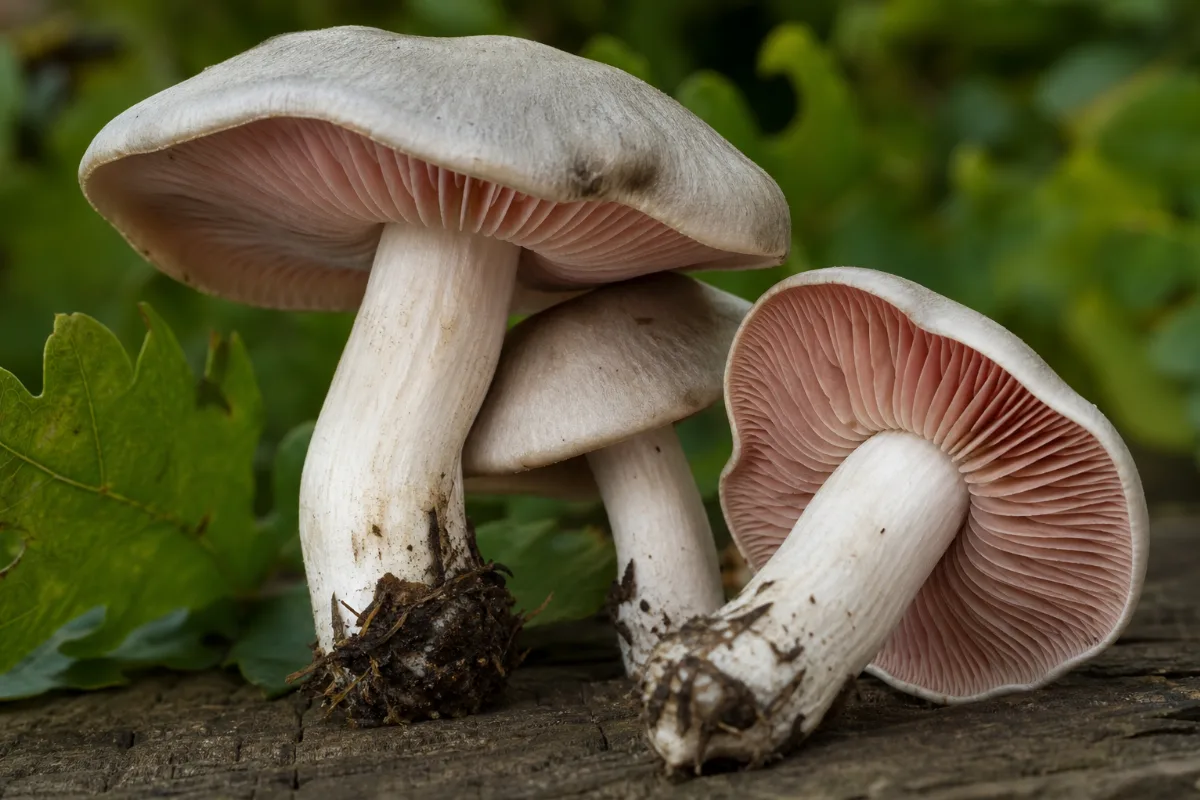
Mushrooms · Poisonous mushroom
Livid pinkgill
Entoloma sinuatum (Entoloma lividum) · also called Leaden entoloma, livid entoloma
The livid pinkgill is a poisonous wild mushroom of Europe and North America. Eating it causes vomiting, diarrhoea and low blood pressure, usually within a few hours, and it is one of the most common causes of mushroom poisoning in parts of Europe. People eat it because it is mistaken for edible mushrooms. If anyone may have eaten a wild mushroom, call a poison centre right away. It has no known health use.
General information, not medical advice. Last substantive update · Not medically reviewed. A named clinician has not signed off on this page. How this page is made
About Livid pinkgill
The livid pinkgill (Entoloma sinuatum, also called Entoloma lividum) is a poisonous wild mushroom of mainland Europe and parts of North America. Poisoning causes vomiting, diarrhoea and low blood pressure, and it is one of the most common causes of mushroom poisoning in the lists we read. It is eaten by mistake for edible mushrooms. It has no known health use, and this page gives no identification help.
How often it poisons people
On the Tuscany Poison Control Centre list for 2007 to 2017, it was behind 153 of 448 cases, more than any other species. In South Sardinia it was the third most frequent toxic species (14 of 164 cases). A nature guide says a high proportion of fungus poisoning cases in Europe come from eating it by mistake. These are counts of poisonings reported to centres and hospitals. They do not say how many people ate it, so they give no rate of illness.
What it is
Entoloma sinuatum is a fungus in the family Entolomataceae. GBIF accepts that name and lists Entoloma lividum as a synonym, which is why both names appear. It was first described in 1788 and has been renamed several times. It is not a plant, not a food and not sold as a supplement. We found no traditional medicinal use.
The toxin and treatment
The toxin is not known. The nature guide says the toxins have not been isolated, and the 2020 review says how these mushrooms do harm is not understood in detail and that no blood or urine test exists. There is no antidote. Treatment, described in the review, is replacing fluids and salts, with anti-sickness medicine if needed, given by clinicians.
What the research shows
The research on this mushroom is about poisoning counts, naming and contamination. No study tests it for a health benefit in people, animals or the lab. One survey in Poland found high mercury in the caps and stalks of this species (together with two others), and a review lists it as an arsenic accumulator. Those are contamination points and do not explain the poisoning.
At a glance
Traditional uses history, not proof
- No traditional medicinal use or food use was found in the sources read. A nature guide calls it very poisonous.
Studied for research
- No health use has been studied. The research is about poisoning, identification and contamination.
Main compounds
- The toxin is not known (not isolated)
- Mercury and arsenic from the soil in some wild specimens
Common forms
- None. Not a food or a supplement, and not safe to eat. Cooking and drying do not remove the toxins of poisonous mushrooms.
Research links: Poison Help (US) · Medical review: Mushroom Poisoning (2020) · South Sardinia poisoning review (2024) · Penn State Extension: mushroom safety · Research Library · Genes & Biomarkers Library
What it is and its history
- Accepted scientific name
- Entoloma sinuatum
- Naming authority
- (Bull.) P.Kumm. (GBIF); a nature guide writes (Pers.) P. Kumm.
- Synonyms
- Entoloma lividum Quel. (a synonym in GBIF; still widely used); Agaricus lividus Bull. (described 1788, per nature guide); Agaricus sinuatus Pers. (1801, per nature guide); Rhodophyllus lividus and Rhodophyllus sinuatus (per nature guide)
- Common names
- Livid pinkgill (English); Leaden entoloma (English); Livid entoloma (English); Lead poisoner (old British name) (English)
- Family or group
- Entolomataceae (a fungus family), not a plant
- Classification
- Fungi > Basidiomycota > Agaricomycetes > Agaricales > Entolomataceae > Entoloma > Entoloma sinuatum
- Native range
- The nature guide says it occurs throughout mainland Europe and in many parts of North America, and is widespread but infrequent in Britain and Ireland.
- Habitat
- Not described here.
- What it looks like
- Fruiting body: Not described here on purpose: this page gives no identification help.
- Cultivation
- None. It is a poisonous wild species.
- Look-alikes and adulterants
- Name: Edible Agaricus mushrooms, the miller (Clitopilus prunulus) and St George's mushroom (Calocybe gambosa); Note: Named by a nature guide as mushrooms it is mistaken for. No identification detail is given here. Do not use any text, photo or app to tell them apart.
- Sustainability and conservation
- Not checked.
Traditional use and history history, not clinical proof
| Tradition or era | Documented use | Source |
|---|---|---|
| Scientific naming (1788 to 1871) | Described by Bulliard in 1788 as Agaricus lividus; validly named Agaricus sinuatus by Persoon in 1801; moved to the genus Entoloma by Kummer in 1871. Its old British name was 'Lead Poisoner', and 'lividum' means leaden. | s-firstnature |
| Medicine and food | No traditional medicinal use and no food use was found. It is described as very poisonous. | s-firstnature |
Traditional use shows how it was used. It does not show that it works or is safe today.
What is inside, and how it may work
What it contains and how those compounds act in cells and animals. Laboratory and animal mechanisms are not proven effects in people.
Main compounds
| Compound | Family | Where it is concentrated | Activity studied | Level of evidence |
|---|---|---|---|---|
| Toxin causing gut illness | unknown | Fruiting body | Not isolated. The nature guide says the toxins have not been isolated; the 2020 review says the mechanism is not understood and no toxin test exists. 7 6 | Clinical observation |
| Mercury | metal | Caps and stalks (wild, Poland) Caps 1,800 to 3,500 ng/g dry weight and stalks 900 to 2,300 ng/g (range for three species together) | Contamination, not a cause of the poisoning. 1 | Compositional |
| Arsenic (arsenite and arsenate forms) | metalloid | Not stated | Listed as an arsenic accumulator in a review (secondary report). 2 | Compositional |
Mechanisms, receptors and pathways
| Target or pathway | Gene or receptor | What was found | Level |
|---|---|---|---|
| Gastrointestinal lining | Not known | The review describes toxins with a local irritant action on the gut lining for this type of poisoning; the detailed mechanism is not understood. 6 | Clinical observation |
Absorption, metabolism and elimination
- Absorption
- Not found.
- Distribution
- Not found.
- Metabolism
- Not found.
- Elimination
- Not found.
- Bioavailability
- Not established.
Isolated compounds versus whole extracts
No compound has been isolated as the cause, so there are no isolated-compound studies.
Nutritional composition
Not a food. No nutrient table exists and none is wanted.
What is Livid pinkgill good for?
There are no health uses to list. No study of this mushroom as a remedy was found, and it is poisonous. The safety tab has what matters.
Benefits, one by one
Each card is a research question, not a promise. Tap a goal to filter. Open a card to see the studies, doses and limits.
Connections to the rest of health
How Livid pinkgill connects to the rest of our health knowledge graph. Every link says what kind of connection it is. A safety link (for example to the liver) is a warning, not a benefit. A study that merely mentions a topic never creates a benefit link.
Explore every connection: goals, body systems, organs, symptoms, genes
B. Body systems
| Connected to | Kind of connection | Evidence status | Context | Studies |
|---|---|---|---|---|
| Digestive System | Adverse effect or risk | Moderate certainty | Vomiting and diarrhoea within hours in poisoning series. Preparation or compound: Wild fruiting body |
6 5 |
E. Health conditions
| Connected to | Kind of connection | Evidence status | Context | Studies |
|---|---|---|---|---|
| Food Poisoning | Adverse effect or risk | Moderate certainty | 153 of 448 Tuscan cases; 14 of 164 Sardinian cases. Preparation or compound: Wild fruiting body |
3 5 |
| Hypotension | Adverse effect or risk | Low certainty | Listed for the gastrointestinal irritant syndrome in a 2020 review. Preparation or compound: Wild fruiting body |
6 |
L. Active compounds
| Connected to | Kind of connection | Evidence status | Context | Studies |
|---|---|---|---|---|
| Toxin causing gut illness | Biological association | Clinical observation | Not isolated. The nature guide says the toxins have not been isolated; the 2020 review says the mechanism is not understood and no toxin test exists. Preparation or compound: Fruiting body |
7 6 |
| Mercury | Biological association | Compositional | Contamination, not a cause of the poisoning. Preparation or compound: Caps and stalks (wild, Poland) |
1 |
| Arsenic (arsenite and arsenate forms) | Biological association | Compositional | Listed as an arsenic accumulator in a review (secondary report). | 2 |
Each connection is stored with the ingredient, the connected record, the kind of connection, the evidence status, the supporting studies, the preparation or compound involved, and a review date (last reviewed October 25, 2026).
The evidence
The research centre for Livid pinkgill. Every record here was checked against PubMed or the publisher's page; we never list a study we have not verified.
Evidence by outcome
Bars show how many studies we found for each outcome, not how well it works. People are added up across trials only (reviews are not added, to avoid double counting).
How we rate evidence
High certainty
Several well-run trials or reviews agree; further research is unlikely to change the picture much.
Moderate certainty
Good trials point the same way, but some doubt remains.
Low certainty
Small, short or inconsistent trials. The finding could change with better research.
Very low certainty
Very little or very weak human data. Treat as a possibility only.
Mixed findings
Trials or reviews disagree with each other.
Not enough evidence
Not enough human research to say either way.
Evidence against
Good research found no benefit, or found harm.
We take the reviewers' own risk-of-bias and GRADE statements where they exist, and otherwise judge from study size, design, consistency, directness and whether a product matches what is sold. Many publications do not make evidence high. Method note: We read the PubMed records and abstracts for 6 papers (1 review of poisoning syndromes, 1 older review abstract, 2 poisoning lists, 1 mercury survey, 1 mineral review), the medical review and the Sardinian and Tuscan papers in full text, a UK nature guide, Penn State Extension and the US Poison Help page, and checked the names in GBIF. Index Fungorum, LiverTox, regulators and poison-centre databases were not searched in depth. Certainty ratings are the compiler's own reading.
Study library: every study we checked 10
| Study | Design | People | Product, dose, length | Result |
|---|---|---|---|---|
| Falandysz 2002 Mercury in mushrooms and soil of the Tarnobrzeska Plain, south-eastern Poland. Journal of Environmental Science and Health Part A · PMID 11929073 · DOI |
Compositional analysis chemistry |
405 405 mushroom samples of 15 species and 221 soil samples, Tarnobrzeska Plain, Poland, collected 1995 |
Livid pinkgill (Entoloma sinuatum) fruiting body, wild fruiting body Not shown here |
Livid Entoloma (E. sinuatum), King Bolete and Red-capped Scaber Stalk had the greatest mercury in caps (1,800 +/- 600 to 3,500 +/- 1,100 ng/g dry weight) and stalks (900 +/- 400 to 2,300 +/- 1,000 ng/g dry weight). Soil under Livid Entoloma held 630 +/- 80 ng/g dry weight, which the abstract calls somewhat elevated against 21 to 58 ng/g for other species. The abstract does not give a separate value for livid pinkgill. Range given for three species together Methods, limits and fundingOutcomes: Mercury in fruiting bodies and soil Limitations: One area of Poland in one year; the abstract gives ranges for three species, not a single figure for this one. Contamination point only: it does not explain the poisoning. Funding and conflicts: Research support, non-US government Read: abstract |
| Falandysz 2013 Macro and trace mineral constituents and radionuclides in mushrooms: health benefits and risks. Applied Microbiology and Biotechnology · PMID 23179616 · DOI |
Narrative review chemistry |
Review of mineral and radionuclide data in mushrooms | Livid pinkgill (Entoloma sinuatum) fruiting body, wild fruiting body Not shown here |
Only one passage was read in the full text: the review lists Entoloma lividum among mushrooms that bioaccumulate arsenic (citing Byrne and colleagues, 1995) and says its major arsenic forms are arsenite and arsenate. No amounts for this species were read. Qualitative statement Methods, limits and fundingOutcomes: Arsenic accumulation by species Limitations: Secondary review, only the arsenic passage was read. The abstract does not mention this species. Funding and conflicts: Research support, non-US government Read: full text (one passage) |
| Giusti 2021 Building of an Internal Transcribed Spacer (ITS) Gene Dataset to Support the Italian Health Service in Mushroom Identification. Foods (Basel) · PMID 34070525 · DOI |
Database study |
448 448 poisoning cases on the Tuscany Poison Control Centre list, 2007 to 2017 |
Livid pinkgill (Entoloma sinuatum) fruiting body, wild fruiting body Not shown here |
Table 1 lists 153 of the 448 cases (about 34%) as livid pinkgill (Entoloma sinuatum), the most of any species, ahead of Omphalotus olearius (135) and Clitocybe nebularis (22). The authors write that at national level in Italy the largest number of poisonings are also caused by E. sinuatum, O. olearius and C. nebularis, and that many of these species are also often involved in poisonings in other EU countries. Read in the full text on Europe PMC. 153 of 448 cases Methods, limits and fundingOutcomes: Species involved in poisoning cases Limitations: The paper is about a DNA reference dataset; the case list is background. The list holds cases reported to one regional poison centre, not all poisonings. The abstract does not mention these figures. Funding and conflicts: Funding not read Read: full text |
| Kohn 1997 [Mushroom poisoning--classification, symptoms and therapy]. Vnitrni Lekarstvi · PMID 9601842 |
Narrative review |
Review of mushroom poisoning types | Livid pinkgill (Entoloma sinuatum) fruiting body, wild fruiting body Not shown here |
The abstract says the gastroenteric type of mushroom poisoning is the one most frequently met and is caused by many species, naming Boletus satanas and Entoloma sinuatum as examples. Qualitative statement Methods, limits and fundingOutcomes: Classification of poisonings Limitations: Short abstract of a 1997 Czech-language review; no figures for this species. Funding and conflicts: Funding not stated in the abstract Read: abstract |
| La Rosa 2024 Epidemiology and clinical aspect of mushroom poisonings in South Sardinia: A 10-year retrospective analysis (2011-2021). Food Science & Nutrition · PMID 38268883 · DOI |
Retrospective case series |
164 164 mushroom poisoning cases recorded by Mycological Inspectorates in South Sardinia, 2011 to 2021 |
Livid pinkgill (Entoloma sinuatum) fruiting body, wild fruiting body Not shown here |
Livid pinkgill (Entoloma sinuatum) was listed as toxic, with 14 of the 164 cases (about 8.5%), the third most frequent toxic species after Omphalotus olearius (18) and Agaricus xanthodermus (15). Symptoms listed: diarrhoea, headache, nausea, stomach ache, sweating, tremor, vertigo and vomiting. The mean delay was 1 hour and the mean hospital stay 1 day. Read from Table 3 of the full text. 14 of 164 cases Methods, limits and fundingOutcomes: Species, symptoms, delay of symptoms, hospital stay Limitations: Small numbers. The table lists the symptoms of the species together, not per person. It does not say how many people ate the mushroom, so it gives no rate of illness. Funding not read. Funding and conflicts: Funding not read Read: full text |
| Wennig 2020 Mushroom Poisoning. Deutsches Arzteblatt International · PMID 33559585 · DOI |
Narrative review |
Review of mushroom poisoning syndromes in Europe (German data 2000-2018: 4,412 hospitalisations and 22 deaths from mushroom toxicity) | Livid pinkgill (Entoloma sinuatum) fruiting body, wild fruiting body Not shown here |
The review lists livid pinkgill (Entoloma sinuatum) first among the species behind the gastrointestinal irritant syndrome. For that syndrome it gives a delay of 30 minutes to 4 (up to 6) hours, toxins that irritate the lining of the gut, mechanisms not understood in detail, symptoms of vomiting, diarrhoea and low blood pressure, treatment with fluid and salt replacement and anti-sickness medicine if needed, and toxins unknown with no blood or urine test. It advises hospital observation for at least 36 hours for people who have eaten what were probably poisonous mushrooms, and that other diners are checked too. It says short-delay syndromes usually have a relatively harmless course and that the diagnosis is made from symptoms, delay and a careful history with a mushroom expert's help. Table and text read in full on PMC. Syndrome-level description, not a measurement for this species alone Methods, limits and fundingOutcomes: Poisoning syndromes, symptoms, delay, treatment, diagnosis Limitations: The syndrome table covers a group of species, so symptoms and delay are for the group, not only livid pinkgill. The review is mostly about German and wider European data. Funding and conflicts: No conflict of interest statement read Read: full text |
| n/a 2026 Entoloma sinuatum (Livid Pinkgill) First Nature · Source |
Guide n/a |
n/a | Livid pinkgill (Entoloma sinuatum) fruiting body, wild fruiting body Not shown here |
A UK nature guide calls it a large and very poisonous species, widespread but infrequent in Britain and Ireland, occurring throughout mainland Europe and in many parts of North America. It says the toxins causing severe stomach pain, sickness and diarrhoea have not been isolated, that the effects can be long lasting and that at least one fatality has been attributed to eating it. It says a high proportion of fungus poisoning cases in Europe are attributed to eating it by mistake, and names an edible Agaricus mushroom, the miller (Clitopilus prunulus) and St George's mushroom (Calocybe gambosa) as mushrooms it is mistaken for. It also gives the naming history: described by Bulliard in 1788 as Agaricus lividus, validly named Agaricus sinuatus by Persoon in 1801, moved to Entoloma by Kummer in 1871, and once called the 'Lead Poisoner' in Britain. The guide's identification section is not used here. Methods, limits and fundingOutcomes: n/a Limitations: A nature guide, not a clinical source. The fatality is not described in detail. Undated page, read 2026-10-25. Funding and conflicts: Not a funded study; First Nature Read: full text |
| n/a 2026 Preparing and Preserving Mushrooms Penn State Extension · Source |
Authoritative guidance n/a |
n/a | Livid pinkgill (Entoloma sinuatum) fruiting body, wild fruiting body Not shown here |
The page says only an expert can tell poisonous from edible mushrooms, that non-experts should not forage, and that no matter how much you cook or dry mushrooms you will not destroy their toxins. Methods, limits and fundingOutcomes: n/a Limitations: A general statement about poisonous mushrooms, not a study of this species. Page read 2026-10-25. Funding and conflicts: Not a funded study; Penn State Extension Read: full text |
| n/a 2026 Poison Help America's Poison Centers (HRSA / CDC / FDA partners) · Source |
Authoritative guidance n/a |
n/a | Livid pinkgill (Entoloma sinuatum) fruiting body, wild fruiting body Not shown here |
The US Poison Help line is 1-800-222-1222, free, confidential and open 24 hours. The page says to call 911 if someone has collapsed, had a seizure, has trouble breathing or cannot be awakened. Methods, limits and fundingOutcomes: n/a Limitations: US service; the page does not mention mushrooms. People elsewhere should use their own poison centre or emergency number. Funding and conflicts: Not a funded study; America's Poison Centers (HRSA / CDC / FDA partners) Read: full text |
| n/a 2026 GBIF Backbone Taxonomy: Entoloma sinuatum GBIF · Source |
Taxonomy record n/a |
n/a | Livid pinkgill (Entoloma sinuatum) fruiting body, wild fruiting body Not shown here |
GBIF accepts Entoloma sinuatum (Bull.) P.Kumm. (key 2539308), family Entolomataceae, order Agaricales, class Agaricomycetes, phylum Basidiomycota. Entoloma lividum Quel. (key 2539312) is a synonym of it. API checked 2026-10-25. Methods, limits and fundingOutcomes: n/a Limitations: GBIF is a database, not a mycological authority; Index Fungorum was not checked. A nature guide writes the authority as (Pers.) P. Kumm., which differs from GBIF. Funding and conflicts: Not a funded study; GBIF Read: full text |
What we do not know yet
- No study of any health use for this mushroom.
- The toxin is not known, and nothing says how much it takes to poison someone.
- No rate of illness among people who ate it, and no death rate.
- No data for children, pregnancy, older people, alcohol or medicines.
- No regulator statement was found.
How new research is added
New studies are found by a saved PubMed search and placed in a review queue. A person reads each one before it changes any evidence rating or safety wording.
Lab markers
What changed in blood or saliva tests during trials. A changed number is not the same as feeling or being healthier, and we give no "normal ranges".
Safety
What studies and official sources say about side effects, medicines and who should check first. Each point shows what kind of evidence it comes from.
Main points to know 6
- Eating it poisons people: vomiting, diarrhoea and low blood pressure. A 2020 European medical review lists the livid pinkgill first among the mushrooms behind the gastrointestinal irritant syndrome: vomiting, diarrhoea and low blood pressure, starting about 30 minutes to 4 hours (up to 6) after the meal. In 14 poisoning cases in South Sardinia the symptoms also included headache, stomach ache, sweating, tremor and vertigo, with a mean delay of 1 hour and a mean hospital stay of 1 day. A nature guide says the effects can be long lasting. Case series 6 5 7
- It is one of the most common causes of mushroom poisoning in parts of Europe. On the Tuscany Poison Control Centre list for 2007 to 2017 it was behind 153 of 448 cases, more than any other species. In South Sardinia it was the third most frequent toxic species (14 of 164 cases). A nature guide says a high proportion of fungus poisoning cases in Europe come from eating it by mistake. These counts come from poison centre and hospital lists, so they show how often it is involved, not how many people ate it. Case series 3 5 7 4
- It is mistaken for edible mushrooms, so no identification help is given here. A nature guide says inexperienced collectors confuse it with edible mushrooms, naming an edible Agaricus, the miller and St George's mushroom. Penn State Extension says only an expert can tell poisonous from edible mushrooms and that non-experts should not forage. Do not try to identify wild mushrooms from words, photos or apps. Guide 7 8
- Cooking and drying do not make a poisonous mushroom safe. Penn State Extension says no matter how much you cook or dry mushrooms you will not destroy their toxins. No study of cooking this species was found. Guide 8
- The toxin is not known and there is no antidote or test. The nature guide says the toxins have not been isolated. The medical review says the mechanisms are not understood in detail, there is no toxin analysis of blood or urine, and treatment is replacing fluids and salts, with anti-sickness medicine if needed. That is care given by clinicians, not something to do at home. The review advises hospital observation for at least 36 hours after a possible poisonous mushroom meal, because the first signs can be mistaken for a mild illness. Review 6 7
- Death has been reported, but no rate was found. The nature guide says at least one fatality has been attributed to eating it. The medical review says short-delay gut syndromes usually have a relatively harmless course. No case-fatality figure for this species was found, so do not assume a mild outcome. Guide 7 6
Side effects 5
| Effect | How often | Severity and recovery | Evidence |
|---|---|---|---|
| Vomiting Starts within about 30 minutes to 4 (up to 6) hours. | Listed for the syndrome and for the 14 Sardinian cases; no rate among people who ate it. | moderate to severe Mean hospital stay 1 day in the Sardinian cases; the nature guide says effects can be long lasting | Case series 6 5 7 |
| Diarrhoea Fluid loss can cause dehydration. | Same sources. | moderate to severe As above | Case series 6 5 |
| Low blood pressure Syndrome-level symptom. | Listed for the gastrointestinal irritant syndrome in the review; not broken down for this species. | moderate to severe Not described | Review 6 |
| Headache, stomach ache, sweating, tremor and vertigo The table lists symptoms for the species as a group of cases. | Listed among the symptoms of the 14 Sardinian cases; counts per symptom not given for this species. | moderate Mean hospital stay 1 day | Case series 5 |
| Death Not described in detail in the guide. | At least one fatality attributed by a nature guide; no rate found. | severe Not reversible | Guide 7 |
Liver
No liver or kidney injury report for livid pinkgill was found in the sources read. The medical review classes its poisoning with the short-delay gut syndromes, not with the organ-damaging ones. LiverTox was not searched for this species. 6
How often. No data.
Monitoring. No monitoring advice specific to this species was read. The review advises hospital observation for at least 36 hours after a possible poisonous mushroom meal.
This is a safety connection. It is not evidence that Livid pinkgill supports liver health.
Medicines and supplements 3
| With | Why it matters | Importance | Evidence | What to do |
|---|---|---|---|---|
| Alcohol substance | Not known | No source on alcohol and this mushroom was found. | Gap Not enough evidence | Do not read the lack of a warning as safety. |
| Prescription medicines (any) prescription | Not studied | No interaction study was found. Vomiting, diarrhoea and low blood pressure could upset the absorption or effect of regular medicines, for example for blood pressure, heart, kidney or diabetes. This is reasoning, not a study result. | Theoretical Not enough evidence 6 | Tell the poison centre and the clinicians about every medicine taken. |
| Herbal products and supplements herb | Not studied | No data were found. | Gap Not enough evidence | Tell the poison centre about every product taken. |
Who should check first 3
| Situation | Advice | Evidence |
|---|---|---|
| Everyone | Do not eat it. It is not a food and not a supplement. | Case series 6 5 3 |
| Anyone unsure what wild mushroom they have | Do not eat wild mushrooms you cannot have identified in person by an expert. | Guide 8 7 |
| Pregnancy, breastfeeding, children, older people, people with weakened immunity, kidney, heart or liver disease | No data were found for this species in these groups. The medical review notes that mushroom intolerance can arise in immunosuppressed patients, young children, pregnant women and older persons, and fluid loss is more dangerous in them. Call the poison centre at once after any possible exposure. | Review 6 |
Overdose, product quality and regulators
Summary. Toxin not known. The nature guide says the toxins have not been isolated; the review says their mechanism is not understood and no toxin analysis is available.
Animal. No animal toxicity study was found.
High dose or long term signals. Not studied.
Overdose response. Treatment is for clinicians: the review describes fluid and salt replacement, with anti-sickness medicine if needed, and no antidote. Call a poison centre or emergency number right away.
Genotoxicity. Not read.
Toxic or hazardous parts. Fungus: the fruiting body. Cooking and drying do not destroy the toxins of poisonous mushrooms (Penn State Extension).
Wild specimens can carry metals from the soil. This is a side point: it does not explain the poisoning.
Mercury. In one survey of south-eastern Poland (collected 1995), livid pinkgill, king bolete and red-capped scaber stalk had the highest mercury in caps (1,800 to 3,500 ng/g dry weight) and stalks (900 to 2,300 ng/g dry weight). Soil under livid pinkgill held 630 ng/g, called somewhat elevated. The abstract gives ranges for the three species together. 1
Arsenic. A 2013 review lists Entoloma lividum among mushrooms that accumulate arsenic and says its major arsenic forms are arsenite and arsenate (citing earlier work). Only that passage was read; no amounts were read. 2
| Body | Action | Date |
|---|---|---|
| America's Poison Centers (Poison Help) (United States) | Gives the free emergency line 1-800-222-1222 for any poisoning. The page does not mention mushrooms or this species. source | 2026-10-25 |
When to get medical help
- Anyone who may have eaten this or any wild mushroom they were unsure of: call Poison Help (1-800-222-1222 in the US) or your local poison centre or emergency number right away. Do not wait for symptoms, and keep a sample of the mushroom.
- Anyone who has collapsed, had a seizure, has trouble breathing or cannot be woken: call emergency services at once (911 in the US)
- Vomiting or diarrhoea that does not stop, or signs of dehydration (dizziness, very little urine, dry mouth)
- Faintness or a very low blood pressure feeling when standing
- Severe stomach pain, confusion, tremor, severe headache or heavy sweating
- Anyone who shared the same mushroom meal, even without symptoms: the medical review says other diners should be examined too
If someone may be poisoned or in a crisis, contact a clinician or emergency service straight away. In the US, Poison Control is 1-800-222-1222.
General information only, not medical advice. Ask a clinician or pharmacist before use, especially with medicines, in pregnancy or with a health condition. See the Natural Remedy Safety guide.
Frequently asked questions
What is the livid pinkgill?
Is the livid pinkgill poisonous?
What symptoms does it cause, and how fast?
The review gives vomiting, diarrhoea and low blood pressure, starting about 30 minutes to 4 hours (up to 6) after the meal. In 14 South Sardinian cases the symptoms also included headache, stomach ache, sweating, tremor and vertigo, starting after a mean of 1 hour, with a mean hospital stay of 1 day.
What should I do if someone has eaten one?
Does cooking or drying make it safe?
No. Penn State Extension says that no matter how much you cook or dry mushrooms, you will not destroy their toxins. No study of cooking this species was found.
How common are poisonings from it?
Why do people eat it by mistake?
A nature guide says it is mistaken for edible mushrooms, naming an edible Agaricus, the miller and St George's mushroom. This page gives no identification help, because wild mushrooms should not be identified from words, photos or apps. Penn State Extension says only an expert can tell poisonous from edible mushrooms.
What is the toxin, and is there an antidote?
Has it killed anyone?
A nature guide says at least one death has been attributed to it, without details. We found no death rate. The review says short-delay gut poisonings usually have a relatively harmless course, but it also advises hospital observation for at least 36 hours after a possible poisonous mushroom meal.
Does it have any health use?
No. We found no study of it for any health use, no supplement and no traditional medicinal use. Please do not treat it as a remedy.
Is it riskier for children, older people or pregnant women?
No data for this species were found. A medical review notes that mushroom intolerance can arise in immunosuppressed patients, young children, pregnant women and older persons, and fluid loss from vomiting and diarrhoea is more dangerous for them. Call a poison centre after any possible exposure.
Explore by health goal
Editorial transparency
- Written by
- AlternativeMed editorial team. Research compiled with AI assistance, then checked against PubMed records.
- Medical review
- None. This page has not been reviewed by a physician or pharmacist.
- First published
- 2026-10-25
- Last substantive update
- 2026-10-25
- How we research
- We read the PubMed records and abstracts for 6 papers (1 review of poisoning syndromes, 1 older review abstract, 2 poisoning lists, 1 mercury survey, 1 mineral review), the medical review and the Sardinian and Tuscan papers in full text, a UK nature guide, Penn State Extension and the US Poison Help page, and checked the names in GBIF. Index Fungorum, LiverTox, regulators and poison-centre databases were not searched in depth. Certainty ratings are the compiler's own reading.
- How we rate evidence
- See "How we rate evidence" in the Evidence tab.
- Independence
- No product is promoted on this page. No affiliate links are shown. This page is information, not a recommendation to eat this mushroom.
Sources 10
Each source was opened and checked. Where we read only the abstract, it says so. The small numbers in the text point here.
- Falandysz J. Mercury in mushrooms and soil of the Tarnobrzeska Plain, south-eastern Poland.. Journal of Environmental Science and Health Part A. 2002. PMID 11929073. DOI 10.1081/ese-120002833. (abstract)
- Falandysz J, Borovicka J. Macro and trace mineral constituents and radionuclides in mushrooms: health benefits and risks.. Applied Microbiology and Biotechnology. 2013. PMID 23179616. DOI 10.1007/s00253-012-4552-8. (full text (one passage))
- Giusti A, Ricci E, Gasperetti L, Galgani M, Polidori L, Verdigi F, Narducci R, Armani A. Building of an Internal Transcribed Spacer (ITS) Gene Dataset to Support the Italian Health Service in Mushroom Identification.. Foods (Basel). 2021. PMID 34070525. DOI 10.3390/foods10061193. (full text)
- Kohn R, Mot'ovska Z. [Mushroom poisoning--classification, symptoms and therapy].. Vnitrni Lekarstvi. 1997. PMID 9601842. (abstract)
- La Rosa L, Corrias S, Pintor I, Cosentino S. Epidemiology and clinical aspect of mushroom poisonings in South Sardinia: A 10-year retrospective analysis (2011-2021).. Food Science & Nutrition. 2024. PMID 38268883. DOI 10.1002/fsn3.3793. (full text)
- Wennig R, Eyer F, Schaper A, Zilker T, Andresen-Streichert H. Mushroom Poisoning.. Deutsches Arzteblatt International. 2020. PMID 33559585. DOI 10.3238/arztebl.2020.0701. (full text)
- n/a. Entoloma sinuatum (Livid Pinkgill). First Nature. 2026. (full text)
- n/a. Preparing and Preserving Mushrooms. Penn State Extension. 2026. (full text)
- n/a. Poison Help. America's Poison Centers (HRSA / CDC / FDA partners). 2026. (full text)
- n/a. GBIF Backbone Taxonomy: Entoloma sinuatum. GBIF. 2026. (full text)


