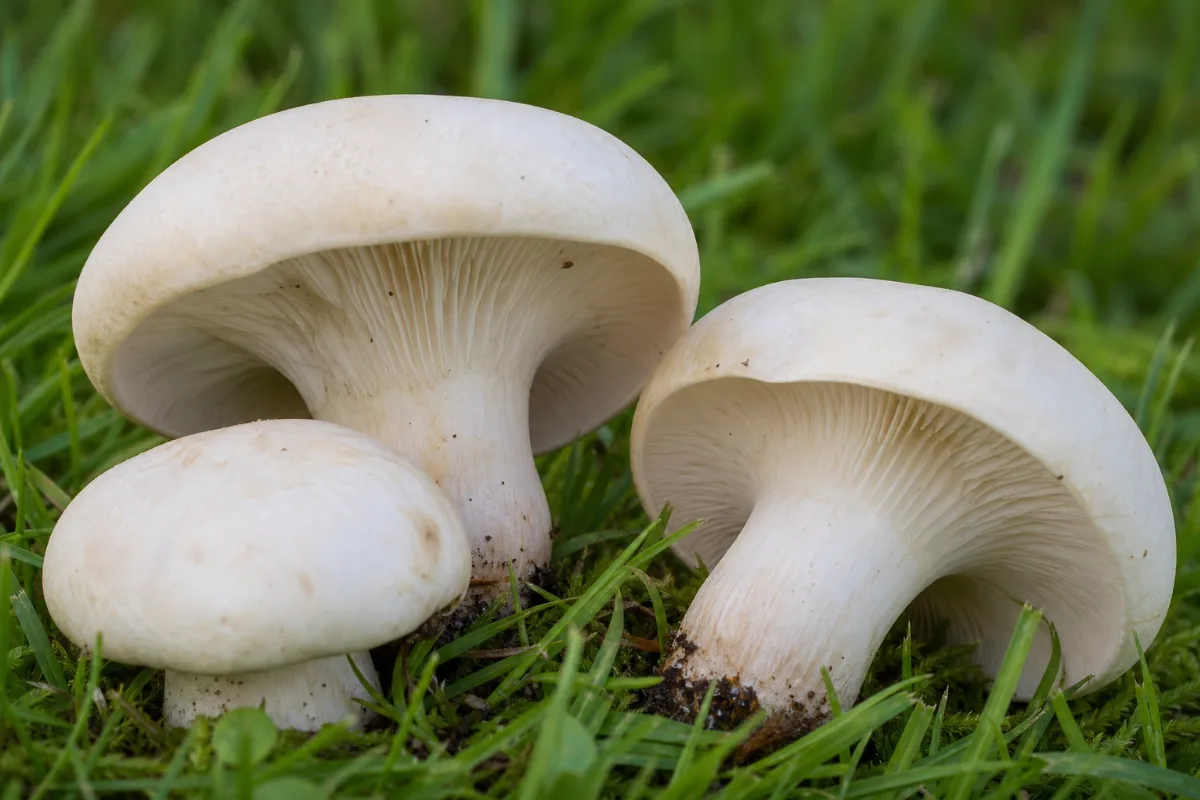
Mushrooms · Wild culinary mushroom
St George's Mushroom
Calocybe gambosa · also called Spring mushroom, Maipilz, marzolino, Tricholoma gambosum (older name)
St George's mushroom is a pale wild mushroom eaten in spring, especially in parts of Europe. It is a food, not a proven remedy: we found no human trial of it for any health outcome, and the lab findings are only early ideas. The most serious caution is mistaken identity. Sources say very poisonous mushrooms, including the livid pinkgill and the muscarine-containing fool's funnel, can be confused with it. A shop study in Spain also found Listeria on fresh samples.
General information, not medical advice. Last substantive update · Not medically reviewed. A named clinician has not signed off on this page. How this page is made
About St George's Mushroom
St George's mushroom is a wild spring mushroom eaten for its flavour. There is no human research on health benefits. The real concerns are poisonous look-alikes, Listeria on fresh mushrooms, and where it grew. Safety information for medicines and pregnancy is missing, not reassuring.
What it is
St George's mushroom is Calocybe gambosa (GBIF accepted name, family Lyophyllaceae). The older name Tricholoma gambosum is a synonym of the same fungus. It is picked wild in spring. A nature guide says it often returns to the same spot for years and sometimes grows in rings.
A 2025 field and lab study describes its fairy rings: a zone of dead vegetation followed by a greener belt. That is about grass and the fungus underground, not about eating it.
What research has tested
We found no trial in which people ate or took St George's mushroom and a health outcome was measured. The research is about composition and the lab. A Serbian analysis of dried wild mushrooms reported carbohydrate, protein, low fat, trehalose, a little vitamin E and several organic acids, plus antioxidant and moderate antimicrobial activity in the lab.
A separate chemistry paper described a beta-type glucan from the fruiting body. These results are ideas for future research. They are not evidence that the mushroom prevents or treats any condition.
Bacteria, metals and oxalic acid
In 402 fresh mushroom samples of 22 species sold in Zaragoza, Spain, Listeria monocytogenes was found in 6.5 percent overall and in 40 percent of the St George's mushroom samples tested. The abstract does not say how many of those samples there were, so the figure may rest on very few. Listeria matters most in pregnancy and for people with weak immunity.
A Czech orchard study measured 18 elements in five mushroom species including this one. Its authors expect no pronounced health effect from occasional eating if mushrooms are not the main part of the diet, but the abstract gives no separate figures for this species. A nature guide warns against picking from busy roadside verges. The Serbian analysis found oxalic acid at 2.8 g per 100 g dry weight, which matters mainly to people told to limit oxalate.
Raw or cooked
A nature guide calls the species reputed to be safe even uncooked, while its author always cooks it. A German poisoning review says raw, spoiled or inadequately cooked mushrooms in general can cause stomach and gut illness. We found no safety study of this species eaten raw, so this page does not advise it.
Rules and official statements
We did not find or read a statement specific to St George's mushroom from the European Food Safety Authority, the US Food and Drug Administration, the European Medicines Agency, NCCIH, LiverTox or LactMed, and we found no USDA food record. Absence of a statement is not a safety guarantee.
At a glance
Traditional uses history, not proof
- A 2025 paper calls it an edible mushroom highly appreciated especially in Italy (Graziosi 2025).
- A nature guide says it is usually one of the first large edible fungi of the year, called Maipilz (May mushroom) in Germany and marzolino (March) in Italy (First Nature).
Studied for research
- Nutrition as a food: mostly carbohydrate and protein, low fat, in one analysis of dried Serbian mushrooms (no health effect shown), insufficient
- Antioxidant activity in four test-tube assays, insufficient
- Moderate germ-killing activity of a methanol extract in the lab, insufficient
- Beta-glucan structure (chemistry only), insufficient
Main compounds
- Carbohydrate, protein and little fat (72, 16 and 1.5 g per 100 g dry weight in one analysis)
- A beta-type glucan polysaccharide, described structurally only
- Organic acids including oxalic acid (2.8 g per 100 g dry weight) and malic acid (11.3 g)
- Ergosterol (3.3 to 4.0 mg per g dry matter in a group that included this species)
Common forms
- Fresh mushroom, cooked
- Dried mushroom (the form analysed in the Serbian study)
- Dried flakes used in a cookie taste test
- Extracts used in laboratory research
Research links: Entoloma sinuatum (Livid Pinkgill), nature guide · Clitocybe rivulosa (Fool's Funnel), nature guide · Muscarine released from a precursor in Clitocybe rivulosa (abstract) · Muscarine poisoning case report, Hong Kong (abstract) · Listeria in fresh wild and cultivated mushrooms, Spain (abstract) · Mushroom poisoning, German review (abstract) · Nutritional and biological potential of Calocybe gambosa, Serbia (abstract page) · Research Library · Genes & Biomarkers Library
What it is and its history
- Accepted scientific name
- Calocybe gambosa
- Naming authority
- (Fr.) Donk (GBIF)
- Synonyms
- Tricholoma gambosum (Fr.) P.Kumm.
- Common names
- St George's mushroom (English); Spring mushroom (English); Maipilz (May mushroom) (German); Marzolino (Italian)
- Family or group
- Lyophyllaceae (a fungus family), not a plant. A nature guide notes some authorities place Calocybe in the Tricholomataceae.
- Classification
- Fungi > Basidiomycota > Agaricomycetes > Agaricales > Lyophyllaceae > Calocybe > Calocybe gambosa
- Native range
- Not checked in a paper. A nature guide says it is found throughout Europe and in North America.
- Habitat
- A nature guide says it usually appears in spring, often recurs in the same place for years, and sometimes forms fairy rings; some authorities consider it mycorrhizal while others link ring growth to a saprophytic habit. A 2025 field and lab study describes it forming fairy rings with a dead-vegetation front followed by a greener belt.
- What it looks like
- Fruiting body: No identification description is given here by design.
- Cultivation
- Not checked in the sources read. Our existing summary treats it as a wild-picked mushroom.
- Harvest and processing
- Sources read mention cooking, and a taste test of cookies made with dried flakes. No other processing was read.
- Look-alikes and adulterants
- Name: Livid pinkgill (Entoloma sinuatum); Note: A nature guide says it is very poisonous, can be confused with St George's mushroom by inexperienced collectors, and causes severe stomach pains, sickness and diarrhoea (First Nature).; Name: Fool's funnel (Clitocybe rivulosa, treated with C. dealbata); Note: The same guide says it often grows in fairy rings, contains muscarine and is deadly poisonous (First Nature). A 2024 paper says muscarine-producing mushrooms can cause circulatory collapse or death.; Name: Inocybe erubescens; Note: The First Nature page for St George's mushroom names it as a deadly poisonous possible confusion. We did not check the current accepted name of this fungus.
- Sustainability and conservation
- Not checked.
Traditional use and history history, not clinical proof
| Tradition or era | Documented use | Source |
|---|---|---|
| Spring food in Europe | A nature guide says the common name relates to St George's Day and that the mushroom is usually among the first large edible fungi of the year; German and Italian names refer to May and March. The reason for the name is stated without a dated source. | s-firstnature-calocybe |
| Italy | A 2025 paper describes it as an edible mushroom highly appreciated especially in Italy. | p41012036 |
| Naming | A nature guide says Linnaeus named it Agaricus georgii in 1753, Fries described it as Agaricus gambosus in 1821, Kummer moved it to Tricholoma, and Donk reclassified it as Calocybe. Not checked in Index Fungorum. | s-firstnature-calocybe |
Traditional use shows how it was used. It does not show that it works or is safe today.
What is inside, and how it may work
What it contains and how those compounds act in cells and animals. Laboratory and animal mechanisms are not proven effects in people.
Main compounds
| Compound | Family | Where it is concentrated | Activity studied | Level of evidence |
|---|---|---|---|---|
| Carbohydrate, protein and fat (macronutrients) | nutrient | Fruiting body Per 100 g dry weight: carbohydrate 72 g, protein 16 g, fat 1.5 g (Petrovic 2022). | Food composition. 8 | Other |
| Beta-type glucan polysaccharide | polysaccharide | Fruiting body Not given in the abstract. | Structure only: 145 kDa, (1->4),(1->6)-linked, 4 percent branching, triple-strand helix. 11 | Other |
| Ergosterol | sterol | Fruiting body 3.3 to 4.0 mg per g dry matter for a group of species that included C. gambosa (Villares 2014). | Content measurement only. 12 | Other |
| Organic acids including oxalic and malic acid | organic acid | Fruiting body Per 100 g dry weight: oxalic 2.8 g, quinic 1.45 g, malic 11.3 g, citric 1.3 g, fumaric 0.08 g (Petrovic 2022). | Oxalic acid matters to people limiting oxalate. 8 | Other |
| Trehalose, mannitol and alpha-tocopherol | sugars and vitamin E form | Fruiting body Per 100 g dry weight: trehalose 3.82 g, mannitol 0.22 g, alpha-tocopherol 7.8 micrograms (Petrovic 2022). | Food composition. 8 | Other |
Mechanisms, receptors and pathways
| Target or pathway | Gene or receptor | What was found | Level |
|---|---|---|---|
| Antioxidant assays (test tube) | Not applicable | Four chemical assays suggested antioxidant capacity of an extract; no numbers in the abstract. 8 | Laboratory research |
| Bacterial cell-to-cell communication (lab model) | Pseudomonas aeruginosa PAO1 model system | At a sub-inhibitory level a methanol extract disrupted bacterial cell-to-cell communication. 8 | Laboratory research |
| Fairy-ring ecology (plants, not people) | Plant roots and shoots | In the lab the mycelium acted as a root pathogen on grass while its volatile compounds stimulated shoot growth. 7 | Laboratory research |
Absorption, metabolism and elimination
- Absorption
- Not found in the sources read.
- Distribution
- Not found.
- Metabolism
- Not found.
- Elimination
- Not found.
- Bioavailability
- Not established in people.
Isolated compounds versus whole extracts
The glucan and extract findings come from isolated polysaccharides and methanol extracts. Eating the cooked mushroom is not the same thing, and no human trial tested either.
Nutritional composition
Petrovic 2022, wild-grown in Serbia, per 100 g dry weight: carbohydrate 72 g, protein 16 g, fat 1.5 g. Fresh mushrooms contain much more water. No USDA record was found. These are food composition facts, not advice.
6 not enough evidence
What was looked at
The 6 benefits and uses checked for St George's Mushroom, each with how strong the evidence is. Tap one to open it.
- As a food (nutrients)Not enough evidence
- Antioxidant activity in the test tubeNot enough evidence
- Any health effect in peopleNot enough evidence
- Germ-killing activity in the labNot enough evidence
- Beta-glucan polysaccharide (chemistry only)Not enough evidence
- Ergosterol (sterol) contentNot enough evidence
What is St George's Mushroom good for?
What St George's mushroom has been studied for and how strong the evidence is. None of it is proven in people. Read this together with the Safety tab.
Benefits, one by one
Each card is a research question, not a promise. Tap a goal to filter. Open a card to see the studies, doses and limits.
As a food (nutrients)
Not enough evidenceSt George's mushroom is eaten as a seasonal wild food. One laboratory analysis of dried, wild-grown mushrooms from Serbia found mostly carbohydrate and protein with little fat. That describes the food. No trial shows that eating it changes anyone's health.
3 studiesFresh or cooked fruiting body is the food. The Serbian analysis used …
Studies, doses and limits
Results
Petrovic 2022 (dried, wild-grown, Serbia), per 100 g dry weight: carbohydrate 72 g, protein 16 g, fat 1.5 g; trehalose 3.82 g; mannitol 0.22 g; alpha-tocopherol 7.8 micrograms; 24 fatty acids, mostly polyunsaturated. Oxalic acid was 2.8 g per 100 g dry weight (see the Safety tab). Fresh mushrooms contain much more water, so these figures do not describe a serving. No USDA record was found.
Effect sizes as reported
Nutrient values only; no health effect measured
Why this rating
One analysis of one wild sample set, from an abstract page. Composition varies with where and when the mushroom grew. Nothing shows a health benefit from eating it.
Form and dose studied
Fresh or cooked fruiting body is the food. The Serbian analysis used dried fruiting bodies. This page gives no amounts.
Limits
Abstract page only; no water content, site or date in what we read. The same study also reports a taste test of cookies made with C. gambosa flakes, which says nothing about health.
Why researchers looked
It is a prized wild food, so the research mainly asks what is in it.
Traditional use
A 2025 paper calls it an edible mushroom highly appreciated especially in Italy (Graziosi 2025). A nature guide notes that the German name means May mushroom and the Italian name refers to March (First Nature).
Proposed mechanism Other
Not a mechanism claim. The values are laboratory measurements of the food.
A proposed mechanism does not show that the effect happens in people.
Wild-picked mushrooms can be confused with poisonous look-alikes. See the Safety tab first.
Antioxidant activity in the test tube
Not enough evidenceFour test-tube tests suggested that an extract of St George's mushroom has antioxidant activity. This is a laboratory finding. It does not show that eating the mushroom protects cells in a person.
1 studiesLaboratory extract, not a food portion.
Studies, doses and limits
Results
Petrovic 2022: the authors concluded from four antioxidant assays that the mushroom is a promising antioxidant source. The abstract gives no numbers.
Effect sizes as reported
Not given in the abstract
Why this rating
Test-tube work only, no numbers read, no human or animal data.
Form and dose studied
Laboratory extract, not a food portion.
Limits
Abstract page only. Test-tube antioxidant results often do not carry over to people.
Why researchers looked
Antioxidant assays are routinely run on edible mushroom extracts.
Proposed mechanism Laboratory research
The assays measure how well an extract neutralises chemicals in a tube (reducing power, DPPH radical scavenging, beta-carotene/linoleate and TBARS assays).
A proposed mechanism does not show that the effect happens in people.
None specific. See the Safety tab.
Any health effect in people
Not enough evidenceWe searched PubMed for St George's mushroom (Calocybe gambosa and the older name Tricholoma gambosum) and found no trial, in people or in animals, of eating it or taking an extract for any health outcome.
1 studiesNot applicable
Studies, doses and limits
Results
PubMed searches on 2026-10-25 for Calocybe gambosa and Tricholoma gambosum returned chemistry, ecology, taxonomy and food-science papers only.
Why this rating
No human or animal outcome study found.
Limits
Searched by name only; papers not indexed in PubMed may exist.
Why researchers looked
Not studied for a health outcome that we could find.
Proposed mechanism Other
No mechanism has been shown in people.
A proposed mechanism does not show that the effect happens in people.
See the Safety tab.
Germ-killing activity in the lab
Not enough evidenceA methanol extract of St George's mushroom had a moderate germ-killing effect in lab tests. This is a laboratory finding about an extract, not about eating the mushroom.
1 studiesMethanol extract in the lab; not a food or supplement.
Studies, doses and limits
Results
Petrovic 2022: antimicrobial potential was described as moderate; no numbers in the abstract.
Effect sizes as reported
Not given in the abstract
Why this rating
Test-tube work only, no numbers read.
Form and dose studied
Methanol extract in the lab; not a food or supplement.
Limits
Abstract page only. A moderate lab effect does not mean it treats any infection.
Why researchers looked
Antimicrobial screening is common for wild edible mushrooms.
Proposed mechanism Laboratory research
At a level too low to kill the bacteria, the extract disrupted cell-to-cell communication in a Pseudomonas aeruginosa lab model (abstract).
A proposed mechanism does not show that the effect happens in people.
No claims about infection are made here.
Beta-glucan polysaccharide (chemistry only)
Not enough evidenceResearchers isolated a beta-type glucan from the fruiting body and described its structure. It was not tested for any effect on the immune system or health.
1 studiesIsolated polysaccharide, not a food or supplement.
Studies, doses and limits
Results
Villares 2013: three extractions gave the same glucan with a molecular weight of 145 kDa.
Effect sizes as reported
Structure only
Why this rating
Chemistry paper with no biological test.
Form and dose studied
Isolated polysaccharide, not a food or supplement.
Limits
No amount in the mushroom is given in the abstract and no effect was tested.
Why researchers looked
Mushroom beta-glucans are the usual starting point for immune research on mushrooms.
Proposed mechanism Other
None shown. The paper describes structure only: glucose units with (1->4) and (1->6) links, 4 percent branching, beta-type links, a triple-strand helix.
A proposed mechanism does not show that the effect happens in people.
None specific.
Ergosterol (sterol) content
Not enough evidenceA laboratory comparison measured the ergosterol content of several edible mushrooms. St George's mushroom was in the middle range. No study measured what happens in the body after eating it.
1 studiesNot applicable
Studies, doses and limits
Results
Villares 2014: ergosterol 3.3 to 4.0 mg per g dry matter in a group that included Calocybe gambosa, Pleurotus ostreatus, Lentinus edodes and Boletus edulis.
Effect sizes as reported
Content only
Why this rating
Food-chemistry measurement across species; no health outcome.
Limits
The abstract does not give a separate figure for C. gambosa inside the range.
Why researchers looked
Ergosterol is a major sterol in mushrooms and is measured when comparing species.
Proposed mechanism Other
Not a mechanism claim; a content measurement and a test of how storage and UV light change it.
A proposed mechanism does not show that the effect happens in people.
None specific.
Connections to the rest of health
How St George's Mushroom connects to the rest of our health knowledge graph. Every link says what kind of connection it is. A safety link (for example to the liver) is a warning, not a benefit. A study that merely mentions a topic never creates a benefit link.
Explore every connection: goals, body systems, organs, symptoms, genes
A. Wellness goals
| Connected to | Kind of connection | Evidence status | Context | Studies |
|---|---|---|---|---|
| Cellular Protection | Not enough evidence | Antioxidant activity in the test tube: Four test-tube tests suggested that an extract of St George's mushroom has antioxidant activity. This is a laboratory finding. It does not show that eating the mushroom protects cells in a person. | 8 |
B. Body systems
| Connected to | Kind of connection | Evidence status | Context | Studies |
|---|---|---|---|---|
| Digestive System | Biological association | Not enough evidence | Studied for: As a food (nutrients) | 8 3 7 |
| Immune System | Biological association | Not enough evidence | Studied for: Beta-glucan polysaccharide (chemistry only) | 11 |
C. Body parts and organs
| Connected to | Kind of connection | Evidence status | Context | Studies |
|---|---|---|---|---|
| Gut | Adverse effect or risk | Not enough evidence | Severe stomach pain, sickness and diarrhoea after eating it by mistake (nature guide). Preparation or compound: Livid pinkgill (Entoloma sinuatum), a look-alike; not St George's mushroom |
4 |
| Heart | Adverse effect or risk | Not enough evidence | Palpitations and circulatory collapse are described in muscarine poisoning; higher risk with weak heart (nature guide, chemistry paper, case report). Circulatory collapse is described for muscarine-producing mushrooms. Preparation or compound: Fool's funnel (Clitocybe rivulosa), a look-alike containing muscarine; not St George's mushroom |
5 2 1 |
L. Active compounds
| Connected to | Kind of connection | Evidence status | Context | Studies |
|---|---|---|---|---|
| Carbohydrate, protein and fat (macronutrients) | Biological association | Other | Food composition. Preparation or compound: Fruiting body |
8 |
| Beta-type glucan polysaccharide | Biological association | Other | Structure only: 145 kDa, (1->4),(1->6)-linked, 4 percent branching, triple-strand helix. Preparation or compound: Fruiting body |
11 |
| Ergosterol | Biological association | Other | Content measurement only. Preparation or compound: Fruiting body |
12 |
| Organic acids including oxalic and malic acid | Biological association | Other | Oxalic acid matters to people limiting oxalate. Preparation or compound: Fruiting body |
8 |
| Trehalose, mannitol and alpha-tocopherol | Biological association | Other | Food composition. Preparation or compound: Fruiting body |
8 |
Each connection is stored with the ingredient, the connected record, the kind of connection, the evidence status, the supporting studies, the preparation or compound involved, and a review date (last reviewed October 25, 2026).
Evidence at a glance: what the research found for 6 outcomes
Each outcome below is one thing researchers measured. Certainty is how far the evidence can be trusted, not how well it works. The full studies are on the next tab.
The evidence
The research centre for St George's Mushroom. Every record here was checked against PubMed or the publisher's page; we never list a study we have not verified.
Evidence by outcome
Bars show how many studies we found for each outcome, not how well it works. People are added up across trials only (reviews are not added, to avoid double counting).
How we rate evidence
High certainty
Several well-run trials or reviews agree; further research is unlikely to change the picture much.
Moderate certainty
Good trials point the same way, but some doubt remains.
Low certainty
Small, short or inconsistent trials. The finding could change with better research.
Very low certainty
Very little or very weak human data. Treat as a possibility only.
Mixed findings
Trials or reviews disagree with each other.
Not enough evidence
Not enough human research to say either way.
Evidence against
Good research found no benefit, or found harm.
We take the reviewers' own risk-of-bias and GRADE statements where they exist, and otherwise judge from study size, design, consistency, directness and whether a product matches what is sold. Many publications do not make evidence high. Method note: We read PubMed records and abstracts for 8 papers (a Spanish food-microbiology study, a Czech element study, a glucan chemistry paper, a sterol paper, a fairy-ring ecology paper, a muscarine chemistry paper, a muscarine case report and a German poisoning review), plus the journal abstract page of a Serbian composition study, three nature-guide web pages and the GBIF taxonomy record. Index Fungorum, EFSA, FDA, EMA, NCCIH, LiverTox and LactMed were not read. The nature-guide pages are undated and not peer reviewed. Certainty ratings are the compiler's own reading.
Study library: every study we checked 13
| Study | Design | People | Product, dose, length | Result |
|---|---|---|---|---|
| Chan 2023 Cholinergic Mushroom Poisoning With a Detection of Muscarine Toxin in Urine. Journal of Medical Cases · PMID 37435104 · DOI |
Case report |
2 Two middle-aged patients in Hong Kong who ate cooked wild mushrooms |
Wild mushrooms (species not stated) fruiting body |
Both patients had stomach pain, vomiting and diarrhoea, followed by small pupils, palpitations and sweating (a cholinergic picture). Muscarine, found in Inocybe and Clitocybe species, was identified in both patients' urine. One had mildly raised liver enzymes. Illustrates muscarine poisoning from wild mushrooms in general Methods, limits and fundingOutcomes: Symptoms and detection of muscarine Limitations: Two people; the mushroom species is not stated in the abstract and is not shown to be a St George's look-alike. Funding and conflicts: No funding statement read in the abstract record. Read: abstract (PubMed efetch) |
| Dorner 2024 The Fatal Mushroom Neurotoxin Muscarine is Released from a Harmless Phosphorylated Precursor upon Cellular Injury. Angewandte Chemie International Edition · PMID 39432715 · DOI |
Laboratory analysis fungus (look-alike) |
Mycelium of the fool's funnel mushroom Clitocybe rivulosa and other muscarine-producing fungi | Mycelium extract fruiting body |
The abstract says muscarine-producing mushrooms are a severe threat because ingestion can result in circulatory collapse or even death. In C. rivulosa mycelium the main product was 4'-phosphomuscarine, which binds weakly to the muscarinic receptor but can release muscarine when enzymes cut it. The authors say this matters for emergency medicine when estimating how toxic these mushrooms are. Explains why Clitocybe rivulosa is a poisonous look-alike Methods, limits and fundingOutcomes: Chemistry of the toxin muscarine Limitations: Laboratory chemistry. It is not a case series and says nothing about St George's mushroom. Funding and conflicts: No funding statement read in the abstract record. Read: abstract (PubMed efetch) |
| First Nature (nature guide) 2026 Calocybe gambosa, St George's Mushroom first-nature.com, undated page · Source |
Nature guide fungus |
Species page for St George's mushroom | Fruiting body fruiting body |
The page lists synonyms including Tricholoma gambosum and Agaricus georgii, says the Linnaean name dates from 1753 and the current name followed Donk, and places the species in the family Lyophyllaceae (noting some authorities use Tricholomataceae). It says the species could be confused with the deadly poisonous Inocybe erubescens, calls it a good edible species reputed safe even uncooked although the author always cooks it, warns that roadside verge mushrooms may contain pollutants from vehicles, and notes the mushroom usually appears in spring and recurs in the same place for years, sometimes in fairy rings. Naturalist description and opinion; not a study Methods, limits and fundingOutcomes: Names, history, look-alikes and kitchen notes Limitations: Undated web page; not peer reviewed. The "safe uncooked" remark is the page's opinion and conflicts with the general warning about raw mushrooms in the German review, so this page does not advise it. Funding and conflicts: No funding statement; independent website. Read: web page read 2026-10-25 |
| First Nature (nature guide) 2026 Entoloma sinuatum (Livid Pinkgill) first-nature.com, undated page · Source |
Nature guide fungus (look-alike) |
Species page for the livid pinkgill | Fruiting body fruiting body |
The page calls Entoloma sinuatum large and very poisonous and says inexperienced collectors can confuse it with edible mushrooms, naming a late-fruiting St George's mushroom, Calocybe gambosa, among them. It says the toxins causing severe stomach pains, sickness and diarrhoea have not been isolated, that effects can be long lasting, that at least one death has been attributed to it, and that a high proportion of fungus poisoning cases in Europe are attributed to eating it by mistake. Statement by a nature guide, not a peer-reviewed study Methods, limits and fundingOutcomes: Toxicity and confusion with edible mushrooms Limitations: Undated web page by a naturalist; not peer reviewed. Its identification text is deliberately not repeated on this page. Funding and conflicts: No funding statement; independent website. Read: web page read 2026-10-25 |
| First Nature (nature guide) 2026 Clitocybe rivulosa (=Clitocybe dealbata), Fool's Funnel first-nature.com, undated page · Source |
Nature guide fungus (look-alike) |
Species page for the fool's funnel | Fruiting body fruiting body |
The page says these poisonous mushrooms often grow in fairy rings and that anyone gathering fairy ring champignons, St George's mushrooms or other pale edible fairy-ring mushrooms must be very careful. It says they contain muscarine and are deadly poisonous. Symptoms of muscarine poisoning include heavy salivation and sweating within half an hour, then possibly abdominal pain, sickness, diarrhoea, blurred vision and laboured breathing. It says deaths of otherwise healthy people are very rare, but people with a weakened heart or breathing problems are at much more risk. Statement by a nature guide, not a peer-reviewed study Methods, limits and fundingOutcomes: Toxicity and warning to gatherers of St George's mushroom Limitations: Undated web page by a naturalist; not peer reviewed. It treats C. rivulosa and C. dealbata as one species. Its identification text is deliberately not repeated here. Funding and conflicts: No funding statement; independent website. Read: web page read 2026-10-25 |
| GBIF Secretariat 2026 GBIF: Calocybe gambosa (Fr.) Donk GBIF Backbone Taxonomy (API) · Source |
Database record fungus |
n/a | Fruiting body fruiting body |
API match checked 2026-10-25: accepted species, key 8936224, family Lyophyllaceae, order Agaricales, class Agaricomycetes, phylum Basidiomycota, kingdom Fungi, exact match. A second query for Tricholoma gambosum (Fr.) P.Kumm. returned status SYNONYM pointing to the same accepted key 8936224. Entoloma sinuatum (key 2539308, family Entolomataceae) and Clitocybe rivulosa (key 2531052, family Tricholomataceae) are accepted species. Accepted name confirmed; older name is a synonym Methods, limits and fundingOutcomes: Accepted name and rank Limitations: Taxonomy database only. Index Fungorum was not opened. Says nothing about health. Funding and conflicts: n/a Read: database record, checked 2026-10-25 |
| Graziosi 2025 Analysis of Plant-Fungus Interactions in Calocybe gambosa Fairy Rings. Plants (Basel) · PMID 41012036 · DOI |
Field and laboratory fungus |
Three C. gambosa fairy rings in the field, plus mycelium grown with a grass (Poa trivialis) in the lab | Mycelium fruiting body |
The abstract calls C. gambosa an edible mushroom highly appreciated especially in Italy. Plant species composition changed across the ring zones. In the lab the mycelium behaved as a plant pathogen (79 percent shorter roots, 76 percent shorter leaves, root necrosis), while its volatile compounds increased shoot length by 17 percent. Ecology of the fungus; says nothing about eating it Methods, limits and fundingOutcomes: Plant community changes; effect of the mycelium on grass Limitations: About plants and the fungus underground, not about people or food safety. Funding and conflicts: No funding or conflict statement in the abstract record. Read: abstract (PubMed efetch) |
| Petrovic 2022 A Step Forward Towards Exploring Nutritional and Biological Potential of Mushrooms: A Case Study of Calocybe gambosa (Fr.) Donk Wild Growing in Serbia Polish Journal of Food and Nutrition Sciences · Source · DOI |
Laboratory analysis fungus |
Wild-grown Calocybe gambosa fruiting bodies from Serbia, analysed in the laboratory; sensory test of enriched cookies | Fruiting body fruiting body |
Per 100 g dry weight: carbohydrate 72 g, protein 16 g, fat 1.5 g; trehalose 3.82 g, mannitol 0.22 g; alpha-tocopherol 7.8 ug; 24 fatty acids with polyunsaturated ones most common. Organic acids per 100 g dry weight: oxalic 2.8 g, quinic 1.45 g, malic 11.3 g, citric 1.3 g, fumaric 0.08 g. Four antioxidant test-tube assays suggested a promising antioxidant source; antimicrobial activity was moderate. At a level too low to kill bacteria, the methanol extract disrupted cell-to-cell communication in a Pseudomonas aeruginosa lab model. Oatmeal cookies enriched with C. gambosa flakes were praised in a sensory test. Composition and lab activity only; no health outcome in people Methods, limits and fundingOutcomes: Macronutrients, sugars, tocopherol, fatty acids, organic acids, antioxidant and antimicrobial activity, cookie taste test Limitations: Abstract page read; the full text was not opened. Dry-weight figures cannot be turned into amounts in a fresh mushroom without the water content, which the abstract does not give. Antioxidant and antimicrobial results have no numbers in the abstract. Sensory test was a taste test, not a health test. Funding and conflicts: Funded by the Serbian Ministry of Education, Science and Technological Development and by Portuguese national funds (FCT). No company funding stated on the page read. Read: journal abstract page (full text not opened) |
| Sima 2020 The three-year monitoring of 18 elements in five edible mushroom species collected from an old orchard. Journal of Environmental Science and Health, Part B · PMID 31793393 · DOI |
Laboratory analysis fungus |
Five edible species, including Calocybe gambosa, from one orchard in the Czech Republic, 2016 to 2018 | Fruiting body fruiting body |
Calocybe gambosa was one of five species measured. Across species, bioconcentration factors were below 0.05 for aluminium, chromium, iron and lead, and the highest accumulation was seen in Amanita rubescens (for example cadmium 16.2). The authors say that although arsenic, beryllium, cadmium, lead and nickel are toxic, no pronounced health effect is expected if these mushrooms are eaten occasionally and are not the main part of the diet. Occasional eating not expected to harm, in the authors' view Methods, limits and fundingOutcomes: Content of 18 elements in fruiting bodies Limitations: One orchard, three seasons. The abstract gives no separate figures for C. gambosa, and results from one site say little about other sites. Funding and conflicts: No funding or conflict statement in the abstract record. Read: abstract (PubMed efetch) |
| Venturini 2011 Microbiological quality and safety of fresh cultivated and wild mushrooms commercialized in Spain. Food Microbiology · PMID 21925034 · DOI |
Observational fungus (fresh, shop-bought) |
402 402 samples of 22 fresh mushroom species sold in shops in Zaragoza, Spain |
Fruiting body fruiting body |
Listeria monocytogenes was found in 26 samples (6.5 percent). Its occurrence was relatively high in Calocybe gambosa (40 percent), Hygrophorus limacinus (40 percent) and Tuber indicum (100 percent). Salmonella, E. coli O157:H7 and Staphylococcus aureus were not isolated from any sample. The authors suggest ways to reduce bacteria on some fresh mushrooms should be investigated. Listeria found in 40 percent of the C. gambosa samples tested Methods, limits and fundingOutcomes: Microbial counts and food-poisoning bacteria Limitations: The abstract does not say how many C. gambosa samples were tested, so the 40 percent may rest on very few. Shop-bought fresh mushrooms in one Spanish city in one study. Funding and conflicts: No funding or conflict statement in the abstract record. Read: abstract (PubMed efetch) |
| Villares 2013 Polysaccharides from the edible mushroom Calocybe gambosa: structure and chain conformation of a (1->4),(1->6)-linked glucan. Carbohydrate Research · PMID 23711570 · DOI |
Laboratory analysis fungus |
Polysaccharides isolated from C. gambosa fruiting bodies | Isolated polysaccharides fruiting body |
Three polysaccharides were isolated by cold water, hot water and hot sodium hydroxide extraction. All three had a molecular weight of 145 kDa and were the same glucan: glucose units linked (1->4) and (1->6) with 4 percent branching and beta-type links, forming a triple-strand helix with Congo red. Structure described; no biological or health test Methods, limits and fundingOutcomes: Chemical structure of the polysaccharides Limitations: Chemistry only. The abstract gives no amount in the mushroom and tests no effect in cells, animals or people. Funding and conflicts: No funding or conflict statement in the abstract record. Read: abstract (PubMed efetch) |
| Villares 2014 Storage temperature and UV-irradiation influence on the ergosterol content in edible mushrooms. Food Chemistry · PMID 24206714 · DOI |
Laboratory analysis fungus |
Several edible mushroom species, including Calocybe gambosa, analysed by HPLC | Fruiting body fruiting body |
Ergosterol was 3.3 to 4.0 mg per g dry matter in Pleurotus ostreatus, Calocybe gambosa, Lentinus edodes and Boletus edulis, compared with 6.4 to 6.8 in Agaricus bisporus and Hygrophorus marzuolus and 0.2 to 0.4 in Cantharellus cibarius, Lactarius deliciosus and Craterellus cornucopioides. Lower storage temperature (-20 C) and shorter UV time gave less ergosterol oxidation. Ergosterol content measured; no health outcome Methods, limits and fundingOutcomes: Ergosterol content and its oxidation on storage and UV light Limitations: Chemistry across species. The abstract does not give a separate figure for C. gambosa inside the 3.3 to 4.0 range and tests no human outcome. Funding and conflicts: No funding or conflict statement in the abstract record. Read: abstract (PubMed efetch) |
| Wennig 2020 Mushroom Poisoning. Deutsches Arzteblatt International · PMID 33559585 · DOI |
Narrative review review |
Review of mushroom poisoning syndromes, toxins and diagnosis; German hospital data 2000 to 2018 | Fruiting body fruiting body |
Poisoning with a short delay (under 6 hours) usually gives a gastrointestinal syndrome with a relatively harmless course; poisoning with a delay of 6 to 24 hours or more can be life-threatening. German records for 2000 to 2018 list 4412 hospitalisations and 22 deaths from mushroom toxic effects, and 90 percent of the deaths were due to the death cap. Stomach and gut syndromes can also come from microbially spoiled, raw or inadequately cooked mushrooms, or from very large or frequent servings. General mushroom-poisoning picture; not about St George's mushroom Methods, limits and fundingOutcomes: Syndromes by delay before symptoms; hospitalisations and deaths Limitations: Only the abstract was read. It does not mention St George's mushroom. Used only for general points about poisoning and about raw or spoiled mushrooms. Funding and conflicts: No funding statement read in the abstract record. Read: abstract (PMC / PubMed) |
What we do not know yet
- No trial of eating or taking St George's mushroom for any health outcome was found.
- No statement specific to this species from a regulator or poison centre was read.
- The look-alike warnings come from a nature guide and a chemistry paper; no case series of mistaken-identity poisoning was found.
- No study of eating it raw, and no allergy, interaction, pregnancy, breastfeeding or children data were found.
- The Listeria finding does not state how many St George's samples were tested.
How new research is added
New studies are found by a saved PubMed search and placed in a review queue. A person reads each one before it changes any evidence rating or safety wording. New publications never change ratings automatically.
Lab markers
What changed in blood or saliva tests during trials. A changed number is not the same as feeling or being healthier, and we give no "normal ranges".
Safety
What studies and official sources say about side effects, medicines and who should check first. Each point shows what kind of evidence it comes from.
Main points to know 5
- Poisonous look-alikes are the main danger. Sources describe poisonous mushrooms that can be mistaken for St George's mushroom. A nature guide says the livid pinkgill (Entoloma sinuatum) is very poisonous and that inexperienced collectors can confuse it with edible mushrooms, naming St George's mushroom. It says the toxins are not isolated, effects can be long lasting, at least one death has been attributed to it, and a high proportion of fungus poisoning cases in Europe are attributed to eating it by mistake. The same guide warns that the fool's funnel (Clitocybe rivulosa, treated with Clitocybe dealbata) often grows in fairy rings, as St George's mushroom sometimes does, and contains muscarine; it also names the deadly poisonous Inocybe erubescens as a possible confusion. A 2024 chemistry paper says muscarine-producing mushrooms can cause circulatory collapse or even death. This page does not teach identification. Never eat a wild mushroom unless a qualified local expert has confirmed it. Other 4 5 3 2
- Muscarine poisoning looks different from the gut upset of other look-alikes. The nature guide describes fool's funnel poisoning as heavy salivation and sweating within half an hour of eating, then possibly abdominal pain, sickness, diarrhoea, blurred vision and laboured breathing. It says deaths of otherwise healthy people are very rare, but people with a weak heart or breathing problems are at much more risk. A case report of two patients in Hong Kong who ate cooked wild mushrooms describes stomach pain, vomiting and diarrhoea followed by small pupils, palpitations and sweating, with muscarine found in their urine. That report does not name the mushroom. Case report 5 1
- Listeria was found in fresh St George's mushrooms in a Spanish shop study. In 402 fresh mushroom samples of 22 species sold in Zaragoza, Spain, Listeria monocytogenes was found in 6.5 percent overall and in 40 percent of the Calocybe gambosa samples tested. The abstract does not say how many C. gambosa samples there were, so the figure may rest on very few. The authors say ways to reduce bacteria on some fresh mushrooms should be investigated. Listeria matters most in pregnancy and for people with weak immunity; ask a doctor or midwife. Observational 10
- Raw or undercooked mushrooms can upset the stomach. A German poisoning review says stomach and gut syndromes can come not only from poisonous mushrooms but from spoiled, raw or inadequately cooked mushrooms, or from very large or frequent servings. One nature guide calls St George's mushroom reputed to be safe even uncooked but says its author always cooks it. We found no safety study of this species eaten raw, so this page does not advise eating it raw. Other 13 3
- Where it grew matters; oxalic acid is also present. A nature guide warns against gathering mushrooms from busy roadside verges because they may contain pollutants. In a Czech orchard study that included Calocybe gambosa, the authors expected no pronounced health effect from occasional eating but not as the main part of the diet. A Serbian analysis found oxalic acid at 2.8 g per 100 g of dry weight; this matters mainly to people told to limit oxalate, for example after kidney stones. Ask a doctor. Lab analysis 3 9 8
Side effects 5
| Effect | How often | Severity and recovery | Evidence |
|---|---|---|---|
| Severe stomach pain, sickness and diarrhoea after eating the livid pinkgill by mistake Not caused by St George's mushroom itself. The risk is eating the wrong fungus. The source is an undated nature guide, not a peer-reviewed study. | Not given; a nature guide says a high proportion of fungus poisoning cases in Europe are attributed to this species | serious Effects can be long lasting; at least one death attributed (nature guide) | Other 4 |
| Muscarine poisoning after eating a fool's funnel by mistake: sweating, heavy salivation, gut upset, blurred vision, laboured breathing Not caused by St George's mushroom itself. Higher risk with heart or breathing problems (nature guide). | Not given | serious Not described; the guide says deaths in otherwise healthy people are very rare | Other 5 2 1 |
| Gut upset from raw, spoiled or undercooked mushrooms General statement about mushrooms; nothing specific to St George's mushroom. | Not known for this species | moderate Described as usually relatively harmless when symptoms start within 6 hours | Other 13 |
| Food-borne bacteria (Listeria monocytogenes) on fresh mushrooms Contamination finding, not a reaction to the mushroom. | 40 percent of the C. gambosa samples tested in one Spanish study (number of samples not stated) | variable Not described | Observational 10 |
| Allergic reactions to this species No report specific to St George's mushroom was found. | Not known | variable Not described | Insufficient |
Liver
No report of liver injury from eating St George's mushroom was found, and we did not look up a LiverTox entry for it. This is a gap, not a safety guarantee. One of the two Hong Kong patients with muscarine poisoning had mildly raised liver enzymes, but the mushroom was not named. 1
How often. No rate can be given.
This is a safety connection. It is not evidence that St George's Mushroom supports liver health.
Medicines and supplements 3
| With | Why it matters | Importance | Evidence | What to do |
|---|---|---|---|---|
| Prescription medicines in general prescription | Unknown. No report, trial or label statement was found. | Gap Not enough evidence | Ask a pharmacist or doctor if you take regular medicines and plan to eat wild mushrooms. | |
| Blood thinners and drugs that suppress the immune system prescription | Some medicinal mushrooms carry cautions of this kind. No such caution was found for this species. | Unknown. No report or study found. | Gap Not enough evidence | Tell your pharmacist what you eat if you take these medicines. |
| Heart medicines and drugs that act on the nervous system prescription | Not an interaction with the mushroom. Muscarine poisoning from a look-alike affects the heart rate and the nervous system, and a nature guide says people with heart or breathing problems are at greater risk. | Relevant to look-alike poisoning only; unknown for the edible species. | Other Not enough evidence 5 | If you have a heart or breathing condition, be especially careful about eating any wild mushroom and ask your doctor. |
Who should check first 5
| Situation | Advice | Evidence |
|---|---|---|
| Any wild mushroom that has not been confirmed by a qualified local expert | Do not eat it. Sources describe very poisonous fungi that can be mistaken for St George's mushroom. This page does not teach how to tell them apart, and pictures or phone apps are not enough. | Other 4 5 3 |
| Pregnancy, breastfeeding and young children | No safety data were found for this species in these groups. Ask a doctor or midwife. Listeria was found on fresh mushrooms in one study, and look-alike poisoning is a risk for everyone. | Gap 10 |
| Known allergy to edible mushrooms | Avoid it unless an allergy specialist advises otherwise. No allergy report specific to this species was found. | Insufficient |
| Weak immune system, or heart or breathing problems | Ask a doctor before eating wild mushrooms. A nature guide says people with heart or breathing problems are at greater risk from muscarine look-alikes. | Other 5 10 |
| People told to limit oxalate, for example after kidney stones | A Serbian analysis found oxalic acid at 2.8 g per 100 g dry weight. Ask a doctor whether it fits your diet. | Lab analysis 8 |
Overdose, product quality and regulators
Summary. St George's mushroom is a long-used European food, and none of the papers we read describes it as poisonous. The documented dangers are look-alike fungi, bacteria on fresh mushrooms, pollutants where it grows, and oxalic acid for people who must limit it.
Animal. Not reviewed. No toxicity study in animals was found.
Human doses studied. No human trials. This page gives no amounts and none are advised.
High dose or long term signals. No long-term safety study was found. Orchard-study authors judged occasional eating low risk for metals but not as the main part of the diet.
Overdose response. Not described.
Genotoxicity. Not read.
Toxic or hazardous parts. Fungus: fruiting body (eaten). Look-alikes, not this species, are the poisonous ones. No identification help is given here.
Mushrooms can carry bacteria and take up metals from where they grow. Findings for this species are thin.
Bacteria on fresh mushrooms (Spain). Listeria monocytogenes was found in 40 percent of the Calocybe gambosa samples tested, 6.5 percent of all 402 samples; Salmonella, E. coli O157:H7 and Staphylococcus aureus were not isolated from any sample. The number of C. gambosa samples is not stated in the abstract. 10
Elements in an orchard (Czech Republic). Calocybe gambosa was one of five species measured for 18 elements over three years. Bioconcentration factors were below 0.05 for aluminium, chromium, iron and lead in all species. The authors expect no pronounced health effect from occasional eating if the mushrooms are not the main part of the diet. No C. gambosa-specific figures appear in the abstract. 9
Roadside verges. A nature guide warns that mushrooms from busy roadside verges are likely to contain toxins accumulated from vehicle exhaust, oil and other pollutants. 3
Radioactivity. No measurement for this species was read.
| Body | Action | Date |
|---|
When to get medical help
- Heavy sweating, drooling, small pupils, blurred vision, slow or racing heartbeat or trouble breathing within hours of eating a wild mushroom: call emergency services or poison control at once.
- Vomiting, belly cramps or diarrhoea within hours of eating a wild mushroom: get medical advice the same day, and tell the clinicians exactly what was eaten. Keep any leftover mushroom, uncooked if possible, for identification.
- Symptoms that start many hours or days after the meal, or return after seeming to improve, can mean a more dangerous poisoning: get emergency care.
- Trouble breathing, swelling of the face or throat, or hives after eating mushrooms: call emergency services.
- Anyone else who shared the same meal should be checked too.
If someone may be poisoned or in a crisis, contact a clinician or emergency service straight away. In the US, Poison Control is 1-800-222-1222.
General information only, not medical advice. Ask a clinician or pharmacist before use, especially with medicines, in pregnancy or with a health condition. See the Natural Remedy Safety guide.
Frequently asked questions
What is St George's mushroom?
Is St George's mushroom safe to eat?
It is a long-used food and the papers we read do not describe it as poisonous. The danger is mistaken identity: very poisonous look-alikes exist. A Spanish shop study also found Listeria in 40 percent of the samples tested, from an unstated number. Only eat wild mushrooms confirmed by a qualified local expert.
What are the poisonous look-alikes?
What does muscarine poisoning look like?
Can I tell look-alikes apart from a description or an app?
Does St George's mushroom have any health benefits?
Is it nutritious?
One analysis of dried Serbian mushrooms found 72 g carbohydrate, 16 g protein and 1.5 g fat per 100 g dry weight. Fresh mushrooms hold much more water, and no food-database record was found, so this says little about a serving.
Can it be eaten raw?
Does it contain oxalic acid?
A Serbian analysis found 2.8 g oxalic acid per 100 g dry weight. This matters mainly to people told to limit oxalate, for example after kidney stones. Ask a doctor.
Do wild mushrooms carry metals or other pollutants?
Does it interact with medicines?
We found no report or study of interactions. People with heart or breathing problems should be especially careful with wild mushrooms because of muscarine look-alikes. Ask a pharmacist or doctor.
Is it safe in pregnancy, breastfeeding or for children?
No safety data were found for these groups. Listeria on fresh mushrooms matters most in pregnancy. Ask a doctor or midwife; the look-alike risk applies to everyone.
Explore by health goal
Editorial transparency
- Written by
- AlternativeMed editorial team. Research compiled with AI assistance, then checked against PubMed records.
- Medical review
- None. This page has not been reviewed by a physician or pharmacist.
- First published
- 2026-10-25
- Last substantive update
- 2026-10-25
- How we research
- We read PubMed records and abstracts for 8 papers (a Spanish food-microbiology study, a Czech element study, a glucan chemistry paper, a sterol paper, a fairy-ring ecology paper, a muscarine chemistry paper, a muscarine case report and a German poisoning review), plus the journal abstract page of a Serbian composition study, three nature-guide web pages and the GBIF taxonomy record. Index Fungorum, EFSA, FDA, EMA, NCCIH, LiverTox and LactMed were not read. The nature-guide pages are undated and not peer reviewed. Certainty ratings are the compiler's own reading.
- How we rate evidence
- See "How we rate evidence" in the Evidence tab.
- Independence
- No product is promoted on this page. No affiliate links are shown. This page is information, not a recommendation to eat or pick any mushroom.
Sources 13
Each source was opened and checked. Where we read only the abstract, it says so. The small numbers in the text point here.
- Chan TYC, Ng SW, Chan CK, Lee HHC. Cholinergic Mushroom Poisoning With a Detection of Muscarine Toxin in Urine.. Journal of Medical Cases. 2023. PMID 37435104. DOI 10.14740/jmc4109. (abstract (PubMed efetch))
- Dorner S, Trottmann F, Jordan PM, et al. The Fatal Mushroom Neurotoxin Muscarine is Released from a Harmless Phosphorylated Precursor upon Cellular Injury.. Angewandte Chemie International Edition. 2024. PMID 39432715. DOI 10.1002/anie.202417220. (abstract (PubMed efetch))
- First Nature (nature guide). Calocybe gambosa, St George's Mushroom. first-nature.com, undated page. 2026. (web page read 2026-10-25)
- First Nature (nature guide). Entoloma sinuatum (Livid Pinkgill). first-nature.com, undated page. 2026. (web page read 2026-10-25)
- First Nature (nature guide). Clitocybe rivulosa (=Clitocybe dealbata), Fool's Funnel. first-nature.com, undated page. 2026. (web page read 2026-10-25)
- GBIF Secretariat. GBIF: Calocybe gambosa (Fr.) Donk. GBIF Backbone Taxonomy (API). 2026. (database record, checked 2026-10-25)
- Graziosi S, Lombini A, Puliga F, et al. Analysis of Plant-Fungus Interactions in Calocybe gambosa Fairy Rings.. Plants (Basel). 2025. PMID 41012036. DOI 10.3390/plants14182884. (abstract (PubMed efetch))
- Petrovic J, Fernandes A, Stojkovic D, et al. A Step Forward Towards Exploring Nutritional and Biological Potential of Mushrooms: A Case Study of Calocybe gambosa (Fr.) Donk Wild Growing in Serbia. Polish Journal of Food and Nutrition Sciences. 2022. DOI 10.31883/pjfns/144836. (journal abstract page (full text not opened))
- Sima J, Kobera M, Seda M, Rokos L. The three-year monitoring of 18 elements in five edible mushroom species collected from an old orchard.. Journal of Environmental Science and Health, Part B. 2020. PMID 31793393. DOI 10.1080/03601234.2019.1696618. (abstract (PubMed efetch))
- Venturini ME, Reyes JE, Rivera CS, Oria R. Microbiological quality and safety of fresh cultivated and wild mushrooms commercialized in Spain.. Food Microbiology. 2011. PMID 21925034. DOI 10.1016/j.fm.2011.08.007. (abstract (PubMed efetch))
- Villares A. Polysaccharides from the edible mushroom Calocybe gambosa: structure and chain conformation of a (1->4),(1->6)-linked glucan.. Carbohydrate Research. 2013. PMID 23711570. DOI 10.1016/j.carres.2013.04.017. (abstract (PubMed efetch))
- Villares A, Mateo-Vivaracho L, Garcia-Lafuente A, Guillamon E. Storage temperature and UV-irradiation influence on the ergosterol content in edible mushrooms.. Food Chemistry. 2014. PMID 24206714. DOI 10.1016/j.foodchem.2013.09.144. (abstract (PubMed efetch))
- Wennig R, Eyer F, Schaper A, Zilker T, Andresen-Streichert H. Mushroom Poisoning.. Deutsches Arzteblatt International. 2020. PMID 33559585. DOI 10.3238/arztebl.2020.0701. (abstract (PMC / PubMed))


