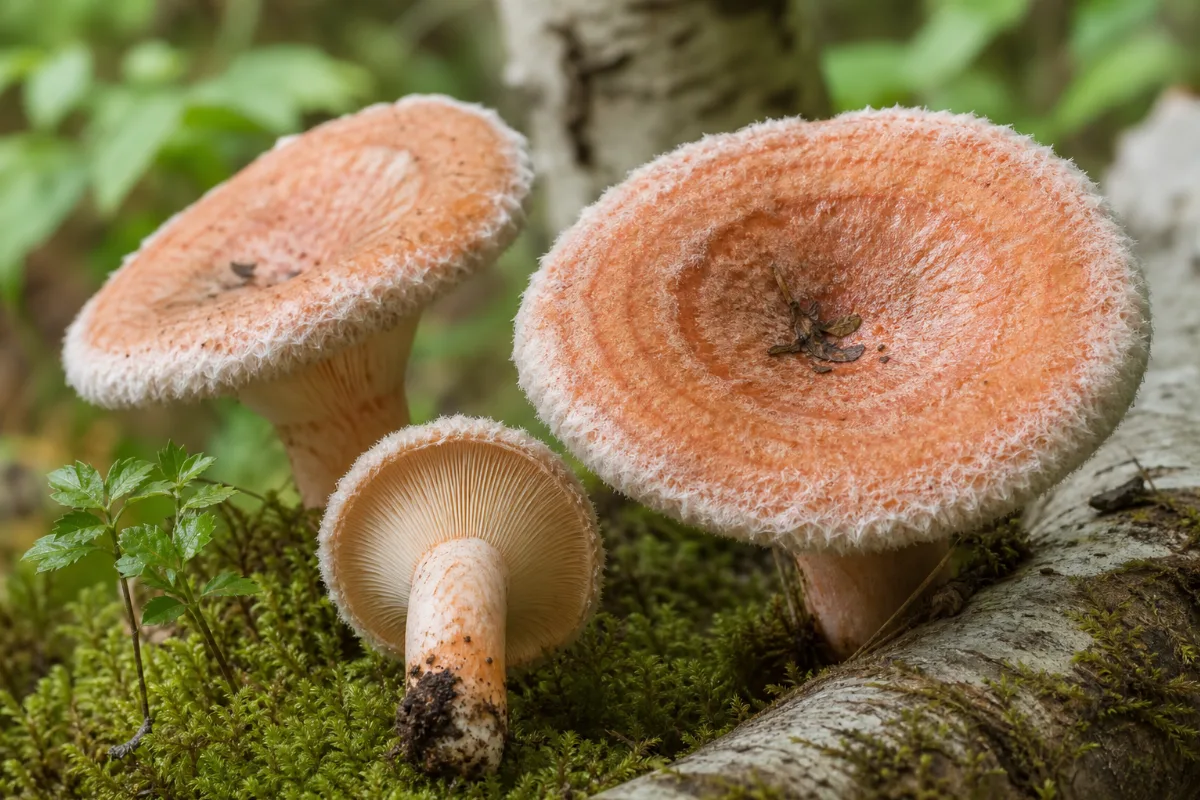
Mushrooms · Poisonous mushroom
Woolly Milkcap
Lactarius torminosus (Schaeff.) Pers. · also called Woolly milkcap, bearded milkcap, karvarousku (Finnish), skäggriska (Swedish) (a fungus, not a plant)
The woolly milkcap (Lactarius torminosus) is a wild mushroom that sources call poisonous in most countries. Some sources say people in places such as Russia and Finland eat it after processing, but no study shows that this makes it safe. No trial shows it helps any condition. If someone has eaten a wild mushroom, call a poison centre right away.
General information, not medical advice. Last substantive update · Not medically reviewed. A named clinician has not signed off on this page. How this page is made
About Woolly Milkcap
The woolly milkcap (Lactarius torminosus) is a wild milk cap that sources call poisonous in most countries. Some sources say it is eaten after heat treatment, blanching or salting in places such as Russia and Finland, but nobody has tested whether that makes it safe. The usual picture for poisonous milk caps is a stomach-and-bowel illness, but a stomach upset after a wild mushroom can also be the first sign of a far worse poison, so call a poison centre. No human study shows any benefit.
Danger first: what it can do
Sources call the woolly milkcap poisonous. A 2025 Polish paper says it is considered poisonous in most countries, and a 2025 Andorran paper calls it a poisonous wild mushroom. We found no case series of poisoning by this mushroom alone, so we cannot give a measured rate, timeline or severity for it.
For gut-irritant mushroom poisoning in general, the North American Mycological Association (NAMA) says symptoms usually appear within 20 minutes to 4 hours, recovery is complete, and severe cases may need hospital care to replace lost fluids and salts. That is a general description, not a study of this mushroom. If someone has eaten a wild mushroom, call a poison centre right away. In the US call Poison Help at 1-800-222-1222 (free, confidential), and 911 if the person collapses, has a seizure, has trouble breathing or cannot be awakened. In the UK call NHS 111 if unsure and 999 in an emergency. In Australia call 13 11 26.
When a stomach upset is not the whole story
A German clinical review says mushroom poisoning with symptoms inside six hours is usually a gut illness with a fairly harmless course, while poisoning that starts six to 24 hours or more after eating can be life-threatening. NAMA warns that gut symptoms starting 6 to 24 hours after eating could mean serious amatoxin poisoning.
You cannot tell which kind of poisoning you have from the first symptoms, and you cannot tell which mushroom was eaten from a stomach upset. Gut illness can also come from spoiled, raw or under-cooked mushrooms. That is one more reason to call a poison centre rather than wait.
Boiling, blanching, salting and old advice
The Polish paper says it is eaten after thermal treatment in some countries, for example Russia, but considered poisonous in most. A 1983 Finnish paper says blanching is necessary before these mushrooms are eaten, and a Finnish university museum guide (we could read only a search excerpt of it) describes boiling and then salting, and says its sharp taste is why it is not eaten in Central and Southern Europe.
No study tests whether any of this removes the cause of illness. A 1982 test-tube study found that boiled extracts of the woolly milkcap were still active in a bacterial mutagenicity test; the same was true of common champignons and shiitake, and it does not show harm to people. This page gives no preparation method.
Who is at higher risk
We found no species-specific data for children, older adults, pregnancy, breastfeeding, people with long-term illness, medicines, alcohol or pets. Fluid loss from vomiting and diarrhoea matters more for the very young, the old and the unwell. Call a poison centre for a person, and a vet or animal poison service for a pet.
No identification help here
Several milk caps look and smell alike. The Polish paper describes this one as a look-alike of a prized edible milk cap and of an inedible one, and the Andorran paper calls it a poisonous mushroom at risk of confusion with edible ones of the same genera. This page gives no way to recognise a wild mushroom. A photo, an app, a book or a smell test is not proof that a mushroom is safe.
What research exists
Very little. A 2025 smell-chemistry study separated three Lactarius species and found a C15H24 sesquiterpene signal only in this one, without linking it to poisoning. A 1983 Finnish analysis measured selenium. A 1982 test-tube study found it mutagenic in bacterial tests. Surveys in Russia, Sweden, Ukraine and Lithuania list it, and in Lithuania its use fell sharply. No source names the irritant, and no trial tested it in people.
Metals and minerals
A Polish study measured mercury in 14 mushroom species including the woolly milkcap, but the abstract gives no level for this species. Wild mushrooms in general can carry metals from the soil. Selenium averaged 1.9 mg/kg dry weight in Finnish samples. None of this makes the mushroom a food.
At a glance
Traditional uses history, not proof
- No traditional medicinal use is described in the sources we read.
- A 2025 Polish paper says it is eaten after heat treatment in some countries, for example Russia, but is considered poisonous in most (Wróblewski 2025).
- A 1983 Finnish paper treats it as a food that is blanched before it is eaten, and a Finnish university guide (search excerpt only) describes boiling and salting. We found no study testing whether this makes it safe.
- In a Lithuanian survey it was among the three species whose use fell most.
Studied for research
- Food use after processing: against; most sources call it poisonous
- Selenium content: measured once in 1983, no health effect studied
- No human trial of any benefit
Main compounds
- Irritant not identified in any source we read
- Selenium (a measured trace mineral, 1.9 mg/kg dry weight in a Finnish analysis)
Common forms
- Wild mushroom (called poisonous in most countries; not a supplement)
- Boiled or salted wild mushroom (regional food practice reported by sources; not shown to be safe)
Research links: Poison Control (US): call 1-800-222-1222 · NAMA: mushroom poisoning syndromes · Mushroom poisoning, German review 2020 (abstract) · Smell study of three Lactarius mushrooms, 2025 · Selenium in Finnish mushrooms, 1983 (abstract) · Research Library · Genes & Biomarkers Library
What it is and its history
- Accepted scientific name
- Lactarius torminosus
- Naming authority
- (Schaeff.) Pers.
- Synonyms
- Agaricus torminosus Schaeff.; Lactarius torminosus (Schaeff.) Gray; Lactifluus torminosus (Schaeff.) Kuntze; Galorrheus torminosus (Schaeff.) P.Kumm.; Lactarius cilicioides (Fr.) Fr.
- Common names
- Woolly milkcap (English); Bearded milkcap (English (used on the older page; not in the GBIF list)); Birken-Milchling (German); Baardige melkzwam (Dutch); Skäggriska (Swedish); Karvarousku (Finnish); Skjeggriske (Norwegian); Wełnianka (Polish (older page; not re-checked)); Волнушка розовая (Russian (Russian-language survey list))
- Family or group
- Russulaceae, the milkcap and brittlegill family (a fungus, not a plant). The part concerned is the fruiting body, the mushroom. It lives in partnership with tree roots; a 2025 Andorran paper links it with birch.
- Classification
- Fungi > Basidiomycota > Agaricomycetes > Russulales > Russulaceae > Lactarius > Lactarius torminosus
- Native range
- GBIF holds about 26,700 occurrence records. Records are observations and are not a map of native range.
- Habitat
- Associated with birch (Andorran paper). Not described further, deliberately.
- What it looks like
- Part used: The fruiting body (the mushroom). This page does not describe how to recognise it.
- Look-alikes and adulterants
- Name: Other milk caps, including a prized edible one; Note: A 2025 Polish paper compares it with the edible Lactarius deliciosus and the inedible L. pubescens, and the Andorran paper calls it 'at risk of confusion' with edible milk caps. No identification advice is given here.
- Sustainability and conservation
- Not checked.
Traditional use and history history, not clinical proof
| Tradition or era | Documented use | Source |
|---|---|---|
| Taxonomy | GBIF gives the accepted name Lactarius torminosus (Schaeff.) Pers., with the first name Agaricus torminosus Schaeff. | GBIF |
| Food use in northern and eastern Europe | A Russian-area survey lists it among recorded mushrooms (as 'Волнушка розовая'), a 2025 Polish paper says it is eaten after heat treatment in some countries such as Russia, and a 1983 Finnish paper treats it as a food that is blanched first. A Finnish museum guide (search excerpt) says it is boiled and salted, and not eaten in Central and Southern Europe because of its sharp taste. | Wild food survey (Sweden, Ukraine, NW Russia, 2015); Molecules 2025; Z Lebensm Unters Forsch 1983; University of Jyväskylä museum |
| Falling use | In a Lithuanian survey it was among the three species with the greatest decline in consumption. | J Ethnobiol Ethnomed 2024 |
| Medicinal use | No traditional medicinal use is described in the sources we read. | n/a |
Traditional use shows how it was used. It does not show that it works or is safe today.
What is inside, and how it may work
What it contains and how those compounds act in cells and animals. Laboratory and animal mechanisms are not proven effects in people.
Main compounds
| Compound | Family | Where it is concentrated | Activity studied | Level of evidence |
|---|---|---|---|---|
| Sesquiterpene (C15H24, in released smell) | Terpene-type fungal chemicals | Not stated | A 2025 smell-analysis study found a strong signal for a protonated C15H24 sesquiterpene only in this species among three Lactarius tested. The paper does not link it to poisoning. 8 | Unclear |
| Selenium | Trace mineral | Fruiting body 1.9 mg/kg dry weight (mean, Finnish samples, 1983) | Content measured only; no health effect studied. 6 | Measured |
Mechanisms, receptors and pathways
| Target or pathway | Gene or receptor | What was found | Level |
|---|---|---|---|
| Gut lining irritation (assumed pattern) | Not established | NAMA groups gut-irritant mushroom poisoning together; nothing in the sources we read shows the mechanism for this species. 9 | Not established |
| Bacterial mutagenicity test | Salmonella tester strains | Extracts, including boiled extracts, were positive in tester strains sensitive to base-pair substitution mutagens. Cultivated champignon and shiitake were also positive. Test tube only. 14 | Laboratory research |
Absorption, metabolism and elimination
- Absorption
- Not studied.
- Distribution
- Not studied.
- Metabolism
- Not studied.
- Elimination
- Not studied.
- Bioavailability
- Not studied.
Isolated compounds versus whole extracts
The wild mushroom, its released smell chemicals and its selenium are different things. Only the whole mushroom is described as poisonous; no isolated compound has been tied to poisoning.
Nutritional composition
The woolly milkcap is not recommended as a food or nutrient source. The only measured nutrient we found is selenium (1.9 mg/kg dry weight, Finland, 1983). No USDA entry was found.
1 not enough evidence1 evidence against
What was looked at
The 2 benefits and uses checked for Woolly Milkcap, each with how strong the evidence is. Tap one to open it.
What is Woolly Milkcap good for?
The uses people ask about and how strong the evidence is for each. None is proven, and there is no human evidence at all. Read every row together with the Safety tab: most sources call this a poisonous mushroom.
Benefits, one by one
Each card is a research question, not a promise. Tap a goal to filter. Open a card to see the studies, doses and limits.
Use as a food after processing (regional practice)
Evidence againstIn a few countries, including Russia and Finland, it is described as eaten after heat treatment. In most countries it is considered poisonous. No study tests whether any processing makes it safe, so this is not a benefit.
6 studiesNot covered. This page gives no amounts, preparation or ways of using…
Studies, doses and limits
Results
Papers and guides disagree by country: poisonous in most countries (Poland team, Andorra paper), eaten after heat treatment in Russia and described as pre-treated in Finland. A laboratory test found that boiled extracts of this mushroom were still active in a bacterial mutagenicity test (see Safety).
Why this rating
The sources we read call it poisonous in most countries. The regional food use is reported second-hand, with no safety testing of any preparation.
Form and dose studied
Not covered. This page gives no amounts, preparation or ways of using the mushroom.
Limits
Regional use does not show that it is safe, and a country's habit is not a safety test. Food use is the only 'use' of this mushroom discussed in the sources, and it carries a poisoning risk.
Why researchers looked
It is a common forest mushroom in northern Europe, so researchers who study wild food and mushroom poisoning mention it.
Traditional use
A 2025 Polish paper says it is eaten after thermal treatment in some countries, for example Russia, but is considered poisonous in most. A Finnish selenium paper (1983) says blanching is necessary before these mushrooms are eaten. A Finnish university museum guide (search excerpt only) describes boiling then salting. Lithuanian and Russian surveys list it, and in Lithuania it was among the species whose use fell most.
Proposed mechanism Not established
Not established. No source names the irritant or tests whether heat or salting removes it.
A proposed mechanism does not show that the effect happens in people.
Most sources call this a poisonous mushroom. If someone has eaten it, call a poison centre. Do not use this page to decide to eat a wild mushroom.
Selenium content (a measurement, not a health effect)
Not enough evidenceA 1983 Finnish study measured selenium in wild mushrooms and found the woolly milkcap among the higher ones. It did not test health effects. Blanching lowered the selenium.
1 studiesNot covered. This page gives no amounts, preparation or ways of using…
Studies, doses and limits
Results
Mean 1.9 mg/kg dry weight for Lactarius torminosus, against 17 mg/kg for Boletus edulis, the highest of 38 species. The authors say that content could be nutritionally significant for Finnish intake. Blanching lowered the selenium of L. torminosus by an average of 32%.
Effect sizes as reported
1.9 mg/kg dry weight; 32% average loss after blanching (abstract).
Why this rating
One 1983 chemical analysis, with no data on how much is absorbed or on any health outcome. The same abstract calls the mushroom one eaten after blanching, but safety was not tested.
Form and dose studied
Not covered. This page gives no amounts, preparation or ways of using the mushroom.
Limits
A mineral content in a poisonous mushroom does not make it a food source. Selenium is available from ordinary foods. The abstract does not give how many samples were this species.
Why researchers looked
Selenium is a trace mineral, and researchers wanted to know which Finnish wild mushrooms contribute to intake.
Proposed mechanism Laboratory analysis
Not applicable. This is a chemical measurement of the mushroom, not an effect in a body.
A proposed mechanism does not show that the effect happens in people.
This is a mushroom that most sources call poisonous. A mineral measurement is no reason to eat it.
Connections to the rest of health
How Woolly Milkcap connects to the rest of our health knowledge graph. Every link says what kind of connection it is. A safety link (for example to the liver) is a warning, not a benefit. A study that merely mentions a topic never creates a benefit link.
Explore every connection: goals, body systems, organs, symptoms, genes
B. Body systems
| Connected to | Kind of connection | Evidence status | Context | Studies |
|---|---|---|---|---|
| Digestive system | Adverse effect or risk | Low certainty | Gut-irritant poisoning is the pattern described for poisonous milk caps; no species-specific case data. Preparation or compound: Mushroom (fruiting body) |
9 7 8 |
| Digestive System | Biological association | Evidence against | Studied for: Use as a food after processing (regional practice) | 8 6 5 3 4 1 |
| Endocrine System | Biological association | Not enough evidence | Studied for: Selenium content (a measurement, not a health effect) | 6 |
E. Health conditions
| Connected to | Kind of connection | Evidence status | Context | Studies |
|---|---|---|---|---|
| Food poisoning | Adverse effect or risk | Low certainty | Mushroom poisoning with a short delay shows as gut illness (review). Preparation or compound: Mushroom (fruiting body) |
7 |
L. Active compounds
| Connected to | Kind of connection | Evidence status | Context | Studies |
|---|---|---|---|---|
| Sesquiterpene (C15H24, in released smell) | Biological association | Unclear | A 2025 smell-analysis study found a strong signal for a protonated C15H24 sesquiterpene only in this species among three Lactarius tested. The paper does not link it to poisoning. | 8 |
| Selenium | Biological association | Measured | Content measured only; no health effect studied. Preparation or compound: Fruiting body |
6 |
Each connection is stored with the ingredient, the connected record, the kind of connection, the evidence status, the supporting studies, the preparation or compound involved, and a review date (last reviewed October 25, 2026).
Evidence at a glance: what the research found for 2 outcomes
Each outcome below is one thing researchers measured. Certainty is how far the evidence can be trusted, not how well it works. The full studies are on the next tab.
The evidence
The research centre for Woolly Milkcap. Every record here was checked against PubMed or the publisher's page; we never list a study we have not verified.
Evidence by outcome
Bars show how many studies we found for each outcome, not how well it works. People are added up across trials only (reviews are not added, to avoid double counting).
How we rate evidence
High certainty
Several well-run trials or reviews agree; further research is unlikely to change the picture much.
Moderate certainty
Good trials point the same way, but some doubt remains.
Low certainty
Small, short or inconsistent trials. The finding could change with better research.
Very low certainty
Very little or very weak human data. Treat as a possibility only.
Mixed findings
Trials or reviews disagree with each other.
Not enough evidence
Not enough human research to say either way.
Evidence against
Good research found no benefit, or found harm.
We take the reviewers' own risk-of-bias and GRADE statements where they exist, and otherwise judge from study size, design, consistency, directness and whether a product matches what is sold. Many publications do not make evidence high. Method note: We read the abstracts of five papers in PubMed (full text for the 2025 Polish smell study), full-text passages of three ethnomycology surveys, the NAMA poisoning-syndromes page, poison-help pages from the US, UK and Australia, and checked the scientific name in GBIF. A Finnish university guide could be read only as a search excerpt. Index Fungorum was not opened. Where a statement could not be checked it is marked as such.
Study library: every study we checked 14
| Study | Design | People | Product, dose, length | Result |
|---|---|---|---|---|
| Andorran ethnomycology authors (see journal page) 2025 Andorran ethnomycology: culinary uses and beyond (J Ethnobiol Ethnomed 2025, PMC12606818) J Ethnobiol Ethnomed · Source · DOI |
Survey survey |
Ethnomycological study in Andorra | n/a |
The text names Lactarius torminosus (Schaeff.) Pers. as 'a poisonous' wild mushroom 'at risk of confusion with other' wild edible mushrooms of the same genera, found with birch. Methods, limits and fundingOutcomes: Local mushroom knowledge and use Limitations: Read only the passage that names this species (full text searched). The paper is about Andorran use in general. Read: full-text |
| Falandysz 2003 Content and bioconcentration of mercury in mushrooms from northern Poland. Food Addit Contam · PMID 12623649 · DOI |
Laboratory analysis laboratory |
404 mushroom samples (nine edible and five inedible species) and 202 soil samples, Trójmiejski Landscape Park, Poland, 1996 | n/a |
Mercury was measured in 14 species, including the woolly milkcap (L. torminosus) and the death cap. High levels were reported for five edible species (horse mushroom, brown birch scaber stalk, parasol, king bolete, yellow-cracking bolete). For the woolly milkcap and death cap caps, mercury was negatively correlated with soil mercury (p < 0.05). Methods, limits and fundingOutcomes: Mercury in caps and stalks Limitations: The abstract gives no mercury figure for the woolly milkcap, so the paper shows only that it was measured and how it related to soil. It does not say whether levels were high or low in this species. Read: abstract |
| Kolodziejska-Degorska I and colleagues (see journal page) 2015 From economic survival to recreation: contemporary uses of wild food and medicine in rural Sweden, Ukraine and NW Russia (J Ethnobiol Ethnomed 2015, PMC4474580) J Ethnobiol Ethnomed · Source · DOI |
Survey survey |
Field interviews in rural Sweden, Ukraine and NW Russia | n/a |
Lists Lactarius torminosus (Schaeff.) Gray, 'Woolly milkcap', with the Russian name 'Волнушка розовая', among the mushrooms recorded as used in the study area, as a whole mushroom. Methods, limits and fundingOutcomes: Which wild foods and medicines are used Limitations: Used only for the list entry and the local name. The passage we read does not describe how it is prepared or whether anyone was ill. Read: full-text |
| Lithuanian ethnomycology authors (see journal page) 2024 Diversity of ethnomycological knowledge and mushroom use in Lithuania (J Ethnobiol Ethnomed 2024, PMC11409470) J Ethnobiol Ethnomed · Source · DOI |
Survey survey |
Survey of mushroom collectors in several regions of Lithuania | n/a |
Lactarius torminosus was not collected at all in Dzūkija and by only two respondents in Žemaitija. In other regions, except Suvalkija, some respondents stopped collecting it. It was one of the three species with the greatest decline in consumption (with Paxillus involutus and Lactarius turpis). Methods, limits and fundingOutcomes: Which mushrooms are collected and how that has changed Limitations: Survey answers show habits, not toxicity. The reasons for stopping are not given in the passage we read. Read: full-text |
| Mikael Sjölund (named in the search result) University of Jyväskylä museum, edible mushrooms of Finland: karvarouskut (Finnish; web-search excerpt) n/a · Source |
Expert guide n/a |
Finnish-language mushroom guide page | n/a |
A search excerpt of the Finnish page says the woolly milkcap (karvarousku) must be boiled before it can be made into food, then rinsed and salted, and that its taste is sharp and fiery, which is why it is not eaten in Central and Southern Europe. Methods, limits and fundingOutcomes: How the woolly milkcap is treated in Finland Limitations: The page itself returned a server error when we tried to open it on 2026-10-25, so only the search excerpt was read. It is a university museum guide, not a regulator and not a toxicology study. We do not repeat any times or method. Read: abstract |
| Piepponen 1983 The selenium content of edible mushrooms in Finland. Z Lebensm Unters Forsch · PMID 6685955 · DOI |
Laboratory analysis laboratory |
142 mushroom samples of 38 species, mostly wild Finnish species used as food, measured for selenium | n/a |
Lactarius torminosus had a mean selenium content of 1.9 mg/kg dry weight, one of the higher values after Boletus edulis (17 mg/kg). The authors say these contents are nutritionally significant in relation to the usual Finnish intake. They also say blanching 'necessary before consumption' of these mushrooms lowered the selenium of L. torminosus by an average of 32%. Methods, limits and fundingOutcomes: Selenium content by species; effect of blanching Limitations: 1983 chemical analysis. It measures selenium, not safety. The phrase about blanching shows that the authors treated it as a Finnish food that is pre-treated; it does not test whether pre-treatment makes it safe. Sample numbers for this species are not in the abstract. Read: abstract |
| Wennig 2020 Mushroom Poisoning. Dtsch Arztebl Int · PMID 33559585 · DOI |
Review review |
Review of mushroom poisoning syndromes, toxins and diagnosis (general, not species-specific) | n/a |
Mushroom poisoning with a short delay (under six hours) usually shows as a gastrointestinal syndrome with a fairly harmless course. Poisoning with a delay of six to 24 hours or more can be life-threatening. German hospital data for 2000-2018 show 4,412 hospitalizations and 22 deaths from mushroom toxic effects, 90% of the deaths from the death cap. Gut syndromes can also come from spoiled, raw or inadequately cooked mushrooms, or from eating too many. Methods, limits and fundingOutcomes: How poisoning with short and long delay differs; hospital figures for Germany Limitations: General review. It does not mention the woolly milkcap in the abstract. Diagnosis rests on symptoms, timing and what was eaten, which is why a poison centre should be called. Read: abstract |
| Wróblewski 2025 Studies on the Emission of Volatile Organic Compounds from Selected Forest Mushrooms of the Genus Lactarius Using Proton-Transfer Reaction Mass Spectrometry. Molecules · PMID 40733266 · DOI |
Laboratory study laboratory |
Wild Lactarius mushrooms from northern Poland: L. deliciosus, L. pubescens and L. torminosus (smell-chemistry analysis, not a toxicity test) | n/a |
The abstract and full text call Lactarius torminosus a poisonous species and describe the three species as similar to each other. The full text says that in some countries, for example Russia, it is eaten after heat treatment, but in most countries it is considered poisonous. Smell-profile analysis of 20 ions separated the three species statistically. One ion, a sesquiterpene of formula C15H24, was strong only in L. torminosus. The study did not test toxicity. Methods, limits and fundingOutcomes: Differences in released smell chemicals between three look-alike Lactarius species Limitations: A smell-chemistry study of identification, not of poisoning. It names no toxin and gives no symptoms. Smell analysis in a laboratory is not a way for anyone to identify a mushroom at home. The statement about Russia is made second-hand in the paper (its reference 32). Funding and conflicts: Conflict of interest: none declared (abstract). Read: full-text |
| n/a 2026 North American Mycological Association: Mushroom Poisoning Syndromes (page read 25 October 2026) n/a · Source |
Authoritative guidance n/a |
n/a | n/a |
The most frequent form of mushroom poisoning is caused by gastrointestinal irritants. Symptoms usually appear within 20 minutes to 4 hours. Recovery is described as complete, though severe cases may need hospitalization; replacing lost fluids and electrolytes is important. Gut distress starting 6 to 24 hours after eating could mean serious amatoxin poisoning; other poisons show later as kidney damage. Methods, limits and fundingOutcomes: What gastrointestinal-irritant mushroom poisoning looks like and how it is treated Limitations: General syndrome page; it does not name Lactarius or the woolly milkcap. Undated. Read: full-text |
| n/a 2026 Poison Control (US): Need immediate assistance? (page read 25 October 2026) n/a · Source |
Authoritative guidance n/a |
n/a | n/a |
Call 1-800-222-1222: free, confidential, experts 24/7; an online tool is also offered. Call 911 immediately if the person collapses, has a seizure, has trouble breathing or cannot be awakened. Methods, limits and fundingOutcomes: What to do in a suspected poisoning in the US Limitations: General help page, not about mushrooms specifically. Read: full-text |
| n/a 2026 NHS (UK): Poisoning (page read 25 October 2026) n/a · Source |
Authoritative guidance n/a |
n/a | n/a |
Call 999 or go to A&E if someone may have swallowed something harmful, has lost consciousness, stopped breathing, has severe breathing difficulty or a seizure. Call NHS 111 if not sure whether something is harmful. Lists plants and mushrooms among causes. Look for packaging that may show the cause. Do not make the person vomit and do not give them anything to eat or drink. Methods, limits and fundingOutcomes: What to do in suspected poisoning in the UK Limitations: General page. Read: full-text |
| n/a 2026 NSW Poisons Information Centre (Australia): home page (read 25 October 2026) n/a · Source |
Authoritative guidance n/a |
n/a | n/a |
Call 13 11 26 at any time (24/7) and do not wait for symptoms. Call Triple Zero (000) for an ambulance if the person is unconscious or not breathing. Methods, limits and fundingOutcomes: Poison advice line in Australia Limitations: One Australian state service shown as the national poisons line. Read: full-text |
| n/a 2026 GBIF Backbone Taxonomy: Lactarius torminosus (Schaeff.) Pers. (species key 8122710) n/a · Source |
Registry or database n/a |
n/a | n/a |
Accepted species Lactarius torminosus (Schaeff.) Pers., family Russulaceae, order Russulales, class Agaricomycetes (fungi). Synonyms include Agaricus torminosus Schaeff., Lactarius torminosus (Schaeff.) Gray and Lactifluus torminosus (Schaeff.) Kuntze. Vernacular names include Woolly Milkcap, Baardige melkzwam (Dutch), Birken-Milchling (German), skäggriska (Swedish), karvarousku (Finnish), skjeggriske (Norwegian), ryzec kravský (Czech). About 26,700 occurrence records. Methods, limits and fundingOutcomes: Accepted name, authority, family, synonyms, common names, records Limitations: A database record. Occurrence records are observations and say nothing about toxicity. Index Fungorum was not opened. Read: full-text |
| von Wright 1982 The mutagenicity of some edible mushrooms in the Ames test. Food Chem Toxicol · PMID 7201952 · DOI |
Laboratory study in-vitro |
Extracts of five wild and two cultivated mushrooms, including Lactarius torminosus, in bacterial test strains (test tube) | n/a |
All the mushrooms tested, including L. torminosus, were mutagenic to tester strains sensitive to base-pair substitution mutagens. Metabolic activation was not required, and activity could be detected even in boiled mushroom extracts. The same was seen in the cultivated champignon and shiitake. Methods, limits and fundingOutcomes: Mutagenic activity in the Ames test Limitations: Bacterial test-tube assay on extracts from 1982. It does not show cancer or harm in people, and the cultivated mushrooms were also positive. It is listed here because the abstract says boiling did not remove the activity. Read: abstract |
What we do not know yet
- No clinical series of poisoning by the woolly milkcap alone.
- No study identifies the irritant or measures its amount.
- No study of any boiling, blanching, salting or pickling method.
- No animal or human study of benefit.
- No information on pregnancy, breastfeeding, medicines, alcohol or pets.
- No regulator statement specific to the species was found, and the Finnish museum guide could be read only as a search excerpt.
How new research is added
New studies are found by a saved PubMed search and placed in a review queue. A person reads each one before it changes this page. Poison-help pages are rechecked on a schedule.
Lab markers
What changed in blood or saliva tests during trials. A changed number is not the same as feeling or being healthier, and we give no "normal ranges".
Safety
What studies and official sources say about side effects, medicines and who should check first. Each point shows what kind of evidence it comes from.
Main points to know 5
- If someone has eaten it, call a poison centre now. Do not wait to see whether symptoms appear or pass. In the US call Poison Help at 1-800-222-1222 (free and confidential, 24/7), and 911 if the person collapses, has a seizure, has trouble breathing or cannot be awakened. In the UK call NHS 111 if unsure and 999 in an emergency. In Australia call 13 11 26. Keep any leftover mushroom or meal, or a photo, to show staff. Authoritative guidance 10 11 12
- Most sources call it poisonous. A 2025 Polish paper says the woolly milkcap is considered a poisonous mushroom in most countries, although it is eaten after heat treatment in some, for example Russia. A 2025 Andorran paper also calls it poisonous. A Finnish university museum guide (search excerpt only) describes boiling and salting before it is cooked. No study tests whether any preparation makes it safe, and this page gives no preparation method. Expert guide 8 1 5
- A stomach upset can hide a worse poison. A German review says poisoning with symptoms inside six hours is usually a stomach-and-bowel illness with a fairly harmless course, while poisoning that starts six to 24 hours or more after eating can be life-threatening. NAMA warns that gut symptoms starting 6 to 24 hours after eating could mean serious amatoxin poisoning. You cannot tell which poison you have from the first symptoms. Review 7 9
- No identification help. Several wild mushrooms look and smell alike, and the Polish paper describes this species as one of three look-alike milk caps, one of them a prized edible. This page does not help anyone recognise a wild mushroom. A photo, an app or a book is not proof that a mushroom is safe. Expert guide 8 1
- No safe amount is known. No source we read measures a toxin or sets any safe amount. This page gives no amount, preparation or sourcing advice. None 7
Side effects 3
| Effect | How often | Severity and recovery | Evidence |
|---|---|---|---|
| Stomach and bowel illness (described for poisonous milk caps, not measured for this species) NAMA describes gastrointestinal-irritant poisoning as nausea, vomiting, cramps and diarrhoea, usually within 20 minutes to 4 hours, with complete recovery. We found no case series of the woolly milkcap itself, so we cannot say how often, how severe or how long. | Not established | moderate Described as passing once the irritant has left the body; severe cases can need hospital care | Authoritative guidance 9 7 |
| Fluid and salt loss from vomiting and diarrhoea NAMA says replacing lost fluids and electrolytes is important. This is a clinician's treatment, not home advice. | Not established | moderate Treated in hospital where needed | Authoritative guidance 9 |
| Gut illness from raw, spoiled, under-cooked or excessive mushroom meals in general The German review says gut syndromes can come from spoiled, raw or inadequately cooked mushrooms or from eating very much, not only from poisonous species. This does not mean cooking makes a poisonous species safe. | Not established | moderate Not described | Review 7 |
Liver
No liver or kidney injury is described for the woolly milkcap in the sources we read. Do not take that as comfort: an early stomach upset can also come from poisons that harm the liver or kidneys later, so a poison centre should be called. 9 7
How often. No data for the woolly milkcap.
- NAMA poisoning syndromes page. Gut symptoms starting 6 to 24 hours after eating could signal amatoxin poisoning, a very serious toxicity. 9
This is a safety connection. It is not evidence that Woolly Milkcap supports liver health.
Medicines and supplements 1
| With | Why it matters | Importance | Evidence | What to do |
|---|---|---|---|---|
| Medicines, alcohol and supplements all | No interaction has been studied for the woolly milkcap. | Unknown. Vomiting and diarrhoea can affect how medicines are taken in and may be dangerous for people who depend on them. | None Not enough evidence 10 11 | Tell the poison centre or emergency team about every medicine, supplement and substance taken. |
Who should check first 5
| Situation | Advice | Evidence |
|---|---|---|
| Anyone | It is a mushroom most sources call poisonous, with no proven benefit. This page does not suggest eating it in any form. | Authoritative guidance 8 1 |
| Pregnancy and breastfeeding | No data. We found no pregnancy, breastfeeding or LactMed information for this species. A poisoning with vomiting and fluid loss would be a risk in itself, so call a poison centre. | None 10 |
| Children, older adults and people with weak immunity or other illness | No species-specific data. Fluid loss from vomiting and diarrhoea matters more in the very young, the old and the unwell, so call a poison centre at once. | None 9 10 |
| Pets | We found no source on pets and this mushroom. Call a vet or an animal poison service if a pet has eaten a wild mushroom. | None 10 |
| Allergy | No allergy report for this species was found. Any mushroom can in principle cause an allergic reaction; collapse or trouble breathing is an emergency. | None 10 11 |
Overdose, product quality and regulators
Summary. The woolly milkcap is called poisonous in most countries, but no source we read names or measures the toxin. A 2025 smell study found a sesquiterpene signal (C15H24) only in this species, but no source links either to poisoning. A 1982 bacterial test found that extracts of this mushroom, including boiled extracts, were mutagenic in the Ames test, as were extracts of the common champignon and shiitake; that is a laboratory result, not evidence of cancer or harm in people.
Amounts. No toxin level and no safe amount has been established in any source we read.
Onset and course. Not reported for this species. For gut-irritant mushroom poisoning in general, NAMA says symptoms usually appear within 20 minutes to 4 hours and recovery is complete; delayed gut symptoms (6 to 24 hours) can signal a far more dangerous poison.
Repeated use. No data.
Not read. Original toxicology and case reports on Lactarius poisoning were not found or read. The Finnish museum guide page could not be opened (only a search excerpt was read).
No product testing exists for this species. Wild mushrooms in general can carry metals and other contaminants from the ground where they grow.
Mercury (northern Poland, 1996 samples). A Polish study measured mercury in 14 mushroom species, including the woolly milkcap. High mercury was reported for five edible species. For the woolly milkcap the abstract gives only that cap mercury was negatively correlated with soil mercury; it gives no level for this species. 2
Selenium (Finland). Selenium averaged 1.9 mg/kg dry weight in the woolly milkcap and fell by an average of 32% after blanching. This is a nutrient measurement, not a safety finding. 6
| Body | Action | Date |
|---|---|---|
| Poison Control (US, National Capital Poison Center) (United States) | Call 1-800-222-1222 for free, confidential help; call 911 immediately if the person collapses, has a seizure, has trouble breathing or cannot be awakened. source | |
| NHS (UK) (United Kingdom) | Call 999 or go to A&E for loss of consciousness, stopped breathing, severe breathing difficulty or a seizure; call NHS 111 if unsure whether something swallowed is harmful. source | |
| NSW Poisons Information Centre (Australia) (Australia) | Call 13 11 26 at any time and do not wait for symptoms; call 000 if the person is unconscious or not breathing. source |
When to get medical help
- Collapse, a seizure, trouble breathing or someone who cannot be woken: call emergency services at once.
- Vomiting or diarrhoea that will not stop, or signs of drying out (very dry mouth, very little urine, dizziness).
- Gut symptoms that start 6 to 24 hours or more after eating a wild mushroom, or that seem to improve and then come back.
- Yellow skin or eyes, dark urine, or severe pain in the back or sides after a wild mushroom meal.
- Confusion, hallucinations or a very fast or slow heartbeat.
- Any symptoms in a child, an older person, someone pregnant or someone with a long-term illness after eating a wild mushroom.
If someone may be poisoned or in a crisis, contact a clinician or emergency service straight away. In the US, Poison Control is 1-800-222-1222.
General information only, not medical advice. Ask a clinician or pharmacist before use, especially with medicines, in pregnancy or with a health condition. See the Natural Remedy Safety guide.
Frequently asked questions
Is the woolly milkcap (Lactarius torminosus) poisonous?
What should I do if someone has eaten it, or a wild mushroom that might be it?
Call a poison centre right away, even if the person seems fine. In the US call Poison Help at 1-800-222-1222 (free, confidential), and 911 if the person collapses, has a seizure, has trouble breathing or cannot be awakened. In the UK call NHS 111 if unsure and 999 in an emergency. In Australia call 13 11 26. Keep any leftover mushroom or meal, or a photo, to show staff. Do not wait to see whether symptoms pass.
What are the symptoms?
We found no case series for this mushroom. For gut-irritant mushroom poisoning in general, NAMA describes nausea, vomiting, cramps and diarrhoea, usually starting within 20 minutes to 4 hours, with complete recovery and hospital care needed in severe cases.
Can a stomach upset be a sign of something worse?
Is it eaten in some countries?
Some sources say so. The 2025 Polish paper names Russia, where it is eaten after heat treatment. A 1983 Finnish paper says blanching is necessary before these mushrooms are eaten. A Russian-area survey lists it and a Lithuanian survey shows its use falling. These are reports of habits, not safety findings.
Does boiling or cooking make it safe?
We found no study showing that it does, and this page gives no preparation method. A 1982 test-tube study found that boiled extracts were still active in a bacterial mutagenicity test, but that is a laboratory result and also applied to cultivated mushrooms. A German review adds that cooking does not rescue every poisonous species.
How can I tell it from edible milk caps?
Does it have any health benefits?
What is in it?
Is it safe in pregnancy, for children or for pets?
Could it contain metals?
Wild mushrooms can. A Polish study measured mercury in the woolly milkcap among 14 species, but the abstract gives no level for it.
Is it a fungus or a plant, and what is its right name?
It is a fungus. GBIF lists the accepted name as Lactarius torminosus (Schaeff.) Pers. Older texts write the authority as Gray, which GBIF lists as a synonym.
Explore by health goal
Editorial transparency
- Written by
- AlternativeMed editorial team. Research compiled with AI assistance, then checked against PubMed records, poison-help pages and GBIF.
- Medical review
- None. This page has not been reviewed by a physician or pharmacist.
- First published
- 2026-10-25
- Last substantive update
- 2026-10-25
- How we research
- We read the abstracts of five papers in PubMed (full text for the 2025 Polish smell study), full-text passages of three ethnomycology surveys, the NAMA poisoning-syndromes page, poison-help pages from the US, UK and Australia, and checked the scientific name in GBIF. A Finnish university guide could be read only as a search excerpt. Index Fungorum was not opened. Where a statement could not be checked it is marked as such.
- How we rate evidence
- See "How we rate evidence" in the Evidence tab.
- Independence
- No product is promoted on this page. No affiliate links are shown. This page gives no dose, preparation, identification, picking or sourcing advice.
Sources 14
Each source was opened and checked. Where we read only the abstract, it says so. The small numbers in the text point here.
- Andorran ethnomycology authors (see journal page). Andorran ethnomycology: culinary uses and beyond (J Ethnobiol Ethnomed 2025, PMC12606818). J Ethnobiol Ethnomed. 2025. DOI 10.1186/s13002-025-00829-6. (full-text)
- Falandysz J, Gucia M, Brzostowski A, Kawano M, Bielawski L, Frankowska A, Wyrzykowska B. Content and bioconcentration of mercury in mushrooms from northern Poland.. Food Addit Contam. 2003. PMID 12623649. DOI 10.1080/0265203021000057485. (abstract)
- Kolodziejska-Degorska I and colleagues (see journal page). From economic survival to recreation: contemporary uses of wild food and medicine in rural Sweden, Ukraine and NW Russia (J Ethnobiol Ethnomed 2015, PMC4474580). J Ethnobiol Ethnomed. 2015. DOI 10.1186/s13002-015-0036-0. (full-text)
- Lithuanian ethnomycology authors (see journal page). Diversity of ethnomycological knowledge and mushroom use in Lithuania (J Ethnobiol Ethnomed 2024, PMC11409470). J Ethnobiol Ethnomed. 2024. DOI 10.1186/s13002-024-00730-8. (full-text)
- Mikael Sjölund (named in the search result). University of Jyväskylä museum, edible mushrooms of Finland: karvarouskut (Finnish; web-search excerpt). n/a. . (abstract)
- Piepponen S, Liukkonen-Lilja H, Kuusi T. The selenium content of edible mushrooms in Finland.. Z Lebensm Unters Forsch. 1983. PMID 6685955. DOI 10.1007/BF01082489. (abstract)
- Wennig R, Eyer F, Schaper A, Zilker T, Andresen-Streichert H. Mushroom Poisoning.. Dtsch Arztebl Int. 2020. PMID 33559585. DOI 10.3238/arztebl.2020.0701. (abstract)
- Wróblewski T, Kamińska A, Włodarkiewicz A. Studies on the Emission of Volatile Organic Compounds from Selected Forest Mushrooms of the Genus Lactarius Using Proton-Transfer Reaction Mass Spectrometry.. Molecules. 2025. PMID 40733266. DOI 10.3390/molecules30143000. (full-text)
- n/a. North American Mycological Association: Mushroom Poisoning Syndromes (page read 25 October 2026). n/a. 2026. (full-text)
- n/a. Poison Control (US): Need immediate assistance? (page read 25 October 2026). n/a. 2026. (full-text)
- n/a. NHS (UK): Poisoning (page read 25 October 2026). n/a. 2026. (full-text)
- n/a. NSW Poisons Information Centre (Australia): home page (read 25 October 2026). n/a. 2026. (full-text)
- n/a. GBIF Backbone Taxonomy: Lactarius torminosus (Schaeff.) Pers. (species key 8122710). n/a. 2026. (full-text)
- von Wright A, Knuutinen J, Lindroth S, Pellinen M, Widén KG, Seppä EL. The mutagenicity of some edible mushrooms in the Ames test.. Food Chem Toxicol. 1982. PMID 7201952. DOI 10.1016/s0278-6915(82)80291-3. (abstract)


