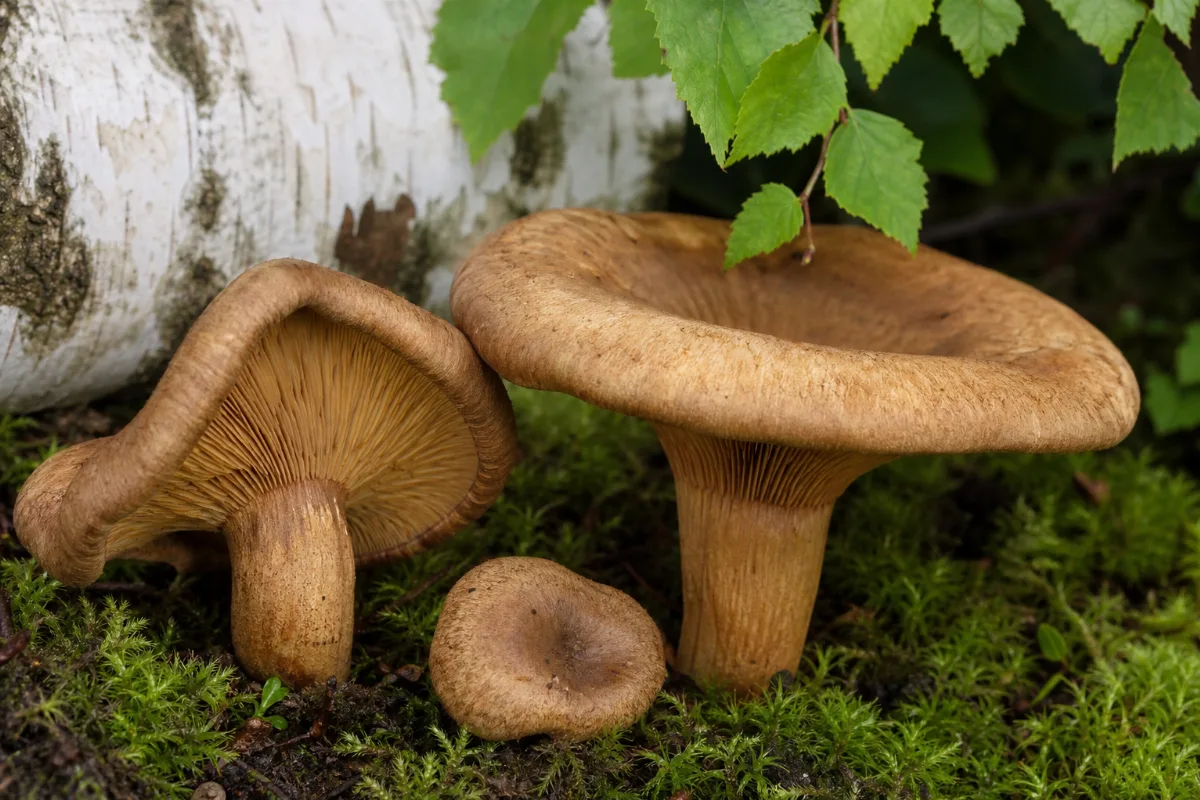
Mushrooms · Poisonous mushroom
Brown Roll-Rim
Paxillus involutus (Batsch) Fr. · also called Poison pax; brown rollrim
The brown roll-rim (Paxillus involutus) is a poisonous mushroom. In some people, especially after eating it many times, the body makes antibodies that destroy red blood cells, which can lead to kidney failure, clotting damage and death within days. It is also known to cause stomach illness. Eating it safely before is no protection. No trial shows it helps any condition. If someone has eaten it, call a poison centre right away.
General information, not medical advice. Last substantive update · Not medically reviewed. A named clinician has not signed off on this page. How this page is made
About Brown Roll-Rim
The brown roll-rim (Paxillus involutus) is a poisonous mushroom. Reports describe two kinds of poisoning: stomach illness, and a rare immune reaction called the Paxillus syndrome in which antibodies destroy red blood cells. The immune reaction has led to kidney failure, widespread clotting damage, liver failure and death within about 3 to 4 days, including in people who had eaten it many times before. No clinical trial supports any health use.
Danger first: what it is and why it poisons
The brown roll-rim is a mushroom that was once eaten as food. A 2019 review says it was considered edible until the middle of the 20th century. Later reports of poisoning led doctors to describe a Paxillus syndrome, and a 2019 paper says that after a number of deaths the mushroom is officially classed as dangerously poisonous. Some mushroom eaters still treat it as edible.
Two kinds of poisoning are described. The first is stomach illness: nausea, vomiting, diarrhoea and belly pain. It usually happens after raw or under-cooked mushrooms, has also happened after proper heating, and usually affects everyone who ate it. In 38 patients poisoned by Paxillus mushrooms in a Russian-language report (two Paxillus species), 17 had only slight stomach illness, but 21 were medium-severe to extremely severe and 2 died. If someone has eaten it, call a poison centre right away.
The immune reaction called Paxillus syndrome
The second kind is rare and far more dangerous. It affects only some of the people who ate the same meal. The body makes antibodies, immune complexes form and attach to red blood cells, and the complement system destroys them. This is called immune haemolysis. Symptoms can include lower-back pain, dark or bloody urine, yellowish skin or eyes, shock, kidney failure and widespread clotting damage.
A 49-year-old man in a 1982 report died three and a half days after a mushroom meal, and a 37-year-old in a 1986 report survived with plasma exchange and dialysis. In a 2019 paper, two adults died three to four days after eating the mushroom, one mainly of clotting damage and one mainly of liver failure. The authors found 14 reported cases in their literature search, 6 of them fatal. The toxin or antigen behind the reaction has not been identified.
Why earlier safe meals do not protect
In both fatal 2019 cases the patients had eaten the mushroom many times before, one for about ten years, and allegedly had no trouble. People who ate the same meals stayed well. A 1991 report says repeated eating may sensitise a person, and the authors of the 2019 paper suggest the patients may have been unusually susceptible (one had an antibody against red cells, the other had chronic hepatitis C). That is a suggestion from two cases.
Cooking is not a safeguard. Both 2019 patients ate it cooked, one marinated and one fried, and a 1986 patient had eaten it sufficiently cooked. This page gives no way to prepare or identify the mushroom, because no preparation is known to make it safe.
Easily mistaken for another poisoning
A 2019 paper says Paxillus poisoning is often mistaken for death cap (amatoxin) poisoning, because the picture can look similar, with liver failure and shock. In one fatal case death cap poisoning was suspected first, and the treatment started for it was stopped after a mycologist named the mushroom. This is why doctors need to know exactly which mushroom was eaten. A photo or the leftover mushroom helps staff.
What hospitals do
There is no known antidote. The reports describe shock treatment, corticosteroids, plasma exchange to remove immune complexes, dialysis for kidney failure and intensive care. These come from a handful of single cases, not trials, and decisions belong to the hospital team.
What research exists
Almost all published human research is case reports, a few small series and reviews from 1982 to 2019. No clinical trial tests the mushroom for any use. Laboratory studies found antioxidant, germ-killing and anti-colon-cancer-cell activity in a 2025 extract, and cell-killing activity in a 1996 extract, but the 2025 extract also damaged DNA and destroyed red blood cells. The authors of that study call the mushroom toxic for human consumption. These are test-tube results and do not show benefit in people.
Law and regulators
We did not find or read a regulator statement about this mushroom. A 2019 paper says it is officially classified as dangerously poisonous, but we did not check which authorities say so. The proposed 2019 clinical classification of mushroom poisoning lists the Paxillus syndrome as syndrome 6C. Laws and advice differ by country and change.
At a glance
Traditional uses history, not proof
- It was long eaten as a wild mushroom. A 2019 review says it was considered edible until the middle of the 20th century (Zmitrovich 2019).
- After reports of poisoning and deaths it came to be classed as dangerously poisonous, and the immune reaction is called the Paxillus syndrome (Stöver 2019).
- No traditional medicinal use is described in the sources we read.
Studied for research
- Food: evidence against, because of poisoning and deaths
- Health or medicinal use: no trial, not enough evidence
- Antioxidant, germ-killing and cancer-cell effects: test-tube work only, very low evidence
- Almost all human research is about poisoning, not benefit
Main compounds
- No toxin has been identified for the immune reaction (the 'X' antigen is unknown)
- Heat-stable and heat-unstable toxins have been proposed in older reports
- Phenolic compounds such as ellagic acid (measured in a lab extract; not linked to poisoning)
Common forms
- Wild mushroom eaten as food, in the reports cooked, marinated or fried (no way of preparing it is known to make it safe)
- Laboratory extracts (research only)
Research links: Poison Control (US): get help online or call 1-800-222-1222 · Two fatal cases of Paxillus syndrome, 2019 (open access) · Severe haemolysis from antibodies against the mushroom, plasma exchange (abstract) · Fatal immune haemolytic anaemia after eating the mushroom, 1982 (abstract) · Toxicity of Paxillus mushrooms in 38 patients (abstract) · NHS (UK): poisoning · Research Library · Genes & Biomarkers Library
What it is and its history
- Accepted scientific name
- Paxillus involutus
- Naming authority
- (Batsch) Fr.
- Synonyms
- Agaricus involutus Batsch; Agaricus contiguus Bull.; Agaricus adscendibus Bolton; Omphalia involuta (Batsch) Gray
- Common names
- Brown roll-rim (English); Brown rollrim (English); Poison pax (English); Kahler Krempling (German); Paxille enroulé (French); Paxilo enrollado (Spanish)
- Family or group
- Paxillaceae, a family of fungi (this is a mushroom, not a plant). Part concerned: the fruiting body, which is the mushroom.
- Classification
- Fungi > Basidiomycota > Agaricomycetes > Boletales > Paxillaceae > Paxillus > Paxillus involutus
- Native range
- The 2019 case-report paper says it is widely distributed through the Northern Hemisphere and has also been introduced to South Africa, Australia and South America. It grows in woods and grass areas in late summer and autumn.
- Habitat
- The 2019 review calls it a mycorrhizal fungus (it lives joined to tree roots) that makes biomass quickly in nature but is hard to keep in culture.
- What it looks like
- Part used: The fruiting body (the mushroom). This page does not describe how to recognise the mushroom, on purpose; a photo or a name is never proof that a mushroom is safe, and reports say poisonings are often confused with other mushroom poisonings.
- Look-alikes and adulterants
- Name: Identification; Note: Not covered on purpose. A 2019 review says clear speciation is still being fixed within the P. involutus complex, so the species name itself is still being refined. In one fatal case the poisoning was first mistaken for death cap poisoning.
- Sustainability and conservation
- Not checked.
Traditional use and history history, not clinical proof
| Tradition or era | Documented use | Source |
|---|---|---|
| Food use until the mid-20th century | A 2019 review says the species was considered edible until the middle of the 20th century. Later reports of poisoning led to the term Paxillus syndrome. The 2019 case-report paper says it was widely eaten in earlier years and is still eaten by some mushroom eaters despite earlier warnings. | Zmitrovich 2019; Stöver 2019 |
| Medical literature on immune haemolysis (1970s to 1990s) | German-language case reports from 1982 and 1986 describe fatal and severe immune haemolysis after repeated eating, with antibodies against the mushroom found in the blood. A 1983 review lists immunohaemolysis after repeated eating as well documented, and a Danish report from 1991 calls it a dangerous poisonous mushroom. | Winkelmann 1982, 1986; Flammer 1983; Olesen 1991 |
| Classification of the syndrome (2019) | A proposed clinical classification of mushroom poisoning lists the Paxillus syndrome as syndrome 6C, in a miscellaneous group. | White 2019 |
Traditional use shows how it was used. It does not show that it works or is safe today.
What is inside, and how it may work
What it contains and how those compounds act in cells and animals. Laboratory and animal mechanisms are not proven effects in people.
Main compounds
| Compound | Family | Where it is concentrated | Activity studied | Level of evidence |
|---|---|---|---|---|
| Unidentified toxin or antigen | unknown | Not known | No toxin has been identified for the Paxillus syndrome (2019 case report). A 2019 review hopes immunology groups will identify the unknown 'X' antigen. A 1991 report suggests a heat-stable sensitising toxin and a heat-unstable stomach toxin. 6 10 4 | Insufficient |
| Ellagic acid PubChem 5281855 | phenolic compound | Methanol extract of wild mushroom (Serbia) 34.92 micrograms per g in a 2025 laboratory extract; the most abundant phenolic found | Measured in an extract that also showed haemolytic and genotoxic effects. No claim is made that it is useful or harmful in people. 5 15 | Lab |
| 5-O-caffeoylquinic acid (chlorogenic acid) PubChem 1794427 | phenolic acid | Methanol extract of wild mushroom (Serbia) 4.51 micrograms per g in the same extract | Measured only; no activity of the single compound was tested. 5 16 | Lab |
| Isoorientin PubChem 114776 | flavonoid | Methanol extract of wild mushroom (Serbia) 3.42 micrograms per g, the most abundant flavonoid in the extract | Measured only; no activity of the single compound was tested. 5 17 | Lab |
Mechanisms, receptors and pathways
| Target or pathway | Gene or receptor | What was found | Level |
|---|---|---|---|
| Immune-complex haemolysis | IgG antibodies and the complement system | In 1982 and 1986 cases, IgG antibodies against Paxillus involutus extract or membrane particles were found in the patient's blood. The authors suggest immune complexes form and attach to red cells as innocent bystanders, and complement activation then destroys them (human case-report findings and interpretation). 8 9 | Case report |
| Susceptibility | Anti-red-cell antibody; chronic hepatitis C | In the 2019 cases, one patient carried an antibody against red cells (auto-anti-e) and the other had chronic hepatitis C. The authors suggest these patients may have been particularly susceptible; this is a suggestion from two cases. 6 | Case report |
| Cell toxicity of extracts | Not identified | An ethyl acetate extract killed cultured cells in a way that heat and strong acid did not remove (cell-line work, 1996). A 2025 methanol extract caused severe haemolysis and was genotoxic in the laboratory. 2 5 | Laboratory research |
Absorption, metabolism and elimination
- Absorption
- Not established.
- Distribution
- Not established.
- Metabolism
- Not established.
- Elimination
- Not established.
- Bioavailability
- Not established. Symptoms in the 2019 cases began 2 to 3 hours after the last meal.
Isolated compounds versus whole extracts
The poisoning is linked to the whole mushroom, and the 2019 review warns against using unfractionated raw mushroom material because of the unknown antigen. No isolated compound has been linked to the syndrome, and no product of this mushroom is recommended.
Nutritional composition
The brown roll-rim is not a food or nutrient. It is poisonous.
1 very low certainty1 not enough evidence1 evidence against
What was looked at
The 3 benefits and uses checked for Brown Roll-Rim, each with how strong the evidence is. Tap one to open it.
What is Brown Roll-Rim good for?
The uses people ask about and how strong the human evidence is for each. None is proven. Read every row together with the Safety tab: this is a poisonous mushroom.
Benefits, one by one
Each card is a research question, not a promise. Tap a goal to filter. Open a card to see the studies, doses and limits.
Eating it as a food
Evidence againstThe brown roll-rim was once eaten and treated as edible. Doctors now describe it as dangerously poisonous. It is not a safe food.
4 studiesNot covered. This page gives no amounts, preparations or ways of usin…
Studies, doses and limits
What the trials found
Case reports, a hospital series and reviews, no trials. In 38 patients poisoned by Paxillus mushrooms (two species) in a series reported in a Russian-language journal, 21 had medium-severe to extremely severe poisoning and two died (Musselius 2002). In a literature search reported in 2019, 14 cases of immune haemolytic anaemia were found, 6 of them fatal (Stöver 2019). In both fatal cases in that paper the patients had eaten the mushroom many times before without known trouble, and relatives who ate the same meals stayed well.
Results
Evidence against it as a food. Stomach illness occurs in people who eat it raw or under-cooked, and also after heating. A separate, rarer immune reaction can be deadly.
Effect sizes as reported
Not measured as a benefit. Harms only: stomach illness in many people, immune haemolysis, kidney failure, clotting damage, liver failure and death in a few.
Why this rating
Several independent medical reports across decades describe serious and fatal poisoning. No source supports it as safe to eat.
Form and dose studied
Not covered. This page gives no amounts, preparations or ways of using the mushroom.
Who was studied
People who ate it as a wild food, often for years; two fatal cases were in adults in Kazakhstan and a series was reported in a Russian-language journal.
Limits
The number of poisonings is unknown and probably under-counted. Papers are case reports, small series and old (1982 to 2019). Cases are described in hindsight.
Why researchers looked
People collected and ate it for years, and some still do. That is why doctors have recorded poisonings, some of them deadly, in people who had eaten it many times before.
Traditional use
A 2019 review says that until the middle of the 20th century the species was considered edible, and that later reports of poisoning led to the term Paxillus syndrome (Zmitrovich 2019). A 2019 case report says it was widely eaten in earlier years and is still eaten by some mushroom eaters (Stöver 2019).
Proposed mechanism Insufficient
No toxin has been identified. The reports point to an immune reaction in people who have become sensitised after eating it many times (case reports and a 2019 review).
A proposed mechanism does not show that the effect happens in people.
This is a poisonous mushroom. It can cause an immune reaction that destroys red blood cells, kidney and liver failure, and death. See the Safety tab first. If someone has eaten it, call a poison centre right away.
Health or medicinal use
Not enough evidenceNo trial has tested the brown roll-rim as a remedy for any condition, and it should not be used as one.
2 studiesNot covered. This page gives no amounts, preparations or ways of usin…
Studies, doses and limits
Results
No human benefit has been measured.
Why this rating
No human study of benefit at all. The only warnings come from reviews and case reports.
Form and dose studied
Not covered. This page gives no amounts, preparations or ways of using the mushroom.
Limits
Nothing to compare. The review quoted is a narrative review by authors who promote lab research on the species.
Why researchers looked
Researchers look at poisonous mushrooms in the laboratory in case they hold useful compounds. For this species, that work is test-tube work only (see the Evidence tab).
Traditional use
No traditional medicinal use is described in the sources we read.
Proposed mechanism None
Not applicable: there is no health use to explain.
A proposed mechanism does not show that the effect happens in people.
This is a poisonous mushroom. It can cause an immune reaction that destroys red blood cells, kidney and liver failure, and death. See the Safety tab first. If someone has eaten it, call a poison centre right away.
Laboratory work on extracts (antioxidant, germ-killing, cancer cells)
Very low certaintyTest-tube studies of extracts show some activity, but the same extracts also damaged cells, red blood cells and DNA. It is early work and not a health benefit.
3 studiesNot covered. This page gives no amounts, preparations or ways of usin…
Studies, doses and limits
Results
In the 2025 laboratory study the methanol extract showed antioxidant, antimicrobial and antibiofilm activity, was genotoxic, caused severe haemolysis and was selectively cytotoxic to colon cancer cells (Petrović 2025). In the 1996 study the water extract did not affect cultured cells, while the ethyl acetate extract was cytotoxic (IC50 125 to 250 micrograms per ml) (Habtemariam 1996).
Effect sizes as reported
The 2025 authors conclude the mushroom is toxic for human consumption but could be a source of compounds for drug development. A 2019 review hopes for work on purified substances.
Why this rating
Test-tube and cell-culture work only. The harmful findings (DNA damage, destruction of red cells) are as prominent as the active ones.
Form and dose studied
Not covered. This page gives no amounts, preparations or ways of using the mushroom.
Limits
One extract per study, no tests in animals or people. Activity in a test tube often does not carry over to the body.
Why researchers looked
Researchers test unusual fungi for compounds that could become drugs. A 2025 study from Serbia looked at a methanol extract of wild brown roll-rim, and a 1996 study tested extracts on cultured cells to understand the poisoning.
Proposed mechanism Laboratory research
The 2025 extract held phenolic compounds such as ellagic acid, and showed antioxidant and antimicrobial activity in test-tube assays. The 1996 work found a non-polar, heat- and acid-stable principle that killed cultured cells, which the author suggests may play a role in the haemolysis seen in poisoning (laboratory, cell-line work).
A proposed mechanism does not show that the effect happens in people.
This is a poisonous mushroom. It can cause an immune reaction that destroys red blood cells, kidney and liver failure, and death. See the Safety tab first. If someone has eaten it, call a poison centre right away.
Connections to the rest of health
How Brown Roll-Rim connects to the rest of our health knowledge graph. Every link says what kind of connection it is. A safety link (for example to the liver) is a warning, not a benefit. A study that merely mentions a topic never creates a benefit link.
Explore every connection: goals, body systems, organs, symptoms, genes
B. Body systems
| Connected to | Kind of connection | Evidence status | Context | Studies |
|---|---|---|---|---|
| Immune system | Adverse effect or risk | Low certainty | Immune haemolysis (Paxillus syndrome) in sensitised people; case reports. Preparation or compound: Mushroom (unidentified antigen) |
9 8 6 |
| Kidney and urinary system | Adverse effect or risk | Low certainty | Acute kidney failure and dark urine after haemolysis; case reports. Preparation or compound: Mushroom |
8 9 3 |
| Digestive system | Adverse effect or risk | Low certainty | Stomach illness, gut paralysis; case series. Preparation or compound: Mushroom |
3 6 |
| Immune System | Biological association | Evidence against | Studied for: Eating it as a food Studied for: Health or medicinal use | 6 10 3 4 5 2 |
| Digestive System | Biological association | Evidence against | Studied for: Eating it as a food | 6 10 3 4 |
C. Body parts and organs
K. Biological pathways
L. Active compounds
| Connected to | Kind of connection | Evidence status | Context | Studies |
|---|---|---|---|---|
| Unidentified toxin or antigen | Biological association | Not enough evidence | No toxin has been identified for the Paxillus syndrome (2019 case report). A 2019 review hopes immunology groups will identify the unknown 'X' antigen. A 1991 report suggests a heat-stable sensitising toxin and a heat-unstable stomach toxin. Preparation or compound: Not known |
6 10 4 |
| Ellagic acid | Biological association | Lab | Measured in an extract that also showed haemolytic and genotoxic effects. No claim is made that it is useful or harmful in people. Preparation or compound: Methanol extract of wild mushroom (Serbia) |
5 15 |
| 5-O-caffeoylquinic acid (chlorogenic acid) | Biological association | Lab | Measured only; no activity of the single compound was tested. Preparation or compound: Methanol extract of wild mushroom (Serbia) |
5 16 |
| Isoorientin | Biological association | Lab | Measured only; no activity of the single compound was tested. Preparation or compound: Methanol extract of wild mushroom (Serbia) |
5 17 |
Each connection is stored with the ingredient, the connected record, the kind of connection, the evidence status, the supporting studies, the preparation or compound involved, and a review date (last reviewed October 25, 2026).
Evidence at a glance: what the research found for 3 outcomes
Each outcome below is one thing researchers measured. Certainty is how far the evidence can be trusted, not how well it works. The full studies are on the next tab.
The evidence
The research centre for Brown Roll-Rim. Every record here was checked against PubMed or the publisher's page; we never list a study we have not verified.
Evidence by outcome
Bars show how many studies we found for each outcome, not how well it works. People are added up across trials only (reviews are not added, to avoid double counting).
How we rate evidence
High certainty
Several well-run trials or reviews agree; further research is unlikely to change the picture much.
Moderate certainty
Good trials point the same way, but some doubt remains.
Low certainty
Small, short or inconsistent trials. The finding could change with better research.
Very low certainty
Very little or very weak human data. Treat as a possibility only.
Mixed findings
Trials or reviews disagree with each other.
Not enough evidence
Not enough human research to say either way.
Evidence against
Good research found no benefit, or found harm.
We take the reviewers' own risk-of-bias and GRADE statements where they exist, and otherwise judge from study size, design, consistency, directness and whether a product matches what is sold. Many publications do not make evidence high. Method note: We searched PubMed and read the abstracts of 10 papers, plus the full text of one open-access paper (Stöver 2019). We read the Poison Control and NHS poison-help pages, confirmed the Australian poisons line number, and checked the scientific name in GBIF and compound identifiers in PubChem. Index Fungorum could not be used. Where a statement could not be checked it is marked as unverified in our notes.
Study library: every study we checked 17
| Study | Design | People | Product, dose, length | Result |
|---|---|---|---|---|
| Flammer 1983 [Hemolysis in mushroom poisoning: facts and hypotheses]. Schweiz Med Wochenschr · PMID 6359399 |
Review |
Narrative review of haemolysis in mushroom poisoning (German-language journal, English abstract) | n/a |
The abstract states that primary haemolysis driven by mushroom antigens must be told apart from haemolysis secondary to shock and clotting damage, and that primary haemolysis is well documented as immunohaemolysis after repeated eating of Paxillus involutus (involute paxillus). Methods, limits and fundingOutcomes: Types of haemolysis in mushroom poisoning Limitations: 1983 narrative review; abstract only. Funding and conflicts: Not stated in the abstract. Read: abstract |
| Habtemariam 1996 Cytotoxicity of extracts from the mushroom Paxillus involutus. Toxicon · PMID 8817815 · DOI |
Laboratory cell lines |
Extracts of freshly collected Paxillus involutus tested on mouse and human cell lines (L929, RAW 264.7, HeLa, EAhy926) | n/a |
The water extract did not affect cell viability. The butanol extract reduced it by 30% to 45% at the highest level tested. The ethyl acetate extract killed cells in a concentration-dependent way (IC50 125 to 250 micrograms per ml) and its effect was not removed by warming or by strong acid. The author suggests this non-polar, heat- and acid-stable principle may play a role in the haemolysis and other effects of poisoning. Methods, limits and fundingOutcomes: Cell viability Limitations: Cell-culture work from 1996. It is a suggestion about poisoning, not a proof, and the substance was not identified. Funding and conflicts: Not stated in the abstract. Read: abstract |
| Musselius 2002 [Toxicity of mushrooms Paxillus involutus and Paxillus atrotomentosus]. Anesteziol Reanimatol · PMID 12226995 |
Case series |
38 38 patients poisoned by Paxillus involutus or Paxillus atrotomentosus (two species, not separated in the abstract) |
n/a |
Poisoning was slight (stomach illness only) in 17 patients, medium-severe in 13, severe in 6 and extremely severe in 2. Liver and kidney involvement tracked severity. Patients with kidney failure were treated with dialysis. The mushrooms disturbed gut movement, and 11 patients with abdominal adhesions developed ileus. Two patients died: a 26-year-old man who ate fried (not boiled) mushrooms and a 76-year-old woman with ileus and multiple organ failure; the rest left hospital in satisfactory condition. Methods, limits and fundingOutcomes: Severity, organ involvement, outcome Limitations: Abstract only. Two Paxillus species are mixed in the numbers. Few clinical details. Funding and conflicts: Not stated in the abstract. Read: abstract |
| Olesen 1991 [Poisoning with the brown roll-rim mushroom, Paxillus involutus]. Ugeskr Laeger · PMID 2000656 |
Case report |
Case report and short review (Danish journal, English abstract) | n/a |
The abstract calls the brown roll-rim a dangerous poisonous mushroom with symptoms a few hours after eating. Repeated eating may cause sensitisation to a heat-stable toxin, leading to haemolysis of any degree, and severe stomach symptoms may come from a heat-unstable toxin. For immune haemolysis, treatment is a corticosteroid, possibly plasmapheresis, and symptom care. Methods, limits and fundingOutcomes: Nature of the poisoning and treatment Limitations: Short abstract only; the number of patients is not stated in the abstract. Funding and conflicts: Not stated in the abstract. Read: abstract |
| Petrović 2025 Exploring health beneficial effects of poisonous mushroom Paxillus involutus Batsch Fr. Drug Chem Toxicol · PMID 39412001 · DOI |
Laboratory laboratory |
Methanol extract of wild Paxillus involutus collected in Serbia, tested in the laboratory | n/a |
The extract held phenolic compounds (ellagic acid 34.92 micrograms per g was the most abundant; total phenolics 74.67 mg GAE per g dry weight) and showed antioxidant, antimicrobial and antibiofilm activity in test-tube assays. The same extract was genotoxic, caused severe haemolysis and was selectively cytotoxic to colon cancer cells. The authors conclude it is toxic for human consumption but may be a source of bioactive compounds for drug development. Methods, limits and fundingOutcomes: Phenolic content; antioxidant, antimicrobial, antibiofilm, genotoxic, haemolytic and cell-killing activity Limitations: Test-tube work on one extract; says nothing about benefit in people. Genotoxic and haemolytic findings are harms. Funding and conflicts: Not stated in the abstract. Read: abstract |
| Stöver 2019 Fatal Immunohaemolysis after the Consumption of the Poison Pax Mushroom: A Focus on the Diagnosis of the Paxillus Syndrome with the Aid of Two Case Reports. Diagnostics (Basel) · PMID 31561486 · DOI |
Case report |
2 Two adults in Kazakhstan (a 46-year-old man and a 32-year-old woman) who died after eating Paxillus involutus; full text on PubMed Central also read |
n/a |
Both patients had eaten the mushroom many times before without known trouble. Symptoms began 2 to 3 hours after the last meal and became circulatory collapse, multiorgan failure and death (3 to 4 days in the full text). Disseminated intravascular coagulation was the cause of death in patient 1 on autopsy, and patient 2 died of multiorgan failure, mainly of the liver. In patient 1 an antibody against red cells (auto-anti-e) was found; patient 2 had chronic hepatitis C and a long history of alcohol and drug use. The authors say the patients may have been unusually susceptible and that the syndrome may be limited to regular eaters with a predisposition. The full text also states that no toxin has been identified and that their literature search found 14 cases of immune haemolytic anaemia with poison pax, 6 of them fatal. Relatives who ate the same meals stayed well. Methods, limits and fundingOutcomes: Course, laboratory findings, mycological and toxicology checks, diagnosis Limitations: Two cases told in hindsight by forensic doctors who were not treating the patients. Other illnesses may have contributed. One meal also held other mushrooms (honey fungus and porcini). Funding and conflicts: Not stated in the abstract. Read: full-text |
| White 2019 Mushroom poisoning: A proposed new clinical classification. Toxicon · PMID 30439442 · DOI |
Review |
Review of mushroom poisoning syndromes with a proposed classification | n/a |
The authors propose six groups of mushroom poisoning. The Paxillus syndrome (Paxillus involutus) is listed as syndrome 6C in the miscellaneous group, apart from the liver-damaging, kidney-damaging, nerve-affecting and stomach-irritant groups. Methods, limits and fundingOutcomes: Grouping of poisoning syndromes Limitations: Classification paper; says little about Paxillus beyond its place in the scheme. Funding and conflicts: Not stated in the abstract. Read: abstract |
| Winkelmann 1982 [Fatal immunohaemolytic anaemia after eating the mushroom Paxillus involutus (author's transl)]. Dtsch Med Wochenschr · PMID 7105997 · DOI |
Case report |
1 A 49-year-old previously healthy man who repeatedly ate Paxillus involutus |
n/a |
Haemolysis and circulatory shock caused acute kidney failure, acute respiratory failure and disseminated intravascular coagulation. He died three and a half days after the mushroom meal. Autopsy showed clotting damage in the lungs, kidneys, adrenals, heart, liver and spleen. An IgG antibody against a Paxillus involutus extract was found in his blood, suggesting immune complexes that attach to red cells and activate complement. The authors write that diagnosis rests first on the history of what was eaten, and that early plasma separation could offer a chance of effective treatment. Methods, limits and fundingOutcomes: Course, post-mortem findings, immune findings Limitations: One case from 1982, German-language paper with an English abstract. Funding and conflicts: Not stated in the abstract. Read: abstract |
| Winkelmann 1986 Severe hemolysis caused by antibodies against the mushroom Paxillus involutus and its therapy by plasma exchange. Klin Wochenschr · PMID 3784443 · DOI |
Case report |
1 A 37-year-old patient who became severely ill after repeatedly eating sufficiently cooked Paxillus involutus |
n/a |
Shock and acute kidney failure followed haemolysis. IgG antibodies against Paxillus involutus membrane particles were found in the patient's blood, pointing to immune complexes that attach to red cells and, with complement, cause haemolysis. Plasma exchange on the first 3 days lowered free haemoglobin and immune-complex levels by 60% to 75% each time, and the kidney failure was treated with dialysis. The authors suggest plasma separation as the treatment of choice, together with shock treatment. Methods, limits and fundingOutcomes: Haemolysis, immune findings, treatment Limitations: One patient. Treatment effect is the authors' interpretation of laboratory levels, not a trial. Funding and conflicts: Not stated in the abstract. Read: abstract |
| Zmitrovich 2019 The Brown Roll-Rim Mushroom, Paxillus involutus (Agaricomycetes), as a Promising Biomedical Research Resource. Int J Med Mushrooms · PMID 32464015 · DOI |
Review review |
Narrative review of the species, its toxicity and its lab-research potential | n/a |
The abstract says information on its toxicity is controversial. Until the mid-20th century it was considered edible; later data on poisoning gave rise to the term Paxillus syndrome. The authors warn of a hidden danger in using unfractionated raw mushroom material, hope immunology groups will identify the unknown 'X' antigen behind the syndrome, and note that effects on cancer cells seen with known bioactive complexes are lab findings. They also say clear speciation is being fixed within the P. involutus complex. Methods, limits and fundingOutcomes: Toxicity, bioactive complexes, naming of the species complex Limitations: Narrative review, written by authors who promote research use. The abstract has a few garbled words. Funding and conflicts: Not stated in the abstract. Read: abstract |
| n/a 2026 Poison Control (National Capital Poison Center): need immediate assistance n/a · Source |
Authoritative guidance n/a |
n/a | n/a |
The page gives the poison centre number 1-800-222-1222 (free, expert and confidential) and a web option. Read 25 October 2026. Methods, limits and fundingOutcomes: What to do in a suspected poisoning in the US Limitations: A public help page. Read: full-text |
| n/a 2026 NHS (UK): Poisoning n/a · Source |
Authoritative guidance n/a |
n/a | n/a |
The page says to call 999 or go to A&E if someone may have swallowed something harmful, and to use NHS 111 if you are unsure. Read 25 October 2026. Methods, limits and fundingOutcomes: What to do in suspected poisoning in the UK Limitations: A public help page. Read: full-text |
| n/a 2026 NSW Poisons Information Centre (Australia): home page n/a · Source |
Authoritative guidance n/a |
n/a | n/a |
The home page shows the poisons line 13 11 26 (24/7). Number re-confirmed on the page 25 October 2026. Methods, limits and fundingOutcomes: Poison advice line in Australia Limitations: A public help page for one Australian state service; the line is shown as the national poisons line. Read: full-text |
| n/a 2026 GBIF Backbone Taxonomy: Paxillus involutus (Batsch) Fr., species key 5240002 n/a · Source |
Registry or database n/a |
n/a | n/a |
GBIF lists Paxillus involutus (Batsch) Fr. as ACCEPTED, published 1838 in Epicrisis Systematis Mycologici. Kingdom Fungi, phylum Basidiomycota, class Agaricomycetes, order Boletales, family Paxillaceae. Synonyms include Agaricus involutus Batsch. English names include Brown Roll-Rim. Read through the GBIF API 25 October 2026. Methods, limits and fundingOutcomes: Accepted name, authority, family, synonyms, common names Limitations: Index Fungorum and MycoBank were not opened; GBIF is the only name authority read. Read: registry |
| n/a 2026 PubChem: Ellagic Acid, CID 5281855 n/a · Source |
Registry or database n/a |
n/a | n/a |
PubChem REST (25 October 2026) returns CID 5281855, formula C14H6O8, title Ellagic Acid. Methods, limits and fundingOutcomes: Compound identity Limitations: Name lookup only. Read: registry |
| n/a 2026 PubChem: Chlorogenic Acid (5-O-caffeoylquinic acid), CID 1794427 n/a · Source |
Registry or database n/a |
n/a | n/a |
PubChem REST (25 October 2026) returns CID 1794427, formula C16H18O9, title Chlorogenic Acid. We matched this to the paper's '5-O-caffeoylquinic acid' by common naming. Methods, limits and fundingOutcomes: Compound identity Limitations: Match of the paper's name to this PubChem entry is by common naming and was not checked in the paper's methods. Read: registry |
| n/a 2026 PubChem: Isoorientin, CID 114776 n/a · Source |
Registry or database n/a |
n/a | n/a |
PubChem REST (25 October 2026) returns CID 114776, formula C21H20O11, title Isoorientin. Methods, limits and fundingOutcomes: Compound identity Limitations: Name lookup only. Read: registry |
What we do not know yet
- No clinical trial of the brown roll-rim for any use.
- The toxin or antigen that triggers the Paxillus syndrome has not been identified.
- No reliable count of poisonings and deaths; the 14 cases (6 fatal) come from a limited 2019 literature search.
- No studies in pregnancy, breastfeeding or children, and no medicine-interaction studies.
- No regulator statement was read, and treatment evidence is limited to a few single cases.
How new research is added
New studies are found by a saved PubMed search and are placed in a review queue. A person reads each one before it changes this page. Poison-help details are rechecked on a schedule.
Lab markers
What changed in blood or saliva tests during trials. A changed number is not the same as feeling or being healthier, and we give no "normal ranges".
Safety
What studies and official sources say about side effects, medicines and who should check first. Each point shows what kind of evidence it comes from.
Main points to know 8
- If someone has eaten it, call a poison centre now. Do not wait to see whether symptoms appear or pass. In the US call Poison Help at 1-800-222-1222 (free and confidential), or 911 in an emergency. In the UK call 999 in an emergency or NHS 111 if you are unsure. In Australia the Poisons Information Centre line is 13 11 26. Keep any leftover mushroom or a photo to show staff, and tell doctors which mushroom it was: in one fatal case doctors first suspected death cap poisoning, until a mycologist named the mushroom. Authoritative guidance 11 12 13 6
- The brown roll-rim can cause an immune reaction that destroys red blood cells (Paxillus syndrome). In rare cases the body makes antibodies against the mushroom. These form immune complexes that attach to red blood cells and, with the complement system, destroy them (haemolysis). Shock, kidney failure, clotting damage across the body and death followed in published cases. A 2019 paper found 14 reported cases of this immune haemolytic anaemia, 6 of them fatal. Case report 9 8 6 1
- Eating it safely many times before is no protection. Both patients in the 2019 fatal case reports had eaten the mushroom many times before without known trouble, and the people who ate the same meals stayed well. A 1991 report says repeated eating may sensitise a person to a heat-stable toxin. The syndrome is described as an immune reaction in a susceptible person, so a past meal without problems is not a guide to safety. Case report 6 4
- Cooking does not clearly make it safe. A 2019 paper says stomach illness can follow raw or under-cooked mushrooms and has also occurred after proper heating. Both fatal 2019 patients ate it cooked (one cooked and marinated, one cooked and fried), and the 1986 patient ate it sufficiently cooked. A 1991 report says the sensitising toxin is heat-stable. No way of preparing it is known to make it safe, and this page gives no preparation advice. Case report 6 9 4
- Stomach illness is common, and mild cases happen too. A first kind of poisoning mainly causes stomach and gut symptoms, and usually everyone who ate it is affected. In a series of 38 patients poisoned by Paxillus mushrooms (two Paxillus species), 17 had only mild stomach illness, 13 medium-severe, 6 severe and 2 extremely severe poisoning. Case series 6 3
- It can look like another mushroom poisoning. A 2019 paper says Paxillus involutus poisoning is often mistaken for death cap (amatoxin) poisoning because the picture looks similar. In one fatal case the liver failed and death cap poisoning was first suspected; the treatment given for death cap poisoning was stopped after a mycologist identified the mushroom. This is why doctors need to know exactly what was eaten. Case report 6
- No antidote is known; treatment is hospital support. Reports describe shock treatment, corticosteroids (hydrocortisone), plasma exchange (plasmapheresis), dialysis for kidney failure and intensive care. Treatment decisions are for hospital teams. Evidence is a few single cases, not trials. Case report 9 4 6 3
- No benefit is proven for any use. No trial shows it helps any condition. Lab studies of extracts also found DNA damage and destruction of red blood cells, so they do not support using it. Laboratory research 5 2
Side effects 9
| Effect | How often | Severity and recovery | Evidence |
|---|---|---|---|
| Nausea, vomiting, diarrhoea and belly pain Symptoms began about 2 to 3 hours after eating in the 2019 fatal cases. | 17 of 38 patients had only slight stomach illness (Paxillus mushrooms, two species); a 2019 paper says usually everyone who ate the mushroom is affected | moderate Most mild cases left hospital in satisfactory condition | Case series 3 6 |
| Immune destruction of red blood cells (haemolysis, Paxillus syndrome) Described as affecting only one of the people who ate the same meal. | Rare: 14 cases found in a 2019 literature search, 6 fatal | life-threatening Can be fatal within days; survivors in the reports needed intensive care and dialysis | Case report 6 9 8 4 |
| Dark or bloody urine and lower-back pain The 2019 paper lists yellowish skin or eyes (subicterus), haemoglobin in urine and pain around the lower spine. | Reported in the syndrome description and in both 2019 cases | severe Not established | Case report 6 |
| Acute kidney failure Described as following haemolysis and shock. | Reported in the 1982 and 1986 cases and among patients treated with dialysis in the Russian series | severe Treated with dialysis in a 1986 patient who survived | Case report 8 9 3 |
| Shock and widespread clotting damage (DIC) The 1982 patient also had acute breathing failure. | Seen in the 1982 case and in the 2019 cases (DIC found on autopsy in patient 1) | life-threatening Fatal in these cases | Case report 8 6 |
| Liver failure Patient 2 also had chronic hepatitis C and long-term alcohol use, which may have played a part. | Patient 2 in 2019 (AST 9500 and ALT 2800 U/L on day 4); liver involvement tracked severity in the Russian series | life-threatening Fatal in that case | Case report 6 3 |
| Bowel paralysis (ileus) The abstract says the mushrooms disturbed small-intestine movement. | 11 of 38 patients with abdominal adhesions in the Russian series (two Paxillus species) | severe One death was a woman with ileus and multiple organ failure | Case series 3 |
| Death Deaths occurred roughly 3 to 4 days after the meal in the haemolysis cases. | 2 of 38 in the Russian series; 1 case in 1982, 2 cases in 2019; 6 of 14 reported syndrome cases | life-threatening Not reversible | Case series 3 8 6 |
| DNA and cell damage seen in the laboratory A methanol extract was genotoxic and caused severe haemolysis in a test tube; an ethyl acetate extract killed cultured cells. | Not a human finding | unknown n/a | Laboratory research 5 2 |
Liver
Liver damage is described in the more severe cases. In the 2019 case of a 32-year-old woman, liver enzymes were very high (AST 9500 U/L, ALT 2800 U/L on day 4) and she died of multiorgan failure, mainly of the liver, but she also had chronic hepatitis C and long-term alcohol and drug use. The Russian series says liver and kidney involvement tracked severity. Whether the mushroom injures the liver directly, or the liver fails after haemolysis, shock and clotting damage, is not settled in the papers we read. 6 3
How often. Not known. Only small series and single cases exist.
Monitoring. Hospital teams decide on tests. Not applicable to home care.
- Stöver 2019 (patient 2). Very high liver enzymes, severe coagulation problems, haemolysis, then acute-on-chronic liver failure and death on day 3 after admission. 6
- Stöver 2019 (patient 1). Acute liver failure at first led doctors to suspect death cap poisoning; amatoxins were excluded and the mushroom was identified. 6
- Musselius 2002 (38 patients). Liver and kidney involvement matched severity; treatment included liver-protecting therapy. 3
This is a safety connection. It is not evidence that Brown Roll-Rim supports liver health.
Medicines and supplements 2
| With | Why it matters | Importance | Evidence | What to do |
|---|---|---|---|---|
| Medicines and supplements in general prescription and non-prescription | No interaction studies exist for this mushroom. Treatment in hospital is chosen by the team. | Not studied. Tell the emergency team about every medicine and supplement the person takes. | Insufficient Not enough evidence 11 | Call a poison centre and tell staff every medicine the person takes. |
| Other mushrooms in the same meal food | A meal can hold more than one species. In one 2019 case the meal also had honey fungus and porcini; in another fatal case death cap poisoning was first suspected. | Mixed meals make it harder to know the cause and delay the right care. | Case report Low certainty 6 | Tell doctors every mushroom that was eaten and keep a sample or photo. |
Who should check first 4
| Situation | Advice | Evidence |
|---|---|---|
| Anyone | There is no proven benefit and the mushroom is poisonous. Do not eat it. A 2019 paper says it is officially classed as dangerously poisonous (authorities not checked here). | Case report 6 4 |
| People who have eaten it before without trouble | Earlier safe meals are no guide. The syndrome is described in people who ate it often over years. | Case report 6 |
| People with antibodies against their own red cells, existing liver disease or other blood or immune conditions | The authors of a 2019 report suggest such conditions may make a person more susceptible (one patient had an anti-red-cell antibody, the other had hepatitis C). This is a suggestion from two cases, not an established rule. | Case report 6 |
| Pregnancy, breastfeeding and children | No data exist. Because the mushroom is dangerous for anyone, it should not be eaten at all. If a child has eaten any wild mushroom, call a poison centre now. | Insufficient 11 |
Overdose, product quality and regulators
Summary. The toxin behind the Paxillus syndrome has not been identified. Reports describe two events: stomach illness (mostly after raw or under-cooked mushrooms but also after heating) and, rarely, an immune reaction in sensitised people that destroys red blood cells. A 1991 report suggests a heat-unstable toxin for the stomach symptoms and a heat-stable toxin for the sensitisation. A lab study found a non-polar, acid- and heat-stable principle in an ethyl acetate extract that killed cultured cells, but linking it to poisoning is the author's suggestion.
Amounts. No safe amount is known and none is given here. In the 2019 cases other people who ate the same meals stayed well, which shows that harm depends on the person, not only on the amount.
Onset and course. Symptoms started about 2 to 3 hours after the last meal in the 2019 cases. In the cases that ended in death, death came about 3 to 4 days after eating (1982 case: 3.5 days).
Repeated use. The syndrome is described mainly after repeated eating, which is thought to sensitise the body.
Animal data. No animal poisoning data were read. Laboratory extract work is described in the Evidence tab.
Toxic parts. Not established. Treat the whole mushroom as poisonous.
Not read. The immune target (the unknown 'X' antigen), long-term toxicity, reproductive toxicity and blood levels linked to severity were not found in the sources we read.
No tested product was found. The main quality problem is wild-mushroom mix-ups, not a product label.
Mixed meals and misidentification. A 2019 paper says poisoning by this mushroom is often mistaken for death cap poisoning, and one meal in a fatal case held honey fungus and porcini too. This page gives no identification help; a name or photo is never proof that a mushroom is safe. 6
| Body | Action | Date |
|---|
When to get medical help
- If someone may have eaten this mushroom, or any wild mushroom you cannot name for certain, call a poison centre right away, even if they seem fine. In the US call Poison Help at 1-800-222-1222 (free and confidential) (Poison Control). Call 911 in an emergency.
- UK: call 999 or go to A&E if someone may have swallowed something harmful, and use NHS 111 if you are unsure (NHS). Australia: the Poisons Information Centre line is 13 11 26 (NSW Poisons Information Centre).
- Signs seen in the reports: nausea, vomiting, diarrhoea and belly pain within a few hours; severe lower-back pain; dark or bloody urine; yellowish skin or eyes; light-headedness, heavy sweating or collapse; bleeding or small red spots on the skin. These can become life-threatening within a day or two.
- Do not wait for symptoms to settle. In the reports the worst problems developed over the next 1 to 4 days. Take the mushroom, a photo or any leftover meal to the hospital so staff know what was eaten.
- Tell the doctor that the mushroom is Paxillus involutus (brown roll-rim) if known, because the picture can look like death cap poisoning and the care differs.
If someone may be poisoned or in a crisis, contact a clinician or emergency service straight away. In the US, Poison Control is 1-800-222-1222.
General information only, not medical advice. Ask a clinician or pharmacist before use, especially with medicines, in pregnancy or with a health condition. See the Natural Remedy Safety guide.
Frequently asked questions
Is the brown roll-rim (Paxillus involutus) poisonous?
What should I do if someone has eaten it?
Call a poison centre right away, even if the person seems fine. In the US call Poison Help at 1-800-222-1222 (free, confidential), and 911 in an emergency. In the UK call 999 in an emergency or NHS 111 if unsure. In Australia the Poisons Information Centre line is 13 11 26. Do not wait to see whether symptoms pass, and keep the mushroom or a photo to show staff.
What is Paxillus syndrome?
I have eaten it many times with no trouble. Is it safe for me?
Does cooking make it safe?
Why do some people get ill and others at the same meal do not?
The immune reaction depends on the person. In the 2019 cases relatives who ate the same food stayed well, and the authors suggest the patients may have been unusually susceptible. That is a suggestion from two cases, and the cause is not established.
What are the warning signs?
Reports describe nausea, vomiting, diarrhoea and belly pain within a few hours, severe lower-back pain, dark or bloody urine, yellowish skin or eyes, collapse and bleeding. Symptoms began 2 to 3 hours after the last meal in the 2019 cases, and the worst problems followed over the next days. Call a poison centre at the first sign.
Can it be mistaken for death cap poisoning?
Yes. A 2019 paper says the picture is often mistaken for death cap poisoning. In one fatal case the death cap treatment was started first and then stopped once a mycologist named the mushroom. Telling doctors exactly what was eaten matters.
Is there an antidote or treatment?
Does it have any health benefits?
Is it safe in pregnancy, breastfeeding or for children?
No data exist. Because the mushroom is dangerous for everyone, it should not be eaten at all. If a child may have eaten any wild mushroom, call a poison centre now.
Can I take it with my medicines?
Nobody should take it. No interaction studies exist. If someone has eaten it, tell the poison centre or emergency team about every medicine the person takes.
Explore by health goal
Editorial transparency
- Written by
- AlternativeMed editorial team. Research compiled with AI assistance, then checked against PubMed records and poison-help pages.
- Medical review
- None. This page has not been reviewed by a physician or pharmacist.
- First published
- 2026-10-25
- Last substantive update
- 2026-10-25
- How we research
- We searched PubMed and read the abstracts of 10 papers, plus the full text of one open-access paper (Stöver 2019). We read the Poison Control and NHS poison-help pages, confirmed the Australian poisons line number, and checked the scientific name in GBIF and compound identifiers in PubChem. Index Fungorum could not be used. Where a statement could not be checked it is marked as unverified in our notes.
- How we rate evidence
- See "How we rate evidence" in the Evidence tab.
- Independence
- No product is promoted on this page. No affiliate links are shown, and none will be added. This page gives no dose, preparation, identification, picking or sourcing advice.
Sources 17
Each source was opened and checked. Where we read only the abstract, it says so. The small numbers in the text point here.
- Flammer R, Gallen S. [Hemolysis in mushroom poisoning: facts and hypotheses].. Schweiz Med Wochenschr. 1983. PMID 6359399. (abstract)
- Habtemariam S. Cytotoxicity of extracts from the mushroom Paxillus involutus.. Toxicon. 1996. PMID 8817815. DOI 10.1016/0041-0101(96)00024-4. (abstract)
- Musselius SG, Ryk AA, Lebedev AG, Pakhomova GV, Golikov PP, Davydov BV, Donova LV, Zimina LN, Platonova GA, Selina IE, Skvortsova AV. [Toxicity of mushrooms Paxillus involutus and Paxillus atrotomentosus].. Anesteziol Reanimatol. 2002. PMID 12226995. (abstract)
- Olesen LL. [Poisoning with the brown roll-rim mushroom, Paxillus involutus].. Ugeskr Laeger. 1991. PMID 2000656. (abstract)
- Petrović J, Glamočlija J, Cvetković S, Nikolić B, Gašić U, Robajac D. Exploring health beneficial effects of poisonous mushroom Paxillus involutus Batsch Fr.. Drug Chem Toxicol. 2025. PMID 39412001. DOI 10.1080/01480545.2024.2412776. (abstract)
- Stöver A, Haberl B, Helmreich C, Müller W, Musshoff F, Fels H, Graw M, Groth O. Fatal Immunohaemolysis after the Consumption of the Poison Pax Mushroom: A Focus on the Diagnosis of the Paxillus Syndrome with the Aid of Two Case Reports.. Diagnostics (Basel). 2019. PMID 31561486. DOI 10.3390/diagnostics9040130. (full-text)
- White J, Weinstein SA, De Haro L, Bédry R, Schaper A, Rumack BH, Zilker T. Mushroom poisoning: A proposed new clinical classification.. Toxicon. 2019. PMID 30439442. DOI 10.1016/j.toxicon.2018.11.007. (abstract)
- Winkelmann M, Borchard F, Stangel W, Grabensee B. [Fatal immunohaemolytic anaemia after eating the mushroom Paxillus involutus (author's transl)].. Dtsch Med Wochenschr. 1982. PMID 7105997. DOI 10.1055/s-2008-1070100. (abstract)
- Winkelmann M, Stangel W, Schedel I, Grabensee B. Severe hemolysis caused by antibodies against the mushroom Paxillus involutus and its therapy by plasma exchange.. Klin Wochenschr. 1986. PMID 3784443. DOI 10.1007/BF01728620. (abstract)
- Zmitrovich IV, Belova NV, Psurtseva NV, Wasser SP. The Brown Roll-Rim Mushroom, Paxillus involutus (Agaricomycetes), as a Promising Biomedical Research Resource.. Int J Med Mushrooms. 2019. PMID 32464015. DOI 10.1615/IntJMedMushrooms.2019033047. (abstract)
- n/a. Poison Control (National Capital Poison Center): need immediate assistance. n/a. 2026. (full-text)
- n/a. NHS (UK): Poisoning. n/a. 2026. (full-text)
- n/a. NSW Poisons Information Centre (Australia): home page. n/a. 2026. (full-text)
- n/a. GBIF Backbone Taxonomy: Paxillus involutus (Batsch) Fr., species key 5240002. n/a. 2026. (registry)
- n/a. PubChem: Ellagic Acid, CID 5281855. n/a. 2026. (registry)
- n/a. PubChem: Chlorogenic Acid (5-O-caffeoylquinic acid), CID 1794427. n/a. 2026. (registry)
- n/a. PubChem: Isoorientin, CID 114776. n/a. 2026. (registry)


