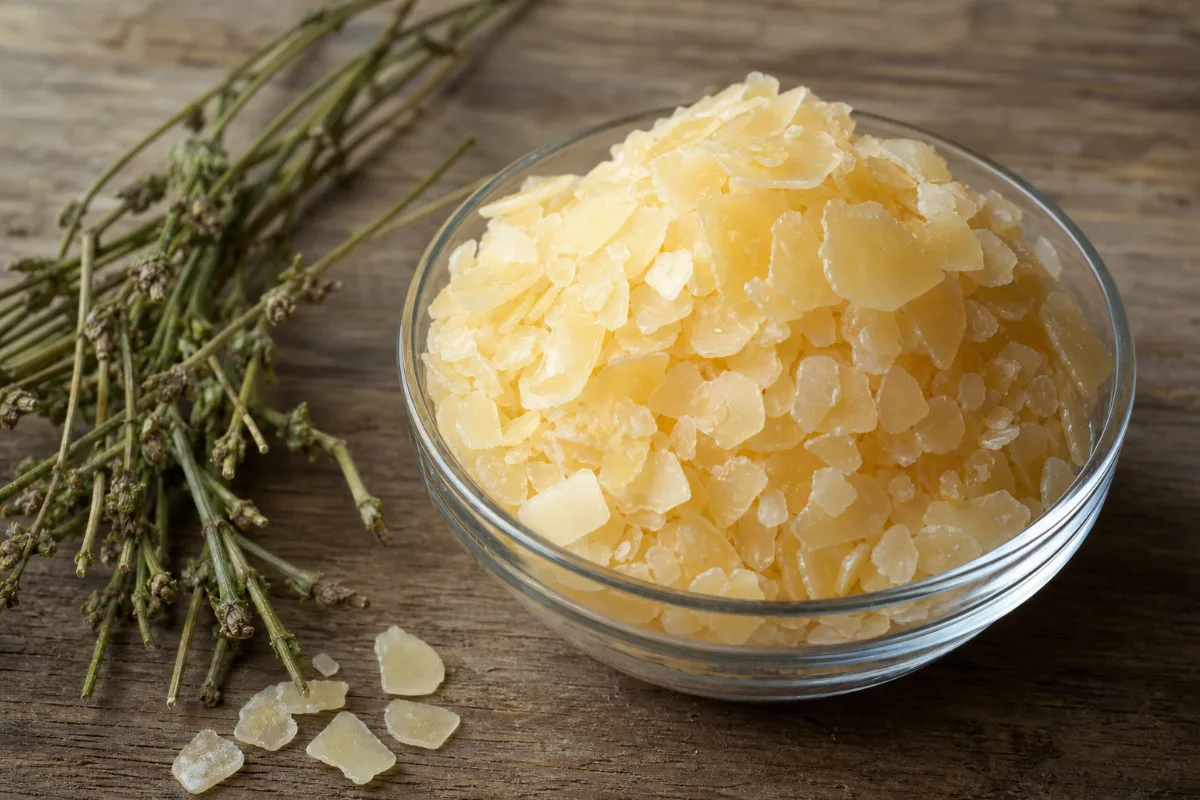
Natural Oils & Butters · Wax
Candelilla Wax
Euphorbia antisyphilitica Zucc. (also sold as Euphorbia cerifera) · also called Cera de candelilla, candelilla cera, E 902, vegan wax.
Candelilla wax is a hard wax that coats the stems of a desert shrub from northern Mexico and West Texas. It is used to firm up lip balms and lipsticks, as a plant alternative to beeswax, and as a glaze on sweets and in chewing gum (E 902). We found no human trial of any health benefit. A few case reports describe lip allergy, so patch test a balm or lipstick first.
General information, not medical advice. Last substantive update · Not medically reviewed. A named clinician has not signed off on this page. How this page is made
About Candelilla Wax
Candelilla wax is a hard plant wax collected from a Mexican desert shrub. It is used in lip balms, cosmetics, sweets and gum. The research is about its chemistry, food science and regulation, not health benefit. The main safety point is that allergy, mostly on the lips, has been reported.
What it is
Candelilla wax is the coating on the stems of Euphorbia antisyphilitica, a shrub of northern Mexico and West Texas. GBIF accepts this name and lists Euphorbia cerifera as a synonym, which is why both names appear on labels.
The wax is mostly hydrocarbons (about half, per the US rule) with smaller amounts of esters and free fatty acids. The exact mix varies between waxes.
How it is made
Harvesters pull the plants by hand. The stems are boiled in a vat with sulfuric acid and the wax is skimmed off the top. The raw wax, called cerote, is hardened, then melted again to remove water and sand. Only about 1.5 to 2.5 percent of the plant weight ends up as wax.
This description comes from a history page on the early Texas wax camps and from the US rule. Modern methods were not checked.
How it is used
Makers melt it with oils and butters to firm up lip balms, lipsticks and cosmetics. In food it is a glaze on sweets and a part of chewing gum base. Older uses included polishes, candles, inks and waterproofing.
The people who harvest it
Most candelilla wax comes from wild plants in northern Mexico. A search summary of a CITES fact sheet says Coahuila supplies about 80% of exported wax, drawing on roughly 230 ejidos (community land holdings) and 50 private ranches, with an estimated 3,500 to 20,000 harvesters. It also says legal harvest needs a permit and a forestry technician, and that some harvesters feel buyer prices are unfair.
We could not open those documents, so treat the figures as unconfirmed. A 2020 journal paper is also said to state that heavy harvesting appears to be slowly reducing wild populations. A fair-trade or sustainable label on a product is the seller's claim, not something we could check.
What the research shows
There is no good evidence on candelilla wax for chapped lips, dry skin or any health problem. No human study of it was found.
Lab food science shows it can gel oils and coat fruit. These findings are not health results.
Claims checked
"Vegan and natural, so it cannot cause allergy": allergy case reports exist, so patch test.
"Same as beeswax": both are waxes, but they differ in origin and makeup, and no study compared them on skin. Beeswax also has reports of contact allergy.
"Safe to eat because it is a food additive": regulators accept it as a glaze or gum ingredient at current uses. That does not make a craft or industrial wax suitable for food.
At a glance
Traditional uses history, not proof
- A history page lists lipstick, lip balm, chewing gum, polishes, candles and waterproofing among the uses of the wax from the early Texas and Mexican wax camps. It does not describe a medicine use.
Studied for research
- Lip and skin balm base, insufficient (a texture job, no trial)
- Food glazing and gum base, safety status only, not a health benefit
- Wax gels as a fat replacer in foods (lab only), very low
- Edible coating for fruit (lab only), very low
Main compounds
- Hydrocarbons (about 50 percent, per the US rule text)
- Wax esters
- Fatty alcohols
- Free fatty acids
Common forms
- Raw wax (cerote) skimmed from boiled stems
- Refined wax pellets or flakes
- Food-grade wax (E 902)
- Ingredient in lip balms, lipsticks and cosmetics
Research links: Candelilla wax in the US food rule (21 CFR 184.1976) · FAO/WHO food additive summary, candelilla wax · Allergic contact cheilitis due to candelilla wax (title only) · How the wax was made in the Texas wax camps · EU food additive opinion, E 902 (page blocked; extract read) · Research Library · Genes & Biomarkers Library
What it is and its history
- Accepted scientific name
- Euphorbia antisyphilitica
- Naming authority
- Zucc.
- Synonyms
- Euphorbia cerifera Alcocer
- Common names
- Candelilla (Spanish (Mexico), means little candle); Candelilla wax (English); Cera de candelilla (Spanish); E 902 (Food additive number)
- Family or group
- Euphorbiaceae (the spurge family)
- Classification
- Plantae > Tracheophyta > Magnoliopsida > Malpighiales > Euphorbiaceae > Euphorbia > Euphorbia antisyphilitica
- Native range
- Northern Mexico (Zacatecas, Nuevo Leon, Durango, Coahuila, Chihuahua) and West Texas, per a history page.
- Habitat
- Semi-desert (per a 2024 paper title on fungi of semidesert candelilla); not otherwise checked.
- What it looks like
- Roots: Not checked.; Stems: The wax coats the stems, per the history page.; Leaves: Not checked.; Flowers: Not checked.; Fruit: Not checked.
- Cultivation
- Wild-harvested in the sources read; cultivation not checked.
- Harvest and processing
- Harvesters pull plants by hand and haul them by burro to camp. Plants are boiled in a vat with sulfuric acid and the wax skimmed off as foam. The raw wax (cerote) is hardened in moulds, then melted again to remove water and sand. Yield about 1.5 to 2.5% of plant weight (Texas Beyond History, early 20th-century Texas camps).
- Look-alikes and adulterants
- Name: Carnauba wax, beeswax and other waxes; Note: Other waxes are also made of esters. They differ in origin and makeup. A 2026 lab paper compared the composition of beeswax, sunflower, rice bran, candelilla and carnauba wax.
- Sustainability and conservation
- A search-tool summary of CITES and journal documents says demand was once much higher, that current harvest is judged unlikely to threaten the species as a whole, and that a 2020 paper says intense harvesting appears to be gradually reducing natural populations. Not verified (documents blocked).
Traditional use and history history, not clinical proof
| Tradition or era | Documented use | Source |
|---|---|---|
| Wax camps of northern Mexico and West Texas | A museum history page describes hand harvest by candelilleros, boiling in sulfuric acid, and a refined wax sold for chewing gum, breath mints, lipstick and lip balm, as well as polishes, candles, inks, crayons, waterproofing and wartime uses. It does not give dates for the Mexican trade. | s-tbh-wax |
| Mexican harvest communities today (NOT VERIFIED) | A search summary of a CITES fact sheet says Coahuila supplies about 80% of exported candelilla wax, that harvesting draws on roughly 230 ejidos (community land holdings) plus 50 private ranches with an estimated 3,500 to 20,000 harvesters, that legal harvest needs a technician's assessment and a permit, and that some harvesters feel buyers' prices are unfair. The documents were not opened, so these figures are unconfirmed. Treat any fair-trade or sustainability label as the seller's claim. | s-cites-search |
Traditional use shows how it was used. It does not show that it works or is safe today.
What is inside, and how it may work
What it contains and how those compounds act in cells and animals. Laboratory and animal mechanisms are not proven effects in people.
Main compounds
| Compound | Family | Where it is concentrated | Activity studied | Level of evidence |
|---|---|---|---|---|
| Hydrocarbons | alkanes | Stem wax About 50 percent, per the US rule text. | Makes up half the wax. No health activity shown. 15 | Lab |
| Wax esters, fatty alcohols and free fatty acids | lipids | Stem wax Smaller amounts of esters and free acids, per the US rule. Proportions vary between waxes. | Give the wax its hardness. No health activity shown. 15 3 | Lab |
Mechanisms, receptors and pathways
| Target or pathway | Gene or receptor | What was found | Level |
|---|---|---|---|
| Oil gelling | n/a | Wax crystals set liquid oil into a gel. In a lab digestion model, an olive oil gel slowed fat breakdown. Not tested in people. 13 | Lab |
| Coating | n/a | A candelilla coating on apples gave intermediate gas resistance. 1 | Lab |
Absorption, metabolism and elimination
- Absorption
- Expected to be low (EU panel extract).
- Distribution
- Not described.
- Metabolism
- Absorbed components expected to join normal metabolic pathways (EU panel extract).
- Elimination
- Not described.
- Bioavailability
- Not measured in people. In a lab digestion model of an olive oil gel, vitamin E (alpha-tocopherol) bioavailability was 34% in the gel vs 16% in plain olive oil.
Isolated compounds versus whole extracts
The wax is not the plant. Only the stem coating is collected, and it is refined. Other plant parts and the sap are not part of the product.
Nutritional composition
It is not a nutrient. It is a wax with almost no absorption expected.
2 very low certainty2 not enough evidence
What was looked at
The 4 benefits and uses checked for Candelilla Wax, each with how strong the evidence is. Tap one to open it.
What is Candelilla Wax good for?
What the research shows for each use, and how strong it is. None of it is a proven health benefit. Read the Safety tab too.
Benefits, one by one
Each card is a research question, not a promise. Tap a goal to filter. Open a card to see the studies, doses and limits.
Lip and skin balm base (a vegan wax)
Not enough evidenceCandelilla wax is a hard plant wax. Makers melt it with oils and butters to firm up balms and lip products, as a plant alternative to beeswax. This is a texture job. No trial in people tested whether it helps lips or skin.
2 studiesHard wax, used as pellets or flakes melted into balms and lipsticks. …
Studies, doses and limits
Results
No result on skin or lip health. A lab method paper lists wax makeup (esters, fatty alcohols, fatty acids and hydrocarbons, in varying proportions). A history page lists lipstick and lip balm among its uses.
Why this rating
No human trial. Only use history and wax chemistry.
Form and dose studied
Hard wax, used as pellets or flakes melted into balms and lipsticks. No amounts are given here.
Who was studied
No human group studied.
Limits
A texture role is not a health benefit. History pages show use, not effect.
Why researchers looked
It is a hard wax made of long-chain esters, fatty alcohols, fatty acids and hydrocarbons, so it sets oils into a stick or balm.
Traditional use
Candelilla wax from Mexico and Texas has long been made for use in polishes, candles and, later, lip products. A history page lists lipstick and lip balm among its uses.
Proposed mechanism Pharmacological theory
Proposed, not tested for skin: a solid wax mixed into oils makes a firmer film. No study measured moisture loss or healing with candelilla wax.
A proposed mechanism does not show that the effect happens in people.
Allergy case reports exist, mostly on lips. Patch test first. See the Safety tab.
Food glazing and gum base (regulatory status, not a health benefit)
Not enough evidenceCandelilla wax is allowed as a shiny coating and chewing-gum ingredient. Regulators judged it acceptable at the amounts used in food. That is a safety finding for an additive, not a health benefit.
4 studiesFood-grade wax (E 902).
Studies, doses and limits
What the trials found
No health trial. Regulators reviewed it as an additive.
Results
The US rule affirms it as generally recognized as safe in chewing gum and hard candy at good manufacturing practice levels. The FAO/WHO committee (2005) found no safety concern at the predicted intake (under 650 mg per person per day) and listed the ADI as acceptable. The EU panel (2012) set no ADI because long-term toxicity data were missing, but did not find a genotoxic concern.
Why this rating
Not a health outcome. Regulatory statements only.
Form and dose studied
Food-grade wax (E 902).
Who was studied
General population eating foods that contain it.
Limits
The US rule covers only gum and hard candy. The EU opinion was read only as an extract.
Why researchers looked
It is used on sweets and in chewing gum to give gloss and body.
Proposed mechanism Authoritative guidance
Not applicable. It is not absorbed much, according to the EU panel's expectation.
A proposed mechanism does not show that the effect happens in people.
Not applicable.
Wax gels as a fat replacer in foods (lab food science)
Very low certaintyIn the lab, candelilla wax can set liquid oil into a soft gel. One olive oil and candelilla wax gel was more stable when frying and soaked into potato slices less than plain olive oil. This is food technology. No person ate it, so it says nothing about health.
2 studiesWax used as a gelling agent in oil. No amounts are given here.
Studies, doses and limits
Results
Olive oil-candelilla gel: 10.29% oil uptake in fried potato vs 14.51% for plain olive oil; lab fat breakdown 44% vs 54%; storage in the dark reduced oxidation, light increased it.
Effect sizes as reported
Lab values above.
Why this rating
Laboratory study; no human data.
Form and dose studied
Wax used as a gelling agent in oil. No amounts are given here.
Who was studied
No human group studied.
Limits
One lab study read in detail. A general review of wax gels does not name candelilla in its abstract.
Why researchers looked
Food scientists look for ways to replace solid animal fats and trans fats with gelled plant oils.
Proposed mechanism Laboratory research
Wax crystals trap oil in a network. In a lab digestion model, the gel slowed fat breakdown. Not tested in people.
A proposed mechanism does not show that the effect happens in people.
Lab food science only. Nobody ate these gels in the studies read.
Edible coating for fruit (lab)
Very low certaintyCandelilla wax has been tested as a coating on apples. In a 2002 study it changed the gas levels inside the fruit and the aroma compounds the fruit held. This is about storing fruit, not about human health.
1 studiesWax coating on fruit surface.
Studies, doses and limits
Results
Candelilla coating gave intermediate gas resistance and the highest levels of butyl acetate and 2-methylbutyl acetate; the tightest coatings caused fermentation in some apples.
Why this rating
Fruit storage experiment, not a health outcome.
Form and dose studied
Wax coating on fruit surface.
Who was studied
Apples (four varieties).
Limits
Old study; abstract only.
Why researchers looked
Wax coatings slow moisture and gas exchange in stored fruit.
Proposed mechanism Laboratory research
A wax layer slows gas exchange through the fruit skin. Measured in apples.
A proposed mechanism does not show that the effect happens in people.
Not applicable.
Connections to the rest of health
How Candelilla Wax connects to the rest of our health knowledge graph. Every link says what kind of connection it is. A safety link (for example to the liver) is a warning, not a benefit. A study that merely mentions a topic never creates a benefit link.
Explore every connection: goals, body systems, organs, symptoms, genes
A. Wellness goals
| Connected to | Kind of connection | Evidence status | Context | Studies |
|---|---|---|---|---|
| Healthy Skin | Not enough evidence | Lip and skin balm base (a vegan wax): Candelilla wax is a hard plant wax. Makers melt it with oils and butters to firm up balms and lip products, as a plant alternative to beeswax. This is a texture job. No trial in people tested whether it helps lips or skin. Food glazing and gum base (regulatory status, not a health benefit): Candelilla wax is allowed as a shiny coating and chewing-gum ingredient. Regulators judged it acceptable at the amounts used in food. That is a safety finding for an additive, not a health benefit. | 14 3 15 8 12 7 | |
| Metabolic Health | Very low certainty | Wax gels as a fat replacer in foods (lab food science): In the lab, candelilla wax can set liquid oil into a soft gel. One olive oil and candelilla wax gel was more stable when frying and soaked into potato slices less than plain olive oil. This is food technology. No person ate it, so it says nothing about health. | 13 6 | |
| Healthy Skin | Very low certainty | Edible coating for fruit (lab): Candelilla wax has been tested as a coating on apples. In a 2002 study it changed the gas levels inside the fruit and the aroma compounds the fruit held. This is about storing fruit, not about human health. | 1 |
B. Body systems
| Connected to | Kind of connection | Evidence status | Context | Studies |
|---|---|---|---|---|
| Skin Hair Beauty | Biological association | Not enough evidence | Studied for: Lip and skin balm base (a vegan wax) Studied for: Food glazing and gum base (regulatory status, not a health benefit) | 14 3 15 8 12 7 1 |
| Metabolism Weight | Biological association | Very low certainty | Studied for: Wax gels as a fat replacer in foods (lab food science) | 13 6 |
C. Body parts and organs
L. Active compounds
| Connected to | Kind of connection | Evidence status | Context | Studies |
|---|---|---|---|---|
| Hydrocarbons | Biological association | Lab | Makes up half the wax. No health activity shown. Preparation or compound: Stem wax |
15 |
| Wax esters, fatty alcohols and free fatty acids | Biological association | Lab | Give the wax its hardness. No health activity shown. Preparation or compound: Stem wax |
15 3 |
Each connection is stored with the ingredient, the connected record, the kind of connection, the evidence status, the supporting studies, the preparation or compound involved, and a review date (last reviewed October 25, 2026).
Evidence at a glance: what the research found for 4 outcomes
Each outcome below is one thing researchers measured. Certainty is how far the evidence can be trusted, not how well it works. The full studies are on the next tab.
The evidence
The research centre for Candelilla Wax. Every record here was checked against PubMed or the publisher's page; we never list a study we have not verified.
Evidence by outcome
Bars show how many studies we found for each outcome, not how well it works. People are added up across trials only (reviews are not added, to avoid double counting).
How we rate evidence
High certainty
Several well-run trials or reviews agree; further research is unlikely to change the picture much.
Moderate certainty
Good trials point the same way, but some doubt remains.
Low certainty
Small, short or inconsistent trials. The finding could change with better research.
Very low certainty
Very little or very weak human data. Treat as a possibility only.
Mixed findings
Trials or reviews disagree with each other.
Not enough evidence
Not enough human research to say either way.
Evidence against
Good research found no benefit, or found harm.
We take the reviewers' own risk-of-bias and GRADE statements where they exist, and otherwise judge from study size, design, consistency, directness and whether a product matches what is sold. Many publications do not make evidence high. Method note: We read PubMed records of 8 papers (abstracts where they exist; three case reports have titles only), the US food rule text, the FAO/WHO summary page and a history page, and checked the plant names in GBIF. The EU opinion and the CITES documents could not be opened, so those points are marked as unconfirmed. Certainty ratings are the compiler's own reading.
Study library: every study we checked 15
| Study | Design | People | Product, dose, length | Result |
|---|---|---|---|---|
| Bai 2002 Volatile response of four apple varieties with different coatings during marketing at room temperature. J Agric Food Chem · PMID 12475286 · DOI |
Lab food science lab |
Apples of four varieties, coated or uncoated | Candelilla coating among five experimental fruit coatings wax coating Not given here |
A candelilla coating and a carnauba-shellac mix gave intermediate gas resistance and the highest levels of two aroma esters (butyl acetate and 2-methylbutyl acetate). Coatings with the highest gas resistance caused fermentation in some apples. Methods, limits and fundingOutcomes: Gas levels inside fruit and aroma compounds Limitations: Old fruit-coating work; abstract only; not about human health. Funding and conflicts: Not stated in the abstract. Read: abstract |
| Barrientos 2013 Contact cheilitis caused by candelilla wax contained in lipstick. Contact Dermatitis · PMID 23869737 · DOI |
Case report |
Case report (details not read) | Candelilla wax in a lipstick (per title) stem coating wax Not given here |
Title reports contact cheilitis caused by candelilla wax in a lipstick. No abstract is held. Methods, limits and fundingOutcomes: Contact cheilitis (title) Limitations: Only the title and record were read. PubMed holds no abstract for this report, so the details (patch-test results, amounts, outcome) were not read. Funding and conflicts: Not stated in the record. Read: title-only |
| Brykczynski 2026 A novel, single-step LC-ELSD method to characterize the aliphatic fraction of natural waxes. Food Chem · PMID 41785768 · DOI |
Lab analysis lab |
Samples of beeswax, sunflower, rice bran, candelilla and carnauba wax | Candelilla wax among five natural waxes stem coating wax Not given here |
Natural waxes are made mainly of wax esters, fatty alcohols, fatty acids and hydrocarbons, and their proportions vary. The method agreed well with other data on the five waxes including candelilla. No percentages for candelilla are given in the abstract. Methods, limits and fundingOutcomes: Wax composition (esters, fatty alcohols, fatty acids, hydrocarbons) Limitations: Method paper; abstract only; no health outcome. Funding and conflicts: Authors declare no competing interests. Read: abstract |
| CITES Secretariat; MDPI Forests 2022 CITES and livelihoods fact sheet: Candelilla, Mexico, with CITES document PC18 Inf06 and a 2020 Forests paper (summary seen, documents not opened) CITES / MDPI (summaries only) · Source |
Search summary n/a |
Mexican candelilla harvest communities | Harvest of wild candelilla for wax stem coating wax Not given here |
A search-tool summary of these documents says: Coahuila supplies about 80% of exported candelilla wax; harvesting draws on roughly 230 ejidos (community land holdings) plus 50 private ranches, with an estimated 3,500 to 20,000 harvesters; legal harvest needs a forestry technician's assessment and a permit; some refiners pay for the technicians; some harvesters see buyers' prices as unfair. The PC18 paper is said to judge current harvest unlikely to threaten the species as a whole, while a 2020 Forests paper is said to state that intense harvesting appears to be gradually reducing natural populations. Methods, limits and fundingOutcomes: Who harvests, how it is regulated, pressure on wild plants Limitations: NOT VERIFIED. The three documents returned an access block and were not opened. Numbers come from a summary and may be wrong. Re-check before relying on them. Funding and conflicts: Documents from CITES and an academic journal; funding not read. Read: search-summary |
| Darrigade 2020 A peculiar case of sensitization to Candelilla Cera and sucrose (di)stearate in a toddler. Contact Dermatitis · PMID 31400015 · DOI |
Case report |
1 One toddler (per title) |
Candelilla cera and sucrose (di)stearate (per title) stem coating wax Not given here |
Title reports sensitization to candelilla cera and sucrose (di)stearate in a toddler. No abstract is held. Methods, limits and fundingOutcomes: Skin sensitization (title) Limitations: Only the title and record were read. PubMed holds no abstract for this report, so the details (patch-test results, amounts, outcome) were not read. The title also names a second ingredient, so the wax may not be the only cause. Funding and conflicts: Not stated in the record. Read: title-only |
| Dimakopoulou-Papazoglou 2025 Natural Waxes as Gelators in Edible Structured Oil Systems: A Review. Gels · PMID 40868786 · DOI |
Review lab |
Review of natural-wax oleogels and bigels | Natural waxes as oil gelators (candelilla not named in the abstract) waxes in general Not given here |
The review describes using natural waxes to make oleogels and bigels as a way to replace trans and saturated fats in foods. The abstract does not name candelilla and does not report health outcomes. Methods, limits and fundingOutcomes: Use of wax gels to replace trans and saturated fats in foods Limitations: Food-technology review; abstract only read; no health outcome. Funding and conflicts: Authors declare no conflicts of interest. Read: abstract |
| EFSA Panel on Food Additives and Nutrient Sources added to Food (ANS) 2012 Scientific Opinion on the re-evaluation of candelilla wax (E 902) as a food additive EFSA Journal 10(11):2946 · Source · DOI |
Authoritative guidance n/a |
n/a | Candelilla wax (E 902) as a food additive stem coating wax Not given here |
The panel expected absorption to be low and judged the wax not genotoxic on the data available. It set no acceptable daily intake because long-term toxicity data on candelilla wax were lacking, but noted that toxicity studies on the main components reported no findings, and that exposure estimates left sufficient margins of safety. It noted limited data comparing the tested wax with the additive specification. Methods, limits and fundingOutcomes: EU food additive safety Limitations: The publisher page returned an access block (403). These points come from an extract of the opinion shown by a search tool, not from the full opinion. Treat as not fully verified. Funding and conflicts: Independent EU panel. Read: search-extract |
| FAO/WHO Joint Expert Committee on Food Additives 2005 Candelilla wax: JECFA evaluation summary (INCHEM) IPCS INCHEM · Source |
Authoritative guidance n/a |
n/a | Candelilla wax (INS 902) as a food additive stem coating wax Not given here |
The summary page lists candelilla wax as INS 902 with functions as glazing agent, chewing gum base component, surface finishing agent and flavour carrier. Latest evaluation 2005, ADI listed as acceptable, with the comment: no safety concern at the predicted dietary exposure (less than 650 mg/person per day). Methods, limits and fundingOutcomes: Food additive safety Limitations: Summary page only; the full monograph was not opened. Funding and conflicts: Expert committee of FAO and WHO. Read: summary-page |
| GBIF Secretariat 2026 GBIF Backbone Taxonomy: Euphorbia antisyphilitica Zucc. GBIF API · Source |
Database n/a |
n/a | Name check stem coating wax Not given here |
GBIF API match on 2026-10-25: Euphorbia antisyphilitica Zucc., usageKey 3069440, status ACCEPTED, family Euphorbiaceae, order Malpighiales. Methods, limits and fundingOutcomes: Accepted name Limitations: Database lookup only. Funding and conflicts: n/a Read: api |
| GBIF Secretariat 2026 GBIF Backbone Taxonomy: Euphorbia cerifera Alcocer GBIF API · Source |
Database n/a |
n/a | Name check stem coating wax Not given here |
GBIF API match on 2026-10-25: Euphorbia cerifera Alcocer, usageKey 3069441, status SYNONYM of Euphorbia antisyphilitica (accepted key 3069440). Methods, limits and fundingOutcomes: Name status Limitations: Database lookup only. Funding and conflicts: n/a Read: api |
| Han 2023 Allergic Contact Cheilitis due to Candelilla Wax. Dermatitis · PMID 37145882 · DOI |
Case report |
Case report (details not read) | Candelilla wax in a lip product (details not read) stem coating wax Not given here |
Title reports allergic contact cheilitis (lip inflammation) due to candelilla wax. No abstract is held, so nothing further is stated here. Methods, limits and fundingOutcomes: Allergic lip inflammation (title) Limitations: Only the title and record were read. PubMed holds no abstract for this report, so the details (patch-test results, amounts, outcome) were not read. Funding and conflicts: Not stated in the record. Read: title-only |
| Joint FAO/WHO Expert Committee on Food Additives 2006 Evaluation of certain food additives (WHO Technical Report Series 934). World Health Organ Tech Rep Ser · PMID 17069402 |
Authoritative guidance n/a |
n/a | Candelilla wax is among the additives evaluated stem coating wax Not given here |
The record states the committee evaluated candelilla wax among other additives to recommend acceptable daily intakes and specifications. The abstract gives no candelilla finding; the JECFA summary page does. Methods, limits and fundingOutcomes: Safety evaluation of food additives Limitations: Abstract only; the report itself was not opened. Funding and conflicts: Expert committee of FAO and WHO. Read: abstract |
| Kutahneci 2025 Evaluation of Frying Performance, Storage Stability, and In Vitro Digestion of Extra Virgin Olive Oil-Candelilla Wax Oleogel. J Food Sci · PMID 40641176 · DOI |
Lab food science lab |
Lab samples; potato slices fried in oil or gel; lab digestion model | Extra virgin olive oil gelled with candelilla wax (oleogel) wax (as gelling agent) Not given here |
The oleogel was more stable than plain olive oil when frying. Potato slices took up 10.29% oil in gel vs 14.51% in olive oil. In the lab digestion model fat breakdown was 44% for the gel vs 54% for olive oil. Light speeded oxidation; dark storage reduced it. Oil uptake 10.29% vs 14.51% (lab) Methods, limits and fundingOutcomes: Frying stability, 90-day storage oxidation, oil uptake, in vitro digestion Limitations: Laboratory food science; no person ate it. Digestion was a lab model. Funding and conflicts: Authors declare no conflicts of interest. Read: abstract |
| Texas Beyond History Candelilla wax camps: techniques (Texas Beyond History) Texas Beyond History (web page) · Source |
History source n/a |
n/a | Candelilla stems boiled with sulfuric acid to produce wax stem coating wax Not given here |
Candelilla (Euphorbia antisyphilitica, also described as E. cerifera) grows in northern Mexico and West Texas. Harvesters pull plants by hand and bring them to camp by burro. The plants are boiled in a vat with sulfuric acid and the wax is skimmed off as foam, hardened as raw wax (cerote) and later melted to remove sand and water. Yield is about 1.5 to 2.5% of plant weight. The page lists chewing gum, breath mints, lipstick and lip balm among many uses, plus polishes, candles, inks and waterproofing. Methods, limits and fundingOutcomes: How the wax was traditionally made and used Limitations: A museum-style history page of the early 20th-century Texas wax camps; modern Mexican production was not described. Date not shown. Funding and conflicts: Educational web page. Read: full-page |
| US Food and Drug Administration 2024 21 CFR 184.1976 Candelilla wax (US eCFR, 2024-04-01 edition) Code of Federal Regulations · Source |
Authoritative guidance n/a |
n/a | Candelilla wax as a food ingredient stem coating wax Not given here |
The rule describes candelilla wax as obtained from the candelilla plant by immersing plants in boiling water with sulfuric acid and skimming off the wax, with about 50 percent hydrocarbons and smaller amounts of esters and free acids. It affirms the wax as generally recognized as safe as a lubricant and surface-finishing agent in chewing gum and hard candy, at levels not above good manufacturing practice. The rule dates from 1983. Methods, limits and fundingOutcomes: US food status Limitations: Covers only chewing gum and hard candy. Says nothing about skin or lip products. Funding and conflicts: Government text. Read: full-text |
What we do not know yet
- What the evidence supports: insufficient for every use. No human trial of candelilla wax was found.
- How common allergy is; patch-test details of the case reports (only titles read).
- No data on pregnancy, breastfeeding, babies or pets.
- EU panel wording read only as an extract; CITES and harvest-community figures are from a summary and unconfirmed; the 1984 cosmetic safety report was not read.
How new research is added
New studies are found by a saved PubMed search and placed in a review queue. A person reads each one before it changes any rating or safety wording.
Lab markers
What changed in blood or saliva tests during trials. A changed number is not the same as feeling or being healthier, and we give no "normal ranges".
Safety
What studies and official sources say about side effects, medicines and who should check first. Each point shows what kind of evidence it comes from.
Main points to know 4
- Allergy to candelilla wax is reported, mostly on the lips. PubMed lists case reports titled as allergic contact cheilitis (lip inflammation) due to candelilla wax, contact cheilitis from candelilla wax in a lipstick, and sensitization to candelilla cera in a toddler. Only the titles could be read, so how common this is, and what exactly was tested, is not known. Such reports look rare. Case report 11 2 5
- Accepted as a food additive at current uses. The US allows it in chewing gum and hard candy at good manufacturing practice levels. The FAO/WHO committee found no safety concern at the predicted intake. The EU panel set no acceptable daily intake because long-term toxicity data were lacking, but did not find a genotoxic concern. Authoritative guidance 15 8 7
- Patch test first, especially for lip products. If your lips or skin have reacted to a balm or lipstick, a wax such as candelilla could be one cause among many ingredients. Ask a doctor or allergist, who can patch test the separate ingredients. Expert opinion 11
- Grade matters. Traditional wax making boils the stems with sulfuric acid, and the US rule describes this. Food, cosmetic and industrial grades differ, and the EU panel noted limited data comparing the tested wax with the additive specification. Authoritative guidance 15 7
Side effects 1
| Effect | How often | Severity and recovery | Evidence |
|---|---|---|---|
| Allergic contact reaction (lip inflammation, skin sensitization) Details such as patch-test results were not available, because PubMed holds no abstracts for these reports. The toddler report names a second ingredient as well, so the wax may not be the only cause. | Not known; reports look rare | Not known Not known | Case report 11 2 5 |
Liver
No source read describes liver injury from candelilla wax. LiverTox was not checked.
How often. Not known.
This is a safety connection. It is not evidence that Candelilla Wax supports liver health.
Medicines and supplements 2
| With | Why it matters | Importance | Evidence | What to do |
|---|---|---|---|---|
| Prescription and over-the-counter medicines prescription | No interaction mechanism was described in the sources read. The EU panel expected low absorption. | None documented in the sources read. | Insufficient Not enough evidence 7 | Tell your pharmacist what you use on your lips or skin if you also use medicated products. |
| Other lip and skin products other-topical | Not studied. | Not known. Balms and lipsticks contain many ingredients, so a reaction cannot be traced to one without testing. | Insufficient Not enough evidence | Introduce one new product at a time so a reaction can be traced. |
Who should check first 2
| Situation | Advice | Evidence |
|---|---|---|
| Earlier reaction to a lip balm, lipstick or wax-containing product | Ask a doctor or allergist before using products with candelilla wax. Reports exist of allergy to it, but only titles were read. | Case report 11 2 |
| Broken, weeping or very inflamed skin or lips | Ask a doctor or pharmacist before putting any new wax product on it. No source covers this for candelilla wax. | Expert opinion |
Overdose, product quality and regulators
Summary. The EU panel expected absorption of the wax to be low and judged it not genotoxic on available data. It set no ADI because long-term toxicity data on the wax were lacking. The FAO/WHO committee saw no concern at predicted intakes.
Animal. Not reviewed here.
High dose or long term signals. Long-term toxicity data on candelilla wax were described as lacking by the EU panel.
Overdose response. Not described.
Genotoxicity. EU panel: not genotoxic on available data (extract read).
Toxic or hazardous parts. Candelilla is a spurge (Euphorbia). Many Euphorbia plants have irritating sap, but no source read describes the sap of this plant. The wax is the coating of the stems, collected by boiling.
The wax is made by boiling stems with sulfuric acid, as the US rule and a history page describe. Grades vary, and the EU panel noted limited data comparing the tested wax with the food additive specification.
Production with sulfuric acid. The US rule says the wax is prepared by immersing the plants in boiling water containing sulfuric acid and skimming off the wax. A history page describes the same camp method. Modern methods were not checked. 15 14
Composition varies. A 2026 lab method paper says natural waxes vary in the proportions of esters, fatty alcohols, fatty acids and hydrocarbons. 3
Specification gap. The EU panel noted limited data comparing the tested wax with the additive specification (extract read). 7
| Body | Action | Date |
|---|---|---|
| US FDA (21 CFR 184.1976) (United States) | Affirmed as generally recognized as safe as a lubricant and surface-finishing agent in chewing gum and hard candy, at levels not above good manufacturing practice. source | 1983-11-10 |
| FAO/WHO Joint Expert Committee on Food Additives (JECFA) (International) | INS 902. Latest evaluation 2005: ADI listed as acceptable; no safety concern at predicted dietary exposure (less than 650 mg per person per day). source | 2005 |
When to get medical help
- Swelling of the lips, tongue or face, wheezing, or trouble breathing after contact: get emergency help.
- Painful, cracked, blistering or spreading rash on the lips or skin: stop using the product and see a doctor.
- If a child has swallowed a large amount of a balm or wax, call a poison control centre.
Stop using the product and contact a clinician or emergency service. In the US, Poison Control is 1-800-222-1222.
General information only, not medical advice. Ask a clinician or pharmacist before use, especially with medicines, in pregnancy or with a health condition. See the Natural Remedy Safety guide.
Frequently asked questions
What is candelilla wax?
Is candelilla wax the same as E 902?
Is candelilla wax safe to eat?
Can candelilla wax cause an allergic reaction?
Is candelilla wax a good vegan substitute for beeswax?
Does candelilla wax heal chapped lips or skin?
No trial tested it. It is a texture ingredient in balms.
Where does candelilla wax come from?
Is candelilla wax sustainable?
We could not confirm it. A summary of CITES material says current harvest is judged unlikely to threaten the species as a whole, while a 2020 paper is said to report slow loss of wild plants. Treat labels as the seller's claim.
How is candelilla wax made?
Is it safe in pregnancy, for babies or for pets?
No source read covers pregnancy, breastfeeding, babies or pets. Ask a doctor, pharmacist or vet.
Is candelilla wax comedogenic?
We found no source that rates it for clogging pores. No acne study was found.
Explore by health goal
Editorial transparency
- Written by
- AlternativeMed editorial team. Research compiled with AI assistance, then checked against PubMed records.
- Medical review
- None. This page has not been reviewed by a physician or pharmacist.
- First published
- 2026-10-25
- Last substantive update
- 2026-10-25
- How we research
- We read PubMed records of 8 papers (abstracts where they exist; three case reports have titles only), the US food rule text, the FAO/WHO summary page and a history page, and checked the plant names in GBIF. The EU opinion and the CITES documents could not be opened, so those points are marked as unconfirmed. Certainty ratings are the compiler's own reading.
- How we rate evidence
- See "How we rate evidence" in the Evidence tab.
- Independence
- No product is promoted on this page. No affiliate links are shown.
Sources 15
Each source was opened and checked. Where we read only the abstract, it says so. The small numbers in the text point here.
- Bai J, Hagenmaier RD, Baldwin EA. Volatile response of four apple varieties with different coatings during marketing at room temperature.. J Agric Food Chem. 2002. PMID 12475286. DOI 10.1021/jf020543n. (abstract)
- Barrientos N, Abajo P, Moreno de Vega M et al. Contact cheilitis caused by candelilla wax contained in lipstick.. Contact Dermatitis. 2013. PMID 23869737. DOI 10.1111/cod.12080. (title-only)
- Brykczynski H, Rudolph-Flöter ESJ, Schreiber V et al. A novel, single-step LC-ELSD method to characterize the aliphatic fraction of natural waxes.. Food Chem. 2026. PMID 41785768. DOI 10.1016/j.foodchem.2026.148570. (abstract)
- CITES Secretariat; MDPI Forests. CITES and livelihoods fact sheet: Candelilla, Mexico, with CITES document PC18 Inf06 and a 2020 Forests paper (summary seen, documents not opened). CITES / MDPI (summaries only). 2022. (search-summary)
- Darrigade AS, Dendooven E, Mangodt E et al. A peculiar case of sensitization to Candelilla Cera and sucrose (di)stearate in a toddler.. Contact Dermatitis. 2020. PMID 31400015. DOI 10.1111/cod.13381. (title-only)
- Dimakopoulou-Papazoglou D, Zampouni K, Katsanidis E. Natural Waxes as Gelators in Edible Structured Oil Systems: A Review.. Gels. 2025. PMID 40868786. DOI 10.3390/gels11080656. (abstract)
- EFSA Panel on Food Additives and Nutrient Sources added to Food (ANS). Scientific Opinion on the re-evaluation of candelilla wax (E 902) as a food additive. EFSA Journal 10(11):2946. 2012. DOI 10.2903/j.efsa.2012.2946. (search-extract)
- FAO/WHO Joint Expert Committee on Food Additives. Candelilla wax: JECFA evaluation summary (INCHEM). IPCS INCHEM. 2005. (summary-page)
- GBIF Secretariat. GBIF Backbone Taxonomy: Euphorbia antisyphilitica Zucc.. GBIF API. 2026. (api)
- GBIF Secretariat. GBIF Backbone Taxonomy: Euphorbia cerifera Alcocer. GBIF API. 2026. (api)
- Han J, Warshaw EM. Allergic Contact Cheilitis due to Candelilla Wax.. Dermatitis. 2023. PMID 37145882. DOI 10.1089/derm.2023.0062. (title-only)
- Joint FAO/WHO Expert Committee on Food Additives. Evaluation of certain food additives (WHO Technical Report Series 934).. World Health Organ Tech Rep Ser. 2006. PMID 17069402. (abstract)
- Kutahneci E, Yalcin H. Evaluation of Frying Performance, Storage Stability, and In Vitro Digestion of Extra Virgin Olive Oil-Candelilla Wax Oleogel.. J Food Sci. 2025. PMID 40641176. DOI 10.1111/1750-3841.70405. (abstract)
- Texas Beyond History, University of Texas. Candelilla wax camps: techniques (Texas Beyond History). Texas Beyond History (web page). . (full-page)
- US Food and Drug Administration. 21 CFR 184.1976 Candelilla wax (US eCFR, 2024-04-01 edition). Code of Federal Regulations. 2024. (full-text)
Where to buy
Check the label first. Whatever you buy, look for these:
- 100% pure with no added fragrance or fillers
- Cold-pressed or unrefined if you want the most natural form
- For skin use, do a small patch test first
- Cosmetic or food grade, matched to how you will use it
Talk to a pharmacist or doctor before you start any supplement, especially if you take medicines. See the Safety tab for interactions.
Support our free guides: as an Amazon Associate we earn from qualifying purchases. Full disclosure.


