Natural Oils & Butters · Wax
Carnauba Wax
Copernicia prunifera (Mill.) H.E.Moore (leaf wax); synonym Copernicia cerifera · also called Brazil wax, palm wax, cera carnauba, E903.
Carnauba wax is a hard plant wax taken from the leaves of a Brazilian palm. It is used as a glaze on sweets, nuts, coffee beans and fruit, and to firm up lipsticks, lip balms and mascara. US law and the UN food-additive committee accept it as a glaze. It is not a proven cholesterol remedy, and a few people get an allergic rash from it.
General information, not medical advice. Last substantive update · Not medically reviewed. A named clinician has not signed off on this page. How this page is made
About Carnauba Wax
Carnauba wax is a hard, glossy plant wax scraped from palm leaves in north-east Brazil. It is mainly a food glaze and a cosmetic hardener, not a medicine. Regulators accept it as a glaze, but long-term toxicity data are limited. Cholesterol claims come from a different product, sugarcane policosanol, and the results disagree.
What it is
Carnauba wax is a wax from the leaves (and buds) of the Brazilian wax palm. GBIF accepts the palm as Copernicia prunifera, in the palm family. The older name Copernicia cerifera is a synonym, and the US law text still uses it.
US law describes the wax as hard and brittle, insoluble in water, sold in five grades. It is mostly saturated fatty acids and alcohols with 24 to 32 carbon atoms. A food review calls it mostly esters that are inert and stable.
How it is used
In food, it is a glaze on confectionery, chocolate-coated bakery, snacks, nuts and coffee beans, and a surface treatment on fresh fruit, as the 2012 news report describes. The US list covers baked goods, chewing gum, confections, fruits, sauces and soft candy.
In cosmetics, it is used to firm sticks, balms and mascara. The food review describes research on fruit coatings, edible films and water-repellent, biodegradable packaging.
What the research shows
We found no trial in people of carnauba wax for any health use. The studies are about coatings, mouse work on compounds taken from the wax, and one fat-cell test in a dish.
The cholesterol claim belongs to policosanol, a group of waxy alcohols usually taken from sugarcane. A 2018 meta-analysis of 22 studies found lower LDL, while a 2006 German trial of 143 people found no effect beyond placebo. Neither tested carnauba wax.
Claims checked
"Carnauba wax lowers cholesterol": the human evidence is for sugarcane policosanol and it is mixed. Mouse studies used isolated compounds, not the wax.
"Carnauba wax is an inert, harmless coating": regulators accept current uses, but EFSA noted missing long-term toxicity data, and allergy case reports exist.
"Carnauba harvest supports Brazilian communities": a survey of 36 leaf extractors in two communities found income rose with the number of leaves extracted. It did not measure fairness of pay. A genetics paper says habitat is shrinking and there is no sustainable management plan. Treat sustainability labels as the seller's claim.
Where it comes from
The wax is made from leaves that local extractors collect in rural Brazil. A powder is taken from the leaves and made into wax. New leaves sell for the most because they give the most powder.
The survey covered about 80 thousand palms in two communities. Leaves are also used for fertilizer and building. The genomics study says the palm's natural habitats are being reduced and calls for conservation efforts.
At a glance
Traditional uses history, not proof
- No traditional medicinal use is described in the sources read. A survey of 36 leaf extractors in Brazil says the leaf is used to make wax, and also for fertilizer and building.
Studied for research
- Food glaze and fruit coating, low (regulatory use; one tomato study)
- Hardening lip and makeup products, insufficient (no benefit study)
- Cholesterol-lowering claims (policosanol), insufficient (trials are on sugarcane and disagree)
- Cholesterol in mice given compounds from the wax, very-low (animal only)
- Fat-cell effects in a dish, insufficient (the dish test went the wrong way)
Main compounds
- Long-chain saturated fatty acids and alcohols (C24 to C32)
- Wax esters
- Cinnamic acid diesters (studied in mice)
Common forms
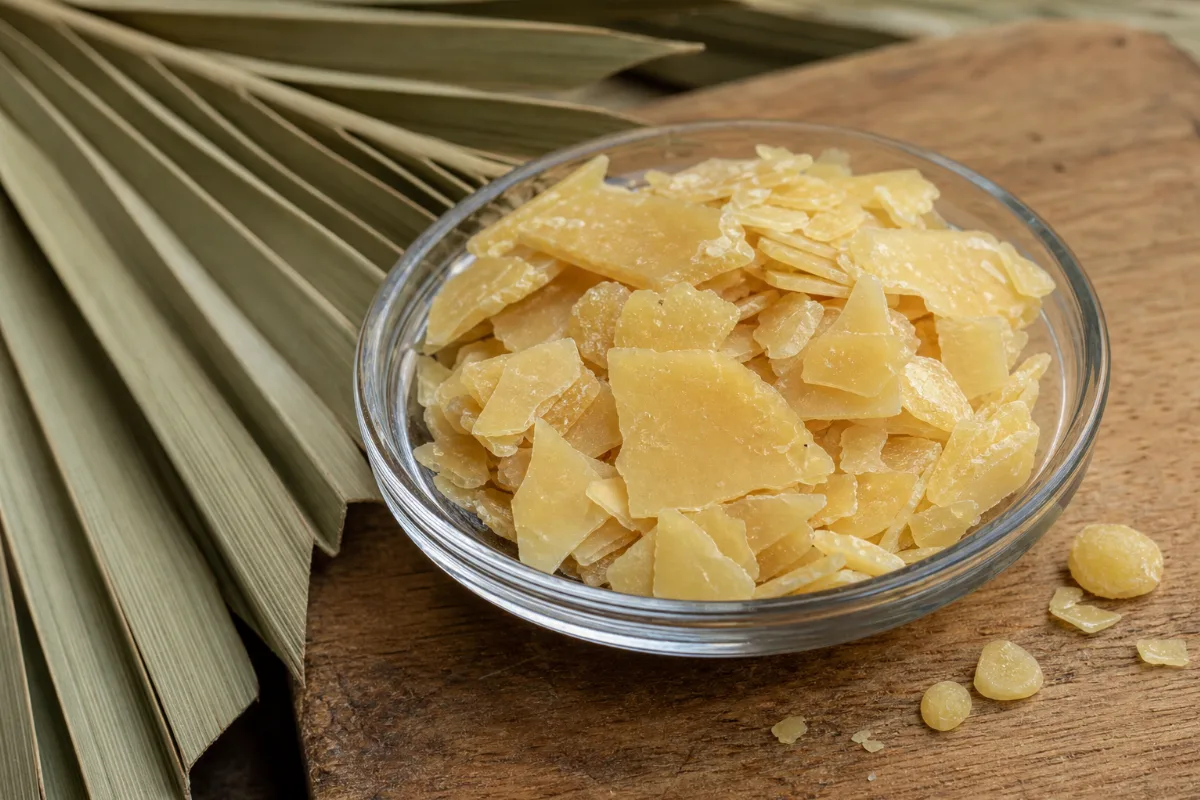
- Raw wax flakes or powder from leaves
- Refined and food-grade wax
- Glaze on sweets, nuts, coffee beans and fruit
- Cosmetic wax in sticks, balms and mascara
Research links: US law on carnauba wax in food (21 CFR 184.1978) · UN food additive committee summary, INS 903 · News report on the 2012 EFSA opinion · Carnauba wax uses in food, review (abstract) · Sugarcane policosanol trial, no cholesterol effect (abstract) · Leaf extractors in Brazilian communities (abstract) · Research Library · Genes & Biomarkers Library
What it is and its history
- Accepted scientific name
- Copernicia prunifera
- Naming authority
- (Mill.) H.E.Moore
- Synonyms
- Copernicia cerifera (Arruda) Mart.
- Common names
- Carnauba (en); Carnauba wax (en); Brazil wax (en); Cera carnauba (es); Carnauba, carnaúba (pt)
- Family or group
- Arecaceae (palm family)
- Classification
- Plantae > Arecaceae > Copernicia > Copernicia prunifera
- Native range
- Native to Brazil, per the genomics paper.
- Habitat
- Not checked beyond the sources below.
- What it looks like
- Roots: Not checked.; Stems: Not checked.; Leaves: The wax comes from the leaves (and buds, per US law).; Flowers: Not checked.; Fruit: Not checked.
- Cultivation
- The genomics paper says wild habitat is shrinking and there is no sustainable management plan.
- Harvest and processing
- Communities collect leaves, from which a powder is extracted to make wax (ethnobiology survey of 36 extractors). The US regulation describes the wax as hard and brittle, sold in five grades. Processing steps were not described in the sources read.
- Look-alikes and adulterants
- Name: Candelilla wax; Note: Another plant wax used as a glaze and in cosmetics, from a different plant. Not compared in the sources read.
- Sustainability and conservation
- The 2022 genomics paper says habitat reduction and the absence of a sustainable management plan have compromised the palm populations and calls for conservation efforts.
Traditional use and history history, not clinical proof
| Tradition or era | Documented use | Source |
|---|---|---|
| Modern use as described by regulators and reviews | The wax is used as a food glaze, a surface coating and a cosmetic hardener. The sources read do not describe a traditional medicinal use. | s-fda-184-1978 |
| Rural Brazil today | Leaves are harvested by local extractors, who sell them for wax production; leaves are also used for fertilizer and building. | p33752732 |
Traditional use shows how it was used. It does not show that it works or is safe today.
What is inside, and how it may work
What it contains and how those compounds act in cells and animals. Laboratory and animal mechanisms are not proven effects in people.
Main compounds
| Compound | Family | Where it is concentrated | Activity studied | Level of evidence |
|---|---|---|---|---|
| Long-chain saturated fatty acids and alcohols (C24 to C32) | wax lipids | Leaf wax Described as the main part of commercial grades (US regulation). | Give hardness and a high-gloss finish; not studied for health effects in the sources read. 14 | Authoritative guidance |
| Esters | wax esters | Leaf wax Described as predominant (food review abstract). | Inert and stable, per the review abstract. 16 | Review |
| Cinnamic acid diesters (p-methoxycinnamic and p-hydroxycinnamic diesters) | phenolic esters | Leaf wax | Isolated compounds lowered cholesterol in mice on a high-fat diet; not tested in people. 11 13 | Animal research |
Mechanisms, receptors and pathways
| Target or pathway | Gene or receptor | What was found | Level |
|---|---|---|---|
| Cholesterol handling in the liver (mouse) | LCAT, liver X receptor | Isolated wax compounds raised LCAT and liver X receptor gene activity in high-fat-fed mice, alongside lower cholesterol and LDL. A computer model found the compound fits the LCAT enzyme. Not shown in people. 11 13 | In vivo |
Absorption, metabolism and elimination
- Absorption
- Not described in the sources read.
- Distribution
- Not described.
- Metabolism
- Not described.
- Elimination
- Not described.
- Bioavailability
- Not described.
Isolated compounds versus whole extracts
Mouse studies used isolated cinnamic acid diesters from the wax, not the whole wax. Policosanol trials used sugarcane wax alcohols. Neither tells us about the wax used as a glaze or in cosmetics.
Nutritional composition
Used in tiny amounts as a surface coating; not a food source of nutrients. Not studied in the sources read.
1 low certainty1 very low certainty3 not enough evidence
What was looked at
The 5 benefits and uses checked for Carnauba Wax, each with how strong the evidence is. Tap one to open it.
- Food glaze and fruit coatingLow certainty
- Hardening lip and makeup productsNot enough evidence
- Cholesterol-lowering claims (policosanol)Not enough evidence
- Cholesterol in mice given compounds from the waxVery low certainty
- Fat-cell effects in a dishNot enough evidence
Lab markers tracked in the studies
LDL cholesterol (policosanol trials)
What is Carnauba Wax good for?
What the research shows for each use, and how strong it is. None of it is proven in people for carnauba wax. Read the Safety tab too.
Benefits, one by one
Each card is a research question, not a promise. Tap a goal to filter. Open a card to see the studies, doses and limits.
Food glaze and fruit coating
Low certaintyCarnauba wax is a legal food glaze (E903). In one lab test on tomatoes, a fine carnauba coating cut water loss and gave a glossier fruit that tasters preferred. This is about how food looks and keeps, not about health.
3 studiesA fine wax emulsion or nanoemulsion coating on fruit; wax glaze on sw…
Studies, doses and limits
What the trials found
No human health trial. Regulators judged its safety as a glaze (see Safety tab). One lab trial on tomatoes and a review of food uses.
Results
Uncoated tomatoes lost the most water. Firmness, ethylene and breathing rate were not largely changed by the coatings. Fruit with the nanoemulsion coating was glossiest and preferred by consumers.
Effect sizes as reported
No effect sizes in the abstract.
Why this rating
One small lab study on one tomato variety and a narrative review. It describes a food-handling use, not a health benefit.
Form and dose studied
A fine wax emulsion or nanoemulsion coating on fruit; wax glaze on sweets, nuts and coffee beans. No amounts given here.
Who was studied
Tomatoes (storage test) and a taster panel.
Limits
One fruit, 15 days, and a coating the authors developed. Industry reviews of uses are not safety trials.
Why researchers looked
The wax is hard, water-repellent and stable, so it is studied as a coating that slows drying and adds shine.
Traditional use
The sources read describe the wax as scraped from the leaves of a Brazilian palm and used as a glaze, polish and hardener. No traditional medicinal use is described in the sources read.
Proposed mechanism Physical property
A thin wax layer on the surface can slow water loss and make the surface shiny. Tested on tomatoes in one study.
A proposed mechanism does not show that the effect happens in people.
Regulators accept it as a glaze at current uses; long-term toxicity data are limited (EFSA 2012). See the Safety tab.
Hardening lip and makeup products
Not enough evidenceCarnauba wax is used to make lipsticks, lip balms and mascara firm and glossy. No trial tested whether it does anything for skin or lips. The evidence we found about it in cosmetics is case reports of allergy.
3 studiesWax ingredient in sticks, balms and mascara. No amounts given here.
Studies, doses and limits
Results
No benefit result. Case reports (titles only): allergic contact cheilitis from carnauba wax in a lip balm (2013); allergic contact dermatitis to propolis and carnauba wax from a lip balm and chewable vitamins in a child (2008); allergic contact dermatitis from prime yellow carnauba wax and coathylene in a mascara (2002).
Why this rating
No study measured any skin or lip benefit. The only published papers found are allergy case reports.
Form and dose studied
Wax ingredient in sticks, balms and mascara. No amounts given here.
Who was studied
No benefit study group; case reports of single patients.
Limits
A case report cannot show how common an allergy is. Abstracts were not available for the three case reports, so only their titles were read.
Why researchers looked
It has a high melting point and is hard, so makers use it to give structure to stick and wax products.
Traditional use
The sources read describe the wax as scraped from the leaves of a Brazilian palm and used as a glaze, polish and hardener. No traditional medicinal use is described in the sources read.
Proposed mechanism Pharmacological theory
Proposed, not tested in the sources read: a hard wax stiffens oils and waxes in a stick or cream.
A proposed mechanism does not show that the effect happens in people.
Patch test a new product with carnauba wax first. See the Safety tab.
Cholesterol-lowering claims (policosanol)
Not enough evidencePolicosanol is a mix of waxy alcohols sold for cholesterol. Most of what has been tested is made from sugarcane, not carnauba wax, and results disagree: a meta-analysis found lowering, a large German trial found none. No trial in people tested carnauba wax.
2 studiesPolicosanol supplements of various makes; amounts are not given here.
Studies, doses and limits
Results
Meta-analysis (22 studies, 1,886 people): sugarcane policosanol significantly lowered total cholesterol and LDL and raised HDL versus placebo, with no significant effect on triglycerides or weight, high heterogeneity and larger effects in Cuban studies. German trial (143 people): no significant difference from placebo on LDL or any other lipid.
Effect sizes as reported
See the study records for ranges. Total cholesterol -0.87 to -0.30 mmol/L and LDL -1.02 to -0.40 mmol/L in the meta-analysis (95% CI).
Why this rating
The studies are on sugarcane policosanol and disagree with each other. Nothing is known for carnauba wax in people, so the rating for carnauba is insufficient.
Form and dose studied
Policosanol supplements of various makes; amounts are not given here.
Who was studied
Adults with high cholesterol in the trials.
Limits
Source plant differs. Many older trials came from one research institute (per Berthold 2006). Only abstracts were read.
Why researchers looked
Policosanol is a natural group of long-chain alcohols that can be taken from plant waxes, and sugarcane has been the usual source in trials.
Traditional use
The sources read describe the wax as scraped from the leaves of a Brazilian palm and used as a glaze, polish and hardener. No traditional medicinal use is described in the sources read.
Proposed mechanism Pharmacological theory
Policosanol has been proposed to affect cholesterol production in the body. Not shown for carnauba wax.
A proposed mechanism does not show that the effect happens in people.
Policosanol was well tolerated in the sources read, but those are sugarcane products. Ask a doctor or pharmacist before using it with cholesterol medicines.
Cholesterol in mice given compounds from the wax
Very low certaintyIn mice fed a high-fat diet, fatty-acid-like compounds taken out of carnauba wax lowered cholesterol and LDL. This was isolated compounds, not the wax itself, and no trial in people has followed.
2 studiesIsolated wax compounds (p-methoxycinnamic or p-hydroxycinnamic dieste…
Studies, doses and limits
Results
Both mouse studies reported lower total cholesterol and LDL than untreated high-fat-fed mice. One reported less weight gain and no kidney or liver toxicity signs in the mice, and no toxicity to human blood cells in a dish. Simvastatin was a comparator.
Effect sizes as reported
No effect sizes in the abstracts.
Why this rating
Animal and cell studies of isolated compounds by related research groups. Not a human result.
Form and dose studied
Isolated wax compounds (p-methoxycinnamic or p-hydroxycinnamic diesters) by gavage in mice.
Who was studied
Mice and cultured human blood cells.
Limits
Mice are not people. The compounds are not the same as the whole wax or a food glaze.
Why researchers looked
Researchers in Brazil looked at which parts of the wax are active in animals.
Traditional use
The sources read describe the wax as scraped from the leaves of a Brazilian palm and used as a glaze, polish and hardener. No traditional medicinal use is described in the sources read.
Proposed mechanism In vivo
In the mouse studies, the compounds changed liver cholesterol-handling gene activity (LCAT, liver X receptor).
A proposed mechanism does not show that the effect happens in people.
No human safety data for these compounds.
Fat-cell effects in a dish
Not enough evidenceIn a mouse fat-cell test, carnauba wax led to more fat build-up than the control, not less. It is a dish result only.
1 studiesWax added to cell culture; amounts are in the paper.
Studies, doses and limits
Results
Both beeswax and carnauba wax at 3.0 ppm showed significantly higher lipid accumulation than the control and other groups. Higher amounts also lowered fat-cell viability.
Effect sizes as reported
No effect sizes in the abstract.
Why this rating
One cell-line study; the direction was higher fat accumulation, so the lab result does not support weight-loss claims.
Form and dose studied
Wax added to cell culture; amounts are in the paper.
Who was studied
Mouse 3T3-L1 fat cells.
Limits
A dish test cannot say what happens in the body, and the wax is not normally eaten in amounts that would reach fat cells.
Why researchers looked
Researchers tested edible waxes to see whether they change fat-cell growth, because waxes are used to firm oils in food.
Traditional use
The sources read describe the wax as scraped from the leaves of a Brazilian palm and used as a glaze, polish and hardener. No traditional medicinal use is described in the sources read.
Proposed mechanism Laboratory research
Not explained in the abstract; gene activity for fat-making was measured.
A proposed mechanism does not show that the effect happens in people.
None reported beyond cell viability falling at higher amounts.
Connections to the rest of health
How Carnauba Wax connects to the rest of our health knowledge graph. Every link says what kind of connection it is. A safety link (for example to the liver) is a warning, not a benefit. A study that merely mentions a topic never creates a benefit link.
Explore every connection: goals, body systems, organs, symptoms, genes
A. Wellness goals
| Connected to | Kind of connection | Evidence status | Context | Studies |
|---|---|---|---|---|
| Healthy Skin | Not enough evidence | Hardening lip and makeup products: Carnauba wax is used to make lipsticks, lip balms and mascara firm and glossy. No trial tested whether it does anything for skin or lips. The evidence we found about it in cosmetics is case reports of allergy. | 1 8 4 | |
| Cholesterol Balance | Not enough evidence | Cholesterol-lowering claims (policosanol): Policosanol is a mix of waxy alcohols sold for cholesterol. Most of what has been tested is made from sugarcane, not carnauba wax, and results disagree: a meta-analysis found lowering, a large German trial found none. No trial in people tested carnauba wax. | 6 2 | |
| Heart Health | Not enough evidence | Cholesterol-lowering claims (policosanol): Policosanol is a mix of waxy alcohols sold for cholesterol. Most of what has been tested is made from sugarcane, not carnauba wax, and results disagree: a meta-analysis found lowering, a large German trial found none. No trial in people tested carnauba wax. | 6 2 | |
| Cholesterol Balance | Very low certainty | Cholesterol in mice given compounds from the wax: In mice fed a high-fat diet, fatty-acid-like compounds taken out of carnauba wax lowered cholesterol and LDL. This was isolated compounds, not the wax itself, and no trial in people has followed. | 11 13 | |
| Heart Health | Very low certainty | Cholesterol in mice given compounds from the wax: In mice fed a high-fat diet, fatty-acid-like compounds taken out of carnauba wax lowered cholesterol and LDL. This was isolated compounds, not the wax itself, and no trial in people has followed. | 11 13 | |
| Weight Management | Not enough evidence | Fat-cell effects in a dish: In a mouse fat-cell test, carnauba wax led to more fat build-up than the control, not less. It is a dish result only. | 7 |
B. Body systems
| Connected to | Kind of connection | Evidence status | Context | Studies |
|---|---|---|---|---|
| Skin Hair Beauty | Biological association | Not enough evidence | Studied for: Hardening lip and makeup products | 1 8 4 |
| Cardiovascular System | Biological association | Not enough evidence | Studied for: Cholesterol-lowering claims (policosanol) Studied for: Cholesterol in mice given compounds from the wax | 6 2 11 13 |
| Metabolism Weight | Biological association | Not enough evidence | Studied for: Fat-cell effects in a dish | 7 |
C. Body parts and organs
I. Biomarkers
| Connected to | Kind of connection | Evidence status | Context | Studies |
|---|---|---|---|---|
| LDL cholesterol (policosanol trials) | Biological association | Mixed findings | Measured in trials: lowered (meta-analysis) or not changed (large German trial). A lab change is not the same as a health benefit. | 6 2 |
J. Genes, receptors and enzymes
| Connected to | Kind of connection | Evidence status | Context | Studies |
|---|---|---|---|---|
| LCAT (lecithin-cholesterol acyltransferase) | Preliminary mechanism | Animal | Higher gene activity in mice given isolated carnauba wax compounds. | 11 |
L. Active compounds
| Connected to | Kind of connection | Evidence status | Context | Studies |
|---|---|---|---|---|
| Long-chain saturated fatty acids and alcohols (C24 to C32) | Biological association | Authoritative guidance | Give hardness and a high-gloss finish; not studied for health effects in the sources read. Preparation or compound: Leaf wax |
14 |
| Esters | Biological association | Review | Inert and stable, per the review abstract. Preparation or compound: Leaf wax |
16 |
| Cinnamic acid diesters (p-methoxycinnamic and p-hydroxycinnamic diesters) | Biological association | Animal | Isolated compounds lowered cholesterol in mice on a high-fat diet; not tested in people. Preparation or compound: Leaf wax |
11 13 |
Each connection is stored with the ingredient, the connected record, the kind of connection, the evidence status, the supporting studies, the preparation or compound involved, and a review date (last reviewed October 25, 2026).
Evidence at a glance: what the research found for 5 outcomes
Each outcome below is one thing researchers measured. Certainty is how far the evidence can be trusted, not how well it works. The full studies are on the next tab.
The evidence
The research centre for Carnauba Wax. Every record here was checked against PubMed or the publisher's page; we never list a study we have not verified.
Evidence by outcome
Bars show how many studies we found for each outcome, not how well it works. People are added up across trials only (reviews are not added, to avoid double counting).
How we rate evidence
High certainty
Several well-run trials or reviews agree; further research is unlikely to change the picture much.
Moderate certainty
Good trials point the same way, but some doubt remains.
Low certainty
Small, short or inconsistent trials. The finding could change with better research.
Very low certainty
Very little or very weak human data. Treat as a possibility only.
Mixed findings
Trials or reviews disagree with each other.
Not enough evidence
Not enough human research to say either way.
Evidence against
Good research found no benefit, or found harm.
We take the reviewers' own risk-of-bias and GRADE statements where they exist, and otherwise judge from study size, design, consistency, directness and whether a product matches what is sold. Many publications do not make evidence high. Method note: We read PubMed abstracts of 10 papers and the titles of 3 case reports that have no abstract, the US eCFR text, the INCHEM JECFA summary page and a news report on the EFSA opinion, and checked the plant name in GBIF. Certainty ratings are the compiler's own reading. Funding is not stated in most abstracts. No study is cited that we could not verify.
Study library: every study we checked 17
| Study | Design | People | Product, dose, length | Result |
|---|---|---|---|---|
| Alrowaishdi 2013 Allergic contact cheilitis caused by carnauba wax in a lip balm. Contact Dermatitis · PMID 24117745 · DOI |
Case report |
Case report (details not in the PubMed record) | Carnauba wax in a lip balm wax in a finished product |
The title reports allergic contact cheilitis (lip inflammation) caused by carnauba wax in a lip balm. The PubMed record has no abstract, so details were not read. Methods, limits and fundingOutcomes: Allergic reaction of the lips Limitations: Title only. No abstract on PubMed. One case. Funding and conflicts: Not known. Read: title-only (no abstract in PubMed) |
| Berthold 2006 Effect of policosanol on lipid levels among patients with hypercholesterolemia or combined hyperlipidemia: a randomized controlled trial. JAMA · PMID 16705107 · DOI |
Controlled trial |
143 143 adults in Germany with high cholesterol, 12 weeks of treatment |
Cuban sugar cane policosanol (not carnauba wax) sugarcane wax Four amounts were tested; not given here 12 weeks after a 6 week run-in · vs Placebo |
In none of the groups did LDL fall more than 10% from baseline. There was no significant difference from placebo, no dose effect, and no significant effect on total cholesterol, HDL, triglycerides or other measures. Policosanol was well tolerated without serious adverse events. The authors conclude it did not lower lipids beyond placebo. Methods, limits and fundingOutcomes: Change in LDL cholesterol; other lipids Limitations: Sugarcane policosanol, not carnauba wax. 12 weeks, 143 people. Funding and conflicts: PubMed lists research support from a non-US government source; sponsor not stated in the abstract. Registration: NCT00288483 Read: abstract |
| Caroline Scott-Thomas (FoodNavigator); opinion by EFSA ANS Panel 2012 EFSA reaffirms carnauba wax safety at current usage levels (FoodNavigator news report on the EFSA opinion) FoodNavigator, 10 Oct 2012 · Source · DOI |
News report news |
n/a | Not applicable Not given here |
The article quotes the EFSA panel: long-term toxicity data on carnauba wax were lacking, so no ADI was set, but exposure from the authorised uses left enough margin of safety against the no-observed-adverse-effect levels, so its use as a food additive with the current authorised uses would not be of safety concern. It also reports EU maximum levels of 200 mg/kg food, 500 mg/kg in confectionery and 1200 mg/kg in chewing gum. Methods, limits and fundingOutcomes: EFSA re-evaluation of carnauba wax (E 903) Limitations: Read through a trade news report. The EFSA opinion itself (efsa.europa.eu) returned an access error and was not opened. Funding and conflicts: n/a Read: secondary-source |
| Chowdhury 2002 Allergic contact dermatitis from prime yellow carnauba wax and coathylene in mascara. Contact Dermatitis · PMID 12081708 · DOI |
Case report |
Case report (details not in the PubMed record) | Prime yellow carnauba wax and coathylene in a mascara wax in a finished product |
The title reports allergic contact dermatitis from prime yellow carnauba wax and coathylene in a mascara. The PubMed record has no abstract, so details were not read. Methods, limits and fundingOutcomes: Allergic contact dermatitis Limitations: Title only. No abstract on PubMed. One case, and a second ingredient was also involved. Funding and conflicts: Not known. Read: title-only (no abstract in PubMed) |
| Costa 2022 Population genomics of the neotropical palm Copernicia prunifera (Miller) H. E. Moore: Implications for conservation. PLoS One · PMID 36327224 · DOI |
Genetic survey plant |
14 wild populations of Copernicia prunifera | Not applicable Not given here |
The abstract says products from the leaf extracts are a source of income for local families and for industry. It says natural habitats are shrinking and there is no sustainable management plan, so keeping the wild populations has been compromised. Genetic variety was in line with the biology of the palm, most of it within populations (77.26%), and populations differed little from each other. The authors call for efforts to conserve the palm and its range. Methods, limits and fundingOutcomes: Genetic diversity and structure (1,013 SNP markers) Limitations: Genetic study of the palm, not of the wax or of harvest practice. Only the abstract was read. Funding and conflicts: Research support from a non-US government source is listed in PubMed; no industry funding noted. Read: abstract |
| Gong 2018 Efficacy and safety of sugarcane policosanol on dyslipidemia: A meta-analysis of randomized controlled trials. Mol Nutr Food Res · PMID 28730734 · DOI |
Meta-analysis review |
1886 22 studies, 1,886 people, compared with placebo |
Sugarcane policosanol (not carnauba wax) sugarcane wax Not given here Varied by study · vs Placebo |
Compared with placebo, sugarcane policosanol significantly lowered total cholesterol (95% CI -0.87 to -0.30 mmol/L) and LDL (95% CI -1.02 to -0.40 mmol/L) and raised HDL. There was no significant effect on triglycerides or body weight. Studies from Cuba showed larger effects than studies elsewhere, and effects did not rise with the amount taken. The authors note high heterogeneity and ask for more trials. Methods, limits and fundingOutcomes: Total cholesterol, LDL, HDL, triglycerides, body weight, adverse effects Limitations: High heterogeneity. This is sugarcane policosanol, not carnauba wax. Only the abstract was read. Funding and conflicts: Not stated in the abstract. Berthold 2006 notes most older trials came from one research institute. Read: abstract |
| Issara 2019 Determination of Fat Accumulation Reduction by Edible Fatty Acids and Natural Waxes In Vitro. Food Sci Anim Resour · PMID 31304472 · DOI |
Laboratory research cells |
Mouse 3T3-L1 fat-cell line in a dish | Carnauba wax and beeswax, with fatty acids wax (as sold for food use) 3.0 ppm for the result quoted Not given here · vs Control cells and other treatments |
Higher amounts of fatty acids and waxes lowered fat-cell viability. Both beeswax and carnauba wax at 3.0 ppm showed significantly higher lipid accumulation than the control and other groups. Beeswax acted more like alpha-linolenic acid on fat-gene activity than carnauba did. The authors suggest alpha-linolenic acid and beeswax may be useful in processed meat. Methods, limits and fundingOutcomes: Cell viability, triglyceride accumulation, fat-gene activity Limitations: Cells in a dish from a mouse cell line. It says nothing about weight in people. Funding and conflicts: Not stated in the abstract. Read: abstract |
| Jacob 2008 Allergic contact dermatitis to propolis and carnauba wax from lip balm and chewable vitamins in a child. Contact Dermatitis · PMID 18353036 · DOI |
Case report |
Case report of a child (details not in the PubMed record) | Propolis and carnauba wax in a lip balm and chewable vitamins wax in finished products |
The title reports allergic contact dermatitis in a child to propolis and carnauba wax, from a lip balm and chewable vitamins. The PubMed record has no abstract, so details were not read. Methods, limits and fundingOutcomes: Allergic contact dermatitis Limitations: Title only. No abstract on PubMed. One case, and the child reacted to propolis as well. Funding and conflicts: Not known. Read: title-only (no abstract in PubMed) |
| Joint FAO/WHO Expert Committee on Food Additives 1992 JECFA evaluation summary: Carnauba wax, INS 903 (INCHEM) INCHEM, JECFA Evaluations · Source |
Authoritative guidance n/a |
n/a | Not applicable Not given here |
The INCHEM summary lists INS 903, functional class glazing agent, bulking agent, acidity regulator and carrier, latest evaluation 1992, ADI 0 to 7 mg/kg body weight (report TRS 828). Methods, limits and fundingOutcomes: Functional class and acceptable daily intake Limitations: A summary page. The full JECFA monograph was not opened. Read: web-page |
| Miranda 2022 Carnauba wax nanoemulsion applied as an edible coating on fresh tomato for postharvest quality evaluation. Heliyon · PMID 35800251 · DOI |
Lab trial plant-product |
Tomatoes (cultivar Debora) coated or uncoated, stored 15 days at 23 C; a consumer sensory test at the end | Carnauba wax nanoemulsion (44 nm particles) or ordinary wax emulsion, as a coating leaf wax 9% and 18% wax coating (concentration of the coating) 15 days · vs Uncoated tomatoes |
Uncoated tomatoes lost the most water. Firmness, ethylene and respiration were not largely changed by the coatings. Tomatoes with the nanoemulsion coating had the highest gloss and were preferred by consumers in the sensory test. Methods, limits and fundingOutcomes: Water loss, firmness, gloss, colour, ethylene, respiration, consumer preference Limitations: One tomato variety, a coating the authors developed, short storage. Numbers are in the paper, not the abstract. Not a human health outcome. Funding and conflicts: Not stated in the abstract. Read: abstract |
| Paim 2020 p-Methoxycinnamic Acid Diesters Lower Dyslipidemia, Liver Oxidative Stress and Toxicity in High-Fat Diet Fed Mice and Human Peripheral Blood Lymphocytes. Nutrients · PMID 31968556 · DOI |
Animal and in vitro mouse |
Swiss mice fed a high-fat diet; human blood cells in a dish | p-Methoxycinnamic acid diesters (PCO-C) from carnauba-derived wax leaf wax extract (isolated compounds) Not given here Not given here · vs Simvastatin; high-fat diet controls |
Oral treatment lowered total cholesterol and LDL in high-fat-fed mice, reduced excess weight gain and lipid peroxidation, and raised LCAT gene activity. The compound showed no evidence of kidney or liver toxicity in the mice, and no cytotoxic or genotoxic effect on human blood lymphocytes in a dish. The authors say more work is needed before human studies. Methods, limits and fundingOutcomes: Cholesterol, LDL, weight gain, lipid peroxidation, liver and kidney markers, cell toxicity Limitations: Mouse and cell study of an isolated compound, not the whole wax. Not a human trial. Funding and conflicts: Not stated in the abstract. Read: abstract |
| Payen de la Garanderie 2025 Food additive mixtures and type 2 diabetes incidence: Results from the NutriNet-Sante prospective cohort. PLoS Med · PMID 40198579 · DOI |
Cohort study |
108643 108,643 French adults, average follow-up 7.7 years, 1,131 diagnosed with type 2 diabetes |
Mixtures of food additives (one mixture included carnauba wax) Mean follow-up 7.7 years · vs Lower exposure to the mixture |
Two of five additive mixtures were linked to higher type 2 diabetes. The second mixture listed citric acid, sodium citrates, phosphoric acid, sulphite ammonia caramel, acesulfame-K, aspartame, sucralose, arabic gum, malic acid, carnauba wax, paprika extract, anthocyanins, guar gum and pectin (HR 1.13, 1.08 to 1.18, p < 0.001 per 1 SD of the mixture score). The authors say causality cannot be established and residual confounding cannot be ruled out. HR 1.13 per 1 SD of the mixture score (1.08 to 1.18) Methods, limits and fundingOutcomes: Type 2 diabetes incidence Limitations: Carnauba wax is one of many items in the mixture, so the result cannot be pinned on the wax. Observational, eating pattern linked to ultra-processed food. Funding and conflicts: Not stated in the abstract. Read: abstract |
| Silva JYGD 2021 Hypolipidemic and reduced nitrergic effects of p-hydroxycinnamic diesters extracted from Copernicia prunifera in mice challenged by a high-fat diet. Biomed Pharmacother · PMID 34416631 · DOI |
Animal research mouse |
Male C57BL/6J mice on a high-fat diet for 60 days, treated for 30 days | p-Hydroxycinnamic diesters (HCE) extracted from carnauba wax leaf wax extract (isolated compounds) Two amounts by gavage; not given here 30 days · vs Simvastatin; saline |
HCE treatment reduced serum total cholesterol and LDL, raised liver X receptor activity, and did not significantly change IL-1 beta or TNF-alpha liver gene activity. The authors call HCE safe in this test. Methods, limits and fundingOutcomes: Serum cholesterol and LDL, liver gene activity Limitations: Mouse study of isolated compounds, not the whole wax. Funding and conflicts: Not stated in the abstract. Read: abstract |
| US Food and Drug Administration 2026 21 CFR 184.1978 Carnauba wax (US Code of Federal Regulations) eCFR (final rule 48 FR 51147, 7 Nov 1983) · Source |
Authoritative guidance n/a |
n/a | Not applicable Not given here |
The text affirms carnauba wax as generally recognized as safe (GRAS) as a direct human food ingredient. It describes the wax as obtained from leaves and buds of the Brazilian wax palm Copernicia cerifera Martius, made up mostly of C24 to C32 saturated fatty acids and primary alcohols. Uses listed include anticaking agent, formulation aid, lubricant and release agent, and surface-finishing agent, in foods such as baked goods, chewing gum, confections and frostings, fresh and processed fruits and juices, gravies and sauces and soft candy, at levels not above current good manufacturing practice. Methods, limits and fundingOutcomes: Legal status of carnauba wax in US food Limitations: Regulatory text read from eCFR on 2026-10-25. It is a legal status, not a health benefit. Read: full-text |
| de Almeilda 2021 Use, perception, and local management of Copernicia prunifera (Miller) H. E. Moore in rural communities in the Brazilian Savanna. J Ethnobiol Ethnomed · PMID 33752732 · DOI |
Interview survey human-survey |
36 leaf extractors in two Brazilian communities (15 in Bem Quer, 21 in Cana) | Not applicable Not given here |
The leaf was named the most used part, from which a powder is extracted to make wax. The leaf was also used for fertilizer and building. Income from leaf sales rose with the number of leaves extracted (R2 = 0.73, p < 0.001). Time in the work, years in the community and age were not linked to the number of leaves. Extractors said new leaves sell for the most because they give the most powder. The authors say economic factors mainly steer how the palm is managed and that more study is needed. Methods, limits and fundingOutcomes: Uses, management and perception of the palm; leaves harvested and income Limitations: Two communities and 36 people, interviews and the extractors own notes. The abstract does not say how much of the wax income stays with the extractors or what the work is like. Funding and conflicts: Not stated in the abstract. Read: abstract |
| de Freitas 2019 Carnauba wax uses in food - A review. Food Chem · PMID 31006469 · DOI |
Narrative review review |
Review of the literature on carnauba wax in food | Carnauba wax in food leaf wax Not given here |
The abstract says carnauba wax is widely used in food because it is mostly esters, which are inert and stable. It describes research on flavour encapsulation, edible films and water-repellent, biodegradable packaging. The review covers extraction, safety aspects and national and international law. Methods, limits and fundingOutcomes: Uses in food, extraction, chemistry, safety aspects, laws and permitted uses Limitations: Only the abstract was read. The abstract does not give safety findings or legal limits. Funding and conflicts: Not stated in the abstract. Read: abstract |
| n/a 2026 GBIF Backbone Taxonomy: Copernicia prunifera (Mill.) H.E.Moore and Copernicia cerifera (Arruda) Mart. n/a · Source |
Authoritative guidance n/a |
n/a | Not applicable Not given here |
GBIF accepts Copernicia prunifera (Mill.) H.E.Moore (family Arecaceae, key 2738262). Copernicia cerifera (Arruda) Mart. is listed as a synonym of it (key 2738264). Methods, limits and fundingOutcomes: Accepted scientific name and family Limitations: A database record. NCBI Taxonomy was not checked. Read: api |
What we do not know yet
- What the evidence supports: low for coating use, insufficient or lower for every health use. No human trial of carnauba wax exists in the sources read.
- No allergy frequency, pregnancy, breastfeeding or pet data.
- The EFSA opinion was read only through a news report; cosmetic regulators and CIR were not checked.
- No study of fairness of pay or practice for carnauba leaf harvesters.
How new research is added
New studies are found by a saved PubMed search and placed in a review queue. A person reads each one before it changes any rating or safety wording.
Lab markers
What changed in blood or saliva tests during trials. A changed number is not the same as feeling or being healthier, and we give no "normal ranges".
Other 1
LDL cholesterol (policosanol trials)
Lowered (meta-analysis) or not changed (large German trial) in trials
LDL cholesterol is the blood fat people often call bad cholesterol.
Mixed findingsResults and what it means
Why it was measured
Policosanol is sold for lowering cholesterol; these trials are on sugarcane policosanol, not carnauba wax.
Statistical vs. clinical meaning
Mixed for sugarcane policosanol and unknown for carnauba wax, which was not tested in people.
Safety implication
Policosanol was reported well tolerated in both sources.
| Study | Result | People | Product |
|---|---|---|---|
| 6 | Sugarcane policosanol lowered LDL versus placebo (95% CI -1.02 to -0.40 mmol/L) across 22 studies; Cuban studies showed more effect and the effect was not proportional to amount. | 1,886 people in 22 trials | Sugarcane policosanol |
| 2 | No significant difference from placebo; no group dropped LDL by more than 10%. | 143 adults with high cholesterol, Germany | Cuban sugar cane policosanol, four amounts, 12 weeks |
Safety
What studies and official sources say about side effects, medicines and who should check first. Each point shows what kind of evidence it comes from.
Main points to know 4
- Approved as a food glaze, with limited long-term toxicity data. US law affirms carnauba wax as generally recognized as safe in set foods. JECFA set an ADI of 0 to 7 mg/kg body weight in 1992. EFSA in 2012, as reported by FoodNavigator, set no ADI because long-term toxicity data were lacking, but judged the current authorised uses not a safety concern. Authoritative guidance 14 9 3
- Allergy in lip balm and mascara. Three case reports describe allergic contact reactions to carnauba wax: lips from a lip balm (2013), a child who reacted to a lip balm and chewable vitamins (2008, propolis too), and a mascara (2002, a second ingredient too). Only titles were available. Case report 1 8 4
- Not a cholesterol medicine. Cholesterol-lowering claims come from sugarcane policosanol trials that disagree. They do not show carnauba wax lowers cholesterol, and wax on sweets or fruit is not studied for it. Controlled trial 6 2
- A food-additive cohort result cannot be pinned on the wax. A French cohort linked one mixture of 14 additives that included carnauba wax with higher type 2 diabetes. The authors say causality cannot be established, and the wax is one of many items. Observational 12
Side effects 2
| Effect | How often | Severity and recovery | Evidence |
|---|---|---|---|
| Allergic contact reaction (lips, skin) Titles report allergic contact cheilitis and dermatitis. Details were not read because PubMed has no abstracts for them. | Not known; only case reports | Not known Not known | Case report 1 8 4 |
| Reactions from eating it as a glaze No report of harm from food glaze was found in the sources read. The child case report mentions chewable vitamins, but the title does not say which ingredient caused the reaction there. | Not known | Not known Not known | Insufficient |
Liver
No source read describes liver injury from carnauba wax. LiverTox was not checked. One mouse study of isolated wax compounds reported no signs of liver or kidney toxicity in mice. 11
How often. Not known.
This is a safety connection. It is not evidence that Carnauba Wax supports liver health.
Medicines and supplements 2
| With | Why it matters | Importance | Evidence | What to do |
|---|---|---|---|---|
| Prescription and over-the-counter medicines prescription | No interaction was described in the sources read. | None documented in the sources read. | Insufficient Not enough evidence | Policosanol products are a different matter: ask a pharmacist if you take cholesterol or blood-thinning medicines. |
| Other cosmetic ingredients that cause allergy (for example propolis) other-topical | Case reports describe reactions to carnauba wax together with propolis or coathylene. | Cannot tell which ingredient caused the reaction in those reports. | Case report Very low certainty 8 4 | If you reacted to a lip balm or mascara, bring the ingredient list to a doctor or allergist. |
Who should check first 3
| Situation | Advice | Evidence |
|---|---|---|
| Earlier allergic reaction to a lip balm, lipstick or mascara | Check the ingredient list for carnauba wax (also called Copernicia cerifera wax or cera carnauba) and ask a doctor or allergist before using it again. | Case report 1 4 |
| Pregnancy, breastfeeding and young children | No source read covers carnauba wax in pregnancy, breastfeeding or children, apart from one case report in a child. Ask a doctor or pharmacist. | Insufficient 8 |
| Policosanol supplements | Their evidence is for sugarcane products. If you have high cholesterol, ask your doctor first; do not replace prescribed treatment. | Controlled trial 6 2 |
Overdose, product quality and regulators
Summary. JECFA set an ADI of 0 to 7 mg/kg body weight in 1992. EFSA, as reported by FoodNavigator, said long-term toxicity data were lacking and no ADI was set, but exposure from the authorised uses left sufficient margins of safety.
Animal. Mouse studies of isolated compounds from the wax reported no signs of kidney or liver toxicity.
High dose or long term signals. EFSA noted long-term toxicity data were lacking (news report of the opinion).
Overdose response. Not described.
Genotoxicity. One cell study reported no cytotoxic or genotoxic effect of wax compounds on human blood lymphocytes.
Toxic or hazardous parts. The wax is taken from the leaves. No toxicity of other plant parts is described in the sources read.
No source read tested carnauba wax for pesticides, metals or other contaminants. Food use is covered by purity rules; cosmetic and grade differences were not checked.
Grades and purity. The US text says commercial wax is sold in five grades and must meet a Food Chemicals Codex specification to be used in food. Grade and purity differ between sellers. 14
Contaminant testing. Not found in the sources read.
| Body | Action | Date |
|---|---|---|
| US Food and Drug Administration (21 CFR 184.1978) (United States) | Affirmed as generally recognized as safe (GRAS) as a direct human food ingredient in baked goods, chewing gum, confections and frostings, fresh and processed fruits and juices, gravies and sauces and soft candy, at levels not above current good manufacturing practice. source | 1983-11-07 |
| JECFA (FAO/WHO) (International) | INS 903; functional class glazing agent, bulking agent, acidity regulator, carrier; ADI 0 to 7 mg/kg body weight; latest evaluation 1992. source | 1992 |
When to get medical help
- Swelling of the lips, tongue or face, wheezing or trouble breathing after contact: get emergency help.
- A spreading, blistering or very painful rash or lip reaction: stop using the product and see a doctor.
- If a child has swallowed a large amount of wax product, call a poison control centre or a doctor.
Stop using the product and contact a clinician or emergency service. In the US, Poison Control is 1-800-222-1222.
General information only, not medical advice. Ask a clinician or pharmacist before use, especially with medicines, in pregnancy or with a health condition. See the Natural Remedy Safety guide.
Frequently asked questions
What is carnauba wax?
Is carnauba wax safe to eat?
What does E903 mean?
E903 is the European number for carnauba wax as a food additive, and INS 903 is the international number. JECFA lists it as a glazing agent, bulking agent, acidity regulator and carrier.
Is carnauba wax vegan?
It comes from palm leaves, not animals. Nothing in the sources read says otherwise, but we did not check how individual products are made.
Does carnauba wax lower cholesterol?
Can carnauba wax cause an allergy?
Is carnauba wax the same as beeswax or candelilla wax?
No. It comes from a palm. A fat-cell study tested carnauba and beeswax and found them different on fat-gene activity. We did not compare it with candelilla wax.
Is carnauba wax safe in pregnancy or breastfeeding?
No source read covers pregnancy or breastfeeding. Ask a doctor or pharmacist.
Is it safe for children?
A case report describes a child with an allergic skin reaction to carnauba wax and propolis from a lip balm and chewable vitamins. Otherwise no source read covers children. Ask a doctor.
Is carnauba wax sustainable?
Why is it put on fruit and sweets?
Is carnauba wax linked to diabetes?
A French cohort found a mix of additives that included carnauba wax linked to higher type 2 diabetes. The wax was one of 14 items and the authors say cause cannot be shown.
Explore by health goal
Cholesterol BalanceHeart HealthHealthy SkinWeight Management
Editorial transparency
- Written by
- AlternativeMed editorial team. Research compiled with AI assistance, then checked against PubMed records.
- Medical review
- None. This page has not been reviewed by a physician or pharmacist.
- First published
- 2026-10-25
- Last substantive update
- 2026-10-25
- How we research
- We read PubMed abstracts of 10 papers and the titles of 3 case reports that have no abstract, the US eCFR text, the INCHEM JECFA summary page and a news report on the EFSA opinion, and checked the plant name in GBIF. Certainty ratings are the compiler's own reading. Funding is not stated in most abstracts. No study is cited that we could not verify.
- How we rate evidence
- See "How we rate evidence" in the Evidence tab.
- Independence
- No product is promoted on this page. No affiliate links are shown.
Sources 17
Each source was opened and checked. Where we read only the abstract, it says so. The small numbers in the text point here.
- Alrowaishdi F, Colomb S, Guillot B. Allergic contact cheilitis caused by carnauba wax in a lip balm.. Contact Dermatitis. 2013. PMID 24117745. DOI 10.1111/cod.12108. (title-only (no abstract in PubMed))
- Berthold HK, Unverdorben S, Degenhardt R et al. Effect of policosanol on lipid levels among patients with hypercholesterolemia or combined hyperlipidemia: a randomized controlled trial.. JAMA. 2006. PMID 16705107. DOI 10.1001/jama.295.19.2262. (abstract)
- Caroline Scott-Thomas (FoodNavigator); opinion by EFSA ANS Panel. EFSA reaffirms carnauba wax safety at current usage levels (FoodNavigator news report on the EFSA opinion). FoodNavigator, 10 Oct 2012. 2012. DOI 10.2903/j.efsa.2012.2880. (secondary-source)
- Chowdhury MM. Allergic contact dermatitis from prime yellow carnauba wax and coathylene in mascara.. Contact Dermatitis. 2002. PMID 12081708. DOI 10.1034/j.1600-0536.2002.460414.x. (title-only (no abstract in PubMed))
- Costa MF, Morales-Marroquin JA, de Araujo Batista CE et al. Population genomics of the neotropical palm Copernicia prunifera (Miller) H. E. Moore: Implications for conservation.. PLoS One. 2022. PMID 36327224. DOI 10.1371/journal.pone.0276408. (abstract)
- Gong J, Qin X, Yuan F et al. Efficacy and safety of sugarcane policosanol on dyslipidemia: A meta-analysis of randomized controlled trials.. Mol Nutr Food Res. 2018. PMID 28730734. DOI 10.1002/mnfr.201700280. (abstract)
- Issara U, Park S, Park S. Determination of Fat Accumulation Reduction by Edible Fatty Acids and Natural Waxes In Vitro.. Food Sci Anim Resour. 2019. PMID 31304472. DOI 10.5851/kosfa.2019.e38. (abstract)
- Jacob SE, Chimento S, Castanedo-Tardan MP. Allergic contact dermatitis to propolis and carnauba wax from lip balm and chewable vitamins in a child.. Contact Dermatitis. 2008. PMID 18353036. DOI 10.1111/j.1600-0536.2007.1261.x. (title-only (no abstract in PubMed))
- Joint FAO/WHO Expert Committee on Food Additives. JECFA evaluation summary: Carnauba wax, INS 903 (INCHEM). INCHEM, JECFA Evaluations. 1992. (web-page)
- Miranda M, Ribeiro MMM, Spricigo PC et al. Carnauba wax nanoemulsion applied as an edible coating on fresh tomato for postharvest quality evaluation.. Heliyon. 2022. PMID 35800251. DOI 10.1016/j.heliyon.2022.e09803. (abstract)
- Paim RTT, Rodrigues PSA, Silva JYGD et al. p-Methoxycinnamic Acid Diesters Lower Dyslipidemia, Liver Oxidative Stress and Toxicity in High-Fat Diet Fed Mice and Human Peripheral Blood Lymphocytes.. Nutrients. 2020. PMID 31968556. DOI 10.3390/nu12010262. (abstract)
- Payen de la Garanderie M, Hasenbohler A, Dechamp N et al. Food additive mixtures and type 2 diabetes incidence: Results from the NutriNet-Sante prospective cohort.. PLoS Med. 2025. PMID 40198579. DOI 10.1371/journal.pmed.1004570. (abstract)
- Silva JYGD, Rodrigues PAS, Holanda MO et al. Hypolipidemic and reduced nitrergic effects of p-hydroxycinnamic diesters extracted from Copernicia prunifera in mice challenged by a high-fat diet.. Biomed Pharmacother. 2021. PMID 34416631. DOI 10.1016/j.biopha.2021.111930. (abstract)
- US Food and Drug Administration. 21 CFR 184.1978 Carnauba wax (US Code of Federal Regulations). eCFR (final rule 48 FR 51147, 7 Nov 1983). 2026. (full-text)
- de Almeilda JAS, Feitosa NA, Sousa LCE et al. Use, perception, and local management of Copernicia prunifera (Miller) H. E. Moore in rural communities in the Brazilian Savanna.. J Ethnobiol Ethnomed. 2021. PMID 33752732. DOI 10.1186/s13002-021-00440-5. (abstract)
- de Freitas CAS, de Sousa PHM, Soares DJ et al. Carnauba wax uses in food - A review.. Food Chem. 2019. PMID 31006469. DOI 10.1016/j.foodchem.2019.03.133. (abstract)
- n/a. GBIF Backbone Taxonomy: Copernicia prunifera (Mill.) H.E.Moore and Copernicia cerifera (Arruda) Mart.. n/a. 2026. (api)
Where to buy
Check the label first. Whatever you buy, look for these:
- 100% pure with no added fragrance or fillers
- Cold-pressed or unrefined if you want the most natural form
- For skin use, do a small patch test first
- Cosmetic or food grade, matched to how you will use it
Talk to a pharmacist or doctor before you start any supplement, especially if you take medicines. See the Safety tab for interactions.
Support our free guides: as an Amazon Associate we earn from qualifying purchases. Full disclosure.


