Nuts & Seeds · Nut
Beechnuts
Fagus grandifolia, Fagus sylvatica · also called Beech nuts, beechmast, Bucheckern (German)
Beechnuts are the small three-sided nuts of beech trees. USDA lists them as high in fat and calories, with a lot of manganese and copper. No study has tested eating them for any health goal. The main caution is that raw beechnuts are reported to be mildly toxic, so the sources say to heat them first.
General information, not medical advice. Last substantive update · Not medically reviewed. A named clinician has not signed off on this page. How this page is made
About Beechnuts
Beechnuts are small, high-fat tree nuts. They are a food, not a proven remedy. Very little research exists, and raw nuts are reported to be mildly toxic.
What it is
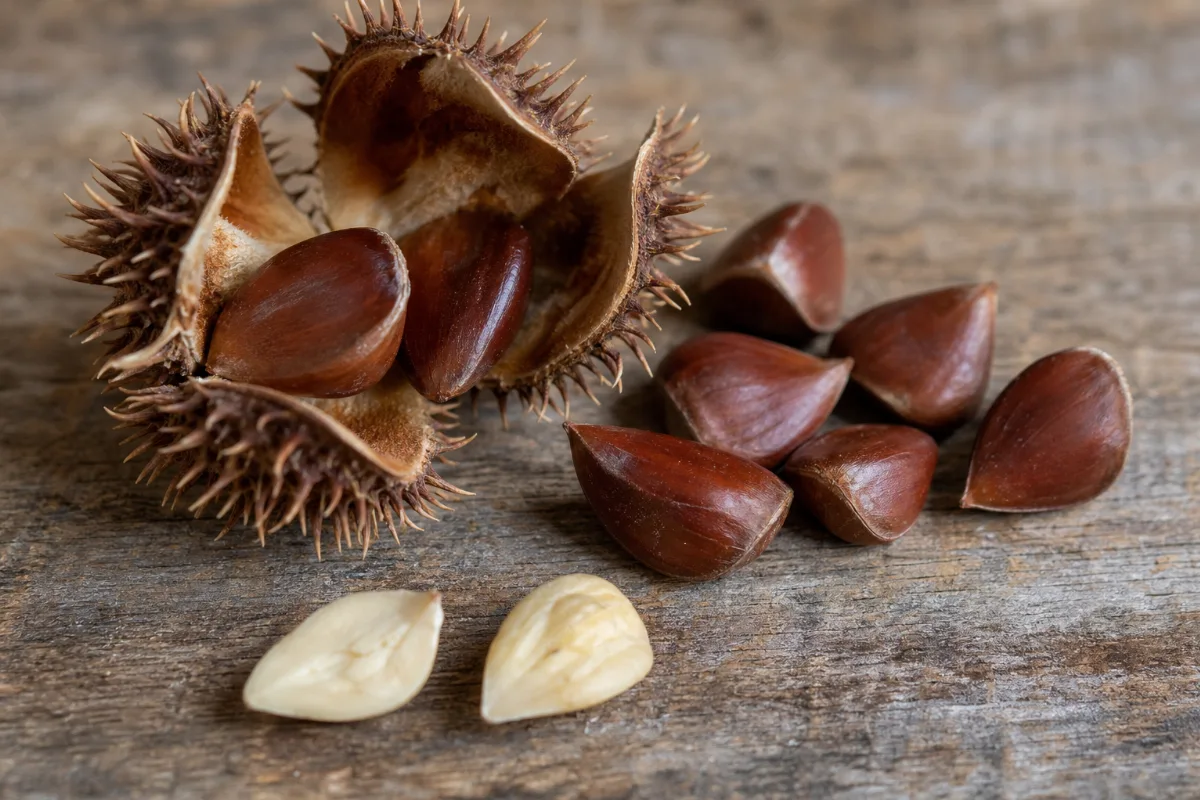
Beechnuts are the nuts of beech trees in the genus Fagus, mainly American beech (Fagus grandifolia) and European beech (Fagus sylvatica). Beeches belong to the beech family, Fagaceae. The kernel sits in a thin shell inside a prickly husk (OEKO-TEST).
USDA data for dried beechnuts: 576 kcal, 50 g fat, 6.2 g protein and 33.5 g carbohydrate per 100 g. One ounce (28 g) has about 163 kcal, 14 g fat, 1.8 g protein, 0.38 mg manganese, 0.19 mg copper and 288 mg potassium. USDA lists no fibre value and has no entry for roasted beechnuts.
What the research shows
We found no trial of eating beechnuts. A search of PubMed for beechnut mostly returned forest and animal studies.
One 2026 lab study made roasted spreads from European beech seeds and measured polyphenols and antioxidant activity. It also found that one roasting setting (125 C) gave higher toxicity in a cell test. It does not show a health benefit.
A survey of 78 elderly Dutch people found that beechnuts were among the wild foods regularly eaten in the wartime famine. It is not a safety study.
Whole nuts versus oil, flour and spreads
Sources mention oil and flour only as ways to use heated nuts. No trial of beechnut oil, flour or extract was found, so nothing carries over from one form to another.
Amounts
This page gives no amounts to eat. The sources give no safe amount of raw beechnuts. Ask a doctor or pharmacist if you have questions.
At a glance
Traditional uses history, not proof
- Eaten roasted, ground into flour or pressed into oil (OEKO-TEST)
- Eaten as a wild food during the Dutch wartime famine; long use is not proof of any benefit
Studied for research
- Nutrients (energy, manganese, copper), high certainty for the USDA numbers only
- Cholesterol and heart health, insufficient evidence
- Antioxidant activity of roasted spreads, lab study only
- Blood sugar, weight, cancer, brain health, insufficient evidence
Main compounds
- Fat (50 g per 100 g)
- Manganese and copper (USDA)
- Fagin, the toxin named in raw nuts by consumer sources
Common forms
- Roasted kernels (the form the guides describe)
- Raw kernels (reported mildly toxic)
- Flour or meal and oil, mentioned by one guide; no trial
- Roasted spread (a lab study only)
Research links: USDA FoodData Central: Nuts, beechnuts, dried · OEKO-TEST: Bucheckern essen (German) · NHS: Foods to avoid giving babies and young children · Research Library · Genes & Biomarkers Library
What it is and its history
- Accepted scientific name
- Fagus grandifolia; Fagus sylvatica
- Naming authority
- Ehrh.; L. (GBIF accepted)
- Common names
- Beechnuts (English); Beech nuts (English); Beechmast (English); Bucheckern (German)
- Family or group
- Fagaceae (the beech family), as given by GBIF.
- Classification
- Plantae > Tracheophyta > Magnoliopsida > Fagales > Fagaceae > Fagus > Fagus grandifolia (American beech) and Fagus sylvatica (European beech)
- Native range
- Not verified from a source read.
- Habitat
- Not verified from a source read.
- What it looks like
- Roots: Not verified.; Stems: Not verified.; Leaves: Not verified.; Flowers: Not verified.; Fruit: OEKO-TEST: about 2 cm, inside a prickly capsule that opens when ripe.
- Cultivation
- Not verified from a source read.
- Harvest and processing
- OEKO-TEST: pour boiling water over the nuts to help peeling, then dry-roast the peeled nuts for a few minutes; roasted nuts can be ground to flour or pressed into oil.
- Look-alikes and adulterants
- Name: Other nuts of the beech family, such as chestnuts and acorns; Note: Different plants with their own pages; their findings do not carry over to beechnuts.
- Sustainability and conservation
- Not assessed.
Photographs
Traditional use and history history, not clinical proof
| Tradition or era | Documented use | Source |
|---|---|---|
Traditional use shows how it was used. It does not show that it works or is safe today.
What is inside, and how it may work
What it contains and how those compounds act in cells and animals. Laboratory and animal mechanisms are not proven effects in people.
Main compounds
| Compound | Family | Where it is concentrated | Activity studied | Level of evidence |
|---|---|---|---|---|
| Fagin | named toxin | Raw nut Not given | Named by OEKO-TEST (citing NABU) and Plantura as the poison in raw beechnuts. Neither describes it chemically. 8 10 | Consumer guidance |
| Manganese | mineral | Kernel USDA: 1.341 mg per 100 g | Present in the food; no effect of beechnut manganese was studied. 11 | Composition data |
| Copper | mineral | Kernel USDA: 0.67 mg per 100 g | Present in the food; no effect studied. 11 | Composition data |
| Polyphenols | plant compounds | Roasted seed spread Not given as numbers in the abstract | Total polyphenol content was measured in roasted spreads. 2 | Lab |
Mechanisms, receptors and pathways
| Target or pathway | Gene or receptor | What was found | Level |
|---|---|---|---|
| Antioxidant activity of roasted spreads | Not applicable | Measured in the lab in spreads made from European beech seeds; highest at 35 minutes of roasting. No human evidence. 2 | Lab |
Absorption, metabolism and elimination
- Absorption
- Not found.
- Distribution
- Not found.
- Metabolism
- Not found.
- Elimination
- Not found.
- Bioavailability
- Not found.
Isolated compounds versus whole extracts
Beechnut oil, flour and extracts were not reviewed. Sources mention oil and flour only as ways to use heated nuts. No trial of any beechnut oil or extract was found.
Nutritional composition
Nutrition from USDA FoodData Central (Nuts, beechnuts, dried, FDC 170161, SR Legacy, record dated 2019-04-01, values read 2026-10-26 from the SR Legacy data file). Per 100 g: 576 kcal, 6.6 g water, 6.2 g protein, 50 g fat (5.72 g saturated, 21.9 g monounsaturated, 20.1 g polyunsaturated), 33.5 g carbohydrate, 1,017 mg potassium, 38 mg sodium, 1 mg calcium, 2.46 mg iron, 0.36 mg zinc, 1.341 mg manganese, 0.67 mg copper, 15.5 mg vitamin C, 0.304 mg thiamin, 0.371 mg riboflavin, 0.877 mg niacin, 0.684 mg vitamin B6, 113 micrograms folate (DFE). One household portion is 1 ounce (28.35 g): about 163 kcal, 14.2 g fat, 1.6 g saturated fat, 1.8 g protein, 9.5 g carbohydrate, 288 mg potassium, 0.38 mg manganese, 0.19 mg copper, 0.70 mg iron, 32 micrograms folate, 4.4 mg vitamin C (per-100 g value times 0.2835). USDA lists no fibre, vitamin E or selenium value, and lists 0 for magnesium and phosphorus, which look like missing data and are not shown. USDA has no entry for roasted beechnuts. Values vary with variety, growing place, roasting and storage.
1 high certainty3 not enough evidence
What was looked at
The 4 benefits and uses checked for Beechnuts, each with how strong the evidence is. Tap one to open it.
What is Beechnuts good for?
There is very little research, so this list is short. Beechnuts are a food, not a proven remedy.
Benefits, one by one
Each card is a research question, not a promise. Tap a goal to filter. Open a card to see the studies, doses and limits.
Everyday nutrients: energy, manganese and copper
High certaintyUSDA lists dried beechnuts as a high-fat, high-calorie nut with a lot of manganese and copper. One ounce (28 g) has about 163 kcal, 14 g of fat, 0.38 mg manganese (17% of the Daily Value) and 0.19 mg copper (21%). No study has tested what eating beechnuts does for health.
3 studiesDried kernels as listed by USDA. USDA has no value for roasted beechn…
Studies, doses and limits
What the trials found
USDA food composition data for one item, "Nuts, beechnuts, dried". No trial in people was found.
Results
Per 100 g: 576 kcal, 50 g fat, 6.2 g protein, 33.5 g carbohydrate, 1.341 mg manganese, 0.67 mg copper, 2.46 mg iron, 1,017 mg potassium.
Effect sizes as reported
Per 1 oz (28.35 g): 163 kcal, 0.38 mg manganese, 0.19 mg copper, 288 mg potassium (USDA values multiplied by 0.2835).
Why this rating
High only for the composition numbers, which come from USDA. There is no trial of beechnuts, so nothing is shown about health effects. Values vary with variety, growing place and roasting.
Form and dose studied
Dried kernels as listed by USDA. USDA has no value for roasted beechnuts.
Who was studied
Anyone eating them after heating.
Limits
Nutrient content is not proof of a health effect. USDA lists no fibre, vitamin E or selenium value.
Why researchers looked
People who find or buy beechnuts ask whether they are a useful food.
Traditional use
Beechnuts were eaten roasted, ground into flour or pressed into oil (OEKO-TEST). Dutch people remembered eating them in the World War II famine. Long use as food is not proof that they treat any condition.
Proposed mechanism Composition data
Nutrient content only. We read no source on how beechnut nutrients act in the body.
A proposed mechanism does not show that the effect happens in people.
Raw beechnuts are reported to be mildly toxic; the sources say to heat them first (see the safety section).
Cholesterol and heart health
Not enough evidenceNo trial of eating beechnuts for cholesterol or heart disease was found. USDA lists 20.1 g polyunsaturated and 21.9 g monounsaturated fat per 100 g. Findings for other nuts cannot be assumed for beechnuts.
1 studiesNot applicable.
Studies, doses and limits
Results
No study of beechnuts and heart health was found.
Why this rating
Nothing was found to rate.
Limits
No beechnut study.
Why researchers looked
People ask because other nuts are linked to heart health.
Traditional use
No traditional use for this goal was read.
Proposed mechanism Not tested
Not tested.
A proposed mechanism does not show that the effect happens in people.
None specific.
Antioxidant activity (lab study of roasted spreads)
Not enough evidenceA 2026 lab study made roasted spreads from European beech seeds. It measured total polyphenols and antioxidant activity in the spreads, and found the highest values at 35 minutes of roasting. It was not a study of people.
1 studiesNot applicable.
Studies, doses and limits
What the trials found
No human study.
Results
Roasting time and sugar changed the measures. One roasting setting (125 C) gave higher toxicity in a cell test with an acid extract.
Why this rating
Lab study of a processed product only; no human evidence.
Limits
Spreads, not whole nuts. No people were studied. It does not show a health benefit.
Why researchers looked
Food scientists tested beechnut seeds as an ingredient for palm-oil-free spreads.
Traditional use
No traditional use for this goal was read.
Proposed mechanism Lab
Measured in the lab as polyphenol content and antioxidant activity of the spreads.
A proposed mechanism does not show that the effect happens in people.
None specific.
Blood sugar, weight, cancer and brain health
Not enough evidenceNo study of beechnuts was found for these goals.
0 studiesNot applicable.
Studies, doses and limits
Results
Not studied in what we read.
Why this rating
Nothing was found to rate.
Limits
No beechnut study.
Why researchers looked
These are common questions about nuts in general.
Traditional use
No traditional use for this goal was read.
Proposed mechanism Not tested
Not tested.
A proposed mechanism does not show that the effect happens in people.
None specific.
Connections to the rest of health
How Beechnuts connects to the rest of our health knowledge graph. Every link says what kind of connection it is. A safety link (for example to the liver) is a warning, not a benefit. A study that merely mentions a topic never creates a benefit link.
Explore every connection: goals, body systems, organs, symptoms, genes
B. Body systems
| Connected to | Kind of connection | Evidence status | Context | Studies |
|---|---|---|---|---|
| Digestive System | Biological association | High certainty | Studied for: Everyday nutrients: energy, manganese and copper | 11 8 3 |
| Cardiovascular System | Biological association | Not enough evidence | Studied for: Cholesterol and heart health | 11 |
E. Health conditions
| Connected to | Kind of connection | Evidence status | Context | Studies |
|---|---|---|---|---|
| Food Poisoning | Adverse effect or risk | Documented risk | Raw beechnuts are reported by consumer sources to cause stomach and gut upset in larger amounts; heating is advised. Preparation or compound: Raw beechnuts (fagin) |
8 10 |
| Choking | Adverse effect or risk | Documented risk | The NHS advises against whole nuts for children under 5; beechnuts are not named. Preparation or compound: Whole nuts |
7 |
L. Active compounds
| Connected to | Kind of connection | Evidence status | Context | Studies |
|---|---|---|---|---|
| Fagin | Biological association | Consumer guidance | Named by OEKO-TEST (citing NABU) and Plantura as the poison in raw beechnuts. Neither describes it chemically. Preparation or compound: Raw nut |
8 10 |
| Manganese | Biological association | Composition data | Present in the food; no effect of beechnut manganese was studied. Preparation or compound: Kernel |
11 |
| Copper | Biological association | Composition data | Present in the food; no effect studied. Preparation or compound: Kernel |
11 |
| Polyphenols | Biological association | Lab | Total polyphenol content was measured in roasted spreads. Preparation or compound: Roasted seed spread |
2 |
Each connection is stored with the ingredient, the connected record, the kind of connection, the evidence status, the supporting studies, the preparation or compound involved, and a review date (last reviewed October 26, 2026).
Evidence at a glance: what the research found for 4 outcomes
Each outcome below is one thing researchers measured. Certainty is how far the evidence can be trusted, not how well it works. The full studies are on the next tab.
The evidence
The research centre for Beechnuts. Every record here was checked against PubMed or the publisher's page; we never list a study we have not verified.
Evidence by outcome
Bars show how many studies we found for each outcome, not how well it works. People are added up across trials only (reviews are not added, to avoid double counting).
How we rate evidence
High certainty
Several well-run trials or reviews agree; further research is unlikely to change the picture much.
Moderate certainty
Good trials point the same way, but some doubt remains.
Low certainty
Small, short or inconsistent trials. The finding could change with better research.
Very low certainty
Very little or very weak human data. Treat as a possibility only.
Mixed findings
Trials or reviews disagree with each other.
Not enough evidence
Not enough human research to say either way.
Evidence against
Good research found no benefit, or found harm.
We take the reviewers' own risk-of-bias and GRADE statements where they exist, and otherwise judge from study size, design, consistency, directness and whether a product matches what is sold. Many publications do not make evidence high. Method note: We started from our existing beechnuts summary, re-checked nutrition against the USDA data file, re-opened every web source, and searched PubMed. Only abstracts were read for studies. Little research exists, so this page is short on purpose.
Study library: every study we checked 12
| Study | Design | People | Product, dose, length | Result |
|---|---|---|---|---|
| Jeong 2025 Update on Tree Nut and Seed Allergies: Prevalence, Clinical Characteristics, Diagnosis, and Management. Allergy Asthma Immunol Res · PMID 41330701 · DOI |
Narrative review |
People with tree nut and seed allergy (general) | Tree nuts and seeds (beechnuts not named in the abstract) Nut or seed |
Tree nut and seed allergies are often severe, usually start in childhood and may last for life. Clinical co-allergy between nuts is seen less than co-sensitization, with the highest overlap reported for cashew-pistachio and walnut-pecan. Prompt intramuscular epinephrine is the first-line treatment for anaphylaxis. Not applicable (Not applicable) Methods, limits and fundingOutcomes: Prevalence, symptoms, diagnosis, management Limitations: Review of tree nuts in general. Says nothing about beechnuts. Funding and conflicts: No conflict of interest stated. Read: abstract |
| Puscas 2026 Application of response surface methodology in the formulation of spreadable creams from beechnut seeds as sustainable ingredient. Food Sci Technol Int · PMID 39763329 · DOI |
Laboratory study in vitro (cells) and food chemistry |
None (food-science study of spreads, no people) | Roasted spreads made from European beech (Fagus sylvatica) seeds Seed Roasting at 125, 145 and 165 C for different times; 0 or 20% sugar · vs Different recipes compared with each other |
Roasting temperature, time and sugar changed texture and the other measures. The highest polyphenols and antioxidant activity were reached at 35 minutes of roasting. The 125 C setting gave increased toxicity levels in the cell test. The authors call the seeds a viable sustainable ingredient for new spreads. Not given as numbers in the abstract (Not given in the abstract) Methods, limits and fundingOutcomes: Texture, colour, total polyphenols, antioxidant activity, cell survival with an acid extract Limitations: Lab study of a processed spread. No people were studied. It does not show a health benefit. Funding and conflicts: Authors declared no conflicting interests. Read: abstract |
| Vorstenbosch 2017 Famine food of vegetal origin consumed in the Netherlands during World War II. J Ethnobiol Ethnomed · PMID 29149858 · DOI |
Cross sectional |
78 78 elderly Dutch citizens interviewed about wartime food |
Wild and cultivated emergency foods, including beechnuts Nut Not given Hunger Winter 1944-1945 and wartime |
Beechnuts were among the regularly eaten wild foods. The only negative effects reported were sore throats and stomachache from sugar beets and tulip bulbs. No beechnut effect is stated in the abstract. Not applicable (Not applicable) Methods, limits and fundingOutcomes: Which plants were eaten; adverse effects remembered Limitations: Memories of elderly people decades later. Not a safety study. The abstract does not say how the beechnuts were prepared. Funding and conflicts: No competing interests declared. Read: abstract |
| s-fda-allergens FDA: Food allergies · Source |
Health agency n/a |
Methods, limits and fundingRead: full-text | ||
| s-gbif-fagus-grandifolia GBIF Backbone: Fagus grandifolia Ehrh. (usageKey 2882274) · Source |
Reference database n/a |
Methods, limits and fundingRead: full-text | ||
| s-gbif-fagus-sylvatica GBIF Backbone: Fagus sylvatica L. (usageKey 2882316) · Source |
Reference database n/a |
Methods, limits and fundingRead: full-text | ||
| s-nhs-foods-avoid NHS: Foods to avoid giving babies and young children · Source |
Health agency n/a |
Methods, limits and fundingRead: full-text | ||
| s-oekotest-bucheckern OEKO-TEST: Bucheckern essen: Was Sie dabei beachten sollten (4 Nov 2025) · Source |
Consumer guidance n/a |
Methods, limits and fundingRead: full-text | ||
| s-petpoison-beech Pet Poison Helpline: Beech trees · Source |
Veterinary guidance animal |
Methods, limits and fundingRead: full-text | ||
| s-plantura-fagin Plantura: Sind Bucheckern giftig? · Source |
Consumer guidance n/a |
Methods, limits and fundingRead: full-text | ||
| s-usda-fdc-170161 USDA FoodData Central: Nuts, beechnuts, dried (SR Legacy, FDC 170161) · Source |
Reference database n/a |
Methods, limits and fundingRead: full-text | ||
| s-who-mycotoxins WHO: Mycotoxins fact sheet · Source |
Health agency n/a |
Methods, limits and fundingRead: full-text |
What we do not know yet
- No trial of eating beechnuts was found for any health goal.
- No medical study or case report of human beechnut poisoning was found, and no safe amount of raw nuts is given.
- No source says whether beechnut allergy occurs.
- Nothing was found on medicines, kidney disease, pregnancy or breastfeeding.
- Fagin was not described chemically, and the effect of heating was not tested in any source read.
How new research is added
New studies are found by a saved PubMed search and placed in a review queue before the page changes.
Lab markers
What changed in blood or saliva tests during trials. A changed number is not the same as feeling or being healthier, and we give no "normal ranges".
Safety
What studies and official sources say about side effects, medicines and who should check first. Each point shows what kind of evidence it comes from.
Main points to know 4
- Raw beechnuts are reported to be mildly toxic: heat them first. A German consumer magazine says raw beechnuts contain a poison called fagin, that larger amounts can cause poisoning, and that children can react especially strongly. A regional poison information center (GIZ-Nord, cited by the magazine) lists strong stomach and gut symptoms, headache and cramps. A garden guide gives the same advice. Both say heating breaks the poisons down. These are consumer sources, not medical studies, and none gives a safe amount or says how much heating is enough. Consumer guidance 8 10
- European and American beechnuts may differ. A veterinary poison helpline says American beechnuts are much less toxic than European ones and are considered edible in small amounts, while European beechnuts may cause stomach upset, fever and mild nerve signs. The page is about pets and does not name the toxin. No human comparison was found. Veterinary guidance 9
- Tree nut allergy. The FDA lists tree nuts among the nine major food allergens. Its page does not mention beechnuts. A 2025 review says tree nut allergies are often severe. We found no source that says beechnut allergy exists or does not, so do not assume they are safe if you have another nut allergy. Authoritative guidance 4 1
- Choking in young children. The NHS says whole nuts should not be given to children under 5. Beechnuts are not named; the rule is applied as a precaution. Authoritative guidance 7
Side effects 2
| Effect | How often | Severity and recovery | Evidence |
|---|---|---|---|
| Stomach and gut upset, headache and cramps after eating larger amounts of raw beechnuts Reported by a consumer magazine citing a poison center and by a garden guide. No medical case report or study was read. | Not stated | not stated Not stated | Consumer guidance 8 10 |
| Stomach upset, fever and mild nerve signs from European beechnuts (animals) About pets; grazing animals are at greater risk. Not a human source. | Not stated | mild in small animals per the source Not stated | Veterinary guidance 9 |
Liver
No liver injury from beechnuts was found. A liver-safety source (such as LiverTox) was not searched for this food page.
How often. No frequency was found.
Monitoring. No agency monitoring advice was found.
This is a safety connection. It is not evidence that Beechnuts supports liver health.
Medicines and supplements 1
| With | Why it matters | Importance | Evidence | What to do |
|---|---|---|---|---|
| Medicines in general prescription | No source read reports a medicine interaction with beechnuts. | None found Not enough evidence | Ask a pharmacist if you take regular medicine and eat beechnuts often. Not having found a warning is not proof of safety. |
Who should check first 3
| Situation | Advice | Evidence |
|---|---|---|
| Eating raw beechnuts | The sources we read say to heat them first. If you are not sure, do not eat them raw. | Consumer guidance 8 10 |
| Children | Raw beechnuts may affect children more strongly, and whole nuts are a choking risk under 5. | Consumer guidance 8 7 |
| Known tree nut allergy | Ask an allergist before trying beechnuts. | Authoritative guidance 4 1 |
Overdose, product quality and regulators
Summary. Raw beechnuts are reported to be mildly toxic because of fagin; heating is said to break the poisons down. No medical study of human poisoning, no toxic amount and no chemical description of fagin was found.
Animal. Pet Poison Helpline: European beechnuts can cause stomach upset, fever and mild nerve signs in small animals; grazing animals such as cattle and horses are at greater risk of severe signs.
High dose or long term signals. Larger amounts of raw nuts are said to cause poisoning (consumer sources). A garden guide also names oxalic acid and alkaloids without a source.
Overdose response. Not found.
Genotoxicity. Not researched.
Toxic or hazardous parts. Raw nuts are the part named. Other parts were not researched.
No beechnut-specific mould or aflatoxin source was found. General nut advice from WHO is to discard nuts that look mouldy, discoloured or shrivelled.
Mould. WHO advises inspecting nuts for mould and discarding any that look mouldy, discoloured or shrivelled. Its page names peanuts, pistachio, almond, walnut, coconut, Brazil nuts and hazelnuts, not beechnuts. 12
Fat and rancidity. Beechnuts are high in fat (50 g per 100 g by USDA). We read no source on whether they go rancid. 11
| Body | Action | Date |
|---|---|---|
| FDA (USA) (United States) | Food allergies page lists tree nuts among the nine major allergens; beechnuts are not mentioned. source | not stated |
| NHS (UK) (United Kingdom) | Whole nuts should not be given to children under 5 because of choking; beechnuts not named. source | not stated |
| WHO (International) | Mycotoxins fact sheet: discard mouldy, discoloured or shrivelled nuts; beechnuts not named. source | not stated |
When to get medical help
- Trouble breathing, swelling of the lips, face or throat, or widespread hives after eating a nut. Call your local emergency number.
- Severe or lasting vomiting, stomach pain or cramps after eating raw beechnuts, especially in a child. Contact a poison center or doctor.
- Choking.
Stop using the product and contact a clinician or emergency service. In the US, Poison Control is 1-800-222-1222.
General information only, not medical advice. Ask a clinician or pharmacist before use, especially with medicines, in pregnancy or with a health condition. See the Natural Remedy Safety guide.
Frequently asked questions
What are beechnuts?
Are beechnuts good for you?
USDA lists manganese and copper, and they are energy dense. No study has tested eating them for health, so we cannot say they help with any goal.
Are raw beechnuts poisonous?
Does heating make beechnuts safe?
Are American and European beechnuts the same?
Not exactly. A pet poison helpline says American beechnuts are much less toxic than European ones. No human comparison was found.
Are beechnuts safe for children?
Can I be allergic to beechnuts?
Do beechnuts lower cholesterol?
Not shown. No study of beechnuts and cholesterol was found.
Are beechnuts a good source of antioxidants?
Only a lab study of roasted spreads measured antioxidant activity. It did not study people.
Do beechnuts interact with medicines?
No source we read reports any. That is not proof of safety. Ask a pharmacist.
Can beechnuts go bad?
Is beechnut oil or flour studied?
No. Sources mention them only as uses of heated nuts, and no trial was found.
Explore by health goal
Editorial transparency
- Written by
- AlternativeMed editorial team. Research compiled with AI assistance, then checked against the sources listed.
- Medical review
- None. This page has not been reviewed by a physician or pharmacist.
- First published
- 2026-10-26
- Last substantive update
- 2026-10-26
- How we research
- We started from our existing beechnuts summary, re-checked nutrition against the USDA data file, re-opened every web source, and searched PubMed. Only abstracts were read for studies. Little research exists, so this page is short on purpose.
- How we rate evidence
- See "How we rate evidence" in the Evidence tab.
- Independence
- No product is promoted on this page. No affiliate links are shown.
Sources 12
Each source was opened and checked. Where we read only the abstract, it says so. The small numbers in the text point here.
- Jeong K, Lee S. Update on Tree Nut and Seed Allergies: Prevalence, Clinical Characteristics, Diagnosis, and Management.. Allergy Asthma Immunol Res. 2025. PMID 41330701. DOI 10.4168/aair.2025.17.6.672. (abstract)
- Puscas A, Tanislav A, Socaciu MI, et al.. Application of response surface methodology in the formulation of spreadable creams from beechnut seeds as sustainable ingredient.. Food Sci Technol Int. 2026. PMID 39763329. DOI 10.1177/10820132241307999. (abstract)
- Vorstenbosch T, de Zwarte I, Duistermaat L, van Andel T. Famine food of vegetal origin consumed in the Netherlands during World War II.. J Ethnobiol Ethnomed. 2017. PMID 29149858. DOI 10.1186/s13002-017-0190-7. (abstract)
- . FDA: Food allergies. . . (full-text)
- . GBIF Backbone: Fagus grandifolia Ehrh. (usageKey 2882274). . . (full-text)
- . GBIF Backbone: Fagus sylvatica L. (usageKey 2882316). . . (full-text)
- . NHS: Foods to avoid giving babies and young children. . . (full-text)
- . OEKO-TEST: Bucheckern essen: Was Sie dabei beachten sollten (4 Nov 2025). . . (full-text)
- . Pet Poison Helpline: Beech trees. . . (full-text)
- . Plantura: Sind Bucheckern giftig?. . . (full-text)
- . USDA FoodData Central: Nuts, beechnuts, dried (SR Legacy, FDC 170161). . . (full-text)
- . WHO: Mycotoxins fact sheet. . . (full-text)
Where to buy
Check the label first. Whatever you buy, look for these:
- Raw or roasted, and salted or unsalted
- A best-by date, since nuts and seeds turn rancid
- Tree nut and peanut allergy warnings
- A resealable bag, and cool storage once opened
Talk to a pharmacist or doctor before you start any supplement, especially if you take medicines. See the Safety tab for interactions.
Support our free guides: as an Amazon Associate we earn from qualifying purchases. Full disclosure.


