Spices · Spice
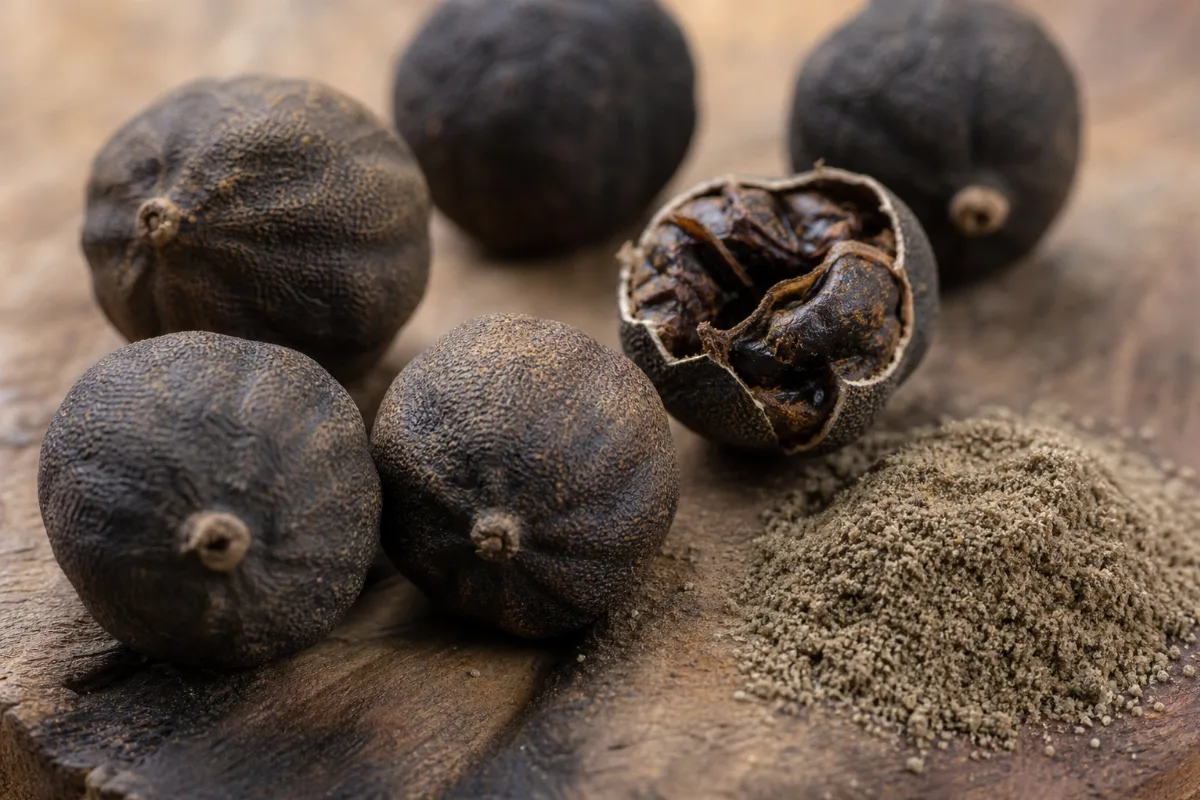
Dried black lime (loomi)
Citrus aurantiifolia · also called Loomi, black lime, dried lime, Omani lime, noomi Basra, limoo amani, lima negra seca (Spanish)
Dried black lime, or loomi, is a whole lime dried until it is hard and dark. It adds a sour, earthy, smoky taste to stews, soups and rice in Gulf, Iraqi and Persian cooking. Its health claims are not backed by studies of people; the research is a lab study of extracts. The main caution is for medicines with a grapefruit warning, because lime juice has a lab link to medicine-processing enzymes.
General information, not medical advice. Last substantive update · Not medically reviewed. A named clinician has not signed off on this page. How this page is made
About Dried black lime (loomi)
Dried black lime is a flavoring, not a health food or remedy. It gives a sour, earthy, smoky depth to slow-cooked dishes. Very little research exists and none in people.
What it is
Dried black lime is a whole lime dried until hard, dark and hollow, usually in the sun. It goes by many names: loomi in Oman, noomi Basra in Iraq and limoo amani in Iran. It started in the Persian Gulf region and is used across the Middle East.
The peel, flesh and seeds are all in it. One cooking source says thin-skinned Persian limes are used, so the lime variety can differ. A 2021 lab study named the dried fruit it tested Citrus aurantifolia.
Flavor and cooking
It tastes sour like fresh lime but with earthy, smoky notes and a slightly bitter, fermented edge, and it has none of the sweetness of fresh lime. Brown limes, dried for a shorter time, are more fragrant and citrusy. Black limes, dried longer, are smokier and more bitter.
Cooks prick a whole lime and simmer it in a stew, or halve it, take out the seeds and add it to soup or rice. It can be ground to a powder, which is one ingredient in baharat. A cooking source says fresh lime is not a good swap, because it is sharper and does not build the same slow depth.
Nutrition
We found no USDA FoodData Central entry for dried lime, so we give no calories or nutrient numbers. It is used one piece at a time for flavor, so it adds taste, not much food value. Claims that it is rich in vitamin C, antioxidants or minerals came from sources that cite no data we could check, so we do not repeat them.
What the research shows
We found no study of people eating or drinking dried lime. The one research paper on the dried fruit is a 2021 lab study of methanol and ethanol extracts and an infusion. Its abstract reports antioxidant activity, starch-enzyme blocking and activity against cultured cells.
These are test-tube and cell-dish results. We read only the abstract. They do not tell us what happens when people cook with dried lime or drink the tea.
Food versus extracts
The lab results come from solvent extracts. A dried lime simmered in a stew, or a cup of tea, is very different and has not been studied.
Amounts
No source we read gives a usual amount in grams. This page gives no amounts. If you use strong tea, extracts or supplements, ask a doctor or pharmacist.
At a glance
Traditional uses history, not proof
- Souring stews, soups, rice and fish dishes in Persian, Iraqi and Gulf cooking
- Tea made from the peels, drunk in Iraq and the Arabian Peninsula for an upset stomach, with no clinical evidence
- Ground to a powder as one ingredient in baharat spice mix
- Long use as food is not proof that it treats any condition
Studied for research
- Antioxidant activity, insufficient evidence (lab test of extracts)
- Starch-digesting enzyme blocked, insufficient evidence (enzyme test, not blood sugar)
- Effects on cells in a dish, insufficient evidence (lab only)
- Upset stomach with the tea, insufficient evidence (traditional use, no trial)
Main compounds
- Compounds not named in the sources read
- Bergamottin (measured in fresh lime juice, not dried lime)
Common forms
- Whole dried limes, pricked and simmered in a dish
- Halved with the seeds removed
- Ground powder
- Tea from the peels
- Lab extracts (the research used these, not food)
Research links: 2021 lab study of dried lime extracts · 2003 study of lime juice and CYP3A4 · FDA: grapefruit juice and some drugs · Research Library · Genes & Biomarkers Library
What it is and its history
- Accepted scientific name
- Citrus aurantiifolia
- Common names
- Dried lime (English); Black lime (English); Loomi (English (Oman)); Omani lime (English); Noomi Basra (Arabic (Iraq)); Limoo amani (Persian (Iran)); Lima negra seca (Spanish)
- Family or group
- Rutaceae (the citrus family), as given in the 2021 abstract.
- Classification
- Plantae > Rutaceae > Citrus > Citrus aurantiifolia
- Native range
- The drying tradition comes from the Persian Gulf region (Wikipedia). The origin of the lime tree was not researched.
- What it looks like
- Fruit: A whole lime dried until hard, dark and hollow. The peel, flesh and seeds are all in it. Black ones are hard and crunchy; brown ones are slightly soft (End of the Fork).
- Cultivation
- Not researched. One cooking source says thin-skinned Persian limes are traditionally used, so the variety may differ.
- Harvest and processing
- Limes are blanched in salted water, then dried, traditionally in the sun for one to two weeks. The longer they dry, the darker and more bitter they get (End of the Fork). Wikipedia says they are usually dried mostly in the sun.
- Look-alikes and adulterants
- Name: Fresh lime; Note: The same fruit before drying, but much sharper and not interchangeable in cooking.; Name: Sumac; Note: A different souring spice that a cooking source offers as a milder stand-in; not the same plant.
- Sustainability and conservation
- Not assessed.
Traditional use and history history, not clinical proof
| Tradition or era | Documented use | Source |
|---|---|---|
| Wikipedia: Dried lime. No older source was read. |
Traditional use shows how it was used. It does not show that it works or is safe today.
What is inside, and how it may work
What it contains and how those compounds act in cells and animals. Laboratory and animal mechanisms are not proven effects in people.
Main compounds
| Compound | Family | Where it is concentrated | Activity studied | Level of evidence |
|---|---|---|---|---|
| Plant compounds not named | not specified | Dried fruit | The abstract of the 2021 study does not name the compounds behind the lab activity, and the cooking sources do not name the compounds behind the taste. 2 | Laboratory research |
| Bergamottin (in fresh lime juice) | furanocoumarin | Fresh juice 100 micromol/L in the lime juice tested, versus 25 micromol/L in the grapefruit juice (2003 study) | Blocked CYP3A4 in lab tests; the authors concluded it is not the main cause of the clinical grapefruit-type effect. Not measured in dried lime. 1 | Laboratory research |
Mechanisms, receptors and pathways
| Target or pathway | Gene or receptor | What was found | Level |
|---|---|---|---|
| Radical scavenging, ferric reducing activity and alpha-amylase inhibition | Not specified | Extracts of dried lime were active in test-tube tests. Not shown in animals or people. 2 | Laboratory research |
| CYP3A4 (medicine-processing enzyme in the gut) | CYP3A4 | Fresh lime juice blocked it in lab tests; effect in people varied between volunteers. Dried lime was not tested. 1 | In vitro plus human small |
Absorption, metabolism and elimination
- Absorption
- Not found for dried lime.
- Distribution
- Not found.
- Metabolism
- Not found.
- Elimination
- Not found.
- Bioavailability
- Not established.
Isolated compounds versus whole extracts
The health results here come from solvent extracts (methanol, ethanol) in the lab. A piece of dried lime simmered in a stew, or a cup of tea, is very different and has not been studied.
Nutritional composition
USDA FoodData Central: we found no entry for dried lime (the local copy of the SR Legacy data has only fresh lime, lime juice and lime-flavored products), so we give no calories, vitamins or minerals and do not call dried lime a good source of anything. One recipe site's per-lime figures are calculated by software and are not used. Dried limes are used one piece at a time for flavor, so they add taste, not much food value.
4 not enough evidence
What was looked at
The 4 benefits and uses checked for Dried black lime (loomi), each with how strong the evidence is. Tap one to open it.
What is Dried black lime (loomi) good for?
The studied uses and how strong the evidence is. Everything here is from lab tests of extracts or from traditional use. None is from studies of people eating dried lime.
Benefits, one by one
Each card is a research question, not a promise. Tap a goal to filter. Open a card to see the studies, doses and limits.
Antioxidant activity (lab tests only)
Not enough evidenceIn a 2021 lab study, extracts of dried lime fruit mopped up test-tube chemicals called free radicals, and the methanol extract did best. This was done in test tubes. It does not show that eating dried lime helps the body.
1 studiesMethanol, ethanol and water extracts of dried fruit in the lab. Not d…
Studies, doses and limits
What the trials found
We found no human study of dried lime, as food or as a tea or extract, for this use.
Results
Lab finding only. The study tested a 70% methanol extract, an ethanol extract and an infusion (a water preparation). The abstract says the 70% methanol extract was more active in the antioxidant tests. No figures were in the abstract.
Effect sizes as reported
No human effect size exists. No figures were read.
Why this rating
Insufficient: one lab study read only as an abstract; nothing in animals or people.
Form and dose studied
Methanol, ethanol and water extracts of dried fruit in the lab. Not dried lime eaten in food.
Who was studied
Test tubes, not people.
Limits
Only the abstract was read. Solvent extracts are not what ends up in a stew or a cup of tea. Antioxidant tests in test tubes often do not carry over to the body.
Why researchers looked
Citrus fruits contain plant compounds that show antioxidant activity in lab tests, so researchers screen them.
Traditional use
Dried lime is a souring spice in Iraqi, Gulf and Persian cooking. Long use as food is not proof that it treats any condition.
Proposed mechanism In vitro or animal
Radical scavenging (DPPH and ABTS tests) and ferric reducing activity in test tubes. Not shown in people.
A proposed mechanism does not show that the effect happens in people.
No safety conclusion can be drawn from a lab test.
Starch-digesting enzyme blocked in the lab
Not enough evidenceIn the same 2021 lab study, the methanol and ethanol extracts blocked alpha-amylase, an enzyme that digests starch. The authors called this 'hypoglycemic activity', but the test did not measure blood sugar in any body.
1 studiesMethanol and ethanol extracts of dried fruit in the lab. Not dried li…
Studies, doses and limits
What the trials found
We found no human study of dried lime, as food or as a tea or extract, for this use.
Results
Lab finding only. The abstract says both the 70% methanol and the ethanol extracts had 'potent' alpha-amylase inhibiting activity. No figures were in the abstract and no comparison with a standard drug was read.
Effect sizes as reported
No human effect size exists. No figures were read.
Why this rating
Insufficient: an enzyme test only, read as an abstract, with no animal or human data.
Form and dose studied
Methanol and ethanol extracts of dried fruit in the lab. Not dried lime eaten in food.
Who was studied
Enzyme test, not people.
Limits
An enzyme blocked in a test tube is not lower blood sugar. Only the abstract was read.
Why researchers looked
Blocking starch digestion is one lead researchers look for in plants that might one day be tested for blood sugar.
Traditional use
Dried lime is a souring spice in Iraqi, Gulf and Persian cooking. Long use as food is not proof that it treats any condition.
Proposed mechanism In vitro or animal
Alpha-amylase inhibition in an enzyme test. Not shown in animals or people.
A proposed mechanism does not show that the effect happens in people.
Anyone who takes diabetes medicine should not treat this as a reason to change it.
Effects on cells in the lab (cytotoxicity)
Not enough evidenceIn the 2021 lab study, the ethanol extract was the most active against three kinds of cultured cells. This is a cell-dish result. It says nothing about treating or preventing any disease.
1 studiesEthanol extract in the lab. Not dried lime eaten in food.
Studies, doses and limits
What the trials found
We found no human study of dried lime, as food or as a tea or extract, for this use.
Results
Lab finding only. The abstract says the ethanol extract was more active in the cytotoxicity tests. It does not say how strong the effect was or whether healthy cells were also affected.
Effect sizes as reported
No figures were read.
Why this rating
Insufficient: a cell-dish screen read only as an abstract.
Form and dose studied
Ethanol extract in the lab. Not dried lime eaten in food.
Who was studied
Cultured cell lines.
Limits
Killing cells in a dish is not a treatment. Cell tests do not predict what a food does in the body.
Why researchers looked
Plant extracts are often screened on cell lines for toxicity and for leads on future research.
Traditional use
Dried lime is a souring spice in Iraqi, Gulf and Persian cooking. Long use as food is not proof that it treats any condition.
Proposed mechanism In vitro or animal
Cell-culture toxicity tests on A549, MCF-7 and L929 cell lines. Not shown in animals or people.
A proposed mechanism does not show that the effect happens in people.
An extract that is toxic to cells is a reason for caution, not a reason to take it.
Upset stomach, indigestion, diarrhea and nausea (traditional tea)
Not enough evidenceIn Iraq and the Arabian Peninsula, dried lime tea is a traditional drink for an upset stomach. We found no trial of it, so we cannot say whether it works.
2 studiesTea simmered from the peels of dried limes, usually sweetened with su…
Studies, doses and limits
What the trials found
No clinical study or even a small human study of dried lime tea was found.
Results
No study results exist. The only claim is traditional use, repeated in an encyclopedia article that cites cookbooks.
Why this rating
Insufficient: traditional use only, with no study.
Form and dose studied
Tea simmered from the peels of dried limes, usually sweetened with sugar or honey.
Who was studied
Not studied.
Limits
Sources are cookbooks quoted by Wikipedia. Diarrhea can be serious, especially in children and older people. Sweetened tea adds sugar.
Why researchers looked
This is a folk use reported by reference sources, not a studied outcome.
Traditional use
Wikipedia says the tea is made by simmering the pricked or cracked peels in water for 15 to 30 minutes and is sweetened, and that it is drunk to aid indigestion, diarrhea and nausea.
Proposed mechanism Traditional use
Not described in any source read.
A proposed mechanism does not show that the effect happens in people.
If diarrhea, vomiting or stomach pain lasts or is severe, see a doctor.
Connections to the rest of health
How Dried black lime (loomi) connects to the rest of our health knowledge graph. Every link says what kind of connection it is. A safety link (for example to the liver) is a warning, not a benefit. A study that merely mentions a topic never creates a benefit link.
Explore every connection: goals, body systems, organs, symptoms, genes
B. Body systems
| Connected to | Kind of connection | Evidence status | Context | Studies |
|---|---|---|---|---|
| Metabolic And Endocrine | Biological association | Not enough evidence | Studied for: Antioxidant activity (lab tests only) Studied for: Starch-digesting enzyme blocked in the lab | 2 |
| Blood And Immune | Biological association | Not enough evidence | Studied for: Effects on cells in the lab (cytotoxicity) | 2 |
| Digestive System | Biological association | Not enough evidence | Studied for: Upset stomach, indigestion, diarrhea and nausea (traditional tea) | 7 6 |
L. Active compounds
| Connected to | Kind of connection | Evidence status | Context | Studies |
|---|---|---|---|---|
| Plant compounds not named | Biological association | In vitro | The abstract of the 2021 study does not name the compounds behind the lab activity, and the cooking sources do not name the compounds behind the taste. Preparation or compound: Dried fruit |
2 |
| Bergamottin (in fresh lime juice) | Biological association | In vitro | Blocked CYP3A4 in lab tests; the authors concluded it is not the main cause of the clinical grapefruit-type effect. Not measured in dried lime. Preparation or compound: Fresh juice |
1 |
Each connection is stored with the ingredient, the connected record, the kind of connection, the evidence status, the supporting studies, the preparation or compound involved, and a review date (last reviewed October 26, 2026).
Evidence at a glance: what the research found for 4 outcomes
Each outcome below is one thing researchers measured. Certainty is how far the evidence can be trusted, not how well it works. The full studies are on the next tab.
The evidence
The research centre for Dried black lime (loomi). Every record here was checked against PubMed or the publisher's page; we never list a study we have not verified.
Evidence by outcome
Bars show how many studies we found for each outcome, not how well it works. People are added up across trials only (reviews are not added, to avoid double counting).
How we rate evidence
High certainty
Several well-run trials or reviews agree; further research is unlikely to change the picture much.
Moderate certainty
Good trials point the same way, but some doubt remains.
Low certainty
Small, short or inconsistent trials. The finding could change with better research.
Very low certainty
Very little or very weak human data. Treat as a possibility only.
Mixed findings
Trials or reviews disagree with each other.
Not enough evidence
Not enough human research to say either way.
Evidence against
Good research found no benefit, or found harm.
We take the reviewers' own risk-of-bias and GRADE statements where they exist, and otherwise judge from study size, design, consistency, directness and whether a product matches what is sold. Many publications do not make evidence high. Method note: We started from our existing dried black lime page and re-read the 2021 lab study and the 2003 lime juice study (abstracts, through PubMed), the FDA grapefruit page and two reference and cooking pages. Very little research exists, so this page is short on purpose.
Study library: every study we checked 7
| Study | Design | People | Product, dose, length | Result |
|---|---|---|---|---|
| p12811362 Bailey DG, Dresser GK, Bend JR. Bergamottin, lime juice, and red wine as inhibitors of cytochrome P450 3A4 activity: comparison with grapefruit juice. Clin Pharmacol Ther 2003;73(6):529-37 · Source |
In vitro plus crossover trial Fresh lime juice (not dried lime); lab enzyme tests plus a randomized crossover trial of felodipine with juice, wine or water |
Methods, limits and fundingRead: abstract | ||
| p31928230 Seker Karatoprak G, Yucel Asik C, Cakir A, Kongul Safak E. In vitro pharmacological screening of antioxidant, cytotoxic and enzyme inhibitory activities of Citrus aurantifolia Linn. dried fruit extract. Int J Environ Health Res 2021;31(8):991-1000 · Source |
In vitro study Citrus aurantifolia dried fruit ('Lime Basra', 'Limoo Omani'): 70% methanol extract, ethanol extract and infusion; test tube and cell lines |
Methods, limits and fundingRead: abstract | ||
| s-endofthefork-dried-limes End of the Fork: Dried Limes (Loomi): What They Are and How to Use Them · Source |
Cooking reference Dried lime |
Methods, limits and fundingRead: full-text | ||
| s-fda-grapefruit-drugs FDA consumer update: Grapefruit Juice and Some Drugs Don't Mix · Source |
Regulator consumer guidance Grapefruit juice and grapefruit (limes not named) |
Methods, limits and fundingRead: full-text | ||
| s-usda-sr-legacy-no-entry USDA FoodData Central, SR Legacy (April 2018): no entry for dried lime · Source |
Reference database n/a |
Methods, limits and fundingRead: full-text | ||
| s-wikipedia-dried-lime Wikipedia: Dried lime · Source |
Reference article Dried lime |
Methods, limits and fundingRead: full-text | ||
| s-wikipedia-dried-lime-tea Wikipedia: Dried lime tea · Source |
Reference article Dried lime tea |
Methods, limits and fundingRead: full-text |
What we do not know yet
- No study of people, and no animal study, of dried lime was found.
- Only the abstract of the 2021 lab study was read, so figures, funding and the infusion result are unknown.
- No USDA nutrition entry was found.
- Dried lime has not been tested for medicine interactions; the lime juice study is the closest.
- No regulator statement on dried lime, and no allergy, pregnancy, breastfeeding or children's information, was found.
- The cooking and history facts come from Wikipedia and a cooking blog.
How new research is added
New studies are found by a saved PubMed search and placed in a review queue before the page changes.
Lab markers
What changed in blood or saliva tests during trials. A changed number is not the same as feeling or being healthier, and we give no "normal ranges".
Safety
What studies and official sources say about side effects, medicines and who should check first. Each point shows what kind of evidence it comes from.
Main points to know 3
- Medicines: lime juice has a lab link to medicine-processing enzymes; dried lime has not been tested. The FDA says grapefruit juice and grapefruit can raise the level of some medicines in the blood, and names statins, some blood pressure drugs, transplant drugs and others. The FDA page does not mention limes. A 2003 study found fresh lime juice had more bergamottin than grapefruit juice (100 versus 25 micromol/L) and blocked the CYP3A4 enzyme in lab tests. In a crossover trial, quarter-strength lime juice did not change average felodipine levels, but it more than doubled the medicine's blood level in 2 volunteers. That was juice, not dried lime in cooking, so we do not know what dried lime does. Human trial small 1 4
- No safety data exist for dried lime in food. We found no report of harm from dried lime used in cooking, and also no safety study. The sources read say nothing on pregnancy, breastfeeding, children, allergy or liver and kidney effects. Silence is not proof of safety. None found 6 3
- Seeds and hard pieces. Cooking sources say to remove the seeds before slicing or grinding, and the whole lime is hard and brittle. Whole dried limes are meant to be simmered in a dish, and the sources we read do not say whether to eat the softened lime. Take care with small children and with anyone who has trouble chewing. Authoritative guidance 3
Side effects 0
| Effect | How often | Severity and recovery | Evidence |
|---|
Liver
No liver injury from dried lime was found in the sources read. A liver-safety source (such as LiverTox) was not searched.
How often. No frequency was found.
Monitoring. No agency monitoring advice was found.
This is a safety connection. It is not evidence that Dried black lime (loomi) supports liver health.
Medicines and supplements 2
| With | Why it matters | Importance | Evidence | What to do |
|---|---|---|---|---|
| Medicines with a grapefruit warning (for example some statins, some blood pressure drugs and some transplant drugs) prescription | Per the FDA, grapefruit juice can block CYP3A4 in the gut so more of a medicine enters the blood. Lime juice blocked CYP3A4 in the lab, though the 2003 authors conclude bergamottin is not the main cause of the clinical effect. Dried lime was not tested. | Quarter-strength lime juice did not change average felodipine levels but more than doubled them in 2 volunteers. The effect of dried lime in cooking is unknown, and the amounts in a dish are small. | Human trial small Low certainty 1 4 | If your medicine has a grapefruit warning, ask a pharmacist whether dried lime or lime tea is a problem for you. |
| Diabetes medicines prescription | The lab enzyme result is not a blood sugar effect. | No interaction was found and none has been studied. Dried lime in food has no known blood sugar effect. | None found Not enough evidence 2 | No change to medicine is suggested by this page. |
Who should check first 4
| Situation | Advice | Evidence |
|---|---|---|
| Medicines with a grapefruit warning | Ask a pharmacist before using dried lime in large or frequent amounts, such as strong daily lime tea. | Human trial small 1 4 |
| Pregnancy and breastfeeding | The sources we read do not describe dried lime in pregnancy or breastfeeding. Ask your midwife or doctor, especially about tea or extracts. | None found |
| Children | No source describes dried lime in children. Whole dried limes and seeds are hard; remove them from food before serving. | Authoritative guidance 3 |
| Citrus allergy | No report on allergy to dried lime was found. If you react to limes or other citrus, take care and ask a doctor. | None found |
Overdose, product quality and regulators
Summary. No toxicity study of dried lime as food was found. The one lab study found an extract was active against cultured cells.
Animal. No animal study was found.
Human doses studied. No human dosing study was found.
Overdose response. Not found.
Genotoxicity. Not researched.
The sources we read give no quality test and no information on lead, mold or sulfites in dried limes. We did not research it further.
| Body | Action | Date |
|---|---|---|
| FDA (US) | source | undated page, read 2026-10-26 |
When to get medical help
- Trouble breathing, swelling of the lips, face or throat, or widespread hives after eating it
- Signs of too much medicine in the body if you take a medicine with a grapefruit warning, such as unusual muscle pain or weakness: call your doctor or pharmacist
- Diarrhea or vomiting that does not stop, or any blood in stool or vomit
Stop using the product and contact a clinician or emergency service. In the US, Poison Control is 1-800-222-1222.
General information only, not medical advice. Ask a clinician or pharmacist before use, especially with medicines, in pregnancy or with a health condition. See the Natural Remedy Safety guide.
Frequently asked questions
What does black lime taste like?
What is loomi?
How is dried black lime used in cooking?
How is it made?
Limes are blanched in salted water and then dried until hard, traditionally in the sun for one to two weeks. The longer they dry, the darker, smokier and more bitter they become.
Is dried black lime good for you?
Not shown. The only research is a lab study of extracts. We found no study of people, so we cannot say eating it does anything for health.
Does it lower blood sugar?
Not shown. Extracts blocked a starch-digesting enzyme in a test, which is not the same as lowering blood sugar. No animal or human study was found.
Does dried lime tea help an upset stomach?
It is a traditional drink in Iraq and the Arabian Peninsula for indigestion, nausea and diarrhea, but we found no trial. See a doctor if symptoms are severe or last.
Does it have vitamin C?
Can it interact with medicines?
Is it safe in pregnancy?
The sources we read do not describe dried lime in pregnancy. Ask your midwife or doctor, especially about tea.
Do I have to take the seeds out?
What can I use instead?
One cooking source says fresh lime is not a good swap because it is sharper. It names sumac as milder and closest, but treat that as a cooking tip, not research.
Explore by health goal
Editorial transparency
- Written by
- AlternativeMed editorial team. Research compiled with AI assistance, then checked against the sources listed.
- Medical review
- None. This page has not been reviewed by a physician or pharmacist.
- First published
- 2026-10-26
- Last substantive update
- 2026-10-26
- How we research
- We started from our existing dried black lime page and re-read the 2021 lab study and the 2003 lime juice study (abstracts, through PubMed), the FDA grapefruit page and two reference and cooking pages. Very little research exists, so this page is short on purpose.
- How we rate evidence
- See "How we rate evidence" in the Evidence tab.
- Independence
- No product is promoted on this page. No affiliate links are shown.
Sources 7
Each source was opened and checked. Where we read only the abstract, it says so. The small numbers in the text point here.
- . Bailey DG, Dresser GK, Bend JR. Bergamottin, lime juice, and red wine as inhibitors of cytochrome P450 3A4 activity: comparison with grapefruit juice. Clin Pharmacol Ther 2003;73(6):529-37. . . (abstract)
- . Seker Karatoprak G, Yucel Asik C, Cakir A, Kongul Safak E. In vitro pharmacological screening of antioxidant, cytotoxic and enzyme inhibitory activities of Citrus aurantifolia Linn. dried fruit extract. Int J Environ Health Res 2021;31(8):991-1000. . . (abstract)
- . End of the Fork: Dried Limes (Loomi): What They Are and How to Use Them. . . (full-text)
- . FDA consumer update: Grapefruit Juice and Some Drugs Don't Mix. . . (full-text)
- . USDA FoodData Central, SR Legacy (April 2018): no entry for dried lime. . . (full-text)
- . Wikipedia: Dried lime. . . (full-text)
- . Wikipedia: Dried lime tea. . . (full-text)
Where to buy
Check the label first. Whatever you buy, look for these:
- Whole or ground: whole spices keep their flavor longer
- The origin and a packed-on or best-by date for freshness
- Organic or non-irradiated labeling if that matters to you
- A resealable, airtight container
Talk to a pharmacist or doctor before you start any supplement, especially if you take medicines. See the Safety tab for interactions.
Support our free guides: as an Amazon Associate we earn from qualifying purchases. Full disclosure.


