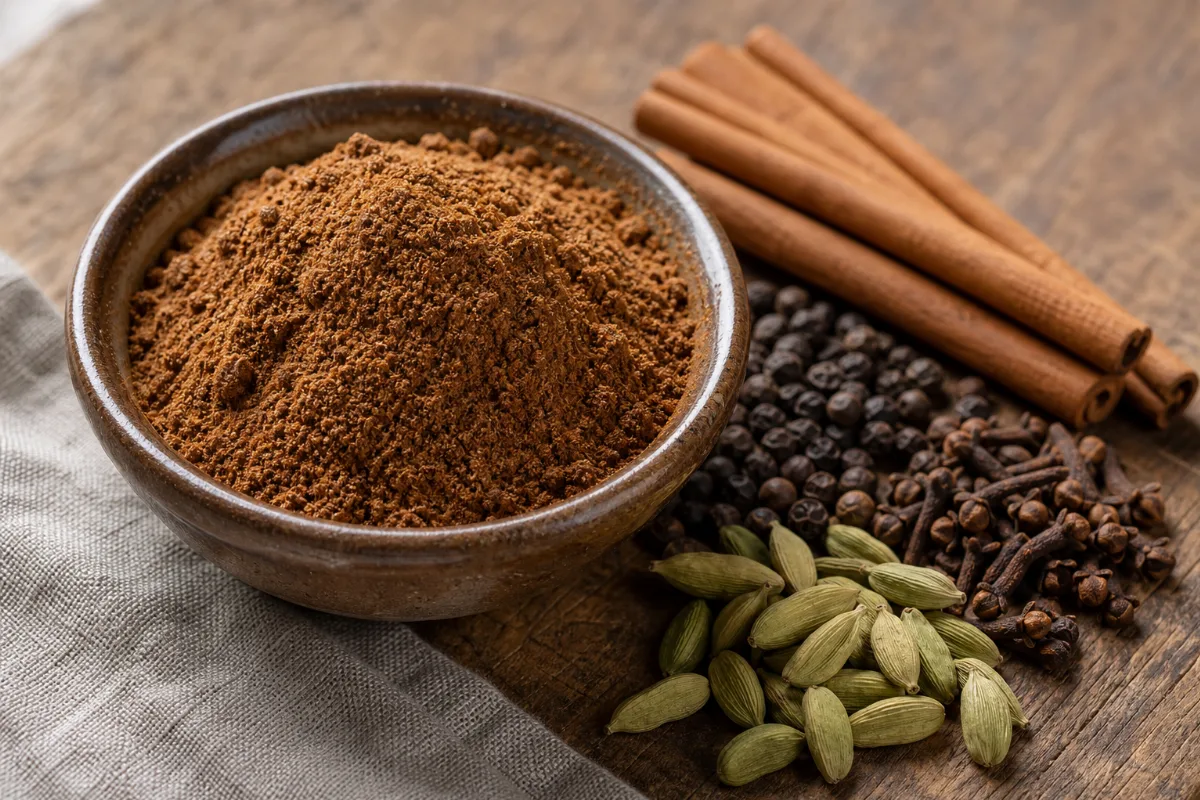
Spices · Spice blend
Baharat
Blend of spices (no single species) · also called Bahārāt, Arabic seven-spice (Levantine version)
Baharat is a warm, peppery Middle Eastern spice blend used on meat, soups and vegetables. The word means 'spices' in Arabic, and there is no one fixed recipe. No health study of the blend itself was found, so this is a flavoring, not a proven remedy. The main cautions are quality ones: lead and germs have been found in some ground spices.
General information, not medical advice. Last substantive update · Not medically reviewed. A named clinician has not signed off on this page. How this page is made
About Baharat
Baharat is a warm, sweet and peppery blend from Middle Eastern cooking. It is a flavoring, not a proven remedy, and the blend has not been studied for health. Buy from sellers you trust, since lead and germs have been found in some ground spices.
What it is
Baharat is a spice mixture used in Middle Eastern cooking. The word is Arabic for 'spices' and often means spices in general, not one set recipe. Medieval Arabic cookbooks recorded spice blends under other names, and the word baharat for a blend likely began in the Ottoman Empire.
Typical parts include black pepper, allspice, cinnamon or cassia, cloves, cumin, coriander seed, cardamom, nutmeg, and paprika or dried chili. Cloves, black pepper, allspice and cinnamon are often the main ones. Wikipedia gives one example mix of 6 parts paprika, 4 black pepper, 4 cumin, 3 cinnamon, 3 cloves, 3 coriander, 3 nutmeg and 1 cardamom (by parts, not an amount to eat).
In the kitchen
It is rubbed on or stirred into lamb, mutton, fish, chicken, beef and soups, and it can be a table condiment. Mixed with olive oil and lime juice it makes a marinade.
Versions differ by place. Turkish baharat usually has cinnamon, dried rose buds and black pepper, and often mint. The Levantine 'seven spices' mix has cinnamon, black pepper, white pepper, allspice, cloves, nutmeg and coriander. Eastern Arabian versions can add dried black lime and saffron. Mixes for sweets often use cinnamon, anise, mahlab, cardamom, saffron or mastic.
Nutrition
No nutrition figures are given for baharat. We could not confirm a USDA entry for it, and the mix varies by cook and maker. Read the label on a ready-made product, since some may add salt.
What the research shows
No study of baharat as a blend was found for any health outcome. Results from supplements or extracts of single spices would not carry over to a pinch of a mixed blend in cooking, so none are borrowed here.
Amounts
This page gives no amounts to eat. Ask a doctor, pharmacist or dietitian what is right for you, especially in pregnancy, with allergies or with medicines.
At a glance
Traditional uses history, not proof
- Rubbed on or stirred into lamb, mutton, fish, chicken, beef and soups, and used as a table condiment
- Mixed with olive oil and lime juice as a marinade
Studied for research
- Baharat eaten as a spice blend: no human study found
Main compounds
- Piperine (from the black pepper in many versions)
Common forms
- Ground blend used in cooking
- Freshly ground whole spices (the traditional method)
Research links: CDC MMWR: Lead in spices, herbal remedies and ceremonial powders (2018) · Foodborne illness outbreaks from microbial contaminants in spices (Food Microbiol, 2013) · Wikipedia: Baharat · Research Library · Genes & Biomarkers Library
What it is and its history
- Accepted scientific name
- Not a single species (a blend of ground spices)
- Common names
- Baharat (Arabic transliteration); Bahārāt (Arabic transliteration); Arabic seven-spice (the Levantine version) (English); Mezcla de especias árabes (Spanish)
- Native range
- Used across Middle Eastern cooking (Wikipedia).
- Harvest and processing
- Finely ground spices mixed together (Wikipedia).
- Look-alikes and adulterants
- Name: Garam masala, ras el hanout, advieh; Note: Other warm spice blends from neighbouring cuisines; Wikipedia lists them as related.
Photographs
Traditional use and history history, not clinical proof
| Tradition or era | Documented use | Source |
|---|---|---|
Traditional use shows how it was used. It does not show that it works or is safe today.
What is inside, and how it may work
What it contains and how those compounds act in cells and animals. Laboratory and animal mechanisms are not proven effects in people.
Main compounds
| Compound | Family | Where it is concentrated | Activity studied | Level of evidence |
|---|---|---|---|---|
| Piperine (from black pepper) | alkaloid (amide) | Black pepper fruit | Peppery bite. Isolated piperine can change how some drugs are handled; not shown for pepper in food. 3 | Review |
Mechanisms, receptors and pathways
| Target or pathway | Gene or receptor | What was found | Level |
|---|---|---|---|
| Drug-handling enzymes and transporters (isolated piperine) | Not specified in the abstract | Piperine can inhibit or stimulate drug-metabolising enzymes and transporters, so drug levels may rise or fall. Not shown for baharat. 3 | Review |
Absorption, metabolism and elimination
- Absorption
- Not found for the blend.
- Distribution
- Not found.
- Metabolism
- Not found for the blend.
- Elimination
- Not found.
- Bioavailability
- Not established.
Isolated compounds versus whole extracts
Supplements or extracts of a single spice are not the same as a pinch of a mixed blend in cooking. No supplement form of baharat was found, and no result for one spice carries over to the blend.
Nutritional composition
No nutrition figures are given for baharat. A USDA FoodData Central lookup for the blend could not be completed on 2026-10-26 (the public interface refused the request), so we do not say whether it holds an entry; an earlier note on this site said it did not. The mix varies by cook and maker, so any figure would be a guess. Recipes in the sources are described as mixing spices only, and some ready-made products may add salt, so check the label. No amount to eat is given.
1 not enough evidence
What was looked at
The 1 benefits and uses checked for Baharat, each with how strong the evidence is. Tap one to open it.
What is Baharat good for?
There is no human evidence on the blend, so there is only one entry. Single spices in the mix have their own pages.
Benefits, one by one
Each card is a research question, not a promise. Tap a goal to filter. Open a card to see the studies, doses and limits.
Baharat eaten as a spice blend (health effects of kitchen amounts)
Not enough evidenceNo study was found of baharat, the blend, for any health outcome. It is a flavoring, and what is known comes from its single spices, which this page does not rate.
1 studiesA ground or freshly ground blend used in cooking. No amount is given …
Studies, doses and limits
What the trials found
Wikipedia says baharat usually means spices in general rather than one fixed set. No human trial of any baharat mix was found in the sources read.
Results
No human trial of baharat was found.
Why this rating
No study of the blend exists in the sources read, so nothing can be rated.
Form and dose studied
A ground or freshly ground blend used in cooking. No amount is given here.
Who was studied
Not studied.
Limits
Absence of studies is not proof of no effect, and not proof of safety. Results for one spice (for example from supplements) do not carry over to a blend in food.
Why researchers looked
People ask whether a warm spice blend does anything for health.
Traditional use
Baharat means 'spices' in Arabic and is used across Middle Eastern cooking for meat, soups and vegetables. Long use in food is not proof of a health effect.
Proposed mechanism Unknown
Not established for the blend. The mix differs from cook to cook, so there is no single recipe to study.
A proposed mechanism does not show that the effect happens in people.
See the Safety tab for lead, germs, nutmeg and pepper-and-medicine cautions.
Connections to the rest of health
How Baharat connects to the rest of our health knowledge graph. Every link says what kind of connection it is. A safety link (for example to the liver) is a warning, not a benefit. A study that merely mentions a topic never creates a benefit link.
Explore every connection: goals, body systems, organs, symptoms, genes
B. Body systems
| Connected to | Kind of connection | Evidence status | Context | Studies |
|---|---|---|---|---|
| Digestive System | Biological association | Not enough evidence | Studied for: Baharat eaten as a spice blend (health effects of kitchen amounts) | 5 |
E. Health conditions
| Connected to | Kind of connection | Evidence status | Context | Studies |
|---|---|---|---|---|
| Lead poisoning | Documented risk | Lead was found in some spices; baharat itself was not named in the parts read. Preparation or compound: Ground spices in general |
4 | |
| Salmonella infections | Documented risk | Most spice outbreaks were Salmonella; not shown for baharat specifically. Preparation or compound: Contaminated spices in general |
1 |
L. Active compounds
| Connected to | Kind of connection | Evidence status | Context | Studies |
|---|---|---|---|---|
| Piperine (from black pepper) | Biological association | Review | Peppery bite. Isolated piperine can change how some drugs are handled; not shown for pepper in food. Preparation or compound: Black pepper fruit |
3 |
Each connection is stored with the ingredient, the connected record, the kind of connection, the evidence status, the supporting studies, the preparation or compound involved, and a review date (last reviewed October 26, 2026).
Evidence at a glance: what the research found for 1 outcome
Each outcome below is one thing researchers measured. Certainty is how far the evidence can be trusted, not how well it works. The full studies are on the next tab.
The evidence
The research centre for Baharat. Every record here was checked against PubMed or the publisher's page; we never list a study we have not verified.
Evidence by outcome
Bars show how many studies we found for each outcome, not how well it works. People are added up across trials only (reviews are not added, to avoid double counting).
How we rate evidence
High certainty
Several well-run trials or reviews agree; further research is unlikely to change the picture much.
Moderate certainty
Good trials point the same way, but some doubt remains.
Low certainty
Small, short or inconsistent trials. The finding could change with better research.
Very low certainty
Very little or very weak human data. Treat as a possibility only.
Mixed findings
Trials or reviews disagree with each other.
Not enough evidence
Not enough human research to say either way.
Evidence against
Good research found no benefit, or found harm.
We take the reviewers' own risk-of-bias and GRADE statements where they exist, and otherwise judge from study size, design, consistency, directness and whether a product matches what is sold. Many publications do not make evidence high. Method note: Little research exists for this blend, so this page is smaller than others. We read Wikipedia for identity and uses, checked four PubMed items (abstracts read) and the CDC report's full text for the lead limit statement. Items we could not verify are flagged in the research gaps.
Study library: every study we checked 5
| Study | Design | People | Product, dose, length | Result |
|---|---|---|---|---|
| p24010629 Foodborne illness outbreaks from microbial contaminants in spices, 1973-2010. · Source |
Review of outbreaks |
Methods, limits and fundingRead: abstract | ||
| p24452991 Nutmeg poisonings: a retrospective review of 10 years experience from the Illinois Poison Center, 2001-2011. · Source |
Case series |
Methods, limits and fundingRead: abstract | ||
| p29250980 Piperine-mediated drug interactions and formulation strategy for piperine: recent advances and future perspectives. · Source |
Narrative review mixed |
Methods, limits and fundingRead: abstract | ||
| p30462630 Lead in Spices, Herbal Remedies, and Ceremonial Powders Sampled from Home Investigations for Children with Elevated Blood Lead Levels - North Carolina, 2011-2018. · Source |
Case series |
Methods, limits and fundingRead: abstract + full-text passage on limits | ||
| s-wiki-baharat Wikipedia: Baharat · Source |
Encyclopedia n/a |
Methods, limits and fundingRead: full-text |
What we do not know yet
- No study of baharat as a blend was found for any health outcome.
- Lead and germ levels in baharat blends were not found.
- Nutrition data for the blend could not be confirmed.
- Pregnancy, breastfeeding and allergen information for the blend was not found.
- History comes from a secondary source.
How new research is added
New studies are found by a saved PubMed search and placed in a review queue before the page changes.
Lab markers
What changed in blood or saliva tests during trials. A changed number is not the same as feeling or being healthier, and we give no "normal ranges".
Safety
What studies and official sources say about side effects, medicines and who should check first. Each point shows what kind of evidence it comes from.
Main points to know 4
- Lead and germs in ground spices: a quality question, not shown for baharat. In one North Carolina set of home samples taken because a child had high blood lead, 28.8% of spices, herbal remedies and ceremonial powders held 1 mg/kg lead or more. The full report says the US has no permissible limit for lead in spices. Baharat itself was not named in the parts we read. A review of reported outbreaks found 14 outbreaks from germ-contaminated spices between 1973 and 2010, mostly Salmonella, and infants and children were the main group in 5 of them. Case series 4 1
- Nutmeg: a small part of many blends, harmful only in large amounts. Poison-center reports describe nutmeg harm after intentional large ingestions in teens and after accidental swallowing or eye exposure in young children. Nutmeg is only one part of some baharat mixes, and no case tied to baharat was found. Keep spice jars out of small children's reach. Case series 2 5
- Black pepper's piperine can change how some medicines work. A review says isolated piperine can change drug levels, helpfully or harmfully, depending on dose, timing and length of use. Most of that work is on piperine alone, not on the pinch of pepper in a blend, and nothing was found about baharat. If you take a medicine with a narrow safety margin, ask a pharmacist. Review 3
- Pregnancy, breastfeeding and allergy: not addressed for baharat. None of the sources read describe baharat in pregnancy, breastfeeding or allergy. Any single spice can cause allergy, and the mix changes from maker to maker, so people with a known spice allergy should read the label or ask the maker. Authoritative guidance 5
Side effects 3
| Effect | How often | Severity and recovery | Evidence |
|---|---|---|---|
| Lead exposure from contaminated ground spice Spices in general, not baharat specifically. | 28.8% of products sampled in one set of homes with lead-exposed children had 1 mg/kg or more; not a population rate | Can matter most for children over time Not assessed | Case series 4 |
| Food poisoning from germ-contaminated spice, mainly Salmonella Spices in general. Greatest risk where spice is added to ready-to-eat food after the last germ-killing step. | 14 reported outbreaks, 1973-2010 | 1946 illnesses, 128 hospitalizations, 2 deaths across those outbreaks Not assessed | Outbreak review 1 |
| Poisoning from large amounts of nutmeg Intentional large ingestion or child accidents, not cooking use. | 32 cases in 10 years at one poison center | One teen taking several drugs needed breathing support Not assessed | Case series 2 |
Liver
No liver injury linked to baharat was found in the sources read.
How often. Not assessed.
This is a safety connection. It is not evidence that Baharat supports liver health.
Medicines and supplements 1
| With | Why it matters | Importance | Evidence | What to do |
|---|---|---|---|---|
| Medicines affected by piperine (from black pepper) prescription | Isolated piperine can inhibit or stimulate drug-handling enzymes and transporters. | Depends on dose, timing and duration; mostly shown for isolated piperine, not for pepper in food or baharat. | Review Very low certainty 3 | If you take a medicine with a narrow safety margin, ask a pharmacist. Do not change a prescribed medicine on your own. |
Who should check first 2
Overdose, product quality and regulators
Summary. No toxicity from baharat in food was found in the sources read. The documented harms are from contaminated spice batches and from large amounts of nutmeg.
Animal. Not researched.
Human doses studied. No safe or harmful intake of baharat is set in the sources read.
High dose or long term signals. Not found for the blend.
Overdose response. Not found for the blend. For nutmeg see the poison-center series.
Genotoxicity. Not researched.
Ground spices and blends can carry lead or germs; baharat was not specifically tested in the sources read.
Lead in spices. 28.8% of spices, herbal remedies and ceremonial powders sampled in homes of lead-exposed children held 1 mg/kg or more lead. No US permissible limit for lead in spices exists (full text). 4
Germs in spices. 14 outbreaks attributed to contaminated spices between 1973 and 2010; Salmonella caused 10. 1
| Body | Action | Date |
|---|---|---|
| CDC (US), MMWR report (United States) | Reports that no US permissible limit for lead in spices exists and that a national limit might reduce lead exposure. source | 2018-11-23 |
When to get medical help
- A child may have swallowed a large amount of nutmeg or a spice jar: call your local poison centre or emergency number at once.
- Severe vomiting, fever or bloody diarrhoea after eating: see a doctor.
- Trouble breathing, swelling of the lips, face or throat, or widespread hives after eating a spice blend: get emergency help.
Stop using the product and contact a clinician or emergency service. In the US, Poison Control is 1-800-222-1222.
General information only, not medical advice. Ask a clinician or pharmacist before use, especially with medicines, in pregnancy or with a health condition. See the Natural Remedy Safety guide.
Frequently asked questions
What is baharat?
A Middle Eastern spice blend. The word means 'spices' in Arabic, and there is no single fixed recipe.
What is in baharat?
It varies. Cloves, black pepper, allspice and cinnamon are often the main parts, and cumin, coriander, cardamom, nutmeg and paprika are common.
What does baharat taste like?
Warm and sweet-spiced with a peppery edge, going by its usual parts. The sources read do not describe the taste in detail.
How is baharat used?
Rubbed on or stirred into lamb, mutton, fish, chicken, beef and soups, as a table condiment, or in a marinade with olive oil and lime juice.
Is baharat good for you?
No study of the blend was found, so no health benefit can be claimed. It is a flavoring.
Is baharat the same as garam masala?
No. Wikipedia lists garam masala as a related blend from another cuisine; the mixes differ in makeup.
Can baharat contain lead?
Lead has been found in some spices and herbal powders. In one set of homes with lead-exposed children, 28.8% of samples held 1 mg/kg or more. Baharat was not named in the parts we read.
Can spices carry Salmonella?
Yes. A review of reported outbreaks found 14 from contaminated spices between 1973 and 2010, and most were Salmonella. Baharat was not named.
Is baharat safe in pregnancy and breastfeeding?
The sources read do not address baharat. Ask your midwife or doctor.
Can I eat baharat with medicines?
No problem has been reported for baharat in food. Isolated piperine from black pepper can change how some drugs are handled, so ask a pharmacist if your medicine has a narrow safety margin.
Does baharat contain nutmeg, and is that a problem?
Can you be allergic to baharat?
Any single spice can cause allergy, and the mix varies. The sources read do not list allergens for baharat, so ask the maker if you are unsure.
Explore by health goal
Editorial transparency
- Written by
- AlternativeMed editorial team. Research compiled with AI assistance, then checked against the sources listed.
- Medical review
- None. This page has not been reviewed by a physician or pharmacist.
- First published
- 2026-10-26
- Last substantive update
- 2026-10-26
- How we research
- Little research exists for this blend, so this page is smaller than others. We read Wikipedia for identity and uses, checked four PubMed items (abstracts read) and the CDC report's full text for the lead limit statement. Items we could not verify are flagged in the research gaps.
- How we rate evidence
- See "How we rate evidence" in the Evidence tab.
- Independence
- No product is promoted on this page. No affiliate links are shown.
Sources 5
Each source was opened and checked. Where we read only the abstract, it says so. The small numbers in the text point here.
- . Foodborne illness outbreaks from microbial contaminants in spices, 1973-2010.. . . (abstract)
- . Nutmeg poisonings: a retrospective review of 10 years experience from the Illinois Poison Center, 2001-2011.. . . (abstract)
- . Piperine-mediated drug interactions and formulation strategy for piperine: recent advances and future perspectives.. . . (abstract)
- . Lead in Spices, Herbal Remedies, and Ceremonial Powders Sampled from Home Investigations for Children with Elevated Blood Lead Levels - North Carolina, 2011-2018.. . . (abstract + full-text passage on limits)
- . Wikipedia: Baharat. . . (full-text)
Where to buy
Check the label first. Whatever you buy, look for these:
- Whole or ground: whole spices keep their flavor longer
- The origin and a packed-on or best-by date for freshness
- Organic or non-irradiated labeling if that matters to you
- A resealable, airtight container
Talk to a pharmacist or doctor before you start any supplement, especially if you take medicines. See the Safety tab for interactions.
Support our free guides: as an Amazon Associate we earn from qualifying purchases. Full disclosure.


