Spices · Spice
Tamarind
Tamarindus indica · also called Tamarindo (Spanish)
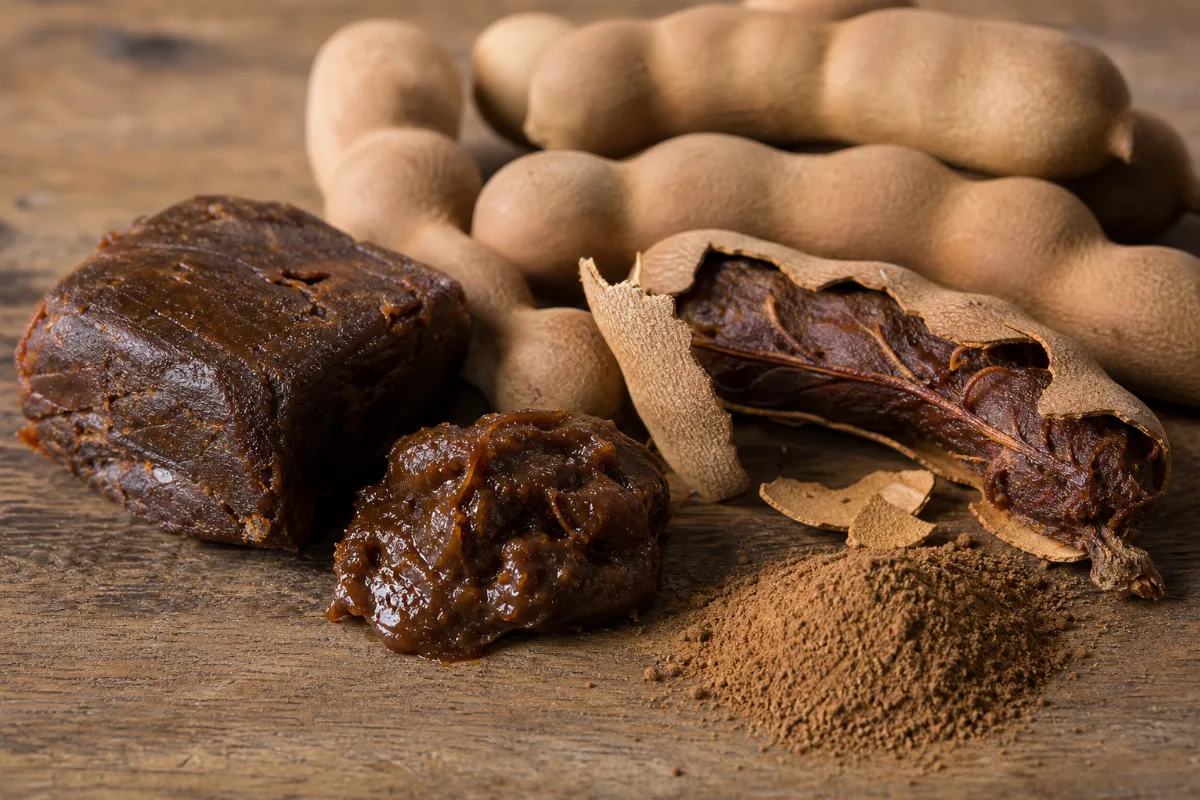
Tamarind is the sticky, sweet-sour pulp inside the brown pods of a tropical tree, used in curries, chutneys, soups and drinks. Small trials found no clear benefit of eating the pulp for weight or blood sugar. Past tests found lead in some imported tamarind candy, a small study found it raised aspirin levels, and the seeds are an airway danger for young children.
General information, not medical advice. Last substantive update · Not medically reviewed. A named clinician has not signed off on this page. How this page is made
About Tamarind
Tamarind is a cooking ingredient, not a proven remedy. Eating it is generally fine; the cautions are imported candy, aspirin users, seeds for young children, and extracts.
What it is
Tamarind (Tamarindus indica) is the pulp inside the pods of a tree in the legume family, according to GBIF. The 2025 juice trial describes it as a fruit native to Africa.
USDA data for raw pulp: 239 kcal per 100 g, mostly carbohydrate, with 5.1 g fibre, 628 mg potassium, 92 mg magnesium and 2.8 mg iron. One cup of pulp is 120 g. A spoonful of paste gives only a fraction of that, for example about 36 kcal and 94 mg potassium per 15 g (calculated). Jarred pastes and candy vary.
What the research shows
Eating 20 g of pulp a day for 6 weeks made no significant difference to weight, waist, blood fats, blood glucose or blood pressure compared with a control group (40 adults).
A 4-week trial of 50 people living with HIV with high triglycerides compared two juice strengths. The stronger juice lowered triglycerides and the weaker lowered systolic blood pressure. The authors call it exploratory.
A tamarind extract added to rice did not change blood glucose in 18 healthy men. Two small studies in boys found more fluoride in the urine after tamarind.
We found no trial of tamarind as a seasoning, and no trial for its folk uses.
Pulp versus extract, juice and candy
These are different products. The pulp trial was null, the juice trial was a large daily volume in a specific group, and the aspirin study used an extract. Candy is a sweet with its own lead history. Seed gum and seed extract are industrial or supplement products, not the food.
Amounts
This page gives no amounts to eat. Ask a doctor, pharmacist or dietitian if you have questions, especially if you take aspirin, have diabetes, are pregnant, or want to use extracts.
At a glance
Traditional uses history, not proof
- Used as a souring and flavouring ingredient in food and drinks
- Folk use as a mild laxative and for fever and sore throat
- Long use as food is not proof that it treats any condition
Studied for research
- Weight and waist size, low certainty (no benefit in a 6-week trial)
- Triglycerides and blood pressure with juice, very low certainty
- Blood sugar after a meal, low certainty (no effect in healthy men)
- Fluoride leaving the body in urine, low certainty
Main compounds
- Polyphenols (as a group)
Common forms
- Pods, pressed pulp, paste, juice and candy (food forms)
- Seed extract and seed gum (different products)
Research links: Trial: tamarind pulp in overweight adults · Trial: tamarind juice and triglycerides · Study: tamarind extract and aspirin levels · Report: lead in imported tamarind candy · USDA FoodData Central: Tamarinds, raw · Research Library · Genes & Biomarkers Library
What it is and its history
- Accepted scientific name
- Tamarindus indica
- Naming authority
- L. (GBIF accepted)
- Common names
- Tamarind (English); Tamarindo (Spanish)
- Family or group
- Fabaceae (the legume family), as given by GBIF.
- Classification
- Plantae > Tracheophyta > Magnoliopsida > Fabales > Fabaceae > Tamarindus > Tamarindus indica
- Native range
- Described as a fruit native to Africa in the abstract of the 2025 juice trial.
- Habitat
- Not verified from a source read.
- What it looks like
- Roots: Not verified.; Stems: Not verified.; Leaves: Not verified.; Flowers: Not verified.; Fruit: The pulp is the sticky part inside the pod; the seeds are hard and swell in water (the airway case series notes swollen seeds). Further appearance not verified.
- Cultivation
- Not verified from a source read.
- Harvest and processing
- Sold as pods, pressed pulp, paste, juice and candy according to our earlier summary; not re-checked.
- Look-alikes and adulterants
- Name: Kokum and Garcinia cambogia; Note: Other sour fruit rinds used in cooking; different plants, sometimes called Malabar tamarind. Not the same as tamarind.; Name: Tamarind seed gum or powder; Note: A processed product from the seeds used in industry, eye drops and textiles; not the food pulp.
- Sustainability and conservation
- Not assessed.
Photographs
What is inside, and how it may work
What it contains and how those compounds act in cells and animals. Laboratory and animal mechanisms are not proven effects in people.
Main compounds
| Compound | Family | Where it is concentrated | Activity studied | Level of evidence |
|---|---|---|---|---|
| Polyphenols (as a group) | polyphenol | Fruit pulp Juice in the 2025 trial was analysed at about 1.6 g of polyphenols in the daily volume; no content per gram of pulp was read. | The authors of the 2025 juice trial describe the fruit as rich in polyphenols and propose they may affect blood fats and pressure; not shown to be the cause. 7 | Human data |
Mechanisms, receptors and pathways
| Target or pathway | Gene or receptor | What was found | Level |
|---|---|---|---|
| Urine fluoride and pH | Not specified | After tamarind, boys passed more fluoride in urine and urine pH rose; the authors suggest fluoride is mobilised from bone. This is an interpretation of urine markers, not a measured bone effect. 5 6 | Human data |
Absorption, metabolism and elimination
- Absorption
- Not found.
- Distribution
- Not found.
- Metabolism
- Not found.
- Elimination
- Not found.
- Bioavailability
- Not established for the pulp.
Isolated compounds versus whole extracts
Pulp, juice, water extract, seed extract and seed gum are different products. The pulp trial was null for weight; the juice trial was a different product in a different group. Candy is a sweet with its own lead history, and is not the same as pulp.
Nutritional composition
Nutrition from USDA FoodData Central (Tamarinds, raw, FDC 167763, SR Legacy; record dated 2019-04-01; read 2026-10-26 from the April 2018 data download). Per 100 g of raw pulp: 239 kcal, 2.8 g protein, 0.6 g fat (0.27 g saturated), 62.5 g carbohydrate, 5.1 g fibre, 31.4 g water, 74 mg calcium, 2.8 mg iron, 92 mg magnesium, 113 mg phosphorus, 628 mg potassium, 28 mg sodium, 0.1 mg zinc, 3.5 mg vitamin C, 0.43 mg thiamin (vitamin B1), 0.15 mg riboflavin, 1.9 mg niacin. Most of the calories are carbohydrate. USDA lists 1 cup of pulp as 120 g, which is about 287 kcal, 6.1 g fibre and 754 mg potassium (calculated). A spoonful of paste in a curry gives only a fraction of that: 15 g would give about 36 kcal, 0.8 g fibre, 94 mg potassium and 0.4 mg iron (calculated from the per-100 g values). Jarred pastes and candy vary and may have added sugar or salt.
3 low certainty1 very low certainty1 not enough evidence
What was looked at
The 5 benefits and uses checked for Tamarind, each with how strong the evidence is. Tap one to open it.
- Weight and waist sizeLow certainty
- Triglycerides and blood pressure (tamarind juice)Very low certainty
- Blood sugar after a mealLow certainty
- Fluoride leaving the body in urineLow certainty
- Constipation, fever, sore throat and other folk usesNot enough evidence
Lab markers tracked in the studies
TriglyceridesSystolic blood pressureUrine fluoride
What is Tamarind good for?
Only a few small trials exist, and none tests tamarind as a seasoning. Results are mostly no clear benefit, with one exploratory juice trial.
Benefits, one by one
Each card is a research question, not a promise. Tap a goal to filter. Open a card to see the studies, doses and limits.
Weight and waist size
Low certaintyIn a 6-week trial of overweight and obese adults, eating 20 g of tamarind pulp a day made no significant difference to weight measures compared with a control group. That is more pulp than most dishes contain.
1 studiesFruit pulp eaten with meals in the trial.
Studies, doses and limits
What the trials found
One small randomised trial of fruit pulp found no significant difference from control.
Results
BMI and waist circumference fell within the tamarind group but not significantly more than in the control group.
Effect sizes as reported
No significant difference between groups.
Why this rating
One small 6-week trial of 20 people per group that found no effect; no repeat trial found.
Form and dose studied
Fruit pulp eaten with meals in the trial.
Who was studied
Overweight and obese adults.
Limits
Small, short, abstract-level reading only. Does not tell us about seasoning amounts.
Why researchers looked
Animal studies had suggested tamarind pulp might act against obesity, so researchers tested it in people.
Traditional use
Tamarind is a sour-sweet cooking ingredient. It is not a traditional weight-loss food in the sources read.
Proposed mechanism Animal evidence
Not established in people. The trial's background points to animal studies only.
A proposed mechanism does not show that the effect happens in people.
No safety signal was reported in the abstract.
Triglycerides and blood pressure (tamarind juice)
Very low certaintyA small exploratory trial in people living with HIV and high triglycerides found that a strong tamarind juice (30% pulp, 600 mL a day for 4 weeks) lowered triglycerides. A weaker juice lowered systolic blood pressure instead. The authors say the trial was too small for firm conclusions.
1 studiesJuice made with fruit pulp, a large daily volume. Not a seasoning amo…
Studies, doses and limits
What the trials found
One 50-person double-blind exploratory trial comparing two juice strengths. No no-tamarind group was described in the abstract.
Results
Triglycerides fell about 17% with the 30% juice. Cholesterol (total, LDL, HDL) did not change significantly with either strength. Systolic blood pressure fell with the 10% juice only.
Effect sizes as reported
Triglycerides -39.8 mg/dL (95% CI -67.7 to -11.9) with 30% juice; systolic blood pressure -7.4 mmHg (95% CI -14.5 to -0.26) with 10% juice.
Why this rating
One small exploratory trial in a specific group, no no-tamarind comparison, inconsistent pattern across the two strengths.
Form and dose studied
Juice made with fruit pulp, a large daily volume. Not a seasoning amount.
Who was studied
Adults living with HIV with high triglycerides.
Limits
Not powered for firm conclusions, per the authors. Funding not stated in the abstract. Cannot be applied to people in general or to cooking amounts.
Why researchers looked
Tamarind fruit is rich in polyphenols, plant compounds that may affect blood fats and blood pressure.
Traditional use
Not part of traditional use in the sources read.
Proposed mechanism Authoritative guidance
Not established. The authors point to polyphenols in the fruit.
A proposed mechanism does not show that the effect happens in people.
Not reported in the abstract.
Blood sugar after a meal
Low certaintyIn 18 healthy men, a water extract of tamarind pulp added to high-glycaemic rice, either drunk or cooked in, did not change blood glucose or insulin after the meal compared with plain rice. Any benefit for people with diabetes has not been shown.
2 studiesWater extract of pulp with a rice meal.
Studies, doses and limits
What the trials found
One small crossover trial in healthy men; the abstract reports tamarind together with cumin and corn silk.
Results
No change in blood glucose, insulin or blood pressure with the extracts. Insulin was lower when extracts were cooked into the rice than when drunk.
Effect sizes as reported
No significant effect on blood glucose, insulin or blood pressure.
Why this rating
One small trial in healthy men that found no effect; people with diabetes were not studied here.
Form and dose studied
Water extract of pulp with a rice meal.
Who was studied
Healthy Chinese men.
Limits
Healthy men only, single meals, extract rather than whole pulp.
Why researchers looked
Tamarind, cumin and corn silk are Asian ingredients often said, in popular belief, to help with diabetes.
Traditional use
Popular belief in parts of Asia; the trial's abstract calls it anecdotal.
Proposed mechanism Insufficient
Not established.
A proposed mechanism does not show that the effect happens in people.
A case report describes high blood sugar in a woman with diabetes after a crude tamarind herbal pill; see the Safety tab.
Fluoride leaving the body in urine
Low certaintyTwo small trials in boys from India found that eating tamarind daily raised the amount of fluoride passing out in urine. The authors suggest it may help in places where drinking water has too much fluoride. Neither trial measured bone health or symptoms.
2 studiesTamarind eaten with meals (10 g a day in 2002).
Studies, doses and limits
What the trials found
Two small randomised diet-control studies from the same institute.
Results
Urine fluoride was higher with tamarind: 4.8 vs 3.5 mg a day in the 2002 study. In the 2004 study the tamarind group also had higher urine fluoride than the control group. Urine magnesium and zinc were lower on tamarind in 2002.
Effect sizes as reported
2002: urine fluoride 4.8 vs 3.5 mg a day (P < 0.001).
Why this rating
Two small, short studies from one group, measuring urine markers only.
Form and dose studied
Tamarind eaten with meals (10 g a day in 2002).
Who was studied
School and adolescent boys.
Limits
Not tested in adults or in people with fluorosis symptoms. Lower magnesium and zinc excretion was also seen.
Why researchers looked
In some regions, drinking water holds too much fluoride, which can damage teeth and bones (fluorosis). Researchers tested a cheap local food.
Traditional use
Not part of traditional use in the sources read.
Proposed mechanism Human evidence
Not established. The 2004 paper reports higher urine pH and lower urine calcium; the authors link this to fluoride leaving bone.
A proposed mechanism does not show that the effect happens in people.
Fluoride exposure itself is best handled by a safe water supply. Ask a doctor about fluorosis.
Constipation, fever, sore throat and other folk uses
Not enough evidenceTamarind pulp has a folk reputation as a mild laxative and for fever and sore throat. We found no trial testing it for these uses, so nothing can be said about benefit.
0 studiesPulp, drinks, poultices in folk use.
Studies, doses and limits
What the trials found
No human trial found. The folk uses come from our earlier summary of general references, which were not re-opened for this page.
Results
No benefit shown.
Why this rating
No human trial found.
Form and dose studied
Pulp, drinks, poultices in folk use.
Limits
Our PubMed search found no trial for these uses.
Why researchers looked
Long food and folk use in Africa, South Asia and Latin America.
Traditional use
Traditional use only. Long use as food is not proof that it treats any condition.
Proposed mechanism Insufficient
Not established.
A proposed mechanism does not show that the effect happens in people.
See the Safety tab.
Connections to the rest of health
How Tamarind connects to the rest of our health knowledge graph. Every link says what kind of connection it is. A safety link (for example to the liver) is a warning, not a benefit. A study that merely mentions a topic never creates a benefit link.
Explore every connection: goals, body systems, organs, symptoms, genes
A. Wellness goals
| Connected to | Kind of connection | Evidence status | Context | Studies |
|---|---|---|---|---|
| Weight Management | Low certainty | Weight and waist size: In a 6-week trial of overweight and obese adults, eating 20 g of tamarind pulp a day made no significant difference to weight measures compared with a control group. That is more pulp than most dishes contain. | 1 |
B. Body systems
| Connected to | Kind of connection | Evidence status | Context | Studies |
|---|---|---|---|---|
| Metabolism Weight | Biological association | Low certainty | Studied for: Weight and waist size | 1 |
| Cardiovascular System | Biological association | Very low certainty | Studied for: Triglycerides and blood pressure (tamarind juice) | 7 |
| Endocrine System | Biological association | Low certainty | Studied for: Blood sugar after a meal | 4 12 |
| Urinary System | Biological association | Low certainty | Studied for: Fluoride leaving the body in urine | 5 6 |
| Digestive System | Biological association | Not enough evidence | Studied for: Constipation, fever, sore throat and other folk uses |
E. Health conditions
| Connected to | Kind of connection | Evidence status | Context | Studies |
|---|---|---|---|---|
| Lead poisoning | Adverse effect or risk | Documented risk | Lead was found in some imported tamarind candy and wrappers; the risk is the candy product, not the pulp. Preparation or compound: Some imported tamarind candy and wrappers |
8 3 |
I. Biomarkers
| Connected to | Kind of connection | Evidence status | Context | Studies |
|---|---|---|---|---|
| Triglycerides | Biological association | Very low certainty | Measured in trials: lowered with the 30% juice only. A lab change is not the same as a health benefit. | 7 |
| Systolic blood pressure | Biological association | Very low certainty | Measured in trials: mixed. A lab change is not the same as a health benefit. | 7 1 |
| Urine fluoride | Biological association | Low certainty | Measured in trials: raised. A lab change is not the same as a health benefit. | 5 6 |
L. Active compounds
| Connected to | Kind of connection | Evidence status | Context | Studies |
|---|---|---|---|---|
| Polyphenols (as a group) | Biological association | Human | The authors of the 2025 juice trial describe the fruit as rich in polyphenols and propose they may affect blood fats and pressure; not shown to be the cause. Preparation or compound: Fruit pulp |
7 |
Each connection is stored with the ingredient, the connected record, the kind of connection, the evidence status, the supporting studies, the preparation or compound involved, and a review date (last reviewed October 26, 2026).
Evidence at a glance: what changed in 2 lab markers
Tap a number to show only those markers. Counts are markers, not people.
The evidence
The research centre for Tamarind. Every record here was checked against PubMed or the publisher's page; we never list a study we have not verified.
Evidence by outcome
Bars show how many studies we found for each outcome, not how well it works. People are added up across trials only (reviews are not added, to avoid double counting).
How we rate evidence
High certainty
Several well-run trials or reviews agree; further research is unlikely to change the picture much.
Moderate certainty
Good trials point the same way, but some doubt remains.
Low certainty
Small, short or inconsistent trials. The finding could change with better research.
Very low certainty
Very little or very weak human data. Treat as a possibility only.
Mixed findings
Trials or reviews disagree with each other.
Not enough evidence
Not enough human research to say either way.
Evidence against
Good research found no benefit, or found harm.
We take the reviewers' own risk-of-bias and GRADE statements where they exist, and otherwise judge from study size, design, consistency, directness and whether a product matches what is sold. Many publications do not make evidence high. Method note: We started from our existing tamarind summary, searched PubMed for human studies, read the abstract of each study cited, re-read the USDA nutrition record and the US food regulation, and checked the species name at GBIF. Items we could not verify are flagged in the research gaps.
Study library: every study we checked 15
| Study | Design | People | Product, dose, length | Result |
|---|---|---|---|---|
| Asgary 2020 Evaluation on the Effects of Tamarindus Indica L. Fruit on Body Weight and Several Cardiometabolic Risk Factors in Obese and Overweight Adult Patients: A Randomized Controlled Clinical Trial. Int J Prev Med · PMID 32175064 · DOI |
Randomized controlled trial |
40 Obese and overweight adults; 20 per group completed |
Tamarind fruit pulp eaten with meals, plus diet and activity advice Fruit pulp 10 g twice daily with meals (20 g a day) 6 weeks · vs Control group given the same diet and activity advice without tamarind |
Within the tamarind group, BMI, waist circumference, LDL cholesterol and systolic and diastolic blood pressure were lower than at the start. None of these changes was statistically significant compared with the control group. The authors conclude 20 g a day had no significant effect on weight, waist, blood fats, blood glucose or blood pressure. No significant difference from control (Not given in the abstract) Methods, limits and fundingOutcomes: Body mass index, waist circumference, blood pressure, fasting glucose, total, LDL and HDL cholesterol, triglycerides Limitations: Small, 6 weeks. The abstract does not describe a placebo. Many results are within-group changes only, which do not show a tamarind effect. Funding and conflicts: Authors state no conflicts of interest. Read: abstract |
| Borkar 2024 Tamarind Seeds in Tracheobronchial Tree: Challenges during Rigid Bronchoscopy. J Indian Assoc Pediatr Surg · PMID 38912035 · DOI |
Case series |
5 Five children (four boys, one girl), median age 10, who breathed a tamarind seed into the airway |
Tamarind seed (aspirated) Seed |
All five needed a rigid-camera airway procedure to remove the seed. Two who came within a week needed a temporary opening in the windpipe because the swollen seed could not pass the narrow voice box. Late arrivals needed the seed removed in pieces. All recovered without problems. Not applicable (Not applicable) Methods, limits and fundingOutcomes: Where the seed lodged, difficulty of removal, recovery Limitations: Five patients from one hospital; shows the danger of the seed in the airway, not how often it happens. The authors say it is not frequent. Funding and conflicts: Authors state no conflicts of interest. Read: abstract |
| Centers for Disease Control and Prevention (CDC) 2002 Childhood lead poisoning associated with tamarind candy and folk remedies--California, 1999-2000. MMWR Morb Mortal Wkly Rep · PMID 12233910 |
Case series |
5 Five children in California with lead poisoning from unusual sources |
Tamarind candy (and folk remedies, Mexican pottery, other imported candies named in the abstract) Candy (not pulp) |
The report describes five California cases of lead poisoning from sources other than paint, including certain imported candies, folk remedies and pottery. It tells health providers and communities about these hazards. The abstract does not say which case came from which source. Not applicable (Not applicable) Methods, limits and fundingOutcomes: Source of lead exposure Limitations: Abstract read only. This is about candy products and wrappers, not tamarind pulp as a food. Funding and conflicts: Public-health agency report; funding not applicable. Read: abstract |
| Haldar 2019 Postprandial Glycemic and Insulinemic Effects of the Addition of Aqueous Extracts of Dried Corn Silk, Cumin Seed Powder or Tamarind Pulp, in Two Forms, Consumed with High Glycemic Index Rice. Foods · PMID 31554322 · DOI |
Randomized crossover trial |
18 Healthy Chinese men, mean age 37.5 |
Water extract of tamarind pulp, either drunk with rice or cooked into the rice Fruit pulp (water extract) Single meals over 3 hours, up to nine sessions each · vs Plain rice with plain water |
Adding the extracts, in either form, did not change blood glucose, insulin or blood pressure compared with plain rice. Insulin was lower when the extracts were cooked into the rice than when drunk. The abstract reports the three ingredients (corn silk, cumin, tamarind) together. No change in blood glucose, insulin or blood pressure vs plain rice (Not given in the abstract) Methods, limits and fundingOutcomes: Blood glucose and insulin after the meal, blood pressure Limitations: Healthy men only, single meals, extracts rather than whole pulp. The abstract does not give tamarind-only numbers. Funding and conflicts: Authors state no conflicts of interest. Read: abstract |
| Khandare 2002 Effect of tamarind ingestion on fluoride excretion in humans. Eur J Clin Nutr · PMID 11840184 · DOI |
Randomized diet control study |
20 Healthy school boys in a hostel; 18 of 20 finished |
Tamarind eaten with lunch Fruit (tamarind) 10 g a day with lunch 18 days · vs The boys' own control diet period (constant diet) |
Urine fluoride was higher on tamarind (4.8 mg a day) than on the control diet (3.5 mg a day; P < 0.001). Urine magnesium and zinc were lower on tamarind. Calcium and phosphorus did not differ. The authors conclude tamarind may help delay progression of fluorosis. Urine fluoride 4.8 vs 3.5 mg a day (Not given in the abstract) Methods, limits and fundingOutcomes: 24-hour urine fluoride, magnesium, zinc, calcium, phosphorus, creatinine Limitations: Small, short, boys only, and a urine marker, not a health outcome. Lower urine magnesium and zinc was also seen. Authors are from one public nutrition institute. Funding and conflicts: Funding and conflicts are not stated in the abstract. Read: abstract |
| Khandare 2004 Additional beneficial effect of tamarind ingestion over defluoridated water supply to adolescent boys in a fluorotic area. Nutrition · PMID 15105030 · DOI |
Randomized diet control study |
30 Adolescent boys from a fluoride-endemic area; 15 per group |
Tamarind eaten daily, after 2 weeks of defluoridated drinking water Fruit (tamarind) 3 weeks · vs Defluoridated water only |
Compared with the control group, the tamarind group had higher urine fluoride and urine pH and lower urine calcium and copper. Urine volume did not differ. The authors suggest tamarind helps move stored fluoride out of bone. Higher urine fluoride and pH, lower urine calcium and copper (Not given in the abstract) Methods, limits and fundingOutcomes: Urine fluoride, urine pH, calcium, copper, magnesium, volume Limitations: Small, 3 weeks, urine markers only. Bone fluoride and fluorosis symptoms were not measured. Same research group as the 2002 study. Funding and conflicts: Funding and conflicts are not stated in the abstract. Read: abstract |
| Kiyimba 2025 Effect of tamarind (Tamarindus indica L.) on the cardiometabolic health of patients living with HIV and elevated triglyceride levels: a dose-response double-blind, randomized exploratory trial. Food Funct · PMID 40264275 · DOI |
Randomized controlled trial |
50 Adults aged 30 to 60 living with HIV and triglycerides of 150 mg/dL or more; 25 per juice strength |
Tamarind fruit juice made with either 10% or 30% fruit pulp Fruit pulp (juice) 600 mL of juice a day (10% or 30% pulp) 4 weeks · vs The two juice strengths were compared with each other; the abstract describes no no-tamarind group |
With the 30% pulp juice, triglycerides fell by 39.8 mg/dL, a 17.3% drop from the starting level (P = 0.006). The 10% juice did not change triglycerides significantly. Neither strength changed total, LDL or HDL cholesterol significantly. With the 10% juice, systolic blood pressure fell by 7.4 mmHg (P = 0.043). Triglycerides -39.8 mg/dL (30% juice); systolic blood pressure -7.4 mmHg (10% juice) (Triglycerides 95% CI -67.7 to -11.9; systolic blood pressure 95% CI -14.5 to -0.26) Methods, limits and fundingOutcomes: Triglycerides (main outcome), total, LDL and HDL cholesterol, blood pressure, vascular function Limitations: Exploratory trial, not powered for firm conclusions (the authors say so). Large daily juice volume. Only people living with HIV with high triglycerides. Only the weaker juice lowered blood pressure and only the stronger one lowered triglycerides. No no-tamarind comparison group is described. Funding and conflicts: Funding and conflicts are not stated in the abstract. Read: abstract |
| Lynch 2000 Lead-contaminated imported tamarind candy and children's blood lead levels. Public Health Rep · PMID 11354337 · DOI |
Environmental investigation |
2 Two types of imported tamarind sucker (candy) and their packaging tested after a child with high blood lead in Oklahoma City, 1999 |
Imported tamarind candy (suckers) and wrappers Candy (not pulp) |
More than half of the tested suckers were above the US FDA Level of Concern for lead in this kind of product. A child eating one quarter to one half of either sucker a day would exceed the FDA provisional tolerable intake for lead. The wrappers held high lead, suggesting it leached into the candy. A model predicted one sucker a day would sharply raise average blood lead in young children. More than 50% of tested suckers above the FDA Level of Concern (Not applicable) Methods, limits and fundingOutcomes: Lead in candy and packaging; modelled effect on children's blood lead Limitations: Only two products, tested in 1999-2000. The blood lead prediction is a computer model. About candy, not pulp or paste. Funding and conflicts: Not stated in the abstract. Read: abstract |
| Med Lav 1966 [Sensitizing effect of an extract of tamarind seeds used as sizing in weaving]. Med Lav · PMID 6011164 |
Occupational report |
Methods, limits and fundingRead: title-only | ||
| Med Lav 1970 [A case of occupational allergy to tamarind flour]. Med Lav · PMID 4251255 |
Case report |
Methods, limits and fundingRead: title-only | ||
| Mustapha 1996 Effect of Tamarindus indica L. on the bioavailability of aspirin in healthy human volunteers. Eur J Drug Metab Pharmacokinet · PMID 8980919 · DOI |
Crossover pharmacokinetic study |
6 Six healthy volunteers |
Tamarind fruit extract mixed into a traditional meal, taken with 600 mg aspirin tablets Fruit extract Extract amount not stated in the abstract Single doses · vs Aspirin fasting, and aspirin with the same meal without the extract |
Blood levels of aspirin and of salicylic acid (its breakdown product) were significantly higher when the meal with tamarind extract was taken with the tablets than when aspirin was taken fasting or with the meal without extract. Aspirin took longer to clear. Higher aspirin and salicylic acid exposure (Not given in the abstract) Methods, limits and fundingOutcomes: Aspirin and salicylic acid levels in blood Limitations: Only 6 people, one meal, an extract in a traditional meal. The abstract prints its units as mg/ml and gives one P value of 0.085 next to a claim of significance, so we do not quote the size of the rise. It was not tested with cooking amounts of paste. Funding and conflicts: Funding and conflicts are not stated in the abstract. Read: abstract |
| Wiwanitkit 2011 Hyperglycemia in poor controlled diabetes from crude tamarind herbal pill: a case study. Asian Pac J Trop Biomed · PMID 23569730 · DOI |
Case report |
1 One woman with poorly controlled diabetes |
Crude tamarind herbal pill |
The author describes high blood sugar in a woman with diabetes that he attributes to taking a crude tamarind herbal pill. The abstract gives no numbers, dose or other details. Not applicable (single case) (Not applicable) Methods, limits and fundingOutcomes: Blood sugar Limitations: One case and a very short abstract. The cause is the author's judgment; nothing here shows tamarind raised the sugar. Herbal pill, not food. Funding and conflicts: Not stated in the abstract. Read: abstract |
| s-fda-cfr-182-20 US eCFR, 21 CFR 182.20: Essential oils, oleoresins (solvent-free), and natural extractives (including distillates) · Source |
Regulation n/a |
Methods, limits and fundingRead: full-text | ||
| s-gbif-tamarindus-indica GBIF Backbone: Tamarindus indica L. (usageKey 2975768) · Source |
Reference database n/a |
Methods, limits and fundingRead: full-text | ||
| s-usda-fdc-167763 USDA FoodData Central: Tamarinds, raw (FDC 167763, SR Legacy) · Source |
Reference database n/a |
Methods, limits and fundingRead: full-text |
What we do not know yet
- No trial of tamarind as a seasoning or in small food amounts was found, and our PubMed searching was limited.
- No trial for folk uses such as constipation, fever or sore throat was found.
- Allergy, pregnancy, breastfeeding, current candy lead levels, and heavy metals or mould toxins in pulp and paste were not researched.
- Kitchen use, flavour, storage and history rest on sources we did not re-check, so they are not stated.
How new research is added
New studies are found by a saved PubMed search and placed in a review queue before the page changes.
Lab markers
What changed in blood or saliva tests during trials. A changed number is not the same as feeling or being healthier, and we give no "normal ranges".
Metabolic 1
Triglycerides
Lowered with the 30% juice only in trials
A type of fat carried in the blood.
Very low certaintyResults and what it means
Why it was measured
High levels are a heart-risk marker.
Statistical vs. clinical meaning
One exploratory trial; whether it matters for heart health was not tested.
Safety implication
None reported in the abstract.
| Study | Result | People | Product |
|---|---|---|---|
| 7 | -39.8 mg/dL (95% CI -67.7 to -11.9) with the 30% pulp juice; not significant with the 10% juice | 50 adults living with HIV and high triglycerides | 600 mL tamarind juice a day for 4 weeks |
Other 2
Systolic blood pressure
Mixed results in trials
The upper number in a blood pressure reading.
Very low certaintyResults and what it means
Why it was measured
High blood pressure raises heart and stroke risk.
Statistical vs. clinical meaning
Two trials, opposite pictures; the evidence is not consistent.
Safety implication
People who take blood pressure medicine should not change their routine because of tamarind.
Urine fluoride
Raised in trials
The amount of fluoride the body passes out in urine.
Low certaintyResults and what it means
Why it was measured
Used as a sign of how much stored fluoride is being cleared.
Statistical vs. clinical meaning
A marker only; the trials did not test fluorosis symptoms.
Safety implication
Lower urine magnesium and zinc were also seen in the same study.
| Study | Result | People | Product |
|---|---|---|---|
| 5 | 4.8 vs 3.5 mg a day (24-hour urine) | 18 school boys | 10 g tamarind a day for 18 days |
Safety
What studies and official sources say about side effects, medicines and who should check first. Each point shows what kind of evidence it comes from.
Main points to know 3
- Imported tamarind candy has had lead problems. In 1999 an Oklahoma investigation tested two imported tamarind suckers: more than half were above the US FDA Level of Concern for lead, and the wrappers held high lead. A CDC report describes California children poisoned by lead from unusual sources, including some imported candies. This is about candy and wrappers, not the pulp or paste. These reports are from 1999 to 2002 and the situation today was not checked. Case series 8 3
- Aspirin: tamarind extract raised aspirin levels in a tiny study. In six healthy volunteers, a traditional meal with tamarind extract raised blood levels of aspirin (600 mg tablets) compared with aspirin alone or with the meal without extract. It has not been tested with cooking amounts. If you take aspirin regularly, ask a pharmacist before using large amounts of tamarind or extracts. Human pharmacokinetic 11
- The seeds are a choking and airway danger for children. A hospital series describes five children aged about 10 who breathed a tamarind seed into the airway; all needed an airway procedure to remove it, two needed a temporary windpipe opening, and all recovered. Keep whole pods and seeds away from young children. Case series 2
Side effects 2
| Effect | How often | Severity and recovery | Evidence |
|---|---|---|---|
| Seed swallowed into the airway in children Tamarind seeds swell, which made removal harder. | Described as not frequent; five patients in a hospital series | serious All five recovered after the seed was removed | Case series 2 |
| High blood sugar in one woman with poorly controlled diabetes after a crude tamarind herbal pill The author attributes it to the pill; the abstract gives no details, so cause is not proven. It is not about food use. | One reported case | unknown Not stated in the abstract | Case report 12 |
Liver
No liver injury from tamarind pulp was found in the sources read. A liver-safety source (such as LiverTox) was not searched.
How often. No frequency was found.
Monitoring. No agency monitoring advice was found.
This is a safety connection. It is not evidence that Tamarind supports liver health.
Medicines and supplements 2
| With | Why it matters | Importance | Evidence | What to do |
|---|---|---|---|---|
| Aspirin over-the-counter | Not established. A water or traditional-meal extract raised aspirin and salicylic acid levels in blood. | Higher aspirin exposure could in theory raise the chance of stomach irritation or bleeding, but nobody tested that. Only 6 volunteers and an extract; not tested with food amounts. | Human pharmacokinetic Very low certainty 11 | If you take aspirin regularly, ask a pharmacist before using large amounts of tamarind or tamarind extract. |
| Diabetes medicines and blood sugar control prescription | Not established. | One case report links a crude tamarind herbal pill to high blood sugar in a woman with diabetes. A trial in healthy men found no change in blood glucose after a rice meal with tamarind extract. Neither shows an effect of tamarind as a food. | Case report Very low certainty 12 4 | If you have diabetes, keep to your usual treatment and ask your doctor or pharmacist before using tamarind herbal pills or extracts. |
Who should check first 4
| Situation | Advice | Evidence |
|---|---|---|
| Young children and whole pods or seeds | Keep whole tamarind pods and seeds out of reach and do not give seeds to small children. If a child coughs, wheezes or struggles to breathe after swallowing one, get emergency help. | Case series 2 |
| Taking aspirin regularly | Ask a pharmacist before using large amounts or extracts. | Human pharmacokinetic 11 |
| Pregnancy and breastfeeding | We did not find an official statement about tamarind in pregnancy or breastfeeding. Ordinary amounts in cooking are the usual food use; ask your doctor or midwife before using more or taking extracts. | Insufficient |
| Young children and imported tamarind candy | Check where tamarind candy comes from. Past tests found lead in some imported candy and wrappers. | Case series 8 3 |
Overdose, product quality and regulators
Summary. No toxic amount of tamarind pulp was found in the sources read. Tamarind has long been eaten as a food. The documented problems are lead in some imported candy, airway blockage from seeds, and one drug-level change with aspirin.
Animal. Not researched.
Human doses studied. Trials used 20 g of pulp a day for 6 weeks and 600 mL of juice a day for 4 weeks with no safety problem noted in the abstracts.
Genotoxicity. Not researched.
Lead was found in some imported tamarind candy and its wrappers. Other contaminants in pulp or paste (heavy metals, mould toxins, added sugar or salt) were not researched.
Lead in imported tamarind candy. Oklahoma testing in 1999: more than half of the tested suckers exceeded the FDA Level of Concern, and wrappers held high lead. California and CDC reports describe lead poisoning in children from some imported candies and other unusual sources. 8 3
| Body | Action | Date |
|---|---|---|
| FDA (US Food and Drug Administration), 21 CFR 182.20 (United States) | Lists tamarind (Tamarindus indica L.) natural extractives among substances generally recognized as safe for their intended use source | 2025-10-01 |
When to get medical help
- A child who coughs, wheezes, makes noisy breathing or struggles to breathe after swallowing a tamarind seed
- Trouble breathing, swelling of the face or throat, or hives after eating a food containing tamarind (an allergy to tamarind pulp is not documented in the sources read, but any such reaction is an emergency)
- A young child who has been eating imported tamarind candy often and is unusually tired, irritable, has stomach pain or constipation: ask a doctor about a blood lead test
Stop using the product and contact a clinician or emergency service. In the US, Poison Control is 1-800-222-1222.
General information only, not medical advice. Ask a clinician or pharmacist before use, especially with medicines, in pregnancy or with a health condition. See the Natural Remedy Safety guide.
Frequently asked questions
What is tamarind?
The sticky, sweet-sour pulp inside the pods of the tamarind tree, a member of the legume family. It is sold as pods, pressed pulp, paste, juice and candy.
Is tamarind good for you?
Does tamarind help with weight loss?
A 6-week trial in 40 overweight and obese adults found no significant difference from a control group. We found no other human weight trial.
Does tamarind lower cholesterol or blood pressure?
Does tamarind help with diabetes or blood sugar?
Does tamarind interact with aspirin?
A six-person study found higher blood aspirin levels when a tamarind extract was taken with aspirin tablets. It has not been tested with food amounts. Ask your pharmacist if you take aspirin regularly.
Is tamarind candy safe?
Are tamarind seeds dangerous?
For young children they can be. A hospital series describes five children who breathed in a tamarind seed and needed it removed from the airway. Keep whole pods and seeds away from small children.
Is tamarind safe in pregnancy or while breastfeeding?
We did not find an official statement about tamarind in pregnancy or breastfeeding. Ask your doctor or midwife.
Can I be allergic to tamarind?
Does tamarind help the body get rid of fluoride?
Is tamarind a laxative?
It has a folk reputation for constipation, but we found no trial testing it, so we cannot say it works.
Explore by health goal
Editorial transparency
- Written by
- AlternativeMed editorial team. Research compiled with AI assistance, then checked against the sources listed.
- Medical review
- None. This page has not been reviewed by a physician or pharmacist.
- First published
- 2026-10-26
- Last substantive update
- 2026-10-26
- How we research
- We started from our existing tamarind summary, searched PubMed for human studies, read the abstract of each study cited, re-read the USDA nutrition record and the US food regulation, and checked the species name at GBIF. Items we could not verify are flagged in the research gaps.
- How we rate evidence
- See "How we rate evidence" in the Evidence tab.
- Independence
- No product is promoted on this page. No affiliate links are shown.
Sources 15
Each source was opened and checked. Where we read only the abstract, it says so. The small numbers in the text point here.
- Asgary S, Soltani R, Barzegar N, Sarrafzadegan N. Evaluation on the Effects of Tamarindus Indica L. Fruit on Body Weight and Several Cardiometabolic Risk Factors in Obese and Overweight Adult Patients: A Randomized Controlled Clinical Trial.. Int J Prev Med. 2020. PMID 32175064. DOI 10.4103/ijpvm.IJPVM_558_18. (abstract)
- Borkar N, Tiwari C, Ashwin C, Revanth K, Arora RD, Ganga RT. Tamarind Seeds in Tracheobronchial Tree: Challenges during Rigid Bronchoscopy.. J Indian Assoc Pediatr Surg. 2024. PMID 38912035. DOI 10.4103/jiaps.jiaps_220_23. (abstract)
- Centers for Disease Control and Prevention (CDC). Childhood lead poisoning associated with tamarind candy and folk remedies--California, 1999-2000.. MMWR Morb Mortal Wkly Rep. 2002. PMID 12233910. (abstract)
- Haldar S, Gan L, Tay SL, Ponnalagu S, Henry CJ. Postprandial Glycemic and Insulinemic Effects of the Addition of Aqueous Extracts of Dried Corn Silk, Cumin Seed Powder or Tamarind Pulp, in Two Forms, Consumed with High Glycemic Index Rice.. Foods. 2019. PMID 31554322. DOI 10.3390/foods8100437. (abstract)
- Khandare AL, Rao GS, Lakshmaiah N. Effect of tamarind ingestion on fluoride excretion in humans.. Eur J Clin Nutr. 2002. PMID 11840184. DOI 10.1038/sj.ejcn.1601287. (abstract)
- Khandare AL, Kumar P U, Shanker RG, Venkaiah K, Lakshmaiah N. Additional beneficial effect of tamarind ingestion over defluoridated water supply to adolescent boys in a fluorotic area.. Nutrition. 2004. PMID 15105030. DOI 10.1016/j.nut.2004.01.007. (abstract)
- Kiyimba T, Kigozi F, Bamuwamye M, Yiga P, Nakatudde K, Nabbanja W, Ogwok P, Verdonck T, Cabooter D, Van der Schueren B, Matthys C. Effect of tamarind (Tamarindus indica L.) on the cardiometabolic health of patients living with HIV and elevated triglyceride levels: a dose-response double-blind, randomized exploratory trial.. Food Funct. 2025. PMID 40264275. DOI 10.1039/d4fo03595j. (abstract)
- Lynch RA, Boatright DT, Moss SK. Lead-contaminated imported tamarind candy and children's blood lead levels.. Public Health Rep. 2000. PMID 11354337. DOI 10.1093/phr/115.6.537. (abstract)
- . [Sensitizing effect of an extract of tamarind seeds used as sizing in weaving].. Med Lav. 1966. PMID 6011164. (title-only)
- . [A case of occupational allergy to tamarind flour].. Med Lav. 1970. PMID 4251255. (title-only)
- Mustapha A, Yakasai IA, Aguye IA. Effect of Tamarindus indica L. on the bioavailability of aspirin in healthy human volunteers.. Eur J Drug Metab Pharmacokinet. 1996. PMID 8980919. DOI 10.1007/BF03189717. (abstract)
- Wiwanitkit V. Hyperglycemia in poor controlled diabetes from crude tamarind herbal pill: a case study.. Asian Pac J Trop Biomed. 2011. PMID 23569730. DOI 10.1016/S2221-1691(11)60073-7. (abstract)
- . US eCFR, 21 CFR 182.20: Essential oils, oleoresins (solvent-free), and natural extractives (including distillates). . . (full-text)
- . GBIF Backbone: Tamarindus indica L. (usageKey 2975768). . . (full-text)
- . USDA FoodData Central: Tamarinds, raw (FDC 167763, SR Legacy). . . (full-text)
Where to buy
Check the label first. Whatever you buy, look for these:
- Whole or ground: whole spices keep their flavor longer
- The origin and a packed-on or best-by date for freshness
- Organic or non-irradiated labeling if that matters to you
- A resealable, airtight container
Talk to a pharmacist or doctor before you start any supplement, especially if you take medicines. See the Safety tab for interactions.
Support our free guides: as an Amazon Associate we earn from qualifying purchases. Full disclosure.


