Amchur (dried green mango powder): Flavor, Cooking Use and Health Facts
Amchur is a tart, fruity powder from dried green mango used to sour curries and vegetables; there are no human trials on it, and mango allergy or sulfite sensitivity are the main cautions.
Content last updated . This page has not been medically reviewed.
In the kitchen at a glance
Flavor:Sour / tangyCitrusySweet
Aroma: Fruity and a little honey-like, with a sharp tang.
Used in: curries, vegetables, soups and stews, grilling and rubs, pickling
Usual amount in food: Start with about 1/2 teaspoon and taste before adding more (one cooking article); USDA SR Legacy has no entry for amchur, so there is no official gram weight per teaspoon.
What it is
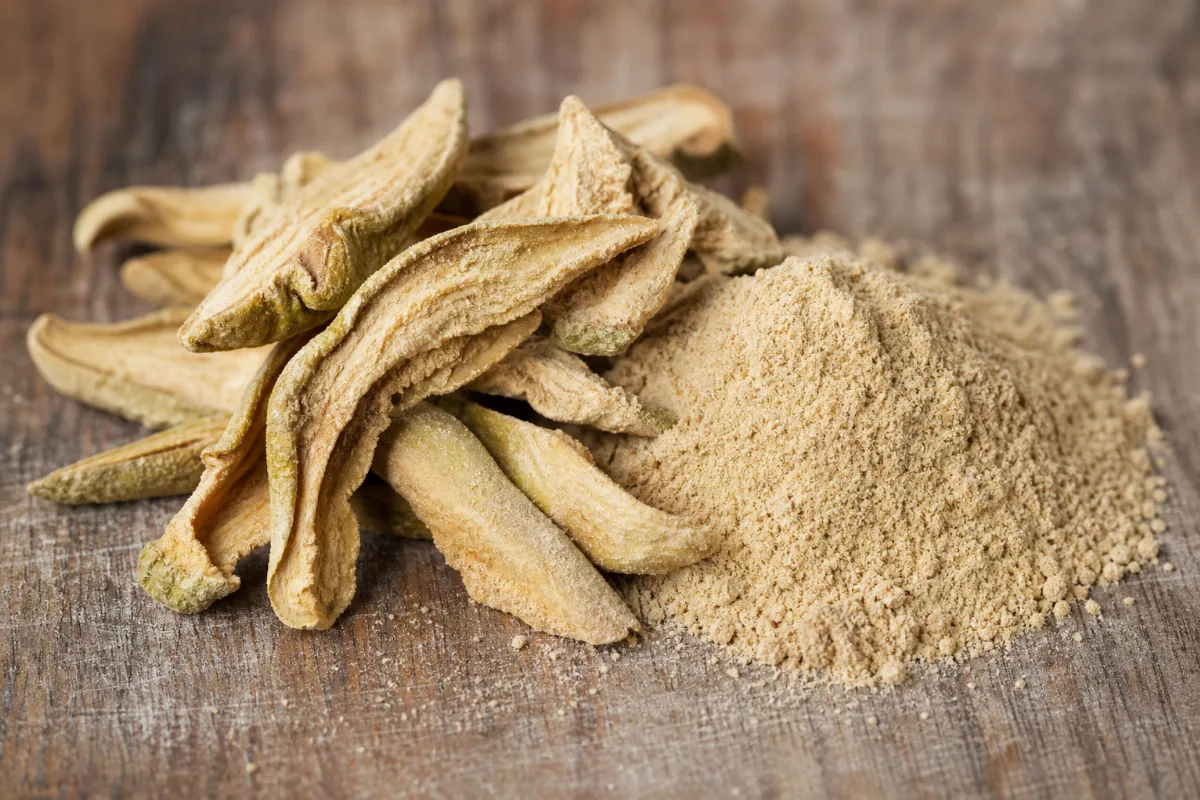
Amchur (also spelled amchoor, and sold as mango powder) is made from unripe green mangoes, Mangifera indica. The fruit is peeled, cut into thin slices and dried in the sun. The dried slices look like strips of bark and can be ground at home, but most are sold already ground to a pale beige or brownish powder. [1][2] It is made mostly in India. [1]Flavor and aroma
Amchur is tart and fruity. It has a sour, fruity taste and a "honey-like" smell. [1][2] Because the fruit is picked green, it is sour rather than sweet like ripe mango. The sources we read do not name the acids that cause the tang, so we do not name them here. [1][2]The big advantage in the kitchen is that it adds sourness without adding liquid. [1]
How it is used in cooking
Cooks use amchur as a souring agent, much as they would use lemon. [1][2]- Vegetables and dals: stir-fried vegetables, soups, curries, stewed lentils and chutneys. It pairs well with okra and potatoes. [1][2]
- Fillings and snacks: samosa and pakora fillings, common in northern Indian cooking. [1][2]
- Marinades: it is used on meat, poultry and fish and is said to tenderize them. [1][2]
- Blends and pickles: it is a main ingredient in chaat masala, and it appears in chutneys and pickles. [1]
- Other: fruit salads and pastries are also listed. [1]
When to add it and whether to toast it: the sources we opened give no timing rules. Fine Dining Lovers says only to start with about half a teaspoon, taste, and add more, since a little goes a long way. [2]
Substitute: one source suggests lemon when you have none. [2] Lemon adds liquid and amchur does not, so a swap changes the dish. [1][2] We opened no source that gives a reliable swap ratio.
Normal food amounts
| Measure | Grams | Source |
|---|---|---|
| 1 teaspoon, ground | Not found | USDA SR Legacy has no entry for amchur |
| Typical recipe amount | About 1/2 teaspoon to start, then taste | Fine Dining Lovers [2] |
USDA SR Legacy has no entry for this spice, so we give no nutrient numbers per teaspoon. We found a retailer page that lists vitamin C and other values for amchur, but they come from a shop, not a lab, so we do not use them. A recipe amount is small, so it is a flavoring and not a meaningful source of nutrients.
Whole fresh mango has USDA values and trials of its own. See our mango page. Those results are for the fresh fruit and do not carry over to a dried green powder.
Buying, storing and preparing
- Forms: whole dried slices, or ground powder. Most is sold ground. [1]
- Where to buy: Indian grocery stores and online. [2]
- Color: pale beige to brownish. [1]
- Storage and shelf life: the sources we opened say nothing about either. Keeping any ground spice in a closed jar in a cool, dry place is common sense, but it is our own advice, not a sourced rule.
- Sulfites and lead in dried mango: we found no report on amchur itself. But regulators have flagged other dried mango products. Ireland's food safety body warned in 2022 about a dried mango batch with sulphites not listed on the label. [7] Hong Kong's food safety centre in 2020 reported lead at 1.58 ppm in one pack of dried mango and said it was harmful to health. [6] These are single products and do not prove anything about amchur. If you are sensitive to sulfites, read the label.
Health: what research says
Using a pinch of amchur in cooking is different from taking concentrated mango products. We found no human trial of amchur at all.Food amounts vs supplements
| In normal cooking | In supplements and extracts | |
|---|---|---|
| Typical amount | About 1/2 teaspoon to begin [2] | Not applicable to amchur; mango powders and extracts are sold as supplements |
| What studies mostly used | No studies of amchur found | Mango fruit, by-products, leaf extract and mangiferin in small trials; a mouse study of a mango fruit powder [8][9] |
| What we can say about benefit | Nothing, no data | Reviews call the trials small and say more standard trials are needed [8] |
| Main safety limit | Mango allergy, sulfite sensitivity [3][4][7] | Side effects were not reported in most trials, so safety is poorly described [8] |
What the evidence shows
| Use | What the sources found | Strength of evidence | Form and population |
|---|---|---|---|
| Any use of amchur on health | We found no human trial of amchur. | Insufficient evidence | Food amounts |
| Blood sugar and blood fats | A 2023 review of 13 studies of mango in various forms (fruit, peel powder, leaf extract, fruit powder, mangiferin) linked mango to better glucose and blood fat readings. It says most trials were small and need standard follow-up. [8] | Mixed | Fresh fruit, by-products, extracts; not amchur [8] |
| Early insulin resistance and liver fat | In mice fed a high-fat diet, a mango fruit powder was protective. The abstract does not say whether the fruit was ripe or unripe. [9] | Lab or animal only | Mice, a proprietary mango powder [9] |
Those studies tell us about mango in other forms. They do not show that amchur at a cooking amount does anything for health, and we do not claim it.
Official statements
We opened no EMA, EFSA, FDA, WHO or NCCIH statement on amchur, and we found no official acceptable intake for it. The only regulators we opened were food-safety bodies reporting on other dried mango products: Ireland's FSAI (2022) [7] and Hong Kong's Centre for Food Safety (2020). [6]Related pages
Health connections for Amchur (dried green mango powder)
What research links to this spice, and how strong the evidence is. Most studies use concentrated extracts or doses far above what you eat; each card says which.
Blood sugar and blood fats (mango in other forms)
Preliminary or mixedA 2023 review of 13 studies of mango in forms such as fruit, peel powder, leaf extract, fruit powder and mangiferin linked mango to better blood sugar and blood fat readings. The authors say most trials were small. We found no human trial of amchur.
Supplements: Not shown for amchur or food amounts; findings are for other mango forms, mostly in small trials.
Early insulin resistance and liver fat (mice)
Lab or animal research onlyIn mice on a high-fat diet, a mango fruit powder was protective against early insulin resistance and liver fat build-up.
Supplements: Animal study only; no human finding for amchur.
Any health use of amchur in food amounts
Not enough evidenceWe found no human study of amchur at cooking amounts.
Supplements: No evidence for food or supplement use of amchur itself.
Connected topics
Open a group to see how each topic connects and how strong the evidence is.
Health goals (1)
- Blood Sugar BalancePreliminary or mixed
Small trials of other mango forms point this way; amchur itself is untested.
Body systems (1)
- Immune SystemDocumented risk
Mango can cause allergy and delayed skin rash on handling peel; sulfites are flagged in some other dried mango products. Nothing found specific to amchur.
Body parts (2)
- Immune SystemDocumented risk
Mango allergy is described, with variable cross-reaction to cashew and pistachio.
- SkinDocumented risk
Raw mango peel can cause a delayed rash in people already sensitive to poison ivy; the flesh appears to carry little of the allergen.
Root causes (1)
- Heavy Metal ExposureDocumented risk
Lead was reported in one dried mango product in Hong Kong in 2020; we found no report on amchur.
Biomarkers (1)
- Blood GlucosePreliminary or mixed
Reviewed trials of other mango forms report better glucose readings; not shown for amchur.
Conditions & symptoms (4)
- Food AllergyDocumented risk
Mango allergy is described; amchur is made from mango, but no source addresses amchur directly.
- Contact DermatitisDocumented risk
Handling raw mango peel can cause a delayed rash in people sensitized to poison ivy; the flesh seems to carry little.
- Lead PoisoningDocumented risk
One dried mango product had lead above a level regulators judged harmful; no amchur report found.
- Poison Ivy DermatitisDocumented risk
Mango peel compounds overlap with the poison ivy allergen; people with past poison ivy rashes may react to peel.
Documented risks and interactions (4)
- Mango allergy. Mango can cause allergy, though reactions are much less common than to foods such as cow's milk. Mango pulp showed little cross-reaction with cashew and pistachio in the lab, while the seed did; some mango-allergic patients react to the nuts and others do not.
- Skin reaction to mango peel (urushiol-related). Mango skin, leaves and stems contain compounds related to the poison ivy allergen; people with earlier poison ivy rashes may get a delayed rash from handling peel. The authors say the compounds look negligible in the flesh.
- Sulfites in some dried mango products. Ireland's food safety body warned in 2022 about a dried mango batch with sulphites missing from the label, which may be unsafe for people allergic to or intolerant of sulphites.
- Lead in one dried mango product. In 2020 Hong Kong's Centre for Food Safety reported 1.58 ppm lead in one pack of dried mango and judged it harmful to health.
Frequently asked questions
Is amchur sweet?
No. It is tart and fruity, with a honey-like smell, because it is made from unripe mango. [1][2]
How much is normal?
We found no official amount. One cooking article says to start with about half a teaspoon, taste, then add more. [2] USDA has no entry for amchur.
What can I use instead?
One source suggests lemon when you have none. [2] Lemon adds liquid, amchur does not, so the dish will change. [1]
Is it safe in pregnancy?
The sources we read do not describe a caution for amchur in food amounts. Ask your midwife or doctor.
Can I take it with medicines?
The sources we read describe no medicine interaction with amchur. If you take regular medicines and want a mango supplement, ask a pharmacist.
Is it good for blood sugar?
We found no trial of amchur. Some small trials of other mango forms report favorable blood sugar readings, but they do not show this for a pinch in a recipe. [8]
More details: evidence, limits and cautions
The details behind this page: cautions, limits of the evidence and where sources disagree. Open any note to read it.
Safety note at a glance
Safety in more detail
- Medicines: the sources we read do not describe any medicine interaction with amchur.
- Pregnancy: the sources we read do not describe an amchur caution. Ask your midwife or doctor about supplements.
- Breastfeeding: the sources we read do not describe this.
- Children: the sources we read do not describe this.
- Allergy: mango can cause allergy, though the AAAAI says reactions to mango are much less common than those to foods such as cow's milk. [4] Mango, cashew and pistachio are in the same plant family. In the lab, mango pulp showed little cross-reaction with cashew and pistachio, though the seed did; some mango-allergic patients react to the nuts and others do not. [4] The only sure test is a supervised food challenge. [4] We found no source that says whether the drying and grinding change this risk. For a serious reaction (swelling of the lips, mouth or throat, hard breathing), the NHS says call 999 (911 in the US) and use an adrenaline injector if you have one. [5]
- Skin: mango skin, leaves and stems contain compounds related to the poison ivy allergen. People with earlier poison ivy rashes may get a delayed rash from handling mango peel. The authors say these compounds look negligible in the flesh. [3] Amchur is made from peeled fruit, so this is mainly a concern for people handling raw mangoes; we found no source on amchur itself. [1][3]
- Liver and kidney: the sources we read do not describe this.
- Surgery: the sources we read do not describe a surgery caution.
- Quality and contamination: sulfites and lead have been reported in some other dried mango products. We found no amchur report. [6][7]
- Amounts that cause trouble: the sources we read give no amount of amchur that causes trouble.
References
- Wikipedia — Amchoor. https://en.wikipedia.org/wiki/Amchoor (accessed 2026-10-24)
- Fine Dining Lovers — Have you tried amchur? Here's what to do with this mango powder (Colón-Singh, 7 Dec 2015). https://www.finedininglovers.com/explore/articles/have-you-tried-amchur-heres-what-do-mango-powder (accessed 2026-10-24)
- Yoo MJ, Carius BM — Mango dermatitis after urushiol sensitization. West J Emerg Med (CPC-EM) case report, 2020. https://westjem.com/case-report/mango-dermatitis-after-urushiol-sensitization.html (accessed 2026-10-24)
- AAAAI — Ask the Expert: cross-reactivity of papaya, mango and cashew (reviewed again 2026). https://www.aaaai.org/allergist-resources/ask-the-expert/answers/old-ask-the-experts/cross-reactivity-papaya-mango-cashew (accessed 2026-10-24)
- NHS (UK) — Food allergy, reviewed 20 August 2026. https://www.nhs.uk/conditions/food-allergy/ (accessed 2026-10-24)
- Centre for Food Safety, Hong Kong — Press release on lead in dried mango, 24 Dec 2020. https://www.cfs.gov.hk/english/press/20201224_8386.html (accessed 2026-10-24)
- FSAI (Ireland) — Allergen alert: undeclared sulphites in a batch of dried mango, 1 April 2022. https://www.fsai.ie/news-and-alerts/allergen-alerts/undeclared-sulphites-in-a-batch-of-xoai-say-deo-dr (accessed 2026-10-24)
- Minniti G et al. — Mangifera indica L., by-products, and mangiferin on cardio-metabolic and other health conditions: a systematic review. Life (Basel) 2023. https://pmc.ncbi.nlm.nih.gov/articles/PMC10744517/ (accessed 2026-10-24)
- Consumption of a mango fruit powder protects mice from high-fat induced insulin resistance and hepatic fat accumulation. Cell Physiol Biochem 2017; abstract page read. https://docta.ucm.es/entities/publication/d2557aa2-d6f7-4b8a-ba1f-b5331fce9eb1/full (accessed 2026-10-24)