Spices · Spice
Dried citrus peel
Citrus spp. (sweet orange, bitter orange, mandarin, lemon) · also called Dried orange peel, dried lemon peel, dried tangerine peel, chenpi (aged mandarin peel)
Dried citrus peel is the dried outer rind of oranges, mandarins, lemons and other citrus, used by the pinch in baking, drinks, stews and tea. We found no study of it as a seasoning. The research that exists is on hesperidin supplements and peel extracts, and it is mixed or mostly lab and animal work. The main caution is Seville (bitter) orange, which the FDA says might act like grapefruit on some medicines.
General information, not medical advice. Last substantive update · Not medically reviewed. A named clinician has not signed off on this page. How this page is made
About Dried citrus peel
Dried citrus peel is a flavouring, not a proven remedy. The health studies tested supplements and extracts, not the pinch used in cooking, and the one firm caution is Seville orange and some medicines.
What it is
Dried citrus peel is the outer rind of citrus fruit, dried so it keeps. It can come from sweet orange, bitter (Seville) orange, mandarin, lemon and others, all in the Rutaceae family. Dried mandarin peel that has been aged for years is called chenpi.
USDA FoodData Central has no entry for dried citrus peel that we found. For raw orange peel it lists, per 100 g, 97 kcal, 10.6 g of fibre and 136 mg of vitamin C. A tablespoon of raw peel (6 g) works out to about 6 kcal, 0.6 g of fibre and 8 mg of vitamin C. Dried peel is lighter, so these figures do not carry over, and a pinch in a dish adds almost no nutrients.
What the research shows
We found no study of dried peel used as a seasoning. The research is on other products made from citrus peel.
A pooled analysis of 10 trials of hesperidin supplements (577 people) found no effect on total cholesterol, LDL, HDL, triglycerides or blood pressure. A 2026 scoping review of orange peel extracts and fibre says most of the evidence is lab and animal work, with limited human data.
A 2024 review of chenpi says clinical studies of formulas containing it improved indigestion, but gives no trial details we could read. NCCIH says bitter orange has not been clearly shown to help for any health purpose.
Seasoning versus supplements and extracts
Hesperidin tablets, peel extracts, fibre fractions, bitter orange supplements and Chinese herbal formulas are concentrated products. They are not the same as a pinch of peel in a cake or stew, and their results do not describe the seasoning. Ask a doctor or pharmacist before using concentrated products.
At a glance
Traditional uses history, not proof
- Flavouring cakes, puddings, liqueurs and mulled drinks
- Aged dried mandarin peel (chenpi) in Chinese cooking, tea and traditional medicine
Studied for research
- Blood fats and blood pressure with hesperidin supplements (not peel), mixed certainty
- Gut and metabolic health with orange peel extracts and fibre (mostly lab and animal), very low certainty
- Indigestion with chenpi in mixed formulas, insufficient evidence
- Weight loss and sport with bitter orange supplements (not peel), insufficient evidence
Main compounds
- Hesperidin, a citrus flavonoid
- Nobiletin and tangeretin (peel flavones)
- Furocoumarins such as bergamottin, found in Seville orange juice
- Pectin, a fibre, and peel oil
Common forms
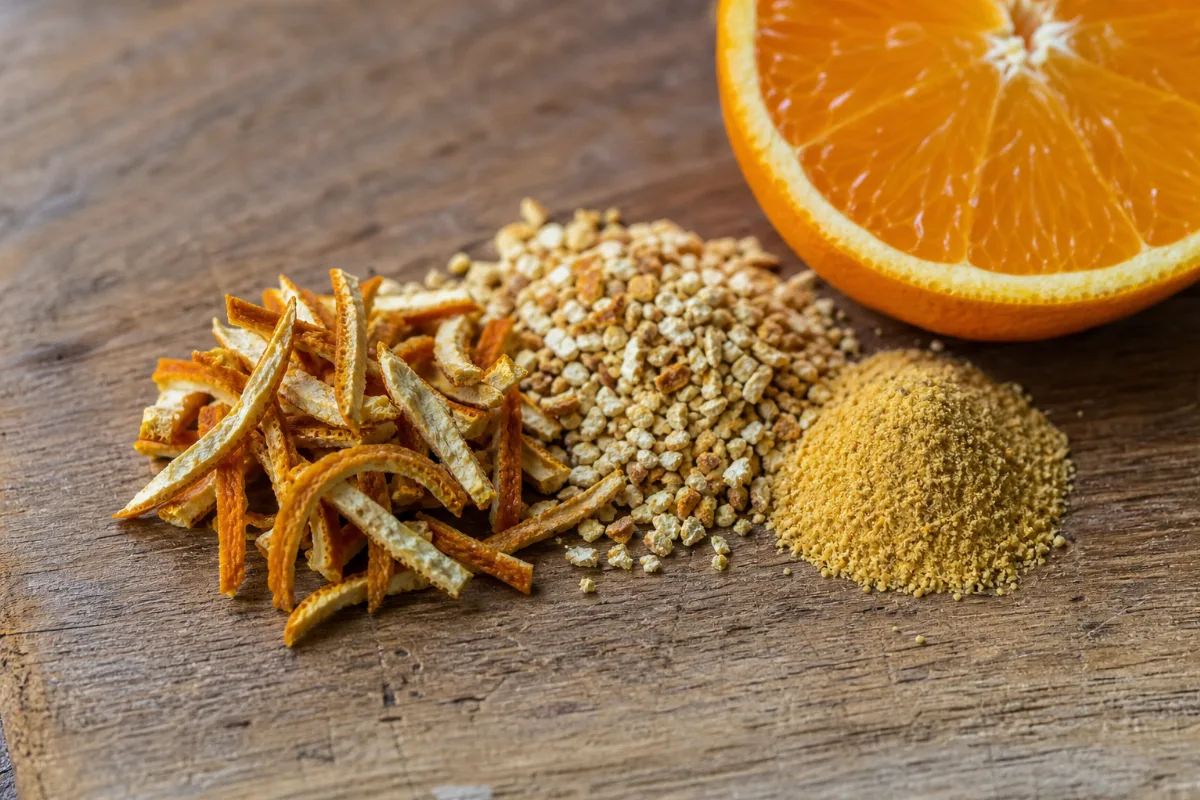
- Zest, strips, flakes or powder (the seasoning)
- Aged dried mandarin peel (chenpi)
- Bitter orange supplements (not the same as seasoning)
- Hesperidin and peel-extract supplements (not the same as seasoning)
Research links: FDA: Grapefruit juice and some drugs · NCCIH: Bitter orange · Hesperidin meta-analysis, Phytotherapy Research (2019) · USDA FoodData Central: raw orange peel · Research Library · Genes & Biomarkers Library
What it is and its history
- Accepted scientific name
- Dried citrus peel (the dried outer rind of citrus fruit, several species)
- Naming authority
- Not one species. Common sources: sweet orange (Citrus sinensis, a synonym in GBIF of Citrus x aurantium), bitter or Seville orange (Citrus x aurantium L.), mandarin (Citrus reticulata Blanco) and lemon (Citrus x limon (L.) Osbeck); GBIF matches run 2026-10-26.
- Synonyms
- Dried orange peel; Dried lemon peel; Dried tangerine or mandarin peel; Chenpi (aged dried mandarin peel); Orange zest, dried
- Common names
- Dried citrus peel (English); Chenpi / chen pi (Chinese (pinyin)); Cascara de cítrico seca (Spanish)
- Family or group
- Rutaceae, the citrus family (GBIF).
- Classification
- Plantae > Tracheophyta > Magnoliopsida > Sapindales > Rutaceae > Citrus > Several (see authority)
- Native range
- Not verified from a source read here. NCCIH says the bitter orange tree is native to Southeast Asia.
- Habitat
- Not verified.
- What it looks like
- Fruit: The part used is the peel (rind) of the fruit, dried as zest, strips, flakes or powder. The coloured outer layer is what cooks mostly use (existing page summary; not re-sourced).
- Cultivation
- Not verified.
- Harvest and processing
- The chenpi review says mandarin fruit is harvested in late autumn and early winter, the peel is removed and dried in ventilated or low-temperature conditions, and for chenpi it is aged for more than three years.
- Look-alikes and adulterants
- Name: Fresh citrus zest; Note: Fresh peel, not dried; the USDA record read is for raw peel.; Name: Bitter orange / Seville orange peel; Note: A different fruit from sweet orange. The FDA says Seville oranges might act like grapefruit on some medicines.; Name: Chenpi (aged mandarin peel); Note: Dried mandarin peel aged for years in Chinese cooking and medicine. It has its own tea page on this site.
- Sustainability and conservation
- Not assessed.
Traditional use and history history, not clinical proof
| Tradition or era | Documented use | Source |
|---|---|---|
| Traditional Chinese medicine and cooking (chenpi) | The 2024 review says chenpi has a history of thousands of years in China, is used in traditional medicine for conditions such as vomiting, nausea and anaemia, and is added as a flavouring in Chinese food. | p38998484 (review text, full text read) |
| Western cooking and drinks | NCCIH says the fruit, peel and essential oils of bitter orange are used in cooking and as flavourings in beer and spirits. | s-nccih-bitter-orange |
| Other cuisines | Details such as use in Japanese shichimi togarashi, Scandinavian baking and liqueurs came from Wikipedia in the earlier page text and are NOT verified here. | NOT verified |
Traditional use shows how it was used. It does not show that it works or is safe today.
What is inside, and how it may work
What it contains and how those compounds act in cells and animals. Laboratory and animal mechanisms are not proven effects in people.
Main compounds
| Compound | Family | Where it is concentrated | Activity studied | Level of evidence |
|---|---|---|---|---|
| Hesperidin | flavanone glycoside (flavonoid) | Peel | The review calls hesperidin a major flavonoid of mandarin peel. Supplements of it did not change blood fats or blood pressure in pooled trials. 3 2 | Human trials of supplements |
| Nobiletin and tangeretin | polymethoxylated flavones | Peel | Named by the review as the main polymethoxylated flavones of mandarin peel; research it describes is lab and animal work. 3 | Lab and animal |
| Furocoumarins (bergamottin, 6',7'-dihydroxybergamottin, bergapten) | furocoumarin | Found in Seville orange juice (peel content not found) Seville orange juice: bergamottin 5, 6',7'-dihydroxybergamottin 36, bergapten 31 micromol/L | Block the gut enzyme CYP3A4; linked by the trial authors to the drug interaction. 1 | Human trial of juice plus lab measurements |
| p-Synephrine | amine | Bitter orange fruit | A stimulant-like compound; structurally similar to ephedrine but with different actions (NCCIH). 8 | Authoritative guidance |
| Pectin, essential oil and carotenoids | fibre, volatile oil and pigments | Orange peel | Named by the scoping review as peel components with reported gut and metabolic effects, mostly in lab and animal studies. 4 | Lab and animal |
Mechanisms, receptors and pathways
| Target or pathway | Gene or receptor | What was found | Level |
|---|---|---|---|
| Gut enzyme CYP3A4 (medicine breakdown) | CYP3A4 | In a 10-person trial, Seville orange juice raised felodipine exposure by 76%; the authors say the likely route is inactivation of intestinal CYP3A4 by furocoumarins in the juice. 1 | Human trial of juice |
| Gut bacteria, gut barrier and inflammation | Preclinical studies of orange peel flavonoids, pectin and oils report changes in gut bacteria, barrier strength and inflammation. 4 | Lab and animal |
Absorption, metabolism and elimination
- Absorption
- Not found for dried peel.
- Distribution
- Not found.
- Metabolism
- Not found for peel compounds; see the CYP3A4 note for Seville orange juice.
- Elimination
- Not found.
- Bioavailability
- Not established.
Isolated compounds versus whole extracts
The trials behind the health claims used hesperidin supplements, peel extracts, fibre fractions or multi-ingredient Chinese formulas. None used dried peel as a seasoning, which is eaten by the pinch. The drug-interaction trial used Seville orange juice, not peel.
Nutritional composition
No USDA entry for dried citrus peel was found, so there is no source-based figure for the dried seasoning. USDA FoodData Central lists RAW orange peel (SR Legacy, record 169103) per 100 g at 97 kcal, 72.5 g water, 1.5 g protein, 0.2 g fat, 25.0 g carbohydrate, 10.6 g fibre, 161 mg calcium, 0.8 mg iron, 212 mg potassium, 3 mg sodium and 136 mg vitamin C. A tablespoon of raw peel (6 g, USDA household portion) works out to about 5.8 kcal, 0.6 g fibre and 8 mg vitamin C (our calculation). Dried peel has less water, so it is lighter per spoonful and these figures do not carry over. Peel in cooking is used by the pinch, so it adds almost no nutrients to a dish.
1 mixed findings1 very low certainty2 not enough evidence
What was looked at
The 4 benefits and uses checked for Dried citrus peel, each with how strong the evidence is. Tap one to open it.
- Blood fats and blood pressure (hesperidin supplements, not seasoning)Mixed findings
- Gut and metabolic health (orange peel ingredients, mostly lab and animal)Very low certainty
- Indigestion and stomach lining (chenpi in mixed formulas)Not enough evidence
- Weight loss and sports performance (bitter orange supplements, not peel in food)Not enough evidence
Lab markers tracked in the studies
Total cholesterolLDL cholesterolSystolic blood pressure
What is Dried citrus peel good for?
The studied uses and how strong the human evidence is. All of it comes from supplements, extracts or mixed formulas. None of it tested dried peel used as a seasoning.
Benefits, one by one
Each card is a research question, not a promise. Tap a goal to filter. Open a card to see the studies, doses and limits.
Blood fats and blood pressure (hesperidin supplements, not seasoning)
Mixed findingsHesperidin is the main flavonoid in citrus peel and juice. When 10 trials of hesperidin supplements were pooled, cholesterol, triglycerides and blood pressure did not change in a way that was clearly different from zero. These were supplements, not a pinch of dried peel in cooking.
2 studiesHesperidin supplements and peel extracts. Not dried peel in food.
Studies, doses and limits
What the trials found
A 2019 meta-analysis of 10 randomised trials (577 people) of hesperidin supplements found no effect on total cholesterol, LDL, HDL, triglycerides, or systolic or diastolic blood pressure. A 2026 scoping review says some clinical studies of hesperidin-rich and fibre-rich orange peel extracts reported better blood fats and blood pressure, so the wider picture is mixed.
Results
Pooled hesperidin trials: no clear change. Scoping review of extracts: some positive clinical reports, with limited and varied data.
Effect sizes as reported
Total cholesterol -1.04 mg/dl (95% CI -5.65 to 3.57); LDL -1.96 mg/dl (-7.56 to 3.64); systolic BP -0.85 mmHg (-3.07 to 1.36).
Why this rating
One pooled analysis of supplements found no effect, while a scoping review of peel extracts mentions some positive trials. Neither studied dried peel as a seasoning, so nothing here applies to culinary amounts.
Form and dose studied
Hesperidin supplements and peel extracts. Not dried peel in food.
Who was studied
Adults in the trials; details not in the abstract.
Limits
The meta-analysis searched up to May 2018. Abstracts only were read.
Why researchers looked
Citrus peel is rich in flavonoids, so researchers tested the best-known one.
Traditional use
Dried mandarin peel (chenpi) is used in Chinese food and medicine; no source read ties that use to blood fats.
Proposed mechanism Unknown
Not established. The abstract does not explain a route.
A proposed mechanism does not show that the effect happens in people.
See the Safety tab. Ask a doctor or pharmacist before using concentrated citrus products.
Gut and metabolic health (orange peel ingredients, mostly lab and animal)
Very low certaintyA 2026 review mapped research on orange peel made into ingredients such as flavonoid extracts and fibre. Most of it is lab and animal work, with only limited human data. It says nothing about dried peel used to flavour food.
1 studiesExtracts, fibre fractions and other processed peel ingredients.
Studies, doses and limits
What the trials found
Of the 84 studies and 14 completed clinical trials mapped, the authors say the evidence is dominated by in vitro and animal studies. Clinical studies, mostly of hesperidin-rich and fibre-rich extracts, report better blood sugar after meals, blood fats, blood pressure and some gut-bacteria markers. Pectin and carotenoids are under-represented in human trials.
Results
Promising in lab and animal models; limited and heterogeneous in people.
Why this rating
The authors themselves describe the clinical data as limited and varied, and the products were extracts and fibre fractions, not culinary peel.
Form and dose studied
Extracts, fibre fractions and other processed peel ingredients.
Limits
A scoping review does not rate study quality. Abstract only.
Why researchers looked
Orange peel is a large food-industry by-product that holds flavonoids, pectin (a fibre) and oils.
Proposed mechanism Preliminary mechanism
In animal studies, peel flavonoids, pectin and oils are reported to change gut bacteria, the gut barrier and inflammation. This is animal and lab evidence.
A proposed mechanism does not show that the effect happens in people.
None specific to food amounts.
Indigestion and stomach lining (chenpi in mixed formulas)
Not enough evidenceIn Chinese medicine, dried aged mandarin peel (chenpi) is used for stomach complaints. A 2024 review says clinical studies of formulas that contain it reported improvement in functional dyspepsia and chronic atrophic gastritis, but it gives no trial details we could read, and the formulas had several ingredients.
1 studiesFormulas that include chenpi. Not culinary use.
Studies, doses and limits
What the trials found
The review states that clinical studies showed improvements with chenpi-containing formulations. The text read does not describe the trials, their size or their quality.
Results
Reported improvement in formulas; cannot be credited to the peel alone.
Effect sizes as reported
Not given in the text read.
Why this rating
The claim is second-hand, trial details were not read, and the products were multi-ingredient formulas of mandarin peel, not seasoning.
Form and dose studied
Formulas that include chenpi. Not culinary use.
Who was studied
Adults with functional dyspepsia or chronic atrophic gastritis (as the review states).
Limits
Review of a different product (aged mandarin peel in formulas). No trial was opened.
Why researchers looked
Chenpi is a traditional digestive remedy.
Traditional use
Chenpi is used in Chinese medicine and added as a flavouring in Chinese foods, according to the 2024 review.
Proposed mechanism Preliminary mechanism
The review describes lab and animal work on gut movement and gut bacteria. This is not human evidence.
A proposed mechanism does not show that the effect happens in people.
The review advises caution with chenpi in traditional use for Yin deficiency with dry cough, internal heat excess, or coughing blood.
Weight loss and sports performance (bitter orange supplements, not peel in food)
Not enough evidenceDried peel from bitter (Seville) orange is a flavouring, but bitter orange is also sold as a supplement for weight loss and sport. NCCIH says it has not been clearly shown to help for any health purpose.
1 studiesBitter orange supplements, often combined with other ingredients.
Studies, doses and limits
What the trials found
NCCIH says studies on weight loss and athletic performance were mostly small, some were not rigorous, many tested combination products, and results were unclear or inconsistent, with most sport studies showing no benefit.
Results
Not clearly shown to help for any purpose.
Effect sizes as reported
Not given by NCCIH.
Why this rating
Small studies, mixed products, conflicting results (NCCIH). This is a supplement question, not about peel in cooking.
Form and dose studied
Bitter orange supplements, often combined with other ingredients.
Who was studied
Adults in small trials.
Limits
We read the NCCIH summary page, not the trials.
Why researchers looked
Bitter orange fruit contains p-synephrine, which is structurally similar to ephedrine, and products became popular after ephedra supplements were banned.
Traditional use
NCCIH says the fruit, peel and oils are used in cooking and as flavourings in beer and spirits.
Proposed mechanism Authoritative guidance
NCCIH says p-synephrine is similar in structure to ephedrine but acts differently in the body. No mechanism for weight loss is established.
A proposed mechanism does not show that the effect happens in people.
See the Safety tab: serious heart events have been reported with bitter orange products, but their cause is unclear.
Connections to the rest of health
How Dried citrus peel connects to the rest of our health knowledge graph. Every link says what kind of connection it is. A safety link (for example to the liver) is a warning, not a benefit. A study that merely mentions a topic never creates a benefit link.
Explore every connection: goals, body systems, organs, symptoms, genes
A. Wellness goals
| Connected to | Kind of connection | Evidence status | Context | Studies |
|---|---|---|---|---|
| Heart Health | Mixed findings | Blood fats and blood pressure (hesperidin supplements, not seasoning): Hesperidin is the main flavonoid in citrus peel and juice. When 10 trials of hesperidin supplements were pooled, cholesterol, triglycerides and blood pressure did not change in a way that was clearly different from zero. These were supplements, not a pinch of dried peel in cooking. | 2 4 | |
| Gut Health | Very low certainty | Gut and metabolic health (orange peel ingredients, mostly lab and animal): A 2026 review mapped research on orange peel made into ingredients such as flavonoid extracts and fibre. Most of it is lab and animal work, with only limited human data. It says nothing about dried peel used to flavour food. | 4 | |
| Blood Sugar Balance | Very low certainty | Gut and metabolic health (orange peel ingredients, mostly lab and animal): A 2026 review mapped research on orange peel made into ingredients such as flavonoid extracts and fibre. Most of it is lab and animal work, with only limited human data. It says nothing about dried peel used to flavour food. | 4 | |
| Digestive Support | Not enough evidence | Indigestion and stomach lining (chenpi in mixed formulas): In Chinese medicine, dried aged mandarin peel (chenpi) is used for stomach complaints. A 2024 review says clinical studies of formulas that contain it reported improvement in functional dyspepsia and chronic atrophic gastritis, but it gives no trial details we could read, and the formulas had several ingredients. | 3 | |
| Healthy Weight | Not enough evidence | Weight loss and sports performance (bitter orange supplements, not peel in food): Dried peel from bitter (Seville) orange is a flavouring, but bitter orange is also sold as a supplement for weight loss and sport. NCCIH says it has not been clearly shown to help for any health purpose. | 8 |
B. Body systems
| Connected to | Kind of connection | Evidence status | Context | Studies |
|---|---|---|---|---|
| Cardiovascular System | Biological association | Mixed findings | Studied for: Blood fats and blood pressure (hesperidin supplements, not seasoning) | 2 4 |
| Digestive System | Biological association | Very low certainty | Studied for: Gut and metabolic health (orange peel ingredients, mostly lab and animal) Studied for: Indigestion and stomach lining (chenpi in mixed formulas) | 4 3 |
| Metabolic Health | Biological association | Very low certainty | Studied for: Gut and metabolic health (orange peel ingredients, mostly lab and animal) Studied for: Weight loss and sports performance (bitter orange supplements, not peel in food) | 4 8 |
E. Health conditions
| Connected to | Kind of connection | Evidence status | Context | Studies |
|---|---|---|---|---|
| Medicine interactions | Drug or supplement interaction | Documented risk | Seville orange juice raised felodipine levels in a trial, and FDA says Seville oranges might act like grapefruit. FDA says Seville oranges might act like grapefruit on some medicines; a trial used the juice. Preparation or compound: Seville orange (juice tested; peel not tested) |
1 5 |
| Heart rhythm problems | Adverse effect or risk | Documented risk | Heart events were reported with mostly multi-ingredient bitter orange products; cause unclear (NCCIH). Heart events were reported with mostly multi-ingredient bitter orange supplements; cause unclear. Preparation or compound: Bitter orange supplements |
8 |
I. Biomarkers
| Connected to | Kind of connection | Evidence status | Context | Studies |
|---|---|---|---|---|
| Total cholesterol | Biological association | Low certainty | Measured in trials: no clear change. A lab change is not the same as a health benefit. | 2 |
| LDL cholesterol | Biological association | Low certainty | Measured in trials: no clear change. A lab change is not the same as a health benefit. | 2 |
| Systolic blood pressure | Biological association | Low certainty | Measured in trials: no clear change. A lab change is not the same as a health benefit. | 2 |
L. Active compounds
| Connected to | Kind of connection | Evidence status | Context | Studies |
|---|---|---|---|---|
| Hesperidin | Biological association | Human trials of supplements | The review calls hesperidin a major flavonoid of mandarin peel. Supplements of it did not change blood fats or blood pressure in pooled trials. Preparation or compound: Peel |
3 2 |
| Nobiletin and tangeretin | Biological association | Lab and animal | Named by the review as the main polymethoxylated flavones of mandarin peel; research it describes is lab and animal work. Preparation or compound: Peel |
3 |
| Furocoumarins (bergamottin, 6',7'-dihydroxybergamottin, bergapten) | Biological association | Human trial of juice plus lab measurements | Block the gut enzyme CYP3A4; linked by the trial authors to the drug interaction. Preparation or compound: Found in Seville orange juice (peel content not found) |
1 |
| p-Synephrine | Biological association | Authoritative guidance | A stimulant-like compound; structurally similar to ephedrine but with different actions (NCCIH). Preparation or compound: Bitter orange fruit |
8 |
| Pectin, essential oil and carotenoids | Biological association | Lab and animal | Named by the scoping review as peel components with reported gut and metabolic effects, mostly in lab and animal studies. Preparation or compound: Orange peel |
4 |
Each connection is stored with the ingredient, the connected record, the kind of connection, the evidence status, the supporting studies, the preparation or compound involved, and a review date (last reviewed October 26, 2026).
Evidence at a glance: what the research found for 4 outcomes
Each outcome below is one thing researchers measured. Certainty is how far the evidence can be trusted, not how well it works. The full studies are on the next tab.
The evidence
The research centre for Dried citrus peel. Every record here was checked against PubMed or the publisher's page; we never list a study we have not verified.
Evidence by outcome
Bars show how many studies we found for each outcome, not how well it works. People are added up across trials only (reviews are not added, to avoid double counting).
How we rate evidence
High certainty
Several well-run trials or reviews agree; further research is unlikely to change the picture much.
Moderate certainty
Good trials point the same way, but some doubt remains.
Low certainty
Small, short or inconsistent trials. The finding could change with better research.
Very low certainty
Very little or very weak human data. Treat as a possibility only.
Mixed findings
Trials or reviews disagree with each other.
Not enough evidence
Not enough human research to say either way.
Evidence against
Good research found no benefit, or found harm.
We take the reviewers' own risk-of-bias and GRADE statements where they exist, and otherwise judge from study size, design, consistency, directness and whether a product matches what is sold. Many publications do not make evidence high. Method note: We started from our existing summary of dried citrus peel, re-read the PubMed abstracts, the chenpi review, the NCCIH and FDA pages and the USDA FoodData Central record, and dropped cooking claims we could not re-verify. Only abstracts were read for most studies. Items we could not verify are flagged in the research gaps.
Study library: every study we checked 9
| Study | Design | People | Product, dose, length | Result |
|---|---|---|---|---|
| Malhotra 2001 Seville orange juice-felodipine interaction: comparison with dilute grapefruit juice and involvement of furocoumarins. Clin Pharmacol Ther · PMID 11180034 · DOI |
Randomised three way crossover trial |
10 10 volunteers |
240 mL of Seville orange juice, dilute grapefruit juice, or common orange juice (negative control), taken with one felodipine 10 mg extended-release tablet juice (not peel) One session per juice Single dose · vs Common orange juice |
Compared with common orange juice, felodipine AUC rose 76% after Seville orange juice and 93% after grapefruit juice. Bergamottin and 6',7'-dihydroxybergamottin were found in Seville orange juice, and bergapten only in Seville orange juice. The authors conclude Seville orange juice and grapefruit juice interact through a common mechanism, probably intestinal CYP3A4. Seville orange juice did not interact with cyclosporine. Felodipine AUC +76% (Seville orange juice) vs common orange juice. Methods, limits and fundingOutcomes: Felodipine and dehydrofelodipine blood levels; furocoumarin content of the juices Limitations: Ten volunteers, one drug, juice rather than peel. The abstract does not say how much of these compounds sits in dried peel. Abstract only. Funding and conflicts: Research support from US public health funding listed in PubMed; industry funding not stated Read: abstract |
| Mohammadi 2019 Hesperidin, a major flavonoid in orange juice, might not affect lipid profile and blood pressure: A systematic review and meta-analysis of randomized controlled clinical trials. Phytother Res · PMID 30632207 · DOI |
Systematic review and meta analysis of randomised controlled trials |
577 10 randomised trials, 577 participants; searches up to May 2018 |
Hesperidin supplements (a citrus flavonoid, not dried peel) purified or concentrated compound Varied by trial; not stated in the abstract Varied · vs Placebo or control |
No effect on total cholesterol (WMD -1.04 mg/dl, 95% CI -5.65 to 3.57), LDL (-1.96 mg/dl, -7.56 to 3.64), HDL (0.16 mg/dl, -1.94 to 2.28), triglycerides (0.69 mg/dl, -5.91 to 7.30), systolic blood pressure (-0.85 mmHg, -3.07 to 1.36) or diastolic blood pressure (-0.48 mmHg, -2.39 to 1.42). The authors say hesperidin might not improve lipids or blood pressure and call for better trials. All pooled differences small, with confidence intervals that include zero. (Total cholesterol -5.65 to 3.57 mg/dl; systolic BP -3.07 to 1.36 mmHg) Methods, limits and fundingOutcomes: Total cholesterol, LDL, HDL, triglycerides, systolic and diastolic blood pressure Limitations: Hesperidin supplements, not peel as a seasoning. The search ended in May 2018. Only the abstract was read, so trial quality and funding were not checked. Funding and conflicts: Not stated in the abstract read Read: abstract |
| Shi 2024 Recent Advances in the Health Benefits and Application of Tangerine Peel (Citri Reticulatae Pericarpium): A Review. Foods · PMID 38998484 · DOI |
Narrative review (mostly lab and animal studies) mixed (lab, animal, some human) |
Review of chenpi, the dried, aged peel of mandarin (Citrus reticulata) used in Chinese medicine and food | Chenpi (dried mandarin peel, aged more than three years) and its compounds peel Not relevant to this page |
Most of the research it describes is cell and animal work on compounds such as hesperidin and nobiletin. On digestion it says clinical studies showed improvements with chenpi-containing formulations in functional dyspepsia and chronic atrophic gastritis; the paper gives no details of those trials in the text read. In its toxicology section it says the peel holds moisture and polysaccharides, which make it prone to mould in storage; Aspergillus can grow and make aflatoxins, and it calls aflatoxin a significant safety matter. It also advises caution in traditional use with Yin deficiency and dry cough, internal heat excess, or coughing of blood, and says more human studies are needed. Qualitative (no pooled figures). Methods, limits and fundingOutcomes: Reported effects of the peel and its flavonoids; toxicology and cautions Limitations: A narrative review of mandarin peel (chenpi), not of every dried citrus peel. Trial details for the digestion claim were not read. Full text read from the PubMed Central copy. Funding and conflicts: Not checked Read: full-text |
| Vilas-Boas 2026 Upcycled Orange Peel Ingredients for Gastrointestinal and Cardiometabolic Health: A Scoping Review and Market Perspectives. Nutrients · PMID 41978175 · DOI |
Scoping review (PRISMA ScR), not a pooled analysis mixed (lab, animal, human) |
84 studies and 14 completed clinical trials on orange peel ingredients, searched 2014 to 2025 in Scopus and ClinicalTrials.gov | Orange peel ingredients (flavonoid-rich and fibre-rich extracts, pectin, oils), not dried peel as seasoning peel, processed into ingredients Varied Varied · vs Varied |
The evidence mixes lab, animal and human work. Animal studies report changes in gut bacteria, gut barrier, blood sugar, blood fats and inflammation. Clinical studies, mostly of hesperidin-rich and fibre-rich extracts, report better blood sugar after meals, blood fats, blood pressure and some gut-bacteria markers. The authors say the evidence is dominated by lab and animal studies, with limited and varied clinical data, and few human trials of pectin or carotenoids. No pooled numbers (scoping review). Methods, limits and fundingOutcomes: Gut and cardiometabolic outcomes Limitations: A scoping review maps research and does not rate trial quality. Only the abstract was read. Products were extracts and fractions, not culinary peel. Funding and conflicts: Not stated in the abstract read Read: abstract |
| s-fda-grapefruit-juice FDA: Grapefruit Juice and Some Drugs Don't Mix (consumer update, content current as of 07/01/2021) · Source |
Regulator consumer guidance n/a |
Methods, limits and fundingRead: full-text | ||
| s-fda-produce-safely FDA: Selecting and Serving Produce Safely (content current as of 03/05/2024) · Source |
Regulator consumer guidance n/a |
Methods, limits and fundingRead: full-text | ||
| s-gbif-citrus GBIF Backbone species match for Citrus sinensis, Citrus x aurantium, Citrus reticulata and Citrus x limon · Source |
Reference database n/a |
Methods, limits and fundingRead: full-text | ||
| s-nccih-bitter-orange NCCIH: Bitter Orange: Usefulness and Safety · Source |
Regulator consumer guidance n/a |
Methods, limits and fundingRead: full-text | ||
| s-usda-fdc-169103 USDA FoodData Central (SR Legacy): Orange peel, raw (fdcId 169103, NDB 9216) · Source |
Reference database n/a |
Methods, limits and fundingRead: full-text |
What we do not know yet
- No study of dried citrus peel used as a seasoning was found, for any outcome.
- Health findings come from hesperidin supplements, peel extracts, fibre fractions and mixed formulas.
- Whether a pinch of dried Seville orange peel can change drug levels is unknown; the trial used juice.
- Nutrition of dried peel was not found; the USDA record read is for raw peel.
- Pregnancy, children, allergy, pesticide residues and wax on peel were not researched for the peel itself.
- EMA, EFSA and JECFA statements were not read.
How new research is added
New studies are found by a saved PubMed search and placed in a review queue before the page changes.
Lab markers
What changed in blood or saliva tests during trials. A changed number is not the same as feeling or being healthier, and we give no "normal ranges".
Metabolic 2
Total cholesterol
No clear change in trials
All the cholesterol carried in the blood.
Low certaintyResults and what it means
LDL cholesterol
No clear change in trials
The cholesterol carried in LDL particles, often called the 'bad' cholesterol.
Low certaintyOther 1
Systolic blood pressure
No clear change in trials
The top number in a blood pressure reading.
Low certaintyResults and what it means
Safety
What studies and official sources say about side effects, medicines and who should check first. Each point shows what kind of evidence it comes from.
Main points to know 3
- Seville (bitter) orange can act like grapefruit on some medicines. The FDA says Seville oranges might have the same effect as grapefruit juice on some medicines and that people whose medicine interacts with grapefruit should not eat them. In a 10-person trial, Seville orange juice raised the blood level of the blood pressure drug felodipine by 76% compared with ordinary orange juice. These facts are about the fruit and its juice. We did not find a test of dried peel, so the effect of a pinch of dried Seville orange peel is unknown. Authoritative guidance 5 1
- Bitter orange supplements are a different matter from peel in food. NCCIH says bitter orange is likely safe in the amounts found in foods. It also says serious events such as abnormal heart rhythms, heart attacks and strokes have been reported in people who took bitter orange products, but most products had several ingredients, so it is unclear whether bitter orange itself caused them. Ask a doctor or pharmacist before using any bitter orange supplement. Authoritative guidance 8
- Mould can grow on peel stored damp. A 2024 review of aged mandarin peel (chenpi) says the peel holds moisture and polysaccharides that make it prone to mould in storage, and that Aspergillus can grow and make aflatoxins. It calls this a significant safety matter. Dry storage and throwing away peel that smells musty or looks mouldy is our reading of that, not a rule in the review. Narrative review 3
Side effects 2
| Effect | How often | Severity and recovery | Evidence |
|---|---|---|---|
| Heart rhythm problems, heart attack, stroke (reported with bitter orange supplements) NCCIH says most of the products contained several ingredients, so the role of bitter orange or its p-synephrine is unclear. No frequency was given. Some studies suggest bitter orange raises blood pressure and heart rate and others do not. | Not established | serious, reported in case reports Not stated | Case reports and authoritative guidance 8 |
| Allergy to citrus peel No source we read describes allergy to dried citrus peel. Anyone who reacts to citrus fruit should treat the peel with the same care. This is general caution, not a finding. | Not established | not found Not found | Not found |
Liver
No liver injury linked to eating dried citrus peel was found in the sources read. LiverTox was not checked.
How often. No frequency found.
This is a safety connection. It is not evidence that Dried citrus peel supports liver health.
Medicines and supplements 2
| With | Why it matters | Importance | Evidence | What to do |
|---|---|---|---|---|
| Medicines that warn about grapefruit (for example some blood pressure and cholesterol medicines) prescription | Grapefruit blocks the gut enzyme CYP3A4. In the felodipine trial, Seville orange juice did the same, and the authors link this to compounds called furocoumarins (bergamottin, 6',7'-dihydroxybergamottin and bergapten) found in the juice. | The FDA says Seville oranges might have the same effect as grapefruit juice. The trial used juice, one drug and 10 people. Ordinary orange juice, the control, did not raise the drug level. No test of dried peel was found. | Controlled trial of juice and authoritative guidance Low certainty 1 5 | If your medicine's leaflet warns about grapefruit, ask a pharmacist about Seville orange peel, marmalade and bitter orange products. Sweet orange peel was not tested. |
| Any medicine, when taking bitter orange supplements supplement | Not established. Bitter orange contains p-synephrine. | NCCIH says if you take any medicine, talk with your health care provider before using bitter orange or other herbal products, because some herbs and medicines interact harmfully. | Authoritative guidance Very low certainty 8 | Tell your doctor or pharmacist about any bitter orange supplement, especially if you have a heart condition or take heart or blood pressure medicine. |
Who should check first 3
| Situation | Advice | Evidence |
|---|---|---|
| Taking a medicine that warns against grapefruit | Ask a pharmacist before using Seville (bitter) orange peel, marmalade or bitter orange products. | Authoritative guidance 5 |
| Pregnancy or breastfeeding and bitter orange supplements | NCCIH says bitter orange may not be safe during pregnancy or breastfeeding, and animal data suggest it might lower milk production. Its statement that bitter orange is likely safe applies to food amounts. Ask your midwife or doctor. | Authoritative guidance 8 |
| Traditional Chinese medicine cautions for chenpi: Yin deficiency with dry cough, internal heat excess, or coughing blood | The 2024 review says to use caution in these situations. This is traditional-medicine guidance, not a Western clinical finding. Ask a qualified practitioner. | Narrative review 3 |
Overdose, product quality and regulators
Summary. Dried citrus peel in cooking is an ordinary food flavouring; the sources read describe no toxic part. The concerns are drug interactions (Seville orange), supplement products, and mould on badly stored peel.
Animal. Not reviewed.
Human doses studied. No trial of dried peel as a seasoning was found.
High dose or long term signals. Not found for peel in food. The review of chenpi calls mould and aflatoxin a significant safety matter in storage.
Overdose response. Not found.
Genotoxicity. Not reviewed.
Toxic or hazardous parts. Not checked beyond the sources read. Concentrated peel oil on skin was not verified from a primary source.
Mould and aflatoxin in stored peel, quality of bitter orange supplements, and dirt or bacteria on the fruit surface.
Mould and aflatoxin in stored aged mandarin peel. The 2024 review says moisture and polysaccharides make the peel prone to mould, that Aspergillus can make aflatoxins, and that detection methods exist for aflatoxins in the peel. It also notes that regulators set maximum residue limits for herbal products, which matter most for children and pregnant women. 3
Quality of bitter orange supplements. NCCIH reports that FDA researchers analysed 59 bitter orange supplements. Several had more amines than expected from an extract. Of 23 products that stated their synephrine amount, only 5 were within 80 to 120 percent of the label. Six contained synthetic amines (methylsynephrine or isopropyloctopamine) that are not legal dietary ingredients in the United States. 8
Dirt and bacteria on the fruit surface. The FDA says to wash all produce thoroughly under running water before preparing it, and not to use soap, detergent or produce wash. This is general produce advice; none of the sources read covers pesticide residues or wax on peel that is dried. 6
| Body | Action | Date |
|---|---|---|
| FDA (US Food and Drug Administration) (United States) | Consumer update: grapefruit juice and some drugs; Seville oranges, pomelos and tangelos might have the same effect as grapefruit juice source | 2021-07-01 (content current as of) |
| NCCIH (US National Center for Complementary and Integrative Health) (United States) | Bitter orange: likely safe orally in amounts found in foods; serious concerns about supplements; may not be safe in pregnancy or breastfeeding source | Date not visible in the page text read (read 2026-10-26) |
| FDA (US Food and Drug Administration) (United States) | Produce safety: wash all produce under running water; no soap or produce wash source | 2024-03-05 (content current as of) |
When to get medical help
- Chest pain, a racing or irregular heartbeat, fainting or shortness of breath after taking a bitter orange or other stimulant supplement
- Swelling of the lips, mouth, tongue or throat, or trouble breathing after eating citrus peel
- Sudden severe dizziness, a very slow or very fast pulse, or a bad headache after starting a new medicine and eating Seville orange or marmalade, if your medicine warns about grapefruit
Stop using the product and contact a clinician or emergency service. In the US, Poison Control is 1-800-222-1222.
General information only, not medical advice. Ask a clinician or pharmacist before use, especially with medicines, in pregnancy or with a health condition. See the Natural Remedy Safety guide.
Frequently asked questions
What is dried citrus peel?
Is dried citrus peel good for you?
Does it lower cholesterol or blood pressure?
Not shown. Ten pooled trials of hesperidin supplements (577 people) found no effect on cholesterol or blood pressure. These were supplements, not dried peel.
Does chenpi help digestion?
A 2024 review says clinical studies of formulas that contain chenpi reported improvement in indigestion and stomach-lining problems, but gave no trial details we could read, and the formulas had other ingredients. The evidence is insufficient.
Does dried citrus peel interact with medicines?
Is sweet orange peel the same as bitter orange peel?
Are bitter orange supplements safe?
NCCIH has serious concerns. It says heart rhythm problems, heart attacks and strokes have been reported with bitter orange products, mostly mixed products, so the cause is unclear. FDA researchers found many products did not match their labels. Ask a doctor or pharmacist first.
Is it safe in pregnancy and breastfeeding?
NCCIH says bitter orange is likely safe in food amounts but may not be safe as a supplement during pregnancy or breastfeeding, and animal data suggest it might lower milk production. No advice specific to dried peel was found. Ask your midwife or doctor.
Can dried peel grow mould?
Yes, if stored damp. A review of chenpi says the peel holds moisture and can grow Aspergillus mould, which can make aflatoxins. Keep it dry and discard peel that smells musty or looks mouldy.
Is there nutrition in dried citrus peel?
USDA has no dried-peel entry that we found. For raw orange peel it lists 10.6 g of fibre and 136 mg of vitamin C per 100 g. A pinch of dried peel adds almost nothing.
Should I wash citrus fruit before drying the peel?
Yes. The FDA says to wash all produce thoroughly under running water, and not to use soap, detergent or produce wash. We found no source on pesticide residues or wax on peel.
Who should be careful with chenpi?
The 2024 review says traditional practice advises caution with Yin deficiency and dry cough, internal heat excess, or coughing blood. This is traditional-medicine guidance. Ask a qualified practitioner.
Explore by health goal
Heart HealthGut HealthBlood Sugar BalanceDigestive SupportHealthy Weight
Editorial transparency
- Written by
- AlternativeMed editorial team. Research compiled with AI assistance, then checked against the sources listed.
- Medical review
- None. This page has not been reviewed by a physician or pharmacist.
- First published
- 2026-10-26
- Last substantive update
- 2026-10-26
- How we research
- We started from our existing summary of dried citrus peel, re-read the PubMed abstracts, the chenpi review, the NCCIH and FDA pages and the USDA FoodData Central record, and dropped cooking claims we could not re-verify. Only abstracts were read for most studies. Items we could not verify are flagged in the research gaps.
- How we rate evidence
- See "How we rate evidence" in the Evidence tab.
- Independence
- No product is promoted on this page. No affiliate links are shown.
Sources 9
Each source was opened and checked. Where we read only the abstract, it says so. The small numbers in the text point here.
- Malhotra S, et al. (4 authors). Seville orange juice-felodipine interaction: comparison with dilute grapefruit juice and involvement of furocoumarins.. Clin Pharmacol Ther. 2001. PMID 11180034. DOI 10.1067/mcp.2001.113185. (abstract)
- Mohammadi M, et al. (5 authors). Hesperidin, a major flavonoid in orange juice, might not affect lipid profile and blood pressure: A systematic review and meta-analysis of randomized controlled clinical trials.. Phytother Res. 2019. PMID 30632207. DOI 10.1002/ptr.6264. (abstract)
- Shi M, et al. (6 authors). Recent Advances in the Health Benefits and Application of Tangerine Peel (Citri Reticulatae Pericarpium): A Review.. Foods. 2024. PMID 38998484. DOI 10.3390/foods13131978. (full-text)
- Vilas-Boas AA, et al. (4 authors). Upcycled Orange Peel Ingredients for Gastrointestinal and Cardiometabolic Health: A Scoping Review and Market Perspectives.. Nutrients. 2026. PMID 41978175. DOI 10.3390/nu18071126. (abstract)
- . FDA: Grapefruit Juice and Some Drugs Don't Mix (consumer update, content current as of 07/01/2021). . . (full-text)
- . FDA: Selecting and Serving Produce Safely (content current as of 03/05/2024). . . (full-text)
- . GBIF Backbone species match for Citrus sinensis, Citrus x aurantium, Citrus reticulata and Citrus x limon. . . (full-text)
- . NCCIH: Bitter Orange: Usefulness and Safety. . . (full-text)
- . USDA FoodData Central (SR Legacy): Orange peel, raw (fdcId 169103, NDB 9216). . . (full-text)
Where to buy
Check the label first. Whatever you buy, look for these:
- Whole or ground: whole spices keep their flavor longer
- The origin and a packed-on or best-by date for freshness
- Organic or non-irradiated labeling if that matters to you
- A resealable, airtight container
Talk to a pharmacist or doctor before you start any supplement, especially if you take medicines. See the Safety tab for interactions.
Support our free guides: as an Amazon Associate we earn from qualifying purchases. Full disclosure.


