Spices · Spice
Onion powder
Allium cepa · also called Dried ground onion, cebolla en polvo (Spanish)
Onion powder is dried, ground onion used as a savory seasoning in rubs, soups and sauces. A teaspoon weighs about 2.4 g and gives about 8 kcal, so it is mainly flavor. No study tested onion powder itself for a health benefit. The main cautions are irritable bowel syndrome (onion is very high in fructans), rare allergy, and that onion is toxic to dogs, cats and horses.
General information, not medical advice. Last substantive update · Not medically reviewed. A named clinician has not signed off on this page. How this page is made
About Onion powder
Onion powder is dried, ground onion used for flavor. It is a food ingredient, not a proven remedy: the health findings are for related products, not the seasoning.
What it is
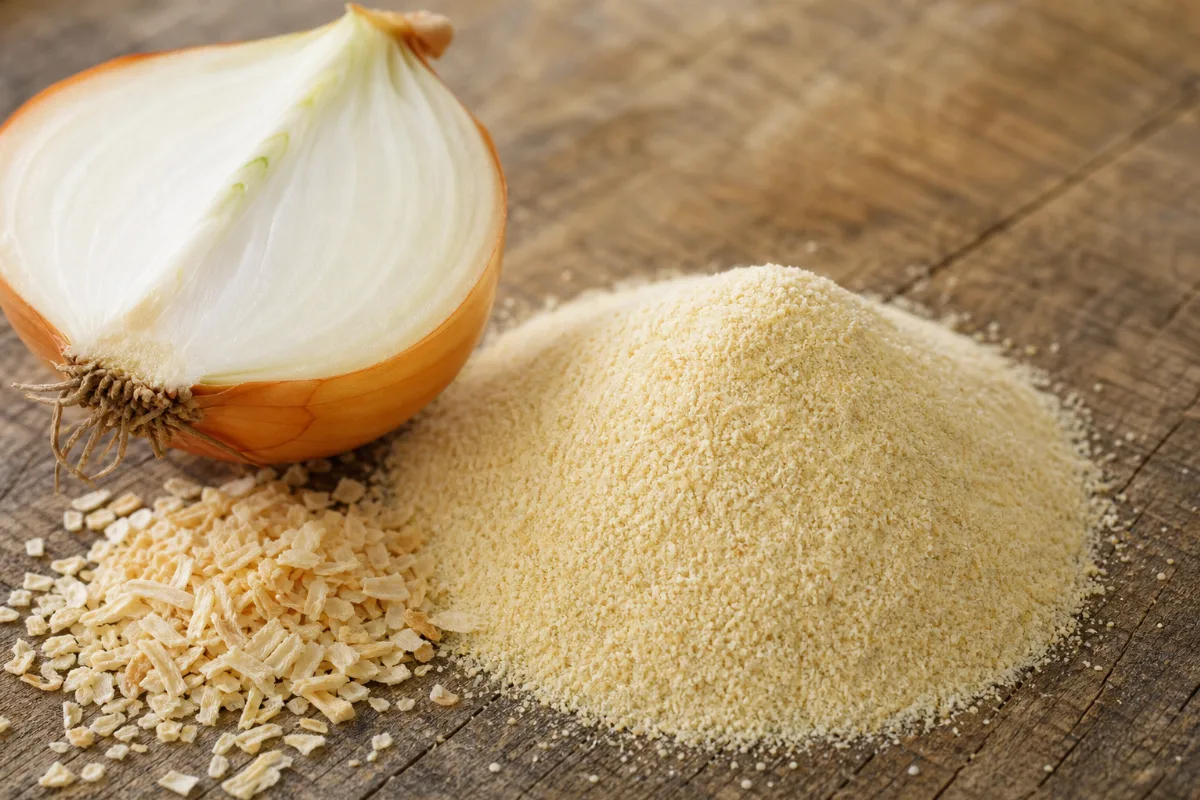
Onion powder is dehydrated, ground onion used as a seasoning. It is made from the bulb of Allium cepa. White, yellow or red onions may be used, some kinds are made from toasted onion, and it can be made at home.
Commercial makers use drying methods such as freeze-drying, vacuum-shelf drying and flow drying. A general encyclopedia entry says commercial powder is generally accepted to be about ten times stronger in flavor than fresh onion, so a little goes a long way. It also says some commercial powders are irradiated against germs.
It is used on pasta, pizza and grilled chicken, in meat rubs, and in seasoning mixes such as beau monde seasoning. Onion salt is a different product made of dried onion and salt, so it adds sodium.
What is in a teaspoon
USDA data for onion powder (per 100 g): 341 kcal, 15.2 g fibre, 79.1 g carbohydrate, 985 mg potassium, 384 mg calcium, 73 mg sodium and 23.4 mg vitamin C. A teaspoon is 2.4 g and a tablespoon is 6.9 g (USDA household portions).
So one teaspoon gives about 8 kcal, 0.4 g fibre, 24 mg potassium, 9 mg calcium, 2 mg sodium and 0.6 mg vitamin C (our arithmetic). That is a small amount, so we do not call onion powder a good source of any nutrient. The USDA data are from 2019 and real products vary.
What the research shows
We found no study of onion powder as a seasoning for any health outcome.
The clearest related finding is for quercetin supplements: a pooling of 17 trials found a small drop in blood pressure (about 3 mmHg). Onion contains quercetin, but those trials did not test onion powder.
A pooling of 5 trials found lower weight measures with onion products in people with obesity, mostly onion peel. Observational studies found no clear link between allium vegetables and cancer risk. Observational studies cannot prove cause.
Seasoning versus supplements and extracts
The blood pressure results are for quercetin supplements and the weight results are for onion products, mostly peel. A result for a capsule or extract does not carry over to a teaspoon of seasoning.
Amounts
This page gives no amounts to use. Ask a doctor, pharmacist or dietitian what is right for you, especially if you have IBS, take medicines or use supplements.
At a glance
Traditional uses history, not proof
- Used as a dried seasoning for savory food
- Long use in cooking is not proof that it treats any condition
Studied for research
- Blood pressure, low certainty (trials of quercetin supplements, not onion powder)
- Body weight, low certainty (onion products, mostly peel)
- Blood sugar and blood fats, insufficient evidence
- Cancer risk, low certainty (allium vegetables as a group, observational)
Main compounds
- Quercetin
- Fructans
- Organosulfur compounds
- Fibre
- Potassium
Common forms
- Plain onion powder and similar dried onion as a seasoning
- Onion salt is a different product that also contains salt
- Onion peel extract and quercetin capsules (used in trials, not the same as the seasoning)
Research links: USDA FoodData Central: Spices, onion powder · Fructan content in common foods (2024) · ASPCA: Onion (toxic plants) · Research Library · Genes & Biomarkers Library
What it is and its history
- Accepted scientific name
- Allium cepa
- Naming authority
- L.
- Common names
- Onion powder (English); Dried ground onion (English); Cebolla en polvo (Spanish)
- Family or group
- Not verified in a source read for this page (the onion vegetable page gives Amaryllidaceae from GBIF).
- Classification
- Plantae > Allium > Allium cepa
- Native range
- Not verified from a source read.
- Habitat
- Not verified from a source read.
- What it looks like
- Roots: Not verified.; Stems: Not verified.; Leaves: Not verified. The seasoning is made from the bulb.; Flowers: Not verified.; Fruit: Not verified.
- Cultivation
- Not verified from a source read.
- Harvest and processing
- A general encyclopedia entry says onion powder is dehydrated, ground onion, made commercially by drying methods such as freeze-drying, vacuum-shelf drying and flow drying; some kinds use toasted onion; white, yellow or red onions may be used; and it can be made at home. Some commercial powders are irradiated against germs. It readily takes up water, so it may be sold in airtight packs, and powder with 4 to 5 percent moisture can cake in warm storage. The same entry says commercial powder is generally accepted to be about ten times stronger in flavour than fresh onion. These points come from a general encyclopedia that cites older books we did not open.
- Look-alikes and adulterants
- Name: Onion salt; Note: A different product that contains salt as well as dried onion. Do not treat it as plain onion powder.; Name: Garlic powder; Note: A related allium seasoning with its own research. Many studies pool allium vegetables.
- Sustainability and conservation
- Not assessed.
What is inside, and how it may work
What it contains and how those compounds act in cells and animals. Laboratory and animal mechanisms are not proven effects in people.
Main compounds
| Compound | Family | Where it is concentrated | Activity studied | Level of evidence |
|---|---|---|---|---|
| Quercetin PubChem 5280343 | flavonol | Bulb (and peel) | A plant pigment tested as a supplement for blood pressure; the pooled supplement trials lowered it by about 3 mmHg. Its content in onion powder was not found. 5 | Human data |
| Fructans (short-chain) | carbohydrate (FODMAP) | Bulb 1.97 g per 100 g fresh onion (2024 measurement of Slovenian foods); powder not measured | Ferment quickly in the gut and can worsen IBS symptoms. 4 | Human data |
| N-propyl disulfide | organosulfur compound | Bulb | Named by the ASPCA as the toxic principle of onion for pets. 8 | Animal research |
Mechanisms, receptors and pathways
| Target or pathway | Gene or receptor | What was found | Level |
|---|---|---|---|
| Fructan fermentation in the gut | Not specified | Short-chain fructans have a rapid fermentation rate and can worsen symptoms in people with IBS. 4 | Human data |
| Red blood cell damage in dogs | Glucose-6-phosphate dehydrogenase (in dog red cells) | In dogs fed cooked onions, red cell G6PD and reduced glutathione fell and oxidative damage rose, with Heinz bodies and hemolytic anemia. 6 | Animal research |
Absorption, metabolism and elimination
- Absorption
- Not found.
- Distribution
- Not found.
- Metabolism
- Not found.
- Elimination
- Not found.
- Bioavailability
- Not established for onion powder in the sources read.
Isolated compounds versus whole extracts
The blood pressure results come from quercetin supplements and the weight results from onion products, mostly peel, so none tell us about onion powder in cooking. Powder, peel and extract are different products. A teaspoon of powder weighs about 2.4 g (USDA), far less than a supplement or a whole onion.
Nutritional composition
Nutrition from USDA FoodData Central (Spices, onion powder, FDC 171327, SR Legacy, last updated 4/1/2019, read 2026-10-26). Per 100 g: 341 kcal, 10.4 g protein, 1.04 g fat, 79.1 g carbohydrate, 15.2 g fibre, 6.63 g sugars, 5.39 g water, 384 mg calcium, 3.9 mg iron, 113 mg magnesium, 322 mg phosphorus, 985 mg potassium, 73 mg sodium, 4.05 mg zinc, 23.4 mg vitamin C, 0.718 mg vitamin B6, 64 micrograms folate (DFE), 4.1 micrograms vitamin K, no vitamin A (RAE). Household portions in USDA: 1 teaspoon = 2.4 g and 1 tablespoon = 6.9 g. Per teaspoon (2.4 g), our own arithmetic: about 8 kcal, 1.9 g carbohydrate, 0.4 g fibre, 9 mg calcium, 24 mg potassium, 2 mg sodium and 0.6 mg vitamin C. A teaspoon is mostly flavour, so we do not call onion powder a good source of any nutrient. Real products vary, and onion salt has much more sodium. We found no source that sets a usual recipe amount.
3 low certainty1 not enough evidence
What was looked at
The 4 benefits and uses checked for Onion powder, each with how strong the evidence is. Tap one to open it.
- Blood pressure (quercetin supplements)Low certainty
- Body weight and waist size (onion products, mostly peel)Low certainty
- Blood sugar and blood fatsNot enough evidence
- Cancer risk (allium vegetables)Low certainty
Lab markers tracked in the studies
Systolic blood pressure after quercetin supplementsBody weight, BMI, waist size and triglycerides after onion productsBlood glucose after quercetin supplements
What is Onion powder good for?
The studied uses and how strong the human evidence is for each. Nothing here was tested with onion powder as a seasoning: the results are for quercetin supplements, onion products such as peel, or allium vegetables as a group.
Benefits, one by one
Each card is a research question, not a promise. Tap a goal to filter. Open a card to see the studies, doses and limits.
Blood pressure (quercetin supplements)
Low certaintyOnions contain quercetin, a plant pigment. A 2020 pooling of 17 trials found quercetin supplements lowered blood pressure by a few points. Those trials tested supplements, not onion powder in food, so they do not show the same effect from seasoning.
1 studiesQuercetin supplements or quercetin-enriched extracts (not onion powde…
Studies, doses and limits
What the trials found
Huang 2020 pooled 17 randomised trials of quercetin or a quercetin-enriched extract (896 adults): systolic pressure fell 3.09 mmHg and diastolic 2.86 mmHg.
Results
Quercetin supplements lowered blood pressure by about 3 mmHg in the pooled trials. No trial of onion powder was found.
Effect sizes as reported
Systolic -3.09 mmHg (95% CI -4.59 to -1.59); diastolic -2.86 mmHg (95% CI -5.09 to -0.63).
Why this rating
Low for the supplement and insufficient for onion powder as a seasoning. One meta-analysis (read at abstract level) of supplements; no GRADE rating in the abstract; a 3 mmHg change is small. The quercetin content of a teaspoon of onion powder was not found.
Form and dose studied
Quercetin supplements or quercetin-enriched extracts (not onion powder).
Who was studied
Adults in the pooled trials.
Limits
Supplements are not a seasoning. Abstract-level reading only.
Why researchers looked
Onion is a well-known source of quercetin, and quercetin has been tested for blood pressure.
Traditional use
Onion powder is used as a dried seasoning. Long use in cooking is not proof that it treats any condition.
Proposed mechanism Human data
Not explained in the abstract read.
A proposed mechanism does not show that the effect happens in people.
People who take blood pressure medicines should ask a clinician or pharmacist before starting quercetin supplements.
Body weight and waist size (onion products, mostly peel)
Low certaintyA 2023 pooling of 5 trials in people with obesity found lower weight, BMI, waist size and triglycerides with onion products. Four trials used onion peel and one used onion. None tested onion powder as a seasoning.
1 studiesMostly onion peel (4 of 5 trials) and one onion product; not onion po…
Studies, doses and limits
What the trials found
Chung 2023 reviewed 38 studies and pooled 5 clinical trials in people with obesity; onion peel was used in four and onions in one. Body weight, BMI, waist size and triglycerides were significantly lower than with placebo, and the authors say the effect was largest with onion peel.
Results
Lower weight measures were reported with onion products, mainly peel. The abstract gives no numbers. Nothing was found for onion powder used in cooking.
Effect sizes as reported
Not in the abstract.
Why this rating
Low for onion products and insufficient for the powder: only 5 small trials, mostly peel, no effect sizes read.
Form and dose studied
Mostly onion peel (4 of 5 trials) and one onion product; not onion powder seasoning.
Who was studied
Adults with obesity.
Limits
Abstract-level reading; trial sizes and effect numbers were not read.
Why researchers looked
Researchers have tested onion products, including peel that people do not usually eat, for weight and body fat.
Traditional use
Onion powder is used as a dried seasoning. Long use in cooking is not proof that it treats any condition.
Proposed mechanism Human data
Not explained in the abstract read.
A proposed mechanism does not show that the effect happens in people.
Ask a doctor or dietitian before trying supplements for weight.
Blood sugar and blood fats
Not enough evidenceThe same 2020 quercetin pooling found no significant change in blood glucose or blood fats overall. Nothing was found for onion powder.
1 studiesQuercetin supplements (not onion powder).
Studies, doses and limits
What the trials found
Huang 2020 (17 trials, 896 adults): neither lipid profiles nor glucose changed significantly overall. In subgroups of parallel-design trials lasting 8 weeks or more, HDL cholesterol and triglycerides changed significantly.
Results
No overall benefit for glucose or blood fats from quercetin supplements. Onion powder was not tested.
Effect sizes as reported
Not significant overall; numbers not in the abstract.
Why this rating
Insufficient: no trial of onion powder, and the only pooled data are for quercetin supplements.
Form and dose studied
Quercetin supplements (not onion powder).
Who was studied
Adults.
Limits
Supplement data only; abstract-level reading.
Why researchers looked
Onion products are sometimes promoted for blood sugar and cholesterol.
Traditional use
Onion powder is used as a dried seasoning. Long use in cooking is not proof that it treats any condition.
Proposed mechanism Human data
Not covered in the abstract read.
A proposed mechanism does not show that the effect happens in people.
People taking diabetes medicines should follow their care team's advice.
Cancer risk (allium vegetables)
Low certaintyA 2021 pooling of 22 observational studies found no significant link between eating more allium vegetables and cancer risk. These were vegetables, not onion powder.
1 studiesAllium vegetables as food (not powder).
Studies, doses and limits
What the trials found
Zhang 2021 pooled 22 studies (25 reports) of allium vegetables: high intake showed no significant association with cancer risk (RR 0.97, 95% CI 0.92 to 1.03).
Results
No link found. The authors say the finding needs further validation.
Effect sizes as reported
RR 0.97 (95% CI 0.92 to 1.03).
Why this rating
Low: observational data, and allium vegetables as a group. Observational studies cannot show cause.
Form and dose studied
Allium vegetables as food (not powder).
Who was studied
Adults in observational studies.
Limits
Observational; group of vegetables, not onion powder; abstract-level reading.
Why researchers looked
Lab studies of allium compounds looked promising, so researchers checked whether people who eat more allium vegetables get less cancer.
Traditional use
Onion powder is used as a dried seasoning. Long use in cooking is not proof that it treats any condition.
Proposed mechanism Human data
Not covered in the abstract read.
A proposed mechanism does not show that the effect happens in people.
Not a cancer screening or treatment guide. Follow your care team's advice.
Connections to the rest of health
How Onion powder connects to the rest of our health knowledge graph. Every link says what kind of connection it is. A safety link (for example to the liver) is a warning, not a benefit. A study that merely mentions a topic never creates a benefit link.
Explore every connection: goals, body systems, organs, symptoms, genes
A. Wellness goals
| Connected to | Kind of connection | Evidence status | Context | Studies |
|---|---|---|---|---|
| Blood Pressure Support | Low certainty | Blood pressure (quercetin supplements): Onions contain quercetin, a plant pigment. A 2020 pooling of 17 trials found quercetin supplements lowered blood pressure by a few points. Those trials tested supplements, not onion powder in food, so they do not show the same effect from seasoning. | 5 | |
| Metabolic Health | Low certainty | Body weight and waist size (onion products, mostly peel): A 2023 pooling of 5 trials in people with obesity found lower weight, BMI, waist size and triglycerides with onion products. Four trials used onion peel and one used onion. None tested onion powder as a seasoning. | 3 | |
| Blood Sugar Balance | Biological association | Not enough evidence | Blood sugar and blood fats: The same 2020 quercetin pooling found no significant change in blood glucose or blood fats overall. Nothing was found for onion powder. | 5 |
B. Body systems
| Connected to | Kind of connection | Evidence status | Context | Studies |
|---|---|---|---|---|
| Cardiovascular System | Biological association | Low certainty | Studied for: Blood pressure (quercetin supplements) | 5 |
| Metabolism Weight | Biological association | Low certainty | Studied for: Body weight and waist size (onion products, mostly peel) Studied for: Blood sugar and blood fats | 3 5 |
| Immune System | Biological association | Low certainty | Studied for: Cancer risk (allium vegetables) | 7 |
| Digestive System | Biological association | Low certainty | Studied for: Cancer risk (allium vegetables) | 7 |
E. Health conditions
| Connected to | Kind of connection | Evidence status | Context | Studies |
|---|---|---|---|---|
| Irritable bowel syndrome | Adverse effect or risk | Documented risk | Onion has the most fructans of 40 foods measured (fresh onion); fructans can worsen IBS symptoms in some people. Preparation or compound: Fructans in onion |
4 |
| Food allergy | Adverse effect or risk | Case report | Rare but severe reactions to onion, including cooked onion, are reported. Preparation or compound: Onion |
1 |
I. Biomarkers
| Connected to | Kind of connection | Evidence status | Context | Studies |
|---|---|---|---|---|
| Systolic blood pressure after quercetin supplements | Biological association | Low certainty | Measured in trials: lowered. A lab change is not the same as a health benefit. | 5 |
| Body weight, BMI, waist size and triglycerides after onion products | Biological association | Low certainty | Measured in trials: lowered. A lab change is not the same as a health benefit. | 3 |
| Blood glucose after quercetin supplements | Biological association | Not enough evidence | Measured in trials: no-change. A lab change is not the same as a health benefit. | 5 |
K. Biological pathways
| Connected to | Kind of connection | Evidence status | Context | Studies |
|---|---|---|---|---|
| Fructans (FODMAPs) | Preliminary mechanism | Human | Onion is the highest-fructan food in a 40-food measurement; relevant to IBS. The powder was not measured. | 4 |
| Quercetin | Preliminary mechanism | Human | Onion is a source of the flavonol quercetin, tested as a supplement for blood pressure. | 5 |
L. Active compounds
| Connected to | Kind of connection | Evidence status | Context | Studies |
|---|---|---|---|---|
| Quercetin | Biological association | Human | A plant pigment tested as a supplement for blood pressure; the pooled supplement trials lowered it by about 3 mmHg. Its content in onion powder was not found. Preparation or compound: Bulb (and peel) |
5 |
| Fructans (short-chain) | Biological association | Human | Ferment quickly in the gut and can worsen IBS symptoms. Preparation or compound: Bulb |
4 |
| N-propyl disulfide | Biological association | Animal | Named by the ASPCA as the toxic principle of onion for pets. Preparation or compound: Bulb |
8 |
Each connection is stored with the ingredient, the connected record, the kind of connection, the evidence status, the supporting studies, the preparation or compound involved, and a review date (last reviewed October 26, 2026).
The evidence
The research centre for Onion powder. Every record here was checked against PubMed or the publisher's page; we never list a study we have not verified.
Evidence by outcome
Bars show how many studies we found for each outcome, not how well it works. People are added up across trials only (reviews are not added, to avoid double counting).
How we rate evidence
High certainty
Several well-run trials or reviews agree; further research is unlikely to change the picture much.
Moderate certainty
Good trials point the same way, but some doubt remains.
Low certainty
Small, short or inconsistent trials. The finding could change with better research.
Very low certainty
Very little or very weak human data. Treat as a possibility only.
Mixed findings
Trials or reviews disagree with each other.
Not enough evidence
Not enough human research to say either way.
Evidence against
Good research found no benefit, or found harm.
We take the reviewers' own risk-of-bias and GRADE statements where they exist, and otherwise judge from study size, design, consistency, directness and whether a product matches what is sold. Many publications do not make evidence high. Method note: A smaller page than most: little research exists on the powder itself. We re-checked nutrition at USDA FoodData Central, read the NHS and ASPCA pages and an encyclopedia entry, and read the PubMed abstracts of each study listed. Only abstracts were read for studies. Items we could not verify are flagged in the research gaps.
Study library: every study we checked 11
| Study | Design | People | Product, dose, length | Result |
|---|---|---|---|---|
| Albanesi 2019 Immunological characterization of onion (Allium cepa) allergy. Postepy Dermatologii i Alergologii · PMID 30858787 · DOI |
Case report |
1 One 35-year-old man with anaphylaxis after eating cooked onion |
Cooked onion (allergy testing) Bulb Trial detail, not advice Single episode |
Skin test and ImmunoCAP confirmed an IgE-dependent reaction to onion. Peach extract only slightly reduced onion-specific IgE (about 30 percent). The authors say cooked onion can cause severe allergic reactions, suggesting some heat-stable allergen parts. Their introduction notes that handling onion can cause contact dermatitis, rhinoconjunctivitis and asthma, while reports of reactions to eating onion are sporadic. Not applicable (Not applicable) Methods, limits and fundingOutcomes: Allergy tests (skin test, ImmunoCAP, cross-reactivity with peach) Limitations: A single case, so it says nothing about how common onion allergy is. Funding and conflicts: The authors declare no conflict of interest. Read: abstract |
| Almogren 2013 Garlic and onion sensitization among Saudi patients screened for food allergy: a hospital based study. African Health Sciences · PMID 24250308 · DOI |
Cross sectional |
108 108 patients in Saudi Arabia with suspected food allergy |
Blood test for garlic and onion IgE antibodies Trial detail, not advice Records 2008 to 2009 |
15 of 108 patients (13.8 percent) had garlic and onion IgE antibodies; 13 had onion IgE. Of these 15, 12 had both. The authors say this shows sensitization and allergenic potential. 15 of 108 (13.8%) with garlic or onion IgE; 13 with onion IgE (Not applicable) Methods, limits and fundingOutcomes: Garlic and onion specific IgE Limitations: Sensitization (a blood marker) is not the same as a reaction. These were people already suspected of food allergy, so it does not show how common onion allergy is in the general public. Funding and conflicts: Not stated in the abstract. Read: abstract |
| Chung 2023 Antiobesity effects of onion (Allium cepa) in subjects with obesity: Systematic review and meta-analysis. Food Science & Nutrition · PMID 37576046 · DOI |
Systematic review meta analysis |
People with obesity in 5 clinical trials (38 studies screened) | Onion peel in 4 trials and onion in 1 trial Onion peel (4 trials) or onion (1 trial) Trial detail, not advice Not given in the abstract · vs Placebo |
Body weight, BMI, waist circumference and triglycerides were significantly lower in the onion groups than with placebo. The authors say the effect was particularly pronounced with onion peel. Risk of bias was generally low. Weighted mean differences are not given in the abstract. (Not given in the abstract) Methods, limits and fundingOutcomes: Body weight, BMI, waist circumference, triglycerides Limitations: Only 5 trials, and 4 of them used onion peel, which is not the part people usually eat. Numbers were not read (abstract only). Funding and conflicts: The authors declare no conflicts of interest. Read: abstract |
| Ferjancic 2024 Fructan content in most commonly consumed Slovenian foods and estimation of daily fructan consumption. Frontiers in Nutrition · PMID 39155934 · DOI |
Laboratory measurement food analysis |
40 of the most commonly eaten foods in Slovenia | Fructan content measured in foods Fresh food Trial detail, not advice |
Fructan content was relatively low overall (0.1 to 1.97 g per 100 g). The highest was in onion (1.97 g per 100 g), then wheat flour (0.75 g per 100 g). Short-chain fructans ferment fast and can worsen symptoms in people with irritable bowel syndrome (IBS). Onion 1.97 g fructan per 100 g fresh weight (highest of 40 foods) (Not applicable) Methods, limits and fundingOutcomes: Fructan content per 100 g fresh weight; estimated daily fructan intake Limitations: A food measurement in Slovenian foods, not a trial in people with IBS. It does not say how any one person will react. Funding and conflicts: The authors declare no commercial or financial relationships. Read: abstract |
| Huang 2020 Effect of quercetin supplementation on plasma lipid profiles, blood pressure, and glucose levels: a systematic review and meta-analysis. Nutrition Reviews · PMID 31940027 · DOI |
Systematic review meta analysis |
896 896 people in 17 randomised trials |
Quercetin or standardised quercetin-enriched extract Supplement or extract, not onions Trial detail, not advice Trials searched up to July 2018 · vs Placebo or control |
Quercetin lowered systolic and diastolic blood pressure. Blood lipids and glucose did not change significantly overall. In some subgroups (parallel-design trials of 8 weeks or longer) HDL cholesterol and triglycerides changed. Systolic BP WMD -3.09 mmHg; diastolic BP WMD -2.86 mmHg; glucose and lipids not significantly changed overall (Systolic 95% CI -4.59 to -1.59, P=0.0001; diastolic 95% CI -5.09 to -0.63, P=0.01) Methods, limits and fundingOutcomes: Blood lipids, blood pressure, blood glucose Limitations: Supplements and extracts, not onions as food. Funding and conflicts: Not stated in the abstract. Read: abstract |
| Tang 2008 An experimental study of hemolysis induced by onion (Allium cepa) poisoning in dogs. Journal of Veterinary Pharmacology and Therapeutics · PMID 18307506 · DOI |
Animal experiment dog (animal) |
6 Six adult, clinically normal Pekingese dogs |
Cooked onions fed to dogs Cooked onion Trial detail for dogs only: 30 g per kg body weight per day 2 days of feeding, blood followed to day 24 |
Red blood cell counts, hemoglobin and hematocrit fell, significantly by day 5, with a rise in Heinz bodies and bilirubin. The authors confirm onion poisoning in dogs causes hemolytic anemia (red blood cells breaking down). Red blood cells, hemoglobin and hematocrit decreased from day 1, significantly by day 5 (P<0.01) (P values only) Methods, limits and fundingOutcomes: Red blood cells, hemoglobin, Heinz bodies, bilirubin and red cell chemistry Limitations: Six dogs, no control group. This is about dogs, not people. Funding and conflicts: Not stated in the abstract. Read: abstract |
| Zhang 2022 Allium Vegetables, Garlic Supplements, and Risk of Cancer: A Systematic Review and Meta-Analysis. Frontiers in Nutrition · PMID 35402472 · DOI |
Systematic review meta analysis |
22 studies (25 reports) of allium vegetables; 10 studies of garlic supplements | Allium vegetables as food (onion, garlic and others, pooled) Bulbs and other allium vegetables Trial detail, not advice Observational follow-up · vs Lowest intake group |
High allium vegetable intake showed no significant link with overall cancer risk. Garlic supplements also showed no significant link. The authors found no evidence that higher intake reduced cancer risk and say the finding needs further validation. Allium vegetables and cancer risk RR 0.97 (95% CI 0.92-1.03 (fixed-effects model)) Methods, limits and fundingOutcomes: Cancer risk Limitations: Pooled allium vegetables, not onions alone. Observational studies cannot show cause. Funding and conflicts: The authors declare no commercial or financial relationships. Registration: PROSPERO CRD42021246947 Read: abstract |
| s-aspca-onion ASPCA: Toxic and Non-toxic Plants, Onion · Source |
Health agency n/a |
Methods, limits and fundingRead: full-text | ||
| s-nhs-ibs NHS: Further help and support for IBS · Source |
Health agency n/a |
Methods, limits and fundingRead: full-text | ||
| s-usda-fdc-171327 USDA FoodData Central: Spices, onion powder (FDC 171327) · Source |
Reference database n/a |
Methods, limits and fundingRead: full-text | ||
| s-wiki-onion-powder Wikipedia: Onion powder · Source |
Reference encyclopedia n/a |
Methods, limits and fundingRead: full-text |
What we do not know yet
- No trial of onion powder as a seasoning was found for any health outcome.
- The quercetin and fructan content of onion powder was not found; the fructan figure is for fresh onion.
- No usual recipe amount was found in a source.
- Allergy was found only in a case report and a sensitization study; how common it is was not found.
- Pregnancy, breastfeeding, children, contamination of dried onion, liver safety and cooking effects were not researched.
How new research is added
New studies are found by a saved PubMed search and placed in a review queue before the page changes.
Lab markers
What changed in blood or saliva tests during trials. A changed number is not the same as feeling or being healthier, and we give no "normal ranges".
Metabolic 2
Body weight, BMI, waist size and triglycerides after onion products
Lowered in trials
Body size measures and a blood fat, tracked in trials in people with obesity.
Low certaintyResults and what it means
Why it was measured
Onion products have been tested for weight and body fat.
Statistical vs. clinical meaning
Reported as lower, mostly with peel. Not a test of onion powder.
Safety implication
None specific.
| Study | Result | People | Product |
|---|---|---|---|
| 3 | Body weight, BMI, waist circumference and triglycerides significantly lower than placebo (numbers not in the abstract) | 5 clinical trials in people with obesity | Onion peel in 4 trials, onions in 1 (not onion powder) |
Blood glucose after quercetin supplements
No clear change in trials
The amount of sugar in the blood, measured in trials of quercetin supplements.
Not enough evidenceResults and what it means
Why it was measured
Trials of plant products often check glucose.
Statistical vs. clinical meaning
No significant change. Not a test of onion powder.
Safety implication
None specific.
| Study | Result | People | Product |
|---|---|---|---|
| 5 | Glucose concentrations did not change significantly | 896 people in 17 trials | Quercetin or quercetin-enriched extract (not onion powder) |
Other 1
Systolic blood pressure after quercetin supplements
Lowered in trials
The top blood pressure number, measured in trials of quercetin supplements.
Low certaintyResults and what it means
Why it was measured
Quercetin is found in onions and has been tested as a supplement for blood pressure.
Statistical vs. clinical meaning
A small drop of about 3 mmHg in trials of supplements. Not a result for onion powder.
Safety implication
People taking blood pressure medicines should ask a clinician before supplements.
| Study | Result | People | Product |
|---|---|---|---|
| 5 | Systolic BP WMD -3.09 mmHg (95% CI -4.59 to -1.59, P=0.0001) | 896 people in 17 randomised trials | Quercetin or quercetin-enriched extract (not onion powder) |
Safety
What studies and official sources say about side effects, medicines and who should check first. Each point shows what kind of evidence it comes from.
Main points to know 3
- Pets: onion is toxic to dogs, cats and horses. The ASPCA lists onion as toxic to dogs, cats and horses. Signs include vomiting, breakdown of red blood cells, blood in urine, weakness, high heart rate and panting. The ASPCA page does not say whether powder is more or less harmful than raw onion. In an experiment, six dogs fed cooked onions for 2 days developed hemolytic anemia. If a pet ate onion or food seasoned with it, call a veterinarian or ASPCA Poison Control at (888) 426-4435 (a fee may apply). Authoritative guidance 8 6
- Irritable bowel syndrome: onion is high in fructans. A 2024 study measured fructans in 40 common Slovenian foods and found the most in fresh onion (1.97 g per 100 g). Short-chain fructans ferment quickly and can worsen symptoms in people with irritable bowel syndrome. The study measured fresh onion, not powder. The NHS says a dietitian may recommend a low FODMAP diet if general changes have not helped. Ask a dietitian instead of cutting foods out alone. Lab 4 9
- Allergy: rare after eating, but severe cases are reported. A 2019 report describes anaphylaxis after cooked onion in a 35-year-old man, suggesting some allergens survive heat. Handling onion can cause skin rash, runny eyes or nose and asthma. We did not find a study of allergy to onion powder. For trouble breathing or swelling of the face or throat, call emergency services. Case report 1 2
Side effects 3
| Effect | How often | Severity and recovery | Evidence |
|---|---|---|---|
| Worse IBS symptoms in some people (fructans are a type of FODMAP) The fructan study measured fresh onion, not powder or people. Whether a given person reacts is individual. | Not established | not stated Not stated | Lab 4 |
| Anaphylaxis after eating cooked onion A single case. It cannot tell us how common onion allergy is. | One case described | severe Not stated in the abstract | Case report 1 |
| Onion IgE antibodies (sensitization) Sensitization is a blood marker, not proof of a reaction, and these were people already suspected of food allergy. | 13 of 108 patients with suspected food allergy had onion IgE; 15 had garlic or onion IgE | not stated Not applicable | Observational 2 |
Liver
No liver injury from onion powder was found in the sources read. A liver-safety source (such as LiverTox) was not searched.
How often. No frequency was found.
Monitoring. No agency monitoring advice was found.
This is a safety connection. It is not evidence that Onion powder supports liver health.
Medicines and supplements 2
| With | Why it matters | Importance | Evidence | What to do |
|---|---|---|---|---|
| Quercetin or onion extract supplements with blood pressure medicines prescription | Quercetin supplements lowered blood pressure by about 3 mmHg in trials, so an added effect with blood pressure medicines is possible in theory. No interaction study was read. | Not studied. This concerns supplements, not onion powder used in cooking. | Theoretical Not enough evidence 5 | Ask a pharmacist or clinician before using quercetin or onion extract supplements. |
| Medicines in general (onion powder as a seasoning) prescription | No source read described a medicine interaction with onion powder as a seasoning. | No claim either way is made. | None found Not enough evidence | A pharmacist can check any medicine or supplement you take. |
Who should check first 3
| Situation | Advice | Evidence |
|---|---|---|
| Irritable bowel syndrome that flares with onion | Ask a dietitian about a low FODMAP plan instead of cutting foods out alone. | Lab 4 9 |
| Known onion allergy or a past reaction to cooked onion | Avoid onion and ask an allergy clinician about testing. Call emergency services for trouble breathing or swelling of the face or throat. | Case report 1 |
| Feeding onion powder or food seasoned with it to dogs, cats or horses | Do not feed it to them (ASPCA). | Authoritative guidance 8 |
Overdose, product quality and regulators
Summary. No toxicity from onion powder eaten as a seasoning in people was found in the sources read. Onion is toxic to dogs, cats and horses.
Animal. Six dogs fed cooked onions for 2 days had falling red blood cell counts and hemoglobin, with Heinz bodies; the authors confirm onion poisoning causes hemolytic anemia in dogs. The ASPCA names N-propyl disulfide as the toxic principle for pets.
Overdose response. Not found for people.
Genotoxicity. Not researched.
Dried spices can carry germs, but no source read named a specific problem for onion powder. Some commercial onion powders are irradiated to reduce germs, according to a general encyclopedia entry. Pesticide residues, heavy metals and recalls were not researched.
Irradiation. A general encyclopedia entry says some commercial onion powders are irradiated against possible microbial contamination. It cites an older book we did not open. 11
Onion salt. Onion salt is a different product that contains salt as well as dried onion, so it adds sodium. Plain onion powder has little sodium by USDA data (73 mg per 100 g). 11 10
| Body | Action | Date |
|---|---|---|
| NHS (UK) (United Kingdom) | IBS page: a GP may refer you to a dietitian, who may recommend a low FODMAP diet that avoids some fruit and vegetables. Onion is not named on the page. source | 2025-03-17 |
| ASPCA (US animal welfare charity) (United States) | Lists onion (Allium cepa) as toxic to dogs, cats and horses. source | not shown |
When to get medical help
- Trouble breathing, swelling of the lips, face or throat, or widespread hives after eating onion
- A pet that has eaten onion and shows vomiting, weakness, blood in the urine or a fast heart rate: call a veterinarian or ASPCA Poison Control at (888) 426-4435 (a fee may apply)
Stop using the product and contact a clinician or emergency service. In the US, Poison Control is 1-800-222-1222.
General information only, not medical advice. Ask a clinician or pharmacist before use, especially with medicines, in pregnancy or with a health condition. See the Natural Remedy Safety guide.
Frequently asked questions
What is onion powder?
Dried, ground onion used as a seasoning. White, yellow or red onions may be used, and it can be made at home. Onion salt is a different product that also contains salt.
Is onion powder good for you?
It adds flavor, not much else. A teaspoon (2.4 g) gives about 8 kcal and small amounts of fibre and potassium. We found no study of onion powder for any health benefit.
Does onion powder lower blood pressure?
Not shown for onion powder. A pooling of 17 trials found quercetin supplements lowered blood pressure by about 3 mmHg. Onion contains quercetin, but those trials did not test the powder.
Can onion powder help you lose weight?
Not shown. A pooling of 5 trials found lower weight measures with onion products, but 4 of the 5 used onion peel, and none used onion powder as a seasoning.
Is onion powder good for blood sugar or cholesterol?
Not shown. The 2020 quercetin pooling found no significant change in glucose or blood fats overall, and nothing was found for onion powder. People taking diabetes medicines should follow their care team's advice.
Does onion powder prevent cancer?
Not shown. A pooling of 22 observational studies found no significant link between allium vegetables and cancer risk. These were vegetables, not onion powder.
Can onion powder make IBS worse?
Can you be allergic to onion powder?
Is onion powder safe for dogs and cats?
Is onion powder safe in pregnancy and for children?
The sources we read did not describe a caution for onion powder in food, so we make no claim. Ask your midwife, doctor or paediatrician about the whole diet.
Can I take it with medicines?
The sources we read name no interaction for onion powder as a seasoning. A pharmacist can check any supplement, such as quercetin or onion extract, against your medicines.
Explore by health goal
Editorial transparency
- Written by
- AlternativeMed editorial team. Research compiled with AI assistance, then checked against the sources listed.
- Medical review
- None. This page has not been reviewed by a physician or pharmacist.
- First published
- 2026-10-26
- Last substantive update
- 2026-10-26
- How we research
- A smaller page than most: little research exists on the powder itself. We re-checked nutrition at USDA FoodData Central, read the NHS and ASPCA pages and an encyclopedia entry, and read the PubMed abstracts of each study listed. Only abstracts were read for studies. Items we could not verify are flagged in the research gaps.
- How we rate evidence
- See "How we rate evidence" in the Evidence tab.
- Independence
- No product is promoted on this page. No affiliate links are shown.
Sources 11
Each source was opened and checked. Where we read only the abstract, it says so. The small numbers in the text point here.
- Albanesi M, Pasculli C, Giliberti L, et al.. Immunological characterization of onion (Allium cepa) allergy.. Postepy Dermatologii i Alergologii. 2019. PMID 30858787. DOI 10.5114/ada.2019.82829. (abstract)
- Almogren A, Shakoor Z, Adam MH. Garlic and onion sensitization among Saudi patients screened for food allergy: a hospital based study.. African Health Sciences. 2013. PMID 24250308. DOI 10.4314/ahs.v13i3.24. (abstract)
- Chung MY, Hwang JT, Park SH. Antiobesity effects of onion (Allium cepa) in subjects with obesity: Systematic review and meta-analysis.. Food Science & Nutrition. 2023. PMID 37576046. DOI 10.1002/fsn3.3426. (abstract)
- Ferjancic B, Korosec M, Kocevar Baloh A, et al.. Fructan content in most commonly consumed Slovenian foods and estimation of daily fructan consumption.. Frontiers in Nutrition. 2024. PMID 39155934. DOI 10.3389/fnut.2024.1446771. (abstract)
- Huang H, Liao D, Dong Y, Pu R. Effect of quercetin supplementation on plasma lipid profiles, blood pressure, and glucose levels: a systematic review and meta-analysis.. Nutrition Reviews. 2020. PMID 31940027. DOI 10.1093/nutrit/nuz071. (abstract)
- Tang X, Xia Z, Yu J. An experimental study of hemolysis induced by onion (Allium cepa) poisoning in dogs.. Journal of Veterinary Pharmacology and Therapeutics. 2008. PMID 18307506. DOI 10.1111/j.1365-2885.2007.00930.x. (abstract)
- Zhang Q, Zhao Q, Shen Y, Zhao F, Zhu Y. Allium Vegetables, Garlic Supplements, and Risk of Cancer: A Systematic Review and Meta-Analysis.. Frontiers in Nutrition. 2022. PMID 35402472. DOI 10.3389/fnut.2021.746944. (abstract)
- . ASPCA: Toxic and Non-toxic Plants, Onion. . . (full-text)
- . NHS: Further help and support for IBS. . . (full-text)
- . USDA FoodData Central: Spices, onion powder (FDC 171327). . . (full-text)
- . Wikipedia: Onion powder. . . (full-text)
Where to buy
Check the label first. Whatever you buy, look for these:
- Whole or ground: whole spices keep their flavor longer
- The origin and a packed-on or best-by date for freshness
- Organic or non-irradiated labeling if that matters to you
- A resealable, airtight container
Talk to a pharmacist or doctor before you start any supplement, especially if you take medicines. See the Safety tab for interactions.
Support our free guides: as an Amazon Associate we earn from qualifying purchases. Full disclosure.


