Spices · Spice
Tonka bean
Dipteryx odorata · also called Tonka, cumaru, haba tonka (Spanish)
Tonka bean is the black seed of a South American tree, grated in tiny amounts for a sweet, vanilla-and-almond flavor. We found no human study showing a health benefit from eating it. Its main compound, coumarin, can affect the liver in sensitive people, and US law treats food containing tonka bean as adulterated. If you take a blood thinner or have liver disease, ask your doctor or pharmacist first.
General information, not medical advice. Last substantive update · Not medically reviewed. A named clinician has not signed off on this page. How this page is made
About Tonka bean
Tonka bean is a flavoring seed, not a proven remedy. The practical facts are about safety: its coumarin, a US ban on it in food, fake vanilla, and caution with liver disease and blood thinners.
What it is
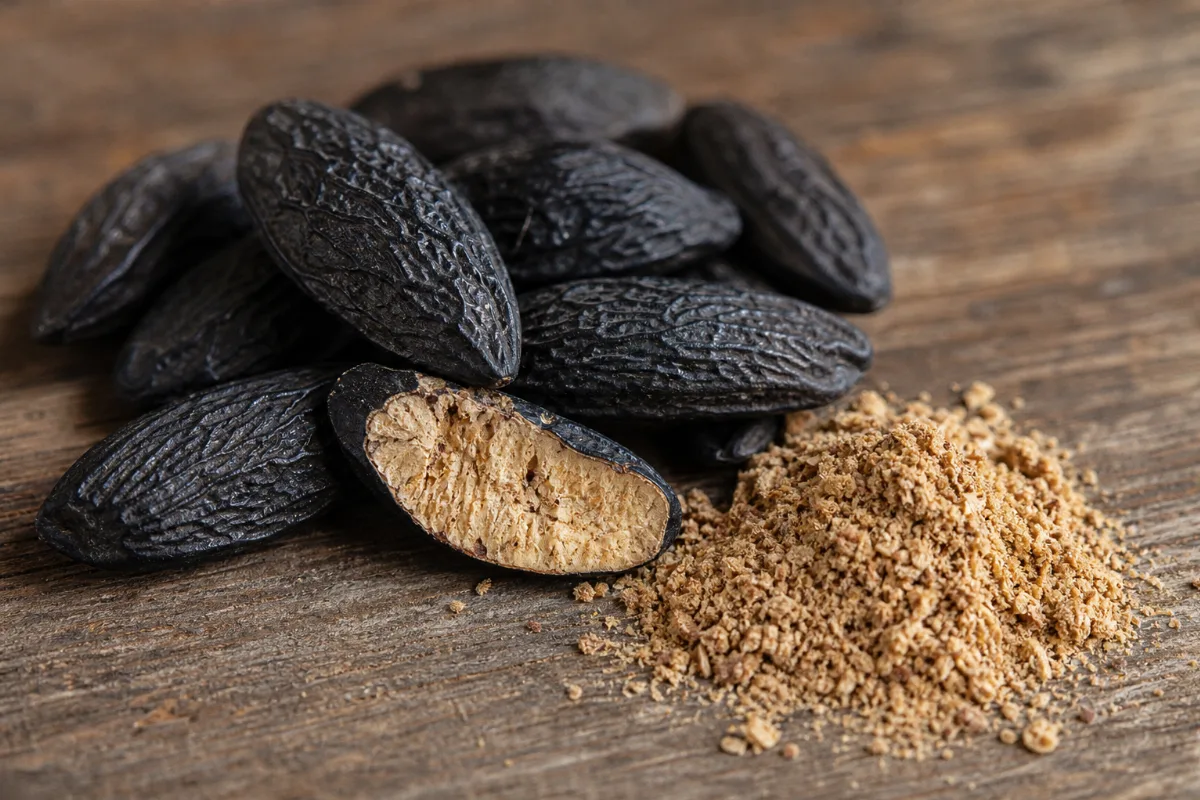
Tonka bean is the seed of Dipteryx odorata, a tree in the pea family. The seed is black and wrinkled with a smooth brown inside. It is grated or infused for a sweet flavor of vanilla, almond and clove.
The main compound is coumarin, about 1 to 3 percent of the seed according to one paper. Coumarin gives the sweet, hay-like smell.
USDA FoodData Central has no entry for tonka bean, so we give no nutrition per portion. One small lab study found raw beans hold 38.9 g fat per 100 g, mostly unsaturated.
What the research shows
We found no human trial of eating tonka bean for any health outcome. The research that exists is chemistry, food analysis and lab work on seed extracts.
Pure coumarin has been studied as a drug, and that work is where the liver safety facts come from. It is not the same as eating a grated bean.
Whole bean versus pure coumarin
Most safety facts are for pure coumarin taken as a medicine. The bean holds coumarin plus other compounds, and we found no human study of the bean itself. Neither result can simply be assumed for the other.
Amounts
This page gives no amounts to use. Ask a doctor, pharmacist or dietitian what is right for you, especially if you take warfarin or have liver disease.
At a glance
Traditional uses history, not proof
- Grated into desserts, drinks and perfume for its sweet, hay-like aroma
- Long use as a flavoring is not proof that it treats any condition
Studied for research
- Any health benefit from eating tonka bean, insufficient evidence
- Germ-fighting effects of seed extracts, very low certainty, lab only
- Pure coumarin as a drug for lymphoedema, low certainty, not tonka bean
Main compounds
- Coumarin (about 1 to 3 percent of the seed in one paper)
- Fats, mostly unsaturated
Common forms
- Whole dried bean
- Grated bean
- Extract (also used in perfume)
Research links: US rule on coumarin in food (21 CFR 189.130) · 2022 review: coumarin and the liver · German regulator FAQ on coumarin in foods (2012) · Research Library · Genes & Biomarkers Library
What it is and its history
- Accepted scientific name
- Dipteryx odorata
- Naming authority
- (Aubl.) Forsyth f. (GBIF accepted)
- Common names
- Tonka bean (English); Cumaru (Brazilian name); Haba tonka (Spanish)
- Family or group
- Fabaceae (the pea family), per GBIF.
- Classification
- Plantae > Tracheophyta > Magnoliopsida > Fabales > Fabaceae > Dipteryx > Dipteryx odorata
- Native range
- A 2022 paper on the bean describes the tree as semi-deciduous; native range is not verified from a source read here (the earlier project summary says northern South America).
- Habitat
- Not verified.
- What it looks like
- Roots: Not verified.; Stems: Not verified.; Leaves: Not verified.; Flowers: Not verified.; Fruit: The part used is the black, wrinkled seed with a smooth brown inside (Gels 2022 paper).
- Cultivation
- Not verified.
- Harvest and processing
- Not verified from a source read.
- Look-alikes and adulterants
- Name: Vanilla; Note: A different plant (an orchid). Some cheap "vanilla" has been made with tonka bean extract, according to a 2008 news report of an FDA warning.; Name: Other Dipteryx species such as baru (Dipteryx alata); Note: Related trees in the same genus; their nuts and oils are different foods and are not covered here.
- Sustainability and conservation
- Not researched.
Photographs
What is inside, and how it may work
What it contains and how those compounds act in cells and animals. Laboratory and animal mechanisms are not proven effects in people.
Main compounds
| Compound | Family | Where it is concentrated | Activity studied | Level of evidence |
|---|---|---|---|---|
| Coumarin PubChem 323 | benzopyrone | Seed About 1 to 3 percent of the seed (introduction of a 2022 paper on tonka bean) | Main aroma compound and the reason tonka bean is not allowed in US food. Pure coumarin has been used as a drug for lymphoedema and can raise liver enzymes in a small subset of patients. 11 8 5 4 | Regulatory and review |
| Fats (mostly linoleic and oleic acid) | fatty acids | Seed 38.9 g total fat per 100 g raw bean in one lab analysis | A food-composition fact, not a health effect. 4 | Laboratory analysis |
Mechanisms, receptors and pathways
| Target or pathway | Gene or receptor | What was found | Level |
|---|---|---|---|
| Liver metabolism of coumarin | Specific CYP450 enzymes (suggested, not proven) | A 2022 review suggests that liver effects of coumarin are limited to a small subset of patients, probably because alternative metabolic routes involving specific CYP450 enzymes are activated in them. 5 | Review hypothesis |
| Bacterial growth | Not specified | Tonka seed ethanol extract slowed growth of four bacteria in the lab; coumarin was the main constituent but the paper does not say it caused the effect. 6 | Laboratory research |
Absorption, metabolism and elimination
- Absorption
- Not found for tonka bean as food.
- Distribution
- Not found.
- Metabolism
- The 2022 review covers absorption, distribution, metabolism and excretion of coumarin as a drug; details were not extracted here.
- Elimination
- Not found.
- Bioavailability
- Not established for tonka bean.
Isolated compounds versus whole extracts
Most safety and drug data are for pure coumarin, not tonka bean. The bean holds coumarin plus fats and other compounds, so results for pure coumarin cannot be assumed to match eating the bean, and the reverse is also true. We found no human study of the bean itself.
Nutritional composition
USDA FoodData Central has no entry for tonka bean, so no per-portion nutrition is given and none is worked out. One small lab study (Gels 2022, read 2026-10-26) analysed raw, roasted and boiled beans: raw beans held 38.9 g total fat per 100 g, of which 34.7 g was unsaturated and 4.2 g saturated, with linoleic acid the largest fat. Roasting lost little and boiling lost more of the nutrients measured. The same paper puts the coumarin content at about 1 to 3 percent. Tonka bean is used in very small amounts as a flavoring, so it adds almost nothing nutritionally.
2 low certainty1 very low certainty1 not enough evidence
What was looked at
The 4 benefits and uses checked for Tonka bean, each with how strong the evidence is. Tap one to open it.
- Any health benefit from eating tonka beanNot enough evidence
- Germ-fighting effects of seed extracts (lab only)Very low certainty
- Pure coumarin as a medicine for lymphoedema (not tonka bean)Low certainty
- What a tonka bean contains (lab analysis)Low certainty
Lab markers tracked in the studies
Bacterial growth in lab dishesFat content of the bean (lab)
What is Tonka bean good for?
The studied uses and how strong the human evidence is for each. There is almost no research on eating tonka bean.
Benefits, one by one
Each card is a research question, not a promise. Tap a goal to filter. Open a card to see the studies, doses and limits.
Any health benefit from eating tonka bean
Not enough evidenceWe found no study in people of tonka bean eaten as a food or taken as a supplement, so no health benefit has been shown.
2 studiesNot applicable.
Studies, doses and limits
What the trials found
Searches of PubMed for tonka bean and Dipteryx odorata returned lab, chemistry and food-analysis papers, one 2011 Spanish-language case letter and no trial of eating tonka bean for a health outcome.
Results
No human result to report.
Why this rating
No human trial was found. This is absence of evidence, not proof of no effect.
Limits
Our search was a short title-level PubMed search and checks of the sources below, not a full systematic review.
Why researchers looked
Tonka bean is used mainly as a flavoring; its main compound, coumarin, is studied as a drug.
Traditional use
Used for its sweet, hay-like aroma in desserts and perfume. Long use as a flavoring is not proof that it treats any condition.
Proposed mechanism Not found
Not applicable: no human outcome was found.
A proposed mechanism does not show that the effect happens in people.
Tonka bean is not allowed as an ingredient in food in the United States because of its coumarin. See the Safety tab.
Germ-fighting effects of seed extracts (lab only)
Very low certaintyIn a 2026 lab study, an alcohol extract of tonka bean seeds slowed the growth of four kinds of bacteria in dishes. This has not been tested in people.
1 studiesLab extracts made with strong solvents, not food.
Studies, doses and limits
Results
The ethanol (alcohol) extract showed strong activity against the bacteria tested; the hexane extract was weaker. Higher extract amounts were toxic to human cells, and one extract raised DNA damage from a lab chemical in one test.
Effect sizes as reported
Not given in the abstract.
Why this rating
Lab-only study of concentrated extracts; cannot be used to judge eating tonka bean.
Form and dose studied
Lab extracts made with strong solvents, not food.
Limits
Only the abstract was read. Lab results often do not carry over to people. The same study found cell toxicity at higher amounts.
Why researchers looked
Seed extracts are routinely screened for germ-fighting activity.
Traditional use
Not described in the sources we read.
Proposed mechanism Laboratory research
Coumarin was the main constituent of both extracts tested; the paper does not show that coumarin caused the effect.
A proposed mechanism does not show that the effect happens in people.
The study also reported cell toxicity at higher amounts, a reason not to treat extracts as safe.
Pure coumarin as a medicine for lymphoedema (not tonka bean)
Low certaintyPure coumarin has been used as a drug for swelling from lymphatic problems. This is a different thing from eating tonka bean and is shown here only because coumarin is tonka bean's main compound.
1 studiesPure coumarin as a prescription-type drug. Not tonka bean.
Studies, doses and limits
What the trials found
A 2022 narrative review says coumarin is an effective treatment for primary lymphoedema and for lymphoedema after breast cancer radiotherapy or surgery. We did not read the trials behind this statement.
Results
The reviewers call it effective, but clinical use is limited in several countries because of possible liver effects.
Effect sizes as reported
Not read.
Why this rating
The rating is ours. It rests on a narrative review abstract, the trials were not checked, and the finding is for pure coumarin as a drug, so it says nothing about tonka bean as food.
Form and dose studied
Pure coumarin as a prescription-type drug. Not tonka bean.
Who was studied
People with lymphoedema.
Limits
Narrative review; only the abstract and parts of the full text were read.
Why researchers looked
Coumarin has been studied as a medicine, which is also why its liver safety is well known.
Proposed mechanism Review
Not described in the abstract.
A proposed mechanism does not show that the effect happens in people.
The same review stresses liver enzyme rises in a small subset of patients. This is no reason to use tonka bean.
What a tonka bean contains (lab analysis)
Low certaintyOne small lab study measured raw, roasted and boiled beans. Raw beans are about 39 percent fat by weight, mostly unsaturated fat. Beans are used in tiny amounts, so this is not a health benefit.
1 studiesRaw, roasted and boiled whole beans in the lab.
Studies, doses and limits
Results
Raw beans: 38.9 g total fat per 100 g, of which 34.7 g unsaturated and 4.2 g saturated. Roasting lost little and boiling lost more of the nutrients measured. Lab antioxidant tests (polyphenols) were measured; they are not a health effect in people.
Effect sizes as reported
Per 100 g raw bean (lab analysis): 38.9 g fat.
Why this rating
One small lab analysis of a few samples. USDA has no entry for tonka bean.
Form and dose studied
Raw, roasted and boiled whole beans in the lab.
Limits
Mineral unit labels in the paper look wrong, so no mineral values are given. Beans are used in tiny amounts and also contain coumarin.
Why researchers looked
People ask what tonka bean adds nutritionally.
Traditional use
Grated in tiny amounts for flavor.
Proposed mechanism Laboratory analysis
A lab measurement of fats, minerals and antioxidant tests in the bean.
A proposed mechanism does not show that the effect happens in people.
Coumarin content (about 1 to 3 percent per the paper) is the main safety issue, not the nutrition.
Connections to the rest of health
How Tonka bean connects to the rest of our health knowledge graph. Every link says what kind of connection it is. A safety link (for example to the liver) is a warning, not a benefit. A study that merely mentions a topic never creates a benefit link.
Explore every connection: goals, body systems, organs, symptoms, genes
B. Body systems
| Connected to | Kind of connection | Evidence status | Context | Studies |
|---|---|---|---|---|
| Immune System | Biological association | Very low certainty | Studied for: Germ-fighting effects of seed extracts (lab only) | 6 |
| Circulatory System | Biological association | Low certainty | Studied for: Pure coumarin as a medicine for lymphoedema (not tonka bean) | 5 |
| Digestive System | Biological association | Low certainty | Studied for: What a tonka bean contains (lab analysis) | 4 |
C. Body parts and organs
| Connected to | Kind of connection | Evidence status | Context | Studies |
|---|---|---|---|---|
| Liver | Adverse effect or risk | Documented risk | Enzyme rises in a small subset of patients, usually reversible; not shown for food amounts. Enzyme rises in a small group taking coumarin as a drug; usually reversible; not shown for food amounts. Preparation or compound: Coumarin used as a drug (tonka bean contains it) |
5 7 |
I. Biomarkers
| Connected to | Kind of connection | Evidence status | Context | Studies |
|---|---|---|---|---|
| Bacterial growth in lab dishes | Biological association | Very low certainty | Measured in trials: decrease. A lab change is not the same as a health benefit. | 6 |
| Fat content of the bean (lab) | Biological association | Low certainty | Measured in trials: not-applicable. A lab change is not the same as a health benefit. | 4 |
K. Biological pathways
L. Active compounds
| Connected to | Kind of connection | Evidence status | Context | Studies |
|---|---|---|---|---|
| Coumarin | Biological association | Regulatory and review | Main aroma compound and the reason tonka bean is not allowed in US food. Pure coumarin has been used as a drug for lymphoedema and can raise liver enzymes in a small subset of patients. Preparation or compound: Seed |
11 8 5 4 |
| Fats (mostly linoleic and oleic acid) | Biological association | Laboratory analysis | A food-composition fact, not a health effect. Preparation or compound: Seed |
4 |
Each connection is stored with the ingredient, the connected record, the kind of connection, the evidence status, the supporting studies, the preparation or compound involved, and a review date (last reviewed October 26, 2026).
Evidence at a glance: what the research found for 4 outcomes
Each outcome below is one thing researchers measured. Certainty is how far the evidence can be trusted, not how well it works. The full studies are on the next tab.
The evidence
The research centre for Tonka bean. Every record here was checked against PubMed or the publisher's page; we never list a study we have not verified.
Evidence by outcome
Bars show how many studies we found for each outcome, not how well it works. People are added up across trials only (reviews are not added, to avoid double counting).
How we rate evidence
High certainty
Several well-run trials or reviews agree; further research is unlikely to change the picture much.
Moderate certainty
Good trials point the same way, but some doubt remains.
Low certainty
Small, short or inconsistent trials. The finding could change with better research.
Very low certainty
Very little or very weak human data. Treat as a possibility only.
Mixed findings
Trials or reviews disagree with each other.
Not enough evidence
Not enough human research to say either way.
Evidence against
Good research found no benefit, or found harm.
We take the reviewers' own risk-of-bias and GRADE statements where they exist, and otherwise judge from study size, design, consistency, directness and whether a product matches what is sold. Many publications do not make evidence high. Method note: We started from our existing tonka bean summary, re-read the US rule on coumarin, a German regulator FAQ, a news report of the FDA vanilla warning, and the abstracts of PubMed papers. Research on tonka bean is thin, so this page is smaller than others. Gaps are listed above.
Study library: every study we checked 11
| Study | Design | People | Product, dose, length | Result |
|---|---|---|---|---|
| p21715058 [Tonka bean, gin tonic, Sintrom and creative cuisine: a case study] (Gac Sanit 2011) · Source |
Case report letter Spanish-language letter, details not read |
Methods, limits and fundingRead: title-only | ||
| p23627682 Cassia cinnamon as a source of coumarin in cinnamon-flavored food and food supplements in the United States (J Agric Food Chem 2013) · Source |
Laboratory food analysis Cinnamon products |
Methods, limits and fundingRead: abstract | ||
| p32443406 Coumarins in Food and Methods of Their Determination (Foods 2020) · Source |
Narrative review Coumarin in foods (mainly cinnamon) |
Methods, limits and fundingRead: abstract | ||
| p36354612 Nutritional Composition of Tonka Bean (Dipteryx odorata) and Its Application as an Elder-Friendly Food with Gelling Agent (Gels 2022) · Source |
Laboratory food analysis Dipteryx odorata seed, raw, roasted and boiled |
Methods, limits and fundingRead: abstract-and-full-text | ||
| p36558195 Coumarin-Induced Hepatotoxicity: A Narrative Review (Molecules 2022) · Source |
Narrative review Pure coumarin (drug use), lab and human data |
Methods, limits and fundingRead: abstract-and-full-text-search | ||
| p41596223 Evaluation of the Antimicrobial, Cyto-Genotoxic, and Antigenotoxic Activity of Dipteryx odorata Seed Extracts (Int J Mol Sci 2026) · Source |
In vitro study Dipteryx odorata seed ethanol and hexane extracts; human blood cells and four bacteria in the lab |
Methods, limits and fundingRead: abstract | ||
| s-bfr-2012 BfR (German Federal Institute for Risk Assessment): FAQ on coumarin in cinnamon and other foods (27 Sept 2012) · Source |
Regulator faq Coumarin in foods |
Methods, limits and fundingRead: full-text | ||
| s-ecfr-189-130 US 21 CFR 189.130: Coumarin (read through Cornell LII e-CFR copy) · Source |
Regulation n/a |
Methods, limits and fundingRead: full-text | ||
| s-gbif-dipteryx-odorata GBIF Backbone: Dipteryx odorata (Aubl.) Forsyth f. (usageKey 10779983) · Source |
Reference database n/a |
Methods, limits and fundingRead: full-text | ||
| s-healthday-fda-2008 HealthDay: FDA Warns of Dangers of Mexican Vanilla (31 Oct 2008) · Source |
News report of agency warning n/a |
Methods, limits and fundingRead: full-text | ||
| s-pubchem-coumarin PubChem: Coumarin (CID 323) · Source |
Reference database n/a |
Methods, limits and fundingRead: full-text |
What we do not know yet
- No human trial of tonka bean as a food or supplement was found.
- Only abstracts of the review and lab papers were read, except short parts of full texts.
- The FDA warning on Mexican vanilla is known only through a 2008 news report.
- A Spanish-language case letter on tonka bean and a blood thinner exists, but only its title could be read.
- Pregnancy, breastfeeding, allergy, heavy metals and pesticide residues were not found or researched.
- EU and Canadian rules specific to tonka bean, and LiverTox, were not read.
How new research is added
New studies are found by a saved PubMed search and placed in a review queue before the page changes.
Lab markers
What changed in blood or saliva tests during trials. A changed number is not the same as feeling or being healthier, and we give no "normal ranges".
Other 2
Bacterial growth in lab dishes
Decrease in trials
A lab test of whether an extract stops germs growing in a dish.
Very low certaintyResults and what it means
Why it was measured
Used to screen extracts for germ-fighting activity.
Statistical vs. clinical meaning
A lab marker only. No human result.
Safety implication
The same study found toxicity to human blood cells at higher extract amounts.
| Study | Result | People | Product |
|---|---|---|---|
| 6 | Tonka bean seed ethanol extract showed antimicrobial activity against two Gram-positive and two Gram-negative bacteria; the hexane extract was less potent. | Bacteria in the lab | Seed extracts (not food) |
Fat content of the bean (lab)
Not-applicable in trials
The share of the bean's weight that is fat.
Low certaintyResults and what it means
Safety
What studies and official sources say about side effects, medicines and who should check first. Each point shows what kind of evidence it comes from.
Main points to know 4
- In the US, food containing tonka bean or tonka extract is illegal (adulterated). US rule 21 CFR 189.130 says food containing added coumarin, as such or as a constituent of tonka beans or tonka extract, is adulterated, based on a 1954 order. So tonka bean cannot be sold as a food ingredient there. The rule does not describe a harm measured from a small amount of tonka bean; it is a ban based on coumarin. Authoritative guidance 8 2
- The concern is coumarin, which is the main compound in tonka bean. A 2020 review and a 2012 German regulator FAQ both say high or drug-level coumarin can harm the liver in a small group of sensitive people. A paper on the bean puts its coumarin at about 1 to 3 percent. Authoritative guidance 7 3 4
- Cheap "vanilla" has been made with tonka bean. A 2008 news report of an FDA warning says Mexican "vanilla" is often made with tonka bean extract containing coumarin. Look for "vanilla bean" on the label and avoid products that list tonka bean or have a vague or missing ingredient list. Authoritative guidance 10
- Blood thinners: sources disagree. The FDA warning (as reported) says coumarin is related to warfarin and eating coumarin foods may be dangerous for people on blood thinners. A 2022 review says pure coumarin itself has no anticoagulant activity, unlike warfarin. A Spanish-language 2011 case letter about tonka bean and a blood thinner (Sintrom) exists, but only its title was readable. If you take a blood thinner, ask your clinic or pharmacist. Mixed 10 5 1
Side effects 3
| Effect | How often | Severity and recovery | Evidence |
|---|---|---|---|
| Raised liver enzymes (mild to moderate) from coumarin used as a drug This is for pure coumarin taken as a medicine for weeks, not for tonka bean as a food. We found no report of liver harm from tonka bean in food in the sources we read. | A small subset of patients; the review gives no single percentage in its abstract. | mild to moderate; a few severe cases, no liver failure reported (review) Usually reversible (BfR) | Review 5 7 |
| Liver inflammation with jaundice (severe cases, coumarin as a drug) Described by BfR for sensitive people taking coumarin as a drug. | Not established | severe Usually reversible (BfR) | Authoritative guidance 7 |
| Allergic reaction to tonka bean No source we read described tonka bean allergy, so nothing is claimed. The plant is in the pea family; we found no source linking it to other legume allergy. | Not established | not stated Not stated | Not found |
Liver
Coumarin, the main compound of tonka bean, has been linked to liver enzyme rises and, rarely, liver inflammation in a small subset of people taking it as a drug for weeks. A 2022 review reports only a few severe cases and no liver failure, and suggests only some patients are affected. No case of liver harm from tonka bean eaten as food was found in the sources we read, but food use has not been studied. 5 7
How often. No frequency for tonka bean as a food was found.
Monitoring. No agency monitoring advice for tonka bean was found. LiverTox was not read.
This is a safety connection. It is not evidence that Tonka bean supports liver health.
Medicines and supplements 2
| With | Why it matters | Importance | Evidence | What to do |
|---|---|---|---|---|
| Warfarin and other blood thinners prescription | Coumarin is a chemical relative of warfarin, but the 2022 review says pure coumarin has no anticoagulant activity itself. | The FDA warning as reported by a news site says coumarin foods may be dangerous with blood thinners. The 2022 review disagrees on the anticoagulant point. One Spanish-language case letter exists but its content was not readable. | Mixed Mixed findings 10 5 1 | If you take a blood thinner, do not use tonka bean and ask your clinic or pharmacist. |
| Other medicines that can affect the liver, and alcohol prescription | Coumarin can raise liver enzymes in a small subset of people when used as a drug. | No study of tonka bean combined with other liver-affecting medicines was found. This is a precaution drawn from coumarin's liver effects, not a documented interaction. | Theoretical Not enough evidence 7 5 | Ask a pharmacist if you have liver disease or take medicines that affect the liver. |
Who should check first 3
| Situation | Advice | Evidence |
|---|---|---|
| Taking warfarin or another blood thinner | Ask your clinic or pharmacist before using tonka bean; sources disagree about coumarin and blood thinners. | Mixed 10 5 |
| Liver disease, or taking medicines that affect the liver | Coumarin can affect the liver in sensitive people. Ask your doctor before using tonka bean or any product containing it. | Review 5 7 |
| Living in the United States | Food containing tonka bean or its extract is treated as adulterated there, so it should not be bought as a food ingredient. | Authoritative guidance 8 |
Overdose, product quality and regulators
Summary. The main toxicity concern is coumarin and the liver. Animal studies and drug use of coumarin are behind it. We found no human case of toxicity from tonka bean as food in the sources read.
Animal. BfR says liver damage appeared in animal experiments with coumarin. Details were not given in the page we read.
High dose or long term signals. BfR describes liver enzyme rises and, in severe cases, liver inflammation with jaundice after weeks of coumarin as a drug, usually reversible.
Overdose response. Not found. We give no figure for how many beans are harmful: the one claim we saw (in a 2022 lab paper) had no source.
Genotoxicity. A 2026 lab study found no DNA damage from tonka seed extracts at most amounts tested, but one extract raised DNA damage from a lab chemical and higher amounts were toxic to cells. Lab only.
Toxic or hazardous parts. The seed is the part used; it holds the coumarin.
The main quality problem found is mislabelled or fake vanilla made with tonka bean extract. Heavy metals, pesticides and mold toxins in tonka bean were not researched.
Fake vanilla. A 2008 news report of an FDA warning says Mexican "vanilla" is often made with tonka bean extract, and advises checking the label for "vanilla bean". 10
Coumarin as a flavoring in food. In the EU, isolated coumarin may not be added to food, while plant parts that naturally contain it can be used for flavoring. 7 3
| Body | Action | Date |
|---|---|---|
| US FDA (via e-CFR, Cornell LII copy) (United States) | Food containing any added coumarin, or coumarin as a constituent of tonka beans or tonka extract, is deemed adulterated (21 CFR 189.130, based on a 1954 order). source | 2024-01-01 |
| BfR (Germany) and EFSA (EU) (Germany and EU) | A tolerable daily intake per kilogram of body weight exists for coumarin in food; isolated coumarin must not be added to food, but coumarin-containing plant parts may be used for flavoring. source | 2012-09-27 |
When to get medical help
- Yellow skin or eyes, dark urine, pale stools or severe tiredness after using tonka bean or coumarin products (possible liver problem)
- Unexplained bruising, nosebleeds or bleeding in someone on a blood thinner who has used tonka bean or cheap "vanilla" of unknown origin
- Trouble breathing, swelling of the lips, face or throat, or widespread hives after eating it
Stop using the product and contact a clinician or emergency service. In the US, Poison Control is 1-800-222-1222.
General information only, not medical advice. Ask a clinician or pharmacist before use, especially with medicines, in pregnancy or with a health condition. See the Natural Remedy Safety guide.
Frequently asked questions
What is tonka bean?
Does tonka bean have health benefits?
Why is tonka bean banned in the US?
What is coumarin?
Can tonka bean harm the liver?
Is tonka bean safe with blood thinners such as warfarin?
Is tonka bean the same as vanilla?
No. Vanilla is the pod of an orchid. Tonka bean is a seed from a tree in the pea family. A 2008 news report of an FDA warning says some cheap Mexican "vanilla" was made with tonka bean extract.
How can I avoid fake vanilla with tonka bean?
The FDA advice, as reported, is to look for "vanilla bean" on the ingredient list and not buy products that say "tonka bean" or have a vague or missing ingredient list.
What does tonka bean contain?
Is tonka bean safe in pregnancy or for children?
We found no source on tonka bean in pregnancy or breastfeeding. A German regulator says small children can reach the safe limit for coumarin with much less food than adults. Ask a doctor or midwife.
Can you be allergic to tonka bean?
We found no source describing tonka bean allergy, so we cannot say. If you have reactions to legumes or nuts, ask an allergy doctor before trying it.
Do tonka bean extracts or supplements work?
We found no human study. A 2026 lab study found seed extracts slowed bacteria in dishes but also harmed human cells at higher amounts. That does not show benefit or safety in people.
Explore by health goal
Editorial transparency
- Written by
- AlternativeMed editorial team. Research compiled with AI assistance, then checked against the sources listed.
- Medical review
- None. This page has not been reviewed by a physician or pharmacist.
- First published
- 2026-10-26
- Last substantive update
- 2026-10-26
- How we research
- We started from our existing tonka bean summary, re-read the US rule on coumarin, a German regulator FAQ, a news report of the FDA vanilla warning, and the abstracts of PubMed papers. Research on tonka bean is thin, so this page is smaller than others. Gaps are listed above.
- How we rate evidence
- See "How we rate evidence" in the Evidence tab.
- Independence
- No product is promoted on this page. No affiliate links are shown.
Sources 11
Each source was opened and checked. Where we read only the abstract, it says so. The small numbers in the text point here.
- . [Tonka bean, gin tonic, Sintrom and creative cuisine: a case study] (Gac Sanit 2011). . . (title-only)
- . Cassia cinnamon as a source of coumarin in cinnamon-flavored food and food supplements in the United States (J Agric Food Chem 2013). . . (abstract)
- . Coumarins in Food and Methods of Their Determination (Foods 2020). . . (abstract)
- . Nutritional Composition of Tonka Bean (Dipteryx odorata) and Its Application as an Elder-Friendly Food with Gelling Agent (Gels 2022). . . (abstract-and-full-text)
- . Coumarin-Induced Hepatotoxicity: A Narrative Review (Molecules 2022). . . (abstract-and-full-text-search)
- . Evaluation of the Antimicrobial, Cyto-Genotoxic, and Antigenotoxic Activity of Dipteryx odorata Seed Extracts (Int J Mol Sci 2026). . . (abstract)
- . BfR (German Federal Institute for Risk Assessment): FAQ on coumarin in cinnamon and other foods (27 Sept 2012). . . (full-text)
- . US 21 CFR 189.130: Coumarin (read through Cornell LII e-CFR copy). . . (full-text)
- . GBIF Backbone: Dipteryx odorata (Aubl.) Forsyth f. (usageKey 10779983). . . (full-text)
- . HealthDay: FDA Warns of Dangers of Mexican Vanilla (31 Oct 2008). . . (full-text)
- . PubChem: Coumarin (CID 323). . . (full-text)
Where to buy
Check the label first. Whatever you buy, look for these:
- Whole or ground: whole spices keep their flavor longer
- The origin and a packed-on or best-by date for freshness
- Organic or non-irradiated labeling if that matters to you
- A resealable, airtight container
Talk to a pharmacist or doctor before you start any supplement, especially if you take medicines. See the Safety tab for interactions.
Support our free guides: as an Amazon Associate we earn from qualifying purchases. Full disclosure.


