Vegetables · Vegetable
Chicory, Endive & Radicchio
Cichorium intybus, Cichorium endivia · also called Chicory, endive, escarole, radicchio, achicoria, endivia (Spanish)
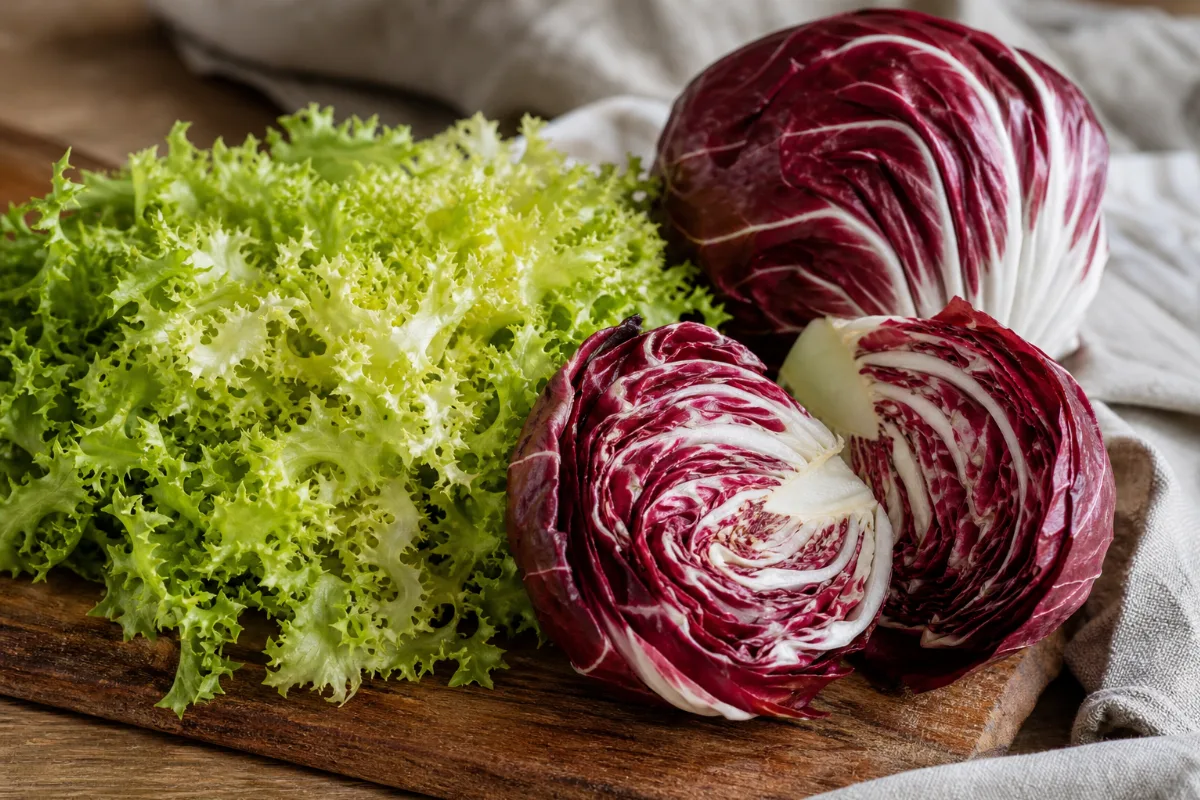
Chicory, endive and radicchio are bitter leaf vegetables from two related daisy-family plants. They are rich in vitamin K and low in calories. No trial has tested the leaves for any illness. The main cautions are vitamin K if you take warfarin, and allergy in people sensitive to birch pollen or other daisy-family plants.
General information, not medical advice. Last substantive update · Not medically reviewed. A named clinician has not signed off on this page. How this page is made
About Chicory, Endive & Radicchio
Chicory, endive and radicchio are bitter leaf vegetables that are very rich in vitamin K and low in calories. They are nutritious foods, not proven remedies: no trial has tested the leaves for any illness.
What it is
Chicory (Cichorium intybus, which includes radicchio) and endive (Cichorium endivia, which includes escarole) are two closely related plants in the daisy family. The leaves are eaten raw in salads or cooked, and they taste bitter.
USDA data for raw leaves: endive has 17 kcal per 100 g, and 1 cup chopped (25 g) has about 4 kcal, 0.8 g fibre, 58 mcg vitamin K and 36 mcg folate. Radicchio has 23 kcal per 100 g, and 1 cup shredded (40 g) has about 9 kcal, 0.4 g fibre, 102 mcg vitamin K, 24 mcg folate and 0.9 mg vitamin E. Radicchio also has about 8,830 mcg of lutein plus zeaxanthin per 100 g. Other nutrients are small per portion.
What the research shows
The firmest facts are about nutrients. Vitamin K is needed for blood clotting, and these leaves are rich in it. That is a content fact, not a trial of the leaves.
A large 2017 meta-analysis linked more fruit and vegetables with lower heart disease and early death, and named green leafy vegetables and salads among the groups linked with lower risk. These are observational studies of vegetables as a group.
The fibre people link to chicory, inulin, comes from the root. Trials of inulin helped stool frequency and softness in constipation, but the leaves were not tested. Antioxidant findings are from lab extracts only.
Leaves versus chicory root and inulin
The leaves are not chicory root, inulin powder or extracts. Trials of inulin and lab studies of extracts do not tell you what eating endive or radicchio does. Results for one form do not carry over to another.
Amounts
This page gives no amounts to eat. Ask a doctor or pharmacist what is right for you, especially if you take warfarin or other medicine.
At a glance
Traditional uses history, not proof
- Eaten raw in salads or cooked, for their bitter taste
- Chicory, as a plant, has a long history as a medicinal plant and coffee substitute, mostly the root; long use is not proof it works
Studied for research
- Vitamin K and folate source, high certainty for the nutrient content, no leaf trial
- Heart disease and early death, low certainty (vegetables as a group, observational)
- Bowel regularity, insufficient evidence for the leaves (the trials tested inulin)
- Antioxidant activity, very low certainty (lab only)
Main compounds
- Vitamin K (phylloquinone)
- Folate
- Beta-carotene (endive) and lutein plus zeaxanthin (radicchio)
- Phenolic acids and sesquiterpene lactones (lab and review data)
Common forms
- Raw leaves in salads
- Cooked leaves (braised, grilled, sauteed)
- Bagged or pre-cut salad mixes
- Chicory root, inulin and extracts (separate products, not these leaves)
Research links: MedlinePlus: Vitamin K · Meta-analysis: fruit and vegetables and heart disease, cancer and death (2017) · Oral allergy to chicory with birch pollen allergy (2003) · Research Library · Genes & Biomarkers Library
What it is and its history
- Accepted scientific name
- Cichorium intybus (chicory, including radicchio) and Cichorium endivia (endive, including escarole)
- Naming authority
- Both L. (GBIF accepted, exact match, confidence 99; usageKeys 5392252 and 5392243)
- Common names
- Chicory (English); Endive (English); Escarole (English); Radicchio (red leaf chicory) (English); Achicoria, endivia, escarola (Spanish)
- Family or group
- Asteraceae (the daisy family), which also includes lettuce, artichoke, sunflower, ragweed and mugwort.
- Classification
- Plantae > Tracheophyta > Magnoliopsida > Asterales > Asteraceae > Cichorium > Cichorium intybus; Cichorium endivia
- Native range
- A review says the genus Cichorium originates from the Mediterranean area (Birsa and Sarbu 2023).
- Habitat
- Not verified from a source read.
- What it looks like
- Roots: Not verified. Chicory root is covered on its own page.; Stems: Not verified.; Leaves: The leaves are the food. USDA household portions: 1 cup chopped endive is 25 g; 1 cup shredded radicchio is 40 g.; Flowers: Not verified.
- Cultivation
- Not verified from a source read.
- Harvest and processing
- Eaten raw in salads or cooked. Studies used raw leaf data (USDA) or lab extracts of outer escarole leaves.
- Look-alikes and adulterants
- Name: Chicory root and inulin products; Note: A different part and form. Trials of inulin do not describe the leaves.; Name: Lettuce; Note: A related daisy-family leaf, but a different genus.; Name: Dandelion greens; Note: Another bitter leaf, not the same plant.
- Sustainability and conservation
- Not assessed.
Photographs
Traditional use and history history, not clinical proof
| Tradition or era | Documented use | Source |
|---|---|---|
| Medicinal plant and coffee substitute | A 2023 review says chicory (Cichorium intybus) has a rich history of being known as a medicinal plant and coffee substitute, and is also used as a forage plant. That history mostly concerns the root. | p36986053 |
| Salad and cooked vegetable | A 2023 paper says escarole has achieved a common food status because of its nutritional value and bitter taste, and is eaten cooked or raw in salads. | p37507941 |
Traditional use shows how it was used. It does not show that it works or is safe today.
What is inside, and how it may work
What it contains and how those compounds act in cells and animals. Laboratory and animal mechanisms are not proven effects in people.
Main compounds
| Compound | Family | Where it is concentrated | Activity studied | Level of evidence |
|---|---|---|---|---|
| Phylloquinone (vitamin K1) PubChem 5284607 | vitamin | Leaf USDA: 231 mcg per 100 g raw endive; 255 mcg per 100 g raw radicchio. | Needed to make clotting factors (MedlinePlus). Affects warfarin. 16 17 13 15 | Human data |
| Folate (food folate; folic acid is the supplement form) PubChem 135398658 | vitamin | Leaf USDA: 142 mcg DFE per 100 g raw endive; 60 mcg DFE per 100 g raw radicchio. | Essential nutrient. No leaf trial was read. 16 17 15 | Human data |
| Beta-carotene PubChem 5280489 | carotenoid | Leaf (endive) USDA: 1,300 mcg per 100 g raw endive; 16 mcg per 100 g raw radicchio. | Vitamin A precursor. No leaf trial was read. 16 17 15 | Human data |
| Lutein and zeaxanthin PubChem 5281243 | carotenoid | Leaf (radicchio) USDA: 8,830 mcg lutein plus zeaxanthin per 100 g raw radicchio; 0 listed for raw endive. | Content only; no health outcome is claimed. 17 16 15 | Human data |
| Chicoric acid and chlorogenic acid PubChem 5281764 | phenolic acids | Whole chicory plant (review) Not given. | Antioxidant activity in lab assays (review). 2 15 | Lab |
| Sesquiterpenes and sesquiterpene lactones | terpenoids | Leaf (escarole extracts; chicory plant) Not given. | Identified in escarole leaf extracts; in daisy-family plants they can irritate skin and may cause reactions in sensitised people. 5 2 6 | Lab |
Mechanisms, receptors and pathways
| Target or pathway | Gene or receptor | What was found | Level |
|---|---|---|---|
| Vitamin K and clotting factors | Clotting factors II, VII, IX, X | Vitamin K lets the liver make these clotting proteins (MedlinePlus). Warfarin and dietary vitamin K therefore interact. 13 | Human data |
| Antioxidant and anti-inflammatory activity | Not specified | Escarole leaf extracts scavenged radicals in cell-free tests and showed activity in cell-based assays. Lab only. 5 | Lab |
| IgE cross-reactivity with birch pollen | IgE; chicory proteins of 18, 21, 40, 52, 71 kD | IgE from 4 patients bound several chicory proteins; cross-reaction with birch pollen was shown in 2 patients. 3 | Human data |
| Prebiotic fibre (inulin) | Not specified | Inulin improved some stool measures in trials of isolated inulin. Not tested for the leaves. 4 | Human data |
Absorption, metabolism and elimination
- Absorption
- Not studied for these leaves.
- Distribution
- Not found.
- Metabolism
- Not found.
- Elimination
- Not found.
- Bioavailability
- Not established for vitamin K or other compounds from these leaves.
Isolated compounds versus whole extracts
The leaves are not chicory root, inulin powder or extracts. Inulin trials and lab extract studies do not describe eating endive or radicchio.
Nutritional composition
Nutrition from USDA FoodData Central, SR Legacy, both entries last updated 4/1/2019, read 2026-10-26. Raw endive (FDC 168412, Cichorium endivia), per 100 g: 17 kcal, 1.25 g protein, 0.2 g fat, 3.35 g carbohydrate, 3.1 g fibre, 0.25 g sugars, about 94 g water, 231 mcg vitamin K, 142 mcg folate (DFE), 108 mcg vitamin A (RAE), 1,300 mcg beta-carotene, 6.5 mg vitamin C, 0.44 mg vitamin E, 314 mg potassium, 52 mg calcium, 0.83 mg iron, 22 mg sodium. One cup chopped (25 g): about 4 kcal, 0.8 g fibre, 58 mcg vitamin K, 36 mcg folate, 27 mcg vitamin A (RAE), 1.6 mg vitamin C, 79 mg potassium, 13 mg calcium. Raw radicchio (FDC 168564, Cichorium intybus), per 100 g: 23 kcal, 1.43 g protein, 0.25 g fat, 4.48 g carbohydrate, 0.9 g fibre, 0.6 g sugars, about 93 g water, 255 mcg vitamin K, 60 mcg folate (DFE), 8.0 mg vitamin C, 2.26 mg vitamin E, 0.34 mg copper, 8,830 mcg lutein plus zeaxanthin, 302 mg potassium, 19 mg calcium, 0.57 mg iron, 22 mg sodium. One cup shredded (40 g): about 9 kcal, 0.4 g fibre, 102 mcg vitamin K, 24 mcg folate, 3.2 mg vitamin C, 0.9 mg vitamin E, 0.14 mg copper, 121 mg potassium, 8 mg calcium. Per-portion figures are calculated from the 100 g values. Figures vary with variety, ripeness and storage. Cooked values and Belgian endive (witloof) were not read.
2 high certainty1 low certainty1 very low certainty1 not enough evidence
What was looked at
The 5 benefits and uses checked for Chicory, Endive & Radicchio, each with how strong the evidence is. Tap one to open it.
- Vitamin K source (and clotting)High certainty
- Folate and other nutrientsHigh certainty
- Heart disease, cancer and early death (vegetables as a group)Low certainty
- Bowel regularity (inulin, a chicory-root fibre; not the leaves)Not enough evidence
- Plant compounds and antioxidant activity (lab only)Very low certainty
Lab markers tracked in the studies
Cardiovascular disease and all-cause death riskDietary vitamin K supplied by one portionStool frequency and consistency
What is Chicory, Endive & Radicchio good for?
The main studied uses and how strong the human evidence is for each. No study tested these leaves for an illness. Some results come from vegetables as a group or from chicory root fibre.
Benefits, one by one
Each card is a research question, not a promise. Tap a goal to filter. Open a card to see the studies, doses and limits.
Vitamin K source (and clotting)
High certaintyEndive and radicchio are rich in vitamin K. One typical USDA portion gives about half (endive) to nearly all (radicchio) of an adult man's daily Adequate Intake. The body needs vitamin K to make blood clotting proteins. This is a fact about the food's contents, not a trial of the leaves.
3 studiesRaw leaves as food. Values are for raw leaves; cooked values were not…
Studies, doses and limits
What the trials found
USDA lists 231 mcg of vitamin K per 100 g of raw endive and 255 mcg per 100 g of raw radicchio. Per household portion that is 58 mcg in 1 cup (25 g) of chopped endive and 102 mcg in 1 cup (40 g) of shredded radicchio. MedlinePlus lists an Adequate Intake of 120 mcg a day for men and 90 mcg for women aged 19 and over. Vitamin K deficiency is very rare (MedlinePlus). No trial tested these leaves.
Results
The amount of vitamin K in the leaves is well documented. No health outcome was tested for these leaves.
Effect sizes as reported
58 mcg per cup of chopped endive (25 g) and 102 mcg per cup of shredded radicchio (40 g), against an Adequate Intake of 90 to 120 mcg for adults.
Why this rating
High for the nutrient content (USDA measurements) and for the role of vitamin K in clotting (MedlinePlus). There is no trial of these leaves for any outcome.
Form and dose studied
Raw leaves as food. Values are for raw leaves; cooked values were not read.
Who was studied
General adults. People taking warfarin: see the Safety tab.
Limits
Food composition varies with variety, ripeness and storage. Content of cooked or Belgian endive (witloof) was not read.
Why researchers looked
Leafy greens are the main food source of vitamin K, and people on blood thinners ask how much is in them.
Traditional use
Bitter leaves have long been eaten as salad and cooked greens; long use is not proof of any health effect.
Proposed mechanism Authoritative guidance
Vitamin K is needed by the liver to make clotting factors II, VII, IX and X (MedlinePlus). Raw endive has 231 mcg and raw radicchio 255 mcg per 100 g (USDA).
A proposed mechanism does not show that the effect happens in people.
Vitamin K affects how warfarin works. See the Safety tab before changing how much you eat if you take it.
Folate and other nutrients
High certaintyEndive is a good folate source (142 mcg per 100 g). Radicchio has more copper and vitamin E, and a lot of lutein and zeaxanthin. Both are low in calories. Per typical portion most nutrients other than vitamin K are small.
2 studiesRaw leaves as food (USDA SR Legacy entries last updated 4/1/2019).
Studies, doses and limits
What the trials found
USDA per 100 g, raw endive: 17 kcal, 3.1 g fibre, 142 mcg folate (DFE), 108 mcg vitamin A (RAE), 1,300 mcg beta-carotene, 314 mg potassium, 52 mg calcium, 6.5 mg vitamin C. Raw radicchio: 23 kcal, 0.9 g fibre, 60 mcg folate (DFE), 2.26 mg vitamin E, 0.34 mg copper, 8,830 mcg lutein plus zeaxanthin, 302 mg potassium, 8.0 mg vitamin C. Per household portion: 1 cup chopped endive (25 g) has about 4 kcal, 0.8 g fibre, 36 mcg folate and 79 mg potassium; 1 cup shredded radicchio (40 g) has about 9 kcal, 0.4 g fibre, 24 mcg folate, 0.9 mg vitamin E and 121 mg potassium.
Results
Nutrient contents are documented. No trial links these leaves to a health outcome through these nutrients.
Why this rating
High for the measured nutrient content only. No outcome trial exists for these leaves, so no health benefit is claimed.
Form and dose studied
Raw leaves as food (USDA SR Legacy entries last updated 4/1/2019).
Who was studied
General adults.
Limits
SR Legacy values are averages from a limited number of samples. Cooking effects were not found.
Why researchers looked
People ask what is in a bitter salad leaf besides fibre.
Traditional use
Eaten raw or cooked as a salad vegetable; long use is not proof of any health effect.
Proposed mechanism Authoritative guidance
These are nutrient contents measured by USDA. No mechanism was tested in people.
A proposed mechanism does not show that the effect happens in people.
None specific to these nutrients at food amounts. Vitamin K and warfarin: see the Safety tab.
Heart disease, cancer and early death (vegetables as a group)
Low certaintyLarge studies that followed people over time link eating more fruit and vegetables with lower risk of heart disease, stroke, cancer and early death. Green leafy vegetables and salads were among the groups linked with lower heart risk and death. Endive and radicchio were not studied on their own, and these studies cannot show cause.
3 studiesVegetables as eaten. No amount advice is given on this page.
Studies, doses and limits
What the trials found
A 2017 dose-response meta-analysis of 95 prospective studies found that, for fruit and vegetables combined, each extra 200 g a day went with 8% lower risk of coronary heart disease (RR 0.92), 16% lower stroke (RR 0.84), 8% lower cardiovascular disease (RR 0.92), 3% lower total cancer (RR 0.97) and 10% lower all-cause death (RR 0.90). The abstract says green leafy vegetables and salads were inversely linked with cardiovascular disease and all-cause mortality. WHO and the NHS give general vegetable portion guidance (context only).
Results
Lower risk in people who eat more fruit and vegetables overall. Chicory-family leaves were not analysed separately in the abstract.
Effect sizes as reported
Per 200 g/day fruit and vegetables combined: CHD RR 0.92, stroke 0.84, CVD 0.92, cancer 0.97, all-cause mortality 0.90.
Why this rating
Observational cohort data pooled in a large meta-analysis, but it shows association not cause, there was high heterogeneity for stroke and mortality, and it covers fruit and vegetables or green leafy vegetables as a group, not endive or radicchio.
Form and dose studied
Vegetables as eaten. No amount advice is given on this page.
Who was studied
Adults in cohort studies.
Limits
People who eat many vegetables often differ in other ways (diet, smoking, activity). Funding not stated in the abstract.
Why researchers looked
Whether people who eat more vegetables live longer or have fewer heart attacks.
Proposed mechanism Human observational
Not established. Studies of vegetables as a group cannot say which foods or compounds matter.
A proposed mechanism does not show that the effect happens in people.
None specific.
Bowel regularity (inulin, a chicory-root fibre; not the leaves)
Not enough evidenceTrials of inulin, a fibre best known from chicory root, found it helped stool frequency and softness in people with constipation. Those trials did not test endive or radicchio leaves, and no source we read measured inulin in the leaves.
3 studiesInulin as tested in the trials; not leaves. Doses were not given in t…
Studies, doses and limits
What the trials found
A 2014 meta-analysis of 5 randomised trials (252 people with chronic constipation) found inulin raised stool frequency, softened stool, shortened transit time and reduced hard stools, while pain and bloating did not improve. A 2022 review of 103 trials of fibres says overconsumption of non-digestible carbohydrates, including inulin, can cause gas and bloating and that tolerance depends on the fibre. Neither is about vegetable leaves.
Results
Inulin helped bowel function in constipation. Nothing was shown for endive or radicchio leaves.
Effect sizes as reported
Stool frequency DEM 0.69 (95% CI 0.04-1.34); Bristol consistency 1.07 (0.70-1.45); transit time -0.57 (-0.99 to -0.15); hard stool RR 0.42 (0.26-0.70).
Why this rating
Insufficient for the leaves, because no study tested them. The inulin result is from 5 small trials of an isolated fibre, with one author from a food company.
Form and dose studied
Inulin as tested in the trials; not leaves. Doses were not given in the abstract.
Who was studied
People with chronic constipation (inulin trials).
Limits
Isolated fibre, not the food. Small trials. Inulin content of endive and radicchio leaves was not found.
Why researchers looked
Chicory is known as a source of inulin, so people ask whether the salad leaves act the same way.
Traditional use
Chicory root has long been used as a coffee substitute and medicinal plant (Birsa and Sarbu 2023). The leaves are a salad vegetable.
Proposed mechanism Human trial of isolated fibre
The meta-analysis authors describe inulin as a prebiotic that may influence gut bacteria and bowel function. This was not tested for the leaves.
A proposed mechanism does not show that the effect happens in people.
Concentrated fibre can cause gas and bloating (review). No data for the leaves.
Plant compounds and antioxidant activity (lab only)
Very low certaintyIn test tubes and cells, extracts of escarole leaves contained phenolic compounds, flavonoids and sesquiterpenes and showed antioxidant activity. This has not been tested in people eating the leaves.
2 studiesAlcohol extracts of outer leaves in the lab; not the food as eaten.
Studies, doses and limits
Results
Antioxidant and anti-inflammatory activity in lab assays only; the three cultivars differed in the cell-based tests.
Why this rating
Lab and cell evidence only. It cannot show that eating the leaves does anything in the body.
Form and dose studied
Alcohol extracts of outer leaves in the lab; not the food as eaten.
Limits
Extracts, lab concentrations, no human or animal outcome.
Why researchers looked
Bitter leaves contain many plant compounds, so researchers measure what they do in the lab.
Traditional use
Chicory has a long history as a medicinal plant (Birsa and Sarbu 2023); long use is not proof of effect.
Proposed mechanism Laboratory research
Radical-scavenging in cell-free tests and cell-based antioxidant and anti-inflammatory assays, linked by the authors to polyphenols and sesquiterpenes. A review lists chicoric acid, chlorogenic acid, flavonoids and sesquiterpene lactones among chicory constituents.
A proposed mechanism does not show that the effect happens in people.
None specific.
Connections to the rest of health
How Chicory, Endive & Radicchio connects to the rest of our health knowledge graph. Every link says what kind of connection it is. A safety link (for example to the liver) is a warning, not a benefit. A study that merely mentions a topic never creates a benefit link.
Explore every connection: goals, body systems, organs, symptoms, genes
B. Body systems
| Connected to | Kind of connection | Evidence status | Context | Studies |
|---|---|---|---|---|
| Circulatory System | Biological association | High certainty | Studied for: Vitamin K source (and clotting) Studied for: Folate and other nutrients | 16 17 13 1 18 14 |
| Skeletal System | Biological association | High certainty | Studied for: Vitamin K source (and clotting) | 16 17 13 |
| Digestive System | Biological association | Not enough evidence | Studied for: Bowel regularity (inulin, a chicory-root fibre; not the leaves) | 4 7 2 |
E. Health conditions
| Connected to | Kind of connection | Evidence status | Context | Studies |
|---|---|---|---|---|
| Food allergy | Adverse effect or risk | Documented risk | Oral allergy to chicory has been described in 4 people with birch pollen allergy. Oral allergy to chicory has been described in people with birch pollen allergy. Preparation or compound: Chicory (leaf or root not stated) in people with birch pollen allergy |
3 9 |
| Anticoagulant therapy (warfarin) | Drug or supplement interaction | Documented risk | Vitamin K can change how warfarin works; steady intake is advised. Vitamin K-rich leaves can affect how warfarin works; steady intake is advised. Preparation or compound: Raw endive and radicchio leaves (vitamin K) |
13 16 17 |
I. Biomarkers
| Connected to | Kind of connection | Evidence status | Context | Studies |
|---|---|---|---|---|
| Cardiovascular disease and all-cause death risk | Biological association | Low certainty | Measured in trials: lowered (association). A lab change is not the same as a health benefit. | 1 |
| Dietary vitamin K supplied by one portion | Biological association | High certainty | Measured in trials: supplies (content). A lab change is not the same as a health benefit. | 16 17 13 |
| Stool frequency and consistency | Biological association | Not enough evidence | Measured in trials: raised frequency, softer stool (inulin trials). A lab change is not the same as a health benefit. | 4 7 |
K. Biological pathways
L. Active compounds
| Connected to | Kind of connection | Evidence status | Context | Studies |
|---|---|---|---|---|
| Phylloquinone (vitamin K1) | Biological association | Human | Needed to make clotting factors (MedlinePlus). Affects warfarin. Preparation or compound: Leaf |
16 17 13 15 |
| Folate (food folate; folic acid is the supplement form) | Biological association | Human | Essential nutrient. No leaf trial was read. Preparation or compound: Leaf |
16 17 15 |
| Beta-carotene | Biological association | Human | Vitamin A precursor. No leaf trial was read. Preparation or compound: Leaf (endive) |
16 17 15 |
| Lutein and zeaxanthin | Biological association | Human | Content only; no health outcome is claimed. Preparation or compound: Leaf (radicchio) |
17 16 15 |
| Chicoric acid and chlorogenic acid | Biological association | Lab | Antioxidant activity in lab assays (review). Preparation or compound: Whole chicory plant (review) |
2 15 |
| Sesquiterpenes and sesquiterpene lactones | Biological association | Lab | Identified in escarole leaf extracts; in daisy-family plants they can irritate skin and may cause reactions in sensitised people. Preparation or compound: Leaf (escarole extracts; chicory plant) |
5 2 6 |
Each connection is stored with the ingredient, the connected record, the kind of connection, the evidence status, the supporting studies, the preparation or compound involved, and a review date (last reviewed October 26, 2026).
Evidence at a glance: what the research found for 5 outcomes
Each outcome below is one thing researchers measured. Certainty is how far the evidence can be trusted, not how well it works. The full studies are on the next tab.
The evidence
The research centre for Chicory, Endive & Radicchio. Every record here was checked against PubMed or the publisher's page; we never list a study we have not verified.
Evidence by outcome
Bars show how many studies we found for each outcome, not how well it works. People are added up across trials only (reviews are not added, to avoid double counting).
How we rate evidence
High certainty
Several well-run trials or reviews agree; further research is unlikely to change the picture much.
Moderate certainty
Good trials point the same way, but some doubt remains.
Low certainty
Small, short or inconsistent trials. The finding could change with better research.
Very low certainty
Very little or very weak human data. Treat as a possibility only.
Mixed findings
Trials or reviews disagree with each other.
Not enough evidence
Not enough human research to say either way.
Evidence against
Good research found no benefit, or found harm.
We take the reviewers' own risk-of-bias and GRADE statements where they exist, and otherwise judge from study size, design, consistency, directness and whether a product matches what is sold. Many publications do not make evidence high. Method note: We started from our existing chicory, endive and radicchio summary, re-checked nutrition at USDA FoodData Central, and searched PubMed for human studies, reviews and allergy reports. Only abstracts were read for studies, and two records had titles only. Items we could not verify are flagged in the research gaps.
Study library: every study we checked 18
| Study | Design | People | Product, dose, length | Result |
|---|---|---|---|---|
| Aune 2017 Fruit and vegetable intake and the risk of cardiovascular disease, total cancer and all-cause mortality-a systematic review and dose-response meta-analysis of prospective studies. Int J Epidemiol · PMID 28338764 · DOI |
Meta analysis observational |
Adults in 95 prospective studies (142 publications) | Fruit and vegetable intake (all fruits and vegetables combined, and sub-groups including green leafy vegetables and salads) Food as eaten Per 200 g a day (analysis unit, not advice) Follow-up in cohort studies · vs Lower intake |
Per 200 g a day of fruit and vegetables combined, summary risk ratios were 0.92 for coronary heart disease, 0.84 for stroke, 0.92 for cardiovascular disease, 0.97 for total cancer and 0.90 for all-cause death. The abstract says green leafy vegetables and salads were inversely linked with cardiovascular disease and all-cause mortality. Endive, chicory and radicchio are not named in the abstract. RR 0.92 (CHD), 0.84 (stroke), 0.92 (CVD), 0.97 (cancer), 0.90 (all-cause) per 200 g/day (CHD 0.90-0.94; stroke 0.76-0.92; CVD 0.90-0.95; cancer 0.95-0.99; all-cause 0.87-0.93) Methods, limits and fundingOutcomes: Coronary heart disease, stroke, cardiovascular disease, total cancer, all-cause mortality Limitations: Observational: shows association, not cause. Groups of foods, not endive or radicchio alone. Heterogeneity was high for stroke (I2 73%) and all-cause mortality (I2 83%). Funding and conflicts: Funding not stated in the abstract. Read: abstract |
| Birsa 2023 Health Benefits of Key Constituents in Cichorium intybus L. Nutrients · PMID 36986053 · DOI |
Review mixed (review) |
Narrative review of the plant chemistry literature (no trial population) | Constituents of Cichorium intybus (chicory) Whole plant, mostly not leaves alone |
The review says the genus Cichorium comes from the Mediterranean area, chicory has a long history as a medicinal plant and coffee substitute, and it lists antioxidant-linked constituents: inulin, caffeic acid derivatives, ferulic acid, caftaric acid, chicoric acid, chlorogenic and isochlorogenic acids, dicaffeoyl tartaric acid, sugars, proteins, hydroxycoumarins, flavonoids and sesquiterpene lactones. Not applicable (Not applicable) Methods, limits and fundingOutcomes: Composition and antioxidant activity Limitations: Narrative review about the plant; not about eating leaves. No human results. Funding and conflicts: Authors declare no conflict of interest. Read: abstract |
| Cadot 2003 Oral allergy syndrome to chicory associated with birch pollen allergy. Int Arch Allergy Immunol · PMID 12759485 · DOI |
Case series |
4 4 patients with birch pollen allergy and oral allergy to chicory |
Chicory extract tested against patient blood (immunoblotting) Chicory (type of plant part not stated in the abstract) Lab test |
IgE from the patients bound several chicory proteins (18, 21, 40, 52 and 71 kD). Cross-reaction with birch pollen was shown in the 2 patients with enough serum. The authors conclude chicory should be added to the foods that can cross-react with birch pollen. Not applicable (Not applicable) Methods, limits and fundingOutcomes: IgE-binding proteins in chicory and cross-reaction with birch pollen Limitations: Only 4 patients; lab immunoblotting. The abstract does not say whether leaves or root were the trigger. Funding and conflicts: Not stated in the abstract. Read: abstract |
| Collado Yurrita 2014 Effectiveness of inulin intake on indicators of chronic constipation; a meta-analysis of controlled randomized clinical trials. Nutr Hosp · PMID 25208775 · DOI |
Meta analysis rct |
5 randomised trials, 252 people with chronic constipation (144 inulin, 108 control) | Inulin (a fibre found in chicory root and other plants) Not leaves; inulin as tested in the trials Varied by trial; not given in the abstract Varied · vs Control |
Inulin raised stool frequency (standardised mean difference 0.69), softened stool on the Bristol scale (1.07), shortened transit time (-0.57) and reduced hard stools (RR 0.42). Pain and bloating did not improve. Stool frequency DEM 0.69; Bristol 1.07; transit -0.57; hard stool RR 0.42 (Stool frequency 0.04-1.34; Bristol 0.70-1.45; transit -0.99 to -0.15; hardness RR 0.26-0.70) Methods, limits and fundingOutcomes: Stool frequency, stool consistency, transit time, stool hardness, pain and bloating Limitations: Tested inulin, not endive, radicchio or chicory leaves. Only 5 trials; the abstract does not give doses. One author is affiliated with a food company (Corporacion Alimentaria Penasanta S.A.); funding not stated in the abstract. Funding and conflicts: One author affiliated with a food company; funding not stated in the abstract. Read: abstract |
| Donadio 2023 Characterization of Health Beneficial Components in Discarded Leaves of Three Escarole (Cichorium endivia L.) Cultivar and Study of Their Antioxidant and Anti-Inflammatory Activities. Antioxidants (Basel) · PMID 37507941 · DOI |
Laboratory research cell/in vitro |
No people. Test-tube and cell experiments | Hydroalcoholic extract of discarded outer leaves of three escarole cultivars (C. endivia var. crispum Capriccio, var. latifolium Performance and Leonida) Outer leaves (normally thrown away) Lab concentrations Lab assays |
Extracts contained phenolic compounds, flavonoids, sesquiterpenes, amino acids and unsaturated fatty acids. All extracts had a similar radical-scavenging ability, but the three cultivars differed in the cell-based tests. The authors link the results to polyphenols and sesquiterpenes. Not applicable (Not applicable) Methods, limits and fundingOutcomes: Chemical profile, radical scavenging, cell-based antioxidant, cytotoxic and anti-inflammatory activity Limitations: Lab only. An alcohol extract of outer leaves is not the food as eaten. No people were studied. Funding and conflicts: Authors declare no conflict of interest. Read: abstract |
| Kljucevsek 2025 Allergic Potential of Medicinal Plants From the Asteraceae Family. Health Sci Rep · PMID 39995792 · DOI |
Review mixed (review) |
Narrative review of the Asteraceae (daisy) family literature | Plants of the daisy family (Asteraceae) Various |
The review says Asteraceae are important occupational sensitisers, that panallergens in ragweed and mugwort pollen drive cross-reactions and pollen-food allergy, and that sesquiterpene lactones can irritate skin and could cause systemic reactions after eating in sensitised people. The abstract does not name chicory or endive. Not applicable (Not applicable) Methods, limits and fundingOutcomes: Allergic and sensitising potential Limitations: Family-level review; the abstract does not name chicory, endive or radicchio. Funding and conflicts: Authors declare no conflicts of interest. Read: abstract |
| Mysonhimer 2022 Gastrointestinal Effects and Tolerance of Nondigestible Carbohydrate Consumption. Adv Nutr · PMID 36041173 · DOI |
Review |
Adults without gastrointestinal disease in 103 clinical trials | Fibres the FDA accepts as dietary fibre, including inulin Isolated fibres, not whole vegetables 0.75-160 g/day across trials Single meal to 28 weeks · vs Various |
The review says overconsumption of non-digestible carbohydrates can cause gastrointestinal side effects and that tolerance depends on the type of fibre. It does not say anything about vegetable leaves. Not a single effect size (Not applicable) Methods, limits and fundingOutcomes: Gas, bloating, rumbling, transit time, stool frequency and consistency Limitations: About isolated fibres, not endive or radicchio. Funding and conflicts: Non-U.S. Government research support listed; industry funding not stated in the abstract. Read: abstract |
| Obermeyer 2025 Lettuce Anaphylaxis in a Florist With Hand Dermatitis and Contact Allergy to the Compositae (Asteraceae) Family of Plants. Contact Dermatitis · PMID 40739752 · DOI |
Case report |
1 1 florist with hand dermatitis and contact allergy to Compositae plants |
Lettuce (daisy-family plant) Leaf |
The record has no abstract. The title says a florist with hand dermatitis and contact allergy to the daisy family had anaphylaxis to lettuce. Chicory, endive and radicchio are not named in the title. Not applicable (Not applicable) Methods, limits and fundingOutcomes: Anaphylaxis to lettuce in a florist with daisy-family contact allergy Limitations: Title-only record (no abstract available); one case; about lettuce, not chicory-family leaves. Funding and conflicts: Two authors are employees of MacroArray Diagnostics GmbH (per the record). Read: title-only |
| Otal-Buesa 2026 Chicory-Induced Anaphylaxis: Characterization of Peroxidase as a Novel Allergen. J Investig Allergol Clin Immunol · PMID 41277644 · DOI |
Case report |
Not stated (no abstract) | Chicory |
The record has no abstract. Its title says chicory can cause anaphylaxis and that a peroxidase was characterised as a novel allergen. Nothing else is known from the record. Not applicable (Not applicable) Methods, limits and fundingOutcomes: Anaphylaxis to chicory and a peroxidase allergen Limitations: Title-only record; no numbers, patients or plant part could be read. Funding and conflicts: Not stated. Read: title-only |
| s-fda-produce FDA: Selecting and Serving Produce Safely · Source |
Regulator n/a |
Methods, limits and fundingRead: full-text | ||
| s-gbif-cichorium-endivia GBIF Backbone: Cichorium endivia L. (usageKey 5392243) · Source |
Reference database n/a |
Methods, limits and fundingRead: full-text | ||
| s-gbif-cichorium-intybus GBIF Backbone: Cichorium intybus L. (usageKey 5392252) · Source |
Reference database n/a |
Methods, limits and fundingRead: full-text | ||
| s-medlineplus-vitk MedlinePlus: Vitamin K · Source |
Health agency n/a |
Methods, limits and fundingRead: full-text | ||
| s-nhs-5-a-day NHS: 5 A DAY, what counts · Source |
Health agency n/a |
Methods, limits and fundingRead: full-text | ||
| s-pubchem-compounds PubChem compound records (phylloquinone, beta-carotene, lutein, zeaxanthin, chicoric acid, chlorogenic acid, folic acid) · Source |
Reference database n/a |
Methods, limits and fundingRead: full-text | ||
| s-usda-fdc-168412 USDA FoodData Central: Endive, raw (FDC 168412) · Source |
Reference database n/a |
Methods, limits and fundingRead: full-text | ||
| s-usda-fdc-168564 USDA FoodData Central: Radicchio, raw (FDC 168564) · Source |
Reference database n/a |
Methods, limits and fundingRead: full-text | ||
| s-who-healthy-diet WHO: Healthy diet fact sheet · Source |
Health agency n/a |
Methods, limits and fundingRead: full-text |
What we do not know yet
- No human trial of endive, escarole, radicchio or chicory leaves was found for any illness or health marker.
- Cohort studies covered vegetables or leafy greens as a group, not these leaves alone.
- Inulin trials tested the isolated fibre; the inulin content of the leaves was not found.
- Two allergy records had no abstract, so only their titles were used. How common allergy is was not found.
- Cooked values, Belgian endive, other medicines, pesticide residues, pregnancy and children were not researched beyond what is stated.
How new research is added
New studies are found by a saved PubMed search and placed in a review queue before the page changes.
Lab markers
What changed in blood or saliva tests during trials. A changed number is not the same as feeling or being healthier, and we give no "normal ranges".
Other 3
Cardiovascular disease and all-cause death risk
Lowered (association) in trials
How likely a person is to develop heart disease or stroke, or to die, over years of follow-up in cohort studies.
Low certaintyResults and what it means
Why it was measured
These are the outcomes cohort studies of diet follow, not blood tests.
Statistical vs. clinical meaning
An association across many studies, not proof that any one food causes it.
Safety implication
None specific.
| Study | Result | People | Product |
|---|---|---|---|
| 1 | Per 200 g/day of fruit and vegetables combined: CHD RR 0.92 (0.90-0.94), stroke 0.84 (0.76-0.92), CVD 0.92 (0.90-0.95), all-cause mortality 0.90 (0.87-0.93) | Adults in 95 prospective studies | Fruit and vegetables combined (not endive or radicchio alone) |
Dietary vitamin K supplied by one portion
Supplies (content) in trials
The micrograms of vitamin K (phylloquinone) in a household portion of raw leaves.
High certaintyResults and what it means
Why it was measured
Vitamin K is needed for clotting and matters for people taking warfarin.
Statistical vs. clinical meaning
A measured nutrient content. It is not a measured effect on health.
Safety implication
Relevant for warfarin users: keep intake steady.
Stool frequency and consistency
Raised frequency, softer stool (inulin trials) in trials
How often a person has a bowel movement and how soft the stool is (Bristol scale).
Not enough evidenceResults and what it means
Why it was measured
Standard measures of constipation.
Statistical vs. clinical meaning
For inulin, not for endive or radicchio leaves.
Safety implication
Concentrated fibres can cause gas and bloating.
| Study | Result | People | Product |
|---|---|---|---|
| 4 | Frequency DEM 0.69 (0.04-1.34); consistency 1.07 (0.70-1.45); transit -0.57 (-0.99 to -0.15); hard stool RR 0.42 (0.26-0.70); pain and bloating did not improve | 252 people with chronic constipation in 5 trials | Inulin (not leaves) |
Safety
What studies and official sources say about side effects, medicines and who should check first. Each point shows what kind of evidence it comes from.
Main points to know 3
- Warfarin: keep vitamin K intake steady. Endive and radicchio are very rich in vitamin K (231 and 255 mcg per 100 g, USDA). MedlinePlus says vitamin K or foods containing it can change how warfarin works, that sudden changes in intake can change the medicine's effect, and that you should ask your provider. This is not a reason to avoid the leaves, but a reason to keep intake steady and tell your clinic. Authoritative guidance 13 16 17
- Daisy-family and birch pollen allergy. Chicory is in the daisy family. Oral allergy to chicory has been described in 4 people with birch pollen allergy, and family-level reviews describe cross-reactions with ragweed and mugwort pollen. A 2026 paper title reports chicory-induced anaphylaxis. Case series 3 6 9
- Raw leaves can carry germs. The FDA says bacteria on fresh produce can cause foodborne illness, that washing reduces but does not eliminate them, and that bagged salad greens should be bought refrigerated or on ice. Authoritative guidance 10
Side effects 4
| Effect | How often | Severity and recovery | Evidence |
|---|---|---|---|
| Itching of the mouth and throat after eating raw chicory in people allergic to birch pollen (oral allergy syndrome) 4 patients; the abstract does not name leaf or root as the trigger. | Not established | mild to moderate (not graded in the abstract) Not stated in the abstract | Case series 3 |
| Anaphylaxis to chicory Title only; no patient details could be read. | Not established | severe Not stated | Case report 9 |
| Reaction to related daisy-family plants (lettuce anaphylaxis in a florist with daisy-family contact allergy) Title only; lettuce, not chicory-family leaves. | Not established | severe Not stated | Case report 8 |
| Foodborne illness from contaminated raw produce Applies to fresh produce in general, not to these leaves in particular. | Not established | mild to life-threatening Most people recover within a short period (FDA) | Authoritative guidance 10 |
Liver
No liver injury from eating endive, escarole or radicchio was found in the sources read. LiverTox was not searched for the leaves.
How often. No frequency was found.
Monitoring. No agency monitoring advice was found.
This is a safety connection. It is not evidence that Chicory, Endive & Radicchio supports liver health.
Medicines and supplements 3
| With | Why it matters | Importance | Evidence | What to do |
|---|---|---|---|---|
| Warfarin (a vitamin K blocker) prescription | Warfarin works by blocking the body's use of vitamin K. Foods rich in vitamin K can change how well it works (MedlinePlus). | MedlinePlus says to keep vitamin K intake the same from day to day because sudden changes can change the medicine's effect. These leaves are rich in vitamin K, so the same advice applies; MedlinePlus does not name endive, chicory or radicchio. | Authoritative guidance Moderate certainty 13 16 17 | Tell your prescriber or clinic what greens you eat, and ask before changing how much. |
| Newer blood thinners that do not work through vitamin K prescription | Not read. | No source on these leaves was read. | Not found Not enough evidence | Ask a pharmacist. |
| Other medicines prescription | Not read. | No interaction of endive, escarole or radicchio with other medicines was found in the sources read. This is not proof of safety. | Not found Not enough evidence | Ask a pharmacist if you take regular medicine. |
Who should check first 2
| Situation | Advice | Evidence |
|---|---|---|
| Known allergy to chicory, endive, lettuce or other daisy-family plants, or oral allergy to birch pollen | Avoid the food that triggers symptoms and ask an allergist. Call emergency services for trouble breathing or swelling of the face or throat. | Case series 3 6 9 |
| Taking warfarin | Not a ban. Keep intake of vitamin K greens steady and tell your clinic. | Authoritative guidance 13 |
Overdose, product quality and regulators
Summary. No toxicity from endive, escarole or radicchio as ordinary food was found in the sources read.
Animal. Not reviewed.
Human doses studied. No dose-finding trials of the leaves exist.
Overdose response. Not found.
Genotoxicity. Not researched.
Raw leaves can carry soil or water bacteria. Pesticide residues, nitrates and heavy metals in these leaves were not researched.
Food safety handling. The FDA says to choose undamaged produce, buy bagged salad greens only if refrigerated or on ice, keep perishables at 40 F (4 C) or below, wash under running water without soap or produce wash, and know that washing reduces but does not eliminate bacteria. Pre-washed items can be eaten without further washing. Cooking thoroughly kills harmful bacteria. 10
Who is more vulnerable. The FDA lists children, older adults, pregnant women and people with weakened immune systems as especially vulnerable to foodborne illness. 10
When to get medical help
- Trouble breathing, swelling of the lips, face or throat, or widespread hives after eating chicory, endive, radicchio or other salad leaves
- Itching or swelling of the mouth that spreads or is hard to control after eating raw leaves
- Signs of unusual bleeding or bruising, or new black stools, in someone taking warfarin
- Severe vomiting, bloody diarrhoea, high fever or dehydration after eating raw produce
Stop using the product and contact a clinician or emergency service. In the US, Poison Control is 1-800-222-1222.
General information only, not medical advice. Ask a clinician or pharmacist before use, especially with medicines, in pregnancy or with a health condition. See the Natural Remedy Safety guide.
Frequently asked questions
What are chicory, endive and radicchio good for?
Are chicory, endive and radicchio the same thing?
Do endive and radicchio affect warfarin?
How much vitamin K is in them?
Do they help digestion or constipation?
Not shown for the leaves. Trials found inulin, a chicory-root fibre, helped stool frequency and softness, but they tested inulin, not endive or radicchio.
Is chicory leaf the same as chicory root?
Do they lower the risk of heart disease or cancer?
Not shown for these leaves. Large cohort studies link more vegetables overall, including leafy greens, with lower heart disease risk and early death, but that is association, not proof.
Do they help with blood sugar, weight or detox?
No human evidence was found for these leaves. Claims about cleansing or weight loss are not backed by trials.
Are they antioxidant foods?
Lab tests of escarole leaf extracts showed antioxidant activity in test tubes and cells. No study shows that eating the leaves has the same effect in people.
Can I be allergic to chicory or endive?
Are they safe in pregnancy?
How should I wash and store the leaves?
The FDA says to rinse under running water without soap or produce wash, keep cut or bagged leaves at 40 F (4 C) or below, and buy bagged greens only if refrigerated. Pre-washed bags need no extra wash.
Explore by health goal
Editorial transparency
- Written by
- AlternativeMed editorial team. Research compiled with AI assistance, then checked against the sources listed.
- Medical review
- None. This page has not been reviewed by a physician or pharmacist.
- First published
- 2026-10-26
- Last substantive update
- 2026-10-26
- How we research
- We started from our existing chicory, endive and radicchio summary, re-checked nutrition at USDA FoodData Central, and searched PubMed for human studies, reviews and allergy reports. Only abstracts were read for studies, and two records had titles only. Items we could not verify are flagged in the research gaps.
- How we rate evidence
- See "How we rate evidence" in the Evidence tab.
- Independence
- No product is promoted on this page. No affiliate links are shown.
Sources 18
Each source was opened and checked. Where we read only the abstract, it says so. The small numbers in the text point here.
- Aune D, Giovannucci E, Boffetta P, et al.. Fruit and vegetable intake and the risk of cardiovascular disease, total cancer and all-cause mortality-a systematic review and dose-response meta-analysis of prospective studies.. Int J Epidemiol. 2017. PMID 28338764. DOI 10.1093/ije/dyw319. (abstract)
- Birsa ML, Sarbu LG. Health Benefits of Key Constituents in Cichorium intybus L.. Nutrients. 2023. PMID 36986053. DOI 10.3390/nu15061322. (abstract)
- Cadot P, Kochuyt AM, van Ree R, Ceuppens JL. Oral allergy syndrome to chicory associated with birch pollen allergy.. Int Arch Allergy Immunol. 2003. PMID 12759485. DOI 10.1159/000070430. (abstract)
- Collado Yurrita L, San Mauro Martin I, Ciudad-Cabanas MJ, et al.. Effectiveness of inulin intake on indicators of chronic constipation; a meta-analysis of controlled randomized clinical trials.. Nutr Hosp. 2014. PMID 25208775. DOI 10.3305/nh.2014.30.2.7565. (abstract)
- Donadio G, Bellone ML, Mensitieri F, et al.. Characterization of Health Beneficial Components in Discarded Leaves of Three Escarole (Cichorium endivia L.) Cultivar and Study of Their Antioxidant and Anti-Inflammatory Activities.. Antioxidants (Basel). 2023. PMID 37507941. DOI 10.3390/antiox12071402. (abstract)
- Kljucevsek T, Kreft S. Allergic Potential of Medicinal Plants From the Asteraceae Family.. Health Sci Rep. 2025. PMID 39995792. DOI 10.1002/hsr2.70398. (abstract)
- Mysonhimer AR, Holscher HD. Gastrointestinal Effects and Tolerance of Nondigestible Carbohydrate Consumption.. Adv Nutr. 2022. PMID 36041173. DOI 10.1093/advances/nmac094. (abstract)
- Obermeyer L, Raulf M, Mittermann I, et al.. Lettuce Anaphylaxis in a Florist With Hand Dermatitis and Contact Allergy to the Compositae (Asteraceae) Family of Plants.. Contact Dermatitis. 2025. PMID 40739752. DOI 10.1111/cod.70008. (title-only)
- Otal-Buesa M, Baptista-Serna L, Nunez-Borque E, et al.. Chicory-Induced Anaphylaxis: Characterization of Peroxidase as a Novel Allergen.. J Investig Allergol Clin Immunol. 2026. PMID 41277644. DOI 10.18176/jiaci.1113. (title-only)
- . FDA: Selecting and Serving Produce Safely. . . (full-text)
- . GBIF Backbone: Cichorium endivia L. (usageKey 5392243). . . (full-text)
- . GBIF Backbone: Cichorium intybus L. (usageKey 5392252). . . (full-text)
- . MedlinePlus: Vitamin K. . . (full-text)
- . NHS: 5 A DAY, what counts. . . (full-text)
- . PubChem compound records (phylloquinone, beta-carotene, lutein, zeaxanthin, chicoric acid, chlorogenic acid, folic acid). . . (full-text)
- . USDA FoodData Central: Endive, raw (FDC 168412). . . (full-text)
- . USDA FoodData Central: Radicchio, raw (FDC 168564). . . (full-text)
- . WHO: Healthy diet fact sheet. . . (full-text)


