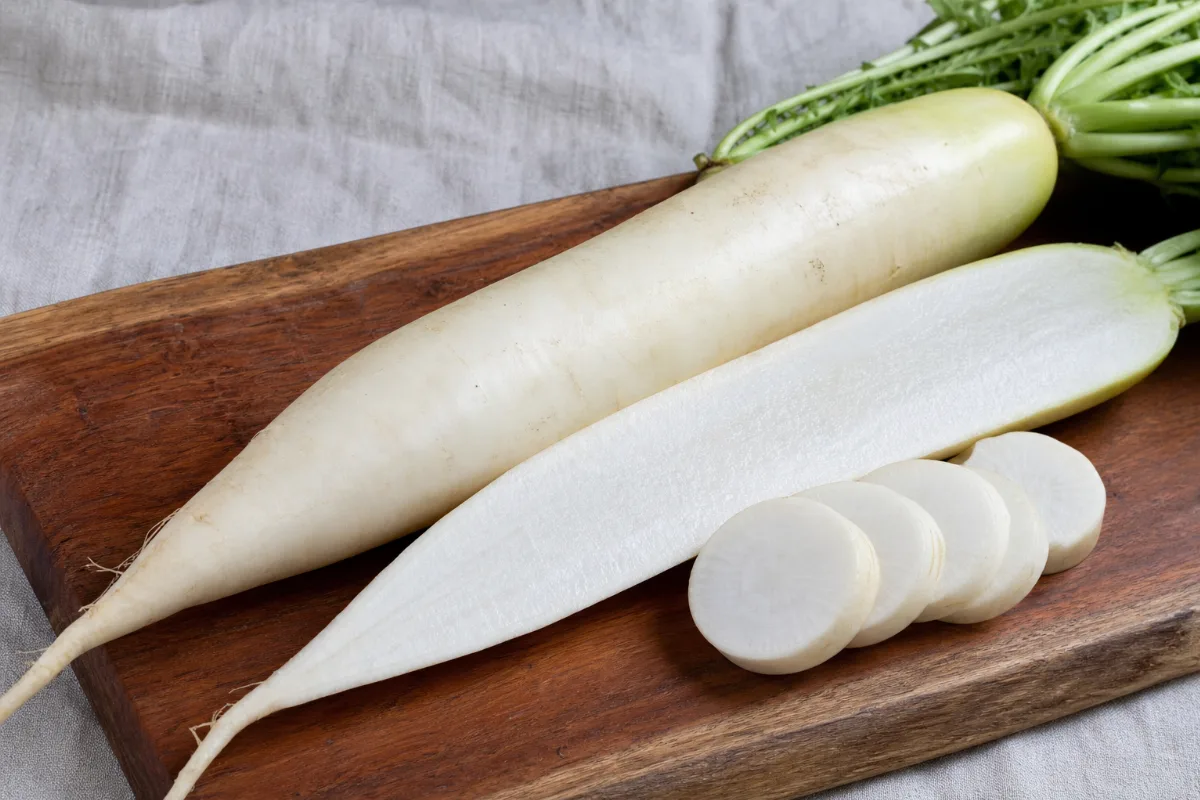
Vegetables · Vegetable
Daikon Radish
Raphanus sativus var. longipinnatus · also called Japanese radish, white radish, oriental radish, mooli, rábano daikon (Spanish)
Daikon is a long, white radish in the cabbage family, eaten raw, grated, cooked or pickled. It is mostly water, has few calories and gives some vitamin C. Studies link cruciferous vegetables as a group to lower cancer and heart disease risk, but daikon itself has not been tested in people. The popular claim that it helps digest starch has no study behind it. The main cautions are rare raw-radish allergy, raw sprouts for vulnerable groups, and medicines handled by certain liver enzymes.
General information, not medical advice. Last substantive update · Not medically reviewed. A named clinician has not signed off on this page. How this page is made
About Daikon Radish
Daikon is a crisp, mild-peppery root that is mostly water, with some vitamin C and fibre. It is a healthy everyday food, not a proven remedy. Health claims come from studies of cruciferous vegetables in general, or from lab and animal work.
What it is
Daikon is the long white root of a type of radish (Raphanus sativus var. longipinnatus) in the cabbage family. GBIF, a plant-name database, treats this variety as a synonym of the radish species Raphanus sativus. USDA lists it as 'oriental radish'. It is common in Japanese, Korean and Chinese cooking.
USDA data for raw daikon: 18 kcal per 100 g. One cup of slices (116 g) has about 21 kcal, 0.7 g protein, 1.9 g fibre, 25.5 mg vitamin C, 263 mg potassium, 32.5 micrograms folate and 31 mg calcium. It has almost no vitamin K (0.3 micrograms per 100 g). Cooked, dried and pickled values were not read.
What the research shows
The firmest facts are about nutrients: vitamin C is needed to make collagen and daikon contains it. These are not trials of daikon.
Two umbrella reviews link cruciferous vegetables as a group to lower risk of some cancers, and a small analysis links leafy and cruciferous vegetables to less heart disease. All are observational and none reports daikon alone, so they cannot show that daikon protects anyone.
Daikon makes a sharp-tasting compound (MTBITC) when cut or grated. In a bacterial test it blocked mutations, and a sprout extract raised a detox enzyme in rats. These are lab and animal results. Cooking inactivates the plant enzyme that makes the compound, so gut bacteria then do the first step (Linus Pauling Institute). The popular idea that daikon enzymes help digest starch has no study behind it that we could find.
Food versus extracts, gels and supplements
The rat study used a sprout extract, the mouse study a lab-stabilised compound, and the skin study a gel. Their results do not carry over to eating daikon. The mouse study's authors include employees and a director of a cyclodextrin company.
Amounts
This page gives no amounts to eat. Ask a doctor, pharmacist or dietitian what is right for you, especially if you take medicines or have kidney or thyroid problems.
At a glance
Traditional uses history, not proof
- Eaten as a root vegetable: sliced raw, grated beside rice or fish, simmered in soups, dried or pickled
- Long use as food is not proof that it treats any condition
Studied for research
- Vitamin C source, high certainty for the nutrient, no daikon trial
- Cancer risk (cruciferous vegetables as a group), low certainty, observational
- Heart disease risk (green leafy and cruciferous vegetables), very low certainty
- Starch digestion by daikon enzymes, insufficient evidence (no study found)
- Plant compounds in the lab and in animals, very low certainty
- Kimchi and fermented vegetables, low certainty, not daikon specific
Main compounds
- Vitamin C
- Glucosinolates (glucoraphasatin, glucoraphenin)
- MTBITC (a pungent isothiocyanate formed when cut or grated)
- Potassium
- Fibre
Common forms
- Raw root, sliced or grated
- Cooked root in soups and stews
- Pickled or fermented, for example in some kimchi
- Dried root
- Sprouts (kaiware daikon)
- Extracts and gels (the lab, animal and skin-gel studies used these, not the root as eaten)
Research links: FDA: Selecting and serving produce safely · 2022 umbrella review: cruciferous vegetables and health outcomes · 2024 systematic review: brassica vegetables and the thyroid · Research Library · Genes & Biomarkers Library
What it is and its history
- Accepted scientific name
- Raphanus sativus L. (daikon is the variety Raphanus sativus var. longipinnatus L.H.Bailey)
- Naming authority
- L. (GBIF accepted species)
- Synonyms
- Raphanus sativus var. longipinnatus L.H.Bailey (GBIF lists the variety as a synonym of the species); Raphanus sativus subsp. longipinnatus L.H.Bailey (GBIF synonym)
- Common names
- Daikon (English); White radish (English); Oriental radish (English); Japanese radish (English); Mooli (English); Chinese radish (English); Rábano daikon (Spanish)
- Family or group
- Brassicaceae (the cabbage or mustard family; cruciferous vegetables), as given by GBIF and by the Linus Pauling Institute, which lists radish among edible crucifers.
- Classification
- Plantae > Tracheophyta > Magnoliopsida > Brassicales > Brassicaceae > Raphanus > Raphanus sativus
- Native range
- Not verified from a source read.
- Habitat
- Not verified from a source read.
- What it looks like
- Roots: The thick white root is the part usually eaten (existing nutrient summary). USDA gives a household portion of one cup of slices as 116 g.; Stems: Not verified.; Leaves: Not verified.; Flowers: Not verified.; Fruit: Not verified.
- Cultivation
- Not verified from a source read.
- Harvest and processing
- Eaten raw (sliced or grated), cooked in soups and stews, dried, or pickled and fermented (existing nutrient summary). Daikon sprouts are eaten as well (the rat study used sprouts). The 2008 paper notes the skin is usually peeled before cooking and holds the plant enzyme in the common variety.
- Look-alikes and adulterants
- Name: Small round red radishes; Note: Also Raphanus sativus but different types with their own page. Results for one type should not be assumed for the other.; Name: Black radish (Raphanus niger) and wild radish (Raphanus raphanistrum); Note: Other radishes. A black radish allergy case and a wild radish lab study exist; they are not assumed to apply to daikon.; Name: Horseradish and wasabi; Note: Different plants in the same family, used as hot condiments.
- Sustainability and conservation
- Not assessed.
Photographs
What is inside, and how it may work
What it contains and how those compounds act in cells and animals. Laboratory and animal mechanisms are not proven effects in people.
Main compounds
| Compound | Family | Where it is concentrated | Activity studied | Level of evidence |
|---|---|---|---|---|
| Vitamin C (ascorbic acid) PubChem 54670067 | vitamin | Root USDA: 22 mg per 100 g raw | Needed to make collagen and repair tissue (MedlinePlus). 19 20 | Human data |
| MTBITC (4-methylthio-3-butenyl isothiocyanate, also called raphasatin) PubChem 103500 | isothiocyanate | Root, formed when cut or grated 71.0 to 363.5 micromol per 100 g fresh root across strains (2001 paper) | Antimutagenic in a bacterial test; raised in grated daikon. PubChem lists the E isomer separately as raphasatin (CID 5368086). 7 8 | Lab |
| Glucoraphenin PubChem 656559 | glucosinolate | Sprouts and root Amount not given in the abstracts read | A glucosinolate named in the rat study of a daikon-sprout extract. 1 | Animal research |
| Glucoraphasatin (4-methylthio-3-butenyl glucosinolate, MTBGLS) | glucosinolate | Root and sprouts Amount not given in the abstracts read | The parent of MTBITC: the plant enzyme myrosinase turns it into the pungent isothiocyanate. A PubChem compound lookup by this name found no CID. 8 1 | Lab |
| Potassium PubChem 5462222 | mineral | Root USDA: 227 mg per 100 g raw | A mineral relevant to people on potassium limits (MedlinePlus). 20 18 | Human data |
Mechanisms, receptors and pathways
| Target or pathway | Gene or receptor | What was found | Level |
|---|---|---|---|
| Myrosinase and glucosinolate conversion | Plant enzyme myrosinase (beta-thioglucosidase) | Cutting or chewing raw crucifers lets myrosinase turn glucosinolates into isothiocyanates. Cooking inactivates the plant enzyme, so gut bacteria then do the first step (Linus Pauling Institute). In the common daikon variety Aokubi the enzyme sat in the outer skin layer. 17 8 | Lab |
| Detoxifying (phase II) enzymes | Glutathione S-transferase, CYP enzymes | A daikon-sprout glucosinolate extract raised glutathione S-transferase in rats. In humans, crucifer-rich diets raised CYP1A2 and glutathione S-transferase alpha activity in a meta-analysis (radish was one of six vegetables). 1 3 | Animal and human |
| Iodine and the thyroid | Goitrin and thiocyanate (from glucosinolates) | Compounds from some glucosinolates can interfere with thyroid hormone making or iodine uptake in animals; in people this does not appear to matter unless iodine is lacking (Linus Pauling Institute); a 2024 systematic review found no antithyroid effect of brassica vegetables in people with adequate iodine. 16 4 | Animal and human |
Absorption, metabolism and elimination
- Absorption
- Isothiocyanates formed from raw crucifers are absorbed in the proximal intestine; from cooked crucifers gut bacteria make them (Linus Pauling Institute). Nothing daikon-specific in people was read.
- Distribution
- Not found.
- Metabolism
- Not found for daikon.
- Elimination
- Not found.
- Bioavailability
- Not established for daikon.
Isolated compounds versus whole extracts
The root as food, a daikon-sprout extract (rats), a stabilised compound (mice) and a skin gel are different products. The animal and gel results do not carry over to eating daikon.
Nutritional composition
Nutrition from USDA FoodData Central (Radishes, oriental, raw, FDC 168451, SR Legacy April 2018 release; read 2026-10-26 from our saved extract of the official bulk download; the live web service was rate-limited). Per 100 g: 18 kcal, 0.6 g protein, 0.1 g fat, 4.1 g carbohydrate (2.5 g sugars), 1.6 g fibre, 94.62 g water, 27 mg calcium, 0.4 mg iron, 16 mg magnesium, 23 mg phosphorus, 227 mg potassium, 21 mg sodium, 0.15 mg zinc, 0.12 mg copper, 22 mg vitamin C, 28 micrograms folate (DFE), 0.3 micrograms vitamin K, and no vitamin A, beta-carotene or lutein listed. One cup of slices (116 g, USDA portion): about 21 kcal, 0.7 g protein, 4.8 g carbohydrate, 1.9 g fibre, 31 mg calcium, 18.6 mg magnesium, 263 mg potassium, 24 mg sodium, 25.5 mg vitamin C, 32.5 micrograms folate (our arithmetic from the per-100 g values). Values vary with variety, ripeness and storage. Cooked, dried and pickled daikon values were not read.
2 high certainty2 low certainty3 very low certainty1 not enough evidence
What was looked at
The 8 benefits and uses checked for Daikon Radish, each with how strong the evidence is. Tap one to open it.
- Vitamin C from daikonHigh certainty
- Water-rich, low-energy root with some fibreHigh certainty
- Cancer risk (cruciferous vegetables as a group)Low certainty
- Heart disease risk (green leafy and cruciferous vegetables)Very low certainty
- The popular claim: daikon enzymes help digest starchNot enough evidence
- Daikon plant compounds in lab and animal studiesVery low certainty
- Kimchi and fermented vegetablesLow certainty
- Skin reaction from radiotherapy (aloe and daikon gel)Very low certainty
Lab markers tracked in the studies
Cancer cases and deaths from any causeNew cardiovascular diseaseGrade of radiation skin reactionBody weight and blood fats (mice only)
What is Daikon Radish good for?
The main studied uses and how strong the human evidence is for each. Many results are for cruciferous vegetables as a group, or for lab and animal work, not for eating daikon.
Benefits, one by one
Each card is a research question, not a promise. Tap a goal to filter. Open a card to see the studies, doses and limits.
Vitamin C from daikon
High certaintyDaikon is a source of vitamin C: USDA lists 22 mg per 100 g of raw root, and about 25.5 mg in one cup of slices (116 g). Vitamin C is needed to make collagen and repair tissue. A severe shortage causes scurvy, which mainly affects older, malnourished adults. This is a nutrient fact, not a trial of daikon.
2 studiesRaw root as food. Values vary with variety, ripeness and storage.
Studies, doses and limits
What the trials found
USDA lists 22 mg of vitamin C per 100 g of raw oriental radish (daikon). MedlinePlus says vitamin C is needed for the growth and repair of tissues, is used to form collagen, and that a severe shortage is called scurvy.
Results
Daikon is a recognised source of vitamin C. No trial of eating daikon for vitamin C status, colds or any other outcome was read.
Effect sizes as reported
USDA: 22 mg vitamin C per 100 g raw; about 25.5 mg per cup of slices (116 g, our arithmetic from the USDA value).
Why this rating
High for the nutrient role and for daikon containing vitamin C (health-agency statement and USDA data). There is no daikon-specific trial, and a varied diet normally supplies vitamin C. Storage and cooking change the amount; this was not read from a source.
Form and dose studied
Raw root as food. Values vary with variety, ripeness and storage.
Who was studied
Anyone eating a varied diet.
Limits
Nutrient fact, not a trial of daikon. This does not show extra benefit in someone who already gets enough vitamin C.
Why researchers looked
Radishes are often named as a vitamin C food, so people ask how much daikon supplies.
Traditional use
Daikon is a long white radish eaten raw, grated, cooked, dried or pickled, especially in Japanese, Korean and Chinese cooking. Long use as food is not proof that it treats any condition.
Proposed mechanism Authoritative guidance
Vitamin C is used by the body to form collagen, heal wounds and repair cartilage, bones and teeth (MedlinePlus).
A proposed mechanism does not show that the effect happens in people.
None specific for the food.
Water-rich, low-energy root with some fibre
High certaintyRaw daikon is about 95% water and has 18 kcal per 100 g (USDA). A cup of slices (116 g) has about 21 kcal, 1.9 g of fibre and 263 mg of potassium. It adds crunch and volume with few calories. This describes what is in the food; it is not a weight-loss or blood-pressure trial.
1 studiesRaw root as food.
Studies, doses and limits
What the trials found
USDA lists, per 100 g of raw root: 18 kcal, 94.62 g water, 1.6 g fibre, 2.5 g total sugars, 227 mg potassium, 21 mg sodium, 27 mg calcium and 16 mg magnesium.
Results
Daikon is a low-energy, water-rich vegetable. No trial of eating daikon for weight, fullness or gut function was read.
Effect sizes as reported
USDA: 18 kcal and 1.6 g fibre per 100 g raw; about 21 kcal and 1.9 g fibre per cup of slices (116 g).
Why this rating
High only for the composition numbers (USDA data). No health effect is claimed or tested.
Form and dose studied
Raw root as food.
Limits
Composition data, not a trial. Cooking and pickling change the water, salt and fibre; not read from a source.
Why researchers looked
People ask whether daikon is a light, filling food.
Traditional use
Daikon is a long white radish eaten raw, grated, cooked, dried or pickled, especially in Japanese, Korean and Chinese cooking. Long use as food is not proof that it treats any condition.
Proposed mechanism Nutrient database
Not a mechanism claim: these are food-composition values.
A proposed mechanism does not show that the effect happens in people.
People who must limit potassium should ask their care team; see the Safety tab.
Cancer risk (cruciferous vegetables as a group)
Low certaintyPeople who eat more cruciferous vegetables have lower risks of some cancers in observational studies. Radish is only one of many vegetables in this group, and daikon was not studied on its own. These studies cannot prove the vegetables are the cause.
2 studiesCruciferous vegetables as food.
Studies, doses and limits
What the trials found
A 2022 umbrella review of 41 meta-analyses (303 observational studies, over 13 million people) found 24 significant results, all showing lower risk, with suggestive evidence for gastric, lung and endometrial cancer and for all-cause mortality and weak evidence for 16 more. A 2024 umbrella review of 22 meta-analyses of 175 cancer studies reported a potential association for lung, gastric, prostate, breast, endometrial and ovarian cancer and renal cell carcinoma.
Results
Observational studies link more cruciferous vegetables to lower risk of some cancers. Neither review separates daikon, and neither is a trial.
Effect sizes as reported
No single effect size is given in the abstracts read.
Why this rating
Low, because the evidence is observational (people who eat more crucifers differ in many other ways), the vegetables are pooled, the abstracts give no effect sizes, and the authors themselves say much uncertainty remains and trials are needed. Nothing was read on daikon alone.
Form and dose studied
Cruciferous vegetables as food.
Who was studied
Adults in observational studies.
Limits
Cannot show cause. Daikon not analysed alone; amounts and cooking differ between studies. Daikon extract or juice trials were not found.
Why researchers looked
Daikon belongs to the cabbage family, whose plant compounds have been studied for cancer for many years.
Traditional use
Daikon is a long white radish eaten raw, grated, cooked, dried or pickled, especially in Japanese, Korean and Chinese cooking. Long use as food is not proof that it treats any condition.
Proposed mechanism Preliminary mechanism
Not established for daikon. Lab work suggests isothiocyanates (formed when the root is cut or chewed) may affect the body's detox enzymes, but this is not shown to prevent cancer in people.
A proposed mechanism does not show that the effect happens in people.
None specific beyond the cautions on the Safety tab.
Heart disease risk (green leafy and cruciferous vegetables)
Very low certaintyA small 2016 pooled analysis of eight observational studies found about 16% less heart disease in people who ate more green leafy and cruciferous vegetables. Daikon is not a leafy green and was not analysed alone, so this is weak, indirect evidence.
1 studiesGreen leafy and cruciferous vegetables as food.
Studies, doses and limits
What the trials found
Pollock (2016) pooled eight studies of green leafy vegetable intake, including cruciferous vegetables, and total cardiovascular disease: relative risk 0.842 (95% CI 0.753 to 0.941), a 15.8% lower incidence.
Results
Higher intake of green leafy and cruciferous vegetables went with less cardiovascular disease in this pooled analysis. It is not about daikon alone.
Effect sizes as reported
RR 0.842 (0.753-0.941)
Why this rating
Very low: observational, only eight studies by a single author, daikon (a root) is not one of the leafy greens named, and the abstract gives no heterogeneity or study-quality information.
Form and dose studied
Green leafy and cruciferous vegetables as food.
Who was studied
Adults in observational studies.
Limits
Cannot show cause. Not daikon. No randomised trial of eating daikon for blood pressure or cholesterol was found.
Why researchers looked
Population studies ask whether people who eat more vegetables have healthier hearts.
Traditional use
Daikon is a long white radish eaten raw, grated, cooked, dried or pickled, especially in Japanese, Korean and Chinese cooking. Long use as food is not proof that it treats any condition.
Proposed mechanism Unknown
Not established. The abstract does not say which nutrient or plant compound might matter.
A proposed mechanism does not show that the effect happens in people.
None specific.
The popular claim: daikon enzymes help digest starch
Not enough evidenceMany web pages say daikon contains enzymes that help digest rice and other starchy food. We found no human study and no paper that measured daikon's enzyme activity or tested its effect on digestion. So this claim is not backed by evidence we could read.
0 studiesGrated or raw root as food.
Studies, doses and limits
What the trials found
A PubMed search on 2026-10-26 for daikon and Raphanus sativus var. longipinnatus (top 20 records read as titles) returned no human digestion study and no study of daikon enzyme activity.
Results
No evidence found either way for daikon.
Why this rating
Insufficient: no relevant human or food-analysis study was found. This is absence of evidence, not proof that it does nothing.
Form and dose studied
Grated or raw root as food.
Limits
Only titles of the search results were screened. A non-PubMed source could exist but was not found.
Why researchers looked
Grated daikon is served beside rice and fried food in Japan, and the enzyme idea is common online.
Traditional use
Daikon is a long white radish eaten raw, grated, cooked, dried or pickled, especially in Japanese, Korean and Chinese cooking. Long use as food is not proof that it treats any condition.
Proposed mechanism Not tested
Not shown. Our own digestive juices and enzymes do most of the work of digesting starch.
A proposed mechanism does not show that the effect happens in people.
None specific.
Daikon plant compounds in lab and animal studies
Very low certaintyWhen daikon is cut or grated, a glucosinolate is turned into a pungent compound called MTBITC. In a bacterial test it blocked mutations, and in rats a daikon-sprout extract raised a detox enzyme. In mice, a lab preparation of the compound reduced weight gain on a high-fat diet. None of this was tested in people eating daikon.
5 studiesRaw root cut or grated (in the chemistry studies); extracts and a sta…
Studies, doses and limits
What the trials found
Nakamura 2001: MTBITC tracked antimutagenic activity of daikon extracts in a bacterial test; Aokubi held 71.0 micromol per 100 g and two wild strains 363.5 and 168.0; grated daikon had 7.0 times the total isothiocyanate of cut daikon after 30 minutes. Nakamura 2008: heirloom varieties made 2.0 to 11.5 times more MTBITC; the enzyme sat in the skin layer of the common variety. Rat study 2013: a daikon-sprout glucosinolate extract raised glutathione S-transferase activity at a low dose. Mouse study 2019: an alpha-cyclodextrin form of the compound lowered weight, blood fats and liver fat on a high-fat diet.
Results
Lab and animal results only. They show what the compounds can do in a dish or an animal, not that eating daikon does anything in people.
Effect sizes as reported
Content: 71.0, 363.5 and 168.0 micromol MTBITC per 100 g (three strains); grated 7.0 times cut after 30 min.
Why this rating
Very low: bacteria, rats and mice only; extracts or a lab-stabilised compound, not the root as eaten. The mouse study is industry-linked.
Form and dose studied
Raw root cut or grated (in the chemistry studies); extracts and a stabilised compound (in the animal studies).
Limits
No human data. Isothiocyanate content varies by variety and preparation. The suggestion not to peel or to grate is the authors' view of the chemistry, not a tested health benefit.
Why researchers looked
Researchers study the sharp-tasting sulphur compounds of crucifers because they act on detox enzymes in cells and animals.
Traditional use
Daikon is a long white radish eaten raw, grated, cooked, dried or pickled, especially in Japanese, Korean and Chinese cooking. Long use as food is not proof that it treats any condition.
Proposed mechanism Lab and animal
Chopping lets the plant enzyme myrosinase turn glucosinolates into isothiocyanates. Isothiocyanates can switch on the body's detoxifying (phase II) enzymes in lab and animal studies (Linus Pauling Institute).
A proposed mechanism does not show that the effect happens in people.
No harm signal from these studies, but they were not safety studies.
Kimchi and fermented vegetables
Low certaintyDaikon is used in some kimchi and pickles. A 2025 review links fermented foods in general with several health outcomes, with consistent protective associations but important limits. No study separates daikon from the other kimchi ingredients.
1 studiesFermented foods with live microbes.
Studies, doses and limits
What the trials found
Sampsell et al. 2025, a narrative review of observational and interventional studies of live-microbe fermented foods, reports consistent protective associations, methodological limits and knowledge gaps, and calls for well-powered clinical trials to establish cause.
Results
Mixed and indirect. The review is not about daikon and not about kimchi alone.
Effect sizes as reported
No effect sizes in the abstract.
Why this rating
Low: a narrative review, mostly observational, fermented foods in general. One author reports foundation funding.
Form and dose studied
Fermented foods with live microbes.
Who was studied
Adults in observational and some intervention studies.
Limits
Products differ in microbes and salt. Pickled or cooked daikon without live microbes would not count as a live fermented food.
Why researchers looked
Fermented foods are popular for gut and metabolic health, and daikon is one common vegetable in them.
Traditional use
Daikon is a long white radish eaten raw, grated, cooked, dried or pickled, especially in Japanese, Korean and Chinese cooking. Long use as food is not proof that it treats any condition.
Proposed mechanism Authors hypothesis
Not established for daikon. Live microbes and fermentation products are the usual suggested reason (review authors).
A proposed mechanism does not show that the effect happens in people.
Fermented foods can be high in salt and can contain histamine; this was not researched from a source here.
Skin reaction from radiotherapy (aloe and daikon gel)
Very low certaintyOne small study of 44 head and neck cancer patients found milder radiation skin reactions with a skin gel that combined aloe vera and daikon than with baby oil. It was not a randomised trial, it used two ingredients, and the gel is put on the skin, not eaten.
1 studiesAloe vera plus daikon gel applied to skin (not food).
Studies, doses and limits
What the trials found
A cohort study (Widjaja 2022) compared an aloe vera plus daikon gel with baby oil in 44 patients having radiotherapy. After 35 sessions the gel group had lower reaction grades (grade 3 in 10% with the gel, and grade 3 or 4 in 54.1% with baby oil; P < 0.001).
Results
Fewer severe skin reactions with the combination gel in this small study.
Effect sizes as reported
After 35 sessions, grade 3 or higher: gel 10%, baby oil 54.1% (45.8% grade 3 plus 8.3% grade 4).
Why this rating
Very low: 44 patients, not randomised, a two-ingredient gel, and some percentages in the abstract that look inconsistent. It cannot be credited to daikon.
Form and dose studied
Aloe vera plus daikon gel applied to skin (not food).
Who was studied
44 head and neck cancer patients having radiotherapy.
Limits
Not randomised and the aloe cannot be separated from the daikon. The reaction scale and exact gel were not described in the abstract.
Why researchers looked
Daikon is described as high in antioxidants, so researchers tried it in a skin gel.
Traditional use
Daikon is a long white radish eaten raw, grated, cooked, dried or pickled, especially in Japanese, Korean and Chinese cooking. Long use as food is not proof that it treats any condition.
Proposed mechanism Not stated
Not stated in the abstract.
A proposed mechanism does not show that the effect happens in people.
A cancer care team should decide what goes on irradiated skin.
Connections to the rest of health
How Daikon Radish connects to the rest of our health knowledge graph. Every link says what kind of connection it is. A safety link (for example to the liver) is a warning, not a benefit. A study that merely mentions a topic never creates a benefit link.
Explore every connection: goals, body systems, organs, symptoms, genes
B. Body systems
| Connected to | Kind of connection | Evidence status | Context | Studies |
|---|---|---|---|---|
| Blood And Immune | Biological association | High certainty | Studied for: Vitamin C from daikon | 20 19 |
| Integumentary System | Biological association | High certainty | Studied for: Vitamin C from daikon Studied for: Skin reaction from radiotherapy (aloe and daikon gel) | 20 19 13 |
| Digestive System | Biological association | High certainty | Studied for: Water-rich, low-energy root with some fibre Studied for: The popular claim: daikon enzymes help digest starch | 20 11 |
| Cellular | Biological association | Low certainty | Studied for: Cancer risk (cruciferous vegetables as a group) Studied for: Daikon plant compounds in lab and animal studies | 6 5 7 8 1 9 17 |
| Cardiovascular System | Biological association | Very low certainty | Studied for: Heart disease risk (green leafy and cruciferous vegetables) | 10 |
| Metabolism Weight | Biological association | Very low certainty | Studied for: Daikon plant compounds in lab and animal studies Studied for: Kimchi and fermented vegetables | 7 8 1 9 17 11 |
C. Body parts and organs
I. Biomarkers
| Connected to | Kind of connection | Evidence status | Context | Studies |
|---|---|---|---|---|
| Cancer cases and deaths from any cause | Biological association | Low certainty | Measured in trials: lowered. A lab change is not the same as a health benefit. | 6 5 |
| New cardiovascular disease | Biological association | Very low certainty | Measured in trials: lowered. A lab change is not the same as a health benefit. | 10 |
| Grade of radiation skin reaction | Biological association | Very low certainty | Measured in trials: lowered. A lab change is not the same as a health benefit. | 13 |
| Body weight and blood fats (mice only) | Biological association | Very low certainty | Measured in trials: lowered. A lab change is not the same as a health benefit. | 9 |
J. Genes, receptors and enzymes
K. Biological pathways
| Connected to | Kind of connection | Evidence status | Context | Studies |
|---|---|---|---|---|
| Vitamin C | Preliminary mechanism | Human | Daikon contains vitamin C, which is needed for collagen. | 19 20 |
| Thyroid | Preliminary mechanism | Human | Crucifer compounds can affect thyroid hormone making in animals; no antithyroid effect in people with adequate iodine. | 4 16 |
L. Active compounds
| Connected to | Kind of connection | Evidence status | Context | Studies |
|---|---|---|---|---|
| Vitamin C (ascorbic acid) | Biological association | Human | Needed to make collagen and repair tissue (MedlinePlus). Preparation or compound: Root |
19 20 |
| MTBITC (4-methylthio-3-butenyl isothiocyanate, also called raphasatin) | Biological association | Lab | Antimutagenic in a bacterial test; raised in grated daikon. PubChem lists the E isomer separately as raphasatin (CID 5368086). Preparation or compound: Root, formed when cut or grated |
7 8 |
| Glucoraphenin | Biological association | Animal | A glucosinolate named in the rat study of a daikon-sprout extract. Preparation or compound: Sprouts and root |
1 |
| Glucoraphasatin (4-methylthio-3-butenyl glucosinolate, MTBGLS) | Biological association | Lab | The parent of MTBITC: the plant enzyme myrosinase turns it into the pungent isothiocyanate. A PubChem compound lookup by this name found no CID. Preparation or compound: Root and sprouts |
8 1 |
| Potassium | Biological association | Human | A mineral relevant to people on potassium limits (MedlinePlus). Preparation or compound: Root |
20 18 |
Each connection is stored with the ingredient, the connected record, the kind of connection, the evidence status, the supporting studies, the preparation or compound involved, and a review date (last reviewed October 26, 2026).
Evidence at a glance: what changed in 4 lab markers
Tap a number to show only those markers. Counts are markers, not people.
The evidence
The research centre for Daikon Radish. Every record here was checked against PubMed or the publisher's page; we never list a study we have not verified.
Evidence by outcome
Bars show how many studies we found for each outcome, not how well it works. People are added up across trials only (reviews are not added, to avoid double counting).
How we rate evidence
High certainty
Several well-run trials or reviews agree; further research is unlikely to change the picture much.
Moderate certainty
Good trials point the same way, but some doubt remains.
Low certainty
Small, short or inconsistent trials. The finding could change with better research.
Very low certainty
Very little or very weak human data. Treat as a possibility only.
Mixed findings
Trials or reviews disagree with each other.
Not enough evidence
Not enough human research to say either way.
Evidence against
Good research found no benefit, or found harm.
We take the reviewers' own risk-of-bias and GRADE statements where they exist, and otherwise judge from study size, design, consistency, directness and whether a product matches what is sold. Many publications do not make evidence high. Method note: We started from our existing daikon summary, re-checked nutrition against USDA FoodData Central values (from our saved copy of the official download, because the live USDA service was rate-limited), read the health pages (MedlinePlus, FDA, Linus Pauling Institute) and searched PubMed for reviews, trials and case reports. Only abstracts were read for studies. Items we could not verify are flagged in the research gaps.
Study library: every study we checked 20
| Study | Design | People | Product, dose, length | Result |
|---|---|---|---|---|
| Abdull Razis 2013 A glucosinolate-rich extract of Japanese Daikon perturbs carcinogen-metabolizing enzyme systems in rat, being a potent inducer of hepatic glutathione S-transferase. Eur J Nutr · PMID 22710810 · DOI |
Animal research rat |
Rats fed a daikon sprout glucosinolate extract in the diet | Glucosinolate-rich extract of daikon sprouts (glucoraphasatin and glucoraphenin) Sprouts (extract) Three dose levels, the low one said to mimic dietary intake 14 days · vs Control diet |
At the low dose, glutathione S-transferase activity rose markedly and some CYP enzymes rose modestly; the CYP rises disappeared at higher doses. The authors say this suggests possible cancer-preventive activity and needs further study. Not given as one number in the abstract (Not applicable) Methods, limits and fundingOutcomes: Liver and lung drug-metabolising enzyme activity Limitations: Rats, an extract of sprouts, not the root, and enzyme markers rather than disease. Funding and conflicts: Funding not stated in the abstract. Read: abstract |
| Abe 2021 A case of hand urticaria, lip angioedema, and oropharyngeal pruritus induced by Japanese radish through IgE-mediated immediate allergic reaction. Allergy Asthma Clin Immunol · PMID 33789748 · DOI |
Case report |
1 A 48-year-old woman |
Raw Japanese radish (daikon), grated and in a salad Raw root |
She developed hives on her hands after grating Japanese radish and lip swelling and an itchy mouth after eating it raw in a salad. A skin prick test with grated radish extract was positive. Her blood showed IgE to an 18 kDa protein that is destroyed by heat. One patient (Not applicable) Methods, limits and fundingOutcomes: Allergic reaction and allergy testing Limitations: A single case. It cannot say how common this allergy is. The heat-labile protein suggests, but does not prove, that cooked radish may be better tolerated. Funding and conflicts: No conflicts of interest declared. Read: abstract |
| Eagles 2020 The Effects of Cruciferous Vegetable-Enriched Diets on Drug Metabolism: A Systematic Review and Meta-Analysis of Dietary Intervention Trials in Humans. Clin Pharmacol Ther · PMID 32086800 · DOI |
Systematic review meta analysis |
23 23 human dietary intervention trials with drug-metabolism end points |
Cruciferous vegetables as food: broccoli, Brussels sprout, cabbage, cauliflower, radish and watercress (daikon not separated) Whole vegetables Varied by trial · vs Usual diet or low-crucifer diet |
Eating cruciferous vegetables increased CYP1A2 activity by 20 to 40% and glutathione S-transferase alpha activity by 15 to 35%. The authors say people taking medicines handled by those enzymes could see different drug levels if they regularly eat large or variable amounts of these vegetables, and that the clinical significance is unclear. CYP1A2 +20 to 40%; GST-alpha +15 to 35% (Not given in the abstract) Methods, limits and fundingOutcomes: Activity of drug-handling enzymes (CYP1A2 and glutathione S-transferase alpha) Limitations: Radish was one of six vegetables, and most of the data are from other crucifers. The abstract says reports disagree and the clinical importance is unclear. Funding and conflicts: Funding not stated in the abstract; open access. Read: abstract |
| Galanty 2024 Do Brassica Vegetables Affect Thyroid Function?-A Comprehensive Systematic Review. Int J Mol Sci · PMID 38612798 · DOI |
Systematic review human, animal, cell |
123 123 articles of cell, animal and human studies |
Brassica vegetables and extracts (a group that includes radish; daikon not analysed alone) Brassica vegetables Varied · vs Varied |
The vast majority of results cast doubt on the assumption that brassica plants have antithyroid effects in humans. The authors conclude that including brassica vegetables in the daily diet, particularly with adequate iodine intake, poses no adverse effects on thyroid function. Not given as numbers in the abstract (Not applicable) Methods, limits and fundingOutcomes: Thyroid size and structure, TSH, T3, T4, iodine uptake Limitations: Mixes cell, animal and human studies, and the abstract does not give the human share or certainty grades. Not about daikon alone. Funding and conflicts: No conflicts of interest declared. Read: abstract |
| Guo 2024 Effect of cruciferous vegetable intake on cancer: An umbrella review of meta-analysis. J Food Sci · PMID 39138635 · DOI |
Umbrella review |
175 22 meta-analyses covering 175 independent cancer studies |
Cruciferous vegetables as food (group; daikon not analysed alone) Cruciferous vegetables Observational studies · vs Lower versus higher intake |
Evidence on lung, gastric, prostate, breast, endometrial and ovarian cancer and renal cell carcinoma suggests a potential association between cruciferous vegetable intake and cancer risk. The authors say better methods and more mechanism work are needed. Not given in the abstract (Not given in the abstract) Methods, limits and fundingOutcomes: Cancer risk Limitations: The abstract gives no effect sizes or certainty grades. Observational; crucifers pooled. Funding and conflicts: Funding not stated in the abstract. Read: abstract |
| Li 2022 Cruciferous vegetable consumption and multiple health outcomes: an umbrella review of 41 systematic reviews and meta-analyses of 303 observational studies. Food Funct · PMID 35352732 · DOI |
Umbrella review |
303 13,394,722 participants across 303 observational studies in 41 meta-analyses |
Cruciferous vegetables as food (a group that includes radish; daikon not analysed alone) Cruciferous vegetables Observational studies · vs Lower versus higher intake |
24 of the 41 meta-analyses were statistically significant, and all of those reported lower risk. Suggestive evidence for gastric, lung and endometrial cancer and all-cause mortality; 16 further associations had weak evidence. The authors call for randomised trials. Not given as one number in the abstract (Not given in the abstract) Methods, limits and fundingOutcomes: 24 health outcomes: cancers (23), cardiovascular disease (12), mortality (5), metabolic disease (1) Limitations: Observational data cannot show cause. Studies pool different crucifers, so the result is not about daikon alone. Methodological quality of the included reviews was moderate (AMSTAR). Funding and conflicts: Funding not stated in the abstract. PROSPERO CRD42021262011. Read: abstract |
| Nakamura 2001 4-(Methylthio)-3-butenyl isothiocyanate, a principal antimutagen in daikon (Raphanus sativus; Japanese white radish). J Agric Food Chem · PMID 11743759 · DOI |
Laboratory research bacteria (in vitro) |
Eight daikon strains; Escherichia coli bacterial test (no people) | Hexane extracts of daikon root and the pure compound MTBITC Root (extract) |
Extract potency tracked the amount of MTBITC, and pure MTBITC was also antimutagenic in this bacterial test. The common Japanese strain Aokubi held 71.0 micromol MTBITC per 100 g fresh root; two wild strains held 363.5 and 168.0. Total isothiocyanate in grated daikon was 7.0 times that in cut daikon measured 30 minutes after cutting. 71.0 vs 363.5 vs 168.0 micromol MTBITC per 100 g (Aokubi, Karami, Momoyama) (Not applicable) Methods, limits and fundingOutcomes: Antimutagenic activity in a bacterial UV-mutation test; isothiocyanate content Limitations: Bacterial assay with solvent extracts. It does not test people eating daikon. The authors' idea that eating habits could raise intake is a suggestion, not a result. Funding and conflicts: Funding not stated in the abstract. Read: abstract |
| Nakamura 2008 Comparison of the glucosinolate-myrosinase systems among daikon (Raphanus sativus, Japanese white radish) varieties. J Agric Food Chem · PMID 18345631 · DOI |
Lab analysis plant (lab) |
Seven daikon varieties (one common, six heirloom); laboratory analysis of roots (no people) | Daikon root tissue Root (skin and flesh) |
The six heirloom varieties produced 2.0 to 11.5 times more MTBITC than the common variety Aokubi. In Aokubi the enzyme myrosinase sat only in the outer skin layer, while the glucosinolate was spread through the root. The authors note that the skin is usually peeled off. 2.0 to 11.5 times more MTBITC (heirloom versus Aokubi) (Not applicable) Methods, limits and fundingOutcomes: Glucosinolate (MTBGLS) amount, myrosinase activity and isothiocyanate (MTBITC) production Limitations: Chemistry only. The authors' recommendations (do not peel, choose heirloom types) are their conclusion, not a test of health effects. Funding and conflicts: Funding not stated in the abstract. Read: abstract |
| Okamoto 2019 Anti-obesity effects of alpha-cyclodextrin-stabilized 4-methylthio-3-butenyl isothiocyanate from daikon (Raphanus sativus var. longipinnatus) in mice. J Clin Biochem Nutr · PMID 31592053 · DOI |
Animal research mouse |
C57BL/6J mice on a high-fat diet | MTBI (the daikon isothiocyanate) complexed with alpha-cyclodextrin, a lab preparation Not the root as eaten (stabilised compound) 16 weeks · vs High-fat diet alone, or with alpha-cyclodextrin alone |
Final body weight, fat-tissue weight, plasma triglycerides and total cholesterol were significantly lower, and liver fat lower, in the MTBI-alpha-cyclodextrin group than in the high-fat control. Not given as numbers in the abstract (Not applicable) Methods, limits and fundingOutcomes: Body weight, fat tissue, blood fats, liver fat Limitations: Mice, a stabilised lab preparation. The abstract says MTBI is quickly broken down in grated daikon, so this does not describe eating daikon. Funding and conflicts: Industry-linked: three authors are employees of CycloChem Bio Co., Ltd., and one is its representative director and the president of CycloChem Co., Ltd., companies that develop and sell cyclodextrin products (conflict of interest statement). Read: abstract |
| Pollock 2016 The effect of green leafy and cruciferous vegetable intake on the incidence of cardiovascular disease: A meta-analysis. JRSM Cardiovasc Dis · PMID 27540481 · DOI |
Meta-analysis |
Eight studies of total cardiovascular disease and green leafy vegetable intake | Green leafy vegetables including cruciferous vegetables, as food (daikon not analysed alone) Green leafy and cruciferous vegetables Observational studies · vs Lower versus higher intake |
Higher intake was linked to lower incidence of cardiovascular disease. RR 0.842 (a 15.8% lower incidence) (95% CI 0.753 to 0.941, p=0.002) Methods, limits and fundingOutcomes: Incidence of total cardiovascular disease Limitations: Eight studies only, one author, observational. The abstract does not give heterogeneity or study quality. Radish is not singled out. Funding and conflicts: Funding not stated in the abstract. Read: abstract |
| Sampsell 2025 Current Research in Fermented Foods: Bridging Tradition and Science. Adv Nutr · PMID 41232606 · DOI |
Narrative review |
Observational and interventional studies of fermented foods containing live microbes | Fermented foods in general (kimchi is a fermented food; daikon not separated) Fermented foods |
The review identifies consistent protective associations, methodological limitations and key knowledge gaps, and says standardised product characterisation and well-powered clinical trials are needed to establish cause. Not given in the abstract (Not given in the abstract) Methods, limits and fundingOutcomes: Metabolic, cardiovascular, cancer and neuropsychological outcomes Limitations: Narrative review, not a systematic one. Not about daikon. Products differ widely. Funding and conflicts: Author JPB reports financial support from the Weston Family Foundation (conflict of interest statement). Read: abstract |
| Uesugi 2023 Pollen Food Allergy Syndrome Caused by Japanese Radish: A Case Report. Indian J Dermatol · PMID 37151264 · DOI |
Case report |
1 A 31-year-old man with painful mouth sores and sore throat |
Raw Japanese radish (daikon) Raw root |
He had mouth sores and pain after often eating raw Japanese radish. A skin prick test confirmed pollen food allergy syndrome. The authors say few such reports exist for radish and that it can be mistaken for a herpes mouth infection. One patient (Not applicable) Methods, limits and fundingOutcomes: Pollen food allergy syndrome (an itchy, sore mouth and throat reaction to certain raw foods) Limitations: A single case. No frequency can be drawn from it. Funding and conflicts: No conflicts of interest declared. Read: abstract |
| Widjaja 2022 Potential Benefits of Aloe vera and Raphanus sativus var. longipinnatus Gel for Prevention of Radiation-Induced Dermatitis in Head and Neck Cancer Patients. Iran J Pharm Res · PMID 36896315 · DOI |
Cohort study |
44 44 head and neck cancer patients receiving radiotherapy, Indonesia |
Skin gel combining aloe vera and daikon (topical, not eaten) Daikon in a skin gel Up to 35 radiotherapy sessions · vs Baby oil on the skin |
Patients using the aloe-daikon gel had lower skin-reaction grades than those using baby oil. After 35 sessions, grade 3 or 4 reactions were 10% with the gel versus 45.8% and 8.3% with baby oil. Grade distribution after 35 sessions: gel grade 0 5%, 1 65%, 2 20%, 3 10%; baby oil grade 1 8.3%, 2 37.5%, 3 45.8%, 4 8.3% (P < 0.001) Methods, limits and fundingOutcomes: Grade of radiation-induced skin inflammation (dermatitis) Limitations: A cohort study, not a randomised trial, with 44 people. A two-ingredient gel, so the effect cannot be given to daikon. Some percentages in the abstract (for example grade 1 after 10 sessions) look inconsistent and could not be checked. Used on skin, not eaten. Funding and conflicts: Supported by a university TALENTA grant; authors declare no conflict of interest. Read: abstract |
| s-fda-produce FDA: Selecting and Serving Produce Safely · Source |
Health agency n/a |
Methods, limits and fundingRead: full-text | ||
| s-gbif-raphanus-sativus GBIF Backbone: Raphanus sativus L. (usageKey 7678610) · Source |
Reference database n/a |
Methods, limits and fundingRead: full-text | ||
| s-lpi-cv Linus Pauling Institute: Cruciferous Vegetables · Source |
University resource n/a |
Methods, limits and fundingRead: full-text | ||
| s-lpi-itc Linus Pauling Institute: Isothiocyanates · Source |
University resource n/a |
Methods, limits and fundingRead: full-text | ||
| s-medlineplus-potassium MedlinePlus: Potassium in diet · Source |
Health agency n/a |
Methods, limits and fundingRead: full-text | ||
| s-medlineplus-vitc MedlinePlus: Vitamin C · Source |
Health agency n/a |
Methods, limits and fundingRead: full-text | ||
| s-usda-fdc-168451 USDA FoodData Central: Radishes, oriental, raw (FDC 168451) · Source |
Reference database n/a |
Methods, limits and fundingRead: saved-copy |
What we do not know yet
- No trial of eating daikon (raw, cooked or pickled) was found for any health outcome.
- Cruciferous vegetable studies pool several vegetables, and a daikon-only result was not in the abstracts read.
- No paper measuring daikon enzyme activity or testing digestion of starch was found.
- The lab and animal studies used extracts, sprouts or a stabilised compound, not the root as eaten.
- Allergy was found only in two case reports; how common it is was not found.
- Oxalate, histamine, FODMAPs, gas and bloating, pesticide residues, heavy metals, nitrate, pregnancy and the effect of cooking and pickling were not researched.
How new research is added
New studies are found by a saved PubMed search and placed in a review queue before the page changes.
Lab markers
What changed in blood or saliva tests during trials. A changed number is not the same as feeling or being healthier, and we give no "normal ranges".
Other 4
Cancer cases and deaths from any cause
Lowered in trials
How many people in a study develop a given cancer or die of any cause.
Low certaintyResults and what it means
Why it was measured
These are the outcomes that matter most, so population studies count them.
Statistical vs. clinical meaning
An association in observational studies, not proof that eating crucifers prevents cancer.
Safety implication
None specific.
| Study | Result | People | Product |
|---|---|---|---|
| 6 | 24 of 41 meta-analyses were significant and all showed lower risk; suggestive evidence for gastric, lung and endometrial cancer and all-cause mortality | Adults in observational studies | Cruciferous vegetables as food (daikon not analysed alone) |
New cardiovascular disease
Lowered in trials
How many people in a study develop heart disease or stroke.
Very low certaintyResults and what it means
Why it was measured
A key health outcome counted in population studies.
Statistical vs. clinical meaning
A weak association from a small pooled analysis.
Safety implication
None specific.
| Study | Result | People | Product |
|---|---|---|---|
| 10 | Total cardiovascular disease RR 0.842 (95% CI 0.753-0.941) with higher green leafy and cruciferous vegetable intake | Adults in eight observational studies | Green leafy and cruciferous vegetables as food (daikon not analysed alone) |
Grade of radiation skin reaction
Lowered in trials
A clinician's grading of redness and skin damage during radiotherapy, from 0 (none) to 4 (most severe).
Very low certaintyResults and what it means
Why it was measured
Used to see how bad the skin reaction is during treatment.
Statistical vs. clinical meaning
A lower reaction grade in a small non-randomised study of a two-ingredient gel.
Safety implication
None reported in the abstract.
| Study | Result | People | Product |
|---|---|---|---|
| 13 | After 35 sessions: gel grade 0 5%, 1 65%, 2 20%, 3 10%; baby oil grade 1 8.3%, 2 37.5%, 3 45.8%, 4 8.3% (P < 0.001) | 44 head and neck cancer patients | Aloe vera plus daikon gel on the skin (not daikon alone, not eaten) |
Body weight and blood fats (mice only)
Lowered in trials
Weight, fat-tissue weight, triglycerides and cholesterol measured in mice on a high-fat diet.
Very low certaintyResults and what it means
Why it was measured
Animal studies check whether a compound limits weight gain.
Statistical vs. clinical meaning
Animal data only; the study is industry-linked and does not show an effect in people.
Safety implication
Not applicable.
| Study | Result | People | Product |
|---|---|---|---|
| 9 | Final body weight, fat-tissue weight, plasma triglycerides, total cholesterol and liver fat were lower with MTBI-alpha-cyclodextrin than with the high-fat control | C57BL/6J mice, 16 weeks | A stabilised lab preparation of the daikon compound (not daikon as eaten) |
Safety
What studies and official sources say about side effects, medicines and who should check first. Each point shows what kind of evidence it comes from.
Main points to know 4
- Allergy to raw radish is rare but reported: stop and get help for breathing trouble or swelling. Case reports describe a woman with hives on her hands after grating Japanese radish and lip swelling and an itchy mouth after eating it raw (a skin test and blood test pointed to a heat-sensitive protein), and a man with painful mouth sores from pollen food allergy syndrome after often eating raw Japanese radish. These are single cases, so how common this is, is not known. If you have trouble breathing or swelling of the face or throat, call emergency services. Case report 2 12
- Raw radish sprouts: the FDA says some groups should avoid them. The FDA says people more vulnerable to foodborne illness (children, older adults, pregnant women and people with weakened immune systems) should avoid eating raw or lightly cooked sprouts of any kind, including radish sprouts. This is about sprouts, not the daikon root. Authoritative guidance 14
- Medicines: crucifer-rich diets can change how some drug-handling enzymes work. A meta-analysis of human diet trials (radish was one of six vegetables) found cruciferous vegetables raised CYP1A2 activity by 20 to 40% and glutathione S-transferase alpha by 15 to 35%. The authors say people taking medicines handled by those enzymes could see different drug levels if they regularly eat large or variable amounts, and that the clinical importance is unclear. Ask a pharmacist if you take such a medicine. Do not change any medicine on your own. Systematic review 3
- Thyroid: no problem shown for normal food intake with enough iodine. A 2024 systematic review of 123 studies says the vast majority of results do not support the idea that brassica vegetables harm the thyroid in people, particularly with adequate iodine. The Linus Pauling Institute says high crucifer intake does not appear to raise the risk of an underactive thyroid unless iodine is lacking. People with a thyroid condition can ask a clinician. Systematic review 4 16
Side effects 3
| Effect | How often | Severity and recovery | Evidence |
|---|---|---|---|
| Allergic reaction to raw Japanese radish: hand hives, lip swelling, itchy mouth One 48-year-old woman. IgE to an 18 kDa heat-sensitive protein in raw radish was found. No frequency is known. | Not established | not stated beyond local swelling Not stated in the abstract | Case report 2 |
| Pollen food allergy syndrome after eating raw Japanese radish: mouth sores, mouth and throat pain One 31-year-old man whose symptoms were first mistaken for a herpes mouth infection. The authors say few radish cases are reported. | Not established | not stated Not stated in the abstract | Case report 12 |
| Gas, bloating or other digestive upset We did not find a source about digestive effects of daikon, so no claim is made. | Not established | not stated Not stated | None found |
Liver
No liver injury from eating daikon was found in the sources read. A liver-safety source (such as LiverTox) was not searched for this food page.
How often. No frequency was found.
Monitoring. No agency monitoring advice was found.
This is a safety connection. It is not evidence that Daikon Radish supports liver health.
Medicines and supplements 3
| With | Why it matters | Importance | Evidence | What to do |
|---|---|---|---|---|
| Medicines handled by CYP1A2 or glutathione S-transferase alpha prescription | Cruciferous vegetables increased the activity of these enzymes in human diet trials (CYP1A2 by 20 to 40%, GST-alpha by 15 to 35%). | The authors say the clinical significance is unclear and that effects may show up with regular large or variable amounts. The trials were of crucifers as a group; daikon was not tested alone. | Systematic review Low certainty 3 | Ask a pharmacist whether any medicine you take is handled by these enzymes. Do not change any medicine on your own. |
| Warfarin (vitamin K) prescription | Vitamin K affects warfarin. USDA lists only 0.3 micrograms of vitamin K per 100 g of raw daikon, so it is not a leafy-green-sized source. | No source read describes a daikon and warfarin interaction. | None found Not enough evidence 20 | Your warfarin clinic can advise on any diet question. |
| Thyroid medicines prescription | The systematic review and the Linus Pauling Institute describe no thyroid problem from usual food intake with enough iodine; neither names thyroid medicines. | None found Not enough evidence 4 16 | People on thyroid medicine can ask their clinician or pharmacist. |
Who should check first 6
| Situation | Advice | Evidence |
|---|---|---|
| Known allergy to radish or pollen food allergy syndrome from raw radish | Avoid raw radish and ask an allergist. Call emergency services for trouble breathing or swelling of the face or throat. One case report found a heat-sensitive allergen, but it does not prove cooked radish is safe for you. | Case report 2 12 |
| Pregnancy, young children, older age or weakened immunity (raw sprouts) | The FDA says these groups should avoid raw or lightly cooked sprouts of any kind, including radish sprouts. Follow official food-safety advice for raw produce. | Authoritative guidance 14 |
| Kidney disease, especially on dialysis, or taking ACE inhibitors, ARBs or potassium-sparing diuretics | Daikon has 227 mg of potassium per 100 g raw (USDA), a modest amount. MedlinePlus says people with kidney problems should not eat too many potassium-rich foods. Ask a clinician about your diet. | Authoritative guidance 18 20 |
| Thyroid condition or low iodine intake | Usual food amounts are not shown to harm the thyroid when iodine is adequate. Ask a clinician if you have a thyroid condition. | Systematic review 4 16 |
| Pregnancy and breastfeeding (daikon as ordinary food) | We found no source on daikon in pregnancy or breastfeeding. The Linus Pauling Institute says there is no safety information on purified isothiocyanates or high-dose glucosinolate or isothiocyanate supplements in pregnancy or breastfeeding in humans; that is about supplements, not food. Ask your doctor. | None found 17 |
| Children | No daikon-specific safety source for children was found. The FDA says children can be especially vulnerable to foodborne illness, so follow produce-washing advice. | Authoritative guidance 14 |
Overdose, product quality and regulators
Summary. No toxicity from daikon as ordinary food was found in the sources read.
Animal. A rat study of a daikon-sprout extract reported enzyme changes, not harm; it was not a safety study.
Human doses studied. No human feeding trial of daikon was found.
Overdose response. Not found.
Genotoxicity. Not researched.
Raw roots can carry germs from soil or water; the FDA gives washing and storage advice. Pesticide residues, heavy metals (one search found a soil-mercury meta-analysis, not read) and nitrate in daikon were not researched.
Food safety handling. The FDA says to choose produce that is not bruised or damaged, wash all produce under running water even if you will peel it, not to use soap, detergent or commercial produce wash, that washing reduces but does not eliminate bacteria, to cut away damaged areas, and to refrigerate cut or packaged produce at 40 F (4 C) or below. 14
Raw sprouts. The FDA says sprouts, which grow in warm, humid conditions, can carry Salmonella, Listeria and E. coli, and that vulnerable groups should avoid raw or lightly cooked sprouts of any kind, including radish sprouts. 14
| Body | Action | Date |
|---|---|---|
| FDA (US Food and Drug Administration) (United States) | Produce safety page: wash produce under running water, do not use soap or produce wash, refrigerate cut produce at 40 F or below; vulnerable groups should avoid raw or lightly cooked sprouts including radish sprouts source | 2024-03-05 |
| MedlinePlus (US National Library of Medicine) (United States) | Potassium page: people with kidney problems, particularly on dialysis, should not eat too many potassium-rich foods; ACE inhibitors, ARBs and potassium-sparing diuretics are listed among causes of high potassium source | 2026-04-30 |
| Linus Pauling Institute (Oregon State University) (United States) | Cruciferous vegetables page: high intakes do not appear to raise hypothyroidism risk unless iodine is lacking; Isothiocyanates page: not known to interact with drugs but may affect CYP enzymes; no safety information on purified isothiocyanates or high-dose supplements in pregnancy or breastfeeding source | 2017-04 |
When to get medical help
- Trouble breathing, swelling of the lips, face or throat, or widespread hives after eating radish
- Painful mouth sores or severe mouth and throat pain after eating raw radish that keep coming back
- Vomiting, diarrhoea or fever after eating raw produce or raw sprouts, especially in pregnancy, young children, older adults or weakened immunity
Stop using the product and contact a clinician or emergency service. In the US, Poison Control is 1-800-222-1222.
General information only, not medical advice. Ask a clinician or pharmacist before use, especially with medicines, in pregnancy or with a health condition. See the Natural Remedy Safety guide.
Frequently asked questions
What is daikon good for?
Does daikon help digest rice and starchy food?
Not shown. Many web pages say daikon enzymes help digestion, but we found no human study and no paper measuring daikon's enzyme activity. Our own digestive enzymes do most of the work.
Does daikon have vitamin C?
Does eating daikon prevent cancer?
Is daikon good for the heart?
Not shown for daikon. A small pooled analysis of eight observational studies linked green leafy and cruciferous vegetables to about 16% less heart disease. It cannot show cause and is not about daikon alone.
Is daikon bad for the thyroid?
Can I be allergic to daikon?
Does daikon interact with medicines?
No daikon-specific interaction was found. A meta-analysis of cruciferous vegetables (radish was one of six) found higher activity of the enzymes CYP1A2 and glutathione S-transferase alpha. The authors say the importance is unclear. Daikon has almost no vitamin K (0.3 micrograms per 100 g, USDA). A pharmacist can check your medicines.
Is daikon safe in pregnancy?
We found no source on daikon in pregnancy. The FDA says pregnant women are more vulnerable to foodborne illness, so wash roots and avoid raw or lightly cooked radish sprouts. Ask your doctor.
Are radish sprouts safe to eat raw?
The FDA says sprouts of any kind, including radish, can carry bacteria such as Salmonella, Listeria and E. coli, and that vulnerable groups should avoid them raw or lightly cooked. This is about sprouts, not the daikon root.
Is kimchi made with daikon healthy?
Fermented foods in general are linked to several health outcomes in a 2025 review, with important limits. No study separates daikon from the other kimchi ingredients. Pickled and fermented products can be high in salt; check labels and ask a clinician if you limit salt.
Explore by health goal
Editorial transparency
- Written by
- AlternativeMed editorial team. Research compiled with AI assistance, then checked against the sources listed.
- Medical review
- None. This page has not been reviewed by a physician or pharmacist.
- First published
- 2026-10-26
- Last substantive update
- 2026-10-26
- How we research
- We started from our existing daikon summary, re-checked nutrition against USDA FoodData Central values (from our saved copy of the official download, because the live USDA service was rate-limited), read the health pages (MedlinePlus, FDA, Linus Pauling Institute) and searched PubMed for reviews, trials and case reports. Only abstracts were read for studies. Items we could not verify are flagged in the research gaps.
- How we rate evidence
- See "How we rate evidence" in the Evidence tab.
- Independence
- No product is promoted on this page. No affiliate links are shown.
Sources 20
Each source was opened and checked. Where we read only the abstract, it says so. The small numbers in the text point here.
- Abdull Razis AF, De Nicola GR, Pagnotta E, et al.. A glucosinolate-rich extract of Japanese Daikon perturbs carcinogen-metabolizing enzyme systems in rat, being a potent inducer of hepatic glutathione S-transferase.. Eur J Nutr. 2013. PMID 22710810. DOI 10.1007/s00394-012-0397-2. (abstract)
- Abe S, Ito J, Harada S, et al.. A case of hand urticaria, lip angioedema, and oropharyngeal pruritus induced by Japanese radish through IgE-mediated immediate allergic reaction.. Allergy Asthma Clin Immunol. 2021. PMID 33789748. DOI 10.1186/s13223-021-00538-1. (abstract)
- Eagles SK, Gross AS, McLachlan AJ. The Effects of Cruciferous Vegetable-Enriched Diets on Drug Metabolism: A Systematic Review and Meta-Analysis of Dietary Intervention Trials in Humans.. Clin Pharmacol Ther. 2020. PMID 32086800. DOI 10.1002/cpt.1811. (abstract)
- Galanty A, Grudzinska M, Pazdziora W, et al.. Do Brassica Vegetables Affect Thyroid Function?-A Comprehensive Systematic Review.. Int J Mol Sci. 2024. PMID 38612798. DOI 10.3390/ijms25073988. (abstract)
- Guo C, Liu Y, Fu H, et al.. Effect of cruciferous vegetable intake on cancer: An umbrella review of meta-analysis.. J Food Sci. 2024. PMID 39138635. DOI 10.1111/1750-3841.17300. (abstract)
- Li YZ, Yang ZY, Gong TT, et al.. Cruciferous vegetable consumption and multiple health outcomes: an umbrella review of 41 systematic reviews and meta-analyses of 303 observational studies.. Food Funct. 2022. PMID 35352732. DOI 10.1039/d1fo03094a. (abstract)
- Nakamura Y, Iwahashi T, Tanaka A, et al.. 4-(Methylthio)-3-butenyl isothiocyanate, a principal antimutagen in daikon (Raphanus sativus; Japanese white radish).. J Agric Food Chem. 2001. PMID 11743759. DOI 10.1021/jf0108415. (abstract)
- Nakamura Y, Nakamura K, Asai Y, et al.. Comparison of the glucosinolate-myrosinase systems among daikon (Raphanus sativus, Japanese white radish) varieties.. J Agric Food Chem. 2008. PMID 18345631. DOI 10.1021/jf7035774. (abstract)
- Okamoto H, Ino S, Nihei N, et al.. Anti-obesity effects of alpha-cyclodextrin-stabilized 4-methylthio-3-butenyl isothiocyanate from daikon (Raphanus sativus var. longipinnatus) in mice.. J Clin Biochem Nutr. 2019. PMID 31592053. DOI 10.3164/jcbn.19-11. (abstract)
- Pollock RL. The effect of green leafy and cruciferous vegetable intake on the incidence of cardiovascular disease: A meta-analysis.. JRSM Cardiovasc Dis. 2016. PMID 27540481. DOI 10.1177/2048004016661435. (abstract)
- Sampsell K, Marcolla CS, Tapping S, et al.. Current Research in Fermented Foods: Bridging Tradition and Science.. Adv Nutr. 2025. PMID 41232606. DOI 10.1016/j.advnut.2025.100554. (abstract)
- Uesugi A, Tsushima F, Miyamoto Y, Harada H. Pollen Food Allergy Syndrome Caused by Japanese Radish: A Case Report.. Indian J Dermatol. 2023. PMID 37151264. DOI 10.4103/ijd.ijd_405_22. (abstract)
- Widjaja SS, Sumantri IB, Rusdiana R, et al.. Potential Benefits of Aloe vera and Raphanus sativus var. longipinnatus Gel for Prevention of Radiation-Induced Dermatitis in Head and Neck Cancer Patients.. Iran J Pharm Res. 2022. PMID 36896315. DOI 10.5812/ijpr-132213. (abstract)
- . FDA: Selecting and Serving Produce Safely. . . (full-text)
- . GBIF Backbone: Raphanus sativus L. (usageKey 7678610). . . (full-text)
- . Linus Pauling Institute: Cruciferous Vegetables. . . (full-text)
- . Linus Pauling Institute: Isothiocyanates. . . (full-text)
- . MedlinePlus: Potassium in diet. . . (full-text)
- . MedlinePlus: Vitamin C. . . (full-text)
- . USDA FoodData Central: Radishes, oriental, raw (FDC 168451). . . (saved-copy)


