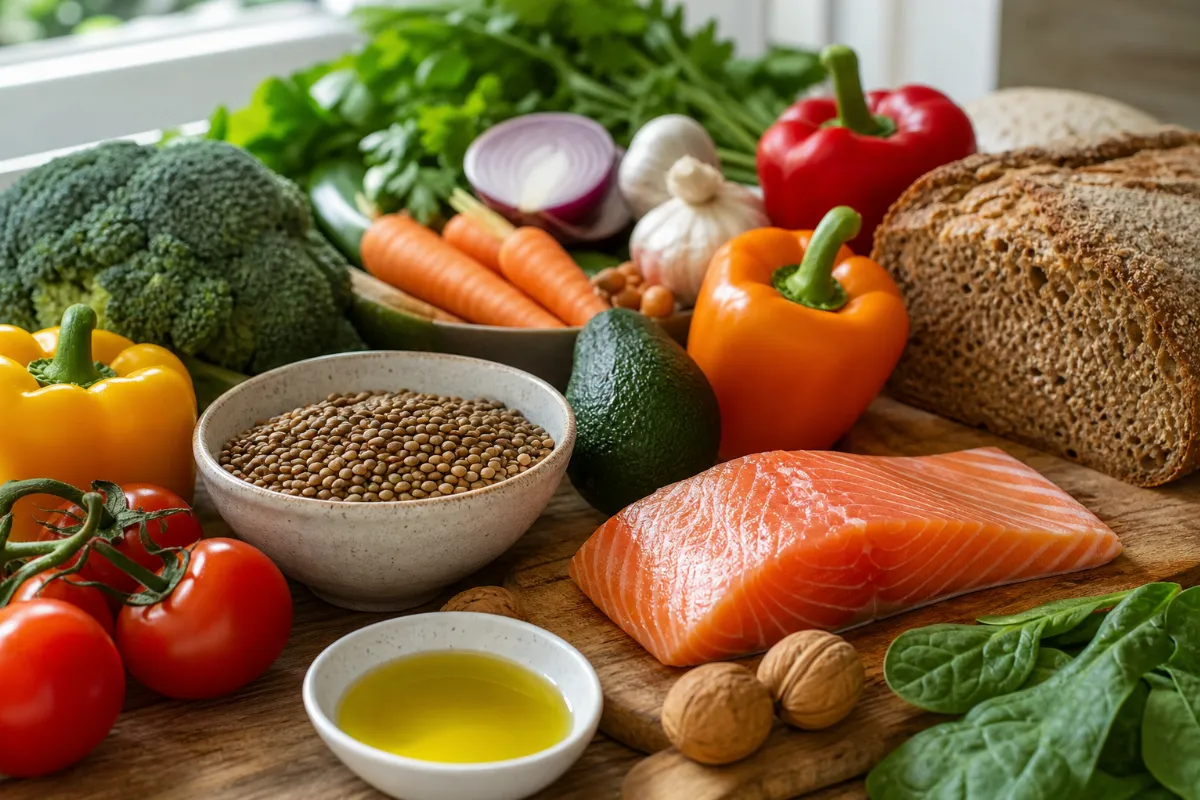
Support Your Heart & Circulation
Eat for Heart Health
A heart-healthy way of eating is mostly about patterns rather than single foods: plenty of vegetables, fruit, whole grains, legumes, nuts and fish, with liquid plant oils in place of butter and less salt, sugar and highly processed food. This page is about what is on the plate; blood pressure, cholesterol, triglycerides, fitness and circulation have their own goal pages.
General information, not medical advice. Last updated October 31, 2026. Written by the AlternativeMed editorial team. Not medically reviewed.
Start here
- Build more meals around vegetables, fruit, beans and lentils, whole grains, nuts and fish, and use liquid plant oils such as olive oil in place of butter where you can.
- Cut back on salt, sweetened drinks, processed meat and highly processed packaged foods, which is the part of the pattern with the most consistent support.
- Change one or two things at a time, such as swapping a refined grain for a whole grain, or adding a handful of nuts. Small steady changes are easier to keep than a complete overhaul.
Be careful with
- Food does not replace prescribed treatment. Never stop, reduce or replace a heart, blood pressure, cholesterol or blood-thinning medicine because you have changed your diet.
- Potassium-rich foods and potassium salt substitutes can be a problem for people with kidney disease or on certain blood pressure medicines (ACE-inhibitor-type and similar). Ask a clinician first.
- A big change in vegetables rich in vitamin K can affect some blood thinners, and some supplements (fish oil, garlic, red yeast rice, niacin, plant sterols) have interactions. See the remedies section.
- No food or supplement 'unclogs' arteries or cures heart disease. Be wary of products that claim to.
Get help when
- Chest pain, pressure or tightness, especially with breathlessness, sweating, nausea or pain spreading to the arm, neck or jaw, or fainting: the NHS says to call 999 (UK) straight away rather than drive yourself; use your local emergency number elsewhere.
- Face drooping, weakness or numbness in one arm, slurred speech or confusion (stroke signs): the NHS says to call 999 (UK) at once, even if the signs pass.
- A very high home blood pressure reading, sudden severe headache, or new breathlessness: seek same-day medical advice.
- Swelling in one leg with pain or redness, or unexplained ankle swelling with breathlessness: get urgent medical review.
- Unintended weight loss, or any pattern of restricting, bingeing or fear of food while changing your diet: talk to a doctor or dietitian.
About Eat for Heart Health
What this goal means
This goal is about food and drink choices that support the heart and blood vessels over the long term. The American Heart Association's 2021 guidance describes a dietary pattern rather than a list of superfoods: plenty of fruit and vegetables, whole grains, healthy protein sources (mostly plants, regular fish and seafood), liquid plant oils, minimally processed foods, little added sugar and salt, and limited alcohol.
Two well-studied examples are the Mediterranean-style pattern and the DASH eating plan. They overlap heavily, and neither requires special products.
1,2What it can feel like
Many people find healthy-eating advice confusing because headlines swing between fats, eggs, carbohydrates and supplements. In practice most of the evidence points the same way: more minimally processed plant foods and fish, less salt, sugary drinks and processed meat.
1What can make it harder
Time, budget, food access, family tastes, shift work and a food environment full of ready-made salty and sweet products all make it harder. The AHA statement names targeted marketing of unhealthy foods and food insecurity as barriers, so this is not simply a matter of willpower.
1Conditions that can be behind it
Diet is one of several things that influence blood pressure, cholesterol and triglycerides, alongside genes, age, weight, activity, smoking, alcohol, sleep and some medicines. Someone with a family history of early heart disease, diabetes, kidney disease or a high reading may need personal dietary advice from a clinician or registered dietitian.
1Realistic expectations
Eating changes tend to shift blood pressure and cholesterol modestly rather than dramatically. In the original DASH trial a combination diet lowered blood pressure by about 5.5/3.0 mm Hg more than a typical American control diet over eight weeks, and in a meta-analysis of trials oat beta-glucan lowered LDL cholesterol by about 0.25 mmol/L. Benefits to heart events come from the pattern kept up for years, as in the PREDIMED and CORDIOPREV trials.
Some of the strongest evidence comes from observational studies, which show association rather than proof.
3,4,5,6Who this applies to
Healthy adults who want to lower their long-term risk, and people with raised blood pressure or cholesterol or a past heart event, who should use food alongside their prescribed care. Children, pregnant people, people with kidney disease, diabetes or a history of disordered eating need individual guidance before major changes.
1Related conditions and symptoms
Prediabetes, type 2 diabetes and metabolic syndrome → Obesity and weight-related health → Eating disorders and disordered eating →
A manageable starting plan
An educational starting point, not a personal prescription. Adjust it to your own situation and any advice from your clinician.
Your first actions
- Choose two swaps this week: for example butter to olive oil, and a sweetened drink to water.
- Add a vegetable and a fruit or legume to most meals; aim to build towards the 25 to 29 g of fibre a day linked to the greatest benefit in the Lancet analysis.
- Eat fish twice a week including one oily portion (unless you are pregnant or otherwise limited).
- Read labels for salt, added sugar and the type of fat.
Optional additions
- Add a handful of unsalted nuts most days.
- Try a week of DASH-style serving targets from the NHLBI guide.
- Cook one new bean or lentil dish a week.
- Meet a registered dietitian.
What to track
- What you eat for 3 days to spot salt, sugary drinks and processed foods.
- Home blood pressure and the cholesterol or triglyceride results your clinician orders.
- Any new supplement and whether you take blood thinners or blood pressure medicines.
When to reassess
Give a new eating pattern at least 8 weeks before judging its effect on blood tests, as DASH and oat trials were of about that length. Review results with your clinician; benefits for heart events are long-term.
When to seek professional support
- Share your eating changes with your doctor, especially if you take medicines for blood pressure, cholesterol, diabetes or blood thinning.
- Ask for a referral to a registered dietitian.
- Use the linked goal pages for blood pressure, cholesterol, triglycerides and fitness.
What helps
Ordered by how well the research supports each step. Evidence strength is shown on every card; precautions sit next to the advice.
Start here
A Mediterranean-style pattern
Moderate certaintyAddresses: Lower risk of heart attacks and strokes in trials in Spain
Why it may help: In the PREDIMED trial of 7,447 adults at high cardiovascular risk, a Mediterranean diet supplemented with extra-virgin olive oil or mixed nuts was linked to about 30% fewer major cardiovascular events than advice to cut dietary fat (hazard ratios 0.69 and 0.72, in the republished analysis after protocol problems were found). In CORDIOPREV, 1,002 people with heart disease eating a Mediterranean diet had fewer repeat events than those on a low-fat diet; the benefit was seen in men but not clearly in women. A Cochrane review judged the evidence overall to be low to moderate quality with remaining uncertainty.
How to apply it: Base meals on vegetables, fruit, legumes, whole grains, nuts, fish and olive oil; eat dairy, eggs and poultry in smaller amounts, and red and processed meat rarely.
Who it may suit: Most adults, including those with a past heart event, as part of their usual care.
Precautions: PREDIMED was republished after randomisation problems; the trials were in Spain and the foods were partly supplied free. Not a replacement for medicines.
5,6,7A DASH-style pattern
High certaintyAddresses: Lower blood pressure
Why it may help: The DASH eating plan is rich in vegetables, fruit, low-fat dairy, whole grains, nuts and beans and low in saturated fat and sweets. In the 1997 trial the combination diet lowered systolic and diastolic blood pressure by 5.5 and 3.0 mm Hg more than the control diet. In DASH-Sodium, eating less sodium lowered pressure further, on both the DASH and the control diet. NHLBI lists a standard sodium limit of 2,300 mg a day and a lower 1,500 mg level.
How to apply it: Use the NHLBI serving guide for your calorie level; weekly servings include nuts, seeds, beans and peas.
Who it may suit: People with high or borderline blood pressure, and anyone wanting a clear structure.
Precautions: Trial participants were fed controlled meals; results in everyday life are usually smaller. Potassium-rich DASH foods need care in kidney disease.
3,8,2Swap saturated fats for liquid plant oils
Moderate certaintyAddresses: Lower LDL cholesterol and possibly fewer cardiovascular events
Why it may help: A Cochrane review of trials lasting at least two years found that cutting saturated fat reduced combined cardiovascular events, with small reductions in total and LDL cholesterol; replacing the energy with polyunsaturated fat or carbohydrate seemed useful, while replacement with monounsaturated fat was unclear. The NHS advises eating less fatty meat, butter, lard, ghee, cream, cheese, pastries and coconut or palm oil, and more oily fish, olive or rapeseed oil, nuts and seeds. The AHA advises liquid plant oils rather than tropical oils.
How to apply it: Cook with olive or rapeseed oil in place of butter, choose lean or unprocessed meats, and check labels for the type of fat.
Who it may suit: Anyone with raised LDL cholesterol or a family history of heart disease.
Precautions: What replaces the saturated fat matters: swapping it for refined starches or sugar gives little benefit.
9,10,1Additional options
Vegetables and fruit, plenty and varied
Moderate certaintyAddresses: Lower cardiovascular risk in observational studies
Why it may help: A meta-analysis of prospective studies found that each extra 200 g a day of fruit and vegetables was linked to an 8% lower risk of cardiovascular disease (relative risk 0.92) and 16% lower stroke risk, with risk falling up to about 800 g a day. Apples and pears, citrus fruit, green leafy and cruciferous vegetables stood out.
How to apply it: Add a vegetable to every meal and keep fruit visible. Frozen and tinned (no added salt or sugar) count.
Who it may suit: Almost everyone.
Precautions: Observational: people who eat more produce differ in other ways. Fruit juice is not the same as whole fruit. Vitamin K-rich greens need consistency if you take warfarin-type blood thinners.
11,1Whole grains and more fibre
Moderate certaintyAddresses: Lower risk of cardiovascular disease and better cholesterol
Why it may help: A series of meta-analyses in the Lancet found the greatest risk reduction with daily fibre intakes of 25 to 29 g, and trials showed lower body weight, systolic blood pressure and total cholesterol with higher fibre (certainty moderate for fibre, low to moderate for whole grains). A BMJ meta-analysis linked each extra 90 g a day of whole grains to 22% lower risk of cardiovascular disease (relative risk 0.78).
How to apply it: Choose oats, brown rice, quinoa, whole-grain bread and pasta, and add beans and lentils. Increase gradually and drink fluids.
Who it may suit: Most adults.
Precautions: Sudden big increases can cause gas and bloating. Coeliac disease needs gluten-free whole grains.
12,13A handful of nuts most days
Moderate certaintyAddresses: Lower risk of coronary heart disease
Why it may help: A meta-analysis found each 28 g a day of nuts was linked to 29% lower coronary heart disease risk (relative risk 0.71) and 21% lower cardiovascular disease risk (0.79); stroke was not clearly changed. In two large US cohorts, eating nuts seven or more times a week was linked to 20% lower mortality than not eating them. PREDIMED's nut group also had fewer events.
How to apply it: Eat about a small handful (28 g) of unsalted nuts as a snack or on meals.
Who it may suit: Adults who are not allergic.
Precautions: Observational for the most part. Nuts are calorie-dense. Tree-nut and peanut allergy is serious; avoid if allergic. Choose unsalted.
14,15,5Fish, especially oily fish, about twice a week
Moderate certaintyAddresses: Lower cardiovascular mortality in observational studies
Why it may help: A meta-analysis of 25 cohorts (about 2 million people) found fish intake linked to 9% lower cardiovascular mortality (relative risk 0.91). The NHS advises at least two portions of fish a week including one oily portion (about 140 g). The AHA statement also advises regular fish and seafood.
How to apply it: Choose salmon, sardines, mackerel, trout or herring, baked, grilled or steamed rather than deep-fried.
Who it may suit: Adults who eat fish.
Precautions: Pregnancy, breastfeeding and children have limits on oily fish and some species (shark, swordfish, marlin); see the NHS guidance. Avoid raw shellfish when pregnant.
16,17,1Extra-virgin olive oil as the main added fat
Moderate certaintyAddresses: Lower mortality in large cohorts, and better outcomes when used as part of Mediterranean eating
Why it may help: In more than 90,000 US adults followed up to 28 years, the highest olive oil intake (more than about half a tablespoon a day) was linked to 19% lower cardiovascular mortality than rarely or never using it, and swapping 10 g a day of margarine, butter, mayonnaise or dairy fat for olive oil was linked to lower mortality. No clear difference was seen compared with other vegetable oils combined. PREDIMED used extra-virgin olive oil.
How to apply it: Use it for dressings and cooking in place of butter.
Who it may suit: Adults who cook at home.
Precautions: Observational. Oils are calorie-dense.
18,5Still being studied
Beans, lentils and chickpeas in place of some meat
Moderate certaintyAddresses: Better balance of fats and fibre
Why it may help: Legumes are part of the Mediterranean, DASH and healthful plant-based patterns. In US cohorts a healthful plant-based diet index (whole grains, fruit and vegetables, nuts and legumes, oils, tea and coffee) was linked to 25% lower coronary heart disease risk in the top decile compared with the bottom (hazard ratio 0.75), while an index of less-healthy plant foods (refined grains, sweets, fries) was linked to 32% higher risk.
How to apply it: Add legumes to soups and salads, or swap them for meat in some meals.
Who it may suit: Most adults.
Precautions: Plant-based does not automatically mean healthy; refined grains, sweets and sweetened drinks count against you. Observational data.
19,1Replacing processed foods with minimally processed ones
Low certaintyAddresses: Lower risk of cardiovascular disease in a large cohort
Why it may help: In the French NutriNet-Sante cohort, higher intake of ultra-processed foods was linked to higher risks of cardiovascular disease, coronary heart disease and stroke, even after adjusting for saturated fat, sodium and sugar. Causality is not established. The AHA advises choosing minimally processed foods instead of ultra-processed foods.
How to apply it: Cook from basic ingredients more often and read labels for salt and added sugar.
Who it may suit: Adults eating many ready meals, snacks and sweet drinks.
Precautions: Observational; 'ultra-processed' is a broad grouping, and the reasons are not clear.
20,1Soluble fibre foods such as oats
Moderate certaintyAddresses: Lower LDL cholesterol
Why it may help: A meta-analysis of randomised trials found that 3 g or more of oat beta-glucan a day lowered LDL cholesterol by about 0.25 mmol/L and total cholesterol by about 0.30 mmol/L, without a change in HDL or triglycerides, with bigger falls where starting LDL was higher.
How to apply it: Oat porridge or oat bran, barley and legumes are everyday sources.
Who it may suit: Adults with raised LDL.
Precautions: A modest effect; works best with other changes.
4Food & nutrition
Building a heart-friendly plate
The AHA and NHS guidance point to the same shape: half the plate vegetables and fruit, a quarter whole grains or beans, a quarter fish, poultry or plant protein, liquid plant oil for cooking, and water to drink. DASH adds low-fat dairy; Mediterranean eating adds olive oil, nuts and a little wine, though the AHA says non-drinkers should not start.
1,2,10Everyday foods with the most support
These are the same foods discussed above; use the table below as a shopping list.
Oily fish
Moderate certaintyAddresses: Cardiovascular mortality
Why it may help: See the helps section: fish intake was linked to 9% lower cardiovascular mortality.
How to apply it: Two portions of fish a week including one oily portion.
Who it may suit: Most adults
Precautions: Limits in pregnancy and for children.
16,17Nuts (unsalted)
Moderate certaintyAddresses: Coronary heart disease risk
Why it may help: 28 g a day was linked to 29% lower coronary heart disease risk.
How to apply it: A small handful.
Who it may suit: Non-allergic adults
Precautions: Allergy; calorie-dense.
14Oats and barley
Moderate certaintyAddresses: LDL cholesterol
Why it may help: 3 g or more of oat beta-glucan a day lowered LDL by about 0.25 mmol/L.
How to apply it: Porridge, oat bran, barley in soups.
Who it may suit: Adults with raised LDL
Precautions: Increase gradually.
4Legumes
Moderate certaintyAddresses: Fibre and plant protein
Why it may help: Part of Mediterranean, DASH and healthful plant-based patterns.
How to apply it: Swap into soups, salads and stews.
Who it may suit: Most adults
Precautions: May cause gas at first.
19,12Olive oil
Moderate certaintyAddresses: Replacing animal fats
Why it may help: Replacing 10 g a day of butter, margarine or dairy fat was linked to lower mortality.
How to apply it: Main cooking and dressing oil.
Who it may suit: Adults who cook
Precautions: Calorie-dense.
18Dark chocolate and cocoa
Low certaintyAddresses: Blood vessel and event outcomes (research)
Why it may help: In the COSMOS trial, a cocoa flavanol extract did not significantly reduce total cardiovascular events (hazard ratio 0.90) but cardiovascular death was 27% lower in a secondary analysis, so more research is needed. This was an extract, not chocolate.
How to apply it: As an occasional treat; no dose can be recommended from this trial for chocolate.
Who it may suit: Adults who enjoy it
Precautions: Chocolate adds sugar and calories; caffeine in some people.
21Salt, and what to put on food instead
NHLBI lists a DASH sodium limit of 2,300 mg a day, or 1,500 mg for a lower level. Herbs, spices, citrus and vinegar add flavour without sodium. The SSaSS trial in China (20,995 people, most with prior stroke or hypertension) found that a salt substitute lowered stroke (rate ratio 0.86), major cardiovascular events and death compared with regular salt, with hyperkalemia events not significantly higher; this does not apply to people with kidney disease or on potassium-raising medicines.
Whether pink or sea salt differ from table salt for the heart: no trials were found; they all contain sodium.
2,22,23Drinks
Water, unsweetened tea and coffee are the default. Sugar-sweetened drinks were linked to higher cardiovascular death in the US cohorts. Alcohol is best kept low; the NHS advises not regularly drinking more than 14 units a week, spread over several days.
24,25,10Remedies & supplements
Traditional use, laboratory findings and human trials are kept apart. "Natural" does not mean safe.
Omega-3 fish oil
Moderate certaintyStudied form and route: Capsules, as a supplement
Intended outcome: Lower triglycerides; small effect on coronary events
Human evidence: A Cochrane review found that more long-chain omega-3 slightly reduced coronary heart disease mortality and events (moderate and low certainty) and lowered triglycerides by about 15% in a dose-dependent way (high certainty), with little effect on blood pressure or stroke.
Traditional use: Oily fish has long been part of coastal diets.
Laboratory findings: Lab findings on inflammation and heart rhythm exist but were not reviewed here.
Limits: Most trials used supplements; benefit in people who already eat fish is unclear.
Interactions and precautions: May increase bleeding tendency in some people on blood thinners; high doses can cause digestive upset; avoid fish liver oil in pregnancy (vitamin A); discuss with a clinician.
26,17Garlic
Moderate certaintyStudied form and route: Powder or aged garlic supplements, or food
Intended outcome: Lower blood pressure in hypertension; slightly lower cholesterol
Human evidence: An updated meta-analysis found garlic supplements lowered systolic blood pressure in trials, by about 8.7 mm Hg in the subgroup with high blood pressure (hypertensive adults). A previously published analysis suggested a roughly 10% cholesterol reduction after more than two months in people with slightly raised levels.
Traditional use: Garlic has been used for the heart in many traditions.
Laboratory findings: Lab studies suggest effects on blood vessels, not shown to be the same as outcomes.
Limits: Trials vary in product and size; the sources read did not show fewer heart attacks.
Interactions and precautions: May increase bleeding risk with blood thinners; care before surgery; can interact with some medicines; stomach upset.
27Psyllium and oat beta-glucan fibre
Moderate certaintyStudied form and route: Husk powder or oat products
Intended outcome: Lower LDL cholesterol
Human evidence: Oat beta-glucan at 3 g a day or more lowered LDL by about 0.25 mmol/L in a meta-analysis of randomised trials.
Traditional use: No traditional use was covered in the sources read.
Laboratory findings: No lab data needed; the effect is shown in human trials.
Limits: Modest effect; psyllium was not reviewed in the sources read here.
Interactions and precautions: Take with enough fluid; may affect absorption of some medicines, so separate timing as advised by a pharmacist; gas and bloating at first.
4Plant sterols and stanols
Moderate certaintyStudied form and route: Fortified spreads, drinks or supplements
Intended outcome: Lower LDL cholesterol
Human evidence: A meta-analysis of 124 studies found that intakes of 0.6 to 3.3 g a day reduced LDL cholesterol by about 6 to 12% on average.
Traditional use: None found.
Laboratory findings: Not reviewed.
Limits: LDL lowering is shown; whether this reduces heart attacks is not shown by that analysis.
Interactions and precautions: Ask a clinician first in pregnancy, for children, or if you take cholesterol medicines.
28Red yeast rice
Low certaintyStudied form and route: Supplement
Intended outcome: Lower cholesterol (when it contains monacolin K)
Human evidence: NCCIH says products with considerable monacolin K may lower cholesterol; products with little have unknown effect.
Traditional use: Used in traditional Chinese food and medicine.
Laboratory findings: Monacolin K is chemically the same as lovastatin.
Limits: Content is unpredictable and not labelled; some products contain citrinin, which can harm the kidneys.
Interactions and precautions: Can cause statin-like muscle, liver and kidney problems and interact like a statin; not recommended in pregnancy or breastfeeding; do not combine with a statin or use as a replacement for prescribed treatment without medical advice.
29Cocoa flavanol extract
Low certaintyStudied form and route: Standardised supplement
Intended outcome: Possible fewer cardiovascular deaths (research)
Human evidence: The COSMOS trial of older adults found no significant reduction in total cardiovascular events (hazard ratio 0.90), though cardiovascular death was lower in a secondary analysis and in per-protocol analysis the main outcome was lower (0.85).
Traditional use: Cacao has long traditional use.
Laboratory findings: Not reviewed.
Limits: Not enough to recommend; one trial of an extract, not of chocolate.
Interactions and precautions: No safety concerns in the trial; check caffeine and interactions.
21Potassium (food, supplements and salt substitutes)
Moderate certaintyStudied form and route: Foods, enriched salt or tablets
Intended outcome: Lower blood pressure and stroke risk
Human evidence: A BMJ meta-analysis found increased potassium intake reduced blood pressure in people with hypertension and was linked to 24% lower stroke risk, with no adverse effect on kidney function in adults without impaired potassium handling.
Traditional use: None found.
Laboratory findings: Not reviewed.
Limits: Does not apply to people with kidney impairment.
Interactions and precautions: Can be dangerous in kidney disease or with medicines that raise potassium; ask a doctor first; no dose suggested here.
30,22Therapies & care
Established care for raised blood pressure, cholesterol or heart disease is led by a doctor and often includes medicines. A registered dietitian can help turn a pattern into a plan that fits your health, culture and budget. This page does not recommend medicines or doses, and you should never stop a prescribed medicine on your own.
Registered dietitian or nutritionist advice
Moderate certaintyProfessional dietary counselling Personalised planning around heart disease, kidney disease, diabetes, food allergies, budget and culture. The AHA statement stresses that tailoring to preferences and circumstances helps people keep a pattern.
Who it may suit: Anyone with a heart condition, high LDL, high blood pressure, diabetes or kidney disease.
Precautions: Choose a qualified professional; avoid anyone selling supplements as the main treatment.
1Structured DASH or Mediterranean programme
High certaintyDietary pattern programme Programmes based on NHLBI's DASH plan or PREDIMED-style advice give meal structure and food lists.
Who it may suit: People who like clear rules.
Precautions: Adjust for kidney disease, allergies and medicines.
2,5,3Cardiac rehabilitation
Not enough evidenceMedically supervised programme Heart-healthy eating is typically taught alongside supervised activity after a heart event; no trials of this were reviewed for this page.
Who it may suit: People after a heart attack or heart procedure, on a doctor's referral.
Precautions: Requires medical clearance.
1What to avoid
Habits, products and claims that can get in the way. Never stop a prescribed medicine without talking to the professional who prescribed it.
Risks that apply to most people
Too much salt
High certaintyWhy: Randomised trials show salt reduction lowers blood pressure in people with and without hypertension, and a JACC review links high salt intake to cardiovascular disease. DASH-Sodium found lower sodium lowered pressure further.
Who it applies to: Most people, especially those with raised blood pressure; processed and restaurant food supplies much of it.
Try instead: Cook with herbs, spices, lemon and vinegar, and compare labels.
23,8Support Healthy Blood Pressure → Natural salts and minerals →
Sugar-sweetened drinks
Moderate certaintyWhy: In two large US cohorts, two or more sugar-sweetened drinks a day were linked to a 31% higher risk of cardiovascular death than rare use (hazard ratio 1.31). The AHA advises minimising added sugars.
Who it applies to: Regular soda, sweetened tea, energy and sports drinks, juice drinks.
Try instead: Water, sparkling water, unsweetened tea or coffee.
24,1Alcohol beyond low amounts
Moderate certaintyWhy: A combined analysis of 599,912 drinkers found the lowest risk of death at about 100 g or less of alcohol a week, and higher stroke, heart failure and hypertensive disease risk with more. The AHA says if you do not drink, do not start. The NHS advises not regularly drinking more than 14 units a week.
Who it applies to: Anyone drinking regularly, and people with high blood pressure, high triglycerides or heart rhythm problems.
Try instead: Keep to low amounts with alcohol-free days, or none.
25,1,10Processed meat and ultra-processed ready foods
Low certaintyWhy: The AHA advises minimally processed foods and, when meat is eaten, lean and unprocessed cuts. Higher ultra-processed food intake was linked to more cardiovascular disease in a French cohort.
Who it applies to: Frequent eaters of sausages, bacon, deli meats and packaged snacks.
Try instead: Fish, beans, poultry or unprocessed lean meat.
1,20Personal triggers to check
Large amounts of potassium from salt substitutes or supplements, if you have kidney disease or take certain medicines
Moderate certaintyWhy: Potassium lowers blood pressure in people with hypertension and kidney function that handles it normally, but in kidney problems or with medicines that raise potassium (such as ACE-inhibitor-type tablets) it can build up. In the large salt-substitute trial in China, serious hyperkalemia events were not significantly more frequent than with regular salt, but the trial does not show safety for people with kidney disease.
Who it applies to: People with kidney disease or on potassium-affecting medicines.
Try instead: Ask a doctor before using potassium-enriched salt or potassium supplements.
30,22Sudden changes in vitamin K-rich greens if you take warfarin-type blood thinners
Not enough evidenceWhy: Not covered by the sources read; this is a general caution: dietary vitamin K can alter how some blood thinners work, so consistency matters more than avoidance.
Who it applies to: People on warfarin-type medicines.
Try instead: Keep your usual greens steady and tell the anticoagulant clinic about diet changes.
Black licorice sweets and licorice products in large amounts
Not enough evidenceWhy: Licorice can raise blood pressure and lower potassium in some people. No trial on this was read for this page; it is a general caution to check with a pharmacist.
Who it applies to: People with high blood pressure or heart rhythm problems.
Try instead: Choose other treats.
Products that need caution
Red yeast rice and other 'cholesterol support' supplements
Low certaintyWhy: NCCIH says red yeast rice with high monacolin K may lower cholesterol, but monacolin K is chemically lovastatin, content varies more than 60-fold between brands and is not listed, and some products contain the kidney-toxic contaminant citrinin. The European Food Safety Authority could not set a safe level.
Who it applies to: Anyone considering it, especially with liver or muscle problems, or on statins; not recommended in pregnancy or breastfeeding.
Try instead: Discuss cholesterol treatment with a doctor.
29Fish oil and omega-3 capsules as a substitute for eating fish
Moderate certaintyWhy: A Cochrane review found omega-3 fats from supplements and foods slightly reduce coronary heart disease events and clearly lower triglycerides by about 15%, with little effect on stroke or blood pressure. Benefits for the general public are small.
Who it applies to: People thinking of capsules in place of a healthier diet.
Try instead: Eat oily fish; ask about capsules if triglycerides are high.
26Unsupported claims
'Eat this food to unclog your arteries'
Evidence againstWhy: No source read supports any food or supplement removing plaque from arteries. The evidence is for lowering risk over years through the overall pattern.
Who it applies to: Social media and supplement marketing.
Try instead: Look for the pattern, not a single food.
1,7'Eggs are always bad' or 'eggs are always fine'
Mixed findingsWhy: A US pooled cohort analysis found each extra half egg a day associated with 6% higher cardiovascular risk, but the egg link was no longer significant after adjusting for dietary cholesterol. Findings across studies are mixed.
Who it applies to: People deciding how many eggs to eat, especially with diabetes or high LDL.
Try instead: Moderate amounts as part of a plant-rich pattern; ask a clinician if LDL is high.
31'Fat is bad, so choose low-fat everything'
Moderate certaintyWhy: In both PREDIMED and CORDIOPREV, Mediterranean eating with plenty of olive oil and nuts did better than low-fat advice. Type of fat and food quality matter more than the total.
Who it applies to: Those buying low-fat processed foods that are high in sugar.
Try instead: Choose unsaturated fats and unprocessed foods.
5,6Common mistakes
Making the change all at once, then giving up
Not enough evidenceWhy: The AHA statement notes that barriers such as cost and access are real; no source read tested step-by-step change, so this is practical advice.
Who it applies to: Anyone starting a new eating plan.
Try instead: Pick one or two swaps for two weeks, then add more.
1Choosing 'plant-based' foods that are refined or sweet
Moderate certaintyWhy: Refined grains, sweets and fries counted as unhealthful plant foods in US cohorts and were linked to higher coronary heart disease risk.
Who it applies to: People relying on vegan ready meals and snacks.
Try instead: Whole grains, legumes, nuts, vegetables and fruit.
19Evidence & safety
What the research shows
The strongest evidence supports patterns, not single foods: DASH lowers blood pressure in controlled feeding trials, Mediterranean eating with olive oil or nuts lowered cardiovascular events in two Spanish trials (PREDIMED and CORDIOPREV), reducing salt lowers blood pressure, and reducing saturated fat lowers events in a Cochrane review. Observational studies link more vegetables, fruit, whole grains, fibre, nuts and fish with lower risk, and sweet drinks, alcohol and highly processed food with higher risk. Supplements have smaller or mixed evidence.
Limits of the evidence
- Most food-and-outcome findings are observational and cannot prove cause.
- PREDIMED was republished after randomisation problems; CORDIOPREV benefit was clear in men but not in women.
- Dietary pattern trials are hard to blind and rely on people reporting what they eat.
- Many trials were in Spain, the US and China and may not generalise to every culture.
- Supplement trials vary in product and dose.
Precautions and interactions
- Do not stop or change prescribed heart, blood pressure, cholesterol, diabetes or blood-thinning medicines because of diet.
- Potassium, fish oil, garlic, vitamin K foods, red yeast rice and plant sterols can interact with medicines.
- No food or supplement is proven to remove plaque from arteries.
- Tell your doctor and pharmacist about any supplements you take.
Life-stage considerations
- Pregnancy and breastfeeding: limit oily fish and avoid shark, swordfish and marlin as the NHS advises; avoid red yeast rice and fish liver oil; high blood pressure in pregnancy needs medical care.
- Children and teenagers: do not restrict fat or use sterols or supplements without paediatric advice; the NHS has oily fish limits for children.
- Older adults: appetite and kidney function change; keep enough protein and check potassium and salt-substitute use with a doctor.
Warning signs
- Chest pain, pressure or tightness, with or without breathlessness, sweating or pain spreading to the arm, neck or jaw: call 999 (UK) or your local emergency number immediately; do not drive yourself.
- Face drooping, arm weakness or slurred speech: call 999 (UK) immediately.
- Fainting, sudden severe headache, or a very high home blood pressure reading: urgent or same-day care.
- Pain, redness and swelling in one leg: urgent medical review.
Claim checks
Red yeast rice is a safe natural alternative to statins
Low certaintyNot supported. It can contain the same active chemical as a statin in unpredictable amounts, and some products contain a kidney toxin.
29Fish oil capsules protect the heart in everyone
Moderate certaintyOverstated. Supplements lower triglycerides and slightly reduce coronary events in a Cochrane review, with little effect on blood pressure or stroke.
26Some foods can unclog your arteries
Evidence againstAgainst. No source read shows food removing plaque; benefits come from lowering risk over years.
1A Mediterranean diet lowers the risk of heart events
Moderate certaintySupported by two Spanish trials and cohort data, with a Cochrane review judging overall certainty low to moderate.
5,6,7Salt substitutes are safe for everyone
Moderate certaintyNo. Potassium-enriched substitutes lowered strokes in a Chinese trial but are unsuitable with kidney disease or some medicines.
22,30It is safe to wait and see if heart attack or stroke warning signs pass
High certaintyNot safe. The NHS says chest pain, pressure or tightness, and face drooping, arm weakness or slurred speech, need an emergency call (999 in the UK) at once, even if the signs pass. Eating well lowers long-term risk; it is not a response to symptoms happening now.
32,33Questions people ask
What is the best diet for heart health?
No single diet has been proven best. The AHA describes a pattern rich in vegetables, fruit, whole grains, legumes, nuts, fish and liquid plant oils and low in salt, added sugar and processed food. DASH and Mediterranean eating both fit, and both have trial evidence.
Is the Mediterranean diet proven to prevent heart attacks?
Two Spanish trials, PREDIMED and CORDIOPREV, found fewer major cardiovascular events than low-fat diets. A Cochrane review still rated the overall evidence low to moderate, so the picture is encouraging but not final.
How much salt should I eat?
NHLBI gives a DASH limit of 2,300 mg of sodium a day, with a lower level of 1,500 mg. Ask your clinician which applies to you.
Are eggs bad for the heart?
The evidence is mixed. A US pooled analysis linked more dietary cholesterol to higher cardiovascular risk, while the egg association was no longer significant after adjusting for cholesterol. Moderate amounts within a plant-rich diet are commonly advised; discuss with a clinician if your LDL is high.
Is olive oil better than butter?
Replacing butter, margarine, mayonnaise or dairy fat with olive oil was linked to lower mortality in large US cohorts. The NHS also advises olive or rapeseed oil instead of butter.
Do I need fish oil capsules?
Not for most people. Capsules lower triglycerides and slightly reduce coronary events in a Cochrane review, but eating oily fish is the usual first advice. Ask a clinician if your triglycerides are high or you take blood thinners.
How much fibre is best?
The Lancet analysis found the greatest risk reduction at 25 to 29 g a day, with possible further benefit above that. Increase gradually and drink enough fluid.
Are nuts too fattening?
Nuts are calorie-dense, but 28 g a day was linked to lower coronary heart disease risk in a meta-analysis. A small handful of unsalted nuts is the amount studied; avoid if allergic.
Is a little alcohol good for the heart?
A large combined analysis found the lowest overall mortality risk at about 100 g or less a week, and stroke and heart failure risk rose with more. The AHA says not to start drinking for heart benefit.
Can I use potassium salt substitutes?
They lowered stroke and deaths in a large trial in people with prior stroke or hypertension, but they are unsuitable for people with kidney disease or on medicines that raise potassium. Ask a doctor first.
Can I stop my medicine if I eat well?
No. Never stop or reduce a prescribed heart, blood pressure or cholesterol medicine without your prescriber. Better eating can work alongside treatment.
Is plant-based eating always heart-healthy?
Not automatically. In US cohorts a healthful plant-based pattern was linked to lower coronary heart disease risk, while a plant-based pattern of refined grains, sweets and fries was linked to higher risk.
References
- Lichtenstein AH, et al. 2021 Dietary Guidance to Improve Cardiovascular Health: A Scientific Statement From the American Heart Association. Circulation 2021. PMID 34724806. Read 2026-10-31. source
- NHLBI. DASH eating plan (last updated February 25, 2026). Read 2026-10-31. source
- Appel LJ, et al. A clinical trial of the effects of dietary patterns on blood pressure (DASH). N Engl J Med 1997. PMID 9099655. Read 2026-10-31. source
- Whitehead A, et al. Cholesterol-lowering effects of oat beta-glucan: a meta-analysis of randomized controlled trials. Am J Clin Nutr 2014. PMID 25411276. Read 2026-10-31. source
- Estruch R, et al. Primary Prevention of Cardiovascular Disease with a Mediterranean Diet Supplemented with Extra-Virgin Olive Oil or Nuts (PREDIMED, republished analysis). N Engl J Med 2018. PMID 29897866. Read 2026-10-31. source
- Delgado-Lista J, et al. Long-term secondary prevention of cardiovascular disease with a Mediterranean diet and a low-fat diet (CORDIOPREV). Lancet 2022. PMID 35525255. Read 2026-10-31. source
- Rees K, et al. Mediterranean-style diet for the primary and secondary prevention of cardiovascular disease. Cochrane Database Syst Rev 2019. PMID 30864165. Read 2026-10-31. source
- Sacks FM, et al. Effects on blood pressure of reduced dietary sodium and the DASH diet (DASH-Sodium). N Engl J Med 2001. PMID 11136953. Read 2026-10-31. source
- Hooper L, et al. Reduction in saturated fat intake for cardiovascular disease. Cochrane Database Syst Rev 2020. PMID 32428300. Read 2026-10-31. source
- NHS. How to lower your cholesterol. Read 2026-10-31. source
- Aune D, et al. Fruit and vegetable intake and the risk of cardiovascular disease, total cancer and all-cause mortality. Int J Epidemiol 2017. PMID 28338764. Read 2026-10-31. source
- Reynolds A, et al. Carbohydrate quality and human health: a series of systematic reviews and meta-analyses. Lancet 2019. PMID 30638909. Read 2026-10-31. source
- Aune D, et al. Whole grain consumption and risk of cardiovascular disease, cancer, and all cause and cause specific mortality. BMJ 2016. PMID 27301975. Read 2026-10-31. source
- Aune D, et al. Nut consumption and risk of cardiovascular disease, total cancer, all-cause and cause-specific mortality. BMC Med 2016. PMID 27916000. Read 2026-10-31. source
- Bao Y, et al. Association of nut consumption with total and cause-specific mortality. N Engl J Med 2013. PMID 24256379. Read 2026-10-31. source
- Jiang L, et al. Intake of Fish and Marine n-3 Polyunsaturated Fatty Acids and Risk of Cardiovascular Disease Mortality: a meta-analysis of prospective cohort studies. Nutrients 2021. PMID 34371852. Read 2026-10-31. source
- NHS. Fish and shellfish in your diet. Read 2026-10-31. source
- Guasch-Ferre M, et al. Consumption of Olive Oil and Risk of Total and Cause-Specific Mortality Among U.S. Adults. J Am Coll Cardiol 2022. PMID 35027106. Read 2026-10-31. source
- Satija A, et al. Healthful and Unhealthful Plant-Based Diets and the Risk of Coronary Heart Disease in U.S. Adults. J Am Coll Cardiol 2017. PMID 28728684. Read 2026-10-31. source
- Srour B, et al. Ultra-processed food intake and risk of cardiovascular disease: prospective cohort study (NutriNet-Sante). BMJ 2019. PMID 31142457. Read 2026-10-31. source
- Sesso HD, et al. Effect of cocoa flavanol supplementation for the prevention of cardiovascular disease events: the COSMOS randomized clinical trial. Am J Clin Nutr 2022. PMID 35294962. Read 2026-10-31. source
- Neal B, et al. Effect of Salt Substitution on Cardiovascular Events and Death. N Engl J Med 2021. PMID 34459569. Read 2026-10-31. source
- He FJ, et al. Salt Reduction to Prevent Hypertension and Cardiovascular Disease: JACC State-of-the-Art Review. J Am Coll Cardiol 2020. PMID 32057379. Read 2026-10-31. source
- Malik VS, et al. Long-Term Consumption of Sugar-Sweetened and Artificially Sweetened Beverages and Risk of Mortality in US Adults. Circulation 2019. PMID 30882235. Read 2026-10-31. source
- Wood AM, et al. Risk thresholds for alcohol consumption: combined analysis of individual-participant data for 599,912 current drinkers in 83 prospective studies. Lancet 2018. PMID 29676281. Read 2026-10-31. source
- Abdelhamid AS, et al. Omega-3 fatty acids for the primary and secondary prevention of cardiovascular disease. Cochrane Database Syst Rev 2020. PMID 32114706. Read 2026-10-31. source
- Ried K. Garlic Lowers Blood Pressure in Hypertensive Individuals, Regulates Serum Cholesterol, and Stimulates Immunity: An Updated Meta-analysis and Review. J Nutr 2016. PMID 26764326. Read 2026-10-31. source
- Ras RT, et al. LDL-cholesterol-lowering effect of plant sterols and stanols across different dose ranges: a meta-analysis. Br J Nutr 2014. PMID 24780090. Read 2026-10-31. source
- NCCIH. Red yeast rice. Read 2026-10-31. source
- Aburto NJ, et al. Effect of increased potassium intake on cardiovascular risk factors and disease: systematic review and meta-analyses. BMJ 2013. PMID 23558164. Read 2026-10-31. source
- Zhong VW, et al. Associations of Dietary Cholesterol or Egg Consumption With Incident Cardiovascular Disease and Mortality. JAMA 2019. PMID 30874756. Read 2026-10-31. source
- NHS. Heart attack. Read 2026-10-31. source
- NHS. Stroke: symptoms. Read 2026-10-31. source
Related on AlternativeMed
Related goals
Build Heart-Healthy Habits → Support Healthy Blood Pressure → Improve Your Cholesterol Levels → Manage High Triglycerides → Improve Your Cardiovascular Fitness → Support Healthy Circulation → Sit Less & Move More →
Ingredients, foods and supplements
Oily fish → Olive oil → Oats → Walnuts → Garlic → Fish oil → Potassium → Magnesium →
Research, safety and claim-check resources
Eating patterns compared → Fiber, fluids and meal patterns → Healthy weight basics → Fish, mercury and safe fish choices →