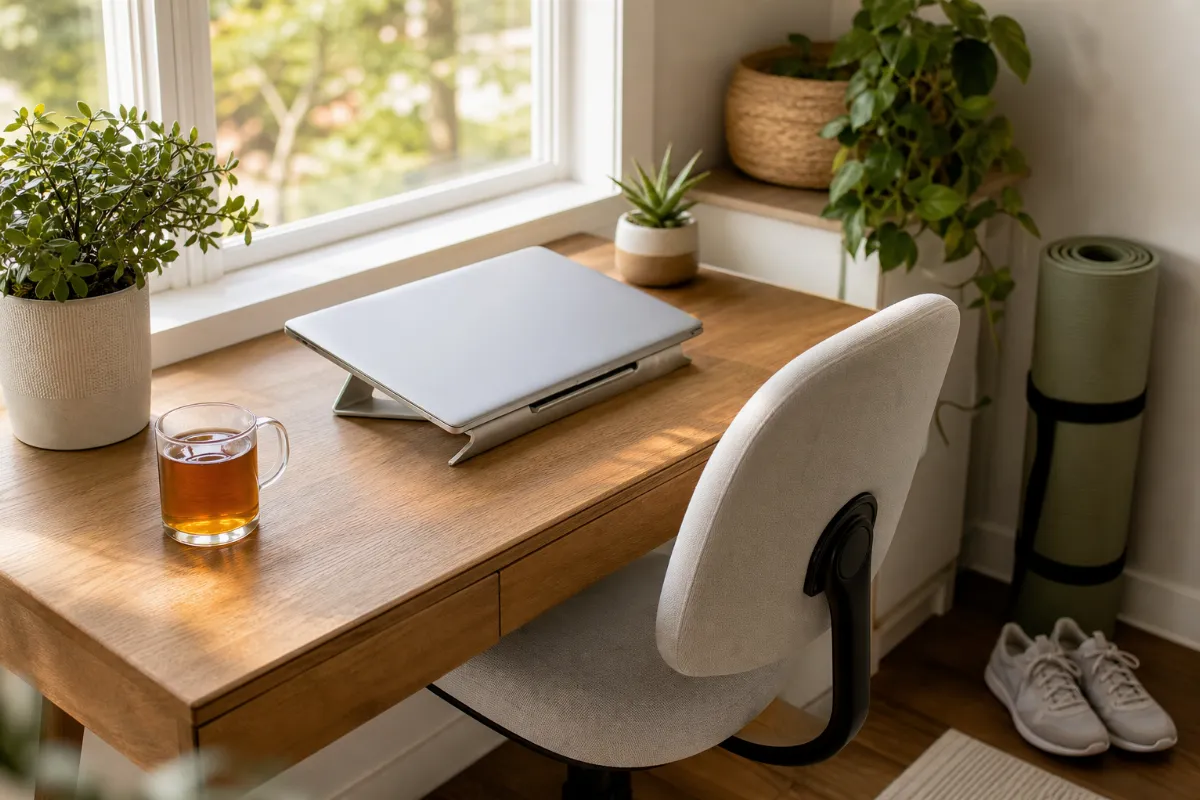
Move Better & Support Your Joints
Improve Your Posture & Movement Habits
Good posture is less about holding one perfect position and more about changing position often, moving through the day and building the strength to do it comfortably. This page is about everyday posture, workspace set-up and movement variety; back care, joint comfort, flexibility and confidence in moving have their own goal pages.
General information, not medical advice. Last updated October 31, 2026. Written by the AlternativeMed editorial team. Not medically reviewed.
Start here
- Change position often: stand up, walk a few steps or shift how you sit every so often rather than trying to hold one 'correct' posture for hours.
- Set up the place where you spend the most time sitting so that your screen, chair, keyboard and feet fit you, using a simple checklist such as the one from OSHA.
- Add regular movement that strengthens the muscles around your back, core, shoulders and hips, in small steps that suit your fitness.
Be careful with
- Do not force a stiff, rigid posture or wear a neck collar or brace for ordinary aches unless a clinician has advised it: the NHS says it is better to keep your neck moving.
- Pain, tingling or numbness that spreads, gets worse or does not ease after a few weeks needs a proper check; do not push through it.
- Posture gadgets, braces and 'corrector' products are sold with big promises. We did not find controlled trials supporting them, so treat them with caution.
- If you have osteoporosis, a recent injury or surgery, or a long-term condition, ask a clinician or physiotherapist before starting a new exercise programme.
Get help when
- Back pain with pain, tingling, weakness or numbness in both legs, loss of feeling around the genitals or anus, or changes in bladder or bowel control: the NHS says to call 999 or go to A&E.
- Back pain that starts suddenly and is severe or getting worse quickly, back pain after a serious accident or fall, back pain with chest pain, or back pain with fever or feeling generally unwell.
- Back or neck pain that has not improved after a few weeks, is worse at night or does not ease with rest, or comes with unexplained weight loss.
- Pins and needles, numbness or weakness in an arm or leg, a cold arm with neck pain, a lump or swelling in your back, or a back that has changed shape.
- Pain, burning, tingling or weakness in the hands, wrists, forearms or shoulders from repeated movements that is not going away or is getting worse.
About Improve Your Posture & Movement Habits
What this goal means
MedlinePlus describes posture as how you hold your body, both while moving (dynamic posture, such as walking or bending) and while still (static posture, such as sitting, standing or sleeping). It says the spine has three natural curves, at the neck, mid back and low back, and that good posture keeps these curves without exaggerating them.
This goal is about the habits around that: how often you change position, how your workspace fits you, how much you move, and whether the muscles that hold you up are used and strong. It is not about reaching a single ideal pose.
1,2What it can feel like
Common experiences are a stiff neck or tight shoulders after a long day at a screen, an ache between the shoulder blades, a tired lower back from sitting, or noticing that you are hunched over a phone or laptop. Some people simply feel that they slouch and would like to carry themselves differently.
The NHS lists bad posture, for example when sitting at a desk for a long time, among the most common causes of neck pain, alongside sleeping awkwardly, a pinched nerve or an injury.
3,4What can make it harder
Long unbroken periods in one position are the most common theme. NIAMS says a desk job may play a part in back pain, especially with poor posture or a day in an uncomfortable chair, and the NHS says not to keep your neck in the same position for a long time.
Other factors named by health agencies include low fitness and weak back and stomach muscles, extra weight, a workstation that does not fit you, high heels, stress and poor sleep, and doing too much too quickly after a period of inactivity.
5,3,1Conditions that can be behind it
Aches that people put down to posture can also come from neck or back pain, repetitive strain injury, tendon problems, a trapped nerve, or in older adults a changed curve of the upper back with age or bone thinning. NIAMS lists many possible causes of back pain, from muscle strain and disc problems to osteoporosis, and notes that often several factors act together.
Pain that persists, spreads or comes with other symptoms should be assessed rather than put down to posture alone.
5,6,7Realistic expectations
A large review of 41 systematic reviews found no consensus that any particular spine posture causes low back pain: some studies found links and others did not, and the authors concluded that association has been documented but does not explain causation. This is why current advice focuses on varying position and staying active rather than chasing one perfect posture.
Trials of workplace changes and movement breaks show real but modest benefits, and many are small or at high risk of bias. Expect gradual change over weeks, not an instant fix, and expect to keep the habits going.
8,9,10Who this applies to
Adults who sit, stand or do repetitive tasks for long periods, anyone who spends a lot of time on a phone, laptop or tablet, and people who would like to feel more comfortable and upright in everyday life. Older adults with a rounded upper back, pregnant people, children and teenagers, and anyone with a spine, bone or nerve condition should read the life-stage notes and involve a clinician.
1,11Related conditions and symptoms
Back pain → Neck pain → Tendinitis → Carpal tunnel syndrome → Tension headache → Sciatica → Chronic pain → Osteoporosis →
A manageable starting plan
An educational starting point, not a personal prescription. Adjust it to your own situation and any advice from your clinician.
Your first actions
- Pick a reminder that works for you and change position or move every so often during long sitting or standing.
- Check your main workspace against a simple checklist (screen at or just below eye level, feet flat, back supported, relaxed shoulders) and fix the biggest gap first.
- Add some muscle-strengthening and gentle stretching on most weeks, building up gradually.
- Bring phones and tablets towards eye level and take breaks from head-down use.
Optional additions
- Try a beginner yoga, tai chi or Pilates class with a qualified instructor.
- Adjust your pillow and sleep position if you wake with a stiff neck.
- Ask a physiotherapist or occupational therapist for a tailored plan if aches persist.
- Wear comfortable, low-heeled shoes for long days.
What to track
- How often you take a movement break in a typical day.
- Where and when aches show up (neck, shoulders, lower back), and what you were doing.
- How you feel at the end of the day and after waking.
When to reassess
Give new habits about 4 weeks. If aches are not easing, are getting worse, or you have any of the warning signs on this page, see a doctor or physiotherapist rather than adding more gadgets.
When to seek professional support
- See a GP if back or neck pain has not improved after a few weeks, is worse at night, or comes with other symptoms.
- In many UK areas you can self-refer to NHS community musculoskeletal services for physiotherapy.
- Ask your employer about a workstation assessment if you work at a computer.
What helps
Ordered by how well the research supports each step. Evidence strength is shown on every card; precautions sit next to the advice.
Start here
Change position often instead of holding one 'perfect' posture
Low certaintyAddresses: Less time in a single, tiring position
Why it may help: OSHA says there is no single correct posture or arrangement that fits everyone, and the NHS advises not keeping your neck in the same position for a long time. MedlinePlus advises switching sitting positions often. In a cluster-randomized trial of 193 high-risk office workers, those given a tool that prompted posture shifts developed neck pain less often over 6 months (17% versus 44% with a placebo seat pad) and low back pain less often (7% versus 33%). A large review of reviews found no consensus that any one spine posture causes low back pain.
How to apply it: Alternate between sitting, standing and short walks. Shift how you sit (feet flat, then one foot on a footrest, upright, then a little reclined). Use a timer or a phone reminder until the habit forms.
Who it may suit: Anyone who sits or stands for long periods.
Precautions: The trial used a special apparatus in one city, not just advice. Stop and get advice if a position causes pain, tingling or numbness.
2,3,1,12,8Take short movement breaks
Low certaintyAddresses: May reduce stiffness and discomfort from long sitting
Why it may help: The NHS advises breaking up long periods of not moving with some activity. A systematic review of 8 randomized and 3 non-randomized trials found moderate-quality evidence that active breaks with a change of posture reduced pain and discomfort in office workers, and no harm to productivity, though the authors said more high-quality studies are needed. A 2026 review of 6 trials (210 people) of 2 to 10 minute 'exercise snacks' found less discomfort in 4 of the 6, but 5 of the 6 were at high risk of bias.
How to apply it: Every so often, stand, walk a few steps, roll your shoulders and gently stretch. Even a couple of minutes counts. Link breaks to things you already do, such as finishing an email or a phone call.
Who it may suit: Desk workers, drivers, students and anyone who sits for long spells.
Precautions: Keep breaks gentle if you are in pain. The studies varied widely in how long and how often people moved.
13,10,14Set up your workspace so it fits you
Mixed findingsAddresses: Makes comfortable positions easier to keep
Why it may help: OSHA's computer workstation guidance suggests the top of the monitor at or just below eye level, head and neck balanced over the torso, shoulders relaxed, elbows close to the body and supported, lower back supported, wrists in line with forearms and feet flat on the floor. A Cochrane review of 15 trials (2,165 office workers) found moderate-quality evidence that an arm support combined with an alternative mouse reduced neck or shoulder disorders, but no clear effect for workstation adjustment alone or a sit-stand desk (one study each), and 14 of the 15 trials were at high risk of bias.
How to apply it: Use a checklist such as OSHA's. Raise a laptop on a stand and use a separate keyboard and mouse. Make sure your chair supports the curve of your lower back, and use a footrest if your feet do not reach the floor.
Who it may suit: People who work at a desk or computer for long periods.
Precautions: A good set-up helps most when you also move. If you have symptoms such as tingling in the hands, an occupational therapist or workplace assessor can tailor advice.
2,9,1Strengthen the muscles that hold you up
Low certaintyAddresses: Makes good positions less tiring to keep
Why it may help: MedlinePlus says any exercise may help posture, with core-strengthening exercises (the muscles around the back, abdomen and pelvis) especially useful. NIAMS advises regular exercise that keeps back muscles strong, and notes that weak back and stomach muscles may not support the spine properly. A randomized trial of 142 office workers with neck, shoulder and low back pain found that a stretching and exercise programme, alone or with workplace changes, lowered pain scores more than no treatment, and the authors advised not relying on workplace changes alone. A review of 7 trials (967 office workers) also reported benefit from workplace exercise but with high risk of bias in 6 of 7.
How to apply it: Build up gradually towards the NHS-recommended amounts of weekly activity, including muscle-strengthening on at least 2 days a week for the main muscle groups if you are able. A physiotherapist can show you exercises for your back, shoulders and hips.
Who it may suit: Most adults, unless a clinician has advised otherwise.
Precautions: Add exercise gradually. NIAMS warns that back pain is more likely if you exercise too strenuously after being inactive. Check with a doctor or physiotherapist first if you have a medical condition, osteoporosis or an injury.
1,5,15,16,13Physical Activity, Strength and Keeping Muscle → Strength Training and Protein for Older Adults →
Keep your head up when using a phone or tablet
Low certaintyAddresses: Eases strain on the neck
Why it may help: A meta-analysis of 7 retrospective studies (10,715 people) found that heavy smartphone use was associated with higher odds of neck pain (adjusted odds ratio 2.34). Because these studies look back in time, they show an association, not proof of cause. The NHS lists sitting at a desk for a long time and bad posture among common causes of neck pain.
How to apply it: Raise the phone or tablet towards eye level rather than bending your neck, change position, put the device down for a while and keep your neck moving.
Who it may suit: People who use phones, tablets or laptops for long periods.
Precautions: Headaches, arm tingling or neck pain that lasts should be checked.
17,3Keep your neck and body moving rather than resting
Moderate certaintyAddresses: Avoids stiffness and weakness from too much rest
Why it may help: The NHS says to keep your neck moving rather than wear a collar, and for repetitive strain injury says not to rest the affected area for more than a few days because resting too long can leave it weaker and less flexible. For back pain it advises staying active and continuing daily activities. A Lancet review of guidelines reports recommendations for education that supports self-management and a return to normal activities and exercise.
How to apply it: Carry on with normal activities as pain allows. Reduce, but do not stop, activity that sets the pain off, and build back up gradually.
Who it may suit: People with ordinary aches from posture or repetitive tasks.
Precautions: This does not apply after a serious injury, a suspected fracture or if you have the warning signs listed on this page.
3,6,7,18Additional options
Neck and shoulder stretching
Low certaintyAddresses: May ease neck and shoulder pain in office workers
Why it may help: In a randomized trial of 96 office workers with moderate-to-severe neck pain for at least 3 months, all received an ergonomics leaflet and the treatment group also did neck and shoulder stretches twice a day, 5 days a week, for 4 weeks. The stretching group improved more on pain (about 1.4 points more on a 10-point scale), neck function and quality of life, and those who stretched at least 3 times a week did better still.
How to apply it: Stretch gently within a comfortable range, a few times a week or more, and stop if it hurts. A physiotherapist can show suitable stretches.
Who it may suit: Adults with stiff, tight necks and shoulders from desk work.
Precautions: One trial with a short follow-up. Do not force a stretch; see a doctor first if you have arm tingling, a cold arm or numbness.
19,3Relax Your Body & Release Tension → Improve Your Flexibility →
Alexander Technique lessons
Low certaintyAddresses: Learning to use the body with less strain; studied for back pain
Why it may help: In a trial of 579 people in England with chronic or recurrent low back pain, 24 one-to-one lessons with registered teachers reduced back-pain disability at one year (about 3.4 points on a scale where the usual-care group averaged 8.1). Six lessons followed by an exercise prescription achieved most of that effect. Massage did not remain effective at one year. No significant harms were reported. The trial measured back pain, not posture itself.
How to apply it: Look for a registered teacher; lessons are usually one to one and teach how to notice and release unnecessary tension in everyday movements.
Who it may suit: Adults with recurrent back pain who want a body-awareness approach.
Precautions: A single trial from 2008; lessons can be costly. Tell the teacher about any injury or medical condition.
20Yoga
Low certaintyAddresses: Small improvements in back function; body awareness
Why it may help: MedlinePlus lists yoga, tai chi and classes that focus on body awareness as useful for posture. A Cochrane review of 21 trials (2,223 people) found that, compared with no exercise, yoga probably gives a small improvement in back-specific function (low-certainty evidence) and pain (moderate certainty) at 3 months that is smaller than what would be seen as clinically important, with little or no difference compared with other back-focused exercise. Low-certainty evidence suggested more adverse events with yoga, mainly increased back pain.
How to apply it: Start with a beginner class led by a qualified instructor and tell them about any pain or condition. Move within your comfort range.
Who it may suit: Adults who enjoy movement and want a regular practice.
Precautions: NCCIH says people with health conditions, older adults and pregnant people may need to avoid or modify some poses. Injuries can occur.
1,21,22Tai chi and qigong
Moderate certaintyAddresses: May reduce pain and disability in chronic musculoskeletal conditions
Why it may help: A meta-analysis of 15 trials (mostly in people with osteoarthritis, with some back pain and headache) found moderate-quality evidence that tai chi reduced pain and disability in the short term compared with no treatment or usual care; long-term effects were not well studied and many trials were small. NCCIH describes tai chi as generally safe, with minor aches possible. MedlinePlus lists tai chi among exercises that may help posture.
How to apply it: Join a beginner class and practise regularly; gentle, slow movements with attention to balance and breathing.
Who it may suit: Adults of most ages who like gentle, low-impact movement.
Precautions: Choose a level that suits your balance and health. Tell the instructor about any joint, bone or heart condition.
23,22,1Pilates
Low certaintyAddresses: May reduce low back pain compared with doing little
Why it may help: A Cochrane review of 10 trials (510 people) found low-quality evidence that Pilates reduced pain compared with minimal intervention in the short term, and moderate-quality evidence at intermediate follow-up. Compared with other exercise, results were mixed. The NHS also mentions pilates among activities that may help ease back pain.
How to apply it: Start with a beginner or small-group class with a trained instructor and progress slowly.
Who it may suit: Adults with non-specific low back pain who want a structured core-strength routine.
Precautions: Tell the instructor about pregnancy, injuries, osteoporosis or recent surgery so exercises can be adapted.
24,7Sleep positions that keep the neck and back neutral
Not enough evidenceAddresses: May lower morning stiffness and neck strain
Why it may help: The NHS advises that your head is level with the rest of your body when sleeping, a firm mattress, not sleeping on your front and not twisting your neck in bed, and suggests a low, firm pillow if you have neck pain. NIAMS suggests sleeping on your side with a small pillow between your knees, or on your back with a pillow under your knees. These are agency tips; we did not find controlled trials of them.
How to apply it: Try a pillow that keeps your head level with your spine, and adjust until you wake with less stiffness.
Who it may suit: People who wake with a stiff neck or sore back.
Precautions: If waking pain is severe, wakes you from sleep or is getting worse, get it checked.
3,25Still being studied
Exercises for a rounded upper back in older adults
Moderate certaintyAddresses: Can reduce the rounded curve (kyphosis) in older adults
Why it may help: A meta-analysis of 24 studies in adults aged 45 and older with increased upper-back curvature found that exercise or physical therapy improved kyphosis measures (moderate-certainty evidence) and quality of life, with no serious adverse events reported; effects on falls were uncertain. In a randomized trial of 99 adults aged 60 and over, 6 months of supervised spine-strengthening and posture training three times a week reduced the curve by about 3 degrees more than health education.
How to apply it: Programmes in trials were supervised by physical therapists and used group spine-strengthening exercise and posture training.
Who it may suit: Older adults with a visibly rounded upper back, after a clinician has checked bone health.
Precautions: A newly rounded back, height loss or sudden back pain may reflect a bone fracture (osteoporosis); see a doctor before starting exercise. Falls risk matters in older adults.
26,27,7Exercises for forward head posture
Low certaintyAddresses: Can change measured head position; the link to pain is not settled
Why it may help: A meta-analysis of 7 trials (627 people) found that corrective exercise improved one measure of forward head position and was linked with less neck pain, but the authors say the exact relationship between head position and pain remains to be established. A separate meta-analysis of 15 cross-sectional studies found that adults with neck pain had more forward head posture than those without, and that this was associated with pain in adults, but not in adolescents; such studies cannot show which comes first.
How to apply it: Exercises in trials were guided by physiotherapists; ask a physiotherapist for a programme rather than copying generic routines.
Who it may suit: Adults with persistent neck pain who want a guided exercise programme.
Precautions: Pins and needles, arm weakness or a cold arm with neck pain need a medical check first.
28,11,3Sit-stand desks and activity trackers
Low certaintyAddresses: Reduce sitting time, but symptom benefit not shown
Why it may help: A Cochrane review of 10 studies (955 people) of workplace interventions to increase standing or walking found low-quality evidence of no significant difference in low back, upper back or neck symptoms for sit-stand workstations, activity trackers or multi-part programmes, compared with no intervention. The authors note the studies were short and limited in quality.
How to apply it: If you have a sit-stand desk, use it to alternate positions rather than stand all day.
Who it may suit: People who want to sit less and have access to a sit-stand desk.
Precautions: Prolonged standing can also tire the legs and back; alternate positions.
29,9Food & nutrition
Food and posture: what the evidence says
No food or supplement has been shown to improve posture. What you eat matters indirectly: MedlinePlus says extra weight can weaken the abdominal muscles, cause problems for the pelvis and spine and contribute to low back pain, and NIAMS lists a healthy weight and enough calcium and vitamin D among habits that keep the spine strong.
We did not find trials showing that any particular food, herb or supplement corrects posture. If a product promises this, treat the claim with caution.
1,5Foods for strong bones and muscles
Bone and muscle strength support an upright frame. NIAMS names calcium and vitamin D as nutrients that keep the spine strong. Specific amounts depend on age and health, so see the bone-health and strength pages and ask a clinician if you are at risk of osteoporosis or have been told your bones are thin.
Do not start high-dose calcium or vitamin D supplements without advice, as upper limits exist.
5Remedies & supplements
Traditional use, laboratory findings and human trials are kept apart. "Natural" does not mean safe.
Heat packs (hot water bottle or heat pack)
Low certaintyStudied form and route: A heat pack or hot water bottle wrapped in a tea towel placed on a stiff area
Intended outcome: Eases stiffness and muscle spasm
Human evidence: The NHS suggests a heat pack or hot water bottle wrapped in a tea towel for joint stiffness or muscle spasm in back pain, and for neck pain suggests heat or cold packs.
Limits: These are NHS self-care tips; we did not find trials rating how much they help.
Interactions and precautions: Always wrap the pack to avoid burns. Take extra care with reduced skin sensation, diabetes, circulation problems or in older adults.
Dose, only as reported in studies: The NHS neck pain page suggests a hot water bottle wrapped in a tea towel for 20 minutes, 2 to 3 times a day.
7,3Cold packs
Low certaintyStudied form and route: A pack of frozen peas wrapped in a tea towel
Intended outcome: May reduce pain and swelling
Human evidence: The NHS suggests an ice pack wrapped in a tea towel for pain and swelling in back pain, and for neck pain a frozen-pea pack wrapped in a tea towel for 5 minutes, 3 times a day; for repetitive strain injury, a cold pack for up to 20 minutes every 2 to 3 hours.
Limits: Self-care advice from the NHS; no trials were reviewed for this page.
Interactions and precautions: Always wrap the pack; do not use on skin with poor sensation.
Dose, only as reported in studies: As above: neck, 5 minutes up to 3 times a day (NHS).
7,3,6Cayenne (capsaicin) cream or plaster
Low certaintyStudied form and route: Topical preparations applied to the skin
Intended outcome: May relieve low back pain
Human evidence: NCCIH says there is evidence that topical cayenne reduces low back pain, and lists it among the herbal products that may help low back pain. We did not review trials ourselves.
Traditional use: Chili peppers have long been used as a warming rub.
Limits: Evidence is for back pain, not for posture. Quality and products vary.
Interactions and precautions: Can sting or burn; follow the label, test on a small area, keep away from eyes and broken skin and wash your hands afterwards. NCCIH notes herbal products may interact with medicines; ask a pharmacist if you use other treatments.
22Massage
Low certaintyStudied form and route: Therapeutic massage by a trained therapist
Intended outcome: Short-term relief of back and neck tension
Human evidence: NCCIH reports a 2015 review of 25 studies (about 3,000 people) that found massage may bring short-term pain relief in low back pain, with low to very low-quality evidence. In the ATEAM trial, massage did not remain effective at one year. NCCIH says the risk of harm appears low.
Limits: Short-lived benefit in studies; evidence quality is low.
Interactions and precautions: Tell the therapist about injuries, pregnancy, bone conditions or if you take blood thinners.
22,20Oral devil's claw and white willow bark
Not enough evidenceStudied form and route: Herbal products taken by mouth
Intended outcome: Possible help with back pain; not shown for posture
Human evidence: NCCIH lists devil's claw and white willow bark, taken by mouth, among herbal products that might be beneficial for low back pain. We did not review the trials, and nothing suggests they affect posture itself.
Traditional use: Both are traditional herbal remedies for aches and pains.
Limits: Evidence is limited and for back pain only.
Interactions and precautions: NCCIH warns that herbal products may have side effects or interact with medicines. Ask a pharmacist or doctor first, especially if you take regular medicines such as blood thinners, have a long-term condition, are pregnant or breastfeeding.
22Therapies & care
Established professional care for posture-related aches starts with a clinician assessment if pain is persistent, and often physiotherapy and occupational therapy. This page does not recommend medicines or doses, and you should not stop a prescribed medicine on your own.
Physiotherapy
Moderate certaintyExercise and movement-based care The NHS says a physiotherapist can show exercises that strengthen muscles and improve posture, and lists group exercise sessions and physiotherapy among treatments for back pain that does not improve. In many UK areas you can refer yourself to NHS community musculoskeletal (MSK) services. A Lancet review of guideline recommendations lists self-management education and exercise as first-line care.
Who it may suit: People with persistent aches, recurrent back or neck pain or repetitive strain.
Precautions: Tell the physiotherapist about medical conditions, osteoporosis and pregnancy.
6,7,18Occupational therapy and workplace assessment
Low certaintyWork and daily-activity advice The NHS says an occupational therapist can work out what is causing the problem and suggest exercises, equipment or changes to your workspace to reduce pain and prevent symptoms getting worse. OSHA's checklist is a starting point for a self-assessment.
Who it may suit: People with repetitive strain, work-related aches or a workstation that does not fit.
Precautions: Changes work best when combined with movement and exercise.
6,2,9Supervised exercise for older adults with a rounded upper back
Moderate certaintyExercise programme Programmes of spine-strengthening exercise and posture training led by a physical therapist reduced kyphosis in trials of older adults, and a meta-analysis found moderate-certainty evidence for improved kyphosis measures.
Who it may suit: Older adults with a visibly rounded upper back after a clinician has assessed bone health.
Precautions: Bone density and fracture risk are medical questions. Do not stop osteoporosis or other prescribed medicines because of exercise.
26,27Spinal manipulation and manual therapy
Low certaintyHands-on therapy The NHS lists manual therapy, where a trained therapist massages and moves the muscles, bones and joints, among treatments for back pain that does not improve after a few weeks. NCCIH reports that the American College of Physicians guideline includes spinal manipulation as an option for acute and chronic low back pain (low-quality evidence), that mild temporary side effects are common, and that serious side effects have occurred though it is unclear whether the treatment caused them.
Who it may suit: People with back pain who want hands-on care after discussing it with a clinician.
Precautions: Choose a registered practitioner. Tell them about osteoporosis, pregnancy, blood thinners, numbness or weakness first.
7,22Medical assessment for persistent or worrying symptoms
Moderate certaintyClinical assessment NIAMS says doctors take a history and examine your spine and posture, and most people do not need extra tests. A GP can check for nerve problems, bone thinning, arthritis or other causes if pain persists, is worse at night, or comes with warning signs.
Who it may suit: Anyone with the warning signs listed on this page or pain lasting more than a few weeks.
Precautions: Do not wait if you have symptoms that need urgent care.
25,7,3What to avoid
Habits, products and claims that can get in the way. Never stop a prescribed medicine without talking to the professional who prescribed it.
Risks that apply to most people
Staying in one position for hours
Low certaintyWhy: The NHS says not to keep your neck in the same position for a long time, and NIAMS advises that when sitting for a long period you get up, move around and switch positions frequently.
Who it applies to: Desk workers, drivers, gamers, students and anyone absorbed in a screen.
Try instead: Change position and move every so often; set a reminder if you forget.
3,25,12Doing too much, too fast, after a period of inactivity
Low certaintyWhy: NIAMS says back pain is more likely if you exercise too strenuously after being inactive for a while.
Who it applies to: People starting a new exercise programme or returning after a break.
Try instead: Build up gradually, warm up first and stop if pain gets worse.
5,25High heels and shoes that throw off your balance
Low certaintyWhy: MedlinePlus says high heels can throw off balance and make you walk differently, putting more stress on muscles and harming posture; NIAMS suggests comfortable shoes with a low heel.
Who it applies to: People who wear high heels often or stand for long periods.
Try instead: Choose comfortable, low-heeled shoes for long days; save heels for short occasions.
1,25Personal triggers to check
Long head-down phone and tablet use
Low certaintyWhy: An association between heavy smartphone use and neck pain was found in a meta-analysis of retrospective studies; the NHS lists posture at a desk among causes of neck pain.
Who it applies to: People who spend hours on a phone or tablet.
Try instead: Bring the screen up towards eye level, change position and take regular breaks.
17,3Sleeping on your front or twisting your neck in bed
Not enough evidenceWhy: The NHS advises against both to help prevent neck pain.
Who it applies to: People who wake with a stiff neck.
Try instead: Try sleeping on your side or back with your head level with your body.
3Repetitive tasks without variety
Low certaintyWhy: The NHS notes that repeated use of a body part, for example typing or using power tools, and poor posture when sitting or standing at work can contribute to repetitive strain injury, although many people do the same job for years without problems.
Who it applies to: Workers in repetitive jobs and long-hours computer users.
Try instead: Vary tasks, take short breaks, and ask your employer or an occupational therapist about changes to how you work.
6,9Products that need caution
Posture braces, 'correctors' and straps used as a cure
Not enough evidenceWhy: We did not find controlled trials showing that wearable posture correctors improve posture or pain in the long term in our searches. Relying on a brace in place of building strength and moving more may not address the cause.
Who it applies to: Anyone tempted by posture-corrector products.
Try instead: Build strength and movement habits first; if a clinician recommends a brace, use it as they advise.
1Neck collars for ordinary neck pain
Moderate certaintyWhy: The NHS says not to wear a neck collar for neck pain unless a doctor tells you to, because it is better to keep your neck moving.
Who it applies to: People with stiff or painful necks.
Try instead: Keep your neck moving gently, use heat or cold, and see a GP if it does not go away.
3Expensive ergonomic equipment as the only fix
Mixed findingsWhy: A Cochrane review found inconsistent evidence for arm supports and alternative mice, and no clear effect of workstation adjustment or sit-stand desks alone; most trials had a high risk of bias.
Who it applies to: People buying chairs, desks or gadgets for comfort.
Try instead: Make sure what you already have is adjusted well, and add movement breaks and exercise.
9,2Unsupported claims
"Slouching will wreck your spine"
Low certaintyWhy: MedlinePlus says slouching can misalign the musculoskeletal system, wear away at the spine and cause neck, shoulder and back pain. However, a review of 41 systematic reviews found no consensus that specific spinal postures cause low back pain. Association has been documented but does not prove cause.
Who it applies to: Articles, adverts and social media posts about posture.
Try instead: Treat posture as one factor among several; vary position, move often and stay strong.
1,8"Perfect posture prevents back and neck pain"
Low certaintyWhy: OSHA says there is no single correct posture that fits everyone, and Swain and colleagues found no consensus on causality. Trials of ergonomic changes show mixed results.
Who it applies to: Product claims and workplace posters.
Try instead: Aim for comfortable, supported positions that you change often.
2,8,9"A standing desk fixes back pain"
Low certaintyWhy: A Cochrane review found low-quality evidence of no significant difference in back symptoms with sit-stand workstations compared with no intervention.
Who it applies to: Marketing for standing desks.
Try instead: Use the desk to vary position and move more through the day.
29Common mistakes
Forcing a rigid, 'military' posture all day
Low certaintyWhy: OSHA says there is no single correct posture, and holding any position for too long is tiring. A stiff pose can add tension rather than relieve it.
Who it applies to: People trying hard to 'sit up straight'.
Try instead: Use relaxed, supported positions (shoulders relaxed, back supported, feet flat) and change them often.
2,1Resting for long periods when something aches
Moderate certaintyWhy: The NHS says not to stay in bed for long periods with back pain, and not to rest an area with repetitive strain for more than a few days because it can get weaker and less flexible.
Who it applies to: People with new back, neck or arm aches.
Try instead: Keep gently active within what is comfortable and build up gradually.
7,6Pushing through pain, tingling or numbness
Moderate certaintyWhy: The NHS says pins and needles or a cold arm with neck pain could be something more serious, and advises stopping exercises if back pain gets worse and seeing a GP.
Who it applies to: Anyone with nerve-type symptoms or worsening pain.
Try instead: Stop the activity and get advice from a doctor or physiotherapist.
3,7Evidence & safety
What the research shows
Health agencies agree that changing position often, avoiding long unbroken sitting, setting up a workspace that fits you and staying physically active are sensible habits. The research is more modest than the advice: a review of reviews found no consensus that a specific spine posture causes low back pain, and trials of ergonomic equipment and sit-stand desks give mixed or low-quality results. Movement breaks with postural change, exercise and stretching programmes, tai chi and yoga show small to moderate benefits in studies that are often small or at risk of bias. Exercise programmes for a rounded upper back in older adults have moderate-certainty evidence.
Limits of the evidence
- Many workplace trials were small, short and at high risk of bias, and participants usually could not be blinded to the intervention.
- Studies linking posture and pain are often cross-sectional, so they cannot show which comes first.
- Much of the best evidence is for low back pain, not for posture itself.
- Pain scores are self-reported.
- We did not read every trial behind the agency and review summaries cited here.
Precautions and interactions
- Add exercise gradually and stop if pain, tingling or numbness gets worse.
- Ask a clinician or physiotherapist before starting exercise if you have osteoporosis, a recent injury or surgery, a heart or lung condition or other long-term illness.
- Herbal and topical products may cause skin reactions or interact with medicines; ask a pharmacist, especially if you take blood thinners.
- Never stop a prescribed medicine, including osteoporosis medicines, because of a posture or exercise programme without speaking to your prescriber.
Life-stage considerations
- Pregnancy: posture and comfort change; NCCIH notes that pregnancy may affect the safety of some mind-body practices, so choose antenatal-trained instructors and ask your midwife or doctor.
- Children and teenagers: a review found forward head posture was not clearly linked to neck pain in adolescents; ask a doctor if you notice a new or changing curve of the spine.
- Older adults: a rounded upper back, height loss or new back pain may reflect bone thinning; see a doctor, and include balance and falls-prevention exercise.
- People with chronic conditions: check with your clinician before changing your activity.
Warning signs
- Back pain with weakness, numbness or tingling in both legs, loss of feeling around the genitals or anus, or bladder or bowel changes: the NHS says call 999 or go to A&E.
- Back pain that starts suddenly and severely, back pain after a serious accident, back pain with chest pain, or with fever or feeling generally unwell.
- Back or neck pain that is worse at night or does not improve with rest, with unexplained weight loss, a lump or swelling, or a back that has changed shape.
- Pins and needles, numbness or a cold arm with neck pain.
Claim checks
Bad posture causes back pain
Low certaintyAgencies list poor posture among contributing factors, but a review of 41 systematic reviews found no consensus on causality. Association is documented; cause is not established.
8,5Ergonomic equipment prevents work-related pain
Mixed findingsMixed. A Cochrane review found moderate-quality evidence for an arm support combined with an alternative mouse reducing neck or shoulder disorders, but no clear effect for several other changes, and most trials had a high risk of bias.
9Sit-stand desks relieve back pain
Low certaintyA Cochrane review found low-quality evidence of no significant difference in back symptoms compared with no intervention.
29Sitting upright makes you feel more confident
Very low certaintyIn a lab experiment of 74 people, those held in an upright seated posture reported better mood, higher self-esteem and less fear during a stress task than those held slumped. It is a single, small, artificial study.
30Posture correctors fix your posture
Not enough evidenceWe did not find controlled trials supporting this claim in our searches. Strength, movement habits and guided exercise have better support.
1Questions people ask
What is good posture?
MedlinePlus describes it as keeping the natural curves of the spine, with your head above your shoulders and the top of your shoulder over your hips. OSHA adds that there is no single correct posture that fits everyone, so comfortable positions you change often matter.
Does poor posture cause back or neck pain?
It can contribute, according to NHS and NIAMS pages, but a review of 41 systematic reviews found no consensus that specific spine postures cause low back pain. Many factors act together, including fitness, stress, sleep and workload.
How often should I move if I sit all day?
The NHS advises breaking up long periods of not moving with some activity. Trials used breaks from 20 seconds to 30 minutes, so there is no proven ideal, but frequent short breaks with a change of posture had the best support in a review of office-worker trials.
Do I need a standing desk?
Not necessarily. A Cochrane review found low-quality evidence that sit-stand desks did not significantly change back symptoms. They can help you alternate positions, but moving regularly is the key.
How should I set up my computer?
OSHA suggests the top of the monitor at or just below eye level, head and neck balanced over your torso, shoulders relaxed, elbows close to your body, lower back supported, wrists in line with forearms and feet flat on the floor.
Are posture correctors worth buying?
We did not find controlled trials supporting them. Strength, stretching and regular movement are better-supported options. If a clinician recommends a brace for a specific problem, follow their advice.
Can yoga, tai chi or Pilates help?
MedlinePlus lists yoga, tai chi and body-awareness classes as helpful for posture. Reviews found small to moderate benefits for back pain, often in low-quality studies. Choose a qualified instructor and tell them about any condition.
What about 'text neck'?
A meta-analysis of 7 retrospective studies found that heavy smartphone use was associated with neck pain. To ease strain, raise the screen, change position and take breaks. See a doctor for arm symptoms or pain that persists.
What if my upper back is rounded?
In older adults, supervised exercise and posture training can reduce the curve. A newly rounded back, height loss or sudden back pain can be a sign of bone thinning, so see a doctor first.
Does sleeping position matter?
The NHS advises keeping your head level with the rest of your body, not sleeping on your front and using a firm mattress. These are practical tips from health agencies rather than the result of trials.
When should I see a doctor?
If back or neck pain has not improved after a few weeks, is worse at night, or comes with numbness, weakness, fever, weight loss or bladder or bowel changes, get advice. Some of these need urgent care.
References
- MedlinePlus. Guide to Good Posture. Read 2026-10-31. source
- Occupational Safety and Health Administration (US). Computer Workstations eTool. Read 2026-10-31. source
- NHS. Neck pain (page last reviewed 27 April 2023). Read 2026-10-31. source
- MedlinePlus. Neck Injuries and Disorders. Read 2026-10-31. source
- NIAMS. Back Pain: Symptoms, Types, and Causes (last reviewed February 2023). Read 2026-10-31. source
- NHS. Repetitive strain injury (RSI) (page last reviewed 28 May 2026). Read 2026-10-31. source
- NHS. Back pain (page last reviewed 5 March 2026). Read 2026-10-31. source
- Swain CTV, et al. No consensus on causality of spine postures or physical exposure and low back pain: A systematic review of systematic reviews. J Biomech. 2020. PMID 31451200. source
- Hoe VC, et al. Ergonomic interventions for preventing work-related musculoskeletal disorders of the upper limb and neck among office workers. Cochrane Database Syst Rev. 2018. PMID 30350850. source
- Waongenngarm P, et al. The effects of breaks on low back pain, discomfort, and work productivity in office workers: A systematic review of randomized and non-randomized controlled trials. Appl Ergon. 2018. PMID 29409639. source
- Mahmoud NF, et al. The Relationship Between Forward Head Posture and Neck Pain: a Systematic Review and Meta-Analysis. Curr Rev Musculoskelet Med. 2019. PMID 31773477. source
- Waongenngarm P, et al. Effects of an active break and postural shift intervention on preventing neck and low-back pain among high-risk office workers: a 3-arm cluster-randomized controlled trial. Scand J Work Environ Health. 2021. PMID 33906239. source
- NHS. Physical activity guidelines for adults aged 19 to 64 (page last reviewed 22 May 2024). Read 2026-10-31. source
- Zeng J, et al. Can exercise snacks alleviate musculoskeletal discomfort in prolonged sitting? A systematic review of randomized controlled trials. BMC Public Health. 2026. PMID 42069572. source
- Shariat A, et al. Effects of stretching exercise training and ergonomic modifications on musculoskeletal discomforts of office workers: a randomized controlled trial. Braz J Phys Ther. 2018. PMID 28939263. source
- Tersa-Miralles C, et al. Effectiveness of workplace exercise interventions in the treatment of musculoskeletal disorders in office workers: a systematic review. BMJ Open. 2022. PMID 35105632. source
- Chen YJ, et al. Association of smartphone overuse and neck pain: a systematic review and meta-analysis. Postgrad Med J. 2025. PMID 39764644. source
- Foster NE, et al. Prevention and treatment of low back pain: evidence, challenges, and promising directions. Lancet. 2018. PMID 29573872. source
- Tunwattanapong P, et al. The effectiveness of a neck and shoulder stretching exercise program among office workers with neck pain: a randomized controlled trial. Clin Rehabil. 2016. PMID 25780258. source
- Little P, et al. Randomised controlled trial of Alexander technique lessons, exercise, and massage (ATEAM) for chronic and recurrent back pain. BMJ. 2008. PMID 18713809. source
- Wieland LS, et al. Yoga for chronic non-specific low back pain. Cochrane Database Syst Rev. 2022. PMID 36398843. source
- NCCIH. Low-Back Pain and Complementary Health Approaches: What You Need To Know (last updated January 2020). Read 2026-10-31. source
- Hall A, et al. Effectiveness of Tai Chi for Chronic Musculoskeletal Pain Conditions: Updated Systematic Review and Meta-Analysis. Phys Ther. 2017. PMID 27634919. source
- Yamato TP, et al. Pilates for low back pain. Cochrane Database Syst Rev. 2015. PMID 26133923. source
- NIAMS. Back Pain: Diagnosis, Treatment, and Steps to Take (last reviewed February 2023). Read 2026-10-31. source
- Ponzano M, et al. Exercise for improving age-related hyperkyphosis: a systematic review and meta-analysis with GRADE assessment. Arch Osteoporos. 2021. PMID 34546447. source
- Katzman WB, et al. Targeted spine strengthening exercise and posture training program to reduce hyperkyphosis in older adults: results from the study of hyperkyphosis, exercise, and function (SHEAF) randomized controlled trial. Osteoporos Int. 2017. PMID 28689306. source
- Sheikhhoseini R, et al. Effectiveness of Therapeutic Exercise on Forward Head Posture: A Systematic Review and Meta-analysis. J Manipulative Physiol Ther. 2018. PMID 30107937. source
- Parry SP, et al. Workplace interventions for increasing standing or walking for decreasing musculoskeletal symptoms in sedentary workers. Cochrane Database Syst Rev. 2019. PMID 31742666. source
- Nair S, et al. Do slumped and upright postures affect stress responses? A randomized trial. Health Psychol. 2015. PMID 25222091. source
Related on AlternativeMed
Related goals
Support Your Back During Everyday Activities → Improve Joint Comfort → Manage Joint Stiffness → Improve Your Flexibility → Maintain Your Range of Motion → Walk More Comfortably → Improve Your Balance → Feel More Confident Moving → Build Stronger Bones → Sit Less & Move More → Relax Your Body & Release Tension →
Ingredients, foods and supplements
Cayenne pepper → Devil's claw → Willow bark → Arnica →
Research, safety and claim-check resources
Falls and Balance Problems → Physical Activity, Strength and Keeping Muscle → Strength Training and Protein for Older Adults → Movement, Yoga and Tai Chi for Stress → Alexander Technique → Feldenkrais Method → Yoga → Tai chi → Qigong → Pilates → Massage therapy → Medicine interactions →