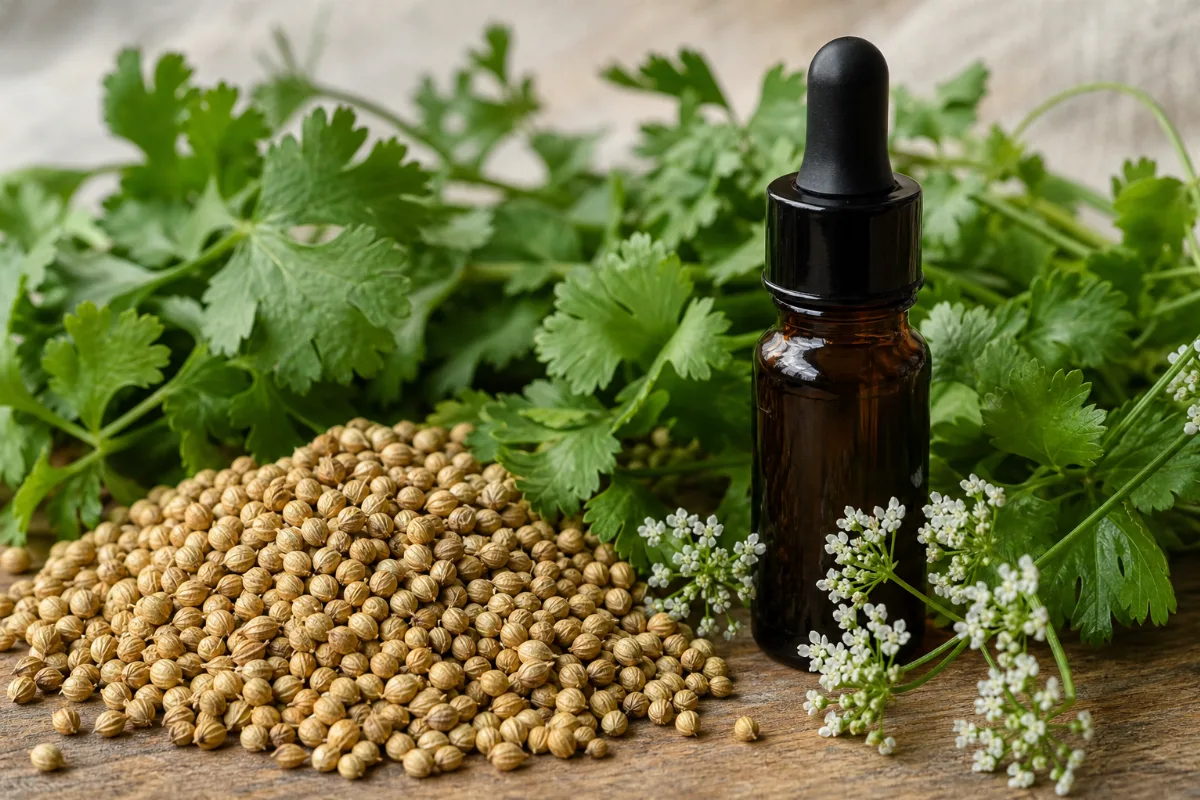
Essential Oils & Aromatherapy · Essential oil
Coriander Oil
Coriandrum sativum L. · also called Coriander seed oil, coriander fruit oil, coriander essential oil, cilantro seed oil
Coriander oil is the sweet, lightly spicy oil distilled from coriander seeds. Its main compound is linalool, a common fragrance that can cause skin allergy when it meets air. Human studies are a few small skin tests and one mouth-rinse trial, and the rest is lab or animal work, so no benefit is proven. The main caution: do not swallow it and do not use it undiluted on skin.
General information, not medical advice. Last substantive update · Not medically reviewed. A named clinician has not signed off on this page. How this page is made
About Coriander Oil
Coriander oil is a seed oil rich in linalool, used in perfume, skin products and aromatherapy. Human research is small: a pilot for athlete's foot, two UV redness tests and a mouth-rinse trial that found no change. Safety comes first: it is not for swallowing, should be diluted and kept off damaged skin, and its main compound turns into skin allergens when it meets air. Safety in pregnancy, children and pets is not established.
What coriander oil is
The oil is steam-distilled from the dry fruits (seeds) of Coriandrum sativum, a plant in the carrot family (Apiaceae, per GBIF).
The oil is a mixture. In one Peruvian seed oil, linalool was 59.80%, with alpha-pinene, camphor and gamma-terpinene as the next largest. Another study's oil was 81.29% linalool, so composition varies.
Three different things share the name. Seed oil is mostly linalool. Leaf (cilantro) oil is dominated by decanol- and decanal-type compounds. Pressed coriander seed oil is a fatty oil, not an essential oil. Results for one do not carry over to the others.
What people use it for, and how strong the evidence is
On the skin, one 40-person pilot found an ointment with coriander oil improved athlete's foot signs more than the plain ointment, though fungus cultures did not change significantly. Two small volunteer tests found a mild drop in UV redness, with the second test not significant. All are small and short.
As a mouth rinse, a two-week trial in 27 people with gum disease found no change in saliva germs compared with water.
Everything else (germs, fungus, pain, seizures, skin ageing, immune cells, memory) comes from test tubes, cells and rodents. A swallowed pressed seed oil helped sensitive skin in a pilot, but that is a different product.
The research in one view
Every human study of the oil is small. No large independent trial and no meta-analysis of coriander essential oil was found.
Claims about pain, seizures, infection and ageing rest on lab and animal work.
Oil, leaf, seed and supplements are different things
We did not use trials of coriander leaf, seed powder, tea or herbal formulas, because they are not the essential oil.
The one swallowed-oil trial used pressed seed oil, a different product. Poison Control says it can be hard to know the species, strength and contaminants in a bottle.
What regulators say
EFSA (2023) judged coriander oil safe as a feed flavouring at the proposed levels for most animal species, with lower levels for cats and chickens. It found no concern for consumers or the environment at those levels. These are feed figures, not advice for oils at home.
The US FDA says sleep, anxiety and pain claims make an aromatherapy product a drug, and that plant origin does not mean a product is safe. We did not read a statement from IFRA, SCCS, EMA or NCCIH about coriander oil.
At a glance
Traditional uses history, not proof
- Coriander seed is used in traditional medicine for joint pain, inflammation and digestion (2025 review; tradition, not proof for the oil).
- The oil is used as a natural fragrance and antimicrobial ingredient in skin products (2008 paper).
- Coriander is a common food spice, generally recognised as safe as a food by the FDA (NIH LactMed).
Studied for research
- Athlete's foot, ointment on skin, low
- UV-induced skin redness, test patches, low
- Gum disease, mouth rinse, insufficient
- Skin bacteria and Candida, laboratory, insufficient
- Pain, seizures and swelling, mice and rats, insufficient
- Skin ageing, immune cells and memory, laboratory, insufficient
- Sensitive skin, pressed seed oil swallowed (a different product), very-low
Main compounds
- Linalool, the main compound
- alpha-Pinene
- Camphor
- gamma-Terpinene
- Limonene, geraniol and geranyl acetate (named in a review)
Common forms
- Essential oil (steam-distilled from the dry fruits)
- Ointment, cream or lotion containing the oil (as used in trials)
- Mouth rinse containing the oil (as used in one trial)
- Pressed coriander seed oil (a different, fatty oil)
- Coriander leaf (cilantro) oil (a different oil)
Research links: Poison Control: Essential oils · FDA: Aromatherapy · EFSA opinion on coriander oil as a feed flavouring (abstract) · Patch tests to oxidised linalool (abstract) · Coriander oil for athlete's foot (abstract) · GBIF: Coriandrum sativum · Research Library · Genes & Biomarkers Library
What it is and its history
- Accepted scientific name
- Coriandrum sativum
- Naming authority
- L.
- Common names
- Coriander seed oil (English); Coriander fruit oil (English); Coriander essential oil (English); Cilantro seed oil (English)
- Family or group
- Apiaceae, the carrot family (GBIF).
- Classification
- Plantae > Apiaceae > Coriandrum > Coriandrum sativum
- Native range
- Not checked in a source read for this page.
- Habitat
- An annual herb, grown as a spice and fresh herb (a 2025 review).
- What it looks like
- Part used: The essential oil is steam-distilled from the dry fruits, called seeds (one Peruvian study used steam distillation of seeds; another used hydro-distillation).
- Look-alikes and adulterants
- Name: Coriander leaf (cilantro) essential oil; Note: A different oil: decanol, decanal and decenol-type compounds dominate (2026 scoping review).; Name: Pressed coriander seed oil; Note: A fatty oil rich in petroselinic acid (60 to 75%, per a 2022 pilot paper); not an essential oil.
- Sustainability and conservation
- Not checked.
Traditional use and history history, not clinical proof
| Tradition or era | Documented use | Source |
|---|---|---|
| Traditional medicine | A 2025 review says coriander has traditional medicinal uses for joint pain, rheumatoid arthritis, inflammation, as a digestive stimulant and as a carminative. These are uses of the plant and seed, not proof for the essential oil. | Chaurasia and Bharati 2025 (abstract) |
| Food and fragrance | LactMed says coriander is generally recognised as safe as a food by the FDA; Reuter et al. 2008 note coriander oil is used as an antimicrobial agent and a natural fragrance. We read no history of aromatherapy use. | NIH LactMed; Reuter 2008 abstract |
Traditional use shows how it was used. It does not show that it works or is safe today.
What is inside, and how it may work
What it contains and how those compounds act in cells and animals. Laboratory and animal mechanisms are not proven effects in people.
Main compounds
| Compound | Family | Where it is concentrated | Activity studied | Level of evidence |
|---|---|---|---|---|
| Linalool PubChem 6549 | monoterpene alcohol | Fruit (seed) oil 59.80% in a Peruvian seed oil; 81.29% in an oil used in an anti-ageing study. Varies by origin. | The main compound. On air exposure it forms hydroperoxides that are skin sensitisers (patch tests). Pure linalool showed pain-reducing action in mice (lab/animal). 22 14 15 5 11 | Clinical trial |
| alpha-Pinene PubChem 6654 | monoterpene | Fruit (seed) oil 8.65% in the Peruvian seed oil. | Listed as a minor main compound; its role was not examined. 22 14 | Not assessed |
| Camphor PubChem 2537 | monoterpene ketone | Fruit (seed) oil 8.48% in the Peruvian seed oil. | Listed as a minor main compound; its role was not examined. 22 14 7 | Not assessed |
| gamma-Terpinene PubChem 7461 | monoterpene | Fruit (seed) oil 7.09% in the Peruvian seed oil. | Listed; its role was not examined. 22 14 | Not assessed |
| Limonene PubChem 22311 | monoterpene | Fruit (seed) oil No typical value given. | Named among the main fruit compounds in a 2025 review; its oxidation products are also skin sensitisers. 22 7 5 | Not assessed |
| Geraniol PubChem 637566 | monoterpene alcohol | Fruit (seed) oil No typical value given. | Named among the main fruit compounds in a 2025 review. 22 7 | Not assessed |
| Geranyl acetate PubChem 1549026 | monoterpene ester | Fruit (seed) oil No typical value given. | Named among the main fruit compounds in a 2025 review. 22 7 | Not assessed |
Mechanisms, receptors and pathways
| Target or pathway | Gene or receptor | What was found | Level |
|---|---|---|---|
| Skin sensitisation by oxidised linalool | Not applicable (immune contact allergy) | Linalool autoxidises in air to hydroperoxides, potent sensitisers that cause positive patch tests (3.1% of 6,719 patients) with co-reactivity to other fragrance allergens. 5 11 | Human correlational |
| Inflammation signals in mouse immune cells | NO, TNF-alpha, IL-10, IL-4 | At low concentrations the oil lowered NO and TNF-alpha and raised anti-inflammatory signals in cells. 12 | Laboratory research |
| Cytokines and COX enzymes (rodents, computer model) | IL-1 beta, IL-6, COX-1, COX-2 | Lower IL-1 beta and IL-6 in rats; a computer model predicted moderate linalool binding to COX-1 and COX-2. 14 | In vivo animal |
| Skin-ageing enzymes and collagen pathway | Collagenase, elastase, TGF-beta / SMAD3 | Enzyme blocking in the lab, and higher TGF-beta and SMAD3 protein with special formulations in UV-injured rat skin. 15 | In vivo animal |
| Fungal and bacterial growth | Not specified | The oil inhibited Candida (30 lab studies), skin bacteria including MRSA, and P. gingivalis in the lab. 16 6 9 | Laboratory research |
Absorption, metabolism and elimination
- Absorption
- Not established in the sources read.
- Distribution
- Not established.
- Metabolism
- Not established.
- Elimination
- Not established.
- Bioavailability
- Not established.
Isolated compounds versus whole extracts
Coriander seed oil is a mixture, mostly linalool with pinene, camphor, terpinene and others. Results for the whole oil, pure linalool, leaf oil, pressed seed oil, the spice, and extracts describe different things and cannot be swapped for each other. In the rodent study the whole oil beat linalool alone on antioxidant action, while linalool alone beat the oil on pain-like writhing.
Nutritional composition
Coriander essential oil is not a nutrient and not a food to take for health.
2 low certainty1 very low certainty7 not enough evidence
What is Coriander Oil good for?
The uses people ask about and how strong the evidence is for each. Read the certainty label first: none is better than low, and most are lab or animal work.
Benefits, one by one
Each card is a research question, not a promise. Tap a goal to filter. Open a card to see the studies, doses and limits.
Athlete's foot (coriander oil ointment on the skin)
Low certaintyIn a 40-person pilot, an ointment with coriander oil improved the signs of athlete's foot between the toes more than the plain ointment on the other foot. Fungus cultures did not change significantly.
1 studiesNot covered. This page gives no amounts and no way to use the oil.
Studies, doses and limits
What the trials found
One randomised half-side pilot: 40 people, each acting as their own comparison.
Results
Clinical signs improved with the coriander-oil ointment over 28 days (p < 0.0001). Positive fungal cultures tended to fall but not significantly (p = 0.0654). Tolerability was described as good.
Effect sizes as reported
No score sizes are given in the abstract.
Why this rating
A single small pilot with no replication, no numbers in the abstract and no clear sign the sides were blinded. It tested one ointment, not the oil in general.
Form and dose studied
Not covered. This page gives no amounts and no way to use the oil.
Who was studied
Adults with athlete's foot between the toes, mean age 52.5.
Limits
Pilot, 28 days, abstract gives no sizes.
Why researchers looked
Coriander oil stopped fungi in test tubes, so researchers tried it on infected skin.
Traditional use
Coriander seed is used in traditional medicine for joint pain, inflammation and digestion (a 2025 review). That is tradition, not proof.
Proposed mechanism Preliminary mechanism
Not established. Lab work suggests the oil can inhibit fungi.
A proposed mechanism does not show that the effect happens in people.
Skin, swallowing and general oil cautions apply (see Safety).
Redness after UV light (test patches on healthy skin)
Low certaintyIn 40 volunteers, a lotion with coriander oil lowered artificial sunburn redness a little compared with the plain lotion, less than a steroid cream. A second small test of seven plant products found a similar trend that was not statistically significant.
2 studiesNot covered. This page gives no amounts and no way to use the oil.
Studies, doses and limits
What the trials found
Two randomised placebo-controlled volunteer tests on the back, 40 people each.
Results
In the 2008 test, the lower-strength coriander-oil lotion significantly reduced UV redness versus placebo but was not as effective as hydrocortisone, and both strengths were well tolerated. In the 2013 test, the Coriandrum sativum product showed lower redness than controls but not significantly; only Aloe vera was significant.
Effect sizes as reported
Mild; weaker than hydrocortisone.
Why this rating
Healthy volunteers, small patches, 48 hours. The numbers are not in the abstracts, and in the second test it is not stated that the coriander product was the essential oil.
Form and dose studied
Not covered. This page gives no amounts and no way to use the oil.
Who was studied
Healthy adult volunteers.
Limits
Artificial sunburn, short term, not a real skin disease.
Why researchers looked
Coriander oil calmed inflammation in lab work, so researchers used a standard UV redness test.
Traditional use
Coriander seed is used in traditional medicine for joint pain, inflammation and digestion (a 2025 review). That is tradition, not proof.
Proposed mechanism Preliminary mechanism
Not established.
A proposed mechanism does not show that the effect happens in people.
Skin, swallowing and general oil cautions apply (see Safety).
Gum disease: a coriander oil mouth rinse (germs in saliva)
Not enough evidenceA 2026 trial in 27 people with gum disease found no detectable change in the mix of germs in saliva after two weeks of a coriander oil rinse, compared with water. The authors say no benefit can be inferred.
1 studiesNot covered. This page gives no amounts and no way to use the oil.
Studies, doses and limits
What the trials found
One randomised three-arm trial, 27 people analysed.
Results
No statistically detectable difference between the coriander-oil rinse and water on the main germ-mix measure (q = 0.413), diversity or species. Chlorhexidine did change the germ mix.
Effect sizes as reported
No effect detected.
Why this rating
Very small, a germ-mix outcome rather than gum health, registered after the trial.
Form and dose studied
Not covered. This page gives no amounts and no way to use the oil.
Who was studied
Adults with periodontitis.
Limits
27 people, 14 days, retrospectively registered; a null result does not rule out small effects.
Why researchers looked
Coriander oil slowed a gum-disease germ (P. gingivalis) in the lab.
Traditional use
No traditional use of the essential oil for this was found in what we read.
Proposed mechanism Preliminary mechanism
Not established. Lab tests showed the oil and chlorhexidine both slowed P. gingivalis, chlorhexidine more.
A proposed mechanism does not show that the effect happens in people.
Skin, swallowing and general oil cautions apply (see Safety).
Skin germs (test tube) and skin tolerance
Not enough evidenceIn test tubes, the oil stopped the growth of most skin bacteria tested, including strep and MRSA. This is lab work. The same paper found no irritation in a short patch test of low-strength creams in 40 volunteers.
1 studiesNot covered. This page gives no amounts and no way to use the oil.
Studies, doses and limits
What the trials found
No treatment trial. A 40-person patch test checked irritation only.
Results
Mean lowest growth-stopping strengths were 0.04% v/v against Streptococcus pyogenes and 0.25% v/v against MRSA; no irritation seen with the light meter in 40 volunteers.
Effect sizes as reported
Test tube only.
Why this rating
Test-tube results do not show that anything works on infected skin; the patch test shows short-term irritation only.
Form and dose studied
Not covered. This page gives no amounts and no way to use the oil.
Who was studied
Bacteria isolates and 40 healthy volunteers.
Limits
No infected patients were treated.
Why researchers looked
Skin infections are common and people look for natural antiseptics.
Traditional use
No traditional use of the essential oil for this was found in what we read.
Proposed mechanism Preliminary mechanism
Not established. Lab-only.
A proposed mechanism does not show that the effect happens in people.
Skin, swallowing and general oil cautions apply (see Safety).
Oral Candida (thrush) fungus (lab studies only)
Not enough evidenceA 2026 scoping review found 30 lab studies on coriander oil and Candida, with good activity in test tubes. It found no animal study and no human trial.
1 studiesNot covered. This page gives no amounts and no way to use the oil.
Studies, doses and limits
What the trials found
None in people.
Results
Antifungal, antioxidant and anti-inflammatory activity in vitro, including against resistant strains and biofilms.
Effect sizes as reported
Not applicable.
Why this rating
Only lab studies; the authors call for animal and human work first.
Form and dose studied
Not covered. This page gives no amounts and no way to use the oil.
Who was studied
Not applicable.
Limits
Seed oil and leaf oil differ in composition, so results are not interchangeable.
Why researchers looked
Candida causes thrush and denture mouth problems.
Traditional use
No traditional use of the essential oil for this was found in what we read.
Proposed mechanism Preliminary mechanism
Test-tube antifungal action; not tested in living bodies.
A proposed mechanism does not show that the effect happens in people.
Skin, swallowing and general oil cautions apply (see Safety).
Pain, seizures and swelling (mice and rats)
Not enough evidenceIn mice and rats, a linalool-rich coriander seed oil lengthened seizure delay, reduced pain-like writhing and reduced paw swelling at the highest amounts tested. This is animal work and cannot be applied to people.
1 studiesNot covered. This page gives no amounts and no way to use the oil.
Studies, doses and limits
What the trials found
None in people.
Results
Seizure latency up by up to 87.20% and seizure frequency down about 43% in mice; paw swelling down 51.35% at 4 hours and IL-1 beta down 49.8%, IL-6 down 26.5% in rats; linalool alone cut writhing by 93.80%.
Effect sizes as reported
Large effects in rodents at high amounts.
Why this rating
Animal only; amounts and routes are not comparable with aromatherapy; no human data.
Form and dose studied
Not covered. This page gives no amounts and no way to use the oil.
Who was studied
Mice and rats.
Limits
Animal work only.
Why researchers looked
Linalool, the main compound, is known to act on the nervous system in animals.
Traditional use
Coriander seed is used in traditional medicine for joint pain, inflammation and digestion (a 2025 review). That is tradition, not proof.
Proposed mechanism Preliminary mechanism
Not established. Rodent cytokines (IL-1 beta, IL-6) fell, and a computer model suggested linalool binding to COX enzymes.
A proposed mechanism does not show that the effect happens in people.
Skin, swallowing and general oil cautions apply (see Safety).
Skin ageing (lab and rat skin)
Not enough evidenceCoriander oil blocked skin-ageing enzymes in the lab, and special oil creams and nanoparticles reduced UV damage markers in rats. No person was tested.
1 studiesNot covered. This page gives no amounts and no way to use the oil.
Studies, doses and limits
What the trials found
None.
Results
Strongest enzyme-blocking of four Apiaceae oils; lower damage markers and more collagen in UV-injured rats with the special formulations.
Effect sizes as reported
Not applicable.
Why this rating
Enzymes and animals only; the formulations are not plain oil.
Form and dose studied
Not covered. This page gives no amounts and no way to use the oil.
Who was studied
Rats.
Limits
Nothing about wrinkles in people.
Why researchers looked
Many cosmetic products use essential oils for their scent and claimed skin effects.
Traditional use
No traditional use of the essential oil for this was found in what we read.
Proposed mechanism Preliminary mechanism
Lab enzyme tests and rat skin markers; not established in people.
A proposed mechanism does not show that the effect happens in people.
Skin, swallowing and general oil cautions apply (see Safety).
Immune cells (cells in a dish)
Not enough evidenceIn mouse immune cells, the oil lowered some inflammation signals at low concentrations and had antioxidant action at high ones. This is cell work only.
1 studiesNot covered. This page gives no amounts and no way to use the oil.
Studies, doses and limits
What the trials found
None.
Results
Lower LPS-induced NO and TNF-alpha at 0.16 to 0.3 mg/mL; free-radical scavenging strong at high concentration.
Effect sizes as reported
Not applicable.
Why this rating
Cells only.
Form and dose studied
Not covered. This page gives no amounts and no way to use the oil.
Who was studied
Mouse cells.
Limits
No test in people.
Why researchers looked
Researchers test oils on immune cells to look for inflammation effects.
Traditional use
No traditional use of the essential oil for this was found in what we read.
Proposed mechanism Preliminary mechanism
Cell culture signals (NO, TNF-alpha, IL-10).
A proposed mechanism does not show that the effect happens in people.
Skin, swallowing and general oil cautions apply (see Safety).
Memory in Alzheimer's models (inhaled, lab and animal)
Not enough evidenceA review of essential oils in Alzheimer's research lists 'inhaled coriander' among oils with lab and animal findings. The abstract does not say which studies, and no human trial is reported.
1 studiesNot covered. This page gives no amounts and no way to use the oil.
Studies, doses and limits
What the trials found
None reported.
Results
Not given in the abstract.
Effect sizes as reported
Not applicable.
Why this rating
A scoping review of 11 in vitro and 14 animal studies across many oils; the coriander studies are not identified.
Form and dose studied
Not covered. This page gives no amounts and no way to use the oil.
Who was studied
Cells and animals.
Limits
Cannot trace the coriander finding.
Why researchers looked
Scent oils are explored for memory and behaviour in dementia.
Traditional use
No traditional use of the essential oil for this was found in what we read.
Proposed mechanism Preliminary mechanism
Not described in the abstract.
A proposed mechanism does not show that the effect happens in people.
Skin, swallowing and general oil cautions apply (see Safety).
Sensitive skin: pressed coriander seed oil taken by mouth (a different product)
Very low certaintyA 2022 pilot in healthy women with sensitive skin found less redness and itching with a daily supplement of pressed coriander seed oil, a fatty oil. This is not the essential oil, and it was swallowed.
1 studiesNot covered. This page gives no amounts and no way to use the oil.
Studies, doses and limits
What the trials found
One randomised double-blind placebo-controlled pilot (number of women not stated in the abstract).
Results
Redness after stripping and itching after stinging were reduced at 28 days, and self-rated sensitivity improved after 56 days.
Effect sizes as reported
Not given in the abstract.
Why this rating
Pilot, sample size not given, short term. A different product from essential oil; nothing here supports swallowing essential oil, which should not be swallowed.
Form and dose studied
Not covered. This page gives no amounts and no way to use the oil.
Who was studied
Healthy women with sensitive skin.
Limits
Pilot; funding not stated.
Why researchers looked
Pressed coriander seed oil is rich in petroselinic acid, which showed anti-inflammatory action in earlier lab work.
Traditional use
No traditional use of the essential oil for this was found in what we read.
Proposed mechanism Preliminary mechanism
Lab work on NF-kB and TRPA1 pathways (reported by the authors).
A proposed mechanism does not show that the effect happens in people.
Skin, swallowing and general oil cautions apply (see Safety).
Connections to the rest of health
How Coriander Oil connects to the rest of our health knowledge graph. Every link says what kind of connection it is. A safety link (for example to the liver) is a warning, not a benefit. A study that merely mentions a topic never creates a benefit link.
Explore every connection: goals, body systems, organs, symptoms, genes
A. Wellness goals
| Connected to | Kind of connection | Evidence status | Context | Studies |
|---|---|---|---|---|
| Skin Health | Low certainty | Athlete's foot (coriander oil ointment on the skin): In a 40-person pilot, an ointment with coriander oil improved the signs of athlete's foot between the toes more than the plain ointment on the other foot. Fungus cultures did not change significantly. Redness after UV light (test patches on healthy skin): In 40 volunteers, a lotion with coriander oil lowered artificial sunburn redness a little compared with the plain lotion, less than a steroid cream. A second small test of seven plant products found a similar trend that was not statistically significant. | 2 13 3 10 | |
| Inflammation | Low certainty | Redness after UV light (test patches on healthy skin): In 40 volunteers, a lotion with coriander oil lowered artificial sunburn redness a little compared with the plain lotion, less than a steroid cream. A second small test of seven plant products found a similar trend that was not statistically significant. | 13 3 | |
| Oral Health | Not enough evidence | Gum disease: a coriander oil mouth rinse (germs in saliva): A 2026 trial in 27 people with gum disease found no detectable change in the mix of germs in saliva after two weeks of a coriander oil rinse, compared with water. The authors say no benefit can be inferred. | 9 | |
| Skin Health | Not enough evidence | Skin germs (test tube) and skin tolerance: In test tubes, the oil stopped the growth of most skin bacteria tested, including strep and MRSA. This is lab work. The same paper found no irritation in a short patch test of low-strength creams in 40 volunteers. | 6 | |
| Oral Health | Not enough evidence | Oral Candida (thrush) fungus (lab studies only): A 2026 scoping review found 30 lab studies on coriander oil and Candida, with good activity in test tubes. It found no animal study and no human trial. | 16 | |
| Pain Relief | Not enough evidence | Pain, seizures and swelling (mice and rats): In mice and rats, a linalool-rich coriander seed oil lengthened seizure delay, reduced pain-like writhing and reduced paw swelling at the highest amounts tested. This is animal work and cannot be applied to people. | 14 | |
| Inflammation | Not enough evidence | Pain, seizures and swelling (mice and rats): In mice and rats, a linalool-rich coriander seed oil lengthened seizure delay, reduced pain-like writhing and reduced paw swelling at the highest amounts tested. This is animal work and cannot be applied to people. | 14 | |
| Skin Health | Not enough evidence | Skin ageing (lab and rat skin): Coriander oil blocked skin-ageing enzymes in the lab, and special oil creams and nanoparticles reduced UV damage markers in rats. No person was tested. | 15 | |
| Immune Support | Not enough evidence | Immune cells (cells in a dish): In mouse immune cells, the oil lowered some inflammation signals at low concentrations and had antioxidant action at high ones. This is cell work only. | 12 | |
| Memory | Not enough evidence | Memory in Alzheimer's models (inhaled, lab and animal): A review of essential oils in Alzheimer's research lists 'inhaled coriander' among oils with lab and animal findings. The abstract does not say which studies, and no human trial is reported. | 1 |
B. Body systems
| Connected to | Kind of connection | Evidence status | Context | Studies |
|---|---|---|---|---|
| Integumentary System | Biological association | Low certainty | Studied for: Athlete's foot (coriander oil ointment on the skin) Studied for: Redness after UV light (test patches on healthy skin) | 2 13 3 6 15 10 |
| Digestive System | Biological association | Not enough evidence | Studied for: Gum disease: a coriander oil mouth rinse (germs in saliva) Studied for: Oral Candida (thrush) fungus (lab studies only) | 9 16 |
| Nervous System | Biological association | Not enough evidence | Studied for: Pain, seizures and swelling (mice and rats) Studied for: Memory in Alzheimer's models (inhaled, lab and animal) | 14 1 |
| Immune System | Biological association | Not enough evidence | Studied for: Pain, seizures and swelling (mice and rats) Studied for: Immune cells (cells in a dish) | 14 12 |
E. Health conditions
| Connected to | Kind of connection | Evidence status | Context | Studies |
|---|---|---|---|---|
| Contact dermatitis | Documented risk | EFSA calls coriander oil a dermal sensitiser; oxidised linalool reacts in about 3% of patch-tested patients. EFSA calls coriander oil a dermal sensitiser; oxidised linalool gave positive patch tests in 3.1% of 6,719 patients. Preparation or compound: Coriander oil and oxidised linalool on the skin |
8 5 |
I. Biomarkers
| Connected to | Kind of connection | Evidence status | Context | Studies |
|---|---|---|---|---|
| Clinical signs of athlete's foot | Biological association | Low certainty | Measured in trials: decrease. A lab change is not the same as a health benefit. | 2 |
| Positive fungal culture | Biological association | Very low certainty | Measured in trials: decrease. A lab change is not the same as a health benefit. | 2 |
| UV-induced skin redness (erythema) | Biological association | Low certainty | Measured in trials: decrease. A lab change is not the same as a health benefit. | 13 3 |
| Salivary germ community (Bray-Curtis change) | Biological association | Not enough evidence | Measured in trials: no-change. A lab change is not the same as a health benefit. | 9 |
| Lowest strength that stops bacterial growth (MIC) | Biological association | Not enough evidence | Measured in trials: decrease. A lab change is not the same as a health benefit. | 6 |
| Rat paw swelling and IL-1 beta / IL-6 | Biological association | Not enough evidence | Measured in trials: decrease. A lab change is not the same as a health benefit. | 14 |
| Skin redness after stripping and itching after stinging stress | Biological association | Very low certainty | Measured in trials: decrease. A lab change is not the same as a health benefit. | 10 |
J. Genes, receptors and enzymes
| Connected to | Kind of connection | Evidence status | Context | Studies |
|---|---|---|---|---|
| TGF-beta and SMAD3 | Preliminary mechanism | In vivo animal | Higher protein levels in UV-injured rat skin after oil formulations. | 15 |
L. Active compounds
| Connected to | Kind of connection | Evidence status | Context | Studies |
|---|---|---|---|---|
| Linalool | Biological association | Clinical trial | The main compound. On air exposure it forms hydroperoxides that are skin sensitisers (patch tests). Pure linalool showed pain-reducing action in mice (lab/animal). Preparation or compound: Fruit (seed) oil |
22 14 15 5 11 |
| alpha-Pinene | Biological association | Not assessed | Listed as a minor main compound; its role was not examined. Preparation or compound: Fruit (seed) oil |
22 14 |
| Camphor | Biological association | Not assessed | Listed as a minor main compound; its role was not examined. Preparation or compound: Fruit (seed) oil |
22 14 7 |
| gamma-Terpinene | Biological association | Not assessed | Listed; its role was not examined. Preparation or compound: Fruit (seed) oil |
22 14 |
| Limonene | Biological association | Not assessed | Named among the main fruit compounds in a 2025 review; its oxidation products are also skin sensitisers. Preparation or compound: Fruit (seed) oil |
22 7 5 |
| Geraniol | Biological association | Not assessed | Named among the main fruit compounds in a 2025 review. Preparation or compound: Fruit (seed) oil |
22 7 |
| Geranyl acetate | Biological association | Not assessed | Named among the main fruit compounds in a 2025 review. Preparation or compound: Fruit (seed) oil |
22 7 |
Each connection is stored with the ingredient, the connected record, the kind of connection, the evidence status, the supporting studies, the preparation or compound involved, and a review date (last reviewed October 25, 2026).
Evidence at a glance: what changed in 1 lab markers
Tap a number to show only those markers. Counts are markers, not people.
The evidence
The research centre for Coriander Oil. Every record here was checked against PubMed or the publisher's page; we never list a study we have not verified.
Evidence by outcome
Bars show how many studies we found for each outcome, not how well it works. People are added up across trials only (reviews are not added, to avoid double counting).
How we rate evidence
High certainty
Several well-run trials or reviews agree; further research is unlikely to change the picture much.
Moderate certainty
Good trials point the same way, but some doubt remains.
Low certainty
Small, short or inconsistent trials. The finding could change with better research.
Very low certainty
Very little or very weak human data. Treat as a possibility only.
Mixed findings
Trials or reviews disagree with each other.
Not enough evidence
Not enough human research to say either way.
Evidence against
Good research found no benefit, or found harm.
We take the reviewers' own risk-of-bias and GRADE statements where they exist, and otherwise judge from study size, design, consistency, directness and whether a product matches what is sold. Many publications do not make evidence high. Method note: We read the abstracts of 16 PubMed papers, the NIH LactMed entry, and the Poison Control, FDA and Pet Poison Helpline pages; checked the plant name in GBIF and the compounds in PubChem. We did not find or read an IFRA, SCCS, EMA, NCCIH or LiverTox statement.
Study library: every study we checked 22
| Study | Design | People | Product, dose, length | Result |
|---|---|---|---|---|
| Abdulghani 2025 Treatments of psychosomatic symptoms in Alzheimer's disease: a scoping review of the potential therapeutic effects of essential oils. Psychogeriatrics · PMID 39921369 · DOI |
Scoping review lab and animal |
25 articles (11 in vitro, 14 in vivo) | Many essential oils, including inhaled coriander various Not reported here n/a · vs n/a |
The review lists 'inhaled coriander' among oils that showed benefit in lab and animal studies, without naming the underlying studies in the abstract. It says human trials are needed. Lab and animal only. Methods, limits and fundingOutcomes: Effects of essential oils on memory and behaviour in Alzheimer's models Limitations: The abstract does not identify the coriander studies, so we cannot say what was tested. Funding and conflicts: Funding and conflicts were not stated in the abstract. Read: abstract |
| Beikert 2013 Topical treatment of tinea pedis using 6% coriander oil in unguentum leniens: a randomized, controlled, comparative pilot study. Dermatology · PMID 23466353 · DOI |
Randomised, placebo controlled half side comparison (pilot) |
40 Adults (mean age 52.5, 60% men) with athlete's foot between the toes on both feet |
Coriander oil in an ointment base, applied to one foot; ointment base alone on the other essential oil (fruit; plant part not stated in the abstract) Not reported here Twice daily, checked at day 14 and day 28 · vs Ointment base alone (placebo) |
Clinical signs improved with the coriander-oil ointment over the whole follow-up (p < 0.0001). The number of positive fungal cultures tended to fall (p = 0.0654, not significant). Tolerability was reported as good. Improvement in clinical signs was statistically strong; the fungal culture change was not significant. Methods, limits and fundingOutcomes: Clinical signs of athlete's foot; fungal cultures; tolerability Limitations: Pilot of 40 people, 28 days, one centre. The abstract gives no score sizes, no confidence intervals and does not say how well the sides were blinded. Funding and conflicts: Funding and conflicts were not stated in the abstract. Read: abstract |
| Beikert 2013 [Antiinflammatory potential of seven plant extracts in the ultraviolet erythema test. A randomized, placebo-controlled study]. Hautarzt · PMID 23337964 · DOI |
Randomised, placebo controlled (UV redness test) |
40 40 healthy volunteers |
Formulations of seven plant products, including Coriandrum sativum (the abstract does not say whether this was the essential oil), under cover on UV-irradiated skin not stated in the abstract Not reported here Measured at 24 and 48 hours · vs Ointment base, UV-only skin, hydrocortisone and betamethasone |
Five of the seven products, including Coriandrum sativum, showed a lower redness than UV-only skin and the ointment base. Only Aloe vera reached statistical significance. All products were well tolerated. For Coriandrum sativum the difference was not statistically significant. Methods, limits and fundingOutcomes: UV-induced redness measured with a light meter Limitations: Not clear that the coriander product was the essential oil. Small, healthy volunteers. Funding and conflicts: Funding and conflicts were not stated in the abstract. Read: abstract |
| Berghea 2025 Spices, herbs and allergic reactions in children: myth or reality - a narrative review with scoping elements. Front Allergy · PMID 41306764 · DOI |
Narrative review with scoping elements review |
Children (adult cases for context) | Spices and herbs, including coriander, eaten various Not reported here n/a · vs n/a |
Names coriander among the most frequently implicated spices in children. Reactions range from mild mouth symptoms to anaphylaxis, both IgE and non-IgE mechanisms, with cross-reactivity to birch and mugwort pollen common. Coriander food allergy exists, mainly from eating the spice or herb. Methods, limits and fundingOutcomes: Allergic reactions to spices and herbs Limitations: About eating the spice or herb, not about the essential oil. Funding and conflicts: Funding and conflicts were not stated in the abstract. Read: abstract |
| Botvid 2026 Ten Years of Patch Testing to Hydroperoxides of Limonene and Linalool: Prevalence, Patterns and Clinical Insights. Contact Dermatitis · PMID 41638887 · DOI |
Retrospective registry analysis (patch tests) |
6719 6,719 consecutively patch-tested patients at one Danish hospital, 2014 to 2025 |
Hydroperoxides of limonene and linalool (formed when these fragrance terpenes oxidise in air) n/a Not reported here n/a · vs n/a |
Positive reactions were found in 1.6% for limonene hydroperoxide and 3.1% for linalool hydroperoxide. Most peaked at day 3 or 4 and were weak. Co-reaction with other fragrance allergens supported true allergy. The authors say the tested strengths seem fit for the European baseline series. About 3 in 100 patch-tested patients reacted to oxidised linalool. Methods, limits and fundingOutcomes: Positive patch test reactions Limitations: Patients sent for patch testing, so not the general population. It is about oxidised linalool, not coriander oil itself. Funding and conflicts: Funding and conflicts were not stated in the abstract. Read: abstract |
| Casetti 2012 Antimicrobial activity against bacteria with dermatological relevance and skin tolerance of the essential oil from Coriandrum sativum L. fruits. Phytother Res · PMID 21815228 · DOI |
Laboratory susceptibility tests plus a randomised patch test human and bacteria |
40 Clinical bacteria isolates in the lab; 40 healthy volunteers for the skin test |
Essential coriander oil (from fruits) in the lab; a cream and a lotion with low oil strengths for the skin test essential oil (fruit) Not reported here Occlusive patch test (single test) · vs Not stated in the abstract |
In test tubes the oil stopped the growth of most bacteria tested, including Streptococcus pyogenes (mean MIC 0.04% v/v) and MRSA (0.25% v/v). In 40 volunteers, the cream and the lotion with the low strengths caused no skin irritation measured by the light meter. Lab antibacterial activity; no irritation in a short patch test. Methods, limits and fundingOutcomes: Lowest strength that stopped bacterial growth; skin irritation measured with a light meter Limitations: The germ-killing part is test-tube only. The patch test checks irritation in healthy people for a short time; it does not rule out allergy that builds with repeated use. Funding and conflicts: The abstract lists research support (non-US government) but no company; funding was not otherwise stated. Read: abstract |
| Chaurasia 2025 Coriander: A holistic outlook on its chemistry and pharmacology. Food Chem · PMID 39719783 · DOI |
Narrative review review |
Review of coriander chemistry and pharmacology | Coriandrum sativum (fruit and leaf) fruit, leaf Not reported here n/a · vs n/a |
Names linalool, geranyl acetate, limonene, camphor and geraniol among the main fruit (seed) compounds, and (E)-2-decenal, (E)-2-dodecenal, linalool and decanol among leaf compounds. Lists traditional uses (joint pain, rheumatoid arthritis, inflammation, digestive stimulant, carminative) and many lab activities, and briefly covers toxicity. Review; used here for composition and traditional uses only. Methods, limits and fundingOutcomes: Chemistry, traditional uses and lab pharmacology Limitations: Narrative review; mostly lab findings. Funding and conflicts: Funding and conflicts were not stated in the abstract. Read: abstract |
| EFSA Panel on Additives and Products or Substances used in Animal Feed (FEEDAP) 2023 Safety and efficacy of a feed additive consisting of an essential oil obtained from the fruit of Coriandrum sativum L. (coriander oil) (FEFANA asbl). EFSA J · PMID 37908443 · DOI |
Regulatory scientific opinion (animal feed) regulatory |
Animal species (feed additive); consumers and environment | Coriander oil, essential oil from the fruit of Coriandrum sativum fruit Not reported here n/a · vs n/a |
EFSA's FEEDAP panel judged coriander oil safe at the proposed levels in feed for most species, with lower calculated safe levels for some, including cats and chickens. It found no concern for consumers or the environment at the proposed feed level. It says coriander oil should be considered an irritant to skin, eyes and the respiratory tract and a dermal and respiratory sensitiser. Safe-level figures are for feed flavouring only. Methods, limits and fundingOutcomes: Safety and efficacy as a feed flavouring Limitations: Not about aromatherapy, skin products or people using the oil. Feed levels must not be copied to any other use. Funding and conflicts: Regulator opinion, requested by the European Commission; the additive applicant was FEFANA asbl. Read: abstract |
| Kazarina 2026 Salivary microbiome responses to chlorhexidine and Coriandrum sativum essential oil mouthwashes in patients with periodontitis in a randomized 2-week clinical trial. Clin Oral Investig · PMID 42828686 · DOI |
Randomised three arm trial (microbiome outcome) |
27 Adults with periodontitis (gum disease); 27 analysed (9 water, 8 coriander oil, 10 chlorhexidine) |
Coriandrum sativum essential oil mouthwash essential oil Not reported here Rinse twice daily for 14 days · vs Water rinse; chlorhexidine (a standard antiseptic rinse) as a benchmark |
No statistically detectable difference between the coriander-oil rinse and water for the main germ-mix measure (q = 0.413), diversity (all q >= 0.259) or individual species. Chlorhexidine did change the germ mix. In the lab, both rinses slowed Porphyromonas gingivalis, chlorhexidine more. A null result for the coriander-oil rinse. The authors say no clinical benefit can be inferred from it. Methods, limits and fundingOutcomes: Mix of germs in saliva, measured by DNA sequencing Limitations: Only 27 people; the outcome was a germ-mix measure, not gum health; the trial was registered after it was done (11 May 2026). Funding and conflicts: Funding and conflicts were not stated in the abstract. Registration: ISRCTN79156900 Read: abstract |
| Kern 2022 Effect of the supplementation of virgin coriander seed oil on reducing reactivity in healthy women with sensitive skin: a randomized double-blind placebo-controlled pilot clinical study. Food Nutr Res · PMID 35440935 · DOI |
Randomised, double blind, placebo controlled pilot |
Healthy women with sensitive skin (number not given in the abstract) | Virgin (pressed) coriander seed oil, a fatty oil rich in petroselinic acid, taken by mouth. NOT the essential oil seed (pressed fatty oil) Not reported here 28 and 56 days · vs Placebo |
Redness and itching were reduced at 28 days and self-rated sensitivity and reactivity improved after 56 days, with the daily supplement. Positive pilot result for a different product. Methods, limits and fundingOutcomes: Redness after stripping stress; itching after stinging stress; self-rated skin sensitivity Limitations: Pilot; sample size not stated in the abstract; the supplement is a different product (pressed fatty oil, swallowed) from the essential oil, so nothing here supports swallowing essential oil. Funding and conflicts: Funding was not visible in the abstract. Read: abstract |
| Ogueta 2022 Limonene and linalool hydroperoxides review: Pros and cons for routine patch testing. Contact Dermatitis · PMID 35122274 · DOI |
Review review |
Review of patch-testing studies | Limonene and linalool hydroperoxides n/a Not reported here n/a · vs n/a |
Limonene and linalool are among the most common fragrance terpenes. They form hydroperoxides on oxidation, which cause frequent positive patch tests in dermatitis patients. Studies increasingly show high percentages of positive reactions. The review says including these in the baseline series may be justified. Oxidised linalool is a recognised contact allergen. Methods, limits and fundingOutcomes: Whether routine patch testing is warranted Limitations: Review of tested patients; exposure and elicitation limits are still being worked out. Funding and conflicts: Funding and conflicts were not stated in the abstract. Read: abstract |
| Omar 2024 The effect of Jordanian essential oil from coriander seeds on antioxidant, anti-inflammatory, and immunostimulatory activities using RAW 246.7 murine macrophages. PLoS One · PMID 39106253 · DOI |
Laboratory study (cells) cells |
Mouse immune cells (RAW 264.7 macrophages) | Jordanian coriander seed essential oil (hydro-distilled) seed Not reported here Cell culture · vs Untreated cells |
At low concentrations the oil lowered LPS-induced nitric oxide and TNF-alpha and raised some anti-inflammatory signals; free-radical scavenging was strong at high concentrations. Effects in cells at specific concentrations. Methods, limits and fundingOutcomes: Antioxidant, inflammation and immune markers in cells Limitations: Cells only. The authors' claim about safety is not supported by a test in people. Funding and conflicts: Funding and conflicts were not stated in the abstract. Read: abstract |
| Reuter 2008 Anti-inflammatory potential of a lipolotion containing coriander oil in the ultraviolet erythema test. J Dtsch Dermatol Ges · PMID 18371049 · DOI |
Randomised, placebo controlled, double blind |
40 40 healthy volunteers; test areas on the back after UV-B light |
Lotion containing essential coriander oil (two strengths), under cover for 47 hours; hydrocortisone and betamethasone lotions as positive controls essential oil (fruit) Not reported here 47 hours of application, measured at 48 hours · vs Lotion base (placebo) and steroid lotions |
Compared with placebo, the lotion with the lower coriander-oil strength significantly reduced UV-induced redness, but less than hydrocortisone. Skin tolerance of both strengths was described as excellent. A mild reduction in redness versus placebo at one strength; weaker than 1% hydrocortisone. Methods, limits and fundingOutcomes: UV-induced redness measured with a light meter; skin tolerance on non-irradiated skin Limitations: Healthy volunteers, artificial sunburn on small test areas, 48 hours, so it says little about real skin disease. The abstract does not give numbers. Funding and conflicts: The abstract lists research support (non-US government) but no company; funding was not otherwise stated. Read: abstract |
| Rojas-Armas 2025 Pharmacological and molecular insights into linalool-rich Coriandrum sativum essential oil: Anticonvulsant, analgesic, anti-inflammatory, and antioxidant potential in rodent models. Vet World · PMID 41113205 · DOI |
Laboratory and animal study animal |
Mice and rats | Peruvian linalool-rich coriander seed essential oil (steam distilled), and pure linalool seed Not reported here Single tests · vs Standard drugs and untreated animals |
Linalool was 59.80% of the oil, with alpha-pinene 8.65%, camphor 8.48% and gamma-terpinene 7.09%. At the highest amount tested the oil lengthened seizure latency by up to 87.20% and cut seizure frequency by about 43% in mice, reduced rat paw swelling by 51.35% at 4 hours and lowered IL-1 beta by 49.8% and IL-6 by 26.5%. Linalool alone cut writhing by 93.80%, similar to tramadol. Large effects in rodents at high amounts given by injection or similar routes. Methods, limits and fundingOutcomes: Oil composition; antioxidant activity; seizure latency (mice); writhing (mice); paw swelling and IL-1 beta and IL-6 (rats); computer docking Limitations: Animals only; amounts and routes are not comparable with aromatherapy in people. Unclear funding. Funding and conflicts: Funding and conflicts were not stated in the abstract. Read: abstract |
| Salem 2022 Coriander (Coriandrum sativum L.) essential oil and oil-loaded nano-formulations as an anti-aging potentiality via TGFβ/SMAD pathway. Sci Rep · PMID 35449437 · DOI |
Laboratory and animal study animal and lab |
Enzyme tests and UV-exposed rats | Coriander essential oil, an oil cream and oil-loaded lipid nanoparticles essential oil Not reported here Not stated in the abstract · vs UV-injured untreated animals |
Coriander oil had the strongest enzyme-blocking activity of four Apiaceae oils tested (fennel, anise, cumin). Linalool was 81.29% of the oil. In UV-injured animals, the cream and the nanoparticle form lowered markers of damage (MDA, COX-2, PGE-2, MMP-1, JNK, AP-1) and raised collagen. Animal skin markers improved. Methods, limits and fundingOutcomes: Enzyme inhibition (collagenase, elastase, tyrosinase, hyaluronidase); skin markers of UV damage and collagen Limitations: Animals and enzymes only; special lab formulations, not plain oil. It says nothing about wrinkles in people. Funding and conflicts: Research support (non-US government) listed; no company stated. Read: abstract |
| Veras 2026 Effects of Coriandrum sativum L. (coriander) essential oil on Candida spp. in oral infection: Scoping review. Arch Oral Biol · PMID 42214910 · DOI |
Scoping review lab |
30 studies, none in people | Coriandrum sativum essential oil essential oil (seed, fruit, flower and leaf oils reviewed) Not reported here n/a · vs n/a |
Out of 245 records, 30 were included. No clinical trial and no animal study was found; test-tube studies showed antioxidant, anti-inflammatory and antifungal activity, including against resistant strains and biofilms. Linalool was the main compound of seed, fruit and flower oils; decanol, decanal and decenol dominated leaf oils. Lab activity only; the authors call for animal and human studies. Methods, limits and fundingOutcomes: Effects of the oil on Candida in oral infection Limitations: Lab work only; methods vary between studies. Funding and conflicts: Funding and conflicts were not stated in the abstract. Read: abstract |
| n/a 2006 NIH LactMed: Coriander (2006 record; text read through Europe PMC 2026-10-25) n/a · Source |
Drugs and lactation database entry n/a |
n/a | n/a n/a n/a n/a · vs n/a |
Says coriander seeds contain a volatile oil, mainly linalool, and 1,8-cineole. Says no scientifically valid clinical trials support its use to raise milk supply, that coriander is generally recognised as safe as a food by the FDA, and that allergic reactions and photosensitivity have been reported and it can cause contact dermatitis. Describes one nursing mother who drank 200 mL of about a 10% water extract daily for 7 days and later developed an adrenal problem (contents and contaminants not verified), and a woman with raised liver enzymes taking a tea mixture that contained coriander. Methods, limits and fundingOutcomes: Coriander in breastfeeding Limitations: About coriander the plant, as food and water extract, not the essential oil. Old record. Read: abstract |
| n/a 2023 FDA: Aromatherapy (cosmetics page, content current as of 2023-09-08; read 2026-10-25) n/a · Source |
Regulator web page n/a |
n/a | n/a n/a n/a n/a · vs n/a |
Says a product's legal category depends on its intended use: claims such as easing pain, treating depression or anxiety, or helping you sleep are drug claims, and drugs need FDA approval before sale. Says plants can contain materials that are toxic, irritating or likely to cause allergic reactions on skin. States FDA has no regulations defining 'natural' or 'organic' for cosmetics. Methods, limits and fundingOutcomes: How aromatherapy products are regulated; whether 'natural' means safe Limitations: General page, not about coriander oil. Read: full-text |
| n/a 2026 Poison Control (National Capital Poison Center): Essential oils: Poisonous when misused (page read 2026-10-25) n/a · Source |
Poison centre education page n/a |
n/a | n/a n/a n/a n/a · vs n/a |
General essential-oil page, not about coriander. Says misuse can cause serious poisoning; many oils can cause rashes and some are poisonous if absorbed through the skin or swallowed; breathing an oil into the lungs can cause pneumonia; children have thin skin and immature livers and may be more susceptible; oils may interact with medications; pure oils are potent, so dilution in a carrier oil is the way to avoid a bad skin reaction, and oils should not be used on damaged skin; bottles must be locked away from children and pets; it can be hard to know the species, concentration or contaminants in a bottle; allergy is a very real possibility and the most common type is a skin rash, so stop use and wash off if a rash appears. Describes an 18-month-old who swallowed a small amount of lavender extract and became extremely drowsy and confused. Methods, limits and fundingOutcomes: Safety statements for essential oils in general Limitations: Not specific to coriander oil. Read: full-text |
| n/a 2026 Pet Poison Helpline: Essential oils (page read 2026-10-25) n/a · Source |
Pet poison centre education page n/a |
n/a | n/a n/a n/a n/a · vs n/a |
Says essential oil toxicosis can affect all species but cats and birds are at the greatest risk; signs include drooling, vomiting, lethargy, loss of appetite and breathing, skin or mouth irritation. Says risk depends on the oil, amount and concentration, with swallowing the highest risk, then skin, then breathing. We found coriander in no part of the text we read, which is not proof of safety. Methods, limits and fundingOutcomes: Essential oil poisoning in pets Limitations: Not specific to coriander oil. Read: full-text |
| n/a 2026 GBIF Backbone Taxonomy: Coriandrum sativum L. (match API read 2026-10-25) n/a · Source |
Registry or database n/a |
n/a | n/a n/a n/a n/a · vs n/a |
Coriandrum sativum L.: status ACCEPTED, exact match, confidence 99, species key 3034871, family Apiaceae. Methods, limits and fundingOutcomes: Accepted name and family Limitations: Confirms the name only. Read: full-text |
| n/a 2026 PubChem PUG REST: linalool (CID 6549), alpha-pinene (6654), camphor (2537), gamma-terpinene (7461), limonene (22311), geraniol (637566), geranyl acetate (1549026) (read 2026-10-25) n/a · Source |
Registry or database n/a |
n/a | n/a n/a n/a n/a · vs n/a |
Linalool C10H18O (CID 6549); alpha-pinene C10H16 (6654); camphor C10H16O (2537); gamma-terpinene C10H16 (7461); limonene C10H16 (22311); geraniol C10H18O (637566); geranyl acetate C12H20O2 (1549026). Methods, limits and fundingOutcomes: Compound identity and formula Limitations: Confirms identity only, not content in any oil. Read: full-text |
What we do not know yet
- What the evidence supports: athlete's foot and UV redness are low certainty; everything else is insufficient or very-low.
- No large independent trial of coriander essential oil was found.
- No human allergy data for coriander essential oil itself, and no study in pregnancy, breastfeeding, children or pets.
- No study of diffusing the oil, and no source on asthma, epilepsy or sun sensitivity of the oil.
- No IFRA, SCCS, EMA, NCCIH or LiverTox statement was read.
How new research is added
New studies are found by a saved PubMed search and are placed in a review queue. A person reads each one before it is added.
Lab markers
What changed in blood or saliva tests during trials. A changed number is not the same as feeling or being healthier, and we give no "normal ranges".
Other 7
Clinical signs of athlete's foot
Decrease in trials
A clinician's rating of redness, scaling and other signs of fungal skin infection between the toes.
Low certaintyResults and what it means
Why it was measured
Main outcome of the ointment pilot.
Statistical vs. clinical meaning
One small pilot.
Safety implication
Improvement says nothing about long-term skin safety.
| Study | Result | People | Product |
|---|---|---|---|
| 2 | Improved more with coriander-oil ointment than with the plain ointment (p < 0.0001) over 28 days; no score sizes in the abstract. |
Positive fungal culture
Decrease in trials
Whether a skin swab grows fungus in the lab.
Very low certaintyUV-induced skin redness (erythema)
Decrease in trials
Redness of small skin patches 48 hours after UV-B light, measured with a light meter.
Low certaintyResults and what it means
Why it was measured
Standard test for a mild anti-inflammatory effect on skin.
Statistical vs. clinical meaning
Mild, small volunteer tests.
Safety implication
Not a safety measure.
Salivary germ community (Bray-Curtis change)
No clear change in trials
How much the mix of germs in saliva changed over two weeks.
Not enough evidenceResults and what it means
Why it was measured
Primary outcome of the mouth-rinse trial.
Statistical vs. clinical meaning
A germ-mix change is not the same as healthier gums.
Safety implication
Not a safety measure.
| Study | Result | People | Product |
|---|---|---|---|
| 9 | No detectable difference between coriander oil and water (q = 0.413); chlorhexidine did change it (q = 0.020). |
Lowest strength that stops bacterial growth (MIC)
Decrease in trials
The weakest oil strength that stops visible bacterial growth in a test tube.
Not enough evidenceRat paw swelling and IL-1 beta / IL-6
Decrease in trials
Swelling of an inflamed rat paw and blood levels of two inflammation signals.
Not enough evidenceResults and what it means
Skin redness after stripping and itching after stinging stress
Decrease in trials
Lab-induced skin reactions in women with sensitive skin.
Very low certaintyResults and what it means
Safety
What studies and official sources say about side effects, medicines and who should check first. Each point shows what kind of evidence it comes from.
Main points to know 10
- Do not swallow essential oil. No coriander-oil poisoning case was found, but poison centres warn about all oils.. Poison Control says some essential oils are poisonous if swallowed or absorbed through the skin, and that oil which enters the lungs can cause pneumonia. It describes an 18-month-old who became extremely drowsy and confused after swallowing a small amount of lavender extract. We found no case report, safe amount or toxic amount for coriander oil, and this page gives none. Do not take it by mouth. Authoritative guidance 19
- Never put essential oil on the skin undiluted, and not on damaged skin.. Poison Control says pure essential oils are potent, that diluting in a carrier oil is the best way to avoid a bad skin reaction, and that oils should not be used on damaged skin. We read no coriander-specific dilution advice and give no figure. The most common sign of allergy is a skin rash. If one appears, stop and wash the oil off. Authoritative guidance 19
- Skin allergy is the main known risk. The oil's main compound, linalool, turns into allergens when it meets air.. Linalool is the main compound of coriander seed oil. When linalool is exposed to air it oxidises into hydroperoxides, which are potent skin sensitisers. In 6,719 patch-tested patients in Denmark, 3.1% reacted to oxidised linalool. EFSA says coriander oil should be considered an irritant to skin, eyes and the respiratory tract and a dermal and respiratory sensitiser. Those reviews do not test coriander oil itself, and an old or air-exposed bottle is the worry that follows from the lab findings (our reading, not a statement in the papers). Regulatory 8 5 11
- In one short patch test, low-strength coriander oil creams did not irritate the skin of 40 healthy volunteers.. A 2012 paper tested a cream and a lotion with low oil strengths under a patch in 40 healthy volunteers and saw no irritation on a light meter. A 2008 test found both lotion strengths well tolerated on unirradiated skin. Short patch tests in healthy people do not rule out allergy that develops with repeated use, and they say nothing about undiluted oil. Clinical trial 6 13
- Eyes and breathing: EFSA calls coriander oil an irritant. We found no source on asthma or diffusers.. EFSA's panel says coriander oil should be considered an irritant to the eyes and respiratory tract and a respiratory sensitiser. We found no study of diffusing coriander oil, and no source on asthma or on oils that trigger seizures. Absence of reports is not proof of safety. Keep oil away from the eyes. Regulatory 8
- Keep the oil away from children and pets, especially cats.. Poison Control says children have thin skin and immature livers and may be more susceptible, and that bottles should be locked away from children and pets. Pet Poison Helpline says essential oil poisoning can affect all species, but cats and birds are at the greatest risk. We found no study of coriander oil in children or pets. EFSA's feed-safety figures for cats and dogs are for animal feed flavouring and do not apply to oils in the home. Authoritative guidance 19 20 8
- Pregnancy and breastfeeding: no study of the oil was found, so safety is not known.. NIH LactMed has an entry on coriander the plant. It says no valid trials support its use to raise milk supply, that allergic reactions, photosensitivity and contact dermatitis have been reported, and it describes one nursing mother who developed an adrenal problem after drinking a large daily water extract (contents unverified). Those are about the plant or a drink, not the oil. Ask a midwife or doctor before using any essential oil. Insufficient 17 19
- Sun sensitivity has been reported with coriander the plant; whether the oil is phototoxic is not known.. LactMed says photosensitivity has been reported with coriander. We found no IFRA or SCCS statement showing the essential oil itself is phototoxic or not, so we do not say either way. Insufficient 17
- People allergic to coriander as a food or spice may react to the oil.. A 2025 review lists coriander among the spices most often implicated in allergy in children, with reactions from mild mouth symptoms to anaphylaxis and frequent cross-reactivity with birch and mugwort pollen. That is about eating the spice or herb. Whether the oil causes the same reactions was not studied in what we read, so anyone with a known allergy to coriander or related spices should ask an allergist first. Narrative review 4
- Bottles can differ: seed oil, leaf oil and pressed seed oil are different things.. Poison Control says it can be hard to know what species, concentration or contaminants are in an essential oil bottle. Linalool dominates seed and fruit oil, while decanol and decanal-type compounds dominate leaf (cilantro) oil. Pressed coriander seed oil is a fatty oil, not an essential oil. Results for one do not carry over to another. Authoritative guidance 19 16 10
Side effects 5
| Effect | How often | Severity and recovery | Evidence |
|---|---|---|---|
| Skin rash, redness or allergic contact dermatitis The linalool figure is for patch-test patients and for oxidised linalool, not for coriander oil in general. | Not found for coriander oil. Oxidised linalool: 3.1% positive in a patch-test clinic population. | Not stated. Poison Control advises stopping and washing the oil off. | Regulatory 8 5 19 |
| Eye and airway irritation EFSA's classification, based on the oil's properties. | Not reported. | Not stated. Not stated. | Regulatory 8 |
| Poisoning or lung inflammation if swallowed General warning for essential oils. | No coriander cases found. | Poison Control describes serious poisoning from essential oils in general. n/a | Authoritative guidance 19 |
| Sun sensitivity Reported with the plant; the oil was not shown to be phototoxic. | Not quantified. | Not stated. Not stated. | Insufficient 17 |
| Adverse events in the athlete's foot pilot and mouth-rinse trial Abstracts give no event counts, so we cannot say none occurred. | Tolerability described as good in the pilot; not reported in the mouth-rinse abstract. | n/a n/a | Clinical trial 2 9 |
Liver
No liver injury linked to coriander essential oil was described in the sources we read. LiverTox was not checked. LactMed mentions raised liver enzymes in a woman taking a tea mixture that contained coriander among other herbs; that does not point to the oil. Poison Control says children may be more sensitive because their livers are immature. 17 19
How often. Not established.
Monitoring. Not applicable.
This is a safety connection. It is not evidence that Coriander Oil supports liver health.
Medicines and supplements 3
| With | Why it matters | Importance | Evidence | What to do |
|---|---|---|---|---|
| Medicines, in general general | Poison Control says essential oils may interact with medications. | General statement, not specific to coriander. | Authoritative guidance Not enough evidence 19 | Ask a pharmacist. |
| Anti-seizure, sedative or other nervous-system medicines seizure-and-nervous-system-medicines | Theoretical: a rodent study found linalool-rich coriander oil lengthened seizure delay. | No case or trial in people. The question arises only from animal work. | Theoretical Not enough evidence 14 | Tell a pharmacist about aromatherapy if you take nervous-system medicine. |
| Other fragrance and skin products containing linalool skin-products | Linalool is common in scented products, and sensitisation to oxidised linalool can come from the total of what you use. | Co-reactivity with other fragrance allergens was seen in patch-test patients. | Clinical trial Low certainty 5 | If you have a fragrance allergy, ask a dermatologist before using scented oils. |
Who should check first 5
| Situation | Advice | Evidence |
|---|---|---|
| Swallowing essential oil, especially by or near children | Do not swallow. If a child or pet may have swallowed any essential oil, call poison control (US: 1-800-222-1222) or your emergency number. | Authoritative guidance 19 |
| Known allergy to fragrances, linalool, essential oils, or to coriander or related spices | Avoid it, or ask a dermatologist or allergist first. A rash means stop and wash the oil off. | Authoritative guidance 19 5 4 |
| Broken or damaged skin | Poison Control says do not use essential oils on damaged skin. | Authoritative guidance 19 |
| Pregnancy, breastfeeding, babies and young children | Safety is not established. Ask a midwife or doctor. | Insufficient 17 19 |
| Households with cats or birds | Pet Poison Helpline names cats and birds as most at risk from essential oils. Keep oils out of reach and ask a vet. | Authoritative guidance 20 |
Overdose, product quality and regulators
Summary. No lethal or toxic amount for coriander essential oil in people is described in the sources we read, and none is stated here. Poison centres warn about essential oils in general.
Amounts. No safe amount is established for use by people, and this page gives none. EFSA's figures are for animal feed only.
Onset and course. Not described for coriander oil.
Repeated use. Not described for coriander oil.
Animal data. EFSA judged coriander oil safe at the proposed feed flavouring levels for most species, with lower calculated levels for cats and chickens. Rodent studies of linalool-rich oil used high amounts and report benefits, not harm, in their abstracts.
Toxic parts. The oil is the concentrated distillate of the fruits. Linalool oxidation products are the recognised skin allergens.
Not read. IFRA standards, the full EFSA opinion, SCCS opinions, Tisserand data, LiverTox, and any asthma or epilepsy source for coriander oil were not read.
Poison Control notes it can be hard to know what is in a bottle. Seed and leaf oils differ, and pressed seed oil is another product.
Unknown species, strength and contaminants. Poison Control says it can be hard to know what species, concentration or contaminants are in an essential oil bottle. 19
Seed oil versus leaf oil. Linalool is the main compound of seed, fruit and flower oils; decanol, decanal and decenol dominate leaf oils. 16 7
Oxidation. Linalool forms sensitising hydroperoxides after air exposure. 5 11
Adulteration. We found no source on mixing or fake coriander oil.
| Body | Action | Date |
|---|---|---|
| European Food Safety Authority (EFSA), FEEDAP Panel (European Union) | 2023 opinion on coriander oil as a feed flavouring: safe at the proposed levels for most animal species (lower levels for cats and chickens), no concern for consumers or the environment at those levels; coriander oil should be considered an irritant to skin, eyes and respiratory tract and a dermal and respiratory sensitiser. source | 2023 |
| US Food and Drug Administration (FDA) (United States) | Aromatherapy page: claims to ease pain, treat depression or anxiety or help sleep are drug claims; plants can contain irritating or allergenic materials; no FDA definition of natural or organic for cosmetics. source | 2023-09-08 |
| Poison Control (National Capital Poison Center) (United States) | General warnings on essential oils: poisoning if swallowed or absorbed, pneumonia if inhaled into the lungs, allergy, children and pets. source | 2026-10-25 |
| Pet Poison Helpline (United States) | Cats and birds are at greatest risk from essential oils; swallowing is the highest-risk route. source | 2026-10-25 |
| NIH LactMed (United States) | Coriander (plant) entry: no valid trials for milk supply; allergic reactions, photosensitivity and contact dermatitis reported; generally recognised as safe as a food. source | 2006 |
When to get medical help
- If a child or pet may have swallowed any essential oil, call poison control (US: 1-800-222-1222) or your local emergency number right away.
- Swelling of the face or throat, trouble breathing, or a spreading rash after contact with an oil or after eating coriander needs urgent medical care.
- Choking or coughing after oil is swallowed can mean it has entered the lungs: seek emergency care.
- A rash that appears after use: stop and wash the oil off, and see a doctor if it does not clear.
Stop using the product and contact a clinician or emergency service. In the US, Poison Control is 1-800-222-1222.
General information only, not medical advice. Ask a clinician or pharmacist before use, especially with medicines, in pregnancy or with a health condition. See the Natural Remedy Safety guide.
Frequently asked questions
Is coriander oil safe to swallow?
No. Do not swallow essential oil. Poison Control warns that some oils are poisonous if swallowed and that oil entering the lungs can cause pneumonia. We found no coriander case and no safe amount. If a child or pet may have swallowed any essential oil, call poison control (US: 1-800-222-1222) or your emergency number.
Can I put coriander oil on my skin?
Not undiluted. Poison Control says pure oils are potent, that diluting in a carrier oil is the best way to avoid a bad reaction, and not to use oils on damaged skin. We found no coriander-specific dilution guidance, so no figure is given. Stop and wash it off if a rash appears.
Can coriander oil cause an allergic reaction?
Does coriander oil treat athlete's foot?
Not proven. A 40-person pilot found an ointment containing coriander oil improved the signs of athlete's foot more than the plain ointment, but fungus cultures did not change significantly and it was one small study. It is not a replacement for medical advice.
Does coriander oil help gum disease or bad bacteria in the mouth?
Not shown. In a 2026 trial of 27 people with gum disease, a coriander-oil rinse did not change saliva germs compared with water, and the authors say no clinical benefit can be inferred. In the lab it did slow one gum-disease germ.
Is coriander oil an anti-inflammatory?
Does coriander oil kill germs?
Is coriander oil safe in pregnancy or breastfeeding?
Is coriander oil safe for children and pets?
Is it safe to diffuse coriander oil?
Not assessed in what we read. EFSA calls the oil an irritant to the eyes and airways and a respiratory sensitiser. We found no study of diffusing it and no source on asthma.
Does coriander oil interact with medicines?
Is coriander oil the same as coriander seed oil supplements or cilantro?
Explore by health goal
Skin HealthInflammationOral HealthPain ReliefImmune SupportMemory
Editorial transparency
- Written by
- AlternativeMed editorial team. Research compiled with AI assistance, then checked against PubMed records.
- Medical review
- None. This page has not been reviewed by a physician or pharmacist.
- First published
- 2026-10-25
- Last substantive update
- 2026-10-25
- How we research
- We read the abstracts of 16 PubMed papers, the NIH LactMed entry, and the Poison Control, FDA and Pet Poison Helpline pages; checked the plant name in GBIF and the compounds in PubChem. We did not find or read an IFRA, SCCS, EMA, NCCIH or LiverTox statement.
- How we rate evidence
- See "How we rate evidence" in the Evidence tab.
- Independence
- No product is promoted on this page. No affiliate links are shown. Funding was not stated in most abstracts and is flagged where unknown.
Sources 22
Each source was opened and checked. Where we read only the abstract, it says so. The small numbers in the text point here.
- Abdulghani MF, Barzegari R, Almagharbeh WT et al. Treatments of psychosomatic symptoms in Alzheimer's disease: a scoping review of the potential therapeutic effects of essential oils.. Psychogeriatrics. 2025. PMID 39921369. DOI 10.1111/psyg.70007. (abstract)
- Beikert FC, Anastasiadou Z, Fritzen B et al. Topical treatment of tinea pedis using 6% coriander oil in unguentum leniens: a randomized, controlled, comparative pilot study.. Dermatology. 2013. PMID 23466353. DOI 10.1159/000346641. (abstract)
- Beikert FC, Schönfeld BS, Frank U et al. [Antiinflammatory potential of seven plant extracts in the ultraviolet erythema test. A randomized, placebo-controlled study].. Hautarzt. 2013. PMID 23337964. DOI 10.1007/s00105-012-2505-x. (abstract)
- Berghea EC, Feketea G, Cosoreanu MT et al. Spices, herbs and allergic reactions in children: myth or reality - a narrative review with scoping elements.. Front Allergy. 2025. PMID 41306764. DOI 10.3389/falgy.2025.1698559. (abstract)
- Botvid S, Søgaard R, Schwensen JFB et al. Ten Years of Patch Testing to Hydroperoxides of Limonene and Linalool: Prevalence, Patterns and Clinical Insights.. Contact Dermatitis. 2026. PMID 41638887. DOI 10.1111/cod.70102. (abstract)
- Casetti F, Bartelke S, Biehler K et al. Antimicrobial activity against bacteria with dermatological relevance and skin tolerance of the essential oil from Coriandrum sativum L. fruits.. Phytother Res. 2012. PMID 21815228. DOI 10.1002/ptr.3571. (abstract)
- Chaurasia PK, Bharati SL. Coriander: A holistic outlook on its chemistry and pharmacology.. Food Chem. 2025. PMID 39719783. DOI 10.1016/j.foodchem.2024.142444. (abstract)
- EFSA Panel on Additives and Products or Substances used in Animal Feed (FEEDAP), Bampidis V, Azimonti G et al. Safety and efficacy of a feed additive consisting of an essential oil obtained from the fruit of Coriandrum sativum L. (coriander oil) (FEFANA asbl).. EFSA J. 2023. PMID 37908443. DOI 10.2903/j.efsa.2023.8349. (abstract)
- Kazarina A, Vaškevica A, Senkāne DE et al. Salivary microbiome responses to chlorhexidine and Coriandrum sativum essential oil mouthwashes in patients with periodontitis in a randomized 2-week clinical trial.. Clin Oral Investig. 2026. PMID 42828686. DOI 10.1007/s00784-026-07198-8. (abstract)
- Kern C, Gombert C, Roso A et al. Effect of the supplementation of virgin coriander seed oil on reducing reactivity in healthy women with sensitive skin: a randomized double-blind placebo-controlled pilot clinical study.. Food Nutr Res. 2022. PMID 35440935. DOI 10.29219/fnr.v66.7730. (abstract)
- Ogueta IA, Brared Christensson J, Giménez-Arnau E et al. Limonene and linalool hydroperoxides review: Pros and cons for routine patch testing.. Contact Dermatitis. 2022. PMID 35122274. DOI 10.1111/cod.14064. (abstract)
- Omar A, Barakat M, Alzaghari LF et al. The effect of Jordanian essential oil from coriander seeds on antioxidant, anti-inflammatory, and immunostimulatory activities using RAW 246.7 murine macrophages.. PLoS One. 2024. PMID 39106253. DOI 10.1371/journal.pone.0297250. (abstract)
- Reuter J, Huyke C, Casetti F et al. Anti-inflammatory potential of a lipolotion containing coriander oil in the ultraviolet erythema test.. J Dtsch Dermatol Ges. 2008. PMID 18371049. DOI 10.1111/j.1610-0387.2008.06704.x. (abstract)
- Rojas-Armas JP, Arroyo-Acevedo JL, Palomino-Pacheco M et al. Pharmacological and molecular insights into linalool-rich Coriandrum sativum essential oil: Anticonvulsant, analgesic, anti-inflammatory, and antioxidant potential in rodent models.. Vet World. 2025. PMID 41113205. DOI 10.14202/vetworld.2025.2598-2614. (abstract)
- Salem MA, Manaa EG, Osama N et al. Coriander (Coriandrum sativum L.) essential oil and oil-loaded nano-formulations as an anti-aging potentiality via TGFβ/SMAD pathway.. Sci Rep. 2022. PMID 35449437. DOI 10.1038/s41598-022-10494-4. (abstract)
- Veras MNB, de Castro RD, Araújo IGA. Effects of Coriandrum sativum L. (coriander) essential oil on Candida spp. in oral infection: Scoping review.. Arch Oral Biol. 2026. PMID 42214910. DOI 10.1016/j.archoralbio.2026.106632. (abstract)
- n/a. NIH LactMed: Coriander (2006 record; text read through Europe PMC 2026-10-25). n/a. 2006. (abstract)
- n/a. FDA: Aromatherapy (cosmetics page, content current as of 2023-09-08; read 2026-10-25). n/a. 2023. (full-text)
- n/a. Poison Control (National Capital Poison Center): Essential oils: Poisonous when misused (page read 2026-10-25). n/a. 2026. (full-text)
- n/a. Pet Poison Helpline: Essential oils (page read 2026-10-25). n/a. 2026. (full-text)
- n/a. GBIF Backbone Taxonomy: Coriandrum sativum L. (match API read 2026-10-25). n/a. 2026. (full-text)
- n/a. PubChem PUG REST: linalool (CID 6549), alpha-pinene (6654), camphor (2537), gamma-terpinene (7461), limonene (22311), geraniol (637566), geranyl acetate (1549026) (read 2026-10-25). n/a. 2026. (full-text)