Essential Oils & Aromatherapy · Essential oil
Vetiver Oil
Chrysopogon zizanioides (L.) Roberty · also called Vetiver, khus, khus oil, vetiver root oil, Vetiveria zizanioides (older name)
Vetiver oil is the deep, smoky, earthy oil distilled from the roots of a tall grass. It is used in perfume, cosmetics and aromatherapy, and people try it for sleep, calm and mosquitoes. Trials are small and often self-rated, and the best mosquito test found it much weaker than DEET, so no benefit is proven. The main caution: do not swallow it and do not use it undiluted on skin.
General information, not medical advice. Last substantive update · Not medically reviewed. A named clinician has not signed off on this page. How this page is made
About Vetiver Oil
Vetiver oil is a deep, earthy root oil used in perfume and aromatherapy. Small trials link it with better sleep and less tiredness, but they are self-rated, the placebo group also improved in the best one, and the other trials use blends or no control group. Safety comes first: it is not for swallowing, should be diluted and kept off damaged skin, and its safety in pregnancy, children and pets is not established. Mosquito protection was moderate in cages and not noticeable in the field.
What vetiver oil is
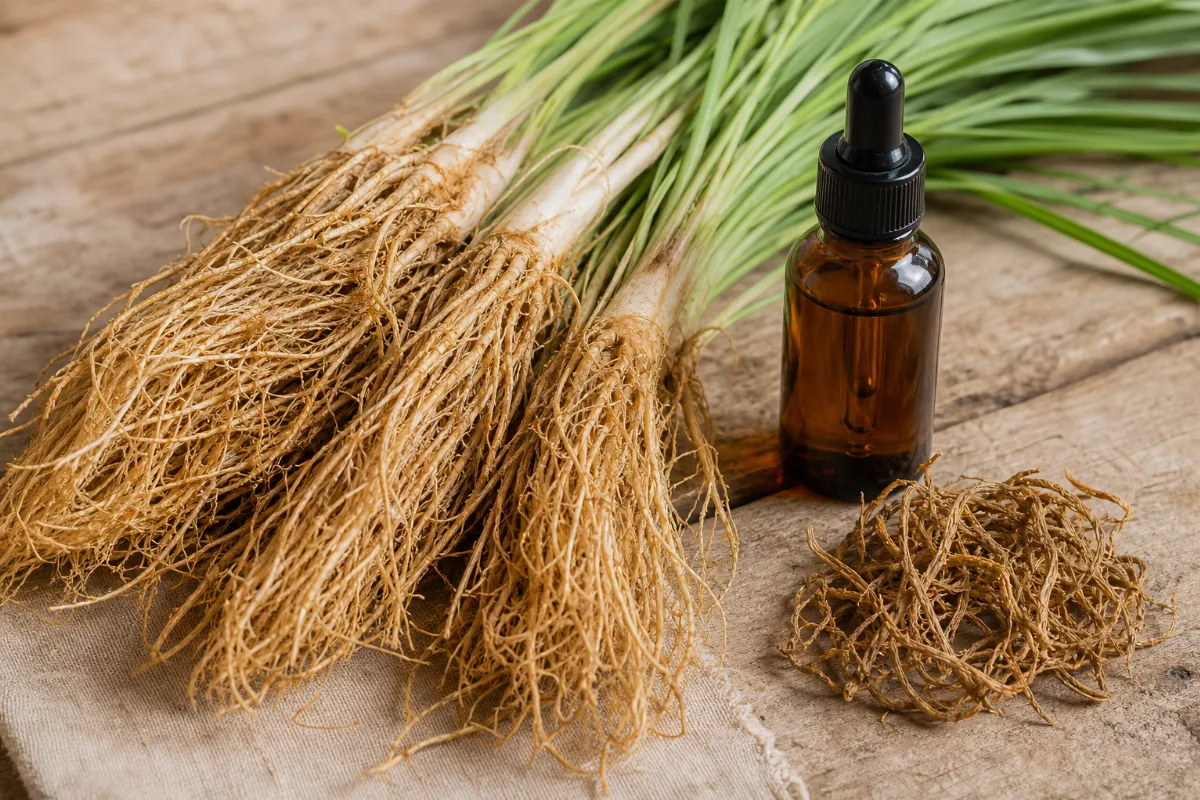
The oil comes from the roots of Chrysopogon zizanioides, a tall perennial grass in the grass family (Poaceae, per GBIF). Many papers still use the older name Vetiveria zizanioides.
The oil is a mixture. One Qatar root oil had 40 compounds, mostly sesquiterpenoids, including khusimol, alpha-vetivone, beta-eudesmol and rosifoliol.
Different materials are sold or studied as vetiver: root oil, leaf oil, and acetylated oil. They are not the same, and results for one do not carry over to another.
What people use it for, and how strong the evidence is
For sleep, the best study is a 4-week trial in 96 intensive care nurses. Vetiver massage improved sleep and tiredness scores more than a jojoba-oil placebo, but the placebo group improved too and everything was self-rated. Two other studies had no control group or used a five-oil blend. In rats, the oil did the opposite and kept animals awake.
For attention, one small experiment used cut roots, not oil, and the effect disappeared with more roots. For anxiety, only rats and a mixed dental-clinic scent trial exist. We found no trial of vetiver for ADHD.
For mosquitoes, vetiver oil gave about half the protection of DEET in cages, and community participants rated it like placebo. Lab and cancer-cell work does not show effects in people.
The research in one view
Every human study is small and most rely on self-rating. A scent is hard to hide from a comparison group. No large independent trial and no meta-analysis of vetiver oil alone was found.
Popular claims on pain, inflammation, infection and diabetes rest on cell and animal work in reviews.
Blends, parts and processed oils are different things
Two trials used blends that include vetiver (the older-adult sleep routine and a dental-clinic scent). Their results do not describe vetiver alone.
One lab study used leaf oil and the EU opinion covers acetylated oil. Poison Control says it can be hard to know the species, strength and contaminants in a bottle.
What regulators say
The EU's SCCS (2019) judged acetylated vetiver oil safe in cosmetics at the levels proposed by the fragrance industry body IFRA, and did not assess inhalation. A 2025 modelling and lab-tissue paper on the same processed material found no airway concern at cosmetic-spray levels.
The US FDA says sleep, anxiety and pain claims make an aromatherapy product a drug, and that plant origin does not mean a product is safe. We did not read a statement from IFRA, EMA or NCCIH about plain vetiver oil.
At a glance
Traditional uses history, not proof
- Roots and oil used in traditional systems across India and Asia for pain, inflammation and infection (2025 review; tradition, not proof).
- A scent material in perfume, cosmetics and aromatherapy, with demand in food, hygiene and other sectors (2025 review).
- The grass itself is also used to clean polluted soil (2025 review).
Studied for research
- Sleep and tiredness in nurses, massage, low
- Sleep in older adults, five-oil blend, very-low
- Sleep, blood pressure and heart rate, small study, very-low
- Attention, cut roots, very-low
- Alertness, rat brain waves, insufficient
- Anxiety, rats and a blend trial, insufficient
- Mosquito repellent, mixed
- Lab claims (germs, cancer cells), insufficient
Main compounds
- Khusimol, a main constituent
- alpha-Vetivone, a main constituent
- beta-Eudesmol, a main constituent
- Rosifoliol, a main constituent
Common forms
- Essential oil (steam-distilled from roots)
- Scent diffused or smelled
- Diluted massage oil (as used in one nurse trial)
- Acetylated vetiver oil (a processed perfume material)
- Cosmetic and perfume products
Research links: Poison Control: Essential oils · FDA: Aromatherapy · EU safety opinion on acetylated vetiver oil (abstract) · Sleep and fatigue in intensive care nurses (abstract) · Vetiver oil and DEET against malaria mosquitoes (abstract) · GBIF: Chrysopogon zizanioides · Research Library · Genes & Biomarkers Library
What it is and its history
- Accepted scientific name
- Chrysopogon zizanioides
- Naming authority
- (L.) Roberty
- Synonyms
- Name: Vetiveria zizanioides; Note: The older name used in many papers. GBIF returned it as a separate record (Vetiveria zizanioides Stapf, key 7352653); synonym status was not confirmed in what we read.
- Common names
- Vetiver (English); Khus (Hindi/English); Khus oil (English); Vetiver root oil (English)
- Family or group
- Poaceae, the grass family (GBIF).
- Classification
- Plantae > Tracheophyta > Liliopsida > Poales > Poaceae > Chrysopogon > Chrysopogon zizanioides
- Native range
- Not checked in a source read for this page.
- Habitat
- A perennial grass, described in papers as an aromatic grass with deep roots that is also used to clean polluted soil.
- What it looks like
- Part used: The oil is distilled from the roots (the 2026 Qatar paper describes steam distillation of root oil). Some lab papers used leaf oil instead, which is a different material.
- Look-alikes and adulterants
- Name: Acetylated vetiver oil; Note: A chemically treated perfume material assessed separately by the EU's SCCS. Not the same as plain oil.; Name: Vetiver leaf oil; Note: Used in one 2025 lab paper; a different material from root oil.
- Sustainability and conservation
- Not checked (no IUCN or CITES source read).
Traditional use and history history, not clinical proof
| Tradition or era | Documented use | Source |
|---|---|---|
| Traditional medicine across India and Asia | A 2025 review says vetiver roots and oils have been used in traditional systems for centuries for inflammation, pain, infection, wounds and other purposes, and that modern work is mostly preclinical. | Gunasekar et al. 2025 (abstract) |
| Perfume, cosmetic, aromatherapy and food flavour | A 2025 review describes demand for the oil in food, beverage, fragrance, cosmetic, aromatherapy, hygiene and pharmaceutical sectors, and use of the plant to clean polluted soil. | Barcellos-Silva et al. 2025 (abstract) |
Traditional use shows how it was used. It does not show that it works or is safe today.
What is inside, and how it may work
What it contains and how those compounds act in cells and animals. Laboratory and animal mechanisms are not proven effects in people.
Main compounds
| Compound | Family | Where it is concentrated | Activity studied | Level of evidence |
|---|---|---|---|---|
| Khusimol PubChem 167519 | sesquiterpene alcohol | Root oil No typical value given. | Listed among the main compounds of a Qatar root oil. A bacterium study suggested it may contribute to the oil's germ-killing effect (lab only). 22 9 16 | Laboratory research |
| alpha-Vetivone PubChem 442405 | sesquiterpene ketone | Root oil No typical value given. | Listed among the main compounds of a Qatar root oil. A computer model predicted binding to cell-signalling proteins; no effect in people is known. 22 9 | In silico |
| beta-Eudesmol PubChem 91457 | sesquiterpene alcohol | Root oil No typical value given. | Listed among the main compounds of a Qatar root oil. Its role was not examined in the sources read. 22 9 | Not assessed |
| Rosifoliol PubChem 527256 | sesquiterpene alcohol | Root oil No typical value given. | Listed among the main compounds of a Qatar root oil; a computer model predicted binding to cell-signalling proteins. 22 9 | In silico |
Mechanisms, receptors and pathways
| Target or pathway | Gene or receptor | What was found | Level |
|---|---|---|---|
| Amygdala nerve activity (rats) | c-fos (activity marker) | Breathing 2.5% vetiver oil gave an anti-anxiety-like pattern in a maze and raised c-fos in one part of the amygdala, as diazepam did. 15 | In vivo animal |
| Brain waves and sleep-waking (rats) | Not specified | Inhalation increased waking, reduced slow-wave sleep, lowered alpha and beta1 activity and raised frontal gamma activity. 5 | In vivo animal |
| Sympathetic nerve activity (people) | Not applicable | With a small amount of cut roots, volunteers had higher sympathetic activity and faster reactions; not with a larger amount. 10 | Human correlational |
| AKT1 and STAT3 (computer prediction) | AKT1, STAT3 | Network analysis and docking suggested root-oil compounds may bind these proteins. A prediction only. 9 | In silico |
| Bacterial cell-wall stress response | sigma M | A vetiver extract switched on a cell-envelope stress response in Bacillus subtilis. 16 | Laboratory research |
Absorption, metabolism and elimination
- Absorption
- Not established in the sources read.
- Distribution
- Not established.
- Metabolism
- Not established.
- Elimination
- Not established.
- Bioavailability
- Not established.
Isolated compounds versus whole extracts
Vetiver oil is a mixture of dozens of compounds (40 found in one Qatar oil, 93% sesquiterpenoids). Results for cut roots, root oil, leaf oil, acetylated oil, blends and single compounds describe different things and cannot be swapped for each other.
Nutritional composition
Vetiver oil is not a nutrient and not a food to take for health.
1 mixed findings1 low certainty3 very low certainty6 not enough evidence
What was looked at
The 11 benefits and uses checked for Vetiver Oil, each with how strong the evidence is. Tap one to open it.
- Sleep and tiredness in intensive care nurses (vetiver oil massage)Low certainty
- Sleep in older adults (a five-oil night blend that included vetiver)Very low certainty
- Sleep, blood pressure and heart rate (vetiver oil, small before-and-after study)Very low certainty
- Attention and reaction time (the smell of cut vetiver roots)Very low certainty
- Alertness versus sleepiness (rats breathing vetiver oil)Not enough evidence
- Anxiety (rat study, and a dental-clinic trial of scents that included vetiver in a blend)Not enough evidence
- Mosquito repellent (vetiver oil on skin or in tests)Mixed findings
- Mosquito tests of vetiver oil mixed with other ingredients (laboratory)Not enough evidence
- Germ-killing and antioxidant action (test tube and skin cells)Not enough evidence
- Cancer-cell experiments (laboratory and computer)Not enough evidence
- Traditional and review claims (pain, inflammation, infection, diabetes)Not enough evidence
Lab markers tracked in the studies
Pittsburgh Sleep Quality Index (PSQI)Tiredness scales (VAS and Piper Fatigue Scale)Blood pressure and heart rateReaction time on a screen taskMosquito landing and blood-feedingCell viability (IC50)
What is Vetiver Oil good for?
The uses people ask about and how strong the evidence is for each. Read the certainty label first: none is better than low, and several are blends or lab work.
Benefits, one by one
Each card is a research question, not a promise. Tap a goal to filter. Open a card to see the studies, doses and limits.
Sleep and tiredness in intensive care nurses (vetiver oil massage)
Low certaintyIn a 96-nurse trial, a nightly vetiver massage for 4 weeks was followed by lower tiredness and better sleep scores than a jojoba-oil massage. The jojoba group improved too, and all scores were self-rated.
1 studiesNot covered. This page gives no amounts and no way to use the oil.
Studies, doses and limits
What the trials found
One randomised, placebo-controlled, single-blind trial in Türkiye: 36 nurses per group at the start, 96 finished.
Results
Tiredness (VAS) fell from 7.0 to 2.0 with vetiver and from 8.0 to 4.0 with jojoba oil. Sleep score (PSQI, lower is better) fell from 10.91 to 4.63 with vetiver and from 10.78 to 6.84 with jojoba. The Piper Fatigue Scale fell from 5.58 to 2.76 and from 5.80 to 4.37. Groups differed after 4 weeks (post-test p < 0.001).
Effect sizes as reported
After 4 weeks the vetiver group scored about 2.2 points better than placebo on the sleep score and about 1.6 on the Piper fatigue scale (our subtraction of the reported values).
Why this rating
One single-blind trial with self-rated outcomes. The placebo group improved a lot, so some of the change is not from the oil, and massage itself may help.
Form and dose studied
Not covered. This page gives no amounts and no way to use the oil.
Who was studied
Intensive care nurses with fatigue and sleep problems, in Türkiye.
Limits
Single-blind, 4 weeks, one country, no objective sleep measure, 12 dropouts.
Why researchers looked
Night-shift nurses are often tired and sleep badly, and a massage with a scented oil is easy to offer.
Traditional use
Vetiver root and oil are used in traditional systems across India and Asia (a 2025 review). That is tradition, not proof.
Proposed mechanism Preliminary mechanism
Not established.
A proposed mechanism does not show that the effect happens in people.
Skin and general oil cautions apply (see Safety).
Sleep in older adults (a five-oil night blend that included vetiver)
Very low certaintyA 60-person trial in a care home used a night blend of five oils including vetiver, plus a different morning blend. Sleep time and deep sleep were higher than in the control group, but nothing can be credited to vetiver alone.
1 studiesNot covered. This page gives no amounts and no way to use the oil.
Studies, doses and limits
What the trials found
One single-blind randomised trial in an Istanbul care home: 30 in the blend group and 30 in the control group.
Results
Compared with control, total sleep time, REM sleep and deep sleep were higher (d = 1.29, 1.34 and 1.47) and time to fall asleep was shorter (d = -1.12), all p < .001. Daytime sleepiness fell and memory and orientation scores rose.
Effect sizes as reported
Very large effect sizes reported (d above 1).
Why this rating
Vetiver was one of five oils in a blend and a second blend was used by day, so the result is for the whole routine. Single-blind, 60 people, smartwatch sleep stages, unusually large effects.
Form and dose studied
Not covered. This page gives no amounts and no way to use the oil.
Who was studied
Adults aged 65 and over in a residential care facility.
Limits
The abstract does not say what the control group received.
Why researchers looked
Sleep and thinking often decline together in older age, and aromatherapy is a low-risk-sounding idea.
Traditional use
Vetiver root and oil are used in traditional systems across India and Asia (a 2025 review). That is tradition, not proof.
Proposed mechanism Preliminary mechanism
Not established.
A proposed mechanism does not show that the effect happens in people.
Skin and general oil cautions apply (see Safety).
Sleep, blood pressure and heart rate (vetiver oil, small before-and-after study)
Very low certaintyIn 18 adults who used vetiver oil for 4 to 6 weeks, sleep scores, top blood pressure and heart rate were a little lower afterwards. There was no comparison group described, and blood pressure started in the normal range.
1 studiesNot covered. This page gives no amounts and no way to use the oil.
Studies, doses and limits
What the trials found
A small study of 67 adults split into lavender, vetiver and orange blossom groups (vetiver n = 18).
Results
Vetiver: sleep score fell from 7.92 to 6.08 (P = .007), systolic blood pressure from 108.39 to 105.33 (P = .0016) and heart rate from 78.33 to 76.00 (P = .0342). Orange blossom also improved sleep score and blood pressure. The abstract gives no result for lavender.
Effect sizes as reported
About 1.8 points on the sleep score; about 3 mmHg on systolic pressure.
Why this rating
No control group is described, so the changes cannot be credited to the oil. 18 people, normal starting blood pressure, mostly self-rated sleep.
Form and dose studied
Not covered. This page gives no amounts and no way to use the oil.
Who was studied
Adults from a general population.
Limits
Small groups; how the oil was used is not stated in the abstract.
Why researchers looked
Sleep, blood pressure and stress often move together, so researchers measured all three.
Traditional use
Vetiver root and oil are used in traditional systems across India and Asia (a 2025 review). That is tradition, not proof.
Proposed mechanism Preliminary mechanism
Not established.
A proposed mechanism does not show that the effect happens in people.
Blood pressure fell in a person already in the normal range; anyone on blood pressure or sleep medicine should ask a pharmacist.
Attention and reaction time (the smell of cut vetiver roots)
Very low certaintyIn a small Japanese experiment, breathing the smell of a small amount of cut roots gave faster reaction times on a screen task. A larger amount did not. This tested roots, not bottled oil.
1 studiesNot covered. This page gives no amounts and no way to use the oil.
Studies, doses and limits
What the trials found
A short clinical experiment (2012) on volunteers doing a visual display terminal task.
Results
With the low amount, reaction times were faster and sympathetic nerve activity was higher. Neither effect appeared with the high amount.
Effect sizes as reported
No numbers in the abstract.
Why this rating
One small, short experiment on cut roots, and the effect vanished with more roots. It does not describe the essential oil.
Form and dose studied
Not covered. This page gives no amounts and no way to use the oil.
Who was studied
Healthy volunteers (number not stated in the abstract).
Limits
One session; no replication was found.
Why researchers looked
The smell is described as fresh and earthy, and researchers asked whether it affects alertness.
Proposed mechanism Preliminary mechanism
Not established. The authors measured higher sympathetic nerve activity with the low amount.
A proposed mechanism does not show that the effect happens in people.
Not about bottled oil; no safety data from this experiment.
Alertness versus sleepiness (rats breathing vetiver oil)
Not enough evidenceIn rats, breathing vetiver oil increased time awake and reduced deep sleep. This is the opposite of what the sleep claims suggest, and it is animal work only.
1 studiesNot covered. This page gives no amounts and no way to use the oil.
Studies, doses and limits
What the trials found
One rat experiment with brain-wave recordings and water as the comparison.
Results
Vetiver inhalation significantly increased total waking and reduced slow-wave sleep. The authors call the effect refreshing.
Effect sizes as reported
No numbers in the abstract.
Why this rating
Animal work only; it does not show an effect in people. It points the opposite way from the sleep trials, which shows how mixed the picture is.
Form and dose studied
Not covered. This page gives no amounts and no way to use the oil.
Who was studied
Adult male rats.
Limits
Rats, one lab, commercial oil of unstated makeup.
Why researchers looked
Researchers wanted a measured brain-wave effect, not a self-rating.
Traditional use
Vetiver root and oil are used in traditional systems across India and Asia (a 2025 review). That is tradition, not proof.
Proposed mechanism Preliminary mechanism
Not established. Brain-wave power changed (less alpha and beta1, more gamma in the frontal area).
A proposed mechanism does not show that the effect happens in people.
Not applicable (animal).
Anxiety (rat study, and a dental-clinic trial of scents that included vetiver in a blend)
Not enough evidenceIn rats, a middle amount of breathed vetiver oil acted like an anti-anxiety drug in a maze test. In 486 dental patients, scents in the air gave a small drop in anxiety, but vetiver was only one of eight oils in one blend.
2 studiesNot covered. This page gives no amounts and no way to use the oil.
Studies, doses and limits
What the trials found
One rat experiment and one cluster-randomised, single-blind trial of vaporised scents in four dental practices.
Results
Rats: 2.5% vetiver oil and diazepam showed an anxiolytic-like pattern. Dental trial: state anxiety was 40.7 with water and 38.4 with the scents combined; the effect was clear only in women and in a post-hoc high-trait-anxiety group. The vetiver blend is not reported on its own.
Effect sizes as reported
Rats: no numbers in the abstract. Dental trial: 2.3 points lower anxiety score with the scents pooled.
Why this rating
The rat result is animal work. The trial cannot say whether vetiver did anything, because it was a minor part of one blend and results are pooled.
Form and dose studied
Not covered. This page gives no amounts and no way to use the oil.
Who was studied
Male rats; adult dental patients.
Limits
Subgroup findings were post-hoc.
Why researchers looked
Anxiety is the most common reason people try aromatherapy.
Traditional use
Vetiver root and oil are used in traditional systems across India and Asia (a 2025 review). That is tradition, not proof.
Proposed mechanism Preliminary mechanism
Not established. In the rats, the oil raised a nerve-activity marker (c-fos) in one part of the amygdala, as diazepam did.
A proposed mechanism does not show that the effect happens in people.
Skin and general oil cautions apply (see Safety).
Mosquito repellent (vetiver oil on skin or in tests)
Mixed findingsVetiver oil gave about half the protection of DEET in cage tests (51.9% versus 95.75% fewer landings). In a 457-person community trial, people rated it no better than placebo.
2 studiesNot covered. This page gives no amounts and no way to use the oil.
Studies, doses and limits
What the trials found
A cage (semi-field) test followed by a nine-month randomised community trial in Thailand, plus laboratory tests on mosquitoes.
Results
Cages: DEET cut landing by 95.75% over 6 hours; vetiver oil by 51.9%. Community: DEET users used it more; ratings for vetiver were comparable to placebo, and the authors say its effect was too weak to notice in the field. Laboratory tests on Anopheles epiroticus found 26-40% escape with vetiver oil in the lab strain but about 14% in the field strain, compared with 64% for DEET.
Effect sizes as reported
51.9% versus 95.75% fewer landings in cages.
Why this rating
A moderate effect in a controlled test, no noticeable benefit in the field, and much weaker than DEET in both. No count of bites or malaria cases is reported in the abstracts.
Form and dose studied
Not covered. This page gives no amounts and no way to use the oil.
Who was studied
Mosquitoes in cages; 457 community participants in Thailand.
Limits
Many people applied repellent to clothing rather than skin.
Why researchers looked
Vetiver is a traditional scent used around insects, and researchers look for plant alternatives to DEET.
Proposed mechanism Preliminary mechanism
Not established.
A proposed mechanism does not show that the effect happens in people.
Putting oil on skin raises the skin-reaction cautions in the Safety tab. Vetiver oil is not a replacement for medically advised malaria protection.
Mosquito tests of vetiver oil mixed with other ingredients (laboratory)
Not enough evidenceIn laboratory tests, mixing vetiver oil with a compound called caryophyllene oxide, or with andrographis, made mosquitoes move away more than either alone. These are mosquito-chamber tests, not human trials.
2 studiesNot covered. This page gives no amounts and no way to use the oil.
Studies, doses and limits
What the trials found
Two laboratory excito-repellency studies on mosquitoes.
Results
The best caryophyllene-oxide plus vetiver mix reached 74.07-78.18% response in Anopheles minimus and 55.36-83.64% in Culex quinquefasciatus. A vetiver plus andrographis mix caused 73.33% escape in a lab Aedes aegypti strain against 26.67% for DEET. Vetiver with ylang-ylang gave weak non-contact escape.
Effect sizes as reported
Up to about 78-84% response in some species.
Why this rating
Test-chamber results in mosquitoes, for mixtures, not vetiver oil alone. The authors say human trials are the next step.
Form and dose studied
Not covered. This page gives no amounts and no way to use the oil.
Who was studied
Laboratory mosquito colonies.
Limits
No person was tested.
Why researchers looked
Mixtures can sometimes work better than one ingredient.
Proposed mechanism Preliminary mechanism
Not established.
A proposed mechanism does not show that the effect happens in people.
Skin and general oil cautions apply (see Safety).
Germ-killing and antioxidant action (test tube and skin cells)
Not enough evidenceIn test tubes, vetiver oil slowed some bacteria and was less toxic to skin cells than the other oils compared. This does not show that it helps skin in people.
2 studiesNot covered. This page gives no amounts and no way to use the oil.
Studies, doses and limits
What the trials found
Laboratory studies on skin bacteria, a skin-cell line and Bacillus subtilis.
Results
Vetiver LEAF oil was less active than clove bud oil; skin-cell toxicity (IC50) was 312.55 micrograms/mL for vetiver. In a bacterium study, a vetiver extract triggered a cell-wall stress response and khusimol may contribute.
Effect sizes as reported
IC50 312.55 micrograms/mL (leaf oil).
Why this rating
Test tube and cells only, and one study used leaf oil rather than root oil. No skin trial in people was found.
Form and dose studied
Not covered. This page gives no amounts and no way to use the oil.
Who was studied
Bacteria and a human skin-cell line.
Limits
Lab concentrations do not translate into safe amounts on skin.
Why researchers looked
Researchers look for natural skin antimicrobials.
Traditional use
Vetiver root and oil are used in traditional systems across India and Asia (a 2025 review). That is tradition, not proof.
Proposed mechanism Preliminary mechanism
Lab only. A khusimol-type compound may contribute to the effect on one bacterium.
A proposed mechanism does not show that the effect happens in people.
Skin and general oil cautions apply (see Safety).
Cancer-cell experiments (laboratory and computer)
Not enough evidenceIn dishes, vetiver root oil from Qatar reduced the growth of colorectal and lung cancer cells and did not affect normal skin fibroblasts. Computer models suggested possible targets. This does not show any benefit in people.
1 studiesNot covered. This page gives no amounts and no way to use the oil.
Studies, doses and limits
What the trials found
One laboratory and computer study (2026).
Results
40 compounds found, 93% sesquiterpenoids. Viability of HCT-116 colorectal cells fell with an IC50 of 62.95 micrograms/mL and A549 lung cells 167.82 micrograms/mL. Normal fibroblasts were unaffected.
Effect sizes as reported
IC50 62.95 and 167.82 micrograms/mL.
Why this rating
Cells and computer models only. Do not use vetiver oil as a cancer remedy.
Form and dose studied
Not covered. This page gives no amounts and no way to use the oil.
Who was studied
Human cell lines.
Limits
No animal or human study was read.
Why researchers looked
Researchers screen many plant oils for activity against cancer cells.
Proposed mechanism Preliminary mechanism
Computer docking pointed to two cell-signalling proteins, AKT1 and STAT3; this is a prediction, not a demonstrated mechanism.
A proposed mechanism does not show that the effect happens in people.
Skin and general oil cautions apply (see Safety).
Traditional and review claims (pain, inflammation, infection, diabetes)
Not enough evidenceReviews list pain-relief, anti-inflammatory, antimicrobial and blood-sugar findings for vetiver, but nearly all come from cells and animals. We did not find a human trial for these uses.
2 studiesNot covered. This page gives no amounts and no way to use the oil.
Studies, doses and limits
What the trials found
Two narrative reviews (2025).
Results
The reviews summarise cell, animal and a few clinical studies. The abstracts do not rate the evidence.
Why this rating
Narrative reviews with no certainty grading; the underlying work is mostly preclinical.
Form and dose studied
Not covered. This page gives no amounts and no way to use the oil.
Limits
Abstracts only were read.
Why researchers looked
Vetiver has a long traditional history in India and Asia.
Traditional use
Vetiver root and oil are used in traditional systems across India and Asia (a 2025 review). That is tradition, not proof.
Proposed mechanism Preliminary mechanism
Reviews mention oxidative stress, inflammation and microbial pathways; these are proposed, not shown in people.
A proposed mechanism does not show that the effect happens in people.
Skin and general oil cautions apply (see Safety).
Connections to the rest of health
How Vetiver Oil connects to the rest of our health knowledge graph. Every link says what kind of connection it is. A safety link (for example to the liver) is a warning, not a benefit. A study that merely mentions a topic never creates a benefit link.
Explore every connection: goals, body systems, organs, symptoms, genes
A. Wellness goals
| Connected to | Kind of connection | Evidence status | Context | Studies |
|---|---|---|---|---|
| Better Sleep | Low certainty | Sleep and tiredness in intensive care nurses (vetiver oil massage): In a 96-nurse trial, a nightly vetiver massage for 4 weeks was followed by lower tiredness and better sleep scores than a jojoba-oil massage. The jojoba group improved too, and all scores were self-rated. Sleep in older adults (a five-oil night blend that included vetiver): A 60-person trial in a care home used a night blend of five oils including vetiver, plus a different morning blend. Sleep time and deep sleep were higher than in the control group, but nothing can be credited to vetiver alone. | 3 7 4 | |
| Reduce Fatigue | Low certainty | Sleep and tiredness in intensive care nurses (vetiver oil massage): In a 96-nurse trial, a nightly vetiver massage for 4 weeks was followed by lower tiredness and better sleep scores than a jojoba-oil massage. The jojoba group improved too, and all scores were self-rated. | 3 | |
| Deep Sleep | Very low certainty | Sleep in older adults (a five-oil night blend that included vetiver): A 60-person trial in a care home used a night blend of five oils including vetiver, plus a different morning blend. Sleep time and deep sleep were higher than in the control group, but nothing can be credited to vetiver alone. | 7 | |
| Blood Pressure Support | Very low certainty | Sleep, blood pressure and heart rate (vetiver oil, small before-and-after study): In 18 adults who used vetiver oil for 4 to 6 weeks, sleep scores, top blood pressure and heart rate were a little lower afterwards. There was no comparison group described, and blood pressure started in the normal range. | 4 | |
| Better Focus | Very low certainty | Attention and reaction time (the smell of cut vetiver roots): In a small Japanese experiment, breathing the smell of a small amount of cut roots gave faster reaction times on a screen task. A larger amount did not. This tested roots, not bottled oil. | 10 | |
| Better Focus | Not enough evidence | Alertness versus sleepiness (rats breathing vetiver oil): In rats, breathing vetiver oil increased time awake and reduced deep sleep. This is the opposite of what the sleep claims suggest, and it is animal work only. | 5 | |
| Better Sleep | Not enough evidence | Alertness versus sleepiness (rats breathing vetiver oil): In rats, breathing vetiver oil increased time awake and reduced deep sleep. This is the opposite of what the sleep claims suggest, and it is animal work only. | 5 | |
| Anxiety Support | Not enough evidence | Anxiety (rat study, and a dental-clinic trial of scents that included vetiver in a blend): In rats, a middle amount of breathed vetiver oil acted like an anti-anxiety drug in a maze test. In 486 dental patients, scents in the air gave a small drop in anxiety, but vetiver was only one of eight oils in one blend. | 15 6 | |
| Calm Relaxation | Not enough evidence | Anxiety (rat study, and a dental-clinic trial of scents that included vetiver in a blend): In rats, a middle amount of breathed vetiver oil acted like an anti-anxiety drug in a maze test. In 486 dental patients, scents in the air gave a small drop in anxiety, but vetiver was only one of eight oils in one blend. | 15 6 | |
| Preventive Wellness | Mixed findings | Mosquito repellent (vetiver oil on skin or in tests): Vetiver oil gave about half the protection of DEET in cage tests (51.9% versus 95.75% fewer landings). In a 457-person community trial, people rated it no better than placebo. | 14 17 | |
| Preventive Wellness | Not enough evidence | Mosquito tests of vetiver oil mixed with other ingredients (laboratory): In laboratory tests, mixing vetiver oil with a compound called caryophyllene oxide, or with andrographis, made mosquitoes move away more than either alone. These are mosquito-chamber tests, not human trials. | 11 12 | |
| Healthy Skin | Not enough evidence | Germ-killing and antioxidant action (test tube and skin cells): In test tubes, vetiver oil slowed some bacteria and was less toxic to skin cells than the other oils compared. This does not show that it helps skin in people. | 18 16 | |
| Cellular Protection | Not enough evidence | Cancer-cell experiments (laboratory and computer): In dishes, vetiver root oil from Qatar reduced the growth of colorectal and lung cancer cells and did not affect normal skin fibroblasts. Computer models suggested possible targets. This does not show any benefit in people. | 9 | |
| Inflammation Balance | Not enough evidence | Traditional and review claims (pain, inflammation, infection, diabetes): Reviews list pain-relief, anti-inflammatory, antimicrobial and blood-sugar findings for vetiver, but nearly all come from cells and animals. We did not find a human trial for these uses. | 8 1 |
B. Body systems
| Connected to | Kind of connection | Evidence status | Context | Studies |
|---|---|---|---|---|
| Nervous System | Biological association | Low certainty | Studied for: Sleep and tiredness in intensive care nurses (vetiver oil massage) Studied for: Sleep in older adults (a five-oil night blend that included vetiver) | 3 7 4 10 5 15 6 8 1 |
| Cardiovascular System | Biological association | Very low certainty | Studied for: Sleep, blood pressure and heart rate (vetiver oil, small before-and-after study) | 4 |
| Integumentary System | Biological association | Mixed findings | Studied for: Mosquito repellent (vetiver oil on skin or in tests) Studied for: Mosquito tests of vetiver oil mixed with other ingredients (laboratory) | 14 17 11 12 18 16 9 |
E. Health conditions
| Connected to | Kind of connection | Evidence status | Context | Studies |
|---|---|---|---|---|
| Contact dermatitis | Not enough evidence | No human allergy data for plain oil; moderate skin sensitiser in test animals for the acetylated material. No human allergy data for plain oil; a processed form was a moderate skin sensitiser in test animals. Preparation or compound: Vetiver oil on the skin |
13 |
I. Biomarkers
| Connected to | Kind of connection | Evidence status | Context | Studies |
|---|---|---|---|---|
| Pittsburgh Sleep Quality Index (PSQI) | Biological association | Low certainty | Measured in trials: decrease. A lab change is not the same as a health benefit. | 3 4 7 |
| Tiredness scales (VAS and Piper Fatigue Scale) | Biological association | Low certainty | Measured in trials: decrease. A lab change is not the same as a health benefit. | 3 |
| Blood pressure and heart rate | Biological association | Very low certainty | Measured in trials: decrease. A lab change is not the same as a health benefit. | 4 |
| Reaction time on a screen task | Biological association | Very low certainty | Measured in trials: decrease. A lab change is not the same as a health benefit. | 10 |
| Mosquito landing and blood-feeding | Biological association | Low certainty | Measured in trials: decrease. A lab change is not the same as a health benefit. | 14 |
| Cell viability (IC50) | Biological association | Not enough evidence | Measured in trials: decrease. A lab change is not the same as a health benefit. | 9 18 |
J. Genes, receptors and enzymes
| Connected to | Kind of connection | Evidence status | Context | Studies |
|---|---|---|---|---|
| AKT1 and STAT3 | Preliminary mechanism | In silico | Computer-predicted targets of root-oil compounds in cancer-cell analysis. | 9 |
L. Active compounds
| Connected to | Kind of connection | Evidence status | Context | Studies |
|---|---|---|---|---|
| Khusimol | Biological association | In vitro | Listed among the main compounds of a Qatar root oil. A bacterium study suggested it may contribute to the oil's germ-killing effect (lab only). Preparation or compound: Root oil |
22 9 16 |
| alpha-Vetivone | Biological association | In silico | Listed among the main compounds of a Qatar root oil. A computer model predicted binding to cell-signalling proteins; no effect in people is known. Preparation or compound: Root oil |
22 9 |
| beta-Eudesmol | Biological association | Not assessed | Listed among the main compounds of a Qatar root oil. Its role was not examined in the sources read. Preparation or compound: Root oil |
22 9 |
| Rosifoliol | Biological association | In silico | Listed among the main compounds of a Qatar root oil; a computer model predicted binding to cell-signalling proteins. Preparation or compound: Root oil |
22 9 |
Each connection is stored with the ingredient, the connected record, the kind of connection, the evidence status, the supporting studies, the preparation or compound involved, and a review date (last reviewed October 25, 2026).
Evidence at a glance: what the research found for 11 outcomes
Each outcome below is one thing researchers measured. Certainty is how far the evidence can be trusted, not how well it works. The full studies are on the next tab.
The evidence
The research centre for Vetiver Oil. Every record here was checked against PubMed or the publisher's page; we never list a study we have not verified.
Evidence by outcome
Bars show how many studies we found for each outcome, not how well it works. People are added up across trials only (reviews are not added, to avoid double counting).
How we rate evidence
High certainty
Several well-run trials or reviews agree; further research is unlikely to change the picture much.
Moderate certainty
Good trials point the same way, but some doubt remains.
Low certainty
Small, short or inconsistent trials. The finding could change with better research.
Very low certainty
Very little or very weak human data. Treat as a possibility only.
Mixed findings
Trials or reviews disagree with each other.
Not enough evidence
Not enough human research to say either way.
Evidence against
Good research found no benefit, or found harm.
We take the reviewers' own risk-of-bias and GRADE statements where they exist, and otherwise judge from study size, design, consistency, directness and whether a product matches what is sold. Many publications do not make evidence high. Method note: We read the abstracts of 18 PubMed papers and the Poison Control and FDA pages, checked the plant name in GBIF and the compounds in PubChem. We did not find or read a LiverTox, LactMed, IFRA, EMA or NCCIH statement.
Study library: every study we checked 22
| Study | Design | People | Product, dose, length | Result |
|---|---|---|---|---|
| Barcellos-Silva 2025 Vetiver, Vetiveria zizanioides (L.) Nash: Biotechnology, Biorefineries, and the Production of Volatile Phytochemicals. Plants (Basel) · PMID 40431000 · DOI |
Narrative review review |
Literature on vetiver oil uses | Vetiver essential oil oil Not reported here |
The review covers vetiver's use in cleaning polluted soil and its listed lab activities (antioxidant, anti-inflammatory, antibacterial, antidepressant and others). It describes demand for the oil in food, beverage, fragrance, cosmetic, aromatherapy, hygiene and pharmaceutical sectors. Methods, limits and fundingOutcomes: Uses, commercial demand and lab findings Limitations: Narrative review; the abstract gives no human evidence and no ratings. Funding and conflicts: Funding and conflicts were not stated in the abstract. Read: abstract |
| Boisleve 2025 Use of NAMs in a weight of evidence approach to evaluate the safety via the inhalation route of acetylated vetiver oil, in spray products. Regulatory Toxicology and Pharmacology · PMID 40639679 · DOI |
Computer modelling and lab airway tissue test model and in vitro |
Model of cosmetic spray exposure and a lab human airway-tissue model (MucilAir) | ACETYLATED vetiver oil in sprays processed oil Not reported here Laboratory |
The authors calculated a margin of safety above 400 for body-wide effects and found no injury to airway tissue at 0.2% and 1%. They concluded that concentrations used in cosmetics are not expected to irritate the airways or add much to total exposure. Margin of safety above 400; margin of exposure 137. Methods, limits and fundingOutcomes: Systemic and local airway risk of inhaled acetylated vetiver oil Limitations: Modelling and lab tissue only, for the acetylated material, not plain vetiver oil or diffusers. The abstract does not state who funded it. Funding and conflicts: Funding not stated in the abstract. Flag: studies of fragrance-ingredient safety are sometimes industry-funded; not confirmed here. Read: abstract |
| Burkev 2026 The Effect of Aromatherapy on Fatigue and Sleep Quality in Intensive Care Nurses: A Randomised Placebo-Controlled Trial. Nursing in Critical Care · PMID 42630137 · DOI |
Randomised, placebo controlled, single blind trial |
96 Intensive care nurses in Türkiye with fatigue and sleep problems (108 randomised, 96 finished) |
Vetiver oil aromatherapy massage (one of two oil groups; the other was a chamomile-lavender blend) root oil (part not stated in the abstract) Not reported here Once daily before bedtime for 4 weeks · vs Jojoba oil massage (placebo), 36 per group at the start |
Median fatigue (VAS) fell from 7.0 to 2.0 with vetiver and from 8.0 to 4.0 with placebo. Sleep scores (PSQI, lower is better) fell from 10.91 to 4.63 with vetiver and from 10.78 to 6.84 with placebo. Piper Fatigue Scale fell from 5.58 to 2.76 with vetiver and from 5.80 to 4.37 with placebo. Groups did not differ at the start; after 4 weeks they differed (post-test p < 0.001 for all three). The placebo group also improved. Both oil groups improved more than placebo on self-rated scores; the placebo group improved too. The abstract gives no separate vetiver-versus-placebo test. Methods, limits and fundingOutcomes: Fatigue (VAS and Piper Fatigue Scale) and sleep quality (Pittsburgh Sleep Quality Index) Limitations: Single-blind (the scent and the massage are hard to hide), self-rated outcomes, 4 weeks, one country, massage rather than scent alone. 12 nurses dropped out. No objective sleep measure. The abstract lists a first author name that we could not cross-check. Funding and conflicts: Funding and conflicts were not stated in the abstract. Registered as NCT06474793. Registration: NCT06474793 Read: abstract |
| Chang 2026 Vetiver and Orange Blossom Aid in Lowering Blood Pressure and Heart Rate and Improving Sleep Quality. Holistic Nursing Practice · PMID 40261984 · DOI |
Small randomised three group before and after study |
67 Adults from a general population who completed a sleep questionnaire online (lavender 21, vetiver 18, orange blossom 17) |
Lavender, vetiver or orange blossom essential oil used for 4 to 6 weeks (how it was used is not stated in the abstract) oil (part not stated) Not reported here 4 to 6 weeks · vs No placebo or untreated group is described in the abstract |
PSQI fell from 7.92 to 6.08 with vetiver (P = .007) and from 8.32 to 6.47 with orange blossom (P = .042). Systolic blood pressure fell from 108.39 to 105.33 with vetiver (P = .0016). Heart rate fell from 78.33 to 76.00 with vetiver (P = .0342). The abstract gives no result for the lavender group. About 1.8 points on a sleep score and about 3 mmHg on top blood pressure, before-and-after only. Methods, limits and fundingOutcomes: Sleep quality (PSQI), blood pressure, heart rate and autonomic nervous system measures before and after Limitations: No control group is described, so the changes cannot be credited to the oil. Blood pressure was already normal-range at the start (about 108). Small groups, mostly self-rated sleep. Funding and conflicts: Funding and conflicts were not stated in the abstract. Read: abstract |
| Cheaha 2016 Modification of sleep-waking and electroencephalogram induced by vetiver essential oil inhalation. Journal of Intercultural Ethnopharmacology · PMID 27069728 · DOI |
Animal experiment rat |
Adult male Wistar rats with brain-wave electrodes | Inhaled commercial vetiver essential oil (20 and 200 microlitres) versus water essential oil Not reported here During recording · vs Water inhalation |
Vetiver oil inhalation significantly increased total waking time and reduced slow-wave sleep. It lowered alpha and beta1 brain-wave activity in two brain areas and raised gamma activity in the frontal area. The authors call this a refreshing, alertness-raising effect. No numbers in the abstract. Methods, limits and fundingOutcomes: Time awake and in slow-wave sleep; brain-wave (EEG) power Limitations: Rats, not people. The finding (more waking, less deep sleep) points the opposite way from the sleep-aid claim. Funding and conflicts: Funding and conflicts were not stated in the abstract. Read: abstract |
| Czakert 2024 Scenting serenity: influence of essential-oil vaporization on dental anxiety - a cluster-randomized, controlled, single-blinded study (AROMA_dent). Scientific Reports · PMID 38898054 · DOI |
Cluster randomised, controlled, single blind trial |
486 Dental patients in four practices |
Vaporised scents: orange, Swiss pine, a citrus blend, and a 'Forest Walk' blend of eight oils that included vetiver, versus water blend (parts not stated) Not reported here Five weekly cycles per scent · vs Water vaporisation |
Across all 486 patients, state anxiety was slightly higher with water (40.7) than with the scents combined (38.4). The effect was only clear in women (n = 296, p = 0.044) and in a post-hoc group with high trait anxiety. Vetiver was one of eight oils in one blend; results are not given for the vetiver blend alone. 2.3 points lower anxiety score with the scents pooled. Methods, limits and fundingOutcomes: State anxiety (STAI-S), trait anxiety, dental fear and pain rating Limitations: Vetiver was a minor part of one blend and the abstract does not separate that blend from the others. Subgroup findings were post-hoc. Funding and conflicts: Funding and conflicts were not stated in the abstract. Read: abstract |
| Ede Sarıkaya 2026 Effects of inhaled aromatherapy on sleep quality and cognitive function in older adults: a randomised controlled trial. Journals of Gerontology Series A · PMID 42011111 · DOI |
Single blind randomised controlled trial |
60 Residents of a care facility in Istanbul aged 65 or over (30 intervention, 30 control) |
A morning peppermint-palmarosa blend plus a night-time blend of vetiver, cedarwood, clary sage, petitgrain and grapefruit oils, inhaled blend (parts not stated) Not reported here 10 minutes daily for 30 days · vs Control group (what the control group received is not stated in the abstract) |
Compared with control, the intervention group had more total sleep time (d = 1.29), more REM sleep (d = 1.34), more deep sleep (d = 1.47) and shorter time to fall asleep (d = -1.12), all p < .001. Daytime sleepiness fell and orientation, memory and concentration scores rose. Very large effect sizes (d above 1) in the abstract. Methods, limits and fundingOutcomes: Sleep quality (PSQI), daytime sleepiness, orientation and memory test, and sleep stages from wrist smartwatches Limitations: Five-oil night blend plus a separate morning blend, so nothing can be credited to vetiver alone. Single-blind, 60 people, one site. Sleep stages came from consumer smartwatches. The effects are unusually large for this kind of study. Funding and conflicts: Funding and conflicts were not stated in the abstract. Registered as NCT06208800. Registration: NCT06208800 Read: abstract |
| Gunasekar 2025 Pharmacological and Therapeutic Potential of Chrysopogon zizanioides (Vetiver): A Comprehensive Review of Its Medicinal Applications and Future Prospects. Biomolecules · PMID 41008619 · DOI |
Narrative review review |
Cell, animal and available clinical studies of vetiver roots and oils | Vetiver roots, extracts and essential oils roots and oil Not reported here |
The review says vetiver roots and oils are used in traditional systems across India and Asia, and that preclinical studies show anti-inflammatory, pain-relieving, antimicrobial, anticancer and antidiabetic effects. It covers cell, animal and the few clinical studies and lists research limitations and gaps. Methods, limits and fundingOutcomes: Medicinal claims and research gaps Limitations: Narrative review; the abstract does not grade the evidence. Most findings it lists are from cells and animals. Funding and conflicts: PubMed lists it as 'Research Support, Non-U.S. Gov't'; no industry funding is stated in the abstract. Read: abstract |
| Karousa 2026 Chrysopogon zizanioides (Vetiver) Essential Oil from Qatar Targets AKT1 and STAT3 in Colorectal and Lung Cancer: GC-MS Profiling, In Vitro Antiproliferative Activity, and In Silico Analyses. Plants (Basel) · PMID 41829818 · DOI |
Laboratory and computer study in vitro and in silico |
Human colorectal (HCT-116) and lung (A549) cancer cell lines; normal neonatal skin fibroblasts | Steam-distilled vetiver root essential oil from Qatar root oil Not reported here Laboratory · vs Untreated cells |
GC-MS found 40 compounds, 93% sesquiterpenoids, including khusimol, β-eudesmol, α-vetivone and rosifoliol. The oil reduced cancer-cell viability (IC50 62.95 micrograms/mL for HCT-116 and 167.82 for A549) and did not affect the growth of normal fibroblasts. Computer docking pointed to AKT1 and STAT3. IC50 62.95 and 167.82 micrograms/mL in cell lines. Methods, limits and fundingOutcomes: Chemical makeup by GC-MS; cancer-cell viability; computer predictions Limitations: Cells and computer models only. It does not show any effect in people, and the oil should not be taken as a cancer remedy. Funding and conflicts: Funding and conflicts were not stated in the abstract. Read: abstract |
| Matsubara 2012 Volatiles emitted from the roots of Vetiveria zizanioides suppress the decline in attention during a visual display terminal task. Biomedical Research · PMID 23124250 · DOI |
Clinical experiment on a computer task |
Volunteers doing a visual display terminal task (number not stated in the abstract) | Smell of cut vetiver roots (1.0 g low amount, 30 g high amount), not bottled oil cut roots Not reported here During one task session |
With the low amount, reaction times were faster and sympathetic activity was higher. These effects were not seen with the high amount. The authors measured 0.25 micrograms of volatiles in the air with the low amount and 1.35 micrograms with the high amount. Faster reactions at the low amount only; no numbers in the abstract. Methods, limits and fundingOutcomes: Reaction time and heart-based measure of sympathetic nerve activity Limitations: Cut roots, not essential oil. Number of people not stated in the abstract. One short session. The effect disappeared with more roots. Funding and conflicts: Funding and conflicts were not stated in the abstract. Read: abstract |
| Nararak 2023 Synergistic Repellent and Irritant Effects of a Mixture of β-Caryophyllene Oxide and Vetiver Oil against Mosquito Vectors. Insects · PMID 37754741 · DOI |
Laboratory excito repellency test on mosquitoes mosquito |
Four laboratory mosquito species | Vetiver oil 2.5%, β-caryophyllene oxide 1% and mixtures essential oil Not reported here Short laboratory exposures · vs Single compounds |
Mixtures produced a much stronger response than either alone. The best mix (1 part caryophyllene oxide to 2 parts vetiver oil) reached 74.07-78.18% in Anopheles minimus and 55.36-83.64% in Culex quinquefasciatus. Knockdown was 18.18-33.33% in three species. Mixture response up to about 78-84% in some species. Methods, limits and fundingOutcomes: Escape responses and knockdown Limitations: Mosquitoes in a test chamber, not people. The strong effect is of the mixture, not vetiver oil alone. Funding and conflicts: Funding and conflicts were not stated in the abstract. Read: abstract |
| Panthawong 2023 Synergistic Behavioral Response Effect of Mixtures of Andrographis paniculata, Cananga odorata, and Vetiveria zizanioides against Aedes aegypti (Diptera: Culicidae). Insects · PMID 36835724 · DOI |
Laboratory excito repellency test on mosquitoes mosquito |
Laboratory and field strains of Aedes aegypti | Binary mixtures of vetiver, andrographis and ylang-ylang (Cananga odorata) preparations compared with DEET plant preparations Not reported here Short laboratory exposures · vs DEET |
Vetiver mixed with andrographis caused 56.57-73.33% escape in the laboratory strain; the 1:4 mix (73.33%) beat DEET (26.67%). Vetiver with ylang-ylang gave weak non-contact escape (6.67-31.67%). The authors say the mixtures could go to human use trials. Up to 73.33% versus DEET 26.67% in one mixture. Methods, limits and fundingOutcomes: Escape responses (irritancy and repellency) Limitations: Mosquitoes in a test chamber, not people. Results are for mixtures, not vetiver oil alone. Funding and conflicts: Funding and conflicts were not stated in the abstract. Read: abstract |
| SCCS (EU Scientific Committee on Consumer Safety) 2019 Opinion of the Scientific Committee on consumer safety (SCCS) - Final opinion on the safety of fragrance ingredient Acetylated Vetiver Oil (AVO) - (Vetiveria zizanioides root extract acetylated) - Submission III. Regulatory Toxicology and Pharmacology · PMID 31176744 · DOI |
Regulatory safety opinion regulatory |
Cosmetic users (risk assessment) | ACETYLATED vetiver oil with 1% alpha-tocopherol (a processed material, not plain oil) root extract, acetylated Not reported here |
SCCS judged acetylated vetiver oil safe in cosmetics at the concentrations proposed by IFRA. It noted some reactive aldehyde and ketone components, a moderate skin-sensitising result in test animals, a human patch study (HRIPT) and years of use without evidence of sensitisation, and said contact allergy in humans is unlikely. Inhalation was not assessed because no data were provided; an assessment would be needed for sprayable products. Methods, limits and fundingOutcomes: Safety of the ingredient in leave-on and rinse-off cosmetics Limitations: Applies to the acetylated material, not plain vetiver oil. Only the abstract was read. Funding and conflicts: Regulator opinion; no study funding. Read: abstract |
| Saeung 2026 Protective efficacy and user acceptability of DEET and Vetiver essential oil repellents against Anopheles dirus (Diptera: Culicidae): semi-field and community-based evaluations. Journal of Medical Entomology · PMID 42762484 · DOI |
Semi field test plus a 9 month community randomised trial human and mosquito |
457 Semi-field mosquito cages; then 457 community participants in Sisaket Province, Thailand |
Topical vetiver essential oil versus DEET versus placebo essential oil Not reported here 6 hours (semi-field); 9 months (community) · vs DEET and placebo |
In cages DEET cut landing by 95.75% over 6 hours and vetiver oil by 51.9%. Both reduced blood-feeding. In the community, DEET users used the product more; participants rated vetiver oil about the same as placebo. The authors say its activity was too weak to be noticed in the field. Most people applied repellent to clothing, not skin. 51.9% (vetiver) versus 95.75% (DEET) fewer landings in cages. Methods, limits and fundingOutcomes: Mosquito landing and blood-feeding in the cages; adherence, user-rated efficacy and acceptability in the community Limitations: Community outcomes were user ratings, not counts of bites or malaria cases (not in the abstract). Use on clothing rather than skin weakened real-world protection. Funding and conflicts: Funding and conflicts were not stated in the abstract. Read: abstract |
| Saiyudthong 2015 Anxiety-like behaviour and c-fos expression in rats that inhaled vetiver essential oil. Natural Product Research · PMID 25553641 · DOI |
Animal experiment rat |
Male Wistar rats | Inhaled vetiver essential oil (1%, 2.5% or 5% w/w) for 7 minutes before an elevated plus-maze test; diazepam as comparison essential oil Not reported here 7 minutes · vs Diazepam 1 mg/kg |
Rats given 2.5% vetiver oil or diazepam showed an anxiolytic-like pattern. Both raised c-fos in one part of the amygdala (the lateral division of the central nucleus). No numbers in the abstract. Methods, limits and fundingOutcomes: Anxiety-like behaviour in the elevated plus-maze; c-fos (a marker of nerve-cell activation) in the amygdala Limitations: Rats, not people. Only the middle amount helped. The authors say the mechanism needs more study. Funding and conflicts: PubMed lists it as 'Research Support, Non-U.S. Gov't'; no industry funding is stated in the abstract. Read: abstract |
| Shinjyo 2022 Analysis of cell death in Bacillus subtilis caused by sesquiterpenes from Chrysopogon zizanioides (L.) Roberty. Journal of General and Applied Microbiology · PMID 35418537 · DOI |
Laboratory study on bacteria bacteria |
Bacillus subtilis (a soil bacterium) | Vetiver extract/essential oil root Not reported here Laboratory · vs Untreated bacteria |
A cell-wall stress response was switched on by the extract. Composition analysis suggested the sesquiterpene khusimol might contribute to the bactericidal effect. No numbers in the abstract. Methods, limits and fundingOutcomes: How bacteria respond to the extract Limitations: A single bacterium in a dish; it says nothing about infections in people. Funding and conflicts: Funding and conflicts were not stated in the abstract. Read: abstract |
| Sukkanon 2026 Do natural or synthetic excito-repellents work better? A study on coastal malaria vector Anopheles epiroticus in Ko Chang, Thailand. PeerJ · PMID 42157904 · DOI |
Laboratory excito repellency test on mosquitoes mosquito |
Laboratory and field-caught Anopheles epiroticus mosquitoes | Vetiver oil, citronella oil, DEET and three insecticides essential oil Not reported here Short laboratory exposures · vs Other repellents in the same test |
In the laboratory strain, vetiver oil gave 26-40% escape in non-contact tests, DEET 18-26% and citronella over 50%. In the field strain, citronella and vetiver oils both gave about 14% and DEET 64% in contact tests. Vetiver oil 26-40% (lab strain) and about 14% (field strain). Methods, limits and fundingOutcomes: Share of mosquitoes escaping under contact and non-contact conditions Limitations: Mosquitoes in a test chamber, not people. Field-strain results were weak for vetiver oil. Funding and conflicts: Funding and conflicts were not stated in the abstract. Read: abstract |
| Thongmee 2025 Comparative evaluation of the antimicrobial, antioxidant, and cytotoxic properties of essential oils from vetiver, lemongrass, and clove buds with implications for topical application. PLoS One · PMID 41124157 · DOI |
Laboratory study (test tube and cell line) in vitro |
Skin bacteria and a human skin-cell line (HaCaT) | Vetiver LEAF oil (and lemongrass and clove bud oils) leaf oil (not root oil) Not reported here Laboratory · vs Other oils in the same tests |
Clove bud oil was the most active; vetiver and lemongrass were less effective. Skin-cell toxicity (IC50) was 312.55 micrograms/mL for vetiver, 122.14 for clove and 123.77 for lemongrass. The authors say vetiver and clove had antimicrobial activity below their toxic concentrations. Vetiver IC50 312.55 micrograms/mL. Methods, limits and fundingOutcomes: Antibacterial activity, antioxidant activity, cytotoxicity Limitations: Leaf oil, which is a different material from the root oil sold for perfume. Test tube and cells only; it does not show a skin benefit in people. Funding and conflicts: Funding and conflicts were not stated in the abstract. Read: abstract |
| n/a 2023 FDA: Aromatherapy (cosmetics page, content current as of 2023-09-08; read 2026-10-25) n/a · Source |
Regulator web page n/a |
n/a | n/a |
Says a product's legal category depends on its intended use: claims such as easing pain, treating depression or anxiety, or helping you sleep are drug claims, and drugs need FDA approval before sale. Says plants can contain materials that are toxic, irritating or likely to cause allergic reactions on skin, that cumin oil can make skin blister, and that certain citrus oils are harmful on sun-exposed skin. States FDA has no regulations defining 'natural' or 'organic' for cosmetics. Methods, limits and fundingOutcomes: How aromatherapy products are regulated; whether 'natural' means safe Limitations: General page, not about vetiver oil. Read: full-text |
| n/a 2026 Poison Control (National Capital Poison Center): Essential oils: Poisonous when misused (page read 2026-10-25) n/a · Source |
Poison centre education page n/a |
n/a | n/a |
General essential-oil page, not about vetiver. Says misuse can cause serious poisoning; many oils can cause rashes and some are poisonous if absorbed through the skin or swallowed; breathing an oil into the lungs can cause pneumonia; children have thin skin and immature livers and may be more susceptible; oils may interact with medications; pure oils are potent, so dilution in a carrier oil is the way to avoid a bad skin reaction, and oils should not be used on damaged skin; bottles must be locked away from children and pets; it can be hard to know the species, concentration or contaminants in a bottle; allergy is a very real possibility and the most common type is a skin rash, so stop use and wash off if a rash appears. Describes an 18-month-old who swallowed a small amount of lavender extract and became extremely drowsy and confused. Methods, limits and fundingOutcomes: Safety statements for essential oils in general Limitations: Not specific to vetiver oil. Read: full-text |
| n/a 2026 GBIF Backbone Taxonomy: Chrysopogon zizanioides (L.) Roberty (match API read 2026-10-25) n/a · Source |
Registry or database n/a |
n/a | n/a |
Chrysopogon zizanioides (L.) Roberty: rank species, status ACCEPTED, exact match, confidence 99, species key 5677150, family Poaceae, order Poales. A separate GBIF match for Vetiveria zizanioides Stapf (key 7352653) was also returned with status ACCEPTED, so GBIF does not treat it as a plain synonym in that check. Methods, limits and fundingOutcomes: Accepted name and family Limitations: Synonym status of the older name was not settled in what we read. Read: full-text |
| n/a 2026 PubChem PUG REST: compound records for khusimol (CID 167519), alpha-vetivone (CID 442405), beta-eudesmol (CID 91457) and rosifoliol (CID 527256) (read 2026-10-25) n/a · Source |
Registry or database n/a |
n/a | n/a |
Khusimol C15H24O (CID 167519); alpha-vetivone C15H22O (CID 442405); beta-eudesmol C15H26O (CID 91457); rosifoliol C15H26O (CID 527256). Methods, limits and fundingOutcomes: Compound identity and formula Limitations: Confirms identity only, not content in any oil. Read: full-text |
What we do not know yet
- What the evidence supports: sleep and tiredness in nurses is low certainty; everything else is very-low, mixed or insufficient.
- No trial of vetiver oil alone against scent-only placebo for sleep or anxiety was found.
- No trial of vetiver for ADHD was found in PubMed.
- No human allergy data for plain oil, and no study in pregnancy, breastfeeding, children or pets.
- No IFRA, EMA, NCCIH, LiverTox or LactMed statement was read.
How new research is added
New studies are found by a saved PubMed search and are placed in a review queue. A person reads each one before it is added.
Lab markers
What changed in blood or saliva tests during trials. A changed number is not the same as feeling or being healthier, and we give no "normal ranges".
Other 6
Pittsburgh Sleep Quality Index (PSQI)
Decrease in trials
A questionnaire score for how well someone has slept; lower is better.
Low certaintyResults and what it means
Why it was measured
Main sleep outcome in the nurse and the small adult study.
Statistical vs. clinical meaning
Self-rated, and a placebo group fell a lot as well, so much of the change is not from the oil.
Safety implication
A better score does not show the oil is safe or works for a sleep disorder.
Tiredness scales (VAS and Piper Fatigue Scale)
Decrease in trials
Self-rated scores for how tired someone feels; lower is better.
Low certaintyResults and what it means
Why it was measured
Main outcome in the nurse trial.
Statistical vs. clinical meaning
Single-blind and self-rated; the placebo group also improved.
Safety implication
Not a safety measure.
| Study | Result | People | Product |
|---|---|---|---|
| 3 | VAS fatigue fell from 7.0 to 2.0 with vetiver and from 8.0 to 4.0 with placebo; Piper score fell from 5.58 to 2.76 and from 5.80 to 4.37. |
Blood pressure and heart rate
Decrease in trials
Top (systolic) blood pressure and pulse at rest.
Very low certaintyResults and what it means
Why it was measured
Measured alongside sleep in the small adult study.
Statistical vs. clinical meaning
Normal-range starting values and no control group; it is not a treatment for high blood pressure.
Safety implication
Do not change blood pressure medicine because of a scent.
| Study | Result | People | Product |
|---|---|---|---|
| 4 | Systolic pressure fell from 108.39 to 105.33 and heart rate from 78.33 to 76.00 with vetiver, with no control group described. |
Reaction time on a screen task
Decrease in trials
How quickly a person responds to a visual task; lower is faster.
Very low certaintyMosquito landing and blood-feeding
Decrease in trials
How many mosquitoes land on or feed from treated skin in a test.
Low certaintyResults and what it means
Cell viability (IC50)
Decrease in trials
The amount of oil that stops half of cultured cells from growing; a lab measure only.
Not enough evidenceResults and what it means
Why it was measured
Used in the lab studies on skin and cancer cells.
Statistical vs. clinical meaning
Lab concentrations in dishes; no link to amounts on skin or in the body.
Safety implication
A low IC50 means a substance is toxic to cells, so it is also a caution for skin contact.
Safety
What studies and official sources say about side effects, medicines and who should check first. Each point shows what kind of evidence it comes from.
Main points to know 7
- Do not swallow essential oil. No vetiver-specific poisoning case was found, but poison centres warn about all oils.. Poison Control says some essential oils are poisonous if swallowed or absorbed through the skin, and that oil which enters the lungs can cause pneumonia. It describes an 18-month-old who became extremely drowsy and confused after swallowing a small amount of lavender extract. We found no case report, safe amount or toxic amount for vetiver oil, and this page gives none. Do not take it by mouth. Authoritative guidance 20
- Never put essential oil on the skin undiluted, and not on damaged skin.. Poison Control says pure essential oils are potent, that diluting in a carrier oil is the best way to avoid a bad skin reaction, and that oils should not be used on damaged skin. We read no vetiver-specific dilution advice and give no figure. Allergy is a real possibility; the most common sign is a skin rash. If one appears, stop and wash the oil off. Authoritative guidance 20
- Skin allergy: no human data for plain vetiver oil was found. A regulator found a related processed oil to be a moderate skin sensitiser in test animals.. The EU's SCCS looked at ACETYLATED vetiver oil, a chemically treated perfume material. It noted a moderate skin-sensitising result in test animals, but judged the material safe in cosmetics at the concentrations proposed by IFRA, and said contact allergy in humans is unlikely given a human patch study and years of use. That finding is about the processed material, not plain oil, and cannot be carried over in either direction. A PubMed search for vetiver oil with patch test or contact allergy found only that opinion. Absence of reports is not proof of safety. Regulatory 13
- Breathing it in: safety of diffusing or spraying plain vetiver oil has not been assessed in what we read.. The SCCS did not assess inhalation of acetylated vetiver oil because no data were provided, and said an inhalation assessment would be needed for sprayable products. A 2025 computer-modelling and lab airway-tissue study of that processed material concluded that cosmetic-spray levels are not expected to irritate the airways. Neither covers plain vetiver oil or room diffusers. We found no source on asthma. Regulatory 13 2
- Keep the oil away from children and pets.. Poison Control says children have thin skin and immature livers and may be more susceptible, and that bottles should be locked away from children and pets. We found no study of vetiver oil in children, cats or dogs. Authoritative guidance 20
- Pregnancy and breastfeeding: no information was found, so safety is not known.. A PubMed search for vetiver with pregnancy, breastfeeding or lactation found no study of the oil. We did not check LactMed. Ask a midwife or doctor before using any essential oil. Insufficient 20
- Bottles can differ: species, strength and contaminants are hard to know.. Poison Control says it can be hard to know what species, concentration or contaminants are in an essential oil bottle. Lab papers use vetiver root oil, leaf oil and acetylated oil, which are different materials. FDA notes that a plant origin does not make a product safe. Authoritative guidance 20 19 18
Side effects 4
| Effect | How often | Severity and recovery | Evidence |
|---|---|---|---|
| Skin rash or allergy The only regulator opinion read concerns acetylated oil. | Not found for plain vetiver oil. | Not stated. Not stated for vetiver; Poison Control advises stopping and washing the oil off. | Authoritative guidance 20 13 |
| Lower alertness or sleepiness, or the opposite Rats breathing the oil stayed awake longer, while people in nurse and older-adult trials reported better sleep. Individual effects are unknown. | Not reported. | Not stated. Not stated. | Animal research 5 |
| Poisoning or lung inflammation if swallowed General warning for essential oils. | No vetiver cases found. | Poison Control describes serious poisoning from essential oils in general. n/a | Authoritative guidance 20 |
| Adverse events in the nurse and older-adult trials No safety data in the abstracts, so we cannot say none occurred. | Not reported in the abstracts. | n/a n/a | Clinical trial 3 7 |
Liver
No liver injury linked to vetiver oil was described in the sources we read. LiverTox was not checked. Poison Control says children may be more sensitive because their livers are immature. 20
How often. Not established.
This is a safety connection. It is not evidence that Vetiver Oil supports liver health.
Medicines and supplements 4
| With | Why it matters | Importance | Evidence | What to do |
|---|---|---|---|---|
| Sleep aids, sedatives and anti-anxiety medicines sleep-and-sedating-medicines | Theoretical: some trials report better sleep and a rat study reports anti-anxiety-like behaviour. | No case or trial of an interaction was found. The question comes only from the sleep and anxiety results. | Theoretical Not enough evidence 3 15 | Tell a pharmacist about aromatherapy if you take sleep or anxiety medicine. |
| Medicines that lower blood pressure blood-pressure-medicines | Theoretical: one small study found slightly lower blood pressure in people already in the normal range. | No case or trial of an interaction was found. | Theoretical Not enough evidence 4 | Do not change blood pressure medicine because of a scent. |
| Medicines, in general general | Poison Control says essential oils may interact with medications. | General statement, not specific to vetiver. | Authoritative guidance Not enough evidence 20 | Ask a pharmacist. |
| Other fragrances and essential oils allergy | Cross-reactions between fragrance materials are possible. | Not studied for vetiver in the sources we read. | Theoretical Not enough evidence 20 | If you have reacted to a perfume or oil, tell a pharmacist or dermatologist before using another. |
Who should check first 4
| Situation | Advice | Evidence |
|---|---|---|
| Swallowing essential oil, especially by or near children | Do not swallow. If a child or pet may have swallowed any essential oil, call poison control (US: 1-800-222-1222) or your emergency number. | Authoritative guidance 20 |
| Known allergy to fragrances or essential oils | Avoid it, or ask a dermatologist first. A rash means stop and wash the oil off. | Authoritative guidance 20 |
| Broken or damaged skin | Poison Control says do not use essential oils on damaged skin. | Authoritative guidance 20 |
| Pregnancy, breastfeeding, babies and young children | Safety is not established. Ask a midwife or doctor. | Insufficient 20 |
Overdose, product quality and regulators
Summary. No lethal or toxic amount for vetiver oil is described in the sources we read, and none is stated here. Poison centres warn about essential oils in general.
Amounts. No safe amount is established, and this page gives none.
Onset and course. Not described for vetiver.
Repeated use. Not described for vetiver.
Animal data. Rats breathing the oil in two studies showed changed behaviour and brain waves; neither abstract reports harm. In test tubes, vetiver leaf oil was toxic to a human skin-cell line at 312.55 micrograms/mL.
Toxic parts. The oil is the concentrated root distillate. Which components could sensitise skin was not described in the sources read.
Not read. IFRA standards for plain vetiver oil, the full SCCS opinion, LiverTox, LactMed, veterinary papers and any asthma or epilepsy sources were not read.
Poison Control notes it can be hard to know what is in a bottle. Studies use root oil, leaf oil and processed (acetylated) oil, which differ.
Unknown species, strength and contaminants. Poison Control says it can be hard to know what species, concentration or contaminants are in an essential oil bottle. 20
Different materials called vetiver. Studies tested root essential oil, leaf essential oil and acetylated oil. An acetylated-oil safety opinion cannot be applied to plain oil. 18 13 9
Adulteration. We found no source on mixing or fake vetiver oil.
| Body | Action | Date |
|---|---|---|
| EU Scientific Committee on Consumer Safety (SCCS) (European Union) | Final opinion on ACETYLATED vetiver oil (submission III): safe in leave-on and rinse-off cosmetics at the concentrations proposed by IFRA; moderate skin sensitiser in test animals but contact allergy unlikely in humans; inhalation not assessed. source | 2019 |
| US Food and Drug Administration (FDA) (United States) | Aromatherapy page: claims to ease pain, treat depression or anxiety or help sleep are drug claims; plant-derived does not mean safe; no FDA definition of natural or organic for cosmetics. source | 2023-09-08 |
| Poison Control (National Capital Poison Center) (United States) | General warnings on essential oils: poisoning if swallowed or absorbed, pneumonia if inhaled into the lungs, allergy, children and pets. source | 2026-10-25 |
When to get medical help
- If a child or pet may have swallowed any essential oil, call poison control (US: 1-800-222-1222) or your local emergency number right away.
- Swelling of the face or throat, trouble breathing, or a spreading rash after contact with an oil needs urgent medical care.
- Choking or coughing after oil is swallowed can mean it has entered the lungs: seek emergency care.
- A rash that appears after use: stop and wash the oil off, and see a doctor if it does not clear.
Stop using the product and contact a clinician or emergency service. In the US, Poison Control is 1-800-222-1222.
General information only, not medical advice. Ask a clinician or pharmacist before use, especially with medicines, in pregnancy or with a health condition. See the Natural Remedy Safety guide.
Frequently asked questions
Is vetiver oil safe to swallow?
No. Do not swallow essential oil. Poison Control warns that some oils are poisonous if swallowed and that oil entering the lungs can cause pneumonia. We found no vetiver case and no safe amount. If a child or pet may have swallowed any essential oil, call poison control (US: 1-800-222-1222) or your emergency number.
Can I put vetiver oil on my skin?
Not undiluted. Poison Control says pure oils are potent, that diluting in a carrier oil is the best way to avoid a bad reaction, and not to use oils on damaged skin. We found no vetiver-specific dilution guidance, so no figure is given. Stop and wash it off if a rash appears.
Can vetiver oil cause an allergic reaction?
Does vetiver oil help you sleep?
Does vetiver oil help anxiety or ADHD?
Does vetiver oil repel mosquitoes?
Does vetiver oil lower blood pressure?
Not shown. In 18 adults using it for 4 to 6 weeks, top blood pressure fell about 3 points from a normal-range start, with no control group. It is not a treatment, and medicine should not be changed because of a scent.
Is vetiver oil safe in pregnancy or breastfeeding?
Unknown. We found no study of vetiver oil in pregnancy or breastfeeding. Ask a midwife or doctor before using any essential oil.
Is vetiver oil safe for children and pets?
Unknown for vetiver. Poison Control says children have thin skin and immature livers and may be more susceptible, and that bottles should be locked away from children and pets. We found no vetiver study in children, cats or dogs.
Is it safe to diffuse or spray vetiver oil?
Does vetiver oil interact with medicines?
What is the difference between vetiver oil and acetylated vetiver oil?
Explore by health goal
Better SleepBetter FocusPreventive WellnessReduce FatigueDeep SleepBlood Pressure SupportAnxiety SupportCalm RelaxationHealthy SkinCellular ProtectionInflammation Balance
Editorial transparency
- Written by
- AlternativeMed editorial team. Research compiled with AI assistance, then checked against PubMed records.
- Medical review
- None. This page has not been reviewed by a physician or pharmacist.
- First published
- 2026-10-25
- Last substantive update
- 2026-10-25
- How we research
- We read the abstracts of 18 PubMed papers and the Poison Control and FDA pages, checked the plant name in GBIF and the compounds in PubChem. We did not find or read a LiverTox, LactMed, IFRA, EMA or NCCIH statement.
- How we rate evidence
- See "How we rate evidence" in the Evidence tab.
- Independence
- No product is promoted on this page. No affiliate links are shown. Funding was not stated in most abstracts and is flagged where unknown.
Sources 22
Each source was opened and checked. Where we read only the abstract, it says so. The small numbers in the text point here.
- Barcellos-Silva IGC, Dos Santos FKF, Kharkwal H, et al. Vetiver, Vetiveria zizanioides (L.) Nash: Biotechnology, Biorefineries, and the Production of Volatile Phytochemicals.. Plants (Basel). 2025. PMID 40431000. DOI 10.3390/plants14101435. (abstract)
- Boisleve F, Vandecasteele HA, Baily J, et al. Use of NAMs in a weight of evidence approach to evaluate the safety via the inhalation route of acetylated vetiver oil, in spray products.. Regulatory Toxicology and Pharmacology. 2025. PMID 40639679. DOI 10.1016/j.yrtph.2025.105905. (abstract)
- Burkev FG, Taşci S, Çetinkaya A, et al (as listed on PubMed). The Effect of Aromatherapy on Fatigue and Sleep Quality in Intensive Care Nurses: A Randomised Placebo-Controlled Trial.. Nursing in Critical Care. 2026. PMID 42630137. DOI 10.1111/nicc.70602. (abstract)
- Chang KM, Whu SW, Shen TS, et al. Vetiver and Orange Blossom Aid in Lowering Blood Pressure and Heart Rate and Improving Sleep Quality.. Holistic Nursing Practice. 2026. PMID 40261984. DOI 10.1097/HNP.0000000000000738. (abstract)
- Cheaha D, Issuriya A, Manor R, et al. Modification of sleep-waking and electroencephalogram induced by vetiver essential oil inhalation.. Journal of Intercultural Ethnopharmacology. 2016. PMID 27069728. DOI 10.5455/jice.20160208050736. (abstract)
- Czakert J, Kandil FI, Boujnah H, et al. Scenting serenity: influence of essential-oil vaporization on dental anxiety - a cluster-randomized, controlled, single-blinded study (AROMA_dent).. Scientific Reports. 2024. PMID 38898054. DOI 10.1038/s41598-024-63657-w. (abstract)
- Ede Sarıkaya B, Ateş S, Kaman T, et al. Effects of inhaled aromatherapy on sleep quality and cognitive function in older adults: a randomised controlled trial.. Journals of Gerontology Series A. 2026. PMID 42011111. DOI 10.1093/gerona/glag105. (abstract)
- Gunasekar CJ, Majdalawieh AF, Abu-Yousef IA, et al. Pharmacological and Therapeutic Potential of Chrysopogon zizanioides (Vetiver): A Comprehensive Review of Its Medicinal Applications and Future Prospects.. Biomolecules. 2025. PMID 41008619. DOI 10.3390/biom15091312. (abstract)
- Karousa MM, Kalath H, Karam L, et al. Chrysopogon zizanioides (Vetiver) Essential Oil from Qatar Targets AKT1 and STAT3 in Colorectal and Lung Cancer: GC-MS Profiling, In Vitro Antiproliferative Activity, and In Silico Analyses.. Plants (Basel). 2026. PMID 41829818. DOI 10.3390/plants15050784. (abstract)
- Matsubara E, Shimizu K, Fukagawa M, et al. Volatiles emitted from the roots of Vetiveria zizanioides suppress the decline in attention during a visual display terminal task.. Biomedical Research. 2012. PMID 23124250. DOI 10.2220/biomedres.33.299. (abstract)
- Nararak J, Sanguanpong U, Sukkanon C, et al. Synergistic Repellent and Irritant Effects of a Mixture of β-Caryophyllene Oxide and Vetiver Oil against Mosquito Vectors.. Insects. 2023. PMID 37754741. DOI 10.3390/insects14090773. (abstract)
- Panthawong A, Nararak J, Jhaiaun P, et al. Synergistic Behavioral Response Effect of Mixtures of Andrographis paniculata, Cananga odorata, and Vetiveria zizanioides against Aedes aegypti (Diptera: Culicidae).. Insects. 2023. PMID 36835724. DOI 10.3390/insects14020155. (abstract)
- SCCS (EU Scientific Committee on Consumer Safety). Opinion of the Scientific Committee on consumer safety (SCCS) - Final opinion on the safety of fragrance ingredient Acetylated Vetiver Oil (AVO) - (Vetiveria zizanioides root extract acetylated) - Submission III.. Regulatory Toxicology and Pharmacology. 2019. PMID 31176744. DOI 10.1016/j.yrtph.2019.05.014. (abstract)
- Saeung M, Jupatanakul N, Jampeesri N, et al. Protective efficacy and user acceptability of DEET and Vetiver essential oil repellents against Anopheles dirus (Diptera: Culicidae): semi-field and community-based evaluations.. Journal of Medical Entomology. 2026. PMID 42762484. DOI 10.1093/jme/tjag148. (abstract)
- Saiyudthong S, Pongmayteegul S, Marsden CA. Anxiety-like behaviour and c-fos expression in rats that inhaled vetiver essential oil.. Natural Product Research. 2015. PMID 25553641. DOI 10.1080/14786419.2014.992342. (abstract)
- Shinjyo Y, Midorikawa N, Matsumoto T, et al. Analysis of cell death in Bacillus subtilis caused by sesquiterpenes from Chrysopogon zizanioides (L.) Roberty.. Journal of General and Applied Microbiology. 2022. PMID 35418537. DOI 10.2323/jgam.2021.09.005. (abstract)
- Sukkanon C, Jabjai S, Ritthison W, et al. Do natural or synthetic excito-repellents work better? A study on coastal malaria vector Anopheles epiroticus in Ko Chang, Thailand.. PeerJ. 2026. PMID 42157904. DOI 10.7717/peerj.21237. (abstract)
- Thongmee A, Wanakhachornkrai O, Chongsa W, et al. Comparative evaluation of the antimicrobial, antioxidant, and cytotoxic properties of essential oils from vetiver, lemongrass, and clove buds with implications for topical application.. PLoS One. 2025. PMID 41124157. DOI 10.1371/journal.pone.0335018. (abstract)
- n/a. FDA: Aromatherapy (cosmetics page, content current as of 2023-09-08; read 2026-10-25). n/a. 2023. (full-text)
- n/a. Poison Control (National Capital Poison Center): Essential oils: Poisonous when misused (page read 2026-10-25). n/a. 2026. (full-text)
- n/a. GBIF Backbone Taxonomy: Chrysopogon zizanioides (L.) Roberty (match API read 2026-10-25). n/a. 2026. (full-text)
- n/a. PubChem PUG REST: compound records for khusimol (CID 167519), alpha-vetivone (CID 442405), beta-eudesmol (CID 91457) and rosifoliol (CID 527256) (read 2026-10-25). n/a. 2026. (full-text)
Where to buy
Check the label first. Whatever you buy, look for these:
- The botanical (Latin) name on the label and 100% pure oil
- A dark glass bottle and a batch number
- Essential oils are strong: dilute for skin, and do not swallow unless a qualified professional directs it
- Keep away from children and pets
Talk to a pharmacist or doctor before you start any supplement, especially if you take medicines. See the Safety tab for interactions.
Support our free guides: as an Amazon Associate we earn from qualifying purchases. Full disclosure.


