Fruits · Fruit
Coconut
Cocos nucifera · also called Coconut meat, coconut water, coconut milk, coco (Spanish)
Coconut is the large seed-fruit of the coconut palm. Its white flesh is eaten fresh or dried, and the clear water inside is a drink. The meat gives fibre, manganese and copper, but it is very high in saturated fat. No trial shows the meat prevents or treats disease. Coconut water has small trials for rehydration and ulcerative colitis. Coconut allergy is uncommon but real.
General information, not medical advice. Last substantive update · Not medically reviewed. A named clinician has not signed off on this page. How this page is made
About Coconut
Coconut is a tropical fruit eaten for its taste, fibre and minerals. It is very high in saturated fat, and the health claims about it are mostly not backed by trials of the food.
What it is
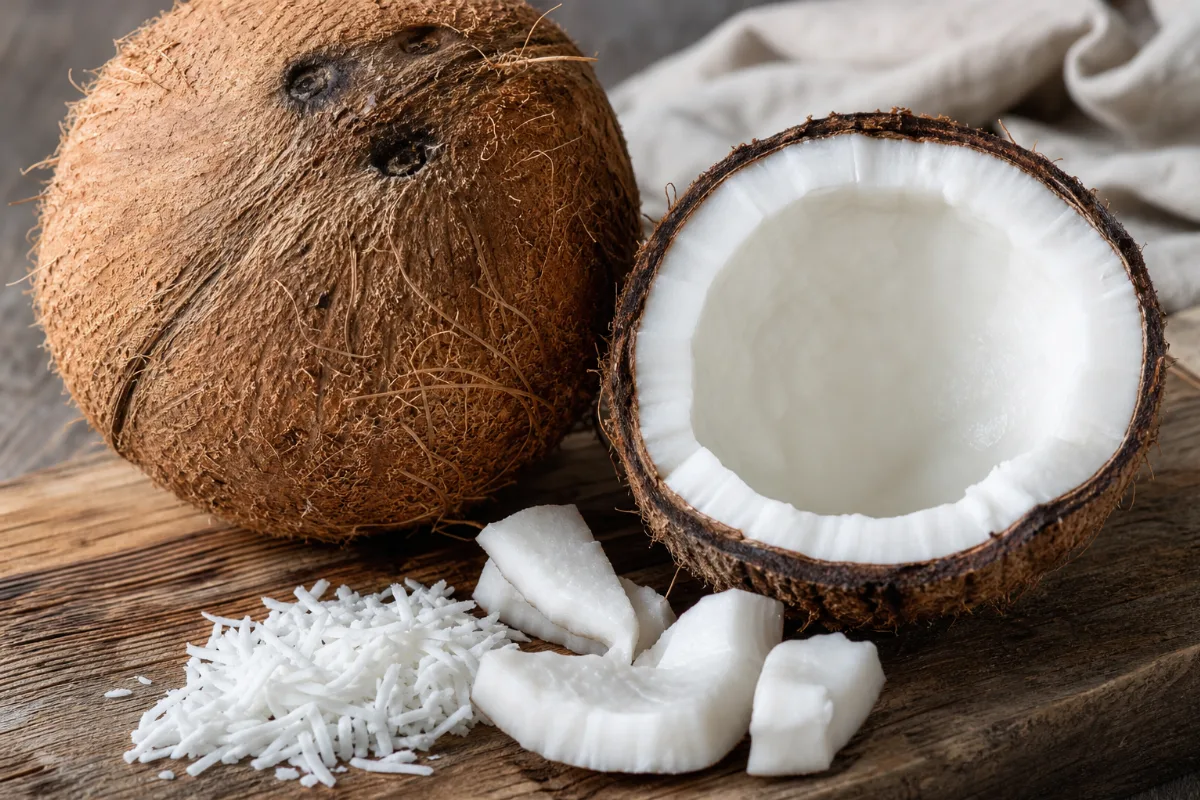
The coconut (Cocos nucifera) is the one-seeded fruit of the coconut palm. People eat the white meat fresh, shredded or dried, drink the water, and press the meat into milk, cream and oil.
USDA data for raw coconut meat: 354 kcal per 100 g. One cup of shredded meat (80 g) has about 283 kcal, 23.8 g saturated fat, 7.2 g fibre, 5.0 g sugars, 285 mg potassium, 1.2 mg manganese and 0.34 mg copper. Raw coconut water has about 46 kcal, 6.3 g sugars and 600 mg potassium in a cup (240 g).
What the research shows
The clearest result is about fat. In a meta-analysis of 16 trials, coconut oil raised LDL cholesterol more than other plant oils. Cochrane found that cutting saturated fat in general lowered cardiovascular events. No trial tested coconut meat for the heart.
Coconut water has two tiny rehydration trials that found it about as good as a sports drink. One trial in 95 adults found more remission with coconut water in mild to moderate ulcerative colitis, as an add-on to medicines.
Blood pressure and blood sugar findings are weak. A review of coconut fat found no benefit for blood sugar control. Detox and immunity claims have no human trial behind them.
Meat, water, milk, flour and oil are different
The cholesterol results are for coconut oil, a concentrated fat. The rehydration, colitis and blood pressure studies used coconut water. The blood sugar trial used coconut flour in baked foods. Results for one product do not carry over to another, and none tested plain coconut meat.
Amounts
This page gives no amounts to eat or drink. Ask a doctor or pharmacist what is right for you, especially if you take medicine, have kidney disease, or have high cholesterol.
At a glance
Traditional uses history, not proof
- Eaten fresh or dried, and pressed into milk, cream and oil in many tropical cuisines
- The water inside young coconuts is drunk as a refreshing drink; long use is not proof it works
Studied for research
- Fibre and minerals in the meat, high certainty for the nutrient content
- Cholesterol: coconut oil raises LDL, moderate certainty (oil, not meat)
- Rehydration after exercise (coconut water), low certainty
- Mild to moderate ulcerative colitis (coconut water, add-on), low certainty
- Blood sugar (coconut fat), against; blood pressure (coconut water), very low certainty
Main compounds
- Saturated fat, including lauric acid
- Dietary fibre
- Manganese and copper
- Potassium (mainly in the water)
Common forms
- Fresh or dried coconut meat as food
- Coconut water, natural or packaged
- Coconut milk or cream, pressed from grated meat
- Coconut flour (used in a 2003 trial)
- Coconut oil (used in the cholesterol trials; not the same as the meat)
Research links: WHO: Healthy diet fact sheet · Meta-analysis: coconut oil and cardiovascular risk factors (2020) · Prevalence of coconut allergy in the United States (2023) · Research Library · Genes & Biomarkers Library
What it is and its history
- Accepted scientific name
- Cocos nucifera
- Naming authority
- L. (GBIF accepted; usageKey 2735117)
- Common names
- Coconut (English); Coco (Spanish)
- Family or group
- Arecaceae (the palm family).
- Classification
- Plantae > Tracheophyta > Liliopsida > Arecales > Arecaceae > Cocos > Cocos nucifera
- Native range
- Not verified from a source read.
- Habitat
- Not verified from a source read.
- What it looks like
- Roots: Not verified.; Stems: Not verified.; Leaves: Not verified.; Flowers: Not verified.; Fruit: The Academy of Nutrition and Dietetics page calls coconut a fruit with a hard shell, a one-seeded drupe. The white flesh is the meat; the liquid inside is coconut water.
- Cultivation
- Not verified from a source read.
- Harvest and processing
- Eaten as fresh or dried meat, as water from the fruit, as milk or cream pressed from grated meat, as flour and as oil. Studies used coconut water, coconut flour in baked foods and coconut oil.
- Look-alikes and adulterants
- Name: Cocoa or cacao; Note: A different plant (the chocolate source) with a similar-sounding name. It is not coconut.; Name: Poria cocos (a medicinal fungus); Note: A fungus whose Latin name includes 'cocos'. It is not coconut and has its own page.; Name: Palm kernel and palm oil; Note: Other palm products (oil palm). Coconut results should not be assumed for them.
- Sustainability and conservation
- Not assessed.
Photographs
Traditional use and history history, not clinical proof
| Tradition or era | Documented use | Source |
|---|---|---|
| Pacific atoll diets | A 1981 study describes two Polynesian atoll populations, Pukapuka and Tokelau, whose diets were high in saturated fat, with coconut the chief energy source (63% of energy in Tokelau, 34% in Pukapuka). | p7270479 |
| Culinary use | Coconut meat, water, milk and oil are eaten in many cuisines (general knowledge; no historical source was read). | Not verified |
Traditional use shows how it was used. It does not show that it works or is safe today.
What is inside, and how it may work
What it contains and how those compounds act in cells and animals. Laboratory and animal mechanisms are not proven effects in people.
Main compounds
| Compound | Family | Where it is concentrated | Activity studied | Level of evidence |
|---|---|---|---|---|
| Saturated fat (total) | fat | Meat (and the oil pressed from it) USDA: 29.7 g per 100 g raw meat; 82.5 g per 100 g coconut oil | Raises LDL cholesterol compared with unsaturated fats (shown for coconut oil in a meta-analysis). 19 21 7 | Human data |
| Lauric acid PubChem 3893 | saturated fatty acid | Meat and oil Described as high (with myristic acid) in the 1981 atoll study; no amount was read | A saturated fat. The 1981 study found a high lauric and myristic content in food samples and human fat biopsies of the atoll groups. 18 10 | Observational |
| Dietary fibre | carbohydrate | Meat and flour USDA: 9.0 g per 100 g raw meat | Authors of the coconut flour trial link the lower glycaemic index of baked foods with the fibre content. 19 12 | Human data |
| Manganese and copper | minerals | Meat USDA per 100 g: manganese 1.5 mg, copper 0.43 mg | Nutrients found in the meat; no coconut trial of them was read. 19 | Composition only |
| Potassium | mineral | Water and meat USDA per 100 g: 250 mg in raw coconut water, 165 mg in an unsweetened ready-to-drink coconut water, 356 mg in raw meat | Coconut water is described by the authors of the sports and colitis papers as potassium-rich. 20 23 19 | Composition only |
| Plant compounds other than the above (polyphenols, medium-chain fats and others) | various | Not looked up | Not researched here. No coconut-specific human trial of these was read, so no claim is made. | Not assessed |
Mechanisms, receptors and pathways
| Target or pathway | Gene or receptor | What was found | Level |
|---|---|---|---|
| Saturated fat and LDL cholesterol | Not specified | Coconut oil raised LDL cholesterol compared with non-tropical vegetable oils across 16 trials. The AHA advisory says replacing saturated fat with unsaturated fat lowers LDL, which it links to atherosclerosis. 7 11 | Human data |
| Fibre and the blood sugar response | Not specified | In the coconut flour trial the glycaemic index of the baked foods fell as their fibre content rose (r = -0.85). This is the authors' interpretation, not direct proof. 12 | Human data |
| Gut microbiome in ulcerative colitis | Not specified | In the colitis trial, bacterial groups that tracked with lower disease scores became more common in the coconut water group. The authors suggest this as part of the explanation. 6 | Human data |
| Electrolytes and rehydration | Not specified | The 2026 trial authors say potassium-rich coconut water worked about as well as a sports drink for rehydration, despite lower sodium. They do not test a mechanism. 3 | Human data |
Absorption, metabolism and elimination
- Absorption
- Not studied for coconut.
- Distribution
- Not found.
- Metabolism
- Not found.
- Elimination
- Not found.
- Bioavailability
- Not established for coconut.
Isolated compounds versus whole extracts
Different coconut products behave differently. The cholesterol and body-fat results are for coconut oil, a concentrated fat. The rehydration, colitis and blood pressure studies used coconut water. The blood sugar studies used coconut flour baked foods or coconut fat. No trial of the plain meat was found. Results from one product do not carry over to another.
Nutritional composition
Nutrition from USDA FoodData Central, as a saved copy of the record (FDC 170169, raw coconut meat, SR Legacy, April 2018 release; read 2026-10-25). Per 100 g: 354 kcal, 33.5 g fat of which 29.7 g saturated, 15.2 g carbohydrate, 9.0 g fibre, 6.2 g total sugars, 3.3 g protein, about 47 g water, 356 mg potassium, 1.5 mg manganese, 0.43 mg copper, 10.1 micrograms selenium, 2.43 mg iron, 1.1 mg zinc, 26 micrograms folate (DFE), 3.3 mg vitamin C. One cup of shredded meat (80 g): about 283 kcal, 26.8 g fat, 23.8 g saturated fat (119% of the FDA Daily Value), 7.2 g fibre, 5.0 g sugars, 285 mg potassium, 1.2 mg manganese, 0.34 mg copper. One piece (2 x 2 x 1/2 inch, 45 g): about 159 kcal, 13.4 g saturated fat, about 4 g fibre. USDA lists no vitamin A and almost no vitamin K (0.2 micrograms per 100 g). Coconut water: raw coconut water (FDC 170174) has 19 kcal, 2.6 g sugars, 250 mg potassium and 105 mg sodium per 100 g, so a 240 g cup has about 46 kcal, 6.3 g sugars, 600 mg potassium and 252 mg sodium. An unsweetened ready-to-drink coconut water (FDC 174831) has 18 kcal, 3.9 g sugars, 165 mg potassium and 26 mg sodium per 100 g, so a 245 g cup has about 44 kcal, 9.6 g sugars, 404 mg potassium and 64 mg sodium. Coconut milk: only a carton drink record was read (FDC 174116, sweetened, fortified): 31 kcal, 2.1 g saturated fat and 2.5 g sugars per 100 g, so about 74 kcal, 5.0 g saturated fat and 6.0 g sugars per 240 g cup. Cooking-style canned coconut milk and cream were not read, so no numbers are given. Coconut oil (FDC 171412) has 892 kcal and 82.5 g saturated fat per 100 g, about 11.2 g saturated fat in a 13.6 g tablespoon. Figures vary with variety, ripeness and storage; dried or sweetened shredded coconut is not in the records read. Per-portion figures are the per-100 g values scaled by weight, rounded.
1 high certainty2 moderate certainty4 low certainty2 very low certainty1 evidence against
What was looked at
The 10 benefits and uses checked for Coconut, each with how strong the evidence is. Tap one to open it.
- Fibre, manganese and copper from coconut meatHigh certainty
- Cholesterol: coconut oil raises LDL (the oil, not the meat)Moderate certainty
- Saturated fat and heart disease (general advice, applies to coconut products)Moderate certainty
- Heart health from eating coconut meatVery low certainty
- Rehydration after exercise (coconut water)Low certainty
- Ulcerative colitis (coconut water as an add-on)Low certainty
- Blood pressure (young coconut water)Very low certainty
- Blood sugar control (coconut oil and coconut fat)Evidence against
- Blood sugar response to foods made with coconut flourLow certainty
- Body fat and inflammation markers (coconut oil)Low certainty
Lab markers tracked in the studies
LDL cholesterolHDL cholesterolUrine output and fluid retained after exerciseClinical remission in ulcerative colitis (SCCAI 2 or less)Fecal calprotectinBlood pressure (systolic and diastolic)HOMA-IR (insulin resistance marker)Glycaemic index of the test food
What is Coconut good for?
The main studied uses and how strong the human evidence is for each. Many results come from coconut oil, coconut water or coconut flour rather than the meat.
Benefits, one by one
Each card is a research question, not a promise. Tap a goal to filter. Open a card to see the studies, doses and limits.
Fibre, manganese and copper from coconut meat
High certaintyCoconut meat is a food source of fibre, manganese and copper. One cup of shredded raw meat (80 g) has about 7.2 g of fibre and 1.2 mg of manganese. This is a nutrient fact from the USDA, not a trial of a health result.
2 studiesFresh or dried coconut meat as food. Sweetened or dried products were…
Studies, doses and limits
What the trials found
USDA lists raw coconut meat at 9.0 g fibre, 1.5 mg manganese, 0.43 mg copper, 10.1 micrograms selenium and 2.43 mg iron per 100 g. WHO advises at least 25 g of naturally occurring fibre a day for people over 10, from many foods.
Results
Coconut meat is a real source of these nutrients. No trial shows that eating it improves a health outcome.
Effect sizes as reported
Per 100 g (USDA): fibre 9.0 g, manganese 1.5 mg, copper 0.43 mg. Per cup of shredded meat (80 g): about 7.2 g fibre, 1.2 mg manganese, 0.34 mg copper.
Why this rating
High for the nutrient content, which is a measured value. There is no coconut trial, so this says nothing about disease.
Form and dose studied
Fresh or dried coconut meat as food. Sweetened or dried products were not looked up.
Who was studied
Anyone eating coconut meat.
Limits
Values vary with variety, ripeness and storage. Dried and sweetened coconut was not measured in the record read. The same cup also has about 24 g of saturated fat (see the next item).
Why researchers looked
People ask whether coconut is a nutritious fruit or mostly fat.
Traditional use
Coconut is a staple food in many tropical regions; long use as food is not proof that it prevents or treats any condition.
Proposed mechanism Authoritative guidance
Fibre, manganese and copper are nutrients found in the food. The page does not claim a disease effect from them.
A proposed mechanism does not show that the effect happens in people.
See the saturated fat item and the Safety tab.
Cholesterol: coconut oil raises LDL (the oil, not the meat)
Moderate certaintyA meta-analysis of 16 trials found coconut oil raised LDL ('bad') cholesterol by about 10.5 mg/dL and HDL ('good') cholesterol by about 4 mg/dL, compared with non-tropical vegetable oils. This was the oil, not the meat, water or milk.
1 studiesCoconut oil as a cooking fat in trials. The meat contains the same ki…
Studies, doses and limits
What the trials found
The 2020 Circulation review pooled 16 trials of at least 2 weeks. LDL rose by 10.47 mg/dL (95% CI 3.01 to 17.94, high variation between trials) and HDL by 4.00 mg/dL. Results held after dropping non-randomised or poor-quality trials. Blood sugar, inflammation and body fat markers did not change significantly.
Results
Coconut oil raised LDL cholesterol more than other plant oils. No benefit for other heart risk markers was found.
Effect sizes as reported
LDL +10.47 mg/dL (95% CI 3.01 to 17.94); HDL +4.00 mg/dL (95% CI 2.26 to 5.73).
Why this rating
The result is consistent after leaving out weak trials, but the trials differed a lot (I2 84%) and tested the oil. It does not directly apply to eating the meat.
Form and dose studied
Coconut oil as a cooking fat in trials. The meat contains the same kind of fat but was not tested.
Who was studied
Adults in 16 trials.
Limits
Oil only. Trials were at least 2 weeks and tested cholesterol markers, not heart attacks or strokes.
Why researchers looked
Coconut oil is often sold as healthy, so researchers compared it with other cooking oils.
Traditional use
Coconut is a staple food in many tropical regions; long use as food is not proof that it prevents or treats any condition.
Proposed mechanism Established physiology
Coconut oil is high in saturated fat. In people, saturated fat raises LDL cholesterol compared with unsaturated fats (shown in the meta-analysis above).
A proposed mechanism does not show that the effect happens in people.
Ask a clinician if you have high cholesterol or heart disease.
Saturated fat and heart disease (general advice, applies to coconut products)
Moderate certaintyCoconut meat and oil are very high in saturated fat. A Cochrane review of 15 long trials found that cutting saturated fat lowered combined heart and blood vessel events by 17%. WHO advises no more than 10% of energy from saturated fat and names coconut oil as a source.
4 studiesNot a dose; the trials changed whole diets.
Studies, doses and limits
What the trials found
Cochrane (2020): 15 trials, 56,675 people, at least 24 months. Combined cardiovascular events fell 17% (RR 0.83, 95% CI 0.70 to 0.98, GRADE moderate). All-cause death (RR 0.96) and cardiovascular death (RR 0.95) showed little or no effect. The AHA advisory (2017) concludes strongly that replacing saturated fat with unsaturated fat lowers cardiovascular disease. USDA lists 29.7 g of saturated fat per 100 g of raw coconut meat.
Results
The general advice is well supported for saturated fat. No trial tested coconut meat itself.
Effect sizes as reported
Cochrane: cardiovascular events RR 0.83. USDA: 29.7 g saturated fat per 100 g; about 23.8 g per cup (80 g).
Why this rating
Cochrane graded the main result moderate-quality. It is about saturated fat in general, not coconut, so applying it to coconut is an inference.
Form and dose studied
Not a dose; the trials changed whole diets.
Who was studied
Adults with and without heart disease.
Limits
Not a coconut trial. The benefit depends on what replaces the saturated fat.
Why researchers looked
Because coconut is high in saturated fat, the general advice on that fat is the closest guide.
Traditional use
Coconut is a staple food in many tropical regions; long use as food is not proof that it prevents or treats any condition.
Proposed mechanism Authoritative guidance
Replacing saturated fat with unsaturated fat lowers LDL cholesterol, which the American Heart Association links to atherosclerosis.
A proposed mechanism does not show that the effect happens in people.
A clinician can tell you how coconut fits your cholesterol plan.
Heart health from eating coconut meat
Very low certaintyNo trial tested eating coconut meat for cholesterol or heart disease. One 1981 comparison of two Pacific island groups who ate a lot of coconut found low rates of vascular disease, but cholesterol was higher in the group that ate more coconut.
1 studiesWhole traditional diet in which coconut was the chief energy source.
Studies, doses and limits
What the trials found
Prior and colleagues (1981) compared Pukapuka and Tokelau. Coconut gave 63% of energy in Tokelau and 34% in Pukapuka. Serum cholesterol was 35 to 40 mg higher in Tokelauans. The authors say vascular disease was uncommon in both groups and there was no evidence of harm in these populations.
Results
Cholesterol went up with more coconut. Disease was uncommon in both groups, but the study cannot say why.
Effect sizes as reported
Serum cholesterol 35 to 40 mg higher with 63% vs 34% of energy from coconut.
Why this rating
One old observational comparison of two groups. It cannot show cause and does not apply directly to other people or diets.
Form and dose studied
Whole traditional diet in which coconut was the chief energy source.
Who was studied
Two Polynesian atoll populations in the 1970s.
Limits
Observational and from 1981. Other parts of those diets and lifestyles were not tested.
Why researchers looked
Some island populations eat coconut as a main food, so researchers looked at their health.
Traditional use
Coconut is a staple food in many tropical regions; long use as food is not proof that it prevents or treats any condition.
Proposed mechanism Preliminary mechanism
The authors of the island study attribute the cholesterol difference between the groups to saturated fat intake.
A proposed mechanism does not show that the effect happens in people.
Not a reason to eat large amounts of coconut.
Rehydration after exercise (coconut water)
Low certaintyTwo small trials compared coconut water with sports drinks. In 8 athletes after cycling, coconut water rehydrated about as well as a sports drink. In 19 cyclists, performance on coconut water matched an equal-calorie sports drink.
2 studiesNatural or commercial coconut water as a drink after exercise.
Studies, doses and limits
What the trials found
Bell and Spriet (2026, 8 athletes, crossover): urine output was 530 ml after flavoured water vs 170 ml after coconut water and 170 ml after the sports drink; fluid status after rehydration did not differ. O'Brien and colleagues (2023, 19 cyclists, crossover): no significant differences in 20 km time trial or body measures; blood glucose was lower with coconut water (effect size 0.31).
Results
Coconut water did about as well as a sports drink in two very small short trials.
Effect sizes as reported
No significant difference between drinks in either trial.
Why this rating
Two tiny, short crossover trials of coconut water. They do not cover coconut meat or milk.
Form and dose studied
Natural or commercial coconut water as a drink after exercise.
Who was studied
Recreational athletes and trained cyclists.
Limits
Very small trials, mostly young men. Not tested in children, older people, heat illness or long events.
Why researchers looked
Coconut water has natural potassium and is sold as a sports drink alternative.
Traditional use
Coconut is a staple food in many tropical regions; long use as food is not proof that it prevents or treats any condition.
Proposed mechanism Preliminary mechanism
Coconut water has potassium and some sodium. The authors of the 2026 trial say it worked despite less sodium than the sports drink.
A proposed mechanism does not show that the effect happens in people.
Coconut water is high in potassium; see the Safety tab.
Ulcerative colitis (coconut water as an add-on)
Low certaintyOne trial of 95 adults with mild to moderate ulcerative colitis gave 400 mL of coconut water a day for 8 weeks on top of usual medicines. More people reached remission than with placebo (53% vs 28%). It is one trial from one centre.
1 studiesPlain coconut water, tested as a drink for 8 weeks.
Studies, doses and limits
What the trials found
Kedia and colleagues (2024): double-blind, placebo-controlled, single centre in India, 49 coconut water and 46 placebo, all on standard therapy. Clinical response 57.1% vs 28.3% (OR 3.4); remission 53.1% vs 28.3% (OR 2.9, 95% CI 1.2 to 6.7); fecal calprotectin under 150 in 30.6% vs 6.5%. Adverse events were similar; no one developed hyperkalemia.
Results
Better remission and calprotectin with coconut water than placebo, as an add-on to medicines.
Effect sizes as reported
Remission OR 2.9 (1.2 to 6.7); response OR 3.4 (1.4 to 7.9); calprotectin <150 OR 6.3 (1.7 to 23.6).
Why this rating
One randomised, double-blind trial of 95 people from a single centre. It needs repeating before the result can be trusted. It was an add-on to usual medicines.
Form and dose studied
Plain coconut water, tested as a drink for 8 weeks.
Who was studied
Adults with mild to moderate ulcerative colitis already on standard treatment.
Limits
Single centre, 8 weeks, funding not stated in the abstract. Does not cover Crohn's disease, children or severe colitis.
Why researchers looked
Coconut water is potassium-rich, and researchers wondered if it could help gut inflammation and the gut microbiome.
Traditional use
Coconut is a staple food in many tropical regions; long use as food is not proof that it prevents or treats any condition.
Proposed mechanism Preliminary mechanism
The authors suggest coconut water may be anti-inflammatory and shift the gut microbiome. Bacteria linked with lower disease scores increased in the coconut group.
A proposed mechanism does not show that the effect happens in people.
Do not stop colitis medicines. People with kidney problems should ask about potassium first.
Blood pressure (young coconut water)
Very low certaintyA small non-randomised study of 30 people with stage 1 high blood pressure found a fall in blood pressure after 150 ml of young coconut water a day for 7 days. The groups were not well matched and the study was tiny.
1 studiesYoung coconut water for 7 days.
Studies, doses and limits
What the trials found
Awaluddin and Pristika (2024), Indonesia, quasi-experimental: 15 people drank young coconut water for 7 days and 15 did not. Blood pressure fell significantly in the coconut group (p < 0.05) and not in the other group. All 15 in the coconut group were women.
Results
A small drop in blood pressure in one small non-randomised study.
Effect sizes as reported
Significant fall in the coconut group only (p < 0.05); size of change not given in the abstract.
Why this rating
Not randomised, 30 people, one week, groups differed, and no size of change was given.
Form and dose studied
Young coconut water for 7 days.
Who was studied
Adults over 35 with stage 1 high blood pressure.
Limits
Cannot show cause. Not a replacement for blood pressure medicine.
Why researchers looked
Coconut water contains potassium, which is linked to blood pressure in general.
Traditional use
Coconut is a staple food in many tropical regions; long use as food is not proof that it prevents or treats any condition.
Proposed mechanism Unknown
Not tested in this study. The abstract does not give a mechanism.
A proposed mechanism does not show that the effect happens in people.
People on blood pressure medicine should ask a pharmacist.
Blood sugar control (coconut oil and coconut fat)
Evidence againstA meta-analysis of 18 studies found that coconut fat did not improve blood sugar control. Long-term, it raised a marker of insulin resistance. The studies mostly used coconut oil.
1 studiesCoconut fat as oil or coconut in meals.
Studies, doses and limits
What the trials found
Dhanasekara and colleagues (2022): 7 acute and 11 long-term (over 10 days) interventional studies. Meals with coconut fat raised the glucose incremental AUC (p = 0.046) and lowered the insulin AUC (p = 0.037). Long-term coconut fat raised HOMA-IR (p = 0.049) and did not change fasting glucose, fasting insulin or HOMA-beta. The authors say the results disprove the claim that coconut fat improves glycemic control.
Results
No benefit for blood sugar control, and a small rise in an insulin resistance marker.
Effect sizes as reported
Long-term HOMA-IR up (p = 0.049); meal glucose AUC up (p = 0.046).
Why this rating
A systematic review with meta-analysis of 18 studies found no benefit and a rise in a marker of insulin resistance. It was mostly oil, not meat, and the abstract gives no certainty grade.
Form and dose studied
Coconut fat as oil or coconut in meals.
Who was studied
Adults in 18 interventional studies.
Limits
The abstract does not say how many studies used whole coconut. Few studies.
Why researchers looked
Coconut fat is promoted online for blood sugar control, so reviewers tested the claim.
Traditional use
Coconut is a staple food in many tropical regions; long use as food is not proof that it prevents or treats any condition.
Proposed mechanism Preliminary mechanism
After a meal with coconut fat, the insulin curve was lower and the glucose curve a little higher.
A proposed mechanism does not show that the effect happens in people.
People with diabetes should ask their care team before changing their diet.
Blood sugar response to foods made with coconut flour
Low certaintyIn 20 people, baked foods with more coconut flour gave lower blood sugar responses. Macaroons and carrot cake with a lot of coconut flour were low glycaemic index. Foods with less coconut flour, such as a bread roll, were high.
1 studiesCoconut flour baked into foods.
Studies, doses and limits
What the trials found
Trinidad and colleagues (2003): 10 healthy people and 10 people with diabetes, randomised crossover. Macaroons GI 45.7 and carrot cake GI 51.8 with 200 to 250 g coconut flour per kg. Foods with 150 g per kg had GI 61.3 to 71.4. Pan de sal (GI 87.2) and a multigrain loaf (GI 85.2) with 50 and 100 g per kg were high.
Results
More coconut flour meant a lower blood sugar response in these baked foods.
Effect sizes as reported
Macaroons GI 45.7 (SEM 3.0); carrot cake GI 51.8 (SEM 3.3).
Why this rating
A small 2003 crossover test of single meals. Coconut flour in baking is not the same as fresh coconut meat.
Form and dose studied
Coconut flour baked into foods.
Who was studied
10 healthy adults and 10 adults with diabetes.
Limits
The authors note the fat content of these foods should always be considered. Single meals only, not long-term control.
Why researchers looked
Coconut flour is high in fibre, and researchers tested whether it lowers the blood sugar rise from baked foods.
Traditional use
Coconut is a staple food in many tropical regions; long use as food is not proof that it prevents or treats any condition.
Proposed mechanism Preliminary mechanism
The authors link the lower glycaemic index to the fibre in coconut flour (r = -0.85 between GI and fibre across test foods).
A proposed mechanism does not show that the effect happens in people.
These foods are also energy-dense.
Body fat and inflammation markers (coconut oil)
Low certaintyIn the same 16-trial review, coconut oil did not change body fatness or inflammation markers compared with other plant oils. No trial tested coconut meat for weight.
1 studiesCoconut oil compared with other oils.
Studies, doses and limits
What the trials found
Neelakantan and colleagues (2020): data on body weight (8 trials), percent body fat (5), waist circumference (4), fasting glucose (4) and C-reactive protein (5). None changed significantly compared with non-tropical vegetable oils.
Results
No measurable effect on body fat or inflammation compared with other oils.
Effect sizes as reported
No significant change in any of these markers.
Why this rating
A null result from a small number of trials for each marker. It is about the oil and not the meat.
Form and dose studied
Coconut oil compared with other oils.
Who was studied
Adults in the included trials.
Limits
Few trials per marker. Does not cover meat, water or milk.
Why researchers looked
Coconut oil is promoted for weight loss and for lowering inflammation.
Traditional use
Coconut is a staple food in many tropical regions; long use as food is not proof that it prevents or treats any condition.
Proposed mechanism None found
No mechanism was tested in the review.
A proposed mechanism does not show that the effect happens in people.
None specific.
Connections to the rest of health
How Coconut connects to the rest of our health knowledge graph. Every link says what kind of connection it is. A safety link (for example to the liver) is a warning, not a benefit. A study that merely mentions a topic never creates a benefit link.
Explore every connection: goals, body systems, organs, symptoms, genes
A. Wellness goals
| Connected to | Kind of connection | Evidence status | Context | Studies |
|---|---|---|---|---|
| Digestive Support | Demonstrated clinical effect | High certainty | Fibre, manganese and copper from coconut meat: Coconut meat is a food source of fibre, manganese and copper. One cup of shredded raw meat (80 g) has about 7.2 g of fibre and 1.2 mg of manganese. This is a nutrient fact from the USDA, not a trial of a health result. | 19 24 |
| Cholesterol Balance | Moderate certainty | Cholesterol: coconut oil raises LDL (the oil, not the meat): A meta-analysis of 16 trials found coconut oil raised LDL ('bad') cholesterol by about 10.5 mg/dL and HDL ('good') cholesterol by about 4 mg/dL, compared with non-tropical vegetable oils. This was the oil, not the meat, water or milk. | 7 | |
| Heart Health | Moderate certainty | Saturated fat and heart disease (general advice, applies to coconut products): Coconut meat and oil are very high in saturated fat. A Cochrane review of 15 long trials found that cutting saturated fat lowered combined heart and blood vessel events by 17%. WHO advises no more than 10% of energy from saturated fat and names coconut oil as a source. | 5 11 19 24 | |
| Heart Health | Biological association | Very low certainty | Heart health from eating coconut meat: No trial tested eating coconut meat for cholesterol or heart disease. One 1981 comparison of two Pacific island groups who ate a lot of coconut found low rates of vascular disease, but cholesterol was higher in the group that ate more coconut. | 10 |
| Recovery Optimization | Low certainty | Rehydration after exercise (coconut water): Two small trials compared coconut water with sports drinks. In 8 athletes after cycling, coconut water rehydrated about as well as a sports drink. In 19 cyclists, performance on coconut water matched an equal-calorie sports drink. | 3 8 | |
| Digestive Support | Low certainty | Ulcerative colitis (coconut water as an add-on): One trial of 95 adults with mild to moderate ulcerative colitis gave 400 mL of coconut water a day for 8 weeks on top of usual medicines. More people reached remission than with placebo (53% vs 28%). It is one trial from one centre. | 6 | |
| Blood Pressure Support | Very low certainty | Blood pressure (young coconut water): A small non-randomised study of 30 people with stage 1 high blood pressure found a fall in blood pressure after 150 ml of young coconut water a day for 7 days. The groups were not well matched and the study was tiny. | 2 | |
| Blood Sugar Balance | Evidence against | Blood sugar control (coconut oil and coconut fat): A meta-analysis of 18 studies found that coconut fat did not improve blood sugar control. Long-term, it raised a marker of insulin resistance. The studies mostly used coconut oil. | 4 | |
| Blood Sugar Balance | Low certainty | Blood sugar response to foods made with coconut flour: In 20 people, baked foods with more coconut flour gave lower blood sugar responses. Macaroons and carrot cake with a lot of coconut flour were low glycaemic index. Foods with less coconut flour, such as a bread roll, were high. | 12 | |
| Weight Management | Low certainty | Body fat and inflammation markers (coconut oil): In the same 16-trial review, coconut oil did not change body fatness or inflammation markers compared with other plant oils. No trial tested coconut meat for weight. | 7 |
B. Body systems
| Connected to | Kind of connection | Evidence status | Context | Studies |
|---|---|---|---|---|
| Digestive System | Biological association | High certainty | Studied for: Fibre, manganese and copper from coconut meat Studied for: Ulcerative colitis (coconut water as an add-on) | 19 24 6 |
| Cardiovascular System | Biological association | Moderate certainty | Studied for: Cholesterol: coconut oil raises LDL (the oil, not the meat) Studied for: Saturated fat and heart disease (general advice, applies to coconut products) | 7 5 11 19 24 10 2 |
| Musculoskeletal System | Biological association | Low certainty | Studied for: Rehydration after exercise (coconut water) | 3 8 |
| Blood Sugar Support | Biological association | Evidence against | Studied for: Blood sugar control (coconut oil and coconut fat) Studied for: Blood sugar response to foods made with coconut flour | 4 12 |
| Metabolism Weight | Biological association | Low certainty | Studied for: Body fat and inflammation markers (coconut oil) | 7 |
E. Health conditions
| Connected to | Kind of connection | Evidence status | Context | Studies |
|---|---|---|---|---|
| Food allergy | Adverse effect or risk | Documented risk | About 1 in 260 US residents report convincing coconut allergy. Preparation or compound: Coconut as food |
13 |
| Ulcerative colitis | Preliminary | One trial of coconut water as an add-on to medicines found more remission than placebo. Preparation or compound: Coconut water |
6 |
I. Biomarkers
| Connected to | Kind of connection | Evidence status | Context | Studies |
|---|---|---|---|---|
| LDL cholesterol | Biological association | Moderate certainty | Measured in trials: increase. A lab change is not the same as a health benefit. | 7 |
| HDL cholesterol | Biological association | Moderate certainty | Measured in trials: increase. A lab change is not the same as a health benefit. | 7 |
| Urine output and fluid retained after exercise | Biological association | Low certainty | Measured in trials: no clear difference. A lab change is not the same as a health benefit. | 3 |
| Clinical remission in ulcerative colitis (SCCAI 2 or less) | Biological association | Low certainty | Measured in trials: improvement. A lab change is not the same as a health benefit. | 6 |
| Fecal calprotectin | Biological association | Low certainty | Measured in trials: improvement. A lab change is not the same as a health benefit. | 6 |
| Blood pressure (systolic and diastolic) | Biological association | Very low certainty | Measured in trials: improvement. A lab change is not the same as a health benefit. | 2 |
| HOMA-IR (insulin resistance marker) | Biological association | Evidence against | Measured in trials: worsening. A lab change is not the same as a health benefit. | 4 |
| Glycaemic index of the test food | Biological association | Low certainty | Measured in trials: improvement. A lab change is not the same as a health benefit. | 12 |
K. Biological pathways
| Connected to | Kind of connection | Evidence status | Context | Studies |
|---|---|---|---|---|
| Saturated fat | Preliminary mechanism | Human | Coconut meat and oil are very high in saturated fat; coconut oil raised LDL cholesterol in a meta-analysis. | 19 7 |
| Potassium | Preliminary mechanism | Human | Coconut water contains potassium and was tested for rehydration and in ulcerative colitis. | 20 6 |
L. Active compounds
| Connected to | Kind of connection | Evidence status | Context | Studies |
|---|---|---|---|---|
| Saturated fat (total) | Biological association | Human | Raises LDL cholesterol compared with unsaturated fats (shown for coconut oil in a meta-analysis). Preparation or compound: Meat (and the oil pressed from it) |
19 21 7 |
| Lauric acid | Biological association | Observational | A saturated fat. The 1981 study found a high lauric and myristic content in food samples and human fat biopsies of the atoll groups. Preparation or compound: Meat and oil |
18 10 |
| Dietary fibre | Biological association | Human | Authors of the coconut flour trial link the lower glycaemic index of baked foods with the fibre content. Preparation or compound: Meat and flour |
19 12 |
| Manganese and copper | Biological association | Composition only | Nutrients found in the meat; no coconut trial of them was read. Preparation or compound: Meat |
19 |
| Potassium | Biological association | Composition only | Coconut water is described by the authors of the sports and colitis papers as potassium-rich. Preparation or compound: Water and meat |
20 23 19 |
| Plant compounds other than the above (polyphenols, medium-chain fats and others) | Biological association | Not assessed | Not researched here. No coconut-specific human trial of these was read, so no claim is made. Preparation or compound: Not looked up |
Each connection is stored with the ingredient, the connected record, the kind of connection, the evidence status, the supporting studies, the preparation or compound involved, and a review date (last reviewed October 25, 2026).
Evidence at a glance: what the research found for 10 outcomes
Each outcome below is one thing researchers measured. Certainty is how far the evidence can be trusted, not how well it works. The full studies are on the next tab.
The evidence
The research centre for Coconut. Every record here was checked against PubMed or the publisher's page; we never list a study we have not verified.
Evidence by outcome
Bars show how many studies we found for each outcome, not how well it works. People are added up across trials only (reviews are not added, to avoid double counting).
How we rate evidence
High certainty
Several well-run trials or reviews agree; further research is unlikely to change the picture much.
Moderate certainty
Good trials point the same way, but some doubt remains.
Low certainty
Small, short or inconsistent trials. The finding could change with better research.
Very low certainty
Very little or very weak human data. Treat as a possibility only.
Mixed findings
Trials or reviews disagree with each other.
Not enough evidence
Not enough human research to say either way.
Evidence against
Good research found no benefit, or found harm.
We take the reviewers' own risk-of-bias and GRADE statements where they exist, and otherwise judge from study size, design, consistency, directness and whether a product matches what is sold. Many publications do not make evidence high. Method note: We started from our existing coconut summary and saved USDA FoodData Central records, checked taxonomy at GBIF, and searched PubMed for trials, reviews and allergy evidence. Only abstracts were read for studies. Items we could not verify are flagged in the research gaps.
Study library: every study we checked 24
| Study | Design | People | Product, dose, length | Result |
|---|---|---|---|---|
| Anagnostou K. 2017 Coconut Allergy Revisited. Children (Basel) · PMID 28961189 · DOI |
Case report |
1 One child who had tolerated coconut before and then reacted |
Coconut (as an allergy trigger) Coconut as food and on skin |
The author says coconut allergy is rare, is not directly associated with nut allergy and has few reported cases. A child who had eaten coconut and been exposed on the skin without trouble later became allergic. One case (Not applicable) Methods, limits and fundingOutcomes: Allergic reaction Limitations: A single case. The abstract gives no frequency. Funding and conflicts: The authors declare no conflict of interest. Read: abstract |
| Awaluddin 2024 The Effect of Young Coconut Water on Blood Pressure in Hypertensive Patients. J Pak Med Assoc · PMID 39221800 · DOI |
Quasi experimental study (not randomised) |
30 30 people over 35 with stage I high blood pressure in Indonesia; 15 drank coconut water, 15 did not (all 15 in the coconut group were women) |
Young coconut water Coconut water 150 ml once a day (trial detail, not advice) 1 week · vs No-treatment comparison group |
Blood pressure fell significantly in the coconut water group (p < 0.05) and did not change significantly in the comparison group. The authors conclude it reduced blood pressure after 7 days. Significant fall in the coconut group only (p < 0.05) (Not given in the abstract) Methods, limits and fundingOutcomes: Systolic and diastolic blood pressure Limitations: Not randomised, only 30 people, one week, groups differed (the coconut group was all women), and the abstract gives no size of change. A small non-randomised result cannot show cause. Funding and conflicts: Funding and conflicts not stated in the abstract. Read: abstract |
| Bell 2026 Rehydration After Exercise-Induced Fluid Losses: Comparing Flavored Water, Coconut Water, and Carbohydrate-Electrolyte Sports Beverage. J Strength Cond Res · PMID 41359932 · DOI |
Randomised single blind crossover trial |
8 8 recreational athletes (7 men, 1 woman) after cycling for 60 minutes to about 1.4% body-mass loss |
Natural coconut water Coconut water Volume equal to 150% of body mass lost (trial detail, not advice) One session per drink · vs Flavoured water; carbohydrate-electrolyte sports drink |
Urine output was higher after flavoured water (530 ml) than after coconut water (170 ml) or the sports drink (170 ml). Body fluid status after rehydration did not differ statistically between the three drinks. The authors say coconut water was as effective and as palatable as the sports drink despite less sodium. Urine output 530 ml (flavoured water) vs 170 ml (coconut water, sports drink) (p < 0.05 for urine output; fluid status p > 0.05) Methods, limits and fundingOutcomes: Fluid retention, urine output, thirst, saltiness, nausea Limitations: Only 8 people, mostly young men, one session each. Short-term exercise rehydration only. Funding and conflicts: No funding or conflict statement in the abstract. Read: abstract |
| Dhanasekara 2022 Effects of consumption of coconut oil or coconut on glycemic control and insulin sensitivity: A systematic review and meta-analysis of interventional trials. Nutr Metab Cardiovasc Dis · PMID 34802850 · DOI |
Systematic review and meta analysis of interventional trials |
18 7 acute-effect and 11 long-term (over 10 days) interventional studies of coconut fat |
Coconut fat (coconut oil or coconut) Mostly oil; the abstract does not split oil from coconut Trial detail, not advice Acute meals; long-term over 10 days · vs Control meals |
Meals with coconut fat slightly raised the glucose curve after the meal (p = 0.046) and lowered the insulin curve (p = 0.037). Long-term coconut fat raised HOMA-IR, a marker of insulin resistance (p = 0.049), and did not change fasting glucose, fasting insulin or HOMA-beta. The authors say their results disprove the popular claim that coconut fat improves blood sugar control. Long-term HOMA-IR increase (p = 0.049); acute glucose AUC increase (p = 0.046) (Not given in the abstract) Methods, limits and fundingOutcomes: Blood sugar and insulin after meals, fasting glucose, fasting insulin, HOMA-IR, HOMA-beta Limitations: The abstract does not say how many trials used whole coconut rather than oil. Small number of studies. Funding and conflicts: The authors declare no conflicts of interest. Read: abstract |
| Hooper 2020 Reduction in saturated fat intake for cardiovascular disease. Cochrane Database Syst Rev · PMID 32827219 · DOI |
Meta analysis of randomised trials |
56675 15 randomised trials (16 comparisons) of reducing saturated fat for at least 24 months |
Lower saturated fat intake (not specific to coconut) Trial detail, not advice At least 24 months · vs Higher saturated fat or usual diet |
Reducing saturated fat lowered combined cardiovascular events by 17% (RR 0.83, GRADE moderate-quality). There was little or no effect on all-cause death (RR 0.96) or cardiovascular death (RR 0.95). Cardiovascular events RR 0.83 (95% CI 0.70 to 0.98) Methods, limits and fundingOutcomes: Cardiovascular events and death Limitations: Not a coconut trial. Trials used a range of diets and advice. The number needed to benefit was about 56 over roughly four years. Funding and conflicts: Cochrane review; the abstract does not give conflict details. Read: abstract |
| Kedia 2024 Coconut Water Induces Clinical Remission in Mild to Moderate Ulcerative Colitis: Double-blind Placebo-controlled Trial. Clin Gastroenterol Hepatol · PMID 38278200 · DOI |
Randomised double blind placebo controlled trial (single centre) |
95 Adults with mild to moderate, endoscopically active ulcerative colitis, all also on standard medical therapy |
Coconut water as add-on to standard therapy Coconut water 400 mL a day (trial detail, not advice) 8 weeks · vs Placebo drink plus standard therapy |
Clinical remission 53.1% with coconut water vs 28.3% with placebo; clinical response 57.1% vs 28.3%; fecal calprotectin under 150 micrograms per g in 30.6% vs 6.5%. Adverse events were similar and no patient developed hyperkalemia. Remission OR 2.9; response OR 3.4; calprotectin OR 6.3 (Remission 1.2 to 6.7; response 1.4 to 7.9; calprotectin 1.7 to 23.6) Methods, limits and fundingOutcomes: Clinical remission (SCCAI 2 or less), clinical response, fecal calprotectin, adverse events, gut microbiome Limitations: One centre in India, 95 people analysed, 8 weeks, an add-on to usual treatment. Not a replacement for medicines. Funding is not stated in the abstract. Funding and conflicts: Funding and conflicts are not stated in the abstract. Registered with the Clinical Trials Registry of India (CTRI/2019/03/01827). Read: abstract |
| Neelakantan 2020 The Effect of Coconut Oil Consumption on Cardiovascular Risk Factors: A Systematic Review and Meta-Analysis of Clinical Trials. Circulation · PMID 31928080 · DOI |
Systematic review and meta analysis of 16 trials (some non randomised) |
16 16 trials of at least 2 weeks comparing coconut oil with other fats |
Coconut oil (not the meat) Oil Trial detail, not advice At least 2 weeks · vs Non-tropical vegetable oils and other fats |
Coconut oil raised LDL cholesterol by 10.47 mg/dL and HDL cholesterol by 4.00 mg/dL compared with non-tropical vegetable oils. It did not significantly change blood sugar markers, inflammation markers or body fatness. Results held after leaving out non-randomised or poor-quality trials. LDL +10.47 mg/dL; HDL +4.00 mg/dL (LDL 95% CI 3.01 to 17.94 (I2 84%); HDL 95% CI 2.26 to 5.73 (I2 72%)) Methods, limits and fundingOutcomes: LDL cholesterol, HDL cholesterol, total cholesterol, triglycerides, body fatness, inflammation, blood sugar Limitations: Trials differed a lot (I2 84% for LDL). The trials tested the oil, not the meat, water or milk. Funding and conflicts: The abstract lists no funding or conflict statement. Authors are at Singapore and Harvard public health schools. Read: abstract |
| O'Brien 2023 Coconut Water: A Sports Drink Alternative? Sports (Basel) · PMID 37755860 · DOI |
Randomised crossover trial |
19 19 experienced cyclists (15 men, 4 women) |
Coconut water (commercially available) versus a sports drink with the same calories Coconut water Trial detail, not advice 90 minutes of cycling plus a 20 km time trial, per drink · vs Commercial sports drink |
No significant differences between drinks for any measured performance or body variable. Blood glucose was lower with coconut water (effect size d = 0.31). The authors conclude coconut water acted like the sports drink. No difference in 20 km time trial; blood glucose lower with coconut water (d = 0.31) (p >= 0.05 for all but glucose effect size) Methods, limits and fundingOutcomes: Time-trial performance, power, blood glucose, lactate, sweat loss, heart rate Limitations: 19 cyclists, one session per drink, a commercial product used. Funding and conflicts: The authors declare no conflict of interest and say the funders had no role. Read: abstract |
| Polk 2016 Association of tree nut and coconut sensitizations. Ann Allergy Asthma Immunol · PMID 27566863 · DOI |
Retrospective laboratory analysis (single centre) |
298 298 coconut IgE blood tests from one centre, 2000 to 2012 |
Coconut and tree nut allergy antibody tests Coconut as food |
30% (90 of 298) of coconut IgE results were positive. Sensitisation to most tree nuts went with coconut sensitisation, but this was largely explained by macadamia (adjusted OR 7.39) and almond (adjusted OR 5.32). The authors say they plan to link this to symptoms. Coconut with macadamia OR 7.39; with almond OR 5.32 (Macadamia 2.60 to 21.02; almond 2.18 to 12.95) Methods, limits and fundingOutcomes: Whether tree nut sensitisation goes with coconut sensitisation Limitations: Blood antibody tests show sensitisation, which is not the same as a real allergy. Single centre and retrospective. Funding and conflicts: Funding and conflicts not stated in the abstract. Read: abstract |
| Prior 1981 Cholesterol, coconuts, and diet on Polynesian atolls: a natural experiment: the Pukapuka and Tokelau island studies. Am J Clin Nutr · PMID 7270479 · DOI |
Observational comparison of two populations |
Two Polynesian atoll populations (Pukapuka and Tokelau) whose diets were high in saturated fat and low in dietary cholesterol and sucrose | Habitual diet where coconut was the chief energy source Coconut as food Lifelong habitual diet · vs The other island population |
Coconut gave 63% of energy in Tokelau and 34% in Pukapuka. Serum cholesterol was 35 to 40 mg higher in Tokelauans, which the authors attribute to their higher saturated fat intake. The authors say vascular disease was uncommon in both groups and that there was no evidence of harm from the high saturated fat intake in these populations. Serum cholesterol 35 to 40 mg higher with 63% versus 34% of energy from coconut (Not given) Methods, limits and fundingOutcomes: Serum cholesterol; vascular disease Limitations: A 1981 comparison of two groups, not a trial. Diet, lifestyle and genes differ from most readers, so it cannot show that coconut is safe for others. Possible reasons for the low disease rate were not tested. Funding and conflicts: Listed as research supported by a non-US government source. Read: abstract |
| Sacks 2017 Dietary Fats and Cardiovascular Disease: A Presidential Advisory From the American Heart Association. Circulation · PMID 28620111 · DOI |
Expert advisory (narrative review) |
Review of randomised trials and observational studies of dietary fats | Replacing saturated fat with unsaturated fat (not specific to coconut) |
The advisory says trials that cut saturated fat and replaced it with polyunsaturated vegetable oil reduced cardiovascular disease by about 30%, and concludes strongly that replacing saturated fat with unsaturated fat, especially polyunsaturated, lowers cardiovascular disease. Replacing it with mostly refined carbohydrates and sugars did not. About 30% fewer events in the trials the advisory counted (Not given) Methods, limits and fundingOutcomes: Cardiovascular disease Limitations: An advisory, not a new trial. Not specific to coconut. The abstract does not name coconut. Funding and conflicts: The AHA states members complete disclosure questionnaires to avoid conflicts. Read: abstract |
| Trinidad 2003 Glycaemic index of different coconut (Cocos nucifera)-flour products in normal and diabetic subjects. Br J Nutr · PMID 13129460 · DOI |
Randomised crossover trial (glycaemic index test) |
20 10 healthy people and 10 people with diabetes |
Bakery foods made with coconut flour Coconut flour (the dried meat after oil removal) Test portions; trial detail, not advice Single test meals · vs Control food |
Macaroons (GI 45.7) and carrot cake (GI 51.8) with 200 to 250 g coconut flour per kg were low-GI (under 60). Foods with 150 g per kg ranged from GI 61.3 to 71.4. Some breads with less coconut flour had a high GI (pan de sal 87.2, multigrain loaf 85.2). GI fell as the fibre content rose (r = -0.85). Macaroons GI 45.7; carrot cake GI 51.8 (SEM 3.0 and 3.3) Methods, limits and fundingOutcomes: Glycaemic index (blood sugar response) of the foods Limitations: 20 people, single test meals, 2003. Coconut flour is not the same as eating fresh coconut. The authors say the fat content of these foods should always be considered. Funding and conflicts: Listed as research supported by a non-US government source; no company funding is stated in the abstract. Read: abstract |
| Warren 2023 Prevalence and burden of coconut allergy in the United States. Ann Allergy Asthma Immunol · PMID 37625503 · DOI |
Cross sectional national survey |
78851 Nationally representative US households, October 2015 to September 2016 |
Coconut (as an allergy trigger) Coconut as food Survey |
0.39% of the US population (about 1 in 260) had convincing coconut allergy: 0.22% of children and 0.43% of adults. Fewer than half had a physician diagnosis. Reactions involved multiple organ systems in 47.5%. A current epinephrine prescription was reported by 40.1%. Most people with coconut allergy also had other food allergies. 0.39% prevalence (95% CI 0.33 to 0.45) Methods, limits and fundingOutcomes: Prevalence of convincing coconut allergy, severity, diagnosis, epinephrine use Limitations: Self-reported survey from 2015 to 2016, not confirmed by food challenges. Funding and conflicts: Funded by NIH and FARE grants for some authors; one author also lists a grant from the National Confectioners Association and consulting for allergy companies. No coconut-product funding is stated. Read: abstract |
| s-eatright-coconut Academy of Nutrition and Dietetics: Coconut is no longer a tree nut allergen · Source |
Professional body n/a |
Methods, limits and fundingRead: full-text | ||
| s-fda-allergen-faq FDA: Frequently asked questions, food allergen labeling guidance for industry · Source |
Regulator n/a |
Methods, limits and fundingRead: full-text | ||
| s-fda-produce FDA: Selecting and Serving Produce Safely · Source |
Regulator n/a |
Methods, limits and fundingRead: full-text | ||
| s-gbif-cocos-nucifera GBIF Backbone: Cocos nucifera L. (usageKey 2735117) · Source |
Reference database n/a |
Methods, limits and fundingRead: full-text | ||
| s-pubchem-lauric-acid PubChem: Lauric acid (CID 3893) · Source |
Reference database n/a |
Methods, limits and fundingRead: full-text | ||
| s-usda-fdc-170169 USDA FoodData Central: Nuts, coconut meat, raw (FDC 170169) · Source |
Reference database n/a |
Methods, limits and fundingRead: saved-copy | ||
| s-usda-fdc-170174 USDA FoodData Central: Nuts, coconut water (liquid from coconuts) (FDC 170174) · Source |
Reference database n/a |
Methods, limits and fundingRead: saved-copy | ||
| s-usda-fdc-171412 USDA FoodData Central: Oil, coconut (FDC 171412) · Source |
Reference database n/a |
Methods, limits and fundingRead: saved-copy | ||
| s-usda-fdc-174116 USDA FoodData Central: Beverages, coconut milk, sweetened, fortified with calcium, vitamins A, B12, D2 (FDC 174116) · Source |
Reference database n/a |
Methods, limits and fundingRead: saved-copy | ||
| s-usda-fdc-174831 USDA FoodData Central: Beverages, coconut water, ready-to-drink, unsweetened (FDC 174831) · Source |
Reference database n/a |
Methods, limits and fundingRead: saved-copy | ||
| s-who-healthy-diet WHO: Healthy diet fact sheet · Source |
Health agency n/a |
Methods, limits and fundingRead: full-text |
What we do not know yet
- No trial has tested eating coconut meat for cholesterol, blood pressure, weight or heart disease.
- The cholesterol and body-fat studies used coconut oil, not meat, water or milk.
- The colitis trial was one centre and has not been repeated; the blood pressure study was not randomised.
- Pregnancy, breastfeeding, children, mould toxins in dried coconut, pesticides and FODMAPs were not researched.
How new research is added
New studies are found by a saved PubMed search and placed in a review queue before the page changes.
Lab markers
What changed in blood or saliva tests during trials. A changed number is not the same as feeling or being healthier, and we give no "normal ranges".
Metabolic 2
LDL cholesterol
Increase in trials
The 'bad' cholesterol carried in the blood that can build up in artery walls.
Moderate certaintyResults and what it means
Why it was measured
A standard heart risk marker.
Statistical vs. clinical meaning
A higher LDL is a risk marker, not a heart attack. This is for the oil.
Safety implication
Ask a clinician if you have high cholesterol.
| Study | Result | People | Product |
|---|---|---|---|
| 7 | Rose by 10.47 mg/dL with coconut oil compared with non-tropical vegetable oils | 16 trials of at least 2 weeks | Coconut oil (not meat) |
HDL cholesterol
Increase in trials
The 'good' cholesterol that carries cholesterol away from the blood vessels.
Moderate certaintyResults and what it means
Why it was measured
A standard heart risk marker.
Statistical vs. clinical meaning
It is unclear that a rise in HDL from this source lowers heart risk. The abstract does not say.
Safety implication
None specific.
| Study | Result | People | Product |
|---|---|---|---|
| 7 | Rose by 4.00 mg/dL with coconut oil compared with non-tropical vegetable oils | 16 trials of at least 2 weeks | Coconut oil (not meat) |
Other 6
Urine output and fluid retained after exercise
No clear difference in trials
How much of a drink the body keeps after sweating.
Low certaintyResults and what it means
Why it was measured
Used to compare rehydration drinks.
Statistical vs. clinical meaning
A small measure in a short crossover trial.
Safety implication
None specific.
| Study | Result | People | Product |
|---|---|---|---|
| 3 | Urine output 170 ml after coconut water and the sports drink vs 530 ml after flavoured water; body fluid status did not differ between drinks | 8 recreational athletes | Natural coconut water after 60 minutes of cycling |
Clinical remission in ulcerative colitis (SCCAI 2 or less)
Improvement in trials
A symptom score for ulcerative colitis. A score of 2 or less counts as remission.
Low certaintyResults and what it means
Why it was measured
The main outcome of the coconut water trial.
Statistical vs. clinical meaning
One trial from one centre.
Safety implication
Does not replace medicines.
| Study | Result | People | Product |
|---|---|---|---|
| 6 | Remission 53.1% with coconut water vs 28.3% with placebo (OR 2.9) | 95 adults with mild to moderate UC on standard therapy | Coconut water as an add-on, 8 weeks |
Fecal calprotectin
Improvement in trials
A stool marker of gut inflammation.
Low certaintyResults and what it means
Why it was measured
Used to check inflammation in colitis.
Statistical vs. clinical meaning
Same single trial as above.
Safety implication
None specific.
| Study | Result | People | Product |
|---|---|---|---|
| 6 | Under 150 micrograms per g in 30.6% with coconut water vs 6.5% with placebo (OR 6.3) | 95 adults with mild to moderate UC | Coconut water as an add-on, 8 weeks |
Blood pressure (systolic and diastolic)
Improvement in trials
The force of blood in the arteries.
Very low certaintyResults and what it means
Why it was measured
A standard heart risk marker.
Statistical vs. clinical meaning
Small non-randomised study.
Safety implication
Not a replacement for blood pressure medicine.
| Study | Result | People | Product |
|---|---|---|---|
| 2 | Fell in the coconut water group (p < 0.05); no change in the comparison group; size not given | 30 adults with stage 1 high blood pressure | Young coconut water, 7 days |
HOMA-IR (insulin resistance marker)
Worsening in trials
A calculation from fasting glucose and insulin that estimates insulin resistance. Higher means more resistance.
Evidence againstResults and what it means
Why it was measured
Used to assess diabetes risk.
Statistical vs. clinical meaning
The authors conclude coconut fat does not help blood sugar control.
Safety implication
People with diabetes should ask their care team.
| Study | Result | People | Product |
|---|---|---|---|
| 4 | Rose with long-term coconut fat (p = 0.049); fasting glucose, fasting insulin and HOMA-beta did not change significantly | 11 long-term interventional studies | Coconut oil or coconut fat |
Glycaemic index of the test food
Improvement in trials
How fast and high a food raises blood sugar compared with a reference.
Low certaintyResults and what it means
Why it was measured
Used to compare foods.
Statistical vs. clinical meaning
Small single-meal test.
Safety implication
Fat content of the foods should be considered.
| Study | Result | People | Product |
|---|---|---|---|
| 12 | Macaroons GI 45.7 and carrot cake GI 51.8 with 200 to 250 g coconut flour per kg | 10 healthy and 10 diabetic adults | Coconut flour bakery foods |
Safety
What studies and official sources say about side effects, medicines and who should check first. Each point shows what kind of evidence it comes from.
Main points to know 4
- Very high in saturated fat. Raw coconut meat has 29.7 g of saturated fat per 100 g, which is about 23.8 g in one cup of shredded meat, more than the whole US Daily Value (USDA). WHO says no more than 10% of energy should come from saturated fat and names coconut oil as a source. People with high cholesterol or heart disease should ask their care team how coconut fits their plan. Authoritative guidance 19 24 5
- Coconut allergy is uncommon but can be serious. A US survey of 78,851 people found about 0.39% (roughly 1 in 260) had convincing coconut allergy. Almost half of them had reactions in more than one body system, and fewer than half had a doctor's diagnosis. For trouble breathing or swelling of the face, lips or throat, call emergency services. Survey 13 1
- Coconut water is high in potassium. USDA lists 250 mg of potassium in 100 g of raw coconut water, about 600 mg in a cup, and about 404 mg in a cup of an unsweetened ready-to-drink product. People told to limit potassium, for example with kidney disease, should ask their care team. A paper titled 'Coconut water-induced hyperkalaemia' exists, but only its title was seen, so no details are given here. In the ulcerative colitis trial, no one developed hyperkalemia on 400 mL a day for 8 weeks. Reference database 20 23 6
- Sweetened coconut products have added sugar. A USDA record for a sweetened, fortified coconut milk carton drink lists 2.5 g sugars per 100 g, about 6 g per cup. WHO advises keeping free sugars under 10% of energy. Check labels on coconut drinks, flaked coconut and other sweetened products. Authoritative guidance 22 24
Side effects 3
| Effect | How often | Severity and recovery | Evidence |
|---|---|---|---|
| Allergic reaction to coconut, from itchy mouth to anaphylaxis 47.5% of people with convincing allergy reported reactions in multiple organ systems. Self-reported survey. | About 0.39% of the US population has convincing coconut allergy (2015 to 2016 survey) | mild to severe Not stated in the abstracts | Survey 13 1 |
| Higher LDL cholesterol with coconut oil compared with other plant oils This is for the oil, not the meat. | Average rise of 10.47 mg/dL in a meta-analysis | mild to moderate marker change Not stated | Systematic review 7 |
| A small rise in a marker of insulin resistance with long-term coconut fat Mostly oil in the studies; the abstract does not split oil from coconut. | Not established | marker change Not stated | Systematic review 4 |
Liver
No liver injury from eating coconut was found in the sources read. LiverTox was not checked for coconut.
How often. No frequency was found.
Monitoring. No agency monitoring advice was found.
This is a safety connection. It is not evidence that Coconut supports liver health.
Medicines and supplements 3
| With | Why it matters | Importance | Evidence | What to do |
|---|---|---|---|---|
| Prescription and over-the-counter medicines (general) prescription | No source read describes a medicine interaction with eating coconut. This is not proof of safety. Coconut water, milk and oil were not checked for interactions. | None found Not enough evidence | A pharmacist can check your own medicines, especially if you must limit potassium. | |
| Potassium-sensitive situations (kidney disease; medicines that raise potassium) condition | Coconut water contains potassium (USDA values given above). | A paper titled 'Coconut water-induced hyperkalaemia' (Br J Hosp Med 2012) exists but only the title was available. The colitis trial reported no hyperkalemia in 49 people on coconut water. | Reference database Not enough evidence 20 6 | If you were told to limit potassium, ask your care team before drinking coconut water often. |
| Blood pressure or diabetes medicines prescription | One small study reported a fall in blood pressure after coconut water, and a review found no blood sugar benefit from coconut fat. No interaction was reported. | None found Not enough evidence 2 4 | Do not change medicines on the basis of these studies. Ask your care team. |
Who should check first 3
| Situation | Advice | Evidence |
|---|---|---|
| Known coconut allergy | Avoid it and read ingredient lists. Ask an allergist about other foods. Call emergency services for trouble breathing or swelling of the face or throat. | Survey 13 15 |
| High cholesterol or heart disease | Ask your care team how coconut meat, milk and oil fit your plan. | Authoritative guidance 24 5 7 |
| Kidney disease or a potassium limit | Ask your care team before drinking coconut water often. | Reference database 20 |
Overdose, product quality and regulators
Summary. No toxicity from coconut as ordinary food was found in the sources read. The concerns are saturated fat, allergy and potassium in coconut water.
Animal. Not reviewed.
Human doses studied. Trials gave coconut water (150 to 400 mL a day for 1 to 8 weeks), coconut flour foods, or coconut oil. The colitis trial reported similar adverse events with coconut water and placebo.
High dose or long term signals. Long-term coconut fat raised an insulin resistance marker in a meta-analysis (mostly oil).
Overdose response. Not found.
Genotoxicity. Not researched.
Washing produce reduces dirt and germs. Mould toxins in dried coconut, pesticides and heavy metals were not researched.
Food safety handling. The FDA says to wash all produce under running water, avoid soap or produce wash, throw away produce that looks rotten, and keep perishable fresh and pre-cut produce at 40 F (4 C) or below. The page does not mention coconut by name. 16
| Body | Action | Date |
|---|---|---|
| FDA (US Food and Drug Administration) (United States) | Coconut is no longer listed in the FDA Tree Nut List, so it is not put in a 'Contains' statement, but it must still be named in the ingredient list unless an exemption applies source | 2025-03-26 |
| Academy of Nutrition and Dietetics (United States) | Explains the 2025 FDA change, calls coconut a one-seeded drupe many botanists would not count as a true tree nut, and repeats the 2023 prevalence of about 1 in 260 source | 2026-05-26 |
| WHO (World Health Organization) (International) | Healthy diet fact sheet: no more than 10% of energy from saturated fat; coconut oil named as a source; free sugars under 10% of energy source | 2026-01-26 |
| FDA (US Food and Drug Administration) (United States) | Produce safety guidance: wash, refrigerate cut produce at 40 F or below, throw away rotten produce source |
When to get medical help
- Trouble breathing, wheeze, swelling of the lips, face, tongue or throat, widespread hives, faintness or repeated vomiting after eating or drinking coconut
- A person with ulcerative colitis whose symptoms get worse, with bleeding or severe pain, should contact their doctor and not rely on coconut water
- Muscle weakness or a very irregular heartbeat in someone with kidney disease after drinking a lot of coconut water (potassium)
Stop using the product and contact a clinician or emergency service. In the US, Poison Control is 1-800-222-1222.
General information only, not medical advice. Ask a clinician or pharmacist before use, especially with medicines, in pregnancy or with a health condition. See the Natural Remedy Safety guide.
Frequently asked questions
What is coconut good for?
Is coconut meat unhealthy because of saturated fat?
Does coconut raise cholesterol?
Coconut oil raised LDL cholesterol by about 10.5 mg/dL compared with other plant oils in a meta-analysis of 16 trials. It also raised HDL. No trial tested the meat. Ask your care team if you have high cholesterol.
Does coconut oil help with weight loss or blood sugar?
Is coconut water good for rehydration?
Does coconut water help ulcerative colitis?
One trial of 95 adults found more remission with coconut water than placebo (53% vs 28%) as an add-on to usual treatment. It was one centre, 8 weeks, and needs repeating. Do not stop your medicines.
Does coconut water lower blood pressure?
One small non-randomised study of 30 people reported a fall after a week. It cannot show cause. Ask your care team before using it alongside blood pressure medicine.
Is coconut a nut? Can I be allergic?
Does a tree nut allergy mean I should avoid coconut?
Is coconut water safe if I have kidney disease?
Coconut water has potassium: 250 mg per 100 g of raw water, about 600 mg per cup (USDA). If you were told to limit potassium, ask your care team first.
Is coconut milk the same as coconut meat?
No. Milk is pressed from grated meat, and a carton drink record read here (sweetened, fortified) has only 2.1 g saturated fat per 100 g. Cooking-style canned coconut milk was not read, so check the label for saturated fat and added sugar.
Is coconut safe in pregnancy?
No coconut-specific caution was found in the sources read, but pregnancy and breastfeeding sources such as LactMed were not checked. Ask your doctor or midwife.
Explore by health goal
Digestive SupportHeart HealthBlood Sugar BalanceCholesterol BalanceRecovery OptimizationBlood Pressure SupportWeight Management
Editorial transparency
- Written by
- AlternativeMed editorial team. Research compiled with AI assistance, then checked against the sources listed.
- Medical review
- None. This page has not been reviewed by a physician or pharmacist.
- First published
- 2026-10-25
- Last substantive update
- 2026-10-25
- How we research
- We started from our existing coconut summary and saved USDA FoodData Central records, checked taxonomy at GBIF, and searched PubMed for trials, reviews and allergy evidence. Only abstracts were read for studies. Items we could not verify are flagged in the research gaps.
- How we rate evidence
- See "How we rate evidence" in the Evidence tab.
- Independence
- No product is promoted on this page. No affiliate links are shown.
Sources 24
Each source was opened and checked. Where we read only the abstract, it says so. The small numbers in the text point here.
- Anagnostou K.. Coconut Allergy Revisited.. Children (Basel). 2017. PMID 28961189. DOI 10.3390/children4100085. (abstract)
- Awaluddin, Pristika A.. The Effect of Young Coconut Water on Blood Pressure in Hypertensive Patients.. J Pak Med Assoc. 2024. PMID 39221800. DOI 10.47391/JPMA.Ind-RInC-14. (abstract)
- Bell SK, Spriet LL.. Rehydration After Exercise-Induced Fluid Losses: Comparing Flavored Water, Coconut Water, and Carbohydrate-Electrolyte Sports Beverage.. J Strength Cond Res. 2026. PMID 41359932. DOI 10.1519/JSC.0000000000005322. (abstract)
- Dhanasekara CS, Nelson A, Spradley M, Wynn A, Robohm-Leavitt C, Shen CL, Kahathuduwa CN.. Effects of consumption of coconut oil or coconut on glycemic control and insulin sensitivity: A systematic review and meta-analysis of interventional trials.. Nutr Metab Cardiovasc Dis. 2022. PMID 34802850. DOI 10.1016/j.numecd.2021.09.014. (abstract)
- Hooper L, Martin N, Jimoh OF, Kirk C, Foster E, Abdelhamid AS.. Reduction in saturated fat intake for cardiovascular disease.. Cochrane Database Syst Rev. 2020. PMID 32827219. DOI 10.1002/14651858.CD011737.pub3. (abstract)
- Kedia S, Virmani S, Bajaj A, Markandey M, Singh N, Madan D, Kaushal K, Sahu P, Vuyyuru SK, Kante B, Kumar P, Thomas DM, Mundhra SK, Singh MK, Verma M, Sharma R, Das P, Dash NR, Monga N, Awasthi A, Makharia G, Ahuja V.. Coconut Water Induces Clinical Remission in Mild to Moderate Ulcerative Colitis: Double-blind Placebo-controlled Trial.. Clin Gastroenterol Hepatol. 2024. PMID 38278200. DOI 10.1016/j.cgh.2024.01.013. (abstract)
- Neelakantan N, Seah JYH, van Dam RM.. The Effect of Coconut Oil Consumption on Cardiovascular Risk Factors: A Systematic Review and Meta-Analysis of Clinical Trials.. Circulation. 2020. PMID 31928080. DOI 10.1161/CIRCULATIONAHA.119.043052. (abstract)
- O'Brien BJ, Bell LR, Hennessy D, Denham J, Paton CD.. Coconut Water: A Sports Drink Alternative?. Sports (Basel). 2023. PMID 37755860. DOI 10.3390/sports11090183. (abstract)
- Polk BI, Dinakarpandian D, Nanda M, Barnes C, Dinakar C.. Association of tree nut and coconut sensitizations.. Ann Allergy Asthma Immunol. 2016. PMID 27566863. DOI 10.1016/j.anai.2016.07.023. (abstract)
- Prior IA, Davidson F, Salmond CE, Czochanska Z.. Cholesterol, coconuts, and diet on Polynesian atolls: a natural experiment: the Pukapuka and Tokelau island studies.. Am J Clin Nutr. 1981. PMID 7270479. DOI 10.1093/ajcn/34.8.1552. (abstract)
- Sacks FM, Lichtenstein AH, Wu JHY, Appel LJ, Creager MA, Kris-Etherton PM, Miller M, Rimm EB, Rudel LL, Robinson JG, Stone NJ, Van Horn LV.. Dietary Fats and Cardiovascular Disease: A Presidential Advisory From the American Heart Association.. Circulation. 2017. PMID 28620111. DOI 10.1161/CIR.0000000000000510. (abstract)
- Trinidad TP, Valdez DH, Loyola AS, Mallillin AC, Askali FC, Castillo JC, Masa DB.. Glycaemic index of different coconut (Cocos nucifera)-flour products in normal and diabetic subjects.. Br J Nutr. 2003. PMID 13129460. DOI 10.1079/bjn2003944. (abstract)
- Warren CM, Sehgal S, Nimmagadda SR, Gupta R.. Prevalence and burden of coconut allergy in the United States.. Ann Allergy Asthma Immunol. 2023. PMID 37625503. DOI 10.1016/j.anai.2023.08.017. (abstract)
- . Academy of Nutrition and Dietetics: Coconut is no longer a tree nut allergen. . . (full-text)
- . FDA: Frequently asked questions, food allergen labeling guidance for industry. . . (full-text)
- . FDA: Selecting and Serving Produce Safely. . . (full-text)
- . GBIF Backbone: Cocos nucifera L. (usageKey 2735117). . . (full-text)
- . PubChem: Lauric acid (CID 3893). . . (full-text)
- . USDA FoodData Central: Nuts, coconut meat, raw (FDC 170169). . . (saved-copy)
- . USDA FoodData Central: Nuts, coconut water (liquid from coconuts) (FDC 170174). . . (saved-copy)
- . USDA FoodData Central: Oil, coconut (FDC 171412). . . (saved-copy)
- . USDA FoodData Central: Beverages, coconut milk, sweetened, fortified with calcium, vitamins A, B12, D2 (FDC 174116). . . (saved-copy)
- . USDA FoodData Central: Beverages, coconut water, ready-to-drink, unsweetened (FDC 174831). . . (saved-copy)
- . WHO: Healthy diet fact sheet. . . (full-text)
Where to buy
Check the label first. Whatever you buy, look for these:
- Unsweetened with no added sugar, if you want the fruit alone
- Sulfur dioxide (sulfites) listed on the label: some people react
- A best-by date and a resealable bag
- Dried fruit is high in sugar and calories, so watch portions
Talk to a pharmacist or doctor before you start any supplement, especially if you take medicines. See the Safety tab for interactions.
Support our free guides: as an Amazon Associate we earn from qualifying purchases. Full disclosure.


