Fruits · Fruit
Persimmons
Diospyros kaki · also called Persimmon, Japanese persimmon, Asian persimmon, kaki, caqui (Spanish)
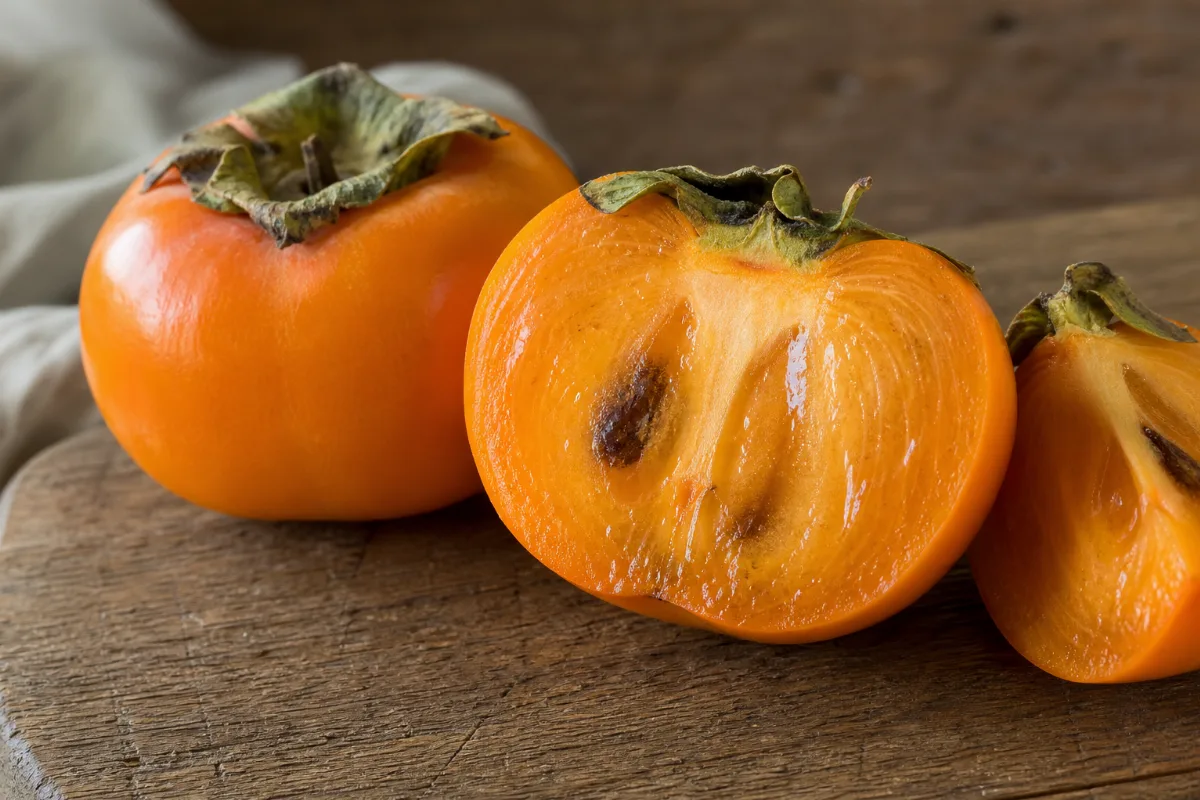
The persimmon is a soft orange fruit eaten fresh or dried. It gives fibre, vitamin A carotenoids, vitamin C and manganese. No trial has tested the fruit for a health outcome; the trials found used leaf or fruit extracts. The main cautions are hard tannin masses (bezoars) that can block the gut, a warfarin case report, potassium in kidney disease, and allergy.
General information, not medical advice. Last substantive update · Not medically reviewed. A named clinician has not signed off on this page. How this page is made
About Persimmons
The persimmon is a sweet orange fruit, a good source of fibre and carotenoids. It is a nutritious food, not a proven remedy: no trial tested the fruit, and the cholesterol and fat findings come from extracts.
What it is
The persimmon (Diospyros kaki) is the fruit of a tree in the ebony family. It is also called the Japanese or Asian persimmon. People eat the soft flesh fresh or dried.
Our existing nutrient summary, which cites USDA FoodData Central (raw Japanese persimmon), lists per 100 g: 70 kcal, 3.6 g fibre, 12.5 g sugars, 7.5 mg vitamin C, 81 micrograms vitamin A (RAE), 0.35 mg manganese and 161 mg potassium. One fruit (168 g) works out to about 118 kcal, 6.0 g fibre, 21 g sugars, 12.6 mg vitamin C, 136 micrograms vitamin A and 270 mg potassium. We could not re-open USDA on the day of writing, so these numbers are not re-verified.
What the research shows
No human trial of the fruit for a health outcome was found. The pooled trials on cholesterol used persimmon leaf extract with other treatment and were of mixed quality.
One small trial gave a standardised fruit extract capsule to adults with overweight for 120 days and saw less fat mass than placebo. Gut-bacteria and antioxidant results come from the lab and animals.
Extracts versus the fruit
The cholesterol review used leaf extract. The fat-mass trial used a standardised fruit extract capsule. Gut studies used powders or fibre fractions in the lab. Results for these do not carry over to eating the fruit.
Amounts
This page gives no amounts to eat. Ask a doctor or pharmacist what is right for you, especially if you take warfarin, have had stomach surgery or have kidney disease.
At a glance
Traditional uses history, not proof
- Eaten as a sweet fruit, fresh or dried
- Leaf made into tea or extract in East Asian tradition; long use is not proof it works
Studied for research
- Nutrient source (fibre, vitamin A carotenoids, vitamin C, manganese), high certainty for composition, no trial of the fruit
- Blood fats, low certainty (leaf extract, not the fruit)
- Body fat, low certainty (one small trial of a fruit extract capsule)
- Gut bacteria and antioxidant effects, insufficient (lab and animal only)
- Blood sugar, blood pressure, bowel regularity from the fruit, insufficient
Main compounds
- Carotenoids, including beta-cryptoxanthin and lutein plus zeaxanthin
- Tannins (found in persimmon bezoars)
- Phenolic acids and flavonoids
- Dietary fibre
Common forms
- Fresh fruit
- Dried fruit (named in one bezoar case)
- Persimmon powder (lab gut-model work)
- Standardised fruit extract capsule (one trial)
- Leaf extract and tea (trials; a different product from the fruit)
Research links: PubMed: persimmon leaf extract in dyslipidemia, meta-analysis (2025) · PubMed: persimmon bezoar and intestinal obstruction, case report (2025) · PubMed: persimmon and warfarin, case report (2026) · Research Library · Genes & Biomarkers Library
What it is and its history
- Accepted scientific name
- Diospyros kaki
- Naming authority
- L.f. (GBIF accepted; usageKey 3032984)
- Common names
- Persimmon (English); Japanese persimmon (English); Asian persimmon (English); Kaki (English); Caqui (Spanish)
- Family or group
- Ebenaceae (the ebony family).
- Classification
- Plantae > Tracheophyta > Magnoliopsida > Ericales > Ebenaceae > Diospyros > Diospyros kaki
- Native range
- Not verified from a source read.
- Habitat
- Not verified from a source read.
- What it looks like
- Roots: Not verified.; Stems: Not verified.; Leaves: Not verified. Leaf extract is used in some trials and is a different product from the fruit.; Flowers: Not verified.; Fruit: The fruit is the food. The USDA household portion in our summary is one fruit, 2-1/2 inch diameter, 168 g.
- Cultivation
- Not verified from a source read.
- Harvest and processing
- Eaten fresh or dried. Studies used unripe fruit (case reports), dried fruit (one case), a standardised fruit extract (one trial) and leaf extract (meta-analysis).
- Look-alikes and adulterants
- Name: Persimmon leaf tea and extract; Note: Made from leaves, not the fruit. Trials of leaf extract do not apply to the fruit.
- Sustainability and conservation
- Not assessed.
Photographs
Traditional use and history history, not clinical proof
| Tradition or era | Documented use | Source |
|---|---|---|
| Culinary and traditional use | Persimmon is eaten as a sweet fruit, fresh or dried, and its leaf is used as a tea or extract in East Asia (general knowledge; no historical source was read). | Not verified |
Traditional use shows how it was used. It does not show that it works or is safe today.
What is inside, and how it may work
What it contains and how those compounds act in cells and animals. Laboratory and animal mechanisms are not proven effects in people.
Main compounds
| Compound | Family | Where it is concentrated | Activity studied | Level of evidence |
|---|---|---|---|---|
| Carotenoids (beta-cryptoxanthin, lutein plus zeaxanthin, beta-carotene, lycopene) | carotenoid | Flesh Our summary of USDA per 100 g: beta-cryptoxanthin 1,447 micrograms, lutein plus zeaxanthin 834, beta-carotene 253, lycopene 159 (not re-verified) | Some carotenoids are turned into vitamin A by the body. No persimmon trial of these was found. 16 11 | Composition only |
| Tannins (condensed tannins) | polyphenol | Fruit and by-products | A bezoar from one patient was more than 98% tannin. Reviews describe tannins as lab-active compounds. 4 11 | Case report |
| Phenolic acids and flavonoids (gallic, caffeic, ferulic acids, quercetin and catechin derivatives) | polyphenol | Mainly by-products (peel, seeds, leaves, calyx) per the review | Antioxidant in the lab; the review says evidence is mostly from lab and animal studies. 11 | Laboratory research |
| Dietary fibre | fibre | Flesh and by-products Our summary of USDA: 3.6 g per 100 g (about 6.0 g per fruit; not re-verified) | Gut bacteria ferment persimmon fibre fractions in the lab. 16 10 2 | Laboratory research |
Mechanisms, receptors and pathways
| Target or pathway | Gene or receptor | What was found | Level |
|---|---|---|---|
| Tannin mass formation | Not applicable | A bezoar removed from a 93-year-old man was more than 98% tannin. The authors link bezoars to excessive persimmon eating with risk factors such as past stomach surgery, diabetes or older age. 4 | Case report |
| Gut bacteria fermentation | Not applicable | In gut simulators and test tubes, persimmon powder and fibre fractions encouraged several short-chain-fatty-acid-producing bacteria. No one ate the products. 2 10 | Laboratory research |
| Warfarin interaction | Not specified | The case authors say the clotting effect may involve more than the vitamin K content. The mechanism is unknown. 6 | Case report |
Absorption, metabolism and elimination
- Absorption
- Not studied for persimmon.
- Distribution
- Not found.
- Metabolism
- Not found.
- Elimination
- Not found.
- Bioavailability
- Not established.
Isolated compounds versus whole extracts
The only trials found used a leaf extract (a pooled review) or a standardised fruit extract capsule. Results for an extract do not apply to eating the fruit, and leaf products vary by maker. Gut studies used powder or fibre fractions in the lab.
Nutritional composition
Nutrition taken from our existing summary of USDA FoodData Central (raw Japanese persimmon, SR Legacy, FDC 169941). The USDA entry could not be re-opened on 2026-10-25 (rate limit), so these figures are not re-verified. Per 100 g: 70 kcal, 3.6 g fibre, 12.5 g total sugars, 7.5 mg vitamin C, 81 micrograms vitamin A (RAE), 0.35 mg manganese, 0.11 mg copper, 161 mg potassium, 2.6 micrograms vitamin K, 8 micrograms folate (DFE). One fruit (2-1/2 inch, 168 g), our scaling of those values: about 118 kcal, 6.0 g fibre, 21 g sugars, 12.6 mg vitamin C, 136 micrograms vitamin A (RAE), 0.59 mg manganese, 0.18 mg copper, 270 mg potassium, 4.4 micrograms vitamin K, 13 micrograms folate. Values vary with variety, ripeness and storage. Dried persimmon was not looked up; drying packs the same sugar and fibre into less weight.
1 high certainty2 low certainty3 not enough evidence
What was looked at
The 6 benefits and uses checked for Persimmons, each with how strong the evidence is. Tap one to open it.
- A source of vitamin A carotenoids, vitamin C, manganese, copper and fibreHigh certainty
- Blood fats: cholesterol and triglycerides (leaf extract, not the fruit)Low certainty
- Body fat and weight (a persimmon fruit extract supplement, not the fruit)Low certainty
- Gut bacteria (laboratory work on persimmon powder and fibre)Not enough evidence
- Antioxidant, anti-inflammatory and blood sugar effects (lab and animal studies of by-products)Not enough evidence
- Blood sugar, blood pressure and bowel regularity from eating the fruitNot enough evidence
Lab markers tracked in the studies
LDL cholesterolTriglyceridesBody fat mass
What is Persimmons good for?
The main studied uses and how strong the human evidence is for each. Several results come from leaf or fruit extracts, not the fruit as eaten, and each says so.
Benefits, one by one
Each card is a research question, not a promise. Tap a goal to filter. Open a card to see the studies, doses and limits.
A source of vitamin A carotenoids, vitamin C, manganese, copper and fibre
High certaintyOne persimmon (168 g) gives about 6 g of fibre, 136 micrograms of vitamin A (RAE) and 12.6 mg of vitamin C, plus manganese and copper. This is what the fruit contains, not a proven health effect. No trial tested persimmon fruit for a health outcome.
1 studiesFresh fruit; dried fruit is also eaten and holds the same sugars and …
Studies, doses and limits
What the trials found
Our existing nutrient summary, which cites USDA FoodData Central (raw Japanese persimmon, FDC 169941), lists per 100 g: 70 kcal, 3.6 g fibre, 12.5 g sugars, 7.5 mg vitamin C, 81 micrograms vitamin A (RAE), 0.35 mg manganese, 0.11 mg copper, 161 mg potassium. We could not re-open the USDA entry on 2026-10-25, so these figures are not re-verified. No human trial of the fruit was found.
Results
A nutrient contribution only. No health outcome was tested for the fruit.
Effect sizes as reported
Per 168 g fruit (our scaling of USDA per-100-g values): about 118 kcal, 6.0 g fibre, 21 g sugars, 12.6 mg vitamin C, 136 micrograms vitamin A (RAE), 0.59 mg manganese, 0.18 mg copper.
Why this rating
High only for the composition facts, from a national food database; there is no trial and these figures were not re-opened this round. It says nothing about disease prevention.
Form and dose studied
Fresh fruit; dried fruit is also eaten and holds the same sugars and fibre in less weight.
Who was studied
People eating a mixed diet.
Limits
Composition varies with variety, ripeness and storage. Not a treatment for any deficiency.
Why researchers looked
Persimmons are eaten for sweetness, fibre and vitamins, so people ask what they add to the diet.
Traditional use
Persimmon, the fruit eaten as food. Long use as a sweet fruit is not proof that it treats any condition.
Proposed mechanism Authoritative guidance
Persimmon flesh supplies vitamin A (as carotenoids), vitamin C, manganese, copper and fibre in the amounts listed on this page. These are ordinary nutrient roles, not a persimmon-specific effect.
A proposed mechanism does not show that the effect happens in people.
See the Safety tab for bowel blockage (bezoars), warfarin, potassium and allergy.
Blood fats: cholesterol and triglycerides (leaf extract, not the fruit)
Low certaintyA 2025 review of 16 trials of persimmon leaf extract found lower total cholesterol, triglycerides and LDL cholesterol than comparison groups, and some improvement in HDL. The trials were mixed in quality. These were leaf extracts used with other treatment, not the fruit. No trial tested the fruit.
1 studiesPersimmon leaf extract (Kaki folium) in trials. Not the fruit, and no…
Studies, doses and limits
What the trials found
A systematic review and meta-analysis searched eight English and Chinese databases to November 2024 and included 16 randomised trials with 1,572 people (790 treated, 782 controls). Many had heart or brain blood vessel disease, high blood pressure, or lipid problems caused by the medicine olanzapine. Leaf extract was combined with other treatment. It lowered total cholesterol, triglycerides and LDL cholesterol and improved HDL to a certain degree. The authors report high heterogeneity and frequent methodological flaws and call for better trials.
Results
Lower total cholesterol, triglycerides and LDL cholesterol in the pooled trials. The fruit was not tested.
Effect sizes as reported
Direction only; the abstract gives no numbers.
Why this rating
Pooled randomised trials, but the authors report high heterogeneity and frequent methodological flaws, and the product is leaf extract used with other treatment. For the fruit itself the evidence is insufficient.
Form and dose studied
Persimmon leaf extract (Kaki folium) in trials. Not the fruit, and not a recommendation.
Who was studied
Adults with lipid problems, many with heart, brain-vessel or blood pressure conditions.
Limits
Leaf, not fruit. Mixed trial quality. Used alongside other treatment. Funding not stated in the abstract.
Why researchers looked
Persimmon leaf is used in East Asian traditional preparations, and people ask whether the fruit does the same.
Traditional use
Persimmon leaf is used as a traditional tea and extract in East Asia. This is not the fruit, and long use is not proof it works.
Proposed mechanism Preliminary mechanism
The authors point to plant compounds in the leaf. Which ones matter, and whether they are in the fruit, was not shown in the abstract.
A proposed mechanism does not show that the effect happens in people.
Leaf products vary by maker. Ask a doctor or pharmacist before using leaf extracts, especially with cholesterol or other medicines.
Body fat and weight (a persimmon fruit extract supplement, not the fruit)
Low certaintyIn one 120-day trial in 71 adults with overweight, a persimmon fruit extract capsule lowered fat mass more than a placebo capsule. Blood fats and blood sugar did not change. This was an extract, not the fruit as eaten, and it is one small trial.
1 studiesStandardised fruit extract capsule (not the whole fruit).
Studies, doses and limits
What the trials found
A single-centre randomised, double-blind, placebo-controlled trial (ClinicalTrials.gov NCT05750342) gave adults with BMI 25 to 34.99 a standardised persimmon fruit extract (400 mg a day, a trial detail, not advice) or placebo for 120 days: 36 placebo, 35 extract. In the overweight group (26 placebo, 23 extract) fat mass in kg and percent fell more with the extract on DEXA and BIA scans (p<0.001), lean mass did not fall significantly, and weight, BMI and waist improved more (p<0.001). Blood fat, sugar and inflammation markers did not change except TNF-alpha, which fell, and total antioxidant capacity, which rose. Quality of life scores were higher. The authors call it safe and well tolerated.
Results
Less fat mass than placebo with a standardised extract capsule in overweight adults over 120 days.
Effect sizes as reported
Between-group differences p<0.001 for fat mass, weight, BMI and waist; effect sizes not given in the abstract.
Why this rating
One small randomised trial of an extract. It was not replicated in the sources read, and funding was not stated in the abstract.
Form and dose studied
Standardised fruit extract capsule (not the whole fruit).
Who was studied
Adults with BMI 25 to 34.99.
Limits
Extract, not fruit; one centre; small; funding not stated in the abstract.
Why researchers looked
Persimmon fruit extracts are sold for weight control, so researchers tested one.
Traditional use
Persimmon, the fruit eaten as food. Long use as a sweet fruit is not proof that it treats any condition.
Proposed mechanism Preliminary mechanism
The authors report more fat passing out in stool in people who started with low stool fat. How the extract works was not established in the abstract.
A proposed mechanism does not show that the effect happens in people.
Supplements are not the food. Ask a doctor or pharmacist before using one.
Gut bacteria (laboratory work on persimmon powder and fibre)
Not enough evidenceLaboratory models using stool bacteria found that persimmon powder and persimmon fibre fractions encouraged some bacteria that make short-chain fatty acids. No one ate anything in these studies, so they do not show a benefit from eating persimmons.
2 studiesDried powder and by-product fibre fractions, not fresh fruit.
Studies, doses and limits
What the trials found
A 2026 gut-simulator (SHIME) study used stool microbes from 4 postmenopausal women and persimmon powder dried at 70 C, and saw growth of Akkermansia muciniphila, Faecalibacterium prausnitzii and Phascolarctobacterium faecium over 14 days. A 2026 test-tube study of fibre fractions from persimmon by-products found selective growth of several short-chain-fatty-acid-producing bacteria. No person ate persimmon in either study.
Results
Changes in bacteria in laboratory models only.
Why this rating
Laboratory models only; no human feeding data.
Form and dose studied
Dried powder and by-product fibre fractions, not fresh fruit.
Limits
No person ate the product; small stool samples; by-product fractions.
Why researchers looked
Persimmon is rich in fibre and plant compounds that gut bacteria can use.
Traditional use
Persimmon, the fruit eaten as food. Long use as a sweet fruit is not proof that it treats any condition.
Proposed mechanism Laboratory research
Bacteria ferment fibre and produce short-chain fatty acids in the models. Whether this happens in people who eat the fruit was not tested.
A proposed mechanism does not show that the effect happens in people.
None specific.
Antioxidant, anti-inflammatory and blood sugar effects (lab and animal studies of by-products)
Not enough evidenceA 2026 review says peel, seed, leaf and calyx extracts show antioxidant, anti-inflammatory, anti-diabetic and blood-fat lowering effects, but mostly in lab and animal studies, with little testing in people. It does not show that eating the fruit does the same.
1 studiesBy-product extracts (peel, seeds, leaves, calyx), not the flesh.
Studies, doses and limits
What the trials found
The review covers studies from 2000 to 2025. It describes the effects as coming primarily from in vitro and in vivo studies and lists limited clinical validation and non-standard methods as main problems.
Results
Lab and animal findings only.
Why this rating
Lab and animal evidence; the review itself notes limited clinical validation.
Form and dose studied
By-product extracts (peel, seeds, leaves, calyx), not the flesh.
Limits
Not human; extracts not the fruit as eaten.
Why researchers looked
Persimmon contains phenolics, flavonoids, tannins and carotenoids that act as antioxidants in the lab.
Traditional use
Persimmon, the fruit eaten as food. Long use as a sweet fruit is not proof that it treats any condition.
Proposed mechanism Laboratory research
Plant compounds scavenge reactive molecules in test systems. This is a lab finding.
A proposed mechanism does not show that the effect happens in people.
None specific.
Blood sugar, blood pressure and bowel regularity from eating the fruit
Not enough evidenceWe found no human trial or review of eating persimmon fruit for blood sugar, blood pressure or bowel regularity. Nothing can be said either way.
1 studiesFresh or dried fruit.
Studies, doses and limits
What the trials found
No trial of persimmon fruit for these outcomes was found in the searches made. The 2026 by-products review says clinical validation of persimmon effects is limited.
Results
No evidence either way.
Why this rating
No studies found.
Form and dose studied
Fresh or dried fruit.
Limits
Absence of studies is not evidence of no effect.
Why researchers looked
The fruit has fibre and natural sugars, so people ask how it affects blood sugar and digestion.
Traditional use
Persimmon, the fruit eaten as food. Long use as a sweet fruit is not proof that it treats any condition.
Proposed mechanism None
Not studied for the fruit.
A proposed mechanism does not show that the effect happens in people.
About 21 g of sugars in one fruit (USDA summary). People managing diabetes can ask their care team how fruit fits their plan.
Connections to the rest of health
How Persimmons connects to the rest of our health knowledge graph. Every link says what kind of connection it is. A safety link (for example to the liver) is a warning, not a benefit. A study that merely mentions a topic never creates a benefit link.
Explore every connection: goals, body systems, organs, symptoms, genes
B. Body systems
| Connected to | Kind of connection | Evidence status | Context | Studies |
|---|---|---|---|---|
| Digestive System | Adverse effect or risk | Documented risk | Case reports describe tannin masses (bezoars) blocking the stomach or bowel. Case reports describe tannin masses (bezoars) from persimmons blocking the stomach or bowel. Preparation or compound: Persimmon tannin |
4 7 |
| Digestive System | Biological association | High certainty | Studied for: A source of vitamin A carotenoids, vitamin C, manganese, copper and fibre Studied for: Gut bacteria (laboratory work on persimmon powder and fibre) | 16 2 10 11 |
| Immune System | Biological association | High certainty | Studied for: A source of vitamin A carotenoids, vitamin C, manganese, copper and fibre | 16 |
| Cardiovascular System | Biological association | Low certainty | Studied for: Blood fats: cholesterol and triglycerides (leaf extract, not the fruit) | 3 |
| Metabolism Weight | Biological association | Low certainty | Studied for: Body fat and weight (a persimmon fruit extract supplement, not the fruit) Studied for: Antioxidant, anti-inflammatory and blood sugar effects (lab and animal studies of by-products) | 8 11 |
C. Body parts and organs
| Connected to | Kind of connection | Evidence status | Context | Studies |
|---|---|---|---|---|
| Stomach | Adverse effect or risk | Documented risk | Stomach bezoars after unripe fruit or stomach surgery in case reports. Preparation or compound: Persimmon tannin |
7 9 |
| Small Intestine | Adverse effect or risk | Documented risk | Small-bowel blockage from a persimmon bezoar in case reports. Preparation or compound: Persimmon tannin |
4 5 |
I. Biomarkers
| Connected to | Kind of connection | Evidence status | Context | Studies |
|---|---|---|---|---|
| LDL cholesterol | Biological association | Low certainty | Measured in trials: lowered. A lab change is not the same as a health benefit. | 3 |
| Triglycerides | Biological association | Low certainty | Measured in trials: lowered. A lab change is not the same as a health benefit. | 3 |
| Body fat mass | Biological association | Low certainty | Measured in trials: lowered. A lab change is not the same as a health benefit. | 8 |
K. Biological pathways
| Connected to | Kind of connection | Evidence status | Context | Studies |
|---|---|---|---|---|
| Vitamin A | Preliminary mechanism | Composition only | Persimmon carotenoids add to vitamin A intake; no persimmon trial was found. | 16 |
L. Active compounds
| Connected to | Kind of connection | Evidence status | Context | Studies |
|---|---|---|---|---|
| Carotenoids (beta-cryptoxanthin, lutein plus zeaxanthin, beta-carotene, lycopene) | Biological association | Composition only | Some carotenoids are turned into vitamin A by the body. No persimmon trial of these was found. Preparation or compound: Flesh |
16 11 |
| Tannins (condensed tannins) | Biological association | Case report | A bezoar from one patient was more than 98% tannin. Reviews describe tannins as lab-active compounds. Preparation or compound: Fruit and by-products |
4 11 |
| Phenolic acids and flavonoids (gallic, caffeic, ferulic acids, quercetin and catechin derivatives) | Biological association | In vitro | Antioxidant in the lab; the review says evidence is mostly from lab and animal studies. Preparation or compound: Mainly by-products (peel, seeds, leaves, calyx) per the review |
11 |
| Dietary fibre | Biological association | In vitro | Gut bacteria ferment persimmon fibre fractions in the lab. Preparation or compound: Flesh and by-products |
16 10 2 |
Each connection is stored with the ingredient, the connected record, the kind of connection, the evidence status, the supporting studies, the preparation or compound involved, and a review date (last reviewed October 25, 2026).
The evidence
The research centre for Persimmons. Every record here was checked against PubMed or the publisher's page; we never list a study we have not verified.
Evidence by outcome
Bars show how many studies we found for each outcome, not how well it works. People are added up across trials only (reviews are not added, to avoid double counting).
How we rate evidence
High certainty
Several well-run trials or reviews agree; further research is unlikely to change the picture much.
Moderate certainty
Good trials point the same way, but some doubt remains.
Low certainty
Small, short or inconsistent trials. The finding could change with better research.
Very low certainty
Very little or very weak human data. Treat as a possibility only.
Mixed findings
Trials or reviews disagree with each other.
Not enough evidence
Not enough human research to say either way.
Evidence against
Good research found no benefit, or found harm.
We take the reviewers' own risk-of-bias and GRADE statements where they exist, and otherwise judge from study size, design, consistency, directness and whether a product matches what is sold. Many publications do not make evidence high. Method note: We started from our existing persimmon summary, searched PubMed for human trials, reviews, case reports and interaction evidence, and read abstracts via PubMed. USDA nutrient numbers come from our earlier summary and were not re-opened. Items we could not verify are flagged in the research gaps.
Study library: every study we checked 16
| Study | Design | People | Product, dose, length | Result |
|---|---|---|---|---|
| Betancor 2023 Allergy to Persimmon (Diospyros kaki), A Chitinase and Thaumatin-Like Protein: 2 Newly Identified Allergens. J Investig Allergol Clin Immunol · PMID 36748361 · DOI |
Case series or lab (title only) |
People with persimmon allergy (details not in the record we read) | Persimmon eaten as food Fruit |
The title reports persimmon allergy and two newly identified allergens, a chitinase and a thaumatin-like protein. PubMed shows no abstract, so only the title was read. Single case; no frequency Methods, limits and fundingOutcomes: Clinical course after eating persimmon Limitations: Title only; no abstract in the PubMed record. Funding and conflicts: Not stated in the abstract. Read: title-only |
| Betoret 2026 Persimmon Powder from Discarded Fruits as a Potential Prebiotic to Modulate Gut Microbiota in Postmenopausal Women. Foods · PMID 41683069 · DOI |
Laboratory research in vitro (human stool microbes) |
4 Gut model (SHIME) inoculated with stool microbes from 4 postmenopausal women; no one ate the powder |
Dried persimmon powder (hot air at 70 C) Powder from discarded fruit 14 days in the lab model |
Powder dried at 70 C had the highest phenol and flavonoid content. In the gut model, growth of Akkermansia muciniphila, Faecalibacterium prausnitzii and Phascolarctobacterium faecium and propionate and isobutyrate production were seen. No effect sizes in the abstract Methods, limits and fundingOutcomes: Bacteria growth and short-chain fatty acids in a gut simulator Limitations: Laboratory model using stool from 4 women. No person ate the powder. Not a trial of the fruit. Funding and conflicts: Not stated in the abstract. Read: abstract |
| Dong 2025 Persimmon leaf extract in dyslipidemia: a systematic review and meta-analysis. Front Pharmacol · PMID 41031166 · DOI |
Meta-analysis |
1572 Adults with lipid problems, often with heart or brain blood vessel disease, high blood pressure, or medicine-induced lipid problems |
Persimmon leaf extract (Kaki folium), combined with other treatment Leaf, not fruit · vs Control groups (790 treated vs 782 control) |
16 randomised trials (to 1 Nov 2024). Leaf extract lowered total cholesterol, triglycerides and LDL cholesterol compared with control and improved HDL to a certain degree. Direction only in the abstract; no numbers given Methods, limits and fundingOutcomes: Total cholesterol, triglycerides, LDL and HDL cholesterol Limitations: High heterogeneity and frequent methodological flaws (authors). The extract was used together with other treatment. Leaf extract is not the fruit. Funding and conflicts: Not stated in the abstract. Registration: PROSPERO CRD42024562090 Read: abstract |
| Habuka 2025 Diospyrobezoar (Persimmon Bezoar)-Induced Intestinal Obstruction in an Older Patient: A Case Report. Cureus · PMID 40655072 · DOI |
Case report |
1 One 93-year-old man, bowel blocked |
Persimmon eaten as food Fruit |
A 93-year-old man had loss of appetite, nausea and vomiting. A scan showed a bezoar blocking the upper small bowel. Cola lavage and endoscopic breaking-up failed, and surgery was needed. A 5 x 5 cm mass was more than 98% tannin. He ate two persimmons daily. He recovered after surgery. The authors say a bezoar is typically seen in people with risk factors such as past stomach surgery, diabetes or older age. Single case; no frequency Methods, limits and fundingOutcomes: Clinical course after eating persimmon Limitations: One person; no way to know how common this is. Funding and conflicts: Not stated in the abstract. Read: abstract |
| Kano 2026 Single-Incision Laparoscopic-Assisted Segmental Small-Bowel Resection for Small-Bowel Obstruction Caused by a Persimmon Bezoar: A Case Report. Surg Case Rep · PMID 42368420 · DOI |
Case report |
1 One 83-year-old woman after earlier stomach surgery (distal gastrectomy) |
Dried persimmon eaten as food Fruit |
An 83-year-old woman who had had part of her stomach removed and often ate dried persimmons came with belly pain and vomiting. A 50 mm bezoar fully blocked the small bowel. Surgery removed the affected bowel segment. The authors say a firmly stuck bezoar can injure the bowel wall even without dead tissue. Single case; no frequency Methods, limits and fundingOutcomes: Clinical course after eating persimmon Limitations: One person; no way to know how common this is. Funding and conflicts: Not stated in the abstract. Read: abstract |
| Kim 2026 Persimmon-induced excessive anticoagulation in a patient with mechanical heart valves receiving warfarin therapy: A case report. Medicine (Baltimore) · PMID 41790714 · DOI |
Case report |
1 One 51-year-old woman with two mechanical heart valves on warfarin |
Unripe persimmons ('Dangam') eaten daily Fruit 2 weeks of daily fruit |
After 2 weeks of daily unripe persimmons her prothrombin time and aPTT rose, with no bleeding or other problems. She stopped persimmon, her warfarin dose was cut from 4.25 to 3.5 mg without vitamin K, and the tests returned to baseline within 2 weeks. Three years of follow-up showed no further problems. The authors suggest the effect may involve more than vitamin K. Single case Methods, limits and fundingOutcomes: Blood-clotting tests (PT, aPTT) and bleeding Limitations: One person; cause not proven; mechanism unknown. Funding and conflicts: Not stated in the abstract. Read: abstract |
| Odeh 2024 A Rare Case of Gastric Phytobezoar (Diospyrobezoar) in a Healthy Adult. Cureus · PMID 39355066 · DOI |
Case report |
1 One healthy 35-year-old man |
Unripe persimmons eaten as food Fruit |
A healthy 35-year-old man with repeated upper belly pain, nausea and a rolling-ball feeling in the belly had eaten unripe persimmons. Scans showed stomach bezoars. Endoscopy failed and a laparoscopic operation removed them. The authors call this rare. Single case; no frequency Methods, limits and fundingOutcomes: Clinical course after eating persimmon Limitations: One person; no way to know how common this is. Funding and conflicts: Not stated in the abstract. Read: abstract |
| Perez-Pinero 2024 Efficacy of a Dietary Supplement Extracted from Persimmon (Diospyros kaki L.f.) in Overweight Healthy Adults: A Randomized, Double-Blind, Controlled Clinical Trial. Foods · PMID 39767014 · DOI |
Controlled trial |
71 Adults with BMI 25 to 34.99 (36 placebo, 35 extract); primary analysis in overweight adults (26 placebo, 23 extract) |
Standardised persimmon fruit extract supplement (400 mg, a trial detail, not advice) Fruit extract 400 mg extract capsule (trial detail, not advice) 120 days · vs Placebo |
In the overweight group fat mass fell more with the extract than with placebo (p<0.001), with no significant fall in lean mass. Weight, BMI and waist also improved more (p<0.001). Blood fat and blood sugar markers did not change. TNF-alpha fell and total antioxidant capacity rose. The authors call the extract safe and well tolerated. Between-group differences p<0.001 for fat mass; sizes not given in the abstract Methods, limits and fundingOutcomes: Fat mass by DEXA and BIA, weight, BMI, waist, blood fats and sugar, quality of life Limitations: Single centre; small; an extract supplement, not the fruit as eaten; funding not stated in the abstract (a standardised commercial-type extract was tested, so industry involvement is possible). Funding and conflicts: Not stated in the abstract. Registration: ClinicalTrials.gov NCT05750342 Read: abstract |
| Powell 2022 Diospyrobezoar Formation in Patient With Sleeve Gastrectomy. Cureus · PMID 36059363 · DOI |
Case report |
1 One person who had sleeve gastrectomy (stomach-reduction surgery) |
Persimmon eaten as food Fruit |
The authors say people with earlier stomach operations are at high risk of a stomach bezoar from eating Asian persimmons, and describe a case after sleeve gastrectomy. Single case; no frequency Methods, limits and fundingOutcomes: Clinical course after eating persimmon Limitations: One person; the abstract gives few details. Funding and conflicts: Not stated in the abstract. Read: abstract |
| Sabater 2026 Persimmon by-products, rich in fibre, promote beneficial gut bacteria. Food Funct · PMID 41700500 · DOI |
Laboratory research in vitro (human stool microbes) |
Laboratory fermentation with human stool microbes | Soluble and insoluble fibre fractions from persimmon by-products By-products |
Different fibre fractions selectively promoted several gut bacteria genera that make short-chain fatty acids. Soluble fractions gave more indole-3-propionic acid than insoluble ones. No effect sizes in the abstract Methods, limits and fundingOutcomes: Bacteria growth and fermentation products in test tubes Limitations: Test-tube work on by-product fibre, not on the fruit as eaten; no person involved. Funding and conflicts: Not stated in the abstract. Read: abstract |
| Wang 2026 Persimmon By-Products: Bioactive Phytochemicals, Sustainable Valorization and Potential Food and Health Applications. Nutrients · PMID 42884645 · DOI |
Narrative review mixed (mostly lab and animal) |
Review of studies published 2000 to 2025 | Persimmon peel, seeds, leaves and calyx (by-products) By-products, not the flesh |
Authors report phenolic acids, flavonoids, carotenoids, tannins, fibre and lipids in by-products, with antioxidant, anti-inflammatory, antidiabetic, hypolipidemic and antimicrobial effects. The evidence is described as primarily from in vitro and in vivo (lab and animal) studies. No effect sizes in the abstract Methods, limits and fundingOutcomes: Phytochemical content and reported biological activities Limitations: Mostly lab and animal evidence; limited clinical validation; varied extraction methods; no standard assays (authors). Funding and conflicts: Not stated in the abstract. Read: abstract |
| Yanari 2023 Potentially Lethal Combination of Fruit and Gastric Acid: The Persimmon Bezoar Causing Esophageal Rupture. Am J Gastroenterol · PMID 37307536 · DOI |
Case report |
1 One person (details not in the record we read) |
Persimmon eaten as food Fruit |
The title reports a persimmon bezoar causing a rupture of the food pipe. PubMed shows no abstract, so only the title was read. Single case; no frequency Methods, limits and fundingOutcomes: Clinical course after eating persimmon Limitations: Title only; no abstract in the PubMed record. Funding and conflicts: Not stated in the abstract. Read: title-only |
| s-fda-produce FDA: Selecting and Serving Produce Safely · Source |
Regulator n/a |
Methods, limits and fundingRead: full-text | ||
| s-gbif-diospyros-kaki GBIF Backbone: Diospyros kaki L.f. (usageKey 3032984) · Source |
Reference database n/a |
Methods, limits and fundingRead: full-text | ||
| s-medlineplus-potassium MedlinePlus: Potassium · Source |
Health agency n/a |
Methods, limits and fundingRead: full-text | ||
| s-usda-fdc-169941 USDA FoodData Central: Persimmons, japanese, raw (SR Legacy, FDC 169941) · Source |
Reference database n/a |
Methods, limits and fundingRead: summary-only |
What we do not know yet
- No human trial of persimmon fruit for cholesterol, blood sugar, blood pressure, weight or any other outcome was found.
- Cholesterol findings are for leaf extract used with other treatment, with high heterogeneity.
- The fat-mass trial was one small trial of an extract.
- How common bezoars, allergy and the warfarin effect are was not found; the allergy paper and one rupture report were read by title only.
- USDA nutrient numbers were not re-verified; dried persimmon, pregnancy, children, pesticide residues and oxalate were not researched.
How new research is added
New studies are found by a saved PubMed search and placed in a review queue before the page changes.
Lab markers
What changed in blood or saliva tests during trials. A changed number is not the same as feeling or being healthier, and we give no "normal ranges".
Metabolic 2
LDL cholesterol
Lowered in trials
The cholesterol carried in low-density particles in the blood, often called bad cholesterol.
Low certaintyResults and what it means
Why it was measured
Higher LDL is a recognised risk marker for blood vessel disease.
Statistical vs. clinical meaning
A change in a blood marker, not proof of fewer heart attacks. Leaf extract only.
Safety implication
None specific.
| Study | Result | People | Product |
|---|---|---|---|
| 3 | Lower than control in pooled trials; size not given in the abstract | 1,572 adults in 16 trials | Persimmon leaf extract with other treatment (not the fruit) |
Triglycerides
Lowered in trials
A type of fat carried in the blood.
Low certaintyResults and what it means
Why it was measured
High triglycerides are a risk marker alongside cholesterol.
Statistical vs. clinical meaning
Marker only. Leaf extract only.
Safety implication
None specific.
| Study | Result | People | Product |
|---|---|---|---|
| 3 | Lower than control in pooled trials; size not given in the abstract | 1,572 adults in 16 trials | Persimmon leaf extract with other treatment (not the fruit) |
Other 1
Body fat mass
Lowered in trials
The weight of fat in the body, measured by DEXA or impedance scans.
Low certaintyResults and what it means
Why it was measured
Used to see whether weight change is fat or muscle.
Statistical vs. clinical meaning
One small extract trial; not the fruit.
Safety implication
The authors call the extract safe and well tolerated.
| Study | Result | People | Product |
|---|---|---|---|
| 8 | Fat mass fell more than placebo in the overweight group (p<0.001); lean mass did not fall significantly | 49 overweight adults in the primary analysis (26 placebo, 23 extract) | 400 mg standardised persimmon fruit extract for 120 days (trial detail, not advice) |
Safety
What studies and official sources say about side effects, medicines and who should check first. Each point shows what kind of evidence it comes from.
Main points to know 4
- Persimmons can form a hard mass (bezoar) that blocks the stomach or bowel. Case reports describe tannin masses called diospyrobezoars. A 93-year-old man who ate two persimmons a day needed surgery for a mass more than 98% tannin. An 83-year-old woman who had stomach surgery and often ate dried persimmons needed bowel surgery. A healthy 35-year-old who ate unripe persimmons needed stomach surgery. Authors name past stomach surgery (including sleeve gastrectomy), diabetes and older age as risk factors. These are single cases; how often it happens was not found. Severe belly pain, repeated vomiting or a swollen belly need urgent care. Case report 4 5 7 9
- Warfarin: one case of raised clotting tests after daily unripe persimmons. A woman with two mechanical heart valves on warfarin had raised clotting tests after eating unripe persimmons daily for 2 weeks. There was no bleeding. The tests returned to baseline after she stopped and her warfarin dose was reduced. The authors say the effect may involve more than vitamin K. One case does not prove a rule. If you take warfarin, tell your prescriber about changes in persimmon intake. Case report 6
- Allergy to persimmon has been reported. A 2023 paper titled 'Allergy to Persimmon' reports two newly identified persimmon allergens. Only the title was available to read. How common it is was not found. Trouble breathing or swelling of the face or throat needs emergency help. Case report 1
- Potassium: people with kidney disease may need to watch it. MedlinePlus says that with chronic kidney disease the kidneys may not remove extra potassium, and some medicines also raise potassium. One persimmon holds about 270 mg of potassium (our scaling of the USDA summary, not re-verified). Ask your care team if this applies to you. Authoritative guidance 15 16
Side effects 4
| Effect | How often | Severity and recovery | Evidence |
|---|---|---|---|
| Tannin bezoar (hard mass) with stomach or bowel blockage Cases involved fresh, unripe and dried persimmons. Frequency not found. | Not established | severe; surgery needed in the cases read Surgery removed the mass in the cases read | Case report 4 5 7 9 |
| Rupture of the food pipe from a persimmon bezoar (one reported case) Only the title was read; the PubMed record has no abstract. | Not established | severe (title only) Not stated | Case report 12 |
| Raised clotting tests in a person on warfarin One person; unripe persimmons. | Not established | no bleeding reported Tests returned to baseline within 2 weeks of stopping | Case report 6 |
| Allergic reaction to persimmon Title only was read. | Not established | Not stated Not stated | Case report 1 |
Liver
No liver injury from eating persimmon was found in the sources read. LiverTox was not checked for persimmon.
How often. No frequency was found.
Monitoring. No agency monitoring advice was found.
This is a safety connection. It is not evidence that Persimmons supports liver health.
Medicines and supplements 2
| With | Why it matters | Importance | Evidence | What to do |
|---|---|---|---|---|
| Warfarin prescription | Unknown. USDA lists little vitamin K in persimmon (2.6 micrograms per 100 g, from our summary), and the case authors say the effect may involve more than vitamin K. | One case of raised clotting tests with daily unripe persimmons. No trial. | Case report Very low certainty 6 | If you take warfarin, ask your prescriber or pharmacist before changing how much persimmon you eat. |
| Medicines or conditions that raise potassium (including chronic kidney disease) prescription | MedlinePlus says kidneys with chronic kidney disease may not remove extra potassium and some medicines raise potassium. | One persimmon holds a modest amount (about 270 mg, 6% of the Daily Value, our scaling of the USDA summary). No persimmon-specific interaction study was found. | Authoritative guidance Low certainty 15 16 | Ask your clinician if you have kidney disease or take potassium-raising medicines. |
Who should check first 5
| Situation | Advice | Evidence |
|---|---|---|
| Past stomach surgery (including sleeve gastrectomy or partial stomach removal) | Authors of case reports name this as a high-risk group for persimmon bezoars. Ask your surgeon or doctor about persimmons, especially dried or unripe ones. | Case report 9 5 |
| Older age or diabetes with slow stomach emptying | One report names older age and diabetes as common risk factors for a bezoar. Ask a doctor. | Case report 4 |
| On warfarin | Tell your prescriber about regular persimmon eating. | Case report 6 |
| Known persimmon allergy | Avoid it and ask an allergist. Call emergency services for trouble breathing or swelling of the face or throat. | Case report 1 |
| Pregnancy, breastfeeding and young children | No source read gave advice on persimmon in pregnancy, breastfeeding or childhood, so no claim is made. Ask your doctor. | None |
Overdose, product quality and regulators
Summary. No toxicity from persimmon as ordinary food was found apart from the bezoar case reports.
Animal. Not reviewed.
Human doses studied. A 120-day trial of a fruit extract capsule reported it safe and well tolerated (abstract). Leaf extract trials were pooled in a 2025 review; the abstract gives no safety data.
High dose or long term signals. Bezoar cases in people who ate persimmons daily or often. Amounts were not quantified beyond two a day in one case.
Overdose response. Not found.
Genotoxicity. Not researched.
Washing produce reduces dirt and germs. Pesticide residues, heavy metals, and drying or storage problems for persimmons were not researched.
Food safety handling. The FDA says to wash all produce under running water, not to use soap, detergent or commercial produce wash, and to keep perishable produce at 40 F (4 C) or below. 13
| Body | Action | Date |
|---|---|---|
| NIH MedlinePlus (United States) | Potassium page: with chronic kidney disease the kidneys may not remove extra potassium; some medicines also raise potassium. source | 2026-10-25 (page read) |
| FDA (US Food and Drug Administration) (United States) | Produce safety advice: wash under running water; no soap or produce wash; refrigerate perishable produce at 40 F or below. source | 2026-10-25 (page read) |
When to get medical help
- Severe belly pain, repeated vomiting, a swollen belly or not passing gas or stool, especially after eating persimmons or if you have had stomach surgery
- Trouble breathing, swelling of the lips, face or throat, or widespread hives after eating persimmon
- Unusual bleeding or bruising while taking warfarin (call your prescriber)
Stop using the product and contact a clinician or emergency service. In the US, Poison Control is 1-800-222-1222.
General information only, not medical advice. Ask a clinician or pharmacist before use, especially with medicines, in pregnancy or with a health condition. See the Natural Remedy Safety guide.
Frequently asked questions
What are persimmons good for?
Do persimmons lower cholesterol?
Not shown for the fruit. A 2025 review found persimmon leaf extract lowered cholesterol and triglycerides, but trial quality was mixed and leaf extract is a different product.
Do persimmons help with weight loss?
Not shown for the fruit. One 120-day trial of a fruit extract capsule found less fat mass than placebo in adults with overweight. It was small, and an extract.
Do persimmons lower blood sugar or blood pressure?
Are persimmons good for the gut?
Can persimmons block the stomach or bowel?
Are persimmons safe with warfarin?
One case report found raised clotting tests after daily unripe persimmons. One case is not proof of a rule. Ask your prescriber or pharmacist.
Can I be allergic to persimmon?
A paper reports persimmon allergy and two allergens (we read only its title). For trouble breathing or swelling of the face or throat, call emergency services.
Are persimmons high in potassium?
Is persimmon safe in pregnancy or for children?
No source read gave advice on this, so we make no claim. Ask your doctor.
Is persimmon leaf tea the same as the fruit?
No. The cholesterol trials used leaf extract, which is a different product from the fruit.
How should I wash persimmons?
The FDA says to wash produce under running water without soap or produce wash, and to keep perishable produce at 40 F (4 C) or below.
Explore by health goal
Editorial transparency
- Written by
- AlternativeMed editorial team. Research compiled with AI assistance, then checked against the sources listed.
- Medical review
- None. This page has not been reviewed by a physician or pharmacist.
- First published
- 2026-10-25
- Last substantive update
- 2026-10-25
- How we research
- We started from our existing persimmon summary, searched PubMed for human trials, reviews, case reports and interaction evidence, and read abstracts via PubMed. USDA nutrient numbers come from our earlier summary and were not re-opened. Items we could not verify are flagged in the research gaps.
- How we rate evidence
- See "How we rate evidence" in the Evidence tab.
- Independence
- No product is promoted on this page. No affiliate links are shown.
Sources 16
Each source was opened and checked. Where we read only the abstract, it says so. The small numbers in the text point here.
- Betancor D, Gomez-Lopez A, Nunez-Borque E, et al.. Allergy to Persimmon (Diospyros kaki), A Chitinase and Thaumatin-Like Protein: 2 Newly Identified Allergens.. J Investig Allergol Clin Immunol. 2023. PMID 36748361. DOI 10.18176/jiaci.0886. (title-only)
- Betoret E, Jimenez-Hernandez N, Duarte S, et al.. Persimmon Powder from Discarded Fruits as a Potential Prebiotic to Modulate Gut Microbiota in Postmenopausal Women.. Foods. 2026. PMID 41683069. DOI 10.3390/foods15030480. (abstract)
- Dong C, Chang T, Wang X, et al.. Persimmon leaf extract in dyslipidemia: a systematic review and meta-analysis.. Front Pharmacol. 2025. PMID 41031166. DOI 10.3389/fphar.2025.1572678. (abstract)
- Habuka M, Yamagiwa M, Yonezawa M, et al.. Diospyrobezoar (Persimmon Bezoar)-Induced Intestinal Obstruction in an Older Patient: A Case Report.. Cureus. 2025. PMID 40655072. DOI 10.7759/cureus.87850. (abstract)
- Kano T, Takahashi K, Hashimoto M, et al.. Single-Incision Laparoscopic-Assisted Segmental Small-Bowel Resection for Small-Bowel Obstruction Caused by a Persimmon Bezoar: A Case Report.. Surg Case Rep. 2026. PMID 42368420. DOI 10.70352/scrj.cr.26-0357. (abstract)
- Kim J, Lee S, Moon H, et al.. Persimmon-induced excessive anticoagulation in a patient with mechanical heart valves receiving warfarin therapy: A case report.. Medicine (Baltimore). 2026. PMID 41790714. DOI 10.1097/MD.0000000000047861. (abstract)
- Odeh AM, Alkhalifa AA, AlHajji MA, et al.. A Rare Case of Gastric Phytobezoar (Diospyrobezoar) in a Healthy Adult.. Cureus. 2024. PMID 39355066. DOI 10.7759/cureus.68353. (abstract)
- Perez-Pinero S, Munoz-Carrillo JC, Echepare-Taberna J, et al.. Efficacy of a Dietary Supplement Extracted from Persimmon (Diospyros kaki L.f.) in Overweight Healthy Adults: A Randomized, Double-Blind, Controlled Clinical Trial.. Foods. 2024. PMID 39767014. DOI 10.3390/foods13244072. (abstract)
- Powell CR, Magee JS, Papadopoulos IB, et al.. Diospyrobezoar Formation in Patient With Sleeve Gastrectomy.. Cureus. 2022. PMID 36059363. DOI 10.7759/cureus.27561. (abstract)
- Sabater C, Lopez-Bermudo L, Moreno-Chamba B, et al.. Persimmon by-products, rich in fibre, promote beneficial gut bacteria.. Food Funct. 2026. PMID 41700500. DOI 10.1039/d5fo03495g. (abstract)
- Wang H, Hou W, Anwar H, et al.. Persimmon By-Products: Bioactive Phytochemicals, Sustainable Valorization and Potential Food and Health Applications.. Nutrients. 2026. PMID 42884645. DOI 10.3390/nu18193194. (abstract)
- Yanari S, Sasaki S, Sato H, et al.. Potentially Lethal Combination of Fruit and Gastric Acid: The Persimmon Bezoar Causing Esophageal Rupture.. Am J Gastroenterol. 2023. PMID 37307536. DOI 10.14309/ajg.0000000000002356. (title-only)
- . FDA: Selecting and Serving Produce Safely. . . (full-text)
- . GBIF Backbone: Diospyros kaki L.f. (usageKey 3032984). . . (full-text)
- . MedlinePlus: Potassium. . . (full-text)
- . USDA FoodData Central: Persimmons, japanese, raw (SR Legacy, FDC 169941). . . (summary-only)
Where to buy
Check the label first. Whatever you buy, look for these:
- Unsweetened with no added sugar, if you want the fruit alone
- Sulfur dioxide (sulfites) listed on the label: some people react
- A best-by date and a resealable bag
- Dried fruit is high in sugar and calories, so watch portions
Talk to a pharmacist or doctor before you start any supplement, especially if you take medicines. See the Safety tab for interactions.
Support our free guides: as an Amazon Associate we earn from qualifying purchases. Full disclosure.


