Beverages · Drink
Soy Milk
Glycine max (soybean drink) · also called Soya milk, soy drink, soya drink
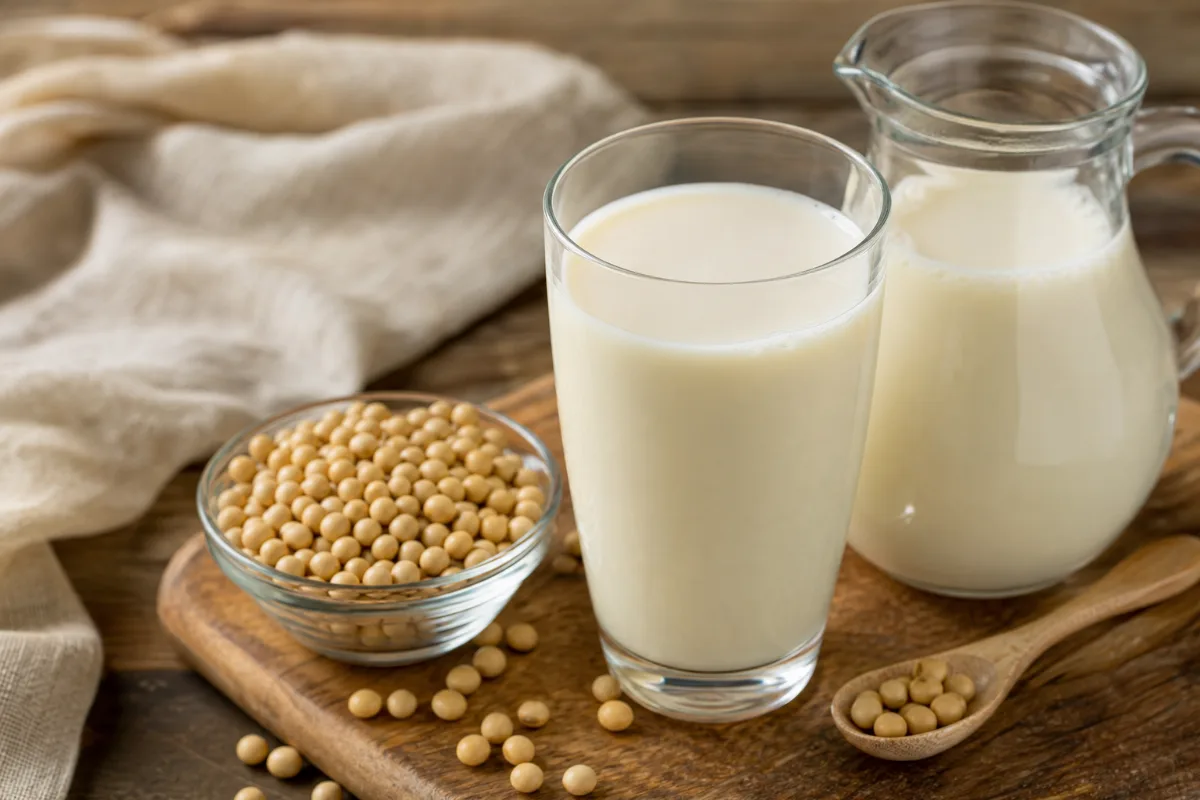
Soy milk is a drink made from soybeans. Fortified, unsweetened types give protein, calcium and vitamin B12 close to cow milk, but unfortified and sweetened types do not, so the label matters. Studies of soy milk itself are few and small; the cholesterol results are mixed. The main cautions are soy allergy, thyroid medicine timing and giving it to babies under 1.
General information, not medical advice. Last substantive update · Not medically reviewed. A named clinician has not signed off on this page. How this page is made
About Soy Milk
Soy milk is a drink made from soybeans. Fortified, unsweetened soy milk is a source of protein, calcium and vitamin B12, but products differ a lot, so check the label. It is a food, not a proven remedy: studies of soy milk itself are few and small, and many results come from soy protein, extracts or isoflavones.
What it is
Soy milk is a drink made from soybeans (Glycine max), a legume. NCCIH lists soy milk with tofu, miso, tempeh and edamame as common soy foods. How it is made was not read from a source for this page.
USDA data for an unsweetened soy milk with added calcium and vitamins A and D (FDC 175215), per 1 cup (243 g): about 80 kcal, 6.95 g protein, 3.9 g fat, 4.2 g carbohydrate, 1 g sugars, 301 mg calcium, 90 mg sodium and 2.7 micrograms vitamin B12. The saved USDA copy lists no vitamin A or D values for it.
Fortified or not: the label matters
The two USDA soy milk records differ a lot. Per cup, the unsweetened fortified one has about 301 mg of calcium, 2.7 micrograms of vitamin B12 and 1 g of sugars. The original and vanilla unfortified one has about 61 mg of calcium, no vitamin B12 and 9.7 g of sugars (USDA does not say how much is added sugar).
The NHS says unsweetened, calcium-fortified dairy alternatives such as soya drinks count toward the dairy food group. In a lab study of New Zealand products, soy drinks were closest to cow milk, and only soy had comparable amino-acid content, but the authors warned plant drinks are not generally nutritional swaps for milk and that settling matters: protein and calcium differed between shaken and unshaken samples. Two of the study authors work for a dairy company. A review of 122 plant drinks found salt was the most common added ingredient.
What the research shows
Cholesterol: a review of 8 small trials of soy milk (263 people) found 3 with no improvement in any blood fat and 3 with a fall in LDL, and called the evidence limited and controversial. Pooled trials of soy protein as a whole found LDL about 4.76 mg/dL lower (about 3 to 4%), which is small and indirect for soy milk. One author of that pooled analysis is listed at a soy industry body; a Canadian public grant is also listed.
Heart disease: in three large US cohorts, soy milk once a week or more was not significantly linked to coronary heart disease (HR 0.87, 95% CI 0.69 to 1.10), while tofu was. These studies can show a link, not cause.
Hormones and thyroid: pooled analyses of soy foods and supplements found no effect on testosterone in men and a very small rise in TSH, with no change in free T3 or free T4. Isoflavone studies for menopause show a small, mixed effect and no clear benefit for hot flushes. Breast cancer links are observational, and a 2026 review by an author at a soy industry body says trials do not support a protective effect.
One small trial of soy milk in 66 people with fatty liver disease found slightly larger falls in blood pressure and insulin resistance. It needs repeating.
Food versus supplements
The nutrient facts are for soy milk as a drink. The cholesterol, menopause and thyroid results are mostly for soy protein, extracts, isoflavones or mixed soy foods and supplements. NCCIH says soy supplements have not been shown to reduce breast cancer risk and that effects may differ between soy products. Soy protein powders and isoflavone supplements are different products from soy milk.
At a glance
Traditional uses history, not proof
- Not described in the sources read; this page gives no history for soy milk
- Used today as a dairy-free milk
Studied for research
- Nutrients as a milk substitute, high certainty for the nutrient content, which depends on fortification
- Cholesterol, low certainty for soy milk (small mixed trials); soy protein as a whole gives a small change
- Heart disease, insufficient evidence (soy milk not significantly linked in cohorts)
- Menopause symptoms, mixed (extracts and isoflavones, not soy milk)
- Blood pressure and insulin resistance, very-low certainty (one small trial)
- Breast cancer risk, low certainty (observational)
- Thyroid hormones and testosterone, no clear effect in pooled trials of soy foods and supplements
Main compounds
- Soy protein
- Isoflavones (amounts in soy milk not found)
- Calcium and vitamin B12 (only when added)
- Sugars (in sweetened types)
Common forms
- Unsweetened, calcium-fortified soy milk (USDA values read)
- Original and vanilla, unfortified soy milk (USDA values read)
- Other brands, sweetened, flavoured and homemade types were not read
- Soy protein powders and isoflavone supplements are different products and are not covered
Research links: 2019 review: soy milk trials and blood fats (8 trials) · 2019 pooled analysis: soy protein and LDL cholesterol · 2023 review: soy and levothyroxine · Research Library · Genes & Biomarkers Library
What it is and its history
- Accepted scientific name
- Glycine max (L.) Merr.
- Naming authority
- (L.) Merr. (GBIF accepted; the plant whose seeds are made into soy milk)
- Common names
- Soy milk (English); Soya milk (English); Soy drink (English); Soya drink (English); Leche de soja (Spanish)
- Family or group
- Fabaceae (the legume or pea family), as given by GBIF. Soy milk itself is a processed drink made from soybeans, not a plant.
- Classification
- Plantae > Tracheophyta > Magnoliopsida > Fabales > Fabaceae > Glycine > Glycine max
- Native range
- Not verified from a source read.
- Habitat
- Not verified from a source read.
- What it looks like
- Roots: Not verified.; Stems: Not verified.; Leaves: Not verified.; Flowers: Not verified.; Fruit: Soy milk is a drink made from soybeans. USDA gives a household portion of 1 cup = 243 g for both soy milk records read.
- Cultivation
- Not verified from a source read.
- Harvest and processing
- How soy milk is made, and how fortified, sweetened, flavoured, shelf-stable and homemade types differ, was not read from a source. The two USDA records are 'unsweetened, with added calcium, vitamins A and D' and 'original and vanilla, unfortified'.
- Look-alikes and adulterants
- Name: Tofu, edamame, tempeh and soy sauce; Note: Other soy foods with their own pages; they differ in nutrients, tyramine and processing.; Name: Other plant milks (oat, almond, rice, coconut); Note: In one lab study, other plant drinks had under 1.1 g protein per 100 mL on average, compared with soy drinks which were closest to milk.; Name: Soy protein and isoflavone supplements; Note: Supplements are not soy milk, and many of the trials read used them.
- Sustainability and conservation
- Not assessed.
Photographs
What is inside, and how it may work
What it contains and how those compounds act in cells and animals. Laboratory and animal mechanisms are not proven effects in people.
Main compounds
| Compound | Family | Where it is concentrated | Activity studied | Level of evidence |
|---|---|---|---|---|
| Soy protein | protein | Seed (made into the drink) USDA: 2.86 g per 100 g (about 6.95 g a cup) in the unsweetened fortified record; 3.27 g per 100 g (about 7.95 g a cup) in the original and vanilla record | In pooled trials, soy protein in place of other protein lowered LDL cholesterol a little. It is also the source of the soy allergen. 23 22 1 | Human data |
| Isoflavones (soy plant compounds) | isoflavone (phytoestrogen) | Seed Not found: USDA lists no isoflavone values for these records and no soy milk amounts were found in the sources read. | NCCIH describes isoflavones as similar in structure to estrogen. A 2026 review says they bind both estrogen receptors, preferentially the beta type. 19 11 | Human data |
| Calcium (added) | mineral | Added to the drink (fortification) USDA: 124 mg per 100 g (about 301 mg a cup) in the calcium-fortified record; 25 mg per 100 g (about 61 mg a cup) in the unfortified record | Fortification makes the calcium in the first record similar to milk on paper. Absorption in people was not shown in the sources read. 23 22 13 | Lab |
| Vitamin B12 (added) | vitamin | Added to the drink (fortification) USDA: 1.11 microgram per 100 g (about 2.7 micrograms a cup) in the fortified record; 0 in the unfortified record | Soy does not supply vitamin B12 by itself; the figure reflects what was added. 23 22 | Lab |
Mechanisms, receptors and pathways
| Target or pathway | Gene or receptor | What was found | Level |
|---|---|---|---|
| Estrogen receptors and isoflavones | Estrogen receptors, preferentially the beta type (per a 2026 review abstract) | Isoflavones bind to estrogen receptors. Whether this explains any health effect of soy milk was not shown; trials of risk markers for breast cancer do not support a protective effect, and trials in men found no change in testosterone. 11 6 | Human data |
Absorption, metabolism and elimination
- Absorption
- Not found for soy milk nutrients or isoflavones in people. A lab study found protein and calcium in several plant drinks differed between shaken and unshaken samples.
- Distribution
- Not found.
- Metabolism
- Not found.
- Elimination
- Not found.
- Bioavailability
- Not established for the calcium in soy milk in the sources read. The 2022 lab study found only soy drinks had amino-acid content and availability comparable to milk.
Isolated compounds versus whole extracts
The cholesterol analysis is for soy protein in many forms. The menopause and thyroid findings are for extracts, supplements and mixed soy products. The cohort result is for soy milk drunk as a food. Soy protein powders and isoflavone supplements are different products from soy milk.
Nutritional composition
Nutrition from USDA FoodData Central (SR Legacy, April 2018 release; values read 2026-10-26 from the saved copy of the USDA data in the project files, not from the live USDA site). The serving figures are the per-100 g values multiplied by 2.43 (one cup is 243 g). Unsweetened soy milk with added calcium and vitamins A and D (FDC 175215), per 1 cup (243 g): about 80 kcal, 6.95 g protein, 3.9 g fat (0.5 g saturated), 4.2 g carbohydrate, 1.0 g sugars, 1.2 g fibre, 301 mg calcium, 292 mg potassium, 90 mg sodium, 39 mg magnesium, 78 mg phosphorus, 1.1 mg iron and 2.7 micrograms vitamin B12. Original and vanilla, unfortified (FDC 172446), per 1 cup: about 131 kcal, 7.95 g protein, 4.3 g fat (0.5 g saturated), 15.3 g carbohydrate, 9.7 g sugars, 1.5 g fibre, 61 mg calcium, 287 mg potassium, 124 mg sodium, 61 mg magnesium, 126 mg phosphorus, 1.6 mg iron and no vitamin B12. The two differ a lot in calcium, sugars and B12, so check the label. The first record is named as having vitamins A and D added, but the saved copy lists no vitamin A or D value for it. Other brands, sweetened, flavoured and homemade types were not read.
1 high certainty1 moderate certainty1 mixed findings3 low certainty1 very low certainty2 not enough evidence
What was looked at
The 9 benefits and uses checked for Soy Milk, each with how strong the evidence is. Tap one to open it.
- Nutrients as a dairy-free milk (nutrient content)High certainty
- Cholesterol (soy milk and soy protein)Low certainty
- Heart disease (observational)Not enough evidence
- Menopause symptoms (soy foods, extracts and isoflavones)Mixed findings
- Blood pressure and insulin resistance (one small trial)Very low certainty
- Breast cancer risk (observational)Low certainty
- Thyroid hormones (soy trials)Low certainty
- Testosterone and male hormonesModerate certainty
- Bone density, blood pressure and type 2 diabetes (isoflavone statements)Not enough evidence
Lab markers tracked in the studies
LDL cholesterolTotal cholesterolTSH (thyroid-stimulating hormone)Testosterone (total and free)Blood pressure
What is Soy Milk good for?
The main studied uses and how strong the human evidence is for each. Few studies tested soy milk itself; many results are for soy protein, extracts or isoflavones in general.
Benefits, one by one
Each card is a research question, not a promise. Tap a goal to filter. Open a card to see the studies, doses and limits.
Nutrients as a dairy-free milk (nutrient content)
High certaintyUnsweetened soy milk with added calcium has about 7 g of protein, 301 mg of calcium and 2.7 micrograms of vitamin B12 in a cup (243 g), by USDA data. An unfortified original and vanilla soy milk has about 61 mg of calcium, no vitamin B12 and 9.7 g of sugars in a cup. In one New Zealand lab study, soy drinks were the plant drinks closest to cow milk.
5 studiesTwo USDA records of soy milk drinks. Other brands, sweetened, flavour…
Studies, doses and limits
What the trials found
No trial was read showing that drinking soy milk corrects low calcium, protein or vitamin B12 in people.
Results
Fortified, unsweetened soy milk is close to cow milk in protein and calcium on paper. Unfortified and sweetened types are not: products differ a lot, so the label decides.
Effect sizes as reported
USDA per 1 cup (243 g): unsweetened fortified (FDC 175215) 80 kcal, 6.95 g protein, 301 mg calcium, 2.7 microgram B12, 1 g sugars. Original and vanilla unfortified (FDC 172446) 131 kcal, 7.95 g protein, 60.8 mg calcium, 0 B12, 9.7 g sugars.
Why this rating
High that the products contain these nutrients (USDA data, one lab study). Not tested as a treatment for any shortfall; how much of the calcium the body takes up was not established in the sources read.
Form and dose studied
Two USDA records of soy milk drinks. Other brands, sweetened, flavoured and homemade types were not read.
Who was studied
General population; people avoiding dairy.
Limits
Nutrient facts, not trials. The USDA records are from 2018 and brands change. The 2022 lab study was a small set of New Zealand products and two authors work for a dairy company.
Why researchers looked
People drink soy milk in place of cow milk when they avoid dairy, for example with lactose intolerance, a milk allergy or a plant-based diet.
Traditional use
Not described in the sources read. This page does not state a history for soy milk.
Proposed mechanism Nutrient database
These are nutrient amounts in the drink from USDA tables and a lab analysis. The calcium and vitamin B12 in the first USDA record are listed as added (fortified), not natural to the soy.
A proposed mechanism does not show that the effect happens in people.
Soy is a major food allergen; see the Safety tab.
Cholesterol (soy milk and soy protein)
Low certaintyTrials of soy milk itself gave mixed results: of 8 small trials, 3 found no blood fat improved and 3 found a fall in LDL cholesterol. Pooled trials of soy protein (not soy milk specifically) found LDL about 4.8 mg/dL lower than with other protein.
3 studiesSoy milk drinks in the 8 trials (amounts not given in the abstract). …
Studies, doses and limits
What the trials found
A systematic review of 8 randomised trials (263 people) of soy milk found limited and conflicting results. A separate pooled analysis of soy protein trials (median 25 g a day for 6 weeks) found a small LDL fall; the abstract does not say how many trials used soy milk.
Results
For soy milk drinks the evidence is limited and controversial (the review authors' words). For soy protein as a whole, the average LDL fall was small.
Effect sizes as reported
Soy protein: LDL -4.76 mg/dL (95% CI -6.71 to -2.80), about 3 to 4%; total cholesterol -6.41 mg/dL (-9.30 to -3.52). Soy milk: no pooled number.
Why this rating
Low for soy milk: small trials with conflicting results and no pooling. The soy protein result is moderate for a small change in a blood marker, but it is indirect for soy milk. It is a blood marker, not heart attacks or strokes.
Form and dose studied
Soy milk drinks in the 8 trials (amounts not given in the abstract). Soy protein, median 25 g a day, in the pooled analysis.
Who was studied
Adults, mostly with raised cholesterol (baseline LDL 110 to 201 mg/dL in the soy protein analysis).
Limits
Short trials. Soy protein results cannot be assumed for soy milk. One author of the soy protein analysis is listed at a soy industry body, although a Canadian public grant is also listed.
Why researchers looked
Soy protein in place of other protein has been studied for lowering LDL cholesterol, and soy milk is one way to eat it.
Traditional use
Not described in the sources read.
Proposed mechanism None read
Not established for soy milk in the sources read.
A proposed mechanism does not show that the effect happens in people.
None specific to this use. See Safety for allergy.
Heart disease (observational)
Not enough evidenceIn three large US studies that followed people for years, soy milk once a week or more was not significantly linked to heart disease risk. Tofu once a week or more was linked to lower risk.
1 studiesSoy milk as drunk in everyday life, reported on questionnaires.
Studies, doses and limits
What the trials found
Prospective cohorts of 74,241 women, 94,233 women and 42,226 men followed for years (8,359 coronary heart disease cases). Diet was asked about with food questionnaires.
Results
Soy milk at 1 serving a week or more versus under 1 a month: pooled hazard ratio 0.87 (95% CI 0.69 to 1.10), which is not significant. Tofu: 0.82 (0.70 to 0.95).
Effect sizes as reported
Soy milk HR 0.87 (0.69 to 1.10; P=0.41).
Why this rating
The soy milk result was not statistically significant, and the study can only show a link, not cause.
Form and dose studied
Soy milk as drunk in everyday life, reported on questionnaires.
Who was studied
US health professionals and nurses; mostly adults followed for decades.
Limits
Observational. People who drink soy milk may differ in other ways.
Why researchers looked
Soy foods are often asked about as part of a heart-healthy diet.
Traditional use
Not described in the sources read.
Proposed mechanism None
Not applicable; this is an association.
A proposed mechanism does not show that the effect happens in people.
None.
Menopause symptoms (soy foods, extracts and isoflavones)
Mixed findingsA Cochrane review found no conclusive proof that plant oestrogen supplements ease hot flushes. A 2025 pooled analysis of isoflavone preparations found a small overall symptom benefit but no significant effect on hot flushes. No trial of soy milk was named in either abstract.
3 studiesDietary soy, soy extracts, red clover extracts and isoflavone prepara…
Studies, doses and limits
What the trials found
Cochrane review: 43 randomised trials (4,364 women) of foods, extracts and supplements. Many were small and at high risk of bias, with a strong placebo effect. 2025 pooled analysis: 12 trials of isoflavone preparations.
Results
Mixed. Some dietary soy trials found benefit and others did not; the Cochrane review found no conclusive evidence for hot flushes or night sweats. The 2025 analysis found a small overall benefit but none for hot flushes.
Effect sizes as reported
2025 analysis: overall symptoms Hedges' g -0.25 (95% CI -0.42 to -0.08; 7 studies, 533 women); depression -0.72 (-1.17 to -0.28); hot flushes not significant. Cochrane: red clover extract hot flushes MD -0.93 per day (-1.95 to 0.10).
Why this rating
Mixed: small trials, a strong placebo effect, and the products studied were mostly extracts and isoflavone preparations, not soy milk. NCCIH calls any effect small and not completely consistent.
Form and dose studied
Dietary soy, soy extracts, red clover extracts and isoflavone preparations.
Who was studied
Perimenopausal and postmenopausal women.
Limits
Not soy milk. The Cochrane review is from 2013.
Why researchers looked
Soy contains isoflavones, plant compounds similar in structure to estrogen, so researchers asked whether they ease menopause symptoms.
Traditional use
Not described in the sources read.
Proposed mechanism Review statement
Isoflavones bind to estrogen receptors, preferentially the beta type (a review abstract). Whether this explains any symptom change was not shown.
A proposed mechanism does not show that the effect happens in people.
Cochrane found no oestrogen-like effects on the womb lining or vagina for up to two years of use. See Safety for hormone-sensitive conditions.
Blood pressure and insulin resistance (one small trial)
Very low certaintyIn one trial of 66 people with fatty liver disease on a diet, those who drank soy milk for 8 weeks had a slightly larger fall in blood pressure and insulin resistance than the control group.
1 studiesSoy milk, 240 ml a day, with a calorie-reduced diet.
Studies, doses and limits
What the trials found
Randomised parallel trial, 66 people, 8 weeks, soy milk group versus control, both on a reduced-calorie diet.
Results
Larger falls in insulin, HOMA-IR and blood pressure with soy milk; no difference in fasting blood sugar, fibrinogen or malondialdehyde.
Effect sizes as reported
Systolic BP -3.81 vs -1.48 mmHg; diastolic -2.39 vs -0.94 mmHg; insulin -3.44 vs -1.09 microIU/ml; HOMA-IR -0.45 vs -0.14.
Why this rating
A single small, short trial in people with one condition. It needs repeating before any conclusion.
Form and dose studied
Soy milk, 240 ml a day, with a calorie-reduced diet.
Who was studied
Adults with non-alcoholic fatty liver disease.
Limits
Small, 8 weeks, one condition. Funding not stated in the abstract.
Why researchers looked
Researchers asked whether a whole soy food helps metabolic markers in people with fatty liver disease.
Traditional use
Not described in the sources read.
Proposed mechanism None read
Not stated in the abstract.
A proposed mechanism does not show that the effect happens in people.
None reported in the abstract.
Breast cancer risk (observational)
Low certaintyCohort studies link higher soy intake with lower breast cancer risk, mainly in Asian and Asian-American women, but trials measuring risk markers do not support a protective effect, and soy supplements have not been shown to lower risk.
2 studiesSoy foods in general (cohorts); isoflavone supplements (trials).
Studies, doses and limits
What the trials found
Prospective cohort studies (observational) and randomised trials of breast cancer risk markers, summarised in a 2026 narrative review and in NCCIH. Soy milk is not singled out in what was read.
Results
Cohort studies suggest lower risk. Trials of risk markers do not support this. The review says there is not enough trial evidence to make a clear recommendation for soy in childhood or adolescence for prevention.
Effect sizes as reported
No numbers in the sources read.
Why this rating
Low: observational findings, not matched by trials, and soy milk was not studied on its own in what was read.
Form and dose studied
Soy foods in general (cohorts); isoflavone supplements (trials).
Who was studied
Women; cohort findings are mainly in Asian and Asian-American women.
Limits
A narrative review by an author listed at a soy industry body. Observational findings cannot show cause.
Why researchers looked
Breast cancer rates are historically lower in Japan, where soy foods are common, and isoflavones act on estrogen receptors.
Traditional use
Not described in the sources read.
Proposed mechanism Review statement
Isoflavones bind estrogen receptors, preferentially the beta type (a 2026 review abstract). This is lab-level understanding.
A proposed mechanism does not show that the effect happens in people.
Ask your cancer care team if you have had a hormone-sensitive cancer.
Thyroid hormones (soy trials)
Low certaintyA pooled analysis of 18 trials of soy found no change in free T3 or free T4 and a very small rise in TSH. The authors said the clinical meaning, if any, is unclear.
1 studiesSoy foods and supplements.
Studies, doses and limits
What the trials found
Meta-analysis of 18 randomised trials that used soy as the intervention and measured thyroid hormones. The conclusion is worded about soy supplementation.
Results
No significant change in free T3 or free T4; TSH about 0.25 mIU/L higher, only just significant.
Effect sizes as reported
fT3 +0.027 pmol/L (-0.052 to 0.107); fT4 -0.003 (-0.018 to 0.011); TSH +0.248 mIU/L (0.001 to 0.494).
Why this rating
Low: high differences between trials, a borderline TSH result, and soy foods and supplements are mixed together, not soy milk alone.
Form and dose studied
Soy foods and supplements.
Who was studied
Adults in 18 trials (not described further in the abstract).
Limits
Soy milk not separated out. This is about thyroid hormone levels, not about levothyroxine tablets (see Safety).
Why researchers looked
Some worry that soy affects the thyroid.
Traditional use
Not described in the sources read.
Proposed mechanism None read
Not stated in the abstract.
A proposed mechanism does not show that the effect happens in people.
See the Safety tab for levothyroxine timing.
Testosterone and male hormones
Moderate certaintyA pooled analysis found no effect of soy foods, soy protein or isoflavones on testosterone and related measures in men. A tiny trial of 6 men found soy milk and dairy milk had similar short-term effects on sex hormones after exercise.
2 studiesSoy foods, soy protein and isoflavone extracts; soy milk after exerci…
Studies, doses and limits
What the trials found
Meta-analysis (searched to 2008) of soy foods, soy protein and isoflavone extracts; and a randomised crossover pilot of 6 men comparing soy milk with dairy milk after resistance exercise.
Results
No significant effect on testosterone, SHBG, free testosterone or free androgen index; no significant differences between soy milk and dairy milk in the pilot.
Effect sizes as reported
No significant effects. Pilot: free testosterone p=0.95, total testosterone p=0.88.
Why this rating
Moderate that long-term soy foods and isoflavones do not change measured testosterone in men (meta-analysis, though from 2010 and not soy milk alone). The soy milk pilot is very-low on its own because only 6 men were tested.
Form and dose studied
Soy foods, soy protein and isoflavone extracts; soy milk after exercise in the pilot.
Who was studied
Adult men.
Limits
Old search date (2008). The pilot lasted two hours.
Why researchers looked
Because isoflavones resemble estrogen, people ask whether soy lowers testosterone.
Traditional use
Not described in the sources read.
Proposed mechanism None
Not applicable (no effect found).
A proposed mechanism does not show that the effect happens in people.
None.
Bone density, blood pressure and type 2 diabetes (isoflavone statements)
Not enough evidenceNCCIH says soy isoflavones probably help bone density after menopause and may modestly lower blood pressure, and that it is uncertain whether soy improves blood sugar control in people who already have type 2 diabetes. No soy milk study on these was read.
1 studiesIsoflavone supplements and soy products in general.
Studies, doses and limits
What the trials found
NCCIH's summary of reviews. The cited reviews were not opened for this page.
Results
Statements are about isoflavone supplements and soy in general, not soy milk.
Effect sizes as reported
No numbers in the page read.
Why this rating
Insufficient for soy milk: NCCIH's statements are about isoflavones and soy generally, and the studies behind them were not checked.
Form and dose studied
Isoflavone supplements and soy products in general.
Who was studied
Postmenopausal women (bone); adults (blood pressure, diabetes).
Limits
Second-hand summary only.
Why researchers looked
Soy isoflavones have been tested as supplements for bone and blood pressure.
Traditional use
Not described in the sources read.
Proposed mechanism None read
Not stated in the source read.
A proposed mechanism does not show that the effect happens in people.
None.
Connections to the rest of health
How Soy Milk connects to the rest of our health knowledge graph. Every link says what kind of connection it is. A safety link (for example to the liver) is a warning, not a benefit. A study that merely mentions a topic never creates a benefit link.
Explore every connection: goals, body systems, organs, symptoms, genes
A. Wellness goals
| Connected to | Kind of connection | Evidence status | Context | Studies |
|---|---|---|---|---|
| Preventive Wellness | High certainty | Nutrients as a dairy-free milk (nutrient content): Unsweetened soy milk with added calcium has about 7 g of protein, 301 mg of calcium and 2.7 micrograms of vitamin B12 in a cup (243 g), by USDA data. An unfortified original and vanilla soy milk has about 61 mg of calcium, no vitamin B12 and 9.7 g of sugars in a cup. In one New Zealand lab study, soy drinks were the plant drinks closest to cow milk. | 23 22 13 4 21 | |
| Cardiovascular Health | Low certainty | Cholesterol (soy milk and soy protein): Trials of soy milk itself gave mixed results: of 8 small trials, 3 found no blood fat improved and 3 found a fall in LDL cholesterol. Pooled trials of soy protein (not soy milk specifically) found LDL about 4.8 mg/dL lower than with other protein. Heart disease (observational): In three large US studies that followed people for years, soy milk once a week or more was not significantly linked to heart disease risk. Tofu once a week or more was linked to lower risk. | 3 1 19 9 10 | |
| Womens Health | Mixed findings | Menopause symptoms (soy foods, extracts and isoflavones): A Cochrane review found no conclusive proof that plant oestrogen supplements ease hot flushes. A 2025 pooled analysis of isoflavone preparations found a small overall symptom benefit but no significant effect on hot flushes. No trial of soy milk was named in either abstract. Breast cancer risk (observational): Cohort studies link higher soy intake with lower breast cancer risk, mainly in Asian and Asian-American women, but trials measuring risk markers do not support a protective effect, and soy supplements have not been shown to lower risk. | 7 8 19 11 | |
| Metabolic Health | Very low certainty | Blood pressure and insulin resistance (one small trial): In one trial of 66 people with fatty liver disease on a diet, those who drank soy milk for 8 weeks had a slightly larger fall in blood pressure and insulin resistance than the control group. | 10 | |
| Hormonal Balance | Low certainty | Thyroid hormones (soy trials): A pooled analysis of 18 trials of soy found no change in free T3 or free T4 and a very small rise in TSH. The authors said the clinical meaning, if any, is unclear. | 12 | |
| Mens Health | Moderate certainty | Testosterone and male hormones: A pooled analysis found no effect of soy foods, soy protein or isoflavones on testosterone and related measures in men. A tiny trial of 6 men found soy milk and dairy milk had similar short-term effects on sex hormones after exercise. | 6 2 | |
| Bone Health | Not enough evidence | Bone density, blood pressure and type 2 diabetes (isoflavone statements): NCCIH says soy isoflavones probably help bone density after menopause and may modestly lower blood pressure, and that it is uncertain whether soy improves blood sugar control in people who already have type 2 diabetes. No soy milk study on these was read. | 19 |
B. Body systems
| Connected to | Kind of connection | Evidence status | Context | Studies |
|---|---|---|---|---|
| Musculoskeletal System | Biological association | High certainty | Studied for: Nutrients as a dairy-free milk (nutrient content) Studied for: Bone density, blood pressure and type 2 diabetes (isoflavone statements) | 23 22 13 4 21 19 |
| Cardiovascular System | Biological association | Low certainty | Studied for: Cholesterol (soy milk and soy protein) Studied for: Heart disease (observational) | 3 1 19 9 10 |
| Endocrine System | Biological association | Mixed findings | Studied for: Menopause symptoms (soy foods, extracts and isoflavones) Studied for: Blood pressure and insulin resistance (one small trial) | 7 8 19 10 11 12 6 2 |
E. Health conditions
| Connected to | Kind of connection | Evidence status | Context | Studies |
|---|---|---|---|---|
| Food allergy | Adverse effect or risk | Documented risk | Soybeans are a major food allergen; challenge-verified soy allergy was about 0.3% in a European review. Soybeans are a major food allergen; about 0.3% of people in Europe had challenge-verified soy allergy. Preparation or compound: Soy protein in soy milk |
16 14 |
I. Biomarkers
| Connected to | Kind of connection | Evidence status | Context | Studies |
|---|---|---|---|---|
| LDL cholesterol | Biological association | Low certainty | Measured in trials: lowered slightly (soy protein); mixed for soy milk. A lab change is not the same as a health benefit. | 1 3 |
| Total cholesterol | Biological association | Low certainty | Measured in trials: lowered slightly (soy protein); 1 of 8 trials for soy milk. A lab change is not the same as a health benefit. | 1 3 |
| TSH (thyroid-stimulating hormone) | Biological association | Low certainty | Measured in trials: slightly raised. A lab change is not the same as a health benefit. | 12 |
| Testosterone (total and free) | Biological association | Moderate certainty | Measured in trials: no significant change. A lab change is not the same as a health benefit. | 6 2 |
| Blood pressure | Biological association | Very low certainty | Measured in trials: slightly lowered (one small trial). A lab change is not the same as a health benefit. | 10 |
K. Biological pathways
L. Active compounds
| Connected to | Kind of connection | Evidence status | Context | Studies |
|---|---|---|---|---|
| Soy protein | Biological association | Human | In pooled trials, soy protein in place of other protein lowered LDL cholesterol a little. It is also the source of the soy allergen. Preparation or compound: Seed (made into the drink) |
23 22 1 |
| Isoflavones (soy plant compounds) | Biological association | Human | NCCIH describes isoflavones as similar in structure to estrogen. A 2026 review says they bind both estrogen receptors, preferentially the beta type. Preparation or compound: Seed |
19 11 |
| Calcium (added) | Biological association | Lab | Fortification makes the calcium in the first record similar to milk on paper. Absorption in people was not shown in the sources read. Preparation or compound: Added to the drink (fortification) |
23 22 13 |
| Vitamin B12 (added) | Biological association | Lab | Soy does not supply vitamin B12 by itself; the figure reflects what was added. Preparation or compound: Added to the drink (fortification) |
23 22 |
Each connection is stored with the ingredient, the connected record, the kind of connection, the evidence status, the supporting studies, the preparation or compound involved, and a review date (last reviewed October 26, 2026).
Evidence at a glance: what the research found for 9 outcomes
Each outcome below is one thing researchers measured. Certainty is how far the evidence can be trusted, not how well it works. The full studies are on the next tab.
The evidence
The research centre for Soy Milk. Every record here was checked against PubMed or the publisher's page; we never list a study we have not verified.
Evidence by outcome
Bars show how many studies we found for each outcome, not how well it works. People are added up across trials only (reviews are not added, to avoid double counting).
How we rate evidence
High certainty
Several well-run trials or reviews agree; further research is unlikely to change the picture much.
Moderate certainty
Good trials point the same way, but some doubt remains.
Low certainty
Small, short or inconsistent trials. The finding could change with better research.
Very low certainty
Very little or very weak human data. Treat as a possibility only.
Mixed findings
Trials or reviews disagree with each other.
Not enough evidence
Not enough human research to say either way.
Evidence against
Good research found no benefit, or found harm.
We take the reviewers' own risk-of-bias and GRADE statements where they exist, and otherwise judge from study size, design, consistency, directness and whether a product matches what is sold. Many publications do not make evidence high. Method note: We started from our existing soy milk summary, took nutrition from a saved copy of USDA FoodData Central data, read the health agency pages (NCCIH, FDA, MedlinePlus, NHS) and one full-text lab study, and re-read PubMed abstracts for reviews, trials and cohort studies. Only abstracts were read for most studies. Items we could not verify are flagged in the research gaps.
Study library: every study we checked 23
| Study | Design | People | Product, dose, length | Result |
|---|---|---|---|---|
| Blanco Mejia 2019 A Meta-Analysis of 46 Studies Identified by the FDA Demonstrates that Soy Protein Decreases Circulating LDL and Total Cholesterol Concentrations in Adults. J Nutr · PMID 31006811 · DOI |
Systematic review meta analysis |
Adults in 46 controlled trials chosen by the FDA (43 gave data; 41 for LDL); baseline LDL 110 to 201 mg/dL | Soy protein (median 25 g a day, median 6 weeks) lowered LDL by 4.76 mg/dL and total cholesterol by 6.41 mg/dL compared with non-soy protein. About 75% of trials showed an LDL fall, but only a minority were individually significant. The abstract does not say how many trials used soy milk. LDL -4.76 mg/dL; total cholesterol -6.41 mg/dL (LDL 95% CI -6.71 to -2.80; total cholesterol -9.30 to -3.52) Methods, limits and fundingOutcomes: LDL cholesterol and total cholesterol Limitations: Soy protein, not soy milk specifically. Moderate to high differences between trials (I2 55% for LDL, 74% for total cholesterol). Short trials. Registered at clinicaltrials.gov (NCT03468127). Funding and conflicts: Funded by a Canadian public body (CIHR grant listed). One author is listed at the Soy Nutrition Institute, a soy industry body. Read: abstract | |
| Craddock 2024 Acute Effects of Dairy or Soy Milk on Sex Hormones Following Resistance Exercise in Males: A Randomized, Crossover Pilot Trial. Cureus · PMID 38854281 · DOI |
Rct crossover pilot |
6 6 male participants |
No significant differences between dairy milk and soy milk in testosterone (free p=0.95; total p=0.88), progesterone (p=0.67) or estrogen (p=0.21), or in the area under the curve. The authors suggest comparable short-term effects and call for larger studies. No significant differences (Not given in the abstract) Methods, limits and fundingOutcomes: Free, % free and total testosterone, estrogen, progesterone and SHBG for 120 minutes after resistance exercise Limitations: Only 6 men, one drink, 2 hours of blood sampling. A pilot study. Funding and conflicts: Funding is not stated in the abstract. Read: abstract | |
| Eslami 2019 Soy milk: A functional beverage with hypocholesterolemic effects? A systematic review of randomized controlled trials. Complement Ther Med · PMID 30670286 · DOI |
Systematic review |
8 randomised trials, 263 people in total, searched to May 2018 | Three of the 8 trials found no significant improvement in any blood fat. One trial each found a significant fall in triglycerides and in total cholesterol; 3 found a significant fall in LDL; 1 found a rise in HDL. The authors called the evidence limited and controversial. No pooled number in the abstract (Not applicable) Methods, limits and fundingOutcomes: Blood fats: total cholesterol, triglycerides, LDL and HDL cholesterol Limitations: No pooled analysis. Small trials (263 people across 8). Study quality is not described in the abstract. Funding and conflicts: Funding is not stated in the abstract. Read: abstract | |
| Fructuoso 2021 An Overview on Nutritional Aspects of Plant-Based Beverages Used as Substitutes for Cow's Milk. Nutrients · PMID 34444815 · DOI |
Narrative review n/a |
122 plant-based beverages of 22 types; soy was the most common (n = 34, 27.87%) | Amounts varied widely between products. Across all plant drinks, calcium ranged 0.00 to 1252.94 mg per 100 mL and protein 0.06 to 12.43 g per 100 mL. Salt was the most common added ingredient. The authors said attention is needed when swapping milk for these drinks. The abstract does not give soy-only ranges. Ranges for all plant drinks, not soy alone (Not applicable) Methods, limits and fundingOutcomes: Labelled energy, macronutrients, fibre and some minerals Limitations: A review of published product data, not lab testing. Soy-only numbers are not in the abstract. Funding and conflicts: Funding is not stated in the abstract. Read: abstract | |
| Gatta 2023 Interference or Noninterference Between Soy and Levothyroxine: That Is the Question. A Narrative Review of Literature. Endocr Pract · PMID 37633413 · DOI |
Narrative review |
Case reports, case series and original studies up to November 2022 | Few data, mainly case reports, suggested soy products may interfere with L-T4 tablet absorption. The only prospective randomised crossover study found no difference when L-T4 and soy isoflavones were taken together. Data on liquid L-T4 were too few to conclude. Any interference seems to have little clinical impact. The authors say the question whether soy milk interferes with L-T4 absorption remains unanswered. No numbers in the abstract (Not applicable) Methods, limits and fundingOutcomes: Absorption of levothyroxine (L-T4) with soy intake Limitations: Narrative review. Mostly case reports. The one trial used soy isoflavones, not soy milk. Funding and conflicts: Funding is not stated in the abstract. Read: abstract | |
| Hamilton-Reeves 2010 Clinical studies show no effects of soy protein or isoflavones on reproductive hormones in men: results of a meta-analysis. Fertil Steril · PMID 19524224 · DOI |
Systematic review meta analysis |
Adult men in 15 placebo-controlled treatment groups (analysis), plus 32 reports (36 groups) in simpler models; searched to July 2008 | No significant effect of soy protein or isoflavone intake on testosterone, SHBG, free testosterone or free androgen index, whatever the statistical model. The authors conclude neither soy foods nor isoflavone supplements alter measures of bioavailable testosterone in men. No significant effect (Not given in the abstract) Methods, limits and fundingOutcomes: Testosterone, SHBG, free testosterone, free androgen index Limitations: Searched to 2008. Soy foods, isolated soy protein and isoflavone extracts are grouped together; soy milk is not separated out. Funding and conflicts: Funding is not stated in the abstract. Read: abstract | |
| Lethaby 2013 Phytoestrogens for menopausal vasomotor symptoms. Cochrane Database Syst Rev · PMID 24323914 · DOI |
Systematic review meta analysis |
Perimenopausal and postmenopausal women; 43 randomised trials, 4,364 participants (foods, extracts and supplements high in phytoestrogens) | Most trials were too different to pool. Many were small and at high risk of bias, and there was a strong placebo effect (1% to 59% reduction with placebo). The review found no conclusive evidence that phytoestrogen supplements reduce hot flushes or night sweats. No oestrogen-like effects on the womb lining or vagina or other adverse effects were seen for up to two years. Some trials of dietary soy found benefit, others did not. Pooled red clover extract trials (5): hot flushes per day MD -0.93 (95% CI -1.95 to 0.10) Methods, limits and fundingOutcomes: Frequency and severity of hot flushes and night sweats Limitations: The review is from 2013. Soy foods could not be pooled. Mostly extracts and supplements, not soy milk. Funding and conflicts: Funding is not stated in the abstract. Read: abstract | |
| Luan 2025 Effects of soy isoflavones on menopausal symptoms in perimenopausal women: a systematic review and meta-analysis. PeerJ · PMID 40718787 · DOI |
Systematic review meta analysis |
12 trials in perimenopausal women (2,099 articles screened) | Soy isoflavones gave a small overall improvement in menopausal symptoms (7 studies, 533 women). Improvements were also found for headache, psychosocial symptoms, palpitation and depression. There was no significant effect on hot flushes, excessive sweating, insomnia or vasomotor symptoms. The authors asked for caution because of small samples. Overall symptoms Hedges' g -0.25; depression -0.72 (Overall -0.42 to -0.08; depression -1.17 to -0.28) Methods, limits and fundingOutcomes: Menopausal symptoms (overall, headache, palpitation, depression, hot flushes and others) Limitations: Isoflavone preparations, not soy milk. Small samples. Funding and conflicts: Funding is not stated in the abstract. Read: abstract | |
| Ma 2020 Isoflavone Intake and the Risk of Coronary Heart Disease in US Men and Women: Results From 3 Prospective Cohort Studies. Circulation · PMID 32200662 · DOI |
Cohort prospective |
74,241 women (NHS), 94,233 women (NHS II) and 42,226 men (HPFS), free of heart disease and cancer at the start; 8,359 coronary heart disease cases over 4,826,122 person-years | Higher isoflavone intake went with lower coronary heart disease risk. Eating tofu once a week or more (compared with less than once a month) went with lower risk. Soy milk at the same level did not show a significant link. Soy milk, at least 1 serving a week versus less than 1 a month: pooled HR 0.87. Tofu: HR 0.82. Isoflavones (top versus bottom fifth): HR 0.87. (Soy milk 0.69 to 1.10 (P=0.41); tofu 0.70 to 0.95; isoflavones 0.81 to 0.94) Methods, limits and fundingOutcomes: Heart attack (non-fatal) and coronary heart disease death Limitations: Observational. Food questionnaires. Cannot show cause. The soy milk result crossed 1.0, so it was not significant. Funding and conflicts: US National Institutes of Health grants listed (NIDDK, NCI). No industry funding listed in the abstract record. Read: abstract | |
| Maleki 2019 Effect of soy milk consumption on glycemic status, blood pressure, fibrinogen and malondialdehyde in patients with non-alcoholic fatty liver disease: a randomized controlled trial. Complement Ther Med · PMID 31126574 · DOI |
Controlled trial |
66 66 people with non-alcoholic fatty liver disease on a reduced-calorie diet |
After 8 weeks, the soy milk group (240 ml a day) had a larger fall in insulin, HOMA-IR and blood pressure and a larger rise in QUICKI than the control group. Fasting blood sugar, fibrinogen and malondialdehyde did not differ. Systolic blood pressure -3.81 vs -1.48 mmHg; diastolic -2.39 vs -0.94 mmHg; insulin -3.44 vs -1.09 microIU/ml; HOMA-IR -0.45 vs -0.14 (Not given in the abstract) Methods, limits and fundingOutcomes: Fasting blood sugar, insulin, HOMA-IR, QUICKI, blood pressure, fibrinogen, malondialdehyde Limitations: Small trial (66 people), 8 weeks, in people with fatty liver disease on a diet, so the result may not apply to others. Not stated whether the control group had a placebo drink. Funding and conflicts: Funding is not stated in the abstract. Read: abstract | |
| Messina 2026 Soy Intake During Childhood and/or Adolescence and Adult Breast Cancer: An Examination of the Early Soy Intake Hypothesis. Nutrients · PMID 42280462 · DOI |
Narrative review mixed |
Prospective cohort studies, trials of breast cancer risk markers, rodent studies and retrospective studies | Prospective cohort studies link isoflavone intake with lower breast cancer risk, but randomised trials of risk markers do not support a protective effect. The authors say the lack of trials rules out a clear recommendation for soy in childhood or adolescence for breast cancer prevention, and that soy foods can be part of a healthy diet for young and adolescent girls. No numbers in the abstract (Not applicable) Methods, limits and fundingOutcomes: Breast cancer risk and risk markers Limitations: Narrative review, not a systematic one. The authors argue for a hypothesis (early-life soy), which is untested in trials. Funding and conflicts: One author is listed at Soy Nutrition Institute Global, a soy industry body. Read: abstract | |
| Otun 2019 Systematic Review and Meta-analysis on the Effect of Soy on Thyroid Function. Sci Rep · PMID 30850697 · DOI |
Systematic review meta analysis |
18 randomised trials that used soy as an intervention and measured thyroid hormones | No significant change in free T3 or free T4. TSH rose slightly (0.248 mIU/L). The authors called the rise very modest and its clinical meaning unclear. Their conclusion is worded about soy supplementation. fT3 +0.027 pmol/L; fT4 -0.003 pmol/L; TSH +0.248 mIU/L (fT3 -0.052 to 0.107; fT4 -0.018 to 0.011; TSH 0.001 to 0.494) Methods, limits and fundingOutcomes: Free T3, free T4 and TSH Limitations: Mixed soy foods and supplements, not soy milk alone. High differences between trials (I2 up to 88%). The TSH result only just reached significance (p=0.049). Funding and conflicts: Funding is not stated in the abstract. Read: abstract | |
| Smith 2022 Nutritional assessment of plant-based beverages in comparison to bovine milk. Front Nutr · PMID 36003838 · DOI |
Laboratory analysis n/a |
Almond, coconut, oat, rice and soy drinks bought in New Zealand supermarkets, compared with cow milk | Soy drinks had the most similar basic composition to milk; the other plant drinks had less than 1.1 g protein per 100 mL on average. Only the soy drinks had amino-acid content and availability comparable to milk. Protein and calcium differed between shaken and unshaken samples for several plant drinks. The authors concluded plant drinks should not generally be seen as nutritional swaps for milk, and soy came nearest, with caveats about settling, calcium availability, protein quality and price. No single effect size (Not applicable) Methods, limits and fundingOutcomes: Energy, fat, protein, amino acids, trace elements; shaken versus unshaken samples Limitations: A small set of New Zealand products. Full text read for this page. Laboratory analysis, not a study of health outcomes. Funding and conflicts: Two authors are employees of Fonterra, a dairy company, and all authors are linked to an institute with industry partners including Fonterra (conflict-of-interest statement read). Read: abstract | |
| Spolidoro 2023 Prevalence estimates of eight big food allergies in Europe: Updated systematic review and meta-analysis. Allergy · PMID 37405695 · DOI |
Systematic review meta analysis |
93 studies across Europe, all ages | Soy: self-reported lifetime allergy 0.5% (95% CI 0.3 to 0.7); food-challenge-verified allergy 0.3% (0.1 to 0.4). The authors report these estimates did not change much over the last decade, with some variation between regions. Soy self-reported 0.5%; challenge-verified 0.3% (Self-reported 0.3 to 0.7; verified 0.1 to 0.4) Methods, limits and fundingOutcomes: Self-reported and food-challenge-verified allergy to eight foods, including soy Limitations: Europe only. Most studies at moderate risk of bias. Soy in general, not soy milk. Funding and conflicts: Funding is not stated in the abstract (a research-support entry is listed for a non-US government source). Read: abstract | |
| Venter 2024 World Allergy Organization (WAO) Diagnosis and Rationale for Action against Cow's Milk Allergy (DRACMA) guidelines update - XVI - Nutritional management of cow's milk allergy. World Allergy Organ J · PMID 39228431 · DOI |
Guideline |
People with cow's milk allergy, from infants to adults | Substitute formulas include soy formula (not hydrolysed), extensively hydrolysed milk-based formulas, rice-based extensive and partially hydrolysed formulas and amino acid formulas. For toddlers who are eating well, children and adults, a suitable plant-based drink may be an alternative to a specialised formula after careful nutritional thought. The guideline abstract does not rate how well soy is tolerated. Not applicable (Not applicable) Methods, limits and fundingOutcomes: Nutritional management of cow's milk allergy Limitations: Abstract only. Not specific to soy milk. Funding and conflicts: Funding is not stated in the abstract. Read: abstract | |
| s-fda-allergens US FDA: Food Allergies · Source |
Health agency n/a |
Methods, limits and fundingRead: full-text | ||
| s-gbif-glycine-max GBIF species match: Glycine max · Source |
Reference database n/a |
Methods, limits and fundingRead: full-text | ||
| s-medlineplus-levothyroxine MedlinePlus: Levothyroxine · Source |
Health agency n/a |
Methods, limits and fundingRead: full-text | ||
| s-nccih-soy NCCIH: Soy: Usefulness and Safety · Source |
Health agency n/a |
Methods, limits and fundingRead: full-text | ||
| s-nhs-baby-drinks NHS: Drinks and cups for babies and young children · Source |
Health agency n/a |
Methods, limits and fundingRead: full-text | ||
| s-nhs-milk-dairy NHS: Milk and dairy in your diet · Source |
Health agency n/a |
Methods, limits and fundingRead: full-text | ||
| s-usda-fdc-172446 USDA FoodData Central: Soymilk, original and vanilla, unfortified (SR Legacy, FDC 172446) · Source |
Reference database n/a |
Methods, limits and fundingRead: full-text | ||
| s-usda-fdc-175215 USDA FoodData Central: Soymilk (all flavors), unsweetened, with added calcium, vitamins A and D (SR Legacy, FDC 175215) · Source |
Reference database n/a |
Methods, limits and fundingRead: full-text |
What we do not know yet
- Studies of soy milk itself are few: the cholesterol review covers 8 small trials, the blood pressure finding is from one trial of 66 people and the testosterone trial had 6 men.
- No study of soy milk on its own was found for menopause symptoms, breast cancer, thyroid hormones or bone; most results are for soy protein, extracts, isoflavones or mixed soy foods.
- The heart disease result is observational and the soy milk result was not significant.
- Isoflavone amounts, tyramine and contamination data for soy milk were not found. History and how soy milk is made were not read from a source.
- Pregnancy, kidney disease, FODMAP, goitre and iodine, gut effects, sweetened types and the CDC advice on children (the CDC site was blocked) were not covered. NCCIH's statements on bone, blood pressure and type 2 diabetes were not checked against the studies behind them.
How new research is added
New studies are found by a saved PubMed search and placed in a review queue before the page changes.
Lab markers
What changed in blood or saliva tests during trials. A changed number is not the same as feeling or being healthier, and we give no "normal ranges".
Hormonal 2
TSH (thyroid-stimulating hormone)
Slightly raised in trials
A hormone from the pituitary gland that tells the thyroid how much hormone to make. A raised TSH can mean an underactive thyroid.
Low certaintyResults and what it means
Why it was measured
To see whether soy changes thyroid control.
Statistical vs. clinical meaning
A very small rise whose clinical meaning is unclear (authors' words).
Safety implication
People on levothyroxine should read the Safety tab.
| Study | Result | People | Product |
|---|---|---|---|
| 12 | TSH +0.248 mIU/L (95% CI 0.001 to 0.494); no significant change in free T3 or free T4 | 18 randomised trials | Soy foods and supplements |
Testosterone (total and free)
No significant change in trials
The main male sex hormone, also present in women in small amounts.
Moderate certaintyResults and what it means
Why it was measured
To check whether soy isoflavones act like estrogen and lower testosterone in men.
Statistical vs. clinical meaning
No effect found.
Safety implication
None specific.
| Study | Result | People | Product |
|---|---|---|---|
| 6 | No significant effect on testosterone, SHBG, free testosterone or free androgen index | Adult men in 15 placebo-controlled treatment groups | Soy foods, soy protein or isoflavone extracts |
| 2 | No significant difference between soy milk and dairy milk in free (p=0.95) or total (p=0.88) testosterone over 2 hours | 6 men after resistance exercise | Soy milk versus dairy milk, single serving |
Metabolic 2
LDL cholesterol
Lowered slightly (soy protein); mixed for soy milk in trials
The 'bad' cholesterol carried in the blood. Higher levels are linked to more heart disease.
Low certaintyResults and what it means
Why it was measured
It is the usual blood marker used in diet trials for heart risk.
Statistical vs. clinical meaning
A small average change for soy protein; for soy milk the trials disagree. A blood marker, not a measure of heart attacks.
Safety implication
None specific.
| Study | Result | People | Product |
|---|---|---|---|
| 1 | LDL -4.76 mg/dL (95% CI -6.71 to -2.80) with soy protein versus non-soy protein | Adults in 41 trials with LDL data (baseline 110 to 201 mg/dL) | Soy protein, median 25 g a day, median 6 weeks (soy milk not broken out) |
| 3 | 3 of 8 trials found no significant change in any blood fat; 3 found a significant LDL fall | 8 randomised trials, 263 people | Soy milk drinks |
Total cholesterol
Lowered slightly (soy protein); 1 of 8 trials for soy milk in trials
All the cholesterol carried in the blood.
Low certaintyResults and what it means
Why it was measured
A common blood test used alongside LDL.
Statistical vs. clinical meaning
Small average fall for soy protein; mixed for soy milk.
Safety implication
None specific.
| Study | Result | People | Product |
|---|---|---|---|
| 1 | Total cholesterol -6.41 mg/dL (95% CI -9.30 to -3.52) with soy protein versus non-soy protein | Adults in 43 trials | Soy protein, median 25 g a day, median 6 weeks (soy milk not broken out) |
| 3 | 1 of 8 soy milk trials found a significant fall in total cholesterol | 8 randomised trials, 263 people | Soy milk drinks |
Other 1
Blood pressure
Slightly lowered (one small trial) in trials
The force of blood on artery walls, written as systolic over diastolic.
Very low certaintyResults and what it means
Why it was measured
High blood pressure raises heart risk; diet trials often measure it.
Statistical vs. clinical meaning
A small difference in one small trial.
Safety implication
None reported in the abstract.
| Study | Result | People | Product |
|---|---|---|---|
| 10 | Systolic -3.81 vs -1.48 mmHg and diastolic -2.39 vs -0.94 mmHg versus control | 66 people with fatty liver disease on a diet | Soy milk 240 ml a day for 8 weeks |
Safety
What studies and official sources say about side effects, medicines and who should check first. Each point shows what kind of evidence it comes from.
Main points to know 3
- Soy is a major food allergen. The US FDA lists soybeans among the nine major food allergens. Reactions range from hives and lip swelling to life-threatening anaphylaxis. A 2023 European review put challenge-verified soy allergy at about 0.3% of people. If you are allergic to soy, soy milk is not safe for you. Soy milk is also not an automatic swap for people with a cow's milk allergy: ask an allergist. Authoritative guidance 16 14 15
- Check the label: not all soy milk is fortified or unsweetened. By USDA data, an unsweetened calcium-fortified soy milk has about 301 mg calcium and 1 g sugars per cup, while an unfortified original and vanilla one has about 61 mg calcium, no vitamin B12 and 9.7 g sugars. Soy milk is not a like-for-like swap for milk unless it is fortified. This is a labelling point, not a toxicity. Reference database 23 22 13
- Thyroid medicine (levothyroxine). MedlinePlus says foods and drinks that contain soybeans, walnuts and fibre may affect how levothyroxine works, and to talk to your doctor. A 2023 review found mostly case reports, one randomised crossover study with no difference (using soy isoflavones, not soy milk), and said whether soy milk interferes remains unanswered. Case reports 18 5
Side effects 2
| Effect | How often | Severity and recovery | Evidence |
|---|---|---|---|
| Allergic reactions to soy, from mild itching and hives to anaphylaxis Prevalence is for soy in general, not soy milk specifically. | Europe, all ages: self-reported lifetime soy allergy 0.5% (95% CI 0.3 to 0.7); food-challenge-verified soy allergy 0.3% (0.1 to 0.4) | can be severe (anaphylaxis) Not described for soy in the sources read. | Observational 14 16 |
| Bloating, constipation, diarrhea and nausea NCCIH's list is for soy products and supplements in general; soy milk is not named. | No frequency given by NCCIH. | mild Not described. | Authoritative guidance 19 |
Liver
No liver injury from drinking soy milk was found in the sources read. A liver-safety source (such as LiverTox) was not searched for soy milk. One trial gave soy milk to people who already had fatty liver disease and reported benefits in some markers; its abstract does not mention liver harm. 10
How often. No frequency was found.
Monitoring. No agency monitoring advice was found.
This is a safety connection. It is not evidence that Soy Milk supports liver health.
Medicines and supplements 2
| With | Why it matters | Importance | Evidence | What to do |
|---|---|---|---|---|
| Levothyroxine (thyroid hormone tablets) prescription | Soy may reduce absorption of levothyroxine tablets; this is based on case reports. Food in general can also affect absorption of tablets taken by mouth. | MedlinePlus says foods and drinks with soybeans may affect how levothyroxine works. A 2023 review judged any soy effect to have little clinical impact and left the soy milk question open. | Case reports Very low certainty 18 5 | Do not change your medicine yourself. Ask your prescriber or pharmacist whether timing matters for you. MedlinePlus says levothyroxine is usually taken on an empty stomach 30 minutes to 1 hour before breakfast. |
| MAOI antidepressants (monoamine oxidase inhibitors) prescription | NCCIH reports that soy products high in tyramine, such as tofu and soy sauce, have been linked with dangerously high blood pressure in people taking MAOIs. | NCCIH does not name soy milk in this warning, and no tyramine value for soy milk was found in the sources read. So the risk for soy milk is unknown. | Authoritative guidance Low certainty 19 | Ask your prescriber or pharmacist before drinking soy milk if you take an MAOI. |
Who should check first 4
| Situation | Advice | Evidence |
|---|---|---|
| Known or suspected soy allergy | Avoid soy milk and other soy foods and read labels (soy must be named on US packaged food labels). Ask an allergist about your own case. For trouble breathing or swelling of the face, lips or throat, call 911 or your local emergency number. | Authoritative guidance 16 19 |
| Cow's milk allergy (as a replacement drink) | A guideline lists soy formula as one substitute, and says a suitable plant-based drink may suit toddlers who eat well, children and adults after careful nutritional thought. The abstract does not rate how well soy is tolerated. Ask an allergist or dietitian. | Guideline 15 |
| Babies under 12 months | The NHS says children can have unsweetened calcium-fortified milk alternatives such as soya drinks from the age of 1, and says to give a baby soya formula only if a health professional advises it. This is about soy milk as a drink, not infant formula. | Authoritative guidance 20 |
| Taking an MAOI antidepressant | Ask your prescriber or pharmacist about soy milk before drinking it. | Authoritative guidance 19 |
Overdose, product quality and regulators
Summary. No toxicity from soy milk as an ordinary drink was found in the sources read. The safety points are allergy, label differences, thyroid medicine timing, the MAOI question and young children.
Animal. Not reviewed.
High dose or long term signals. NCCIH says soy protein supplements have been used safely in research for up to 16 weeks and extracts with concentrated isoflavones for up to 6 months. These are supplements, not soy milk.
Overdose response. Not found.
Genotoxicity. Not researched.
Contamination (heavy metals, pesticides, mould, genetic modification), additives such as thickeners, and spoilage of soy milk were not researched.
Shaking the carton. In a lab analysis, protein and calcium in several plant drinks differed between shaken and unshaken samples, while cow milk did not change. The abstract does not say which drinks. 13
Added salt. A review of 122 plant drinks found salt was the most common added ingredient. USDA lists 37 mg sodium per 100 g (about 90 mg a cup) in the unsweetened fortified record and 51 mg per 100 g (about 124 mg a cup) in the original and vanilla record. 4 23 22
| Body | Action | Date |
|---|---|---|
| US FDA (United States) | Food Allergies: soybeans are one of nine major food allergens; allergic reactions range from hives to anaphylaxis. source | 2026-03-11 |
| NCCIH (US National Institutes of Health) (United States) | Soy: Usefulness and Safety. Some people are allergic; high-tyramine soy products such as tofu and soy sauce and MAOIs have been reported to cause dangerously high blood pressure; soy in pregnancy may be unsafe in amounts greater than those commonly found in foods; little is known about larger amounts while breastfeeding. source | 2025-04 |
| MedlinePlus (US National Library of Medicine) (United States) | Levothyroxine: foods and beverages that contain soybeans, walnuts and dietary fibre may affect how the medicine works; talk to your doctor. source | 2019-02-15 |
| NHS (UK) (United Kingdom) | Children can have unsweetened calcium-fortified milk alternatives such as soya drinks from the age of 1. Give a baby soya formula only if a health professional advises it. source | 2022-10-05 |
When to get medical help
- Trouble breathing, wheezing, swelling of the lips, face, tongue or throat, widespread hives, repeated vomiting, dizziness or collapse after drinking soy milk or eating another soy food (possible anaphylaxis): use epinephrine if prescribed, then call 911 or your local emergency number
- Signs of dangerously high blood pressure (severe headache, chest pain, a pounding heartbeat) after eating or drinking while taking an MAOI: seek urgent medical help
Stop using the product and contact a clinician or emergency service. In the US, Poison Control is 1-800-222-1222.
General information only, not medical advice. Ask a clinician or pharmacist before use, especially with medicines, in pregnancy or with a health condition. See the Natural Remedy Safety guide.
Frequently asked questions
What is soy milk?
Is soy milk as nutritious as cow's milk?
Only a fortified, unsweetened type comes close on paper: about 301 mg of calcium and 7 g of protein per cup (USDA), against about 61 mg of calcium in an unfortified original and vanilla one. A New Zealand lab study found soy drinks the nearest plant drink to cow milk but said plant drinks are not generally nutritional swaps for milk. The study authors include dairy company employees.
Does soy milk lower cholesterol?
Does drinking soy milk protect the heart?
Soy milk was not significantly linked to heart disease risk in three large US cohorts (HR 0.87, 95% CI 0.69 to 1.10). Tofu was. These are observational and cannot prove cause.
Does soy milk lower testosterone in men?
Can I drink soy milk if I take thyroid medicine?
Does soy milk affect the thyroid itself?
In pooled trials of soy foods and supplements, free T3 and free T4 did not change and TSH rose very slightly (0.248 mIU/L), with unclear clinical meaning according to the authors.
Who should avoid soy milk because of soy allergy?
Is soy milk a safe swap for a cow's milk allergy?
Not automatically. A cow's milk allergy guideline lists soy formula as one substitute and says a suitable plant-based drink may suit toddlers who eat well, children and adults after careful thought, but its abstract does not rate how well soy is tolerated. Ask an allergist or dietitian.
Is soy milk safe after breast cancer or with other hormone-sensitive conditions?
Can babies and young children have soy milk?
The NHS says children can have unsweetened calcium-fortified soya drinks from the age of 1, and that a baby should have soya formula only if a health professional advises it. Soy milk as a drink is not infant formula.
Does soy milk help with menopause symptoms?
Explore by health goal
Cardiovascular HealthWomens HealthPreventive WellnessMetabolic HealthHormonal BalanceMens HealthBone Health
Editorial transparency
- Written by
- AlternativeMed editorial team. Research compiled with AI assistance, then checked against the sources listed.
- Medical review
- None. This page has not been reviewed by a physician or pharmacist.
- First published
- 2026-10-26
- Last substantive update
- 2026-10-26
- How we research
- We started from our existing soy milk summary, took nutrition from a saved copy of USDA FoodData Central data, read the health agency pages (NCCIH, FDA, MedlinePlus, NHS) and one full-text lab study, and re-read PubMed abstracts for reviews, trials and cohort studies. Only abstracts were read for most studies. Items we could not verify are flagged in the research gaps.
- How we rate evidence
- See "How we rate evidence" in the Evidence tab.
- Independence
- No product is promoted on this page. No affiliate links are shown. Two analyses cited include an author listed at a soy industry body (Soy Nutrition Institute), and the New Zealand lab study has authors who work for a dairy company; this is stated where each is used.
Sources 23
Each source was opened and checked. Where we read only the abstract, it says so. The small numbers in the text point here.
- Blanco Mejia S, Messina M, Li SS, et al.. A Meta-Analysis of 46 Studies Identified by the FDA Demonstrates that Soy Protein Decreases Circulating LDL and Total Cholesterol Concentrations in Adults.. J Nutr. 2019. PMID 31006811. DOI 10.1093/jn/nxz020. (abstract)
- Craddock JC, Wakefield A, Peoples GE, Goldman DM. Acute Effects of Dairy or Soy Milk on Sex Hormones Following Resistance Exercise in Males: A Randomized, Crossover Pilot Trial.. Cureus. 2024. PMID 38854281. DOI 10.7759/cureus.59972. (abstract)
- Eslami O, Shidfar F. Soy milk: A functional beverage with hypocholesterolemic effects? A systematic review of randomized controlled trials.. Complement Ther Med. 2019. PMID 30670286. DOI 10.1016/j.ctim.2018.11.001. (abstract)
- Fructuoso I, Romao B, Han H, et al.. An Overview on Nutritional Aspects of Plant-Based Beverages Used as Substitutes for Cow's Milk.. Nutrients. 2021. PMID 34444815. DOI 10.3390/nu13082650. (abstract)
- Gatta E, Maltese V, Cavadini M, et al.. Interference or Noninterference Between Soy and Levothyroxine: That Is the Question. A Narrative Review of Literature.. Endocr Pract. 2023. PMID 37633413. DOI 10.1016/j.eprac.2023.08.009. (abstract)
- Hamilton-Reeves JM, Vazquez G, Duval SJ, et al.. Clinical studies show no effects of soy protein or isoflavones on reproductive hormones in men: results of a meta-analysis.. Fertil Steril. 2010. PMID 19524224. DOI 10.1016/j.fertnstert.2009.04.038. (abstract)
- Lethaby A, Marjoribanks J, Kronenberg F, et al.. Phytoestrogens for menopausal vasomotor symptoms.. Cochrane Database Syst Rev. 2013. PMID 24323914. DOI 10.1002/14651858.CD001395.pub4. (abstract)
- Luan H, Liu Q, Guo Y, et al.. Effects of soy isoflavones on menopausal symptoms in perimenopausal women: a systematic review and meta-analysis.. PeerJ. 2025. PMID 40718787. DOI 10.7717/peerj.19715. (abstract)
- Ma L, Liu G, Ding M, et al.. Isoflavone Intake and the Risk of Coronary Heart Disease in US Men and Women: Results From 3 Prospective Cohort Studies.. Circulation. 2020. PMID 32200662. DOI 10.1161/CIRCULATIONAHA.119.041306. (abstract)
- Maleki Z, Jazayeri S, Eslami O, et al.. Effect of soy milk consumption on glycemic status, blood pressure, fibrinogen and malondialdehyde in patients with non-alcoholic fatty liver disease: a randomized controlled trial.. Complement Ther Med. 2019. PMID 31126574. DOI 10.1016/j.ctim.2019.02.020. (abstract)
- Messina M, Duncan AM. Soy Intake During Childhood and/or Adolescence and Adult Breast Cancer: An Examination of the Early Soy Intake Hypothesis.. Nutrients. 2026. PMID 42280462. DOI 10.3390/nu18111820. (abstract)
- Otun J, Sahebkar A, Ostlundh L, et al.. Systematic Review and Meta-analysis on the Effect of Soy on Thyroid Function.. Sci Rep. 2019. PMID 30850697. DOI 10.1038/s41598-019-40647-x. (abstract)
- Smith NW, Dave AC, Hill JP, McNabb WC. Nutritional assessment of plant-based beverages in comparison to bovine milk.. Front Nutr. 2022. PMID 36003838. DOI 10.3389/fnut.2022.957486. (abstract)
- Spolidoro GCI, Ali MM, Amera YT, et al.. Prevalence estimates of eight big food allergies in Europe: Updated systematic review and meta-analysis.. Allergy. 2023. PMID 37405695. DOI 10.1111/all.15801. (abstract)
- Venter C, Meyer R, Groetch M, et al.. World Allergy Organization (WAO) Diagnosis and Rationale for Action against Cow's Milk Allergy (DRACMA) guidelines update - XVI - Nutritional management of cow's milk allergy.. World Allergy Organ J. 2024. PMID 39228431. DOI 10.1016/j.waojou.2024.100931. (abstract)
- . US FDA: Food Allergies. . . (full-text)
- . GBIF species match: Glycine max. . . (full-text)
- . MedlinePlus: Levothyroxine. . . (full-text)
- . NCCIH: Soy: Usefulness and Safety. . . (full-text)
- . NHS: Drinks and cups for babies and young children. . . (full-text)
- . NHS: Milk and dairy in your diet. . . (full-text)
- . USDA FoodData Central: Soymilk, original and vanilla, unfortified (SR Legacy, FDC 172446). . . (full-text)
- . USDA FoodData Central: Soymilk (all flavors), unsweetened, with added calcium, vitamins A and D (SR Legacy, FDC 175215). . . (full-text)


