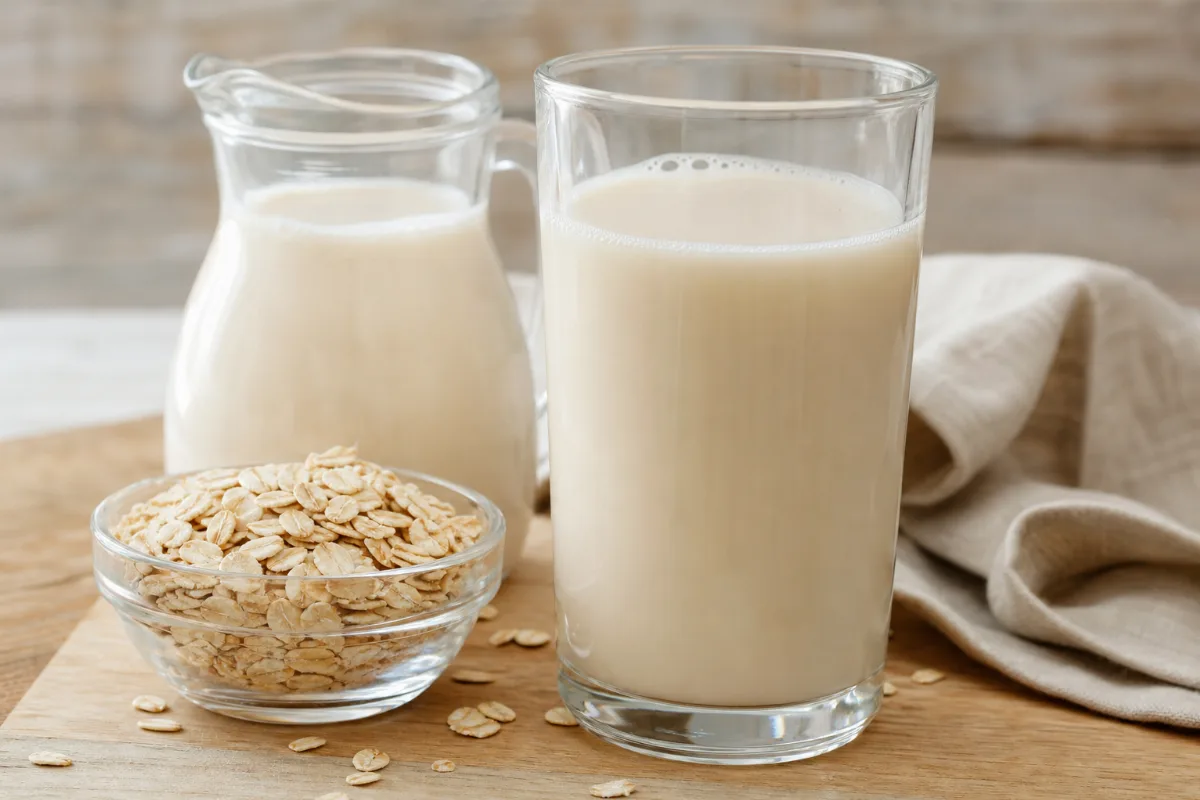
Beverages · Drink
Oat Milk
Avena sativa (oat drink) · also called Oat drink, oat beverage, leche de avena
Oat milk is a plant-based drink made from oats and sold as a dairy-free alternative to milk. Label data show it has much less protein than cow's milk, and calcium depends on the brand. Trials of oat beta-glucan at about 3 g a day lowered LDL cholesterol a little, but none tested commercial oat milk. The main cautions are gluten cross-contact in celiac disease and that babies under 1 should not have it as a milk.
General information, not medical advice. Last substantive update · Not medically reviewed. A named clinician has not signed off on this page. How this page is made
About Oat Milk
Oat milk is a plant-based drink made from oats, used as a dairy-free milk. It is a food, not a proven remedy: its nutrients vary by brand, the cholesterol findings come from oat beta-glucan studies, and no trial of commercial oat milk was found.
What it is
Oat milk, also called oat drink, is a plant-based drink made from oats (Avena sativa, a grass in the Poaceae family). The NHS lists oat drinks among the dairy alternatives sold today and says unsweetened, calcium-fortified versions count within the dairy food group.
Label data for 12 oat drinks sold in New Zealand, per 100 mL on average: 55 kcal, 1.1 g protein, 2.1 g fat, 7.8 g carbohydrate, 3.2 g sugars, 0.9 g fibre, 42 mg sodium and 99 mg calcium. A 240 mL cup, by our arithmetic, is about 132 kcal, 2.6 g protein and 238 mg calcium. We have no USDA record for oat milk, and US products may differ.
How it compares with cow's milk
Protein is the big difference: 1.1 g per 100 mL for oat drinks against 3.5 g for fresh milk on labels. Calcium ranged from 3 to 120 mg per 100 mL across the oat drinks, against 123 mg in fresh milk, so it depends on fortification. In one product the unshaken carton held 97% less calcium than a well-mixed sample.
No oat drink declared added sugar, but the lab analysis of 4 drinks found glucose and maltose, about 2.9 g total sugars per 100 g, with big differences between products. The study authors concluded that only calcium-fortified soy drinks came close to milk. A review of 122 plant drinks also found salt was the most common added ingredient.
What the research shows
The cholesterol findings are about oat beta-glucan, not oat milk. In a double-blind trial of 207 adults with borderline high LDL, a drink made with 3 g a day of beta-glucan lowered LDL by 0.207 mmol/L (about 6%) more than a rice-powder drink over 4 weeks. Pooled analyses of oat beta-glucan found LDL 0.25 mmol/L lower (28 trials) and 0.27 mmol/L lower (13 trials). A trial of 83 adults found HDL and triglycerides did not change and fasting glucose was not affected.
No trial of commercial oat milk was found, and we could not find its beta-glucan content. The US heart-health claim for oat fibre names oat bran, rolled oats, whole oat flour and oatrim, not drinks. The beverage trial's authors were linked to industry funding: a paper from the same trial lists PepsiCo as an agency.
At a glance
Traditional uses history, not proof
- Used today as a dairy-free milk alternative
- Modern use is not proof that it treats any condition
Studied for research
- Protein, calcium and fibre, high certainty for the label content, which varies by brand
- LDL cholesterol with oat beta-glucan, moderate certainty (not oat milk)
- LDL cholesterol with oat milk itself, insufficient evidence
- Dairy-free choice, low certainty (lab composition only)
- Blood sugar after oat milk, insufficient evidence
- Growth in children when plant drinks replace milk, low certainty (observational, a caution)
Main compounds
- Oat beta-glucan (soluble fibre)
- Protein
- Calcium (added by fortification)
- Sugars including glucose and maltose
- Fat and sodium
Common forms
- Commercial oat drinks as sold (New Zealand label and lab data read)
- Oat beta-glucan drinks made for trials, powders and supplements are different products and are not covered
- Homemade oat milk and flavoured versions were not researched
Research links: 2021 trial: oat beta-glucan beverage and LDL cholesterol · 2022 study: nutrients in plant drinks compared with cow's milk · 2026 review: plant drinks in early life · Research Library · Genes & Biomarkers Library
What it is and its history
- Accepted scientific name
- Avena sativa L.
- Naming authority
- L. (GBIF accepted; the cereal whose grain is used to make oat milk)
- Common names
- Oat milk (English); Oat drink (English); Oat beverage (English); Leche de avena (Spanish)
- Family or group
- Poaceae (the grass family), as given by GBIF. Oat milk itself is a processed drink, not a plant.
- Classification
- Plantae > Tracheophyta > Liliopsida > Poales > Poaceae > Avena > Avena sativa
- Native range
- Not verified from a source read.
- Habitat
- Not verified from a source read.
- What it looks like
- Roots: Not verified.; Stems: Not verified.; Leaves: Not verified.; Flowers: Not verified.; Fruit: Oat milk is made from oats. In the nutrient survey, a 250 g serving contained on average 33 g of oats.
- Cultivation
- Not verified from a source read.
- Harvest and processing
- How oat milk is made was not read from a source. The lab analysis found glucose and maltose in the oat drinks tested, and the survey found no added sugar declared on the 12 labels; the study did not explain where these sugars come from. A 2020 report on whole-oat-flour drinks was not re-read and is not used.
- Look-alikes and adulterants
- Name: Oats and oat bran as food; Note: Whole oats and oat bran are the foods named in the US heart health claim; oat milk is a different product.; Name: Oat beta-glucan powders and supplements; Note: Most cholesterol trials used these, not oat milk.; Name: Other plant drinks (soy, almond, rice, coconut); Note: Soy was the only plant drink closest to cow's milk in the nutrient study.
- Sustainability and conservation
- Not assessed.
Photographs
What is inside, and how it may work
What it contains and how those compounds act in cells and animals. Laboratory and animal mechanisms are not proven effects in people.
Main compounds
| Compound | Family | Where it is concentrated | Activity studied | Level of evidence |
|---|---|---|---|---|
| Oat beta-glucan | soluble fibre (polysaccharide) | Oat grain Not found for commercial oat milk. Total fibre on labels averaged 0.9 g per 100 mL. | At about 3 g a day, oat beta-glucan lowered LDL cholesterol a little in trials of drinks, supplements and oat foods. 8 7 6 | Human data |
| Protein | protein | Oat grain Labels: 1.1 g per 100 mL on average (0.2 to 2.3); lab: 0.8 g per 100 g | Lower than cow's milk (3.5 g per 100 mL). 6 | Lab |
| Calcium | mineral | Added (fortification) Labels: 99 mg per 100 mL on average (3 to 120) | Depends on fortification; can settle in the carton. 6 | Lab |
| Sugars (glucose, maltose) | sugars | Drink Labels: total sugars 3.2 g per 100 mL on average (1 to 4.5); lab: glucose 1.23 g and maltose 1.55 g per 100 g | Present although no oat drink declared added sugar. 6 | Lab |
Mechanisms, receptors and pathways
| Target or pathway | Gene or receptor | What was found | Level |
|---|---|---|---|
| Cholesterol lowering by oat beta-glucan | Not specified in the sources read | The abstracts read do not describe how beta-glucan lowers LDL, so no mechanism is stated here. 8 7 | Human data |
Absorption, metabolism and elimination
- Absorption
- Not found for oat milk.
- Distribution
- Not found.
- Metabolism
- Not found.
- Elimination
- Not found.
- Bioavailability
- Not established for the calcium, protein or fibre in oat milk.
Isolated compounds versus whole extracts
The cholesterol results are for oat beta-glucan in trial drinks, supplements and oat foods, at about 3 g a day. They are not results for commercial oat milk, whose beta-glucan content was not found. Whole oats, oat bran, beta-glucan powders and oat milk are different products.
Nutritional composition
Source: label data for 12 oat drinks sold in New Zealand and a lab analysis of 4 oat drinks, from Smith et al. 2022 (Front Nutr, full text read). USDA FoodData Central was not used: our saved USDA file has no oat milk record. Per 100 mL, average of 12 labels (range): 55 kcal (48 to 71), 1.1 g protein (0.2 to 2.3), 2.1 g fat (1 to 3.1), 7.8 g carbohydrate (6 to 11.7), 3.2 g total sugars (1 to 4.5), 0.9 g fibre (0.3 to 2.4), 42 mg sodium (32 to 52.6), 99 mg calcium (3 to 120). One 240 mL cup is our arithmetic (the 100 mL values times 2.4): about 132 kcal, 2.6 g protein, 5.0 g fat, 18.7 g carbohydrate, 7.7 g sugars, 2.2 g fibre, 101 mg sodium and 238 mg calcium. Fresh cow's milk labels averaged 63 kcal, 3.5 g protein, 4.8 g sugars and 123 mg calcium per 100 mL. None of the 12 oat drinks declared added sugar. Lab analysis of 4 oat drinks, per 100 g: 0.8 g protein, 1.9 g fat, 0.85 g fibre, 2.93 g total sugars (glucose 1.23 g and maltose 1.55 g, with large spread between products), iron 0.09 mg, iodine 0.0016 mg, zinc 0.04 mg; lactose below 0.2 g. Calcium varies mainly because of fortification, and in one product the unshaken sample had 97% less calcium than a well-mixed one. US products may differ, so read the Nutrition Facts label.
1 high certainty1 moderate certainty2 low certainty1 very low certainty2 not enough evidence
What was looked at
The 7 benefits and uses checked for Oat Milk, each with how strong the evidence is. Tap one to open it.
- Protein, calcium and fibre (nutrient content compared with cow's milk)High certainty
- LDL ('bad') cholesterol (oat beta-glucan, not oat milk)Moderate certainty
- LDL cholesterol (commercial oat milk itself)Not enough evidence
- Dairy-free choice (lactose intolerance, milk allergy, vegan diets)Low certainty
- Blood sugar after drinking oat milkNot enough evidence
- Growth in children when plant drinks replace cow's milkLow certainty
- Headache, tiredness and other non-gut symptoms (beta-glucan drink)Very low certainty
Lab markers tracked in the studies
LDL cholesterolFasting blood glucose
What is Oat Milk good for?
The main studied uses and how strong the human evidence is for each. Most results are for oat beta-glucan or label data, not for oat milk in people.
Benefits, one by one
Each card is a research question, not a promise. Tap a goal to filter. Open a card to see the studies, doses and limits.
Protein, calcium and fibre (nutrient content compared with cow's milk)
High certaintyOat drinks differ a lot from brand to brand. In a New Zealand study of 12 oat drink labels, protein averaged 1.1 g per 100 mL (range 0.2 to 2.3) against 3.5 g in fresh milk, and calcium averaged 99 mg (range 3 to 120) against 123 mg. Calcium depends on whether the drink is fortified. A 240 mL cup averages about 132 kcal and 2.6 g of protein by our arithmetic.
3 studiesOat drinks as sold in New Zealand; US products may differ.
Studies, doses and limits
What the trials found
No trial was read that tested whether swapping cow's milk for oat milk changes nutrient status. The lab analysis of 4 oat drinks found 0.8 g protein per 100 g and measurable glucose and maltose but no measurable lactose (under 0.2 g). The study authors concluded that, except for calcium-fortified soy, no commercial plant drink had a composition broadly comparable with milk. The NHS says unsweetened, calcium-fortified plant drinks, including oat, count within the dairy food group.
Results
Oat drinks are lower in protein than cow's milk, and their calcium depends on fortification.
Effect sizes as reported
Per 100 mL, average of 12 labels (range): 55 kcal (48 to 71); protein 1.1 g (0.2 to 2.3); fat 2.1 g (1 to 3.1); carbohydrate 7.8 g (6 to 11.7); sugars 3.2 g (1 to 4.5); fibre 0.9 g (0.3 to 2.4); sodium 42 mg (32 to 52.6); calcium 99 mg (3 to 120). Fresh milk: protein 3.5 g, calcium 123 mg.
Why this rating
High that the products on these labels contain these nutrients and that they vary by brand (labels plus lab analysis). Not tested as a treatment, and the figures are from New Zealand products.
Form and dose studied
Oat drinks as sold in New Zealand; US products may differ.
Who was studied
General adult diet.
Limits
Label data come from one country. The lab sample was only 4 oat drinks. A 240 mL cup is our arithmetic (per 100 mL times 2.4), not a study measure.
Why researchers looked
People choose oat drinks as a dairy-free milk and ask whether they replace what cow's milk provides.
Traditional use
Oat drinks are a modern dairy-free drink. Long use as food is not proof that it treats any condition.
Proposed mechanism Nutrient database
These are nutrient amounts on labels and in a lab analysis, not a body effect.
A proposed mechanism does not show that the effect happens in people.
See the Safety tab for gluten, infants and young children.
LDL ('bad') cholesterol (oat beta-glucan, not oat milk)
Moderate certaintyOat beta-glucan, a soluble fibre in oats, lowers LDL cholesterol in trials. In one trial a drink made with 3 g a day of beta-glucan lowered LDL by about 6% more than a rice-powder drink after 4 weeks. These were trial drinks and supplements, not store-bought oat milk.
4 studiesTrial beverages mixed with water and supplements providing about 3 g …
Studies, doses and limits
What the trials found
In a double-blind trial of 207 adults with borderline high LDL, 1 g of high-molecular-weight oat beta-glucan three times a day in 250 mL water for 4 weeks lowered LDL by 0.207 mmol/L (about 6%) more than rice powder. A crossover trial of 83 adults on 3 g a day of oat beta-glucan reported LDL falls of 12.2% at 4 weeks and 15.1% at 8 weeks from baseline, with differences versus placebo. A 2014 pooled analysis of 28 trials of 3 g or more a day found LDL 0.25 mmol/L lower, and a 2022 pooled analysis of 13 trials in 927 adults with high cholesterol found 0.27 mmol/L lower. HDL and triglycerides did not change.
Results
A small, steady fall in LDL with about 3 g a day of oat beta-glucan, shown for beta-glucan drinks, supplements and oat foods. Not shown for oat milk.
Effect sizes as reported
LDL: beverage trial -0.207 mmol/L (about 6%); 28-trial pooled analysis -0.25 mmol/L; 13-trial pooled analysis -0.27 mmol/L; crossover trial -12.2% (4 weeks) and -15.1% (8 weeks) from baseline.
Why this rating
Moderate for beta-glucan at about 3 g a day (several trials and two pooled analyses, a blood marker not heart attacks). Indirect for oat milk. The beverage trial was run with industry-linked funding (PepsiCo is listed on a paper from the same trial).
Form and dose studied
Trial beverages mixed with water and supplements providing about 3 g a day of beta-glucan; not commercial oat milk.
Who was studied
Adults with borderline or moderately high LDL.
Limits
Short trials (4 to 12 weeks) on a blood marker; no trial of heart attacks or strokes with oat drinks. The trial beverage was not oat milk.
Why researchers looked
Oats are a main source of beta-glucan, so researchers asked whether oat products lower cholesterol.
Traditional use
Oat drinks are a modern dairy-free drink. Long use as food is not proof that it treats any condition.
Proposed mechanism Not established
Not described in the abstracts read.
A proposed mechanism does not show that the effect happens in people.
Gut symptoms rose briefly on both the beta-glucan and control drinks in the beverage trial.
LDL cholesterol (commercial oat milk itself)
Not enough evidenceNo trial of commercial oat milk and cholesterol was found. The beta-glucan in store-bought oat milk was not established from any source read, so the trial results for 3 g a day cannot be assumed for a cup of oat milk.
2 studiesCommercial oat milk as sold.
Studies, doses and limits
What the trials found
No trial of oat milk was found in the searches run. The US heart-health claim for oat soluble fibre names oat bran, rolled oats, whole oat flour and oatrim (and barley foods) with 3 g or more a day of beta-glucan; the rule does not mention drinks or milk. The nutrient survey of oat drinks reported 0.9 g of fibre per 100 mL on average, but not the beta-glucan content.
Results
Not tested. Insufficient evidence.
Why this rating
No study of oat milk and cholesterol was read; the beta-glucan content of commercial oat milk was not found.
Form and dose studied
Commercial oat milk as sold.
Limits
A gap in the research, not a finding of no effect.
Why researchers looked
Shoppers ask whether swapping to oat milk lowers cholesterol.
Traditional use
Oat drinks are a modern dairy-free drink. Long use as food is not proof that it treats any condition.
Proposed mechanism Not established
Not applicable.
A proposed mechanism does not show that the effect happens in people.
None specific.
Dairy-free choice (lactose intolerance, milk allergy, vegan diets)
Low certaintyOat drinks are sold as dairy-free alternatives to milk. In a lab test of 4 oat drinks, lactose was not measurable. No study was read on whether people with lactose intolerance or milk allergy have fewer symptoms on oat milk.
3 studiesOat drinks as sold.
Studies, doses and limits
What the trials found
The NHS lists oat drinks among alternatives for people who cannot or choose not to have dairy, and warns they may be at risk of too little calcium. The nutrient lab analysis found no measurable lactose in the oat drinks tested (under 0.2 g per 100 g). No trial of symptoms was read.
Results
Lactose was not measurable in 4 oat drinks. Symptom benefit not tested.
Effect sizes as reported
Lactose below 0.2 g per 100 g in the lab sample.
Why this rating
Low: a lab composition result in a small sample and an agency statement, with no trial in people.
Form and dose studied
Oat drinks as sold.
Who was studied
People avoiding dairy.
Limits
Four products only. The NHS page does not test oat milk for any condition.
Why researchers looked
People who cannot or do not want to have dairy look for a drink to use in its place.
Traditional use
Oat drinks are a modern dairy-free drink. Long use as food is not proof that it treats any condition.
Proposed mechanism Not established
Not applicable.
A proposed mechanism does not show that the effect happens in people.
Check the label for other allergens; oats are not on the US list of nine major allergens, but a product can contain others.
Blood sugar after drinking oat milk
Not enough evidenceNo study of blood sugar after drinking commercial oat milk was found. Labels average 7.8 g of carbohydrate per 100 mL, and a lab analysis of 4 oat drinks found sugars that included glucose and maltose even though none declared added sugar. Two beta-glucan trials found no change in fasting glucose, but those were not oat milk.
3 studiesBeta-glucan supplements and trial beverages; oat drinks only as lab a…
Studies, doses and limits
What the trials found
In the 83-person BELT crossover trial, 3 g a day of oat beta-glucan did not change fasting glucose. In the beta-glucan beverage trial, glucose and insulin did not differ from the control. The label survey found no added sugar declared for any of the 12 oat drinks, but the lab analysis of 4 drinks measured glucose (1.23 g per 100 g) and maltose (1.55 g), with wide variation between products.
Results
Fasting glucose did not change with beta-glucan. Nothing was shown for oat milk and glucose after drinking.
Effect sizes as reported
Fasting glucose: no significant change in two beta-glucan trials. Lab sugars in oat drinks (per 100 g, mean and SD): glucose 1.23 (2.4), maltose 1.55 (1.04), total 2.93 (2.03).
Why this rating
No study of blood sugar after oat milk was read. The related trials used beta-glucan, not the drink.
Form and dose studied
Beta-glucan supplements and trial beverages; oat drinks only as lab analysis.
Who was studied
Adults with borderline or moderately high LDL (the trials).
Limits
A lab sample of 4 products with large differences between them. Fasting glucose is not the same as a rise after a drink.
Why researchers looked
Oat drinks contain carbohydrate, so people with diabetes or insulin concerns ask how they behave.
Traditional use
Oat drinks are a modern dairy-free drink. Long use as food is not proof that it treats any condition.
Proposed mechanism Not established
Not applicable.
A proposed mechanism does not show that the effect happens in people.
If you have diabetes, ask your care team how to count the carbohydrate.
Growth in children when plant drinks replace cow's milk
Low certaintyA 2026 review found that even partly replacing cow's milk with plant drinks in early life went with slightly less height and a lower BMI in 5-year-olds, and case reports describe severe undernutrition when plant drinks were the main drink in the first two years. The review was not oat-specific. This is a caution, not a benefit.
2 studiesPlant-based milk alternatives of all kinds, as drinks.
Studies, doses and limits
What the trials found
The review pooled cross-sectional and cohort studies and case reports of plant-based milk alternatives. Per cup in five-year-olds, the height-for-age z-score was -0.04 and the BMI-for-age z-score was -0.06 (about 0.2 cm and 0.1 kg). The authors found no randomised trials and no long-term studies, and say residual confounding makes the risk hard to quantify. The NHS says babies under 1 should not be given oat, rice or almond drinks as a milk.
Results
Small average differences in growth in observational data; undernutrition in case reports.
Effect sizes as reported
Per cup of plant drink at age 5: height z-score -0.04 (95% CI -0.07 to -0.01); BMI z-score -0.06 (-0.09 to -0.03).
Why this rating
Low: observational studies with confounding and case reports; not oat-specific.
Form and dose studied
Plant-based milk alternatives of all kinds, as drinks.
Who was studied
Infants, children and adolescents.
Limits
Not oat-specific in the abstract; observational; case reports have limited value.
Why researchers looked
Parents ask whether a plant drink can stand in for cow's milk for children.
Traditional use
Oat drinks are a modern dairy-free drink. Long use as food is not proof that it treats any condition.
Proposed mechanism Not established
Not established. The authors point to lower intake of milk nutrients such as iodine.
A proposed mechanism does not show that the effect happens in people.
See the Safety tab for infants and young children.
Headache, tiredness and other non-gut symptoms (beta-glucan drink)
Very low certaintyA secondary look at the beta-glucan drink trial found some self-rated symptoms eased, such as headache at 2 weeks. The authors call this preliminary and hypothesis-generating. It was a beta-glucan drink, not oat milk.
1 studiesOat beta-glucan trial beverage.
Studies, doses and limits
What the trials found
In the same 207-person trial, people rated 16 non-gut symptoms. Fatigue and exhaustion occurred less than before treatment on beta-glucan, and headache was less severe than on control at 2 weeks (p=0.032). Anxiety (p=0.059) was not significant. With 16 symptoms tested and p values near 0.03, chance is a real possibility.
Results
Preliminary signs only.
Effect sizes as reported
Several p values between 0.03 and 0.06; no effect sizes in the abstract.
Why this rating
Very low: a secondary analysis with many symptoms tested, self-rated outcomes, a beta-glucan drink and industry-linked funding.
Form and dose studied
Oat beta-glucan trial beverage.
Who was studied
Adults with borderline high LDL.
Limits
Not oat milk; hypothesis-generating by the authors' own description.
Why researchers looked
Researchers checked whether the fibre had effects beyond cholesterol.
Traditional use
Oat drinks are a modern dairy-free drink. Long use as food is not proof that it treats any condition.
Proposed mechanism Not established
Not described in the abstract.
A proposed mechanism does not show that the effect happens in people.
None specific.
Connections to the rest of health
How Oat Milk connects to the rest of our health knowledge graph. Every link says what kind of connection it is. A safety link (for example to the liver) is a warning, not a benefit. A study that merely mentions a topic never creates a benefit link.
Explore every connection: goals, body systems, organs, symptoms, genes
A. Wellness goals
| Connected to | Kind of connection | Evidence status | Context | Studies |
|---|---|---|---|---|
| Preventive Wellness | High certainty | Protein, calcium and fibre (nutrient content compared with cow's milk): Oat drinks differ a lot from brand to brand. In a New Zealand study of 12 oat drink labels, protein averaged 1.1 g per 100 mL (range 0.2 to 2.3) against 3.5 g in fresh milk, and calcium averaged 99 mg (range 3 to 120) against 123 mg. Calcium depends on whether the drink is fortified. A 240 mL cup averages about 132 kcal and 2.6 g of protein by our arithmetic. | 6 3 16 | |
| Cholesterol Balance | Moderate certainty | LDL ('bad') cholesterol (oat beta-glucan, not oat milk): Oat beta-glucan, a soluble fibre in oats, lowers LDL cholesterol in trials. In one trial a drink made with 3 g a day of beta-glucan lowered LDL by about 6% more than a rice-powder drink after 4 weeks. These were trial drinks and supplements, not store-bought oat milk. | 8 7 10 1 | |
| Heart Health | Moderate certainty | LDL ('bad') cholesterol (oat beta-glucan, not oat milk): Oat beta-glucan, a soluble fibre in oats, lowers LDL cholesterol in trials. In one trial a drink made with 3 g a day of beta-glucan lowered LDL by about 6% more than a rice-powder drink after 4 weeks. These were trial drinks and supplements, not store-bought oat milk. | 8 7 10 1 | |
| Cholesterol Balance | Not enough evidence | LDL cholesterol (commercial oat milk itself): No trial of commercial oat milk and cholesterol was found. The beta-glucan in store-bought oat milk was not established from any source read, so the trial results for 3 g a day cannot be assumed for a cup of oat milk. | 11 6 | |
| Digestive Wellness | Low certainty | Dairy-free choice (lactose intolerance, milk allergy, vegan diets): Oat drinks are sold as dairy-free alternatives to milk. In a lab test of 4 oat drinks, lactose was not measurable. No study was read on whether people with lactose intolerance or milk allergy have fewer symptoms on oat milk. | 6 16 13 | |
| Blood Sugar Balance | Not enough evidence | Blood sugar after drinking oat milk: No study of blood sugar after drinking commercial oat milk was found. Labels average 7.8 g of carbohydrate per 100 mL, and a lab analysis of 4 oat drinks found sugars that included glucose and maltose even though none declared added sugar. Two beta-glucan trials found no change in fasting glucose, but those were not oat milk. | 1 8 6 | |
| Childrens Health | Low certainty | Growth in children when plant drinks replace cow's milk: A 2026 review found that even partly replacing cow's milk with plant drinks in early life went with slightly less height and a lower BMI in 5-year-olds, and case reports describe severe undernutrition when plant drinks were the main drink in the first two years. The review was not oat-specific. This is a caution, not a benefit. | 5 16 | |
| Energy Vitality | Very low certainty | Headache, tiredness and other non-gut symptoms (beta-glucan drink): A secondary look at the beta-glucan drink trial found some self-rated symptoms eased, such as headache at 2 weeks. The authors call this preliminary and hypothesis-generating. It was a beta-glucan drink, not oat milk. | 9 |
B. Body systems
| Connected to | Kind of connection | Evidence status | Context | Studies |
|---|---|---|---|---|
| Digestive System | Biological association | High certainty | Studied for: Protein, calcium and fibre (nutrient content compared with cow's milk) Studied for: Dairy-free choice (lactose intolerance, milk allergy, vegan diets) | 6 3 16 13 |
| Cardiovascular System | Biological association | Moderate certainty | Studied for: LDL ('bad') cholesterol (oat beta-glucan, not oat milk) Studied for: LDL cholesterol (commercial oat milk itself) | 8 7 10 1 11 6 |
| Immune System | Biological association | Low certainty | Studied for: Dairy-free choice (lactose intolerance, milk allergy, vegan diets) | 6 16 13 |
| Endocrine System | Biological association | Not enough evidence | Studied for: Blood sugar after drinking oat milk | 1 8 6 |
| Musculoskeletal System | Biological association | Low certainty | Studied for: Growth in children when plant drinks replace cow's milk | 5 16 |
| Nervous System | Biological association | Very low certainty | Studied for: Headache, tiredness and other non-gut symptoms (beta-glucan drink) | 9 |
E. Health conditions
| Connected to | Kind of connection | Evidence status | Context | Studies |
|---|---|---|---|---|
| Celiac disease | Adverse effect or risk | Documented risk | Oats can pick up gluten from wheat, barley or rye, and a few people with coeliac disease react to pure oats. Preparation or compound: Oat milk as a drink |
15 4 |
| High cholesterol | Preliminary | Oat beta-glucan at about 3 g a day lowered LDL a little in trials; oat milk itself was not tested. Not a treatment. Preparation or compound: Oat beta-glucan |
8 7 |
I. Biomarkers
| Connected to | Kind of connection | Evidence status | Context | Studies |
|---|---|---|---|---|
| LDL cholesterol | Biological association | Moderate certainty | Measured in trials: lowered. A lab change is not the same as a health benefit. | 8 7 10 1 |
| Fasting blood glucose | Biological association | Low certainty | Measured in trials: no significant change. A lab change is not the same as a health benefit. | 1 8 |
K. Biological pathways
| Connected to | Kind of connection | Evidence status | Context | Studies |
|---|---|---|---|---|
| Calcium | Preliminary mechanism | Lab | Oat milk calcium depends on fortification (3 to 120 mg per 100 mL on labels). | 6 |
L. Active compounds
| Connected to | Kind of connection | Evidence status | Context | Studies |
|---|---|---|---|---|
| Oat beta-glucan | Biological association | Human | At about 3 g a day, oat beta-glucan lowered LDL cholesterol a little in trials of drinks, supplements and oat foods. Preparation or compound: Oat grain |
8 7 6 |
| Protein | Biological association | Lab | Lower than cow's milk (3.5 g per 100 mL). Preparation or compound: Oat grain |
6 |
| Calcium | Biological association | Lab | Depends on fortification; can settle in the carton. Preparation or compound: Added (fortification) |
6 |
| Sugars (glucose, maltose) | Biological association | Lab | Present although no oat drink declared added sugar. Preparation or compound: Drink |
6 |
Each connection is stored with the ingredient, the connected record, the kind of connection, the evidence status, the supporting studies, the preparation or compound involved, and a review date (last reviewed October 26, 2026).
Evidence at a glance: what changed in 1 lab markers
Tap a number to show only those markers. Counts are markers, not people.
The evidence
The research centre for Oat Milk. Every record here was checked against PubMed or the publisher's page; we never list a study we have not verified.
Evidence by outcome
Bars show how many studies we found for each outcome, not how well it works. People are added up across trials only (reviews are not added, to avoid double counting).
How we rate evidence
High certainty
Several well-run trials or reviews agree; further research is unlikely to change the picture much.
Moderate certainty
Good trials point the same way, but some doubt remains.
Low certainty
Small, short or inconsistent trials. The finding could change with better research.
Very low certainty
Very little or very weak human data. Treat as a possibility only.
Mixed findings
Trials or reviews disagree with each other.
Not enough evidence
Not enough human research to say either way.
Evidence against
Good research found no benefit, or found harm.
We take the reviewers' own risk-of-bias and GRADE statements where they exist, and otherwise judge from study size, design, consistency, directness and whether a product matches what is sold. Many publications do not make evidence high. Method note: We started from our existing oat milk summary, re-read the PubMed abstracts of each trial and review, read the open-access nutrient study in full, and re-read the NHS, FDA and eCFR pages. Only abstracts were read for most studies. Items we could not verify were removed or flagged in the research gaps.
Study library: every study we checked 16
| Study | Design | People | Product, dose, length | Result |
|---|---|---|---|---|
| Cicero 2020 A randomized Placebo-Controlled Clinical Trial to Evaluate the Medium-Term Effects of Oat Fibers on Human Health: The Beta-Glucan Effects on Lipid Profile, Glycemia and inTestinal Health (BELT) Study. Nutrients · PMID 32138344 · DOI |
Randomized controlled trial crossover |
83 83 Italian adults eating a Mediterranean-style diet, with moderate high cholesterol and low cardiovascular risk |
Oat beta-glucan supplement (not oat milk) Oat beta-glucan supplement (not oat milk) 3 g a day 8 weeks · vs Placebo |
LDL fell from baseline by 12.2% at 4 weeks and 15.1% at 8 weeks, and total and non-HDL cholesterol also fell, with differences versus placebo (p<0.05 or p<0.01). Fasting glucose and self-rated gut well-being were not affected by beta-glucan or placebo. LDL -12.2% at 4 weeks and -15.1% at 8 weeks from baseline; total cholesterol -6.5% and -8.9% (LDL 4 weeks 95% CI -15.4 to -3.8; 8 weeks -17.8 to -5.9) Methods, limits and fundingOutcomes: LDL cholesterol, total cholesterol, non-HDL cholesterol, fasting glucose, self-rated gut well-being Limitations: Percent changes are from baseline, which is larger than the gap versus placebo. Supplement, not a drink. Funding is not stated in the abstract. Funding and conflicts: Funding is not stated in the abstract. Read: abstract |
| Faulkner-Hogg 2026 Oats in Gluten-Free Diets: An Examination of the Codex Standard and Country-Specific Differences in Gluten-Free-Food Labeling Regulations, for Oats and Oats Declared as Ingredients in Gluten-Free Products. Nutr Rev · PMID 42365597 · DOI |
Regulatory review |
Regulations of Codex, the UK, EU, US, Canada, Australia and New Zealand | Oats in gluten-free labelling Oats in gluten-free labelling |
All the listed places except Australia and New Zealand allow a gluten-free label at 20 ppm gluten or less (US: less than 20 ppm). Australia and New Zealand do not allow oats in gluten-free labelled food. The US alone classes oats as not containing gluten. Cross-contact of oats with wheat, rye and barley is a concern for people with celiac disease. Not applicable (Not applicable) Methods, limits and fundingOutcomes: How each jurisdiction treats oats in gluten-free labelling Limitations: A review of regulations, not of health outcomes. It is about oats, not oat milk specifically. Funding and conflicts: Funding is not stated in the abstract. Read: abstract |
| Fructuoso 2021 An Overview on Nutritional Aspects of Plant-Based Beverages Used as Substitutes for Cow's Milk. Nutrients · PMID 34444815 · DOI |
Review of composition data |
122 plant-based beverages of 22 types gathered from published studies (soy most common, 27.87%) | Plant-based drinks including oat Plant-based drinks including oat · vs Cow's milk |
Nutrient content varied hugely across plant drinks (for example calcium 0 to 1252.94 mg per 100 mL and protein 0.06 to 12.43 g per 100 mL). Salt was the most common added ingredient. Some drinks reach certain cow's milk nutrients, but quality differs, so care is needed when replacing milk. Ranges across all 122 drinks, not oat alone (Not applicable) Methods, limits and fundingOutcomes: Energy and nutrient content Limitations: The abstract gives ranges for all plant drinks, not oat milk separately. Funding and conflicts: Funding is not stated in the abstract. Read: abstract |
| Ocal 2025 Naturally gluten-free flours are commonly contaminated, while commercially produced gluten-free flours are relatively safe: a market-based study in Turkey. Front Nutr · PMID 41459067 · DOI |
Laboratory market survey |
163 163 flours (oat, buckwheat, corn, rice) bought in Turkey, tested with the EU-approved R5 ELISA |
Oat flour among other flours (not oat milk) Oat flour among other flours (not oat milk) |
Gluten was found in 16.67% of flours labelled gluten-free, 50% of unlabelled packaged flours and 84.91% of unlabelled unpackaged flours. 16.67% of the labelled flours exceeded 20 mg/kg. Oat and buckwheat flours had significantly more contamination than corn and rice flours. Contamination found in 16.67%, 50% and 84.91% of the three flour groups (p<0.001 for the group differences) Methods, limits and fundingOutcomes: Gluten contamination Limitations: Flours in Turkey, not drinks. It cannot say how much gluten any oat milk has. Funding and conflicts: Funding is not stated in the abstract. Read: abstract |
| Schlune 2026 Plant-Based Drinks as an Alternative to Cow's Milk in Early Life: Health Effects in Infancy, Childhood, and Adolescence. Dtsch Arztebl Int · PMID 41562594 · DOI |
Narrative review |
Cross-sectional and cohort studies and case reports of plant milk alternatives in infants, children and adolescents (not oat-specific in the abstract) | Plant-based milk alternatives (all types) Plant-based milk alternatives (all types) Per cup in 5-year-olds · vs Cow's milk |
Intake of nutrients typical of cow's milk, such as iodine, was lower with exclusive plant drink use. Even partial replacement of cow's milk went with slightly less growth in height and lower BMI: per cup in five-year-olds, height-for-age z-score -0.04 and BMI-for-age z-score -0.06. Case reports describe severe undernutrition, mainly in the first two years with exclusive or predominant plant drink use. No randomised trials and no long-term studies were found. Per cup in 5-year-olds: height z-score -0.04; BMI z-score -0.06 (about 0.2 cm and 0.1 kg) (Height z -0.07 to -0.01; BMI z -0.09 to -0.03) Methods, limits and fundingOutcomes: Nutrient intake, height and BMI, undernutrition Limitations: Observational with residual confounding; the authors say the risk is hard to quantify. Not oat-specific in the abstract. Case reports have limited value. Funding and conflicts: A conflict of interest statement exists in the record; the text was not read. Read: abstract |
| Smith 2022 Nutritional assessment of plant-based beverages in comparison to bovine milk. Front Nutr · PMID 36003838 · DOI |
Laboratory analysis and label survey |
New Zealand supermarket survey of label data (12 oat drinks) plus lab analysis of selected products (4 oat drinks, 3 fresh milks) | Oat drinks sold in New Zealand Oat drinks sold in New Zealand · vs Cow's milk and other plant drinks |
Oat drink labels averaged 1.1 g protein, 2.1 g fat, 7.8 g carbohydrate, 3.2 g sugars, 0.9 g fibre, 42 mg sodium and 99 mg calcium per 100 mL (55 kcal). Fresh milk averaged 3.5 g protein and 123 mg calcium. No oat drink declared added sugar. Lab values for 4 oat drinks per 100 g: 0.8 g protein, 1.9 g fat, 2.93 g total sugars (glucose 1.23 g and maltose 1.55 g among them), 0.85 g fibre. In a shaken versus unshaken test of one product, the unshaken oat sample had 97% less calcium. Only calcium-fortified soy was comparable with milk. Labels per 100 mL, average (range): protein 1.1 g (0.2 to 2.3); calcium 99 mg (3 to 120); energy 55 kcal (48 to 71) (Ranges given instead of confidence intervals) Methods, limits and fundingOutcomes: Label and lab nutrient content, effect of shaking on calcium and protein Limitations: One country (New Zealand) and a small lab sample (4 oat drinks); US products may differ. The calcium shaking test used one product per type. Full text read (open access). Funding and conflicts: Funding not checked in the part read. Read: full-text |
| Whitehead 2014 Cholesterol-lowering effects of oat beta-glucan: a meta-analysis of randomized controlled trials. Am J Clin Nutr · PMID 25411276 · DOI |
Systematic review meta analysis |
28 randomised controlled trials of at least 3 g oat beta-glucan a day versus a control diet | Oat beta-glucan in foods and supplements (not oat milk) Oat beta-glucan in foods and supplements (not oat milk) 3.0 to 12.4 g a day 2 to 12 weeks · vs Control diet |
At least 3 g a day of oat beta-glucan lowered LDL by 0.25 mmol/L and total cholesterol by 0.30 mmol/L, with no effect on HDL or triglycerides. No evidence that dose or length of treatment changed the size of the effect. The fall was larger with higher starting LDL. LDL -0.25 mmol/L; total cholesterol -0.30 mmol/L (LDL 95% CI -0.30 to -0.20; total -0.35 to -0.24) Methods, limits and fundingOutcomes: LDL, total, HDL cholesterol and triglycerides Limitations: Some trial-to-trial differences. Not a study of oat milk. The searches included in-house study reports of a company (CreaNutrition AG). Funding and conflicts: Funding is not stated in the abstract; the search included in-house reports of CreaNutrition AG. Read: abstract |
| Wolever 2021 An Oat beta-Glucan Beverage Reduces LDL Cholesterol and Cardiovascular Disease Risk in Men and Women with Borderline High Cholesterol: A Double-Blind, Randomized, Controlled Clinical Trial. J Nutr · PMID 34236436 · DOI |
Randomized controlled trial |
207 Adults with LDL cholesterol 3.0 to 5.0 mmol/L (207 randomised, 191 analysed; 37.7% male, mean age 43.3) |
High-molecular-weight oat beta-glucan mixed into 250 mL water (a trial beverage, not oat milk) High-molecular-weight oat beta-glucan mixed into 250 mL water (a trial beverage, not oat milk) 1 g three times a day (3 g a day) 4 weeks · vs Rice powder in 250 mL water |
LDL fell more on beta-glucan than on the control: 0.207 mmol/L lower (about 6%). Total cholesterol, non-HDL cholesterol and the Framingham risk score also fell more. HDL, triglycerides, glucose and insulin did not differ. No major adverse events; both drinks transiently increased gut symptoms. LDL difference 0.207 mmol/L (about 6%); total cholesterol 0.226 mmol/L; non-HDL 0.194 mmol/L; Framingham risk 0.474 lower (LDL 95% CI 0.096 to 0.318 mmol/L lower (P=0.0003)) Methods, limits and fundingOutcomes: LDL cholesterol (primary); total cholesterol, non-HDL cholesterol, Framingham risk score, HDL, triglycerides, glucose, insulin Limitations: Four weeks only. The product was a beta-glucan powder mixed with water made for the trial, not commercial oat milk. Run at a contract research organisation; 48 people withdrew for product safety before randomisation. Funding and conflicts: Funding is not stated in this abstract. A secondary analysis of the same trial lists PepsiCo as an agency (PubMed record). Treat as industry-funded. Read: abstract |
| Wolever 2021 Effect of Oat beta-Glucan on Affective and Physical Feeling States in Healthy Adults: Evidence for Reduced Headache, Fatigue, Anxiety and Limb/Joint Pains. Nutrients · PMID 34062937 · DOI |
Randomized controlled trial secondary analysis |
207 Adults with borderline high LDL cholesterol (207 randomised; 96 and 95 analysed) |
Oat beta-glucan beverage (a trial beverage, not oat milk) Oat beta-glucan beverage (a trial beverage, not oat milk) 1 g three times a day 4 weeks · vs Control beverage |
Exhaustion and fatigue occurred less than before treatment on beta-glucan. Headache was less severe than on control at 2 weeks (p=0.032) and feeling cold at 4 weeks (p=0.040); anxiety was not significant (p=0.059). The authors call the data preliminary and hypothesis-generating. Several p values near 0.03 to 0.06 across 16 symptoms; no effect sizes in the abstract (Not applicable) Methods, limits and fundingOutcomes: Severity and occurrence of 16 non-gut symptoms (self-rated none, mild, moderate or severe) Limitations: A secondary analysis of one trial, with many symptoms tested. Beta-glucan beverage, not oat milk. Funding and conflicts: PepsiCo is listed as an agency in the PubMed record; treat as industry-funded. Read: abstract |
| Yu 2022 Effects of Oat Beta-Glucan Intake on Lipid Profiles in Hypercholesterolemic Adults: A Systematic Review and Meta-Analysis of Randomized Controlled Trials. Nutrients · PMID 35631184 · DOI |
Systematic review meta analysis |
927 13 randomised trials, 927 adults with high cholesterol |
Oat beta-glucan (not oat milk) Oat beta-glucan (not oat milk) Varied by trial Varied by trial · vs Control |
Oat beta-glucan lowered total cholesterol and LDL, with no significant effect on triglycerides or HDL. Disease severity, daily amount, source and duration affected results. LDL -0.27 mmol/L; total cholesterol -0.24 mmol/L (LDL 95% CI -0.35 to -0.20; total -0.28 to -0.20) Methods, limits and fundingOutcomes: Total cholesterol, LDL, HDL, triglycerides Limitations: Authors note inevitable limitations. Not a study of oat milk. Funding and conflicts: Funding listed in the record: Chinese university and science foundation grants; no industry funder is listed. Read: abstract |
| s-ecfr-101-81 US eCFR: 21 CFR 101.81, Health claims: soluble fiber from certain foods and risk of coronary heart disease · Source |
Regulation n/a |
Methods, limits and fundingRead: full-text | ||
| s-ecfr-101-91 US eCFR: 21 CFR 101.91, Gluten-free labeling of food · Source |
Regulation n/a |
Methods, limits and fundingRead: full-text | ||
| s-fda-allergens US FDA: Food Allergies · Source |
Health agency n/a |
Methods, limits and fundingRead: full-text | ||
| s-gbif-avena-sativa GBIF Backbone: Avena sativa L. (usageKey 2705290) · Source |
Reference database n/a |
Methods, limits and fundingRead: full-text | ||
| s-nhs-coeliac NHS (UK): Coeliac disease · Source |
Health agency n/a |
Methods, limits and fundingRead: full-text | ||
| s-nhs-dairy NHS (UK): Dairy and alternatives in your diet · Source |
Health agency n/a |
Methods, limits and fundingRead: full-text |
What we do not know yet
- No trial of commercial oat milk was found for cholesterol, blood sugar or any other outcome; most results are for oat beta-glucan.
- The beta-glucan content of commercial oat milk was not found in any source read.
- Label data are from New Zealand, and the lab analysis covered only 4 oat drinks; US products were not surveyed.
- Medicine interactions, pregnancy and breastfeeding, kidney disease, additives, acrylamide, heavy metals and homemade oat milk were not researched.
- Earlier statements citing a CDC page, a Dietary Guidelines line on added sugars and an industry-funded university report could not be re-read and were removed.
How new research is added
New studies are found by a saved PubMed search and placed in a review queue before the page changes.
Lab markers
What changed in blood or saliva tests during trials. A changed number is not the same as feeling or being healthier, and we give no "normal ranges".
Metabolic 2
LDL cholesterol
Lowered in trials
The 'bad' cholesterol carried in the blood. Higher levels are linked to more heart disease.
Moderate certaintyResults and what it means
Why it was measured
It is the usual blood marker used in diet trials for heart risk.
Statistical vs. clinical meaning
A small average fall for beta-glucan at about 3 g a day. Oat milk itself was not tested.
Safety implication
None specific.
| Study | Result | People | Product |
|---|---|---|---|
| 8 | LDL 0.207 mmol/L lower than control (95% CI 0.096 to 0.318), about 6% | 207 adults with LDL 3.0 to 5.0 mmol/L (191 analysed) | Oat beta-glucan beverage, 3 g a day, 4 weeks |
| 7 | LDL -0.25 mmol/L (95% CI -0.30 to -0.20) with 3 g or more a day | 28 randomised trials | Oat beta-glucan, 3.0 to 12.4 g a day |
| 10 | LDL -0.27 mmol/L (95% CI -0.35 to -0.20) | 13 trials, 927 adults with high cholesterol | Oat beta-glucan |
| 1 | LDL -12.2% at 4 weeks and -15.1% at 8 weeks from baseline | 83 adults with moderate high cholesterol | Oat beta-glucan supplement, 3 g a day |
Fasting blood glucose
No significant change in trials
The sugar level in the blood after a night without food.
Low certaintyResults and what it means
Why it was measured
It is a standard measure of blood sugar control.
Statistical vs. clinical meaning
No change in fasting glucose with beta-glucan; oat milk and glucose after drinking was not studied.
Safety implication
None specific.
Safety
What studies and official sources say about side effects, medicines and who should check first. Each point shows what kind of evidence it comes from.
Main points to know 3
- Babies under 1 year old. The NHS says babies under 1 should not be given any drinks called milk, such as rice, oat or almond drinks. A 2026 review (not oat-specific) found case reports of severe undernutrition when plant drinks were the main drink in the first two years, and lower intake of nutrients typical of cow's milk, such as iodine. Ask your health visitor or doctor about infant and toddler drinks. Authoritative guidance 16 5
- Celiac disease and gluten. The NHS says oats do not contain gluten but can cause a reaction if produced where wheat, barley or rye are handled, and a small number of people with coeliac disease also react to pure oats. In Turkey, oat flours had more gluten contamination than corn or rice flours. In the US a gluten-free label means under 20 ppm gluten, and the US alone treats oats as not containing gluten, while Australia and New Zealand do not allow oats in gluten-free labelled food. If you have celiac disease, choose a drink labelled gluten-free and ask your clinician. Authoritative guidance 15 12 2 4
- Not a like-for-like swap for cow's milk. Oat drinks average far less protein than cow's milk (1.1 g against 3.5 g per 100 mL on labels), and calcium ranged from 3 to 120 mg per 100 mL. In one product, the unshaken carton had 97% less calcium than a well-mixed sample, because added calcium can settle. The NHS says unsweetened calcium-fortified versions count towards the dairy group. Read the label, and shake the carton. Laboratory analysis 6 16
Side effects 3
| Effect | How often | Severity and recovery | Evidence |
|---|---|---|---|
| Brief gut symptoms with a beta-glucan drink From a beta-glucan beverage made for the trial, not oat milk. | Not given in the abstract; both beta-glucan and control drinks transiently increased gut symptoms | mild Described as transient. | Randomised trial 8 |
| Gluten reaction from cross-contact in celiac disease The survey was of flours, so it cannot give a rate for oat milk. | In Turkey, gluten was found in 16.67% of labelled gluten-free flours, 50% of unlabelled packaged flours and 84.91% of unlabelled unpackaged flours (all flours, not drinks) | varies; can damage the gut in celiac disease Not described in the sources read. | Laboratory market survey 15 4 |
| Undernutrition and slower growth when plant drinks replace milk in young children Not oat-specific; confounding is likely. | Per cup of plant drink at age 5: height z-score -0.04, BMI z-score -0.06 | small average differences; severe in case reports Not described in the abstract. | Observational 5 |
Liver
No liver injury from oat milk was found in the sources read. A liver-safety source (such as LiverTox) was not searched for oat drinks.
How often. No frequency was found.
Monitoring. No agency monitoring advice was found.
This is a safety connection. It is not evidence that Oat Milk supports liver health.
Medicines and supplements 0
| With | Why it matters | Importance | Evidence | What to do |
|---|
Who should check first 2
| Situation | Advice | Evidence |
|---|---|---|
| Babies under 1 year old (as a milk drink) | Do not give oat drinks in place of breast milk, formula or the milk your health professional advises. Ask a health visitor or doctor. | Authoritative guidance 16 |
| Celiac disease | Not forbidden by the sources read, but choose a drink labelled gluten-free and ask your clinician, because cross-contact is possible and a few people react to pure oats. | Authoritative guidance 15 12 |
Overdose, product quality and regulators
Summary. No toxicity from oat milk as an ordinary drink was found in the sources read. The safety points are babies, gluten cross-contact and nutrients.
Animal. Not reviewed.
High dose or long term signals. Not found for oat milk. In the beta-glucan beverage trial there were no major adverse events over 4 weeks.
Overdose response. Not found.
Genotoxicity. Not researched.
Gluten cross-contact is the main quality question found. Heavy metals, pesticide and mould-toxin residues, acrylamide and spoilage were not researched.
Gluten cross-contact. Oat and buckwheat flours had significantly more gluten contamination than corn and rice flours in a Turkish market survey, and 16.67% of flours labelled gluten-free exceeded 20 mg/kg. 4
Settling of added calcium. In one oat product, the unshaken sample had 97% less calcium than the well-mixed sample. 6
| Body | Action | Date |
|---|---|---|
| NHS (UK) (United Kingdom) | Babies under 1 should not be given drinks called milk such as rice, oat or almond drinks. Unsweetened calcium-fortified dairy alternatives made from oats count as part of the dairy food group. source | 2023-12-11 |
| US eCFR (FDA rule) (United States) | A food labelled gluten-free must have unavoidable gluten below 20 ppm. source | 2025-01-01 |
| US FDA (United States) | Oats are not among the nine major food allergens (milk, eggs, fish, Crustacean shellfish, tree nuts, peanuts, wheat, soybeans, sesame). source | 2026-03-11 |
| US eCFR (FDA rule) (United States) | The oat soluble-fibre heart health claim names oat bran, rolled oats, whole oat flour, oatrim and barley foods with 3 g or more a day of beta-glucan; drinks and milk are not named. source | 2025-01-01 |
When to get medical help
- Trouble breathing, wheezing, swelling of the lips, face, tongue or throat, widespread hives, repeated vomiting, dizziness or collapse after any new food or drink (possible anaphylaxis): use epinephrine if prescribed, then call 911 or your local emergency number
- A baby or young child on plant drinks as the main drink who is feeding poorly, not growing or very tired: see a doctor promptly
Stop using the product and contact a clinician or emergency service. In the US, Poison Control is 1-800-222-1222.
General information only, not medical advice. Ask a clinician or pharmacist before use, especially with medicines, in pregnancy or with a health condition. See the Natural Remedy Safety guide.
Frequently asked questions
What is oat milk?
What is in a cup of oat milk?
By our arithmetic from 12 New Zealand labels, a 240 mL cup averages about 132 kcal, 2.6 g protein, 18.7 g carbohydrate and 238 mg calcium. Brands differ a lot (protein 0.2 to 2.3 g and calcium 3 to 120 mg per 100 mL). US products may differ, so read the label.
Does oat milk lower cholesterol?
Is oat milk as nutritious as cow's milk?
Not in protein. Oat drink labels averaged 1.1 g protein per 100 mL against 3.5 g in fresh milk. Calcium depends on fortification (3 to 120 mg against 123 mg). The study authors said only calcium-fortified soy came close to milk.
Is oat milk gluten-free?
Is oat milk safe for celiac disease?
Does oat milk spike blood sugar?
Can babies drink oat milk?
The NHS says babies under 1 year old should not be given drinks called milk such as rice, oat or almond drinks. Ask your health visitor or doctor.
Can oat milk replace cow's milk for young children?
A 2026 review (not oat-specific) found slightly lower height and BMI in 5-year-olds who partly replaced cow's milk with plant drinks, and case reports of undernutrition when plant drinks were the main drink in the first two years. Ask a doctor or dietitian.
Is oat milk lactose-free?
In a lab test of 4 oat drinks, lactose was not measurable (under 0.2 g per 100 g). No study of symptoms in people with lactose intolerance or milk allergy was read.
Is oat a major allergen?
Oats are not on the US FDA list of nine major food allergens. That does not mean nobody reacts, and a product can contain other allergens, so check the label. For trouble breathing or swelling of the face or throat, call 911 or your local emergency number.
Why does my oat milk carton need shaking?
Added calcium can settle. In one product, the unshaken sample had 97% less calcium than a well-mixed one. That is one product from one study, so check the pack.
Explore by health goal
Cholesterol BalancePreventive WellnessHeart HealthDigestive WellnessBlood Sugar BalanceChildrens HealthEnergy Vitality
Editorial transparency
- Written by
- AlternativeMed editorial team. Research compiled with AI assistance, then checked against the sources listed.
- Medical review
- None. This page has not been reviewed by a physician or pharmacist.
- First published
- 2026-10-26
- Last substantive update
- 2026-10-26
- How we research
- We started from our existing oat milk summary, re-read the PubMed abstracts of each trial and review, read the open-access nutrient study in full, and re-read the NHS, FDA and eCFR pages. Only abstracts were read for most studies. Items we could not verify were removed or flagged in the research gaps.
- How we rate evidence
- See "How we rate evidence" in the Evidence tab.
- Independence
- No product is promoted on this page. No affiliate links are shown. The beta-glucan beverage trial is linked to PepsiCo funding, and the 2014 pooled analysis used in-house reports of a company; both are stated where used.
Sources 16
Each source was opened and checked. Where we read only the abstract, it says so. The small numbers in the text point here.
- Cicero AFG, Fogacci F, Veronesi M, et al.. A randomized Placebo-Controlled Clinical Trial to Evaluate the Medium-Term Effects of Oat Fibers on Human Health: The Beta-Glucan Effects on Lipid Profile, Glycemia and inTestinal Health (BELT) Study.. Nutrients. 2020. PMID 32138344. DOI 10.3390/nu12030686. (abstract)
- Faulkner-Hogg K, Hughes J, Grafenauer S. Oats in Gluten-Free Diets: An Examination of the Codex Standard and Country-Specific Differences in Gluten-Free-Food Labeling Regulations, for Oats and Oats Declared as Ingredients in Gluten-Free Products.. Nutr Rev. 2026. PMID 42365597. DOI 10.1093/nutrit/nuag100. (abstract)
- Fructuoso I, Romao B, Han H, et al.. An Overview on Nutritional Aspects of Plant-Based Beverages Used as Substitutes for Cow's Milk.. Nutrients. 2021. PMID 34444815. DOI 10.3390/nu13082650. (abstract)
- Ocal HY, Ozel HG. Naturally gluten-free flours are commonly contaminated, while commercially produced gluten-free flours are relatively safe: a market-based study in Turkey.. Front Nutr. 2025. PMID 41459067. DOI 10.3389/fnut.2025.1707584. (abstract)
- Schlune A, Nebelung N, Schidelko LP, et al.. Plant-Based Drinks as an Alternative to Cow's Milk in Early Life: Health Effects in Infancy, Childhood, and Adolescence.. Dtsch Arztebl Int. 2026. PMID 41562594. DOI 10.3238/arztebl.m2025.0223. (abstract)
- Smith NW, Dave AC, Hill JP, et al.. Nutritional assessment of plant-based beverages in comparison to bovine milk.. Front Nutr. 2022. PMID 36003838. DOI 10.3389/fnut.2022.957486. (full-text)
- Whitehead A, Beck EJ, Tosh S, Wolever TMS. Cholesterol-lowering effects of oat beta-glucan: a meta-analysis of randomized controlled trials.. Am J Clin Nutr. 2014. PMID 25411276. DOI 10.3945/ajcn.114.086108. (abstract)
- Wolever TMS, Rahn M, Dioum E, Spruill SE, et al.. An Oat beta-Glucan Beverage Reduces LDL Cholesterol and Cardiovascular Disease Risk in Men and Women with Borderline High Cholesterol: A Double-Blind, Randomized, Controlled Clinical Trial.. J Nutr. 2021. PMID 34236436. DOI 10.1093/jn/nxab154. (abstract)
- Wolever TMS, Rahn M, Dioum EH, et al.. Effect of Oat beta-Glucan on Affective and Physical Feeling States in Healthy Adults: Evidence for Reduced Headache, Fatigue, Anxiety and Limb/Joint Pains.. Nutrients. 2021. PMID 34062937. DOI 10.3390/nu13051534. (abstract)
- Yu J, Xia J, Yang C, Pan D. Effects of Oat Beta-Glucan Intake on Lipid Profiles in Hypercholesterolemic Adults: A Systematic Review and Meta-Analysis of Randomized Controlled Trials.. Nutrients. 2022. PMID 35631184. DOI 10.3390/nu14102043. (abstract)
- . US eCFR: 21 CFR 101.81, Health claims: soluble fiber from certain foods and risk of coronary heart disease. . . (full-text)
- . US eCFR: 21 CFR 101.91, Gluten-free labeling of food. . . (full-text)
- . US FDA: Food Allergies. . . (full-text)
- . GBIF Backbone: Avena sativa L. (usageKey 2705290). . . (full-text)
- . NHS (UK): Coeliac disease. . . (full-text)
- . NHS (UK): Dairy and alternatives in your diet. . . (full-text)


