Herbal Teas & Extracts · Herbal tea
Chrysanthemum Tea
Chrysanthemum x morifolium · also called Chrysanthemum flower tea, juhua, ju hua. Not the same as garden chrysanthemums or true tea (Camellia sinensis).
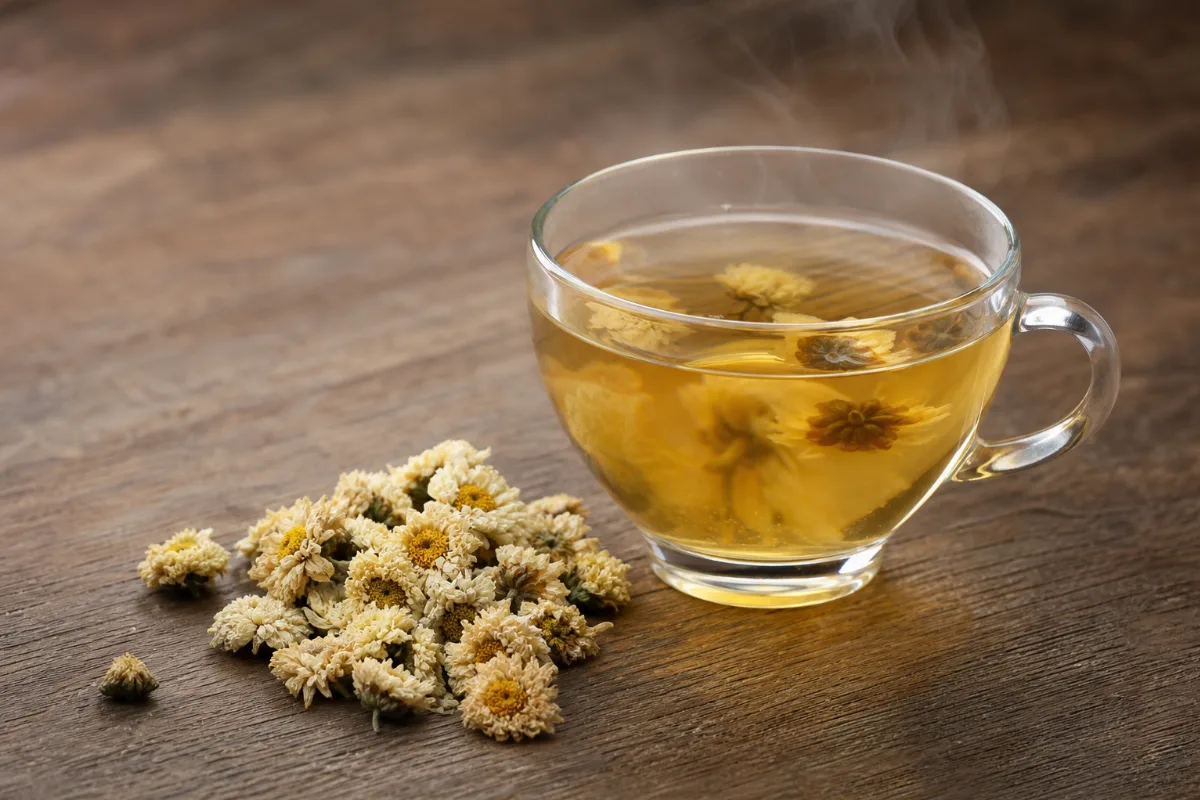
Chrysanthemum tea is a drink made by steeping dried chrysanthemum flower heads in hot water. In China the flower has long been used for colds and for chest and heart complaints. No trial of the tea itself was found, including for blood pressure, eyes or blood sugar. The main caution is allergy: it is a daisy-family flower, so people allergic to ragweed or related plants may react.
General information, not medical advice. Last substantive update · Not medically reviewed. A named clinician has not signed off on this page. How this page is made
About Chrysanthemum Tea
Chrysanthemum tea is the drink made from the dried flower head of Chrysanthemum x morifolium, called juhua in Chinese medicine. Reviews credit it with a very long history in China but no one has tested the tea in a clinical trial. The human trials we found used tablets, granules, an eye mask, an extract and a supplement, and all are rated very low. It is a daisy-family flower, so allergy is the main known caution.
What it is
The plant is Chrysanthemum x morifolium Ramat. ex Hemsl., which GBIF lists as an accepted species in the daisy family (Asteraceae). Papers usually write it as C. morifolium.
The flower holds flavonoids such as luteolin, apigenin and cynaroside, and caffeoylquinic acids such as chlorogenic acid. A dark purple cultivar also held anthocyanins. In hot water most of these dissolved from the flower within about 30 minutes in one lab study.
It is not the tea plant (Camellia sinensis). No source we read measured caffeine in chrysanthemum infusion, so we give no figure. Blends may add true tea, so read the label.
Tea, extract or product
Tea is a water infusion of the dried flower. The trials we found tested other products: a lutein tablet with chrysanthemum, an eye mask, a three-herb granule, an extract added to a meal, and a supplement from a different species (Chrysanthemum indicum).
Results for one of these should not be read as results for another, or for the tea.
What the research shows
Tea trials: none found for blood pressure, eyes, blood sugar or anything else.
Eyes: two trials of mixed products, very low certainty.
Blood sugar: an extract lowered glucose at one hour after a meal in 37 healthy adults, but not the overall rise.
Uric acid, lungs and antioxidants: single small trials or test-tube work, all very low or insufficient.
Quality and contamination
A lab test of two fungicides found 18.7% to 71.2% moved from the flower into the infusion, rising with longer infusion. The authors calculated the daily intake was safe.
A food-processing paper describes pyrrolizidine alkaloids as liver-damaging plant compounds in the chrysanthemum family. It does not say how much a cup holds, so we cannot give a risk level.
A 2020 review says methods to confirm which cultivar a flower is, and whether it is genuine, are lacking. Garden and florists' chrysanthemums are skin sensitisers and are not tea flowers.
At a glance
Traditional uses history, not proof
- A 2024 review says chrysanthemum went from food and tea to medicine in China over more than 3,000 years.
- A 2020 review says juhua is mainly used in China for respiratory and cardiovascular complaints.
- Reviews describe use for colds and inflammation in Chinese dietary herbal medicine. This is tradition, not trial proof.
Studied for research
- Eye strain and dry eye, very low (mixed products, not tea)
- Colds, heart and lung complaints, insufficient (traditional use)
- Blood sugar after a meal, very low (extract, not tea)
- High uric acid, very low (supplement from a different species)
- Lung function in polluted air, very low (multi-herb granules)
- Antioxidant activity, insufficient (test-tube only)
Main compounds
- Flavonoids (luteolin, apigenin and their glycosides)
- Caffeoylquinic acids (including chlorogenic acid)
- Anthocyanins in dark purple cultivars
Common forms
- Dried whole flower heads, loose or compressed
- Tea bags, often blended with other herbs
- Bottled ready-to-drink tea, often sweetened
- Extracts, tablets and Chinese formulas (different products)
Research links: Juhua review (Yuan 2020, abstract) · Chrysanthemum morifolium review (Liu 2024, abstract) · NCCIH: Chamomile, usefulness and safety · Pesticides in chrysanthemum, garden to cup (2025, abstract) · Eye fatigue formula trial (Kan 2020, abstract) · Chrysanthemum extract and after-meal blood sugar (Chen 2023, abstract) · Research Library · Genes & Biomarkers Library
What it is and its history
- Accepted scientific name
- Chrysanthemum x morifolium
- Naming authority
- Ramat. ex Hemsl.
- Common names
- Chrysanthemum tea (English); Juhua (ju hua) (Chinese (pinyin)); Florist's chrysanthemum (garden plant; not the tea flower) (English)
- Family or group
- Asteraceae (daisy family, also called Compositae)
- Classification
- Plantae > Asterales > Asteraceae > Chrysanthemum > Chrysanthemum morifolium
- Native range
- A 2024 review says C. morifolium originated in China.
- Habitat
- Cultivated.
- What it looks like
- Roots: Not described in sources read.; Stems: Not described in sources read.; Leaves: Not described in sources read.; Flowers: The flower head is the part used; colour varies by cultivar (yellow, white and a dark purple cultivar appear in the papers read).; Fruit: Not described in sources read.
- Cultivation
- A 2024 review says many cultivars were produced by several breeding methods and spread worldwide.
- Harvest and processing
- Drying concentrates pesticide residues in the flower (Wang 2025).
- Look-alikes and adulterants
- Name: Chrysanthemum indicum (wild chrysanthemum, ye ju hua); Note: A different species used in the eye-mask and uric-acid products. The two species differ in compounds, so results do not carry over.; Name: Chamomile; Note: Another daisy-family flower tea; allergy cautions overlap.; Name: Florists' chrysanthemums and the pyrethrum daisy; Note: Garden or insecticide plants; florists' chrysanthemums are documented skin sensitisers. Not for tea.
- Sustainability and conservation
- Not covered in the sources read.
Photographs
Traditional use and history history, not clinical proof
| Tradition or era | Documented use | Source |
|---|---|---|
| China, over 3,000 years | A 2024 review says C. morifolium went from food and tea to medicine over more than 3,000 years. | p38621465 |
| Chinese dietary herbal medicine | A 2020 review says juhua is mainly used for respiratory and cardiovascular conditions and summarises the flower medicines recorded in the Chinese Pharmacopoeia. | p32593689 |
Traditional use shows how it was used. It does not show that it works or is safe today.
What is inside, and how it may work
What it contains and how those compounds act in cells and animals. Laboratory and animal mechanisms are not proven effects in people.
Main compounds
| Compound | Family | Where it is concentrated | Activity studied | Level of evidence |
|---|---|---|---|---|
| Luteolin and luteolin glycosides (including cynaroside) PubChem 5280445 | Flavone | Flower Cynaroside exceeded 30% of one flavonoid-rich extract (Chen 2023). | Free-radical scavenging in the lab; compound-level health effects in people not shown. 5 9 4 | Lab |
| Apigenin PubChem 5280443 | Flavone | Flower | More in the yellow cultivar's infusion than in the purple one in one study. 9 4 | Lab |
| Chlorogenic acid and other caffeoylquinic acids PubChem 1794427 | Phenolic acid | Flower Seven caffeoylquinic acids were measured across 27 cultivars; most dissolved in hot water within 30 minutes. | Chemistry only in the papers read. 7 9 4 | Lab |
| Linarin PubChem 5317025 | Flavone glycoside | Flower Found in the purple cultivar's tea, not in the yellow one. | Chemistry only. 9 4 | Lab |
| Anthocyanins | Pigment | Petals (purple cultivar) | Present in the purple cultivar's tea only, with higher antioxidant activity in the test tube. 9 | Lab |
| Sesquiterpene lactones (allergen class) | Terpene | Daisy-family plants | The main skin allergens of the daisy family. 16 11 | Human skin |
Mechanisms, receptors and pathways
| Target or pathway | Gene or receptor | What was found | Level |
|---|---|---|---|
| Free-radical scavenging | n/a | Infusions of two cultivars scavenged free radicals in test-tube assays. 9 13 | Lab |
| Sugar-digesting enzymes (alpha-amylase, alpha-glucosidase) | n/a | Two imperial chrysanthemum teas blocked these enzymes in test tubes; one more strongly. 13 | Lab |
| Anti-inflammatory and nerve-protective activity | n/a | Reviews report these in cells and animals only. 23 12 | Lab and animal |
Absorption, metabolism and elimination
- Absorption
- Not covered for the tea in the sources read.
- Distribution
- Not covered.
- Metabolism
- Not covered.
- Elimination
- Not covered.
- Bioavailability
- Not covered.
Isolated compounds versus whole extracts
Chrysanthemum tea is a hot-water infusion of the dried flower head. A lab study found most flavonoids and caffeoylquinic acids dissolved from the flower within about 30 minutes in hot water. The human trials found are of extracts, tablets, granules, eye masks and mixed formulas, some with another species (Chrysanthemum indicum). Their results should not be read as results for the tea.
Nutritional composition
Chrysanthemum tea is a flower infusion, not made from the tea plant Camellia sinensis. No source we read gives a caffeine or calorie figure for the infusion, so none is stated. Ready-made bottled versions are often sweetened (see the label).
4 very low certainty2 not enough evidence
What was looked at
The 6 benefits and uses checked for Chrysanthemum Tea, each with how strong the evidence is. Tap one to open it.
- Eye strain and dry eye (products with chrysanthemum, not tea)Very low certainty
- Colds, heart and lung complaints (traditional use)Not enough evidence
- Lung function against air pollution (multi-herb granules)Very low certainty
- Blood sugar after a high-fat meal (extract, not tea)Very low certainty
- High uric acid (two-extract supplement from a different species)Very low certainty
- Antioxidant activity (lab work)Not enough evidence
Lab markers tracked in the studies
Eye-fatigue symptom scoreDry-eye symptom scoreLung function measures (FEV1 and others)Blood glucose after a mealSerum uric acid
What is Chrysanthemum Tea good for?
The uses people ask about and how strong the human evidence is for each. No trial tested the tea itself, so each row says what was tested instead.
Benefits, one by one
Each card is a research question, not a promise. Tap a goal to filter. Open a card to see the studies, doses and limits.
Eye strain and dry eye (products with chrysanthemum, not tea)
Very low certaintyTwo Chinese trials tested products that contain chrysanthemum: a chewable tablet for eye strain in 360 adults, and an eye mask for dry eye in 112 adults. Both found some symptom improvement. Neither was tea, and neither can be credited to chrysanthemum alone.
3 studiesChewable tablet with several ingredients; compound eye mask on the sk…
Studies, doses and limits
What the trials found
Tablet trial (Kan 2020): 360 adults with eye fatigue, 90 days, formula of lutein ester, zeaxanthin and extracts of blackcurrant, chrysanthemum and goji berry versus placebo. Eye-mask trial (Wu 2021): 112 analysed adults with mild to moderate dry eye, two weeks, a compound wild chrysanthemum eye mask versus a simulated mask. No trial of chrysanthemum tea for the eyes was found.
Results
Tablet: lower eye-fatigue symptom scores and better tear measures than placebo at all three strengths tested. Eye mask: lower symptom scores than the simulated mask; the group differences in tear break-up time, tear secretion and corneal staining were not significant.
Effect sizes as reported
Not given in the abstracts as one summary figure.
Why this rating
Two trials of mixed products, neither of tea, each reporting benefit mostly on symptom scores. The chrysanthemum part cannot be separated from the other ingredients. Funding was not stated in the abstracts.
Form and dose studied
Chewable tablet with several ingredients; compound eye mask on the skin. Not tea.
Who was studied
Adults with eye fatigue; middle-aged and older adults with mild to moderate dry eye.
Limits
Mixed products. Short follow-up for the eye mask. Not tea.
Why researchers looked
Researchers tested products that contain chrysanthemum for tired and dry eyes, and screen use has made eye fatigue common (Kan 2020).
Traditional use
Not described in the abstracts read for this use.
Proposed mechanism Human trial mixed product
Not established. The tablet trial measured tear film and macular pigment, but the formula also holds lutein, which is the lead ingredient.
A proposed mechanism does not show that the effect happens in people.
Eye mask trial: five mild adverse events (two in the mask group, three in the control group). Tablet trial authors say no serious side effects.
Colds, heart and lung complaints (traditional use)
Not enough evidenceIn China juhua is mainly used for chest and heart complaints and for colds. Reviews describe this as traditional use and lab findings. No trial of the tea was found, and none for blood pressure.
3 studiesDried flower head as tea or in Chinese formulas. No quantities are gi…
Studies, doses and limits
What the trials found
Our searches found no randomised trial in which people drank plain chrysanthemum tea, including for blood pressure. The reviews describe traditional use and lab and animal work.
Results
No tea trial results exist in the sources read.
Why this rating
Support is tradition and lab work, not trials of the tea.
Form and dose studied
Dried flower head as tea or in Chinese formulas. No quantities are given here.
Limits
The reviews are narrative and do not grade the evidence. They are written from a Chinese medicine perspective.
Why researchers looked
Juhua has been eaten and drunk as a dietary herbal medicine in China for a very long time.
Traditional use
A 2024 review says C. morifolium went from food and tea to medicine over more than 3,000 years in China. A 2020 review says juhua is mainly used for respiratory and cardiovascular diseases.
Proposed mechanism Lab and animal
Reviews describe anti-inflammatory and antioxidant activity of its flavonoids and phenolic acids in cells and animals. Not shown for the tea in people.
A proposed mechanism does not show that the effect happens in people.
See the Safety tab. Daisy-family allergy is the main known concern.
Lung function against air pollution (multi-herb granules)
Very low certaintyOne small trial of 47 healthy students tested a Chinese granule formula that includes chrysanthemum, lycium and rehmannia. Lung function fell with air pollution in the control group but the link was much weaker with the granules. It is not tea.
1 studiesGranules made from three herbs. Not tea.
Studies, doses and limits
What the trials found
Randomised, double-blind, placebo-controlled trial of 47 healthy college students in Hangzhou over 4 weeks; 40 completed. Personal fine-particle exposure was monitored.
Results
In the control group several lung function measures fell as PM2.5 exposure rose. In the Qiju group those associations were much weaker and not statistically significant.
Effect sizes as reported
Not summarised in the abstract.
Why this rating
One small trial of a three-herb formula in healthy young adults, with a comparison between exposure slopes rather than between treatment groups on a disease outcome.
Form and dose studied
Granules made from three herbs. Not tea.
Who was studied
Healthy college students.
Limits
Very small; short; formula not tea; healthy people.
Why researchers looked
The formula comes from a traditional Chinese formula used for cough with phlegm, dry mouth and throat.
Traditional use
Qi-Ju-Di-Huang-Wan is a traditional formula (lycium, chrysanthemum and rehmannia).
Proposed mechanism Proposed
The authors point to inflammation, oxidative stress and fibrosis as targets. Not shown for the tea.
A proposed mechanism does not show that the effect happens in people.
The abstract does not report adverse events.
Blood sugar after a high-fat meal (extract, not tea)
Very low certaintyOne trial of 37 healthy young adults gave a chrysanthemum extract with a high-fat meal. Blood sugar one hour after the meal was lower than with the meal alone, but the overall rise over eight hours was not different. Test-tube work on chrysanthemum tea also showed enzyme blocking. No trial of the tea.
3 studiesAn extract mixed into a test meal. Not tea.
Studies, doses and limits
What the trials found
Randomised trial in 37 healthy adults (mean age 25): a high-fat meal alone or with Imperial Chrysanthemum extract, with blood taken over 8 hours.
Results
Glucose at 1 hour was lower with the extract. Maximal changes in glucose and triglycerides differed between groups, but the incremental area under the curve did not differ. Antioxidant markers rose and one oxidation marker (MDA) fell.
Why this rating
One small single-meal trial in healthy people, with an extract, and no difference in the overall area under the curve.
Form and dose studied
An extract mixed into a test meal. Not tea.
Who was studied
Healthy young adults.
Limits
Healthy people, one meal, extract. It does not tell us anything about people with diabetes.
Why researchers looked
Lab work showed chrysanthemum extracts can block enzymes that digest sugar and fat.
Traditional use
Not described in the abstracts read for this use.
Proposed mechanism Lab
Enzyme blocking was shown in test tubes with two imperial chrysanthemum teas (alpha-amylase and alpha-glucosidase). Not shown in people drinking tea.
A proposed mechanism does not show that the effect happens in people.
Adverse events were not reported in the abstract. People on diabetes medicine should ask a pharmacist before changing what they take.
High uric acid (two-extract supplement from a different species)
Very low certaintyOne 12-week trial in 80 adults tested a supplement made from Chrysanthemum indicum and cinnamon cassia extracts. Uric acid fell more than on placebo, but only after 12 weeks. It is a different chrysanthemum species and not tea.
1 studiesA supplement. Not tea.
Studies, doses and limits
What the trials found
Randomised, double-blind, placebo-controlled trial of 80 adults with symptomless high uric acid for 12 weeks.
Results
No significant difference at 6 weeks. At 12 weeks uric acid fell by 0.58 mg/dL with DKB114 and 0.02 mg/dL with placebo (P = 0.0229). Safety tests showed no clinically significant differences.
Effect sizes as reported
Difference between groups of about 0.56 mg/dL at 12 weeks.
Why this rating
One trial, two-extract product made with a different species (C. indicum), not tea; funding not stated.
Form and dose studied
A supplement. Not tea.
Who was studied
Adults with symptomless high uric acid.
Limits
Not C. morifolium and not tea. The study did not test gout attacks.
Why researchers looked
High uric acid is linked with gout, and chrysanthemum extracts were tested as a food ingredient for it.
Traditional use
Not described in the abstract.
Proposed mechanism None stated
Not established in the abstract.
A proposed mechanism does not show that the effect happens in people.
The authors report no clinically significant safety differences.
Antioxidant activity (lab work)
Not enough evidenceChrysanthemum tea infusions scavenge free radicals in test tubes. That is lab chemistry and does not show that drinking it benefits health.
3 studiesInfusions of two cultivars in the lab.
Studies, doses and limits
Results
Both teas scavenged free radicals strongly in the lab (76% to 61% in one assay).
Why this rating
Lab-only evidence; the antioxidant blood markers came from an extract, not tea.
Form and dose studied
Infusions of two cultivars in the lab.
Limits
Test-tube antioxidant tests are not good predictors of benefit in people.
Why researchers looked
The flowers hold flavonoids and caffeoylquinic acids.
Proposed mechanism Lab
Radical scavenging in test-tube assays of two cultivars' infusions.
A proposed mechanism does not show that the effect happens in people.
None specific.
Connections to the rest of health
How Chrysanthemum Tea connects to the rest of our health knowledge graph. Every link says what kind of connection it is. A safety link (for example to the liver) is a warning, not a benefit. A study that merely mentions a topic never creates a benefit link.
Explore every connection: goals, body systems, organs, symptoms, genes
A. Wellness goals
| Connected to | Kind of connection | Evidence status | Context | Studies |
|---|---|---|---|---|
| Eye Health | Very low certainty | Eye strain and dry eye (products with chrysanthemum, not tea): Two Chinese trials tested products that contain chrysanthemum: a chewable tablet for eye strain in 360 adults, and an eye mask for dry eye in 112 adults. Both found some symptom improvement. Neither was tea, and neither can be credited to chrysanthemum alone. | 10 21 1 | |
| Immune Support | Not enough evidence | Colds, heart and lung complaints (traditional use): In China juhua is mainly used for chest and heart complaints and for colds. Reviews describe this as traditional use and lab findings. No trial of the tea was found, and none for blood pressure. | 23 12 1 | |
| Heart Health | Not enough evidence | Colds, heart and lung complaints (traditional use): In China juhua is mainly used for chest and heart complaints and for colds. Reviews describe this as traditional use and lab findings. No trial of the tea was found, and none for blood pressure. | 23 12 1 | |
| Lung Support | Very low certainty | Lung function against air pollution (multi-herb granules): One small trial of 47 healthy students tested a Chinese granule formula that includes chrysanthemum, lycium and rehmannia. Lung function fell with air pollution in the control group but the link was much weaker with the granules. It is not tea. | 6 | |
| Blood Sugar Balance | Very low certainty | Blood sugar after a high-fat meal (extract, not tea): One trial of 37 healthy young adults gave a chrysanthemum extract with a high-fat meal. Blood sugar one hour after the meal was lower than with the meal alone, but the overall rise over eight hours was not different. Test-tube work on chrysanthemum tea also showed enzyme blocking. No trial of the tea. | 5 13 1 | |
| Metabolic Health | Very low certainty | High uric acid (two-extract supplement from a different species): One 12-week trial in 80 adults tested a supplement made from Chrysanthemum indicum and cinnamon cassia extracts. Uric acid fell more than on placebo, but only after 12 weeks. It is a different chrysanthemum species and not tea. | 15 | |
| Cellular Protection | Not enough evidence | Antioxidant activity (lab work): Chrysanthemum tea infusions scavenge free radicals in test tubes. That is lab chemistry and does not show that drinking it benefits health. | 9 7 13 |
B. Body systems
| Connected to | Kind of connection | Evidence status | Context | Studies |
|---|---|---|---|---|
| Eyes | Biological association | Very low certainty | Studied for: Eye strain and dry eye (products with chrysanthemum, not tea) | 10 21 1 |
| Respiratory System | Biological association | Not enough evidence | Studied for: Colds, heart and lung complaints (traditional use) Studied for: Lung function against air pollution (multi-herb granules) | 23 12 1 6 |
| Cardiovascular System | Biological association | Not enough evidence | Studied for: Colds, heart and lung complaints (traditional use) | 23 12 1 |
| Metabolic System | Biological association | Very low certainty | Studied for: Blood sugar after a high-fat meal (extract, not tea) Studied for: High uric acid (two-extract supplement from a different species) | 5 13 1 15 |
| Whole Body | Biological association | Not enough evidence | Studied for: Antioxidant activity (lab work) | 9 7 13 |
E. Health conditions
| Connected to | Kind of connection | Evidence status | Context | Studies |
|---|---|---|---|---|
| Hay fever | Low certainty | People with weed-pollen allergy may react to daisy-family herbs. Preparation or compound: Chrysanthemum tea |
18 14 | |
| Ragweed allergy | Contraindication | Low certainty | NCCIH names chrysanthemums among related plants for chamomile allergy. Preparation or compound: Chrysanthemum tea |
14 |
| Pregnancy and breastfeeding | Not enough evidence | No safety information found. Preparation or compound: Chrysanthemum tea |
23 | |
| Dry eye | Very low certainty | Symptom scores lower than a simulated mask in 112 adults; tear signs not clearly different. Preparation or compound: Compound chrysanthemum eye mask, not tea |
21 |
I. Biomarkers
| Connected to | Kind of connection | Evidence status | Context | Studies |
|---|---|---|---|---|
| Eye-fatigue symptom score | Biological association | Very low certainty | Measured in trials: lower with the multi-ingredient tablet. A lab change is not the same as a health benefit. | 10 |
| Dry-eye symptom score | Biological association | Very low certainty | Measured in trials: lower with the compound eye mask. A lab change is not the same as a health benefit. | 21 |
| Lung function measures (FEV1 and others) | Biological association | Very low certainty | Measured in trials: decline with pollution was weaker with the granules. A lab change is not the same as a health benefit. | 6 |
| Blood glucose after a meal | Biological association | Very low certainty | Measured in trials: lower at 1 hour with the extract; overall area under the curve unchanged. A lab change is not the same as a health benefit. | 5 |
| Serum uric acid | Biological association | Very low certainty | Measured in trials: lower at 12 weeks with the two-extract supplement. A lab change is not the same as a health benefit. | 15 |
L. Active compounds
| Connected to | Kind of connection | Evidence status | Context | Studies |
|---|---|---|---|---|
| Luteolin and luteolin glycosides (including cynaroside) | Biological association | Lab | Free-radical scavenging in the lab; compound-level health effects in people not shown. Preparation or compound: Flower |
5 9 4 |
| Apigenin | Biological association | Lab | More in the yellow cultivar's infusion than in the purple one in one study. Preparation or compound: Flower |
9 4 |
| Chlorogenic acid and other caffeoylquinic acids | Biological association | Lab | Chemistry only in the papers read. Preparation or compound: Flower |
7 9 4 |
| Linarin | Biological association | Lab | Chemistry only. Preparation or compound: Flower |
9 4 |
| Anthocyanins | Biological association | Lab | Present in the purple cultivar's tea only, with higher antioxidant activity in the test tube. Preparation or compound: Petals (purple cultivar) |
9 |
| Sesquiterpene lactones (allergen class) | Biological association | Human skin | The main skin allergens of the daisy family. Preparation or compound: Daisy-family plants |
16 11 |
Each connection is stored with the ingredient, the connected record, the kind of connection, the evidence status, the supporting studies, the preparation or compound involved, and a review date (last reviewed October 25, 2026).
Evidence at a glance: what the research found for 6 outcomes
Each outcome below is one thing researchers measured. Certainty is how far the evidence can be trusted, not how well it works. The full studies are on the next tab.
The evidence
The research centre for Chrysanthemum Tea. Every record here was checked against PubMed or the publisher's page; we never list a study we have not verified.
Evidence by outcome
Bars show how many studies we found for each outcome, not how well it works. People are added up across trials only (reviews are not added, to avoid double counting).
How we rate evidence
High certainty
Several well-run trials or reviews agree; further research is unlikely to change the picture much.
Moderate certainty
Good trials point the same way, but some doubt remains.
Low certainty
Small, short or inconsistent trials. The finding could change with better research.
Very low certainty
Very little or very weak human data. Treat as a possibility only.
Mixed findings
Trials or reviews disagree with each other.
Not enough evidence
Not enough human research to say either way.
Evidence against
Good research found no benefit, or found harm.
We take the reviewers' own risk-of-bias and GRADE statements where they exist, and otherwise judge from study size, design, consistency, directness and whether a product matches what is sold. Many publications do not make evidence high. Method note: We searched PubMed and read the abstracts of the studies listed, read the NCCIH chamomile page for the allergy statement, and checked the plant name in GBIF and five compounds in PubChem. One 2007 abstract was available only in part, so no conclusion is drawn from it.
Study library: every study we checked 23
| Study | Design | People | Product, dose, length | Result |
|---|---|---|---|---|
| AlternativeMed research check 2026 PubMed searches for human trials of chrysanthemum tea (blood pressure, blood sugar, eye strain) PubMed search · Source |
Search record document |
n/a | n/a |
On 2026-10-25 searches of PubMed for chrysanthemum together with tea, infusion, flower, blood pressure, hypertension, diabetes, glucose and eye terms returned no randomised trial in which people drank plain chrysanthemum tea. The human trials that turned up used extracts, tablets, granules, mixed formulas or eye masks, and are listed on this page with what they tested. Methods, limits and fundingOutcomes: Record check Limitations: A search record from a limited set of queries, not a systematic review. A trial in another language or database could exist. Funding and conflicts: Not applicable Read: search |
| AlternativeMed research check 2026 Regulator and reference pages checked for chrysanthemum tea (not found) NCCIH, EMA/HMPC, LiverTox, LactMed · Source |
Not found document |
n/a | n/a |
On 2026-10-25 no NCCIH page, EU herbal monograph, LiverTox entry or LactMed entry for chrysanthemum flower or chrysanthemum tea was found in the checks made (earlier checks of guessed NCCIH and EMA addresses returned 404, and a search of NCBI Books found no LiverTox or LactMed entry). The Chinese Pharmacopoeia, FDA, Commission E and WHO monographs were not read. Methods, limits and fundingOutcomes: Record check Limitations: Not finding a page is not proof none exists. Some checks used guessed web addresses. Funding and conflicts: Not applicable Read: not-found |
| AlternativeMed research check 2026 GBIF species match: Chrysanthemum morifolium GBIF API · Source |
Database record plant |
n/a | n/a |
On 2026-10-25 GBIF returned Chrysanthemum x morifolium Ramat. ex Hemsl. as ACCEPTED (species rank, exact match, confidence 97), family Asteraceae, order Asterales, usage key 3150767. Methods, limits and fundingOutcomes: Record check Limitations: A name database, not evidence about health. Funding and conflicts: Not applicable Read: api |
| AlternativeMed research check 2026 PubChem compound records for luteolin, apigenin, chlorogenic acid, cynaroside (luteolin 7-O-glucoside) and linarin PubChem API · Source |
Database record chemical |
n/a | n/a |
On 2026-10-25 PubChem confirmed CID 5280445 luteolin (C15H10O6), CID 5280443 apigenin (C15H10O5), CID 1794427 chlorogenic acid (C16H18O9), CID 5280637 luteolin 7-O-glucoside (C21H20O11) and CID 5317025 linarin (C28H32O14). Methods, limits and fundingOutcomes: Record check Limitations: Identifies compounds only. Whether each is present in a cup of tea depends on the cultivar and the source papers. Funding and conflicts: Not applicable Read: api |
| Chen L et al. 2023 Analysis of Chemical Constituents of Chrysanthemum morifolium Extract and Its Effect on Postprandial Lipid Metabolism in Healthy Adults Molecules · PMID 36677639 |
Randomized trial |
37 Healthy adults, mean age 25 |
Imperial Chrysanthemum extract added to a high-fat meal Flower extract single meal, blood samples over 8 hours · vs High-fat meal alone |
Blood glucose one hour after the meal was lower with the extract than with the meal alone, and the maximal changes in glucose and triglycerides differed between groups. The overall area under the curve for glucose and fat did not differ between groups. Antioxidant markers (T-AOC, SOD, GSH) rose and MDA fell. Methods, limits and fundingOutcomes: Blood sugar, triglycerides and antioxidant markers after the meal Limitations: An extract, not tea, in 37 healthy young adults after a single meal. The overall area-under-curve showed no difference. Abstract read. Funding and conflicts: Not stated in abstract Read: abstract |
| Chen R et al. 2024 Lung function benefits of traditional Chinese medicine Qiju granules against fine particulate air pollution exposure: a randomized controlled trial Front Med (Lausanne) · PMID 38741765 |
Randomized trial |
47 Healthy college students in Hangzhou, China (40 completed) |
Qiju granules (a Lycium, Chrysanthemum and Rehmannia formula) Mixed herbs 4 weeks · vs Control |
Of 47 students, 40 completed follow-up. In the control group lung function measures fell as fine-particle exposure rose. In the Qiju group those links were much weaker and not statistically significant. The authors say the granules could potentially protect lung function. Registered ChiCTR1900021235. Methods, limits and fundingOutcomes: Lung function against air-pollution exposure Limitations: A multi-herb granule formula, not tea. Small, healthy young adults, 4 weeks, outcome measured against pollution exposure rather than a disease. Abstract read. Funding and conflicts: Not stated in abstract Read: abstract |
| Chen S et al. 2021 Flavonoids and caffeoylquinic acids in Chrysanthemum morifolium Ramat flowers: A potentially rich source of bioactive compounds Food Chem · PMID 33280963 |
Laboratory analysis chemical |
n/a | 27 cultivars and a representative tea of C. morifolium Flower hot-water extraction |
Measured 7 caffeoylquinic acids, 21 flavones and flavonols, 4 carotenoids and 13 other compounds. In hot water, most flavonoids and caffeoylquinic acids dissolved by 30 minutes. Flower colour related to particular flavonoids. Methods, limits and fundingOutcomes: Chemical profile Limitations: Chemistry only. Abstract read. Funding and conflicts: Not stated in abstract Read: abstract |
| Groenewoud GC et al. 2002 Prevalence of occupational allergy to Chrysanthemum pollen in greenhouses in the Netherlands Allergy · PMID 12169182 |
Cross sectional |
104 Greenhouse employees |
Chrysanthemum pollen (workplace exposure) Pollen |
Of 104 greenhouse workers, 56.7% reported work-related symptoms, mainly rhinitis, and 20.2% were sensitised to chrysanthemum pollen. Sensitisation to common airborne pollen including mugwort was closely linked with chrysanthemum sensitisation, which may suggest cross-sensitisation. Methods, limits and fundingOutcomes: Work-related symptoms and pollen sensitisation Limitations: Workers breathing pollen in greenhouses, not people drinking tea. Funding and conflicts: Not stated in abstract (non-US government support listed) Read: abstract |
| Han AR et al. 2019 Phytochemical Composition and Antioxidant Activities of Two Different Color Chrysanthemum Flower Teas Molecules · PMID 30658439 |
Laboratory analysis chemical |
n/a | Infusions of two cultivars (dark purple and yellow) of C. morifolium Flower different water temperatures and times |
The purple cultivar's tea contained anthocyanins and linarin that the yellow one lacked; the yellow tea had more of other flavonoids. Purple tea showed more antioxidant activity in a test-tube assay. Both teas scavenged free radicals strongly in the lab. Methods, limits and fundingOutcomes: Compounds and test-tube antioxidant activity Limitations: Test-tube chemistry on two cultivars. It says nothing about effects in people. Abstract read. Funding and conflicts: Not stated in abstract Read: abstract |
| Kan J et al. 2020 A novel botanical formula improves eye fatigue and dry eye: a randomized, double-blind, placebo-controlled study Am J Clin Nutr · PMID 32542334 |
Randomized trial |
360 Adults with eye fatigue |
Chewable tablet formula of lutein ester, zeaxanthin and extracts of blackcurrant, chrysanthemum and goji berry Mixed extracts 90 days · vs Placebo tablet |
360 adults were split into four groups (placebo and three strengths of the formula). At all three strengths the formula lowered the total eye-fatigue symptom score and lengthened visual persistence time against placebo at 45 and 90 days. Two stronger strengths improved tear secretion on the Schirmer test. Tear film measures improved and macular pigment density rose; retinal thickness did not change. Registered ChiCTR1800018987. Methods, limits and fundingOutcomes: Eye-fatigue symptom score, tear tests, macular pigment Limitations: A combination product; the chrysanthemum extract cannot be separated from lutein, which is the lead ingredient. It is a chewable tablet, not tea. Funding was not stated in the abstract (non-US government support is listed). Funding and conflicts: Not stated in abstract Read: abstract |
| Ključevšek T et al. 2025 Allergic Potential of Medicinal Plants From the Asteraceae Family Health Sci Rep · PMID 39995792 |
Narrative review |
n/a | Asteraceae (daisy family) medicinal plants |
Says daisy-family plants are important sensitizers that cause immediate and delayed allergic reactions, that panallergens in ragweed and mugwort pollen are shared across many species and trigger cross-reactions, and that sesquiterpene lactones can cause skin reactions and may cause systemic reactions after swallowing in sensitized people. Many uncertainties remain. Methods, limits and fundingOutcomes: Allergic potential of daisy-family medicinal plants Limitations: Family-wide review; chrysanthemum tea is not tested. Abstract read. Funding and conflicts: Not stated in abstract Read: abstract |
| Liu Y et al. 2024 Chrysanthemum morifolium as a traditional herb: A review of historical development, classification, phytochemistry, pharmacology and application J Ethnopharmacol · PMID 38621465 |
Narrative review human-and-lab |
n/a | C. morifolium (flower) Flower |
Says C. morifolium originated in China and moved from food and tea to medicine over more than 3,000 years. Reports that flavonoids, phenolic acids, volatile oils and terpenes show anti-inflammatory and antioxidant effects, and describes use for colds, inflammation and cardiovascular conditions. Says future work should focus on the active compounds. Methods, limits and fundingOutcomes: History, chemistry, pharmacology, uses Limitations: A narrative review of mostly lab and animal work; no quality grading. Abstract read; full text not read. Funding and conflicts: Not stated in abstract Read: abstract |
| Liu Y et al. 2025 Widely Targeted Metabolomic Analysis of Two Chinese Traditional Herbal Imperial Chrysanthemum Teas and In Vitro Evaluation of Their Hyperglycemia and Inflammation Enzyme Inhibitory Activities Foods · PMID 40941259 |
Laboratory analysis chemical |
n/a | Two imperial chrysanthemum teas (C. morifolium cv. Huangju) Flower |
Found 1,971 non-volatile and 1,039 volatile compounds. Both teas had high antioxidant capacity in the lab, and one (WYHJ) blocked the sugar-digesting enzymes alpha-amylase and alpha-glucosidase and two other enzymes (xanthine oxidase and lipoxygenase) more strongly. This is test-tube work only. Methods, limits and fundingOutcomes: Metabolites and enzyme-blocking activity in test tubes Limitations: No people and no animals; enzyme tests do not show a blood sugar effect in humans. Abstract read. Funding and conflicts: Not stated in abstract Read: abstract |
| NCCIH (US National Center for Complementary and Integrative Health) 2026 NCCIH: Chamomile: Usefulness and Safety nccih.nih.gov · Source |
Authoritative guidance n/a |
n/a | Chamomile (daisy-family herb) |
Says chamomile can cause allergic reactions, including severe ones and anaphylaxis, in some people, and that people are more likely to react if they are allergic to related plants such as ragweed, chrysanthemums, marigolds or daisies. This is a page about chamomile, not chrysanthemum tea. Methods, limits and fundingOutcomes: Safety of chamomile, including allergy Limitations: A statement about chamomile that names chrysanthemum as a related plant. It does not describe chrysanthemum tea. Page read on 2026-10-25. Funding and conflicts: Not applicable Read: full-text |
| Park YH et al. 2020 A 12-Week, Multicenter, Randomized, Double-Blind, Placebo-Controlled Clinical Trial for Evaluation of the Efficacy and Safety of DKB114 on Reduction of Uric Acid in Serum Nutrients · PMID 33322063 |
Randomized trial |
80 Adults with symptomless high uric acid |
DKB114 (a mixture of Chrysanthemum indicum flower extract and Cinnamomum cassia extract) Flower extract, a different species (C. indicum) 12 weeks · vs Placebo |
No significant difference at 6 weeks. At 12 weeks serum uric acid fell by 0.58 mg/dL in the DKB114 group and by 0.02 mg/dL in the placebo group (P = 0.0229). The authors report no clinically significant safety differences. Registered KCT0002840. Methods, limits and fundingOutcomes: Serum uric acid Limitations: A two-extract supplement made with Chrysanthemum indicum, not C. morifolium and not tea. 80 people. Funding not stated in the abstract; it was designed to test a dietary supplement ingredient, so product-developer involvement is possible. Funding and conflicts: Not stated in abstract; supplement-ingredient study Read: abstract |
| Paulsen 2002 Contact sensitization from Compositae-containing herbal remedies and cosmetics Contact Dermatitis · PMID 12492516 |
Narrative review |
n/a | Compositae-containing herbal remedies |
Says at least 15 daisy-family species have been suspected of causing skin allergy, that sesquiterpene lactones are the main allergens, and that the risk of reactions to such products in people already sensitive to the family is largely unknown. Chrysanthemum is not named in the abstract. Methods, limits and fundingOutcomes: Skin sensitisation from daisy-family herbs Limitations: Review of skin contact, not of drinking tea. Abstract read. Funding and conflicts: Not stated in abstract Read: abstract |
| Paulsen E et al. 2020 Contact sensitization to florists' chrysanthemums and marguerite daisies in Denmark: A 21-year experience Contact Dermatitis · PMID 31483868 |
Case series |
191 Danish patients already sensitised to the daisy family, patch-tested 1998 to 2019 |
Chrysanthemum extract on the skin (patch test) Florists' chrysanthemum extract |
111 of 191 patients (58%) tested positive to chrysanthemum extract. Most were exposed during leisure and most reactions were judged relevant. Feverfew, Compositae mix or parthenolide may cross-react with chrysanthemum. Methods, limits and fundingOutcomes: Positive patch tests Limitations: Patients already known to be sensitised, so the rate is not the rate in the general public. Ornamental florists' chrysanthemums on the skin, not tea. Funding and conflicts: Not stated in abstract Read: abstract |
| Preda M et al. 2024 Diagnostic Workup in IgE-Mediated Allergy to Asteraceae Weed Pollen and Herbal Medicine Products in Europe Medicina (Kaunas) · PMID 39336535 |
Narrative review |
People with respiratory allergy to weed pollen | Daisy-family herbal products |
Says some people with respiratory allergies to weed pollen (ragweed, mugwort) may also react to herbal medicines made from cross-reactive daisy-family (Compositae) plants such as chamomile, marigold and purple coneflower. Chrysanthemum is not named in the abstract. Methods, limits and fundingOutcomes: Cross-reactions between weed pollen and herbal products Limitations: A review for clinicians. Does not test chrysanthemum tea. Abstract read. Funding and conflicts: Not stated in abstract Read: abstract |
| Wang H et al. 2022 Multi-Response Optimization of Pyrrolizidine Alkaloids Removal from Chrysanthemum morifolium by High-Pressure Extraction Foods · PMID 36496634 |
Laboratory method chemical |
n/a | C. morifolium flower processing Flower |
The abstract describes pyrrolizidine alkaloids as liver-damaging plant compounds in the chrysanthemum family and tests a high-pressure process to remove them while keeping useful compounds. It reports the best process settings. It does not report how much of these alkaloids a cup of tea contains. Methods, limits and fundingOutcomes: Removal of pyrrolizidine alkaloids Limitations: A food-processing method paper. Shows the topic matters to producers, not the amounts in a cup. Abstract read. Funding and conflicts: Not stated in abstract Read: abstract |
| Wang X et al. 2025 Occurrence, fate and dietary risk assessment of pesticides in chrysanthemum from garden to cup J Hazard Mater · PMID 40286658 |
Laboratory survey chemical |
111 111 market chrysanthemum products from China |
Dried chrysanthemum products and infusions Flower |
Pesticides were found in the 111 market products. Drying concentrated the residues. Brewing moved between 0.5% and 112.3% of each pesticide from the dry flower into the infusion, depending mainly on how well the pesticide dissolves in water. The authors' combined risk assessment found an acceptable health risk from consuming chrysanthemum. Methods, limits and fundingOutcomes: Pesticide residues, drying, brewing, risk Limitations: A lab survey of Chinese market products; shows presence and risk modelling, not harm in people. Abstract read. Funding and conflicts: Not stated in abstract Read: abstract |
| Wu JL et al. 2021 A multicenter, randomized, double-masked, placebo-controlled trial of compound wild chrysanthemum eye masks for mild and moderate dry eye Zhonghua Yan Ke Za Zhi · PMID 34344121 |
Randomized trial |
112 Middle-aged and older adults with mild to moderate dry eye (120 enrolled, 112 analysed) |
Compound wild chrysanthemum eye masks (a compound product, applied to the eyes) Wild chrysanthemum (compound) 2 weeks · vs Simulated eye mask |
Symptom scores were lower in the eye-mask group than the simulated-mask group after 1 and 2 weeks (P below 0.05). Group differences in tear break-up time, Schirmer test and corneal staining were not significant at each time point. There were five mild adverse events (two in the eye-mask group, three in the control group). Methods, limits and fundingOutcomes: Dry-eye symptom score, tear break-up time, tear secretion, corneal staining Limitations: Used on the skin around the eyes, not drunk; a compound product, so the effect cannot be put down to chrysanthemum. Two weeks only. Abstract read. Funding and conflicts: Not stated in abstract Read: abstract |
| Xue J et al. 2014 Transfer of difenoconazole and azoxystrobin residues from chrysanthemum flower tea to its infusion Food Addit Contam Part A · PMID 24405376 |
Laboratory study chemical |
n/a | Chrysanthemum flower tea spiked with two fungicides Flower |
Between 18.7% and 51.6% of difenoconazole and between 38.1% and 71.2% of azoxystrobin moved into the infusion, rising with longer infusion. Water temperature made no significant difference. The authors calculated that daily intake of the two residues from chrysanthemum tea was safe. Methods, limits and fundingOutcomes: Residue transfer into the infusion Limitations: Two fungicides only, in a lab test. Abstract read. Funding and conflicts: Non-US government research support listed Read: abstract |
| Yuan H et al. 2020 The flower head of Chrysanthemum morifolium Ramat. (Juhua): A paradigm of flowers serving as Chinese dietary herbal medicine J Ethnopharmacol · PMID 32593689 |
Narrative review human-and-lab |
n/a | Juhua (dried flower head of C. morifolium) Flower head |
Says juhua is mainly used in China for respiratory and cardiovascular conditions and reports antimicrobial, anti-inflammatory, anticancer, nerve-protective and cardiovascular activity. The authors say methods to tell cultivars apart and confirm authenticity are lacking, research on the active compounds and how they work needs strengthening, and more safety evaluation of juhua should be done. Methods, limits and fundingOutcomes: Uses in Chinese medicine and diet, cultivars, chemistry, pharmacology, safety Limitations: A narrative review; it does not grade the evidence. Abstract read; full text not read. Funding and conflicts: Not stated in abstract Read: abstract |
What we do not know yet
- No randomised trial of chrysanthemum tea was found for blood pressure, eye strain, blood sugar or any other use.
- The human trials used tablets, granules, an eye mask, an extract or a different species, and are rated very low.
- How often the tea itself triggers allergy is not known.
- Safety in pregnancy, breastfeeding and children and medicine interactions were not described in the sources read.
- Pyrrolizidine alkaloid levels in a cup of tea were not found.
- No source gave a caffeine measurement for chrysanthemum tea.
How new research is added
New studies are found by a saved PubMed search and are placed in a review queue. A person reads each one before it changes any evidence rating or safety wording. New publications never change ratings automatically.
Lab markers
What changed in blood or saliva tests during trials. A changed number is not the same as feeling or being healthier, and we give no "normal ranges".
Other 5
Eye-fatigue symptom score
Lower with the multi-ingredient tablet in trials
A questionnaire total of symptoms such as eye soreness, blurred vision and tearing.
Very low certaintyResults and what it means
Why it was measured
It is how people with eye fatigue feel day to day.
Statistical vs. clinical meaning
A symptom report in one trial of a mixed product.
Safety implication
The authors report no serious side effects.
| Study | Result | People | Product |
|---|---|---|---|
| 10 | Total symptom score lower than placebo at 45 and 90 days at all three strengths | 360 adults with eye fatigue | Lutein-based tablet with chrysanthemum, blackcurrant and goji extracts |
Dry-eye symptom score
Lower with the compound eye mask in trials
A questionnaire total of dry-eye complaints.
Very low certaintyResults and what it means
Why it was measured
Dry-eye symptoms are what bring people to treatment.
Statistical vs. clinical meaning
Symptom change without clear group differences in tear signs.
Safety implication
Five mild adverse events in total.
| Study | Result | People | Product |
|---|---|---|---|
| 21 | Lower than the simulated mask after 1 and 2 weeks (P below 0.05); break-up time, Schirmer and staining differences between groups were not significant | 112 adults with mild to moderate dry eye | Compound wild chrysanthemum eye mask on the skin |
Lung function measures (FEV1 and others)
Decline with pollution was weaker with the granules in trials
Breath tests that show how fast and how much air a person can blow out.
Very low certaintyResults and what it means
Why it was measured
They show the effect of air pollution on the airways.
Statistical vs. clinical meaning
A lab measure in healthy people over 4 weeks.
Safety implication
Not reported in the abstract.
| Study | Result | People | Product |
|---|---|---|---|
| 6 | Control group lung function fell with PM2.5; no statistically significant link in the Qiju group | 40 healthy students who completed | Qiju granules (lycium, chrysanthemum, rehmannia) |
Blood glucose after a meal
Lower at 1 hour with the extract; overall area under the curve unchanged in trials
Blood sugar measured after eating.
Very low certaintyResults and what it means
Why it was measured
Big spikes after meals matter for blood sugar control.
Statistical vs. clinical meaning
One time-point difference in healthy people.
Safety implication
Not reported.
| Study | Result | People | Product |
|---|---|---|---|
| 5 | Lower at 1 hour than with the meal alone; incremental area under the curve not different | 37 healthy adults | Imperial Chrysanthemum extract with a high-fat meal |
Serum uric acid
Lower at 12 weeks with the two-extract supplement in trials
The amount of uric acid in the blood.
Very low certaintyResults and what it means
Why it was measured
High levels are linked with gout.
Statistical vs. clinical meaning
A blood marker, not gout attacks.
Safety implication
No clinically significant safety differences reported.
| Study | Result | People | Product |
|---|---|---|---|
| 15 | Fell 0.58 mg/dL versus 0.02 mg/dL with placebo at 12 weeks (P = 0.0229); no difference at 6 weeks | 80 adults with high uric acid | DKB114 (C. indicum flower and cinnamon cassia extracts) |
Safety
What studies and official sources say about side effects, medicines and who should check first. Each point shows what kind of evidence it comes from.
Main points to know 6
- Allergy: a daisy-family flower. Chrysanthemum belongs to the daisy family (Asteraceae, also called Compositae). NCCIH says people who are allergic to ragweed, chrysanthemums, marigolds or daisies are more likely to react to chamomile. A 2024 review says some people with weed-pollen allergy react to herbal products made from related daisy-family plants. How often chrysanthemum tea itself causes reactions is not known; no study tested it. Authoritative guidance 14 18 11
- Skin and breathing allergy to the plant. In a Danish series of patients already sensitised to the daisy family, 58% (111 of 191) tested positive on the skin to chrysanthemum extract. Among 104 Dutch greenhouse workers, 20.2% were sensitised to chrysanthemum pollen. These are people touching or breathing the plant, not drinking tea, and they are not typical of the public. Observational 17 8
- Pesticide residues in the dried flowers. A study of 111 market chrysanthemum products from China found pesticides. Drying concentrated them, and brewing moved between 0.5% and 112.3% of each pesticide into the cup. The authors judged the combined risk acceptable. A separate lab test of two fungicides found the daily intake from the tea was safe by the authors' calculation. Buying from sellers who test for residues may matter. Food analysis 20 22
- Plant toxins and identity. A 2022 food-processing paper describes pyrrolizidine alkaloids as liver-damaging compounds found in the chrysanthemum family, and tests a way to remove them. It does not report how much a cup of tea holds, so no risk level can be given. A 2020 review also says methods to confirm which cultivar a flower is, and whether it is genuine, are lacking. Food analysis 19 23
- Pregnancy, breastfeeding, children and medicines: not described. The sources we read give no information on pregnancy, breastfeeding, children or medicine interactions for chrysanthemum tea. A 2020 review says more safety evaluation of juhua should be carried out. No regulator monograph was found. Gap 23 2
- Not every chrysanthemum is a tea flower. Garden and florists' chrysanthemums are known skin sensitisers and are not grown for drinking. The pyrethrum daisy that makes insecticide is a different plant. Only buy flowers sold as tea or food. Observational 17 3
Side effects 4
| Effect | How often | Severity and recovery | Evidence |
|---|---|---|---|
| Allergic reaction in people allergic to daisy-family plants Review authors say panallergens and sesquiterpene lactones in daisy-family plants may trigger reactions, and that sensitised people may react to swallowed amounts. Chrysanthemum tea was not tested. | Not known for the tea | mild to severe Not described | Authoritative guidance 14 11 |
| Skin allergy from touching the plant Florists' chrysanthemum extract on the skin, not tea. | 58% of 191 already-sensitised Danish patients patch-tested positive | mild to moderate Not described | Observational 17 16 |
| Hay-fever type symptoms from pollen Occupational pollen exposure. | 56.7% of 104 greenhouse workers had work-related symptoms; 20.2% were sensitised | mild to moderate Not described | Observational 8 |
| No tea-specific side effects reported In the trials of eye masks and a supplement the authors report only five mild eye-mask adverse events and no clinically significant supplement safety differences. Those were not tea. | Unknown | n/a n/a | Gap 21 15 |
Liver
No source we read reports liver injury from chrysanthemum tea. A food-processing paper calls pyrrolizidine alkaloids liver-damaging compounds of the chrysanthemum family but gives no tea levels. LiverTox has no chrysanthemum entry that we found. 19 2
How often. No rate for chrysanthemum tea could be found.
Monitoring. No agency monitoring advice was found.
This is a safety connection. It is not evidence that Chrysanthemum Tea supports liver health.
Medicines and supplements 3
| With | Why it matters | Importance | Evidence | What to do |
|---|---|---|---|---|
| Other daisy-family herbs and pollens (ragweed, mugwort, chamomile, marigold, echinacea) allergy | Shared allergens | NCCIH names chrysanthemums among plants whose allergy makes chamomile reactions more likely, and a 2024 review describes cross-reactions between weed pollen and daisy-family herbal products. | Authoritative guidance Low certainty 14 18 | If you react to ragweed or daisy-family plants, ask an allergy clinician before drinking. |
| Prescription medicines in general prescription | Not established | No source we read describes a medicine interaction with chrysanthemum tea. That is a gap, not a finding of safety. | Gap Not enough evidence 2 | Ask your doctor or pharmacist if you take regular medicine. |
| Blood pressure, blood sugar or uric acid medicines theoretical | Unknown | Chrysanthemum is used traditionally for heart complaints and one trial found lower blood sugar one hour after a meal with an extract. These are not proven effects of the tea, and no interaction has been reported. | Theoretical Not enough evidence 23 5 | Tell your pharmacist if you drink it often and take medicine for these conditions. |
Who should check first 3
| Situation | Advice | Evidence |
|---|---|---|
| Known allergy to chrysanthemum, ragweed, mugwort or other daisy-family plants | Ask an allergy clinician before trying it. | Authoritative guidance 14 18 |
| Pregnancy, breastfeeding and young children | No safety information was found. Ask a midwife or doctor. | Gap 23 |
| Garden or florists' chrysanthemums and the pyrethrum daisy | Not for drinking. | Observational 17 3 |
Overdose, product quality and regulators
Summary. No overdose or poisoning case from chrysanthemum tea was found in the sources read. A 2020 review calls for more safety evaluation. Reproductive toxicity and cancer risk of the tea have not been described in the sources read.
Animal. Not covered in the sources read for the tea.
High dose or long term signals. Unknown.
Overdose response. No case found.
Genotoxicity. Not covered in the sources read.
Toxic or hazardous parts. The flower head is the part used. Ornamental chrysanthemums are sensitisers, and the pyrethrum daisy is an insecticide plant.
Pesticide residues are documented in chrysanthemum flowers. Plant toxins and cultivar mix-ups are raised as quality questions.
Pesticides in market flowers. 111 market products from China contained pesticides. Drying concentrated them; brewing moved 0.5% to 112.3% of each pesticide into the infusion, rising with water solubility. The authors judged the risk acceptable. 20
Two fungicides in the cup. Between 18.7% and 51.6% of difenoconazole and 38.1% and 71.2% of azoxystrobin moved into the infusion, rising with longer infusion. The authors' calculation judged daily intake from the tea safe. 22
Pyrrolizidine alkaloids and authenticity. A process paper describes pyrrolizidine alkaloids as liver-damaging compounds of the chrysanthemum family. A review says tools to tell cultivars apart and confirm authenticity are lacking. 19 23
| Body | Action | Date |
|---|---|---|
| NCCIH (US National Center for Complementary and Integrative Health) (United States) | The chamomile page says people allergic to ragweed, chrysanthemums, marigolds or daisies are more likely to react to chamomile. No NCCIH page on chrysanthemum was found. source | 2026-10-25 |
When to get medical help
- Swelling of the lips, face or tongue, hives, wheezing or trouble breathing after drinking it: get emergency help.
- An itchy mouth, rash or hay-fever type symptoms that return each time you drink it: stop and see a doctor.
- Yellow skin or eyes, dark urine or severe stomach pain after regular use of any herbal tea: stop and see a doctor.
Stop using the product and contact a clinician or emergency service. In the US, Poison Control is 1-800-222-1222.
General information only, not medical advice. Ask a clinician or pharmacist before use, especially with medicines, in pregnancy or with a health condition. See the Natural Remedy Safety guide.
Frequently asked questions
What is chrysanthemum tea?
Does chrysanthemum tea lower blood pressure?
Is chrysanthemum tea good for the eyes or eye strain?
Does chrysanthemum tea help with blood sugar?
Can chrysanthemum tea cause an allergic reaction?
Is chrysanthemum tea safe in pregnancy or when breastfeeding?
Does chrysanthemum tea contain caffeine?
Does chrysanthemum tea interact with medicines?
Are there pesticides in chrysanthemum tea?
Is chrysanthemum tea used in traditional Chinese medicine?
Is the garden chrysanthemum the same as the tea flower?
Explore by health goal
Eye HealthImmune SupportHeart HealthLung SupportBlood Sugar BalanceMetabolic HealthCellular Protection
Editorial transparency
- Written by
- AlternativeMed editorial team. Research compiled with AI assistance, then checked against PubMed records.
- Medical review
- None. This page has not been reviewed by a physician or pharmacist.
- First published
- 2026-10-25
- Last substantive update
- 2026-10-25
- How we research
- We searched PubMed and read the abstracts of the studies listed, read the NCCIH chamomile page for the allergy statement, and checked the plant name in GBIF and five compounds in PubChem. One 2007 abstract was available only in part, so no conclusion is drawn from it.
- How we rate evidence
- See "How we rate evidence" in the Evidence tab.
- Independence
- No product is promoted on this page. No affiliate links are shown. This page is information, not a recommendation to drink or take anything.
Sources 23
Each source was opened and checked. Where we read only the abstract, it says so. The small numbers in the text point here.
- AlternativeMed research check. PubMed searches for human trials of chrysanthemum tea (blood pressure, blood sugar, eye strain). PubMed search. 2026. (search)
- AlternativeMed research check. Regulator and reference pages checked for chrysanthemum tea (not found). NCCIH, EMA/HMPC, LiverTox, LactMed. 2026. (not-found)
- AlternativeMed research check. GBIF species match: Chrysanthemum morifolium. GBIF API. 2026. (api)
- AlternativeMed research check. PubChem compound records for luteolin, apigenin, chlorogenic acid, cynaroside (luteolin 7-O-glucoside) and linarin. PubChem API. 2026. (api)
- Chen L et al.. Analysis of Chemical Constituents of Chrysanthemum morifolium Extract and Its Effect on Postprandial Lipid Metabolism in Healthy Adults. Molecules. 2023. PMID 36677639. (abstract)
- Chen R et al.. Lung function benefits of traditional Chinese medicine Qiju granules against fine particulate air pollution exposure: a randomized controlled trial. Front Med (Lausanne). 2024. PMID 38741765. (abstract)
- Chen S et al.. Flavonoids and caffeoylquinic acids in Chrysanthemum morifolium Ramat flowers: A potentially rich source of bioactive compounds. Food Chem. 2021. PMID 33280963. (abstract)
- Groenewoud GC et al.. Prevalence of occupational allergy to Chrysanthemum pollen in greenhouses in the Netherlands. Allergy. 2002. PMID 12169182. (abstract)
- Han AR et al.. Phytochemical Composition and Antioxidant Activities of Two Different Color Chrysanthemum Flower Teas. Molecules. 2019. PMID 30658439. (abstract)
- Kan J et al.. A novel botanical formula improves eye fatigue and dry eye: a randomized, double-blind, placebo-controlled study. Am J Clin Nutr. 2020. PMID 32542334. (abstract)
- Ključevšek T et al.. Allergic Potential of Medicinal Plants From the Asteraceae Family. Health Sci Rep. 2025. PMID 39995792. (abstract)
- Liu Y et al.. Chrysanthemum morifolium as a traditional herb: A review of historical development, classification, phytochemistry, pharmacology and application. J Ethnopharmacol. 2024. PMID 38621465. (abstract)
- Liu Y et al.. Widely Targeted Metabolomic Analysis of Two Chinese Traditional Herbal Imperial Chrysanthemum Teas and In Vitro Evaluation of Their Hyperglycemia and Inflammation Enzyme Inhibitory Activities. Foods. 2025. PMID 40941259. (abstract)
- NCCIH (US National Center for Complementary and Integrative Health). NCCIH: Chamomile: Usefulness and Safety. nccih.nih.gov. 2026. (full-text)
- Park YH et al.. A 12-Week, Multicenter, Randomized, Double-Blind, Placebo-Controlled Clinical Trial for Evaluation of the Efficacy and Safety of DKB114 on Reduction of Uric Acid in Serum. Nutrients. 2020. PMID 33322063. (abstract)
- Paulsen E. Contact sensitization from Compositae-containing herbal remedies and cosmetics. Contact Dermatitis. 2002. PMID 12492516. (abstract)
- Paulsen E et al.. Contact sensitization to florists' chrysanthemums and marguerite daisies in Denmark: A 21-year experience. Contact Dermatitis. 2020. PMID 31483868. (abstract)
- Preda M et al.. Diagnostic Workup in IgE-Mediated Allergy to Asteraceae Weed Pollen and Herbal Medicine Products in Europe. Medicina (Kaunas). 2024. PMID 39336535. (abstract)
- Wang H et al.. Multi-Response Optimization of Pyrrolizidine Alkaloids Removal from Chrysanthemum morifolium by High-Pressure Extraction. Foods. 2022. PMID 36496634. (abstract)
- Wang X et al.. Occurrence, fate and dietary risk assessment of pesticides in chrysanthemum from garden to cup. J Hazard Mater. 2025. PMID 40286658. (abstract)
- Wu JL et al.. A multicenter, randomized, double-masked, placebo-controlled trial of compound wild chrysanthemum eye masks for mild and moderate dry eye. Zhonghua Yan Ke Za Zhi. 2021. PMID 34344121. (abstract)
- Xue J et al.. Transfer of difenoconazole and azoxystrobin residues from chrysanthemum flower tea to its infusion. Food Addit Contam Part A. 2014. PMID 24405376. (abstract)
- Yuan H et al.. The flower head of Chrysanthemum morifolium Ramat. (Juhua): A paradigm of flowers serving as Chinese dietary herbal medicine. J Ethnopharmacol. 2020. PMID 32593689. (abstract)
Where to buy
Check the label first. Whatever you buy, look for these:
- The herb is the first or only ingredient
- Organic or lab-tested if that matters to you
- Loose leaf or tea bags, and how long they have been stored
- If you take medicines or are pregnant, ask a pharmacist about the herb first
Talk to a pharmacist or doctor before you start any supplement, especially if you take medicines. See the Safety tab for interactions.
Support our free guides: as an Amazon Associate we earn from qualifying purchases. Full disclosure.


