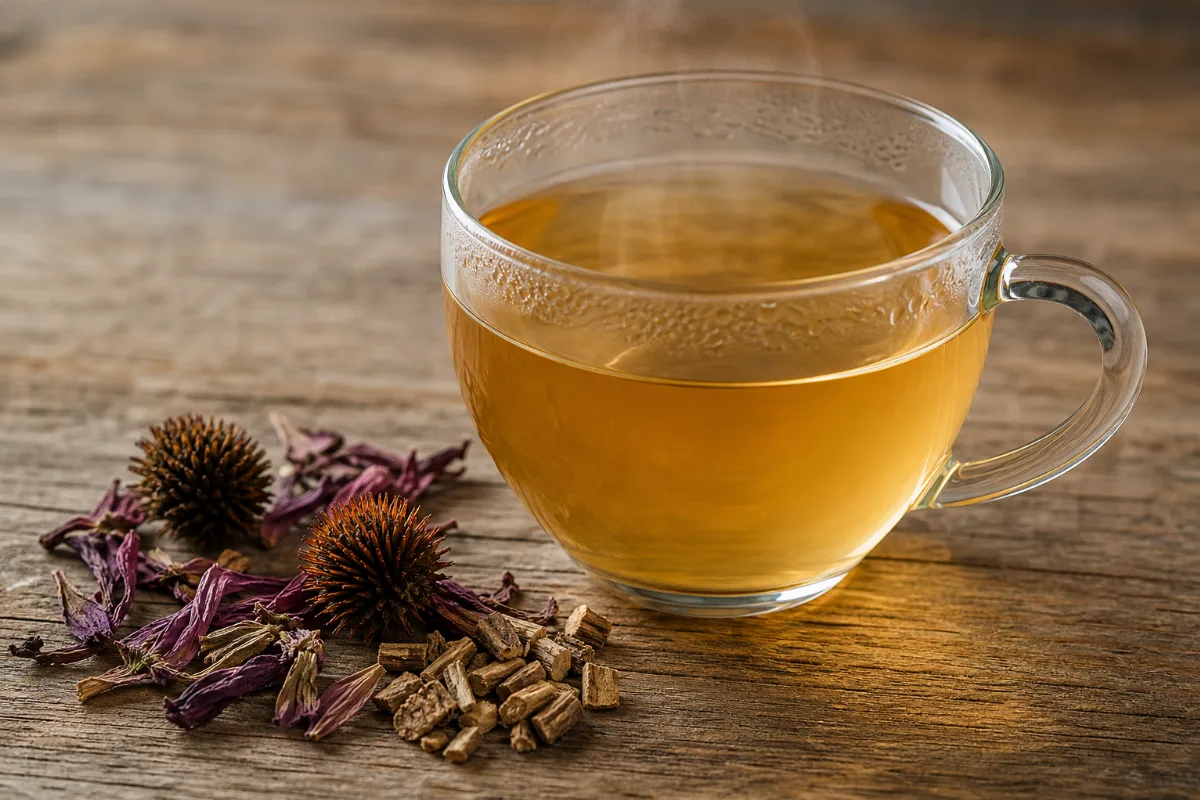
Herbal Teas & Extracts · Herbal tea
Echinacea Tea
Echinacea purpurea (L.) Moench and Echinacea angustifolia DC. · also called Purple coneflower tea, coneflower tea, echinacea herbal tea, equinacea (Spanish)
Echinacea tea is a herbal drink made from the leaf, flower or root of purple coneflower, a daisy-family plant. It is mostly taken for colds. The big Cochrane review found no clear proof that echinacea products help treat a cold, and those trials tested tablets and extracts, not tea. The main cautions are allergy to daisy-family plants, autoimmune disease or immune-suppressing medicine, children under 12 and pregnancy.
General information, not medical advice. Last substantive update · Not medically reviewed. A named clinician has not signed off on this page. How this page is made
About Echinacea Tea
Echinacea tea is a herbal tea from the root, leaf or flower of purple coneflower. It is mostly taken for colds. The best review finds no clear proof that echinacea products help treat a cold, and no tea trial of note exists. The cautions are daisy-family allergy, autoimmune disease and immune-suppressing medicine, children under 12, and pregnancy.
What it is
Echinacea tea is made from the dried root, leaf or flower of Echinacea purpurea (L.) Moench or Echinacea angustifolia DC. Both names are accepted in the GBIF plant database. They belong to the daisy family (Asteraceae), which also includes ragweed.
Echinacea is not the tea plant (Camellia sinensis), so no caffeine is expected. No source we read measured caffeine in echinacea tea, so this is an inference. Blends may contain true tea, so read the label.
What the research shows
The only tea trial we found tested a multi-herb echinacea tea in 95 people and relied on self-scored symptoms. The larger body of research tested tablets, capsules and extracts. The 2014 Cochrane review (24 trials, 4631 people) said these products have not been shown to help treat colds, though a weak benefit is possible, and that products differ appreciably in composition.
For prevention, pooled results suggest a small drop in colds that reviewers question as clinically meaningful. In children, the largest trial found no benefit and more rash. Several positive studies come from authors linked to a manufacturer.
Tea, tincture and extract
A cup of tea is a water infusion of the root, leaf or flower in the bag. Cold trials used tablets, capsules and alcohol extracts, and the EU monographs cover pressed juice and dry root extracts, not tea. In a lab study, water pulled out different compounds from different plant parts than alcohol did, so tea and tincture are not the same mix.
No study compared the safety of tea with extracts. Do not assume that a result from one form applies to another. Any amounts are a question for your doctor or pharmacist.
Where it comes from
NCCIH says Native Americans originally used the plant for respiratory infections, tooth pain and snakebite. Today it is mainly sold as a supplement for the common cold. We did not find a source that dates tea use, so we do not make claims about its history as a tea.
How it may act in the body
The EU herb monograph says the mechanism of action is not known, and no mechanism study of tea was read. Two small human studies show echinacea products can change how some medicines are processed, and a pilot in eye inflammation used it as an immune-modulating add-on, which is why regulators advise caution in immune conditions.
At a glance
Traditional uses history, not proof
- North America: NCCIH says Native Americans originally used the plant for respiratory infections, tooth pain and snakebite
- Today: sold mainly for the common cold and other respiratory infections, as a tea or supplement (NCCIH)
- EU: the regulator lists pressed juice of the fresh herb for short-term prevention and treatment of the common cold, and dry root extracts as a traditional medicine for cold symptoms; it does not list a tea
Studied for research
- Treating a cold (tea), very low (one old multi-herb tea trial)
- Treating a cold (tablets and extracts, not tea), low
- Preventing colds (extracts, not tea), low
- Repeat respiratory infections (extracts), low
- Colds in children, mixed, with more rash in the largest trial
- Influenza (a branded hot-drink product), very low
- Autoimmune eye inflammation (extract), very low
Main compounds
- Chicoric acid and caftaric acid, caffeic acid derivatives measured in the plant in a lab study
- Alkamides (alkylamides) are often named in echinacea research; none were measured in tea in the sources read
- No caffeine expected: echinacea is not the tea plant (an inference; no source measured it)
Common forms
- Herbal tea from dried root, leaf or flower (which part varies by brand)
- Blends with other herbs (the one tea trial used a blend)
- Pressed juice, dry extracts, tablets, capsules and tinctures (the trials and EU monographs cover these, not tea)
- Hot-drink or concentrate products (a different, branded product)
Research links: EU herbal monograph on Echinacea purpurea herb (2015) · EU draft herbal monograph on Echinacea purpurea root (2016) · NCCIH: Echinacea usefulness and safety · Cochrane review: Echinacea for preventing and treating the common cold (2014) · Echinacea compound herbal tea trial (2000) · Research Library · Genes & Biomarkers Library
What it is and its history
- Accepted scientific name
- Echinacea purpurea (L.) Moench and Echinacea angustifolia DC. (Asteraceae)
- Naming authority
- Both names are ACCEPTED in the GBIF backbone (checked by API on 2026-10-25): E. purpurea key 3150935, E. angustifolia key 3150933.
- Synonyms
- Not listed; GBIF synonym lists were not pulled.
- Common names
- Purple coneflower (English); Narrow-leaf purple coneflower (English); Equinacea (Spanish)
- Family or group
- Asteraceae (daisy family; same family as ragweed and sunflower)
- Classification
- Plantae > Tracheophyta > Asterales > Asteraceae > Echinacea > Echinacea purpurea; Echinacea angustifolia
- Native range
- NCCIH: native to areas east of the Rocky Mountains in the United States; widely cultivated.
- Habitat
- Not verified.
- What it looks like
- Roots: Not verified from a botanical source.; Stems: Not verified.; Leaves: Not verified.; Flowers: Not verified.; Fruit: Not verified.
- Cultivation
- NCCIH: widely cultivated today.
- Harvest and processing
- The EU herba monograph covers the fresh flowering herb; the radix monograph covers root. Tea products may use leaf, flower or root; which part is in a bag varies and is not always on the label.
- Look-alikes and adulterants
- Name: Echinacea pallida; Note: A third species used in products; E. purpurea, E. angustifolia and E. pallida are not interchangeable in studies.
- Sustainability and conservation
- Not verified.
Photographs
Traditional use and history history, not clinical proof
| Tradition or era | Documented use | Source |
|---|---|---|
| Native American use (as reported by NCCIH) | NCCIH says E. purpurea was originally discovered by Native Americans, who used the plant for respiratory tract infections, tooth pain and snakebite. | s-nccih-echinacea |
| Traditional tribal use (systematic review) | A 2005 safety review states the three main species were traditionally used by the Indian tribes for mouth sores, colds and snake-bites. | p15853441 |
| Modern use | NCCIH says products are mainly promoted as dietary supplements for the common cold and other respiratory infections, on the idea that certain species may stimulate the immune system. | s-nccih-echinacea |
Traditional use shows how it was used. It does not show that it works or is safe today.
What is inside, and how it may work
What it contains and how those compounds act in cells and animals. Laboratory and animal mechanisms are not proven effects in people.
Main compounds
| Compound | Family | Where it is concentrated | Activity studied | Level of evidence |
|---|---|---|---|---|
| Chicoric acid PubChem 5281764 | Caffeic acid derivative (phenolic) | Flowers and roots In one lab study, up to 1571.79 mg per 100 g dry weight in 40% ethanol extract of flowers (not tea) | A main phenolic compound named in the lab extraction study; no study here shows what it does in people drinking tea. 34 25 | Lab analysis |
| Caftaric acid PubChem 6440397 | Caffeic acid derivative (phenolic) | Leaves In one lab study, 2673.31 mg per 100 g dry weight in a water extract of leaves | Extracted best into water from leaves; a laboratory finding only. 34 25 | Lab analysis |
Mechanisms, receptors and pathways
| Target or pathway | Gene or receptor | What was found | Level |
|---|---|---|---|
| Not established for tea | Not specified | The EU herba monograph says the mechanism of action is not known. No mechanism study of tea was read. 7 | Not established |
Absorption, metabolism and elimination
- Absorption
- The EU herba monograph says no pharmacokinetic data are available for the pressed juice.
- Distribution
- Not found.
- Metabolism
- Two small human studies show echinacea products change how some medicines are processed (see the Safety tab).
- Elimination
- Not found.
- Bioavailability
- Not found for tea.
Isolated compounds versus whole extracts
A cup of echinacea tea is a water infusion of whatever leaf, flower or root is in the bag. Tinctures use alcohol, and capsules or tablets hold powder or dry extracts. In a lab study, water pulled out caftaric acid best from leaves, while 40% alcohol pulled out most chicoric acid from flowers and roots, so tea and tincture contain different mixes. The Cochrane reviewers also note that products labelled echinacea differ appreciably in composition. The cold trials used tablets and extracts, so their results should not be read as results for tea. Any amounts are a question for your doctor or pharmacist.
Nutritional composition
Echinacea tea is a drink, not a meaningful source of vitamins or minerals. No source read measured caffeine in it; echinacea is not the tea plant (Camellia sinensis), so none is expected, which is an inference. Blends may add true tea.
1 mixed findings3 low certainty3 very low certainty
What was looked at
The 7 benefits and uses checked for Echinacea Tea, each with how strong the evidence is. Tap one to open it.
- Treating a cold: echinacea herbal teaVery low certainty
- Treating a cold: echinacea tablets, capsules and extracts (not tea)Low certainty
- Preventing colds (extracts and tablets, not tea)Low certainty
- Repeat chest and throat infections (extracts)Low certainty
- Colds in childrenMixed findings
- Influenza: a branded echinacea hot drinkVery low certainty
- Autoimmune eye inflammation (uveitis), added to steroidsVery low certainty
Lab markers tracked in the studies
Length of a coldChance of catching a coldRepeat respiratory infectionsLength of a cold in childrenRecovery from fluDays off steroids
What is Echinacea Tea good for?
The main studied uses of echinacea tea and how strong the evidence is. 'Very low' means one small or old study. 'Low' means reviews or trials of a different product, such as tablets or extracts. Where a result comes from an extract or branded product, it is said so.
Benefits, one by one
Each card is a research question, not a promise. Tap a goal to filter. Open a card to see the studies, doses and limits.
Treating a cold: echinacea herbal tea
Very low certaintyOne older trial of a multi-herb echinacea tea found people felt better sooner than with placebo tea. It is the only tea trial we found, and it cannot show echinacea alone did it.
1 studiesA herbal tea blend; amounts are not given here. Ask a doctor or pharm…
Studies, doses and limits
What the trials found
In 95 people with early cold or flu symptoms, a compound echinacea tea ('Echinacea Plus', five to six cups a day at first) beat placebo tea on three self-scored questions (p < 0.001). No one in either group reported negative effects. The abstract gives no effect sizes, no species or plant part, and the tea was a blend of herbs.
Results
A single, old, multi-herb tea trial with self-scored results.
Effect sizes as reported
No effect sizes reported.
Why this rating
One small old trial, a herb blend rather than echinacea alone, self-scored symptoms, and no detail in the abstract. The Cochrane review of single-ingredient products did not include it.
Form and dose studied
A herbal tea blend; amounts are not given here. Ask a doctor or pharmacist about amounts.
Who was studied
Adults with early cold or flu symptoms.
Limits
Blend of herbs; symptoms scored by participants; old study; unclear what plant part or species was used.
Why researchers looked
Echinacea has a long reputation as a cold remedy, and tea is a common way to take it.
Traditional use
NCCIH says Native Americans used the plant for respiratory infections, tooth pain and snakebite. Today it is mostly sold for colds.
Proposed mechanism Not established
The reasons are not settled. Research papers name compounds such as alkamides and caffeic acid derivatives, but no study read here shows how a cup of tea would act on a cold.
A proposed mechanism does not show that the effect happens in people.
Do not use if you are allergic to daisy-family plants. See a doctor if a cold gets worse or lasts more than about a week.
Treating a cold: echinacea tablets, capsules and extracts (not tea)
Low certaintyThe best reviews find no clear proof that echinacea makes a cold shorter. A small benefit from some products is possible. These trials tested tablets and extracts, not tea.
4 studiesTablets, capsules and extracts of different species and plant parts; …
Studies, doses and limits
What the trials found
The 2014 Cochrane review (24 double-blind trials, 4631 people) of single-ingredient echinacea products said they have not been shown to help treat colds, though a weak benefit from some products is possible. Only 1 of 7 treatment trials that reported cold length found a significant effect. A 2019 meta-analysis found a mean difference of -0.45 days (95% interval 1.85 to 0.94), so no clear effect. In a 2010 trial of 719 people, colds lasted 6.34 days with echinacea and 6.87 days with placebo, a non-significant 0.53-day difference. In a 2002 trial of 148 students, colds lasted 6.27 days with echinacea and 5.75 days with placebo, also not significant.
Results
No clear proof of a shorter cold from tablets, capsules or extracts.
Effect sizes as reported
Cochrane: not shown to help treating colds. 2019 meta-analysis: -0.45 days (interval spans no effect). 2010 trial: -0.53 days (95% CI -1.25 to 0.19).
Why this rating
Reviews find no clear effect on cold length; products differ a lot between trials; trials were small and varied in quality (Cochrane: 10 low, 6 unclear and 8 high risk of bias). Certainty that there is no large effect is low to moderate; a small effect cannot be ruled out.
Form and dose studied
Tablets, capsules and extracts of different species and plant parts; amounts not given here. Ask a doctor or pharmacist about amounts.
Who was studied
Adults and teenagers with new colds.
Limits
Products and species differ; results for one product do not carry over to another or to tea.
Why researchers looked
Most echinacea cold trials test tablets, capsules and liquid extracts, which are more standardised than a cup of tea.
Traditional use
Used for colds and respiratory infections by North American peoples and later in European medicine (NCCIH).
Proposed mechanism Not established
The reasons are not settled. Research papers name compounds such as alkamides and caffeic acid derivatives, but no study read here shows how a cup of tea would act on a cold.
A proposed mechanism does not show that the effect happens in people.
Allergy to daisy-family plants is a reason not to use it. See a doctor if the cold worsens or high fever develops.
Preventing colds (extracts and tablets, not tea)
Low certaintySome analyses find fewer colds with echinacea, but the benefit is small and may not matter much in practice. No prevention trial of tea was found.
3 studiesExtracts and tablets; amounts not given here. Ask a doctor or pharmac…
Studies, doses and limits
What the trials found
In the Cochrane review none of 12 prevention comparisons was significant on its own; a post hoc pooling suggested a 10% to 20% lower relative risk of catching a cold, which the authors call of questionable clinical relevance. The 2019 meta-analysis found a risk ratio of 0.78 (95% CI 0.68 to 0.88) for upper respiratory infection and said the effect might not be clinically meaningful. A 4-month trial of 755 healthy adults with a branded alcohol extract found fewer colds than placebo and no more adverse reactions; that trial is probably industry-linked.
Results
Small possible reduction in colds from extracts.
Effect sizes as reported
Cochrane post hoc pooled RR about 0.8 to 0.9; 2019 meta-analysis RR 0.78 (95% CI 0.68 to 0.88).
Why this rating
Pooled results lean toward a small effect, but products differ widely, trials had bias concerns and the effect size is small. One of the larger positive trials is probably industry-linked.
Form and dose studied
Extracts and tablets; amounts not given here. Ask a doctor or pharmacist.
Who was studied
Healthy adults.
Limits
Many different products pooled; selective-reporting risk (authors); no trial of tea.
Why researchers looked
People often take echinacea hoping to avoid colds, especially in winter.
Traditional use
Used to prevent respiratory infections in modern herbal practice (NCCIH).
Proposed mechanism Not established
The reasons are not settled. Research papers name compounds such as alkamides and caffeic acid derivatives, but no study read here shows how a cup of tea would act on a cold.
A proposed mechanism does not show that the effect happens in people.
Allergy and children cautions apply (see the Safety tab).
Repeat chest and throat infections (extracts)
Low certaintyA review of six well-run trials found fewer repeat infections with echinacea extracts. Its authors have industry links, and it looked only at selected trials of extracts.
1 studiesExtracts and pressed juices; amounts not given here.
Studies, doses and limits
What the trials found
A 2015 meta-analysis of 6 randomised placebo-controlled trials (2458 people, chosen for high quality) found fewer recurrent respiratory infections with echinacea extracts (RR 0.649, 95% CI 0.545 to 0.774). The RR was 0.501 in people with higher susceptibility, and complications such as pneumonia and ear infection were also less frequent (RR 0.503). The authors say alcohol extracts did better than pressed juices.
Results
Fewer repeat infections in selected trials of extracts.
Effect sizes as reported
RR 0.649 (95% CI 0.545 to 0.774).
Why this rating
Selected trials only, fixed-effect model, possible industry links of authors, and a more optimistic conclusion than the Cochrane review. Not a tea.
Form and dose studied
Extracts and pressed juices; amounts not given here.
Who was studied
Generally healthy people, including those prone to infections.
Limits
Only trials judged high quality were chosen; products differ; possible industry links.
Why researchers looked
People who get infections again and again are a common group for echinacea.
Traditional use
Used for infections in traditional and modern herbal medicine.
Proposed mechanism Not established
The reasons are not settled. Research papers name compounds such as alkamides and caffeic acid derivatives, but no study read here shows how a cup of tea would act on a cold.
A proposed mechanism does not show that the effect happens in people.
Same cautions as other echinacea products (allergy, medicine interactions).
Colds in children
Mixed findingsThe largest trial in children found no benefit and more rashes. A 2025 review is more positive but it only gathered five varied trials.
2 studiesNot for children under 12 per EU guidance; ask a paediatrician.
Studies, doses and limits
What the trials found
In the 2003 JAMA trial of 407 children aged 2 to 11 (707 colds), colds lasted a median of 9 days with echinacea or placebo (p = 0.89), and rash occurred in 7.1% of colds treated with echinacea against 2.7% with placebo (p = 0.008). A 2025 systematic review of 5 trials reports shorter symptom duration and less antibiotic use with some products, with concerns about bias, and says some studies showed no difference from placebo. NCCIH says there is not enough evidence to support a clear link and advises talking to a child's health provider first.
Results
Mixed, with a clear signal of more rash in the biggest trial.
Effect sizes as reported
JAMA 2003: no difference in duration (p = 0.89); rash 7.1% vs 2.7%.
Why this rating
One large well-run trial found nothing and more rash; a small, recent review of varied products is more positive; certainty is poor either way. Children under 12 are not recommended to use it by the EU regulator.
Form and dose studied
Not for children under 12 per EU guidance; ask a paediatrician.
Who was studied
Children aged 2 to 11.
Limits
Products and dosing differ between trials; no trial of tea in children found.
Why researchers looked
Parents often ask whether echinacea can help children's colds.
Traditional use
Not a traditional children's remedy in the sources read.
Proposed mechanism Not established
The reasons are not settled. Research papers name compounds such as alkamides and caffeic acid derivatives, but no study read here shows how a cup of tea would act on a cold.
A proposed mechanism does not show that the effect happens in people.
More rash in the JAMA trial; EU monographs do not recommend use under 12.
Influenza: a branded echinacea hot drink
Very low certaintyOne trial found a branded echinacea hot-drink product as good as oseltamivir for early flu. It was probably industry-linked and had no placebo group.
1 studiesA branded hot-drink product; amounts not given here.
Studies, doses and limits
What the trials found
In 473 adults with early flu symptoms in the Czech Republic, recovery was comparable between the hot-drink product and oseltamivir: 50.2% versus 48.8% after 5 days and 90.1% versus 84.8% after 10 days. The authors say it was non-inferior. Complications were 2.46% versus 6.45% (P = 0.076, not significant).
Results
Comparable recovery to oseltamivir in one branded-product trial.
Effect sizes as reported
Recovery after 5 days 50.2% vs 48.8%; after 10 days 90.1% vs 84.8%.
Why this rating
One trial, no placebo-only group, branded formulation (not a plain tea), likely industry-linked, and most people with flu recover anyway.
Form and dose studied
A branded hot-drink product; amounts not given here.
Who was studied
Adults with early flu symptoms.
Limits
Cannot show the product beats no treatment; tested a branded product, so it does not apply to a tea you make yourself.
Why researchers looked
Echinacea has been used for colds and flu, and a company tested a hot-drink product against a flu medicine.
Traditional use
Used for colds and flu in traditional use (the trial abstract says so).
Proposed mechanism Laboratory research
Not established. The abstract notes antiviral activity of echinacea against influenza viruses in test-tube studies only.
A proposed mechanism does not show that the effect happens in people.
See a doctor for flu, especially if you are at high risk; do not replace prescribed treatment.
Autoimmune eye inflammation (uveitis), added to steroids
Very low certaintyA small pilot study found longer steroid-free time when an echinacea extract was added. This is the opposite of the EU advice to avoid echinacea in autoimmune disease, so it needs a doctor.
1 studiesAn extract; amounts not given here.
Studies, doses and limits
What the trials found
In a pilot of 51 people with low-grade steroid-dependent autoimmune uveitis, patients given an echinacea extract twice a day plus steroid treatment had uveitis settled in 19 of 21 (anterior) and 9 of 11 (intermediate), with steroid-off times of 209 and 146 days. The group on steroids alone had steroid-off times of 121 and 87 days. No adverse reactions were attributed to echinacea.
Results
Longer steroid-free time with echinacea added in a pilot.
Effect sizes as reported
Steroid-off time 209 vs 121 days (anterior) and 146 vs 87 days (intermediate).
Why this rating
Pilot of 51 people, no randomisation or blinding described in the abstract, an extract rather than tea.
Form and dose studied
An extract; amounts not given here.
Who was studied
People with low-grade autoimmune uveitis.
Limits
Small pilot; EU regulators advise against echinacea in autoimmune disease; no replication found.
Why researchers looked
Researchers tested whether echinacea could calm low-grade eye inflammation.
Traditional use
Not a traditional use in the sources read.
Proposed mechanism Not established
Not established.
A proposed mechanism does not show that the effect happens in people.
Do not use echinacea for an autoimmune condition without your doctor's advice.
Connections to the rest of health
How Echinacea Tea connects to the rest of our health knowledge graph. Every link says what kind of connection it is. A safety link (for example to the liver) is a warning, not a benefit. A study that merely mentions a topic never creates a benefit link.
Explore every connection: goals, body systems, organs, symptoms, genes
A. Wellness goals
| Connected to | Kind of connection | Evidence status | Context | Studies |
|---|---|---|---|---|
| Immune Support | Very low certainty | Treating a cold: echinacea herbal tea: One older trial of a multi-herb echinacea tea found people felt better sooner than with placebo tea. It is the only tea trial we found, and it cannot show echinacea alone did it. Treating a cold: echinacea tablets, capsules and extracts (not tea): The best reviews find no clear proof that echinacea makes a cold shorter. A small benefit from some products is possible. These trials tested tablets and extracts, not tea. | 20 17 6 4 3 16 33 36 21 31 | |
| Inflammation Balance | Very low certainty | Autoimmune eye inflammation (uveitis), added to steroids: A small pilot study found longer steroid-free time when an echinacea extract was added. This is the opposite of the EU advice to avoid echinacea in autoimmune disease, so it needs a doctor. | 26 |
B. Body systems
| Connected to | Kind of connection | Evidence status | Context | Studies |
|---|---|---|---|---|
| Immune system | Low certainty | Cochrane: not shown to help treat colds; possible small prevention effect. Preparation or compound: Echinacea tablets and extracts (not tea) |
17 6 | |
| Immune System | Biological association | Very low certainty | Studied for: Treating a cold: echinacea herbal tea Studied for: Treating a cold: echinacea tablets, capsules and extracts (not tea) | 20 17 6 4 3 16 33 36 21 31 26 |
E. Health conditions
| Connected to | Kind of connection | Evidence status | Context | Studies |
|---|---|---|---|---|
| Asteraceae (daisy family) allergy | Contraindication | Moderate certainty | Official contraindication; case reports of anaphylaxis. Preparation or compound: Echinacea herb and extracts |
7 8 22 |
| Autoimmune disease and immunosuppression | Low certainty | EU monographs advise against use; evidence disputed. EU monographs advise against use. Preparation or compound: Echinacea herb and extracts |
7 8 2 | |
| Pregnancy and breastfeeding | Low certainty | Not recommended unless a doctor advises; one large cohort showed no malformation increase. Preparation or compound: Echinacea herb and extracts |
7 14 |
I. Biomarkers
| Connected to | Kind of connection | Evidence status | Context | Studies |
|---|---|---|---|---|
| Length of a cold | Biological association | Low certainty | Measured in trials: lowered (not significant). A lab change is not the same as a health benefit. | 4 6 |
| Chance of catching a cold | Biological association | Low certainty | Measured in trials: lowered (small). A lab change is not the same as a health benefit. | 6 17 |
| Repeat respiratory infections | Biological association | Low certainty | Measured in trials: lowered. A lab change is not the same as a health benefit. | 33 |
| Length of a cold in children | Biological association | Low certainty | Measured in trials: no change. A lab change is not the same as a health benefit. | 36 |
| Recovery from flu | Biological association | Very low certainty | Measured in trials: comparable to oseltamivir. A lab change is not the same as a health benefit. | 31 |
| Days off steroids | Biological association | Very low certainty | Measured in trials: longer. A lab change is not the same as a health benefit. | 26 |
L. Active compounds
| Connected to | Kind of connection | Evidence status | Context | Studies |
|---|---|---|---|---|
| Chicoric acid | Biological association | Lab analysis | A main phenolic compound named in the lab extraction study; no study here shows what it does in people drinking tea. Preparation or compound: Flowers and roots |
34 25 |
| Caftaric acid | Biological association | Lab analysis | Extracted best into water from leaves; a laboratory finding only. Preparation or compound: Leaves |
34 25 |
Each connection is stored with the ingredient, the connected record, the kind of connection, the evidence status, the supporting studies, the preparation or compound involved, and a review date (last reviewed October 25, 2026).
Evidence at a glance: what changed in 1 lab markers
Tap a number to show only those markers. Counts are markers, not people.
The evidence
The research centre for Echinacea Tea. Every record here was checked against PubMed or the publisher's page; we never list a study we have not verified.
Evidence by outcome
Bars show how many studies we found for each outcome, not how well it works. People are added up across trials only (reviews are not added, to avoid double counting).
How we rate evidence
High certainty
Several well-run trials or reviews agree; further research is unlikely to change the picture much.
Moderate certainty
Good trials point the same way, but some doubt remains.
Low certainty
Small, short or inconsistent trials. The finding could change with better research.
Very low certainty
Very little or very weak human data. Treat as a possibility only.
Mixed findings
Trials or reviews disagree with each other.
Not enough evidence
Not enough human research to say either way.
Evidence against
Good research found no benefit, or found harm.
We take the reviewers' own risk-of-bias and GRADE statements where they exist, and otherwise judge from study size, design, consistency, directness and whether a product matches what is sold. Many publications do not make evidence high. Method note: We read the EU herbal monographs and the NCCIH page in full, checked plant names through GBIF and compound identities through PubChem, searched PubMed, and read every cited abstract directly. Two case reports (a blood disorder and a hepatitis letter) have no abstract and were read as titles only. LiverTox and LactMed could not be read. The no-caffeine statement is an inference and is labelled so.
Study library: every study we checked 36
| Study | Design | People | Product, dose, length | Result |
|---|---|---|---|---|
| Abdul 2010 Pharmacokinetic and pharmacodynamic interactions of echinacea and policosanol with warfarin in healthy subjects. Br J Clin Pharmacol · PMID 20573086 · DOI |
Controlled trial |
12 12 healthy men |
Echinacea herbal medicine for 2 weeks before a single warfarin dose Recommended product dose (not reproduced) 2 weeks · vs Warfarin alone |
S-warfarin clearance was higher with echinacea, but INR did not change in a clinically significant way and platelet aggregation was not affected. Warfarin levels fell but clotting was unchanged in healthy men Methods, limits and fundingOutcomes: INR, platelet activity, warfarin blood levels Limitations: 12 healthy men, single warfarin dose; not tested in people who take warfarin long term. Funding and conflicts: Not stated in the abstract. Read: abstract |
| Ardjomand-Woelkart 2016 Review and Assessment of Medicinal Safety Data of Orally Used Echinacea Preparations. Planta Med · PMID 26441065 · DOI |
Narrative review |
Published data on interactions, contraindications, adverse events, pregnancy and long-term use | Orally used echinacea preparations varied varied varied |
Authors say safety data are as product-specific as efficacy data. Adverse events in trials of single-ingredient products were mostly mild. They call the contraindications for autoimmune disease and immune suppression 'questionable', because alkamide-rich preparations suppress cellular immune responses and beneficial effects in autoimmunity were reported. They found no link with malformations in a literature review. Authors judge it well tolerated Methods, limits and fundingOutcomes: Safety profile Limitations: A narrative review by pharmacognosists. Its view on autoimmune disease disagrees with the EU regulator, which still advises against use in those conditions; this page follows the regulator's caution. Funding and conflicts: Not stated in the abstract; one author is also an author of included echinacea trials. Read: abstract |
| Barrett 2002 Treatment of the common cold with unrefined echinacea. A randomized, double-blind, placebo-controlled trial. Ann Intern Med · PMID 12484708 · DOI |
Controlled trial |
148 University students with a recent-onset cold |
Capsules of unrefined E. purpurea herb and root plus E. angustifolia root herb and root Study schedule (not reproduced) Up to 10 days · vs Placebo |
No statistically significant difference on any outcome. Mean cold duration was 5.75 days with placebo and 6.27 days with echinacea (difference -0.52 day, 95% CI -1.09 to 0.22). The authors found no detectable benefit or harm. No benefit or harm detected (-1.09 to 0.22 days) Methods, limits and fundingOutcomes: Cold severity and duration Limitations: Small study in students; one mixture of capsules, not tea. Funding and conflicts: Not stated in the abstract. Read: abstract |
| Barrett 2010 Echinacea for treating the common cold: a randomized trial. Ann Intern Med · PMID 21173411 · DOI |
Controlled trial |
719 People aged 12 to 80 with a new common cold |
Echinacea pills (dose equal to dried echinacea root; species not stated in the abstract) versus placebo pills, no pills, and open-label echinacea root (as stated: dried echinacea root equivalent) High dose in the first 24 hours (not reproduced) 5 days · vs Placebo tablets; no pills |
Mean illness duration was 6.34 days (blinded echinacea) versus 6.87 days (blinded placebo), a non-significant 0.53-day difference (95% CI -1.25 to 0.19, P = 0.075). Severity also did not differ significantly. The authors say the results do not support the ability of this dose of this formulation to substantively change the course of a cold. Trend toward a shorter cold but not statistically significant (-1.25 to 0.19 days) Methods, limits and fundingOutcomes: Illness severity (self-report) and duration Limitations: Higher-than-expected variability limited power to detect small benefits (authors). Funding and conflicts: US National Center for Complementary and Alternative Medicine, NIH (public funding). Registration: NCT00065715 Read: abstract |
| Bossaer 2012 Probable etoposide interaction with Echinacea. J Diet Suppl · PMID 22607644 · DOI |
Case report |
1 A 61-year-old man with lung cancer on cisplatin and etoposide |
Echinacea supplement taken with chemotherapy |
Platelet count fell to a nadir of 16,000 per microlitre in the first cycle while taking echinacea; after stopping it the nadir was 44,000. The authors judge echinacea likely contributed and advise avoiding it with etoposide. One case, probable interaction Methods, limits and fundingOutcomes: Low platelet count Limitations: Single case; cause not proven. Funding and conflicts: Not stated. Read: abstract |
| David 2019 Echinacea for the prevention and treatment of upper respiratory tract infections: A systematic review and meta-analysis. Complement Ther Med · PMID 31126553 · DOI |
Meta-analysis |
Otherwise healthy people of any age in randomised double-blind placebo-controlled trials | Any echinacea-containing preparation versus placebo varied varied varied · vs Placebo |
Prevention: risk ratio 0.78 (95% CI 0.68 to 0.88). Treatment: mean difference in duration -0.45 days (95% interval 1.85 to 0.94, so no clear effect). Safety: risk ratio 1.09 (95% CI 0.95 to 1.25). The authors say any preventive effect may not be clinically meaningful and found no evidence of an effect on duration. Possible small drop in infections; no clear effect on how long a cold lasts; no clear extra side effects in the short term (Prevention RR 0.78, 95% CI 0.68 to 0.88) Methods, limits and fundingOutcomes: Prevention of upper respiratory infection; duration of infection; safety Limitations: Many different preparations pooled; risk of selective reporting and deviations from the review protocol, as the authors state. Funding and conflicts: Not stated in the abstract. Read: abstract |
| European Medicines Agency 2015 European Union herbal monograph on Echinacea purpurea (L.) Moench, herba recens (EMA/HMPC/48704/2014 Corr 1) EMA herbal monograph (final, 24 November 2015) · Source |
Authoritative guidance |
not applicable | Echinacea (see title) varied |
Read in full on 2026-10-25 (7-page PDF). Covers the expressed juice and dried expressed juice of fresh purple coneflower herb: well-established use for short-term prevention and treatment of the common cold; traditional use for small superficial wounds. It does not list a herbal tea. Contraindicated in hypersensitivity to the herb or other Asteraceae (Compositae) plants. Use is not recommended in progressive systemic disorders, autoimmune diseases, immunodeficiencies, immunosuppression and white-blood-cell diseases; atopic patients should consult a doctor; not recommended under 12; pregnancy and lactation not recommended unless advised by a doctor, with several hundred exposed pregnancies showing no adverse effects. Undesirable effects include rash, hives, itching, facial swelling and, with unknown frequency, severe reactions including Stevens-Johnson syndrome, angioedema, bronchospasm, asthma and anaphylactic shock. Interactions: none reported. Overdose: none reported. Reference summary Methods, limits and fundingOutcomes: Regulatory or reference summary Limitations: A regulator summary about the juice, not about tea. 'None reported' means none reported, not none exist. Funding and conflicts: not applicable Read: full-text |
| European Medicines Agency 2016 Draft European Union herbal monograph on Echinacea purpurea (L.) Moench, radix (EMA/HMPC/424583/2016) EMA herbal monograph (draft, 22 November 2016) · Source |
Authoritative guidance |
not applicable | Echinacea (see title) varied |
Read in full on 2026-10-25 (7-page PDF). Covers dry extracts of the root (not tea): traditional use for relief of common cold symptoms and for spots and pimples due to mild acne. Contraindicated in hypersensitivity to Asteraceae plants. Use is not recommended in autoimmune diseases, immunodeficiencies and immunosuppression; possible anaphylactic reactions in atopic people; use under 12 not established; pregnancy and lactation not recommended; skin hypersensitivity of unknown frequency; interactions none reported. Reference summary Methods, limits and fundingOutcomes: Regulatory or reference summary Limitations: This is a draft; whether a final version replaced it was not checked. It covers extracts, not tea. Funding and conflicts: not applicable Read: full-text |
| GBIF Secretariat 2026 GBIF backbone match: Echinacea purpurea (L.) Moench and Echinacea angustifolia DC. GBIF species API · Source |
Taxonomy database plant |
not applicable | Echinacea purpurea; Echinacea angustifolia whole plant |
Checked by API on 2026-10-25: Echinacea purpurea (L.) Moench, key 3150935, ACCEPTED; Echinacea angustifolia DC., key 3150933, ACCEPTED; family Asteraceae, order Asterales. Accepted names confirmed Methods, limits and fundingOutcomes: Accepted names and family Limitations: Taxonomy only. Funding and conflicts: not applicable Read: api |
| Gilroy 2003 Echinacea and truth in labeling. Arch Intern Med · PMID 12639203 · DOI |
Case series product |
59 59 single-herb echinacea products bought in Denver stores in August 2000 |
Retail echinacea preparations varied |
6 of 59 (10%) contained no measurable echinacea. Species matched the label in 31 (52%). Of 21 standardised products, 9 (43%) met the standard on the label. Content often did not match label Methods, limits and fundingOutcomes: Does the content match the label Limitations: Old data from one US city; products have changed since. Funding and conflicts: Not stated in the abstract. Read: abstract |
| Goey 2013 The effect of Echinacea purpurea on the pharmacokinetics of docetaxel. Br J Clin Pharmacol · PMID 23701184 · DOI |
Clinical trial |
10 10 evaluable cancer patients |
Commercial E. purpurea extract (oral drops) with docetaxel chemotherapy Per product label (not reproduced) 14 days · vs Same patients before echinacea |
Docetaxel exposure did not change significantly (mean AUC 3278 before and 3480 after). The authors concluded the product could be combined with docetaxel in this study. No significant change for docetaxel Methods, limits and fundingOutcomes: Docetaxel blood levels Limitations: Only 10 patients; one product; one chemotherapy drug. Funding and conflicts: Not stated in the abstract. Read: abstract |
| Gorski 2004 The effect of echinacea (Echinacea purpurea root) on cytochrome P450 activity in vivo. Clin Pharmacol Ther · PMID 14749695 · DOI |
Clinical trial |
12 12 healthy volunteers |
E. purpurea root preparation (not tea) for 8 days root Study schedule (not reproduced) 8 days · vs Same people before echinacea |
Echinacea increased systemic clearance of midazolam by 34% and reduced the oral clearance of caffeine (from 6.6 to 4.9 L/h, P = 0.049). It did not clearly change the clearance of tolbutamide or dextromethorphan. The authors advise caution with drugs that depend on CYP3A or CYP1A2. Mixed effects on drug-processing enzymes Methods, limits and fundingOutcomes: Clearance of test drugs (caffeine, midazolam, tolbutamide, dextromethorphan) Limitations: 12 people, open-label, no control group; it measures blood levels, not harm. Funding and conflicts: Not stated in the abstract. Read: abstract |
| Gurley 2004 In vivo assessment of botanical supplementation on human cytochrome P450 phenotypes: Citrus aurantium, Echinacea purpurea, milk thistle, and saw palmetto. Clin Pharmacol Ther · PMID 15536458 · DOI |
Controlled trial |
12 12 healthy volunteers |
E. purpurea extract (among four botanical supplements) for 28 days Study schedule (not reproduced) 28 days · vs Same people before supplementation |
No significant effect on the four enzymes was found. The authors say the effects of E. purpurea were minor but that further study of its interaction potential is merited. No significant effect in this study Methods, limits and fundingOutcomes: CYP1A2, CYP2D6, CYP2E1, CYP3A4 activity Limitations: Short study in 12 healthy people; it conflicts with the other enzyme studies, which found changes. Funding and conflicts: Not stated in the abstract. Read: abstract |
| Heitmann 2016 Pregnancy outcomes after prenatal exposure to echinacea: the Norwegian Mother and Child Cohort Study. Eur J Clin Pharmacol · PMID 26895223 · DOI |
Cohort study |
68522 68,522 Norwegian women; 363 (0.5%) reported echinacea use in pregnancy |
Echinacea use reported by questionnaire (form not specified) Self-reported During pregnancy · vs Women who did not use echinacea |
Use of echinacea was not associated with an increased risk of malformations or adverse pregnancy outcomes. No increased risk found Methods, limits and fundingOutcomes: Malformations and adverse pregnancy outcomes Limitations: Only 363 women used it; self-reported; the product, dose and timing varied. It does not prove safety. Funding and conflicts: Research support from NIH and non-US government sources per the PubMed record. Read: abstract |
| Huntley 2005 The safety of herbal medicinal products derived from Echinacea species: a systematic review. Drug Saf · PMID 15853441 · DOI |
Systematic review |
Clinical studies, spontaneous reports and manufacturer data on echinacea | Echinacea (E. angustifolia, E. pallida, E. purpurea) herbal products; combination and homeopathic products excluded varied varied varied |
Adverse events are not commonly reported. Stomach upsets and rashes were most frequent. In rare cases allergic reactions may be severe. Short-term use has a relatively good safety profile. The authors say people with allergy or asthma should carefully consider use, and that use in pregnancy and lactation seems ill-advised given the lack of data. Mostly mild, but rare severe allergy Methods, limits and fundingOutcomes: Adverse events Limitations: Safety was not the focus of most studies; reports are voluntary. Funding and conflicts: Not stated in the abstract. Read: abstract |
| Jawad 2012 Safety and Efficacy Profile of Echinacea purpurea to Prevent Common Cold Episodes: A Randomized, Double-Blind, Placebo-Controlled Trial. Evid Based Complement Alternat Med · PMID 23024696 · DOI |
Controlled trial |
755 Healthy adults over 4 months |
Alcohol extract of freshly harvested E. purpurea (95% herb, 5% root), a branded product herb and root Manufacturer schedule (not reproduced) 4 months · vs Placebo |
Echinacea reduced the total number of cold episodes, cold days and pain-killer treated episodes, and virally confirmed colds. Adverse drug reactions were reported by 9% and 10% of people (echinacea and placebo), so safety was not worse than placebo. Fewer colds over 4 months with this extract Methods, limits and fundingOutcomes: Number of colds, cold days, virally confirmed colds, adverse events Limitations: A branded alcohol extract, not tea. Probably industry-linked (see funding note). Funding and conflicts: Funding not stated in the abstract. Author Schoop R is listed with the product's maker (A. Vogel Bioforce AG) in the related 2015 trial, so treat as probably industry-linked (not confirmed). Read: abstract |
| Karsch-Volk 2014 Echinacea for preventing and treating the common cold. Cochrane Database Syst Rev · PMID 24554461 · DOI |
Systematic review |
4631 People in 24 double-blind trials, prevention and treatment of the common cold |
Many different echinacea single-ingredient preparations (different species and plant parts), compared with placebo varied; 7 trials used aerial parts of E. purpurea varied (not reproduced) varied · vs Placebo |
24 double-blind trials, 33 comparisons. None of 12 prevention comparisons was statistically significant by itself; a post hoc pooling suggested a 10% to 20% lower relative risk. Of 7 treatment trials reporting cold duration, only 1 showed a significant effect. Drop-outs and side effects did not differ significantly from placebo, with a trend to more drop-outs from side effects in prevention trials. Authors' conclusion: echinacea products have not here been shown to benefit treating colds, though a weak benefit from some products is possible. No clear proven benefit for treating colds; possible small prevention effect of questionable clinical relevance Methods, limits and fundingOutcomes: Number with at least one cold (prevention); cold duration (treatment); drop-outs from side effects Limitations: Products differed too much to pool for the main analysis; 10 trials low risk of bias, 6 unclear, 8 high; mono-preparations only, so tea blends were not included; some review authors were involved in several of the included trials (they state they did not assess their own). Funding and conflicts: Cochrane review; authors list involvement in several included trials. Funding not shown in the abstract. Read: abstract |
| Kocaman 2008 Echinacea-induced severe acute hepatitis with features of cholestatic autoimmune hepatitis. Eur J Intern Med · PMID 18249315 · DOI |
Case report |
1 One patient (letter) |
Echinacea |
Title only was read: the letter's title reports severe acute hepatitis with features of cholestatic autoimmune hepatitis attributed to echinacea. PubMed shows no abstract. One reported case; details not read Methods, limits and fundingOutcomes: Liver injury Limitations: No abstract available; only the title was read. Funding and conflicts: Not stated. Read: title-only |
| Liatsos 2006 Severe thrombotic thrombocytopenic purpura (TTP) induced or exacerbated by the immunostimulatory herb Echinacea. Am J Hematol · PMID 16493617 · DOI |
Case report |
1 One patient (letter) |
Echinacea |
Title only was read: the letter's title reports severe thrombotic thrombocytopenic purpura (a blood-clotting disorder) induced or exacerbated by echinacea. PubMed shows no abstract. One reported case; details not read Methods, limits and fundingOutcomes: Blood disorder Limitations: No abstract available; only the title and journal record were read, so no details are given. Funding and conflicts: Not stated. Read: title-only |
| Lindenmuth 2000 The efficacy of echinacea compound herbal tea preparation on the severity and duration of upper respiratory and flu symptoms: a randomized, double-blind placebo-controlled study. J Altern Complement Med · PMID 10976979 · DOI |
Controlled trial |
95 People with early cold or flu symptoms (runny nose, scratchy throat, fever) |
Echinacea compound herbal tea ('Echinacea Plus'), a multi-herb tea, not echinacea alone Amount not reproduced here Tea taken for about 5 days; questionnaire at 14 days · vs Placebo tea |
The tea group scored better than placebo on all 3 questions (p < 0.001). No negative effects were reported by anyone in either group. Symptoms relieved sooner with the compound tea than with placebo tea, by self-score Methods, limits and fundingOutcomes: Self-scored symptom relief, days symptoms lasted, days to change Limitations: A blend of herbs, so echinacea cannot be singled out; symptoms scored by the participants on a questionnaire; the abstract gives no effect sizes, species or plant part, and the study is old. Funding and conflicts: Not stated in the abstract. Read: abstract |
| Mazi 2025 Role of Echinacea in the management and prevention of acute respiratory tract infections in children: A systematic review of the evidence. J Family Community Med · PMID 41234257 · DOI |
Systematic review |
Children in 5 randomised trials of echinacea for cough and respiratory infections | Echinacea preparations (mainly E. purpurea tablets and hydroethanolic extracts) varied varied varied · vs Placebo or usual care |
The review reports high GRADE certainty for shorter symptom duration and less antibiotic use, and moderate certainty for prevention. It says some studies showed no difference from placebo, that results varied by product, and that the trials had concerns about bias in randomisation, allocation concealment, blinding and reporting. Mixed: some pediatric trials positive, some not Methods, limits and fundingOutcomes: Symptom duration, antibiotic use, infection prevention Limitations: Only 5 trials; the review itself notes concerns about bias, and its positive ratings differ from the 2003 JAMA trial. Formulations differed. Funding and conflicts: No conflicts of interest declared. Read: abstract |
| Mullins 2002 Adverse reactions associated with echinacea: the Australian experience. Ann Allergy Asthma Immunol · PMID 11814277 · DOI |
Case series |
5 5 patients seen privately plus 51 Australian adverse-drug reports |
Echinacea products |
Of the 5 patients, 2 had anaphylaxis, 1 an asthma attack 10 minutes after the first ever dose, 1 recurrent mild asthma and 1 a rash. Of 51 reports, 26 suggested allergic reactions (4 anaphylaxis, 12 acute asthma, 10 hives or swelling); more than half were known to be atopic and 4 reacted after their first known exposure. 20% of 100 atopic people who had never taken echinacea had a positive skin-prick test. Allergy risk concentrated in atopic people Methods, limits and fundingOutcomes: Characteristics of adverse reactions Limitations: Voluntary reports cannot give how often it happens; cross-reactivity is a hypothesis. Funding and conflicts: Not stated in the abstract. Read: abstract |
| Mullins RJ. 1998 Echinacea-associated anaphylaxis. Med J Aust · PMID 9507713 · DOI |
Case report |
1 A woman with atopy |
Commercial echinacea extract (plus other supplements) |
Anaphylaxis, confirmed by skin-prick and RAST tests. Among surveyed people with atopy, 19% had a positive echinacea skin test and up to 5% took echinacea regularly. The author raises the possibility of severe reactions even at first use because of cross-reactivity with similar allergens. One confirmed anaphylaxis case plus testing data Methods, limits and fundingOutcomes: Anaphylaxis Limitations: One person plus a small survey; she also took other supplements. Funding and conflicts: Not stated. Read: abstract |
| National Center for Complementary and Integrative Health (NIH) 2026 Echinacea: Usefulness and Safety (NCCIH Herbs at a Glance) NCCIH web page · Source |
Authoritative guidance |
not applicable | Echinacea (see title) varied |
Read in full on 2026-10-25. Says taking echinacea may slightly reduce the chance of catching a cold and that it is unclear whether it shortens a cold. Likely safe for most adults for short periods; some people have allergic reactions that may be severe; the most common side effects are digestive. Possibly safe for children short term, but some children in a trial developed rashes. Conflicting evidence about interactions with drugs processed by the liver, and theoretical reasons to suspect interactions with immunosuppressants or caffeine. Possibly safe up to 7 days in the first trimester; little is known about breastfeeding. Describes echinacea as a dietary supplement not approved by the FDA before sale. Native Americans originally used it for respiratory infections, tooth pain and snakebite. Reference summary Methods, limits and fundingOutcomes: Regulatory or reference summary Limitations: Page date not shown. The page speaks of echinacea products generally, not tea specifically. Funding and conflicts: not applicable Read: full-text |
| National Library of Medicine 2026 PubChem compound records: chicoric acid (CID 5281764) and caftaric acid (CID 6440397) PubChem PUG REST · Source |
Reference database compound |
not applicable | Chicoric acid; caftaric acid |
Checked by name lookup on 2026-10-25: chicoric acid CID 5281764, C22H18O12; caftaric acid CID 6440397, C13H12O9. Identity confirmed Methods, limits and fundingOutcomes: Compound identity Limitations: Identity only. Funding and conflicts: not applicable Read: api |
| Neri 2006 Oral Echinacea purpurea extract in low-grade, steroid-dependent, autoimmune idiopathic uveitis: a pilot study. J Ocul Pharmacol Ther · PMID 17238809 · DOI |
Clinical trial |
51 People with low-grade, steroid-dependent autoimmune uveitis (eye inflammation) |
Oral E. purpurea extract added to steroid treatment Twice a day (amount not reproduced) 9 months of follow-up · vs Steroid treatment alone (20 patients) |
Among those given echinacea, 19 of 21 with anterior uveitis and 9 of 11 with intermediate uveitis had settled disease, with a steroid-off time of 209 and 146 days. Those not given echinacea had steroid-off times of 121 and 87 days. No adverse reactions were attributed to echinacea. Longer steroid-free time with echinacea added Methods, limits and fundingOutcomes: Whether uveitis settled; time off steroids; visual acuity Limitations: Pilot study of 51 people; the abstract does not describe randomisation or blinding; an extract, not tea. Funding and conflicts: Not stated in the abstract. Read: abstract |
| Penzak 2010 Echinacea purpurea significantly induces cytochrome P450 3A activity but does not alter lopinavir-ritonavir exposure in healthy subjects. Pharmacotherapy · PMID 20653355 · DOI |
Clinical trial |
13 13 healthy volunteers |
E. purpurea preparation (not tea) with and without lopinavir-ritonavir Study schedule (not reproduced) 28 days · vs Same people before echinacea |
Echinacea induced CYP3A activity (midazolam exposure fell to 0.73 of baseline, 90% CI 0.61 to 0.85). It did not change lopinavir or ritonavir levels. The authors say it may cause modest decreases in blood levels of other CYP3A drugs. Modest lowering of some drug levels Methods, limits and fundingOutcomes: Blood levels of lopinavir, ritonavir and test drugs Limitations: 13 healthy volunteers, single sequence, supplement product. Funding and conflicts: Not stated in the abstract; US NIH-based authors. Read: abstract |
| Perri 2006 Safety and efficacy of echinacea (Echinacea angustafolia, e. purpurea and e. pallida) during pregnancy and lactation. Can J Clin Pharmacol · PMID 17085774 |
Systematic review |
Literature on echinacea in pregnancy and lactation | Oral echinacea varied varied varied |
Good evidence from a prospective cohort that oral use in the first trimester does not raise the risk of major malformations; low-level expert-opinion evidence that it is safe in pregnancy and lactation. The authors advise caution during lactation until better studies exist. Reassuring in pregnancy, unsure in lactation Methods, limits and fundingOutcomes: Safety in pregnancy and lactation Limitations: Based on a small amount of evidence. Funding and conflicts: Not stated. Read: abstract |
| Pilarska 2022 The Presence of Molds and Their Secondary Metabolites in Purple Coneflower-Based Dietary Supplements (Echinacea purpurea (L.) Moench). Toxins (Basel) · PMID 36136545 · DOI |
Laboratory analysis product |
21 21 purple coneflower products on the Polish market: 5 sachets, 3 dry raw material, 9 capsules, 4 tablets |
Echinacea purpurea dietary supplements varied |
Average mould count was 1012 cfu/g; the most common were Aspergillus, Phoma and Eurotium. The toxin ZEN was found in 18 of 21 samples, DON in 5 and T-2 toxin in 3. Mould toxins were common in a small sample Methods, limits and fundingOutcomes: Molds and mould toxins (mycotoxins) Limitations: Small sample from one country; the abstract does not give results for sachets separately or say whether levels exceeded legal limits. Funding and conflicts: No conflict of interest declared. Read: abstract |
| Raclariu 2018 What's in the box? Authentication of Echinacea herbal products using DNA metabarcoding and HPTLC. Phytomedicine · PMID 29895490 · DOI |
Laboratory analysis product |
53 53 Echinacea herbal products sold in Europe |
Echinacea herbal products tested by DNA and chemistry varied |
Echinacea DNA was found in 34 of the 38 products retained for analysis (89%). All products showed considerable differences between the label and the DNA findings, with an overall ingredient fidelity of only 43%. Labels often did not match contents Methods, limits and fundingOutcomes: Which plants are really in the product Limitations: Products included multi-ingredient herbal products, not only tea; DNA could not tell Echinacea species apart. Funding and conflicts: Not stated in the abstract. Read: abstract |
| Raus 2015 Effect of an Echinacea-Based Hot Drink Versus Oseltamivir in Influenza Treatment: A Randomized, Double-Blind, Double-Dummy, Multicenter, Noninferiority Clinical Trial. Curr Ther Res Clin Exp · PMID 26265958 · DOI |
Controlled trial |
473 Adults with early influenza symptoms (within 48 hours), Czech Republic |
A branded E. purpurea-based formulation called Echinaforce Hotdrink (the abstract does not describe it as a plain tea) versus oseltamivir Manufacturer schedule (not reproduced) 10 days · vs Oseltamivir (5 days) then placebo |
Recovery was comparable: 50.2% versus 48.8% after 5 days and 90.1% versus 84.8% after 10 days. The authors report the hot drink was non-inferior. Complications were 2.46% versus 6.45% (P = 0.076, not statistically significant). As good as oseltamivir by the authors' non-inferiority test Methods, limits and fundingOutcomes: Proportion recovered Limitations: No placebo-only group, so it cannot show the drink beats no treatment; most people with flu recover anyway; a branded formulation, not a home-made tea; authors are linked to the product's maker. Funding and conflicts: Authors include an employee of the product's maker (A. Vogel Bioforce AG); industry-linked. Read: abstract |
| Reznik 2021 A medicinal liver injury with an immunomodulatory drug of natural origin. Case report. Ter Arkh · PMID 36286888 · DOI |
Case report |
1 A 39-year-old patient in Russia |
A herbal immunostimulating mixture of St. John's wort, elecampane, Kopeichnik, echinacea, licorice and rosehip (not echinacea alone) About 10 days before symptoms |
Liver injury (jaundice, ALT up to 2800 U/L) began about 10 days after starting the herbal mixture and cleared completely after it was stopped and treatment given. One case of liver injury linked to a 6-herb mixture Methods, limits and fundingOutcomes: Liver injury Limitations: A combination of six herbs, so echinacea cannot be singled out; Russian-language paper, English abstract read. Funding and conflicts: Not stated. Read: abstract |
| Schapowal 2015 Echinacea reduces the risk of recurrent respiratory tract infections and complications: a meta-analysis of randomized controlled trials. Adv Ther · PMID 25784510 · DOI |
Meta-analysis |
2458 Generally healthy people in 6 selected high-quality (Jadad score 4 or more) placebo-controlled trials |
Echinacea extracts (ethanolic extracts and pressed juices) versus placebo varied varied varied · vs Placebo |
Echinacea extracts were associated with fewer recurrent respiratory infections (RR 0.649, 95% CI 0.545 to 0.774). In people with higher susceptibility the RR was 0.501 (95% CI 0.380 to 0.661). Complications were also less frequent (RR 0.503, 95% CI 0.384 to 0.658). Fewer repeat infections in selected trials (RR 0.649, 95% CI 0.545 to 0.774) Methods, limits and fundingOutcomes: Recurrent respiratory infections and their complications Limitations: Only 6 trials chosen for high quality, so it is a selective look at the best trials; fixed-effect model; authors' conclusion is stronger than the Cochrane review's. The funding is not stated (see funding note). Funding and conflicts: Not stated in the abstract. Klein P also co-authored two manufacturer-linked trials cited on this page (2012 and 2015), so treat as possibly industry-linked (not confirmed). Read: abstract |
| Senica 2019 Which Plant Part of Purple Coneflower (Echinacea purpurea (L.) Moench) Should be Used for Tea and Which for Tincture? J Med Food · PMID 30222488 · DOI |
Laboratory analysis plant |
Root, flower and leaf of purple coneflower, extracted in the laboratory | Water, 40% ethanol and 100% ethanol extracts of E. purpurea roots, flowers and leaves root, flower, leaf |
Chicoric and caftaric acids were the main phenolic compounds. Caftaric acid was extracted best in water from the leaves. Chicoric acid reached its highest levels in 40% ethanol from flowers and from roots. Pure ethanol gave the lowest yield of all phenolics. Laboratory chemistry only: shows that water (as in tea) and alcohol (as in tincture) pull out different amounts of compounds Methods, limits and fundingOutcomes: Chemical content of 23 phenolic compounds Limitations: Laboratory measurement of compounds, not a study in people; it does not show that any compound in a cup of tea has an effect. Funding and conflicts: Not stated in the abstract. Read: abstract |
| Soon 2001 Recurrent erythema nodosum associated with Echinacea herbal therapy. J Am Acad Dermatol · PMID 11174391 · DOI |
Case report |
1 One patient |
Echinacea herbal therapy |
A case of recurrent erythema nodosum (tender skin nodules) that was temporally and perhaps causally associated with echinacea. One case, possible link Methods, limits and fundingOutcomes: Skin reaction Limitations: A single case report; cause not proven. Funding and conflicts: Not stated. Read: abstract |
| Taylor 2003 Efficacy and safety of echinacea in treating upper respiratory tract infections in children: a randomized controlled trial. JAMA · PMID 14657066 · DOI |
Controlled trial |
407 Healthy children aged 2 to 11 years, up to 3 colds each over 4 months |
Echinacea purpurea preparation (form not stated in the abstract) Study schedule (not reproduced) Up to 10 days per cold · vs Placebo |
707 colds in 407 children. Median cold length 9 days, with no difference between echinacea and placebo (p = 0.89). Symptom severity did not differ. Rash occurred in 7.1% of colds treated with echinacea and 2.7% treated with placebo (p = 0.008). No benefit for treating colds in children; more rashes Methods, limits and fundingOutcomes: Duration and severity of cold symptoms; adverse events Limitations: Single product and schedule; results may not apply to other products. Funding and conflicts: Not stated in the abstract. Read: abstract |
What we do not know yet
- No randomised trial of single-herb echinacea tea was found.
- The cold trials tested tablets, capsules and extracts, so they cannot show what a cup of tea does.
- No study of echinacea tea in pregnancy, breastfeeding or children was found.
- No interaction study used tea.
- Heavy-metal and pesticide data for echinacea tea were not found.
- The LiverTox and LactMed entries could not be read.
How new research is added
New studies are found by a saved PubMed search and placed in a review queue. A person checks each one before it is added.
Lab markers
What changed in blood or saliva tests during trials. A changed number is not the same as feeling or being healthier, and we give no "normal ranges".
Other 6
Length of a cold
Lowered (not significant) in trials
How many days a cold lasts, usually reported by the person.
Low certaintyResults and what it means
Why it was measured
The main result in treatment trials.
Statistical vs. clinical meaning
A self-reported measure that varies a lot; the average difference found is under a day and not statistically clear.
Safety implication
No more side effects than placebo in short trials.
| Study | Result | People | Product |
|---|---|---|---|
| 4 | 6.34 days with echinacea against 6.87 days with placebo (difference 0.53 days, 95% CI -1.25 to 0.19, P = 0.075) | 719 people aged 12 to 80 with a new cold | Echinacea pills (blinded group) |
| 6 | Mean difference -0.45 days (95% interval 1.85 to 0.94) | Meta-analysis of treatment trials | Any echinacea product |
Chance of catching a cold
Lowered (small) in trials
Whether a person gets at least one cold during the study.
Low certaintyResults and what it means
Why it was measured
The main result in prevention trials.
Statistical vs. clinical meaning
Small effect that the authors question as clinically relevant.
Safety implication
See the Safety tab.
Repeat respiratory infections
Lowered in trials
How often a person gets another chest or throat infection.
Low certaintyResults and what it means
Length of a cold in children
No change in trials
How many days a child's cold lasts, reported by parents.
Low certaintyResults and what it means
Why it was measured
The main result of the pediatric trial.
Statistical vs. clinical meaning
One large trial; other trials differ.
Safety implication
More rash with echinacea (7.1% vs 2.7%).
| Study | Result | People | Product |
|---|---|---|---|
| 36 | Median 9 days with no difference between echinacea and placebo (p = 0.89) | 407 children aged 2 to 11, 707 colds | Echinacea purpurea preparation |
Recovery from flu
Comparable to oseltamivir in trials
Proportion of people whose flu symptoms were absent or mild.
Very low certaintyResults and what it means
Why it was measured
The main result of the hot-drink trial.
Statistical vs. clinical meaning
No placebo-only group; branded formulation.
Safety implication
See the Safety tab.
| Study | Result | People | Product |
|---|---|---|---|
| 31 | 50.2% vs 48.8% recovered after 5 days; 90.1% vs 84.8% after 10 days | 473 adults with early flu | Branded echinacea hot drink vs oseltamivir |
Days off steroids
Longer in trials
How long steroid treatment could be stopped after uveitis settled.
Very low certaintyResults and what it means
Why it was measured
The main result of the uveitis pilot.
Statistical vs. clinical meaning
Pilot; no randomisation described.
Safety implication
Discuss with your doctor first.
| Study | Result | People | Product |
|---|---|---|---|
| 26 | 209 vs 121 days (anterior) and 146 vs 87 days (intermediate) | 51 people with autoimmune uveitis | Echinacea extract plus steroids vs steroids alone |
Safety
What studies and official sources say about side effects, medicines and who should check first. Each point shows what kind of evidence it comes from.
Main points to know 6
- Allergy to daisy-family plants is the main warning, and reactions can be severe. Echinacea belongs to the daisy family (Asteraceae), the same family as ragweed. The EU monographs list allergy to echinacea or other Asteraceae plants as a reason not to use it. They also warn of possible severe reactions in atopic people (those prone to allergy, hay fever, asthma or eczema). Case reports and Australian reports describe anaphylaxis, asthma attacks, hives and swelling, some after the very first dose. In one study, 20% of 100 allergy-prone people who had never taken echinacea had a positive skin-prick test. How often serious reactions happen is unknown. Authoritative guidance 7 8 22 23 15
- Not recommended with autoimmune disease, immune weakness or immune-suppressing medicine. The EU monographs advise against echinacea in autoimmune diseases, immunodeficiency and immunosuppression, and the 2015 monograph says an association with autoimmune disease cannot be excluded. NCCIH says there are theoretical reasons to suspect an interaction with immunosuppressants. One pharmacy review calls the autoimmune contraindication 'questionable', and a small pilot used it in eye inflammation. We follow the regulators' caution. Talk to your doctor first. Authoritative guidance 7 8 24 2 26
- Children under 12: the EU does not recommend it. Both EU monographs do not recommend use under 12 because of lack of data. In the 2003 JAMA trial in 407 children aged 2 to 11, rash occurred in 7.1% of colds treated with echinacea and 2.7% treated with placebo. NCCIH advises talking to a child's health provider first. Controlled trial 7 8 36 24
- Pregnancy and breastfeeding: not recommended without medical advice. The 2015 EU monograph notes several hundred exposed pregnancies with no adverse effects but still does not recommend use in pregnancy and breastfeeding unless a doctor advises it. A Norwegian study of 68,522 women found no increase in malformations among the 363 who used echinacea. NCCIH says up to 7 days in the first trimester is possibly safe and little is known about breastfeeding. Ask your doctor or midwife. Authoritative guidance 7 8 14 28 24
- Tea is not extract: safety data come mostly from tablets and extracts. Nearly all the safety studies tested tablets, capsules or alcohol extracts. A cup of tea is a different, usually weaker product, and no safety study of echinacea tea alone was found. Do not assume that results from one product carry over to another. Expert opinion 17 2
- Short-term use is usually well tolerated. A 2005 systematic review found that side effects are not commonly reported, mostly stomach upset and rashes. The 2014 Cochrane review found drop-outs and side effects did not differ significantly from placebo. NCCIH says digestive symptoms are the most common effect. These trials were short and cannot rule out rare reactions. Systematic review 15 17 24
Side effects 5
| Effect | How often | Severity and recovery | Evidence |
|---|---|---|---|
| Stomach or gut upset (abdominal pain, nausea) NCCIH lists digestive symptoms as the most common. | Not stated as a figure | mild Usually settles | Systematic review 15 24 |
| Rash, itching, hives, facial swelling Skin hypersensitivity is also listed in the root-extract monograph. | Frequency not known (EU monograph); rash in 7.1% of children's colds treated vs 2.7% on placebo in one trial | mild to moderate Usually settles on stopping | Authoritative guidance 7 36 |
| Severe allergic reactions: asthma, angioedema, anaphylaxis, Stevens-Johnson syndrome Reported after first-time use in some people; atopic people are over-represented. | Frequency not known (EU monograph) | severe Can need emergency care | Authoritative guidance 7 22 23 |
| Recurrent erythema nodosum (tender skin lumps), single case Link possible but not proven. | One case report | moderate Not stated | Case report 35 |
| Blood disorder (thrombotic thrombocytopenic purpura), single case Only the title was read, so no details are given. | One case report; abstract not available | severe Not read | Case report 19 |
Liver
Liver injury has been reported in isolated cases. One 2008 letter is titled as echinacea-induced severe acute hepatitis with autoimmune features (title only was read). A 2021 case report describes liver injury about 10 days after starting a six-herb immune mixture that contained echinacea; it cleared when stopped, but echinacea cannot be singled out. The LiverTox entry could not be read. Controlled trials did not report liver injury in the abstracts read, but they were not designed to look for it. 18 32
How often. Rare and not quantified; no case of tea alone was found.
Monitoring. No monitoring advice exists. Yellow skin or eyes, dark urine, pale stools or severe tiredness are reasons to stop and see a doctor.
- . Title-only record: severe acute hepatitis attributed to echinacea (no abstract). 18
- . Liver injury after a six-herb mixture including echinacea; recovered after stopping. 32
This is a safety connection. It is not evidence that Echinacea Tea supports liver health.
Medicines and supplements 5
| With | Why it matters | Importance | Evidence | What to do |
|---|---|---|---|---|
| Medicines broken down by CYP3A, such as midazolam, and some chemotherapy drug-metabolism | Echinacea changed the processing of midazolam in two small studies of healthy people. | In 12 healthy people an E. purpurea root product increased midazolam clearance by 34% and slowed caffeine clearance; in 13 people another preparation lowered midazolam exposure (ratio 0.73). In 10 cancer patients docetaxel levels did not change significantly. One case report links echinacea to a deeper platelet drop with etoposide. | Clinical pk study Low certainty 12 27 11 5 | Tell your doctor or pharmacist if you drink echinacea tea and take chemotherapy or other critical medicines. |
| Warfarin anticoagulant | Echinacea increased S-warfarin clearance in a study of 12 healthy men. | INR and platelet aggregation did not change in a clinically significant way after a single warfarin dose. | Controlled trial Low certainty 1 | If you take warfarin, mention echinacea to your prescriber. |
| Immunosuppressant medicines (for example after a transplant or for autoimmune disease) immune | Echinacea is described as immune-stimulating; NCCIH says there are theoretical reasons to suspect an interaction. | No clinical study was found; EU monographs advise against use in immunosuppression. | Authoritative guidance Not enough evidence 24 7 | Avoid unless your specialist agrees. |
| Caffeine drug-metabolism | In the 12-person study, echinacea reduced oral clearance of caffeine (6.6 to 4.9 L/h, P = 0.049). | NCCIH notes a theoretical caffeine interaction. Echinacea tea does not itself contain caffeine as far as we know. | Clinical pk study Low certainty 12 24 | If you are sensitive to caffeine from coffee, be aware it might last longer. |
| Other studies of liver enzymes (CYP1A2, 2D6, 2E1, 3A4) drug-metabolism | A 28-day study of 12 healthy people found no significant effect on four enzymes. | The authors called the effect minor but said further study is merited; results across studies conflict. | Controlled trial Mixed findings 13 | Treat interaction data as uncertain. |
Who should check first 5
| Situation | Advice | Evidence |
|---|---|---|
| Allergy to echinacea or any Asteraceae (daisy-family) plant, which includes ragweed | Do not use. | Authoritative guidance 7 8 |
| Autoimmune disease, immune deficiency, immunosuppressant treatment, blood-cell diseases | Not recommended by EU monographs; speak to your doctor first. | Authoritative guidance 7 8 |
| Children under 12 | Not recommended by EU monographs. | Authoritative guidance 7 8 |
| Pregnancy and breastfeeding | Not recommended unless a doctor advises it. | Authoritative guidance 7 8 14 |
| Hay fever, asthma or eczema (atopic people) | Ask a doctor before using; severe reactions are possible. | Authoritative guidance 7 22 |
Overdose, product quality and regulators
Summary. No case of overdose is reported in the EU monograph. Safety studies that tested animals and cells for the pressed juice found no toxicity. Tea has not been studied for toxicity.
Animal. The EU monograph says the pressed juice showed no toxicity in rodent single-dose and 4-week studies or in genotoxicity tests; reproductive toxicity and cancer tests were not done.
Human doses studied. Trials of tablets and extracts up to 4 months (755 people in the longest one read).
Overdose response. No overdose case reported (EU monograph).
Genotoxicity. Pressed juice negative in the tests the monograph describes.
Dried herbs sold for tea can be mixed up or contaminated. Findings below are about echinacea products generally, not only tea.
Wrong or missing echinacea. Of 59 single-herb echinacea products bought in Denver in 2000, 6 (10%) had no measurable echinacea and the species matched the label in 52%. 10
Label does not match contents. In 53 echinacea herbal products sold in Europe, overall ingredient fidelity was 43%, with considerable differences between label and DNA findings. 30
Mould and mycotoxins. In 21 purple coneflower products on the Polish market (5 sachets, 3 dry raw material, 9 capsules, 4 tablets) the average mould count was 1012 cfu/g and the toxin ZEN was found in 18 of 21 samples. 29
| Body | Action | Date |
|---|---|---|
| European Medicines Agency, Committee on Herbal Medicinal Products (HMPC) (European Union) | Final monograph on Echinacea purpurea herb (fresh), expressed juice: well-established use for short-term prevention and treatment of the common cold; contraindicated with Asteraceae allergy; not recommended in autoimmune disease, immunosuppression, or under 12; pregnancy and lactation not recommended unless a doctor advises. The monograph does not cover herbal tea. source | 2015-11-24 |
| European Medicines Agency, HMPC (draft) (European Union) | Draft monograph on E. purpurea root dry extracts: traditional use for relief of cold symptoms and mild acne spots; same allergy, autoimmune, children and pregnancy warnings. No tea. source | 2016-11-22 |
| NIH National Center for Complementary and Integrative Health (NCCIH) (United States) | Echinacea may slightly reduce the chance of catching a cold; unclear whether it shortens one. Likely safe for most adults for short periods; allergic reactions may be severe; talk to a provider before giving to children; conflicting interaction data. Sold as a supplement not approved before sale by the FDA. source | Page read 2026-10-25 (page date not shown) |
When to get medical help
- Swelling of the lips, face or throat, hives, wheeze or trouble breathing after drinking it: call emergency services.
- A new widespread rash, blistering or sores in the mouth or eyes: stop and get urgent medical help.
- Yellow skin or eyes, dark urine or severe tiredness: stop and see a doctor.
- Easy bruising or bleeding, or very low energy with a recent chemotherapy or immune-suppressing medicine: tell your care team.
Stop using the product and contact a clinician or emergency service. In the US, Poison Control is 1-800-222-1222.
General information only, not medical advice. Ask a clinician or pharmacist before use, especially with medicines, in pregnancy or with a health condition. See the Natural Remedy Safety guide.
Frequently asked questions
What is echinacea tea?
Is echinacea tea caffeine-free?
Does echinacea tea help a cold?
Is tea the same as echinacea tablets or extract?
Can echinacea tea prevent colds?
Who should avoid echinacea tea?
Can echinacea cause a serious allergic reaction?
Is echinacea tea safe for children?
Is echinacea tea safe in pregnancy or while breastfeeding?
Does echinacea interact with medicines?
Two small studies found echinacea changed the processing of some medicines (CYP3A drugs and caffeine), a warfarin study found lower warfarin levels without a clinical change in clotting, and one case report links it to a deeper platelet drop with chemotherapy. EU monographs list none reported. Tell your pharmacist.
Is there liver risk?
Explore by health goal
Editorial transparency
- Written by
- AlternativeMed editorial team. Research compiled with AI assistance, then checked against the original sources.
- Medical review
- None. This page has not been reviewed by a physician or pharmacist.
- First published
- 2026-10-25
- Last substantive update
- 2026-10-25
- How we research
- We read the EU herbal monographs and the NCCIH page in full, checked plant names through GBIF and compound identities through PubChem, searched PubMed, and read every cited abstract directly. Two case reports (a blood disorder and a hepatitis letter) have no abstract and were read as titles only. LiverTox and LactMed could not be read. The no-caffeine statement is an inference and is labelled so.
- How we rate evidence
- See "How we rate evidence" in the Evidence tab.
- Independence
- No product is promoted on this page. No affiliate links are shown. Some trials cited were run by or with echinacea makers and are flagged where found.
Sources 36
Each source was opened and checked. Where we read only the abstract, it says so. The small numbers in the text point here.
- Abdul MI, Jiang X, Williams KM, Day RO, Roufogalis BD, Liauw WS, Xu H, Matthias A, Lehmann RP, McLachlan AJ.. Pharmacokinetic and pharmacodynamic interactions of echinacea and policosanol with warfarin in healthy subjects.. Br J Clin Pharmacol. 2010. PMID 20573086. DOI 10.1111/j.1365-2125.2010.03620.x. (abstract)
- Ardjomand-Woelkart K, Bauer R.. Review and Assessment of Medicinal Safety Data of Orally Used Echinacea Preparations.. Planta Med. 2016. PMID 26441065. DOI 10.1055/s-0035-1558096. (abstract)
- Barrett BP, Brown RL, Locken K, Maberry R, Bobula JA, D'Alessio D.. Treatment of the common cold with unrefined echinacea. A randomized, double-blind, placebo-controlled trial.. Ann Intern Med. 2002. PMID 12484708. DOI 10.7326/0003-4819-137-12-200212170-00006. (abstract)
- Barrett B, Brown R, Rakel D, Mundt M, Bone K, Barlow S, Ewers T.. Echinacea for treating the common cold: a randomized trial.. Ann Intern Med. 2010. PMID 21173411. DOI 10.7326/0003-4819-153-12-201012210-00003. (abstract)
- Bossaer JB, Odle BL.. Probable etoposide interaction with Echinacea.. J Diet Suppl. 2012. PMID 22607644. DOI 10.3109/19390211.2012.682643. (abstract)
- David S, Cunningham R.. Echinacea for the prevention and treatment of upper respiratory tract infections: A systematic review and meta-analysis.. Complement Ther Med. 2019. PMID 31126553. DOI 10.1016/j.ctim.2019.03.011. (abstract)
- European Medicines Agency, Committee on Herbal Medicinal Products (HMPC). European Union herbal monograph on Echinacea purpurea (L.) Moench, herba recens (EMA/HMPC/48704/2014 Corr 1). EMA herbal monograph (final, 24 November 2015). 2015. (full-text)
- European Medicines Agency, Committee on Herbal Medicinal Products (HMPC). Draft European Union herbal monograph on Echinacea purpurea (L.) Moench, radix (EMA/HMPC/424583/2016). EMA herbal monograph (draft, 22 November 2016). 2016. (full-text)
- GBIF Secretariat. GBIF backbone match: Echinacea purpurea (L.) Moench and Echinacea angustifolia DC.. GBIF species API. 2026. (api)
- Gilroy CM, Steiner JF, Byers T, Shapiro H, Georgian W.. Echinacea and truth in labeling.. Arch Intern Med. 2003. PMID 12639203. DOI 10.1001/archinte.163.6.699. (abstract)
- Goey AK, Meijerman I, Rosing H, Burgers JA, Mergui-Roelvink M, Keessen M, Marchetti S, Beijnen JH, Schellens JH.. The effect of Echinacea purpurea on the pharmacokinetics of docetaxel.. Br J Clin Pharmacol. 2013. PMID 23701184. DOI 10.1111/bcp.12159. (abstract)
- Gorski JC, Huang SM, Pinto A, Hamman MA, Hilligoss JK, Zaheer NA, Desai M, Miller M, Hall SD.. The effect of echinacea (Echinacea purpurea root) on cytochrome P450 activity in vivo.. Clin Pharmacol Ther. 2004. PMID 14749695. DOI 10.1016/j.clpt.2003.09.013. (abstract)
- Gurley BJ, Gardner SF, Hubbard MA, Williams DK, Gentry WB, Carrier J, Khan IA, Edwards DJ, Shah A.. In vivo assessment of botanical supplementation on human cytochrome P450 phenotypes: Citrus aurantium, Echinacea purpurea, milk thistle, and saw palmetto.. Clin Pharmacol Ther. 2004. PMID 15536458. DOI 10.1016/j.clpt.2004.07.007. (abstract)
- Heitmann K, Havnen GC, Holst L, Nordeng H.. Pregnancy outcomes after prenatal exposure to echinacea: the Norwegian Mother and Child Cohort Study.. Eur J Clin Pharmacol. 2016. PMID 26895223. DOI 10.1007/s00228-016-2021-5. (abstract)
- Huntley AL, Thompson Coon J, Ernst E.. The safety of herbal medicinal products derived from Echinacea species: a systematic review.. Drug Saf. 2005. PMID 15853441. DOI 10.2165/00002018-200528050-00003. (abstract)
- Jawad M, Schoop R, Suter A, Klein P, Eccles R.. Safety and Efficacy Profile of Echinacea purpurea to Prevent Common Cold Episodes: A Randomized, Double-Blind, Placebo-Controlled Trial.. Evid Based Complement Alternat Med. 2012. PMID 23024696. DOI 10.1155/2012/841315. (abstract)
- Karsch-Volk M, Barrett B, Kiefer D, Bauer R, Ardjomand-Woelkart K, Linde K.. Echinacea for preventing and treating the common cold.. Cochrane Database Syst Rev. 2014. PMID 24554461. DOI 10.1002/14651858.CD000530.pub3. (abstract)
- Kocaman O, Hulagu S, Senturk O.. Echinacea-induced severe acute hepatitis with features of cholestatic autoimmune hepatitis.. Eur J Intern Med. 2008. PMID 18249315. DOI 10.1016/j.ejim.2007.04.014. (title-only)
- Liatsos G, Elefsiniotis I, Todorova R, Moulakakis A.. Severe thrombotic thrombocytopenic purpura (TTP) induced or exacerbated by the immunostimulatory herb Echinacea.. Am J Hematol. 2006. PMID 16493617. DOI 10.1002/ajh.20531. (title-only)
- Lindenmuth GF, Lindenmuth EB.. The efficacy of echinacea compound herbal tea preparation on the severity and duration of upper respiratory and flu symptoms: a randomized, double-blind placebo-controlled study.. J Altern Complement Med. 2000. PMID 10976979. DOI 10.1089/10755530050120691. (abstract)
- Mazi A, Alqahtani RM.. Role of Echinacea in the management and prevention of acute respiratory tract infections in children: A systematic review of the evidence.. J Family Community Med. 2025. PMID 41234257. DOI 10.4103/jfcm.jfcm_144_25. (abstract)
- Mullins RJ, Heddle R.. Adverse reactions associated with echinacea: the Australian experience.. Ann Allergy Asthma Immunol. 2002. PMID 11814277. DOI 10.1016/S1081-1206(10)63591-0. (abstract)
- Mullins RJ.. Echinacea-associated anaphylaxis.. Med J Aust. 1998. PMID 9507713. DOI 10.5694/j.1326-5377.1998.tb126773.x. (abstract)
- National Center for Complementary and Integrative Health (NIH). Echinacea: Usefulness and Safety (NCCIH Herbs at a Glance). NCCIH web page. 2026. (full-text)
- National Library of Medicine, PubChem. PubChem compound records: chicoric acid (CID 5281764) and caftaric acid (CID 6440397). PubChem PUG REST. 2026. (api)
- Neri PG, Stagni E, Filippello M, Camillieri G, Giovannini A, Leggio GM, Drago F.. Oral Echinacea purpurea extract in low-grade, steroid-dependent, autoimmune idiopathic uveitis: a pilot study.. J Ocul Pharmacol Ther. 2006. PMID 17238809. DOI 10.1089/jop.2006.22.431. (abstract)
- Penzak SR, Robertson SM, Hunt JD, Chairez C, Malati CY, Alfaro RM, Stevenson JM, Kovacs JA.. Echinacea purpurea significantly induces cytochrome P450 3A activity but does not alter lopinavir-ritonavir exposure in healthy subjects.. Pharmacotherapy. 2010. PMID 20653355. DOI 10.1592/phco.30.8.797. (abstract)
- Perri D, Dugoua JJ, Mills E, Koren G.. Safety and efficacy of echinacea (Echinacea angustafolia, e. purpurea and e. pallida) during pregnancy and lactation.. Can J Clin Pharmacol. 2006. PMID 17085774. (abstract)
- Pilarska G, Twaruzek M, Altyn I.. The Presence of Molds and Their Secondary Metabolites in Purple Coneflower-Based Dietary Supplements (Echinacea purpurea (L.) Moench).. Toxins (Basel). 2022. PMID 36136545. DOI 10.3390/toxins14090607. (abstract)
- Raclariu AC, Tebrencu CE, Ichim MC, Ciuperca OT, Brysting AK, de Boer H.. What's in the box? Authentication of Echinacea herbal products using DNA metabarcoding and HPTLC.. Phytomedicine. 2018. PMID 29895490. DOI 10.1016/j.phymed.2018.03.058. (abstract)
- Raus K, Pleschka S, Klein P, Schoop R, Fisher P.. Effect of an Echinacea-Based Hot Drink Versus Oseltamivir in Influenza Treatment: A Randomized, Double-Blind, Double-Dummy, Multicenter, Noninferiority Clinical Trial.. Curr Ther Res Clin Exp. 2015. PMID 26265958. DOI 10.1016/j.curtheres.2015.04.001. (abstract)
- Reznik EV, Yudin DV, Gudilova YY, Baikova IE, Karmanova SE, Nikitin IG.. A medicinal liver injury with an immunomodulatory drug of natural origin. Case report.. Ter Arkh. 2021. PMID 36286888. DOI 10.26442/00403660.2021.08.200975. (abstract)
- Schapowal A, Klein P, Johnston SL.. Echinacea reduces the risk of recurrent respiratory tract infections and complications: a meta-analysis of randomized controlled trials.. Adv Ther. 2015. PMID 25784510. DOI 10.1007/s12325-015-0194-4. (abstract)
- Senica M, Mlinsek G, Veberic R, Mikulic-Petkovsek M.. Which Plant Part of Purple Coneflower (Echinacea purpurea (L.) Moench) Should be Used for Tea and Which for Tincture?. J Med Food. 2019. PMID 30222488. DOI 10.1089/jmf.2018.0026. (abstract)
- Soon SL, Crawford RI.. Recurrent erythema nodosum associated with Echinacea herbal therapy.. J Am Acad Dermatol. 2001. PMID 11174391. DOI 10.1067/mjd.2001.112219. (abstract)
- Taylor JA, Weber W, Standish L, Quinn H, Goesling J, McGann M, Calabrese C.. Efficacy and safety of echinacea in treating upper respiratory tract infections in children: a randomized controlled trial.. JAMA. 2003. PMID 14657066. DOI 10.1001/jama.290.21.2824. (abstract)
Where to buy
Check the label first. Whatever you buy, look for these:
- The herb is the first or only ingredient
- Organic or lab-tested if that matters to you
- Loose leaf or tea bags, and how long they have been stored
- If you take medicines or are pregnant, ask a pharmacist about the herb first
Talk to a pharmacist or doctor before you start any supplement, especially if you take medicines. See the Safety tab for interactions.
Support our free guides: as an Amazon Associate we earn from qualifying purchases. Full disclosure.


