Herbal Teas & Extracts · Herbal tea
Elderflower Tea
Sambucus nigra · also called Elder flower tea, black elder flower tea, Sambuci flos. Not the same as elderberry syrup or supplements.
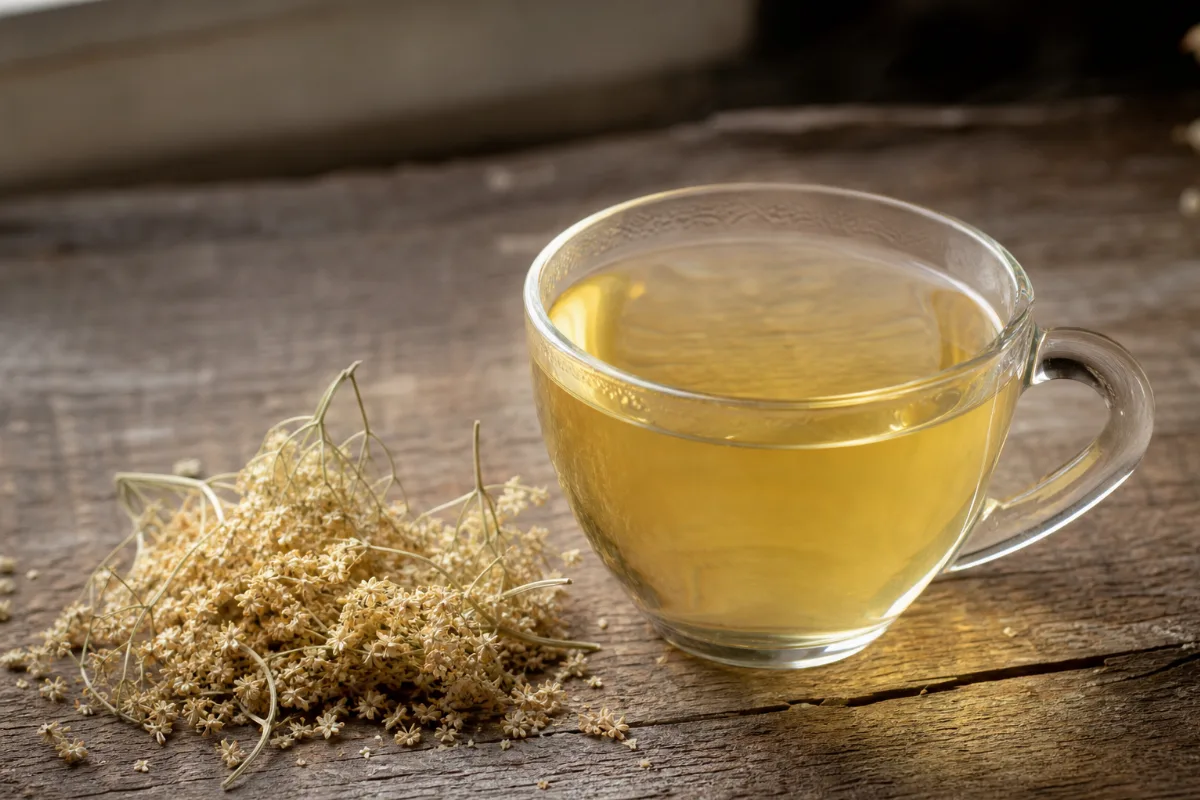
Elderflower tea is a drink made by steeping the dried flowers of the elder tree. In Europe it is a traditional remedy for the first signs of a cold. No trial has tested the tea itself, and the cold and flu trials you may read about used elderberry (berry) products. The key caution: raw elder berries, leaves and stems are poisonous, so the tea should come from the flowers only.
General information, not medical advice. Last substantive update · Not medically reviewed. A named clinician has not signed off on this page. How this page is made
About Elderflower Tea
Elderflower tea is the drink made from the dried flowers of Sambucus nigra. The EU accepts it as a traditional remedy for early cold symptoms on long use alone, and no trial has tested it. Raw or unripe berries, leaves and stems of the elder tree are poisonous, so only the flowers are used for tea. It is not recommended in pregnancy or for children under 12.
What it is
Elderflower tea comes from the flowers of the elder, Sambucus nigra, an accepted species in GBIF. The flower is a separate product from the dark berry used in syrups and supplements.
The flowers hold plant phenolics such as quercetin and rutin. How much depends on the variety and the product: in a survey of 24 commercial teas, flower teas held from 15.23 to 35.57 mg phenolics per gram.
The leaf is not a tea material. Stems and leaves are among the parts NIH names as poisonous.
Tea, extract, syrup or berry product?
The EU monograph covers three flower forms: tea, liquid extract and tincture. Extracts and tinctures contain alcohol and are different products from a cup of tea.
Cordials and syrups are sweetened drinks. Elderberry syrups, gummies and supplements are made from berries.
Almost all the cold and flu research is on berry products. Results for berries cannot be read as results for the flower tea, in either direction.
What the research shows
Colds: traditional use only for the tea. A search of PubMed for elderflower found 47 records and none was a trial of the tea.
Berry products: a 2021 systematic review of five trials calls the evidence uncertain. A 2020 trial of 87 flu patients found no difference (4.9 days on placebo vs 5.3 days on elderberry to no or mild symptoms), after a small 2004 trial reported symptoms eased about 4 days sooner.
Sinusitis: the positive result is for a five-herb formula, not for elder flower or tea.
Blood sugar and antioxidant results are lab or chemistry findings.
Quality and contamination
We found no survey of pesticides or herbal toxins in commercial elderflower tea. One older Czech study of elder flowers from four sites found cadmium in the infusion below the detection limit; metal levels in the plant depend on where it grew.
Products differ: flower composition changes with variety and the teas in one survey varied more than two-fold in phenolics.
Pick tea labelled Sambucus nigra flower from a seller you trust. Do not pick wild elder for tea without expert identification: our elderberry file names dwarf elder as a toxic look-alike (summary-only).
Pregnancy, breastfeeding, children and illness
The EU monograph says safety in pregnancy and breastfeeding has not been established and it does not recommend use. A 2014 review found no safety studies of elderberry in pregnancy. No fertility data exist.
Use under 12 is not recommended.
The monograph advises a doctor if symptoms last longer than 1 week or get worse, or with breathlessness, fever or coloured phlegm. NIH says there is not enough evidence for COVID-19.
At a glance
Traditional uses history, not proof
- The EU lists elder flower tea as a traditional herbal medicine for relief of early symptoms of the common cold, based on long use alone.
- MSK says both elderberry flowers and fruits are used to help reduce cold and flu symptoms.
- Handbooks cited in our elderberry file describe a hot flower tea at the start of a chill or cold (summary-only).
Studied for research
- Early cold symptoms, insufficient (traditional use, no trial of the tea)
- Colds, low (berry products, not the tea)
- Influenza, mixed (berry products, not the tea)
- Sinusitis, very low (a five-herb formula, not the tea)
- Blood sugar, insufficient (lab work only)
- Antioxidant content, insufficient (a lab measurement)
Main compounds
- Phenolics (flavonols such as quercetin and rutin, caffeic and other acids)
- Cyanogenic glycosides (poisonous in raw parts; also found in flowers in one lab study)
- Allergen Sam n 1 (a protein in pollen, flowers and berries)
Common forms
- Dried flowers, loose or in tea bags, steeped in hot water
- Liquid extract and tincture (alcohol-based; different products)
- Elderflower cordials and syrups (sweetened drinks, not plain tea)
Research links: EU herbal monograph on elder flower (EMA) · NCCIH: Elderberry · MSK: Elderberry · Elderberry for viral respiratory illness: systematic review (abstract) · Elderberry extract in influenza: 87-patient trial (abstract) · Elder allergy study (abstract) · Research Library · Genes & Biomarkers Library
What it is and its history
- Accepted scientific name
- Sambucus nigra
- Naming authority
- L.
- Common names
- Elder flower; elderflower; black elder flower (English); Sambuci flos (Latin (pharmacy name)); Flor de saúco (Spanish); Fleur de sureau noir (French); Holunderblüten (German)
- Family or group
- Viburnaceae in GBIF; other databases use Adoxaceae
- Classification
- Plantae > Dipsacales > Viburnaceae (GBIF backbone) > Sambucus > Sambucus nigra
- Native range
- Not re-checked here; our elderberry file says Europe and nearby regions.
- Habitat
- Not checked
- What it looks like
- Roots: Not used; Stems: Not used; Leaves: Not used; Flowers: Clusters of small cream-white flowers; the flower is the tea material; Fruit: Dark berries (a separate product; raw berries poisonous)
- Cultivation
- Varieties differ in flower composition (6 cultivated varieties and the wild form compared in one study).
- Harvest and processing
- Dried flowers (comminuted) are the herbal substance named in the EU monograph.
- Look-alikes and adulterants
- Name: Sambucus ebulus (dwarf elder); Note: A toxic herbaceous look-alike according to our elderberry file (summary-only, not re-read here). Do not pick wild elder for tea without expert identification.; Name: Sambucus canadensis (American elder); Note: A close relative that some authorities treat as a subspecies. Much North American research is on that plant, so check which species a study used.
- Sustainability and conservation
- Not assessed
Photographs
Traditional use and history history, not clinical proof
| Tradition or era | Documented use | Source |
|---|---|---|
| Europe, long-standing traditional use | The EU lists elder flower tea as a traditional herbal medicine for relief of early symptoms of the common cold, based exclusively on long-standing use. | s-ema-hmpc-sambuci-flos |
| Europe, 20th-century handbooks | Our elderberry file says handbooks described a hot flower infusion as a sweat-inducing tea at the start of a cold, and a mild urine-increasing tea in Poland. Summary-only: the EMA assessment report was not opened for this page. | elderberry master file |
| Today | MSK says both elderberry flowers and fruits are used to help reduce cold and flu symptoms, and that it is generally safe in food and tea. | s-msk-elderberry |
Traditional use shows how it was used. It does not show that it works or is safe today.
What is inside, and how it may work
What it contains and how those compounds act in cells and animals. Laboratory and animal mechanisms are not proven effects in people.
Main compounds
| Compound | Family | Where it is concentrated | Activity studied | Level of evidence |
|---|---|---|---|---|
| Phenolic compounds (hydroxycinnamic acids, flavonols such as quercetin, kaempferol, myricetin, rutin) | polyphenols | Flower Elderflower infusions held 15.23 to 35.57 mg gallic acid equivalents per g dry weight in one survey of commercial products; hydroxycinnamic acids and flavonol glycosides were the main groups in traditional drinks. | Antioxidant activity in test tubes. No human outcome shown. 18 12 14 | Laboratory research |
| Cyanogenic glycosides | cyanide-releasing glycosides | Leaves, stems, unripe berries; also found in flowers in one lab study Berries lowest of leaf, flower and berry in one Slovenian study; the abstract gives no flower figure. | Source of the poisoning risk with raw or unripe parts. 15 13 | Lab analysis |
| Allergen Sam n 1 (33.2 kDa protein) | protein | Pollen, flower, berry Not quantified. | Candidate major elder allergen. 3 | Clinical |
Mechanisms, receptors and pathways
| Target or pathway | Gene or receptor | What was found | Level |
|---|---|---|---|
| Glucose uptake and starch-digesting enzymes | n/a | Elderflower extracts and phenolics raised glucose uptake in cultured human muscle and liver cells and blocked alpha-amylase and alpha-glucosidase in test tubes. 6 | Lab |
| Antioxidant capacity | n/a | Flower infusions scored higher than berry infusions in DPPH and FRAP test-tube assays. 18 | Lab |
Absorption, metabolism and elimination
- Absorption
- Not found for elderflower tea.
- Distribution
- Not found.
- Metabolism
- Not found. Test-tube enzyme work on black elderberry is in the Safety section.
- Elimination
- Not found.
- Bioavailability
- Not found.
Isolated compounds versus whole extracts
Tea, liquid extract and tincture are the forms in the EU monograph. A tea is a weak water extract; ethanol extracts pulled out more phenolics in the lab (methanol extract held more of every group than water extracts). Lab results from concentrated or ethanol extracts do not carry over to a cup of tea, and berry results do not carry over to flowers.
Nutritional composition
Elderflower tea is not a source of nutrients on the strength of anything we read. Nothing here is a claim of benefit from its plant compounds.
1 mixed findings1 low certainty1 very low certainty3 not enough evidence
What was looked at
The 6 benefits and uses checked for Elderflower Tea, each with how strong the evidence is. Tap one to open it.
- Early cold symptoms (traditional use)Not enough evidence
- Colds (elderberry berry products, not tea)Low certainty
- Influenza (elderberry berry products, not tea)Mixed findings
- Blood sugar (lab work only)Not enough evidence
- Sinusitis (a five-herb formula, not elderflower tea)Very low certainty
- Antioxidant content of the drink (lab measurement)Not enough evidence
Lab markers tracked in the studies
Days of cold symptomsDays to feel better from fluGlucose uptake in cultured cellsPhenolic content of the tea
What is Elderflower Tea good for?
The uses people ask about and how strong the human evidence is for each. For most of them the research is on elderberry (berry) products or a mixed formula, not on the flower tea, and each row says which.
Benefits, one by one
Each card is a research question, not a promise. Tap a goal to filter. Open a card to see the studies, doses and limits.
Early cold symptoms (traditional use)
Not enough evidenceThe EU lists elder flower tea as a traditional medicine for the early symptoms of a cold, based on long use alone. No trial of the tea was found.
2 studiesTea, liquid extract and tincture are the forms in the EU monograph. A…
Studies, doses and limits
What the trials found
The EU monograph says the use rests exclusively on long-standing use. No clinical trial of elderflower tea for colds was found in PubMed (47 records mentioning elderflower, none a human trial of the tea). A 2014 Natural Standard systematic review covers both berry and flower, but its abstract gives no results.
Results
No trial results for the tea.
Why this rating
The only support is tradition and a regulator listing. Nothing tests the tea.
Form and dose studied
Tea, liquid extract and tincture are the forms in the EU monograph. Amounts are not given here.
Who was studied
Adults and teens over 12 (EU).
Limits
Not a trial. Seeing a doctor is advised if symptoms last over a week or get worse.
Why researchers looked
Elder flower has been used for centuries in Europe at the start of a cold, often as a hot drink.
Traditional use
Handbooks listed in our elderberry file describe a hot flower infusion for chills and the start of a cold. This history was not re-read for this page and is summary-only.
Proposed mechanism Laboratory research
Lab studies show flower extracts have antioxidant and anti-inflammatory activity in cells. This has not been shown to explain any effect in people.
A proposed mechanism does not show that the effect happens in people.
See the Safety tab. Raw berries, leaves and stems are poisonous.
Colds (elderberry berry products, not tea)
Low certaintyTrials of berry extracts and syrups give mixed results for colds. They are a different product from flower tea, so they say nothing certain about the tea.
3 studiesBerry syrup, extract or capsules. Not the flower tea.
Studies, doses and limits
What the trials found
A 2021 systematic review of five randomized trials (elderberry berry products) said elderberry may not lower the chance of a cold, and may shorten and ease colds, with uncertain evidence. A 2019 meta-analysis of 180 people reported a large effect on symptoms. In 312 air travellers, cold days were 117 on placebo and 57 on a berry extract (p = 0.02) while the number of colds did not differ.
Results
Cold days 117 vs 57 (p = 0.02) in travellers; colds 17 vs 12 (p = 0.4).
Effect sizes as reported
Meta-analysis: large mean effect, no numbers in the abstract.
Why this rating
The reviewers call the evidence uncertain. Trials are small and are of berry products only.
Form and dose studied
Berry syrup, extract or capsules. Not the flower tea.
Who was studied
Adults in most trials; one trial included ages 5 and up.
Limits
Berries, not flowers. Small trials; few cold cases in the air-travel trial.
Why researchers looked
Black elder berry products are widely sold for colds and flu.
Traditional use
Berries and flowers both come from Sambucus nigra, so people often assume they act the same. That has not been tested.
Proposed mechanism Laboratory research
Berry anthocyanins and other compounds block flu virus in lab dishes. Not shown to matter in people.
A proposed mechanism does not show that the effect happens in people.
Raw berries are poisonous; trial products were processed.
Influenza (elderberry berry products, not tea)
Mixed findingsOne small trial found flu symptoms eased about 4 days sooner with a berry syrup. A later, larger trial found no benefit. Neither tested flower tea.
3 studiesBerry syrup or extract. Not the flower tea.
Studies, doses and limits
What the trials found
A 2004 trial of 60 adults in Norway found symptoms relieved on average 4 days earlier with berry syrup. A 2020 trial of 87 emergency-room patients found no difference: 4.9 days on placebo vs 5.3 days on berry extract to no or mild symptoms (p = 0.57). A post hoc look suggested those taking elderberry without oseltamivir did about 2 days worse than placebo alone; this is not firm.
Results
Positive small trial (60 adults) and a null trial (87 patients).
Effect sizes as reported
4 days earlier relief (2004); no difference (2020).
Why this rating
Two small trials point different ways. The 2021 systematic review calls the evidence uncertain.
Form and dose studied
Berry syrup or extract. Not the flower tea.
Who was studied
Adults in Norway (2004); people aged 5 and over in US emergency rooms (2020).
Limits
Berry products only; small numbers.
Why researchers looked
Berry extracts blocked influenza virus in lab work.
Traditional use
Elder has a long folk use for flu and fever.
Proposed mechanism Laboratory research
Lab work on berry compounds; not shown in people.
A proposed mechanism does not show that the effect happens in people.
Flu can be serious. See a doctor rather than relying on a tea.
Blood sugar (lab work only)
Not enough evidenceElderflower extracts made muscle and liver cells in dishes take up more sugar. Nobody has tested the tea in people for blood sugar.
2 studiesLab extract, not tea.
Studies, doses and limits
What the trials found
No human trial was found.
Results
Cell and test-tube findings only.
Why this rating
Lab only. Strong lab effects often fail in people.
Form and dose studied
Lab extract, not tea.
Limits
Cells in dishes; ethanol extract, not tea.
Why researchers looked
Flower phenolics might help cells handle glucose.
Traditional use
No traditional use for blood sugar was found in the sources read.
Proposed mechanism Laboratory research
An ethanol extract and its flavonoids raised glucose uptake in cultured human muscle and liver cells and blocked starch-digesting enzymes in test tubes.
A proposed mechanism does not show that the effect happens in people.
Sources list a theoretical add-on effect with diabetes medicine (berry advice); see Safety.
Sinusitis (a five-herb formula, not elderflower tea)
Very low certaintyA formula of five herbs that includes elder flower helped sinusitis symptoms when added to antibiotics. This cannot be credited to elder flower or to the tea.
1 studiesA branded multi-herb medicine. Not a tea.
Studies, doses and limits
What the trials found
A 2006 systematic review of 6 controlled trials (about 900 patients, mostly young men) found the formula beat placebo after 2 weeks in two trials of 159 vs 160 patients, both added to antibiotics: 61.1% 'cured' vs 34.5%. Versus ambroxol there was no difference. Side effects were similar to placebo.
Results
61.1% vs 34.5% rated 'cured' at 2 weeks (formula plus antibiotics vs placebo plus antibiotics).
Effect sizes as reported
Difference 26.6 percentage points in the patient 'cured' rating (calculated from the two figures).
Why this rating
A combination product, older trials, and no way to separate elder flower from the other four herbs.
Form and dose studied
A branded multi-herb medicine. Not a tea.
Who was studied
Adults with sinusitis.
Limits
Not elder flower alone; commercial product; funder not stated in the abstract.
Why researchers looked
Elder flower is one herb in a German formula used for thick mucus and sinus problems.
Traditional use
Elder flower is part of herbal chest and sinus remedies in Europe (summary-only, from our elderberry file).
Proposed mechanism Unknown
Unclear; the review does not show which herb does what.
A proposed mechanism does not show that the effect happens in people.
Adverse events were reported as similar to placebo.
Antioxidant content of the drink (lab measurement)
Not enough evidenceElderflower tea contains plant compounds called phenolics, and flower teas had more than berry teas in one test. That is a measurement of the drink, not a health result.
3 studiesTea and traditional drinks.
Studies, doses and limits
What the trials found
No human trial shows that drinking the tea changes disease risk or any body marker.
Results
Flower infusions averaged more phenolics and higher antioxidant test scores than berry infusions.
Effect sizes as reported
Total phenolics 15.23 to 35.57 mg GAE/g (flower teas) in one survey of 24 products.
Why this rating
Product chemistry only; no health outcome measured.
Form and dose studied
Tea and traditional drinks.
Limits
Content varies by variety and preparation.
Why researchers looked
People hope antioxidant compounds protect cells.
Proposed mechanism Laboratory research
Phenolics such as quercetin and rutin show antioxidant activity in test tubes.
A proposed mechanism does not show that the effect happens in people.
None specific.
Connections to the rest of health
How Elderflower Tea connects to the rest of our health knowledge graph. Every link says what kind of connection it is. A safety link (for example to the liver) is a warning, not a benefit. A study that merely mentions a topic never creates a benefit link.
Explore every connection: goals, body systems, organs, symptoms, genes
A. Wellness goals
| Connected to | Kind of connection | Evidence status | Context | Studies |
|---|---|---|---|---|
| Seasonal Wellness | Not enough evidence | Early cold symptoms (traditional use): The EU lists elder flower tea as a traditional medicine for the early symptoms of a cold, based on long use alone. No trial of the tea was found. | 2 17 | |
| Immune Support | Not enough evidence | Early cold symptoms (traditional use): The EU lists elder flower tea as a traditional medicine for the early symptoms of a cold, based on long use alone. No trial of the tea was found. | 2 17 | |
| Seasonal Wellness | Low certainty | Colds (elderberry berry products, not tea): Trials of berry extracts and syrups give mixed results for colds. They are a different product from flower tea, so they say nothing certain about the tea. Influenza (elderberry berry products, not tea): One small trial found flu symptoms eased about 4 days sooner with a berry syrup. A later, larger trial found no benefit. Neither tested flower tea. | 19 5 16 20 9 | |
| Blood Sugar Balance | Not enough evidence | Blood sugar (lab work only): Elderflower extracts made muscle and liver cells in dishes take up more sugar. Nobody has tested the tea in people for blood sugar. | 6 11 | |
| Breathing Support | Very low certainty | Sinusitis (a five-herb formula, not elderflower tea): A formula of five herbs that includes elder flower helped sinusitis symptoms when added to antibiotics. This cannot be credited to elder flower or to the tea. | 10 | |
| Cellular Protection | Not enough evidence | Antioxidant content of the drink (lab measurement): Elderflower tea contains plant compounds called phenolics, and flower teas had more than berry teas in one test. That is a measurement of the drink, not a health result. | 18 12 14 |
B. Body systems
| Connected to | Kind of connection | Evidence status | Context | Studies |
|---|---|---|---|---|
| Respiratory Health | Biological association | Not enough evidence | Studied for: Early cold symptoms (traditional use) Studied for: Colds (elderberry berry products, not tea) | 2 17 19 5 16 20 9 10 |
| Blood Sugar Support | Biological association | Not enough evidence | Studied for: Blood sugar (lab work only) | 6 11 |
| Wellness Prevention | Biological association | Not enough evidence | Studied for: Antioxidant content of the drink (lab measurement) | 18 12 14 |
E. Health conditions
| Connected to | Kind of connection | Evidence status | Context | Studies |
|---|---|---|---|---|
| Elder allergy | Contraindication | Low certainty | Allergen present in pollen, flowers and berries; EU lists hypersensitivity as contraindication. Preparation or compound: Elder flowers |
3 2 |
| Pregnancy | Contraindication | Low certainty | Not recommended: safety not established. Preparation or compound: Elderflower tea |
2 |
| Common cold | Traditional use | Not enough evidence | EU traditional use for early symptoms; no trial of the tea. Preparation or compound: Elder flower tea |
2 |
| Influenza | Mixed findings | One small positive and one null trial. Preparation or compound: Elderberry (berry) products, not tea |
20 9 |
I. Biomarkers
| Connected to | Kind of connection | Evidence status | Context | Studies |
|---|---|---|---|---|
| Days of cold symptoms | Biological association | Low certainty | Measured in trials: fewer days (berry extract only). A lab change is not the same as a health benefit. | 16 |
| Days to feel better from flu | Biological association | Mixed findings | Measured in trials: mixed (berry products only). A lab change is not the same as a health benefit. | 9 20 |
| Glucose uptake in cultured cells | Biological association | Not enough evidence | Measured in trials: higher uptake (cells, not people). A lab change is not the same as a health benefit. | 6 |
| Phenolic content of the tea | Biological association | Not enough evidence | Measured in trials: flower teas higher than berry teas. A lab change is not the same as a health benefit. | 18 |
L. Active compounds
| Connected to | Kind of connection | Evidence status | Context | Studies |
|---|---|---|---|---|
| Phenolic compounds (hydroxycinnamic acids, flavonols such as quercetin, kaempferol, myricetin, rutin) | Biological association | In vitro | Antioxidant activity in test tubes. No human outcome shown. Preparation or compound: Flower |
18 12 14 |
| Cyanogenic glycosides | Biological association | Lab analysis | Source of the poisoning risk with raw or unripe parts. Preparation or compound: Leaves, stems, unripe berries; also found in flowers in one lab study |
15 13 |
| Allergen Sam n 1 (33.2 kDa protein) | Biological association | Clinical | Candidate major elder allergen. Preparation or compound: Pollen, flower, berry |
3 |
Each connection is stored with the ingredient, the connected record, the kind of connection, the evidence status, the supporting studies, the preparation or compound involved, and a review date (last reviewed October 25, 2026).
Evidence at a glance: what the research found for 6 outcomes
Each outcome below is one thing researchers measured. Certainty is how far the evidence can be trusted, not how well it works. The full studies are on the next tab.
The evidence
The research centre for Elderflower Tea. Every record here was checked against PubMed or the publisher's page; we never list a study we have not verified.
Evidence by outcome
Bars show how many studies we found for each outcome, not how well it works. People are added up across trials only (reviews are not added, to avoid double counting).
How we rate evidence
High certainty
Several well-run trials or reviews agree; further research is unlikely to change the picture much.
Moderate certainty
Good trials point the same way, but some doubt remains.
Low certainty
Small, short or inconsistent trials. The finding could change with better research.
Very low certainty
Very little or very weak human data. Treat as a possibility only.
Mixed findings
Trials or reviews disagree with each other.
Not enough evidence
Not enough human research to say either way.
Evidence against
Good research found no benefit, or found harm.
We take the reviewers' own risk-of-bias and GRADE statements where they exist, and otherwise judge from study size, design, consistency, directness and whether a product matches what is sold. Many publications do not make evidence high. Method note: We searched PubMed for elderflower records and read the abstracts of the studies listed, read the EU herbal monograph, the NCCIH page and the relevant parts of the MSK page, and checked the plant name in GBIF.
Study library: every study we checked 20
| Study | Design | People | Product, dose, length | Result |
|---|---|---|---|---|
| Celechovska 2004 [The content of zinc and cadmium in medicinal plants and their infusions]. Ceska a Slovenska farmacie · PMID 15631004 |
Lab analysis Sambucus nigra |
Elder and lime tree collected at four Czech localities | Elder flowers (Sambuci flos), pollen and fruit, and their infusions flower+pollen+fruit |
In elder flowers cadmium was 3.3 to 15.3 ug/kg and zinc 30.8 to 49.9 mg/kg. Cadmium in the infusions was under the detection limit (0.04 ug/l) at 10, 30 and 60 minutes. About 17 to 25% of the flower zinc passed into the infusion. Contents depend on where the plants grew. Methods, limits and fundingOutcomes: Zinc and cadmium in the dry plant and in the infusion Limitations: Four localities in one country; older study; only two metals. Read: abstract |
| European Medicines Agency 2018 European Union herbal monograph on Sambucus nigra L., flos (EMA/HMPC/611512/2016) EMA herbal monograph, final, 27 March 2018 · Source |
Authoritative guidance Sambucus nigra |
Elder flower (herbal tea, liquid extract, tincture) flower |
Read in full (7 pages). Traditional herbal medicine for relief of early symptoms of the common cold, exclusively based on long-standing use. Teas, liquid extracts and tinctures are covered. Only hypersensitivity is listed as a contraindication. Use under 12 is not recommended. Safety in pregnancy and breastfeeding is not established and use is not recommended. No fertility data. Interactions: none reported. Undesirable effects: none known. Overdose: no case reported. Tests for reproductive toxicity, genotoxicity and carcinogenicity have not been done. A doctor should be seen if symptoms last over 1 week, worsen, or if breathlessness, fever or purulent sputum occur. Methods, limits and fundingOutcomes: Regulatory statement on use and safety Limitations: A traditional-use listing is not proof from trials. 'None reported' is not proof of no interactions. Read: full-text | |
| Forster-Waldl 2003 Type I allergy to elderberry (Sambucus nigra) is elicited by a 33.2 kDa allergen with significant homology to ribosomal inactivating proteins. Clinical and experimental allergy · PMID 14656358 |
Lab and clinical Sambucus nigra |
3668 3,668 people tested in a Vienna routine setting; 9 with elderberry allergy studied in detail |
Extracts of elder pollen, flowers and berries pollen+flower+fruit |
0.6% of 3,668 randomly tested people had a positive skin prick test or blood test to elderberry. A 33.2 kDa protein (named Sam n 1) in pollen, flowers and berries was the main allergen. Symptoms included hay fever, eye symptoms and breathlessness after contact with flowers or elder food products. It did not cross-react with birch, grass or mugwort pollen allergens in the tests. Methods, limits and fundingOutcomes: IgE reactivity, skin prick test Limitations: Small number of allergic patients; one clinic; 2003. Read: abstract |
| GBIF 2026 GBIF Backbone Taxonomy: Sambucus nigra L. GBIF species match API, checked 2026-10-25 · Source |
Database Sambucus nigra |
GBIF key 2888728: Sambucus nigra L., status ACCEPTED, rank species, family Viburnaceae (GBIF backbone). Methods, limits and fundingOutcomes: Accepted name Limitations: Another database (NCBI) files the genus under Adoxaceae, so family names differ between sources. Read: API | ||
| Hawkins 2019 Black elderberry (Sambucus nigra) supplementation effectively treats upper respiratory symptoms: A meta-analysis of randomized, controlled clinical trials. Complementary therapies in medicine · PMID 30670267 |
Meta-analysis Sambucus nigra |
180 180 participants in total |
Black elderberry supplements (berry, not flower tea) fruit |
Reported a large mean effect size for fewer upper respiratory symptoms. The abstract does not state the number of trials or the size of the effect. Methods, limits and fundingOutcomes: Upper respiratory symptoms Limitations: Small total number of people; abstract gives no figures; berry products; the 2021 systematic review (Wieland) rates the evidence uncertain. Read: abstract |
| Ho 2017 Effect of Phenolic Compounds from Elderflowers on Glucose- and Fatty Acid Uptake in Human Myotubes and HepG2-Cells. Molecules · PMID 28067838 |
Laboratory research Sambucus nigra |
Human muscle cells and liver cancer cells in dishes | Elderflower extracts and phenolic compounds (lab) flower |
The 96% ethanol extract gave the biggest rise in glucose and oleic acid uptake in human muscle cells and HepG2 cells. Flavonoids and phenolic acids were potent. Most phenolics blocked alpha-amylase and alpha-glucosidase more than acarbose in the test tube. Methods, limits and fundingOutcomes: Glucose and fatty acid uptake; enzyme inhibition Limitations: Cells in dishes, ethanol extract, not a tea; no people tested. Read: abstract |
| Holst 2014 Echinacea and elderberry-should they be used against upper respiratory tract infections during pregnancy? Frontiers in pharmacology · PMID 24624087 |
Systematic review Sambucus nigra |
Pregnant women | Echinacea and elderberry fruit/unspecified |
No animal or human studies of safety of elderberry in pregnancy were found. Three clinical trials of two elderberry preparations (77 people treated) all reported benefit against influenza. Because of the lack of evidence on efficacy and safety, health care staff should not advise pregnant women to use echinacea or elderberry against upper respiratory infections. Methods, limits and fundingOutcomes: Safety in pregnancy Limitations: About elderberry preparations, not specifically flower tea. Read: abstract |
| Langhammer 2014 In vitro inhibition of human CYP1A2, CYP2D6, and CYP3A4 by six herbs commonly used in pregnancy. Phytotherapy research · PMID 23843424 |
Laboratory research Sambucus nigra |
Lab enzymes | Aqueous or ethanolic extracts of black elderberry and five other herbs fruit |
Black elderberry was one of six herbs tested. The most potent inhibition was for fennel, horsetail and raspberry leaf; the authors named those three (and fennel in the gut) as possibly clinically relevant. The abstract does not name black elderberry as clinically relevant. Methods, limits and fundingOutcomes: Inhibition of drug-handling liver enzymes Limitations: Test-tube enzymes, berry products, not flower tea. Read: abstract |
| Macknin 2020 Elderberry Extract Outpatient Influenza Treatment for Emergency Room Patients Ages 5 and Above: a Randomized, Double-Blind, Placebo-Controlled Trial. Journal of general internal medicine · PMID 32929634 |
RCT Sambucus nigra |
87 87 people with PCR-confirmed influenza, ages 5 and over, three US emergency rooms |
Elderberry extract (berry, not flower tea) fruit 5 days · vs Placebo |
Placebo 4.9 days vs elderberry 5.3 days (p = 0.57) to no or mild symptoms; complete resolution 8.7 vs 8.6 days (p = 0.87). The authors found no evidence that elderberry helps duration or severity of influenza. A post hoc look suggested people taking elderberry without oseltamivir did about 2 days worse than people on placebo alone. Methods, limits and fundingOutcomes: Days to no or mild symptoms; days to complete resolution Limitations: Small trial but powered to detect a 2-day benefit; post hoc finding is not firm. Funding and conflicts: Investigator-initiated; funding not stated in the abstract. Read: abstract |
| Melzer 2006 Systematic review of clinical data with BNO-101 (Sinupret) in the treatment of sinusitis. Forschende Komplementarmedizin · PMID 16645287 |
Systematic review Mixed formula |
900 About 900 patients, mostly young adult males; 6 controlled trials in sinusitis |
BNO-101: a five-herb formula (gentian root, primula flower, sorrel herb, elder flower, vervain herb) flower (one of five herbs) |
After 2 weeks, the formula beat placebo in two trials (159 vs 160 patients), both added to antibiotics: 'cured' 61.1% vs 34.5%. Against ambroxol there was no difference overall. The authors conclude the formula plus antibiotics reduces acute sinusitis symptoms, with side effects similar to placebo. Methods, limits and fundingOutcomes: Patient-assessed cure; sinus signs and symptoms Limitations: Elder flower is only one of five herbs, so this says nothing about elder flower alone or tea. Older trials, mostly young men. The abstract does not name a funder; the formula is a commercial product. Funding and conflicts: Possible industry link not checked Read: abstract |
| Memorial Sloan Kettering Cancer Center 2023 Elderberry (Memorial Sloan Kettering Integrative Medicine, About Herbs) MSK web page, last updated 27 March 2023 · Source |
Authoritative guidance Sambucus nigra |
Elderberry (flowers and fruit named as used; advice is mainly about berries) fruit |
Read the interactions and case sections. States elderberry has hypoglycemic activity and may add to antidiabetic drugs, promotes urination and may add to diuretics, and was reported to have laxative effects in clinical studies and may add to laxatives; for the first two it says clinical relevance has yet to be determined. Lists case reports including acute pancreatitis in a 51-year-old man and autoimmune hepatitis in a 60-year-old woman with Hashimoto thyroiditis after long-term supplements that contained elderberry (liver tests normalised after stopping supplements and starting immunosuppressive therapy). Says elderberry flowers and fruits are used for cold and flu symptoms and that it is generally safe in food and tea, and to talk with providers before supplements. Methods, limits and fundingOutcomes: Safety summary and herb-drug interactions Limitations: Mostly about berries and supplements. Interactions are listed on theoretical grounds. Read: full-text | |
| Mikulic-Petkovsek 2015 Traditional elderflower beverages: a rich source of phenolic compounds with high antioxidant activity. Journal of agricultural and food chemistry · PMID 25646848 |
Lab analysis Sambucus nigra |
3 Three elderflower extracts, including two water-based home-style drinks |
Elderflower drinks (water extracts and methanol extract) flower |
Hydroxycinnamic acids and flavonol glycosides were the main phenolics. Methanol extracts held more of every group than water extracts. Drinks had 91.09 to 746.63 mg gallic acid equivalents per litre. Methods, limits and fundingOutcomes: Phenolic profile (HPLC-MS) Limitations: Lab chemistry on a few samples; sweetened drinks and syrups, not plain tea. Read: abstract |
| National Center for Complementary and Integrative Health 2024 Elderberry (NCCIH, NIH) NCCIH web page, last updated November 2024 · Source |
Authoritative guidance Sambucus nigra |
Elderberry (berry products) fruit |
Read in full. About berry products, not the flower tea. A small number of studies have looked at colds, flu and other upper respiratory infections; some preliminary research suggests berry products may relieve symptoms. There is no good evidence for COVID-19; the FDA and FTC have acted against companies making unsubstantiated COVID-19 claims. Raw or unripe elderberries and other parts of the elder tree, such as the leaves and stem, contain poisonous cyanide-producing substances that can cause nausea, vomiting and severe diarrhea; cooking eliminates this toxin; large quantities may cause serious illness. Little is known about safety in pregnancy or breastfeeding. Talk to a provider before using herbal products if you take medicine. Methods, limits and fundingOutcomes: Evidence and safety summary Limitations: Berries, not flowers. The page does not discuss flower tea. Read: full-text | |
| Nawirska-Olszanska 2024 Elderflowers (Sambuci flos L.): A Potential Source of Health-Promoting Components. Foods · PMID 39200487 |
Lab analysis Sambucus nigra |
7 Six cultivated varieties and the wild form of elder flowers |
Dried elderflowers flower |
Composition and antioxidant activity differed by variety. The wild form and the variety 'Weihenstephan' were richest, at 394.36 and 377.75 mg polyphenols per 100 g dry matter. Methods, limits and fundingOutcomes: Composition, polyphenols, antioxidant activity Limitations: Composition only; no health outcome. Variety changes what is in the flowers, so tea contents vary. Read: abstract |
| Senica 2017 The higher the better? Differences in phenolics and cyanogenic glycosides in Sambucus nigra leaves, flowers and berries from different altitudes. Journal of the science of food and agriculture · PMID 27734518 |
Lab analysis Sambucus nigra |
Elder plants from different altitudes at two locations in Slovenia (by the abstract) | Leaves, flowers and berries (lab analysis) leaf+flower+fruit |
Toxic cyanogenic glycosides were found in leaves, flowers and berries. Berries held the lowest levels of the three plant parts (0.11 ug/g at the foothills, 0.59 ug/g on the hilltop). More cyanogenic glycosides were always present in plant parts from the hilltop. The authors say flowers and berries from the foothills had the lowest levels of both phenolics and cyanogenic glycosides and are suitable for moderate consumption. The abstract gives no flower figure. Methods, limits and fundingOutcomes: Cyanogenic glycoside and phenolic levels Limitations: Lab survey from one region. No figure for flowers in the abstract. Does not say what a cup of tea contains. Read: abstract |
| Tiralongo 2016 Elderberry Supplementation Reduces Cold Duration and Symptoms in Air-Travellers: A Randomized, Double-Blind Placebo-Controlled Clinical Trial. Nutrients · PMID 27023596 |
RCT Sambucus nigra |
312 312 economy-class air passengers travelling from Australia |
Standardised membrane-filtered elderberry extract (berry, not flower tea) fruit · vs Placebo |
Cold episodes: 17 on placebo vs 12 on elderberry, not significant (p = 0.4). Cold days: 117 on placebo vs 57 on elderberry (p = 0.02). Average symptom score over those days: 583 vs 247 (p = 0.05). Methods, limits and fundingOutcomes: Cold episodes, cold duration and symptoms (daily diary, Jackson score, WURSS-21) Limitations: Few people caught colds; counts are of days summed over the group, not per person; travel setting; berry extract. Funding and conflicts: Industry funding not stated in the abstract. Read: abstract |
| Ulbricht 2014 An evidence-based systematic review of elderberry and elderflower (Sambucus nigra) by the Natural Standard Research Collaboration. Journal of dietary supplements · PMID 24409980 |
Systematic review Sambucus nigra |
Mixed | Elderberry and elderflower products fruit+flower |
The abstract read describes the scope only (clinical trials, expert opinion, folklore, pharmacology, interactions, adverse effects, toxicology). It gives no results or grades, so none are stated here. Methods, limits and fundingOutcomes: Safety and efficacy summary Limitations: Only the abstract was read; the full review is paywalled. Read: abstract |
| Viapiana 2017 The Phenolic Contents and Antioxidant Activities of Infusions of Sambucus nigra L. Plant foods for human nutrition · PMID 28084608 |
Lab analysis Sambucus nigra |
24 24 commercial elder berry and flower tea samples |
Infusions (teas) of commercial elderflowers and elderberries flower and fruit |
Flower infusions had more phenolics than berry infusions on average. Total phenolics ranged 15.23 to 35.57 mg gallic acid equivalents per g dry weight for flowers (19.81 to 23.90 for berries); flavonoids 5.27 to 13.19 mg rutin equivalents/g for flowers (2.60 to 4.49 for berries). Quercetin and myricetin were highest in berry and flower teas respectively. Flower teas scored higher in DPPH and FRAP antioxidant tests. Methods, limits and fundingOutcomes: Total phenolics, flavonoids, antioxidant tests Limitations: Chemical tests of products, not health outcomes. Antioxidant scores in a test tube do not show benefit in people. Read: abstract |
| Wieland 2021 Elderberry for prevention and treatment of viral respiratory illnesses: a systematic review. BMC complementary medicine and therapies · PMID 33827515 |
Systematic review Sambucus nigra |
5 People with or at risk of viral respiratory illness |
Elderberry products (berry, not flower tea) fruit |
Five randomized trials included from 1,187 records, GRADE used. Elderberry may not reduce the risk of getting a cold. It may shorten and ease colds, and may shorten influenza, but the authors call the evidence uncertain. Compared with oseltamivir an elderberry-containing product may bring fewer complications and side effects. No studies on clinical inflammation outcomes were found; there was no evidence that elderberry overstimulates the immune system. They conclude it may be a safe option but the evidence on benefits and harms is uncertain. Methods, limits and fundingOutcomes: New illness, severity and duration; inflammatory markers Limitations: Berry products, not flowers. Few, small trials. Read: abstract |
| Zakay-Rones 2004 Randomized study of the efficacy and safety of oral elderberry extract in the treatment of influenza A and B virus infections. The Journal of international medical research · PMID 15080016 |
RCT Sambucus nigra |
60 60 adults aged 18-54 with flu-like symptoms for 48 hours or less, Norway, 1999-2000 |
Elderberry syrup (berry, not flower tea) fruit 5 days · vs Placebo |
Symptoms were relieved on average 4 days earlier and less rescue medicine was used with elderberry than with placebo. The authors say a larger study is needed. Methods, limits and fundingOutcomes: Symptom relief on a visual analogue scale; rescue medicine Limitations: Small; one season; berry syrup; the later 87-patient trial did not find this benefit. Funding and conflicts: Funding not stated in the abstract. Read: abstract |
What we do not know yet
- What the evidence supports: a traditional EU use for early cold symptoms and lab findings on flower extracts.
- No clinical trial of elderflower tea for any use was found.
- The cold and flu trials are on berry products, and the sinusitis result is for a five-herb formula.
- No measurement of cyanide-releasing compounds in a brewed cup was found.
- Safety in pregnancy, breastfeeding and young children has not been studied for the tea.
- Interactions are theoretical and mostly written about elderberry.
How new research is added
New studies are found by a saved PubMed search and are placed in a review queue. A person reads each one before it changes any evidence rating or safety wording. New publications never change ratings automatically.
Lab markers
What changed in blood or saliva tests during trials. A changed number is not the same as feeling or being healthier, and we give no "normal ranges".
Other 4
Days of cold symptoms
Fewer days (berry extract only) in trials
How long a cold lasts, counted from a daily diary.
Low certaintyResults and what it means
Why it was measured
It is what people care about with a cold.
Statistical vs. clinical meaning
A diary report, not a lab test, from a trial with few colds. It does not test flower tea.
Safety implication
None reported in the abstract.
| Study | Result | People | Product |
|---|---|---|---|
| 16 | Cold days 117 on placebo vs 57 on elderberry (p = 0.02); colds 17 vs 12 (p = 0.4) | 312 air travellers | Standardised elderberry (berry) extract |
Days to feel better from flu
Mixed (berry products only) in trials
Days until symptoms are none or mild.
Mixed findingsResults and what it means
Why it was measured
A direct measure of how long flu symptoms last.
Statistical vs. clinical meaning
Two small trials disagree. Neither used flower tea.
Safety implication
The later trial's post hoc note is not firm evidence of harm.
Glucose uptake in cultured cells
Higher uptake (cells, not people) in trials
How much sugar cells in a dish take up.
Not enough evidenceResults and what it means
Why it was measured
A lab test of how a compound might affect sugar handling.
Statistical vs. clinical meaning
Cell-dish result only.
Safety implication
None established.
| Study | Result | People | Product |
|---|---|---|---|
| 6 | 96% ethanol extract gave the biggest increase in glucose and oleic acid uptake | Human muscle cells and HepG2 liver cells | Elderflower extract and constituents |
Phenolic content of the tea
Flower teas higher than berry teas in trials
The amount of plant phenolic compounds measured in the brewed drink.
Not enough evidenceResults and what it means
Why it was measured
A quality and composition marker.
Statistical vs. clinical meaning
Shows content differs a lot between products; it does not show a health benefit.
Safety implication
None.
| Study | Result | People | Product |
|---|---|---|---|
| 18 | 15.23 to 35.57 mg GAE/g dry weight in flower teas vs 19.81 to 23.90 in berry teas | 24 commercial products | Elderflower and elderberry infusions |
Safety
What studies and official sources say about side effects, medicines and who should check first. Each point shows what kind of evidence it comes from.
Main points to know 6
- Raw elder parts are poisonous: use flowers only. NIH says raw or unripe elderberries and other parts of the elder tree, such as the leaves and stem, contain poisonous cyanide-producing substances that can cause nausea, vomiting and severe diarrhea. Elderflower tea is made from the flowers only. In a lab survey cyanogenic glycosides were found in leaves, flowers and berries, with berries lowest. Buy tea labelled as Sambucus nigra flower. Do not pick and prepare elder yourself without expert identification, because leaves and stems can end up in the bunch. Regulator statement 13 15
- Not recommended in pregnancy or breastfeeding. The EU monograph says safety in pregnancy and breastfeeding has not been established and recommends against use for lack of data. A review found no safety studies of elderberry in pregnancy. Regulator statement 2 7
- Medicine interactions: sources list possible ones, none proven. The EU monograph reports no interactions. MSK lists theoretical additive effects of elderberry with diabetes medicine, water pills (diuretics) and laxatives, and says clinical relevance is not determined. These statements are about elderberry, not specifically flower tea. Ask a pharmacist if you take regular medicine. Theoretical 2 11
- Allergy. Elder pollen, flowers and berries contain an allergen. About 0.6% of 3,668 people tested in one clinic reacted. The EU monograph lists hypersensitivity as the only contraindication. Clinical study 3 2
- Under 12 years. The EU monograph says use in children under 12 is not recommended and has not been established for lack of data. Regulator statement 2
- See a doctor if the illness is not mild. The EU monograph says to consult a doctor if symptoms last longer than 1 week or get worse, or if breathlessness, fever or purulent sputum occur. A tea is not a treatment for flu or COVID-19: NIH says there is insufficient evidence for COVID-19. Regulator statement 2 13
Side effects 4
| Effect | How often | Severity and recovery | Evidence |
|---|---|---|---|
| Allergic reaction (hay fever symptoms, breathlessness) From people sensitised to elder pollen, flowers and berries. Not a tea trial. | 0.6% positive tests in one clinic | mild to moderate not stated | Clinical study 3 |
| Undesirable effects of the flower preparations 'None known' is a statement about reports, not proof of safety. Tests for reproductive toxicity, genotoxicity and carcinogenicity have not been performed. | none known (EU monograph) | not applicable not applicable | Regulator statement 2 |
| Nausea, vomiting, severe diarrhea from raw or unripe berries, leaves and stems This concerns the wrong plant parts, not the flower. | not stated | can be serious in large amounts not stated | Regulator statement 13 |
| Acute pancreatitis (one case) and autoimmune hepatitis (one case) after elderberry supplements Reported with berry-containing supplements used over a long time. Not shown to be caused by elder, and not flower tea. | single case reports | serious The liver tests normalised after the supplements were stopped and immunosuppressive treatment given; the pancreatitis settled with steroids | Case report 11 |
Liver
No liver injury report linked to elderflower tea was found. MSK lists one case of autoimmune hepatitis in a woman with Hashimoto thyroiditis after long-term supplements that contained elderberry; tests normalised after stopping and immunosuppressive treatment. 11
How often. A single case; cause not proven; berry supplement, not flower tea.
Monitoring. No monitoring advice found in the sources read.
- s-msk-elderberry.
This is a safety connection. It is not evidence that Elderflower Tea supports liver health.
Medicines and supplements 5
| With | Why it matters | Importance | Evidence | What to do |
|---|---|---|---|---|
| Diabetes medicines prescription | Elderberry has blood-sugar lowering activity (MSK, theory); elderflower extracts raised glucose uptake in cells (lab) | MSK says clinical relevance has yet to be determined. No trial in people on diabetes drugs. About berry; the flower tea has not been tested. | Theoretical Not enough evidence 11 6 | Tell your pharmacist or doctor if you drink it daily and take diabetes medicine. |
| Diuretics (water pills) prescription | Elderberry promotes urination (MSK) | MSK says additive effects are possible and clinical relevance has yet to be determined. | Theoretical Not enough evidence 11 | Ask your pharmacist if you take a water pill. |
| Laxatives otc | Laxative effect reported in clinical studies of elderberry (MSK) | Possible additive effect; relevance not determined. | Theoretical Not enough evidence 11 | Ask your pharmacist. |
| Medicines that suppress the immune system (for example after a transplant or for autoimmune disease) prescription | Elderberry is often described as immune-stimulating; the 2021 review looked for overstimulation and found no evidence of it | No source we read reports an interaction. This is a caution because the herb is marketed for immunity, not a documented harm. The one MSK autoimmune hepatitis case is a single report. | Theoretical Very low certainty 19 11 | Ask the transplant or specialist team before using it regularly. |
| Drugs cleared by liver enzymes (CYP1A2, 2D6, 3A4) prescription | Black elderberry extracts were tested on three enzymes in test tubes | The authors named fennel, horsetail and raspberry leaf as possibly relevant, not black elderberry. | Laboratory research Not enough evidence 8 | No action needed beyond telling your pharmacist about herbal products. |
Who should check first 4
| Situation | Advice | Evidence |
|---|---|---|
| Allergy to elder (hypersensitivity) | Do not use | Regulator statement 2 |
| Pregnancy and breastfeeding | Not recommended (safety not established) | Regulator statement 2 7 |
| Children under 12 | Not recommended | Regulator statement 2 |
| Use as a replacement for care in flu, breathlessness or fever | See a doctor | Regulator statement 2 |
Overdose, product quality and regulators
Summary. Raw or unripe berries and other parts such as leaves and stem contain cyanide-producing substances (NIH). Flowers also contained cyanogenic glycosides in one lab study, with berries lowest, so the flower is not free of them in that survey. The EU monograph states no overdose has been reported for the flower preparations and that tests for reproductive toxicity, genotoxicity and carcinogenicity have not been done. We found no study measuring cyanide in a cup of elderflower tea.
Animal. Not found for the flower.
Overdose response. No case of overdose reported (EU monograph).
Genotoxicity. Not tested for the flower (EU monograph).
Toxic or hazardous parts. Raw or unripe berries, leaves and stems (NIH).
Two points: wrong plant parts or look-alike plants in home-picked bunches, and metals taken up from the soil. We found little testing of commercial elderflower tea.
Metals in flowers and infusions. In an older Czech study of elder flowers from four sites, cadmium in the infusion was below the detection limit, and zinc partly passed into the drink. Levels depend on where the plant grew. 1
Composition varies. Phenolic content of flower teas varied more than two-fold across 24 commercial products, and flower composition differed by variety. So products are not the same. 18 14
Look-alike and wrong plant parts. A dwarf elder (Sambucus ebulus) is a toxic look-alike according to a source in our elderberry file (summary-only, not re-read here). Leaves and stems are poisonous parts, so tea should be made from flowers only. 13
| Body | Action | Date |
|---|---|---|
| EMA / HMPC (European Union) | Traditional herbal medicinal product for relief of early symptoms of the common cold, based exclusively on long-standing use (tea, liquid extract, tincture). Contraindication: hypersensitivity. Not recommended under 12, in pregnancy or breastfeeding. No interactions or undesirable effects reported or known. source | 2018-03-27 |
| NCCIH (NIH) (United States) | About elderberry berries: preliminary research suggests relief of cold and flu symptoms; insufficient evidence for COVID-19; raw or unripe berries and other parts such as leaves and stem are poisonous; little known in pregnancy and breastfeeding. source | 2024-11 |
| FDA (via NCCIH) (United States) | Dietary supplements are not approved by FDA before sale; FDA and FTC have acted against companies making unsubstantiated COVID-19 claims for elderberry products. source | 2024-11 |
When to get medical help
- Trouble breathing, wheeze, swelling of lips or face, or hives after a cup (allergy): get urgent medical help.
- Vomiting, severe diarrhea, cramps, dizziness or confusion after anyone has eaten or drunk anything made from raw or unripe elder berries, leaves or stems: get medical help or call a poison centre.
- High fever, breathlessness or coloured phlegm during a cold: see a doctor rather than relying on a tea.
- Yellow skin or eyes, dark urine or severe stomach pain: see a doctor.
Stop using the product and contact a clinician or emergency service. In the US, Poison Control is 1-800-222-1222.
General information only, not medical advice. Ask a clinician or pharmacist before use, especially with medicines, in pregnancy or with a health condition. See the Natural Remedy Safety guide.
Frequently asked questions
What is elderflower tea?
Does elderflower tea help with colds?
Does elderflower tea help with flu?
Is elderflower tea the same as elderberry?
Are any parts of the elder poisonous?
Do the flowers contain the poison too?
In one lab study, cyanogenic glycosides were found in leaves, flowers and berries, with berries lowest. We found no measurement in a brewed cup, so the page does not say the tea is free of them.
Is elderflower tea safe in pregnancy?
Can children drink it?
The EU says use under 12 is not recommended because of a lack of data.
Does it interact with medicines?
Can I be allergic to elder?
Yes. In one clinic 0.6% of 3,668 people tested were sensitised to elder, and a protein in pollen, flowers and berries was the main allergen. Stop and get help if you have wheeze, swelling or hives.
Does elderflower tea lower blood sugar?
Does it prevent or treat COVID-19?
No. NIH says there is not enough evidence for elderberry and COVID-19, and US regulators acted against unsupported claims. The page found no evidence for the tea.
Explore by health goal
Seasonal WellnessImmune SupportBlood Sugar BalanceBreathing SupportCellular Protection
Editorial transparency
- Written by
- AlternativeMed editorial team. Research compiled with AI assistance, then checked against PubMed records.
- Medical review
- None. This page has not been reviewed by a physician or pharmacist.
- First published
- 2026-10-25
- Last substantive update
- 2026-10-25
- How we research
- We searched PubMed for elderflower records and read the abstracts of the studies listed, read the EU herbal monograph, the NCCIH page and the relevant parts of the MSK page, and checked the plant name in GBIF.
- How we rate evidence
- See "How we rate evidence" in the Evidence tab.
- Independence
- No product is promoted on this page. No affiliate links are shown. This page is information, not a recommendation to drink or take anything.
Sources 20
Each source was opened and checked. Where we read only the abstract, it says so. The small numbers in the text point here.
- Celechovska O, Pizova M, Konickova J. [The content of zinc and cadmium in medicinal plants and their infusions].. Ceska a Slovenska farmacie. 2004. PMID 15631004. (abstract)
- European Medicines Agency, HMPC. European Union herbal monograph on Sambucus nigra L., flos (EMA/HMPC/611512/2016). EMA herbal monograph, final, 27 March 2018. 2018. (full-text)
- Forster-Waldl E, Marchetti M, Scholl I. Type I allergy to elderberry (Sambucus nigra) is elicited by a 33.2 kDa allergen with significant homology to ribosomal inactivating proteins.. Clinical and experimental allergy. 2003. PMID 14656358. (abstract)
- GBIF. GBIF Backbone Taxonomy: Sambucus nigra L.. GBIF species match API, checked 2026-10-25. 2026. (API)
- Hawkins J, Baker C, Cherry L. Black elderberry (Sambucus nigra) supplementation effectively treats upper respiratory symptoms: A meta-analysis of randomized, controlled clinical trials.. Complementary therapies in medicine. 2019. PMID 30670267. (abstract)
- Ho GT, Kase ET, Wangensteen H. Effect of Phenolic Compounds from Elderflowers on Glucose- and Fatty Acid Uptake in Human Myotubes and HepG2-Cells.. Molecules. 2017. PMID 28067838. (abstract)
- Holst L, Havnen GC, Nordeng H. Echinacea and elderberry-should they be used against upper respiratory tract infections during pregnancy?. Frontiers in pharmacology. 2014. PMID 24624087. (abstract)
- Langhammer AJ, Nilsen OG. In vitro inhibition of human CYP1A2, CYP2D6, and CYP3A4 by six herbs commonly used in pregnancy.. Phytotherapy research. 2014. PMID 23843424. (abstract)
- Macknin M, Wolski K, Negrey J. Elderberry Extract Outpatient Influenza Treatment for Emergency Room Patients Ages 5 and Above: a Randomized, Double-Blind, Placebo-Controlled Trial.. Journal of general internal medicine. 2020. PMID 32929634. (abstract)
- Melzer J, Saller R, Schapowal A. Systematic review of clinical data with BNO-101 (Sinupret) in the treatment of sinusitis.. Forschende Komplementarmedizin. 2006. PMID 16645287. (abstract)
- Memorial Sloan Kettering Cancer Center. Elderberry (Memorial Sloan Kettering Integrative Medicine, About Herbs). MSK web page, last updated 27 March 2023. 2023. (full-text)
- Mikulic-Petkovsek M, Samoticha J, Eler K. Traditional elderflower beverages: a rich source of phenolic compounds with high antioxidant activity.. Journal of agricultural and food chemistry. 2015. PMID 25646848. (abstract)
- National Center for Complementary and Integrative Health. Elderberry (NCCIH, NIH). NCCIH web page, last updated November 2024. 2024. (full-text)
- Nawirska-Olszanska A, Kolniak-Ostek J, Zubaidi MA. Elderflowers (Sambuci flos L.): A Potential Source of Health-Promoting Components.. Foods. 2024. PMID 39200487. (abstract)
- Senica M, Stampar F, Veberic R. The higher the better? Differences in phenolics and cyanogenic glycosides in Sambucus nigra leaves, flowers and berries from different altitudes.. Journal of the science of food and agriculture. 2017. PMID 27734518. (abstract)
- Tiralongo E, Wee SS, Lea RA. Elderberry Supplementation Reduces Cold Duration and Symptoms in Air-Travellers: A Randomized, Double-Blind Placebo-Controlled Clinical Trial.. Nutrients. 2016. PMID 27023596. (abstract)
- Ulbricht C, Basch E, Cheung L. An evidence-based systematic review of elderberry and elderflower (Sambucus nigra) by the Natural Standard Research Collaboration.. Journal of dietary supplements. 2014. PMID 24409980. (abstract)
- Viapiana A, Wesolowski M. The Phenolic Contents and Antioxidant Activities of Infusions of Sambucus nigra L.. Plant foods for human nutrition. 2017. PMID 28084608. (abstract)
- Wieland LS, Piechotta V, Feinberg T. Elderberry for prevention and treatment of viral respiratory illnesses: a systematic review.. BMC complementary medicine and therapies. 2021. PMID 33827515. (abstract)
- Zakay-Rones Z, Thom E, Wollan T. Randomized study of the efficacy and safety of oral elderberry extract in the treatment of influenza A and B virus infections.. The Journal of international medical research. 2004. PMID 15080016. (abstract)
Where to buy
Check the label first. Whatever you buy, look for these:
- The herb is the first or only ingredient
- Organic or lab-tested if that matters to you
- Loose leaf or tea bags, and how long they have been stored
- If you take medicines or are pregnant, ask a pharmacist about the herb first
Talk to a pharmacist or doctor before you start any supplement, especially if you take medicines. See the Safety tab for interactions.
Support our free guides: as an Amazon Associate we earn from qualifying purchases. Full disclosure.


