Herbal Teas & Extracts · Herbal tea
Rosemary Tea
Salvia rosmarinus (Rosmarinus officinalis) · also called Rosemary leaf tea, rosemary infusion
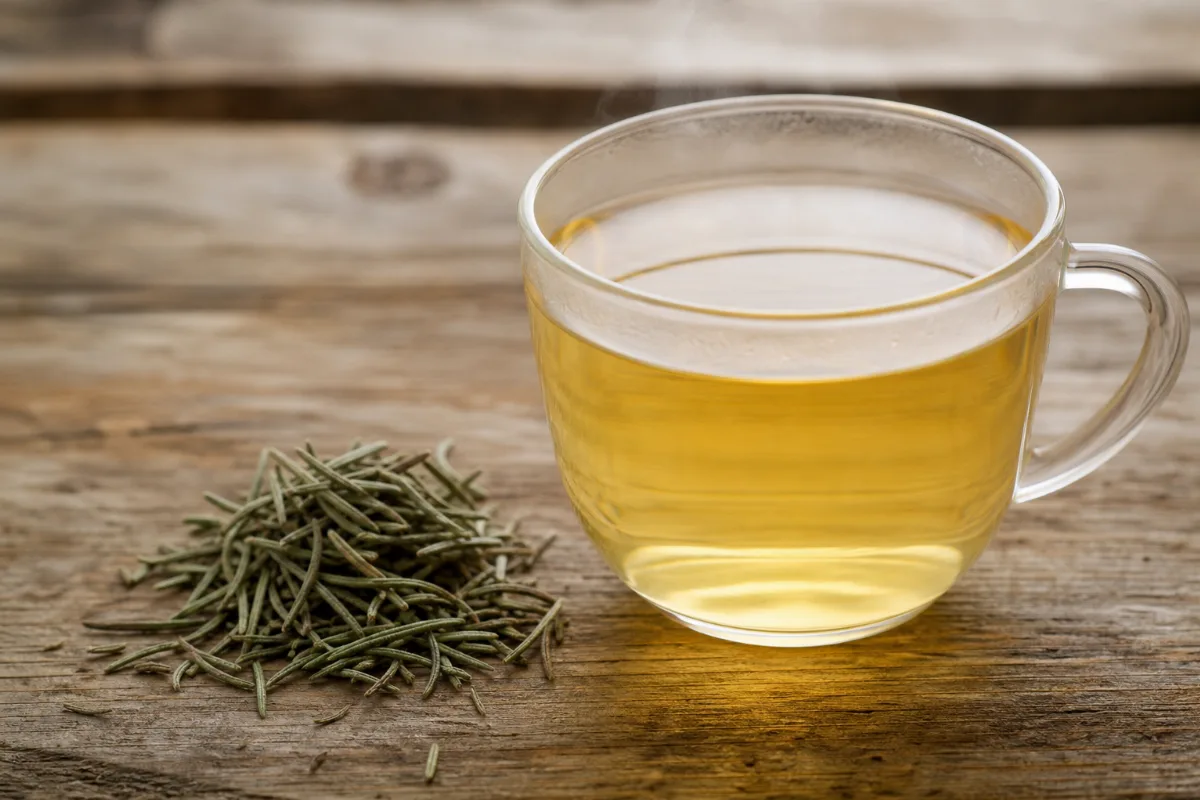
Rosemary tea is a herbal drink made by steeping dried rosemary leaf in hot water. It is not true tea, and rosemary is not known as a source of caffeine. Only two small human studies tested the tea itself, and neither had a placebo group. The main cautions are pregnancy, bile duct and liver conditions, allergy, and the oil, which should never be swallowed.
General information, not medical advice. Last substantive update · Not medically reviewed. A named clinician has not signed off on this page. How this page is made
About Rosemary Tea
Rosemary tea is a herbal drink from the leaf of Salvia rosmarinus. Only two small human studies tested the tea itself, so most claims rest on tradition, other rosemary forms and animal work. Cautions: pregnancy, liver and bile duct conditions, allergy, and never swallowing the oil.
What it is
Rosemary tea is made from the dried leaf of Salvia rosmarinus Spenn., a shrub in the mint family (Lamiaceae). Older papers and the EU monograph call it Rosmarinus officinalis L., which is now treated as a synonym.
It is a herbal tea, not true tea (Camellia sinensis). Rosemary is not known as a source of caffeine, and no source we read lists caffeine in it. Blends and flavoured products can add other ingredients, so check the label if you want a caffeine-free drink.
What the research shows
Two small human studies used rosemary tea. One was a 10-day pilot in 22 healthy adults that measured blood markers. The other followed 40 people with type 2 diabetes for 90 days. Neither described a placebo group.
Better-designed trials exist, but they tested other products: a commercial rosemary water, a rosemary drink, oral rosemary of unstated form and extract capsules. They found small gains on memory and mood scores. Reviews call for more and better trials. Animal results, often quoted in articles about rosemary, do not show what the tea does in people.
Tea, oil, extract and capsules
These are different products. The tea is the leaf infused in water. The essential oil is highly concentrated and is meant for the skin or for smelling, not for swallowing; reviews list it among oils that can cause seizures when swallowed. Extracts and capsules are stronger than tea, and most lab and animal findings come from isolated compounds such as carnosol.
The hair-loss trials used the oil on the scalp. Results from one form should not be assumed for another. For amounts, ask your doctor or pharmacist.
Where it comes from
The EU herbal committee accepts rosemary leaf tea as a traditional medicine for indigestion and mild gut cramps, based on long use. Researchers describe rosemary as traditionally taken as an infusion in folk medicine, and a review calls it the herb of remembrance. We did not find a source that dates the first rosemary teas, so older history is not claimed.
What happens in the body
In healthy adults, rosemary tea polyphenols were only partly absorbed and were heavily changed, mostly by gut bacteria. About 22% of the amount drunk was found in urine as breakdown products. That study measured absorption only, not any health effect.
At a glance
Traditional uses history, not proof
- European traditional medicine: the EU herbal committee accepts rosemary leaf as a herbal tea for indigestion and mild gut cramps, based on long use rather than trials
- Folk medicine: researchers say rosemary is traditionally taken as an infusion for several illnesses, including low mood and anxiety
- Memory folklore: rosemary has long been called the herb of remembrance (a reputation, not proof)
Studied for research
- Blood markers linked to mood (BDNF), very low (one 22-person pilot of the tea, no comparison group)
- Memory and attention, low (small trials of other forms, none of tea)
- Anxiety and low-mood scores, low (one student trial of oral rosemary, form not stated)
- Blood sugar markers in type 2 diabetes, very low (one small tea study, no placebo)
- Indigestion, insufficient (traditional use only)
- Hair loss, low for the oil on the scalp; nothing for the tea
Main compounds
- Rosmarinic acid, a phenolic acid broken down by gut bacteria after tea
- Carnosic acid and carnosol, rosemary diterpenes studied in the lab
- 1,8-Cineole and camphor, oil constituents linked to seizures in case reports of the oil
- No source we read lists caffeine in rosemary
Common forms
- Rosemary leaf tea (dried leaf infused in hot water)
- Rosemary essential oil (not a drink)
- Hydroalcoholic extracts and capsules used in some trials
- Blends with other herbs
Research links: EU herbal monograph on rosemary leaf (EMA) · Rosemary tea and anxiety and depression markers: a pilot (2022) · Rosemary tea in type 2 diabetes (2019) · Absorption of rosemary tea polyphenols in humans (2021) · Toxicity and safety of rosemary: a review (2025) · Research Library · Genes & Biomarkers Library
What it is and its history
- Accepted scientific name
- Salvia rosmarinus Spenn.
- Naming authority
- Spenn.; ACCEPTED in the GBIF backbone (usageKey 10902460), checked 2026-10-25. Rosmarinus officinalis L. (GBIF key 2926634) is a synonym that points to it.
- Synonyms
- Rosmarinus officinalis L. (GBIF synonym; the name most trials and the EU monograph use)
- Common names
- Rosemary (English); Rosemary leaf tea (English); Rosmarini folium (Latin (pharmacopoeia name for the leaf; used in the EU monograph title as 'folium'))
- Family or group
- Lamiaceae (the mint family).
- Classification
- Plantae > Tracheophyta > Lamiales > Lamiaceae > Salvia > Salvia rosmarinus
- Native range
- Not verified from a botanical source read.
- Habitat
- Not verified.
- What it looks like
- Roots: Not verified.; Stems: Not verified.; Leaves: The leaf is the part used for the tea; the EU monograph describes the dried leaf (folium).; Flowers: Not verified.; Fruit: Not verified.
- Cultivation
- Not verified.
- Harvest and processing
- Dried leaf, whole or in pieces, is infused in hot water to make the tea (EU monograph).
- Look-alikes and adulterants
- Name: Camellia sinensis (true tea); Note: A different plant. Rosemary tea is a herbal tea made from rosemary leaf only.; Name: Rosemary essential oil; Note: A concentrated oil with camphor and cineole; not a tea and not for drinking.; Name: Rosemary extracts and capsules; Note: Concentrated products made from the same plant; trial results for them do not automatically apply to a cup of tea.
- Sustainability and conservation
- Not verified.
Photographs
Traditional use and history history, not clinical proof
| Tradition or era | Documented use | Source |
|---|---|---|
| European traditional medicine | The EU herbal committee accepts rosemary leaf, taken as a herbal tea, as a traditional medicine for indigestion and mild gut cramps, and as a bath additive, based on long-standing use rather than trials. | s-ema-hmpc-rosemary-leaf |
| Folk medicine (infusion) | The authors of a 2022 pilot say rosemary is traditionally used as an infusion for several illnesses, including anxiety and depression, and the authors of a 2021 absorption study say it is commonly consumed as a tea in traditional cuisine and folk medicine. | p33565922 |
| Memory folklore | A 2022 animal review says rosemary has long been known as the herb of remembrance. | p35170682 |
| Origins of the tea tradition | No source we read dates the first rosemary teas. Older history is not claimed. | s-ema-hmpc-rosemary-leaf |
Traditional use shows how it was used. It does not show that it works or is safe today.
What is inside, and how it may work
What it contains and how those compounds act in cells and animals. Laboratory and animal mechanisms are not proven effects in people.
Main compounds
| Compound | Family | Where it is concentrated | Activity studied | Level of evidence |
|---|---|---|---|---|
| Rosmarinic acid PubChem 5281792 | Phenolic acid | Leaf | Named in the EU assessment as a main leaf constituent. In people, tea polyphenols such as rosmarinic acid are broken down to caffeic acid forms by gut bacteria. 7 1 22 | Human data |
| Carnosic acid PubChem 65126 | Phenolic diterpene | Leaf | Named in the EU assessment as a main constituent. Relaxed rat arteries in the lab. Whether much ends up in a cup of tea was not shown in the sources read, because the compounds are fat-soluble. 7 17 22 | Laboratory research |
| Carnosol PubChem 442009 | Phenolic diterpene | Leaf | Blocked platelet clumping in rabbit platelets in a dish; linked to skin allergy in case reports. 7 16 18 22 | Laboratory research |
| 1,8-Cineole and camphor PubChem 2758 | Monoterpenes (oil constituents) | Essential oil of the leaf | Constituents of the essential oil linked to seizures in case reports. They matter for the oil, not for a normal cup of tea. 5 4 22 | Human data |
Mechanisms, receptors and pathways
| Target or pathway | Gene or receptor | What was found | Level |
|---|---|---|---|
| Gut-bacteria metabolism of tea polyphenols | Not specified | In healthy adults, rosemary tea polyphenols were partly absorbed and heavily converted to conjugates and bacterial products; about 22% of the amount drunk appeared in urine as phenolic products. 1 | Human data |
| Blood markers BDNF and TNF-alpha | BDNF; TNF | Both rose after 10 days of tea in a 22-person pilot with no comparison group; what this means is unknown. 2 | Human data |
| Vascular potassium channels | KCNQ4 / KCNQ5 | Rosemary extract, carnosol and carnosic acid activated these channels and relaxed rat arteries in the lab. 17 | Laboratory research |
| Platelet thromboxane receptor | TXA2 receptor | Carnosol inhibited collagen-induced platelet clumping in rabbit platelets and appeared to block the thromboxane A2 receptor. 16 | Laboratory research |
| Iron binding in the gut | Not specified | Rosemary extract added to a meal lowered non-haem iron absorption in 14 women; phenolic compounds may bind iron. 29 | Human data |
Absorption, metabolism and elimination
- Absorption
- After rosemary tea, 48 compounds were found in plasma and urine; most were conjugated forms and few were unchanged, pointing to small-intestine absorption and heavy further processing in the colon.
- Distribution
- Not described in the abstract.
- Metabolism
- Extensive phase II conjugation; gut bacteria turn rosmarinic acid into caffeic acid forms and smaller phenolic acids.
- Elimination
- About 22.3% of the amount drunk was recovered in urine as phenolic products (235 umol of 1055 umol).
- Bioavailability
- Partial; heavily metabolised.
Isolated compounds versus whole extracts
Many trials used rosemary water, a drink, capsules or hydroalcoholic extracts; the hair trials used the oil; lab work uses single compounds such as carnosol. These differ from a cup of leaf tea in strength and in which compounds they contain, so results should not be carried across. Only two small human studies (22 and 40 people) used a leaf tea.
Nutritional composition
Rosemary tea is not a source of caffeine as far as the sources read show: it comes from a mint-family plant, not Camellia sinensis, and no source we read lists caffeine among its constituents. It is not a meaningful source of calories or nutrients.
3 low certainty2 very low certainty2 not enough evidence
What was looked at
The 7 benefits and uses checked for Rosemary Tea, each with how strong the evidence is. Tap one to open it.
- Blood markers linked to mood and anxiety (tea pilot)Very low certainty
- Memory, thinking and attention (other forms, not tea)Low certainty
- Anxiety, low mood and sleep scores (oral rosemary, not tea)Low certainty
- Memory in animals (extracts and compounds)Not enough evidence
- Blood sugar markers in type 2 diabetes (tea, one small study)Very low certainty
- Indigestion and mild gut cramps (traditional use)Not enough evidence
- Hair loss (rosemary oil on the scalp, not tea)Low certainty
Lab markers tracked in the studies
BDNF (brain-derived neurotrophic factor)TNF-alphaCortisolCognition score (MoCA-B)HbA1c (average blood sugar)Insulin resistanceHair count
What is Rosemary Tea good for?
The main studied uses of rosemary tea and how strong the human evidence is for each. 'Low' means a small trial or two; 'very low' means a single study with weak measures; 'insufficient' means no usable human data. Most trials used other forms, not tea; this is stated each time.
Benefits, one by one
Each card is a research question, not a promise. Tap a goal to filter. Open a card to see the studies, doses and limits.
Blood markers linked to mood and anxiety (tea pilot)
Very low certaintyIn one small pilot with no comparison group, healthy adults who drank rosemary tea daily for 10 days had higher BDNF and TNF-alpha in their blood. These are lab markers, not feelings. The study does not show the tea lowers anxiety or depression.
1 studiesRosemary leaf tea (dried leaf infused in hot water), once daily; amou…
Studies, doses and limits
What the trials found
Twenty-two healthy adults aged 20 to 50 drank rosemary tea once a day for 10 days. Blood was taken before and after. BDNF rose (about 22,400 to 41,800 pg/mL, p = 0.006) and TNF-alpha rose (about 39.5 to 56.2 pg/mL, p = 0.016). Cortisol, IL-6, IL-4 and interferon-gamma did not change significantly. The abstract describes no comparison group and no mood questionnaire.
Results
Higher BDNF and TNF-alpha after 10 days; cortisol and other markers unchanged.
Effect sizes as reported
BDNF 22,364 to 41,804 pg/mL (p = 0.006); TNF-alpha 39.49 to 56.24 pg/mL (p = 0.016); 22 people; no confidence intervals in the abstract.
Why this rating
One pilot of 22 healthy people, no comparison group described, lab markers only, no symptoms measured, short.
Form and dose studied
Rosemary leaf tea (dried leaf infused in hot water), once daily; amounts are in the abstract.
Who was studied
Healthy adults aged 20 to 50.
Limits
No comparison group; markers, not symptoms; healthy volunteers; the authors themselves ask for larger and longer studies.
Why researchers looked
Rosemary tea is a traditional drink, and animal work suggests rosemary extracts may act like an antidepressant. The authors wanted to see whether the tea changes blood markers in people.
Traditional use
The authors say rosemary has traditionally been used as an infusion for several illnesses, including anxiety and depression. This is traditional use, not proof.
Proposed mechanism Preliminary mechanism
BDNF is a protein that supports nerve cells and is often low in depression, so the authors treated a rise as a good sign. Whether a rise after tea means anything for mood is not known. TNF-alpha is an inflammation signal, and its rise is hard to read as a benefit.
A proposed mechanism does not show that the effect happens in people.
No side effects are described in the abstract.
Memory, thinking and attention (other forms, not tea)
Low certaintySmall trials of rosemary water, a rosemary drink, capsules and an extract found some better test scores. None of them tested a cup of rosemary leaf tea, so they cannot be carried over to the tea.
5 studiesCommercial rosemary water, a rosemary drink, oral rosemary of unstate…
Studies, doses and limits
What the trials found
A single-session trial of 80 healthy adults compared 250 mL of a commercial rosemary water (extract plus hydrolat) with plain mineral water and found a number of small benefits on thinking tasks. A pilot of 48 adults found medium effects on brain-wave markers of attention after a rosemary-containing drink. A one-month trial of 68 students taking oral rosemary (form not stated) found better memory scores than placebo. A two-month trial of 77 people with COPD taking extract capsules found a higher cognition score than placebo (P = 0.022), but two daily-living scales did not clearly differ. A 2024 review says only a few clinical studies exist and more are needed.
Results
Small gains on tests in four small trials of products that were not leaf tea; no trial of the tea.
Effect sizes as reported
Not pooled. 80, 48, 68 and 77 people in the four trials; the abstracts give mostly p-values and medium or small effects, not clinical-size gains.
Why this rating
Several small randomised trials, but different products (water, drink, capsules, extract), short, mostly healthy or young people, self-reported or brain-wave measures; none used tea.
Form and dose studied
Commercial rosemary water, a rosemary drink, oral rosemary of unstated form, and extract capsules. Not leaf tea.
Who was studied
Healthy adults; university students; adults with COPD.
Limits
Not tea; short; small; funding not stated in the abstracts; results from different products cannot be added together.
Why researchers looked
Rosemary has long been called the herb of remembrance, and its aroma and extracts have been tested for memory.
Traditional use
A 2022 animal review calls rosemary 'the herb of remembrance'. This is a folk reputation.
Proposed mechanism Preliminary mechanism
Proposed ideas include effects on the enzyme that breaks down acetylcholine and on oxygen use in the brain; these come from animal, lab and small human work and are not settled.
A proposed mechanism does not show that the effect happens in people.
The abstracts do not report side effects. See the Safety tab.
Anxiety, low mood and sleep scores (oral rosemary, not tea)
Low certaintyIn one month-long trial in university students, oral rosemary lowered anxiety and depression scores more than placebo. The abstract does not say the rosemary was tea, and sleep onset and sleep length did not change.
1 studiesOral rosemary, form not stated. Not shown to be tea.
Studies, doses and limits
What the trials found
In a double-blind trial, 68 students took oral rosemary or placebo twice a day for one month. Scores on the memory, anxiety and depression scales and most sleep-quality items were better than placebo; sleep latency and sleep duration did not differ.
Results
Better anxiety and depression questionnaire scores than placebo in students; sleep latency and duration unchanged.
Effect sizes as reported
68 students; the abstract gives significance only, no effect sizes.
Why this rating
One small randomised, placebo-controlled trial in young students, one month, self-rated scales, form of rosemary not stated, not repeated here.
Form and dose studied
Oral rosemary, form not stated. Not shown to be tea.
Who was studied
University students in Iran.
Limits
Form of rosemary unknown; one month; healthy students rather than patients; self-rated.
Why researchers looked
Rosemary is traditionally used for low mood and nerves, and a few small trials have tried it.
Traditional use
Used as an infusion in folk medicine for nerves and low mood, according to the tea pilot authors.
Proposed mechanism Preliminary mechanism
Not established in people. Animal studies suggest rosemary extracts may have antidepressant-like effects.
A proposed mechanism does not show that the effect happens in people.
Side effects are not reported in the abstract.
Memory in animals (extracts and compounds)
Not enough evidenceA review of lab-animal studies found better memory-test results with rosemary extracts or compounds. This is animal work only and says little about a cup of tea.
1 studiesExtracts and isolated compounds in animals.
Studies, doses and limits
Results
Better memory results in rodents given extracts or compounds.
Effect sizes as reported
SMD 1.19 (0.74 to 1.64) in intact animals; large heterogeneity.
Why this rating
Animal evidence only; large heterogeneity; extracts and isolated compounds, not tea.
Form and dose studied
Extracts and isolated compounds in animals.
Who was studied
Lab animals.
Limits
Animals; heterogeneity; not tea.
Why researchers looked
Animal studies come before human trials and show whether an idea is worth testing.
Traditional use
See above.
Proposed mechanism Preliminary mechanism
Proposed: protection of nerve cells, effects on acetylcholine breakdown and on oxidative stress. Lab and animal findings only.
A proposed mechanism does not show that the effect happens in people.
Not applicable.
Blood sugar markers in type 2 diabetes (tea, one small study)
Very low certaintyIn one small study without a placebo group, people with type 2 diabetes who drank rosemary tea for 90 days (while staying on their diabetes drugs) had lower HbA1c and insulin resistance. This cannot be credited to the tea.
1 studiesRosemary leaf tea; amount in the abstract.
Studies, doses and limits
What the trials found
Forty people with type 2 diabetes who were taking metformin and/or glibenclamide drank rosemary tea each day for 90 days. Body mass index, waist-hip ratio, HbA1c, insulin resistance, beta-cell function score and lipid peroxides were lower (p < 0.05). The abstract describes no placebo group and gives no numbers.
Results
Lower HbA1c, insulin resistance and body measures over 90 days in a single group.
Effect sizes as reported
Not given in the abstract; 40 people.
Why this rating
One small single-group study, no placebo group described, no numbers in the abstract, people stayed on their medicines, in a lower-profile journal.
Form and dose studied
Rosemary leaf tea; amount in the abstract.
Who was studied
Adults with type 2 diabetes in Mexico.
Limits
No placebo group; other changes (diet, drugs, time) may explain the results; small.
Why researchers looked
Earlier work with rosemary leaf powder in capsules suggested lower glucose; the authors tried a tea because the capsule dose was large.
Traditional use
Rosemary is used in folk medicine for several conditions, according to the authors.
Proposed mechanism Preliminary mechanism
Not shown. The authors suggest polyphenols may help; this study did not test a mechanism.
A proposed mechanism does not show that the effect happens in people.
The abstract does not report low-blood-sugar episodes or other side effects. People with diabetes should not change their treatment because of a tea.
Indigestion and mild gut cramps (traditional use)
Not enough evidenceThe EU herbal committee accepts rosemary leaf tea as a traditional medicine for indigestion and mild gut cramps. That rests on long use only. We found no trial of the tea for digestion.
1 studiesRosemary leaf infusion (herbal tea) in the EU monograph.
Studies, doses and limits
What the trials found
No human trial of the tea for digestion was found. The EU category is for traditional products, which do not need proof of effect.
Results
No trial data.
Why this rating
Traditional-use status only; no trials found.
Form and dose studied
Rosemary leaf infusion (herbal tea) in the EU monograph.
Who was studied
Adults and adolescents in the EU monograph.
Limits
A regulatory category for traditional use is not evidence that the tea works.
Why researchers looked
This is the use the EU committee lists for the tea.
Traditional use
Long-standing traditional use in Europe, as recorded in the EU monograph.
Proposed mechanism Traditional use
Not established.
A proposed mechanism does not show that the effect happens in people.
The monograph says to see a doctor if symptoms last or get worse. See the Safety tab.
Hair loss (rosemary oil on the scalp, not tea)
Low certaintyRosemary oil on the scalp matched minoxidil 2% in one six-month trial, and a 2025 network meta-analysis of male pattern hair loss compares topical rosemary oil with drugs. This is about the oil rubbed on the scalp. No study tested drinking the tea for hair.
3 studiesRosemary oil applied to the scalp (not tea).
Studies, doses and limits
What the trials found
In a trial of 100 people with pattern hair loss, rosemary oil and minoxidil 2% were compared for six months. Neither group changed at three months; at six months both had higher hair counts than at the start, with no difference between them. Scalp itching rose in both groups and was more frequent with minoxidil. There was no placebo group. A 2025 network meta-analysis of 24 trials in men gives guidance on topical rosemary oil compared with drugs; the abstract gives no rosemary figure. A 2025 review of 16 randomised herbal trials says rosemary was among herbs with promising results but that study quality varied.
Results
Similar hair-count rise to minoxidil at six months; no placebo group.
Effect sizes as reported
100 people; no hair-count figures in the abstract.
Why this rating
One randomised comparison with a drug but no placebo, a meta-analysis whose abstract does not give the rosemary result, and mixed-quality reviews. This is about the oil on the scalp; for the tea there is no evidence.
Form and dose studied
Rosemary oil applied to the scalp (not tea).
Who was studied
People with pattern hair loss.
Limits
No placebo group; oil not tea; short; abstract-level detail only.
Why researchers looked
Rosemary oil is popular for hair, and a few trials have compared it with drugs.
Traditional use
Popular folk and cosmetic use of the oil on hair.
Proposed mechanism Preliminary mechanism
The trial authors suggest better blood flow in the tiny vessels of the scalp. This is a proposed idea.
A proposed mechanism does not show that the effect happens in people.
Scalp itching was reported. See the Safety tab for skin allergy.
Connections to the rest of health
How Rosemary Tea connects to the rest of our health knowledge graph. Every link says what kind of connection it is. A safety link (for example to the liver) is a warning, not a benefit. A study that merely mentions a topic never creates a benefit link.
Explore every connection: goals, body systems, organs, symptoms, genes
A. Wellness goals
| Connected to | Kind of connection | Evidence status | Context | Studies |
|---|---|---|---|---|
| Mood Balance | Potential benefit | Very low certainty | Blood markers linked to mood and anxiety (tea pilot): In one small pilot with no comparison group, healthy adults who drank rosemary tea daily for 10 days had higher BDNF and TNF-alpha in their blood. These are lab markers, not feelings. The study does not show the tea lowers anxiety or depression. Anxiety, low mood and sleep scores (oral rosemary, not tea): In one month-long trial in university students, oral rosemary lowered anxiety and depression scores more than placebo. The abstract does not say the rosemary was tea, and sleep onset and sleep length did not change. | 2 24 |
| Anxiety Support | Potential benefit | Very low certainty | Blood markers linked to mood and anxiety (tea pilot): In one small pilot with no comparison group, healthy adults who drank rosemary tea daily for 10 days had higher BDNF and TNF-alpha in their blood. These are lab markers, not feelings. The study does not show the tea lowers anxiety or depression. Anxiety, low mood and sleep scores (oral rosemary, not tea): In one month-long trial in university students, oral rosemary lowered anxiety and depression scores more than placebo. The abstract does not say the rosemary was tea, and sleep onset and sleep length did not change. | 2 24 |
| Memory Support | Potential benefit | Low certainty | Memory, thinking and attention (other forms, not tea): Small trials of rosemary water, a rosemary drink, capsules and an extract found some better test scores. None of them tested a cup of rosemary leaf tea, so they cannot be carried over to the tea. | 20 28 24 19 25 |
| Brain Health | Potential benefit | Low certainty | Memory, thinking and attention (other forms, not tea): Small trials of rosemary water, a rosemary drink, capsules and an extract found some better test scores. None of them tested a cup of rosemary leaf tea, so they cannot be carried over to the tea. | 20 28 24 19 25 |
| Better Sleep | Potential benefit | Low certainty | Anxiety, low mood and sleep scores (oral rosemary, not tea): In one month-long trial in university students, oral rosemary lowered anxiety and depression scores more than placebo. The abstract does not say the rosemary was tea, and sleep onset and sleep length did not change. | 24 |
| Memory Support | Biological association | Not enough evidence | Memory in animals (extracts and compounds): A review of lab-animal studies found better memory-test results with rosemary extracts or compounds. This is animal work only and says little about a cup of tea. | 15 |
| Brain Health | Biological association | Not enough evidence | Memory in animals (extracts and compounds): A review of lab-animal studies found better memory-test results with rosemary extracts or compounds. This is animal work only and says little about a cup of tea. | 15 |
| Blood Sugar Balance | Potential benefit | Very low certainty | Blood sugar markers in type 2 diabetes (tea, one small study): In one small study without a placebo group, people with type 2 diabetes who drank rosemary tea for 90 days (while staying on their diabetes drugs) had lower HbA1c and insulin resistance. This cannot be credited to the tea. | 27 |
| Digestive Support | Traditional use | Not enough evidence | Indigestion and mild gut cramps (traditional use): The EU herbal committee accepts rosemary leaf tea as a traditional medicine for indigestion and mild gut cramps. That rests on long use only. We found no trial of the tea for digestion. | 6 |
| Hair Support | Potential benefit | Low certainty | Hair loss (rosemary oil on the scalp, not tea): Rosemary oil on the scalp matched minoxidil 2% in one six-month trial, and a 2025 network meta-analysis of male pattern hair loss compares topical rosemary oil with drugs. This is about the oil rubbed on the scalp. No study tested drinking the tea for hair. | 26 12 3 |
B. Body systems
| Connected to | Kind of connection | Evidence status | Context | Studies |
|---|---|---|---|---|
| Nervous System | Biological association | Very low certainty | Studied for: Blood markers linked to mood and anxiety (tea pilot) Studied for: Memory, thinking and attention (other forms, not tea) | 2 20 28 24 19 25 15 |
| Endocrine System | Biological association | Very low certainty | Studied for: Blood sugar markers in type 2 diabetes (tea, one small study) | 27 |
| Digestive System | Biological association | Not enough evidence | Studied for: Indigestion and mild gut cramps (traditional use) | 6 |
| Integumentary System | Biological association | Low certainty | Studied for: Hair loss (rosemary oil on the scalp, not tea) | 26 12 3 |
C. Body parts and organs
| Connected to | Kind of connection | Evidence status | Context | Studies |
|---|---|---|---|---|
| Liver and gallbladder | Authoritative guidance | EU asks for supervision in liver and bile duct disease; no injury cases found. Preparation or compound: Rosemary leaf tea |
6 | |
| Skin | Adverse effect or risk | Low certainty | Allergic contact dermatitis in case reports. Preparation or compound: Rosemary herb or extracts on skin |
18 |
E. Health conditions
I. Biomarkers
| Connected to | Kind of connection | Evidence status | Context | Studies |
|---|---|---|---|---|
| BDNF | Biological association | Very low certainty | Higher in blood after 10 days of tea in a 22-person pilot. Preparation or compound: Rosemary leaf tea |
2 |
| HbA1c | Potential benefit | Very low certainty | Lower after 90 days in one 40-person study without a placebo group. Preparation or compound: Rosemary leaf tea |
27 |
| BDNF (brain-derived neurotrophic factor) | Biological association | Very low certainty | Measured in trials: raised. A lab change is not the same as a health benefit. | 2 |
| TNF-alpha | Biological association | Very low certainty | Measured in trials: raised. A lab change is not the same as a health benefit. | 2 |
| Cortisol | Biological association | Very low certainty | Measured in trials: no-change. A lab change is not the same as a health benefit. | 2 |
| Cognition score (MoCA-B) | Biological association | Low certainty | Measured in trials: raised. A lab change is not the same as a health benefit. | 19 |
| HbA1c (average blood sugar) | Biological association | Very low certainty | Measured in trials: lowered. A lab change is not the same as a health benefit. | 27 |
| Insulin resistance | Biological association | Very low certainty | Measured in trials: lowered. A lab change is not the same as a health benefit. | 27 |
| Hair count | Biological association | Low certainty | Measured in trials: raised. A lab change is not the same as a health benefit. | 26 |
J. Genes, receptors and enzymes
L. Active compounds
| Connected to | Kind of connection | Evidence status | Context | Studies |
|---|---|---|---|---|
| Rosmarinic acid | Biological association | Human | Named in the EU assessment as a main leaf constituent. In people, tea polyphenols such as rosmarinic acid are broken down to caffeic acid forms by gut bacteria. Preparation or compound: Leaf |
7 1 22 |
| Carnosic acid | Biological association | In vitro | Named in the EU assessment as a main constituent. Relaxed rat arteries in the lab. Whether much ends up in a cup of tea was not shown in the sources read, because the compounds are fat-soluble. Preparation or compound: Leaf |
7 17 22 |
| Carnosol | Biological association | In vitro | Blocked platelet clumping in rabbit platelets in a dish; linked to skin allergy in case reports. Preparation or compound: Leaf |
7 16 18 22 |
| 1,8-Cineole and camphor | Biological association | Human | Constituents of the essential oil linked to seizures in case reports. They matter for the oil, not for a normal cup of tea. Preparation or compound: Essential oil of the leaf |
5 4 22 |
Each connection is stored with the ingredient, the connected record, the kind of connection, the evidence status, the supporting studies, the preparation or compound involved, and a review date (last reviewed October 25, 2026).
Evidence at a glance: what changed in 7 lab markers
Tap a number to show only those markers. Counts are markers, not people.
The evidence
The research centre for Rosemary Tea. Every record here was checked against PubMed or the publisher's page; we never list a study we have not verified.
Evidence by outcome
Bars show how many studies we found for each outcome, not how well it works. People are added up across trials only (reviews are not added, to avoid double counting).
How we rate evidence
High certainty
Several well-run trials or reviews agree; further research is unlikely to change the picture much.
Moderate certainty
Good trials point the same way, but some doubt remains.
Low certainty
Small, short or inconsistent trials. The finding could change with better research.
Very low certainty
Very little or very weak human data. Treat as a possibility only.
Mixed findings
Trials or reviews disagree with each other.
Not enough evidence
Not enough human research to say either way.
Evidence against
Good research found no benefit, or found harm.
We take the reviewers' own risk-of-bias and GRADE statements where they exist, and otherwise judge from study size, design, consistency, directness and whether a product matches what is sold. Many publications do not make evidence high. Method note: We searched PubMed, read every abstract directly, checked taxonomy through GBIF and NCBI, and read the NHS pregnancy page. The EU monograph wording was carried over from our rosemary herb research, where it was read in full, and was not re-read for this page. NCCIH, FDA, LiverTox and LactMed were not checked.
Study library: every study we checked 30
| Study | Design | People | Product, dose, length | Result |
|---|---|---|---|---|
| Achour 2021 Bioavailability and nutrikinetics of rosemary tea phenolic compounds in humans. Food Res Int · PMID 33509454 · DOI |
Human absorption study |
Healthy adults | Rosemary tea leaf not shown here (see the abstract) 24 hours (urine and plasma) |
48 compounds were found in plasma and urine. Few were intact: most polyphenols were heavily changed into conjugates and gut-bacteria products. About 22.3% of the amount drunk (235 umol of 1055 umol) appeared in urine as phenolic products. About 22% excreted as phenolic products; extensive metabolism Methods, limits and fundingOutcomes: Absorption, metabolism and urinary excretion of tea polyphenols Limitations: Absorption only; no health outcome measured; participant number not given in the abstract. Funding and conflicts: Not stated in the abstract. Read: abstract |
| Achour 2022 Rosemary Tea Consumption Alters Peripheral Anxiety and Depression Biomarkers: A Pilot Study in Limited Healthy Volunteers. J Am Nutr Assoc · PMID 33565922 · DOI |
Pilot before and after study (no comparison group described) |
22 Healthy adults aged 20 to 50 (Tunisia) |
Rosemary tea (dried leaf infusion) leaf not shown here (see the abstract) 10 days |
BDNF rose (22,364 to 41,804 pg/mL, p = 0.006) and TNF-alpha rose (39.5 to 56.2 pg/mL, p = 0.016). Interferon-gamma, cortisol, IL-4 and IL-6 changed slightly, not significantly. Higher BDNF and TNF-alpha; no change in cortisol or other markers Methods, limits and fundingOutcomes: Plasma BDNF, IL-6, IL-4, TNF-alpha, interferon-gamma, cortisol Limitations: No comparison group in the abstract; lab markers, not symptoms; healthy people; the authors call for larger and longer studies. The authors read the BDNF rise as promising for anxiety or depression, which this design cannot show. Funding and conflicts: Not stated in the abstract. Read: abstract |
| Allam 2025 Pathophysiology, conventional treatments, and evidence-based herbal remedies of hair loss with a systematic review of controlled clinical trials. Naunyn Schmiedebergs Arch Pharmacol · PMID 40536553 · DOI |
Narrative review plus systematic review of 16 randomised trials |
People with hair loss | Herbal remedies including rosemary various not shown here (see the abstract) varied · vs various |
The authors say rosemary, green tea, ginseng, Aloe vera, olive and saw palmetto 'showed promising efficacy', and that study design limitations and varied outcomes mean more rigorous research is needed. Promising but limited Methods, limits and fundingOutcomes: Hair growth, density, shedding Limitations: Mixed products and routes; the abstract does not separate rosemary or say how it was used. Funding and conflicts: Authors declare no competing interests. Read: abstract |
| Bahr 2019 The Effects of Various Essential Oils on Epilepsy and Acute Seizure: A Systematic Review. Evid Based Complement Alternat Med · PMID 31239862 · DOI |
Systematic review mixed |
Human cases, animal and lab studies | Essential oils (not tea) oil not shown here (see the abstract) |
Says internal use of essential oils such as sage, hyssop, rosemary, camphor, pennyroyal, eucalyptus, cedar, thuja and fennel can cause seizures because of thujone, 1,8-cineole, camphor or pinocamphone. Oil seizure risk Methods, limits and fundingOutcomes: Seizure risk Limitations: Essential oils, not tea; mixes human case reports with animal and lab work. Funding and conflicts: Not stated in the abstract. Read: abstract |
| Burkhard 1999 Plant-induced seizures: reappearance of an old problem. J Neurol · PMID 10460442 · DOI |
Case series plus literature survey |
3 Three patients with seizures after taking several essential oils |
Essential oils (not tea) oil not shown here (see the abstract) |
Names rosemary among 11 essential oils reported to be convulsant, because of ketones such as camphor and cineole. The three cases involved several oils taken for therapeutic purposes. Essential oil seizures (case reports) Methods, limits and fundingOutcomes: Seizures Limitations: Essential oils, not leaf tea; case reports; mixed oils. Funding and conflicts: Not stated in the abstract. Read: abstract |
| EMA Committee on Herbal Medicinal Products (HMPC) 2024 European Union herbal monograph on Rosmarinus officinalis L., folium (Final, Revision 1) EMA/HMPC/513940/2021 · Source |
Authoritative guidance |
not applicable | Rosemary (Salvia rosmarinus) leaf |
Traditional herbal medicinal use (long use, not proof of effect) of rosemary leaf as a herbal tea for dyspepsia and mild gut spasms, and as a bath additive. Contraindicated with hypersensitivity. Oral use not recommended under 12 years; medical supervision for bile duct obstruction, cholangitis, liver disease and gallstones. Pregnancy and breastfeeding: not recommended because safety is not established. Interactions: none reported. Undesirable effect: contact dermatitis, frequency not known. Overdose: none reported. Reference summary Methods, limits and fundingOutcomes: Regulatory or reference summary Limitations: Traditional-use document: it does not prove that rosemary works. As carried over from the rosemary herb file where it was read in full on 2026-10-25; not re-parsed in this build. Funding and conflicts: Not applicable (reference source). Read: summary-only |
| EMA Committee on Herbal Medicinal Products (HMPC) 2024 Assessment report on Rosmarinus officinalis L., aetheroleum and Rosmarinus officinalis L., folium (Final, Revision 1) EMA/HMPC/681037/2021 · Source |
Authoritative guidance |
not applicable | Rosemary (Salvia rosmarinus) leaf and essential oil |
Documents traditional use, composition (carnosic acid, carnosol, rosmarinic acid), rodent enzyme induction, rat toxicity, no data on interactions or human pharmacokinetics, one contact-dermatitis case from a leaf plaster, and says there are no human data to support seizures from swallowing rosemary extracts. The oil is for skin use only. Reference summary Methods, limits and fundingOutcomes: Regulatory or reference summary Limitations: Secondary summary of older studies; most safety data come from isolated compounds or animals. Carried over from the rosemary herb file (read in full there on 2026-10-25); not re-parsed in this build. Funding and conflicts: Not applicable (reference source). Read: summary-only |
| EMA Committee on Herbal Medicinal Products (HMPC) 2025 Assessment Report Summary for the Public: Rosemary leaf EMA/HMPC/387754/2025 · Source |
Authoritative guidance |
not applicable | Rosemary (Salvia rosmarinus) leaf |
Do not use rosemary leaf medicines under 12, in pregnancy or breastfeeding, with allergy to rosemary, or with bile duct obstruction, gallbladder inflammation, gallstones or any liver disease. No interactions described. Contact dermatitis possible, frequency unknown. Rests on traditional use, not clinical trials. Reference summary Methods, limits and fundingOutcomes: Regulatory or reference summary Limitations: Public summary of the monograph. Carried over from the rosemary herb file; not re-parsed in this build. Funding and conflicts: Not applicable (reference source). Read: summary-only |
| Fernandez 2014 Effectiveness of Rosmarinus officinalis essential oil as antihypotensive agent in primary hypotensive patients and its influence on health-related quality of life. J Ethnopharmacol · PMID 24269249 · DOI |
Prospective single group study (no control group) |
32 People with low blood pressure (Spain) |
Rosemary essential oil (not tea; route not given in the abstract) oil not shown here (see the abstract) 72 weeks |
Blood pressure rose (a 'clinically significant antihypotensive effect') and quality-of-life scores improved. Higher blood pressure after rosemary oil Methods, limits and fundingOutcomes: Blood pressure and quality of life Limitations: No control group; oil, not tea; route not stated in the abstract. Funding and conflicts: Not stated in the abstract. Read: abstract |
| GBIF Secretariat 2026 GBIF backbone: Salvia rosmarinus Spenn. GBIF species API · Source |
Taxonomy database plant |
not applicable | Rosemary (Salvia rosmarinus) leaf |
Checked 2026-10-25: usageKey 10902460, status ACCEPTED, family Lamiaceae, order Lamiales, rank SPECIES, exact match, confidence 98. Rosmarinus officinalis L. (key 2926634) is a SYNONYM that points to this accepted name. Reference summary Methods, limits and fundingOutcomes: Regulatory or reference summary Limitations: Database record. Funding and conflicts: Not applicable (reference source). Read: full-text |
| Ghasemzadeh Rahbardar 2025 Toxicity and safety of rosemary (Rosmarinus officinalis): a comprehensive review. Naunyn Schmiedebergs Arch Pharmacol · PMID 39096378 · DOI |
Narrative review of toxicity mixed |
Animal and lab studies plus reports | Rosemary extracts, oil and compounds various not shown here (see the abstract) varied |
Rosemary is considered safe for food preservation. Allergic reactions and dermatitis are reported. High or chronic doses may affect kidney, liver, reproduction (lower sperm and testosterone in animals) and fetal development; the authors advise caution with chronic high doses and mention drug interactions. Possible organ and reproductive effects at high or chronic doses (mostly animal) Methods, limits and fundingOutcomes: Toxicity Limitations: Narrative review; mostly animal and lab data at doses beyond tea; the authors say AI tools were used to rephrase the text. Funding and conflicts: Authors declare no competing interests. Read: abstract |
| Gupta 2025 Relative Efficacy of Conventional Monotherapies and Select Nonconventional, Over-the-Counter Products for Male Androgenetic Alopecia: A Network Meta-Analysis Study. J Cosmet Dermatol · PMID 41051009 · DOI |
Systematic review and network meta analysis |
Men with androgenetic alopecia (24 trials) | Conventional drugs and over-the-counter products including topical rosemary oil topical oil not shown here (see the abstract) 24 weeks (outcome point) · vs drugs and other products |
The review confirms oral dutasteride, minoxidil and finasteride work, and gives guidance on how some over-the-counter agents, including topical rosemary oil, compare. The abstract gives no rosemary figure. Rosemary oil compared with drugs; no figure in the abstract Methods, limits and fundingOutcomes: Change in hair density at 24 weeks Limitations: Skin use of an oil, not a tea; the abstract does not give the rosemary result. Funding and conflicts: Authors declare no conflicts of interest. Read: abstract |
| Haloui 2000 Experimental diuretic effects of Rosmarinus officinalis and Centaurium erythraea. J Ethnopharmacol · PMID 10940584 · DOI |
Animal study (rats) animal |
Wistar rats | Aqueous (water) extract of rosemary not shown here (see the abstract) 1 week · vs untreated rats |
The 8% extract increased urine and sodium, potassium and chloride loss from about day five; the 16% extract had smaller effects; creatinine clearance fell with 8%. Diuretic effect in rats Methods, limits and fundingOutcomes: Urine volume and electrolyte loss Limitations: Rats only; extract strength not comparable with tea. Funding and conflicts: Not stated in the abstract. Read: abstract |
| Huang 2023 Characterization and Pharmacokinetic Profile of Herbs and Spices' Phytochemicals over 24 h after Consumption in Overweight/Obese Adults. Mol Nutr Food Res · PMID 37310415 · DOI |
Rct (crossover, single blind) |
24 Overweight or obese adults |
A mixed Italian-herb blend that included rosemary (with a meal; not tea) leaf (dried herbs) not shown here (see the abstract) 24-hour sampling · vs meal with salt and pepper |
47 metabolites were found in plasma after the herb and spice mixtures; some appeared within 0.5 hours and others lasted up to 24 hours; compounds were absorbed and went through phase I and II metabolism. Herb-meal compounds are absorbed and metabolised Methods, limits and fundingOutcomes: Phytochemicals and metabolites in blood Limitations: A five-herb blend, so rosemary cannot be separated; added to a meal, not a tea. Funding and conflicts: Registered at ClinicalTrials.gov NCT03926442. Read: abstract |
| Hussain 2022 Cognition enhancing effect of rosemary (Rosmarinus officinalis L.) in lab animal studies: a systematic review and meta-analysis. Braz J Med Biol Res · PMID 35170682 · DOI |
Systematic review and meta analysis of animal studies animal |
23 animal studies (15 in the pooled analysis) | Rosemary extracts or active constituents various not shown here (see the abstract) varied · vs untreated or impaired animals |
Rosemary improved cognition in intact animals (effect size 1.19, 0.74 to 1.64) and in impaired animals; there was large unexplained variation between studies. Better memory test results in animals (0.74 to 1.64 (intact animals)) Methods, limits and fundingOutcomes: Memory and learning tests in lab animals Limitations: Animals only; large heterogeneity; extracts and isolated compounds, not tea. Funding and conflicts: Not stated in the abstract. Read: abstract |
| Lee 2006 Antiplatelet activity of carnosol is mediated by the inhibition of TXA2 receptor and cytosolic calcium mobilization. Vascul Pharmacol · PMID 16916624 · DOI |
Laboratory study (rabbit platelets) animal |
Washed rabbit platelets | Carnosol (isolated rosemary compound) isolated compound not shown here (see the abstract) single tests |
Carnosol inhibited collagen- and arachidonic-acid-induced platelet clumping and appeared to block the thromboxane A2 receptor. Antiplatelet action in a dish Methods, limits and fundingOutcomes: Platelet clumping Limitations: Isolated compound in rabbit platelets, not tea or people. Funding and conflicts: Not stated in the abstract. Read: abstract |
| Manville 2023 Medicinal plant rosemary relaxes blood vessels by activating vascular smooth muscle KCNQ channels. FASEB J · PMID 37535015 · DOI |
Laboratory study (cells and rat arteries) animal |
Cells and rat mesenteric arteries | Rosemary extract, carnosol and carnosic acid extract and isolated compounds not shown here (see the abstract) single tests |
Rosemary extract, carnosol and carnosic acid relaxed rat arteries through KCNQ4/KCNQ5 channels. Artery relaxation in rats Methods, limits and fundingOutcomes: Potassium-channel activity and artery relaxation Limitations: Cells and rat arteries; not tea or people. Funding and conflicts: Authors declare no competing interests. Read: abstract |
| Miroddi 2014 Rosmarinus officinalis L. as cause of contact dermatitis. Allergol Immunopathol (Madr) · PMID 23827646 · DOI |
Review of case reports |
Published case reports | Rosemary raw material and extracts (skin contact) leaf and extracts not shown here (see the abstract) |
Both rosemary extracts and raw material can cause allergic contact dermatitis; two cases of cross-reaction between rosemary and thyme are discussed. The authors say it is not common but may be under-recognised, and name carnosol as a likely cause. Allergic contact dermatitis (case reports) Methods, limits and fundingOutcomes: Contact dermatitis Limitations: Case reports, mostly skin contact rather than drinking. Funding and conflicts: Not stated in the abstract. Read: abstract |
| Momeni Safarabadi 2024 The effect of rosemary hydroalcoholic extract on cognitive function and activities of daily living of patients with chronic obstructive pulmonary disease (COPD): A clinical trial. Explore (NY) · PMID 37758539 · DOI |
Rct (triple blind, placebo controlled) |
77 Adults aged 40 to 80 with COPD (Iran) |
Rosemary hydroalcoholic extract capsules (not tea) extract not shown here (see the abstract) 2 months · vs corn-powder capsules |
Total cognition score rose more than with placebo (P = 0.022). Two daily-living scales did not clearly differ between groups. Higher cognition score with extract capsules Methods, limits and fundingOutcomes: Cognition (MoCA-B) and daily-living scales Limitations: An alcohol extract in capsules, not a tea; short; COPD patients only; registered IRCT20150919024080N16. Funding and conflicts: Not stated in the abstract. Read: abstract |
| Moss 2018 Acute ingestion of rosemary water: Evidence of cognitive and cerebrovascular effects in healthy adults. J Psychopharmacol · PMID 30318972 · DOI |
Rct (parallel, single session) |
80 Healthy adults (UK) |
A commercial rosemary water containing an extract and hydrolat of rosemary (not a leaf tea) extract and hydrolat not shown here (see the abstract) single session · vs plain mineral water |
A number of small, statistically significant benefits on cognition. Deoxygenated haemoglobin during tasks was higher after rosemary water. Small cognitive benefits after one drink Methods, limits and fundingOutcomes: Computerised cognitive tasks, mood, near-infrared brain blood-flow measures Limitations: A commercial product that is not a tea; one session; small effects; funding not stated in the abstract; whether the rosemary water was tested by its maker is not stated. Funding and conflicts: Not stated in the abstract. Read: abstract |
| NCBI 2026 NCBI Taxonomy: Salvia rosmarinus NCBI Taxonomy · Source |
Taxonomy database plant |
not applicable | Rosemary (Salvia rosmarinus) leaf |
Checked 2026-10-25 by E-utilities search: Salvia rosmarinus is TaxId 39367. Reference summary Methods, limits and fundingOutcomes: Regulatory or reference summary Limitations: Database record. Funding and conflicts: Not applicable (reference source). Read: full-text |
| NCBI PubChem 2026 PubChem records for rosemary compounds PubChem PUG REST · Source |
Chemistry database plant |
not applicable | Rosemary (Salvia rosmarinus) leaf |
Checked 2026-10-25 by name: rosmarinic acid CID 5281792 (C18H16O8); carnosic acid CID 65126 (C20H28O4); carnosol CID 442009 (C20H26O4); 1,8-cineole CID 2758 (C10H18O); camphor CID 2537 (C10H16O). Reference summary Methods, limits and fundingOutcomes: Regulatory or reference summary Limitations: Database records. Funding and conflicts: Not applicable (reference source). Read: full-text |
| NHS (UK) 2026 Foods to avoid in pregnancy (drinks section) NHS website · Source |
Authoritative guidance |
not applicable | Herbal teas in pregnancy (general) |
Read 2026-10-25. Says there is not much research on the effects of drinking herbal teas in pregnancy, so it is safest to limit how much you drink; it names peppermint and chamomile as examples, avoids liquorice-root teas, and does not mention rosemary tea by name in the text read. Reference summary Methods, limits and fundingOutcomes: Regulatory or reference summary Limitations: Rosemary is not named; the advice is general to herbal teas. Funding and conflicts: Not applicable (reference source). Read: full-text |
| Nematolahi 2018 Effects of Rosmarinus officinalis L. on memory performance, anxiety, depression, and sleep quality in university students: A randomized clinical trial. Complement Ther Clin Pract · PMID 29389474 · DOI |
Rct (double blind, placebo controlled) |
68 University students (Iran) |
Oral rosemary (form not stated in the abstract; 500 mg twice a day) not shown here (see the abstract) 1 month · vs placebo |
Scores for memory, anxiety and depression and most sleep scores were significantly better than placebo; sleep latency and sleep duration did not differ. Better questionnaire scores than placebo Methods, limits and fundingOutcomes: Memory, anxiety, depression and sleep questionnaires Limitations: Form of rosemary not stated (not shown to be tea); one month; young students; self-reported scales; funding not stated in the abstract. Funding and conflicts: Not stated in the abstract. Read: abstract |
| Oresanya 2024 Deciphering Neuroprotective Effect of Rosmarinus officinalis L. (syn. Salvia rosmarinus Spenn.) through Preclinical and Clinical Studies. Curr Drug Targets · PMID 38258779 · DOI |
Narrative review mixed |
Preclinical and clinical studies | Rosemary extracts and constituents various not shown here (see the abstract) varied |
The authors describe mostly animal and lab work, say 'a few clinical studies' supported benefits, and ask for more placebo-controlled and drug-controlled trials. Mostly animal and lab evidence; few clinical studies Methods, limits and fundingOutcomes: Neuroprotective activity, memory, cognition Limitations: Narrative review (no quality rating); mostly preclinical. Funding and conflicts: Not stated in the abstract. Read: abstract |
| Panahi 2015 Rosemary oil vs minoxidil 2% for the treatment of androgenetic alopecia: a randomized comparative trial. Skinmed · PMID 25842469 |
Rct (comparative, no placebo group) |
100 People with androgenetic alopecia (pattern hair loss) |
Rosemary oil on the scalp (an oil, not a tea) oil not shown here (see the abstract) 6 months · vs minoxidil 2% |
No change at 3 months in either group. At 6 months both groups had higher hair counts than at the start, with no difference between rosemary oil and minoxidil. Scalp itching was more frequent in the minoxidil group. Similar hair-count rise to minoxidil 2% at 6 months Methods, limits and fundingOutcomes: Hair count, scalp symptoms Limitations: No placebo group; skin use of an oil, which does not tell us what drinking the tea does; the abstract gives no hair-count numbers. Funding and conflicts: Not stated in the abstract. Read: abstract |
| Quirarte-Baez 2019 A shortened treatment with rosemary tea (rosmarinus officinalis) instead of glucose in patients with diabetes mellitus type 2 (TSD). J Popul Ther Clin Pharmacol · PMID 31909576 · DOI |
Single group study (no placebo group described) |
40 People with type 2 diabetes already taking metformin and/or glibenclamide (Mexico) |
Rosemary tea leaf not shown here (see the abstract) 90 days |
After 90 days body mass index, waist-hip ratio, HbA1c, insulin resistance, beta-cell function score and lipid peroxides were lower (p < 0.05). Lower HbA1c, insulin resistance and body measures over 90 days Methods, limits and fundingOutcomes: Body measures, insulin resistance, HbA1c, beta-cell function, lipid peroxides Limitations: No placebo group described, so changes cannot be credited to the tea; people stayed on their diabetes drugs; small, one centre; the abstract gives no numbers. Funding and conflicts: Authors declare no conflicts of interest. Read: abstract |
| Riby 2023 The impact of a rosemary containing drink on event-related potential neural markers of sustained attention. PLoS One · PMID 37262036 · DOI |
Rct (pilot, between subject) |
48 Healthy adults |
A rosemary-containing drink (not a leaf tea; exact product not described in the abstract) not shown here (see the abstract) single session · vs water drink |
Medium effect sizes for the P3a and P3b brain-wave markers; the authors say the behaviour links should be treated with caution. Medium effect on brain-wave markers in a pilot Methods, limits and fundingOutcomes: EEG markers of attention (P3a, P3b) Limitations: Pilot with 48 people; brain-wave markers, not everyday attention; product is not a tea; funding not stated in the abstract (authors declare no competing interests). Funding and conflicts: Authors declare no competing interests. Read: abstract |
| Samman 2001 Green tea or rosemary extract added to foods reduces nonheme-iron absorption. Am J Clin Nutr · PMID 11237939 · DOI |
Crossover absorption study (isotope labelled) |
14 Young women aged 19 to 39 (rosemary part: n = 14) |
Phenolic-rich rosemary extract added to a test meal extract not shown here (see the abstract) 4 meals over 4 days · vs same meal without extract |
Absorption fell from 7.5% to 6.4% with the rosemary extract (P < 0.05); green tea extract (10 women) lowered it from 12.1% to 8.9%. Iron absorption 7.5% to 6.4% with rosemary extract Methods, limits and fundingOutcomes: Non-haem iron absorption Limitations: An extract added to food, not a cup of tea; small; modest drop. Funding and conflicts: Not stated in the abstract. Read: abstract |
| Yamamoto 2005 Testing various herbs for antithrombotic effect. Nutrition · PMID 15850964 · DOI |
Lab and mouse study animal |
Platelet tests and mice | Crushed fresh herb filtrates including rosemary herb juice not shown here (see the abstract) single tests |
Common thyme and rosemary showed significant antithrombotic activity in vitro and in mice; neither affected flow-mediated vasodilation. Antithrombotic activity in the lab and mice Methods, limits and fundingOutcomes: Platelet-rich thrombus formation Limitations: Lab and mouse work using fresh herb juice, not tea; no human clotting data. Funding and conflicts: Not stated in the abstract. Read: abstract |
What we do not know yet
- No placebo-controlled trial of rosemary leaf tea was found for any use.
- The two tea studies were short and small (22 and 40 people).
- Memory and mood trials used rosemary water, a drink, capsules or extracts, not tea.
- Hair-loss studies used the oil on the scalp, not the tea.
- No human study tested rosemary tea with blood thinners, blood pressure drugs, diuretics, lithium or anti-seizure drugs.
- No analysis of metals, pesticides or adulteration in rosemary tea was found.
- No safety data for tea in pregnancy, breastfeeding or children beyond the EU's lack-of-data statements.
How new research is added
New studies are found by a saved PubMed search and placed in a review queue. A person checks each one before it is added.
Lab markers
What changed in blood or saliva tests during trials. A changed number is not the same as feeling or being healthier, and we give no "normal ranges".
Hormonal 1
Cortisol
No clear change in trials
A stress hormone made by the adrenal glands.
Very low certaintyMetabolic 1
HbA1c (average blood sugar)
Lowered in trials
A blood test that shows average blood sugar over about three months.
Very low certaintyResults and what it means
Why it was measured
The main long-term marker in diabetes care.
Statistical vs. clinical meaning
A change in a single group with no placebo; cannot be credited to the tea.
Safety implication
No low-blood-sugar reports in the abstract.
| Study | Result | People | Product |
|---|---|---|---|
| 27 | Lower after 90 days (p < 0.05); no figures in the abstract | 40 people with type 2 diabetes | Rosemary tea each day plus usual diabetes drugs |
Inflammatory 1
TNF-alpha
Raised in trials
An immune signal that takes part in inflammation.
Very low certaintyResults and what it means
Why it was measured
Measured with BDNF in the pilot.
Statistical vs. clinical meaning
The authors do not explain the rise. A higher inflammation signal is not obviously a benefit.
Safety implication
Unclear; one pilot, no comparison group.
| Study | Result | People | Product |
|---|---|---|---|
| 2 | 39.5 to 56.2 pg/mL after 10 days (p = 0.016) | 22 healthy adults | Rosemary leaf tea once a day |
Other 4
BDNF (brain-derived neurotrophic factor)
Raised in trials
A protein that supports the growth and survival of nerve cells.
Very low certaintyResults and what it means
Why it was measured
Often lower in depression, so researchers use it as a possible marker of mood changes.
Statistical vs. clinical meaning
A rise in a blood marker in one uncontrolled pilot; it is not a mood or symptom result.
Safety implication
None reported.
| Study | Result | People | Product |
|---|---|---|---|
| 2 | 22,364 to 41,804 pg/mL after 10 days (p = 0.006) | 22 healthy adults | Rosemary leaf tea once a day |
Cognition score (MoCA-B)
Raised in trials
A short test of thinking, memory and attention.
Low certaintyResults and what it means
Why it was measured
Used in the COPD trial to see whether the extract changed cognition.
Statistical vs. clinical meaning
A score on a screening test in one small trial of capsules.
Safety implication
Not described in the abstract.
| Study | Result | People | Product |
|---|---|---|---|
| 19 | Total score higher with extract than corn-powder placebo (P = 0.022) | 77 adults with COPD | Rosemary hydroalcoholic extract capsules (not tea) |
Insulin resistance
Lowered in trials
How poorly the body's cells respond to insulin.
Very low certaintyResults and what it means
Why it was measured
A core problem in type 2 diabetes.
Statistical vs. clinical meaning
Same single-group limits as HbA1c.
Safety implication
None reported.
| Study | Result | People | Product |
|---|---|---|---|
| 27 | Lower after 90 days (p < 0.05); no figures in the abstract | 40 people with type 2 diabetes | Rosemary tea each day plus usual diabetes drugs |
Hair count
Raised in trials
The number of hairs counted in a set patch of scalp on photographs.
Low certaintyResults and what it means
Why it was measured
The main outcome in pattern hair loss trials.
Statistical vs. clinical meaning
Similar to a drug in a trial without a placebo; oil, not tea.
Safety implication
Scalp itching reported in both groups.
| Study | Result | People | Product |
|---|---|---|---|
| 26 | Higher at six months than at the start, with no difference from minoxidil 2% | 100 people with pattern hair loss | Rosemary oil on the scalp (not tea) |
Safety
What studies and official sources say about side effects, medicines and who should check first. Each point shows what kind of evidence it comes from.
Main points to know 8
- As a plain cup of tea, rosemary looks low risk, but the evidence is thin. The EU herbal committee, working from long use and limited data, reports no overdose and no interactions with medicines for rosemary leaf as a herbal tea. That is not the same as proof of safety. Rosemary oil, strong extracts and capsules are different products and were not tested well for long use. Authoritative guidance 6 7 8
- Pregnancy and breastfeeding: medicinal use is not recommended. The EU says safety in pregnancy and breastfeeding has not been established and does not recommend rosemary leaf medicines. The NHS says there is not much research on herbal teas in pregnancy and that it is safest to limit them; it does not name rosemary tea. Animal reviews raise reproductive concerns at high doses. Ask a midwife or doctor. Authoritative guidance 6 8 23 11
- Children: not recommended under 12 for oral use. The EU does not recommend swallowing rosemary leaf preparations under 12 years because there are not enough data. Authoritative guidance 6 8
- Bile duct, gallbladder and liver conditions need a doctor first. The EU says that bile duct obstruction, cholangitis, gallstones and other liver or bile duct disease need medical supervision before swallowing rosemary leaf. We found no case of liver injury from rosemary tea in what we read. Authoritative guidance 6 8
- Allergy and skin reactions. Allergic contact dermatitis from rosemary is documented in case reports, and the EU lists it as a side effect of unknown frequency. A rosemary allergy is a reason not to use it. Stop and see a doctor for a rash, swelling or wheezing. Case report 18 6
- Epilepsy and seizures: a warning about the oil, not shown for tea. Reviews list rosemary essential oil among oils that can trigger seizures when swallowed, because of ketones such as camphor and cineole. The EU assessment says there are no human data showing seizures after swallowing rosemary extracts. We found no seizure report linked to rosemary tea. People with epilepsy should still ask their doctor before using strong rosemary products. Case report 5 4 7
- Rosemary may slightly reduce iron absorption from a meal. In a small study, a rosemary extract added to a meal lowered iron absorption from 7.5% to 6.4%. That was an extract added to food, not tea, but people with low iron or anaemia may want to ask a doctor. Controlled trial 29
- Concentrated forms are not the same as tea. Most of the warnings about organ effects, fertility and seizures come from animal studies of strong extracts or the oil, or from the oil. A cup of tea is far weaker, but no study compared their safety directly. Animal research 11 5
Side effects 4
| Effect | How often | Severity and recovery | Evidence |
|---|---|---|---|
| Allergic contact dermatitis Mostly skin contact with the herb or extracts; drinking the tea was not the route in the cases we read. | Not known (EU lists it as unknown frequency); not common but possibly under-recognised (review) | mild to moderate Not described in the abstracts | Case report 18 6 |
| Seizures after swallowing rosemary essential oil Oil only; the tea is not an oil. The EU found no human seizure data for extracts. | Not known | severe Good outcome in two adults, worse in one child (three-case series covering several oils) | Case report 5 4 |
| Lower iron absorption from a meal Extract added to a test meal, not tea. | Seen in the 14 women studied | mild Not studied | Controlled trial 29 |
| Scalp itching (rosemary oil on the scalp) Oil on the skin, not tea. | Rose from the start in both groups of a hair trial; less than with minoxidil | mild Not described | Controlled trial 26 |
Liver
The EU monograph asks for medical supervision before swallowing rosemary leaf in people with bile duct obstruction, cholangitis, gallstones or other liver disease. We found no report of liver injury from rosemary tea in the sources read. A 2025 review of mostly animal studies at high or long-term doses reports liver and kidney changes and says caution is needed with chronic high doses. NIH LiverTox was not checked. 6 8 11
How often. No frequency is known; no human cases of liver injury from rosemary tea were found.
Monitoring. Not described in the sources. People with liver or gallbladder disease should speak to their doctor first.
This is a safety connection. It is not evidence that Rosemary Tea supports liver health.
Medicines and supplements 7
| With | Why it matters | Importance | Evidence | What to do |
|---|---|---|---|---|
| Blood thinners and antiplatelet drugs (for example warfarin or aspirin) prescription | Theory only. Carnosol, a rosemary compound, blocked platelet clumping in rabbit platelets in a dish, and fresh herb juice reduced clot formation in lab and mouse tests. | No human study of rosemary and blood clotting was found, and the EU monograph reports no interactions. The lab results are from isolated compounds or herb juice, not tea. | Pharmacological theory Very low certainty 16 30 6 | If you take a blood thinner or aspirin, ask your doctor or pharmacist before using rosemary as a remedy, and mention it before surgery. |
| Blood pressure medicines (including ACE inhibitors) prescription | Theory only. Rosemary extract and its compounds relaxed rat arteries in the lab, which could add to blood pressure drugs. In the other direction, one uncontrolled study of rosemary oil found higher blood pressure in people with low pressure. | No human study of rosemary tea with ACE inhibitors or other blood pressure drugs was found. | Pharmacological theory Very low certainty 17 9 | If you take blood pressure medicine, ask your doctor or pharmacist before using rosemary as a remedy. |
| Water pills (diuretics) and lithium prescription | Theory only. A water extract of rosemary increased urine and salt loss in rats over a week. Lithium levels depend on salt and water balance, so a diuretic effect could matter in principle; no rosemary source we read tests lithium. | No human data for rosemary with diuretics or lithium. The lithium link is a general pharmacology idea, not a finding. | Pharmacological theory Very low certainty 13 | If you take lithium or a water pill, ask your doctor or pharmacist before using rosemary as a remedy. |
| Anti-seizure medicines prescription | Theory only. The oil contains camphor and cineole, which are linked to seizures in case reports. | No interaction documented; the concern is about the oil. | Pharmacological theory Very low certainty 5 4 | If you take anti-seizure medicine, avoid rosemary oil and ask your neurologist before strong rosemary products. |
| Diabetes medicines prescription | Not shown. The one tea study enrolled people who stayed on metformin and/or glibenclamide and reported lower HbA1c. | The abstract does not report low blood sugar or any interaction, and there was no placebo group. | Controlled trial Not enough evidence 27 | Do not replace diabetes treatment with tea. Tell your care team if you drink it regularly. |
| Iron supplements and iron-rich meals supplement | Rosemary phenolic compounds may bind iron in the gut. | Iron absorption fell from 7.5% to 6.4% with rosemary extract in 14 young women; a modest drop, and an extract rather than tea. | Controlled trial Low certainty 29 | If you have low iron or anaemia, ask your doctor. |
| Medicines cleared by the liver (CYP enzymes) prescription | Rodent studies cited in the EU report suggest rosemary extracts may change liver enzyme activity. | The EU report says there are no data on drug interactions in people. | Animal research Very low certainty 7 | If you take a medicine with a narrow safe range, ask your pharmacist. |
Who should check first 6
| Situation | Advice | Evidence |
|---|---|---|
| Allergy to rosemary or a past reaction to a rosemary product | Do not use. The EU lists hypersensitivity as a contraindication. | Authoritative guidance 6 |
| Pregnancy and breastfeeding (medicinal use) | Not recommended; safety has not been established (EU). Ask a midwife or doctor. | Authoritative guidance 6 8 23 |
| Children under 12 (swallowed) | Not recommended by the EU because of lack of data. | Authoritative guidance 6 8 |
| Bile duct obstruction, cholangitis, gallstones, liver disease | Medical supervision first (EU). | Authoritative guidance 6 8 |
| Epilepsy or past seizures | Avoid the oil, and ask a doctor before strong rosemary products. The concern comes from case reports of the oil; no seizure data exist for the tea. | Case report 5 4 7 |
| Low iron or anaemia | Ask a doctor; an extract lowered iron absorption in a small study. | Controlled trial 29 |
Overdose, product quality and regulators
Summary. No overdose has been reported for rosemary leaf tea in the EU documents. Concerns come from animal studies of strong extracts and the oil.
Animal. A 2025 review of mostly animal studies reports liver and kidney changes (higher AST and urea nitrogen, tissue changes), lower sperm count, motility and testosterone, and possible effects on fetal development at high or chronic doses. A rat study of a water extract found a diuretic effect.
Human doses studied. Tea studies lasted 10 days and 90 days; no serious problems are mentioned in those abstracts.
High dose or long term signals. Chronic high doses of extracts in animals; none shown for tea in people.
Genotoxicity. The 2025 review mentions possible genotoxicity in lab work; the EU monograph says such testing has not been done for the leaf. Not confirmed for tea.
Toxic or hazardous parts. No toxic plant part for the leaf tea is named in the sources read. The essential oil is toxic if swallowed in larger amounts, including seizure risk.
We found no study of heavy metals, pesticides or adulteration specific to rosemary tea.
Heavy metals, pesticides, mould toxins. No analysis of rosemary tea was found in the sources read, so nothing can be said about typical levels. 7
Blends and added ingredients. Products sold as rosemary tea may be blends. Check the label for other herbs, and for caffeine-containing tea if you want a caffeine-free drink.
Tea, oil, extract and capsules. These are different products with different strength and risks. Results and warnings for one do not automatically apply to another. 7 11
| Body | Action | Date |
|---|---|---|
| NHS (UK) (United Kingdom) | Foods to avoid in pregnancy: says there is not much research on herbal teas in pregnancy and it is safest to limit them. Rosemary tea is not named. source | 2026-10-25 |
When to get medical help
- Rash, swelling of the lips or face, or trouble breathing after rosemary: stop and get urgent care.
- Seizure after swallowing any rosemary oil or strong rosemary product: emergency care. Never drink the essential oil.
- Yellow skin or eyes, dark urine or pale stools if you have liver or gallbladder disease: see a doctor.
- Pregnant or breastfeeding and thinking of using rosemary as a remedy: ask a midwife or doctor first.
Stop using the product and contact a clinician or emergency service. In the US, Poison Control is 1-800-222-1222.
General information only, not medical advice. Ask a clinician or pharmacist before use, especially with medicines, in pregnancy or with a health condition. See the Natural Remedy Safety guide.
Frequently asked questions
What is rosemary tea?
Is rosemary tea caffeine-free?
Does rosemary tea improve memory?
Does rosemary tea help anxiety or depression?
Does rosemary tea lower blood sugar?
Possibly, but this is not shown. One 90-day study in 40 people with type 2 diabetes saw lower HbA1c, with no placebo group. Do not replace diabetes treatment with tea.
Does rosemary tea help hair grow?
Is rosemary tea safe in pregnancy or while breastfeeding?
Is rosemary tea safe for children?
Can rosemary tea trigger seizures?
The seizure warnings are about rosemary essential oil, which should never be swallowed. The EU assessment says there are no human data showing seizures after swallowing rosemary extracts, and we found no case linked to tea. If you have epilepsy, ask your doctor before using strong rosemary products.
Does rosemary tea interact with medicines?
The EU monograph reports no interactions, but that rests on limited data. Lab and animal work raises theoretical questions about blood thinners, blood pressure drugs, water pills, lithium and anti-seizure medicines. No human study confirms these. Ask your pharmacist if you take any of them.
Is rosemary tea bad for the liver or gallbladder?
Explore by health goal
Mood BalanceAnxiety SupportMemory SupportBrain HealthBetter SleepBlood Sugar BalanceDigestive SupportHair Support
Editorial transparency
- Written by
- AlternativeMed editorial team. Research compiled with AI assistance, then checked against the original sources.
- Medical review
- None. This page has not been reviewed by a physician or pharmacist.
- First published
- 2026-10-25
- Last substantive update
- 2026-10-25
- How we research
- We searched PubMed, read every abstract directly, checked taxonomy through GBIF and NCBI, and read the NHS pregnancy page. The EU monograph wording was carried over from our rosemary herb research, where it was read in full, and was not re-read for this page. NCCIH, FDA, LiverTox and LactMed were not checked.
- How we rate evidence
- See "How we rate evidence" in the Evidence tab.
- Independence
- No product is promoted on this page. No affiliate links are shown. Funding was not stated in most abstracts.
Sources 30
Each source was opened and checked. Where we read only the abstract, it says so. The small numbers in the text point here.
- Achour M, Bravo L, Sarria B, et al.. Bioavailability and nutrikinetics of rosemary tea phenolic compounds in humans.. Food Res Int. 2021. PMID 33509454. DOI 10.1016/j.foodres.2020.109815. (abstract)
- Achour M, Ben Salem I, Ferdousi F, et al.. Rosemary Tea Consumption Alters Peripheral Anxiety and Depression Biomarkers: A Pilot Study in Limited Healthy Volunteers.. J Am Nutr Assoc. 2022. PMID 33565922. DOI 10.1080/07315724.2021.1873871. (abstract)
- Allam AT, El-Shiekh RA, El-Dessouki AM, et al.. Pathophysiology, conventional treatments, and evidence-based herbal remedies of hair loss with a systematic review of controlled clinical trials.. Naunyn Schmiedebergs Arch Pharmacol. 2025. PMID 40536553. DOI 10.1007/s00210-025-04286-6. (abstract)
- Bahr TA, Rodriguez D, Beaumont C, Allred K.. The Effects of Various Essential Oils on Epilepsy and Acute Seizure: A Systematic Review.. Evid Based Complement Alternat Med. 2019. PMID 31239862. DOI 10.1155/2019/6216745. (abstract)
- Burkhard PR, Burkhardt K, Haenggeli CA, Landis T.. Plant-induced seizures: reappearance of an old problem.. J Neurol. 1999. PMID 10460442. DOI 10.1007/s004150050429. (abstract)
- EMA Committee on Herbal Medicinal Products (HMPC). European Union herbal monograph on Rosmarinus officinalis L., folium (Final, Revision 1). EMA/HMPC/513940/2021. 2024. (summary-only)
- EMA Committee on Herbal Medicinal Products (HMPC). Assessment report on Rosmarinus officinalis L., aetheroleum and Rosmarinus officinalis L., folium (Final, Revision 1). EMA/HMPC/681037/2021. 2024. (summary-only)
- EMA Committee on Herbal Medicinal Products (HMPC). Assessment Report Summary for the Public: Rosemary leaf. EMA/HMPC/387754/2025. 2025. (summary-only)
- Fernandez LF, Palomino OM, Frutos G.. Effectiveness of Rosmarinus officinalis essential oil as antihypotensive agent in primary hypotensive patients and its influence on health-related quality of life.. J Ethnopharmacol. 2014. PMID 24269249. DOI 10.1016/j.jep.2013.11.006. (abstract)
- GBIF Secretariat. GBIF backbone: Salvia rosmarinus Spenn.. GBIF species API. 2026. (full-text)
- Ghasemzadeh Rahbardar M, Hosseinzadeh H.. Toxicity and safety of rosemary (Rosmarinus officinalis): a comprehensive review.. Naunyn Schmiedebergs Arch Pharmacol. 2025. PMID 39096378. DOI 10.1007/s00210-024-03336-9. (abstract)
- Gupta AK, Bamimore MA, Talukder M.. Relative Efficacy of Conventional Monotherapies and Select Nonconventional, Over-the-Counter Products for Male Androgenetic Alopecia: A Network Meta-Analysis Study.. J Cosmet Dermatol. 2025. PMID 41051009. DOI 10.1111/jocd.70483. (abstract)
- Haloui M, Louedec L, Michel JB, Lyoussi B.. Experimental diuretic effects of Rosmarinus officinalis and Centaurium erythraea.. J Ethnopharmacol. 2000. PMID 10940584. DOI 10.1016/s0378-8741(00)00184-7. (abstract)
- Huang Y, Edirisinghe I, Burton-Freeman BM, Sandhu AK.. Characterization and Pharmacokinetic Profile of Herbs and Spices' Phytochemicals over 24 h after Consumption in Overweight/Obese Adults.. Mol Nutr Food Res. 2023. PMID 37310415. DOI 10.1002/mnfr.202200785. (abstract)
- Hussain SM, Syeda AF, Alshammari M, et al.. Cognition enhancing effect of rosemary (Rosmarinus officinalis L.) in lab animal studies: a systematic review and meta-analysis.. Braz J Med Biol Res. 2022. PMID 35170682. DOI 10.1590/1414-431X2021e11593. (abstract)
- Lee JJ, Jin YR, Lim Y, et al.. Antiplatelet activity of carnosol is mediated by the inhibition of TXA2 receptor and cytosolic calcium mobilization.. Vascul Pharmacol. 2006. PMID 16916624. DOI 10.1016/j.vph.2006.04.003. (abstract)
- Manville RW, Baldwin SN, Eriksen EO, Jepps TA, Abbott GW.. Medicinal plant rosemary relaxes blood vessels by activating vascular smooth muscle KCNQ channels.. FASEB J. 2023. PMID 37535015. DOI 10.1096/fj.202301132R. (abstract)
- Miroddi M, Calapai G, Isola S, Minciullo PL, Gangemi S.. Rosmarinus officinalis L. as cause of contact dermatitis.. Allergol Immunopathol (Madr). 2014. PMID 23827646. DOI 10.1016/j.aller.2013.04.006. (abstract)
- Momeni Safarabadi A, Gholami M, Kordestani-Moghadam P, et al.. The effect of rosemary hydroalcoholic extract on cognitive function and activities of daily living of patients with chronic obstructive pulmonary disease (COPD): A clinical trial.. Explore (NY). 2024. PMID 37758539. DOI 10.1016/j.explore.2023.09.008. (abstract)
- Moss M, Smith E, Milner M, McCready J.. Acute ingestion of rosemary water: Evidence of cognitive and cerebrovascular effects in healthy adults.. J Psychopharmacol. 2018. PMID 30318972. DOI 10.1177/0269881118798339. (abstract)
- NCBI. NCBI Taxonomy: Salvia rosmarinus. NCBI Taxonomy. 2026. (full-text)
- NCBI PubChem. PubChem records for rosemary compounds. PubChem PUG REST. 2026. (full-text)
- NHS (UK). Foods to avoid in pregnancy (drinks section). NHS website. 2026. (full-text)
- Nematolahi P, Mehrabani M, Karami-Mohajeri S, Dabaghzadeh F.. Effects of Rosmarinus officinalis L. on memory performance, anxiety, depression, and sleep quality in university students: A randomized clinical trial.. Complement Ther Clin Pract. 2018. PMID 29389474. DOI 10.1016/j.ctcp.2017.11.004. (abstract)
- Oresanya IO, Orhan IE.. Deciphering Neuroprotective Effect of Rosmarinus officinalis L. (syn. Salvia rosmarinus Spenn.) through Preclinical and Clinical Studies.. Curr Drug Targets. 2024. PMID 38258779. DOI 10.2174/0113894501255093240117092328. (abstract)
- Panahi Y, Taghizadeh M, Marzony ET, Sahebkar A.. Rosemary oil vs minoxidil 2% for the treatment of androgenetic alopecia: a randomized comparative trial.. Skinmed. 2015. PMID 25842469. (abstract)
- Quirarte-Baez SM, Zamora-Perez AL, Reyes-Estrada CA, et al.. A shortened treatment with rosemary tea (rosmarinus officinalis) instead of glucose in patients with diabetes mellitus type 2 (TSD).. J Popul Ther Clin Pharmacol. 2019. PMID 31909576. DOI 10.15586/jptcp.v26i4.634. (abstract)
- Riby LM, Edwards S, McDonald H, Moss M.. The impact of a rosemary containing drink on event-related potential neural markers of sustained attention.. PLoS One. 2023. PMID 37262036. DOI 10.1371/journal.pone.0286113. (abstract)
- Samman S, Sandstrom B, Toft MB, et al.. Green tea or rosemary extract added to foods reduces nonheme-iron absorption.. Am J Clin Nutr. 2001. PMID 11237939. DOI 10.1093/ajcn/73.3.607. (abstract)
- Yamamoto J, Yamada K, Naemura A, Yamashita T, Arai R.. Testing various herbs for antithrombotic effect.. Nutrition. 2005. PMID 15850964. DOI 10.1016/j.nut.2004.09.016. (abstract)
Where to buy
Check the label first. Whatever you buy, look for these:
- The herb is the first or only ingredient
- Organic or lab-tested if that matters to you
- Loose leaf or tea bags, and how long they have been stored
- If you take medicines or are pregnant, ask a pharmacist about the herb first
Talk to a pharmacist or doctor before you start any supplement, especially if you take medicines. See the Safety tab for interactions.
Support our free guides: as an Amazon Associate we earn from qualifying purchases. Full disclosure.


