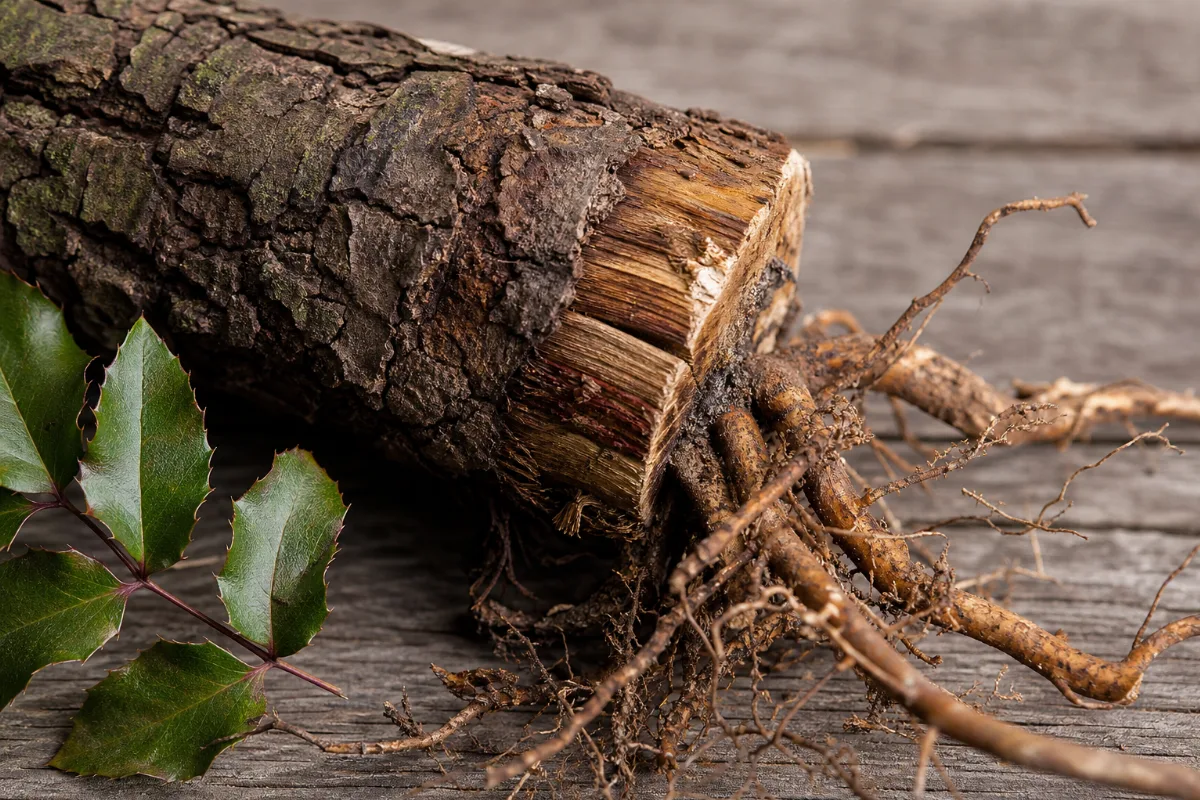
Herbs & Botanicals · Herbs · Evergreen shrub with berberine-rich root and bark; the only human trials are of skin creams
Oregon Grape
Mahonia aquifolium (Pursh) Nutt. (also filed as Berberis aquifolium) · also called Oregon grape, tall Oregon grape, hollyleaf barberry (NCBI common name), Berberis aquifolium (NCBI Taxonomy name for the same plant)
Oregon grape is an evergreen shrub of the barberry family. Its root and bark contain berberine and related alkaloids. The human research is almost all on skin creams and ointments for psoriasis, and it is weak. Nobody has tested it by mouth in people.
General information, not medical advice. Last substantive update · Not medically reviewed. A named clinician has not signed off on this page. How this page is made
About Oregon Grape
Oregon grape (Mahonia aquifolium) is a shrub whose root and bark contain berberine and related alkaloids. The human research is on skin creams for psoriasis and, less so, eczema, and the evidence is low certainty at best. Everything else is lab work. Berberine cautions apply to pregnancy, newborns and some medicines.
What it is
Oregon grape (Mahonia aquifolium) belongs to the barberry family. GBIF accepts the name Mahonia aquifolium; NCBI Taxonomy files the same plant as Berberis aquifolium. Several other plants are also called Oregon grape or Mahonia, and many papers on 'Mahonia' are about Chinese species, so results are not interchangeable.
The root and bark contain berberine and other alkaloids. Barberry and goldenseal also contain berberine, but they are different plants with their own research. NCCIH lists Oregon grape as one of the berberine-containing plants.
What people use it for, and what the research shows
The best-studied use is a cream or ointment for mild to moderate plaque psoriasis. A 12-week placebo-controlled trial of 200 adults of a branded homeopathic cream was positive, and an older half-side ointment trial of 82 people was positive by patient rating only. Two of the reviews call the evidence limited and the others say it shows promise. The branded product is the main subject of several trials and funding is not stated in their abstracts.
For eczema, the only controlled trial used a three-herb ointment and missed its main target. Acne, fungal skin problems and mouth bacteria have only lab tests. No human trial of Oregon grape taken by mouth was found.
At a glance
Traditional uses history, not proof
- Skin inflammation: reviews and lab papers describe the root and stem bark as used on inflamed skin and on skin and mucous-membrane infections (traditional use; the origin was not checked in a primary source).
Studied for research
- Plaque psoriasis (topical), low
- Psoriasis quality of life, very low
- Psoriasis skin markers, low
- Eczema (topical), very low
- Acne and skin germs, lab only
- Fungal skin problems, lab only
- Mouth bacteria, lab only
- Use by mouth, no human data
Main compounds
- Berberine, a yellow alkaloid that can affect drug-processing enzymes
- Berbamine and oxyacanthine, stronger than berberine at slowing skin-cell growth in a lab test
- Jatrorrhizine, another alkaloid with lab antimicrobial activity
Common forms
- Cream or ointment of bark or root extract (the form used in the trials)
- Branded homeopathic cream (Reliéva) used in several trials
- Root extracts (tested in cells only)
Research links: Berberine (NCCIH) · Plant extracts for topical psoriasis, meta-analysis (PubMed) · Reliéva trial in psoriasis (PubMed) · Topical Mahonia for psoriasis and eczema, review (PubMed) · Oregon grape and P-glycoprotein, cell study (PubMed) · Berberine in LiverTox (PubMed) · Research Library · Genes & Biomarkers Library
The plant and its history
- Accepted scientific name
- Mahonia aquifolium (Pursh) Nutt.
- Naming authority
- (Pursh) Nutt. (GBIF)
- Synonyms
- Berberis aquifolium Pursh (GBIF synonym, key 3033868); No other synonyms were read
- Common names
- Oregon grape (English); Hollyleaf barberry (English); Tall Oregon grape (English)
- Botanical family
- Berberidaceae (barberry family). Barberry (Berberis vulgaris) is in the same family but a different plant. Goldenseal (Hydrastis canadensis) is in a different family.
- Classification
- Plantae > Tracheophyta > Ranunculales > Berberidaceae > Mahonia > Mahonia aquifolium
- Native range
- Not verified from a primary source here.
- Habitat
- Not verified.
- What the plant looks like
- Roots: Roots, rhizomes and bark are the parts used and the alkaloid-rich parts in the papers read (stem bark and root).; Stems: Not verified.; Leaves: Holly-like leaves (implied by the common name hollyleaf); not verified in a botanical source.; Flowers: Not verified.; Fruit: Berries are discussed only in a poison-centre paper (p37828294).
- Cultivation
- Not verified.
- Harvest and processing
- Not verified. The trials used cream or ointment of bark extract; the extract type is usually not stated.
- Look-alikes and adulterants
- Name: Berberis vulgaris (barberry); Note: Different species with its own research. Do not borrow its trial results for Oregon grape.; Name: Hydrastis canadensis (goldenseal); Note: Different family; also contains berberine. Evidence is separate.; Name: Other Mahonia species (for example Mahonia bealei, a Chinese species); Note: Many papers on 'Mahonia' are about Chinese species and are not Oregon grape. They were left out.
- Sustainability and conservation
- Not verified.
Traditional use and history history, not clinical proof
| Tradition or era | Documented use | Source |
|---|---|---|
| Traditional skin use | Papers describe the root and stem bark as 'effectively used' on skin inflammatory conditions and the lab paper on antimicrobial activity refers to a 'traditional use' on skin and mucous-membrane infections. The original tradition, region and date were not verified. | p17634120 |
| Modern homeopathic and clinical use | A cream marketed as a homeopathic product (Reliéva) and a bark-extract ointment were tested in psoriasis and eczema trials from 1996 to 2007. | p16645428 |
| Regulatory | No EMA/HMPC monograph found (not verified). NCCIH lists Oregon grape only as a source of berberine. | s-nccih-berberine |
Traditional use shows how a plant was used. It does not show that a supplement works or is safe today.
What is inside, and how it may work
What the plant contains and how those compounds act in cells and animals. Laboratory and animal mechanisms are not proven effects in people.
Main compounds
| Compound | Family | Where it is concentrated | Activity studied | Level of evidence |
|---|---|---|---|---|
| Berberine PubChem 2353 | protoberberine alkaloid | Stem bark (p15476315) | Slowed skin-cell growth like the whole extract in the lab; inhibits CYP3A4 and raised cyclosporin levels in people when given alone. 20 28 24 | Lab, plus human data for isolated berberine |
| Jatrorrhizine PubChem 72323 | protoberberine alkaloid | Stem bark (p15476315) | Antimicrobial in lab tests alongside berberine. 24 25 | Laboratory research |
| Berbamine PubChem 275182 | bisbenzylisoquinoline alkaloid | Root extract (p38304488) | About three times stronger than the extract at slowing skin-cell growth in the lab; reduced efflux in cell lines. 20 12 | Laboratory research |
| Oxyacanthine PubChem 442333 | bisbenzylisoquinoline alkaloid | Not stated | Slowed skin-cell growth and oral bacteria in the lab. 20 23 | Laboratory research |
| Palmatine, magnoflorine, columbamine | protoberberine / aporphine alkaloids | Not read for this plant | CIDs verified in PubChem. Their presence in Oregon grape was not confirmed from a paper read here. 5 | Not verified for Oregon grape |
Mechanisms, receptors and pathways
| Target or pathway | Gene or receptor | What was found | Level |
|---|---|---|---|
| Skin-cell (keratinocyte) growth | Not determined | Bark extract inhibited growth of human keratinocytes (IC50 35 micromolar); berberine matched it; berbamine and oxyacanthine were about three times stronger. 20 | Laboratory research |
| 12-lipoxygenase (inflammation enzyme) | Not determined | Extract and alkaloid fractions affected the enzyme; direct radical scavenging could not be ruled out. 21 | Laboratory research |
| Skin immune and overgrowth markers | ICAM-1, CD3, HLA-DR, keratins 6 and 16 | Reduced in psoriatic skin after 4 weeks of ointment. 7 | Human (biopsy) |
| P-glycoprotein drug pump | MDR1 (ABCB1) | Root extracts changed cyclosporin and digoxin efflux in cells and raised MDR1 messenger RNA. 12 | Laboratory research |
| CYP3A4 drug-processing enzyme | CYP3A4 | Isolated berberine raised cyclosporin levels, likely through CYP3A4. Not tested with Oregon grape. 28 | Human (isolated berberine) |
| Germ growth | Not applicable | Extract and alkaloids slowed skin, mouth and yeast organisms in dishes. 24 23 25 | Laboratory research |
Absorption, metabolism and elimination
- Absorption
- Not found for Oregon grape. How much berberine passes through the skin from a cream was not found.
- Distribution
- Not found.
- Metabolism
- Isolated berberine affects CYP3A4 (human data).
- Elimination
- Not found.
- Bioavailability
- Not found for Oregon grape extract or cream.
Isolated compounds versus whole extracts
The skin trials used whole-plant extracts in creams or ointments. The drug-interaction trial used isolated berberine. A whole extract also holds other alkaloids that were stronger than berberine in one lab test, so berberine data should not be used to predict the cream's effect, and cream data should not be used to predict a berberine capsule.
Nutritional composition
Oregon grape is not a food source of vitamins or minerals in the papers read. No nutrient data were found.
3 low certainty2 very low certainty4 not enough evidence
What was looked at
The 9 benefits and uses checked for Oregon Grape, each with how strong the evidence is. Tap one to open it.
- Plaque psoriasis: skin severity (topical cream or ointment)Low certainty
- Psoriasis: quality of life and how patients rate the treatmentVery low certainty
- Psoriasis: immune and skin-cell markers in skin biopsiesLow certainty
- Psoriasis: patient and doctor ratings can disagreeLow certainty
- Atopic dermatitis (eczema): topical useVery low certainty
- Acne and skin infectionsNot enough evidence
- Fungal skin problems (Malassezia yeast, dandruff-type)Not enough evidence
- Mouth and gum bacteriaNot enough evidence
- Taking Oregon grape by mouth (digestion, liver, blood sugar, infections)Not enough evidence
Lab markers tracked in the studies
Psoriasis Area and Severity Index (PASI)Quality of life scores (QLI and DLQI)ICAM-1, CD3, HLA-DR and keratins 6/16 in psoriatic skinSkin-cell (keratinocyte) growth in the labEczema Area and Severity Index (EASI)Summed eczema score and itch
What is Oregon Grape good for?
The main proposed uses and how strong the human evidence is for each. "Low" means small or inconsistent studies; "very low" means one or two weak studies; "insufficient" means no human study.
Benefits, one by one
Each card is a research question, not a promise. Tap a goal to filter. Open a card to see the studies, doses and limits.
Plaque psoriasis: skin severity (topical cream or ointment)
Low certaintyA Mahonia cream or ointment put on the skin may ease mild to moderate plaque psoriasis a little. The trials are small, short and mostly about one branded cream, so the proof is weak.
9 studiesCreams and ointments applied to the skin (a 10% cream and a bark-extr…
Studies, doses and limits
What the trials found
A 12-week placebo-controlled trial of 200 adults used a branded homeopathic cream (Reliéva) containing a proprietary Mahonia aquifolium extract: PASI and quality of life improved more than with placebo (P < 0.05), with side effects in under 1%. An older trial of 82 people compared Mahonia bark-extract ointment with placebo on opposite sides of the body: patients rated it better (significant), physicians did not. Three small open-label studies of a 10% cream (39, 32 and 33 patients) were positive, but had no proper blinding. Reviews: a 2013 meta-analysis of plant extracts for psoriasis included 5 Mahonia trials and called the support limited; a 2017 review named Mahonia among the most studied topical botanicals but said evidence was limited in quantity and quality; a 2018 review found 5 of 7 psoriasis trials significant; a 2025 review of 20 herbal trials said Mahonia showed promise. No trial has compared Mahonia with a modern prescription treatment in a large, independent, blinded study.
Results
Better than placebo in the one large blinded trial and in 5 of 7 psoriasis trials in a review, but small, short, and mostly one product. Not shown to match prescription treatments.
Effect sizes as reported
Large trial: P < 0.05 for PASI and QLI, no numbers in the abstract. Pooled plant-extract analysis (all plants together, 5 placebo-controlled studies): relative risk 3.37 for clinical efficacy, 95% CI 1.36 to 8.33.
Why this rating
The reviewers themselves call the evidence limited; trials are small, short (4 to 12 weeks), use different products, and the biggest one tested a branded product whose funding is not stated in the abstract. Rated low by the compiler, not a formal GRADE.
Form and dose studied
Creams and ointments applied to the skin (a 10% cream and a bark-extract ointment appear in the trials). Not tested as a tablet, tea or tincture for psoriasis. Ask a doctor or pharmacist about amounts.
Who was studied
Adults with mild to moderate plaque psoriasis (the large trial also used a quality-of-life questionnaire). Not children, not severe psoriasis.
Limits
Several of the best-known trials involve the same branded product (Reliéva) and some authors appear on several reports. Plant part is often not stated. Different extracts are not comparable. Results from a cream do not apply to berberine capsules, barberry or goldenseal.
Why researchers looked
Oregon grape root and bark have been used on the skin, and the alkaloids in them slow the growth of skin cells in the lab.
Traditional use
Reviews describe Mahonia as used for skin inflammation (traditional use). No traditional source was read directly.
Proposed mechanism Laboratory research
In a dish, a bark extract and berberine slowed the growth of human skin cells (keratinocytes), and berbamine and oxyacanthine were about three times stronger. The extract also affected an inflammation enzyme (12-lipoxygenase). This does not show the same thing happens in a person.
A proposed mechanism does not show that the effect happens in people.
Skin irritation, rash, itching and burning can occur; see the safety section.
Psoriasis: quality of life and how patients rate the treatment
Very low certaintyPeople using a Mahonia cream reported better quality of life and rated it well, but much of this comes from open studies with no control group.
3 studiesCreams and ointments; the 2-year study used mahonia or cardiospermum …
Studies, doses and limits
What the trials found
In the 200-person placebo-controlled trial the Quality of Life Index improved more with the Mahonia cream than with placebo (P < 0.05). In an open-label study of 39 people the Dermatology Life Quality Index improved from week 4 and the gain lasted one month after stopping. In a 32-person comparison, 84% rated the Mahonia side good to excellent and 63% rated it equal to or better than standard treatment such as calcipotriol cream. A non-randomised 2-year study of 112 outpatients (mostly psoriasis and eczema) found 52.3% responders with homeopathic mahonia or cardiospermum ointments versus 41.2% with usual care; one quality-of-life score (SF-12) did not differ and another (EQ-5D) favoured the ointments.
Results
Positive in placebo-controlled and open studies; the comparisons with usual care are open-label or non-randomised.
Effect sizes as reported
Responders 52.3% (95% CI 36.1 to 64.9) versus 41.2% at 2 years in the non-randomised study. Other results reported only as significant.
Why this rating
Patient-rated outcomes, open-label designs, no control in several studies, and a non-randomised comparison. Rated very-low by the compiler.
Form and dose studied
Creams and ointments; the 2-year study used mahonia or cardiospermum homeopathic ointments.
Who was studied
Adults with psoriasis or eczema in outpatient clinics.
Limits
Without blinding, patient ratings are easily influenced by expectations. The 2-year study was not randomised and the groups differed at the start.
Why researchers looked
Psoriasis affects daily life, so trials ask people how they feel as well as how the skin looks.
Traditional use
No traditional claim was found for this outcome.
Proposed mechanism Pharmacological theory
No separate mechanism; follows from any change in the skin.
A proposed mechanism does not show that the effect happens in people.
Adverse reactions in the 2-year study were similar between groups.
Psoriasis: immune and skin-cell markers in skin biopsies
Low certaintyAfter four weeks of Mahonia ointment, markers of immune activity and skin overgrowth fell in psoriasis skin, but a standard treatment (dithranol) lowered several of them more.
1 studiesMahonia aquifolium ointment, three times a day, for 4 weeks (trial de…
Studies, doses and limits
What the trials found
In 49 people, skin biopsies before and after 4 weeks showed marked falls in ICAM-1, CD3, HLA-DR and keratins 6 and 16 under Mahonia ointment; dithranol lowered ICAM-1, CD3 and HLA-DR significantly more; Ki-67 did not fall with either.
Results
Markers fell, less than with dithranol.
Effect sizes as reported
Semi-quantitative staining scores; no numbers in the abstract.
Why this rating
One half-side study of 49 people, markers rather than symptoms, no placebo arm.
Form and dose studied
Mahonia aquifolium ointment, three times a day, for 4 weeks (trial design).
Who was studied
Adults with psoriasis who agreed to biopsies.
Limits
A change in a marker does not mean the person feels better. Scoring was by eye.
Why researchers looked
To see whether the ointment acts on the skin processes behind psoriasis, not just on how the skin looks.
Proposed mechanism Preliminary mechanism
The authors suggested effects on skin immune cells and on overgrowth of keratinocytes. Cell division (Ki-67) did not fall.
A proposed mechanism does not show that the effect happens in people.
No safety finding in the abstract.
Psoriasis: patient and doctor ratings can disagree
Low certaintyIn an older trial, patients said the Mahonia ointment worked better than placebo, but their doctors did not see a clear difference.
1 studiesBark-extract ointment, about 4 weeks.
Studies, doses and limits
What the trials found
In 82 people from 22 family practices, one body side got Mahonia bark-extract ointment and the other placebo for about 4 weeks. Patient ratings favoured Mahonia (significant). Physician ratings did not reach significance. Itching, burning and allergic-type reactions occurred in four patients.
Results
Mixed: significant by patient rating, not by physician rating.
Effect sizes as reported
No numbers in the abstract.
Why this rating
Rating scale with three levels, short, no PASI; the split between patient and doctor weakens the finding.
Form and dose studied
Bark-extract ointment, about 4 weeks.
Who was studied
Adults with psoriasis of all severities.
Limits
Both sides of the body were treated at once and the study is from the 1990s.
Why researchers looked
Checks whether the benefit is seen by an independent examiner as well as by the patient.
Proposed mechanism Pharmacological theory
Not studied.
A proposed mechanism does not show that the effect happens in people.
Four people had itching, burning or allergic-type reactions.
Atopic dermatitis (eczema): topical use
Very low certaintyResults are weak. A three-herb ointment with Mahonia did not beat plain cream overall, and an open study with no control group looked positive.
3 studiesA three-herb ointment (Mahonia, Viola tricolor, Centella asiatica) an…
Studies, doses and limits
What the trials found
Randomised half-side trial of 88 adults, 4 weeks: an ointment with Mahonia aquifolium, Viola tricolor and Centella asiatica reduced scores slightly more than base cream, not significantly. A post-hoc subgroup of 64 people treated at 10 degrees C or lower was significant. An open-label trial of 42 adults with the branded Reliéva cream for 12 weeks improved EASI scores from baseline (P < 0.05) but had no control. A 2018 review counted one atopic dermatitis trial as positive.
Results
Mixed to null in the only controlled trial; the positive study had no control group.
Effect sizes as reported
Controlled trial: difference not statistically significant overall; no numbers in the abstract.
Why this rating
The controlled trial used a combination product and missed its main target; the other study had no control. Compiler's rating.
Form and dose studied
A three-herb ointment (Mahonia, Viola tricolor, Centella asiatica) and the branded Reliéva cream. Single-herb Mahonia cream was only tested without a control group.
Who was studied
Adults 18 to 65 with mild to moderate eczema.
Limits
Combination product; post-hoc subgroup; open-label study; the Reliéva study may be industry-linked (funding not stated).
Why researchers looked
The same skin-calming ideas as for psoriasis.
Proposed mechanism Laboratory research
Lab work shows Mahonia extracts affect an inflammation enzyme, but nothing specific to eczema was shown.
A proposed mechanism does not show that the effect happens in people.
See safety section for skin reactions.
Acne and skin infections
Not enough evidenceOnly lab tests exist. An extract slowed the growth of germs from acne and thrush in dishes. No person was treated, so no benefit is shown.
2 studiesNot tested in people.
Studies, doses and limits
What the trials found
No human trial of Mahonia for acne or skin infection was found. A 2018 review found no clinical trials of this plant extract in any skin condition other than psoriasis and eczema.
Results
Lab only.
Effect sizes as reported
MIC values were in the lab paper; not used here.
Why this rating
No human data.
Form and dose studied
Not tested in people.
Limits
Test-tube germ killing often does not carry over to skin.
Why researchers looked
The alkaloids, especially berberine, can slow bacteria and yeast in the lab.
Traditional use
The authors of one lab study said their results gave a rational basis for the traditional use on skin and mucous-membrane infections. This is their view, not evidence in people.
Proposed mechanism Laboratory research
The stem-bark extract and its alkaloids (berberine, jatrorrhizine) slowed staphylococci, Propionibacterium acnes and Candida strains from patients' lesions, to varying degrees.
A proposed mechanism does not show that the effect happens in people.
None.
Fungal skin problems (Malassezia yeast, dandruff-type)
Not enough evidenceIn the lab the extract was only weakly to moderately active against Malassezia yeasts. No human trial.
1 studiesNot tested in people.
Studies, doses and limits
What the trials found
No human trial found.
Results
Lab only; weak.
Effect sizes as reported
MIC range reported in the paper; not used here.
Why this rating
No human data and the lab effect was weak.
Form and dose studied
Not tested in people.
Limits
Six yeast strains only.
Why researchers looked
Malassezia yeast is linked to dandruff and some rashes.
Proposed mechanism Laboratory research
Stem-bark alkaloid fractions showed weak to moderate antifungal activity in a dish.
A proposed mechanism does not show that the effect happens in people.
None.
Mouth and gum bacteria
Not enough evidenceAn extract killed oral bacteria in a dish, most strongly Porphyromonas gingivalis. There is no mouth-rinse or gum trial.
1 studiesNot tested in people.
Studies, doses and limits
What the trials found
No human trial found.
Results
Lab only.
Effect sizes as reported
Minimum inhibitory concentrations in the paper range from 0.0031% to 0.1993% for the extract.
Why this rating
No human data.
Form and dose studied
Not tested in people.
Limits
Culture study.
Why researchers looked
Gum disease involves bacteria such as P. gingivalis.
Proposed mechanism Laboratory research
The extract and berberine chloride and oxyacanthine sulphate stopped and killed nine oral bacteria in culture.
A proposed mechanism does not show that the effect happens in people.
Berberine-containing products carry cautions in pregnancy and for newborns; see safety section.
Taking Oregon grape by mouth (digestion, liver, blood sugar, infections)
Not enough evidenceNo human trial of Oregon grape taken by mouth for any condition was found. Claims about digestion, liver or blood sugar use research on berberine or other plants.
1 studiesNot tested in people.
Studies, doses and limits
What the trials found
No randomised trial, case series or case report of oral Mahonia aquifolium was found in PubMed searches. Human research on berberine alone is a different substance and is not used here.
Results
No data.
Why this rating
No human study of oral Oregon grape exists in what was found.
Form and dose studied
Not tested in people.
Limits
Absence from PubMed searches is not proof of no studies in other databases.
Why researchers looked
Oregon grape root contains berberine, which has been studied alone.
Traditional use
Herbal sources often list internal uses; no primary traditional source was read for this profile.
Proposed mechanism Pharmacological theory
Berberine's effects on blood sugar and fats come from research on berberine itself, not Oregon grape extract. They are not shown for this plant.
A proposed mechanism does not show that the effect happens in people.
Oral berberine carries pregnancy, newborn and drug-interaction cautions; see safety section.
Connections to the rest of health
How Oregon Grape connects to the rest of our health knowledge graph. Every link says what kind of connection it is. A safety link (for example to the liver) is a warning, not a benefit. A study that merely mentions a topic never creates a benefit link.
Explore every connection: goals, body systems, organs, symptoms, genes
A. Wellness goals
| Connected to | Kind of connection | Evidence status | Context | Studies |
|---|---|---|---|---|
| Healthy Skin | Potential benefit | Low certainty | Plaque psoriasis: skin severity (topical cream or ointment): A Mahonia cream or ointment put on the skin may ease mild to moderate plaque psoriasis a little. The trials are small, short and mostly about one branded cream, so the proof is weak. Psoriasis: quality of life and how patients rate the treatment: People using a Mahonia cream reported better quality of life and rated it well, but much of this comes from open studies with no control group. | 8 27 14 10 13 15 6 20 21 16 17 11 |
| Inflammation Balance | Potential benefit | Low certainty | Plaque psoriasis: skin severity (topical cream or ointment): A Mahonia cream or ointment put on the skin may ease mild to moderate plaque psoriasis a little. The trials are small, short and mostly about one branded cream, so the proof is weak. Atopic dermatitis (eczema): topical use: Results are weak. A three-herb ointment with Mahonia did not beat plain cream overall, and an open study with no control group looked positive. | 8 27 14 10 13 15 6 20 21 17 11 |
| Resilience Support | Potential benefit | Very low certainty | Psoriasis: quality of life and how patients rate the treatment: People using a Mahonia cream reported better quality of life and rated it well, but much of this comes from open studies with no control group. | 8 14 16 |
| Inflammation Balance | Biological association | Low certainty | Psoriasis: immune and skin-cell markers in skin biopsies: After four weeks of Mahonia ointment, markers of immune activity and skin overgrowth fell in psoriasis skin, but a standard treatment (dithranol) lowered several of them more. | 7 |
| Healthy Skin | Biological association | Low certainty | Psoriasis: immune and skin-cell markers in skin biopsies: After four weeks of Mahonia ointment, markers of immune activity and skin overgrowth fell in psoriasis skin, but a standard treatment (dithranol) lowered several of them more. | 7 |
| Healthy Skin | Preliminary mechanism | Not enough evidence | Acne and skin infections: Only lab tests exist. An extract slowed the growth of germs from acne and thrush in dishes. No person was treated, so no benefit is shown. Fungal skin problems (Malassezia yeast, dandruff-type): In the lab the extract was only weakly to moderately active against Malassezia yeasts. No human trial. | 24 15 25 |
| Immune Support | Preliminary mechanism | Not enough evidence | Mouth and gum bacteria: An extract killed oral bacteria in a dish, most strongly Porphyromonas gingivalis. There is no mouth-rinse or gum trial. | 23 |
| Digestive Support | Traditional use | Not enough evidence | Taking Oregon grape by mouth (digestion, liver, blood sugar, infections): No human trial of Oregon grape taken by mouth for any condition was found. Claims about digestion, liver or blood sugar use research on berberine or other plants. | 1 |
| Liver Support | Traditional use | Not enough evidence | Taking Oregon grape by mouth (digestion, liver, blood sugar, infections): No human trial of Oregon grape taken by mouth for any condition was found. Claims about digestion, liver or blood sugar use research on berberine or other plants. | 1 |
| Blood Sugar Balance | Traditional use | Not enough evidence | Taking Oregon grape by mouth (digestion, liver, blood sugar, infections): No human trial of Oregon grape taken by mouth for any condition was found. Claims about digestion, liver or blood sugar use research on berberine or other plants. | 1 |
B. Body systems
| Connected to | Kind of connection | Evidence status | Context | Studies |
|---|---|---|---|---|
| Integumentary System | Biological association | Low certainty | Studied for: Plaque psoriasis: skin severity (topical cream or ointment) Studied for: Psoriasis: quality of life and how patients rate the treatment | 8 27 14 10 13 15 6 20 21 16 7 17 11 24 25 |
| Immune System | Biological association | Low certainty | Studied for: Plaque psoriasis: skin severity (topical cream or ointment) Studied for: Psoriasis: immune and skin-cell markers in skin biopsies | 8 27 14 10 13 15 6 20 21 7 |
| Digestive System | Biological association | Not enough evidence | Studied for: Mouth and gum bacteria Studied for: Taking Oregon grape by mouth (digestion, liver, blood sugar, infections) | 23 1 |
| Hepatic System | Biological association | Not enough evidence | Studied for: Taking Oregon grape by mouth (digestion, liver, blood sugar, infections) | 1 |
C. Body parts and organs
| Connected to | Kind of connection | Evidence status | Context | Studies |
|---|---|---|---|---|
| Skin | Adverse effect or risk | Low certainty | Rash, burning, itching reported in trials. Preparation or compound: Topical Mahonia aquifolium extract |
8 27 |
| Liver | Biological association | Very low certainty | LiverTox found no link to liver injury. Nothing found for Oregon grape. Preparation or compound: Berberine |
19 |
| Skin | Potential benefit | Low certainty | Small trials and reviews for mild to moderate plaque psoriasis; evidence limited. Preparation or compound: Topical Mahonia aquifolium extract |
8 10 |
E. Health conditions
| Connected to | Kind of connection | Evidence status | Context | Studies |
|---|---|---|---|---|
| Pregnancy | Contraindication | Low certainty | NCCIH advises against use. NCCIH advises against use; carried over to Oregon grape. Preparation or compound: Berberine |
1 |
| Newborn jaundice | Contraindication | Low certainty | Lab and rat data plus conflicting clinical reports. Preparation or compound: Berberine |
9 18 |
I. Biomarkers
| Connected to | Kind of connection | Evidence status | Context | Studies |
|---|---|---|---|---|
| Psoriasis Area and Severity Index (PASI) | Biological association | Low certainty | Measured in trials: lowered. A lab change is not the same as a health benefit. | 8 14 |
| Quality of life scores (QLI and DLQI) | Biological association | Very low certainty | Measured in trials: lowered. A lab change is not the same as a health benefit. | 8 14 |
| ICAM-1, CD3, HLA-DR and keratins 6/16 in psoriatic skin | Biological association | Low certainty | Measured in trials: lowered. A lab change is not the same as a health benefit. | 7 |
| Skin-cell (keratinocyte) growth in the lab | Biological association | Not enough evidence | Measured in trials: lowered. A lab change is not the same as a health benefit. | 20 |
| Eczema Area and Severity Index (EASI) | Biological association | Very low certainty | Measured in trials: lowered. A lab change is not the same as a health benefit. | 11 |
| Summed eczema score and itch | Biological association | Very low certainty | Measured in trials: no-change. A lab change is not the same as a health benefit. | 17 |
J. Genes, receptors and enzymes
| Connected to | Kind of connection | Evidence status | Context | Studies |
|---|---|---|---|---|
| MDR1 / ABCB1 (P-glycoprotein) | Preliminary mechanism | In vitro | Extract changed pump activity in cells. | 12 |
| CYP3A4 | Preliminary mechanism | Human | Isolated berberine inhibited it in people (cyclosporin). | 28 |
| 12-lipoxygenase | Preliminary mechanism | In vitro | Affected by the extract in a test tube. | 21 |
K. Biological pathways
| Connected to | Kind of connection | Evidence status | Context | Studies |
|---|---|---|---|---|
| ICAM-1, HLA-DR, CD3, keratin 6 and 16 | Preliminary mechanism | Human | Skin markers fell after ointment. | 7 |
L. Active compounds
| Connected to | Kind of connection | Evidence status | Context | Studies |
|---|---|---|---|---|
| Berberine | Biological association | Lab, plus human data for isolated berberine | Slowed skin-cell growth like the whole extract in the lab; inhibits CYP3A4 and raised cyclosporin levels in people when given alone. Preparation or compound: Stem bark (p15476315) |
20 28 24 |
| Jatrorrhizine | Biological association | In vitro | Antimicrobial in lab tests alongside berberine. Preparation or compound: Stem bark (p15476315) |
24 25 |
| Berbamine | Biological association | In vitro | About three times stronger than the extract at slowing skin-cell growth in the lab; reduced efflux in cell lines. Preparation or compound: Root extract (p38304488) |
20 12 |
| Oxyacanthine | Biological association | In vitro | Slowed skin-cell growth and oral bacteria in the lab. | 20 23 |
| Palmatine, magnoflorine, columbamine | Biological association | Not verified for Oregon grape | CIDs verified in PubChem. Their presence in Oregon grape was not confirmed from a paper read here. Preparation or compound: Not read for this plant |
5 |
Each connection is stored with the ingredient, the connected record, the kind of connection, the evidence status, the supporting studies, the preparation or compound involved, and a review date (last reviewed October 25, 2026).
Evidence at a glance: what changed in 6 lab markers
Tap a number to show only those markers. Counts are markers, not people.
The evidence
The research centre for Oregon Grape. Every record here was checked against PubMed or the publisher's page; we never list a study we have not verified.
Evidence by outcome
Bars show how many studies we found for each outcome, not how well it works. People are added up across trials only (reviews are not added, to avoid double counting).
How we rate evidence
High certainty
Several well-run trials or reviews agree; further research is unlikely to change the picture much.
Moderate certainty
Good trials point the same way, but some doubt remains.
Low certainty
Small, short or inconsistent trials. The finding could change with better research.
Very low certainty
Very little or very weak human data. Treat as a possibility only.
Mixed findings
Trials or reviews disagree with each other.
Not enough evidence
Not enough human research to say either way.
Evidence against
Good research found no benefit, or found harm.
We take the reviewers' own risk-of-bias and GRADE statements where they exist, and otherwise judge from study size, design, consistency, directness and whether a product matches what is sold. Many publications do not make evidence high. Method note: We searched PubMed for Mahonia aquifolium, Berberis aquifolium and Oregon grape, then read the abstracts of the human trials, reviews, lab and safety papers used. We read the NCCIH berberine page through a fetch summary and checked plant names in GBIF and NCBI Taxonomy and compounds in PubChem. Only abstracts were read. LactMed could not be opened and the EMA search page was refused; FDA, Commission E and WHO were not checked. Certainty ratings are the compiler's own reading, not formal grades.
Study library: every study we checked 28
| Study | Design | People | Product, dose, length | Result |
|---|---|---|---|---|
| 2026 NCCIH: Berberine (in the news) · Source |
Authoritative guidance |
People who are pregnant or breastfeeding should not use berberine; not for infants; can cause or worsen newborn jaundice with risk of kernicterus; might interact with medicines; most common side effects are abdominal pain, constipation, diarrhoea, nausea and vomiting. Oregon grape is listed among berberine-containing plants; the page does not mention Mahonia. Methods, limits and fundingLimitations: Read through a fetch-tool summary on 2026-10-25, not the original page directly. Read: summary-only | ||
| 2026 GBIF backbone: Mahonia aquifolium (Pursh) Nutt. · Source |
Database |
Accepted species key 3033865, family Berberidaceae. Berberis aquifolium Pursh (key 3033868) is a synonym. Methods, limits and fundingRead: full-text | ||
| 2026 NCBI Taxonomy: Berberis aquifolium (taxid 203270) · Source |
Database |
NCBI records the plant as Berberis aquifolium, common name hollyleaf barberry. Methods, limits and fundingRead: full-text | ||
| 2026 EMA / HMPC: no Mahonia aquifolium or Oregon grape monograph found · Source |
Database |
A search page could not be opened (access refused), so the absence of an EMA/HMPC monograph is NOT verified. Methods, limits and fundingLimitations: Read through a fetch-tool summary on 2026-10-25, not the original page directly. Read: summary-only | ||
| 2026 PubChem: berberine (CID 2353), berbamine (275182), oxyacanthine (442333), jatrorrhizine (72323), palmatine (19009), magnoflorine (73337), columbamine (72310) · Source |
Database |
Names, formulas and CIDs checked through the PubChem API on 2026-10-25. Methods, limits and fundingRead: full-text | ||
| Anheyer 2025 Herbal medicine for treating psoriasis: A systematic review. Complement Ther Med · PMID 40210174 · DOI |
Systematic review |
1115 20 randomised trials of herbal therapies in psoriasis (1,115 patients) |
Herbal therapies including topical Mahonia aquifolium, aloe vera, indigo naturalis, turmeric and others various Varied · vs Varied |
Mahonia aquifolium and indigo naturalis showed promise in reducing psoriasis severity; other herbs gave mixed results. Risk of bias varied. The authors said more research is needed on safety and true effectiveness. Qualitative; no pooled number for Mahonia in the abstract. Methods, limits and fundingOutcomes: Psoriasis severity; safety Limitations: Abstract does not say how many Mahonia trials were included. Funding and conflicts: One author is on a journal editorial board; no other conflicts declared. Read: abstract |
| Augustin 1999 Effects of Mahonia aquifolium ointment on the expression of adhesion, proliferation, and activation markers in the skin of patients with psoriasis. Forsch Komplementarmed · PMID 10352377 · DOI |
Controlled trial |
49 Patients with psoriasis having skin biopsies |
Mahonia aquifolium ointment, three times a day 4 weeks · vs Dithranol (a standard psoriasis treatment) on a comparison area |
After 4 weeks ICAM-1, CD3, HLA-DR and keratins 6 and 16 were clearly reduced under Mahonia. Dithranol reduced ICAM-1, CD3 and HLA-DR significantly more. Ki-67 (cell division) was not reduced by either treatment. The authors judged dithranol more potent. Marker staining fell with Mahonia but less than with dithranol. Methods, limits and fundingOutcomes: Skin-biopsy markers ICAM-1, CD3, HLA-DR, keratin 6 and 16, Ki-67 Limitations: Half-side comparison measuring skin-cell markers, not symptoms; staining was scored by eye; no placebo arm. Funding and conflicts: Funding and conflicts not stated in the abstract. Read: abstract |
| Bernstein 2006 Treatment of mild to moderate psoriasis with Reliéva, a Mahonia aquifolium extract--a double-blind, placebo-controlled study. Am J Ther · PMID 16645428 · DOI |
Controlled trial |
200 Adults with mild to moderate psoriasis |
Reliéva cream (homeopathic product with a proprietary Mahonia aquifolium extract), applied twice a day 12 weeks · vs Placebo cream |
PASI and Quality of Life Index improved more with the Mahonia cream than with placebo (P < 0.05). Side effects were infrequent (< 1%) and minor: rash, burning on application, clothing stain. Statistically significant improvement in PASI and QLI versus placebo; the abstract gives no effect size. Methods, limits and fundingOutcomes: PASI (physician), Quality of Life Index (patient) Limitations: Abstract gives no PASI numbers. Branded product tested by authors who also wrote other reports on the same product; the plant part is not named in the abstract. Funding and conflicts: Funding and conflicts not stated in the abstract. The product is a commercial brand, so treat as possibly industry-linked. Read: abstract |
| Chan 1993 Displacement of bilirubin from albumin by berberine. Biol Neonate · PMID 8513024 · DOI |
Laboratory research animal |
Lab test and adult rats | Berberine (isolated) 10 and 20 micrograms/g daily by injection (rats) 1 week (rats) |
Berberine pushed bilirubin off albumin in the dish, and in rats it raised free and total bilirubin. The author advised avoiding berberine-rich herbs in jaundiced newborns and pregnant women. Lab and rat results. Methods, limits and fundingOutcomes: Bilirubin binding to albumin; bilirubin levels Limitations: Berberine alone, not Oregon grape; adult rats and test tubes, not newborns. Funding and conflicts: Not stated in the abstract. Read: abstract |
| Deng 2013 Plant extracts for the topical management of psoriasis: a systematic review and meta-analysis. Br J Dermatol · PMID 23909714 · DOI |
Meta-analysis |
12 randomised trials of single-plant topical extracts in psoriasis (5 Mahonia aquifolium, 3 Aloe vera, 2 indigo naturalis, 1 kukui nut oil, 1 Camptotheca nut) | Topical single-plant extracts (Mahonia aquifolium in 5 trials) various Varied · vs Mostly placebo |
Six studies could be pooled for clinical efficacy; five were against placebo (relative risk 3.37). The authors said the evidence gives limited support for Mahonia, indigo naturalis and Aloe vera, that no serious side effects were reported, that study quality varied, and that strong conclusions cannot be made. Pooled RR 3.37 for clinical efficacy in the 5 placebo-controlled studies (all plants combined, not Mahonia alone). (95% CI 1.36 to 8.33) Methods, limits and fundingOutcomes: Clinical efficacy, PASI, quality of life Limitations: The pooled number mixes different plants; trials were small and of variable quality; the size of any effect cannot be measured accurately. Funding and conflicts: Not stated in the abstract. Read: abstract |
| Donsky 2007 Reliéva, a Mahonia aquifolium extract for the treatment of adult patients with atopic dermatitis. Am J Ther · PMID 17890932 · DOI |
Open label trial |
42 Adults with atopic dermatitis |
Reliéva cream (homeopathic product with the proprietary Mahonia aquifolium extract Psorberine) 12 weeks |
EASI scores improved from baseline (P < 0.05) and patients reported benefit for itching and appearance. Significant improvement from baseline; no control group. Methods, limits and fundingOutcomes: Eczema Area and Severity Index; patient questionnaire Limitations: No control group, so improvement cannot be separated from natural change or placebo effect; branded product. Funding and conflicts: Funding and conflicts not stated in the abstract; commercial brand, possibly industry-linked. Read: abstract |
| Fan 2024 Effect of Oregon grape root extracts on P-glycoprotein mediated transport in in vitro cell lines. J Pharm Pharm Sci · PMID 38304488 · DOI |
Laboratory research in-vitro |
Human gut-type cell lines (Caco-2, MDCKII-MDR1, LS-180) | Two commercial Oregon grape root extracts; berberine; berbamine root 0.1 to 1 mg/mL extract in cells |
The extracts reduced the pumping-out of cyclosporin and digoxin in a dose-dependent way. At a low level (0.05 mg/mL) one extract increased digoxin absorption. The extract raised MDR1 messenger RNA at 24 hours. The authors concluded the extracts may affect absorption of drugs that use P-glycoprotein. Lab result; direction of effect may depend on concentration. Methods, limits and fundingOutcomes: Transport of cyclosporin and digoxin; MDR1 gene activity Limitations: Cells only; no person was given the extract. Two products with unspecified content. Funding and conflicts: No commercial conflicts declared; authors from the US Food and Drug Administration (their views are their own). Read: abstract |
| Farahnik 2017 Topical Botanical Agents for the Treatment of Psoriasis: A Systematic Review. Am J Clin Dermatol · PMID 28289986 · DOI |
Systematic review |
27 controlled and uncontrolled clinical trials of topical botanicals in psoriasis | Topical botanical agents (Mahonia aquifolium among the most studied) various Varied · vs Varied |
Mahonia aquifolium, indigo naturalis and aloe vera were the most studied and most effective topical botanicals; capsaicin to a lesser degree. Common side effects were local irritation, redness, itching, burning and pain. The authors said overall evidence is limited in quantity and quality and more research is needed before these can be consistently recommended. Review-level summary; no pooled effect size in the abstract. Methods, limits and fundingOutcomes: Psoriasis severity; adverse effects Limitations: Mixes controlled and uncontrolled trials. Funding and conflicts: Not stated in the abstract. Read: abstract |
| Gulliver 2005 A report on three recent clinical trials using Mahonia aquifolium 10% topical cream and a review of the worldwide clinical experience with Mahonia aquifolium for the treatment of plaque psoriasis. Am J Ther · PMID 16148424 · DOI |
Case series |
Adults with mild to moderate plaque psoriasis (three studies: 39, 32 and 33 patients) | Mahonia aquifolium 10% topical cream 12 weeks (study 1), up to 6 months (study 2), 1 month (study 3) · vs Study 2: standard treatment (for example calcipotriol cream) on the other side of the body; study 3: vehicle cream on the other side |
Study 1 (open-label, 39 people): PASI and Dermatology Life Quality Index improved from week 4 and the benefit lasted one month after treatment stopped. Study 2 (32 people): 84% rated the Mahonia side good to excellent; 63% rated it equal to or better than standard treatment. Study 3 (33 people): Mahonia side did as well as or better than the vehicle side. Open-label results; patient-rated. Methods, limits and fundingOutcomes: PASI, DLQI, patient ratings Limitations: All three studies were open-label (no blinding) and small; two used patient ratings. This is a report by authors involved with the product, not an independent review. Funding and conflicts: Funding and conflicts not stated in the abstract. Read: abstract |
| Janeczek 2018 Review of the Efficacy and Safety of Topical Mahonia aquifolium for the Treatment of Psoriasis and Atopic Dermatitis. J Clin Aesthet Dermatol · PMID 30666279 |
Systematic review |
8 clinical trials (7 in psoriasis, 1 in atopic dermatitis) from 502 articles | Topical Mahonia aquifolium Varied · vs Varied |
Five of seven psoriasis trials showed a statistically significant improvement; the one atopic dermatitis study showed efficacy. Cochrane risk of bias was unclear or low. Side effects were minimal. No trials in any other skin condition were found. 5 of 7 psoriasis trials significant. Methods, limits and fundingOutcomes: Skin symptoms; safety Limitations: Narrative review of a small set of trials; the atopic dermatitis trial counted is not named in the abstract. Funding and conflicts: No funding; authors declare no conflicts (abstract). Read: abstract |
| Jong 2013 Plant-based ointments versus usual care in the management of chronic skin diseases: a comparative analysis on outcome and safety. Complement Ther Med · PMID 24050579 · DOI |
Cohort study |
112 Outpatients with chronic skin disease, mostly psoriasis and eczema |
Homeopathic ointments containing mahonia or cardiospermum (44 people) versus usual care such as calcipotriene or steroid creams (68 people) 2 years · vs Usual care |
At two years 52.3% responded with the plant ointments and 41.2% with usual care. Quality of life (SF-12) did not differ; EQ-5D was better with the ointments. Adverse reactions were comparable. Responders 52.3% vs 41.2%. (Ointment 95% CI 36.1 to 64.9) Methods, limits and fundingOutcomes: Responders (complete recovery or major improvement), quality of life, safety Limitations: Not randomised; open to selection bias; ointments were mahonia or cardiospermum products, not Mahonia alone; groups differed at the start. Funding and conflicts: Not stated in the abstract. Read: abstract |
| Klövekorn 2007 A randomized, double-blind, vehicle-controlled, half-side comparison with a herbal ointment containing Mahonia aquifolium, Viola tricolor and Centella asiatica for the treatment of mild-to-moderate atopic dermatitis. Int J Clin Pharmacol Ther · PMID 18077922 · DOI |
Controlled trial |
88 Adults 18 to 65 with mild to moderate atopic dermatitis |
Ointment with Mahonia aquifolium, Viola tricolor and Centella asiatica (a combination) 4 weeks · vs Base cream (vehicle) |
The ointment reduced the scores slightly more than the base cream, but the differences were not statistically significant. In a post-hoc subgroup of 64 people treated at 10 degrees C or lower, the main score was significantly better. Overall: not significant. Cold-weather subgroup (post-hoc, 64 people): significant. Methods, limits and fundingOutcomes: Summed skin score, itch (10 cm scale), global assessment Limitations: A three-herb combination, so any effect cannot be assigned to Mahonia; the subgroup was chosen after the results were known. Funding and conflicts: Not stated in the abstract. Read: abstract |
| Linn 2012 Berberine-induced haemolysis revisited: safety of Rhizoma coptidis and Cortex phellodendri in chronic haematological diseases. Phytother Res · PMID 22002596 · DOI |
Case series |
20 Adults with chronic blood diseases taking berberine-containing Chinese herbs |
Rhizoma coptidis and/or Cortex phellodendri (not Oregon grape) rhizome / bark Traditional doses Up to about 1,000 patient-days |
No organ toxicity in 20 patients; transient bilirubin rises in 3 thalassaemia patients without worse anaemia. The review in the paper found conflicting evidence on berberine and newborn jaundice. Both herbs were banned in Singapore for decades because of the worry in G6PD-deficient newborns. Small single-arm study; no firm conclusion for newborns. Methods, limits and fundingOutcomes: Organ toxicity; bilirubin Limitations: Adults, other herbs, small, uncontrolled. Funding and conflicts: Not stated in the abstract. Read: abstract |
| LiverTox 2020 Berberine. (LiverTox: Clinical and Research Information on Drug-Induced Liver Injury) LiverTox · PMID 33242239 |
Authoritative guidance |
Database entry | Berberine, found in goldenseal, barberry and Oregon grape |
Berberine has not been linked to serum aminotransferase elevations during therapy nor to clinically apparent liver injury. Database statement (abstract read on PubMed). Methods, limits and fundingOutcomes: Liver enzyme rises; clinically apparent liver injury Limitations: About berberine, not Oregon grape extract. Funding and conflicts: Not applicable. Read: abstract |
| Müller 1995 The antipsoriatic Mahonia aquifolium and its active constituents; II. Antiproliferative activity against cell growth of human keratinocytes. Planta Med · PMID 7700998 · DOI |
Laboratory research in-vitro |
Human skin cells (keratinocytes) in culture | Mahonia aquifolium bark extract; berberine, berbamine, oxyacanthine bark Lab concentrations |
The bark extract slowed keratinocyte growth (IC50 35 micromolar). Berberine did the same as the extract; berbamine and oxyacanthine were about three times stronger. Lab result only. Methods, limits and fundingOutcomes: Keratinocyte growth Limitations: Cells in a dish; not evidence of benefit in people. Funding and conflicts: Not stated in the abstract. Read: abstract |
| Rackova 2007 Free radical scavenging activity and lipoxygenase inhibition of Mahonia aquifolium extract and isoquinoline alkaloids. J Inflamm (Lond) · PMID 17634120 · DOI |
Laboratory research in-vitro |
Enzyme and chemical tests | Mahonia aquifolium crude extract and two alkaloid fractions (protoberberine and bisbenzylisoquinoline) root and stem-bark (as described in the abstract) Lab concentrations |
The extract and alkaloid fractions affected 12-lipoxygenase (an inflammation enzyme). The authors said direct radical scavenging could not be ruled out but specific enzyme interaction probably mattered more. Lab result only. Methods, limits and fundingOutcomes: 12-lipoxygenase activity; DPPH radical scavenging Limitations: Test-tube study; no numbers read in the abstract. Funding and conflicts: Not stated in the abstract. Read: abstract |
| Rad 2017 Toxicology effects of Berberis vulgaris (barberry) and its active constituent, berberine: a review. Iran J Basic Med Sci · PMID 28656087 · DOI |
Narrative review animal |
Animal, cell and clinical reports on Berberis vulgaris and berberine | Berberis vulgaris and berberine (not Oregon grape) various Various Various |
Toxicity depended on route and duration. The review lists stomach upset and ulceration, immunotoxicity, phototoxicity, neurotoxicity, cardiotoxicity and jaundice in a dose-dependent way, and advises caution in pregnancy, in newborns and in G6PD deficiency, and with drugs processed by CYP enzymes. Narrative review; no pooled numbers. Methods, limits and fundingOutcomes: Toxicity Limitations: About barberry and berberine, not Oregon grape; mostly animal and cell data. Funding and conflicts: Not stated in the abstract. Read: abstract |
| Rohrer 2007 Antimicrobial activity of Mahonia aquifolium and two of its alkaloids against oral bacteria. Schweiz Monatsschr Zahnmed · PMID 18072463 |
Laboratory research in-vitro |
Nine oral bacteria in culture | Mahonia aquifolium extract; berberine chloride; oxyacanthine sulphate Lab concentrations |
All three substances inhibited and killed oral bacteria in the dish; Porphyromonas gingivalis was the most sensitive. Lab result only. Methods, limits and fundingOutcomes: Minimum inhibitory and bactericidal concentrations Limitations: Test-tube study; no mouth-rinse or gum trial. Funding and conflicts: Not stated in the abstract. Read: abstract |
| Slobodníková 2004 Antimicrobial activity of Mahonia aquifolium crude extract and its major isolated alkaloids. Phytother Res · PMID 15476315 · DOI |
Laboratory research in-vitro |
Bacterial and yeast strains from skin lesions (staphylococci, Propionibacterium acnes, Candida) | Mahonia aquifolium stem-bark crude extract; berberine; jatrorrhizine stem bark Lab concentrations |
The extract and alkaloids slowed the growth of the tested germs to varying degrees. The authors said this gives a rational basis for the traditional use on skin and mucous-membrane infections. Lab result only. Methods, limits and fundingOutcomes: Minimum inhibitory concentrations Limitations: Test-tube study; no patients treated. Funding and conflicts: Not stated in the abstract. Read: abstract |
| Volleková 2001 Isoquinoline alkaloids from Mahonia aquifolium stem bark are active against Malassezia spp. Folia Microbiol (Praha) · PMID 11501395 · DOI |
Laboratory research in-vitro |
Six Malassezia yeast strains in culture | Mahonia aquifolium stem-bark extract and its alkaloid fractions stem bark Lab concentrations |
Antifungal activity was only weak to moderate. Lab result only; weak. Methods, limits and fundingOutcomes: Minimum inhibitory concentrations Limitations: Test-tube study. Funding and conflicts: Not stated in the abstract. Read: abstract |
| Wendt 2023 Exposures to fruit plants in Germany from 2010-2019: Analysis of the Erfurt joint poison information center database. Bundesgesundheitsblatt Gesundheitsforschung Gesundheitsschutz · PMID 37828294 · DOI |
Cohort study |
16088 Poison-centre calls about fruit plants, mostly young children |
Fruit plants including Mahonia spec. (a frequent source of calls) fruit 2010 to 2019 |
Mahonia was among the plants most often asked about. Across all fruit plants 82% of exposures had no symptoms, 14.7% were mild, 3% moderate and 0.3% severe; the abstract does not give a figure for Mahonia alone. Overall outcomes only, not Mahonia-specific. Methods, limits and fundingOutcomes: Severity of exposure Limitations: The abstract does not break out Mahonia outcomes. Funding and conflicts: Not stated in the abstract. Read: abstract |
| Wiesenauer 1996 Mahonia aquifolium in patients with psoriasis vulgaris - an intraindividual study. Phytomedicine · PMID 23195075 · DOI |
Controlled trial |
82 Patients with psoriasis of all severity grades, recruited by 22 family doctors |
Mahonia aquifolium bark extract ointment bark About 4 weeks (average) · vs Placebo ointment on the other side of the body |
Patients rated the Mahonia side better than placebo (statistically significant); physicians' ratings did not reach significance. Itching, burning and allergic-type reactions occurred in four patients. Patient ratings significant; physician ratings not significant. Methods, limits and fundingOutcomes: Patient and physician three-level success rating Limitations: Ordinal rating scale only, no PASI; the two sides were treated at once, so a leaking effect between sides cannot be excluded; short. Funding and conflicts: Funding and conflicts not stated in the abstract. Read: abstract |
| Wu 2005 Effects of berberine on the blood concentration of cyclosporin A in renal transplanted recipients: clinical and pharmacokinetic study. Eur J Clin Pharmacol · PMID 16133554 · DOI |
Controlled trial |
104 Kidney-transplant recipients on cyclosporin |
Berberine (isolated), 0.2 g three times a day 0.2 g three times a day 3 months (PK study 12 days) · vs Cyclosporin alone |
Final cyclosporin levels were 29.3% higher with berberine than without. In six patients over 12 days, cyclosporin AUC rose 34.5%. No significant effect on liver or kidney tests. The authors proposed CYP3A4 inhibition. Cyclosporin trough +29.3% versus the berberine-free group. Methods, limits and fundingOutcomes: Cyclosporin A blood levels; liver and kidney tests Limitations: Isolated berberine, not Oregon grape; levels rose in both groups over time. Funding and conflicts: Not stated in the abstract. Read: abstract |
What we do not know yet
- No large independent blinded trial of Mahonia cream in psoriasis was found.
- No head-to-head trial against modern prescription treatments, and none beyond 6 months.
- No human trial of any oral use.
- No pregnancy, breastfeeding or newborn data for Oregon grape itself.
- Plant part and extract content are often not stated.
- EMA/HMPC, FDA, LactMed, Commission E and WHO were not verified.
How new research is added
New studies are found by a saved PubMed search and are placed in a review queue. A person reads each one before it changes any evidence rating or safety wording. New publications never change ratings automatically.
Lab markers
What changed in blood or saliva tests during trials. A changed number is not the same as feeling or being healthier, and we give no "normal ranges".
Other 6
Psoriasis Area and Severity Index (PASI)
Lowered in trials
A doctor's score of how red, thick and scaly psoriasis plaques are and how much skin they cover.
Low certaintyResults and what it means
Why it was measured
The usual way to judge psoriasis severity in trials.
Statistical vs. clinical meaning
Statistically significant, but without the numbers it is not possible to say whether the change is large enough to matter.
Safety implication
None for this score.
| Study | Result | People | Product |
|---|---|---|---|
| 8 | Improved more than placebo (P < 0.05); values not given in the abstract | 200 adults, mild to moderate psoriasis | Reliéva cream (Mahonia aquifolium extract), 12 weeks |
| 14 | Statistically significant PASI improvement from week 4 in the open-label study | 39 adults | Mahonia aquifolium 10% cream, 12 weeks |
Quality of life scores (QLI and DLQI)
Lowered in trials
Questionnaires where patients rate how psoriasis affects daily life.
Very low certaintyResults and what it means
Why it was measured
Shows whether people feel better, not just whether skin looks better.
Statistical vs. clinical meaning
Patient-reported and partly open-label.
Safety implication
None.
ICAM-1, CD3, HLA-DR and keratins 6/16 in psoriatic skin
Lowered in trials
Proteins in skin biopsies that mark immune-cell activity and skin-cell overgrowth.
Low certaintyResults and what it means
Why it was measured
To see whether a treatment acts on the biology of the plaque.
Statistical vs. clinical meaning
Laboratory marker; not the same as feeling better.
Safety implication
None.
| Study | Result | People | Product |
|---|---|---|---|
| 7 | Marked reduction after 4 weeks with Mahonia ointment; significantly greater reduction of ICAM-1, CD3 and HLA-DR with dithranol; Ki-67 not reduced by either | 49 patients with psoriasis | Mahonia aquifolium ointment three times a day versus dithranol, 4 weeks |
Skin-cell (keratinocyte) growth in the lab
Lowered in trials
How fast human skin cells multiply in a dish.
Not enough evidenceResults and what it means
Why it was measured
Psoriasis skin cells multiply too fast.
Statistical vs. clinical meaning
Cell-culture result only.
Safety implication
None.
| Study | Result | People | Product |
|---|---|---|---|
| 20 | Bark extract inhibited growth, IC50 35 micromolar; berberine similar; berbamine and oxyacanthine about 3 times stronger | Human keratinocytes in culture | Mahonia aquifolium bark extract and alkaloids |
Eczema Area and Severity Index (EASI)
Lowered in trials
A doctor-rated score of eczema redness, swelling, scratching and thickening, and how much skin it covers.
Very low certaintyResults and what it means
Why it was measured
Standard way to track eczema severity.
Statistical vs. clinical meaning
No control group, so change may not be due to the cream.
Safety implication
None.
| Study | Result | People | Product |
|---|---|---|---|
| 11 | Improved from baseline (P < 0.05); no control group | 42 adults with atopic dermatitis | Reliéva cream, 12 weeks |
Summed eczema score and itch
No clear change in trials
A 4-point sum of redness, swelling, oozing, scratching and thickening, plus a 10 cm itch scale.
Very low certaintyResults and what it means
Why it was measured
Primary and secondary outcomes of the controlled trial.
Statistical vs. clinical meaning
The main result was not statistically significant.
Safety implication
None.
| Study | Result | People | Product |
|---|---|---|---|
| 17 | Slightly better than vehicle, not significant overall; significant in a post-hoc subgroup of 64 treated at 10 degrees C or colder | 88 adults, half-side comparison | Ointment with Mahonia aquifolium, Viola tricolor and Centella asiatica, 4 weeks |
Safety
What studies and official sources say about side effects, medicines and who should check first. Each point shows what kind of evidence it comes from.
Main points to know 5
- Pregnancy, breastfeeding and newborns: avoid berberine-containing herbs. NCCIH says people who are pregnant or breastfeeding should not use berberine, and that it should not be given to infants because it can cause or worsen newborn jaundice, which can lead to kernicterus. Oregon grape is a berberine-containing plant, but no Oregon grape study of pregnancy was found and the NCCIH page does not mention Mahonia. This caution is carried over from berberine; the amount of berberine in a given Oregon grape product varies and was not measured in the cream trials. Do not use Oregon grape by mouth in pregnancy, while breastfeeding or in a baby. Ask a doctor before putting any Oregon grape product on the skin in these situations. Authoritative guidance 1 9 22
- On the skin: irritation and allergy can happen. In the main trials the cream was usually well tolerated. The large 12-week trial reported side effects in under 1%: rash, burning on application, and clothing stain. The older ointment trial reported itching, burning and allergic-type reactions in four of 82 people. A review of topical botanicals for psoriasis lists local irritation, redness, itching, burning and pain as the commonest side effects across the group. Stop and ask a doctor if the skin gets worse. Controlled trial 8 27 13
- Medicines: berberine can change how some drugs behave; Oregon grape root may do the same. Berberine given by mouth raised cyclosporin levels in transplant patients, probably by blocking the enzyme CYP3A4. In cell tests two Oregon grape root extracts changed the pump P-glycoprotein, which moves drugs out of cells, and this may change how much of some drugs is absorbed. No person was given Oregon grape extract in an interaction study. Anyone on cyclosporin or other transplant, heart, blood-thinning or seizure medicines should ask a pharmacist before taking Oregon grape by mouth. Controlled trial 28 12 1
- Liver: no signal for berberine; none found for Oregon grape. LiverTox says berberine has not been linked to liver enzyme rises or clinically apparent liver injury. No liver injury case from Oregon grape was found. This is not proof of safety, and a root extract contains other alkaloids. Authoritative guidance 19
- No long-term safety data. The longest Oregon grape trial was about 6 months; most lasted 4 to 12 weeks. Oral use has not been studied in people. Controlled trial 15 14
Side effects 5
| Effect | How often | Severity and recovery | Evidence |
|---|---|---|---|
| Skin rash, burning or itching where the cream is applied Topical Mahonia products only. | Under 1% in the 200-person trial (as reported); 4 of 82 in the older ointment trial | mild Not stated in the abstracts | Controlled trial 8 27 |
| Clothing stain from the cream Cosmetic, not a health harm. | Among the most frequent minor effects in the large trial; no figure given | mild Not applicable | Controlled trial 8 |
| Stomach upset (abdominal pain, constipation, diarrhoea, nausea, vomiting) Reported by NCCIH for berberine taken by mouth. Not studied for oral Oregon grape. | Not established | mild Not stated | Authoritative guidance 1 |
| Local irritation, redness, itching, burning, pain (topical botanicals for psoriasis in general) The review covers several plants, not Mahonia alone. | Not established | mild Not stated | Systematic review 13 |
| Higher bilirubin and kernicterus risk in newborns Berberine only: lab and rat data, and a small adult case series that did not settle the question. Conflicting evidence. | Not established | severe Not stated | Animal research 9 18 |
Liver
LiverTox states that berberine, found in goldenseal, barberry and Oregon grape, has not been linked to serum aminotransferase elevations or clinically apparent liver injury. No case report of liver injury from Oregon grape was found. In a trial of berberine with cyclosporin, liver tests did not change significantly. 19 28
How often. No frequency of liver injury was found for Oregon grape. Not finding reports is not proof of safety.
Monitoring. No agency advice on liver tests for Oregon grape was found. People with liver disease should ask a doctor before using any berberine-containing herb by mouth.
This is a safety connection. It is not evidence that Oregon Grape supports liver health.
Medicines and supplements 4
| With | Why it matters | Importance | Evidence | What to do |
|---|---|---|---|---|
| Cyclosporin (anti-rejection drug) prescription | Berberine appears to inhibit CYP3A4. Oregon grape root extracts also changed the P-glycoprotein pump in cells. | In 52 kidney-transplant patients on berberine, cyclosporin levels were 29.3% higher than in 52 without it; in six patients the drug exposure (AUC) rose 34.5%. This was isolated berberine, not Oregon grape. | Controlled trial Moderate certainty 28 12 | Do not combine Oregon grape by mouth with cyclosporin unless the transplant team agrees and checks drug levels. |
| Digoxin and other P-glycoprotein drugs prescription | Two Oregon grape root extracts reduced digoxin efflux in cell lines at 0.1 to 1 mg/mL, and at a lower level one extract raised digoxin absorption. The extract raised MDR1 gene activity at 24 hours. | Cell-line result only; no human data. The size and direction in people are unknown. | Laboratory research Very low certainty 12 | Ask a pharmacist before taking Oregon grape root by mouth with digoxin or other drugs with a narrow safe range. |
| Drugs cleared by CYP enzymes (general) prescription | A toxicology review says berberine inhibits CYP enzymes and advises care with such drugs. | Review-level statement about berberine; not tested for Oregon grape. | Pharmacological theory Low certainty 22 1 | Ask a pharmacist about oral use if you take regular medicines. |
| Psoriasis medicines put on the skin (dithranol, calcipotriol) prescription | Mahonia was compared side by side with these in small studies, not combined. No interaction data. | Controlled trial Not enough evidence 7 14 | Tell your skin doctor if you add a Mahonia cream. |
Who should check first 7
| Situation | Advice | Evidence |
|---|---|---|
| Pregnancy | Avoid oral use. NCCIH advises against berberine in pregnancy; Oregon grape is a berberine plant. Skin use: ask a doctor first; no study was found. | Authoritative guidance 1 9 |
| Breastfeeding | Avoid oral use. NCCIH advises against berberine while breastfeeding. A LactMed entry could not be opened, so no lactation data were read. | Authoritative guidance 1 |
| Newborns and infants | Do not give. Berberine can worsen newborn jaundice per NCCIH; the evidence behind this is lab, rat and conflicting clinical data. | Authoritative guidance 1 9 18 |
| G6PD deficiency | A toxicology review advises caution with berberine; no Oregon grape data. | Authoritative guidance 22 18 |
| Transplant or other narrow-range medicines | Do not take by mouth without a pharmacist's check. | Controlled trial 28 12 |
| Known allergy to Oregon grape or barberry-family plants | Do not use. Allergic-type reactions were reported in a trial. | Controlled trial 27 |
| Broken, weeping or very inflamed skin | No trial tested this. Irritation was reported, so ask a doctor before applying. | Pharmacological theory 13 |
Overdose, product quality and regulators
Summary. No toxicity study of Oregon grape was found. A review of barberry (a different Berberis species) and berberine describes dose-dependent stomach upset and ulceration, immunotoxicity, phototoxicity, neurotoxicity, cardiotoxicity and jaundice, mostly from animal and cell work.
Animal. Not read for Oregon grape.
Human doses studied. Trials applied creams or ointments for 4 weeks to 6 months. No oral human trial.
Overdose response. No overdose data for Oregon grape were found.
Genotoxicity. Not found for Oregon grape.
Toxic plant parts. Root, rhizome and bark are the alkaloid-rich parts (berberine, berbamine, oxyacanthine). The blue berries are the part children eat. A German poison-centre study found Mahonia among the fruit plants most asked about; across all fruit plants 82% of exposures had no symptoms, 14.7% mild, 3% moderate, 0.3% severe, and the abstract does not give figures for Mahonia alone.
No contamination or adulteration study of Oregon grape products was found. The main practical issue is naming: several different plants are sold as barberry or Oregon grape.
Name confusion. GBIF treats Berberis aquifolium Pursh as a synonym of Mahonia aquifolium, but other Mahonia and Berberis species are also sold as Oregon grape. Product labels may not say which. Results for one species should not be assumed for another. 2 3
Alkaloid content varies. The extracts in the P-glycoprotein study came from two sources and their content was not stated in the abstract; trials of creams do not state berberine content either. 12
| Body | Action | Date |
|---|---|---|
| NCCIH (US National Center for Complementary and Integrative Health) (United States) | Berberine page: not for pregnancy, breastfeeding or infants; may cause or worsen newborn jaundice. Lists Oregon grape as a berberine-containing plant. No Mahonia-specific page found. source | |
| NIDDK LiverTox (United States) | Berberine entry: no link to liver enzyme rises or clinically apparent liver injury; mentions Oregon grape as a source. source | 2020-10-06 |
When to get medical help
- A newborn who looks yellow, is sleepy or feeds badly after the mother or baby has had Oregon grape, barberry or berberine: call a doctor now.
- Swelling of the face or lips, hives or trouble breathing after using it: get urgent help.
- Skin that becomes very red, blistered, weeping or painful after applying a Mahonia product: stop and see a doctor.
- Dark urine, yellow skin or eyes, or severe stomach pain after taking it by mouth: stop and call a doctor.
- Transplant patients: if you took Oregon grape or berberine with cyclosporin, tell your transplant team before the next blood test.
Stop the supplement and contact a clinician or emergency service. In the US, Poison Control is 1-800-222-1222.
General information only, not medical advice. Ask a clinician or pharmacist before use, especially with medicines, in pregnancy or with a health condition. See the Natural Remedy Safety guide.
Frequently asked questions
What is Oregon grape?
Does Oregon grape help psoriasis?
Maybe a little, as a skin cream, for mild to moderate plaque psoriasis. A 12-week trial of 200 adults of a branded cream favoured it over placebo. Reviews say the evidence is limited, the trials are small, and the effect size cannot be measured accurately. It has not been shown to match prescription treatments.
Is the psoriasis research independent?
Does it work for eczema?
Can I take Oregon grape by mouth for digestion, liver or blood sugar?
No human trial of oral Oregon grape was found. Research on berberine capsules is a different substance and should not be assumed to apply. Ask a doctor or pharmacist before taking it by mouth.
Is Oregon grape the same as berberine?
Is it safe in pregnancy or while breastfeeding?
Avoid it. NCCIH advises pregnant and breastfeeding people not to use berberine. No Oregon grape pregnancy study was found, so the caution is carried over from berberine. Ask a doctor before using any Oregon grape product.
Can it be given to babies?
What are the side effects?
Does it interact with medicines?
Can it harm the liver?
No liver injury has been linked to berberine in LiverTox, and none was found for Oregon grape. That is not proof of safety.
Explore by health goal
Healthy SkinInflammation BalanceResilience SupportImmune SupportDigestive SupportLiver SupportBlood Sugar Balance
Editorial transparency
- Written by
- AlternativeMed editorial team. Research compiled with AI assistance, then checked against PubMed records.
- Medical review
- None. This page has not been reviewed by a physician or pharmacist.
- First published
- 2026-10-25
- Last substantive update
- 2026-10-25
- How we research
- We searched PubMed for Mahonia aquifolium, Berberis aquifolium and Oregon grape, then read the abstracts of the human trials, reviews, lab and safety papers used. We read the NCCIH berberine page through a fetch summary and checked plant names in GBIF and NCBI Taxonomy and compounds in PubChem. Only abstracts were read. LactMed could not be opened and the EMA search page was refused; FDA, Commission E and WHO were not checked. Certainty ratings are the compiler's own reading, not formal grades.
- How we rate evidence
- See "How we rate evidence" in the Evidence tab.
- Independence
- No product is promoted on this page. No affiliate links are shown. If one is added later it will be labelled and kept apart from the evidence.
Sources 28
Each source was opened and checked. Where we read only the abstract, it says so. The small numbers in the text point here.
- . NCCIH: Berberine (in the news). . 2026. (summary-only)
- . GBIF backbone: Mahonia aquifolium (Pursh) Nutt.. . 2026. (full-text)
- . NCBI Taxonomy: Berberis aquifolium (taxid 203270). . 2026. (full-text)
- . EMA / HMPC: no Mahonia aquifolium or Oregon grape monograph found. . 2026. (summary-only)
- . PubChem: berberine (CID 2353), berbamine (275182), oxyacanthine (442333), jatrorrhizine (72323), palmatine (19009), magnoflorine (73337), columbamine (72310). . 2026. (full-text)
- Anheyer M, Cramer H, Ostermann T, et al.. Herbal medicine for treating psoriasis: A systematic review.. Complement Ther Med. 2025. PMID 40210174. DOI 10.1016/j.ctim.2025.103173. (abstract)
- Augustin M, Andrees U, Grimme H, et al.. Effects of Mahonia aquifolium ointment on the expression of adhesion, proliferation, and activation markers in the skin of patients with psoriasis.. Forsch Komplementarmed. 1999. PMID 10352377. DOI 10.1159/000057142. (abstract)
- Bernstein S, Donsky H, Gulliver W, et al.. Treatment of mild to moderate psoriasis with Reliéva, a Mahonia aquifolium extract--a double-blind, placebo-controlled study.. Am J Ther. 2006. PMID 16645428. DOI 10.1097/00045391-200603000-00007. (abstract)
- Chan E. Displacement of bilirubin from albumin by berberine.. Biol Neonate. 1993. PMID 8513024. DOI 10.1159/000243932. (abstract)
- Deng S, May BH, Zhang AL, et al.. Plant extracts for the topical management of psoriasis: a systematic review and meta-analysis.. Br J Dermatol. 2013. PMID 23909714. DOI 10.1111/bjd.12557. (abstract)
- Donsky H, Clarke D. Reliéva, a Mahonia aquifolium extract for the treatment of adult patients with atopic dermatitis.. Am J Ther. 2007. PMID 17890932. DOI 10.1097/MJT.0b013e31814002c1. (abstract)
- Fan Y, Zhou Z, Zhang L. Effect of Oregon grape root extracts on P-glycoprotein mediated transport in in vitro cell lines.. J Pharm Pharm Sci. 2024. PMID 38304488. DOI 10.3389/jpps.2023.11927. (abstract)
- Farahnik B, Sharma D, Alban J, et al.. Topical Botanical Agents for the Treatment of Psoriasis: A Systematic Review.. Am J Clin Dermatol. 2017. PMID 28289986. DOI 10.1007/s40257-017-0266-0. (abstract)
- Gulliver WP, Donsky HJ. A report on three recent clinical trials using Mahonia aquifolium 10% topical cream and a review of the worldwide clinical experience with Mahonia aquifolium for the treatment of plaque psoriasis.. Am J Ther. 2005. PMID 16148424. DOI 10.1097/01.mjt.0000174350.82270.da. (abstract)
- Janeczek M, Moy L, Lake EP, et al.. Review of the Efficacy and Safety of Topical Mahonia aquifolium for the Treatment of Psoriasis and Atopic Dermatitis.. J Clin Aesthet Dermatol. 2018. PMID 30666279. (abstract)
- Jong MC, Ermuth U, Augustin M. Plant-based ointments versus usual care in the management of chronic skin diseases: a comparative analysis on outcome and safety.. Complement Ther Med. 2013. PMID 24050579. DOI 10.1016/j.ctim.2013.07.002. (abstract)
- Klövekorn W, Tepe A, Danesch U. A randomized, double-blind, vehicle-controlled, half-side comparison with a herbal ointment containing Mahonia aquifolium, Viola tricolor and Centella asiatica for the treatment of mild-to-moderate atopic dermatitis.. Int J Clin Pharmacol Ther. 2007. PMID 18077922. DOI 10.5414/cpp45583. (abstract)
- Linn YC, Lu J, Lim LC, et al.. Berberine-induced haemolysis revisited: safety of Rhizoma coptidis and Cortex phellodendri in chronic haematological diseases.. Phytother Res. 2012. PMID 22002596. DOI 10.1002/ptr.3617. (abstract)
- LiverTox, NIDDK. Berberine. (LiverTox: Clinical and Research Information on Drug-Induced Liver Injury). LiverTox. 2020. PMID 33242239. (abstract)
- Müller K, Ziereis K, Gawlik I. The antipsoriatic Mahonia aquifolium and its active constituents; II. Antiproliferative activity against cell growth of human keratinocytes.. Planta Med. 1995. PMID 7700998. DOI 10.1055/s-2006-958005. (abstract)
- Rackova L, Oblozinsky M, Kostalova D, et al.. Free radical scavenging activity and lipoxygenase inhibition of Mahonia aquifolium extract and isoquinoline alkaloids.. J Inflamm (Lond). 2007. PMID 17634120. DOI 10.1186/1476-9255-4-15. (abstract)
- Rad SZK, Rameshrad M, Hosseinzadeh H. Toxicology effects of Berberis vulgaris (barberry) and its active constituent, berberine: a review.. Iran J Basic Med Sci. 2017. PMID 28656087. DOI 10.22038/IJBMS.2017.8676. (abstract)
- Rohrer U, Kunz EM, Lenkeit K, et al.. Antimicrobial activity of Mahonia aquifolium and two of its alkaloids against oral bacteria.. Schweiz Monatsschr Zahnmed. 2007. PMID 18072463. (abstract)
- Slobodníková L, Kost'álová D, Labudová D, et al.. Antimicrobial activity of Mahonia aquifolium crude extract and its major isolated alkaloids.. Phytother Res. 2004. PMID 15476315. DOI 10.1002/ptr.1517. (abstract)
- Volleková A, Kostálová D, Sochorová R. Isoquinoline alkaloids from Mahonia aquifolium stem bark are active against Malassezia spp.. Folia Microbiol (Praha). 2001. PMID 11501395. DOI 10.1007/BF02873586. (abstract)
- Wendt S, Prasa D, Lübbert C, et al.. Exposures to fruit plants in Germany from 2010-2019: Analysis of the Erfurt joint poison information center database.. Bundesgesundheitsblatt Gesundheitsforschung Gesundheitsschutz. 2023. PMID 37828294. DOI 10.1007/s00103-023-03780-7. (abstract)
- Wiesenauer M, Lüdtke R. Mahonia aquifolium in patients with psoriasis vulgaris - an intraindividual study.. Phytomedicine. 1996. PMID 23195075. DOI 10.1016/S0944-7113(96)80058-4. (abstract)
- Wu X, Li Q, Xin H, et al.. Effects of berberine on the blood concentration of cyclosporin A in renal transplanted recipients: clinical and pharmacokinetic study.. Eur J Clin Pharmacol. 2005. PMID 16133554. DOI 10.1007/s00228-005-0952-3. (abstract)
Where to buy
Check the label first. Whatever you buy, look for these:
- The plant part and the extract type or ratio on the label
- A standardized amount of the active compounds, where relevant
- A third-party testing mark (USP, NSF or ConsumerLab)
- Interactions: ask a pharmacist if you take medicines, are pregnant or have a medical condition
Talk to a pharmacist or doctor before you start any supplement, especially if you take medicines. See the Safety tab for interactions.
Support our free guides: as an Amazon Associate we earn from qualifying purchases. Full disclosure.


