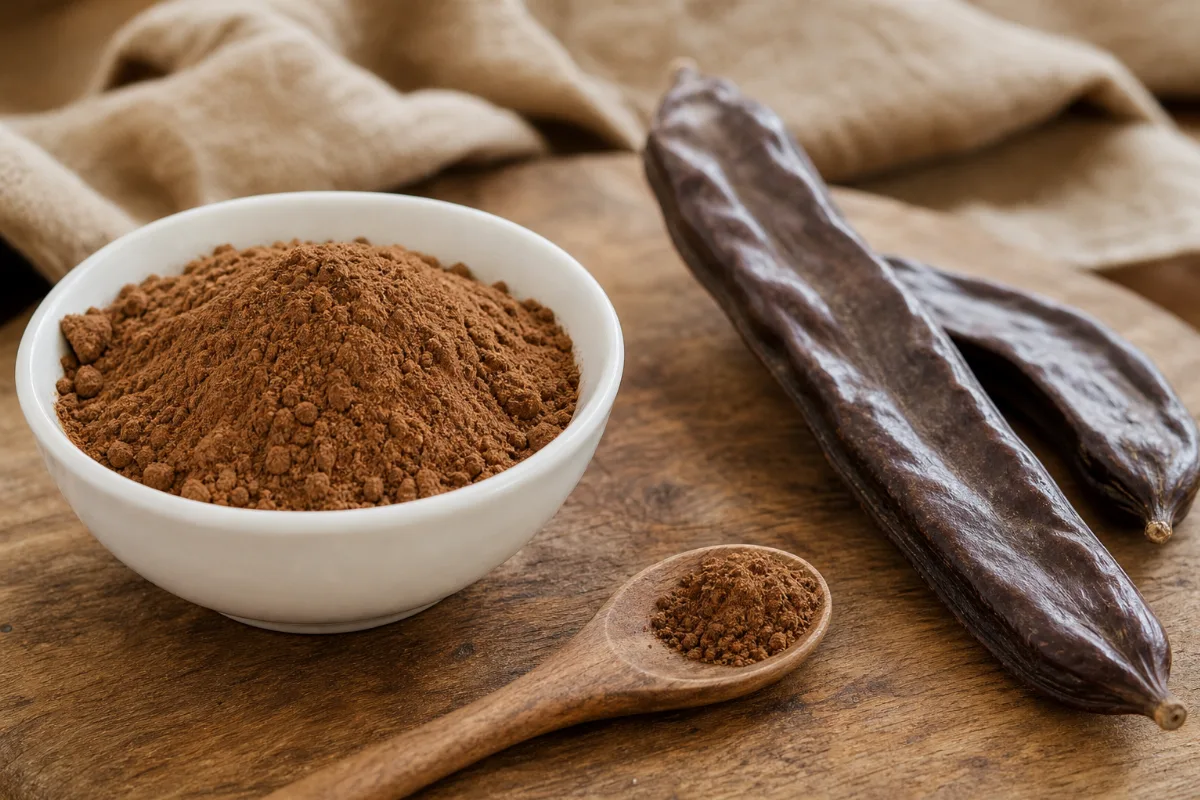
Legumes · Legume pod
Carob
Ceratonia siliqua · also called Carob powder, carob flour, St. John's bread, locust bean tree, algarroba (Spanish)
Carob is the long pod of a Mediterranean tree. Its sweet pulp is dried and ground into a powder used in baking and drinks as a cocoa substitute. It has no caffeine, but it is about half natural sugar. A few small trials of special carob fibre, syrup and concentrate found lower LDL cholesterol or better blood sugar markers, but none tested plain carob powder. The main cautions are sugar, carob allergy (reported in case reports), and the carob-bean gum used to thicken some infant formulas.
General information, not medical advice. Last substantive update · Not medically reviewed. A named clinician has not signed off on this page. How this page is made
About Carob
Carob is the sweet pulp of a pod from a Mediterranean tree, dried and ground into a caffeine-free powder that tastes a little like cocoa. It is a fibre-rich food that is also about half natural sugar. It is not a proven remedy: the cholesterol and blood sugar findings come from small trials of special fibre products, syrups and a liquid concentrate, not from plain powder.
What it is
Carob (Ceratonia siliqua) is a tree of the legume family that is indigenous to the Mediterranean basin. The sweet pulp inside the pod is dried and ground into a powder with a malty, chocolate-like taste, used in baking and drinks. The hard seeds are a different product: they are the source of locust bean gum, a thickener. Syrup, molasses, bars and chips are other carob products.
USDA data for carob flour, per 100 g: 222 kcal, 39.8 g of fibre, 49.08 g of sugars, 4.62 g of protein, 0.65 g of fat, 348 mg of calcium, 827 mg of potassium and 0 mg of caffeine. A tablespoon (6 g) has about 13 kcal, 2.4 g of fibre and 2.9 g of sugars. A tablespoon gives under 10 percent of the Daily Value of any listed vitamin or mineral, so it is not a major source of nutrients at that size.
What the research shows
The firmest facts are about composition: no caffeine, a lot of fibre and a lot of natural sugar. A nutrition website notes that carob bars and coatings have about the same fat and energy as milk chocolate and that carob lacks the antioxidants found in dark chocolate.
Cholesterol: in a 6-week double-blind trial of 58 adults with high cholesterol, bread and a fruit bar made with a carob pulp preparation lowered LDL by 10.5 percent against placebo. In a 4-week trial of 88 adults a carob fibre very rich in polyphenols lowered LDL by 22.5 percent from baseline while the placebo group did not change. An earlier uncontrolled pilot saw 10.6 to 12.2 percent. Blood sugar: a 90-day trial in 52 adults with prediabetes found better HbA1c and glucose with a carob liquid concentrate than placebo, and two small syrup trials found a 16 percent lower after-meal glucose response. All used special products, were short, and the abstracts do not state funding. Plain carob powder was not tested.
Diarrhoea: one small 1998 trial in 80 young children found a processed carob bean juice added to the rehydration drink shortened diarrhoea. It has not been repeated in the sources read. Laboratory studies found antioxidant phenolics, but a lab result does not show that eating carob does the same.
Food versus syrup, fibre and gum
Carob powder in a smoothie is not the same thing as a prepared fibre fraction, a syrup, a liquid concentrate or a thickening gum. The cholesterol and blood sugar trials used one of those prepared products, so they say little about carob powder used in baking. We did not read trials of the plain powder and make no claim about it.
Portions
USDA lists household portions of 1 tablespoon (6 g) and 1 cup (103 g) for carob flour. We did not find an official serving size. This page gives no amounts to eat. Ask a doctor, pharmacist or dietitian what is right for you, especially if you have a food allergy, diabetes or take medicine for blood sugar, cholesterol or thyroid.
At a glance
Traditional uses history, not proof
- Dried and ground to a powder for baking and drinks, used for years as a chocolate substitute
- Carob bean juice has been used for diarrhoea in Anatolia, according to the authors of one trial
- Long use as food is not proof that it treats any condition
Studied for research
- Caffeine-free cocoa substitute, high certainty for the caffeine fact; carob bars are as rich as chocolate bars
- Fibre and natural sugars, high certainty for the nutrient values, no trial of the powder
- Cholesterol, low certainty (special carob fibre products, short trials)
- Blood sugar, low certainty (syrup and liquid concentrate, not powder)
- Diarrhoea in young children, very low certainty (one 1998 trial of a juice)
- Infant reflux (carob bean gum in formula), low certainty and a different product
- Waist size, insufficient evidence (one syrup trial)
- Antioxidant compounds, insufficient evidence (laboratory only)
Main compounds
- Dietary fibre
- Natural sugars
- Phenolic compounds (gallic acid, ferulic acid, kaempferol)
- Inositols (D-pinitol)
- Locust bean gum (seed gum)
- No caffeine or theobromine
Common forms
- Carob powder (ground pod pulp), plain or roasted, as food
- Carob syrup or molasses (used in some trials, a different product)
- Carob fibre preparations and liquid concentrate (used in trials, not the powder)
- Carob bars and chips (added sugar and fat)
- Locust bean gum, a seed thickener (a different product)
Research links: 2003 trial: carob fibre and cholesterol · 2026 trial: carob concentrate in prediabetes · 1999 study: carob and peanut allergy · Research Library · Genes & Biomarkers Library
What it is and its history
- Accepted scientific name
- Ceratonia siliqua
- Naming authority
- L. (GBIF accepted name)
- Common names
- Carob (English); Carob powder or carob flour (ground pod pulp) (English); St. John's bread (English); Locust bean tree (English); Algarroba (pod) and algarrobo (tree) (Spanish)
- Family or group
- Fabaceae (the legume or pea family), as given by GBIF.
- Classification
- Plantae > Tracheophyta > Magnoliopsida > Fabales > Fabaceae > Ceratonia > Ceratonia siliqua
- Native range
- The Mediterranean basin (indigenous there, per a 2026 review).
- Habitat
- The review says the tree is adapted to biotic and abiotic stresses and has a long history in traditional agroforestry.
- What it looks like
- Roots: Not verified.; Stems: Not verified.; Leaves: Leaves are used in some products (2026 review).; Flowers: Not verified.; Fruit: A large, starchy pod. Its sweet pulp is dried and ground to carob powder; the hard seeds are the source of locust bean gum (2026 review and Foodwatch). The pod's colour and shape come from the existing nutrient summary and were not re-verified.
- Cultivation
- Not verified from a source read.
- Harvest and processing
- Foodwatch says the pods are large and starchy, so are easy to roast and then grind into a fine powder. USDA does not say in the record read whether the pods were roasted. Carob is also sold as syrup or molasses, as bars and chips, and as locust bean gum; these are different products.
- Look-alikes and adulterants
- Name: Mesquite pod flour; Note: Another sweet legume pod flour with its own page.; Name: Cocoa and cacao powder; Note: The chocolate ingredient carob is used to replace; it contains caffeine and theobromine, carob does not (Foodwatch, USDA).; Name: Locust bean gum (E 410); Note: A thickener from the carob seeds, a different product from the pulp powder.
- Sustainability and conservation
- Not assessed.
Photographs
Traditional use and history history, not clinical proof
| Tradition or era | Documented use | Source |
|---|---|---|
Traditional use shows how it was used. It does not show that it works or is safe today.
What is inside, and how it may work
What it contains and how those compounds act in cells and animals. Laboratory and animal mechanisms are not proven effects in people.
Main compounds
| Compound | Family | Where it is concentrated | Activity studied | Level of evidence |
|---|---|---|---|---|
| Dietary fibre | carbohydrate | Pod pulp USDA: 39.8 g per 100 g of carob flour | Fibre content only. The trial authors propose that insoluble fibre from the pulp affects blood fats (animal work), which the abstracts do not prove. 23 19 | Human data |
| Natural sugars | carbohydrate | Pod pulp USDA: total sugars 49.08 g per 100 g | Nutrient content only. About half the powder by weight. 23 | Human data |
| Phenolic compounds (gallic acid, ferulic acid, kaempferol, flavanols, galloylated compounds) | polyphenols | Pod Varies by cultivar; Imera had higher total phenolics than Platses (laboratory) | Antioxidant activity in test-tube assays. No human effect shown. 9 6 | Laboratory research |
| Inositols including D-pinitol, myo-inositol and D-chiro inositol | cyclitols (sugar-like compounds) | Fruit (in the liquid concentrate) Not given in the abstract | The concentrate used in the prediabetes trial contained these inositols; the syrup authors say D-pinitol and polyphenols may modulate insulin sensitivity. A proposal only. 12 13 | Human data |
| Isobutyric acid and other volatile compounds | volatile organic acids | Pod powder 22 volatiles found; isobutyric acid dominant in both cultivars | Aroma chemistry from a laboratory analysis. No health claim. 9 | Laboratory research |
| Locust bean gum (carob bean gum, E 410) | seed gum | Seed Not applicable | A thickener used in foods and some infant formulas. A different product from carob pod powder. 4 17 3 | Human data |
| Caffeine and theobromine | stimulants (absent) | Pod pulp USDA: caffeine 0 mg per 100 g; Foodwatch: free of theobromine | Absent. This is why carob is used as a cocoa substitute. 23 20 | Human data |
| Minerals: calcium, potassium, magnesium, iron, copper | minerals | Pod pulp USDA per 100 g: calcium 348 mg, potassium 827 mg, magnesium 54 mg, iron 2.94 mg, copper 0.571 mg | Nutrient content only; absorption was not read. 23 | Human data |
Mechanisms, receptors and pathways
| Target or pathway | Gene or receptor | What was found | Level |
|---|---|---|---|
| Insoluble fibre, polyphenols and blood fats | Not specified | The authors of the cholesterol trials propose that insoluble fibre and polyphenols from carob pulp affect blood lipids, based on animal work. The human trials measured blood fats, not the mechanism. 19 14 | Animal research |
| Inositols, D-pinitol and glucose handling | Not specified | The syrup authors say D-pinitol and polyphenols may play a role in insulin sensitivity and lipid metabolism. This is an attribution, not shown in the trials. 13 12 | Hypothesis |
| Carob bean gum and thyroid medicine absorption | Not specified | The case report authors suggest a carob-bean gum thickened formula may affect absorption of levothyroxine. One case. 17 | Hypothesis |
| Antioxidant capacity | Not specified | Antioxidant activity of carob pod phenolics was measured in test-tube assays (FRAP, DPPH, ABTS). It does not show a benefit from eating carob. 9 6 | Laboratory research |
Absorption, metabolism and elimination
- Absorption
- Not found for carob powder.
- Distribution
- Not found.
- Metabolism
- Not found.
- Elimination
- Not found.
- Bioavailability
- Not established for carob compounds in the sources read.
Isolated compounds versus whole extracts
Almost every carob trial used a prepared product: special carob pulp or fibre preparations (cholesterol), a liquid concentrate and syrups (blood sugar), or bean juice (diarrhoea). None used plain carob powder as sold for baking. Locust bean gum is a different product again, made from the seeds. Bars and chips add sugar and fat.
Nutritional composition
Nutrition from USDA FoodData Central, carob flour (FDC 173755, SR Legacy, April 2018 release; values read 2026-10-26 from the saved copy of the record held with the project). Per 100 g: 222 kcal, 4.62 g protein, 0.65 g fat (0.09 g saturated), 88.88 g carbohydrate, 49.08 g total sugars, 39.8 g fibre, about 3.6 g water, 348 mg calcium, 827 mg potassium, 54 mg magnesium, 79 mg phosphorus, 2.94 mg iron, 0.92 mg zinc, 0.508 mg manganese, 0.571 mg copper, 35 mg sodium, 0.461 mg riboflavin, 0.366 mg vitamin B6, 29 micrograms folate (DFE), 0 mg caffeine and 0 micrograms vitamin K. One tablespoon (6 g): about 13 kcal, 2.39 g fibre, 2.94 g sugars, 0.28 g protein, 20.9 mg calcium, 49.6 mg potassium and 0.18 mg iron (the per-100-g values multiplied by 0.06). One cup (103 g): about 229 kcal, 41 g fibre, 50.6 g sugars, 4.8 g protein, 358 mg calcium, 852 mg potassium and 3.0 mg iron (multiplied by 1.03). A tablespoon gives under 10 percent of the Daily Value of any listed vitamin or mineral, so at that size carob powder is not a major source of nutrients. Values vary with variety, growing place and roasting. Carob bars, chips, syrup and locust bean gum have different values and were not read.
2 high certainty3 low certainty1 very low certainty2 not enough evidence
What was looked at
The 8 benefits and uses checked for Carob, each with how strong the evidence is. Tap one to open it.
- Caffeine-free cocoa substituteHigh certainty
- Fibre and natural sugars (nutrient content)High certainty
- Cholesterol (special carob fibre preparations)Low certainty
- Blood sugar (carob syrup and liquid concentrate)Low certainty
- Diarrhoea in young children (carob bean juice)Very low certainty
- Waist size and body weightNot enough evidence
- Infant reflux (carob bean gum in thickened formula)Low certainty
- Antioxidant plant compounds (laboratory findings)Not enough evidence
Lab markers tracked in the studies
LDL cholesterolTotal cholesterolHbA1c and fasting glucoseAfter-meal glucose responseDuration of diarrhoeaWaist circumference
What is Carob good for?
The main studied uses and how strong the human evidence is for each. The trials used special carob products, not the powder sold for baking.
Benefits, one by one
Each card is a research question, not a promise. Tap a goal to filter. Open a card to see the studies, doses and limits.
Caffeine-free cocoa substitute
High certaintyUSDA lists 0 mg of caffeine in carob flour. A nutrition website adds that carob powder is also free of theobromine, the other stimulant in chocolate. But carob bars and coatings had about the same fat and energy as milk chocolate, so a bar is still a sweet treat.
2 studiesCarob powder; bars and coatings are different products with added sug…
Studies, doses and limits
What the trials found
USDA FoodData Central lists 0 mg of caffeine per 100 g of carob flour. Foodwatch (a nutrition website) says carob powder is free of caffeine and theobromine and has slightly less fat and fewer kilojoules than cocoa powder, but that a 50 g carob block has about 15 g of fat and 2150 kilojoules, the same as a 50 g bar of milk chocolate. It also says carob lacks the antioxidants found in dark chocolate.
Results
The no-caffeine point is a measured fact. The comparison with chocolate bars comes from one nutrition website, not a trial.
Effect sizes as reported
Caffeine 0 mg per 100 g (USDA). Carob block about 15 g fat and 2150 kilojoules per 50 g (Foodwatch).
Why this rating
High for the caffeine fact (USDA analysis). The bar comparison is a single nutrition-website opinion and is low certainty.
Form and dose studied
Carob powder; bars and coatings are different products with added sugar and fat.
Who was studied
General diet.
Limits
USDA does not say whether the pods in the record were roasted. Foodwatch has no named author and no date visible on the page read.
Why researchers looked
People use carob where they want a cocoa-like taste without caffeine.
Traditional use
Carob powder is made from the dried, ground pod pulp and is used in baking and drinks as a cocoa substitute. Long use as food is not proof that it treats any condition.
Proposed mechanism Authoritative guidance
Carob pod pulp comes from a different plant than cocoa and has no caffeine in the USDA record. This is composition, not a mechanism.
A proposed mechanism does not show that the effect happens in people.
Carob powder is about half natural sugars; see the Safety tab.
Fibre and natural sugars (nutrient content)
High certaintyCarob powder is very fibre-rich and about half sugar: USDA lists 39.8 g of fibre and 49.1 g of natural sugars in 100 g. In a tablespoon (6 g) that is about 2.4 g of fibre and 2.9 g of sugars. These are measured nutrient facts; no trial of carob powder for bowel health was read.
1 studiesCarob powder (flour) as food.
Studies, doses and limits
What the trials found
USDA FoodData Central (carob flour, FDC 173755) lists, per 100 g: fibre 39.8 g, total sugars 49.08 g, carbohydrate 88.88 g, protein 4.62 g, fat 0.65 g, 222 kcal. One tablespoon (6 g) has about 13 kcal.
Results
Carob powder is a concentrated source of fibre and of natural sugars. At tablespoon size it gives little of either.
Effect sizes as reported
Per 100 g: fibre 39.8 g, sugars 49.08 g. Per tablespoon (6 g): fibre 2.39 g, sugars 2.94 g.
Why this rating
High for the nutrient values (USDA analysis). No health outcome was tested.
Form and dose studied
Carob powder (flour) as food.
Who was studied
General diet.
Limits
A nutrient fact, not a trial. Values vary with variety, growing place and roasting.
Why researchers looked
The pod pulp is sweet and fibrous, so people ask what the fibre does.
Traditional use
Carob powder is made from the dried, ground pod pulp and is used in baking and drinks as a cocoa substitute. Long use as food is not proof that it treats any condition.
Proposed mechanism Unknown
Not tested for carob powder. Fibre in general adds bulk and slows digestion, but no source read says how this applies to carob.
A proposed mechanism does not show that the effect happens in people.
Half of the powder is natural sugar, which matters for people with diabetes.
Cholesterol (special carob fibre preparations)
Low certaintyTwo small randomised trials and one open study found lower LDL cholesterol in adults with high cholesterol who ate special carob pulp or carob fibre products for 4 to 8 weeks. None of them tested plain carob powder, and the trials are small and short.
3 studiesCarob pulp or fibre preparations in foods or sachets, not carob powde…
Studies, doses and limits
What the trials found
A 6-week double-blind placebo-controlled trial in 58 adults with high cholesterol (Zunft 2003) gave bread and a fruit bar with or without a carob pulp preparation: LDL fell 10.5 percent (p = 0.010) versus placebo. A 4-week double-blind trial in 88 adults (Ruiz-Roso 2010) of a carob fibre very rich in polyphenols found LDL 22.5 percent lower than at baseline, with no significant change in the placebo group. An earlier open study in 47 people without a control group (Zunft 2001) saw LDL fall 10.6 to 12.2 percent.
Results
LDL cholesterol fell in all three studies of the carob fibre products. The control-group trials are small and short. HDL and triglycerides mostly did not change, apart from lower triglycerides in women in one trial.
Effect sizes as reported
LDL -10.5 percent versus placebo (6 weeks); -22.5 percent from baseline (4 weeks); -10.6 to -12.2 percent in the open study.
Why this rating
Low: two small randomised trials and one uncontrolled pilot, each short, with special fibre preparations and no plain powder. The abstracts do not state funding.
Form and dose studied
Carob pulp or fibre preparations in foods or sachets, not carob powder.
Who was studied
Adults with high cholesterol.
Limits
Special preparations. Short. No heart outcomes. The 2010 abstract gives change from baseline rather than a between-group test.
Why researchers looked
The pod pulp is rich in insoluble fibre and polyphenols, and animal work suggested an effect on blood fats.
Traditional use
Carob powder is made from the dried, ground pod pulp and is used in baking and drinks as a cocoa substitute. Long use as food is not proof that it treats any condition.
Proposed mechanism Hypothesis
The trial authors propose that insoluble fibre and polyphenols from the pulp affect blood fats, based on animal work. The abstracts do not prove this.
A proposed mechanism does not show that the effect happens in people.
In the open study 3 of 47 people (6 percent) felt full and 2 dropped out.
Blood sugar (carob syrup and liquid concentrate)
Low certaintyA 90-day trial in 52 adults with prediabetes found better HbA1c and glucose with a carob liquid concentrate than with placebo. Two small trials of commercial carob syrups in healthy adults found a lower after-meal glucose response. These were syrups and a concentrate, not carob powder.
2 studiesCarob liquid concentrate and carob syrups, not carob powder.
Studies, doses and limits
What the trials found
In a 90-day randomised double-blind trial of 52 adults with prediabetes (Perez-Pinero 2026), a carob liquid concentrate improved HbA1c and glucose compared with placebo (p < 0.001, time-by-group interaction), improved insulin resistance indexes and the glucose and insulin response in a glucose tolerance test, and no adverse effects were recorded. Two trials of commercial carob syrups in healthy adults (Planes-Munoz 2025: 20 and 72 people) found a low glycaemic index and a 16 percent lower after-meal glucose response than with glucose.
Results
Better glucose markers in a small trial of people with prediabetes, and a lower glucose response to syrups in healthy adults. The syrup authors call their findings preliminary.
Effect sizes as reported
After-meal glucose response 16 percent lower than glucose control (syrups). The prediabetes abstract gives no mean differences.
Why this rating
Low: one small randomised trial plus two small syrup trials, short, all with special products and not plain powder. Funding is not stated in the abstracts.
Form and dose studied
Carob liquid concentrate and carob syrups, not carob powder.
Who was studied
Adults with prediabetes; healthy adults.
Limits
Small, short, product-specific. Carob powder is half natural sugar and was not tested.
Why researchers looked
The carob fruit contains inositols such as D-pinitol and fibre, which authors link to glucose handling.
Traditional use
Carob powder is made from the dried, ground pod pulp and is used in baking and drinks as a cocoa substitute. Long use as food is not proof that it treats any condition.
Proposed mechanism Hypothesis
The authors suggest D-pinitol, inositols and polyphenols may help insulin sensitivity. This is a proposal, not shown by the trials.
A proposed mechanism does not show that the effect happens in people.
Anyone on diabetes medicine should ask their clinician before changing their diet.
Diarrhoea in young children (carob bean juice)
Very low certaintyOne small 1998 trial in 80 children with acute diarrhoea found that adding carob bean juice to the standard rehydration drink shortened the diarrhoea. It used a processed juice, not carob powder, and has not been repeated in the sources read.
1 studiesCarob bean juice with oral rehydration solution; not carob powder.
Studies, doses and limits
What the trials found
In a randomised trial at a hospital in Turkey (Aksit 1998), 80 children aged 4 to 48 months with acute diarrhoea and mild or moderate dehydration got the standard WHO oral rehydration solution alone or with carob bean juice. Three were excluded for excessive vomiting. With the juice, diarrhoea lasted 45 percent less time, stool output was 44 percent lower and the rehydration drink needed fell 38 percent. Weight gain at 24 hours was similar. Three children in the solution-only group had high blood sodium and none in the juice group.
Results
Shorter and lighter diarrhoea with the juice added, in one small old trial. The authors say the juice would need technological processing and more studies.
Effect sizes as reported
Duration -45 percent; stool output -44 percent; rehydration solution need -38 percent.
Why this rating
Very low: a single small trial from 1998 at one hospital, a processed juice that is not the powder sold today, no repeat trial found, and the abstract does not describe blinding.
Form and dose studied
Carob bean juice with oral rehydration solution; not carob powder.
Who was studied
Children aged 4 to 48 months with acute diarrhoea in hospital.
Limits
Small, old, single site. Not a home remedy. Diarrhoea in young children can be dangerous, so it needs medical advice.
Why researchers looked
Carob has been used in Anatolia for diarrhoeal illness since ancient times, according to the trial authors.
Traditional use
Carob powder is made from the dried, ground pod pulp and is used in baking and drinks as a cocoa substitute. Long use as food is not proof that it treats any condition.
Proposed mechanism Unknown
Not established. The abstract does not explain how the juice might work.
A proposed mechanism does not show that the effect happens in people.
The abstract reports no metabolic problem with the juice. Children with diarrhoea need medical advice.
Waist size and body weight
Not enough evidenceOne six-week trial of a commercial carob syrup in 72 healthy adults reported a small fall in waist size. The authors call it preliminary. No trial tested carob powder for weight.
1 studiesCarob syrup, not powder.
Studies, doses and limits
What the trials found
In the six-week trial of 72 healthy adults (Planes-Munoz 2025) daily carob syrup went with a waist circumference change of -3.58 plus or minus 1.79 cm (p < 0.05). The authors say effects on lipids and body measures were modest and that the findings are preliminary.
Results
A small waist-size change in one syrup trial; weight itself is not reported in the abstract.
Effect sizes as reported
Waist circumference -3.58 plus or minus 1.79 cm.
Why this rating
One small syrup trial that the authors call preliminary. Not tested with carob powder.
Form and dose studied
Carob syrup, not powder.
Who was studied
Healthy adults aged 18 to 65.
Limits
Small, short, syrup only. The abstract does not give weight results.
Why researchers looked
Syrup trials measured body size along with cholesterol and glucose.
Traditional use
Carob powder is made from the dried, ground pod pulp and is used in baking and drinks as a cocoa substitute. Long use as food is not proof that it treats any condition.
Proposed mechanism Hypothesis
The authors attribute effects to D-pinitol and polyphenols, which is a proposal and not shown.
A proposed mechanism does not show that the effect happens in people.
None specific.
Infant reflux (carob bean gum in thickened formula)
Low certaintyLocust bean (carob bean) gum comes from the seeds and is one of the thickeners used in anti-reflux infant formula. A 2026 review found thickened formulas among the most consistently helpful non-drug steps, with low to moderate quality evidence. This is about a medical formula, not carob powder, and it comes with safety points for babies.
2 studiesCarob bean gum in thickened infant formula, a medical product; not ca…
Studies, doses and limits
What the trials found
A 2026 systematic review (Banderali) of 40 studies found thickened formulas and alginates gave the most consistent improvement in infants with reflux, with GRADE certainty from very low to moderate and a high risk of bias in many trials. The abstract does not name carob bean gum separately.
Results
Thickened formulas helped regurgitation in many trials. Whether carob bean gum in particular does so cannot be told from the abstract.
Effect sizes as reported
Not pooled in the review.
Why this rating
Low: the review itself rates the evidence low to moderate, and the abstract does not single out carob bean gum.
Form and dose studied
Carob bean gum in thickened infant formula, a medical product; not carob powder.
Who was studied
Infants with reflux.
Limits
Concerns the seed gum, not the pod powder. A baby's feed is a decision for a paediatrician.
Why researchers looked
Thickened feeds are widely used for babies who spit up often.
Traditional use
Carob powder is made from the dried, ground pod pulp and is used in baking and drinks as a cocoa substitute. Long use as food is not proof that it treats any condition.
Proposed mechanism Unknown
Thickened feeds are thought to be heavier and so stay down more. The abstract does not explain it and does not separate carob bean gum from other thickeners.
A proposed mechanism does not show that the effect happens in people.
A case report links a carob-bean-gum thickened formula to worse control of an infant's thyroid medicine; see the Safety tab.
Antioxidant plant compounds (laboratory findings)
Not enough evidenceLaboratory studies found phenolic compounds with antioxidant activity in carob pods. A 2026 review says the antioxidant, antimicrobial and gut effects are mostly from lab and animal work. Test-tube results do not show that eating carob has the same effect.
2 studiesCarob pod powder in laboratory analysis.
Studies, doses and limits
Results
Phenolics and antioxidant activity are present in carob pods in the laboratory. The effect of eating carob was not tested.
Why this rating
Lab and animal work only; no human outcome.
Form and dose studied
Carob pod powder in laboratory analysis.
Limits
Amounts differ by variety. Antioxidant assays do not predict health effects.
Why researchers looked
Polyphenols in plants are often studied for antioxidant activity.
Traditional use
Carob powder is made from the dried, ground pod pulp and is used in baking and drinks as a cocoa substitute. Long use as food is not proof that it treats any condition.
Proposed mechanism Laboratory research
Test-tube antioxidant assays and animal work. No human effect was shown in the sources read.
A proposed mechanism does not show that the effect happens in people.
None specific.
Connections to the rest of health
How Carob connects to the rest of our health knowledge graph. Every link says what kind of connection it is. A safety link (for example to the liver) is a warning, not a benefit. A study that merely mentions a topic never creates a benefit link.
Explore every connection: goals, body systems, organs, symptoms, genes
A. Wellness goals
| Connected to | Kind of connection | Evidence status | Context | Studies |
|---|---|---|---|---|
| Preventive Wellness | Demonstrated clinical effect | High certainty | Caffeine-free cocoa substitute: USDA lists 0 mg of caffeine in carob flour. A nutrition website adds that carob powder is also free of theobromine, the other stimulant in chocolate. But carob bars and coatings had about the same fat and energy as milk chocolate, so a bar is still a sweet treat. | 23 20 |
| Digestive Support | Demonstrated clinical effect | High certainty | Fibre and natural sugars (nutrient content): Carob powder is very fibre-rich and about half sugar: USDA lists 39.8 g of fibre and 49.1 g of natural sugars in 100 g. In a tablespoon (6 g) that is about 2.4 g of fibre and 2.9 g of sugars. These are measured nutrient facts; no trial of carob powder for bowel health was read. | 23 |
| Cholesterol Balance | Low certainty | Cholesterol (special carob fibre preparations): Two small randomised trials and one open study found lower LDL cholesterol in adults with high cholesterol who ate special carob pulp or carob fibre products for 4 to 8 weeks. None of them tested plain carob powder, and the trials are small and short. | 19 14 18 | |
| Heart Health | Low certainty | Cholesterol (special carob fibre preparations): Two small randomised trials and one open study found lower LDL cholesterol in adults with high cholesterol who ate special carob pulp or carob fibre products for 4 to 8 weeks. None of them tested plain carob powder, and the trials are small and short. | 19 14 18 | |
| Blood Sugar Balance | Low certainty | Blood sugar (carob syrup and liquid concentrate): A 90-day trial in 52 adults with prediabetes found better HbA1c and glucose with a carob liquid concentrate than with placebo. Two small trials of commercial carob syrups in healthy adults found a lower after-meal glucose response. These were syrups and a concentrate, not carob powder. | 12 13 | |
| Digestive Support | Very low certainty | Diarrhoea in young children (carob bean juice): One small 1998 trial in 80 children with acute diarrhoea found that adding carob bean juice to the standard rehydration drink shortened the diarrhoea. It used a processed juice, not carob powder, and has not been repeated in the sources read. Infant reflux (carob bean gum in thickened formula): Locust bean (carob bean) gum comes from the seeds and is one of the thickeners used in anti-reflux infant formula. A 2026 review found thickened formulas among the most consistently helpful non-drug steps, with low to moderate quality evidence. This is about a medical formula, not carob powder, and it comes with safety points for babies. | 1 3 17 | |
| Healthy Weight | Not enough evidence | Waist size and body weight: One six-week trial of a commercial carob syrup in 72 healthy adults reported a small fall in waist size. The authors call it preliminary. No trial tested carob powder for weight. | 13 | |
| Cellular Protection | Not enough evidence | Antioxidant plant compounds (laboratory findings): Laboratory studies found phenolic compounds with antioxidant activity in carob pods. A 2026 review says the antioxidant, antimicrobial and gut effects are mostly from lab and animal work. Test-tube results do not show that eating carob has the same effect. | 9 6 |
B. Body systems
| Connected to | Kind of connection | Evidence status | Context | Studies |
|---|---|---|---|---|
| Digestive System | Biological association | High certainty | Studied for: Caffeine-free cocoa substitute Studied for: Fibre and natural sugars (nutrient content) | 23 20 1 3 17 |
| Cardiovascular System | Biological association | Low certainty | Studied for: Cholesterol (special carob fibre preparations) Studied for: Antioxidant plant compounds (laboratory findings) | 19 14 18 9 6 |
| Endocrine System | Biological association | Low certainty | Studied for: Blood sugar (carob syrup and liquid concentrate) | 12 13 |
| Metabolism Weight | Biological association | Low certainty | Studied for: Blood sugar (carob syrup and liquid concentrate) Studied for: Waist size and body weight | 12 13 |
E. Health conditions
| Connected to | Kind of connection | Evidence status | Context | Studies |
|---|---|---|---|---|
| Food allergy | Adverse effect or risk | Reported in case reports | Case reports describe allergic reactions to carob; how common it is was not found. A small challenge study found no reaction to cooked carob in 12 peanut-allergic children. Case reports describe allergic reactions to carob pods, flour and gum; a small challenge study found no reaction to cooked carob in 12 peanut-allergic children. Preparation or compound: Carob pods, carob flour and carob (locust bean) gum |
10 16 2 5 |
| Congenital hypothyroidism | Drug or supplement interaction | Single case report | One baby's thyroid medicine control worsened on a carob-bean gum thickened formula and improved when it was stopped. The gum is not the pod powder. One baby's thyroid medicine control worsened on a carob-bean gum thickened formula and improved after it was stopped. The seed gum, not the powder. Preparation or compound: Carob-bean gum in infant formula |
17 |
| Diabetes | Nutrient fact | About half of carob powder is natural sugar by USDA data. Preparation or compound: Natural sugars in carob powder |
23 |
I. Biomarkers
| Connected to | Kind of connection | Evidence status | Context | Studies |
|---|---|---|---|---|
| LDL cholesterol | Biological association | Low certainty | Measured in trials: lowered. A lab change is not the same as a health benefit. | 19 14 18 |
| Total cholesterol | Biological association | Low certainty | Measured in trials: lowered. A lab change is not the same as a health benefit. | 14 18 13 |
| HbA1c and fasting glucose | Biological association | Low certainty | Measured in trials: lowered relative to placebo. A lab change is not the same as a health benefit. | 12 |
| After-meal glucose response | Biological association | Low certainty | Measured in trials: lowered. A lab change is not the same as a health benefit. | 13 12 |
| Duration of diarrhoea | Biological association | Very low certainty | Measured in trials: shortened. A lab change is not the same as a health benefit. | 1 |
| Waist circumference | Biological association | Not enough evidence | Measured in trials: lowered. A lab change is not the same as a health benefit. | 13 |
K. Biological pathways
| Connected to | Kind of connection | Evidence status | Context | Studies |
|---|---|---|---|---|
| Fibre | Preliminary mechanism | Human | Carob powder is a concentrated fibre food by USDA data (39.8 g per 100 g). | 23 |
| Natural sugars | Preliminary mechanism | Human | About half of carob powder is natural sugar. | 23 |
| Potassium | Preliminary mechanism | Human | Carob powder contains 827 mg per 100 g (USDA); no carob-specific kidney advice was read. | 23 |
L. Active compounds
| Connected to | Kind of connection | Evidence status | Context | Studies |
|---|---|---|---|---|
| Dietary fibre | Biological association | Human | Fibre content only. The trial authors propose that insoluble fibre from the pulp affects blood fats (animal work), which the abstracts do not prove. Preparation or compound: Pod pulp |
23 19 |
| Natural sugars | Biological association | Human | Nutrient content only. About half the powder by weight. Preparation or compound: Pod pulp |
23 |
| Phenolic compounds (gallic acid, ferulic acid, kaempferol, flavanols, galloylated compounds) | Biological association | In vitro | Antioxidant activity in test-tube assays. No human effect shown. Preparation or compound: Pod |
9 6 |
| Inositols including D-pinitol, myo-inositol and D-chiro inositol | Biological association | Human | The concentrate used in the prediabetes trial contained these inositols; the syrup authors say D-pinitol and polyphenols may modulate insulin sensitivity. A proposal only. Preparation or compound: Fruit (in the liquid concentrate) |
12 13 |
| Isobutyric acid and other volatile compounds | Biological association | In vitro | Aroma chemistry from a laboratory analysis. No health claim. Preparation or compound: Pod powder |
9 |
| Locust bean gum (carob bean gum, E 410) | Biological association | Human | A thickener used in foods and some infant formulas. A different product from carob pod powder. Preparation or compound: Seed |
4 17 3 |
| Caffeine and theobromine | Biological association | Human | Absent. This is why carob is used as a cocoa substitute. Preparation or compound: Pod pulp |
23 20 |
| Minerals: calcium, potassium, magnesium, iron, copper | Biological association | Human | Nutrient content only; absorption was not read. Preparation or compound: Pod pulp |
23 |
Each connection is stored with the ingredient, the connected record, the kind of connection, the evidence status, the supporting studies, the preparation or compound involved, and a review date (last reviewed October 26, 2026).
The evidence
The research centre for Carob. Every record here was checked against PubMed or the publisher's page; we never list a study we have not verified.
Evidence by outcome
Bars show how many studies we found for each outcome, not how well it works. People are added up across trials only (reviews are not added, to avoid double counting).
How we rate evidence
High certainty
Several well-run trials or reviews agree; further research is unlikely to change the picture much.
Moderate certainty
Good trials point the same way, but some doubt remains.
Low certainty
Small, short or inconsistent trials. The finding could change with better research.
Very low certainty
Very little or very weak human data. Treat as a possibility only.
Mixed findings
Trials or reviews disagree with each other.
Not enough evidence
Not enough human research to say either way.
Evidence against
Good research found no benefit, or found harm.
We take the reviewers' own risk-of-bias and GRADE statements where they exist, and otherwise judge from study size, design, consistency, directness and whether a product matches what is sold. Many publications do not make evidence high. Method note: We started from our existing carob summary, re-checked nutrition against the USDA FoodData Central record for carob flour, read the GBIF, MedlinePlus and Foodwatch pages and re-read PubMed abstracts for the trials, case reports and reviews. Only abstracts (or, for five case reports, only titles) were read for studies. Items we could not verify are flagged in the research gaps.
Study library: every study we checked 23
| Study | Design | People | Product, dose, length | Result |
|---|---|---|---|---|
| Aksit 1998 Carob bean juice: a powerful adjunct to oral rehydration solution treatment in diarrhoea. Paediatr Perinat Epidemiol · PMID 9620567 · DOI |
Controlled trial |
77 80 children aged 4 to 48 months with acute diarrhoea and mild or moderate dehydration; 3 were excluded for excessive vomiting |
Carob bean juice together with the standard WHO oral rehydration solution Carob bean juice, a processed liquid and not the powder Not given in the abstract Until the diarrhoea ended · vs Standard WHO oral rehydration solution alone |
With the carob juice added, the duration of diarrhoea was 45 percent shorter, stool output 44 percent lower and the oral rehydration solution requirement 38 percent lower than with the solution alone. Weight gain at 24 hours was similar. Three children in the solution-only group had high blood sodium and none in the juice group. The authors say further studies are justified and that the juice may have a role after it is technologically processed. Diarrhoea duration -45 percent; stool output -44 percent; rehydration solution need -38 percent (Not given in the abstract) Methods, limits and fundingOutcomes: Duration of diarrhoea, stool output, oral rehydration solution needed, weight gain, blood sodium Limitations: Small, one hospital, from 1998. A juice of the carob bean, not carob powder. The abstract does not describe blinding. Funding and conflicts: Funding is not stated in the abstract. Read: abstract |
| Alarcon 2011 Urticaria and angioedema due to ingestion of carob gum: a case report. J Investig Allergol Clin Immunol · PMID 21370730 |
Case report |
1 Single case report (details not read; PubMed has no abstract) |
Carob gum (locust bean gum) Carob gum (locust bean gum) Not read Not read |
Only the title was read: Urticaria and angioedema due to ingestion of carob gum: a case report. No further details are claimed. Not applicable (Not applicable) Methods, limits and fundingOutcomes: Allergic reaction (from the title only) Limitations: Title only; no abstract in PubMed, so no details about the person, the product or the test were read. Funding and conflicts: Not read. Read: title-only |
| Banderali 2026 Efficacy and safety of non-pharmacological interventions for gastroesophageal reflux and gastroesophageal reflux disease in children: a systematic review. Ital J Pediatr · PMID 42098776 · DOI |
Systematic review |
40 studies (39 randomised trials and one systematic review) of mostly infants with uncomplicated reflux | Non-drug approaches such as thickened feeds, probiotics, alginates, positioning and massage Thickened formula (thickeners differ and are not separated in the abstract) Varied · vs Various |
Thickened feeds, probiotics, alginates and left-side positioning were associated with fewer regurgitations. Thickened formulas and alginates showed the most consistent improvement, but overall evidence quality was low to moderate. Risk of bias was often high and certainty ranged from very low to moderate. The approaches appeared generally safe. Not pooled (no meta-analysis because of differences between trials) (Not applicable) Methods, limits and fundingOutcomes: Regurgitation frequency and symptom scores Limitations: The abstract does not separate carob bean gum from other thickeners. It concerns formula for infants with reflux, not carob powder. Funding and conflicts: Not stated in the abstract. Registration: PROSPERO CRD420251041380 Read: abstract |
| EFSA Panel on Food Additives and Flavourings (Younes 2023 Re-evaluation of locust bean gum (E 410) as a food additive in foods for infants below 16 weeks of age and follow-up of its re-evaluation as a food additive for uses in foods for all population groups. EFSA J · PMID 36789355 · DOI |
Regulatory opinion regulatory |
Infants below 16 weeks and toddlers eating special formulae and foods for special medical purposes | Locust bean gum (E 410) as a food additive Carob seed gum, not pod powder Reference point 1,400 mg/kg body weight per day from a piglet study |
EFSA's panel identified a reference point of 1,400 mg/kg body weight per day based on reduced blood zinc levels in a piglet study. It concluded that a margin of exposure above 1 would not raise a safety concern. A margin above 1 was obtained for some scenarios and exposure levels for infants, and for all exposure levels for toddlers who eat these special foods. Reference point 1,400 mg/kg body weight per day (piglet study) (Not applicable) Methods, limits and fundingOutcomes: Safety assessment using a margin of exposure Limitations: A safety opinion about a food additive made from the seed, not about carob pod powder. The reference point comes from piglets. Funding and conflicts: Independent regulatory panel (EFSA). Read: abstract |
| Fiocchi 1999 Carob is not allergenic in peanut-allergic subjects. Clin Exp Allergy · PMID 10202350 · DOI |
Challenge study |
12 12 children (median age 9.5 years) with a history of severe reaction (anaphylaxis) to peanut |
Skin prick tests with raw carob pulp, raw carob bean and cooked carob cotyledon formula; food challenges with carob extract and cooked carob cotyledon formula Carob pulp, carob bean (seed) and cotyledon products 5.5 g of carob extract and of cooked cotyledon formula in the challenges (trial detail, not advice) Single challenges · vs Placebo (double-blind, placebo-controlled food challenge) |
All 12 children had a positive peanut skin test. Skin tests were positive to carob pulp in 3 of 12, to raw carob bean in 6 of 12 and to cooked carob cotyledon formula in none. Blood tests for peanut were positive in all and negative for carob bean in 9 of 12. Carob-specific IgE was found in 8 children. There was no clinical reaction to raw or cooked carob in the food challenges. The authors conclude that carob sensitisation can occur alongside peanut allergy, that cooked carob can be eaten by children allergic to peanut, and that heat-processing reduces carob protein allergenicity. No clinical reaction in 12 of 12 challenges; skin test positive to raw carob bean in 6 of 12 (Not applicable) Methods, limits and fundingOutcomes: Skin prick tests, blood tests (RAST), immunoblotting for carob-specific IgE, clinical reaction during challenge Limitations: Only 12 children, all peanut-allergic and tested in 1999. The challenge material was carob extract and cooked cotyledon formula (the seed), not carob pod powder. Children with a carob allergy of their own were not studied. Funding and conflicts: Funding is not stated in the abstract. Read: abstract |
| Gadoum 2026 Carob Tree: A Review of Traditional Uses, Medicinal Properties, and Future Perspectives in Sustainable Forestry. Life (Basel) · PMID 41900966 · DOI |
Narrative review in-vitro-animal |
Review of carob phytochemistry, traditional uses and products | Carob pods, seeds and leaves and products made from them Pods, seeds, leaves |
The review says the carob tree is indigenous to the Mediterranean basin and has a long history of use in traditional agroforestry. It names phenolic acids and flavonoids such as gallic acid, chlorogenic acid, ellagic acid, catechins, quercetin and luteolin. These compounds were mainly studied in vitro and in vivo (lab and animal work), where they showed antioxidant, antimicrobial and possible heart and gut effects. The authors call for well-designed clinical studies. Not applicable (Not applicable) Methods, limits and fundingOutcomes: Phytochemicals, traditional uses and applications Limitations: A narrative review; the health effects it describes are mostly from lab and animal work. Funding and conflicts: Not stated in the abstract. Read: abstract |
| Hawley 2017 Allergic sinusitis and severe asthma caused by occupational exposure to locust bean gum: Case report. Am J Ind Med · PMID 28497854 · DOI |
Case report |
1 One cheesemaker who worked with locust bean gum |
Inhaled locust bean gum at work Carob seed gum, not pod powder Occupational exposure over many years 16 years of worsening symptoms |
A man developed work-related sinusitis and bronchitis one year after starting work at a creamery. His breathing problems worsened over 16 years into persistent asthma needing repeated emergency room visits before the work cause was found. The authors stress that doctors should consider an occupational cause and remove the person from exposure. Not applicable (Not applicable) Methods, limits and fundingOutcomes: Sinusitis, bronchitis and asthma Limitations: One case; exposure was to the seed gum at work, not to eating carob. Funding and conflicts: Not stated in the abstract. Read: abstract |
| Jedrzejczyk 2020 FPIES Induced by Locust Bean Gum in an Infant. J Investig Allergol Clin Immunol · PMID 32043466 · DOI |
Case report |
1 Single case report (details not read; PubMed has no abstract) |
Locust bean gum in an infant Locust bean gum in an infant Not read Not read |
Only the title was read: FPIES Induced by Locust Bean Gum in an Infant. No further details are claimed. Not applicable (Not applicable) Methods, limits and fundingOutcomes: Allergic reaction (from the title only) Limitations: Title only; no abstract in PubMed, so no details about the person, the product or the test were read. Funding and conflicts: Not read. Read: title-only |
| Kleftaki 2026 Antioxidant Capacity and Phenolic Profile of Edible Carob Pods (Ceratonia siliqua L.). Foods · PMID 42793983 · DOI |
Laboratory in-vitro |
Carob powder from two Cretan cultivars (Imera and Platses), analysed in the laboratory | Laboratory analysis (FT-IR, GC-MS, LC-MS, antioxidant assays) Edible carob pod powder · vs Comparison of two cultivars |
GC-MS identified 22 volatile compounds, with isobutyric acid dominant in both cultivars. Imera had more flavonoids, galloylated and flavanol compounds and higher total phenolics and antioxidant capacity in three assays; Platses had more gallic acid, ferulic acid and kaempferol. Phenolic content and antioxidant activity correlated strongly. Not applicable (Not applicable) Methods, limits and fundingOutcomes: Phenolic composition, volatile compounds, antioxidant capacity in test-tube assays Limitations: Laboratory chemistry. Test-tube antioxidant results do not show an effect in people. Funding and conflicts: Not stated in the abstract. Read: abstract |
| Komericki 2009 Immediate hypersensitivity to carob pods. Contact Dermatitis · PMID 19825099 · DOI |
Case report |
1 Single case report (details not read; PubMed has no abstract) |
Carob pods Carob pods Not read Not read |
Only the title was read: Immediate hypersensitivity to carob pods. No further details are claimed. Not applicable (Not applicable) Methods, limits and fundingOutcomes: Allergic reaction (from the title only) Limitations: Title only; no abstract in PubMed, so no details about the person, the product or the test were read. Funding and conflicts: Not read. Read: title-only |
| Mastrorilli 2024 IgE-Mediated Legume Allergy: A Pediatric Perspective. J Pers Med · PMID 39338152 · DOI |
Narrative review |
Review of the scientific literature on legume allergy in children | Legumes as food allergens Legume foods |
Legumes can cause IgE-mediated allergy. Peanuts and soybeans are the legumes most involved in Western countries; lentils, peas and chickpeas are reported mainly in the Mediterranean area and India. The abstract does not mention carob. Not applicable (Not applicable) Methods, limits and fundingOutcomes: Which legumes cause allergy, diagnosis and treatment Limitations: Carob is not named in the abstract. Funding and conflicts: Not stated in the abstract. Read: abstract |
| Perez-Pinero 2026 Effects of Specific Carob (Ceratonia siliqua L.) Liquid Concentrate on Glucose Metabolism in Subjects with Prediabetes: A Randomized Double-Blind Controlled Clinical Trial. Nutrients · PMID 42196981 · DOI |
Controlled trial |
52 52 adults with confirmed prediabetes (25 carob, 27 placebo), mean age 45.6 |
Carob liquid concentrate containing inositols of the carob fruit (D-pinitol, myo-inositol, D-chiro inositol) Carob fruit liquid concentrate, not powder 6.66 g a day in two doses (trial detail, not advice) 90 days · vs Placebo |
Compared with placebo, the carob group improved HbA1c and glucose levels (p < 0.001 for the time-by-group interaction). Fasting insulin fell within the carob group, and the insulin indexes HOMA-IR and QUICKI improved in the carob group only. In the glucose tolerance test the glucose and insulin area under the curve and the glucose peak improved in the carob group only. No adverse effects were recorded. Better HbA1c and glucose than placebo (p < 0.001, interaction); the abstract gives no mean differences (Not given in the abstract) Methods, limits and fundingOutcomes: Fasting and 2-hour oral glucose tolerance test glucose and insulin, HbA1c, insulin resistance indexes Limitations: Small, 90 days, a specific concentrate and not carob powder. The abstract gives no numbers for the size of the change. Funding and conflicts: Funding is not stated in the abstract. Read: abstract |
| Planes-Munoz 2025 Evaluation of Commercial Carob Syrups (Ceratonia siliqua L.) in Randomized Controlled Trials: Effects on Lipid, Glycaemic, and Anthropometric Parameters. Foods · PMID 41227648 · DOI |
Controlled trial |
92 Two trials in healthy adults aged 18 to 65: a glycaemic test with 20 volunteers and a six-week trial with 72 participants |
Two commercial carob syrups Carob syrup, not powder Not given in the abstract Single test meal; 6 weeks · vs Glucose control (glycaemic test); control group (six-week trial) as described in the abstract |
Both syrups had low glycaemic indices (56.04 plus or minus 13.75 and 60.46 plus or minus 26.92 percent) and the after-meal glucose response was 16 percent lower than with the glucose control (p < 0.05). In the six-week trial, daily syrup went with a significant reduction in total cholesterol (-14.68 plus or minus 25.60 mg/dL) and waist circumference (-3.58 plus or minus 1.79 cm), p < 0.05. The authors call this preliminary evidence and the effects on lipids and body measures modest. After-meal glucose response 16 percent lower than glucose control; total cholesterol -14.68 mg/dL; waist -3.58 cm (Not given (mean plus or minus standard deviation in the abstract)) Methods, limits and fundingOutcomes: After-meal glucose response, glycaemic index, serum cholesterol, waist circumference Limitations: Two small trials in healthy adults, short, syrups and not carob powder. The authors say the findings are preliminary. Funding and conflicts: Funding is not stated in the abstract. Read: abstract |
| Ruiz-Roso 2010 Insoluble carob fiber rich in polyphenols lowers total and LDL cholesterol in hypercholesterolemic sujects. Plant Foods Hum Nutr · PMID 20094802 · DOI |
Controlled trial |
88 88 adults with high cholesterol (43 carob fibre, 45 placebo) |
Insoluble carob fibre described as very rich in polyphenols (84 percent insoluble polyphenols by the abstract) Carob fibre preparation, not plain powder 4 g twice a day (trial detail, not advice) 4 weeks · vs Placebo |
In the carob fibre group, compared with their own baseline, total cholesterol fell 17.8 percent (p < 0.05), LDL cholesterol 22.5 percent (p < 0.001), the LDL to HDL ratio 26.2 percent (p < 0.001) and triglycerides 16.3 percent (p < 0.05). The placebo group showed no significant differences in the lipid profile. LDL cholesterol -22.5 percent from baseline in the carob fibre group; the abstract does not give a direct between-group difference (Not given in the abstract) Methods, limits and fundingOutcomes: Total, LDL and HDL cholesterol and triglycerides at baseline and 4 weeks Limitations: Short (4 weeks), a special fibre preparation and not plain carob powder. The abstract reports change from baseline in the carob group and says the placebo group did not change, but gives no between-group test. Funding and conflicts: Funding is not stated in the abstract. Read: abstract |
| Savino 1999 Allergy to carob gum in an infant. J Pediatr Gastroenterol Nutr · PMID 10512412 · DOI |
Case report |
1 Single case report (details not read; PubMed has no abstract) |
Carob gum (locust bean gum) in an infant Carob gum (locust bean gum) in an infant Not read Not read |
Only the title was read: Allergy to carob gum in an infant. No further details are claimed. Not applicable (Not applicable) Methods, limits and fundingOutcomes: Allergic reaction (from the title only) Limitations: Title only; no abstract in PubMed, so no details about the person, the product or the test were read. Funding and conflicts: Not read. Read: title-only |
| Scoditti 1996 Asthma to carob bean flour. Ann Allergy Asthma Immunol · PMID 8705642 · DOI |
Case report |
1 Single case report (details not read; PubMed has no abstract) |
Carob bean flour (letter) Carob bean flour (letter) Not read Not read |
Only the title was read: Asthma to carob bean flour. No further details are claimed. Not applicable (Not applicable) Methods, limits and fundingOutcomes: Allergic reaction (from the title only) Limitations: Title only; no abstract in PubMed, so no details about the person, the product or the test were read. Funding and conflicts: Not read. Read: title-only |
| Signorino 2025 Worsening of Congenital Hypothyroidism After Start of Carob-bean Gum Thickened Formula: Is There a Link? A Case Report. J Clin Res Pediatr Endocrinol · PMID 38054412 · DOI |
Case report |
1 One baby girl with congenital hypothyroidism treated with levothyroxine |
Carob-bean gum thickened formula for reflux Carob seed gum in infant formula About 5 weeks on the formula before tests worsened · vs Regular formula (after the thickened formula was stopped) |
Thyroid levels were normal on levothyroxine, then worsened (TSH 31.1 then 44.8 microIU/mL) after the baby started a carob-bean gum thickened formula, even when the medicine dose was raised. Fourteen days after the formula was stopped, TSH fell to 0.38 microIU/mL and fT4 rose to 2.68 ng/dL, allowing the medicine dose to be lowered. The authors suggest the formula may affect absorption of the medicine and recommend more frequent thyroid checks if such formulas are used. TSH 44.8 microIU/mL on thickened formula versus 0.38 microIU/mL 14 days after stopping it (Not applicable) Methods, limits and fundingOutcomes: Thyroid stimulating hormone (TSH) and free thyroxine (fT4) Limitations: One baby. The link is suggested, not proven. It concerns the seed gum in infant formula, not carob pod powder. Funding and conflicts: Not stated in the abstract. Read: abstract |
| Zunft 2001 Carob pulp preparation for treatment of hypercholesterolemia. Adv Ther · PMID 11783460 · DOI |
Open label pilot |
47 47 volunteers with moderately high cholesterol (total cholesterol 232 to 302 mg/dL) |
Carob pulp preparation rich in insoluble fibre and polyphenols, in a breakfast cereal, a fruit muesli bar and a powdered drink Carob pod pulp preparation, not plain powder 15 g of carob a day in three products (trial detail, not advice) 8 weeks |
After 4 weeks total cholesterol was 7.1 percent lower and LDL 10.6 percent lower; after 6 weeks 7.8 percent and 12.2 percent lower (all p < 0.001). HDL and triglycerides did not change. Three volunteers (6 percent) reported a sensation of fullness, which led to 2 of the 3 dropouts. LDL cholesterol -10.6 percent at 4 weeks and -12.2 percent at 6 weeks, no control group (Not given in the abstract (p < 0.001)) Methods, limits and fundingOutcomes: Total, LDL and HDL cholesterol and triglycerides Limitations: Open-label, no control group, so changes cannot be credited to carob alone. Pilot study. Funding and conflicts: PubMed lists 'Research Support, Non-U.S. Gov't'; the funder is not named in the abstract. Read: abstract |
| Zunft 2003 Carob pulp preparation rich in insoluble fibre lowers total and LDL cholesterol in hypercholesterolemic patients. Eur J Nutr · PMID 14569404 · DOI |
Controlled trial |
58 58 adults with high cholesterol |
Carob pulp preparation (carob fibre) added to bread (two servings) and a fruit bar (one serving) Carob pod pulp preparation, not plain powder 15 g a day of the carob preparation, as described in the abstract (trial detail, not advice) 6 weeks · vs Same bread and fruit bar without the carob preparation (placebo) |
Carob fibre lowered LDL cholesterol by 10.5 percent (plus or minus 2.2, p = 0.010) compared with placebo. The LDL to HDL ratio fell by 7.9 percent, which was marginal (p = 0.058). Triglycerides fell by 11.3 percent in women (p = 0.030). Effects were stronger in women than in men. LDL cholesterol -10.5 percent versus placebo (Not given in the abstract (p = 0.010)) Methods, limits and fundingOutcomes: Total, LDL and HDL cholesterol and triglycerides at baseline and weeks 4 and 6 Limitations: Small trial, 6 weeks, a special pulp preparation in foods and not plain carob powder. Randomised, double-blind and placebo-controlled by the abstract. Many outcomes were looked at. Funding and conflicts: Funding is not stated in the abstract. Read: abstract |
| s-foodwatch-carob Foodwatch (Australia): Is carob better for you than chocolate? · Source |
Nutrition website n/a |
Methods, limits and fundingRead: full-text | ||
| s-gbif-ceratonia-siliqua GBIF Backbone: Ceratonia siliqua L. (usageKey 5356354) · Source |
Reference database n/a |
Methods, limits and fundingRead: full-text | ||
| s-medlineplus-foodallergy MedlinePlus: Food allergy · Source |
Health agency n/a |
Methods, limits and fundingRead: full-text | ||
| s-usda-fdc-173755 USDA FoodData Central: Carob flour (FDC 173755) · Source |
Reference database n/a |
Methods, limits and fundingRead: full-text |
What we do not know yet
- No trial of plain carob powder was found for cholesterol, blood sugar, blood pressure, weight or heart disease; the trials used special fibre preparations, syrups, a liquid concentrate or a bean juice.
- None of the abstracts read states who funded the trials, and two of the three cholesterol studies come from one research group.
- Carob allergy was described only in case reports (most with no abstract); how common it is, and whether pod powder differs from the seed gum, was not found.
- Pregnancy and breastfeeding advice, medicine interactions, gas and digestion, kidney (potassium) limits, heavy metals, pesticide residues and choking risk for small children were not researched for carob.
How new research is added
New studies are found by a saved PubMed search and placed in a review queue before the page changes.
Lab markers
What changed in blood or saliva tests during trials. A changed number is not the same as feeling or being healthier, and we give no "normal ranges".
Metabolic 2
LDL cholesterol
Lowered in trials
The 'bad' cholesterol carried in the blood. Higher levels are linked to more heart disease.
Low certaintyResults and what it means
Why it was measured
It is the usual blood marker used in diet trials for heart risk.
Statistical vs. clinical meaning
A fall in LDL in short trials of special carob fibre products. Plain powder was not tested.
Safety implication
Fullness in 6 percent of people in the open study.
| Study | Result | People | Product |
|---|---|---|---|
| 19 | LDL -10.5 percent versus placebo (p = 0.010) | 58 adults with high cholesterol | Carob pulp preparation (carob fibre) in bread and a fruit bar, 6 weeks |
| 14 | LDL -22.5 percent from baseline (p < 0.001); no significant change in placebo | 88 adults with high cholesterol | Insoluble carob fibre rich in polyphenols, 4 weeks |
| 18 | LDL -10.6 percent at 4 weeks and -12.2 percent at 6 weeks (p < 0.001), no control group | 47 adults with moderately high cholesterol | Carob pulp preparation in three products, 8-week study |
Total cholesterol
Lowered in trials
All cholesterol carried in the blood, including LDL and HDL.
Low certaintyResults and what it means
Why it was measured
A routine blood fat measure reported in all three cholesterol studies.
Statistical vs. clinical meaning
Lower in small, short studies of special carob products.
Safety implication
None specific.
| Study | Result | People | Product |
|---|---|---|---|
| 14 | Total cholesterol -17.8 percent from baseline (p < 0.05); placebo no significant change | 88 adults with high cholesterol | Insoluble carob fibre rich in polyphenols, 4 weeks |
| 18 | Total cholesterol -7.1 percent at 4 weeks and -7.8 percent at 6 weeks (p < 0.001), no control group | 47 adults with moderately high cholesterol | Carob pulp preparation in three products |
| 13 | Total cholesterol -14.68 plus or minus 25.60 mg/dL (p < 0.05) | 72 healthy adults | Commercial carob syrup daily for 6 weeks |
Other 4
HbA1c and fasting glucose
Lowered relative to placebo in trials
HbA1c reflects average blood sugar over the past two to three months; fasting glucose is blood sugar after not eating.
Low certaintyResults and what it means
Why it was measured
Standard markers for blood sugar control and for prediabetes.
Statistical vs. clinical meaning
One small trial with a special concentrate.
Safety implication
No adverse effects were recorded in the trial.
| Study | Result | People | Product |
|---|---|---|---|
| 12 | HbA1c and glucose improved versus placebo (p < 0.001, time-by-group interaction); HOMA-IR and QUICKI improved in the carob group only; no numbers for the size of change in the abstract | 52 adults with prediabetes | Carob liquid concentrate (inositols), 90 days |
After-meal glucose response
Lowered in trials
How much blood sugar rises after a test drink or meal.
Low certaintyResults and what it means
Why it was measured
Shows how fast a food raises blood sugar.
Statistical vs. clinical meaning
Lower responses in small trials of syrup and concentrate.
Safety implication
None specific.
| Study | Result | People | Product |
|---|---|---|---|
| 13 | Glycaemic index 56.04 plus or minus 13.75 and 60.46 plus or minus 26.92 percent for the two syrups; after-meal glucose response 16 percent lower than the glucose control (p < 0.05) | 20 healthy adults aged 18 to 65 | Two commercial carob syrups, single test |
| 12 | Glucose and insulin area under the curve and glucose peak improved in the carob group only | 52 adults with prediabetes | Carob liquid concentrate, 90 days |
Duration of diarrhoea
Shortened in trials
How long diarrhoea lasts in a child with an acute stomach illness.
Very low certaintyResults and what it means
Why it was measured
The main practical outcome in diarrhoea trials.
Statistical vs. clinical meaning
One small 1998 trial with a processed juice.
Safety implication
Children with diarrhoea need medical advice.
| Study | Result | People | Product |
|---|---|---|---|
| 1 | Duration -45 percent, stool output -44 percent, rehydration solution requirement -38 percent versus rehydration solution alone | 77 children aged 4 to 48 months analysed (80 randomised) | Carob bean juice plus standard WHO oral rehydration solution |
Waist circumference
Lowered in trials
The distance around the waist, a simple body-size measure.
Not enough evidenceResults and what it means
Safety
What studies and official sources say about side effects, medicines and who should check first. Each point shows what kind of evidence it comes from.
Main points to know 5
- Allergy to carob is reported, in case reports. Carob is a legume, and legume allergy is real. Case reports describe an immediate allergic reaction to carob pods, asthma to carob bean flour, and reactions to carob (locust bean) gum, including hives and swelling after eating it, an allergy in an infant, and a gut reaction called FPIES in an infant. For most of these only the title was read, so no details are claimed. There is no data on how common carob allergy is. For trouble breathing or swelling of the face, lips or throat, call emergency services. Case report 10 16 2 15 8 22
- Peanut allergy: a small challenge study found no reaction to carob. In a 1999 study, 12 children with a history of severe reaction to peanut were given raw and cooked carob in double-blind food challenges and none reacted. Skin tests were positive to raw carob bean in 6 of 12 and to carob pulp in 3 of 12, so carob can sensitise peanut-allergic children even when they do not react. The authors say cooked carob can be eaten by such children. The challenges used carob extract and cooked seed (cotyledon) formula, not pod powder, and only 12 children were tested. Ask an allergist before trying carob if you have a legume allergy. Challenge study 5 11
- Infants: carob bean gum in formula is a medical product. Carob bean (locust bean) gum, made from the seeds, thickens some anti-reflux infant formulas. One case report links such a formula to worse control of a baby's thyroid medicine, and the authors suggest it may affect absorption. EFSA re-evaluated the gum in 2023 and said a margin of exposure above 1 does not raise a safety concern, a result it found for some infant scenarios. This is the seed gum, not carob powder. Thickened formula is a decision for a paediatrician. Case report 17 4 3
- Half of the powder is natural sugar. USDA lists 49.08 g of natural sugars and 39.8 g of fibre in 100 g of carob flour, which is about 2.9 g of sugars in a tablespoon (6 g). Carob bars and coatings can carry added sugar and fat: a nutrition website found a 50 g carob block had the same fat and kilojoules as a 50 g milk chocolate bar. This matters most for people with diabetes. Authoritative guidance 23 20
- Pregnancy, breastfeeding and young children: no carob-specific advice was found. No source read gives carob-specific advice for pregnancy, breastfeeding or feeding carob powder to young children. Ask your doctor, midwife or paediatrician. None found
Side effects 4
| Effect | How often | Severity and recovery | Evidence |
|---|---|---|---|
| Allergic reactions to carob pods, carob flour or carob gum, from hives and swelling to asthma For most of these only the title was read. | Not found. Only case reports were identified. | can be severe (asthma, swelling); anaphylaxis is a medical emergency Not studied | Case report 10 16 2 15 8 |
| Sensation of fullness A special pulp preparation in three foods, not plain powder. | 3 of 47 volunteers (6 percent) in an 8-week open study of a carob pulp preparation; 2 of the 3 dropped out | mild Not studied | Open label pilot 18 |
| No adverse effects recorded in a 90-day trial of a carob liquid concentrate Small trial of a concentrate, not powder. | 0 recorded in 52 adults (25 carob) | none Not applicable | Controlled trial 12 |
| Asthma and sinus disease from breathing in locust bean gum dust at work Workplace exposure to the seed gum, not eating carob. | One case report of a cheesemaker | severe The authors stress removal from exposure | Case report 7 |
Liver
No liver injury from eating carob was found in the sources read. A liver-safety source (such as LiverTox) was not searched for food.
How often. No frequency was found.
Monitoring. No agency monitoring advice was found.
This is a safety connection. It is not evidence that Carob supports liver health.
Medicines and supplements 4
| With | Why it matters | Importance | Evidence | What to do |
|---|---|---|---|---|
| Levothyroxine (thyroid hormone medicine) in infants given carob-bean-gum thickened formula prescription | The case report authors suggest the gum may reduce absorption of the thyroid medicine. This is a suggestion from one case. | One baby with congenital hypothyroidism had worse thyroid results on a carob-bean-gum thickened formula and better results after it was stopped. The authors recommend more frequent thyroid checks if such formulas are used. It concerns the seed gum, not carob powder. | Case report Not enough evidence 17 | If a baby takes thyroid medicine, ask the paediatrician before using any thickened formula. |
| Medicines for diabetes prescription | A carob concentrate and syrups lowered blood sugar markers in small trials; a large diet change could in theory add to a medicine's effect. | No source read ties carob to a specific medicine interaction. Carob powder itself is about half sugar. This is a general caution, not a documented interaction. | Theoretical Not enough evidence 12 13 | Ask your clinician or pharmacist before making big diet changes if you take diabetes medicine. |
| Medicines for high cholesterol prescription | Special carob fibre products lowered LDL in small trials; a big diet change could in theory add to a medicine's effect. | No source read ties carob to a specific cholesterol-medicine interaction. This is a general caution, not a documented interaction. | Theoretical Not enough evidence 19 14 | Ask your clinician or pharmacist before making big diet changes if you take cholesterol medicine. |
| Warfarin (blood thinner) prescription | Vitamin K affects clotting and warfarin works against it. USDA lists 0 micrograms of vitamin K in 100 g of carob flour. | No source read names carob as a concern for warfarin, and it has no vitamin K by USDA data. Steady diet matters with warfarin. | None found Not enough evidence 23 | Ask your warfarin clinic about any big change in diet. Do not change medicine on your own. |
Who should check first 3
| Situation | Advice | Evidence |
|---|---|---|
| Known or suspected carob, locust bean gum or other legume allergy (including peanut allergy) | Avoid carob until an allergist has advised you. A small study found no reaction to cooked carob in peanut-allergic children, but only 12 were tested. For trouble breathing or swelling of the face or throat, call emergency services. | Case report 10 5 11 22 |
| Babies with thyroid conditions who take thyroid medicine | Ask the paediatrician before using a carob-bean-gum thickened formula. | Case report 17 |
| Diabetes | Carob powder is about half natural sugar. Ask your clinician or dietitian how it fits your plan. | Authoritative guidance 23 |
Overdose, product quality and regulators
Summary. No toxicity from carob powder as ordinary food was found in the sources read.
Animal. A piglet study (reduced blood zinc) set EFSA's reference point of 1,400 mg/kg body weight per day for locust bean gum (the seed gum), not for the pod powder.
Human doses studied. Trials of special carob fibre products and syrups for up to 90 days reported few or no side effects (trial detail, not advice).
Overdose response. Not found.
Genotoxicity. Not researched.
Heavy metals, pesticide residues, mould toxins and recalls were not researched for carob.
Added sugar and fat in carob bars and coatings. Foodwatch says carob bars and coatings contain about as much fat, sugar and kilojoules as chocolate, and the fat may be listed only as 'vegetable oil', so its type is often unclear. 20
| Body | Action | Date |
|---|---|---|
| EFSA (European Food Safety Authority) Panel on Food Additives and Flavourings (European Union) | Re-evaluated locust bean gum (E 410) as a food additive in foods for infants under 16 weeks; reference point 1,400 mg/kg body weight per day from a piglet study; a margin of exposure above 1 does not raise a safety concern, and was obtained for some infant scenarios and for all toddler exposure levels. About the seed gum, not pod powder. source | 2023-02 |
| MedlinePlus (US National Library of Medicine) (United States) | Food allergy: lists symptoms, describes anaphylaxis as a medical emergency and says to call 911 for its symptoms. Carob is not named. source | 2025-11-19 |
When to get medical help
- Trouble breathing, swelling of the lips, face or throat, widespread hives, repeated vomiting or collapse after eating carob (possible anaphylaxis): call emergency services
- A baby with diarrhoea who is very sleepy, has a dry mouth, or passes little urine: see a doctor the same day (do not treat at home with carob)
Stop using the product and contact a clinician or emergency service. In the US, Poison Control is 1-800-222-1222.
General information only, not medical advice. Ask a clinician or pharmacist before use, especially with medicines, in pregnancy or with a health condition. See the Natural Remedy Safety guide.
Frequently asked questions
What is carob?
Does carob have caffeine?
Is carob healthier than chocolate?
Does carob lower cholesterol?
Special carob fibre products lowered LDL cholesterol in two small trials and one uncontrolled pilot: 10.5 percent lower than placebo at 6 weeks, and 22.5 percent lower than baseline at 4 weeks in the second trial. Plain carob powder was not tested, the trials were short, and the abstracts do not state funding. It is not a treatment for high cholesterol.
Does carob help with blood sugar?
Possibly a little, in the products tested. A 90-day trial in 52 adults with prediabetes found better HbA1c and glucose with a carob liquid concentrate than placebo, and two small syrup trials found a lower after-meal glucose response. Those were not carob powder, which is about half natural sugar. This is not a treatment for diabetes.
How much sugar is in carob powder?
Can you be allergic to carob?
Yes, case reports describe allergic reactions to carob pods, carob bean flour and carob gum, from hives and swelling to asthma. For most only the title was read, and how common carob allergy is was not found. Ask an allergist. For trouble breathing or swelling of the face or throat, call emergency services.
If I am allergic to peanuts, can I eat carob?
Ask an allergist. Peanut and carob are both legumes. In a small 1999 study, 12 children with a history of severe peanut reaction did not react to raw or cooked carob in food challenges, though some had positive skin tests. Only 12 children were tested and the challenge used carob extract and cooked seed formula, not pod powder.
Is carob safe for babies?
Does carob help with diarrhoea?
One small 1998 trial in 80 young children found that adding processed carob bean juice to the rehydration drink shortened diarrhoea. It was a juice, not powder, and was not repeated in the sources read. Diarrhoea in young children can be dangerous, so ask a doctor.
Is carob safe in pregnancy or with medicines?
No carob-specific advice for pregnancy or breastfeeding was found, and no interaction study of carob powder. Ask your doctor, midwife or pharmacist, especially if you take medicine for diabetes, cholesterol or thyroid problems.
Is carob powder the same as carob syrup, fibre or locust bean gum?
Explore by health goal
Digestive SupportPreventive WellnessCholesterol BalanceHeart HealthBlood Sugar BalanceHealthy WeightCellular Protection
Editorial transparency
- Written by
- AlternativeMed editorial team. Research compiled with AI assistance, then checked against the sources listed.
- Medical review
- None. This page has not been reviewed by a physician or pharmacist.
- First published
- 2026-10-26
- Last substantive update
- 2026-10-26
- How we research
- We started from our existing carob summary, re-checked nutrition against the USDA FoodData Central record for carob flour, read the GBIF, MedlinePlus and Foodwatch pages and re-read PubMed abstracts for the trials, case reports and reviews. Only abstracts (or, for five case reports, only titles) were read for studies. Items we could not verify are flagged in the research gaps.
- How we rate evidence
- See "How we rate evidence" in the Evidence tab.
- Independence
- No product is promoted on this page. No affiliate links are shown.
Sources 23
Each source was opened and checked. Where we read only the abstract, it says so. The small numbers in the text point here.
- Aksit S, Caglayan S, Cukan R, et al.. Carob bean juice: a powerful adjunct to oral rehydration solution treatment in diarrhoea.. Paediatr Perinat Epidemiol. 1998. PMID 9620567. DOI 10.1046/j.1365-3016.1998.00093.x. (abstract)
- Alarcon E, del Pozo V, Bartolome B, et al.. Urticaria and angioedema due to ingestion of carob gum: a case report.. J Investig Allergol Clin Immunol. 2011. PMID 21370730. (title-only)
- Banderali G, Mameli C, Bozzola E, et al.. Efficacy and safety of non-pharmacological interventions for gastroesophageal reflux and gastroesophageal reflux disease in children: a systematic review.. Ital J Pediatr. 2026. PMID 42098776. DOI 10.1186/s13052-026-02264-z. (abstract)
- EFSA Panel on Food Additives and Flavourings (Younes M, Aquilina G, Castle L, et al.). Re-evaluation of locust bean gum (E 410) as a food additive in foods for infants below 16 weeks of age and follow-up of its re-evaluation as a food additive for uses in foods for all population groups.. EFSA J. 2023. PMID 36789355. DOI 10.2903/j.efsa.2023.7775. (abstract)
- Fiocchi A, Restani P, Travaini M, et al.. Carob is not allergenic in peanut-allergic subjects.. Clin Exp Allergy. 1999. PMID 10202350. DOI 10.1046/j.1365-2222.1999.00495.x. (abstract)
- Gadoum A, Difallah S, Adda A, et al.. Carob Tree: A Review of Traditional Uses, Medicinal Properties, and Future Perspectives in Sustainable Forestry.. Life (Basel). 2026. PMID 41900966. DOI 10.3390/life16030448. (abstract)
- Hawley B, Cummings K, Mohammed N, et al.. Allergic sinusitis and severe asthma caused by occupational exposure to locust bean gum: Case report.. Am J Ind Med. 2017. PMID 28497854. DOI 10.1002/ajim.22725. (abstract)
- Jedrzejczyk M, Bartnik W, Funkowicz M, et al.. FPIES Induced by Locust Bean Gum in an Infant.. J Investig Allergol Clin Immunol. 2020. PMID 32043466. DOI 10.18176/jiaci.0475. (title-only)
- Kleftaki S, Tsiaka T, Bekiaris G, et al.. Antioxidant Capacity and Phenolic Profile of Edible Carob Pods (Ceratonia siliqua L.).. Foods. 2026. PMID 42793983. DOI 10.3390/foods15183197. (abstract)
- Komericki P, Kranke B. Immediate hypersensitivity to carob pods.. Contact Dermatitis. 2009. PMID 19825099. DOI 10.1111/j.1600-0536.2009.01614.x. (title-only)
- Mastrorilli C, Chiera F, Arasi S, et al.. IgE-Mediated Legume Allergy: A Pediatric Perspective.. J Pers Med. 2024. PMID 39338152. DOI 10.3390/jpm14090898. (abstract)
- Perez-Pinero S, Munoz-Carrillo JC, Herrera-Fernandez C, et al.. Effects of Specific Carob (Ceratonia siliqua L.) Liquid Concentrate on Glucose Metabolism in Subjects with Prediabetes: A Randomized Double-Blind Controlled Clinical Trial.. Nutrients. 2026. PMID 42196981. DOI 10.3390/nu18101521. (abstract)
- Planes-Munoz D, Rosell C, Frontela-Saseta C, et al.. Evaluation of Commercial Carob Syrups (Ceratonia siliqua L.) in Randomized Controlled Trials: Effects on Lipid, Glycaemic, and Anthropometric Parameters.. Foods. 2025. PMID 41227648. DOI 10.3390/foods14213676. (abstract)
- Ruiz-Roso B, Quintela JC, de la Fuente E, et al.. Insoluble carob fiber rich in polyphenols lowers total and LDL cholesterol in hypercholesterolemic sujects.. Plant Foods Hum Nutr. 2010. PMID 20094802. DOI 10.1007/s11130-009-0153-9. (abstract)
- Savino F, Muratore MC, Silvestro L, et al.. Allergy to carob gum in an infant.. J Pediatr Gastroenterol Nutr. 1999. PMID 10512412. DOI 10.1097/00005176-199910000-00020. (title-only)
- Scoditti A, Peluso G, Pezzuto M, et al.. Asthma to carob bean flour.. Ann Allergy Asthma Immunol. 1996. PMID 8705642. DOI 10.1016/S1081-1206(10)63484-9. (title-only)
- Signorino G, Municchi G, Ferrari M, et al.. Worsening of Congenital Hypothyroidism After Start of Carob-bean Gum Thickened Formula: Is There a Link? A Case Report.. J Clin Res Pediatr Endocrinol. 2025. PMID 38054412. DOI 10.4274/jcrpe.galenos.2023.2023-9-12. (abstract)
- Zunft HJ, Luder W, Harde A, et al.. Carob pulp preparation for treatment of hypercholesterolemia.. Adv Ther. 2001. PMID 11783460. DOI 10.1007/BF02853169. (abstract)
- Zunft HJ, Luder W, Harde A, et al.. Carob pulp preparation rich in insoluble fibre lowers total and LDL cholesterol in hypercholesterolemic patients.. Eur J Nutr. 2003. PMID 14569404. DOI 10.1007/s00394-003-0438-y. (abstract)
- . Foodwatch (Australia): Is carob better for you than chocolate?. . . (full-text)
- . GBIF Backbone: Ceratonia siliqua L. (usageKey 5356354). . . (full-text)
- . MedlinePlus: Food allergy. . . (full-text)
- . USDA FoodData Central: Carob flour (FDC 173755). . . (full-text)
Where to buy
Check the label first. Whatever you buy, look for these:
- A recent packed-on date: very old dried beans cook unevenly
- Organic or not, and the country of origin
- Whether you want dried or canned
- Soak and cook thoroughly; some raw beans are unsafe
Talk to a pharmacist or doctor before you start any supplement, especially if you take medicines. See the Safety tab for interactions.
Support our free guides: as an Amazon Associate we earn from qualifying purchases. Full disclosure.


