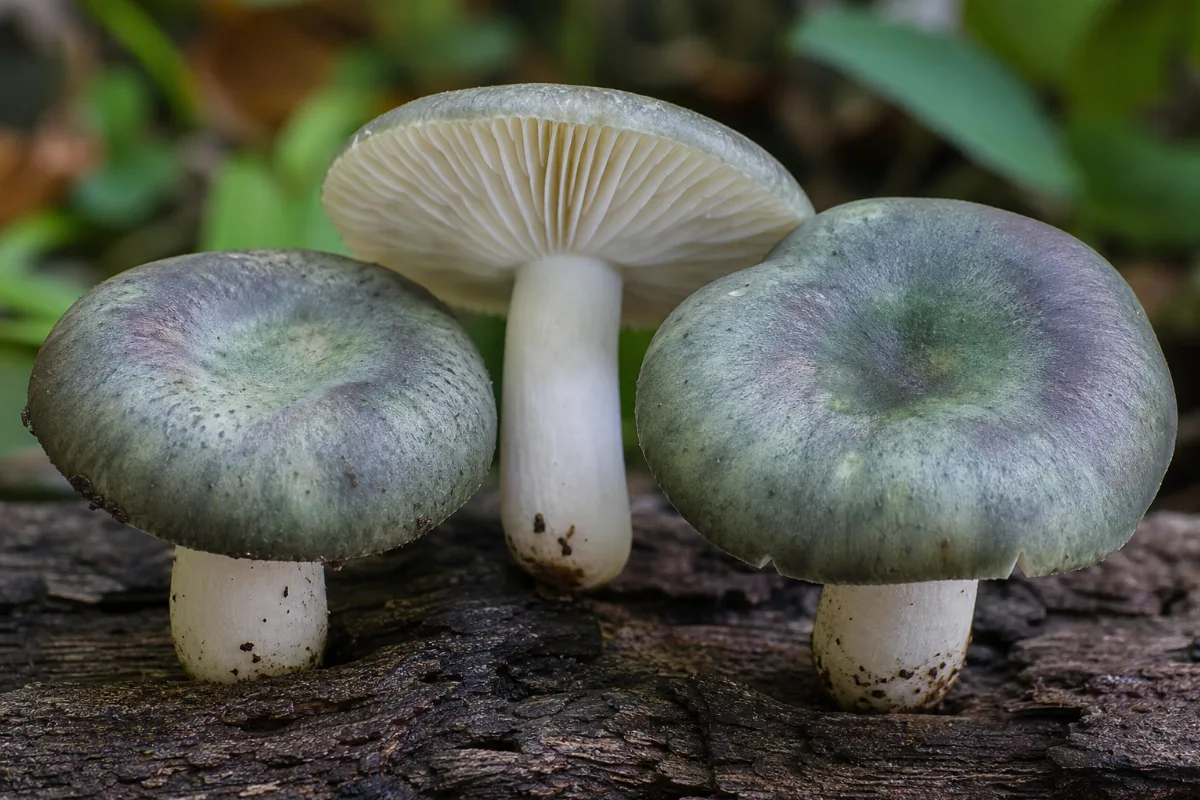
Mushrooms · Wild culinary mushroom
Charcoal Burner
Russula cyanoxantha · also called Charcoal burner, charcoal brittlegill; Vinetica porumbeilor or pigeon mushroom (Romanian name in a Romanian survey)
The charcoal burner is a wild mushroom eaten as food in Europe. It is not a remedy: we found no human study of any health effect, only test-tube work on its sugar chains and a steroid. The most important caution is mistaken identity. A government guide says the deadly death cap can be confused with some green russulas, and a poisonous Russula caused more fatal poisoning incidents than any other mushroom in one Chinese region. Never rely on text, a photo or an app to name a wild mushroom.
General information, not medical advice. Last substantive update · Not medically reviewed. A named clinician has not signed off on this page. How this page is made
About Charcoal Burner
The charcoal burner (Russula cyanoxantha) is an edible wild mushroom listed as a well-known food species. We found no human study of a health effect. The research is measurements of what wild samples contain and test-tube work on purified molecules. The real issue is safety: a government guide says the death cap can be confused with some green russulas, a poisonous Russula exists, other Russula species cause stomach upset, and wild samples have contained mercury, chromium and cadmium. Cooking does not remove toxins.
What it is
Russula cyanoxantha is a fungus in the brittlegill family (Russulaceae), a forest mushroom that lives with trees; a review says it prefers beech in European forests. GBIF lists the name as accepted, and lists Russula cutefracta as a synonym. It is eaten cooked as a wild food.
The review says Russula species depend on living host trees and typically do not fruit on artificial substrates. We found no cultivated supply, so the mushroom is wild-gathered, and no supplement of it was found.
Traditional and current uses
A 2025 review calls the charcoal burner a globally renowned edible species and says Russula species have long had a place in cooking and traditional medicine in Europe and Asia. It says R. cyanoxantha and a relative are used traditionally for fever and that R. cyanoxantha is listed among traditional tonics. It gives no detail, and tradition is not evidence that something works.
A Polish forest study measured protein in seven wild species, including this one, and found species identity mattered most. The charcoal burner was not among the three highest. A Romanian county survey includes it among 18 wild edible mushrooms.
What the research shows
No trial, case series or review of people eating this mushroom with a health outcome was found. The research is test-tube work. Two purified polysaccharides from the fruiting body slowed liver and lung cancer cell growth and activated mouse immune cells in a dish, and a purified steroid called ergone caused liver cancer cells to die in a dish. A review reports, second-hand, antioxidant, enzyme-blocking, germ and allergy-cell results for extracts.
None of this shows a benefit in people. Eating the mushroom is not shown to do any of it.
Metals from the soil
Wild mushrooms take up metals from where they grow. In three samples from southern Spain, mercury was 2.14, 4.12 and 3.21 mg per kg dry weight, and the authors flagged mercury as a cause of concern for frequent large portions in the season. Chromium was also above their risk index in two of three samples.
In a Romanian forest study cadmium was 3.15 to 14.1 mg per kg in forest samples and much lower in city samples. A Romanian county survey calculated a combined risk above 1 for children for several wild species including this one. These are measurements from a few samples and model estimates, not observed illness, and one site does not predict another.
Legal and regulatory status
We did not read any statement on the charcoal burner from the FDA, EFSA, EMA, Health Canada or WHO, so none is stated here. We also did not check legal limits for metals in wild mushrooms. Rules on picking and selling wild mushrooms differ by country and region. The US poison centre number is 1-800-222-1222.
At a glance
Traditional uses history, not proof
- Listed by a 2025 review among globally renowned edible Russula species, with a long place in cooking and traditional medicine in Europe and Asia.
- Used traditionally for fever and listed among traditional tonics, according to the same review (no detail given).
- Counted among wild edible mushrooms eaten in Romania, where the authors of a survey say wild mushrooms are widely used as traditional food.
Studied for research
- Eaten as a wild food (not a health benefit), insufficient
- Protein and amino acids, one Polish forest study, very low
- Mineral content, a few wild samples, very low
- Cancer cells, immune cells, antioxidant and enzyme tests, germs (all test tube), insufficient
- Traditional use for fever and as a tonic, insufficient
- Any health effect in people: none found, insufficient
Main compounds
- Two polysaccharides (sugar chains), RCP-I and RCP-II, studied in test tubes
- Ergone, a steroid found in several fungi, studied on cancer cells in a dish
- A ceramide and other compounds identified by chemistry only
Common forms
- Cooked fresh fruiting body (the food use)
- Laboratory polysaccharide extracts (research only, not a consumer product we found)
Research links: Catalan government: Toxic mushrooms · Poison Control (US): get help now · Mushroom poisoning deaths in Hunan, 2014-2023 (abstract) · Review of Russula bioactive compounds and safety (abstract) · Metals in wild mushrooms, southern Spain and northern Morocco (abstract) · Polysaccharides from Russula cyanoxantha, cell studies (abstract) · Research Library · Genes & Biomarkers Library
What it is and its history
- Accepted scientific name
- Russula cyanoxantha
- Naming authority
- (Schaeff.) Fr. (GBIF)
- Synonyms
- Russula cutefracta Cooke
- Common names
- Charcoal burner (English); Charcoal brittlegill (English); Vinetica porumbeilor (pigeon mushroom) (Romanian)
- Family or group
- Russulaceae (brittlegills), a fungus family, not a plant
- Classification
- Fungi > Basidiomycota > Agaricomycetes > Russulales > Russulaceae > Russula > Russula cyanoxantha
- Native range
- A 2025 review calls it a globally renowned edible species and says it lives with beech (Fagus) in European forests. Metal surveys sampled it in Spain, Romania and the East Black Sea region, and the polysaccharide paper calls it an edible mushroom in China.
- Habitat
- A tree-associated forest fungus. The Romanian survey lists mixed deciduous and coniferous forests and clearings on hills and mountains, and also meadows and gardens in plains, fruiting in summer to autumn. The Spanish samples came from deciduous forest with Quercus (oak). Given only to describe the fungus, not to help anyone find it.
- What it looks like
- Fruiting body: Not described on purpose. Do not identify a wild mushroom from text.
- Cultivation
- The 2025 review says Russula species depend on living host trees and typically do not fruit on standard artificial substrates, and says R. cyanoxantha preferentially associates with Fagus in European forests. No cultivated supply was found, so the mushroom is wild-gathered.
- Harvest and processing
- Not checked. Drying was not studied for this species.
- Look-alikes and adulterants
- Name: Death cap (Amanita phalloides); Note: A Catalan government guide says it may be confused with some green russulas. It contains amatoxins that destroy the liver. The guide does not name the charcoal burner. No identification tips are given here.; Name: Russula subnigricans; Note: A poisonous Russula; the Hunan authors say it is similar to the edible R. densifolia and R. virescens. They do not mention the charcoal burner.; Name: Green-cracking russula (Russula virescens); Note: A related edible Russula; sources warn that some green russulas are confused with the death cap.; Name: Russula pseudocyanoxantha; Note: A similarly named species that a 2025 review lists as edible with caution. The sources read do not compare how the two look.
- Sustainability and conservation
- Not checked.
Traditional use and history history, not clinical proof
| Tradition or era | Documented use | Source |
|---|---|---|
| Europe and Asia, cooking and traditional medicine | A 2025 review says Russula species have been used in traditional cuisine and medicine for centuries in Europe, Asia and Eastern Europe, and calls R. cyanoxantha and R. virescens globally renowned edible species. | p40422676 |
| Traditional fever remedy and tonic | The review says R. cyanoxantha and R. nobilis are used traditionally for fever and that R. cyanoxantha is listed among traditional tonics. It gives no country, date or preparation. | p40422676 |
| Romania, wild food | A Romanian survey includes it among 18 wild edible species from forests of Dâmbovița County, where the authors say edible wild mushrooms are widely used as a traditional food. | p41154076 |
Traditional use shows how it was used. It does not show that it works or is safe today.
What is inside, and how it may work
What it contains and how those compounds act in cells and animals. Laboratory and animal mechanisms are not proven effects in people.
Main compounds
| Compound | Family | Where it is concentrated | Activity studied | Level of evidence |
|---|---|---|---|---|
| Polysaccharides RCP-I and RCP-II | polysaccharide | Fruiting body | Sugar chains of 15,138 and 16,455 Da made of fucose, mannose, glucose and galactose (RCP-I 44.44% galactose, RCP-II 53.08%). Slowed cancer-cell growth and activated macrophage cells in a dish. 18 | Laboratory research |
| Ergosta-4,6,8(14),22-tetraen-3-one (ergone) PubChem 6441416 | steroid (ergostane) | Fruiting body (named in the review and cell paper as present in R. cyanoxantha) | Purified ergone caused cell-cycle arrest and caspase-dependent cell death in HepG2 liver cancer cells in a dish. 17 16 10 | Laboratory research |
| Phytosphingosine-type ceramide and other isolated compounds | mixed (ceramide, sterols, nucleobases, organic acids) | Fruiting body | Isolated and identified by chemistry; no activity was tested in the paper. 4 | Chemistry only |
| Lectins | protein | Fruiting body | The review says the lectins of this mushroom clump blood cells more strongly at 4 degrees C than at room temperature. This is a second-hand lab observation. 16 | Laboratory research |
Mechanisms, receptors and pathways
| Target or pathway | Gene or receptor | What was found | Level |
|---|---|---|---|
| Macrophage activation | RAW264.7 mouse macrophage cells | RCP-II, with more galactose, was the stronger activator of the cells in a dish. 18 | Laboratory research |
| Cancer-cell growth | HepG-2 and A549 cell lines | RCP-I, with more mannose, slowed growth better than RCP-II in a dish. 18 | Laboratory research |
| Apoptosis (programmed cell death) | Caspase-3, -8, -9; Bax; Bcl-2; PARP | Purified ergone raised caspase activity and Bax and lowered Bcl-2 in HepG2 cells. 17 | Laboratory research |
| Mast-cell degranulation | Syk and MAPK signalling in rat basophilic leukaemia cells | The review reports second-hand that an extract of R. cutefracta (given as the same species) blocked antigen-triggered degranulation. The original letter has no abstract and was not read. 16 | Laboratory research |
Absorption, metabolism and elimination
- Absorption
- Not found in the sources read.
- Distribution
- Not found.
- Metabolism
- Not found.
- Elimination
- Not found.
- Bioavailability
- Not established.
Isolated compounds versus whole extracts
The mushroom is eaten cooked as a whole fruiting body. All laboratory activity here comes from purified polysaccharides, a purified steroid or lab extracts, so it cannot be applied to eating the mushroom. No supplement or extract product evidence was found.
Nutritional composition
Measured essential minerals in wild samples were zinc, copper, selenium and iron (see the Benefits tab). We found no USDA entry and no open full nutrient table for the charcoal burner, so no calorie or protein figures are given.
2 very low certainty6 not enough evidence
What was looked at
The 8 benefits and uses checked for Charcoal Burner, each with how strong the evidence is. Tap one to open it.
- Eaten as a wild foodNot enough evidence
- Protein and amino acids (one Polish forest study)Very low certainty
- Mineral content (Spain, Romania)Very low certainty
- Cancer cells in the test tubeNot enough evidence
- Immune cells in the test tubeNot enough evidence
- Antioxidant and starch-enzyme tests (test tube)Not enough evidence
- Germs in a dishNot enough evidence
- Traditional use for fever and as a tonicNot enough evidence
What is Charcoal Burner good for?
The uses people ask about and how strong the evidence is for each. The charcoal burner is a food: none of these is a proven health benefit, and every research item is a measurement in wild samples, a test-tube result or a second-hand report. Read this together with the Safety tab.
Benefits, one by one
Each card is a research question, not a promise. Tap a goal to filter. Open a card to see the studies, doses and limits.
Eaten as a wild food
Not enough evidenceThe charcoal burner is a wild forest mushroom that sources list as edible and well known as food in Europe. That is a food use, not a health benefit. No study shows that eating it changes anyone's health.
2 studiesEaten cooked as a wild mushroom. No capsule or supplement was found. …
Studies, doses and limits
Results
The review lists R. cyanoxantha as edible. A 2022 metals study names it, with Lactarius deliciosus, as one of the most consumed and appreciated wild species in the Russulaceae family. Neither source measures an effect of eating it.
Why this rating
There is no health claim to rate. Edibility is a statement from reviews and surveys, not from a study of effects.
Form and dose studied
Eaten cooked as a wild mushroom. No capsule or supplement was found. This page gives no amounts.
Limits
Edibility statements apply only to a correctly named mushroom. Being a Russula is not a safety test.
Why researchers looked
People pick and eat it for taste. Scientists have mostly measured what is in it and what it takes up from the soil.
Traditional use
A 2025 review says Russula species have been part of cooking and traditional medicine in Europe and Asia for centuries, and calls R. cyanoxantha one of the globally renowned edible species.
Proposed mechanism Not applicable
Not a health mechanism.
A proposed mechanism does not show that the effect happens in people.
The documented danger is picking the wrong mushroom. See the Safety tab first.
Protein and amino acids (one Polish forest study)
Very low certaintyA 2025 study in a Polish forest measured protein and amino acids in seven wild mushroom species, including the charcoal burner. It found that the species itself decided most of the protein level, and the charcoal burner was not among the three species with the highest protein. The abstract gives no figures for this species.
1 studiesFresh wild fruiting body. Dried products were not tested.
Studies, doses and limits
Results
The authors report that the highest protein content was in Xerocomellus chrysenteron, Macrolepiota procera and Rhodocolybia butyracea. Soil and forest conditions had weak, species-specific effects: the abstract names effects for three other species and says the effects were negligible for all the rest. Amino acid profiles were not changed by any environmental factor.
Effect sizes as reported
Not given for R. cyanoxantha in the abstract
Why this rating
A measurement from one forest. It does not say how much protein a person gets from a meal.
Form and dose studied
Fresh wild fruiting body. Dried products were not tested.
Limits
One study area in Poland. Figures for this species were not available in the abstract.
Why researchers looked
Wild mushrooms are often described as a protein food, but little was known about what changes their protein content.
Proposed mechanism Food chemistry
Not a health mechanism. It describes what the mushroom contains.
A proposed mechanism does not show that the effect happens in people.
None specific. Protein content is no reason to eat a wild mushroom.
Mineral content (Spain, Romania)
Very low certaintyThree studies measured essential minerals in wild charcoal burners. Zinc and copper were the main ones, with some selenium and iron. The amounts differed a lot between sites, so these are snapshots, not typical values.
3 studiesFresh wild fruiting body. Dried products were not tested. This page g…
Studies, doses and limits
Results
Southern Spain, three wild samples (dry weight, mg per kg): zinc 51.2, 61.4 and 63.4; copper 23.7, 43.1 and 35.3; selenium 0.613, 2.55 and 1.49. In that paper zinc was the main element across species, followed by copper and selenium. Dâmbovița County, Romania, one sample (fresh weight, mg per kg): iron 28.289, copper 2.385, zinc 8.004. Cluj-Napoca, Romania: iron was 69.1 in city samples and 22.6 to 34.5 in forest samples (mg per kg, as the abstract gives it).
Effect sizes as reported
Measured amounts in a few samples; no health effect
Why this rating
Values were measured with standard laboratory methods, but there are only a few samples and the levels depend on the soil where each mushroom grew.
Form and dose studied
Fresh wild fruiting body. Dried products were not tested. This page gives no amounts to eat.
Limits
Few samples; different drying and units between papers; sites in Spain and Romania only.
Why researchers looked
Researchers wanted to know both the useful minerals and the toxic metals in mushrooms people pick.
Proposed mechanism Food chemistry
Not a health mechanism. Mushrooms take up minerals and metals from the soil where they grow.
A proposed mechanism does not show that the effect happens in people.
The same papers measured mercury, cadmium and chromium. See the Safety tab.
Cancer cells in the test tube
Not enough evidenceIn a 2025 lab study, two sugar-chain molecules (polysaccharides) taken from the charcoal burner slowed the growth of human liver and lung cancer cells in a dish. A separate lab study used a steroid called ergone, which is found in this and several other fungi, on liver cancer cells. These are cell tests, not a treatment, and no study in animals or people was found.
3 studiesPurified polysaccharides and a purified steroid, not the mushroom as …
Studies, doses and limits
Results
Zhong 2025: RCP-I (15,138 Da) worked better against HepG-2 and A549 cells than RCP-II (16,455 Da). The authors link the stronger effect to RCP-I having more mannose. Zhao 2011 used purified ergone, which the paper says is found in several fungi including R. cyanoxantha; it caused cell-cycle arrest and apoptosis in HepG2 cells. The abstracts give no figures for the cell effects.
Effect sizes as reported
Lab activity only; no figures in the abstracts
Why this rating
Cell lines only. The ergone experiment used the purified compound, not the mushroom.
Form and dose studied
Purified polysaccharides and a purified steroid, not the mushroom as eaten.
Who was studied
Cell lines
Limits
In vitro only; no animal or human data. Eating the mushroom is not shown to do this.
Why researchers looked
Mushroom polysaccharides and steroids are often screened against cancer cell lines.
Proposed mechanism Laboratory research
Polysaccharides RCP-I and RCP-II slowed HepG-2 and A549 cell growth. Purified ergone made HepG2 cells arrest in their cycle and die in a caspase-dependent way.
A proposed mechanism does not show that the effect happens in people.
Do not treat cancer with wild mushrooms. Ask your cancer team before using any mushroom product.
Immune cells in the test tube
Not enough evidenceThe same 2025 study found that the two polysaccharides activated mouse immune cells (macrophages) in a dish, and one of them did this more strongly than the other. A review also mentions a lab test in which a charcoal burner extract calmed allergy-type cells from rats. No immune result was measured in animals or people.
2 studiesPurified polysaccharides or a lab extract.
Studies, doses and limits
Results
Zhong 2025: RCP-II showed a stronger immunomodulatory effect on RAW264.7 cells; the authors suggest its higher galactose content may explain it and say the findings lay a foundation for possible use of these polysaccharides as immunomodulators. The 2025 review reports, second-hand, that R. cutefracta (given as the same species) inhibited mast-cell degranulation in rat basophilic leukaemia cells.
Effect sizes as reported
No figures in the abstracts
Why this rating
Cell lines only; the allergy-cell result is second-hand from a review.
Form and dose studied
Purified polysaccharides or a lab extract.
Who was studied
Mouse and rat cell lines
Limits
In vitro only. 'Possible use' is the authors' hope, not a result.
Why researchers looked
Beta-glucans and other mushroom sugars are often tested on macrophage cells.
Proposed mechanism Laboratory research
RCP-II, which has more galactose, was the stronger activator of RAW264.7 macrophage cells in the dish.
A proposed mechanism does not show that the effect happens in people.
Medicinal mushrooms can affect immune medicines in some cases, but nothing is known for this one. Ask your doctor or pharmacist.
Antioxidant and starch-enzyme tests (test tube)
Not enough evidenceA 2025 review reports that extracts of the charcoal burner and two other Russula species mopped up free radicals and slowed two starch-digesting enzymes in test tubes. We read this second-hand. Nobody tested blood sugar in animals or people.
2 studiesLaboratory extracts, not the mushroom as eaten.
Studies, doses and limits
Results
As reported by the review: extracts from R. densifolia, R. violeipes and R. cyanoxantha showed strong antioxidant activity (ABTS and DPPH tests) along with alpha-glucosidase and alpha-amylase inhibition. A separate Indian study of nine wild mushroom species says all nine samples showed alpha-amylase-inhibitory activity (the abstract does not single out the charcoal burner).
Effect sizes as reported
No figures in the text we read
Why this rating
Test-tube screening reported second-hand; the extract type is not stated in the review text we read.
Form and dose studied
Laboratory extracts, not the mushroom as eaten.
Limits
Second-hand; test tube only; three species were tested together.
Why researchers looked
Food extracts are often screened for antioxidant activity and for blocking these enzymes, which some diabetes medicines also block.
Proposed mechanism Laboratory research
Radical scavenging and inhibition of alpha-glucosidase and alpha-amylase by extracts.
A proposed mechanism does not show that the effect happens in people.
Do not use a wild mushroom to manage blood sugar.
Germs in a dish
Not enough evidenceIn a lab study of wild mushrooms from India, charcoal burner samples (with three other species) gave the largest clear zone around them against one bacterium and one fungus in a dish. It is not an antibiotic and not a food-safety measure.
2 studiesLaboratory extract.
Studies, doses and limits
Results
Khan 2019: Agaricus bisporus, A. campestris, Russula cyanoxantha and Amanita pantherina all showed the largest zone of inhibition against Pseudomonas putida and Microsporum canis among the nine species tested. The 2025 review repeats this as antifungal activity against M. canis and antibacterial activity against P. putida.
Effect sizes as reported
Largest zone among nine species; no figures in the abstract
Why this rating
Lab plate test only; extract type and strength are not given in the abstract.
Form and dose studied
Laboratory extract.
Who was studied
Bacteria and fungi in a dish
Limits
In vitro only. The tested germs are not the ones that make people ill from mushrooms.
Why researchers looked
Mushroom extracts are often screened against bacteria and fungi.
Proposed mechanism Laboratory research
Zone-of-inhibition test on agar plates.
A proposed mechanism does not show that the effect happens in people.
None specific.
Traditional use for fever and as a tonic
Not enough evidenceA 2025 review says the charcoal burner and one relative have been used traditionally for fever, and that the charcoal burner is listed among Russula species used as tonics. This is tradition only. We found no study that tested either use.
1 studiesNot stated.
Studies, doses and limits
Results
The review names R. cyanoxantha and R. nobilis for fever and lists R. cyanoxantha among traditional tonics. It gives no detail on preparation.
Why this rating
Traditional use is not evidence that something works.
Limits
Second-hand statement from a review; the underlying sources were not opened.
Why researchers looked
Traditional use is why researchers screened these mushrooms.
Traditional use
The review gives these uses from other sources and does not say which country or period.
Proposed mechanism Not applicable
Not studied.
A proposed mechanism does not show that the effect happens in people.
Fever can be serious. See a doctor rather than treating it with a wild mushroom.
Connections to the rest of health
How Charcoal Burner connects to the rest of our health knowledge graph. Every link says what kind of connection it is. A safety link (for example to the liver) is a warning, not a benefit. A study that merely mentions a topic never creates a benefit link.
Explore every connection: goals, body systems, organs, symptoms, genes
B. Body systems
| Connected to | Kind of connection | Evidence status | Context | Studies |
|---|---|---|---|---|
| Digestive System | Biological association | Not enough evidence | Studied for: Eaten as a wild food Studied for: Protein and amino acids (one Polish forest study) | 16 1 12 11 19 |
| Immune System | Biological association | Not enough evidence | Studied for: Cancer cells in the test tube Studied for: Immune cells in the test tube | 18 17 16 6 |
| Endocrine System | Biological association | Not enough evidence | Studied for: Antioxidant and starch-enzyme tests (test tube) | 16 6 |
C. Body parts and organs
| Connected to | Kind of connection | Evidence status | Context | Studies |
|---|---|---|---|---|
| Liver | Adverse effect or risk | Not enough evidence | Fatal liver failure after mistaking a toxic mushroom for an edible one. Preparation or compound: Deadly look-alike danger, the death cap (amatoxins), not the charcoal burner |
13 9 5 |
| Muscles and kidneys | Adverse effect or risk | Low certainty | Muscle breakdown, kidney injury and deaths in a Chinese region. Preparation or compound: Russula subnigricans, a poisonous Russula, not the charcoal burner |
15 |
E. Health conditions
| Connected to | Kind of connection | Evidence status | Context | Studies |
|---|---|---|---|---|
| Mushroom poisoning | Adverse effect or risk | Low certainty | Mistaken identity is the documented route to serious poisoning. Preparation or compound: Wrongly identified wild mushrooms |
5 15 14 |
G. Root causes and contributing factors
| Connected to | Kind of connection | Evidence status | Context | Studies |
|---|---|---|---|---|
| Heavy metal exposure | Low certainty | Mercury, cadmium and chromium measured in wild samples; levels depend on the site. Preparation or compound: Wild-collected charcoal burner fruiting body |
1 19 11 |
L. Active compounds
| Connected to | Kind of connection | Evidence status | Context | Studies |
|---|---|---|---|---|
| Polysaccharides RCP-I and RCP-II | Biological association | In vitro | Sugar chains of 15,138 and 16,455 Da made of fucose, mannose, glucose and galactose (RCP-I 44.44% galactose, RCP-II 53.08%). Slowed cancer-cell growth and activated macrophage cells in a dish. Preparation or compound: Fruiting body |
18 |
| Ergosta-4,6,8(14),22-tetraen-3-one (ergone) | Biological association | In vitro | Purified ergone caused cell-cycle arrest and caspase-dependent cell death in HepG2 liver cancer cells in a dish. Preparation or compound: Fruiting body (named in the review and cell paper as present in R. cyanoxantha) |
17 16 10 |
| Phytosphingosine-type ceramide and other isolated compounds | Biological association | Chemistry only | Isolated and identified by chemistry; no activity was tested in the paper. Preparation or compound: Fruiting body |
4 |
| Lectins | Biological association | In vitro | The review says the lectins of this mushroom clump blood cells more strongly at 4 degrees C than at room temperature. This is a second-hand lab observation. Preparation or compound: Fruiting body |
16 |
Each connection is stored with the ingredient, the connected record, the kind of connection, the evidence status, the supporting studies, the preparation or compound involved, and a review date (last reviewed October 25, 2026).
Evidence at a glance: what the research found for 8 outcomes
Each outcome below is one thing researchers measured. Certainty is how far the evidence can be trusted, not how well it works. The full studies are on the next tab.
The evidence
The research centre for Charcoal Burner. Every record here was checked against PubMed or the publisher's page; we never list a study we have not verified.
Evidence by outcome
Bars show how many studies we found for each outcome, not how well it works. People are added up across trials only (reviews are not added, to avoid double counting).
How we rate evidence
High certainty
Several well-run trials or reviews agree; further research is unlikely to change the picture much.
Moderate certainty
Good trials point the same way, but some doubt remains.
Low certainty
Small, short or inconsistent trials. The finding could change with better research.
Very low certainty
Very little or very weak human data. Treat as a possibility only.
Mixed findings
Trials or reviews disagree with each other.
Not enough evidence
Not enough human research to say either way.
Evidence against
Good research found no benefit, or found harm.
We take the reviewers' own risk-of-bias and GRADE statements where they exist, and otherwise judge from study size, design, consistency, directness and whether a product matches what is sold. Many publications do not make evidence high. Method note: We read PubMed records and abstracts for 14 papers (a review, two case reports, a surveillance analysis, a cell-toxicity test, five metals or composition analyses, two polysaccharide or steroid lab studies, one plate-screening study and one chemistry paper), the open full texts of the Russula review and the Spanish and Romanian metals papers, the Catalan government mushroom guide, the Kansas and national Poison Control pages, and checked the name in GBIF and the ergone record in PubChem. Numbers come from those abstracts and open texts. Certainty ratings are the compiler's own reading.
Study library: every study we checked 19
| Study | Design | People | Product, dose, length | Result |
|---|---|---|---|---|
| Barea-Sepulveda 2022 Exposure to Essential and Toxic Elements via Consumption of Agaricaceae, Amanitaceae, Boletaceae, and Russulaceae Mushrooms from Southern Spain and Northern Morocco. Journal of Fungi · PMID 35628800 · DOI |
Lab analysis fungus |
Wild edible mushrooms from southern Spain and northern Morocco; three R. cyanoxantha samples (all from Spain) among 16 samples of five species | ICP-MS measurement of eight elements fruiting body (dry weight) Not shown here |
For the three R. cyanoxantha samples (mg per kg dry weight): copper 23.7, 43.1, 35.3; zinc 51.2, 61.4, 63.4; selenium 0.613, 2.55, 1.49; chromium 7.39, 5.01, 10.2; arsenic 0.147, 0.302, 0.111; cadmium 0.408, 0.223, 1.16; mercury 2.14, 4.12, 3.21; lead 0.397, 0.325, 0.305. Zinc was the main element across species, then copper and selenium. The abstract says the health-risk assessment for all species studied showed mercury as a cause of concern for frequent consumption of around 300 g of fresh mushrooms per day during the mushrooming season. Measured amounts; authors' risk calculation, not an observed harm Methods, limits and fundingOutcomes: Levels of chromium, arsenic, cadmium, mercury, lead, copper, zinc and selenium, and the authors' intake and health-risk calculations Limitations: Three samples of this species, from two Spanish sites; levels depend on the place. The risk figures rest on the authors' assumption of a large daily portion. Funding and conflicts: Declared no conflict of interest Read: abstract and open full text read through Europe PMC |
| Busuioc 2011 The bioaccumulation and translocation of Fe, Zn, and Cu in species of mushrooms from Russula genus. Environmental Science and Pollution Research · PMID 21274641 · DOI |
Lab analysis fungus |
R. virescens, R. cyanoxantha, R. foetens and R. nigrescens from forest ecosystems in southern Romania | EDXRF measurement of metals in mushrooms and their substrate fruiting body Not shown here |
Across the four species iron ranged from 58.83 to 340.34, zinc from 19.70 to 99.62 and copper from 5.03 to 9.37 mg/kg. The bioaccumulation factors were below 1, which the authors say shows low capacity of these species to accumulate these metals when soil concentrations rise above normal. Translocation factors were high. Low bioaccumulation of three metals across four species Methods, limits and fundingOutcomes: Iron, zinc and copper in the fruiting body and the bioaccumulation and translocation factors Limitations: Figures are for the four species together, not R. cyanoxantha alone; iron, zinc and copper only (not cadmium or mercury). Funding and conflicts: Research support non-U.S. government per the record Read: abstract |
| GBIF 2026 GBIF Backbone Taxonomy: Russula cyanoxantha (Schaeff.) Fr. n/a · Source |
Taxonomy record n/a |
n/a | n/a Not shown here |
Russula cyanoxantha (Schaeff.) Fr. is ACCEPTED, key 2551542, family Russulaceae, order Russulales, class Agaricomycetes, phylum Basidiomycota. Russula cutefracta Cooke is a SYNONYM of it (key 2551545). Methods, limits and fundingOutcomes: Russula cyanoxantha (Schaeff.) Fr. is ACCEPTED, key 2551542, family Russulaceae, order Russulales, class Agaricomycetes, phylum Basidiomycota. Russula cutefracta Cooke is a SYNONYM of it (key 2551545). Limitations: Database record checked on 2026-10-25 through the API. Index Fungorum could not be reached from the tool used, so it was not read directly. Funding and conflicts: Independent public or government information source Read: full text |
| Gao 2001 A new ceramide from the basidiomycete Russula cyanoxantha. Lipids · PMID 11269698 · DOI |
Chemistry study fungus |
Fruiting bodies of Russula cyanoxantha extracted for chemical isolation | Ethanol and chloroform/methanol extracts fruiting body Not shown here |
A new phytosphingosine-type ceramide was isolated together with nine other compounds: two epidioxy-ergostane sterols, two ergostane triols, inosine, adenine, L-pyroglutamic acid, fumaric acid and D-allitol. The structure of the ceramide was worked out by spectroscopy and chemistry. Compounds identified; no activity tested Methods, limits and fundingOutcomes: Isolation and structure of compounds Limitations: Chemistry paper: no amounts in the abstract and no health testing. Funding and conflicts: Not stated in the abstract Read: abstract |
| Generalitat de Catalunya (Catalan government) Toxic mushrooms (Generalitat de Catalunya, mushroom season guide) n/a · Source |
Authoritative guidance n/a |
n/a | n/a Not shown here |
Calls Amanita phalloides (death cap) the most dangerous mushroom and the cause of the majority of fatal poisonings, and says it may be confused with some green russulas (Russula). Methods, limits and fundingOutcomes: Calls Amanita phalloides (death cap) the most dangerous mushroom and the cause of the majority of fatal poisonings, and says it may be confused with some green russulas (Russula). Limitations: Undated public-information page. It gives look-alike warnings and identification comments; this page repeats none of them. It does not name the charcoal burner. Funding and conflicts: Independent public or government information source Read: full text |
| Khan 2019 Bioprospecting of Wild Mushrooms from India with Respect to Their Medicinal Aspects. International Journal of Medicinal Mushrooms · PMID 30806224 · DOI |
Lab study fungus |
Nine wild mushroom species from forests of Ranchi District, Jharkhand, India (200 samples collected) | Laboratory extracts tested on four bacteria, four fungi, alpha-amylase and antioxidant tests fruiting body Not shown here |
Agaricus bisporus, A. campestris, Russula cyanoxantha and Amanita pantherina showed the largest zone of inhibition against Pseudomonas putida and Microsporum canis. All collected samples showed alpha-amylase-inhibitory activity. Other tests singled out other species (for example Astraeus hygrometricus for antioxidant activity). Lab plate tests; no figures in the abstract Methods, limits and fundingOutcomes: Antibacterial, antifungal, alpha-amylase-inhibition and antioxidant tests Limitations: Extract type and strength not in the abstract; screening only. Funding and conflicts: Not stated in the abstract Read: abstract |
| Long 2023 Cytotoxicity of 4 Wild Mushrooms in a Case of Yunnan Sudden Unexplained Death. Fa Yi Xue Za Zhi · PMID 37277374 · DOI |
Case report cell line |
Four wild mushrooms eaten by a family in one sudden-death incident in Yunnan, tested on kidney-derived HEK293 cells | Raw, boiled and boiled-then-enzyme-digested extracts fruiting body Not shown here |
The four mushrooms were Butyriboletus roseoflavus, Boletus edulis, Russula virescens and Amanita manginiana. Only Amanita manginiana was cytotoxic. Boiling and enzyme digestion lowered but did not remove its toxicity. The authors conclude eating Amanita manginiana is potentially dangerous. Boiling lowered, but did not remove, the toxicity of one Amanita Methods, limits and fundingOutcomes: Cell toxicity of each mushroom extract Limitations: Cell test on a different Russula species (R. virescens) and a different Amanita; says nothing directly about the charcoal burner. Funding and conflicts: Not stated in the abstract Read: abstract |
| Poison Control (America's Poison Centers) 2026 Need immediate assistance? (Poison Control, America's Poison Centers) n/a · Source |
Authoritative guidance n/a |
n/a | n/a Not shown here |
Gives 1-800-222-1222 as the US poison centre number, free and confidential, and says to call 911 if the person collapses, has a seizure, has trouble breathing or cannot be woken. Methods, limits and fundingOutcomes: Gives 1-800-222-1222 as the US poison centre number, free and confidential, and says to call 911 if the person collapses, has a seizure, has trouble breathing or cannot be woken. Limitations: US only. Read on 2026-10-25. Funding and conflicts: Independent public or government information source Read: full text |
| Ponnam 2026 Mushrooms: The Good, the Bad, and the Deadly. Cureus · PMID 41728395 · DOI |
Case report |
Two older adults with severe Amanita poisoning | Wild Amanita mushrooms in a soup fruiting body Not shown here |
The abstract says amatoxin mushrooms such as Amanita phalloides carry high illness and death rates, and that poisoning often results from accidental ingestion or wrong identification, with diagnosis delayed because identification is hard. In the case text the 80-year-old man deteriorated quickly, was flown to a liver transplant centre and died several hours later. Two severe cases after a mushroom soup Methods, limits and fundingOutcomes: Presentation, diagnosis and treatment of severe Amanita poisoning Limitations: Two cases; nothing in it concerns Russula. Funding and conflicts: Authors declare no financial relationships Read: abstract and parts of full text |
| PubChem (US National Library of Medicine) 2026 PubChem: Ergosta-4,6,8(14),22-Tetraen-3-One (ergone) n/a · Source |
Chemistry record n/a |
n/a | n/a Not shown here |
CID 6441416, molecular formula C28H40O. Methods, limits and fundingOutcomes: CID 6441416, molecular formula C28H40O. Limitations: Database record checked on 2026-10-25 through the API; it confirms the compound's identity, not its presence in any amount in the mushroom. Funding and conflicts: Independent public or government information source Read: full text |
| Stihi 2025 Assessment of the Impact of Metals in Wild Edible Mushrooms from Dambovita County, Romania, on Human Health. Foods · PMID 41154076 · DOI |
Lab analysis fungus |
18 wild edible mushroom species from forest areas of Dâmbovița County, Romania (R. cyanoxantha is sample WM2) | EDXRF measurement of metals (fresh weight) and risk modelling fruiting body Not shown here |
For R. cyanoxantha (mg per kg, fresh weight): iron 28.289, copper 2.385, zinc 8.004, lead 0.214, cadmium 0.187. The authors list R. cyanoxantha among the species whose combined non-cancer risk index for children was above 1, and place it high in their risk order. Their cancer-risk estimate for copper was above 1 in 10,000 in all samples, and for chromium and cadmium in several species including R. cyanoxantha. Measured amounts and model-based risk estimates Methods, limits and fundingOutcomes: Metal content and the authors' non-cancer and cancer risk estimates for adults and children Limitations: A survey with small numbers per species; risk estimates use the authors' own intake assumptions and are not observed illness. Funding and conflicts: Declared no conflicts of interest Read: abstract and open full text read through Europe PMC |
| Stojek 2025 Protein content and amino acid profile of wild mushrooms depend on environmental conditions. Fungal Biology · PMID 40915666 · DOI |
Lab analysis fungus |
Seven wild mushroom species in the Białowieża forest area, Poland (including Russula cyanoxantha) | Measurement of total protein and essential amino acids fruiting body Not shown here |
Species identity determined most of the protein content and amino acid profile. The highest protein was in Xerocomellus chrysenteron, Macrolepiota procera and Rhodocolybia butyracea. The abstract names environmental effects only for X. chrysenteron, Lactifluus vellereus and M. procera and says effects were negligible for all other species; no figures for R. cyanoxantha are given. Species differences in protein Methods, limits and fundingOutcomes: Effect of soil and tree stand on protein and amino acids Limitations: Figures for this species are not in the abstract. Funding and conflicts: Declared no competing interests Read: abstract |
| Tobias 2024 Diagnosis and Management of Amanita Phalloides Toxicity in the Emergency Department Observation Unit: A Case Report. Clinical Practice and Cases in Emergency Medicine · PMID 38546312 · DOI |
Case report |
One man with stomach symptoms and raised liver tests | Wild mushrooms believed to be Amanita phalloides (death cap) fruiting body Not shown here |
A man came to the emergency department with stomach and bowel distress and raised liver function tests; it emerged that he had eaten wild mushrooms believed to be death caps. The authors say mushroom toxicity is an important cause of acute liver injury with stomach symptoms and that foraging hobbyists need a high index of suspicion. One patient with liver injury after a wild mushroom meal Methods, limits and fundingOutcomes: Presentation and management of mushroom toxicity Limitations: Single case; final outcome not given in the abstract; nothing in it concerns Russula. Funding and conflicts: Authors disclosed none Read: abstract |
| University of Kansas Health System Poison Control Center Poisonous Mushrooms (University of Kansas Health System Poison Control Center) n/a · Source |
Authoritative guidance n/a |
n/a | n/a Not shown here |
Says symptoms may not develop for a couple of days, that cooking, canning, pickling, freezing and drying poisonous mushrooms does not remove toxins, that some people are allergic to mushrooms that are not considered poisonous, and that anyone who eats a wild mushroom should contact poison control immediately without waiting for symptoms. Methods, limits and fundingOutcomes: Says symptoms may not develop for a couple of days, that cooking, canning, pickling, freezing and drying poisonous mushrooms does not remove toxins, that some people are allergic to mushrooms that are not considered poisonous, and that anyone who eats a wild mushroom should contact poison control immediately without waiting for symptoms. Limitations: US poison-centre page; date not shown on the page. General advice, not about Russula. Funding and conflicts: Independent public or government information source Read: full text |
| Wu 2025 Mushroom poisoning deaths and prevention practices in Hunan, 2014-2023. PLoS One · PMID 40522929 · DOI |
Surveillance analysis |
Fatal wild mushroom poisoning incidents reported in Hunan Province, China, 2014 to 2023 | Wild mushroom poisoning surveillance data Not shown here |
80 fatal incidents and 111 deaths. The species most often linked to fatal poisoning were Russula subnigricans (20 events, 25.0%), Amanita fuliginea (18 events, 22.5%) and Amanita rimosa (11 events, 13.5%). All fatal incidents followed accidental picking and eating at home. The discussion says R. subnigricans is similar to the edible Russula densifolia and Russula virescens and that its main toxin can cause rhabdomyolysis, leading to acute kidney injury, heart damage and death in severe cases. A poisonous Russula was the single most common cause of fatal incidents in this region Methods, limits and fundingOutcomes: Number, timing, species and people affected in fatal incidents Limitations: Chinese region and species; the similarity statement is in the discussion and is not tested in the paper. It does not name the charcoal burner. Funding and conflicts: Non-U.S. government research support per the record; no competing interests declared Read: abstract and parts of full text |
| Yang 2025 Unveiling the Bioactive Compounds and Therapeutic Potential of Russula: A Comprehensive Review. Journal of Fungi · PMID 40422676 · DOI |
Narrative review fungus |
Review of many Russula species (fungi), mostly laboratory and preclinical work | Review of Russula species and extracts fruiting body Not shown here |
Table 1 lists R. cyanoxantha as edible and R. pseudocyanoxantha as edible with caution. The text calls R. cyanoxantha and R. virescens globally renowned edible species and says R. cyanoxantha and R. nobilis are used traditionally for fever, and R. cyanoxantha is listed among traditional tonics. It says R. emetica and R. nigricans are poisonous; R. densifolia, R. fragrantissima and R. rosacea can cause gastroenteritis; R. olivacea can cause nausea, vomiting and diarrhoea; R. subnigricans can cause rhabdomyolysis, severe low calcium, respiratory failure, acute kidney failure, lung oedema, a fast abnormal heart rhythm and circulatory shock. For R. cyanoxantha it reports (second-hand) inhibition of mast-cell degranulation (listed under R. cutefracta, given as the same species), antifungal activity against Microsporum canis and antibacterial activity against Pseudomonas putida, the cytotoxic steroid ergone, and antioxidant and starch-enzyme-blocking effects of extracts shared with two other species. It cites an East Black Sea study with cadmium of 3.16 mg/kg in R. cyanoxantha, the highest cadmium level among the Russula species tested, and says R. cyanoxantha prefers beech (Fagus) in European forests and Russula species fail to fruit without living host trees. Preclinical findings only for R. cyanoxantha; no human trial Methods, limits and fundingOutcomes: Bioactive compounds, edibility, preclinical activity, safety and toxicology Limitations: Narrative review; the primary papers behind the R. cyanoxantha statements were not opened, so they are second-hand. Funding and conflicts: Declared no conflicts of interest Read: abstract and open full text read through Europe PMC |
| Zhao 2011 Ergosta-4,6,8(14),22-tetraen-3-one induces G2/M cell cycle arrest and apoptosis in human hepatocellular carcinoma HepG2 cells. Biochimica et Biophysica Acta · PMID 21241775 · DOI |
Lab study cell line |
Human liver cancer cell line HepG2 | Purified ergone (ergosta-4,6,8(14),22-tetraen-3-one), a steroid found in several fungi including Russula cyanoxantha purified compound Not shown here |
Ergone showed remarkable anti-proliferative activity toward HepG2 cells, with G2/M arrest, chromatin condensation, nuclear fragmentation, phosphatidylserine exposure, PARP cleavage, caspase-3, -8 and -9 activation, higher Bax and lower Bcl-2. The authors conclude ergone causes apoptosis in a caspase-dependent way. Cell effect of the purified compound Methods, limits and fundingOutcomes: Cell-cycle arrest and cell death markers Limitations: The experiment did not use the mushroom; it used the purified steroid. No animal or human data. Funding and conflicts: Not stated in the abstract Read: abstract |
| Zhong 2025 Comparative structure characteristics, anticancer and immunomodulatory activities of two bioactive polysaccharides RCP-I and RCP-II from mushroom Russula cyanoxantha (Schaeff.) Fr. International Journal of Biological Macromolecules · PMID 40414403 · DOI |
Lab study cell line |
Test tube chemistry, human liver (HepG-2) and lung (A549) cancer cell lines and mouse macrophage (RAW264.7) cells | Two purified polysaccharides, RCP-I (15,138 Da) and RCP-II (16,455 Da), made by ultrasonic hot-water extraction fruiting body Not shown here |
RCP-I contained 10.22% fucose, 24.00% mannose, 21.33% glucose and 44.44% galactose; RCP-II 11.15%, 19.64%, 16.13% and 53.08%. RCP-I had the better antiproliferation effect against HepG-2 and A549 cells; RCP-II had the stronger immunomodulatory effect on RAW264.7 cells. The authors suggest higher mannose in RCP-I and higher galactose in RCP-II explain this and that the findings lay a foundation for potential use as immunomodulators. Lab activity only Methods, limits and fundingOutcomes: Structure of the polysaccharides, antiproliferative effect on cancer cells and immunomodulatory effect on macrophages Limitations: In vitro only; purified fractions; no figures for the cell effects in the abstract; not tested in animals or people. Funding and conflicts: Authors declare no competing interests Read: abstract |
| Zsigmond 2020 Elemental composition of Russula cyanoxantha along an urbanization gradient in Cluj-Napoca (Romania). Chemosphere · PMID 31446272 · DOI |
Lab analysis fungus |
R. cyanoxantha and soil from six forests and two city parks in and around Cluj-Napoca, Romania | ICP-OES measurement of elements fruiting body Not shown here |
Cadmium was 0.39 ± 0.35 mg per kg in city samples and 3.15 to 14.1 in forest samples; chromium 0.40 ± 0.19 versus below 0.18; iron 69.1 ± 29.9 versus 22.6 to 34.5; manganese 10.9 ± 1.3 versus 15.9 to 19.1. The mushroom went from a cadmium accumulator to a cadmium excluder toward the city. The authors' idea that city pollution would raise its metal content was disproved, and they suggest carbonate in city soil locks metals up. Large difference in cadmium between sites Methods, limits and fundingOutcomes: Metal uptake along an urbanization gradient Limitations: The abstract does not state whether values are dry or fresh weight. Soil uptake, not a health effect, was the focus. Funding and conflicts: Not stated in the abstract Read: abstract |
What we do not know yet
- No human study of any health effect of eating the charcoal burner.
- No published poisoning report naming it as the mistaken mushroom; the death cap warning rests on a government guide about green russulas in general.
- Test-tube results use purified molecules and some are second-hand from a review.
- Metals data are a few wild samples from Spain and Romania plus one Black Sea study read second-hand.
- FDA, EFSA, EMA and WHO statements were not read; no data on medicines, pregnancy, breastfeeding or allergy.
How new research is added
New studies are found by a saved PubMed search and placed in a review queue. A person reads each one before it changes any evidence rating or safety wording. New publications never change ratings automatically.
Lab markers
What changed in blood or saliva tests during trials. A changed number is not the same as feeling or being healthier, and we give no "normal ranges".
Safety
What studies and official sources say about side effects, medicines and who should check first. Each point shows what kind of evidence it comes from.
Main points to know 6
- A deadly mushroom can be mistaken for a green russula. A Catalan government mushroom guide says the death cap (Amanita phalloides) may be confused with some green russulas. It calls the death cap the most dangerous mushroom and the cause of the majority of fatal poisonings. The guide does not name the charcoal burner, and we found no published poisoning report that names the charcoal burner as the mushroom that was mistaken. This page does not teach identification. Do not identify a wild mushroom from text, a photo or an app. Authoritative guidance 5 9
- Death cap poisoning can look like a stomach bug and then injure the liver. A case report describes a man with stomach and bowel distress and raised liver tests after eating wild mushrooms believed to be death caps. A 2026 report of two cases says poisoning often follows wrong identification, and an 80-year-old man died several hours after being flown to a liver transplant centre. A poison centre says symptoms may not develop for a couple of days, by which time serious damage may have occurred. Case report 13 9 14
- Some Russula species are poisonous, and one caused the most deaths in a Chinese region. In Hunan, China, Russula subnigricans caused 20 of 80 fatal wild mushroom poisoning incidents over 2014 to 2023 (25%), the most of any species. The authors say it is similar to two edible russulas they name (R. densifolia and R. virescens, not the charcoal burner). Its toxin can cause muscle breakdown (rhabdomyolysis), which in severe cases leads to kidney injury, heart damage and death. Surveillance 15 16
- Other Russula species are poisonous or upset the stomach. A 2025 review lists R. cyanoxantha as edible, and R. emetica and R. nigricans as poisonous. It says R. densifolia, R. fragrantissima and R. rosacea can cause gastroenteritis and R. olivacea can cause nausea, vomiting and diarrhoea. It lists a similarly named species, R. pseudocyanoxantha, as edible with caution. The word 'russula' on its own does not mean a mushroom is safe. Review 16
- Cooking, drying and freezing do not make a toxic mushroom safe. A poison centre says cooking, canning, pickling, freezing and drying poisonous mushrooms does not remove the toxins. In a cell test from a Yunnan incident, boiling lowered but did not remove the toxicity of an Amanita extract. Authoritative guidance 14 7
- Wild charcoal burners have contained mercury, cadmium and chromium. In three samples from southern Spain, mercury was 2.14, 4.12 and 3.21 mg per kg dry weight, and the authors' health-risk index flagged mercury as a cause of concern for frequent large portions in the mushrooming season. A Cluj-Napoca forest study found cadmium of 3.15 to 14.1 in forest samples. The level depends on where the mushroom grew. See the contamination section. Lab analysis 1 19 16
Side effects 4
| Effect | How often | Severity and recovery | Evidence |
|---|---|---|---|
| Stomach and bowel upset (from other Russula species or a wrongly picked mushroom) Shown because the genus has several species that cause gastroenteritis or vomiting. | Not known for the charcoal burner; no poisoning by it was found in the sources read. | mild to severe, depending on the mushroom Not described in the sources read | Review 16 |
| Muscle breakdown, kidney and heart injury (from Russula subnigricans) Applies to the poisonous Russula, not to the charcoal burner. | 20 of 80 fatal poisoning incidents in Hunan, China, 2014 to 2023. | life-threatening Deaths occurred | Surveillance 15 16 |
| Liver failure (from the death cap) Applies to the look-alike danger, not to the charcoal burner. | Not applicable to the charcoal burner. | life-threatening Some people need a liver transplant; deaths are reported | Case report 13 9 |
| Allergy A poison centre says some people are allergic to mushrooms that are not considered poisonous. | Not known for this species. | varies Not described | Authoritative guidance 14 |
Liver
No liver injury linked to the charcoal burner was found. The liver danger on this page comes from the death cap look-alike, which a poison-centre page and case reports describe as a delayed, serious poisoning. 13 9
How often. Not known for the charcoal burner.
Monitoring. No agency monitoring advice for this mushroom was found. Anyone who has eaten a wild mushroom they cannot name should call a poison centre or go to hospital, even if they feel well.
- p38546312.
- p41728395.
This is a safety connection. It is not evidence that Charcoal Burner supports liver health.
Medicines and supplements 2
| With | Why it matters | Importance | Evidence | What to do |
|---|---|---|---|---|
| Prescription medicines (any) prescription | No interaction data for the charcoal burner were found. | Unknown. Absence of reports is not proof of no interaction. | Gap Not enough evidence 16 | Tell your doctor or pharmacist about any wild mushrooms you eat regularly. |
| Immune-system medicines prescription | In a dish, purified polysaccharides from this mushroom activated mouse immune cells. The whole mushroom was not tested and no human case was found. | Unknown; lab finding only. | Laboratory research Not enough evidence 18 | Ask your pharmacist if you take medicines that change the immune system. |
Who should check first 4
| Situation | Advice | Evidence |
|---|---|---|
| Any wild mushroom that has not been confirmed by a qualified local expert | Do not eat it. This page does not teach how to tell this mushroom from look-alikes, and pictures or apps are not enough. | Case report 5 9 15 |
| Known mushroom allergy | Ask an allergy doctor first. | Authoritative guidance 14 |
| Children | Not studied directly. A Romanian survey calculated a combined non-cancer risk above 1 for children for several wild species including the charcoal burner, because of their lower body weight, using the authors' own intake assumptions. | Lab analysis 11 |
| Pregnancy and breastfeeding | No data were found. Ask a clinician; the safest course is not to eat wild mushrooms you cannot be sure of. | Gap 16 |
Overdose, product quality and regulators
Summary. No toxic constituent of the correctly identified charcoal burner is described in the sources read, and no poisoning by it was found. The documented dangers are look-alikes, other Russula species and metals taken up from the soil.
Animal. No animal safety study of the charcoal burner was found.
High dose or long term signals. Not studied in people. The authors of the Spanish and Romanian surveys calculated metal-intake risks from assumed portions; these are estimates, not observed harm.
Overdose response. If anyone has eaten a wild mushroom and you are unsure what it was, call Poison Control (1-800-222-1222 in the US) or go to emergency care now. Do not wait for symptoms.
Genotoxicity. Not found.
Toxic or hazardous parts. Fungus: the fruiting body is eaten. Poisonous relatives named in sources include the death cap (amatoxins) and Russula subnigricans.
Wild mushrooms take up metals from the soil, so the place they grew matters. Several papers measured metals in wild charcoal burners.
Mercury in three Spanish samples. Mercury was 2.14, 4.12 and 3.21 mg per kg dry weight. The paper's calculated intake was above its tolerable daily intake for mercury in these samples, and its health-risk index flagged mercury as a cause of concern for eating around 300 g of fresh mushrooms a day, frequently, in the season. That portion is the authors' assumption. 1
Chromium and cadmium in Spain. Chromium was 7.39, 5.01 and 10.2 mg per kg dry weight, and the risk index was above 1 for two of the three samples. Cadmium was 0.408, 0.223 and 1.16 mg per kg dry weight; the authors' cadmium intake was below their limit for these samples. 1
Cadmium depends on the site. In Cluj-Napoca, Romania, cadmium was 3.15 to 14.1 mg per kg in forest samples and 0.39 in city samples, as the abstract gives it. A review also cites an East Black Sea study with cadmium of 3.16 mg per kg, the highest among the Russula species it tested (second-hand). 19 16
Romanian county survey and children. In Dâmbovița County, fresh-weight lead was 0.214 and cadmium 0.187 mg per kg. The authors calculated a combined non-cancer risk above 1 for children for several species including the charcoal burner, and cancer-risk estimates for copper, chromium and cadmium above their threshold. They are model estimates from assumed intakes. 11
Iron, zinc and copper uptake. A study of four Russula species (including this one) found low bioaccumulation of iron, zinc and copper from soil. It did not measure cadmium or mercury. 2
| Body | Action | Date |
|---|---|---|
| Poison Control (America's Poison Centers) (United States) | Gives 1-800-222-1222 as the US poison centre number, free and confidential. source | 2026-10-25 |
| University of Kansas Health System Poison Control Center (United States) | Advises contacting poison control immediately after anyone eats a wild mushroom, without waiting for symptoms, and says cooking, canning, pickling, freezing and drying do not remove toxins. source | 2026-10-25 |
When to get medical help
- Vomiting, diarrhoea or belly pain after eating any wild mushroom, especially if it starts many hours later or comes back after seeming to settle.
- Yellow skin or eyes, dark urine, pale stools or severe tiredness after eating a wild mushroom.
- Muscle pain or weakness with dark urine after eating a wild mushroom.
- Swelling of the lips or face, wheezing, trouble breathing, fainting or a rash that spreads quickly: this can be an allergic emergency.
- In the US call Poison Control on 1-800-222-1222 (or 911 if the person has collapsed, has a seizure or cannot be woken). Elsewhere call your local poison centre or emergency number. Tell them what was eaten, and keep a piece if you can.
If someone may be poisoned or in a crisis, contact a clinician or emergency service straight away. In the US, Poison Control is 1-800-222-1222.
General information only, not medical advice. Ask a clinician or pharmacist before use, especially with medicines, in pregnancy or with a health condition. See the Natural Remedy Safety guide.
Frequently asked questions
What is the charcoal burner?
Is it safe to eat?
Can it be confused with the death cap?
A Catalan government guide says the death cap may be confused with some green russulas. The death cap destroys the liver and is the cause of most fatal mushroom poisonings, according to that guide. The guide does not name the charcoal burner, and we found no published case naming it, so the warning is about green russulas in general. This page does not teach how to tell them apart.
Can I identify it from a photo, an app or this page?
Are all russulas safe?
No. Russula subnigricans caused 20 of 80 fatal mushroom poisoning incidents in Hunan, China, and the authors say it resembles two edible russulas. A review also lists R. emetica and R. nigricans as poisonous and others as causing stomach upset. The word 'russula' does not mean safe. For a related edible species see the green-cracking russula page.
Does it have health benefits?
Does cooking make a wild mushroom safe?
Can wild charcoal burners contain heavy metals?
Yes. They take up metals from the soil. Three Spanish samples contained mercury and chromium that the authors flagged for frequent large portions, a Romanian forest study found cadmium that varied widely by site, and a Romanian county survey calculated a risk above 1 for children. These are measurements from a few samples and model estimates, not proof of harm from a normal meal.
Is it sold as a supplement?
We found no consumer supplement of this mushroom. Studies used purified molecules and lab extracts. The review says Russula species rely on living host trees and typically do not fruit in artificial cultivation, so the mushroom is wild-gathered.
Does it interact with medicines?
No interaction has been reported, but it has not been studied. In a dish, purified polysaccharides from it activated mouse immune cells; the whole mushroom was not tested. Tell your doctor or pharmacist if you eat wild mushrooms and take medicines, especially ones that affect the immune system.
Is it safe in pregnancy, breastfeeding, for children or with allergy?
Explore by health goal
Editorial transparency
- Written by
- AlternativeMed editorial team. Research compiled with AI assistance, then checked against PubMed records.
- Medical review
- None. This page has not been reviewed by a physician or pharmacist.
- First published
- 2026-10-25
- Last substantive update
- 2026-10-25
- How we research
- We read PubMed records and abstracts for 14 papers (a review, two case reports, a surveillance analysis, a cell-toxicity test, five metals or composition analyses, two polysaccharide or steroid lab studies, one plate-screening study and one chemistry paper), the open full texts of the Russula review and the Spanish and Romanian metals papers, the Catalan government mushroom guide, the Kansas and national Poison Control pages, and checked the name in GBIF and the ergone record in PubChem. Numbers come from those abstracts and open texts. Certainty ratings are the compiler's own reading.
- How we rate evidence
- See "How we rate evidence" in the Evidence tab.
- Independence
- No product is promoted on this page. No affiliate links are shown. This page is information, not a recommendation to eat any wild mushroom.
Sources 19
Each source was opened and checked. Where we read only the abstract, it says so. The small numbers in the text point here.
- Barea-Sepulveda M, Espada-Bellido E, Ferreiro-Gonzalez M, et al. Exposure to Essential and Toxic Elements via Consumption of Agaricaceae, Amanitaceae, Boletaceae, and Russulaceae Mushrooms from Southern Spain and Northern Morocco.. Journal of Fungi. 2022. PMID 35628800. DOI 10.3390/jof8050545. (abstract and open full text read through Europe PMC)
- Busuioc G, Elekes CC, Stihi C, et al. The bioaccumulation and translocation of Fe, Zn, and Cu in species of mushrooms from Russula genus.. Environmental Science and Pollution Research. 2011. PMID 21274641. DOI 10.1007/s11356-011-0446-z. (abstract)
- GBIF. GBIF Backbone Taxonomy: Russula cyanoxantha (Schaeff.) Fr.. n/a. 2026. (full text)
- Gao JM, Dong ZL, Liu JK. A new ceramide from the basidiomycete Russula cyanoxantha.. Lipids. 2001. PMID 11269698. DOI 10.1007/s11745-001-0704-x. (abstract)
- Generalitat de Catalunya (Catalan government). Toxic mushrooms (Generalitat de Catalunya, mushroom season guide). n/a. . (full text)
- Khan F, Chandra R. Bioprospecting of Wild Mushrooms from India with Respect to Their Medicinal Aspects.. International Journal of Medicinal Mushrooms. 2019. PMID 30806224. DOI 10.1615/IntJMedMushrooms.2019029969. (abstract)
- Long W, Qu PF, Ma L, et al. Cytotoxicity of 4 Wild Mushrooms in a Case of Yunnan Sudden Unexplained Death.. Fa Yi Xue Za Zhi. 2023. PMID 37277374. DOI 10.12116/j.issn.1004-5619.2021.310802. (abstract)
- Poison Control (America's Poison Centers). Need immediate assistance? (Poison Control, America's Poison Centers). n/a. 2026. (full text)
- Ponnam HC, Gopagoni R, Parsi S, et al. Mushrooms: The Good, the Bad, and the Deadly.. Cureus. 2026. PMID 41728395. DOI 10.7759/cureus.102089. (abstract and parts of full text)
- PubChem (US National Library of Medicine). PubChem: Ergosta-4,6,8(14),22-Tetraen-3-One (ergone). n/a. 2026. (full text)
- Stihi C, Dumitrescu C. Assessment of the Impact of Metals in Wild Edible Mushrooms from Dambovita County, Romania, on Human Health.. Foods. 2025. PMID 41154076. DOI 10.3390/foods14203540. (abstract and open full text read through Europe PMC)
- Stojek K, Bobrowska-Korczak B, Fraczek J, et al. Protein content and amino acid profile of wild mushrooms depend on environmental conditions.. Fungal Biology. 2025. PMID 40915666. DOI 10.1016/j.funbio.2025.101620. (abstract)
- Tobias M, McGoldrick M, Rometti M, et al. Diagnosis and Management of Amanita Phalloides Toxicity in the Emergency Department Observation Unit: A Case Report.. Clinical Practice and Cases in Emergency Medicine. 2024. PMID 38546312. DOI 10.5811/cpcem.1268. (abstract)
- University of Kansas Health System Poison Control Center. Poisonous Mushrooms (University of Kansas Health System Poison Control Center). n/a. . (full text)
- Wu S, Wang Q, Duan H, et al. Mushroom poisoning deaths and prevention practices in Hunan, 2014-2023.. PLoS One. 2025. PMID 40522929. DOI 10.1371/journal.pone.0326107. (abstract and parts of full text)
- Yang J, Karunarathna SC, Patabendige N, et al. Unveiling the Bioactive Compounds and Therapeutic Potential of Russula: A Comprehensive Review.. Journal of Fungi. 2025. PMID 40422676. DOI 10.3390/jof11050341. (abstract and open full text read through Europe PMC)
- Zhao YY, Shen X, Chao X, et al. Ergosta-4,6,8(14),22-tetraen-3-one induces G2/M cell cycle arrest and apoptosis in human hepatocellular carcinoma HepG2 cells.. Biochimica et Biophysica Acta. 2011. PMID 21241775. DOI 10.1016/j.bbagen.2010.12.005. (abstract)
- Zhong RF, Li YM, Chen J, et al. Comparative structure characteristics, anticancer and immunomodulatory activities of two bioactive polysaccharides RCP-I and RCP-II from mushroom Russula cyanoxantha (Schaeff.) Fr.. International Journal of Biological Macromolecules. 2025. PMID 40414403. DOI 10.1016/j.ijbiomac.2025.144576. (abstract)
- Zsigmond AR, Kantor I, May Z, et al. Elemental composition of Russula cyanoxantha along an urbanization gradient in Cluj-Napoca (Romania).. Chemosphere. 2020. PMID 31446272. DOI 10.1016/j.chemosphere.2019.124566. (abstract)


