Mushrooms · Medicinal fungus
Golden Thread Cordyceps
Tolypocladium ophioglossoides (older name Cordyceps ophioglossoides) · also called Cordyceps ophioglossoides, Elaphocordyceps ophioglossoides (older scientific names)
Golden thread cordyceps is a rare fungus that grows on an underground truffle-like fungus, not on insects. A laboratory paper says it is used in Chinese medicine for postmenopausal symptoms, but we found no trial in people. All other research is on rats, mice, cells and chemistry. No safety information for people exists, and wild samples contain arsenic.
General information, not medical advice. Last substantive update · Not medically reviewed. A named clinician has not signed off on this page. How this page is made
About Golden Thread Cordyceps
Golden thread cordyceps (Tolypocladium ophioglossoides) is a rare fungus that grows on buried truffle-like fungi. Research is thin: a statement of Chinese medicine use, and lab, cell and animal work. Nothing has been tested in people, so safety and benefit are both unknown.
What it is
Golden thread cordyceps is a sac fungus in the family Ophiocordycipitaceae. It used to be called Cordyceps ophioglossoides, and later Elaphocordyceps ophioglossoides. It was moved to the genus Tolypocladium in 2014. The accepted name in the GBIF database is Tolypocladium ophioglossoides.
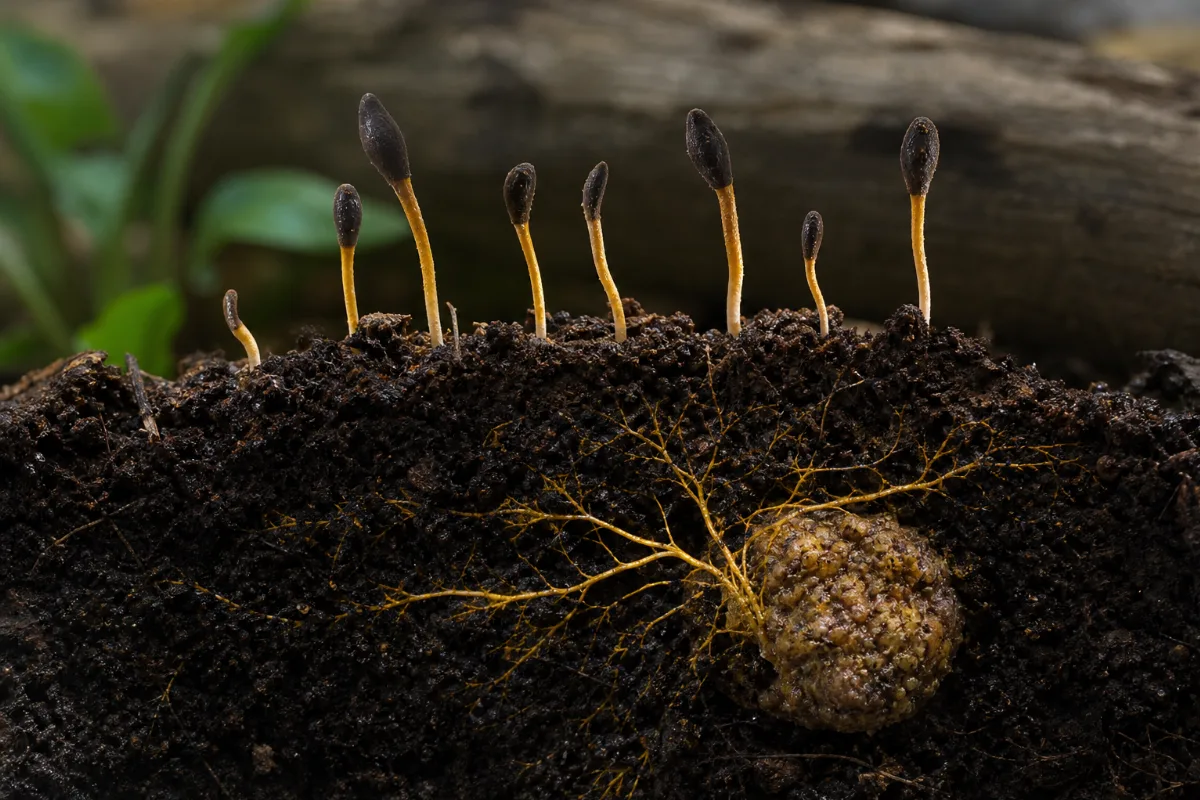
Unlike the cordyceps sold in most supplements, it does not grow on insects. It grows on underground truffle-like fungi of the genus Elaphomyces, in Asia, Europe and North America. The Cordyceps page covers the insect fungi in detail.
Traditional and current uses
A 2020 paper in a laboratory journal calls it a rare and valuable fungus used in Chinese medicine to relieve postmenopausal syndrome in women, and adds that its active molecules are unknown. No date, text or trial is given in the abstract. Traditional use is not proof that something works or is safe.
We found no source that treats it as a food, and no nutrient analysis.
What the research shows
No human study of any kind was found. In rats, a methanol extract of cultured mycelium, injected for 30 days, prevented memory loss caused by a toxic peptide. In mice, a sugar-chain fraction (CO-N) slowed transplanted tumours in 1989 work. In dishes, cordycepol C killed liver-cancer cells and pure balanol slowed colorectal cancer cells.
These are first steps in the lab. Most animal and cell results never lead to a treatment that works in people. The balanol figure of 2187.39 mg per litre is from an engineered culture, not from the mushroom.
Wild mushroom, mycelium and lab extracts are different
The wild fruiting body grows from a host fungus. The research mostly used mycelium grown in a lab, and extracts or isolated compounds from it. Results from one cannot be applied to another, and no source we read tested a retail product.
Legal and regulatory status
We found no monograph or statement about this species from the EMA, FDA, NCCIH, LiverTox, LactMed or WHO. That is a gap in what we found, not proof that there are none. Rules differ by country and change.
At a glance
Traditional uses history, not proof
- A 2020 laboratory paper says it is a rare and valuable fungus used in Chinese medicine to relieve postmenopausal syndrome in women. No date or historical text is given (Chen 2020).
Studied for research
- Postmenopausal symptoms, traditional use only, insufficient (no human test)
- Memory and nerve-cell protection, rat and cell study, insufficient
- Anti-tumour effects of a sugar chain in mice, 1989, insufficient
- Cordycepol C killing liver-cancer cells in a dish, insufficient
- Balanol, an enzyme blocker, lab chemistry only, insufficient
Main compounds
- Balanol (also called ophiocordin), an enzyme blocker in lab tests
- CO-N, a protein-bound sugar chain
- Cordycepol C, a sesquiterpene whose published structure was later revised
Common forms
- Wild fruiting body with its truffle-like host (traditional)
- Cultured mycelium (used for laboratory extracts)
- Laboratory extracts (methanol extract, sugar-chain fractions); not consumer products
Research links: PubMed: Chen 2020 (traditional use statement) · PubMed: rat memory study (Jin 2004) · PubMed: arsenic in wild samples (Braeuer 2021) · PubMed: mouse sugar-chain study (Ohmori 1989) · Review of the genus Tolypocladium (Yu 2021) · Research Library · Genes & Biomarkers Library
What it is and its history
- Accepted scientific name
- Tolypocladium ophioglossoides
- Naming authority
- (J.F.Gmel.) C.A.Quandt, Kepler & Spatafora (GBIF)
- Synonyms
- Cordyceps ophioglossoides (older name); Elaphocordyceps ophioglossoides (older name); Torrubia ophioglossoides; Sphaeria ophioglossoides (original name); Clavaria parasitica (older synonym)
- Common names
- Golden thread cordyceps (English)
- Family or group
- Ophiocordycipitaceae (a fungus family; sac fungi), not a plant
- Classification
- Fungi > Ascomycota > Sordariomycetes > Hypocreales > Ophiocordycipitaceae > Tolypocladium > Tolypocladium ophioglossoides
- Native range
- Yu 2021 lists it in Asia (China, Japan, Korea), Europe and North America.
- Habitat
- A parasite of fungi: it grows on underground truffle-like fungi of the genus Elaphomyces, not on insects (Yu 2021; Quandt 2015).
- What it looks like
- Fruiting body: For the genus, Yu 2021 describes stromata (the visible fungal structures) that arise directly from the host and are sometimes linked to it by rhizome-like structures, simple or branched. Details for this species were not read.
- Cultivation
- The balanol and extract work used cultured mycelium in laboratories. Whether it is cultivated for sale was not found.
- Harvest and processing
- Not found.
- Look-alikes and adulterants
- Name: Other Tolypocladium species on Elaphomyces; Note: Yu 2021 lists several relatives on the same kind of host and gives an identification key using features such as perithecia and ascospores.; Name: Cordyceps militaris and Ophiocordyceps sinensis; Note: Different fungi that grow on insects. These are what 'cordyceps' on supplement labels usually means. See the Cordyceps page.
- Sustainability and conservation
- Not checked.
Traditional use and history history, not clinical proof
| Tradition or era | Documented use | Source |
|---|---|---|
| Naming, 1789 to 2014 | First described as Sphaeria ophioglossoides, later placed in Cordyceps, then Elaphocordyceps (2007), then Tolypocladium (2014). | s-quandt-2014 |
| Chinese medicine (statement, not a dated record) | A 2020 paper calls it a rare and valuable fungus extensively used in Chinese medicine to relieve postmenopausal syndrome in women. No historical text or date is given in the abstract. | p32805368 |
| 1990s drug research | Ophiocordin from this fungus was shown to be the same compound as balanol, an enzyme blocker studied by a drug company. | p7928689 |
Traditional use shows how it was used. It does not show that it works or is safe today.
What is inside, and how it may work
What it contains and how those compounds act in cells and animals. Laboratory and animal mechanisms are not proven effects in people.
Main compounds
| Compound | Family | Where it is concentrated | Activity studied | Level of evidence |
|---|---|---|---|---|
| Balanol (ophiocordin) PubChem 5287736 | fungal metabolite (polyketide and peptide-derived) | Cultured mycelium 2187.39 mg per litre of culture in an engineered strain; amount in wild material not found. | Blocks protein kinase C in lab tests; found by computer screening to block PAK1, and slowed colorectal cancer cells in a dish. 11 1 7 8 5 | Laboratory research |
| CO-N (galactosaminoglycan, a sugar chain) | protein-bound polysaccharide | Culture Average molecular weight 33,000. | Slowed transplanted tumours in mice and killed tumour cells in a dish. 9 10 | Animal research |
| Cordycepol C (a sesquiterpene with a hydroperoxy group) | sesquiterpene | Cultured mycelia Not found. | Caused liver-cancer cell death in a dish. The published structure was later said to be misassigned. 15 14 | Laboratory research |
| Arsenocholine-O-sulfate (arsenic compound) | organic arsenic species | Wild-grown fruiting bodies Up to 56% of the extracted arsenic; total arsenic 0.070 to 3.44 mg per kg dry mass. | Not a medicinal compound. Whether it is harmful is not stated in the abstract. 2 | Analytical |
Mechanisms, receptors and pathways
| Target or pathway | Gene or receptor | What was found | Level |
|---|---|---|---|
| Protein kinase C | PKC | Balanol blocks protein kinase C in lab tests. 1 7 | Laboratory research |
| PAK1 (p21-activated kinase) | PAK1 | Pure balanol blocked PAK1 and slowed colorectal cancer cells in a dish. 8 | Laboratory research |
| Cell death in cancer cells | Bax, AIF, endonuclease G | Cordycepol C caused caspase-independent cell death in liver-cancer cells in a dish. 15 | Laboratory research |
| Free radicals (reactive oxygen species) | n/a | A mycelium extract cleared reactive oxygen species in cells; the authors suggest this explains nerve-cell protection. 6 | Laboratory research |
Absorption, metabolism and elimination
- Absorption
- Not found.
- Distribution
- Not found.
- Metabolism
- Not found.
- Elimination
- Not found.
- Bioavailability
- Not established.
Isolated compounds versus whole extracts
Every positive finding in this fungus is for an isolated compound, a culture extract or an engineered strain. No study tested the wild mushroom, with or without its truffle-like host, or a retail product.
Nutritional composition
No nutrient analysis was found and none of the sources we read describes this fungus as a food.
5 not enough evidence
What was looked at
The 5 benefits and uses checked for Golden Thread Cordyceps, each with how strong the evidence is. Tap one to open it.
- Postmenopausal symptoms (traditional use only)Not enough evidence
- Memory and nerve-cell protection (rats and cells only)Not enough evidence
- Anti-tumour effects of a sugar-chain fraction in mice (1989)Not enough evidence
- Cordycepol C killing liver-cancer cells in a dishNot enough evidence
- Balanol, an enzyme blocker made by the fungus (lab chemistry)Not enough evidence
What is Golden Thread Cordyceps good for?
The uses people ask about and how strong the human evidence is for each. For this fungus there is no human evidence for any of them. Read this together with the Safety tab.
Benefits, one by one
Each card is a research question, not a promise. Tap a goal to filter. Open a card to see the studies, doses and limits.
Postmenopausal symptoms (traditional use only)
Not enough evidenceOne 2020 laboratory paper says this fungus is used in Chinese medicine to relieve postmenopausal syndrome. We found no trial in people that tests this, so there is no evidence either way.
1 studiesNot studied in people. No amounts are given or advised.
Studies, doses and limits
What the trials found
No human study was found.
Results
No human results exist.
Why this rating
No trial, case series or survey was found. The only source is a one-line statement of tradition in a laboratory paper.
Form and dose studied
Not studied in people. No amounts are given or advised.
Limits
A traditional use is not proof that something works or is safe. Menopause symptoms need care from a doctor.
Why researchers looked
The statement comes from the introduction of a gene-transfer paper. It is the only traditional use we found named for this fungus.
Traditional use
Described as 'a rare and valuable fungus extensively used in Chinese medicine for relieving postmenopausal syndrome in women' (Chen 2020 abstract). The abstract names no historical or clinical source.
Proposed mechanism None
The same abstract says the active molecules of the fungus are unknown.
A proposed mechanism does not show that the effect happens in people.
No human safety information was found for this fungus (see the Safety tab).
Memory and nerve-cell protection (rats and cells only)
Not enough evidenceA 2004 Korean study found that a methanol extract of cultured mycelium protected nerve cells in a dish and prevented memory loss in rats given a toxic peptide. It was injected into the rats, and nothing has been tested in people.
1 studiesMethanol extract of cultured mycelium, injected into the abdomen in r…
Studies, doses and limits
What the trials found
No human study was found.
Results
Cells: less cell death with the extract. Rats: less loss of spatial memory in a water maze after the peptide, with 30 days of injections. No numbers are given in the abstract.
Why this rating
One animal and cell study from 2004, not repeated in the sources we read, using an injected extract. Animal results often do not carry over to people.
Form and dose studied
Methanol extract of cultured mycelium, injected into the abdomen in rats. A methanol extract is not a food or supplement product.
Who was studied
Rats and a human nerve-cell line
Limits
The rats were given a toxic peptide into the brain, which is a model, not the human disease. No safety data for people.
Why researchers looked
The researchers screened fungus extracts for protection against the amyloid peptide linked to Alzheimer disease.
Traditional use
No traditional use for memory was found in the sources we read.
Proposed mechanism Laboratory research
The extract cleared reactive oxygen species (free radicals) in the cells. The authors suggest this may explain the protection.
A proposed mechanism does not show that the effect happens in people.
The extract was injected; eating or taking a product by mouth was not tested.
Anti-tumour effects of a sugar-chain fraction in mice (1989)
Not enough evidenceA sugar-chain fraction called CO-N, made from a culture of the fungus, slowed transplanted tumours in mice and killed tumour cells in a dish. This was injected, in 1989, and was never followed by a trial in people that we could find.
2 studiesAn isolated, injected fraction from a culture. Not a food, tea or cap…
Studies, doses and limits
What the trials found
No human study was found.
Results
In mice, tumour growth fell and life was prolonged with some tumours; no numbers in the abstracts.
Why this rating
Two 1989 mouse and cell papers on an injected isolated fraction. No human data and no recent repeat.
Form and dose studied
An isolated, injected fraction from a culture. Not a food, tea or capsule product.
Who was studied
Mice and cultured tumour cells
Limits
Transplanted mouse tumours are not human cancer. Nothing here says that eating or taking this fungus helps anyone with cancer.
Why researchers looked
Japanese researchers screened a protein-bound polysaccharide from the culture for anti-tumour activity.
Traditional use
No traditional use against cancer was found.
Proposed mechanism Animal research
CO-N killed cultured tumour cells directly and bound to the surface of Ehrlich cells in the lab. Bigger sugar chains were more active.
A proposed mechanism does not show that the effect happens in people.
Toxicity of the fraction was not described in the abstracts. Anyone with cancer should talk to their cancer team before using any fungus product.
Cordycepol C killing liver-cancer cells in a dish
Not enough evidenceA compound called cordycepol C, made from cultured mycelium, caused liver-cancer cells to die in a dish while sparing one normal liver cell line. Its drawn structure was later said to be wrong, and it has not been tested in animals or people in our sources.
2 studiesA pure compound in a dish. Not a product.
Studies, doses and limits
What the trials found
No human study was found.
Results
Cell death in HepG2 cells, none in the normal L-02 liver cell line, in a dish.
Why this rating
Cell-dish work on one isolated compound whose structure was later revised.
Form and dose studied
A pure compound in a dish. Not a product.
Who was studied
Cultured cells
Limits
A compound that kills cells in a dish may also be toxic to people. This is a reason for caution, not a benefit.
Why researchers looked
It was the first sesquiterpene found in the genus Cordyceps, so researchers looked at what it does to cancer cells.
Proposed mechanism Laboratory research
It triggered cell death that did not need caspases, through a pathway involving Bax, mitochondria, AIF and endonuclease G.
A proposed mechanism does not show that the effect happens in people.
Cell-killing activity means the safety of the fungus is not established.
Balanol, an enzyme blocker made by the fungus (lab chemistry)
Not enough evidenceThe fungus makes balanol, first called ophiocordin. Balanol blocks protein kinase C and other enzymes in lab tests. This is chemistry, not a health benefit for people who take the fungus.
4 studiesPure compound or engineered culture. The amount in wild mushrooms or …
Studies, doses and limits
What the trials found
No human study was found.
Results
An engineered strain reached 2187.39 mg per litre in a fermenter. Cell effects of the pure compound only.
Why this rating
Lab chemistry and cell work on a pure compound; no test of the fungus or any product in animals or people.
Form and dose studied
Pure compound or engineered culture. The amount in wild mushrooms or products is not known.
Who was studied
Cultures and cancer cells in a dish
Limits
A drug-discovery lead is not a supplement benefit. A strong enzyme blocker could also affect healthy cells.
Why researchers looked
Balanol is a drug-discovery lead. A culture of the fungus has been engineered to make a lot of it.
Proposed mechanism Laboratory research
Balanol blocks protein kinase C in lab tests (Boros 1994, Li 2022). Computer screening also found it to block PAK1, and the pure compound slowed colorectal cancer cells in a dish (Liu 2023).
A proposed mechanism does not show that the effect happens in people.
Balanol acts on human enzymes in the lab, so the effect of the whole fungus on people and medicines is unknown.
Connections to the rest of health
How Golden Thread Cordyceps connects to the rest of our health knowledge graph. Every link says what kind of connection it is. A safety link (for example to the liver) is a warning, not a benefit. A study that merely mentions a topic never creates a benefit link.
Explore every connection: goals, body systems, organs, symptoms, genes
A. Wellness goals
| Connected to | Kind of connection | Evidence status | Context | Studies |
|---|---|---|---|---|
| Menopause Support | Not enough evidence | Postmenopausal symptoms (traditional use only): One 2020 laboratory paper says this fungus is used in Chinese medicine to relieve postmenopausal syndrome. We found no trial in people that tests this, so there is no evidence either way. | 3 | |
| Memory Support | Preliminary mechanism | Not enough evidence | Memory and nerve-cell protection (rats and cells only): A 2004 Korean study found that a methanol extract of cultured mycelium protected nerve cells in a dish and prevented memory loss in rats given a toxic peptide. It was injected into the rats, and nothing has been tested in people. | 6 |
B. Body systems
| Connected to | Kind of connection | Evidence status | Context | Studies |
|---|---|---|---|---|
| Reproductive System | Biological association | Not enough evidence | Studied for: Postmenopausal symptoms (traditional use only) | 3 |
| Nervous System | Biological association | Not enough evidence | Studied for: Memory and nerve-cell protection (rats and cells only) | 6 |
| Immune System | Biological association | Not enough evidence | Studied for: Anti-tumour effects of a sugar-chain fraction in mice (1989) | 9 10 |
| Hepatic System | Biological association | Not enough evidence | Studied for: Cordycepol C killing liver-cancer cells in a dish | 15 14 |
G. Root causes and contributing factors
| Connected to | Kind of connection | Evidence status | Context | Studies |
|---|---|---|---|---|
| Heavy metals (arsenic) | Low certainty | Arsenic found in all wild-grown samples tested; harm of the main form not stated. Arsenic found in wild-grown samples; harm of the main form not stated. Preparation or compound: Wild-grown fruiting bodies |
2 |
J. Genes, receptors and enzymes
K. Biological pathways
| Connected to | Kind of connection | Evidence status | Context | Studies |
|---|---|---|---|---|
| Bax, AIF and endonuclease G cell-death pathway | Preliminary mechanism | In vitro | Used by cordycepol C in liver-cancer cells. | 15 |
L. Active compounds
| Connected to | Kind of connection | Evidence status | Context | Studies |
|---|---|---|---|---|
| Balanol (ophiocordin) | Biological association | In vitro | Blocks protein kinase C in lab tests; found by computer screening to block PAK1, and slowed colorectal cancer cells in a dish. Preparation or compound: Cultured mycelium |
11 1 7 8 5 |
| CO-N (galactosaminoglycan, a sugar chain) | Biological association | Animal | Slowed transplanted tumours in mice and killed tumour cells in a dish. Preparation or compound: Culture |
9 10 |
| Cordycepol C (a sesquiterpene with a hydroperoxy group) | Biological association | In vitro | Caused liver-cancer cell death in a dish. The published structure was later said to be misassigned. Preparation or compound: Cultured mycelia |
15 14 |
| Arsenocholine-O-sulfate (arsenic compound) | Biological association | Analytical | Not a medicinal compound. Whether it is harmful is not stated in the abstract. Preparation or compound: Wild-grown fruiting bodies |
2 |
Each connection is stored with the ingredient, the connected record, the kind of connection, the evidence status, the supporting studies, the preparation or compound involved, and a review date (last reviewed October 25, 2026).
Evidence at a glance: what the research found for 5 outcomes
Each outcome below is one thing researchers measured. Certainty is how far the evidence can be trusted, not how well it works. The full studies are on the next tab.
The evidence
The research centre for Golden Thread Cordyceps. Every record here was checked against PubMed or the publisher's page; we never list a study we have not verified.
Evidence by outcome
Bars show how many studies we found for each outcome, not how well it works. People are added up across trials only (reviews are not added, to avoid double counting).
How we rate evidence
High certainty
Several well-run trials or reviews agree; further research is unlikely to change the picture much.
Moderate certainty
Good trials point the same way, but some doubt remains.
Low certainty
Small, short or inconsistent trials. The finding could change with better research.
Very low certainty
Very little or very weak human data. Treat as a possibility only.
Mixed findings
Trials or reviews disagree with each other.
Not enough evidence
Not enough human research to say either way.
Evidence against
Good research found no benefit, or found harm.
We take the reviewers' own risk-of-bias and GRADE statements where they exist, and otherwise judge from study size, design, consistency, directness and whether a product matches what is sold. Many publications do not make evidence high. Method note: We read PubMed abstracts for 12 papers (one rat and cell study, two mouse studies, one cell study, one chemistry revision, one chemistry comparison, two gene studies, one cancer-cell study of pure balanol, one analysis of arsenic in wild samples, one genome paper, and one laboratory paper that states the traditional use). We also read the relevant parts of two open-access taxonomy papers and checked the names in GBIF and balanol in PubChem. 16 sources in total. No trial in people exists. Only abstracts were read for papers, so numbers come from abstracts. Regulator pages were not found. Certainty ratings are the compiler's own reading.
Study library: every study we checked 16
| Study | Design | People | Product, dose, length | Result |
|---|---|---|---|---|
| Boros 1994 Comparison of balanol from Verticillium balanoides and ophiocordin from Cordyceps ophioglossoides. J Antibiot (Tokyo) · PMID 7928689 · DOI |
Chemistry study chemistry |
Compounds from two fungi in the laboratory | Balanol and ophiocordin cultures Not shown here |
The two fungi make the same compound, with the structure assigned to balanol. Balanol is a strong protein kinase C inhibitor (a lab enzyme blocker). The authors were at Sphinx Pharmaceuticals. Ophiocordin and balanol are one compound Methods, limits and fundingOutcomes: Whether balanol and ophiocordin are different compounds Limitations: A 1994 chemistry paper by a drug company; no health effect tested. Funding and conflicts: Company-affiliated authors (Sphinx Pharmaceuticals Corporation) Read: abstract |
| Braeuer 2021 Arsenocholine-O-sulfate: A novel compound as major arsenic species in the parasitic mushroom Tolypocladium ophioglossoides. Chemosphere · PMID 33228987 · DOI |
Analytical study fungus |
Wild-grown Tolypocladium ophioglossoides samples (and one host Elaphomyces sample) | Whole wild-grown fungus samples measured for arsenic and 34 other elements wild-grown fruiting bodies Not shown here |
Arsenic ranged from 0.070 to 3.44 mg per kg of dry mass. Up to 56% of the extracted arsenic was a previously unknown form, arsenocholine-O-sulfate, identified in this study. A small amount was also found in one host truffle-like sample. Arsenic is present in wild-grown samples, mostly as a new organic form Methods, limits and fundingOutcomes: Arsenic amount and which arsenic compounds are present Limitations: The abstract gives no number of samples or places and does not say whether the new arsenic compound is harmful. Funding and conflicts: No competing interests declared Read: abstract |
| Chen 2020 An efficient genetic transformation system for Chinese medicine fungus Tolypocladium ophioglossoides. J Microbiol Methods · PMID 32805368 · DOI |
Laboratory method fungus |
The fungus in a laboratory | Tolypocladium ophioglossoides (gene-transfer method) conidia (spores) in culture Not shown here |
The paper is a gene-transfer method. The medicinal-use statement is in the introduction of the abstract and the abstract adds that the bioactive molecules are unknown. No clinical source is named in the abstract. None for health: this is the only place our sources state the menopause use, and it is a statement, not a test Methods, limits and fundingOutcomes: A method to alter genes of the fungus; its first sentence describes the fungus as a rare and valuable one used in Chinese medicine for relieving postmenopausal syndrome in women Limitations: The statement of traditional use is not backed by a trial in the abstract, and the paper does not test any health effect. Funding and conflicts: Non-US government research support per the PubMed record; no competing interests declared Read: abstract |
| GBIF 2026 GBIF Backbone Taxonomy: Tolypocladium ophioglossoides (usage key 7646591) GBIF API · Source |
Database record n/a |
n/a | n/a Not shown here |
Accepted: Tolypocladium ophioglossoides (J.F.Gmel.) C.A.Quandt, Kepler & Spatafora; family Ophiocordycipitaceae; order Hypocreales; class Sordariomycetes. Synonyms include Cordyceps ophioglossoides, Elaphocordyceps ophioglossoides, Torrubia ophioglossoides and Sphaeria ophioglossoides. n/a Methods, limits and fundingOutcomes: Accepted name, authority, family and synonyms Limitations: Checked through the GBIF species API on 2026-10-25; Index Fungorum was not opened. Funding and conflicts: Public database Read: API record |
| He 2018 Revelation of the Balanol Biosynthetic Pathway in Tolypocladium ophioglossoides. Org Lett · PMID 30277789 · DOI |
Genetics study fungus |
The fungus in a laboratory | Tolypocladium ophioglossoides, balanol gene cluster cultured fungus Not shown here |
Switching on a hidden gene cluster (bln) led to balanol and eight other compounds. The paper proposes a biosynthetic pathway. The fungus can make balanol Methods, limits and fundingOutcomes: How the fungus builds balanol Limitations: Gene work; no health effect tested. Funding and conflicts: Non-US government research support per the PubMed record Read: abstract |
| Jin 2004 Mycelial extract of Cordyceps ophioglossoides prevents neuronal cell death and ameliorates beta-amyloid peptide-induced memory deficits in rats. Biol Pharm Bull · PMID 15256753 · DOI |
Animal study rat / cell line |
Human nerve-cell line (SK-N-SH) in a dish, and rats given a toxic amyloid peptide into the brain | Methanol extract of cultured Cordyceps ophioglossoides mycelium cultured mycelium Not shown here 30 days (rats) · vs Untreated cells and rats; a second fungus extract (Hypocrea citrina) was tested in cells |
In cells, extracts of both fungi reduced cell death caused by the peptide. In rats, only the C. ophioglossoides extract, injected into the abdomen for 30 days, prevented the loss of spatial memory caused by the peptide. Only this extract also cleared reactive oxygen species in the cells. Less memory loss in a rat model of Alzheimer-type damage; suggested to work by free-radical scavenging Methods, limits and fundingOutcomes: Nerve-cell death caused by the amyloid peptide in cells; spatial memory in a water maze in rats; free-radical (ROS) scavenging Limitations: Rats and cells only. The extract was injected, not eaten. The abstract groups the fungi as Basidiomycetes, but this species is an ascomycete (GBIF), so the abstract is loose with its labels. Not repeated in the sources we read. Funding and conflicts: Non-US government research support per the PubMed record Read: abstract |
| Li 2022 Gram-Level Production of Balanol through Regulatory Pathway and Medium Optimization in Herb Fungus Tolypocladium ophioglossoides. J Fungi (Basel) · PMID 35628765 · DOI |
Genetics study fungus |
Engineered and normal fungus cultures | Tolypocladium ophioglossoides with the balanol regulator gene blnR switched up cultured fungus Not shown here |
Balanol production reached 2187.39 mg per litre with the improved medium. The paper describes balanol as a potential protein kinase C inhibitor. High balanol output from an engineered culture Methods, limits and fundingOutcomes: Balanol production in a fermenter Limitations: This figure is for an engineered strain in a culture, not the amount in the wild mushroom or any product. Funding and conflicts: No competing interests; funders had no role (per the abstract) Read: abstract |
| Liu 2023 Identification of Balanol As a Potential Inhibitor of PAK1 That Induces Apoptosis and Cytoprotective Autophagy in Colorectal Cancer Cells. ChemMedChem · PMID 37323074 · DOI |
Laboratory research cell line |
SW480 colorectal cancer cells in a dish | Pure balanol (compound), found by computer screening compound only, not the fungus Not shown here · vs Untreated cells |
Balanol blocked the PAK1 enzyme, reduced growth and movement of the cancer cells, and caused cell death and a protective self-digestion (autophagy). Cell effects in a dish Methods, limits and fundingOutcomes: PAK1 enzyme inhibition, cancer-cell growth and migration Limitations: Pure balanol in cells. It says nothing about eating the fungus. Funding and conflicts: Non-US government research support per the PubMed record Read: abstract |
| Ohmori 1989 Isolation of galactosaminoglycan moiety (CO-N) from protein-bound polysaccharide of Cordyceps ophioglossoides and its effects against murine tumors. Chem Pharm Bull (Tokyo) · PMID 2766404 · DOI |
Animal study mouse / cell line |
Mice with transplanted tumours; cultured tumour cells | CO-N, a protein-bound galactosaminoglycan (sugar-chain) made from a Cordyceps ophioglossoides culture cultured mycelium (culture) Not shown here · vs Untreated mice |
Given into the abdomen, CO-N reduced the growth of sarcoma 180 cells and prolonged life in mice with ascitic Ehrlich and IMC tumours. It also reduced solid Ehrlich tumours when given into the tumour and slowed a solid mammary tumour (MM46) when given into a vein at a low dose. It killed cultured IMC and P388D1 cells. Slower tumour growth in mice with transplanted tumours Methods, limits and fundingOutcomes: Tumour growth and survival in mice; killing of cultured cells Limitations: 1989 mouse and cell work with an isolated fraction given by injection. Not a food, tea or supplement. Mouse tumours transplanted into mice are not the same as cancer in people. Funding and conflicts: Funding not stated in the abstract Read: abstract |
| Ohmori 1989 The correlation between molecular weight and antitumor activity of galactosaminoglycan (CO-N) from Cordyceps ophioglossoides. Chem Pharm Bull (Tokyo) · PMID 2630099 · DOI |
Animal study mouse |
Mice with Ehrlich ascitic carcinoma or MM46 mammary tumours | CO-N fractions of different molecular size (cultured C. ophioglossoides) cultured mycelium (culture) Not shown here |
The average molecular weight of CO-N was 33,000. Bigger fractions were more active, the fraction below 6,600 was weakly active, and a broken-down form of about 5,500 kept the activity against both tumours. Activity depends partly on the size of the sugar chain Methods, limits and fundingOutcomes: Antitumour activity by molecular size; average molecular weight Limitations: Chemistry and mouse work from 1989; the abstract gives no survival numbers. Funding and conflicts: Funding not stated in the abstract Read: abstract |
| PubChem 2026 PubChem: Balanol (CID 5287736) PubChem API · Source |
Database record n/a |
n/a | n/a Not shown here |
Balanol, formula C28H26N2O10, molecular weight 550.5. n/a Methods, limits and fundingOutcomes: Identity of balanol Limitations: Checked through the PubChem PUG REST API on 2026-10-25. Funding and conflicts: Public database Read: API record |
| Quandt 2014 Phylogenetic-based nomenclatural proposals for Ophiocordycipitaceae (Hypocreales) with new combinations in Tolypocladium. IMA Fungus · PMID 25083412 · DOI |
Taxonomy study fungus |
Fungi of the family Ophiocordycipitaceae | n/a Not shown here |
Makes the combination Tolypocladium ophioglossoides (Ehrh. ex J.F.Gmel.) Quandt, Kepler & Spatafora, with the basionym Sphaeria ophioglossoides and the synonyms Cordyceps ophioglossoides, Torrubia ophioglossoides and Elaphocordyceps ophioglossoides. n/a Methods, limits and fundingOutcomes: New combinations in Tolypocladium Limitations: Read from the nomenclature section of the open-access text only; authors beyond the first two not copied. Funding and conflicts: Not read Read: full text (name section) |
| Quandt 2015 The genome of the truffle-parasite Tolypocladium ophioglossoides and the evolution of antifungal peptaibiotics. BMC Genomics · PMID 26215153 · DOI |
Genomics study fungus |
The genome of the fungus | n/a Not shown here |
The draft genome has many secondary-metabolite gene clusters, many with no known product, and three large peptaibiotic clusters. Tolypocladium species are mainly truffle parasites, a few are insect pathogens. n/a Methods, limits and fundingOutcomes: Draft genome, secondary-metabolite gene clusters Limitations: Genome paper; no chemistry measured in products and no health effect tested. Funding and conflicts: Non-US government research support per the PubMed record Read: abstract |
| Reddy 2016 Structure Revision of an Acorane Sesquiterpene Cordycepol A. Org Lett · PMID 27611774 · DOI |
Chemistry study chemistry |
Computer calculation of the molecular structure of cordycepol A | Cordycepol A from Cordyceps ophioglossoides Not shown here |
The structure reported for cordycepol A was revised using computed coupling constants, and the paper says cordycepols B and C were also misassigned. The published structures of three cordycepols were wrong Methods, limits and fundingOutcomes: Correct chemical structure of the cordycepols Limitations: A chemistry paper; it does not test any health effect. Funding and conflicts: Non-US-PHS US government research support per the PubMed record Read: abstract |
| Sun 2014 Cordycepol C induces caspase-independent apoptosis in human hepatocellular carcinoma HepG2 cells. Biol Pharm Bull · PMID 24694607 · DOI |
Laboratory research cell line |
HepG2 liver-cancer cells and a normal liver cell line (L-02) in a dish | Cordycepol C, a sesquiterpene isolated from cultured mycelia of Cordyceps ophioglossoides cultured mycelia Not shown here · vs Untreated cells |
Cordycepol C caused HepG2 cells to self-destruct (apoptosis) without affecting the normal liver cell line, by a pathway that did not need caspases. The paper says no sesquiterpenes had been found before in the genus Cordyceps. Cell killing in a dish Methods, limits and fundingOutcomes: Cell death pathways in cancer cells Limitations: Cells in a dish only. A later chemistry paper (Reddy 2016) says the structure drawn for cordycepol C was misassigned, so what the tested molecule is exactly is uncertain. Funding and conflicts: Non-US government research support per the PubMed record Read: abstract |
| Yu 2021 Comprehensive Review of Tolypocladium and Description of a Novel Lineage from Southwest China. Pathogens · PMID 34832545 · DOI |
Narrative review fungus |
Fungi of the genus Tolypocladium (41 species at the time) | n/a Not shown here |
Lists T. ophioglossoides as growing on Elaphomyces species (E. granulatus, E. japonicus, E. muricatus, E. shimizuensis, E. titibuensis and others) and found in Asia, Europe and North America. Says some Tolypocladium species make cyclosporin, efrapeptins, ophiocordin and ophiosetin. Provides a key to the sexual-stage species. n/a Methods, limits and fundingOutcomes: Taxonomy, hosts, geography and chemistry of the genus Limitations: Open-access review; only the parts about this species and the genus were read. Funding and conflicts: Not read Read: full text (relevant parts) |
What we do not know yet
- No human study of any kind.
- No safety, toxicity or interaction data for the whole fungus.
- The Chinese medicine use rests on one sentence in a lab paper with no source.
- No test of a product for arsenic or other contaminants; wild samples contain arsenic.
- The cordycepol structures were revised after the cell work.
How new research is added
New studies are found by a saved PubMed search and placed in a review queue. A person reads each one before it changes any evidence rating or safety wording. New publications never change ratings automatically.
Lab markers
What changed in blood or saliva tests during trials. A changed number is not the same as feeling or being healthier, and we give no "normal ranges".
Safety
What studies and official sources say about side effects, medicines and who should check first. Each point shows what kind of evidence it comes from.
Main points to know 5
- No human safety information was found. We found no safety trial, no case report and no drug-interaction study for this fungus. That does not mean it is safe. It means nobody has looked in the sources we read. Lab work shows that some of its compounds, such as balanol, cordycepol C and the CO-N sugar chain, block enzymes or kill cells in a dish, so the honest status is unknown, not safe. Absence of evidence 8 15 9
- Wild-grown samples contain arsenic. A study of wild-grown samples found 0.070 to 3.44 mg of arsenic per kg of dry mass, and up to 56% of the extracted arsenic was a newly discovered organic form. The paper does not say whether that form is harmful. We did not read any arsenic test of a product. Laboratory analysis 2
- Wild-picked fungi can be mistaken for others. This fungus grows from an underground truffle-like fungus. Several close relatives grow on the same kind of host, and a published key to tell them apart uses small features such as the shape of the spore-producing parts. Never pick or use a wild fungus based on a photo, an app or this page. Taxonomy record 16
- The word 'cordyceps' on a label usually means other fungi. Most cordyceps products contain Cordyceps militaris or Ophiocordyceps sinensis, which are different fungi that grow on insects. Their cautions are on the Cordyceps page and cannot be assumed to apply here, or the other way round. Taxonomy record 16 12
- Same genus as a drug-making fungus, which is a reason to check labels. The genus Tolypocladium includes species that make cyclosporin and other compounds. We did not find a source saying this species makes cyclosporin, and this is not a claim that it does. It is a reminder that fungi in this genus can make strong compounds. Review 16
Side effects 2
| Effect | How often | Severity and recovery | Evidence |
|---|---|---|---|
| No adverse effects have been described in people No human use was studied, so absence of reports is not reassurance. | Not established | unknown Unknown | Absence of evidence |
| Arsenic exposure from wild-grown material Whether the main form found is harmful is not stated in the abstract. | 0.070 to 3.44 mg arsenic per kg dry mass in the samples tested | unknown Unknown | Laboratory analysis 2 |
Liver
No case report or study of liver injury with this fungus was found. Some lab compounds from the fungus kill liver-cancer cells in a dish and spared one normal liver cell line (cordycepol C), but this is not a safety test. People with liver disease should ask a doctor before using any fungus product. 15
How often. No data.
Monitoring. No agency monitoring advice was found.
This is a safety connection. It is not evidence that Golden Thread Cordyceps supports liver health.
Medicines and supplements 3
| With | Why it matters | Importance | Evidence | What to do |
|---|---|---|---|---|
| Prescription medicines (any) prescription | Not studied | No interaction study was found for this fungus. | Absence of evidence Not enough evidence | Ask a pharmacist or doctor before using it if you take any medicine. Do not assume the cautions of other cordyceps apply, or that they do not. |
| Medicines that act on kinase enzymes (such as some cancer drugs) prescription | Theory only: balanol blocks protein kinase C and PAK1 in lab tests | No one has tested whether the fungus or a product contains enough balanol to matter. This is a laboratory-based theory, not an observed interaction. | Theoretical Not enough evidence 1 7 8 | If you have cancer or take cancer medicines, tell your care team before using any fungus product. |
| Herbs and supplements herb-supplement | Not studied | None found. | Absence of evidence Not enough evidence | Tell your pharmacist about all products you use. |
Who should check first 4
| Situation | Advice | Evidence |
|---|---|---|
| Pregnancy and breastfeeding | No data. Ask a doctor before use. Untested products are generally best avoided in pregnancy and breastfeeding. | Absence of evidence |
| Children | No data on children. Ask a doctor before use. | Absence of evidence |
| Cancer treatment, liver disease, or taking prescription medicines | Ask your doctor or pharmacist before use. Some compounds from this fungus are cell-toxic in lab tests. | Laboratory 15 9 |
| History of allergy to fungi or moulds | No allergy report was found for this fungus. Ask a doctor before use if you have had allergic reactions to fungi. | Absence of evidence |
Overdose, product quality and regulators
Summary. No poisoning or toxicity study of the whole fungus was found. Some isolated fractions kill cells in a dish.
Animal. The 1989 mouse papers give no toxicity figures in their abstracts. A 2004 rat study injected an extract for 30 days; the abstract reports no toxicity data.
Human doses studied. No human use was studied. No amounts are given or advised.
High dose or long term signals. Unknown.
Overdose response. No description was found. Seek medical help for the urgent signs below.
Genotoxicity. Not found.
Toxic or hazardous parts. Fungus: the fruiting body grows from a truffle-like host. Mycelium has been cultured in labs. Nothing compares the safety of the parts.
We found no test of any product. The one analysis we read is of wild-grown samples.
Arsenic. Wild-grown samples held 0.070 to 3.44 mg arsenic per kg dry mass, mostly as a newly identified organic form (arsenocholine-O-sulfate). The abstract does not say whether it is harmful. 2
Host truffle-like fungus attached. The fruiting body grows from an Elaphomyces truffle-like fungus, and a small amount of the same arsenic form was found in one host sample. Material sold with the host attached may differ from the stalk alone; this has not been tested. 2 16
Which fungus is in the product. Names such as Cordyceps ophioglossoides, Elaphocordyceps ophioglossoides and Tolypocladium ophioglossoides all point to the same species, but 'cordyceps' on a label usually means other fungi. 12 4
When to get medical help
- If you ate a wild fungus you could not identify with certainty and you feel sick (vomiting, severe belly pain, confusion): call poison control or emergency services now.
- Swelling of the face or throat, wheeze, hives or trouble breathing after taking a fungus product: call emergency services.
- Yellow skin or eyes, dark urine or pale stools after using a fungus product: stop it and get medical help now.
- Unusual bleeding or bruising, especially if you take blood thinners: get medical help now.
If someone may be poisoned or in a crisis, contact a clinician or emergency service straight away. In the US, Poison Control is 1-800-222-1222.
General information only, not medical advice. Ask a clinician or pharmacist before use, especially with medicines, in pregnancy or with a health condition. See the Natural Remedy Safety guide.
Frequently asked questions
What is golden thread cordyceps?
Is it the same as the cordyceps in supplements?
What does it grow on?
Is it used for menopause?
A 2020 laboratory paper says it is used in Chinese medicine for postmenopausal syndrome. It gives no source, and we found no trial in people. There is no evidence either way. Menopause symptoms are worth discussing with a doctor.
Does it help memory or protect the brain?
Only in rats and cells. A 2004 study found a methanol extract of mycelium reduced memory loss in rats given a toxic peptide and protected nerve cells in a dish. It was injected, and nothing has been tested in people.
Does it fight cancer?
No one has shown that. Mouse studies from 1989 found a sugar-chain fraction slowed some transplanted tumours, and cell studies found cordycepol C and pure balanol killed or slowed cancer cells in a dish. These are not tests in people. Talk to your cancer team before using any fungus product.
Is it safe?
Does it contain arsenic?
Wild-grown samples did: 0.070 to 3.44 mg per kg of dry mass, and up to 56% was a newly found organic arsenic form. The study does not say whether that form is harmful. No product was tested in the sources we read.
Does it interact with medicines?
Is it safe in pregnancy, breastfeeding or for children?
No data. Ask a doctor before use. Untested products are generally best avoided in pregnancy and breastfeeding and for children.
Is it edible, and can I pick it in the wild?
Has any regulator approved it?
We found no statement from the EMA, FDA, NCCIH, LiverTox, LactMed or WHO about this species. Supplements are not approved as medicines in most countries before sale. Rules differ by country.
Explore by health goal
Editorial transparency
- Written by
- AlternativeMed editorial team. Research compiled with AI assistance, then checked against PubMed records.
- Medical review
- None. This page has not been reviewed by a physician or pharmacist.
- First published
- 2026-10-25
- Last substantive update
- 2026-10-25
- How we research
- We read PubMed abstracts for 12 papers (one rat and cell study, two mouse studies, one cell study, one chemistry revision, one chemistry comparison, two gene studies, one cancer-cell study of pure balanol, one analysis of arsenic in wild samples, one genome paper, and one laboratory paper that states the traditional use). We also read the relevant parts of two open-access taxonomy papers and checked the names in GBIF and balanol in PubChem. 16 sources in total. No trial in people exists. Only abstracts were read for papers, so numbers come from abstracts. Regulator pages were not found. Certainty ratings are the compiler's own reading.
- How we rate evidence
- See "How we rate evidence" in the Evidence tab.
- Independence
- No product is promoted on this page. No affiliate links are shown. This page is information, not a recommendation to use this fungus.
Sources 16
Each source was opened and checked. Where we read only the abstract, it says so. The small numbers in the text point here.
- Boros C, Hamilton SM, Katz B, et al. Comparison of balanol from Verticillium balanoides and ophiocordin from Cordyceps ophioglossoides.. J Antibiot (Tokyo). 1994. PMID 7928689. DOI 10.7164/antibiotics.47.1010. (abstract)
- Braeuer S, Borovicka J, Glabonjat RA, et al. Arsenocholine-O-sulfate: A novel compound as major arsenic species in the parasitic mushroom Tolypocladium ophioglossoides.. Chemosphere. 2021. PMID 33228987. DOI 10.1016/j.chemosphere.2020.128886. (abstract)
- Chen XA, He X, Zhang M, et al. An efficient genetic transformation system for Chinese medicine fungus Tolypocladium ophioglossoides.. J Microbiol Methods. 2020. PMID 32805368. DOI 10.1016/j.mimet.2020.106032. (abstract)
- GBIF. GBIF Backbone Taxonomy: Tolypocladium ophioglossoides (usage key 7646591). GBIF API. 2026. (API record)
- He X, Zhang M, Guo YY, et al. Revelation of the Balanol Biosynthetic Pathway in Tolypocladium ophioglossoides.. Org Lett. 2018. PMID 30277789. DOI 10.1021/acs.orglett.8b01543. (abstract)
- Jin DQ, Park BC, Lee JS, et al. Mycelial extract of Cordyceps ophioglossoides prevents neuronal cell death and ameliorates beta-amyloid peptide-induced memory deficits in rats.. Biol Pharm Bull. 2004. PMID 15256753. DOI 10.1248/bpb.27.1126. (abstract)
- Li RQ, Liu X, Zhang M, et al. Gram-Level Production of Balanol through Regulatory Pathway and Medium Optimization in Herb Fungus Tolypocladium ophioglossoides.. J Fungi (Basel). 2022. PMID 35628765. DOI 10.3390/jof8050510. (abstract)
- Liu Y, Zou Y, Huang Y, et al. Identification of Balanol As a Potential Inhibitor of PAK1 That Induces Apoptosis and Cytoprotective Autophagy in Colorectal Cancer Cells.. ChemMedChem. 2023. PMID 37323074. DOI 10.1002/cmdc.202300114. (abstract)
- Ohmori T, Tamura K, Fukui K, et al. Isolation of galactosaminoglycan moiety (CO-N) from protein-bound polysaccharide of Cordyceps ophioglossoides and its effects against murine tumors.. Chem Pharm Bull (Tokyo). 1989. PMID 2766404. DOI 10.1248/cpb.37.1019. (abstract)
- Ohmori T, Tamura K, Ohgane N, et al. The correlation between molecular weight and antitumor activity of galactosaminoglycan (CO-N) from Cordyceps ophioglossoides.. Chem Pharm Bull (Tokyo). 1989. PMID 2630099. DOI 10.1248/cpb.37.1337. (abstract)
- PubChem. PubChem: Balanol (CID 5287736). PubChem API. 2026. (API record)
- Quandt CA, Kepler RM, et al. Phylogenetic-based nomenclatural proposals for Ophiocordycipitaceae (Hypocreales) with new combinations in Tolypocladium.. IMA Fungus. 2014. PMID 25083412. DOI 10.5598/imafungus.2014.05.01.12. (full text (name section))
- Quandt CA, Bushley KE, Spatafora JW. The genome of the truffle-parasite Tolypocladium ophioglossoides and the evolution of antifungal peptaibiotics.. BMC Genomics. 2015. PMID 26215153. DOI 10.1186/s12864-015-1777-9. (abstract)
- Reddy DS, Kutateladze AG. Structure Revision of an Acorane Sesquiterpene Cordycepol A.. Org Lett. 2016. PMID 27611774. DOI 10.1021/acs.orglett.6b02341. (abstract)
- Sun YS, Lv LX, Zhao Z, et al. Cordycepol C induces caspase-independent apoptosis in human hepatocellular carcinoma HepG2 cells.. Biol Pharm Bull. 2014. PMID 24694607. DOI 10.1248/bpb.b13-00877. (abstract)
- Yu FM, Chethana KWT, Wei DP, et al. Comprehensive Review of Tolypocladium and Description of a Novel Lineage from Southwest China.. Pathogens. 2021. PMID 34832545. DOI 10.3390/pathogens10111389. (full text (relevant parts))
Where to buy
Check the label first. Whatever you buy, look for these:
- Fruiting body versus mycelium on grain: the label should say which
- The extract type and the beta-glucan amount, if stated
- A third-party testing mark
- Interactions: ask a pharmacist if you take medicines or blood thinners
Talk to a pharmacist or doctor before you start any supplement, especially if you take medicines. See the Safety tab for interactions.
Support our free guides: as an Amazon Associate we earn from qualifying purchases. Full disclosure.


