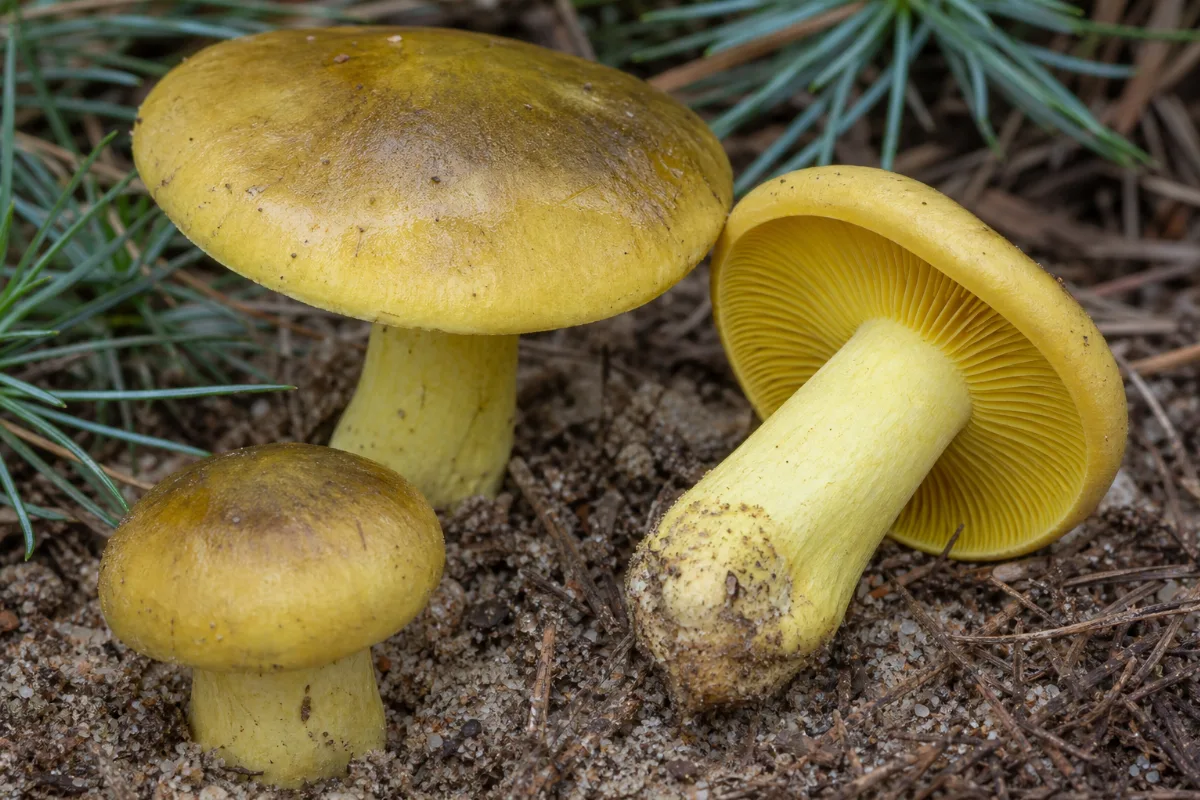
Mushrooms · Wild mushroom
Man on Horseback
Tricholoma equestre (also written Tricholoma flavovirens) · also called Yellow knight, yellow tricholoma, Grünling, bidaou, canary mushroom
Man on horseback is a wild mushroom that was long eaten in Europe. Since 2001, reports from France, Lithuania and Poland link repeated meals of it to rhabdomyolysis, a breakdown of muscle that can damage the heart and lungs, and some patients died. Experts disagree about whether it was the cause, and no toxin has been found. No health benefit has been shown. If someone may have eaten it, call a poison centre.
General information, not medical advice. Last substantive update · Not medically reviewed. A named clinician has not signed off on this page. How this page is made
About Man on Horseback
Man on horseback (Tricholoma equestre) is a wild mushroom once prized as food. Case reports from France, Lithuania and Poland link repeated meals to delayed rhabdomyolysis, with some deaths. The cause is disputed and no toxin has been found. France moved to ban its sale in 2005. No health benefit has been shown. If someone may have eaten it, call a poison centre right away.
Danger first: delayed muscle breakdown
Reports link meals of man on horseback, eaten on several days in a row, to rhabdomyolysis. In this condition muscle fibres break down and spill their contents into the blood. The reports describe tiredness, nausea without vomiting, heavy sweating without fever, then muscle weakness and pain, often in the thighs, and very high levels of CK, a muscle marker, with raised liver enzymes. Dark urine is also described.
A review says it may appear 24 to 72 hours after eating, so feeling well after a meal does not show it was safe. In the worst cases reports describe breathing failure, heart inflammation and heart rhythm problems. Most people who were treated recovered over about 10 days to 3 weeks, and some died. Hospital care described in reviews is intravenous fluids, treatment of high potassium and dialysis. There is no home remedy.
What the reports say
A 2001 report from France described twelve cases, three of them fatal, and mice fed the mushroom for three days had raised CK. Those figures are quoted from two later papers; the original has no abstract and we did not open it. A Lithuanian series of four patients from 2004 to 2013 included one death. The authors say he died of a heart attack and had a history of alcohol abuse. In Poland, a series of four patients included a 72-year-old who died, and a poison-centre series of cases from 2001 to 2010 reported a death rate of about 20%. That series gives no patient total in its abstract, so the 20% cannot be used as a risk for people who eat the mushroom.
These are small, selected hospital cases. In many cases the species was named from the patient's own account, and the sources say amounts in the cases were large and repeated. People who shared the same meal in smaller amounts had no symptoms in the Lithuanian cases.
Why experts disagree
A 2018 survey of 1,545 Polish foragers found that more than half had eaten it at least once and a quarter on consecutive days, with few adverse events and no rhabdomyolysis. In the same study, 10 healthy volunteers who ate one large meal of DNA-identified mushroom had no blood changes. A Polish series of 56 patients also found no rise in muscle or liver enzymes. The authors argue that the poisoning cases did not prove the species was the cause, because look-alikes were not ruled out.
Against this, a 2020 review says the group cannot be told apart reliably without DNA analysis, that mushrooms that look like the safe form have caused poisonings, and that from a medical view the risk is not worth taking. One volunteer meal cannot test the repeated-meal pattern. Other edible mushrooms also raised CK in mice at high amounts, and a Polish man had rhabdomyolysis after repeated large meals of other mushrooms, so a muscle effect is not unique to this species.
Unknown toxin, mix-ups and no identification help
No causative compound has been isolated. In mice, higher CK, heart and liver signs were seen at high amounts, and one report found the active part was water-soluble. This page does not describe how to recognise this or any wild mushroom. A photo, a name or an app is never proof, and no way of preparing it is known to make it safe.
Official action in some countries
In France, the food-safety agency Afssa gave a favourable opinion on 13 May 2005 on a draft decree making it forbidden to import, hold for sale, sell or give away the mushroom, fresh or processed, under the names Tricholoma auratum, T. equestre and T. flavovirens. It refers to a one-year suspension ordered in 2004. We read the opinion, not the final decree, and did not check whether the ban still applies.
A 2018 paper says Spain and Italy also warned against it, while Polish law treats it as edible. We did not read those official texts. Rules differ by country and change over time.
What it is
GBIF accepts Tricholoma equestre (L.) P.Kumm., in the family Tricholomataceae, and lists T. flavovirens and T. auratum as synonyms. A DNA study supports treating the European forms as one species growing with conifers. Common names include man on horseback and yellow knight in English, Grünling in German and bidaou or canari in French.
What the lab studies show
One compound taken from the mushroom slowed the growth of colon cancer cells in a dish and did not cause DNA fragmentation. This is not evidence of any benefit of the mushroom. A lab study also found indole compounds such as tryptophan, tryptamine and serotonin in the fruiting body, and mercury studies found the mushroom takes up mercury from soil, with low levels in unpolluted forests.
If someone may have eaten it
Poison centres say to call right away if a wild mushroom may have been eaten, and not to wait for symptoms. In the US, Poison Help is 1-800-222-1222; elsewhere use your local poison centre or emergency number. Call emergency services if the person collapses, has a seizure, has trouble breathing or cannot be woken. Muscle pain or weakness, dark urine or heavy sweating in the days after a wild mushroom meal needs urgent medical help.
At a glance
Traditional uses history, not proof
- A 2018 paper says it was considered edible from medieval times and was highly appreciated for its taste (Klimaszyk 2018).
- A Lithuanian paper says it was served fried or boiled as a main dish (Laubner 2016).
- We found no traditional medicinal use.
Studied for research
- Poisoning: muscle breakdown reported after repeated meals, with deaths (documented risk)
- Food use: now disputed, not a health benefit (insufficient)
- One compound slowed colon cancer cell growth in a dish (very low, lab only)
- No human trial of any benefit
Main compounds
- No toxin identified
- Flavomannin-6,6'-dimethylether (lab study of one compound)
- Indole compounds including tryptophan, tryptamine and serotonin (lab measurement)
Common forms
- Wild fruiting body, eaten as food in the reports
- No extract, powder or supplement was found
Research links: Poison Control (US): get help online or call 1-800-222-1222 · Rhabdomyolysis series from Lithuania (abstract) · Controversial toxic potential of traditional mushrooms (review) · Survey and volunteer study defending edibility (abstract) · French food-safety opinion of 2005 (PDF, in French) · GBIF species record · Research Library · Genes & Biomarkers Library
What it is and its history
- Accepted scientific name
- Tricholoma equestre (L.) P.Kumm.
- Naming authority
- (L.) P.Kumm. (per GBIF, checked 2026-10-25)
- Synonyms
- Tricholoma flavovirens (Pers.) S.Lundell; Tricholoma auratum Gillet; Agaricus equestris L.; Agaricus flavovirens Pers.; Gyrophila equestris (L.) Quél.
- Common names
- Man on horseback (English); Yellow knight (English); Grünling (German); Tricholome équestre (French); Verdone (Italian); Seta de los caballeros (Spanish); Gąska zielonka (Polish)
- Family or group
- Tricholomataceae (a fungus family, not a plant)
- Classification
- Fungi > Basidiomycota > Agaricomycetes > Agaricales > Tricholomataceae > Tricholoma > Tricholoma equestre
- Native range
- Reports and surveys come from France, Poland, Lithuania and other parts of Europe. A 2020 review says it is also collected in North America and in parts of Asia.
- Habitat
- Grows with conifers (pine or fir, depending on place) as a tree-root partner, according to a DNA study (Moukha 2013). A Lithuanian paper says it grows in late autumn.
- What it looks like
- Fruiting body: Not described here by design.
- Cultivation
- Not covered.
- Harvest and processing
- Not covered.
- Sustainability and conservation
- Not covered in the sources read.
Traditional use and history history, not clinical proof
| Tradition or era | Documented use | Source |
|---|---|---|
| Wild food in Europe | A 2018 paper says it has been considered edible since medieval times and was highly appreciated for its taste. A Lithuanian paper says it was served fried or boiled as a main dish. | p30428584 |
| 2001 onward: poisoning reports | A 2001 French report of twelve poisoning cases, three fatal, was followed by official warnings and by French limits on import and sale (see Safety). Later reports came from Poland and Lithuania. Since then opinion on whether to call it edible has been divided. | p33023182 |
Traditional use shows how it was used. It does not show that it works or is safe today.
What is inside, and how it may work
What it contains and how those compounds act in cells and animals. Laboratory and animal mechanisms are not proven effects in people.
Main compounds
| Compound | Family | Where it is concentrated | Activity studied | Level of evidence |
|---|---|---|---|---|
| Flavomannin-6,6'-dimethylether | ||||
| Tryptophan, tryptamine, serotonin | ||||
| Mercury | ||||
| Toxin of the poisoning reports |
Absorption, metabolism and elimination
- Absorption
- Not found in the sources read.
- Distribution
- Not found.
- Metabolism
- Not found.
- Elimination
- Not found.
- Bioavailability
- Not established.
Isolated compounds versus whole extracts
One isolated compound has been tested in cells. No extract or powder has been studied for benefit, and no supplement form was found.
Nutritional composition
No nutrient analysis (protein, fibre, vitamins, minerals) was read for this page. Only a few lab measurements of indoles and mercury.
1 very low certainty1 not enough evidence
What was looked at
The 2 benefits and uses checked for Man on Horseback, each with how strong the evidence is. Tap one to open it.
What is Man on Horseback good for?
Man on horseback is not used for health, so this table lists what it has been studied for and how strong the evidence is. Read every row together with the Safety tab first.
Benefits, one by one
Each card is a research question, not a promise. Tap a goal to filter. Open a card to see the studies, doses and limits.
Food use (a traditional wild edible, now disputed)
Not enough evidenceMan on horseback was eaten as a prized wild mushroom in parts of Europe for a long time. Since 2001, reports of muscle poisoning after repeated meals have split opinion. Eating it is not a health benefit, and this page does not suggest eating it.
4 studiesFresh wild fruiting body. This page gives no amounts and no advice to…
Studies, doses and limits
What the trials found
No trial of any health benefit. Human safety information comes from case reports, a survey, 10 volunteers and a 56-patient blood-test series, which disagree.
Results
A Polish survey of 1,545 foragers and a one-meal test in 10 volunteers found no harm (Klimaszyk 2018). A Polish series of 56 patients found no rise in muscle or liver enzymes (Chodorowski 2005). A 2018 review argues it should not be called toxic (Rzymski 2018). Against these stand the poisoning case series on the Safety tab, and a 2020 review that concludes the risk would not be worth taking.
Why this rating
There is no benefit to rate. Safety evidence is mixed: poisoning case reports against small reassuring studies and a survey.
Form and dose studied
Fresh wild fruiting body. This page gives no amounts and no advice to eat it.
Who was studied
Healthy adult volunteers, foragers, and patients in small studies
Limits
Reassuring studies were small or self-reported and could not test repeated large meals. The authors of the reassuring studies and of the poisoning reports disagree about whether the cases were caused by this species.
Why researchers looked
It was a traditional food, so researchers asked whether it is safe to eat, not whether it helps health.
Traditional use
A 2018 paper says it has been considered edible since medieval times and was highly appreciated for its taste (Klimaszyk 2018).
Proposed mechanism None
Not applicable: no benefit mechanism. The cause of the poisoning reports is unknown (see the Safety tab).
A proposed mechanism does not show that the effect happens in people.
Read the Safety tab first. Delayed muscle breakdown has been reported after repeated meals.
Laboratory work on one compound (colon cancer cells in a dish)
Very low certaintyIn one lab study, a compound taken out of this mushroom slowed the growth of human colon cancer cells in a dish. This is a very early finding about one chemical, not about the mushroom, and not about people.
1 studiesIsolated compound in the lab. Not a food or supplement form.
Studies, doses and limits
Results
Flavomannin-6,6'-dimethylether slowed Caco-2 cell growth in culture and did not cause apoptosis or DNA fragmentation (Pachon-Pena 2009).
Effect sizes as reported
50% growth inhibition at 96 micrograms per mL (24 h) and 78 micrograms per mL (48 h) in cells
Why this rating
A single cell-culture study of one isolated compound. No animal or human data.
Form and dose studied
Isolated compound in the lab. Not a food or supplement form.
Limits
Lab only. Concentrations are not what eating the mushroom would give. The mushroom is linked to muscle-poisoning reports.
Why researchers looked
Mushroom compounds are screened in the lab for effects on cancer cells.
Traditional use
No traditional medicinal use was found in the sources read.
Proposed mechanism Laboratory research
The compound arrested the cells in an early phase of the cell cycle and raised a protein called p27, according to the authors.
A proposed mechanism does not show that the effect happens in people.
This is not a reason to eat the mushroom. See the Safety tab.
Connections to the rest of health
How Man on Horseback connects to the rest of our health knowledge graph. Every link says what kind of connection it is. A safety link (for example to the liver) is a warning, not a benefit. A study that merely mentions a topic never creates a benefit link.
Explore every connection: goals, body systems, organs, symptoms, genes
B. Body systems
| Connected to | Kind of connection | Evidence status | Context | Studies |
|---|---|---|---|---|
| Musculoskeletal system | Adverse effect or risk | Documented | Rhabdomyolysis reported in case series from France, Lithuania and Poland; cause disputed. Preparation or compound: Wild fruiting body, repeated meals |
9 3 4 |
| Musculoskeletal System | Biological association | Not enough evidence | Studied for: Food use (a traditional wild edible, now disputed) | 8 17 5 14 |
| Digestive System | Biological association | Very low certainty | Studied for: Laboratory work on one compound (colon cancer cells in a dish) | 15 |
L. Active compounds
| Connected to | Kind of connection | Evidence status | Context | Studies |
|---|---|---|---|---|
| Flavomannin-6,6'-dimethylether | Biological association | |||
| Tryptophan, tryptamine, serotonin | Biological association | |||
| Mercury | Biological association | |||
| Toxin of the poisoning reports | Biological association |
Each connection is stored with the ingredient, the connected record, the kind of connection, the evidence status, the supporting studies, the preparation or compound involved, and a review date (last reviewed October 25, 2026).
Evidence at a glance: what the research found for 2 outcomes
Each outcome below is one thing researchers measured. Certainty is how far the evidence can be trusted, not how well it works. The full studies are on the next tab.
The evidence
The research centre for Man on Horseback. Every record here was checked against PubMed or the publisher's page; we never list a study we have not verified.
Evidence by outcome
Bars show how many studies we found for each outcome, not how well it works. People are added up across trials only (reviews are not added, to avoid double counting).
How we rate evidence
High certainty
Several well-run trials or reviews agree; further research is unlikely to change the picture much.
Moderate certainty
Good trials point the same way, but some doubt remains.
Low certainty
Small, short or inconsistent trials. The finding could change with better research.
Very low certainty
Very little or very weak human data. Treat as a possibility only.
Mixed findings
Trials or reviews disagree with each other.
Not enough evidence
Not enough human research to say either way.
Evidence against
Good research found no benefit, or found harm.
We take the reviewers' own risk-of-bias and GRADE statements where they exist, and otherwise judge from study size, design, consistency, directness and whether a product matches what is sold. Many publications do not make evidence high. Method note: We searched PubMed for the species name (37 records on 2026-10-25) and read the abstracts of the case series, reviews, animal and lab papers cited here. We read the full text of three open-access papers, two poison-centre pages and the 2005 French food-safety opinion, and checked the name in GBIF. The 2001 French paper had no abstract and its figures are quoted from later papers. Certainty ratings are the compiler's own reading.
Study library: every study we checked 22
| Study | Design | People | Product, dose, length | Result |
|---|---|---|---|---|
| Afssa (French food safety agency 2005 Avis de l'Afssa, saisine n° 2005-SA-0095, sur un projet de décret relatif aux interdictions concernant le champignon Tricholome équestre Afssa / ANSES · Source |
Authoritative guidance authoritative |
French official opinion of 13 May 2005 | Tricholome équestre (Tricholoma auratum, T. equestre, T. flavovirens) fruiting body Not shown here |
The agency gave a favourable opinion on a draft decree and recommended wording that makes it forbidden to import, hold for sale, sell or give away the mushroom, fresh or processed, for T. auratum, T. equestre and T. flavovirens (common French names bidaou, jaunet, chevalier, canari). It cites its own opinions of 13 October 2003 and 29 April 2004 (suspension of import and sale and withdrawal for one year). Methods, limits and fundingOutcomes: Whether temporary bans should become permanent Limitations: This is a 2005 opinion on a draft. We did not read the final decree and did not check the current legal status. Funding and conflicts: Public authority Read: one-page PDF read 2026-10-25 |
| AlternativeMed editorial team 2026 PubMed searches for Tricholoma equestre, 2026-10-25 PubMed · Source |
Database record database |
Search record | Tricholoma equestre fruiting body Not shown here |
A PubMed search for the species name returned 37 records on 2026-10-25. We did not search LiverTox or LactMed, EMA, FDA or NCCIH for this species, so absence of an entry there is not established. Methods, limits and fundingOutcomes: Records found and which safety databases were checked Limitations: A search record, not a study. Funding and conflicts: Not applicable Read: PubMed esearch 2026-10-25 |
| Anand 2009 Acute poisoning with Tricholoma equestre. Przegl Lek · PMID 19788144 |
Case series |
4 4 patients in Poland (3 adults, 1 child) |
Tricholoma equestre over several consecutive meals fruiting body Not shown here |
Adults had fatigue, weakness and muscle pain; two needed breathing support. The highest CK in adults was 48,136 U/L (306 in the child). A 72-year-old with respiratory failure died on the second hospital day. The others recovered within 2 to 3 weeks. No other cause of rhabdomyolysis was found. Methods, limits and fundingOutcomes: CK, AST, ALT, breathing, outcome Limitations: Four cases from poison-centre records. Species by patient report. A very small, selected group. Funding and conflicts: Not stated in the abstract Read: abstract (PubMed efetch, 2026-10-25) |
| Bedry 2001 Wild-mushroom intoxication as a cause of rhabdomyolysis. N Engl J Med · PMID 11556299 · DOI |
Case series human+animal |
12 patients (as quoted by later papers) Patients in France who ate the mushroom, 1992-2001 (per Laubner 2016); 3 died |
Tricholoma equestre, repeated meals; also fed to mice for 3 days fruiting body Not shown here |
Quoted by Klimaszyk 2018 and Nieminen 2020: twelve cases of poisoning, three fatal, with fatigue, nausea, muscle weakness then muscle pain, raised AST, ALT and CK. Mice fed the mushroom for three days had raised CK and disorganised muscle fibres. Methods, limits and fundingOutcomes: Muscle breakdown (CK), liver enzymes, deaths; CK in mice Limitations: The PubMed record has no abstract and we did not open the paper itself, so every figure here is secondhand from two later papers. Species identification in the cases was by patient report. Funding and conflicts: Not read Read: PubMed record only (no abstract available); figures quoted from Klimaszyk 2018 (full text) and Nieminen 2020 (full text) |
| Chodorowski 2005 Enzymatic examination of potential interaction between statins or fibrates and consumed Tricholoma equestre. Przegl Lek · PMID 16225097 |
Observational case series |
56 56 patients (18-76 years) who ate the mushroom of their own choice; 32 took statins or fibrates |
Tricholoma equestre dishes eaten once or on up to 4 consecutive days fruiting body Not shown here 1-4 days of meals |
No significant rise in CK, AST or ALT was found in the group, including those taking statins or fibrates. The authors conclude it can be eaten in reasonable amounts by these patients. Methods, limits and fundingOutcomes: Blood CK, AST, ALT 3-6 days after the last dish Limitations: Not a trial; 56 people, blood taken once 3-6 days after the last dish. The abstract does not say the species was DNA-checked. Its reassurance conflicts with the case reports, so we do not repeat it as safety advice. Funding and conflicts: Not stated in the abstract Read: abstract (PubMed efetch, 2026-10-25) |
| Chwaluk 2013 [Rhabdomyolysis as an unspecyfic symptom of mushroom poisoning--a case report]. Przegl Lek · PMID 24466721 |
Case report |
1 57-year-old man in Poland |
Large repeated meals of stewed Leccinum and Boletus mushrooms (not Tricholoma) fruiting bodies of other species Not shown here |
Severe thigh pain and weakness with CK 3,811 U/L, which subsided after several days in hospital. The author notes rhabdomyolysis after a very large amount of mushrooms may be unspecific and unrelated to the species. Methods, limits and fundingOutcomes: CK, muscle pain Limitations: One case. It concerns other mushrooms; it is here only because it shows muscle damage after large mushroom meals is not unique to this species. Funding and conflicts: Not stated in the abstract Read: abstract (PubMed efetch, 2026-10-25) |
| GBIF Secretariat 2026 GBIF Backbone Taxonomy: Tricholoma equestre (L.) P.Kumm. GBIF · Source |
Database record database |
Species name record | Name lookup (API, key 3324883) fruiting body Not shown here |
The backbone lists Tricholoma equestre (L.) P.Kumm. (key 3324883) as ACCEPTED, family Tricholomataceae, order Agaricales, class Agaricomycetes. Tricholoma flavovirens (Pers.) S.Lundell and Tricholoma auratum Gillet are listed as synonyms, along with older names such as Agaricus equestris L. and Agaricus flavovirens Pers. Vernacular names include Man-on-Horseback and Yellow Knight (English), Grünling (German), Tricholome équestre (French), Verdone (Italian), seta de los caballeros (Spanish) and gąska zielonka (Polish). Methods, limits and fundingOutcomes: Whether the name is accepted, its synonyms and common names Limitations: A compiled list; shows how one checklist files the names. Index Fungorum was not checked. Funding and conflicts: Not applicable Read: API response read 2026-10-25 |
| Klimaszyk 2018 The Yellow Knight Fights Back: Toxicological, Epidemiological, and Survey Studies Defend Edibility of Tricholoma equestre. Toxins (Basel) · PMID 30428584 · DOI |
Survey and volunteer trial |
1,545 foragers; 10 volunteers Polish mushroom foragers (survey); 10 healthy adult volunteers; national poisoning records from 2008 |
Tricholoma equestre, molecularly identified, fried, one large meal (volunteers) fruiting body Not shown here one meal, 1 week follow-up |
More than half of foragers had eaten it at least once and a quarter had eaten it on consecutive days. Adverse events were rare and no rhabdomyolysis was reported. National records showed no rhabdomyolysis case in the last decade. The 10 volunteers showed no blood changes after one large meal. The authors conclude it is edible in rational amounts for healthy people. Methods, limits and fundingOutcomes: Frequency of eating and of adverse events; blood counts and chemistry for a week Limitations: Self-reported survey. Only 10 volunteers, one meal, followed for a week, so it cannot test the repeated-meal pattern seen in the poisoning reports. The authors argue earlier cases lacked species proof. Authors are researchers, not a regulator. Funding and conflicts: Funding statement not found in the text we read Read: full text (Europe PMC, read 2026-10-25) and abstract (PubMed efetch) |
| Laubner 2016 A series of cases of rhabdomyolysis after ingestion of Tricholoma equestre. Acta Med Litu · PMID 28356809 · DOI |
Case series |
4 4 patients in Lithuania, 2004-2013 (ages 44-73); 1 died |
Tricholoma equestre as a main dish, repeated meals over days to a month (amounts not exactly known) fruiting body Not shown here |
All four had rhabdomyolysis signs. The severe cases had fatigue, nausea without vomiting, muscle pain and heavy sweating without fever. Highest CK values reported were 30,571 and 34,600 IU/L. Three recovered. One man died on day 6; the authors say he died of a heart attack and had a history of alcohol abuse. No kidney failure was seen. People who ate smaller amounts of the same meal had no symptoms. Methods, limits and fundingOutcomes: Symptoms, CK, AST, ALT, heart tracing, outcome Limitations: Four cases. Species was named by the patients, not DNA-tested. The authors note heart changes may or may not be due to the mushroom. Funding and conflicts: Not stated in the text we read Read: full text (Europe PMC, read 2026-10-25) and abstract (PubMed efetch) |
| Maćkiewicz 2012 Total mercury in Yellow Knights (Tricholoma equestre) mushrooms and beneath soils. Bull Environ Contam Toxicol · PMID 22869392 · DOI |
Lab analysis lab |
Fruiting bodies and top soil from ten sites in Poland | Tricholoma equestre caps and stems fruiting body Not shown here |
Called an effective accumulator of mercury; the factor in caps varied more than tenfold between places and fell as soil mercury rose. Methods, limits and fundingOutcomes: Total mercury and bioconcentration factor Limitations: Mercury only. Not linked to the muscle reports. Funding and conflicts: Not stated in the abstract Read: abstract (PubMed efetch, 2026-10-25) |
| Moukha 2013 A molecular contribution to the assessment of the Tricholoma equestre species complex. Fungal Biol · PMID 23452952 · DOI |
Phylogenetic study lab |
Worldwide strains of the Tricholoma equestre species complex | Tricholoma equestre, T. flavovirens, T. auratum (DNA markers ITS and cox1) fruiting body Not shown here |
The DNA analysis supports placing European T. equestre, T. flavovirens and T. auratum strains as one species, associated with conifers (pine or fir depending on place). Four Japanese T. auratum strains formed a separate clade. The abstract says the species is difficult to distinguish from its relatives by shape under the microscope too. Methods, limits and fundingOutcomes: Whether the three names are one species Limitations: Abstract only (the end of the abstract was cut off in the record read). Taxonomy, not safety. Funding and conflicts: Not stated in the abstract Read: abstract (PubMed efetch, 2026-10-25) |
| Muszyńska 2009 Indole compounds in fruiting bodies of some selected Macromycetes species and in their mycelia cultured in vitro. Pharmazie · PMID 19694188 |
Lab analysis lab |
Methanol extracts of fruiting bodies and lab-grown mycelium | Tricholoma equestre fruiting bodies (and Xerocomus badius, another species) fruiting body Not shown here |
Tryptophan, tryptamine and serotonin were found in fruiting bodies of both species; contents ranged widely, 0.182 to 2.851 mg per 100 g dry weight across compounds and samples. Methods, limits and fundingOutcomes: Content of nine indole compounds Limitations: A composition measurement in two species together; not a health or toxicity result. Funding and conflicts: Not stated in the abstract Read: abstract (PubMed efetch, 2026-10-25) |
| Nieminen 2008 Indications of hepatic and cardiac toxicity caused by subchronic Tricholoma flavovirens consumption. Food Chem Toxicol · PMID 18055085 · DOI |
Animal study animal |
Laboratory mice | Frozen Tricholoma flavovirens (= T. equestre) fed at a high daily amount for a prolonged period fruiting body Not shown here · vs control mice |
Mice fed the mushroom had higher CK, CK-MB and bilirubin and lymphocyte infiltrates around the heart than controls. The authors say this indicates muscle, heart and liver toxicity. Methods, limits and fundingOutcomes: Blood CK, CK-MB, bilirubin; organ slides Limitations: Mice, high amounts, no human dose equivalent shown here. A later review notes other edible mushrooms also raised CK in mice. Funding and conflicts: Not stated in the abstract Read: abstract (PubMed efetch, 2026-10-25) |
| Nieminen 2020 Toxic Potential of Traditionally Consumed Mushroom Species-A Controversial Continuum with Many Unanswered Questions. Toxins (Basel) · PMID 33023182 · DOI |
Review review |
Review of mushrooms traditionally eaten but linked to poisoning | Tricholoma equestre group and other species fruiting body Not shown here |
Says delayed rhabdomyolysis after large quantities over several consecutive days was reported in France and Poland, with three deaths, and four cases and one death in Lithuania. The toxin is unknown. Identification of the group needs DNA analysis. Concludes that, from the viewpoint of practical toxicology, the risk would not be worth taking because safe fruiting bodies cannot be told apart by conventional means and the people who will fall ill cannot be predicted. Methods, limits and fundingOutcomes: Poisoning reports, animal data, toxins, how to treat the controversy Limitations: Narrative review by two authors; their closing opinion, not a measured risk. Evidence in humans is described as mostly anecdotal. Funding and conflicts: Not stated in the text we read Read: full text (Europe PMC, read 2026-10-25) and abstract (PubMed efetch) |
| Pachón-Peña 2009 Antiproliferative effect of flavomannin-6,6'-dimethylether from Tricholoma equestre on Caco-2 cells. Toxicology · PMID 19686795 · DOI |
Cell study lab |
Human colon cancer cell line (Caco-2) in culture | Flavomannin-6,6'-dimethylether, a compound isolated from Tricholoma equestre fruiting bodies isolated compound Not shown here |
The compound slowed growth of the cells (50% inhibition at 96 and 78 micrograms per mL after 24 and 48 hours), stopped them at an early stage of the cell cycle and did not cause cell suicide or DNA fragmentation. The authors call it a promising agent for the cells in culture. Methods, limits and fundingOutcomes: Cell growth, cell-cycle arrest, apoptosis, DNA damage Limitations: Cells in a dish only. One isolated compound, not the mushroom. Says nothing about eating the mushroom, and the mushroom itself is linked to poisoning reports. Funding and conflicts: Not stated in the abstract Read: abstract (PubMed efetch, 2026-10-25) |
| Poison Control (National Capital Poison Center) 2026 Need immediate assistance? poison.org · Source |
Authoritative guidance authoritative |
Public poison-help advice (US) | Any possible poisoning fruiting body Not shown here |
Gives 1-800-222-1222 as the US poison-centre number; says call 911 immediately if the person collapses, has a seizure, has trouble breathing or cannot be awakened; and says outside the US, use local procedures to call a poison centre or an ambulance. Methods, limits and fundingOutcomes: When to call Limitations: US page; not mushroom specific. Numbers differ by country. Funding and conflicts: Non-profit Read: full page text (read 2026-10-25) |
| Rzymski 2018 Is the Yellow Knight Mushroom Edible or Not? A Systematic Review and Critical Viewpoints on the Toxicity of Tricholoma equestre. Compr Rev Food Sci Food Saf · PMID 33350153 · DOI |
Systematic review review |
All published information on Tricholoma equestre (morphology, genes, contaminants, look-alikes, animal data, human cases) | Tricholoma equestre fruiting body fruiting body Not shown here |
The authors suggest T. equestre cannot be considered toxic and does not appear a greater threat than other mushrooms called edible. They ask that future cases be fully identified and interfering factors excluded, and give reporting guidelines. Methods, limits and fundingOutcomes: Whether the species can be called toxic Limitations: Opinion of two authors who also wrote the 2018 survey. Only the abstract was read. Another review (Nieminen 2020) reaches a more cautious view. Funding and conflicts: Not stated in the abstract Read: abstract (PubMed efetch, 2026-10-25) |
| Saviuc 2006 New syndromes in mushroom poisoning. Toxicol Rev · PMID 17192123 · DOI |
Review review |
Review of new mushroom poisoning syndromes since the 1990s | Tricholoma equestre and other species fruiting body Not shown here |
Describes several cases of massive rhabdomyolysis after eating large amounts of Tricholoma equestre, reported since 1993 in France and since 2001 in Poland, with breathing and heart (myocarditis) complications that led to death. Says treatment of these new syndromes is mainly supportive. Methods, limits and fundingOutcomes: Syndromes and treatment Limitations: Short review; older (2006). Funding and conflicts: Not stated in the abstract Read: abstract (PubMed efetch, 2026-10-25) |
| Sein Anand 2010 Acute intoxication with Tricholoma equestre--clinical course. Przegl Lek · PMID 21384788 |
Case series |
Patients admitted to two Polish poison centres, 2001-2010 | Tricholoma equestre, repeated large meals fruiting body Not shown here |
Main signs were muscle weakness, nausea without vomiting, sweating without fever and, in the worst cases, respiratory failure. The authors report a mortality rate of about 20% and say severity followed the amount eaten; the worst problems were respiratory failure, myocarditis with rhythm disturbance and circulatory collapse. Picture differed between children and adults. Methods, limits and fundingOutcomes: Symptoms, CK, AST, ALT, mortality Limitations: Number of patients is not given in the abstract, so the 20% cannot be turned into a risk for people who eat the mushroom. Hospital cases only. Funding and conflicts: Not stated in the abstract Read: abstract (PubMed efetch, 2026-10-25) |
| Tuğcan 2025 Mushroom poisoning: An updated review. Turk J Emerg Med · PMID 39882097 · DOI |
Review review |
General review of mushroom poisoning syndromes | Poisonous mushrooms in general fruiting body Not shown here |
The review says amatoxin mushrooms cause more than 90% of mushroom-poisoning deaths and that poisonous species cannot always be told from edible ones by form. In the part we read it says rhabdomyolysis may develop 24-72 hours after eating Tricholoma equestre-type mushrooms, that 25% of such cases may end in death, and that treatment is intravenous fluids, treatment of high potassium and haemodialysis. Methods, limits and fundingOutcomes: Syndromes, toxins, treatment Limitations: General review; the Tricholoma statement is one sentence citing earlier reports, so the 25% rests on the few severe cases already described. Funding and conflicts: Not stated in the text we read Read: full text (Europe PMC, read 2026-10-25) and abstract (PubMed efetch) |
| University of Kansas Health System Poison Control Center 2023 Poisonous Mushrooms kansaspoisoncenter.com · Source |
Authoritative guidance authoritative |
Public advice on wild mushroom ingestion | Wild mushrooms in general fruiting body Not shown here |
Says mushroom ingestion can be very serious, to contact the poison centre immediately if someone eats a wild mushroom, not to wait for symptoms, and not to pick and eat wild mushrooms. Lists effects including confusion, vomiting, seizures and heart, liver and kidney damage (for poisonous mushrooms generally). Methods, limits and fundingOutcomes: What to do if someone eats a wild mushroom Limitations: Page is about poisonous mushrooms in general, not this species. Funding and conflicts: University hospital service Read: full page text (read 2026-10-25) |
| Širić 2020 Contamination, bioconcentration and distribution of mercury in Tricholoma spp. mushrooms from southern and northern regions of Europe. Chemosphere · PMID 32443241 · DOI |
Lab analysis lab |
Mushrooms and soils from 10 background sites in Poland and Croatia | Tricholoma species including T. equestre fruiting body Not shown here |
Mercury was low in mushrooms and soils from unpolluted forests; the authors say these Tricholoma mushrooms can be considered a low-risk food as to tolerable mercury intake. T. equestre showed good ability to bioconcentrate mercury. Methods, limits and fundingOutcomes: Mercury in caps and stems Limitations: Unpolluted sites only; says nothing about polluted places or other contaminants. Funding and conflicts: Not stated in the abstract Read: abstract (PubMed efetch, 2026-10-25) |
What we do not know yet
- The toxin, if there is one, has not been identified.
- No study has tested repeated large meals of DNA-confirmed mushroom.
- No trial of any benefit exists.
- The original French report was not opened; figures are quoted from later papers.
- The current legal status in France, Spain, Italy and elsewhere was not checked.
- LiverTox, LactMed and similar databases were not searched.
How new research is added
New studies are found by a saved PubMed search and placed in a review queue. A person reads each one before it changes any evidence rating or safety wording. New publications never change ratings automatically.
Lab markers
What changed in blood or saliva tests during trials. A changed number is not the same as feeling or being healthier, and we give no "normal ranges".
Safety
What studies and official sources say about side effects, medicines and who should check first. Each point shows what kind of evidence it comes from.
Main points to know 4
- Reported danger: delayed muscle breakdown (rhabdomyolysis), some deaths. Case reports link repeated meals of man on horseback to rhabdomyolysis, a breakdown of muscle fibres that releases muscle contents into the blood. Reports from France (12 cases, 3 deaths, 2001), Lithuania (4 cases, 1 death) and Poland describe tiredness, nausea, muscle weakness and pain, and very high CK blood levels. Some patients needed breathing support and some died. Symptoms can start a day or more after the last meal, so feeling well at first does not show a meal was safe. Case series 4 9 3 20
- Experts disagree about the cause. Some authors say the mushroom causes the poisoning, and one review says the risk would not be worth taking. Other authors say no case proves the species was the cause, because the mushroom was named by patients and look-alikes were not ruled out, and a Polish survey and volunteer test found no harm. We do not claim to settle it. Both sides agree that a toxin has not been found. Review 14 8 17
- No identification help and no safe way to eat it is given here. A 2020 review says the group cannot be told apart reliably by sight and needs DNA analysis, and that look-alike species may be behind some reports. This page does not describe how to recognise this or any wild mushroom. No amount, preparation or cooking method is known to make it safe. Review 14
- If someone may have eaten it, call a poison centre. Poison centres say to call right away if a wild mushroom may have been eaten, and not to wait for symptoms. Call emergency services if the person collapses, has a seizure, has trouble breathing or cannot be woken. Reviews describe hospital care with fluids, treatment of high potassium and dialysis. There is no home remedy. Authoritative guidance 21 16 20
Side effects 4
| Effect | How often | Severity and recovery | Evidence |
|---|---|---|---|
| Rhabdomyolysis (muscle breakdown with very high CK) Deaths: 3 of 12 in France (as quoted), 1 of 4 in Lithuania (death attributed to a heart attack, alcohol abuse in history), 1 of 4 in one Polish series, and about 20% in a Polish poison-centre series without a patient total. | Not known. Counts in reports are of patients, not of everyone who ate it. | can be severe or fatal Most patients in the reports recovered over about 10 days to 3 weeks; some died | Case series 4 9 3 19 |
| Breathing failure and heart involvement Respiratory failure needing a ventilator, myocarditis with rhythm disturbance and collapse are described. | Reported in the worst cases | life-threatening Unknown | Case series 3 19 18 9 |
| Raised liver enzymes (AST, ALT) Could come from muscle injury as well as the liver. | All reported cases that gave values | moderate in the reports Fell during recovery in the Lithuanian cases | Case series 9 3 |
| Heavy sweating without fever, nausea without vomiting, muscle pain in the thighs and weakness Early signs can be mistaken for flu or tiredness. | Typical in the reports | warning signs n/a | Case series 9 19 |
Liver
AST and ALT were raised in the reported cases, along with CK, and mice fed the mushroom had higher bilirubin. The authors link the enzyme rise to muscle injury and possible liver effects. We did not search LiverTox for this species. 9 3 13
How often. Not known.
Monitoring. There is no monitoring advice for healthy eaters. Anyone with liver disease should ask a doctor before eating any wild mushroom.
- .
- .
This is a safety connection. It is not evidence that Man on Horseback supports liver health.
Medicines and supplements 3
| With | Why it matters | Importance | Evidence | What to do |
|---|---|---|---|---|
| Cholesterol medicines (statins, fibrates) prescription | Statins and fibrates can themselves affect muscle, so some doctors worry about adding a muscle-toxic mushroom. A Polish series of 56 patients, 32 of them on these medicines, found no rise in CK, AST or ALT after mushroom meals. | Unclear | Observational series Very low certainty 5 | This does not show it is safe. Ask a doctor or pharmacist; this page does not recommend eating it. |
| Alcohol lifestyle | One fatal Lithuanian patient had a history of alcohol abuse. The authors do not say it was the cause. | Unknown | Case report Not enough evidence 9 | No interaction has been shown. |
| Other medicines prescription | No interaction study with other medicines was found. | Unknown | Gap Not enough evidence 2 | If you take medicines for a long-term illness, ask a doctor or pharmacist. |
Who should check first 5
| Situation | Advice | Evidence |
|---|---|---|
| Anyone, because of the reported deaths | Do not eat it. This page does not give a safe way to eat it. | Review 14 9 |
| Pregnancy and breastfeeding | No study was found. A 2020 review says restricting this mushroom for pregnant women, children and people with underlying conditions could be advisable, and an Italian review it cites advised caution. Ask a clinician. | Review 14 |
| Children | A child was among four Polish cases; the child had a much lower CK than the adults (306 U/L). Children eating a wild mushroom need a poison-centre call. | Case series 3 14 |
| Heart, kidney, liver or muscle disease, or older age | An Italian review, quoted by Nieminen 2020, advised caution for elderly or chronically ill people. Fatal patients in the reports included a 72-year-old and a 44-year-old with a history of alcohol abuse. | Case series 14 3 9 |
| Mushroom or food allergy | Allergy to this species has not been reported or studied. | Gap 2 |
Overdose, product quality and regulators
Summary. No toxin has been identified. In mice, the poison-like activity was found in a water-soluble fraction in one study and extracts of the mushroom raised CK in another; other edible mushrooms also raised CK in mice at high amounts, so the mouse results are not specific to this one.
Animal. Mice fed the mushroom for 3 days (Bedry, as quoted) or for longer (Nieminen 2008) had higher CK; the longer study also found higher CK-MB and bilirubin and lymphocytes around the heart (Nieminen 2008).
High dose or long term signals. Reports describe poisoning after repeated meals over several days or weeks, not after one meal, and the Polish authors say the effect seems to build up. Volunteers who ate one large meal showed no blood changes (Klimaszyk 2018).
Overdose response. Hospital care: fluids, treatment of high potassium, dialysis (reviews). Call a poison centre first.
Genotoxicity. Not read for the mushroom. The isolated compound flavomannin showed no DNA fragmentation in cells.
Toxic or hazardous parts. Fungus, not a plant. Reports concern the fruiting body.
As a wild mushroom it takes up what is in the soil where it grew.
Mercury. Called an effective mercury accumulator in Poland, with big differences between places. A later study of unpolluted forests in Poland and Croatia found low mercury and called these mushrooms a low-risk food for mercury. 10 22
Look-alike species. A review says similar species may have been eaten in some reports and that DNA tests are needed to tell. This is a contamination of the meal, not of the mushroom. 14
| Body | Action | Date |
|---|---|---|
| Afssa (French food safety agency, now ANSES) (France) | Opinion of 13 May 2005 supporting a decree to forbid importing, selling or giving away Tricholoma equestre sensu lato (auratum, equestre, flavovirens), fresh or processed. It refers to a one-year suspension ordered in 2004. source | 2005-05-13 |
When to get medical help
- If anyone may have eaten a wild mushroom, call a poison centre right away and do not wait for symptoms. In the US, Poison Help is 1-800-222-1222. Outside the US, use your local poison centre or emergency number.
- Call emergency services at once for collapse, a seizure, trouble breathing, chest pain or an uneven heartbeat, or if the person cannot be woken.
- Muscle pain or weakness (often in the thighs), dark or tea-coloured urine, heavy sweating without fever or nausea, in the days after any wild mushroom meal, needs urgent medical help. Symptoms may start 1 to 3 days after eating.
- Tell clinicians exactly what was eaten and over how many days. Keep any leftover mushroom in a paper bag for the experts.
If someone may be poisoned or in a crisis, contact a clinician or emergency service straight away. In the US, Poison Control is 1-800-222-1222.
General information only, not medical advice. Ask a clinician or pharmacist before use, especially with medicines, in pregnancy or with a health condition. See the Natural Remedy Safety guide.
Frequently asked questions
What is man on horseback?
Is man on horseback poisonous?
What is rhabdomyolysis?
What are the warning signs?
How many people have died?
Why is it banned in some countries?
Why do experts disagree about it?
Does it have any health benefits?
No. We found no human trial of any benefit. One compound slowed colon cancer cells in a dish, which says nothing about eating the mushroom.
Can I tell it from look-alikes?
This page does not help with identification. A 2020 review says the group needs DNA analysis to be told apart, and a name, photo or app is never proof that a wild mushroom is safe.
What if someone has eaten it?
Is it safe in pregnancy or for children?
Does it interact with medicines?
No proper interaction study exists. A small Polish series of 56 patients, some taking statins or fibrates, found no rise in muscle enzymes, but that does not show it is safe. Ask a doctor or pharmacist about any medicine you take.
Explore by health goal
Editorial transparency
- Written by
- AlternativeMed editorial team. Research compiled with AI assistance, then checked against PubMed records.
- Medical review
- None. This page has not been reviewed by a physician or pharmacist.
- First published
- 2026-10-25
- Last substantive update
- 2026-10-25
- How we research
- We searched PubMed for the species name (37 records on 2026-10-25) and read the abstracts of the case series, reviews, animal and lab papers cited here. We read the full text of three open-access papers, two poison-centre pages and the 2005 French food-safety opinion, and checked the name in GBIF. The 2001 French paper had no abstract and its figures are quoted from later papers. Certainty ratings are the compiler's own reading.
- How we rate evidence
- See "How we rate evidence" in the Evidence tab.
- Independence
- No product is promoted on this page. No affiliate links are shown. This page is information, not a recommendation to eat any wild mushroom.
Sources 22
Each source was opened and checked. Where we read only the abstract, it says so. The small numbers in the text point here.
- Afssa (French food safety agency, now part of ANSES). Avis de l'Afssa, saisine n° 2005-SA-0095, sur un projet de décret relatif aux interdictions concernant le champignon Tricholome équestre. Afssa / ANSES. 2005. (one-page PDF read 2026-10-25)
- AlternativeMed editorial team. PubMed searches for Tricholoma equestre, 2026-10-25. PubMed. 2026. (PubMed esearch 2026-10-25)
- Anand JS, Chwaluk P, Sut M. Acute poisoning with Tricholoma equestre.. Przegl Lek. 2009. PMID 19788144. (abstract (PubMed efetch, 2026-10-25))
- Bedry R, Baudrimont I, Deffieux G, Creppy EE, Pomies JP, Ragnaud JM et al. Wild-mushroom intoxication as a cause of rhabdomyolysis.. N Engl J Med. 2001. PMID 11556299. DOI 10.1056/NEJMoa010581. (PubMed record only (no abstract available); figures quoted from Klimaszyk 2018 (full text) and Nieminen 2020 (full text))
- Chodorowski Z, Sein Anand J, Madaliński M, Rutkowski B, Cylkowska B, Rutkowski P et al. Enzymatic examination of potential interaction between statins or fibrates and consumed Tricholoma equestre.. Przegl Lek. 2005. PMID 16225097. (abstract (PubMed efetch, 2026-10-25))
- Chwaluk P. [Rhabdomyolysis as an unspecyfic symptom of mushroom poisoning--a case report].. Przegl Lek. 2013. PMID 24466721. (abstract (PubMed efetch, 2026-10-25))
- GBIF Secretariat. GBIF Backbone Taxonomy: Tricholoma equestre (L.) P.Kumm.. GBIF. 2026. (API response read 2026-10-25)
- Klimaszyk P, Rzymski P. The Yellow Knight Fights Back: Toxicological, Epidemiological, and Survey Studies Defend Edibility of Tricholoma equestre.. Toxins (Basel). 2018. PMID 30428584. DOI 10.3390/toxins10110468. (full text (Europe PMC, read 2026-10-25) and abstract (PubMed efetch))
- Laubner G, Mikulevičienė G. A series of cases of rhabdomyolysis after ingestion of Tricholoma equestre.. Acta Med Litu. 2016. PMID 28356809. DOI 10.6001/actamedica.v23i3.3385. (full text (Europe PMC, read 2026-10-25) and abstract (PubMed efetch))
- Maćkiewicz D, Falandysz J. Total mercury in Yellow Knights (Tricholoma equestre) mushrooms and beneath soils.. Bull Environ Contam Toxicol. 2012. PMID 22869392. DOI 10.1007/s00128-012-0757-x. (abstract (PubMed efetch, 2026-10-25))
- Moukha S, Férandon C, Beroard E, Guinberteau J, Castandet B, Callac P et al. A molecular contribution to the assessment of the Tricholoma equestre species complex.. Fungal Biol. 2013. PMID 23452952. DOI 10.1016/j.funbio.2013.01.003. (abstract (PubMed efetch, 2026-10-25))
- Muszyńska B, Sułkowska-Ziaja K, Ekiert H. Indole compounds in fruiting bodies of some selected Macromycetes species and in their mycelia cultured in vitro.. Pharmazie. 2009. PMID 19694188. (abstract (PubMed efetch, 2026-10-25))
- Nieminen P, Kärjä V, Mustonen AM. Indications of hepatic and cardiac toxicity caused by subchronic Tricholoma flavovirens consumption.. Food Chem Toxicol. 2008. PMID 18055085. DOI 10.1016/j.fct.2007.10.014. (abstract (PubMed efetch, 2026-10-25))
- Nieminen P, Mustonen AM. Toxic Potential of Traditionally Consumed Mushroom Species-A Controversial Continuum with Many Unanswered Questions.. Toxins (Basel). 2020. PMID 33023182. DOI 10.3390/toxins12100639. (full text (Europe PMC, read 2026-10-25) and abstract (PubMed efetch))
- Pachón-Peña G, Reyes-Zurita FJ, Deffieux G, Azqueta A, de Cerain AL, Centelles JJ et al. Antiproliferative effect of flavomannin-6,6'-dimethylether from Tricholoma equestre on Caco-2 cells.. Toxicology. 2009. PMID 19686795. DOI 10.1016/j.tox.2009.08.009. (abstract (PubMed efetch, 2026-10-25))
- Poison Control (National Capital Poison Center). Need immediate assistance?. poison.org. 2026. (full page text (read 2026-10-25))
- Rzymski P, Klimaszyk P. Is the Yellow Knight Mushroom Edible or Not? A Systematic Review and Critical Viewpoints on the Toxicity of Tricholoma equestre.. Compr Rev Food Sci Food Saf. 2018. PMID 33350153. DOI 10.1111/1541-4337.12374. (abstract (PubMed efetch, 2026-10-25))
- Saviuc P, Danel V. New syndromes in mushroom poisoning.. Toxicol Rev. 2006. PMID 17192123. DOI 10.2165/00139709-200625030-00004. (abstract (PubMed efetch, 2026-10-25))
- Sein Anand J, Chwaluk P. Acute intoxication with Tricholoma equestre--clinical course.. Przegl Lek. 2010. PMID 21384788. (abstract (PubMed efetch, 2026-10-25))
- Tuğcan MO, Akpınar AA. Mushroom poisoning: An updated review.. Turk J Emerg Med. 2025. PMID 39882097. DOI 10.4103/tjem.tjem_129_24. (full text (Europe PMC, read 2026-10-25) and abstract (PubMed efetch))
- University of Kansas Health System Poison Control Center. Poisonous Mushrooms. kansaspoisoncenter.com. 2023. (full page text (read 2026-10-25))
- Širić I, Falandysz J. Contamination, bioconcentration and distribution of mercury in Tricholoma spp. mushrooms from southern and northern regions of Europe.. Chemosphere. 2020. PMID 32443241. DOI 10.1016/j.chemosphere.2020.126614. (abstract (PubMed efetch, 2026-10-25))


