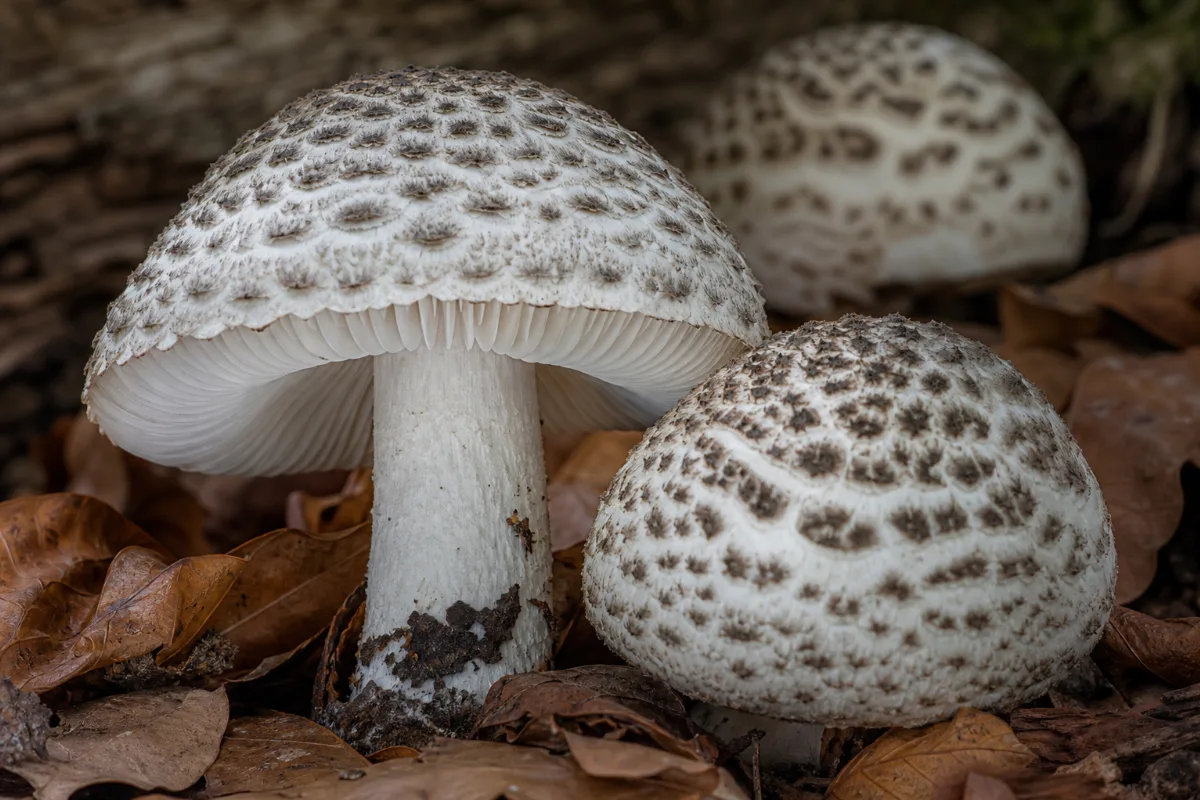
Mushrooms · Poisonous mushroom
Tiger tricholoma
Tricholoma pardinum · also called Leopard knight, spotted tricholoma; Tigerritterling (German), tricholome tigre (French)
The tiger tricholoma (leopard knight) is a poisonous wild mushroom. A German expert review lists it among the mushrooms that cause vomiting, diarrhoea and low blood pressure within hours. The poison is unknown, there is no test for it, and we found no study of people poisoned by this species alone. No study shows any health benefit. If someone has eaten it, call a poison centre.
General information, not medical advice. Last substantive update · Not medically reviewed. A named clinician has not signed off on this page. How this page is made
About Tiger tricholoma
The tiger tricholoma (Tricholoma pardinum), also called the leopard knight, is a poisonous wild mushroom. A 2020 German expert review lists it among the mushrooms that cause the gut-irritant type of poisoning: vomiting, diarrhoea and low blood pressure, usually starting within 30 minutes to 4 (up to 6) hours. The poison has not been identified. We found no study of this species alone, so its true severity is not known. No study shows any health benefit.
What the medical sources say, and what is missing
The species is named in a table of the 2020 review, in the gut-irritant syndrome. For that syndrome the review gives vomiting, diarrhoea and low blood pressure, treatment with fluids, electrolytes and anti-sickness medicine, and says there is no blood or urine test. A 2025 review says people with this early type usually show gut symptoms within the first 2 to 3 hours, and that gastroenteritis-type poisonings without liver failure generally do not cause death.
We searched PubMed and Europe PMC and found no case series, death count, onset times or toxin analysis for the tiger tricholoma alone. A Swiss hospital series of 51 mushroom poisonings (all kinds of mushrooms, not this one) found stomach or gut symptoms in 86%, no deaths and no liver failure, with 80% discharged within 24 hours. Those figures are not about this species and should not be read as how it behaves.
What is known about the poison
Nothing certain. The review says the toxins are unknown and that how they cause harm is not understood in detail. Chemists have isolated several compounds from the mushroom, but the papers we read describe effects on cells or bacteria in dishes, and none says that any of them causes the poisoning.
No source we read says that cooking, drying or freezing makes this mushroom safe, so do not assume that any preparation does.
Why mix-ups happen, and why this page cannot help you sort them
Poisonings are often a mix-up. This page does not teach identification, on purpose. A 2025 review says poisonous species cannot always be told from edible ones by appearance and that the mushroom eaten is never identified in up to 80% of cases. In the Bern series the exact type was identified in only 37.3% of 51 poisonings, even though mycologists were involved in 60.8%. A 2024 paper on another Tricholoma species says the genus is complex and its chemistry varies between collections. A photo, a smell, an app or a name is never proof that a wild mushroom is safe. If a wild mushroom has been eaten and you are unsure what it was, call a poison centre and keep the leftovers.
What research exists
There is no clinical trial of this mushroom for any use. The human evidence is expert review text and general poisoning records. The rest is laboratory chemistry: tricholopardins and pardinols (triterpenoids), pardinumones and acetylenic alcohols. In dishes, one tricholopardin reduced nitric oxide production in mouse immune cells (IC50 0.08 micromolar) and another was toxic to human cancer cell lines (IC50 4.7 and 9.7 micromolar). Pardinumones slowed three kinds of bacteria (MIC 6.25 to 50 micrograms per mL). A crude extract was active against a crop-pest mite. A 2026 computer study predicts that two compounds may bind cancer-related human proteins.
None of this has been tested in animals or people, and none of it suggests the mushroom itself is helpful. A compound that harms cells in a dish is not a treatment.
Products and contaminants
No supplement or food product made from this mushroom was found, and no analysis of metals or other contaminants in it. Nothing here is a product recommendation.
At a glance
Traditional uses history, not proof
- No traditional use as food or medicine is described in the sources we read.
- A 2020 German medical review lists it among the poisonous species that cause gut poisoning (Wennig 2020).
- Chemistry papers since 2018 have isolated new compounds from it and tested them in dishes, as possible leads for drugs.
Studied for research
- Eating it as food: harm described, evidence against
- Lab compounds (test tube and computer): very low evidence, nothing in animals or people
- No clinical trial for any use
Main compounds
- Tricholopardins and pardinols (triterpenoids; lab work)
- Pardinumones (polyketide-amino acid compounds; slowed bacteria in dishes)
- Acetylenic alcohols (lab work)
- The poison itself is not identified
Common forms
- Wild mushroom, usually eaten by mistake
- No supplement or product based on it was found
Research links: Poison Control (US): get help online or call 1-800-222-1222 · NHS: what to do in poisoning · NSW Poisons Information Centre (Australia): 13 11 26 · Mushroom Poisoning, expert review (abstract) · Mushroom poisoning: an updated review (abstract) · Mushroom poisoning in Bern, Switzerland, 17 years (abstract) · Research Library · Genes & Biomarkers Library
What it is and its history
- Accepted scientific name
- Tricholoma pardinum
- Naming authority
- (Pers.) Quel.
- Synonyms
- Agaricus myomyces var. pardinus Pers.; Agaricus unguentatus Fr.; Tricholoma unguentatum (Fr.) P.Karst.; Tricholoma pardolatum Herink & Kotlaba; Tricholoma pardinum var. unguentatum (Fr.) Bon; Tricholoma pardinum f. albellum Bon
- Common names
- Tiger tricholoma (English); Leopard knight (English); Spotted tricholoma (English); Tigerritterling (German); Tricholome tigre (French)
- Family or group
- Tricholomataceae, a family of fungi (this is a mushroom, not a plant).
- Classification
- Fungi > Basidiomycota > Agaricomycetes > Agaricales > Tricholomataceae > Tricholoma > Tricholoma pardinum
- Native range
- GBIF holds about 1,993 occurrence records of the species (2026-10-25 count). This page does not describe where to find it.
- Habitat
- Not described here.
- What it looks like
- Part used: The fruiting body (the mushroom). This page does not describe its appearance, on purpose.
- Look-alikes and adulterants
- Name: Other mushrooms, including edible ones, in the same genus and elsewhere; Note: This page gives no identification help. A 2024 paper says the genus Tricholoma is complex and that its chemistry varies between collections, so naming a species with confidence needs expert and DNA work.
Traditional use and history history, not clinical proof
| Tradition or era | Documented use | Source |
|---|---|---|
| Taxonomy | GBIF gives the combination Tricholoma pardinum as published by Quelet in 1873 (Mem. Soc. Emul. Montbeliard), based on an earlier variety name by Persoon. No traditional food or medicine use is described in the sources we read. | GBIF |
Traditional use shows how it was used. It does not show that it works or is safe today.
What is inside, and how it may work
What it contains and how those compounds act in cells and animals. Laboratory and animal mechanisms are not proven effects in people.
Main compounds
| Compound | Family | Where it is concentrated | Activity studied | Level of evidence |
|---|---|---|---|---|
| Tricholopardins A-D | Tricholoma triterpenoids | Fruiting body | Tricholopardin A reduced nitric oxide production in mouse immune cells in dishes; tricholopardin C was toxic to cancer cell lines in dishes. Not shown to cause the poisoning. 4 6 | Laboratory research |
| Pardinols A-H | lanostane triterpenoids | Fruiting body | Several reduced nitric oxide production and were toxic to human cancer cell lines in dishes. Not shown to cause the poisoning. 10 | Laboratory research |
| Pardinumones A-D | polyketide-amino acid derivatives | Fruiting body | Slowed growth of three bacteria in dishes. Not shown to cause the poisoning. 9 | Laboratory research |
| Acetylenic alcohols (four new compounds) | acetylenic alcohols | Fruiting body | The crude extract was active against a crop-pest mite. Not shown to cause the poisoning. 2 | Laboratory research |
| 1H-indole-3-carbaldehyde PubChem 10256 | indole | Fruiting body | Reported alongside the acetylenic compounds; no activity given in the abstract. 2 15 | Laboratory research |
Mechanisms, receptors and pathways
| Target or pathway | Gene or receptor | What was found | Level |
|---|---|---|---|
| Gut irritation | n/a | Not known. The 2020 review says the toxins irritate the lining of the gut and that the mechanisms are not understood in detail. 8 | Pharmacological theory |
| Nitric oxide production in macrophage cells | not given in the abstracts | Compounds from the mushroom lowered nitric oxide in stimulated mouse cells in dishes. Test-tube work. 4 10 | Laboratory research |
| Cell death in a breast cancer cell line | apoptosis | Tricholopardin C caused apoptosis in MCF-7 cells in dishes (studied briefly). 6 | Laboratory research |
| PARP1 and PIP4K2G binding | PARP1; PIP4K2G | Computer models predict strong binding of two compounds. Prediction only. 1 | In silico |
Absorption, metabolism and elimination
- Absorption
- Not established. Gut symptoms start within about 30 minutes to 4 (up to 6) hours per the 2020 review.
- Distribution
- Not established.
- Metabolism
- Not established.
- Elimination
- Not established.
- Bioavailability
- Not established.
Isolated compounds versus whole extracts
The poisoning is described for the whole mushroom eaten. The laboratory compounds were purified from dried mushroom extracts and tested alone in dishes. Nothing shows that any of them causes the poisoning or has an effect in people.
Nutritional composition
The tiger tricholoma is not a food or a nutrient source. It is poisonous, and no USDA entry exists for it.
3 very low certainty1 evidence against
What was looked at
The 4 benefits and uses checked for Tiger tricholoma, each with how strong the evidence is. Tap one to open it.
What is Tiger tricholoma good for?
The uses people ask about and how strong the evidence is for each. None is shown to help. Read every row together with the Safety tab: this is a poisonous mushroom.
Benefits, one by one
Each card is a research question, not a promise. Tap a goal to filter. Open a card to see the studies, doses and limits.
Eating it as a food
Evidence againstThe tiger tricholoma is not a food. A German medical review lists it among the mushrooms that cause stomach and gut poisoning. We found no study of people poisoned by this species alone, and no sign of any benefit.
3 studiesNot covered. No amounts, no preparation and no ways of using the mush…
Studies, doses and limits
What the trials found
No case series, poison-centre count or trial for this species alone was found in PubMed or Europe PMC. The evidence is one listing in a 2020 expert review (Table 1 and Table 3a). Two other reviews and a Swiss hospital series describe the same type of poisoning in general, without naming this species.
Results
Not a benefit. The review describes vomiting, diarrhoea and low blood pressure, starting 30 minutes to 4 (up to 6) hours after eating, treated with fluids, electrolytes and anti-sickness medicine. It says this type is usually not life-threatening but should not be underestimated.
Why this rating
Expert review and general case records point to harm. They cannot show that any amount is safe, and nothing here is specific to this species beyond the listing.
Form and dose studied
Not covered. No amounts, no preparation and no ways of using the mushroom are given.
Who was studied
Adults and children who ate wild mushrooms; no group has been studied for benefit.
Limits
The species is named only in a table. The Swiss figures are for all mushrooms together and are not about this species.
Why researchers looked
Poison centres and hospitals write about gut-irritant mushrooms because people eat wild mushrooms by mistake and need quick, correct care.
Traditional use
No traditional food or medicine use is described in the sources we read.
Proposed mechanism Pharmacological theory
The poison is unknown. The review says the toxins of this group act locally on the lining of the gut and that how they work is not understood in detail, and that blood and urine tests for them are not available.
A proposed mechanism does not show that the effect happens in people.
This is a poisonous wild mushroom. Eating it can cause vomiting, diarrhoea and low blood pressure within hours. See the Safety tab first. If someone has eaten it, call a poison centre.
Laboratory work on anti-inflammatory compounds
Very low certaintyChemists isolated compounds from the mushroom and tested them on mouse immune cells in dishes. One, tricholopardin A, strongly cut nitric oxide production in those cells. This is test-tube work and does not mean the mushroom helps anyone.
2 studiesNot covered.
Studies, doses and limits
Results
Tricholopardin A reduced nitric oxide production in stimulated RAW264.7 mouse macrophages (IC50 0.08 micromolar). Pardinols B and E-H did the same (IC50 5.3 to 14.7 micromolar).
Effect sizes as reported
Values come from single test-tube studies; see the results.
Why this rating
Test-tube or computer work on pure compounds from the mushroom, with no animal or human testing.
Form and dose studied
Not covered.
Limits
Pure compounds, not the mushroom. Only abstracts were read. Nothing is known about safety in the body.
Why researchers looked
Drug researchers look at natural compounds as starting points for new medicines.
Proposed mechanism Laboratory research
Reduced nitric oxide production in stimulated mouse macrophage cells (test-tube work). The target was not named in the abstracts.
A proposed mechanism does not show that the effect happens in people.
This is a poisonous wild mushroom. Eating it can cause vomiting, diarrhoea and low blood pressure within hours. See the Safety tab first. If someone has eaten it, call a poison centre.
Laboratory work on cancer cell toxicity
Very low certaintySome compounds from the mushroom killed human cancer cells grown in dishes, and a 2026 computer study predicted that two others might bind cancer-related proteins. None has been tested in animals or people, and killing cells in a dish is not a treatment.
3 studiesNot covered.
Studies, doses and limits
Results
Tricholopardin C was toxic to MCF-7 and HeLa cancer cell lines (IC50 4.7 and 9.7 micromolar) and caused MCF-7 cells to die by apoptosis. Pardinols were also toxic to human cancer cell lines (values not in the abstract). In a computer model, two of six other compounds were predicted to bind PARP1 and PIP4K2G.
Effect sizes as reported
Values come from single test-tube studies; see the results.
Why this rating
Test-tube or computer work on pure compounds from the mushroom, with no animal or human testing.
Form and dose studied
Not covered.
Limits
Pure compounds in cell lines and computer models. The 2026 paper is prediction only. A compound toxic to cancer cells is generally toxic to other cells too.
Why researchers looked
Cell-killing compounds from fungi are screened as possible leads for cancer drugs.
Proposed mechanism Laboratory research
Cell death (apoptosis) in a breast cancer cell line, test-tube work; computer docking to two human proteins (prediction only).
A proposed mechanism does not show that the effect happens in people.
This is a poisonous wild mushroom. Eating it can cause vomiting, diarrhoea and low blood pressure within hours. See the Safety tab first. If someone has eaten it, call a poison centre.
Laboratory work on bacteria and a crop pest
Very low certaintyFour compounds called pardinumones slowed the growth of three kinds of bacteria in dishes, and a crude extract was active against a mite that damages crops. This is test-tube work and does not mean the mushroom treats infections.
2 studiesNot covered.
Studies, doses and limits
Results
Pardinumones A-D slowed growth of Staphylococcus aureus, Staphylococcus epidermidis and Escherichia coli in dishes (MIC 6.25 to 50 micrograms per mL). A crude acetone extract showed potent activity against the spider mite Tetranychus urticae.
Effect sizes as reported
Values come from single test-tube studies; see the results.
Why this rating
Test-tube or computer work on pure compounds from the mushroom, with no animal or human testing.
Form and dose studied
Not covered.
Limits
Pure compounds and a crude extract, not the whole mushroom. Not tested in animals or people.
Why researchers looked
Natural compounds are screened for new antibiotics and pest-control agents.
Proposed mechanism Laboratory research
Slowed bacterial growth in dishes; mechanism not given in the abstracts.
A proposed mechanism does not show that the effect happens in people.
This is a poisonous wild mushroom. Eating it can cause vomiting, diarrhoea and low blood pressure within hours. See the Safety tab first. If someone has eaten it, call a poison centre.
Connections to the rest of health
How Tiger tricholoma connects to the rest of our health knowledge graph. Every link says what kind of connection it is. A safety link (for example to the liver) is a warning, not a benefit. A study that merely mentions a topic never creates a benefit link.
Explore every connection: goals, body systems, organs, symptoms, genes
B. Body systems
| Connected to | Kind of connection | Evidence status | Context | Studies |
|---|---|---|---|---|
| Digestive system | Adverse effect or risk | Low certainty | Listed among mushrooms that cause vomiting and diarrhoea within hours (expert review; no species-level series). Preparation or compound: Mushroom (toxins unknown) |
8 |
| Digestive System | Biological association | Evidence against | Studied for: Eating it as a food | 8 5 7 |
L. Active compounds
| Connected to | Kind of connection | Evidence status | Context | Studies |
|---|---|---|---|---|
| Tricholopardins A-D | Biological association | In vitro | Tricholopardin A reduced nitric oxide production in mouse immune cells in dishes; tricholopardin C was toxic to cancer cell lines in dishes. Not shown to cause the poisoning. Preparation or compound: Fruiting body |
4 6 |
| Pardinols A-H | Biological association | In vitro | Several reduced nitric oxide production and were toxic to human cancer cell lines in dishes. Not shown to cause the poisoning. Preparation or compound: Fruiting body |
10 |
| Pardinumones A-D | Biological association | In vitro | Slowed growth of three bacteria in dishes. Not shown to cause the poisoning. Preparation or compound: Fruiting body |
9 |
| Acetylenic alcohols (four new compounds) | Biological association | In vitro | The crude extract was active against a crop-pest mite. Not shown to cause the poisoning. Preparation or compound: Fruiting body |
2 |
| 1H-indole-3-carbaldehyde | Biological association | In vitro | Reported alongside the acetylenic compounds; no activity given in the abstract. Preparation or compound: Fruiting body |
2 15 |
Each connection is stored with the ingredient, the connected record, the kind of connection, the evidence status, the supporting studies, the preparation or compound involved, and a review date (last reviewed October 25, 2026).
Evidence at a glance: what the research found for 4 outcomes
Each outcome below is one thing researchers measured. Certainty is how far the evidence can be trusted, not how well it works. The full studies are on the next tab.
The evidence
The research centre for Tiger tricholoma. Every record here was checked against PubMed or the publisher's page; we never list a study we have not verified.
Evidence by outcome
Bars show how many studies we found for each outcome, not how well it works. People are added up across trials only (reviews are not added, to avoid double counting).
How we rate evidence
High certainty
Several well-run trials or reviews agree; further research is unlikely to change the picture much.
Moderate certainty
Good trials point the same way, but some doubt remains.
Low certainty
Small, short or inconsistent trials. The finding could change with better research.
Very low certainty
Very little or very weak human data. Treat as a possibility only.
Mixed findings
Trials or reviews disagree with each other.
Not enough evidence
Not enough human research to say either way.
Evidence against
Good research found no benefit, or found harm.
We take the reviewers' own risk-of-bias and GRADE statements where they exist, and otherwise judge from study size, design, consistency, directness and whether a product matches what is sold. Many publications do not make evidence high. Method note: We searched PubMed and Europe PMC for this species, read PubMed records and abstracts for 10 papers, read the relevant parts of the free full text for three reviews and case series, read the Poison Control, NHS and NSW poisons pages, and checked the scientific name in GBIF and one chemical identifier in PubChem. Where a statement could not be checked, it is marked as unverified in our notes.
Study library: every study we checked 15
| Study | Design | People | Product, dose, length | Result |
|---|---|---|---|---|
| Amin 2026 In silico evaluation of novel metabolites from Tricholoma pardinum: Insights into drug-likeness, toxicity and target interactions via molecular docking and dynamics. Technol Health Care · PMID 42541422 · DOI |
Computational in-silico |
Six previously uncharacterised metabolites from the mushroom, modelled on a computer | Computer model of isolated compounds |
The authors predicted that two of the six compounds bind strongly to two cancer-related human proteins in computer models, and call them possible starting points for future anticancer drugs that need laboratory testing. Methods, limits and fundingOutcomes: Predicted drug-likeness, toxicity and binding to two human proteins (PARP1, PIP4K2G) Limitations: Computer prediction only. No cells, animals or people were tested. Published 2026; not independently checked by us. Funding and conflicts: Not stated in the abstract. Read: abstract |
| Clericuzio 2021 New acetylenic metabolites from the toxic mushroom Tricholoma pardinum. Nat Prod Res · PMID 32538156 · DOI |
Laboratory lab |
Acetone extract and isolated compounds from the poisonous mushroom, tested on a crop pest | Mushroom extract and pure compounds fruiting body |
Four new acetylenic alcohols were isolated, together with two known indole compounds (1H-indole-3-carbaldehyde and 6-hydroxy-1H-indole-3-carbaldehyde). The crude acetone extract showed potent activity against the two-spotted spider mite, a crop pest. Methods, limits and fundingOutcomes: Compounds present; activity against the spider mite Tetranychus urticae Limitations: Chemistry and pest-control test. Not tested on people or animals. Not shown to cause the poisoning. Funding and conflicts: Not stated in the abstract. Read: abstract |
| Clericuzio 2024 No Evidence Was Found for the Presence of Terreolides, Terreumols or Saponaceolides H-S in the Fruiting Bodies of Tricholoma terreum (Basidiomycota, Agaricales). Molecules · PMID 38675614 · DOI |
Laboratory lab |
2 Two collections of a Tricholoma species from Italy, analysed by DNA and chemistry |
Mushroom extracts fruiting body |
The authors found that mushroom chemistry in the large genus Tricholoma varies a lot, and that results from one collection could not be repeated in another collection of what had been called the same species. They conclude that unambiguous identification of the species is needed in this complex genus. It is about a different Tricholoma species, not Tricholoma pardinum. Methods, limits and fundingOutcomes: Compounds present; species identification Limitations: About another species; cited only for the point that Tricholoma species are hard to name reliably and that their chemistry varies. Funding and conflicts: Not stated in the abstract. Read: abstract |
| Feng 2019 Tricholopardins A and B, Anti-inflammatory Terpenoids from the Fruiting Bodies of Tricholoma pardinum. J Nat Prod · PMID 30629435 · DOI |
Laboratory lab |
Two new compounds isolated from the fruiting bodies, tested on mouse macrophage cells in dishes | Pure compounds isolated from a mushroom extract fruiting body |
Tricholopardin A strongly reduced nitric oxide production in the stimulated mouse cells, with an IC50 of 0.08 micromolar. Its effects on three inflammatory mediators were also evaluated. Methods, limits and fundingOutcomes: Nitric oxide production in lipopolysaccharide-treated RAW264.7 mouse macrophages Limitations: Cell-culture work on one pure compound from a poisonous mushroom. Says nothing about people. Funding and conflicts: Not stated in the abstract. Read: abstract |
| Keller 2018 Mushroom Poisoning-A 17 Year Retrospective Study at a Level I University Emergency Department in Switzerland. Int J Environ Res Public Health · PMID 30558129 · DOI |
Case series |
51 51 patients with mushroom poisoning seen at one emergency department in Bern, Switzerland, January 2001 to October 2017 |
Wild and other mushrooms eaten fruiting body |
Gastrointestinal disturbances were reported in 86% of the 51 cases (44 patients, 86.3%; nausea 82.4%, vomiting 58.8%, diarrhoea 45.1%, abdominal pain 35.3%). The mushroom type was identified exactly in 37.3% (19 patients) and stayed unknown in 43.1% (22), although mycologists were involved in 60.8%. 84.3% received intravenous fluids. There were no deaths and no liver failure, and 80% were discharged within 24 hours. The abstract says poisonous mushrooms and severe complications were also recorded. This paper does not name Tricholoma pardinum; all figures are for all mushrooms together. Methods, limits and fundingOutcomes: Symptoms, identification of the mushroom, treatment, outcome Limitations: One hospital in one country. Does not name this species. Patients who reached an emergency department only. Figures are for all mushrooms, not this one. Funding and conflicts: Not stated in the abstract. Read: full-text |
| Shi 2021 Structures, Chemical Conversions, and Cytotoxicity of Tricholopardins C and D, Two Tricholoma Triterpenoids from the Wild Mushroom Tricholoma pardinum. Nat Prod Bioprospect · PMID 33449279 · DOI |
Laboratory lab |
Two new compounds isolated from the wild mushroom, tested on human cancer cell lines in dishes | Pure compounds isolated from a mushroom extract fruiting body |
Tricholopardin C showed cytotoxicity to MCF-7 and HeLa cells in dishes, with IC50 values of 4.7 micromolar and 9.7 micromolar. The authors briefly studied how it made MCF-7 cells die (apoptosis). Compounds C and D were also made by chemical conversion from known analogues. Methods, limits and fundingOutcomes: Cell toxicity (IC50) in MCF-7 and HeLa cell lines Limitations: Cell-culture work on one pure compound. Toxic to cells in a dish does not mean a treatment, and the compound is not shown to cause the poisoning in people. Funding and conflicts: Funded by the National Natural Science Foundation of China and the Natural Science Foundation of Hubei Province (public funders, per PubMed). Read: abstract |
| Tugcan 2025 Mushroom poisoning: An updated review. Turk J Emerg Med · PMID 39882097 · DOI |
Review |
Narrative review of mushroom poisoning syndromes, toxins and treatment | Poisonous mushrooms (review) fruiting body |
The review says the poisonous species cannot always be told from edible ones by appearance and that in up to 80% of cases the mushroom eaten is never identified. It says patients usually begin to show gut symptoms within the first 2 to 3 hours, and that deadly mushrooms usually cause symptoms after 6 to 8 hours. It says fungi that cause gastroenteritis without liver failure generally do not cause death and that treatment is supportive. It does not name Tricholoma pardinum. Methods, limits and fundingOutcomes: Syndromes, timing, treatment Limitations: Narrative review. Does not name this species. Read the abstract and the relevant passages of the free full text. Funding and conflicts: Not stated in the part read. Read: full-text |
| Wennig 2020 Mushroom Poisoning. Dtsch Arztebl Int · PMID 33559585 · DOI |
Review |
Review of mushroom poisoning syndromes, toxins and treatment, with an overview table of poisonous species | Wild mushrooms (review) fruiting body |
Table 1 of the review lists Leopard Knight (Tricholoma pardinum) among the poisonous species of the gastrointestinal irritant syndrome. Table 3a gives that syndrome a latency of 30 minutes to 4 (6) hours, toxins with a local irritant action on the gut lining whose mechanisms are not understood in detail, vomiting, diarrhoea and low blood pressure, treatment with fluids, electrolytes and anti-sickness medicine, and says the toxins are unknown and serum or urine analysis is not available. The text says poisoning with a short latency is usually not life-threatening but should not be underestimated, that a short latency does not always rule out amatoxin poisoning (mixed mushroom dishes), and that people with symptoms or who probably ate poisonous mushrooms should generally be kept under hospital observation for at least 36 hours. It also says gut syndromes can come from spoiled, raw or undercooked mushrooms, or from eating too much. Methods, limits and fundingOutcomes: Poisoning syndromes, latency, symptoms, treatment Limitations: Narrative review by poison-centre experts. The species is named only in a table; the review gives no case numbers, onset times or outcomes for this species alone. Groups the species with others by syndrome, so the group description may not fit every species equally. Abstract read in PubMed; the full text (including Tables 1 and 3a) was read on PubMed Central. Funding and conflicts: Not stated in the part read. Read: full-text |
| Yang 2021 Pardinumones A-D: Antibacterial Polyketide-Amino Acid Derivatives from the Mushroom Tricholoma pardinum. ACS Omega · PMID 34604687 · DOI |
Laboratory lab |
Four pure compounds isolated from the fruiting bodies of Tricholoma pardinum, tested on bacteria in dishes | Pure compounds isolated from a mushroom extract fruiting body |
Four polyketide-amino acid compounds, pardinumones A-D, were isolated. They slowed growth of the three bacteria in dishes at minimum inhibitory concentrations of 6.25 to 50 micrograms per mL. Methods, limits and fundingOutcomes: Growth of Staphylococcus aureus, Staphylococcus epidermidis, Escherichia coli Limitations: Test-tube work on pure compounds. Says nothing about the whole mushroom or about people. The pardinumones are not shown to cause the poisoning. Funding and conflicts: Not stated in the abstract. Read: abstract |
| Zhang 2018 Lanostane triterpenoids from Tricholoma pardinum with NO production inhibitory and cytotoxic activities. Phytochemistry · PMID 29758519 · DOI |
Laboratory lab |
Eight new lanostane triterpenoids (pardinols A-H) isolated from the fruiting bodies, tested in dishes | Pure compounds isolated from a mushroom extract fruiting body |
Pardinols B and E-H reduced nitric oxide production in cell tests with IC50 values of 5.3 to 14.7 micromolar, and were also toxic to human cancer cell lines. Pardinol values for the cancer cell lines were not given in the abstract. Methods, limits and fundingOutcomes: Nitric oxide production; toxicity to human cancer cell lines Limitations: Test-tube work on pure compounds. Says nothing about people. Funding and conflicts: Not stated in the abstract. Read: abstract |
| n/a 2026 Poison Control (National Capital Poison Center): home page and call advice n/a · Source |
Authoritative guidance n/a |
n/a | n/a |
The page gives the poison help number 1-800-222-1222 (free, expert and confidential) and says to call 911 if the person collapses, has a seizure, has trouble breathing or cannot be awakened. Read 25 October 2026. Methods, limits and fundingOutcomes: What to do in a suspected poisoning in the US Limitations: A public help page; not about this species. Read: full-text |
| n/a 2026 NHS (UK): Poisoning n/a · Source |
Authoritative guidance n/a |
n/a | n/a |
The page says to call 999 or go to A&E if someone may have swallowed something harmful or has lost consciousness, and to call NHS 111 if you are not sure whether something swallowed is harmful. It says not to try to make someone sick and not to give them anything to eat or drink, and to take what was swallowed or its packaging to show healthcare staff. Read 25 October 2026. Methods, limits and fundingOutcomes: What to do in suspected poisoning in the UK Limitations: A public help page; not about this species. Read: full-text |
| n/a 2026 NSW Poisons Information Centre (Australia): home page n/a · Source |
Authoritative guidance n/a |
n/a | n/a |
The home page says the centre can be called 24/7 on 13 11 26, to call Triple Zero (000) for an ambulance if someone is unconscious or not breathing, and not to wait for symptoms if you think someone has been poisoned. Read 25 October 2026. Methods, limits and fundingOutcomes: Poison advice line in Australia Limitations: A public help page for one Australian state service; not about this species. Read: full-text |
| n/a 2026 GBIF Backbone Taxonomy: Tricholoma pardinum (Pers.) Quel. (species key 7242174) n/a · Source |
Registry or database n/a |
n/a | n/a |
GBIF lists Tricholoma pardinum (Pers.) Quel., published 1873, as ACCEPTED, in the family Tricholomataceae, with eight synonyms and common names including Leopard Knight, Spotted tricholoma, Tiger-Ritterling and Tricholome tigre. It holds about 1,993 occurrence records. Read through the GBIF API 25 October 2026. Methods, limits and fundingOutcomes: Accepted name, synonyms, family, common names Limitations: A registry. Index Fungorum was not checked. Read: full-text |
| n/a 2026 PubChem: Indole-3-carboxaldehyde (CID 10256) n/a · Source |
Registry or database n/a |
n/a | n/a |
PubChem CID 10256 is 1H-indole-3-carbaldehyde, formula C9H7NO. Read through the PubChem API 25 October 2026. Methods, limits and fundingOutcomes: Identity of a compound named in the 2021 acetylenic metabolites paper Limitations: Identity only. Read: full-text |
What we do not know yet
- No case series, death count, onset times or toxin analysis for the tiger tricholoma alone.
- The poison is not identified; the compounds found in the lab are not shown to cause it.
- No study of what cooking, drying or freezing does to the poison.
- No studies in pregnancy, breastfeeding, children, older adults, pets or people on medicines.
- No animal or human study of any compound from the mushroom.
How new research is added
New studies are found by a saved PubMed search and are placed in a review queue. A person reads each one before it changes this page.
Lab markers
What changed in blood or saliva tests during trials. A changed number is not the same as feeling or being healthier, and we give no "normal ranges".
Safety
What studies and official sources say about side effects, medicines and who should check first. Each point shows what kind of evidence it comes from.
Main points to know 5
- If someone has eaten it, call a poison centre now. Do not wait to see whether symptoms start. In the US call Poison Help at 1-800-222-1222 (free and confidential), or 911 if the person collapses, has a seizure, has trouble breathing or cannot be awakened. In the UK call NHS 111 if you are unsure and 999 in an emergency. In Australia the Poisons Information Centre line is 13 11 26, and Triple Zero (000) if someone is unconscious or not breathing. Do not try to make the person sick and do not give food or drink unless the poison service says so. Keep the mushroom, a photo or the leftovers to show staff. Authoritative guidance 11 12 13
- It is listed as a gut-irritant poisonous mushroom. A 2020 German expert review lists the leopard knight (Tricholoma pardinum) among the poisonous species of the gastrointestinal irritant syndrome: vomiting, diarrhoea and low blood pressure, starting 30 minutes to 4 (up to 6) hours after eating. The toxins are unknown and there is no blood or urine test for them. Expert review 8
- Mild in general does not mean safe for you. The review says poisoning with a short delay is usually not life-threatening but should not be underestimated. A short delay does not rule out a more dangerous mushroom in the same meal, and people who probably ate a poisonous mushroom should generally be watched in hospital for at least 36 hours. We found no death or case series for this species alone, so its true range of severity is not known. Expert review 8 7
- Nobody can sort safe from unsafe by looking. A 2025 review says poisonous species cannot always be told from edible ones by appearance and that the mushroom eaten is never identified in up to 80% of cases. In a Swiss hospital series of 51 mushroom poisonings the exact type was identified in only 37.3%, even with mycologists involved in 60.8%. A 2024 paper on another Tricholoma species stresses how variable the genus is. This page does not teach identification, on purpose. Case series 7 5 3
- Compounds found in the mushroom are not the proven poison. Laboratory papers describe several compounds from the mushroom that act on cells in dishes. None of the papers we read says that any of them causes the poisoning. The poison itself is still unknown. Laboratory research 8 6 9
Side effects 3
| Effect | How often | Severity and recovery | Evidence |
|---|---|---|---|
| Vomiting and diarrhoea In the Bern series of 51 mushroom poisonings from all kinds of mushrooms (not this one), nausea was 82.4%, vomiting 58.8%, diarrhoea 45.1% and abdominal pain 35.3%. | Not counted for this species. Named as the main symptoms of the gut-irritant syndrome in the 2020 review. | moderate The review says symptoms of many mushroom poisonings often go away on their own within 2 to 3 days at most. | Expert review 8 |
| Low blood pressure Loss of fluid is the practical danger, so repeated vomiting and diarrhoea matter most for young children, older people and people with other illnesses. This is general medical reasoning from the review's treatment advice, not a finding about this species. | Not counted for this species. Listed among the symptoms of the syndrome. | moderate Treated with fluids and electrolytes in hospital according to the review. | Expert review 8 |
| Delayed or more serious poisoning from a mixed meal The review warns that a short delay does not always rule out amatoxin poisoning when different mushrooms were eaten together. Deadly mushrooms usually cause symptoms after 6 to 8 hours (2025 review). | Not known. | high Depends on the other mushroom. | Expert review 8 7 |
Liver
No liver injury from the tiger tricholoma was described in the sources we read. The gut-irritant syndrome is defined in the 2020 review as acute gastroenteritis without liver failure, unlike other mushroom poisonings with later onset. 8 5 7
How often. Not studied for this species. Absence of reports is not proof of absence.
- Bern emergency department, 51 mushroom poisonings from all kinds of mushrooms, 2001 to 2017. No death and no liver failure in the series. The species is not named. 5
This is a safety connection. It is not evidence that Tiger tricholoma supports liver health.
Medicines and supplements 1
| With | Why it matters | Importance | Evidence | What to do |
|---|---|---|---|---|
| Medicines taken by mouth (tablets, capsules, contraceptive pills) prescription and non-prescription | Vomiting and diarrhoea may stop medicines staying down or being absorbed. | Not studied. Poison staff and doctors need the full list of what the person takes. | Pharmacological theory Not enough evidence | Tell the poison centre or emergency team about every medicine, supplement and drink taken. Ask a doctor or pharmacist about missed doses. |
Who should check first 4
| Situation | Advice | Evidence |
|---|---|---|
| Anyone | It is a poisonous mushroom with no known benefit. Do not eat it. | Expert review 8 |
| Pregnancy, breastfeeding and children | No data were found for pregnancy, breastfeeding or children for this species. Fluid loss from vomiting and diarrhoea can be more dangerous for young children. If a child or a pregnant or breastfeeding person may have eaten it, call a poison centre or doctor straight away. | Pharmacological theory 8 |
| Pets and livestock | No veterinary data were found. If a pet may have eaten a wild mushroom, call a vet or an animal poison service at once. | Pharmacological theory |
| People with heart, kidney or other long-term illness, and older people | Not studied for this species. Dehydration is the usual worry in gut illness, so seek medical advice early. | Pharmacological theory 8 |
Overdose, product quality and regulators
Summary. The poison is unknown. The 2020 review gives 'toxins unknown' for the gut-irritant group and says the toxins act locally on the gut lining. Laboratory chemists have isolated several compounds from the mushroom (tricholopardins, pardinols, pardinumones, acetylenic alcohols), but none is shown to cause the poisoning.
Amounts. No safe amount has been established in any source we read, and no amount that causes illness was found for this species.
Onset and course. 30 minutes to 4 (up to 6) hours for the group, per the 2020 review; gut symptoms usually within 2 to 3 hours per the 2025 review. Symptoms of many mushroom poisonings often settle within 2 to 3 days at most.
Repeated use. No data on repeated or long-term eating were found. Do not confuse this with the muscle-damage poisoning linked to a different Tricholoma species.
Animal data. No animal poisoning data were found. A 2026 computer paper predicted toxicity of six compounds, which is prediction only.
Toxic parts. Not studied. The fruiting body is the part described in all sources.
Not read. Blood or urine levels, genotoxicity, reproductive toxicity, and effects of cooking, drying or freezing.
No supplement, extract or food product made from the tiger tricholoma was found. It is not sold as a food or supplement in the sources we read.
| Body | Action | Date |
|---|---|---|
| Poison Control, National Capital Poison Center (United States) | Public poison guidance, not a rule about this mushroom: call 1-800-222-1222 (free, expert, confidential), and 911 if the person collapses, has a seizure, has trouble breathing or cannot be awakened. source | 2026-10-25 |
| NHS (United Kingdom) | Public guidance on poisoning: call 999 or go to A&E for a serious case, call NHS 111 if unsure, do not try to make someone sick, take the substance to show staff. source | 2026-10-25 |
| NSW Poisons Information Centre (Australia) | Poisons line 13 11 26 (24/7); Triple Zero (000) if someone is unconscious or not breathing; do not wait for symptoms. source | 2026-10-25 |
When to get medical help
- If someone may have eaten this mushroom, or any wild mushroom they cannot be sure of, call a poison centre now, even if they feel fine.
- Call emergency services (911, 999, 000) for collapse, a seizure, trouble breathing or if the person cannot be woken.
- Get urgent medical help for vomiting or diarrhoea that will not stop, signs of dehydration (very dry mouth, little or no urine, dizziness, fainting), or confusion.
- Stomach illness that starts 6 or more hours after a wild-mushroom meal needs urgent advice, because other poisonous mushrooms cause late and dangerous illness.
- Everyone who shared the meal should be checked, even if they feel well (2020 review).
If someone may be poisoned or in a crisis, contact a clinician or emergency service straight away. In the US, Poison Control is 1-800-222-1222.
General information only, not medical advice. Ask a clinician or pharmacist before use, especially with medicines, in pregnancy or with a health condition. See the Natural Remedy Safety guide.
Frequently asked questions
Is the tiger tricholoma poisonous?
Yes. A 2020 German expert review lists the leopard knight (Tricholoma pardinum) among the poisonous mushrooms that irritate the gut, causing vomiting, diarrhoea and low blood pressure within hours. The poison is unknown. We found no study of this species alone, so its full range of severity is not known.
What should I do if someone has eaten it?
Call a poison centre right away, even if the person feels fine. In the US call Poison Help at 1-800-222-1222 (free, confidential), or 911 if the person collapses, has a seizure, has trouble breathing or cannot be awakened. In the UK call NHS 111 if you are unsure, or 999 in an emergency. In Australia the Poisons Information Centre line is 13 11 26. Do not try to make the person sick and do not give food or drink unless the poison service says so. Keep the mushroom or a photo to show staff. Call emergency services for a seizure, collapse or trouble breathing.
How soon do symptoms start?
The 2020 review gives 30 minutes to 4 (up to 6) hours for this type of poisoning, and a 2025 review says gut symptoms usually start within the first 2 to 3 hours. Stomach symptoms that start 6 or more hours after a wild-mushroom meal need urgent medical advice, because other poisonous mushrooms cause late illness.
Is it dangerous to life?
The review says early-onset gut poisonings are usually not life-threatening, but it also says they should not be underestimated, and a more dangerous mushroom can be in the same meal. We found no death count or case series for this species, so do not rely on a general statement. Call a poison centre rather than waiting.
What is the poison in it?
Does cooking, drying or freezing make it safe?
No source we read says it does. The effect of cooking on this mushroom was not studied in the sources we read, so do not assume that any preparation makes a wild mushroom safe.
Can a photo or an app tell me if a wild mushroom is safe?
No. Reviews say poisonous species cannot always be told from edible ones by appearance, and in a Swiss hospital series the mushroom type stayed unknown in 43.1% of 51 poisonings. This page does not teach identification. If you are unsure, do not eat it, and use a local mycological service or a poison centre.
Does it help with any health problem?
Could it be used to make a cancer drug?
Is it safe in pregnancy, for children or for pets?
No data were found for pregnancy, breastfeeding, children or pets. Fluid loss from vomiting and diarrhoea can be more dangerous for young children and older people. Avoid it, and call a poison centre, doctor or vet if it was eaten.
Can it interact with medicines or alcohol?
No interaction study was found. Vomiting and diarrhoea may stop tablets staying down, so tell the poison centre or emergency team about every medicine and drink taken, and ask a doctor or pharmacist about missed doses.
Is it the same as the man on horseback mushroom?
No. The man on horseback (Tricholoma equestre) is a different species with its own page, linked to a different, delayed muscle-damage poisoning. Do not apply what is said about one Tricholoma species to another.
Explore by health goal
Editorial transparency
- Written by
- AlternativeMed editorial team. Research compiled with AI assistance, then checked against PubMed records.
- Medical review
- None. This page has not been reviewed by a physician or pharmacist.
- First published
- 2026-10-25
- Last substantive update
- 2026-10-25
- How we research
- We searched PubMed and Europe PMC for this species, read PubMed records and abstracts for 10 papers, read the relevant parts of the free full text for three reviews and case series, read the Poison Control, NHS and NSW poisons pages, and checked the scientific name in GBIF and one chemical identifier in PubChem. Where a statement could not be checked, it is marked as unverified in our notes.
- How we rate evidence
- See "How we rate evidence" in the Evidence tab.
- Independence
- No product is promoted on this page. No affiliate links are shown. This page gives no dose, preparation, identification, picking, growing or sourcing advice.
Sources 15
Each source was opened and checked. Where we read only the abstract, it says so. The small numbers in the text point here.
- Amin AA, Amin HIM, Hamad AR, Azeeza YH, Kareem RO, Rashid RF, Omer RA. In silico evaluation of novel metabolites from Tricholoma pardinum: Insights into drug-likeness, toxicity and target interactions via molecular docking and dynamics.. Technol Health Care. 2026. PMID 42541422. DOI 10.1177/09287329261472774. (abstract)
- Clericuzio M, Hussain FHS, Amin HIM, Salis A, Damonte G, Pavela R, Vidari G. New acetylenic metabolites from the toxic mushroom Tricholoma pardinum.. Nat Prod Res. 2021. PMID 32538156. DOI 10.1080/14786419.2020.1777415. (abstract)
- Clericuzio M, Serra S, Vidari G. No Evidence Was Found for the Presence of Terreolides, Terreumols or Saponaceolides H-S in the Fruiting Bodies of Tricholoma terreum (Basidiomycota, Agaricales).. Molecules. 2024. PMID 38675614. DOI 10.3390/molecules29081794. (abstract)
- Feng T, Gan XQ, Zhao YL, Zhang SB, Chen HP, He J, Zheng YS, Sun H, Huang R, Li ZH, Liu JK. Tricholopardins A and B, Anti-inflammatory Terpenoids from the Fruiting Bodies of Tricholoma pardinum.. J Nat Prod. 2019. PMID 30629435. DOI 10.1021/acs.jnatprod.8b00460. (abstract)
- Keller SA, Klukowska-Rotzler J, Schenk-Jaeger KM, Kupferschmidt H, Exadaktylos AK, Lehmann B, Liakoni E. Mushroom Poisoning-A 17 Year Retrospective Study at a Level I University Emergency Department in Switzerland.. Int J Environ Res Public Health. 2018. PMID 30558129. DOI 10.3390/ijerph15122855. (full-text)
- Shi C, Peng YL, He J, Li ZH, Liu JK, Feng T. Structures, Chemical Conversions, and Cytotoxicity of Tricholopardins C and D, Two Tricholoma Triterpenoids from the Wild Mushroom Tricholoma pardinum.. Nat Prod Bioprospect. 2021. PMID 33449279. DOI 10.1007/s13659-021-00297-x. (abstract)
- Tugcan MO, Akpinar AA. Mushroom poisoning: An updated review.. Turk J Emerg Med. 2025. PMID 39882097. DOI 10.4103/tjem.tjem_129_24. (full-text)
- Wennig R, Eyer F, Schaper A, Zilker T, Andresen-Streichert H. Mushroom Poisoning.. Dtsch Arztebl Int. 2020. PMID 33559585. DOI 10.3238/arztebl.2020.0701. (full-text)
- Yang HX, Ma JT, He J, Li ZH, Huang R, Feng T, Liu JK. Pardinumones A-D: Antibacterial Polyketide-Amino Acid Derivatives from the Mushroom Tricholoma pardinum.. ACS Omega. 2021. PMID 34604687. DOI 10.1021/acsomega.1c04418. (abstract)
- Zhang SB, Li ZH, Stadler M, Chen HP, Huang Y, Gan XQ, Feng T, Liu JK. Lanostane triterpenoids from Tricholoma pardinum with NO production inhibitory and cytotoxic activities.. Phytochemistry. 2018. PMID 29758519. DOI 10.1016/j.phytochem.2018.05.002. (abstract)
- n/a. Poison Control (National Capital Poison Center): home page and call advice. n/a. 2026. (full-text)
- n/a. NHS (UK): Poisoning. n/a. 2026. (full-text)
- n/a. NSW Poisons Information Centre (Australia): home page. n/a. 2026. (full-text)
- n/a. GBIF Backbone Taxonomy: Tricholoma pardinum (Pers.) Quel. (species key 7242174). n/a. 2026. (full-text)
- n/a. PubChem: Indole-3-carboxaldehyde (CID 10256). n/a. 2026. (full-text)


