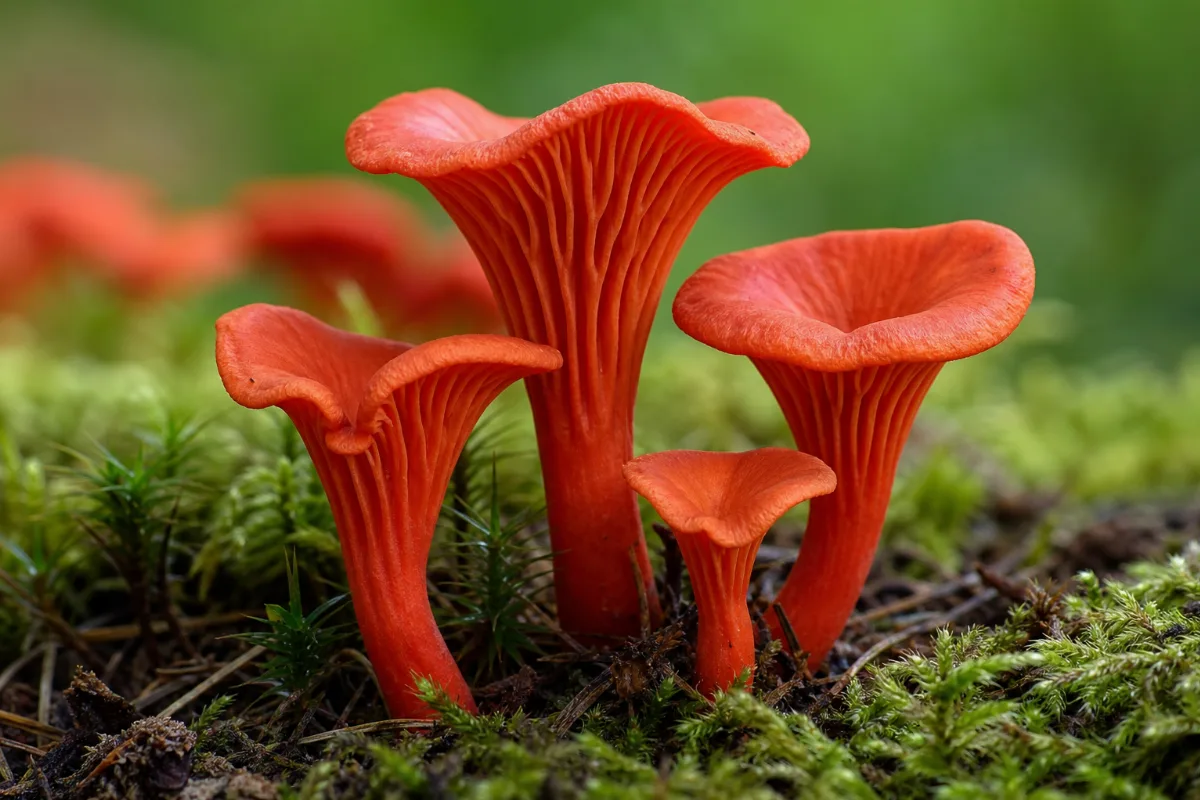
Mushrooms · Wild culinary mushroom
Red Chanterelle
Cantharellus cinnabarinus · also called Cinnabar chanterelle, cinnabar-red chanterelle
The red chanterelle is a small, bright red-orange wild mushroom eaten in several countries. Its red colour comes from a carotenoid pigment, canthaxanthin, that was first isolated from it. We found no study of what eating it does for health. The main caution is that wild mushrooms have look-alikes, and some are deadly.
General information, not medical advice. Last substantive update · Not medically reviewed. A named clinician has not signed off on this page. How this page is made
About Red Chanterelle
The red chanterelle (Cantharellus cinnabarinus) is a small red-orange wild mushroom that lives with tree roots. People eat it in places such as Yunnan, China. Its colour comes from the carotenoid canthaxanthin, which was first isolated from it. There is no health research on the mushroom itself. The cautions are look-alike fungi, the missing safety and contamination data for this species, and the eye findings seen with concentrated canthaxanthin tanning products.
What it is
Cantharellus cinnabarinus is the accepted name in GBIF, in the fungus family Hydnaceae. Common English names are red chanterelle and cinnabar chanterelle. It is a different species from the golden chanterelle (Cantharellus cibarius), which has most of the research.
A 2015 study on Guadeloupe lists it among seven fungi that live in partnership with tree roots (ectomycorrhizal). We found no source describing farming it.
Which species are meant
Several red and pink chanterelles are close relatives. Cantharellus texensis was described as a southern lookalike of C. cinnabarinus, and a 2026 Virginia study found genetic and colour variation within C. cinnabarinus. In China, the same subgenus holds species such as C. sinocinnabarinus.
So a mushroom sold or eaten under this name in China or Brazil may or may not be the same species as the eastern North American one. We name the species in every result.
As a food
In the Pu'er survey, it was popular in markets and easy to find in season, and it has become more popular in recent years with a high market value. A photo caption shows it stir-fried.
A 2024 review of wild edible mushrooms in Brazil lists it among species assessed as Least Concern on the Global Fungal Red List Initiative. We found no nutrition table for it, so this page gives no nutrition figures.
The red pigment and the eye
Two reviews say canthaxanthin was first isolated from this mushroom as a major part of a mixture of carotenoids, citing a 1950 paper that we did not open. A 2020 review says there are no comprehensive studies of its effects and benefits in humans.
Taken for a long time and in large amounts as a skin-bronzing product, canthaxanthin has caused yellow to red crystals in the retina, usually without symptoms. They seem to fade after stopping. One case report describes an 84-year-old woman with lasting visual loss that improved after she stopped. No report links eating the mushroom to this, and the amount in the mushroom is not known.
What the research shows
Nothing on health. A search for the species name found papers on naming, DNA and where the fungus grows. The reviews of the golden chanterelle list lab and animal findings for another species.
Metals and radioactive caesium have been measured in the golden chanterelle and some relatives: wide differences by site, and low levels of cadmium, lead and mercury in background areas of Poland. Nothing was measured for the red chanterelle.
At a glance
Traditional uses history, not proof
- A 2022 market survey in Pu'er, Yunnan (China) lists it as edible, popular in markets and valued, and shows it stir-fried.
- A 2024 review lists it among the wild edible mushrooms recorded for Brazil.
- We found no traditional medicine use.
Studied for research
- As a food (what it contains, health effects), insufficient
- Its red pigment canthaxanthin (pure-pigment lab and animal research), insufficient
- Any health effect of eating the red chanterelle itself, none found
- Golden chanterelle (a different species) lab and animal findings, insufficient
Main compounds
- Canthaxanthin (red-orange carotenoid pigment)
- Beta-carotene (listed as another carotenoid)
Common forms
- Fresh or cooked fruiting body (the food)
- Pigment extract (laboratory use only, not a retail product)
Research links: Reviews: Canthaxanthin, a red-hot carotenoid (PubMed) · Case report: Canthaxanthin retinopathy with visual loss (PubMed) · Name check: Cantharellus cinnabarinus (GBIF) · Research Library · Genes & Biomarkers Library
What it is and its history
- Accepted scientific name
- Cantharellus cinnabarinus
- Naming authority
- (Schwein.) Schwein. (GBIF species key 5249599)
- Synonyms
- Agaricus cinnabarinus Schwein.; Cantharellus cibarius var. australiensis Cleland; Cantharellus cinnabarinus var. australiensis (Cleland) Corner; Chanterel cinnabarinus (Schwein.) Murrill; Hygrophorus cinnabarinus (Schwein.) Sacc.; Mastocephalus cinnabarinus (Schwein.) Kuntze; Cantharellus cinnabarius appears as a spelling variant in at least one paper
- Common names
- Red chanterelle (English); Cinnabar chanterelle (English); Cinnabar-red chanterelle (English); Chanterelle cinabre (French); Anacate rojo (Spanish)
- Family or group
- Hydnaceae (a fungus family), not a plant
- Classification
- Fungi > Basidiomycota > Agaricomycetes > Cantharellales > Hydnaceae > Cantharellus > Cantharellus cinnabarinus
- Native range
- Reported from eastern North America in the papers we read. A 2011 paper places the smaller reddish-pink chanterelles in the Gulf of Mexico states and eastern United States, and a 2026 Virginia study expands the known distribution of related chanterelles in the eastern United States. The species is also recorded in Guadeloupe (Lesser Antilles). Papers in Yunnan, China and Brazil also use the name; whether all of those are the same species is not settled in what we read.
- Habitat
- A 2015 Guadeloupe study lists it among seven ectomycorrhizal fungal species whose fruiting bodies were found under seagrape trees. Ectomycorrhizal means the fungus lives in partnership with tree roots. Chanterelles are described as ectomycorrhizal in the Virginia study.
- What it looks like
- Fruiting body: A 2011 paper calls the group smaller, reddish-pink chanterelles and says the red species were told apart by DNA (tef1) and microscopic features. No field description is given here on purpose.
- Cultivation
- No source we read describes farming this species. The golden chanterelle is described as a wild edible ectomycorrhizal mushroom in a 2025 review. The Yunnan survey recorded it both in markets and in natural habitats.
- Harvest and processing
- In the Yunnan market survey, a photo caption shows it stir-fried. No other preparation detail was read.
- Look-alikes and adulterants
- Name: Close red and pink chanterelles; Note: Cantharellus texensis (southern United States) was described as a lookalike of C. cinnabarinus, and C. persicinus is a third pinkish taxon. In China, new species of the same subgenus include C. sinocinnabarinus. The papers separate them with DNA and microscopic features. They say nothing about the edibility of these relatives.; Name: Poisonous fungi that have been mistaken for chanterelles in general; Note: Jack-o'-lantern fungi (Omphalotus) are mistaken for edible Cantharellus and Pleurotus species, and deadly webcap (Cortinarius) is sometimes mistaken for chanterelles. The papers do not name the red chanterelle. A photo, description or app is not a safe way to identify wild mushrooms.
- Sustainability and conservation
- GBIF carries a global status of Least Concern from the IUCN Red List. A 2024 review of Brazil's wild edible mushrooms also lists it as assessed Least Concern.
Traditional use and history history, not clinical proof
| Tradition or era | Documented use | Source |
|---|---|---|
| 1832: first scientific description | GBIF gives the first publication as Schweinitz, Transactions of the American Philosophical Society (1832, printed 1834), as Agaricus cinnabarinus. This is a naming record, not a use. | s-gbif-5249599 |
| 1950: pigment study | Two reviews cite Haxo (Botanical Gazette, 1950) for the first isolation of canthaxanthin from this mushroom, as a major part of a mixture of carotenoids. One review elsewhere dates it to the mid-19th century, which does not match its own citation. The 1950 paper was not opened. | p32824217 |
| Yunnan, China: market food | A 2022 survey of Pu'er markets lists it as edible, popular and valued, and shows it stir-fried. | p35948993 |
| Brazil: wild edible list | A 2024 review lists it among Brazil's wild edible mushrooms assessed as Least Concern on the Global Fungal Red List Initiative. | p39673069 |
Traditional use shows how it was used. It does not show that it works or is safe today.
What is inside, and how it may work
What it contains and how those compounds act in cells and animals. Laboratory and animal mechanisms are not proven effects in people.
Main compounds
| Compound | Family | Where it is concentrated | Activity studied | Level of evidence |
|---|---|---|---|---|
| Canthaxanthin PubChem 5281227 | carotenoid (ketocarotenoid), red-orange pigment | Fruiting body of Cantharellus cinnabarinus (major carotenoid per the 2020 review) Not available (marked n.a. in the review table) | Reviews describe antioxidant, fat-metabolism, nerve-protection and immune roles in lab and animal work, and say there are no comprehensive human studies of benefits. Heavy use as a tanning product has caused retinal crystals. 17 10 2 16 | Laboratory research |
| Beta-carotene PubChem 5280489 | carotenoid | Fruiting body (listed as another carotenoid of C. cinnabarinus in the 2020 review table) Not available | No finding for this mushroom. 17 16 | Other |
Mechanisms, receptors and pathways
| Target or pathway | Gene or receptor | What was found | Level |
|---|---|---|---|
| Antioxidant activity of the pure pigment | Not specified | A 2023 review says canthaxanthin has powerful antioxidant properties and a role in fat metabolism, nerve protection and immune regulation. This is about the pure pigment, in the lab and animals, not the mushroom. 10 | Laboratory research |
Absorption, metabolism and elimination
- Absorption
- Not found for the mushroom.
- Distribution
- A 2023 review says controlled long feeding of canthaxanthin in one animal study led to accumulation in liver, fat, lungs and small intestine without toxicity. It is about the pure pigment.
- Metabolism
- Not found.
- Elimination
- Not found. Retinal crystals from tanning-product use appeared to clear after stopping, over a variable time.
- Bioavailability
- Not established for the mushroom.
Isolated compounds versus whole extracts
All the pigment research is on isolated or lab-made canthaxanthin, not on the mushroom. The golden chanterelle reviews are about another species. Nothing read shows what eating the red chanterelle does.
Nutritional composition
We found no USDA entry and no open nutrient table for the red chanterelle, so we give no nutrition figures.
4 not enough evidence
What was looked at
The 4 benefits and uses checked for Red Chanterelle, each with how strong the evidence is. Tap one to open it.
What is Red Chanterelle good for?
The uses people ask about and how strong the evidence is for each. None is proven in people. Read this together with the Safety tab.
Benefits, one by one
Each card is a research question, not a promise. Tap a goal to filter. Open a card to see the studies, doses and limits.
Red chanterelle as a wild food
Not enough evidenceThe red chanterelle is a small wild mushroom that people in several countries eat. A market survey in Yunnan, China lists it as edible and shows it stir-fried. We found no nutrition figures for it, and no study of what eating it does to health.
3 studiesFresh or cooked fruiting body (stir-fried in the Yunnan survey). This…
Studies, doses and limits
Results
Edible and sold in markets in Yunnan; included in Brazil's list of wild edible mushrooms; no composition or health data found
Effect sizes as reported
No numbers; use records only
Why this rating
The records show the mushroom is eaten, not that it is nutritious or healthy. Chinese and Brazilian records may not all refer to the same species as the eastern North American mushroom, because several close red-pink species exist.
Form and dose studied
Fresh or cooked fruiting body (stir-fried in the Yunnan survey). This page gives no amounts.
Who was studied
Market vendors, collectors and food surveys in China and Brazil
Limits
A survey of local practice is not a safety study. The Brazilian paper's abstract does not say which of its edibility groups (safe, or edible with conditions) holds this species.
Why researchers looked
It is studied as part of surveys of wild food mushrooms and of which fungi grow where. Its use as a food comes up in those surveys.
Traditional use
A 2022 survey of 11 markets in Pu'er, Yunnan lists Cantharellus cinnabarinus as edible, popular in markets and easy to find in season, and says it has become more popular recently with a high market value. A 2024 review of wild edible mushrooms in Brazil lists it among the species assessed as Least Concern on the Global Fungal Red List Initiative.
Proposed mechanism Other
Not a mechanism claim. These are records of food use.
A proposed mechanism does not show that the effect happens in people.
Wild mushrooms have look-alikes, some deadly. See the Safety tab.
Its red-orange pigment canthaxanthin (a carotenoid)
Not enough evidenceCanthaxanthin, a red-orange carotenoid, was first isolated from this mushroom in 1950, as a major pigment in a mixture of carotenoids. That is why this mushroom appears in papers on the pigment. The papers study the pure pigment, which is mostly made by microbes or in a lab. They do not show that eating the mushroom does anything for health.
3 studiesPure pigment as a colour additive or lab extract. Not a retail mushro…
Studies, doses and limits
Results
Canthaxanthin was the major carotenoid in the mushroom, with beta-carotene also listed. The amount in the mushroom was not given in the review table (marked n.a.). No benefit in people has been shown for the pigment.
Effect sizes as reported
No effect sizes; pigment amounts not available
Why this rating
The pigment studies are not of the mushroom, the 1950 original paper was not opened, and one review's date for the first isolation does not match its own citation. No amount of pigment in the mushroom was found.
Form and dose studied
Pure pigment as a colour additive or lab extract. Not a retail mushroom product. No amounts given here.
Limits
Studies of the pigment do not tell us what is in a meal of the mushroom, or what the body does with it.
Why researchers looked
The pigment is used as a colour in animal feed, food and cosmetics, and researchers write about its natural sources. The red chanterelle is the historical source.
Proposed mechanism Laboratory research
Reviews describe antioxidant activity and roles in fat metabolism, nerve protection and the immune system for the pure pigment. These are lab and animal findings, not shown from eating the mushroom.
A proposed mechanism does not show that the effect happens in people.
Heavy long-term use of canthaxanthin as a tanning product has caused crystals in the eye. No report linking eating this mushroom to that was found.
Any health effect of eating the red chanterelle itself
Not enough evidenceWe found no human or animal study of the red chanterelle for any health outcome, and no tested health claim. A search of PubMed for its name returned four papers: three on how chanterelles are named and told apart, and one on fungi under trees in Guadeloupe.
4 studiesNot applicable.
Studies, doses and limits
Results
No health studies found for Cantharellus cinnabarinus
Why this rating
There is nothing to rate. Absence of research is not proof of absence of effect.
Limits
The search used the species name and common names on PubMed and Europe PMC on 2026-10-25. Other names and spelling variants (for example Cantharellus cinnabarius) may be used in older papers.
Why researchers looked
Not studied for health.
Proposed mechanism Other
None.
A proposed mechanism does not show that the effect happens in people.
No safety study either. See the Safety tab.
Lab and animal findings from the golden chanterelle (a different species)
Not enough evidenceReviews of the golden chanterelle (Cantharellus cibarius) list antioxidant, immune, anti-inflammatory and other effects seen in the lab or in animals. It is a close relative, but a different species. These findings should not be carried over to the red chanterelle, and they are not shown in people.
2 studiesFresh fruiting bodies and lab extracts of the golden chanterelle. No …
Studies, doses and limits
Results
Claimed antioxidant, antimicrobial, immune, anti-inflammatory, antitumour, neuroprotective, antidiabetic and prebiotic functions for Cantharellus cibarius in the reviews' abstracts
Why this rating
A different species, lab or animal work, and we read only the review abstracts. Nothing in them is tested for the red chanterelle.
Form and dose studied
Fresh fruiting bodies and lab extracts of the golden chanterelle. No amounts given here.
Who was studied
Cells and animals
Limits
Even within the genus, species can differ in chemistry. No study we read compares the two.
Why researchers looked
The golden chanterelle is a common, valued food mushroom, so most chanterelle research is on it.
Proposed mechanism Laboratory research
The reviews list bioactive compounds such as beta-glucans, phenolic compounds and carotenoids in the golden chanterelle. The mechanisms are lab and animal findings.
A proposed mechanism does not show that the effect happens in people.
See the Safety tab for look-alikes, metals and radiocaesium.
Connections to the rest of health
How Red Chanterelle connects to the rest of our health knowledge graph. Every link says what kind of connection it is. A safety link (for example to the liver) is a warning, not a benefit. A study that merely mentions a topic never creates a benefit link.
Explore every connection: goals, body systems, organs, symptoms, genes
B. Body systems
| Connected to | Kind of connection | Evidence status | Context | Studies |
|---|---|---|---|---|
| Digestive System | Biological association | Not enough evidence | Studied for: Red chanterelle as a wild food | 22 6 23 |
C. Body parts and organs
| Connected to | Kind of connection | Evidence status | Context | Studies |
|---|---|---|---|---|
| Kidneys | Adverse effect or risk | Not enough evidence | Permanent kidney failure after mistaking it for an edible mushroom. Preparation or compound: Deadly webcap (Cortinarius), a look-alike of some chanterelles; not the red chanterelle |
21 |
| Gut | Adverse effect or risk | Not enough evidence | Vomiting, cramps and diarrhoea after eating it by mistake. Preparation or compound: Jack-o'-lantern (Omphalotus), a look-alike; not the red chanterelle |
14 |
| Eyes | Not enough evidence | Crystals in the retina with long, heavy use of the pure pigment. Not reported from eating the mushroom. Preparation or compound: Canthaxanthin, the main pigment of the red chanterelle, taken as a tanning product |
2 17 |
L. Active compounds
| Connected to | Kind of connection | Evidence status | Context | Studies |
|---|---|---|---|---|
| Canthaxanthin | Biological association | In vitro | Reviews describe antioxidant, fat-metabolism, nerve-protection and immune roles in lab and animal work, and say there are no comprehensive human studies of benefits. Heavy use as a tanning product has caused retinal crystals. Preparation or compound: Fruiting body of Cantharellus cinnabarinus (major carotenoid per the 2020 review) |
17 10 2 16 |
| Beta-carotene | Biological association | Other | No finding for this mushroom. Preparation or compound: Fruiting body (listed as another carotenoid of C. cinnabarinus in the 2020 review table) |
17 16 |
Each connection is stored with the ingredient, the connected record, the kind of connection, the evidence status, the supporting studies, the preparation or compound involved, and a review date (last reviewed October 25, 2026).
Evidence at a glance: what the research found for 4 outcomes
Each outcome below is one thing researchers measured. Certainty is how far the evidence can be trusted, not how well it works. The full studies are on the next tab.
The evidence
The research centre for Red Chanterelle. Every record here was checked against PubMed or the publisher's page; we never list a study we have not verified.
Evidence by outcome
Bars show how many studies we found for each outcome, not how well it works. People are added up across trials only (reviews are not added, to avoid double counting).
How we rate evidence
High certainty
Several well-run trials or reviews agree; further research is unlikely to change the picture much.
Moderate certainty
Good trials point the same way, but some doubt remains.
Low certainty
Small, short or inconsistent trials. The finding could change with better research.
Very low certainty
Very little or very weak human data. Treat as a possibility only.
Mixed findings
Trials or reviews disagree with each other.
Not enough evidence
Not enough human research to say either way.
Evidence against
Good research found no benefit, or found harm.
We take the reviewers' own risk-of-bias and GRADE statements where they exist, and otherwise judge from study size, design, consistency, directness and whether a product matches what is sold. Many publications do not make evidence high. Method note: We read PubMed records and abstracts for 19 papers (two reviews of the pigment, one case report with review, three naming and DNA studies, one fungal survey, one ethnomycological survey, one records review, two golden chanterelle reviews, four metal or radioactivity studies, two look-alike poisoning papers, one app test and one allergy letter), read five of them in open-access full text for the species statements, and checked the name in GBIF and NCBI. Regulators were not read. Numbers come from abstracts unless stated. Certainty ratings are the compiler's own reading. Chinese and Brazilian food uses are credited as the sources state them and have not been reviewed by people from those communities.
Study library: every study we checked 23
| Study | Design | People | Product, dose, length | Result |
|---|---|---|---|---|
| America's Poison Centers (poisonhelp.org) 2025 Poison Help (America's Poison Centers): Call 1-800-222-1222 poisonhelp.org · Source |
Public health service page n/a |
United States residents | n/a |
The page (modified 2025-08-01, read 2026-10-25) says to call 1-800-222-1222 to speak with a live poison expert, and calls the service fast, free and confidential. Service page Methods, limits and fundingOutcomes: Where to get poison advice Limitations: United States only. A service page, not a mushroom guide. Other countries have their own poison centres. Funding and conflicts: n/a Read: web page |
| Beaulieu 2013 Canthaxanthin retinopathy with visual loss: a case report and review. Case Reports in Ophthalmological Medicine · PMID 24288637 · DOI |
Case report and review |
One 84-year-old woman, plus a short review | Canthaxanthin taken as a tanning product |
The abstract says canthaxanthin is used as a colourant for food and dyes or as a skin-bronzing agent. Its most common effect on human health is canthaxanthin retinopathy: yellow to red crystals around the macula, with dose-dependent exposure. Patients usually have no symptoms. Stopping appears to reverse the crystals, but the time is variable, and long-standing visual changes may occur. The case was an 84-year-old woman with significant visual loss that improved after she stopped. Crystals in the retina with high exposure; usually reversible Methods, limits and fundingOutcomes: Eye findings after canthaxanthin ingestion Limitations: A single case plus a literature review. It concerns canthaxanthin as a tanning product, not mushroom food. No report linking eating the red chanterelle to this was found. Funding and conflicts: Not stated in the abstract. Read: abstract |
| Bily 2026 Cantharellus diversity in mixed oak forests of Virginia, with a new species, Cantharellus sabuletorum. Mycologia · PMID 41191597 · DOI |
Taxonomy dna study fungus |
31 104 DNA sequences from 31 voucher specimens in 12 Virginia counties |
Species survey fruiting body |
The study found 11 taxa, including one new species, and says it provides evidence of genetic and colour variation within C. cinnabarinus. Chanterelles are described as ectomycorrhizal fungi (they live with tree roots). C. cinnabarinus varies in DNA and colour Methods, limits and fundingOutcomes: Which Cantharellus species occur, by DNA and form Limitations: A species-naming study. It says nothing about food safety or health. Funding and conflicts: Not stated in the abstract. Read: abstract |
| Buyck 2011 Cantharellus texensis sp. nov. from Texas, a southern lookalike of C. cinnabarinus revealed by tef-1 sequence data. Mycologia · PMID 21558500 · DOI |
Taxonomy dna study fungus |
Smaller reddish-pink chanterelles of the Gulf of Mexico states and eastern United States | Species description fruiting body |
The paper presents C. texensis as a new southern lookalike of C. cinnabarinus, supported by DNA sequence data from the tef1 gene and by microscopic features. It discusses a third pinkish taxon, C. persicinus, and says C. cinnabarinus was neotypified. Close red-pink relatives exist and needed DNA and microscopy to separate Methods, limits and fundingOutcomes: Separating C. cinnabarinus from similar red-pink chanterelles Limitations: A naming study. It does not say whether any of these species is edible or harmful. Funding and conflicts: Not stated in the abstract. Read: abstract |
| Chen 2024 Insights into chemical components, health-promoting effects, and processing impact of golden chanterelle mushroom Cantharellus cibarius. Food & Function · PMID 38967456 · DOI |
Narrative review fungus (Cantharellus cibarius, a different species) |
Review of the golden chanterelle (a different species) | Cantharellus cibarius fruiting body fruiting body |
The abstract says numerous studies claim antioxidant, antimicrobial, immune, anti-inflammatory, antitumour, neuroprotective, antidiabetic and prebiotic functions in vivo or in vitro. It also says heavy-metal accumulation in the golden chanterelle is discussed. Claims come from in vivo or in vitro studies of the golden chanterelle Methods, limits and fundingOutcomes: Composition, reported health functions, processing and heavy metals in the golden chanterelle Limitations: A review of a different species. The abstract says in vivo or in vitro, not human trials. We read the abstract only. Funding and conflicts: Not stated in the abstract. Read: abstract |
| Drewinski 2024 Over 400 food resources from Brazil: evidence-based records of wild edible mushrooms. IMA Fungus · PMID 39673069 · DOI |
Records review fungus |
409 wild edible mushroom species recorded for Brazil | Records review and DNA sequencing fruiting body |
Open full text read. Of the 409 wild edible mushrooms recorded for Brazil, 22 had been assessed on the Global Fungal Red List Initiative. Cantharellus cinnabarinus is among those assessed as Least Concern. The abstract says 350 of the 409 can be safely consumed and 59 are edible with conditions. We did not find which group holds C. cinnabarinus. Listed among Brazil's wild edible mushrooms; conservation status Least Concern Methods, limits and fundingOutcomes: Which wild mushrooms are eaten in Brazil and their conservation status Limitations: The abstract does not list each species' group. Our reading of the full text found the species only in the Red List sentence. Funding and conflicts: Authors declare no conflict of interest. Read: abstract and open full text (PMC11639120) |
| Falandysz 2015 Macro and trace elements in Common Chanterelle (Cantharellus cibarius) mushroom from the European background areas in Poland: Composition, accumulation, dietary exposure and data review for species. Journal of Environmental Science and Health B · PMID 25826106 · DOI |
Contaminant analysis and review fungus (Cantharellus cibarius, a different species) |
Golden chanterelles from background areas in Poland, plus a literature review | Cantharellus cibarius fruiting body fruiting body |
The authors say the contents of cadmium, lead, mercury and silver in the golden chanterelle are much below tolerance limits, using an assumed annual intake for a typical consumer. Taste is rated more than the minerals it supplies. Low metal exposure for the golden chanterelle from background areas Methods, limits and fundingOutcomes: Metal content and dietary exposure Limitations: A different species, background (not polluted) areas, one country. It cannot be applied to the red chanterelle. Funding and conflicts: Not stated in the abstract. Read: abstract |
| Falandysz 2016 Evaluation of the activity concentrations of (137) Cs and (40)K in some Chanterelle mushrooms from Poland and China. Environmental Science and Pollution Research · PMID 27438876 · DOI |
Contaminant analysis fungus (other Cantharellus species) |
Cantharellus mushrooms collected in Poland (1997 to 2013) and Yunnan, China (2013) | Cantharellus cibarius, C. tubaeformis, C. minor fruiting body |
In golden chanterelles from Poland, caesium-137 ranged from 64 to 1600 Bq per kg dry weight in 1997 to 2004 and from 4.2 to 1400 in 2006 to 2013, with no clear downward trend. Chinese Cantharellus had very low levels (under 1.2 to 1.2). The authors compared published values for many Cantharellus species worldwide, one of them spelled Cantharellus cinnabarius; the abstract gives no figure for it. In Polish cooking, blanching before frying or pickling removes most alkali elements, including radiocaesium. Radiocaesium depends on where the mushrooms grew; blanching and pickling reduce it Methods, limits and fundingOutcomes: Caesium-137 and potassium-40; effect of blanching and pickling Limitations: Measured in other Cantharellus species. No value for the red chanterelle was read. Funding and conflicts: Not stated in the abstract. Read: abstract |
| GBIF Secretariat 2026 GBIF Backbone Taxonomy: Cantharellus cinnabarinus (Schwein.) Schwein. (species key 5249599) GBIF API · Source |
Taxonomy record fungus |
Name record | n/a Not shown here |
Cantharellus cinnabarinus (Schwein.) Schwein. is an accepted species in the family Hydnaceae, order Cantharellales, class Agaricomycetes, phylum Basidiomycota (queried 2026-10-25). First published in Trans. Am. Phil. Soc. 4(2): 153 (1832, printed 1834). Listed synonyms: Agaricus cinnabarinus Schwein., Cantharellus cibarius var. australiensis Cleland, Cantharellus cinnabarinus var. australiensis (Cleland) Corner, Chanterel cinnabarinus (Schwein.) Murrill, Hygrophorus cinnabarinus (Schwein.) Sacc. and Mastocephalus cinnabarinus (Schwein.) Kuntze. English names listed: Red Chanterelle, Cinnabar Chanterelle, Cinnabar-red Chanterelle. A distribution record sourced from the IUCN Red List gives global status Least Concern. Accepted name Methods, limits and fundingOutcomes: Accepted name, family, synonyms, English names, conservation record Limitations: A database record. It does not say how any paper or product used the name. Index Fungorum was not queried. Funding and conflicts: n/a Read: database record |
| Gaur 2023 Microbial canthaxanthin: an orange-red keto carotenoid with potential pharmaceutical applications. BioTechnologia (Poznan) · PMID 37850112 · DOI |
Narrative review fungus (source) and review of the isolated pigment |
Review of microbial canthaxanthin | Canthaxanthin (isolated pigment) |
Open full text read. The abstract says canthaxanthin has powerful antioxidant properties and plays a role in lipid metabolism, neuroprotection and immunomodulation, and is used as animal-feed additive, food colour and in cosmetics. The text says its isolation was first reported from the edible mushroom Cantharellus cinnabarinus (citing Haxo, 1950), although the same sentence calls this the mid-19th century, which does not match the 1950 citation. It says prolonged heavy use as a skin-shading agent led to canthaxanthin crystals in the eye that were reabsorbed after stopping. Reported properties of the pure pigment; mostly lab and animal work Methods, limits and fundingOutcomes: Sources, uses and reported properties of canthaxanthin Limitations: A review of pure or microbe-made pigment, not of the mushroom. Its date for the first isolation is inconsistent with its own citation. Funding and conflicts: Authors state no conflicts. Read: abstract and open full text (PMC10578118) |
| Kumar 2025 Nutritional, Nutraceutical, and Medicinal Potential of Cantharellus cibarius Fr.: A Comprehensive Review. Food Science and Nutrition · PMID 39803245 · DOI |
Narrative review fungus (Cantharellus cibarius, a different species) |
Review of the golden chanterelle (a different species) | Cantharellus cibarius fruiting body fruiting body |
The abstract says the golden chanterelle is a wild edible ectomycorrhizal mushroom with carbohydrates, protein, beta-glucans and fibre, and that its fruiting body holds many metabolites including carotenoids. It lists antioxidant, anticancer, anti-inflammatory, antifungal, antibacterial and other properties. It calls for more work on mechanisms. Reported properties of the golden chanterelle, not the red one Methods, limits and fundingOutcomes: Composition and reported biological properties of the golden chanterelle Limitations: A review of a different species. Properties are mostly from lab and animal work. We read the abstract only. Funding and conflicts: Authors declare no conflicts of interest. Read: abstract |
| Kuznetsov 2026 AI-mediated risks and real-life challenges in mushroom foraging. npj Science of Food · PMID 41735347 · DOI |
App accuracy test n/a |
Popular AI mushroom identification apps tested with more than 100 photos of nearly 60 species | AI identification apps |
Even the best-performing tool failed in almost 15 percent of cases and others did worse. None consistently gave a single correct answer. The authors say they cannot be trusted for definitive life-or-death identification decisions. Best app wrong in almost 15 percent of cases Methods, limits and fundingOutcomes: How often the apps were wrong Limitations: A test of apps and photos, not of this species. Authors declare no competing interests. Funding and conflicts: Authors declare no competing interests. Read: abstract |
| Lee Qiyu 2026 Edible mushroom allergy: a clinically heterogeneous and under-recognized condition. European Annals of Allergy and Clinical Immunology · PMID 42788552 · DOI |
Letter |
Edible mushroom allergy in general | n/a |
The PubMed record has a title and no abstract. The title says edible mushroom allergy is clinically varied and under-recognised. We read nothing about the red chanterelle. Allergy to edible mushrooms exists Methods, limits and fundingOutcomes: Existence of edible mushroom allergy Limitations: Title and record only; no content read. Funding and conflicts: Not stated. Read: title and PubMed record only |
| Li 2026 Omphalotus yunnanensis: A New Poisonous Mushroom Discovered from China Based on Morphological, Molecular and Toxin-Detection Evidence. Toxins (Basel) · PMID 41591186 · DOI |
Species description and toxin analysis fungus (a poisonous genus) |
A newly named toxic jack-o'-lantern relative from China | Species description and toxin measurement fruiting body |
Open full text read. The introduction says Omphalotus poisoning causes nausea, vomiting, abdominal cramps and diarrhoea 1 to 6 hours after eating, and that the main cause is mistaking Omphalotus for edible mushrooms such as Pleurotus and Cantharellus because of superficial similarity. Illudin S was found in the new species at 6.98 to 86.1 mg per kg dry weight. A toxic fungus is commonly mistaken for edible mushrooms of the genus Cantharellus Methods, limits and fundingOutcomes: Identification of the species; illudin S measurement Limitations: A Chinese white species. The paper does not name the red chanterelle. Funding and conflicts: Authors declare no conflicts of interest. Read: abstract and open full text (PMC12846239) |
| NCBI 2026 NCBI Taxonomy: Cantharellus cinnabarinus (taxid 57193) NCBI Taxonomy (E-utilities) · Source |
Taxonomy record fungus |
Name record | n/a Not shown here |
NCBI Taxonomy lists Cantharellus cinnabarinus as an active species-rank record, division basidiomycete fungi, taxid 57193 (queried 2026-10-25). Identifier confirmed Methods, limits and fundingOutcomes: Taxonomy identifier Limitations: An identifier record only. Funding and conflicts: n/a Read: database record |
| NCBI PubChem 2026 PubChem compound records: Canthaxanthin (CID 5281227) and Beta-Carotene (CID 5280489) PubChem PUG REST · Source |
Chemistry record n/a |
Compound records | n/a |
Canthaxanthin is CID 5281227, formula C40H52O2. Beta-carotene is CID 5280489, formula C40H56 (queried 2026-10-25). Identifiers confirmed Methods, limits and fundingOutcomes: Compound identifiers and formulas Limitations: Chemistry records. They do not say how much of either compound is in the red chanterelle. Funding and conflicts: n/a Read: database record |
| Rebelo 2020 Canthaxanthin, a Red-Hot Carotenoid: Applications, Synthesis, and Biosynthetic Evolution. Plants (Basel) · PMID 32824217 · DOI |
Narrative review fungus (source) and review of the isolated pigment |
Review of the carotenoid canthaxanthin and its natural producers | Canthaxanthin (isolated pigment) |
Open full text read. The review says canthaxanthin was first isolated from an edible chanterelle mushroom, Cantharellus cinnabarinus, as a major component in a mixture of carotenoid extracts (it cites Haxo, Bot Gaz 1950). Its source table lists C. cinnabarinus with canthaxanthin as the major ketocarotenoid, beta-carotene as another carotenoid, and the amount as not available. It also says there are no comprehensive studies about the effects and benefits of canthaxanthin in humans, and that it is used as a skin-tanning agent which, in large quantities, gives an orange-brown colour to the skin. Pigment source stated; no human benefit studies Methods, limits and fundingOutcomes: Natural sources, uses and production of canthaxanthin Limitations: A review about the pure pigment, mostly made by microbes or chemically. It does not measure the pigment in the mushroom. The 1950 original paper was not opened. Funding and conflicts: No conflict of interest declared by the authors. Read: abstract and open full text (PMC7463686) |
| Sene 2015 Ectomycorrhizal fungal communities of Coccoloba uvifera (L.) L. mature trees and seedlings in the neotropical coastal forests of Guadeloupe (Lesser Antilles). Mycorrhiza · PMID 25711744 · DOI |
Field survey fungus |
Four coastal forests on Guadeloupe; 546 fruiting bodies collected | Fungal survey fruiting body |
Cantharellus cinnabarinus is one of seven ectomycorrhizal fungal species recovered among fruiting bodies in these forests (the others are Amanita arenicola, Russula cremeolilacina, Inocybe littoralis, Inocybe xerophytica, Melanogaster sp. and Scleroderma bermudense). Found in the Caribbean as well as eastern North America; lives with tree roots Methods, limits and fundingOutcomes: Which ectomycorrhizal fungi fruit under seagrape trees Limitations: Ecology only. It says nothing about eating or health. Funding and conflicts: Not stated in the abstract. Read: abstract |
| Steinhauser 2016 A Simple and Rapid Method for Reducing Radiocesium Concentrations in Wild Mushrooms (Cantharellus and Boletus) in the Course of Cooking. Journal of Food Protection · PMID 28221918 · DOI |
Laboratory study fungus (Cantharellus cibarius, a different species) |
Wild chanterelles (Cantharellus cibarius) and porcini (Boletus edulis) | Washing and removing cooking juice fruiting body |
The abstract says mushrooms are known accumulators of radioactive caesium, even years after major nuclear accidents. By discarding the juice produced while cooking, up to 29 percent of the radiocaesium could be removed from chanterelles. Boletes held less caesium than chanterelles. Up to 29 percent removed in the golden chanterelle Methods, limits and fundingOutcomes: Radiocaesium removed during cooking Limitations: Golden chanterelle, not the red one. A food-handling result, not a health result. Funding and conflicts: Not stated in the abstract. Read: abstract |
| Strumińska-Parulska 2025 Evaluation of radioactivity in chanterelle (Cantharellus cibarius) and health implications. Environmental Geochemistry and Health · PMID 40493290 · DOI |
Contaminant analysis fungus (Cantharellus cibarius, a different species) |
Golden chanterelles collected across Poland | Cantharellus cibarius fruiting body fruiting body |
Caesium-137 in the mushrooms ranged from 118 to 1647 Bq per kg dry weight, and potassium-40 from 1316 to 1895. The authors say the estimated annual dose and cancer risk from 137Cs and polonium-210 were similar to each other and two to three orders of magnitude higher than from potassium-40 and lead-210. Radiocaesium varies a lot by site Methods, limits and fundingOutcomes: Radioactivity and estimated radiation dose Limitations: A different species, Polish sites only. It does not measure the red chanterelle. Funding and conflicts: Authors declare no conflict of interest. Read: abstract |
| Vejrup 2026 [Acute dialysis-requiring and irreversible renal failure in a married couple after ingestion of deadly webcap]. Ugeskrift for Laeger · PMID 42740553 · DOI |
Case report |
2 A married couple in Denmark |
Deadly webcap (Cortinarius), eaten by mistake fruiting body |
The abstract says deadly webcap is a highly toxic mushroom that is sometimes mistaken for chanterelles. The couple were admitted with severe acute kidney failure and gastroenteritis 10 days after eating it. Treatment is symptomatic only, and both developed end-stage kidney disease needing lifelong dialysis or transplantation. Permanent kidney failure after a look-alike mix-up, symptoms delayed 10 days Methods, limits and fundingOutcomes: Kidney failure after ingestion Limitations: A Danish case report in Danish, abstract read in English. It does not name the red chanterelle. Funding and conflicts: Not stated in the abstract. Read: abstract |
| Wang 2022 Ethnomycological study on wild mushrooms in Pu'er Prefecture, Southwest Yunnan, China. Journal of Ethnobiology and Ethnomedicine · PMID 35948993 · DOI |
Ethnomycological survey fungus |
Interviews with vendors and collectors; 11 markets visited, 101 species in markets | Market and field survey fruiting body |
Open full text read. Its species table lists Cantharellus cinnabarinus as edible. The text says it was among the mushrooms popular in markets and easy to find in natural habitats in season, and that species such as C. cinnabarinus, Laccaria laccata and Boletus edulis have become more popular recently and have high market value. A figure caption shows it stir-fried. A market food in Yunnan, China (name match to the North American species not confirmed) Methods, limits and fundingOutcomes: Which wild mushrooms are sold and how they are cooked Limitations: A survey of local practice, not a test of safety or health. Chinese red chanterelle names are unsettled (see the China diversity paper). Funding and conflicts: Authors declare no competing interests. Read: abstract and open full text (PMC9367157) |
| Zhang 2022 Diversity of Cantharellus (Cantharellales, Basidiomycota) in China with Description of Some New Species and New Records. Journal of Fungi · PMID 35628737 · DOI |
Taxonomy dna study fungus |
Chinese Cantharellus subgenera Cinnabarinus and Parvocantharellus | Species descriptions fruiting body |
The paper describes four new species, two of them in subgenus Cinnabarinus (C. chrysanthus and C. sinocinnabarinus), and reports three new Chinese records, including C. albovenosus and C. citrinus of subgenus Cinnabarinus. It provides a key to the species of that subgenus in China. Cantharellus is called a well-known genus of edible mushrooms. Several red chanterelle-group species exist in China Methods, limits and fundingOutcomes: Which red and small Cantharellus species occur in China Limitations: A naming study. It does not test food safety. Whether Chinese records under the name C. cinnabarinus are the same species as the eastern North American one is not settled by what we read. Funding and conflicts: No conflict of interest declared. Read: abstract |
What we do not know yet
- No health trial, animal study or food-composition table for the red chanterelle.
- The amount of canthaxanthin in the mushroom is unknown to us.
- No data on metals, radioactivity, allergy, interactions, pregnancy, breastfeeding, children or the liver for this species.
- No regulator statement (EFSA, EMA, FDA, NCCIH, LiverTox, LactMed) was read.
- Whether red chanterelles in China and Brazil are the same species as the North American mushroom is not settled in what we read.
How new research is added
New studies are found by a saved PubMed search and placed in a review queue. A person reads each one before it changes any evidence rating or safety wording. New publications never change ratings automatically.
Lab markers
What changed in blood or saliva tests during trials. A changed number is not the same as feeling or being healthier, and we give no "normal ranges".
Safety
What studies and official sources say about side effects, medicines and who should check first. Each point shows what kind of evidence it comes from.
Main points to know 5
- Wild mushrooms have look-alikes, and some are deadly. The red chanterelle is a wild mushroom. Sources describe poisonings that came from mistaking other fungi for chanterelles. Jack-o'-lantern fungi (Omphalotus) cause vomiting, belly cramps and diarrhoea 1 to 6 hours after eating, and a 2026 paper says the main cause is mistaking them for edible mushrooms such as Pleurotus and Cantharellus. A 2026 Danish case report says deadly webcap is sometimes mistaken for chanterelles. Those papers do not name the red chanterelle. Even among red and pink chanterelles, experts needed DNA and a microscope to separate some close relatives. Do not rely on a photo, a description or an app. In a 2026 test the best AI mushroom app was wrong in almost 15 percent of cases. Only eat wild mushrooms that a local expert has identified for you. Case report 14 21 4 12
- A kidney poisoning can start days after the meal. In the Danish case report, a couple who ate deadly webcap were admitted with severe kidney failure and stomach upset 10 days later. Treatment is only supportive, and both ended up needing lifelong dialysis or a transplant. If you feel unwell days after any wild mushroom meal, say so to a clinician and say what was eaten. Case report 21
- Its red pigment, taken as a tanning product, has harmed the eye. The main pigment in this mushroom, canthaxanthin, has been used as a skin-bronzing product. Heavy use has caused yellow to red crystals in the retina, usually without symptoms. They tend to fade after stopping, but one case report describes lasting visual loss. We found no report linking eating the red chanterelle to this, and no amount of canthaxanthin in the mushroom, so this is a caution about the concentrated pigment, not a finding about the food. Case report 2 17 10
- Metals and radioactive caesium were measured in the golden chanterelle, not in this one. Chanterelles take up substances from the soil. In the golden chanterelle (a different species) from background areas in Poland, cadmium, lead, mercury and silver were far below tolerance limits. Radioactive caesium-137 varied widely by site, from 64 to 1600 Bq per kg dry weight in one set of Polish samples and almost none in samples from Yunnan, China. Discarding the cooking juice removed up to 29 percent of it. Nothing was measured for the red chanterelle. Food contaminant analysis 7 8 20 19
- No data on allergy, medicines, pregnancy, breastfeeding, children or the liver. We found no report, trial or regulator statement on the red chanterelle for these. That is a gap in research, not proof that nothing happens. Allergy to edible mushrooms exists in general. Lack of evidence 13
Side effects 6
| Effect | How often | Severity and recovery | Evidence |
|---|---|---|---|
| Vomiting, belly cramps and diarrhoea within 1 to 6 hours after eating jack-o'-lantern fungi (Omphalotus) by mistake This is a poisoning by a different fungus. It is not an effect of the red chanterelle. | Not established | moderate Not described in the abstract or introduction we read | Look alike poisoning 14 |
| Severe kidney failure, with stomach upset, appearing 10 days after eating deadly webcap by mistake A poisoning by a different fungus, sometimes mistaken for chanterelles. Not an effect of the red chanterelle. | One couple in the case report | severe Not reversible: both needed lifelong dialysis or a transplant | Case report 21 |
| Crystals in the retina after long, heavy use of canthaxanthin as a tanning product The pure pigment, not the mushroom. The case was an 84-year-old woman whose vision improved after she stopped. | Not established | usually mild; sometimes visual loss Appears to reverse after stopping, but the time varies and long-standing visual changes may occur | Case report 2 10 |
| Orange-brown skin colour with large amounts of canthaxanthin A 2020 review says large amounts used as a tanning agent can do this. It is the pure pigment, not the mushroom. | Not established | cosmetic Not stated | Review statement 17 |
| Allergic reactions to edible mushrooms in general Only the title of a 2026 letter was available to us. No red chanterelle allergy report was found. | Not established | varies Not stated | Lack of evidence 13 |
| Side effects from eating the red chanterelle itself None reported in the sources we read, and no safety study exists. This is a gap, not a guarantee. | Not established | unknown unknown | Lack of evidence |
Liver
No report of liver injury from the red chanterelle was found in the sources read. LiverTox was not checked. This is a gap, not a safety guarantee.
How often. No rate can be given.
This is a safety connection. It is not evidence that Red Chanterelle supports liver health.
Medicines and supplements 3
| With | Why it matters | Importance | Evidence | What to do |
|---|---|---|---|---|
| Any prescription medicine prescription | No source we read tested the red chanterelle, or an extract of it, with any medicine. | Unknown. | Lack of evidence Not enough evidence | Ask a pharmacist if you take regular medicines and plan to eat wild mushrooms often. |
| Blood thinners and medicines that suppress the immune system prescription | No interaction report or study was found for the red chanterelle. Mushroom-specific interactions are a general concern for some medicinal mushrooms; none is described for this species. | Unknown. | Lack of evidence Not enough evidence | Tell your doctor or transplant clinic if you plan to use any mushroom extract. |
| Canthaxanthin tanning products or other concentrated carotenoid supplements supplement | The pigment found in this mushroom has caused retinal crystals when taken in large amounts as a tanning product. No study looked at eating the mushroom alongside such products. | Unknown for the mushroom as food. | Case report Very low certainty 2 | Anyone who has used canthaxanthin tanning products and has vision changes should see an eye doctor. |
Who should check first 5
| Situation | Advice | Evidence |
|---|---|---|
| Picking or eating wild mushrooms that no local expert has identified for you | Do not eat them. A photo, a written description or an app is not enough. | General safety principle 12 21 14 |
| A past allergy to mushrooms or moulds | Ask a doctor first. Edible mushroom allergy exists. No red chanterelle report was found. | Lack of evidence 13 |
| Pregnancy and breastfeeding | No data were found. Ask a doctor or midwife. | Lack of evidence |
| Young children | No data were found. The look-alike risks apply at any age, and a child's body is smaller. Ask a doctor. | Lack of evidence |
| Having used canthaxanthin as a tanning product | Tell your eye doctor, because retinal crystals are usually without symptoms and are found on an eye exam. | Case report 2 |
Overdose, product quality and regulators
Summary. The red chanterelle is described as edible in a Chinese market survey and a Brazilian list, and no source we read describes poisoning from it. The documented dangers are look-alike fungi, the concentrated pigment taken as a tanning product, and uptake of metals and radiocaesium (measured in other chanterelles).
Animal. Not found for the red chanterelle. A 2023 review says excessive doses of canthaxanthin in monkey feed were associated with canthaxanthin and lipoprotein complexes leading to retinopathy-related disease, and that controlled long-term feeding in another study led to accumulation in organs without toxicity. These are about the pure pigment.
Human doses studied. No human trial of the mushroom. This page gives no amounts and none are advised.
High dose or long term signals. For the pure pigment, retinal crystals with long, high exposure. For the mushroom, no long-term safety study was found.
Overdose response. Not described.
Genotoxicity. Not read.
Toxic or hazardous parts. Fungus: fruiting body (eaten). The red chanterelle is not described as poisonous in the sources read. Other fungi that look like chanterelles can be.
Wild chanterelles take up metals and radioactive caesium from the soil. Amounts depend on the site. All of the figures we found are for other chanterelle species.
Metals in the golden chanterelle. A Polish review of golden chanterelles from background areas says cadmium, lead, mercury and silver contents are much below tolerance limits, using the authors' assumed annual intake for a typical consumer. A 2024 review mentions that heavy-metal accumulation in the golden chanterelle is discussed. 7 5
Radioactive caesium-137. In Polish golden chanterelles, caesium-137 ranged from 64 to 1600 Bq per kg dry weight (1997 to 2004) and 4.2 to 1400 (2006 to 2013), with no clear downward trend. Chinese Cantharellus from Yunnan were very low (under 1.2 to 1.2). A second Polish study found 118 to 1647 Bq per kg and estimated that caesium-137 and polonium-210 gave a similar radiation risk, 2 to 3 orders of magnitude higher than potassium-40 and lead-210. A paper comparing published values included a species spelled Cantharellus cinnabarius, but its abstract gives no figure. 8 20
Cooking and pickling. In Polish cooking, blanching before frying or pickling removes most alkali elements including radiocaesium. A separate test of golden chanterelles found up to 29 percent of the radiocaesium could be removed by discarding the juice made in cooking. 8 19
Red chanterelle. No measurement of metals or radioactivity in the red chanterelle was found.
| Body | Action | Date |
|---|---|---|
| America's Poison Centers (Poison Help) (United States) | Says to call 1-800-222-1222 to speak with a live poison expert; fast, free and confidential. This is a service for poisoning questions, not a statement about the red chanterelle. source | 2025-08-01 |
When to get medical help
- Vomiting, belly cramps or diarrhoea after eating a wild mushroom: get medical advice the same day and tell the clinicians exactly what was eaten.
- Stomach upset followed days later by much less urine, swelling, back or side pain or extreme tiredness: this is a possible kidney warning after a poisonous fungus. Get emergency care at once. It started 10 days after the meal in one case report.
- Trouble breathing, swelling of the face or throat, or hives after eating mushrooms: call your emergency number.
- Call your local poison centre (in the United States, 1-800-222-1222). Keep a sample or photo of what was eaten, and check anyone who shared the meal.
- Blurred or changed vision after using concentrated canthaxanthin products: see an eye doctor.
If someone may be poisoned or in a crisis, contact a clinician or emergency service straight away. In the US, Poison Control is 1-800-222-1222.
General information only, not medical advice. Ask a clinician or pharmacist before use, especially with medicines, in pregnancy or with a health condition. See the Natural Remedy Safety guide.
Frequently asked questions
What is the red chanterelle?
Is the red chanterelle safe to eat?
It is eaten as a food in places such as Yunnan, China, and no source we read describes poisoning from it. We also found no safety study. The real danger is mistaken identity: other fungi have been mistaken for chanterelles with serious results. Only eat wild mushrooms that a local expert has identified.
Can I tell it from poisonous mushrooms by looking?
Which poisonous mushrooms have been mistaken for chanterelles?
A 2026 paper says Omphalotus (jack-o'-lantern) fungi are mistaken for edible Cantharellus and Pleurotus mushrooms, causing vomiting and diarrhoea within 1 to 6 hours. A 2026 Danish case report says deadly webcap is sometimes mistaken for chanterelles and caused kidney failure that began 10 days after the meal. These papers do not name the red chanterelle.
Does it have any health benefits?
What is canthaxanthin and why is it linked to this mushroom?
Is the pigment an antioxidant, and does eating the mushroom help?
Is it related to the canthaxanthin tanning pills that harmed eyes?
Does it contain heavy metals or radioactivity?
Wild chanterelles can take up metals and radioactive caesium from the soil, and amounts differ by site. These were measured in the golden chanterelle, not this one. Cadmium, lead, mercury and silver in golden chanterelles from background areas in Poland were far below tolerance limits, and radiocaesium varied widely. Nothing is known for the red chanterelle.
Is it safe in pregnancy, breastfeeding or for children?
We found no data. The look-alike risks apply at any age. Ask a doctor or midwife.
Does it interact with medicines or cause allergy?
We found no interaction study or allergy report for this species. Allergy to edible mushrooms exists in general. Ask a pharmacist if you take regular medicines, and see a doctor if you have had reactions to mushrooms.
Why are the scientific names different in some papers?
Explore by health goal
Editorial transparency
- Written by
- AlternativeMed editorial team. Research compiled with AI assistance, then checked against PubMed records.
- Medical review
- None. This page has not been reviewed by a physician or pharmacist.
- First published
- 2026-10-25
- Last substantive update
- 2026-10-25
- How we research
- We read PubMed records and abstracts for 19 papers (two reviews of the pigment, one case report with review, three naming and DNA studies, one fungal survey, one ethnomycological survey, one records review, two golden chanterelle reviews, four metal or radioactivity studies, two look-alike poisoning papers, one app test and one allergy letter), read five of them in open-access full text for the species statements, and checked the name in GBIF and NCBI. Regulators were not read. Numbers come from abstracts unless stated. Certainty ratings are the compiler's own reading. Chinese and Brazilian food uses are credited as the sources state them and have not been reviewed by people from those communities.
- How we rate evidence
- See "How we rate evidence" in the Evidence tab.
- Independence
- No product is promoted on this page. No affiliate links are shown. This page is information, not a recommendation to eat any wild mushroom.
Sources 23
Each source was opened and checked. Where we read only the abstract, it says so. The small numbers in the text point here.
- America's Poison Centers (poisonhelp.org). Poison Help (America's Poison Centers): Call 1-800-222-1222. poisonhelp.org. 2025. (web page)
- Beaulieu RA, Warwar RE, Buerk BM. Canthaxanthin retinopathy with visual loss: a case report and review.. Case Reports in Ophthalmological Medicine. 2013. PMID 24288637. DOI 10.1155/2013/140901. (abstract)
- Bily D, Swenie RA, Gyatso T, et al. Cantharellus diversity in mixed oak forests of Virginia, with a new species, Cantharellus sabuletorum.. Mycologia. 2026. PMID 41191597. DOI 10.1080/00275514.2025.2559556. (abstract)
- Buyck B, Cruaud C, Couloux A, et al. Cantharellus texensis sp. nov. from Texas, a southern lookalike of C. cinnabarinus revealed by tef-1 sequence data.. Mycologia. 2011. PMID 21558500. DOI 10.3852/10-261. (abstract)
- Chen X, Xu B. Insights into chemical components, health-promoting effects, and processing impact of golden chanterelle mushroom Cantharellus cibarius.. Food & Function. 2024. PMID 38967456. DOI 10.1039/d4fo00891j. (abstract)
- Drewinski MP, Correa-Santos MP, Lima VX, et al. Over 400 food resources from Brazil: evidence-based records of wild edible mushrooms.. IMA Fungus. 2024. PMID 39673069. DOI 10.1186/s43008-024-00171-8. (abstract and open full text (PMC11639120))
- Falandysz J, Drewnowska M. Macro and trace elements in Common Chanterelle (Cantharellus cibarius) mushroom from the European background areas in Poland: Composition, accumulation, dietary exposure and data review for species.. Journal of Environmental Science and Health B. 2015. PMID 25826106. DOI 10.1080/03601234.2015.1000190. (abstract)
- Falandysz J, Zalewska T, Apanel A, et al. Evaluation of the activity concentrations of (137) Cs and (40)K in some Chanterelle mushrooms from Poland and China.. Environmental Science and Pollution Research. 2016. PMID 27438876. DOI 10.1007/s11356-016-7205-0. (abstract)
- GBIF Secretariat. GBIF Backbone Taxonomy: Cantharellus cinnabarinus (Schwein.) Schwein. (species key 5249599). GBIF API. 2026. (database record)
- Gaur V, Bera S. Microbial canthaxanthin: an orange-red keto carotenoid with potential pharmaceutical applications.. BioTechnologia (Poznan). 2023. PMID 37850112. DOI 10.5114/bta.2023.130733. (abstract and open full text (PMC10578118))
- Kumar A, Devi R, Dhalaria R, et al. Nutritional, Nutraceutical, and Medicinal Potential of Cantharellus cibarius Fr.: A Comprehensive Review.. Food Science and Nutrition. 2025. PMID 39803245. DOI 10.1002/fsn3.4641. (abstract)
- Kuznetsov NV, Xia Y, Kuznetsov S, et al. AI-mediated risks and real-life challenges in mushroom foraging.. npj Science of Food. 2026. PMID 41735347. DOI 10.1038/s41538-026-00752-4. (abstract)
- Lee Qiyu ML, Song Chia J. Edible mushroom allergy: a clinically heterogeneous and under-recognized condition.. European Annals of Allergy and Clinical Immunology. 2026. PMID 42788552. DOI 10.23822/EurAnnACI.1764-1489.452. (title and PubMed record only)
- Li ZF, Zhang J, Min XD, et al. Omphalotus yunnanensis: A New Poisonous Mushroom Discovered from China Based on Morphological, Molecular and Toxin-Detection Evidence.. Toxins (Basel). 2026. PMID 41591186. DOI 10.3390/toxins18010040. (abstract and open full text (PMC12846239))
- NCBI. NCBI Taxonomy: Cantharellus cinnabarinus (taxid 57193). NCBI Taxonomy (E-utilities). 2026. (database record)
- NCBI PubChem. PubChem compound records: Canthaxanthin (CID 5281227) and Beta-Carotene (CID 5280489). PubChem PUG REST. 2026. (database record)
- Rebelo BA, Farrona S, Ventura MR, et al. Canthaxanthin, a Red-Hot Carotenoid: Applications, Synthesis, and Biosynthetic Evolution.. Plants (Basel). 2020. PMID 32824217. DOI 10.3390/plants9081039. (abstract and open full text (PMC7463686))
- Sene S, Avril R, Chaintreuil C, et al. Ectomycorrhizal fungal communities of Coccoloba uvifera (L.) L. mature trees and seedlings in the neotropical coastal forests of Guadeloupe (Lesser Antilles).. Mycorrhiza. 2015. PMID 25711744. DOI 10.1007/s00572-015-0633-8. (abstract)
- Steinhauser G, Steinhauser V. A Simple and Rapid Method for Reducing Radiocesium Concentrations in Wild Mushrooms (Cantharellus and Boletus) in the Course of Cooking.. Journal of Food Protection. 2016. PMID 28221918. DOI 10.4315/0362-028X.JFP-16-236. (abstract)
- Strumińska-Parulska D, Moniakowska A, Szymańska K, et al. Evaluation of radioactivity in chanterelle (Cantharellus cibarius) and health implications.. Environmental Geochemistry and Health. 2025. PMID 40493290. DOI 10.1007/s10653-025-02576-9. (abstract)
- Vejrup AL, Langkilde RZ, Thuesen AD. [Acute dialysis-requiring and irreversible renal failure in a married couple after ingestion of deadly webcap].. Ugeskrift for Laeger. 2026. PMID 42740553. DOI 10.61409/V11250893. (abstract)
- Wang R, Herrera M, Xu W, et al. Ethnomycological study on wild mushrooms in Pu'er Prefecture, Southwest Yunnan, China.. Journal of Ethnobiology and Ethnomedicine. 2022. PMID 35948993. DOI 10.1186/s13002-022-00551-7. (abstract and open full text (PMC9367157))
- Zhang M, Wang CQ, Gan MS, et al. Diversity of Cantharellus (Cantharellales, Basidiomycota) in China with Description of Some New Species and New Records.. Journal of Fungi. 2022. PMID 35628737. DOI 10.3390/jof8050483. (abstract)


