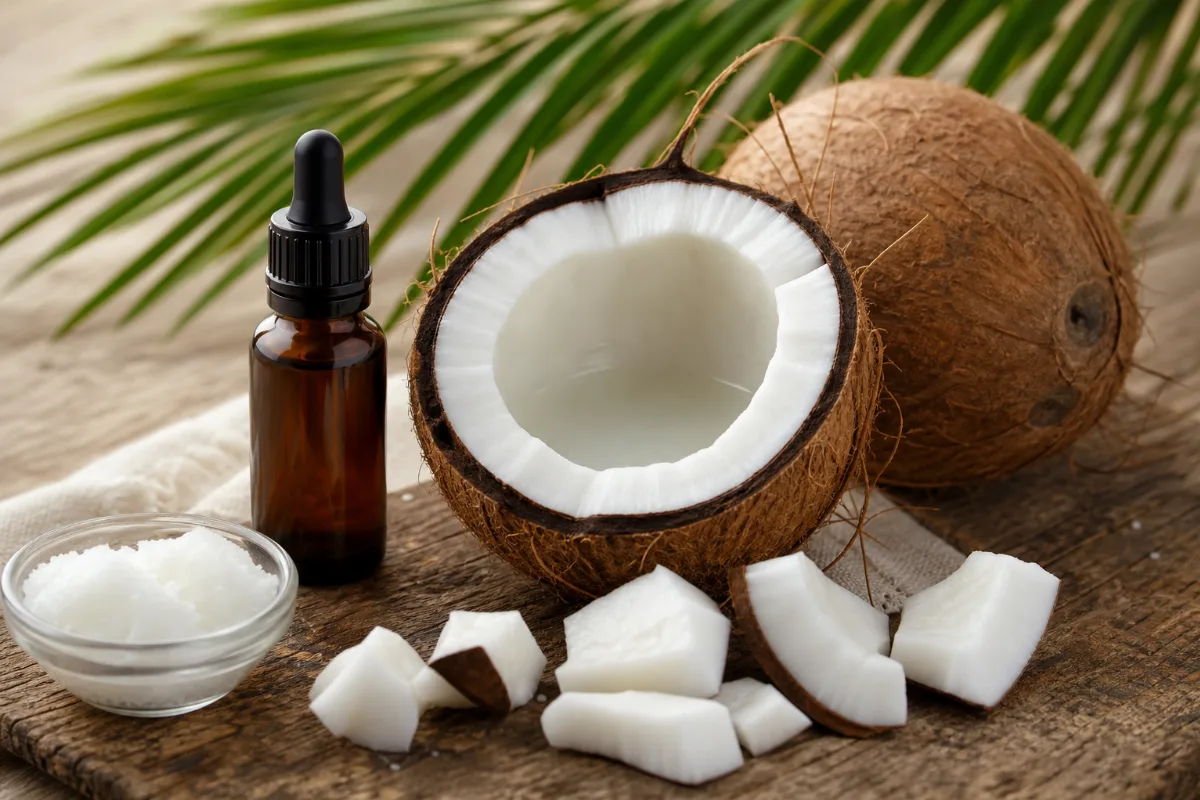
Essential Oils & Aromatherapy · Carrier oil
Coconut Oil and Fractionated Coconut Oil
Cocos nucifera L. · also called Virgin coconut oil, refined (copra) coconut oil, fractionated coconut oil, liquid coconut oil.
Coconut oil is pressed from the kernel of the coconut and is about 90% saturated fat. It is used on skin and hair and to dilute essential oils. The best human research is on virgin coconut oil for eczema and for preterm babies' skin, and it is limited. We found nothing on fractionated coconut oil. Test a small spot first, and ask a doctor before using it on a newborn.
General information, not medical advice. Last substantive update · Not medically reviewed. A named clinician has not signed off on this page. How this page is made
About Coconut Oil and Fractionated Coconut Oil
Coconut oil is a plain plant fat used to moisturise skin and hair and to dilute essential oils. Research is limited: a few small trials on eczema and on preterm babies' skin, a laboratory hair study, and a small mouth-rinse trial. We found no study of fractionated coconut oil. It is not a medicine.
What it is
Coconut oil comes from the kernel of the coconut, Cocos nucifera. GBIF accepts that name. A 2011 safety review describes it as about 90% saturated triglycerides, and lauric acid is its main fatty acid.
There are two main types, copra (refined) oil and virgin oil. They have similar fatty acid profiles, but virgin oil has more vitamin E and plant compounds. Fractionated coconut oil is the liquid kind sold as a carrier oil. No source we read describes how it is made or what is in it, and the eczema trials all used virgin coconut oil. Do not assume the results apply to fractionated oil.
How it is used
The National Cancer Institute describes aromatherapy massage as essential oils mixed into a carrier oil and massaged into the skin. Coconut oil is also used as a moisturiser, a hair oil, a baby massage oil in some countries and for oil pulling, where it is swished in the mouth and spat out.
The trials used virgin coconut oil on skin, in hospital baby care and in the mouth. We give no amounts or product advice here.
Where the knowledge comes from
Two trial papers describe oil massage of newborns as a traditional practice in South Asia. A 2008 trial paper says coconut and olive oils are traditionally used to moisturise and treat skin infections. A 2026 review lists oil pulling among traditional oral hygiene practices. Traditional use is not proof that it works.
What the research shows
Skin: one double-blind trial in 117 children with eczema and one small trial in 52 adults found better scores with virgin coconut oil than with mineral oil or olive oil. These are low-certainty results, and reviews call the evidence limited.
Babies: two hospital trials in preterm babies found better skin and, in Pakistan, fewer infections. Weight results disagree. A review of 14 trials of different oils found most favourable.
Other: a 2003 lab study of hair fibres, a 29-person oil pulling trial, and a 2026 stretch mark review with no numbers. Pore-clogging, acne and sun protection were not measured in any source we read.
Eating: the larger analysis found higher LDL cholesterol, and an umbrella review says the adverse effect on blood fats is consistent.
Quality, storage and labels
No source we read tested shop products for rancidity, contamination or what is in fractionated oils. Look for the Latin name on the label and check whether other oils are added. Smell it and throw it away if it smells sharp or off. The Cosmetic Ingredient Review panel concluded in 2011 that coconut oil is safe as used in cosmetics.
At a glance
Traditional uses history, not proof
- Oil massage of newborns is described as a traditional practice in South Asia in two trial papers (Konar 2020; Salam 2015).
- A 2008 trial paper says coconut and olive oils are traditionally used to moisturise and treat skin infections (Verallo-Rowell 2008).
- Oil pulling with sesame or coconut oil is listed among traditional oral hygiene practices in a 2026 review (Shahzad 2026).
Studied for research
- Eczema in children (virgin coconut oil on skin), low
- Eczema and skin bacteria in adults, low
- Skin care and infections in preterm babies (hospital trials), low
- Stretch marks in pregnancy, very low
- Weight gain in preterm babies, mixed
- Hair protein loss (laboratory), very low
- Oil pulling and plaque, low
- Eating it and LDL cholesterol, mixed (and against a benefit)
Main compounds
- Lauric acid, the main fatty acid
- Caprylic and capric acids (medium-chain fats)
- Mostly saturated triglycerides (about 90%)
- Vitamin E and polyphenols (more in virgin oil)
Common forms
- Virgin coconut oil
- Refined (copra) coconut oil
- Fractionated coconut oil (liquid form; no source read describes it)
- Ingredient in skin and hair products
Research links: Virgin coconut oil in children with eczema, trial (abstract) · Coconut and olive oils in adults with eczema (abstract) · Coconut oil in preterm infants in Pakistan, trial (abstract) · Topical oils on newborn skin, systematic review (abstract) · Coconut oil and cholesterol, 16 trials (abstract) · Health effects of coconut oil, narrative review (abstract) · FDA food allergen Q&A (coconut) · Research Library · Genes & Biomarkers Library
What it is and its history
- Accepted scientific name
- Cocos nucifera
- Naming authority
- L.
- Common names
- Coconut oil (English); Virgin coconut oil (English); Copra oil (English); Fractionated coconut oil (English)
- Family or group
- Arecaceae (the palm family)
- Classification
- Plantae > Tracheophyta > Liliopsida > Arecales > Arecaceae > Cocos > Cocos nucifera
- Native range
- Not checked.
- Habitat
- Not checked.
- What it looks like
- Roots: Not checked.; Stems: Not checked.; Leaves: Not checked.; Flowers: Not checked.; Fruit: Wallace 2019 says the oil is extracted from the kernel of mature coconuts.
- Cultivation
- Not checked.
- Harvest and processing
- Wallace 2019 describes two main types: copra oil (refined, bleached and deodorized) and virgin coconut oil. How fractionated oil is made is not described in any source read.
- Look-alikes and adulterants
- Name: Babassu oil; Note: A different palm oil, also rich in lauric acid.; Name: Palm kernel oil; Note: Another lauric acid oil, from a different palm.; Name: Pure medium-chain fat (MCT) oil; Note: A different product; Wallace 2019 says research on pure medium-chain fats cannot be applied directly to coconut oil products.
- Sustainability and conservation
- Not checked.
Traditional use and history history, not clinical proof
| Tradition or era | Documented use | Source |
|---|---|---|
| Traditional newborn oil massage, South Asia | The India and Pakistan trial papers call emollient or oil massage of newborns a traditional practice in the subcontinent and in low-income settings. | p31257430 |
| Traditional skin moisturiser | Verallo-Rowell 2008 says coconut and olive oils are traditionally used to moisturise and treat skin infections. | p19134433 |
| Oil pulling | A 2026 review lists oil pulling with sesame or coconut oil among traditional oral hygiene practices. | p41670379 |
| Today | Wallace 2019 calls coconut oil a mainstream edible oil whose popularity rests on perceived health effects of some of its fatty acids. The Cosmetic Ingredient Review reported it in 626 cosmetics (2011). | p30395784 |
Traditional use shows how it was used. It does not show that it works or is safe today.
What is inside, and how it may work
What it contains and how those compounds act in cells and animals. Laboratory and animal mechanisms are not proven effects in people.
Main compounds
| Compound | Family | Where it is concentrated | Activity studied | Level of evidence |
|---|---|---|---|---|
| Lauric acid PubChem 3893 | saturated fatty acid (C12) | Kernel oil The primary fatty acid in coconut oil (Wallace 2019); percentage not given in the abstracts read. | Rele 2003 links hair-protein protection to lauric acid; Verallo-Rowell 2008 links skin bacteria effect to monolaurin made from it. Neither tested it alone in people. 17 11 16 | Laboratory |
| Caprylic and capric acids PubChem 379 | medium-chain saturated fatty acids (C8 and C10) | Kernel oil Not given in the abstracts read. | Named here because 'MCT oil' and fractionated coconut oil are discussed with them; no source read describes the composition of fractionated oil. 17 | Not described |
| Triglycerides, mostly saturated | fats | Kernel oil About 90% saturated triglycerides (Burnett 2011); the 2022 meta-analysis says 92%. | Raised LDL cholesterol when eaten in the larger analysis. 3 4 10 | Human data |
| Vitamin E and polyphenols | micronutrient and plant compounds | Kernel oil Higher in virgin than in copra oil (Wallace 2019); no amounts in the abstract. | No outcome tied to them in the sources read. 17 | Not described |
Mechanisms, receptors and pathways
| Target or pathway | Gene or receptor | What was found | Level |
|---|---|---|---|
| Skin barrier and water loss | Not studied | In children with eczema, skin water loss fell and skin hydration rose with virgin coconut oil; the trial did not test how. 5 | Human measures |
| Skin bacteria | Not studied | The authors link the S. aureus result to monolaurin, made from lauric acid, which is active in the lab against bacteria, fungi and viruses. This link was not tested in the trial. 16 | Hypothesis |
| Hair protein | Not studied | The authors suggest coconut oil, a lauric acid triglyceride, enters the hair shaft and reduces protein loss, unlike sunflower or mineral oil. 11 | Laboratory |
| Blood cholesterol | LDL | Eating coconut oil raised LDL cholesterol in one 16-trial analysis. The mechanism was not tested. 10 | Human measures |
Absorption, metabolism and elimination
- Absorption
- Not described in the sources read. Wallace 2019 says lauric acid may behave as both a medium- and a long-chain fatty acid in the body.
- Distribution
- Not described.
- Metabolism
- Not described.
- Elimination
- Not described.
- Bioavailability
- Not described.
Isolated compounds versus whole extracts
Virgin coconut oil, refined (copra) coconut oil, fractionated coconut oil, pure medium-chain fat (MCT) oil and lauric acid are different products. Skin trials used virgin coconut oil. Results for one should not be carried to another.
Nutritional composition
Coconut oil is about 90% saturated fat (Burnett 2011). When eaten, the larger analysis found it raises LDL cholesterol compared with nontropical vegetable oils. This page is about its use as a carrier oil on skin.
2 mixed findings4 low certainty2 very low certainty
What was looked at
The 8 benefits and uses checked for Coconut Oil and Fractionated Coconut Oil, each with how strong the evidence is. Tap one to open it.
- Eczema in children (virgin coconut oil on the skin)Low certainty
- Eczema and skin bacteria in adults (virgin coconut oil on the skin)Low certainty
- Skin care for newborn and preterm babies (coconut oil in hospital trials)Low certainty
- Stretch marks in pregnancy (coconut oil on the skin)Very low certainty
- Weight gain and growth in preterm babies (oil massage)Mixed findings
- Hair damage and protein loss (coconut oil on hair)Very low certainty
- Oil pulling and plaque (swishing coconut oil in the mouth)Low certainty
- Eating coconut oil and blood fats (LDL, HDL)Mixed findings
Lab markers tracked in the studies
Eczema severity score (SCORAD / objective SCORAD)Water lost through the skin (TEWL) and skin hydrationStaphylococcus aureus on the skinHospital-acquired bloodstream infection in preterm babiesWeight gain in preterm babiesHair protein lost during groomingPlaque indexLDL cholesterol
What is Coconut Oil and Fractionated Coconut Oil good for?
The uses people ask about and how strong the evidence is for each. Trials are small and mostly compare coconut oil with another oil.
Benefits, one by one
Each card is a research question, not a promise. Tap a goal to filter. Open a card to see the studies, doses and limits.
Eczema in children (virgin coconut oil on the skin)
Low certaintyIn one double-blind trial of 117 children with mild to moderate atopic dermatitis, virgin coconut oil improved a skin severity score more than mineral oil over 8 weeks. Skin water loss fell and skin hydration rose more with the coconut oil. It is one trial, and it compared two oils, not an oil against nothing.
3 studiesVirgin coconut oil rubbed on the skin in the trial; amounts are in th…
Studies, doses and limits
What the trials found
One randomized, double-blind trial (Evangelista 2014) plus a narrative review (Wallace 2019) that calls the evidence for eczema limited but consistent, and an umbrella review that says too few studies to conclude.
Results
SCORAD fell 68.23% with virgin coconut oil and 38.13% with mineral oil (P < 0.001). Skin water loss (TEWL) went from 26.68 to 7.09 with coconut oil and 24.12 to 13.55 with mineral oil. Skin capacitance rose from 32.0 to 42.3 with coconut oil and from 31.31 to 37.49 with mineral oil.
Effect sizes as reported
SCORAD change 68.23% vs 38.13%, P < 0.001.
Why this rating
One trial of 117 children for 8 weeks, compared with mineral oil, not a plain placebo. Reviews call the overall evidence limited. Funding is not stated in the abstract.
Form and dose studied
Virgin coconut oil rubbed on the skin in the trial; amounts are in the paper and are not given here.
Who was studied
Children with mild to moderate atopic dermatitis. Not tested in severe eczema.
Limits
Mineral oil is a different comparison from no treatment or a standard eczema moisturiser. Eczema needs a doctor's care; an oil is not a medicine for it.
Why researchers looked
Atopic dermatitis skin loses water easily. Oils that coat skin could help, so researchers compared virgin coconut oil with mineral oil.
Traditional use
A 2008 trial paper says coconut and olive oils are traditionally used to moisturise and treat skin infections (Verallo-Rowell 2008).
Proposed mechanism Human trial measures
Proposed by the researchers: the oil acts as a moisturiser and improves the skin barrier. The trial measured water loss and hydration but did not test how.
A proposed mechanism does not show that the effect happens in people.
Test a small spot of skin first and stop if there is redness, itching, swelling or a rash. See the Safety tab. The comparison was mineral oil, so this is not proof it beats other moisturisers.
Eczema and skin bacteria in adults (virgin coconut oil on the skin)
Low certaintyIn a small double-blind trial of 52 adults with eczema, fewer people on virgin coconut oil still had Staphylococcus aureus bacteria on the skin after 4 weeks than people on virgin olive oil. Severity scores fell with both oils and fell more with coconut oil.
1 studiesVirgin coconut oil twice daily on two sites of skin in the trial.
Studies, doses and limits
What the trials found
One small double-blind trial (Verallo-Rowell 2008).
Results
Of 20 coconut oil users who had S. aureus at the start, 1 (5%) still did after 4 weeks; of 12 on olive oil, 6 (50%) still did. Relative risk 0.10 (95% CI 0.01 to 0.73, p = .0028). Severity score fell with both oils (p < .005), more with coconut oil (p = .004).
Effect sizes as reported
Relative risk 0.10 (95% CI 0.01 to 0.73).
Why this rating
Small trial, 4 weeks, two clinics, compared with olive oil, not no treatment. Funding is not stated in the abstract.
Form and dose studied
Virgin coconut oil twice daily on two sites of skin in the trial.
Who was studied
Adults with atopic dermatitis.
Limits
The result is about bacteria counts and a severity score on two skin spots. It does not show that the oil treats skin infections.
Why researchers looked
Eczema skin is readily colonised by Staphylococcus aureus, so researchers looked at whether an oil could lower it.
Traditional use
A 2008 trial paper says coconut and olive oils are traditionally used to moisturise and treat skin infections (Verallo-Rowell 2008).
Proposed mechanism Laboratory and human
The authors point to monolaurin, formed from lauric acid, which is active against bacteria in the lab. That link was not tested in this trial.
A proposed mechanism does not show that the effect happens in people.
Test a small spot of skin first and stop if there is redness, itching, swelling or a rash. See the Safety tab. Do not treat an infected rash with an oil alone.
Skin care for newborn and preterm babies (coconut oil in hospital trials)
Low certaintyTrials in preterm babies in hospitals in India and Pakistan found better skin condition with coconut oil. The Pakistan trial also found fewer hospital-acquired bloodstream infections. A review of 14 trials of different oils on newborn skin found most favourable, with a few mixed or negative. The authors of the review ask for better studies.
3 studiesVirgin or plain coconut oil applied by nurses, then by mothers in the…
Studies, doses and limits
What the trials found
Two randomized trials with coconut oil (Konar 2020, 2,294 infants; Salam 2015, 258 infants), one review of 14 oil trials (5,683 mostly preterm babies, 5 using coconut oil).
Results
Pakistan trial (258 preterm infants, coconut oil vs none): hospital-acquired infection hazard in controls 6.0 times higher after adjustment (95% CI 2.3 to 16); 219.1 vs 39.5 infections per 1000 patient-days; skin condition better; no irritation or local infection. India trial (2,294 preterm infants, coconut oil vs massage without oil): better skin maturity, less hypothermia and apnea, no significant adverse effect. Review: 11 of 14 trials favourable, 3 equivocal, negative or mixed.
Effect sizes as reported
Adjusted hazard 6.0 (95% CI 2.3 to 16) for infection in the no-oil group.
Why this rating
Two sizeable trials but few, from hospitals in Asia, and the India abstract does not describe blinding. The review pools several oils. Results may not apply to full-term babies or to other settings.
Form and dose studied
Virgin or plain coconut oil applied by nurses, then by mothers in the Pakistan trial; amounts are in the papers and are not given here.
Who was studied
Preterm infants, mostly 26 to 37 weeks.
Limits
The comparison in India was massage without oil, so the oil is separated from the massage, but the weight result went the other way (see the Other uses file).
Why researchers looked
Preterm babies have thin, immature skin and a high risk of infection, and oil massage is a common practice, so researchers tested it.
Traditional use
Two trial papers call oil massage a traditional newborn practice in South Asia (Konar 2020; Salam 2015).
Proposed mechanism Hypothesis
Proposed: the oil protects the skin barrier and may reduce germs getting in. Not shown in these trials.
A proposed mechanism does not show that the effect happens in people.
Only studied in hospital and clinic settings with medical staff. Do not start oil on a newborn at home without asking your baby's doctor or nurse. See the Safety tab.
Stretch marks in pregnancy (coconut oil on the skin)
Very low certaintyA 2026 review of four small trials (671 pregnant women) said coconut oil helped prevent stretch marks, while rose, sesame and sweet almond oils did not. The abstract gives no numbers, so we cannot tell how big the effect was.
1 studiesCoconut oil rubbed on the skin; amounts are in the trials and are not…
Studies, doses and limits
What the trials found
One systematic review of four randomized trials (Guner Emul 2026). Only the abstract was read.
Results
Coconut oil was reported effective in preventing stretch marks; rose, sesame and sweet almond oils were not.
Effect sizes as reported
No numbers in the abstract.
Why this rating
Four trials, few details, no effect sizes or quality ratings in the abstract, and the authors ask for larger, blinded trials.
Form and dose studied
Coconut oil rubbed on the skin; amounts are in the trials and are not given here.
Who was studied
Pregnant women.
Limits
Stretch marks do not affect health. Results may differ by trial and may not be blinded.
Why researchers looked
Stretch marks are common in pregnancy and cause distress for some women, so many try oils.
Traditional use
The review says women may use moisturizers or aromatherapy oils in attempts to prevent stretch marks.
Proposed mechanism Not described
Not described in the abstract.
A proposed mechanism does not show that the effect happens in people.
Test a small spot of skin first and stop if there is redness, itching, swelling or a rash. See the Safety tab. Ask your midwife or doctor before using anything new in pregnancy.
Weight gain and growth in preterm babies (oil massage)
Mixed findingsResults go in different directions. A review pooling 14 trials of sunflower, coconut and other oils found preterm babies gained about 52 g more with oil massage, with very high variation. A trial in Pakistan found coconut oil babies gained 11.3 g a day more. An Indian trial found weight gain per day was higher in the no-oil group.
3 studiesOils applied as a massage to preterm babies; amounts are in the paper…
Studies, doses and limits
What the trials found
A review of 18 trials (1,454 babies; 14 in the pooled result) with mixed oils (Getaneh 2024), one Pakistan trial (Salam 2015) and one India trial (Konar 2020).
Results
Review: pooled mean difference +52.15 g (95% CI 45.96 to 58.35), I2 above 93%; +78.57 g (95% CI 52.46 to 104.68) after removing two outlier studies. Pakistan: +11.3 g/day (95% CI 8.1 to 14.6). India: weight loss early on was smaller with coconut oil, but weight gain per day was higher in the no-oil group.
Effect sizes as reported
+52.15 g pooled (mixed oils).
Why this rating
Opposite results in two coconut oil trials, mixed oils pooled, very high heterogeneity.
Form and dose studied
Oils applied as a massage to preterm babies; amounts are in the papers and are not given here.
Who was studied
Preterm infants.
Limits
The review's own conclusion is moderate-to-high certainty, but we rate it lower because the variation is very high and the coconut-only trials disagree.
Why researchers looked
Preterm babies need to gain weight. Massage and oil may help, so researchers tested both.
Traditional use
Oil massage of newborns is a traditional practice in South Asia (Konar 2020; Salam 2015).
Proposed mechanism Uncertain
Not clear. The benefit may come from the massage rather than the oil.
A proposed mechanism does not show that the effect happens in people.
Only in hospital-supervised or clinic settings. Ask your baby's doctor or nurse first.
Hair damage and protein loss (coconut oil on hair)
Very low certaintyIn a laboratory study of hair fibres, coconut oil reduced the loss of hair protein during combing and grooming. Sunflower oil and mineral oil did not. It was not a trial of hair growth or of hair breakage in people, and it is from 2003.
2 studiesCoconut oil used before or after washing in the lab; amounts are in t…
Studies, doses and limits
What the trials found
One laboratory study (Rele 2003). A 2019 narrative review says coconut oil may help prevent hair damage but more studies are needed (Wallace 2019).
Results
Coconut oil was the only one of three oils that reduced protein loss, for undamaged and damaged hair, used before or after washing.
Effect sizes as reported
No numbers in the abstract.
Why this rating
Laboratory hair fibres, an old study, no numbers in the abstract, and no human trial. Funding is not stated.
Form and dose studied
Coconut oil used before or after washing in the lab; amounts are in the paper.
Who was studied
Hair fibres, not people.
Limits
Protein loss is not the same as thicker, stronger or longer hair.
Why researchers looked
Combing and washing damage hair and strip protein from it, so researchers compared oils on hair fibres.
Traditional use
A 2003 paper says mineral oil is extensively used in hair oil formulations in India; it compares it with coconut and sunflower oils.
Proposed mechanism Laboratory
The authors suggest coconut oil enters the hair shaft because of its lauric acid, unlike sunflower or mineral oil.
A proposed mechanism does not show that the effect happens in people.
Test a small spot of skin first and stop if there is redness, itching, swelling or a rash. See the Safety tab.
Oil pulling and plaque (swishing coconut oil in the mouth)
Low certaintyIn a small crossover trial of 29 volunteers, swishing coconut oil for 4 days gave plaque regrowth similar to a chlorhexidine mouthrinse and less staining. A 2026 review of 31 studies on traditional oral hygiene said oil pulling with sesame or coconut oil moderately reduced germs and helped gum health, though results varied against chlorhexidine. Two earlier reviews called the evidence for preventing cavities limited.
4 studiesCoconut oil swished in the mouth in the trial; amounts and time are i…
Studies, doses and limits
What the trials found
One crossover trial (Sezgin 2019), one systematic review (Shahzad 2026) and two reviews of reviews (Wallace 2019; Jayawardena 2021).
Results
Plaque index 1.67 with oil versus 1.61 with chlorhexidine; stain index 0.21 versus 0.47; gum index and bleeding similar.
Effect sizes as reported
Plaque index 1.67 vs 1.61.
Why this rating
29 people for 4 days; plaque regrowth, not tooth decay or gum disease. The review mixes sesame and coconut oil and many other methods.
Form and dose studied
Coconut oil swished in the mouth in the trial; amounts and time are in the paper.
Who was studied
Healthy volunteers after a dental cleaning.
Limits
The review notes findings varied against chlorhexidine.
Why researchers looked
People look for natural mouth rinses, and chlorhexidine can stain teeth.
Traditional use
Oil pulling is a traditional mouth practice. A 2026 review groups it with miswak and herbal rinses as a traditional method.
Proposed mechanism Hypothesis
Not shown. Researchers suggest the oil may lower bacteria in the mouth.
A proposed mechanism does not show that the effect happens in people.
Oil pulling means swishing and spitting out. Do not swallow the oil, and do not use it in place of brushing or dental care. See the Safety tab.
Eating coconut oil and blood fats (LDL, HDL)
Mixed findingsA 2020 review of 16 trials found coconut oil raised LDL ('bad') cholesterol by 10.47 mg/dL and HDL by 4.00 mg/dL compared with nontropical vegetable oils. A 2022 review of 7 trials found no significant change in LDL, a small rise in HDL, and rated the evidence very low certainty. An umbrella review said strong, consistent evidence shows an adverse effect on blood fats.
4 studiesEaten coconut oil in the trials, amounts vary.
Studies, doses and limits
What the trials found
Two meta-analyses (Neelakantan 2020; Duarte 2022), an umbrella review (Jayawardena 2021) and a narrative review (Wallace 2019).
Results
LDL +10.47 mg/dL (95% CI 3.01 to 17.94) and HDL +4.00 mg/dL (95% CI 2.26 to 5.73) in 16 trials; LDL -1.67 mg/dL (95% CI -6.93 to 3.59, not significant) and HDL +3.28 mg/dL in 7 trials with very low certainty.
Effect sizes as reported
LDL +10.47 mg/dL in one meta-analysis; not significant in the other.
Why this rating
The two meta-analyses disagree on LDL, with high heterogeneity and different trial sets. Blood fats are a stand-in for heart disease, not heart attacks. No benefit on weight, waist or blood sugar was found.
Form and dose studied
Eaten coconut oil in the trials, amounts vary.
Who was studied
Adults.
Limits
The most consistent finding is not a benefit. Pure medium-chain fat (MCT) studies cannot be applied to coconut oil (Wallace 2019).
Why researchers looked
Coconut oil is high in saturated fat, and the effect on cholesterol is argued about.
Traditional use
A 2019 review calls coconut oil a mainstream edible oil and says its popularity rests on perceived health effects of some of its fats.
Proposed mechanism Review level
Saturated fatty acids raise LDL cholesterol; the reviews do not test the pathway.
A proposed mechanism does not show that the effect happens in people.
This is about eating the oil, not carrier or skin use. Saturated fat advice from heart health bodies applies. See the Safety tab.
Connections to the rest of health
How Coconut Oil and Fractionated Coconut Oil connects to the rest of our health knowledge graph. Every link says what kind of connection it is. A safety link (for example to the liver) is a warning, not a benefit. A study that merely mentions a topic never creates a benefit link.
Explore every connection: goals, body systems, organs, symptoms, genes
A. Wellness goals
| Connected to | Kind of connection | Evidence status | Context | Studies |
|---|---|---|---|---|
| Healthy Skin | Low certainty | Eczema in children (virgin coconut oil on the skin): In one double-blind trial of 117 children with mild to moderate atopic dermatitis, virgin coconut oil improved a skin severity score more than mineral oil over 8 weeks. Skin water loss fell and skin hydration rose more with the coconut oil. It is one trial, and it compared two oils, not an oil against nothing. Eczema and skin bacteria in adults (virgin coconut oil on the skin): In a small double-blind trial of 52 adults with eczema, fewer people on virgin coconut oil still had Staphylococcus aureus bacteria on the skin after 4 weeks than people on virgin olive oil. Severity scores fell with both oils and fell more with coconut oil. | 5 17 8 16 13 9 1 | |
| Infection Support | Low certainty | Eczema and skin bacteria in adults (virgin coconut oil on the skin): In a small double-blind trial of 52 adults with eczema, fewer people on virgin coconut oil still had Staphylococcus aureus bacteria on the skin after 4 weeks than people on virgin olive oil. Severity scores fell with both oils and fell more with coconut oil. | 16 | |
| Healthy Skin | Very low certainty | Stretch marks in pregnancy (coconut oil on the skin): A 2026 review of four small trials (671 pregnant women) said coconut oil helped prevent stretch marks, while rose, sesame and sweet almond oils did not. The abstract gives no numbers, so we cannot tell how big the effect was. | 7 | |
| Womens Wellness | Very low certainty | Stretch marks in pregnancy (coconut oil on the skin): A 2026 review of four small trials (671 pregnant women) said coconut oil helped prevent stretch marks, while rose, sesame and sweet almond oils did not. The abstract gives no numbers, so we cannot tell how big the effect was. | 7 | |
| Hair Support | Very low certainty | Hair damage and protein loss (coconut oil on hair): In a laboratory study of hair fibres, coconut oil reduced the loss of hair protein during combing and grooming. Sunflower oil and mineral oil did not. It was not a trial of hair growth or of hair breakage in people, and it is from 2003. | 11 17 | |
| Oral Health | Low certainty | Oil pulling and plaque (swishing coconut oil in the mouth): In a small crossover trial of 29 volunteers, swishing coconut oil for 4 days gave plaque regrowth similar to a chlorhexidine mouthrinse and less staining. A 2026 review of 31 studies on traditional oral hygiene said oil pulling with sesame or coconut oil moderately reduced germs and helped gum health, though results varied against chlorhexidine. Two earlier reviews called the evidence for preventing cavities limited. | 14 15 17 8 | |
| Heart Health | Mixed findings | Eating coconut oil and blood fats (LDL, HDL): A 2020 review of 16 trials found coconut oil raised LDL ('bad') cholesterol by 10.47 mg/dL and HDL by 4.00 mg/dL compared with nontropical vegetable oils. A 2022 review of 7 trials found no significant change in LDL, a small rise in HDL, and rated the evidence very low certainty. An umbrella review said strong, consistent evidence shows an adverse effect on blood fats. | 10 4 8 17 | |
| Cholesterol Balance | Mixed findings | Eating coconut oil and blood fats (LDL, HDL): A 2020 review of 16 trials found coconut oil raised LDL ('bad') cholesterol by 10.47 mg/dL and HDL by 4.00 mg/dL compared with nontropical vegetable oils. A 2022 review of 7 trials found no significant change in LDL, a small rise in HDL, and rated the evidence very low certainty. An umbrella review said strong, consistent evidence shows an adverse effect on blood fats. | 10 4 8 17 |
B. Body systems
| Connected to | Kind of connection | Evidence status | Context | Studies |
|---|---|---|---|---|
| Skin Hair Beauty | Biological association | Low certainty | Studied for: Eczema in children (virgin coconut oil on the skin) Studied for: Eczema and skin bacteria in adults (virgin coconut oil on the skin) | 5 17 8 16 13 9 1 7 11 |
| Immune System | Biological association | Low certainty | Studied for: Skin care for newborn and preterm babies (coconut oil in hospital trials) | 13 9 1 |
| Reproductive System | Biological association | Very low certainty | Studied for: Stretch marks in pregnancy (coconut oil on the skin) | 7 |
| Metabolism Weight | Biological association | Mixed findings | Studied for: Weight gain and growth in preterm babies (oil massage) | 6 13 9 |
| Digestive System | Biological association | Low certainty | Studied for: Oil pulling and plaque (swishing coconut oil in the mouth) | 14 15 17 8 |
| Cardiovascular System | Biological association | Mixed findings | Studied for: Eating coconut oil and blood fats (LDL, HDL) | 10 4 8 17 |
C. Body parts and organs
| Connected to | Kind of connection | Evidence status | Context | Studies |
|---|---|---|---|---|
| Skin | Adverse effect or risk | Not enough evidence | No skin reaction reported in the trials read; skin allergy not studied. Preparation or compound: Coconut oil on skin |
13 9 |
| Skin | Low certainty | Small eczema and preterm-baby trials; no fractionated oil data. Preparation or compound: Virgin coconut oil on skin |
5 16 13 |
E. Health conditions
| Connected to | Kind of connection | Evidence status | Context | Studies |
|---|---|---|---|---|
| Coconut allergy | Adverse effect or risk | Case report | Rare; cross-reaction with walnut and hazelnut shown in one child. Preparation or compound: Eaten coconut |
2 |
I. Biomarkers
| Connected to | Kind of connection | Evidence status | Context | Studies |
|---|---|---|---|---|
| Eczema severity score (SCORAD / objective SCORAD) | Biological association | Low certainty | Measured in trials: reduced. A lab change is not the same as a health benefit. | 5 16 |
| Water lost through the skin (TEWL) and skin hydration | Biological association | Low certainty | Measured in trials: reduced. A lab change is not the same as a health benefit. | 5 |
| Staphylococcus aureus on the skin | Biological association | Low certainty | Measured in trials: reduced. A lab change is not the same as a health benefit. | 16 |
| Hospital-acquired bloodstream infection in preterm babies | Biological association | Low certainty | Measured in trials: reduced. A lab change is not the same as a health benefit. | 13 |
| Weight gain in preterm babies | Biological association | Mixed findings | Measured in trials: mixed. A lab change is not the same as a health benefit. | 6 13 9 |
| Hair protein lost during grooming | Biological association | Very low certainty | Measured in trials: reduced. A lab change is not the same as a health benefit. | 11 |
| Plaque index | Biological association | Low certainty | Measured in trials: similar-to-comparator. A lab change is not the same as a health benefit. | 14 |
| LDL cholesterol | Biological association | Mixed findings | Measured in trials: increased-or-no-change. A lab change is not the same as a health benefit. | 10 4 |
K. Biological pathways
L. Active compounds
| Connected to | Kind of connection | Evidence status | Context | Studies |
|---|---|---|---|---|
| Lauric acid | Biological association | Laboratory | Rele 2003 links hair-protein protection to lauric acid; Verallo-Rowell 2008 links skin bacteria effect to monolaurin made from it. Neither tested it alone in people. Preparation or compound: Kernel oil |
17 11 16 |
| Caprylic and capric acids | Biological association | Not described | Named here because 'MCT oil' and fractionated coconut oil are discussed with them; no source read describes the composition of fractionated oil. Preparation or compound: Kernel oil |
17 |
| Triglycerides, mostly saturated | Biological association | Human | Raised LDL cholesterol when eaten in the larger analysis. Preparation or compound: Kernel oil |
3 4 10 |
| Vitamin E and polyphenols | Biological association | Not described | No outcome tied to them in the sources read. Preparation or compound: Kernel oil |
17 |
Each connection is stored with the ingredient, the connected record, the kind of connection, the evidence status, the supporting studies, the preparation or compound involved, and a review date (last reviewed October 25, 2026).
Evidence at a glance: what changed in 1 lab markers
Tap a number to show only those markers. Counts are markers, not people.
The evidence
The research centre for Coconut Oil and Fractionated Coconut Oil. Every record here was checked against PubMed or the publisher's page; we never list a study we have not verified.
Evidence by outcome
Bars show how many studies we found for each outcome, not how well it works. People are added up across trials only (reviews are not added, to avoid double counting).
How we rate evidence
High certainty
Several well-run trials or reviews agree; further research is unlikely to change the picture much.
Moderate certainty
Good trials point the same way, but some doubt remains.
Low certainty
Small, short or inconsistent trials. The finding could change with better research.
Very low certainty
Very little or very weak human data. Treat as a possibility only.
Mixed findings
Trials or reviews disagree with each other.
Not enough evidence
Not enough human research to say either way.
Evidence against
Good research found no benefit, or found harm.
We take the reviewers' own risk-of-bias and GRADE statements where they exist, and otherwise judge from study size, design, consistency, directness and whether a product matches what is sold. Many publications do not make evidence high. Method note: We read the abstracts of 18 PubMed papers, the FDA allergen Q&A, Poison Control and the NCI aromatherapy page, checked the plant name in GBIF and the fatty acids in PubChem. For most papers only the abstract was read. Certainty ratings are the compiler's own reading. Funding is not stated in most abstracts. No study is cited that we could not verify.
Study library: every study we checked 22
| Study | Design | People | Product, dose, length | Result |
|---|---|---|---|---|
| Aksucu 2022 Effects of Topical Oils on Neonatal Skin: A Systematic Review. Adv Skin Wound Care · PMID 36409192 · DOI |
Systematic review |
5683 Neonates, most of them preterm, in 14 randomized trials |
Topical oils: sunflower (8 trials), coconut (5), almond (2), olive (1), mustard (1), vegetable (1) Various Varies Varies · vs Varies |
Eleven of 14 trials concluded that the oils improved skin condition and barrier function. Three found equivocal, negative or mixed results. The authors say more studies with a high level of evidence are needed. 11 of 14 favourable; 3 equivocal, negative or mixed. Methods, limits and fundingOutcomes: Skin barrier function and skin integrity Limitations: Several oils are pooled, and coconut was used in only 5 trials. The abstract does not give a quality rating. Funding and conflicts: Funding and conflicts of interest are not stated in the abstract. Read: abstract |
| Benito 2007 Identification of a 7S globulin as a novel coconut allergen. Ann Allergy Asthma Immunol · PMID 17601273 · DOI |
Case report |
2 Two people allergic to coconut: an adult with pollen allergy and a child with walnut allergy |
Coconut extract (laboratory tests); coconut eaten in the reactions Coconut |
The abstract says coconut allergy is infrequent, with only 5 cases reported at that time. The adult had severe mouth and throat symptoms; the child, who was allergic to walnut, had anaphylaxis after eating coconut. A 7S storage protein was found to be an allergen. Cross-reaction between coconut, walnut and hazelnut was shown in the child. n/a Methods, limits and fundingOutcomes: IgE binding proteins; cross-reaction with tree nuts Limitations: Two people only, from 2007, about eating coconut. It does not describe skin reactions to the oil. Funding and conflicts: Funding is listed as non-US government research support; conflicts are not stated. Read: abstract |
| Burnett 2011 Final report on the safety assessment of Cocos nucifera (coconut) oil and related ingredients. Int J Toxicol · PMID 21772024 · DOI |
Regulatory safety assessment regulatory |
Cosmetic use of coconut oil and related ingredients | Coconut oil and related ingredients in cosmetics Coconut kernel oil 0.0001% to 70% in 626 products (as reported) |
The Cosmetic Ingredient Review panel describes coconut oil as 90% saturated triglycerides and reports it in 626 cosmetics at 0.0001% to 70%. It concludes that coconut oil and related ingredients are safe as cosmetic ingredients in the practices of use and concentration described in the assessment. n/a Methods, limits and fundingOutcomes: Cosmetic safety Limitations: The abstract does not say whether the review covers fractionated coconut oil as a separate product, or how babies' skin or damaged skin were treated. Funding and conflicts: Funding and conflicts of interest are not stated in the abstract. Read: abstract |
| Duarte 2022 The effects of coconut oil on the cardiometabolic profile: a systematic review and meta-analysis of randomized clinical trials. Lipids Health Dis · PMID 36045407 · DOI |
Meta-analysis |
515 Adults in 7 randomized trials (4 weeks to 2 years) |
Eaten coconut oil Coconut kernel oil Varied 4 weeks to 2 years · vs Other oils and fats |
Coconut oil did not significantly change body weight, waist size, body fat, LDL cholesterol (mean difference -1.67 mg/dL, 95% CI -6.93 to 3.59) or triglycerides. It was linked to a small rise in HDL cholesterol (3.28 mg/dL, 95% CI 0.66 to 5.90). The authors rated risk of bias as high and the certainty of evidence as very low, and conclude there was no clinically relevant improvement. LDL -1.67 mg/dL (not significant); HDL +3.28 mg/dL. Methods, limits and fundingOutcomes: Body weight, waist, body fat, LDL, HDL, triglycerides Limitations: Small trials, mixed methods and amounts, high risk of bias. Registered as PROSPERO CRD42018081461. Funding and conflicts: Funded by a hospital and a national research council (public bodies, per the abstract's grant list). Read: abstract |
| Evangelista 2014 The effect of topical virgin coconut oil on SCORAD index, transepidermal water loss, and skin capacitance in mild to moderate pediatric atopic dermatitis: a randomized, double-blind, clinical trial. Int J Dermatol · PMID 24320105 · DOI |
Randomized double blind trial |
117 Children with mild to moderate atopic dermatitis |
Virgin coconut oil on the skin Coconut kernel oil Amount not given in the abstract 8 weeks · vs Mineral oil |
Mean SCORAD fell 68.23% with virgin coconut oil and 38.13% with mineral oil (P < 0.001). In the coconut group 47% (28/59) had moderate improvement and 46% (27/59) an excellent response; in the mineral oil group 34% (20/58) and 19% (11/58). TEWL went from 26.68 to 7.09 with coconut oil and from 24.12 to 13.55 with mineral oil. Skin capacitance rose from 32.0 to 42.3 with coconut oil and from 31.31 to 37.49 with mineral oil. SCORAD change 68.23% vs 38.13%, P < 0.001. Methods, limits and fundingOutcomes: SCORAD severity index, transepidermal water loss (TEWL), skin capacitance (skin water content) Limitations: The comparison was mineral oil, not a plain placebo or no treatment. One trial, 8 weeks. The abstract does not say who paid for it. Funding and conflicts: Funding and conflicts of interest are not stated in the abstract. Read: abstract |
| Getaneh 2024 Effect of topical emollient oil application on weight of preterm newborns: A systematic review and meta-analysis. PLoS One · PMID 38743769 · DOI |
Meta-analysis |
1454 Preterm newborns in 18 randomized trials (14 in the pooled weight result) |
Emollient oil massage: sunflower, coconut and other oils Various Varies Varies · vs Usual care |
Pooled mean weight gain was higher by 52.15 g (95% CI 45.96 to 58.35) with oil, but heterogeneity was very high (I2 above 93%). Without two outlier studies the difference was 78.57 g (95% CI 52.46 to 104.68). Of 9 studies that reported adverse events, only two mentioned rash and accidental slipping of the infant. The authors say the evidence suggests effectiveness with moderate-to-high certainty. +52.15 g (95% CI 45.96 to 58.35). Methods, limits and fundingOutcomes: Weight gain Limitations: Mixed oils (sunflower and coconut), very high heterogeneity, and the benefit may come from massage as well as the oil. We cannot tell the coconut result apart from the abstract alone. Funding and conflicts: Funding and conflicts of interest are not stated in the abstract. Read: abstract |
| Guner Emul 2026 Effect of Aromatherapy Oil Applications on Striae Gravidarum: A Systematic Review. Skin Res Technol · PMID 41988841 · DOI |
Systematic review |
671 Pregnant women in 4 randomized trials |
Oils rubbed on the skin: coconut, rose, sesame, sweet almond, olive Various Varies Varies · vs Varies |
The review says coconut oil was effective in preventing stretch marks, while rose, sesame and sweet almond oils were not. It concludes there is some evidence and asks for larger, higher-quality, blinded trials. Direction only; no numbers in the abstract. Methods, limits and fundingOutcomes: Prevention of stretch marks (striae gravidarum) Limitations: Four trials; the abstract gives no effect sizes, quality ratings or the size of each trial. Only the abstract was read. Funding and conflicts: Funding and conflicts of interest are not stated in the abstract. Read: abstract |
| Jayawardena 2021 Health effects of coconut oil: Summary of evidence from systematic reviews and meta-analysis of interventional studies. Diabetes Metab Syndr · PMID 33689936 · DOI |
Umbrella review |
Seven systematic reviews and meta-analyses of coconut oil trials | Coconut oil Coconut kernel oil · vs Various |
Coconut oil significantly raised total, LDL and HDL cholesterol compared with poly- and monounsaturated oils. The authors say strong and consistent evidence shows an adverse effect on blood fats, and that limited studies show topical use helping atopic dermatitis and oil pulling helping prevent dental caries, too few to conclude. n/a Methods, limits and fundingOutcomes: Cardio-metabolic, skin and oral health outcomes Limitations: A review of reviews; the abstract has no numbers. Funding and conflicts: Funding and conflicts of interest are not stated in the abstract. Read: abstract |
| Konar 2020 Effect of Virgin Coconut Oil Application on the Skin of Preterm Newborns: A Randomized Controlled Trial. J Trop Pediatr · PMID 31257430 · DOI |
Randomized controlled trial |
2294 Preterm infants in rural India (mean gestation 31.9 weeks) |
Virgin coconut oil applied to the skin Coconut kernel oil Not given in the abstract Skin checks to day 28; development checks at 3, 6 and 12 months · vs Body massage without any oil |
1,146 infants got coconut oil and 1,148 got massage without oil. The authors report less hypothermia and apnea, better skin maturity and better neurodevelopment with coconut oil, and no significant adverse effect. Weight loss in the first days was less with coconut oil, but mean weight gain per day was higher in the no-oil group. Direction only; no numbers for most outcomes in the abstract. Methods, limits and fundingOutcomes: Skin maturity, hypothermia, apnea, neurodevelopment, weight Limitations: The comparison group had massage without oil. The abstract does not describe blinding, and the authors say more studies are needed before a universal recommendation. Funding and conflicts: Funding and conflicts of interest are not stated in the abstract. Read: abstract |
| Neelakantan 2020 The Effect of Coconut Oil Consumption on Cardiovascular Risk Factors: A Systematic Review and Meta-Analysis of Clinical Trials. Circulation · PMID 31928080 · DOI |
Meta-analysis |
Adults in 16 trials of eating coconut oil for at least 2 weeks | Eaten coconut oil Coconut kernel oil Varied At least 2 weeks · vs Other cooking oils and fats |
Compared with nontropical vegetable oils, coconut oil raised LDL cholesterol by 10.47 mg/dL (95% CI 3.01 to 17.94, I2 = 84%) and HDL cholesterol by 4.00 mg/dL (95% CI 2.26 to 5.73). The effects stayed after leaving out non-randomised or poor-quality trials. Coconut oil did not significantly change blood sugar, inflammation or body fat measures. LDL +10.47 mg/dL; HDL +4.00 mg/dL. Methods, limits and fundingOutcomes: LDL and HDL cholesterol, body fat, blood sugar, inflammation markers Limitations: High heterogeneity (I2 84% for LDL). Blood measures, not heart attacks or deaths. About eating, not skin use. Funding and conflicts: Listed as non-US government-supported research; conflicts are not stated in the abstract. Read: abstract |
| Rele 2003 Effect of mineral oil, sunflower oil, and coconut oil on prevention of hair damage. J Cosmet Sci · PMID 12715094 |
Laboratory hair study laboratory |
Hair fibres of different types, undamaged and damaged | Coconut oil, sunflower oil, mineral oil on hair Coconut kernel oil Not given in the abstract Not given · vs Sunflower oil and mineral oil |
Coconut oil was the only one of the three oils that reduced protein loss, for both undamaged and damaged hair, as a pre-wash and post-wash product. Sunflower and mineral oils did not reduce protein loss. The authors suggest coconut oil penetrates the hair shaft because of its lauric acid composition. No numbers in the abstract. Methods, limits and fundingOutcomes: Hair protein loss with combing and grooming Limitations: A laboratory test of hair fibres from 2003, not a trial in people with hair complaints. The authors link it to earlier work of theirs. Protein loss is not the same as hair breakage or growth. Funding and conflicts: Funding and conflicts of interest are not stated in the abstract. Read: abstract |
| Sacks 2017 Dietary Fats and Cardiovascular Disease: A Presidential Advisory From the American Heart Association. Circulation · PMID 28620111 · DOI |
Authoritative guidance |
Evidence on dietary saturated fat and cardiovascular disease | Replacing saturated fat with unsaturated fat |
The advisory concludes strongly that lowering saturated fat intake and replacing it with unsaturated fats, especially polyunsaturated fats, will lower the rate of cardiovascular disease. Trials of replacing saturated fat with polyunsaturated vegetable oil reduced cardiovascular disease by about 30%. Replacing it with refined carbohydrates and sugars did not help. The abstract does not name coconut oil. About 30% reduction in trials of replacing saturated fat with polyunsaturated vegetable oil. Methods, limits and fundingOutcomes: Cardiovascular disease Limitations: General advice on saturated fat. The abstract does not mention coconut oil, so it is used here only for that general point. Funding and conflicts: Written by an American Heart Association expert group; conflicts are not stated in the abstract. Read: abstract |
| Salam 2015 Effect of emollient therapy on clinical outcomes in preterm neonates in Pakistan: a randomised controlled trial. Arch Dis Child Fetal Neonatal Ed · PMID 25637007 · DOI |
Randomized controlled trial |
258 Hospital-born preterm infants (26 to 37 weeks), Karachi |
Topical coconut oil by nurses, then by mothers at home Coconut kernel oil Twice daily From birth to day 28 · vs No oil (control) |
The risk of hospital-acquired infection in the control group was 4.7 times that of the coconut oil group (95% CI 1.8 to 12.4) and 6.0 after adjusting (95% CI 2.3 to 16). Infection rates were 219.1 versus 39.5 per 1000 patient-days. Weight gain was 11.3 g/day higher (95% CI 8.1 to 14.6) and skin condition better with coconut oil. Hospital stay and deaths did not differ. No irritation or local infection was seen. Adjusted hazard 6.0 for infection in controls (95% CI 2.3 to 16). Methods, limits and fundingOutcomes: Hospital-acquired bloodstream infection (primary), weight gain, skin condition, deaths Limitations: One hospital in Pakistan, 258 infants. The authors say its use in community settings needs more study. Registered as NCT01396642. Funding and conflicts: Listed as non-US government-supported research; conflicts are not stated in the abstract. Read: abstract |
| Sezgin 2019 Efficacy of oil pulling therapy with coconut oil on four-day supragingival plaque growth: A randomized crossover clinical trial. Complement Ther Med · PMID 31780023 · DOI |
Randomized crossover trial |
29 29 volunteers after a professional teeth cleaning |
Oil pulling (swishing) with coconut oil Coconut kernel oil Not given in the abstract 4 days, then a 14-day wash-out · vs 0.2% chlorhexidine mouthrinse |
Plaque regrowth was similar with oil pulling and chlorhexidine (plaque index 1.67 vs 1.61). Oil pulling caused less staining (0.21 vs 0.47). Gum index and bleeding were similar. Plaque index 1.67 vs 1.61; stain index 0.21 vs 0.47. Methods, limits and fundingOutcomes: Plaque index, gingival index, stain index, bleeding on probing Limitations: 29 people for 4 days. It tested plaque regrowth, not tooth decay. Observer-masked, not double-blind. Funding and conflicts: Funding and conflicts of interest are not stated in the abstract. Read: abstract |
| Shahzad 2026 Traditional Oral Hygiene Practices and Their Effectiveness: A Systematic Review of the Evidence. Oral Health Prev Dent · PMID 41670379 · DOI |
Systematic review |
31 studies of traditional oral hygiene methods (miswak, oil pulling, herbal products) | Oil pulling with sesame or coconut oil Plant oil · vs Chlorhexidine mouthwash, brushing |
The review says oil pulling with sesame or coconut oil showed moderate reductions in microbial load and improved gum health, though findings varied compared with chlorhexidine mouthwash. It says traditional methods may offer benefits similar to conventional ones but that study problems and variation call for cautious reading. n/a Methods, limits and fundingOutcomes: Plaque and gum inflammation Limitations: Covers sesame and coconut oil together, and many other methods. The abstract gives no numbers for oil pulling. Funding and conflicts: Funding and conflicts of interest are not stated in the abstract. Read: abstract |
| Verallo-Rowell 2008 Novel antibacterial and emollient effects of coconut and virgin olive oils in adult atopic dermatitis. Dermatitis · PMID 19134433 |
Randomized double blind trial |
52 Adults with atopic dermatitis, two outpatient clinics (26 per oil) |
Virgin coconut oil on the skin Coconut kernel oil Twice daily; amount not given in the abstract 4 weeks · vs Virgin olive oil |
Of those on coconut oil, 20 had S. aureus at the start and 1 (5%) still had it after 4 weeks; on olive oil 12 had it at the start and 6 (50%) after. Relative risk 0.10 (95% CI 0.01 to 0.73, p = .0028). The O-SSI fell with both oils and fell more with coconut oil (p = .004). Relative risk 0.10 for staying colonised (95% CI 0.01 to 0.73). Methods, limits and fundingOutcomes: Staphylococcus aureus on the skin, objective-SCORAD severity index (O-SSI) Limitations: Small, and the comparison was olive oil. Study sites were two clinics. Funding and conflicts: Funding and conflicts of interest are not stated in the abstract. Read: abstract |
| Wallace 2019 Health Effects of Coconut Oil-A Narrative Review of Current Evidence. J Am Coll Nutr · PMID 30395784 · DOI |
Narrative review |
Published research on coconut oil products | Coconut oil products (copra and virgin) Coconut kernel oil |
The review says copra and virgin coconut oil have similar fatty acid profiles, with more vitamin E and polyphenols in virgin oil. It describes limited but consistent evidence for topical use in atopic dermatitis and for oil pulling against dental caries, and says coconut oil may help prevent hair damage from protein loss, but more studies are needed. It says limited evidence does not support use for Alzheimer's disease, bone loss or blood sugar control, and that research on pure medium-chain fatty acids cannot be applied directly to coconut oil products. n/a Methods, limits and fundingOutcomes: Skin, oral health, hair, cardiovascular and other claims Limitations: A narrative review, not a systematic one. Only the abstract was read. Funding and conflicts: Listed as non-US government-supported research; conflicts are not stated in the abstract. Read: abstract |
| Williams 2025 Routine Emollient Therapy with Coconut Oil in Preterm Infants and Allergic Sensitization at 1-Year Corrected Age. Neonatology · PMID 40472816 · DOI |
Cohort follow up |
90 Very preterm infants (median gestation 28.2 weeks) seen at about 15 months corrected age |
Routine skin care with virgin coconut oil in hospital Coconut kernel oil Not given in the abstract During the neonatal admission |
Eight children had a positive skin prick test to one or more common allergens (egg, peanut, cashew, dust mite). No child was sensitised to coconut oil or coconut extract. The authors found no evidence of allergic sensitisation after neonatal coconut oil skin care. 8 of 90 positive to common allergens; 0 to coconut. Methods, limits and fundingOutcomes: Skin prick tests and allergy questionnaires Limitations: No comparison group, so it cannot show whether coconut oil changes the allergy rate. Short follow-up. Funding and conflicts: Funding and conflicts of interest are not stated in the abstract. Read: abstract |
| n/a Poison Control: Essential oils n/a · Source |
Authoritative guidance n/a |
n/a | n/a |
Poison Control says pure essential oils are potent and diluting them in a carrier oil is the best way to avoid a bad reaction from direct skin contact. It says not to use essential oils on damaged skin. Methods, limits and fundingOutcomes: Safe use of essential oils on skin Limitations: General guidance on essential oils. It does not rank carrier oils or name coconut oil in the passages read. Read: full-text |
| n/a National Cancer Institute: Aromatherapy and Essential Oils (PDQ) n/a · Source |
Authoritative guidance n/a |
n/a | n/a |
The NCI says that in aromatherapy massage one or more essential oils is diluted into a carrier oil and massaged into the skin. Methods, limits and fundingOutcomes: How aromatherapy is used Limitations: Describes the practice; it does not rate any particular carrier oil. Read: full-text |
| n/a 2025 FDA: Frequently asked questions on food allergen labeling (Food Allergen Q&A guidance) n/a · Source |
Authoritative guidance n/a |
n/a | n/a |
Dated 2025/03/26: the FDA says coconut is no longer listed in the Tree Nut List of its 5th edition Food Allergen Q&A guidance. Methods, limits and fundingOutcomes: Which foods count as major food allergens in US labelling Limitations: About US food labelling. It does not say whether people with a tree nut allergy react to coconut, or to the oil on skin. Read: full-text |
| n/a 2026 GBIF Backbone Taxonomy API match for "Cocos nucifera" n/a · Source |
Database record n/a |
n/a | n/a |
Cocos nucifera L. is ACCEPTED (key 2735117, family Arecaceae), exact match, retrieved 2026-10-25. Methods, limits and fundingOutcomes: Accepted scientific name Limitations: A name database, not a source about the oil. Read: api |
What we do not know yet
- What the evidence supports: low certainty for eczema (children and adults), preterm baby skin and oil pulling; very low for stretch marks and hair; mixed for baby weight gain and eating it.
- No study of fractionated coconut oil.
- No study of skin allergy to the oil, acne, pore-clogging, sun protection, or use on cats and dogs.
- LiverTox, non-US regulators and shop-product quality were not checked.
How new research is added
New studies are found by a saved PubMed search and placed in a review queue. A person reads each one before it changes any rating or safety wording.
Lab markers
What changed in blood or saliva tests during trials. A changed number is not the same as feeling or being healthier, and we give no "normal ranges".
Metabolic 1
LDL cholesterol
Increased-or-no-change in trials
'Bad' cholesterol in the blood, linked to clogged arteries.
Mixed findingsResults and what it means
Why it was measured
Commonly used heart risk marker.
Statistical vs. clinical meaning
The better-known analysis shows a rise; the other shows no clear change.
Safety implication
A rise in LDL is the unfavourable direction.
Other 7
Eczema severity score (SCORAD / objective SCORAD)
Reduced in trials
A clinician's score of how much eczema there is and how bad it looks, sometimes with symptoms added.
Low certaintyResults and what it means
Why it was measured
It is the standard way to track eczema severity.
Statistical vs. clinical meaning
Better than the comparison oils in two small trials.
Safety implication
None reported in the abstracts.
| Study | Result | People | Product |
|---|---|---|---|
| 5 | Fell 68.23% with virgin coconut oil and 38.13% with mineral oil over 8 weeks (P < 0.001). | 117 children with mild to moderate atopic dermatitis | Virgin coconut oil or mineral oil on the skin |
| 16 | Objective SCORAD fell with both oils and fell more with virgin coconut oil than with virgin olive oil (p = .004). | 52 adults with atopic dermatitis | Virgin coconut oil or virgin olive oil, 4 weeks |
Water lost through the skin (TEWL) and skin hydration
Reduced in trials
How much water leaves through the skin, and how well it holds water. Lower loss and higher hydration suggest a better skin barrier.
Low certaintyResults and what it means
Why it was measured
Eczema skin leaks water, so these show barrier function.
Statistical vs. clinical meaning
Instrument measures; they do not show how the child felt.
Safety implication
None reported in the abstract.
| Study | Result | People | Product |
|---|---|---|---|
| 5 | TEWL went from 26.68 to 7.09 with virgin coconut oil and from 24.12 to 13.55 with mineral oil. Skin capacitance rose from 32.0 to 42.3 and from 31.31 to 37.49. | 117 children with atopic dermatitis | Virgin coconut oil or mineral oil, 8 weeks |
Staphylococcus aureus on the skin
Reduced in trials
Whether the common skin bacterium Staphylococcus aureus is found on a swab of eczema skin.
Low certaintyResults and what it means
Why it was measured
The trial paper says eczema skin is dry and readily colonised by this bacterium.
Statistical vs. clinical meaning
Small trial; counts of bacteria, not infections.
Safety implication
None reported in the abstract.
| Study | Result | People | Product |
|---|---|---|---|
| 16 | 5% of virgin coconut oil users (1 of 20 who started positive) still had it after 4 weeks versus 50% (6 of 12) on virgin olive oil. Relative risk 0.10. | 52 adults with atopic dermatitis | Virgin coconut oil or virgin olive oil twice daily, 4 weeks |
Hospital-acquired bloodstream infection in preterm babies
Reduced in trials
Blood infections that start in hospital in babies born early.
Low certaintyResults and what it means
Why it was measured
It was the main outcome of the Pakistan trial.
Statistical vs. clinical meaning
One trial in one hospital; large effect that needs repeating elsewhere.
Safety implication
No irritation or local infection seen in the trial.
| Study | Result | People | Product |
|---|---|---|---|
| 13 | Infection rate 39.5 per 1000 patient-days with coconut oil versus 219.1 with no oil; adjusted hazard 6.0 higher without oil (95% CI 2.3 to 16). Deaths and hospital stay did not differ. | 258 hospital-born preterm infants in Pakistan | Coconut oil twice daily to day 28 versus none |
Weight gain in preterm babies
Mixed results in trials
Grams gained in weight over the study.
Mixed findingsResults and what it means
Why it was measured
Growth is a key aim of preterm care.
Statistical vs. clinical meaning
Depends on the trial.
Safety implication
Rash and slipping of the baby were mentioned in 2 of 9 studies reporting harms (Getaneh 2024).
| Study | Result | People | Product |
|---|---|---|---|
| 6 | Pooled +52.15 g with emollient oil massage (mixed oils); high variation. | 1,454 preterm newborns in 18 trials | Oil massage |
| 13 | +11.3 g/day with coconut oil (95% CI 8.1 to 14.6). | 258 preterm infants | Coconut oil twice daily |
| 9 | Mean weight gain per day was higher in the group without oil. | 2,294 preterm infants | Coconut oil versus massage without oil |
Hair protein lost during grooming
Reduced in trials
Protein washed or combed out of hair fibres.
Very low certaintyResults and what it means
Why it was measured
A lab marker of damage to hair.
Statistical vs. clinical meaning
Lab result; not hair breakage or growth.
Safety implication
None reported.
| Study | Result | People | Product |
|---|---|---|---|
| 11 | Coconut oil reduced protein loss from undamaged and damaged hair; sunflower and mineral oils did not. No numbers in the abstract. | Hair fibres | Oil before or after washing |
Plaque index
Similar-to-comparator in trials
A dentist's score of how much plaque is on the teeth.
Low certaintyResults and what it means
Why it was measured
A short-term marker of mouth cleanliness.
Statistical vs. clinical meaning
Similar plaque to a standard rinse in a small crossover trial.
Safety implication
None reported in the abstract.
| Study | Result | People | Product |
|---|---|---|---|
| 14 | 1.67 with coconut oil pulling versus 1.61 with 0.2% chlorhexidine after 4 days; stain index 0.21 versus 0.47. | 29 volunteers | Coconut oil swished in the mouth |
Safety
What studies and official sources say about side effects, medicines and who should check first. Each point shows what kind of evidence it comes from.
Main points to know 7
- Mixing essential oils into a carrier oil lowers skin risk but does not make them safe. Poison Control says pure essential oils are potent and that diluting them in a carrier oil is the best way to avoid a bad reaction from direct skin contact. It also says not to use essential oils on damaged skin. The carrier does not remove the risks of the essential oil itself, such as skin allergy, harm if swallowed, or harm to children and pets. Read the essential oil's own safety page. We did not verify any dilution figure, so none is given here. Authoritative guidance 19 20
- Coconut allergy is uncommon but real, and skin reactions to the oil were not studied. A 2007 paper says coconut allergy is infrequent (only 5 cases reported in the literature at that time). It describes a child allergic to walnut who had anaphylaxis after eating coconut, with cross-reaction between coconut, walnut and hazelnut shown in the lab. The FDA says that since March 2025 coconut is no longer on its tree nut list for US food labelling. That is a labelling rule, not a statement that nobody reacts. We found no study of skin reactions to coconut oil in people. Test a small spot of skin first, and ask an allergy clinician if you have a nut or coconut allergy. Case report 2 21
- Babies: studied only in hospital settings. The trials in preterm babies were done in hospitals with medical staff, in India and Pakistan. The Pakistan trial saw no irritation or local infection, and the India trial no significant adverse effect, and a review of newborn oils said more high-quality studies are needed. A follow-up of 90 very preterm babies found no sensitisation to coconut oil at about 15 months, but it had no comparison group. Review abstracts mention rash and accidental slipping in two studies. Do not start an oil on a newborn without asking your baby's doctor or nurse, and keep a baby from being dropped, because oiled skin is slippery. Randomized trial 13 9 1 18 6
- Eating coconut oil raises LDL cholesterol in the larger analysis. A 2020 review of 16 trials found coconut oil raised LDL cholesterol by 10.47 mg/dL and HDL by 4.00 mg/dL compared with nontropical vegetable oils. A 2022 review of 7 trials found no significant change in LDL but rated the evidence very low certainty. The American Heart Association's 2017 advisory concludes that lowering saturated fat and replacing it with unsaturated fat will lower the rate of heart disease; its abstract does not name coconut oil, but coconut oil is described as about 90% saturated fat in the cosmetic assessment. If you have high cholesterol or heart disease, ask your doctor before making coconut oil a regular part of your diet. Meta-analysis 10 4 12 3
- Oil pulling is not a replacement for brushing, and the oil is not to be swallowed in quantity. In the oil pulling trial the oil was swished and spat out for 4 days. Reviews call the evidence limited and say results vary against standard rinses. Brush and see a dentist as usual. The trials did not study swallowing the oil, children or pregnancy. Randomized trial 14 15 17
- Fractionated coconut oil: no safety data found. The sources we read describe virgin and refined coconut oil. None describes fractionated coconut oil (the liquid form sold for massage and for diluting essential oils), how it is made, or whether safety or trial results for coconut oil apply to it. A 2019 review warns that research on pure medium-chain fats cannot be applied directly to coconut oil products, and the reverse is also not shown. Do not assume the trials above apply to it. Insufficient 17
- Pores, acne and sun protection: not studied in the sources read. No source we read measured whether coconut oil clogs pores, treats acne or protects against the sun. Comedogenic ratings online are not from the studies we read. Stop using it on your face if breakouts get worse. See our page on comedogenic ratings. Insufficient
Side effects 4
| Effect | How often | Severity and recovery | Evidence |
|---|---|---|---|
| Skin allergy or irritation from the oil The Pakistan trial reported no irritation or local infection and the India trial no significant adverse effect, but neither was designed to find allergy. Patch test as for any new oil. | No skin reaction reported in the trials read | unknown Not stated | Insufficient 13 9 |
| Allergy to coconut when eaten, including anaphylaxis in a rare case The case was a child allergic to walnut who had anaphylaxis after eating coconut. It does not describe skin use. | Described as infrequent (5 reported cases at the time of the paper) | severe in the case described Not stated | Case report 2 |
| Slippery baby; rash in infants after oil massage From a review of mixed oils in preterm babies, not coconut alone. | Rash and accidental slipping in 2 of 9 studies that reported harms | Not stated Not stated | Meta-analysis 6 |
| Higher LDL cholesterol when eaten About eating the oil, not skin use. | Average +10.47 mg/dL in one 16-trial analysis; not significant in a 7-trial analysis | mild to moderate (a blood marker) Not stated | Meta-analysis 10 4 |
Liver
No source read describes liver injury from coconut oil used on skin, hair or in the mouth. The eating trials reviewed above reported blood fats and weight, not liver harm. LiverTox was not searched. 10
How often. Not known.
This is a safety connection. It is not evidence that Coconut Oil and Fractionated Coconut Oil supports liver health.
Medicines and supplements 2
| With | Why it matters | Importance | Evidence | What to do |
|---|---|---|---|---|
| Prescription and over-the-counter medicines prescription | No interaction was described in the sources read. | None documented in the sources read. | Insufficient Not enough evidence | Tell your pharmacist you use it, as for any product. Cholesterol medicines are the one area to ask about if you eat a lot of it. |
| Essential oils mixed into it other-product | The carrier dilutes the essential oil on the skin. | Dilution lowers, but does not remove, the risk of a skin reaction to the essential oil. | Authoritative guidance Not enough evidence 19 20 | Follow the safety page of the essential oil you use. Do not use essential oils on damaged skin. |
Who should check first 4
| Situation | Advice | Evidence |
|---|---|---|
| Allergy to coconut, nuts or palm products, or a past skin reaction to oils | Ask an allergy clinician before use. Patch test a small spot and stop if there is a rash, swelling or itching. | Case report 2 21 |
| Newborns and preterm babies | Only as directed by the baby's doctor or nurse. The trials were done in hospitals. | Randomized trial 13 9 1 |
| High cholesterol or heart disease (when eating it) | Ask your doctor before making it a regular part of your diet. | Meta-analysis 10 12 |
| Damaged or infected skin | Poison Control says not to use essential oils on damaged skin; for any rash or wound, see a clinician and do not rely on an oil. | Authoritative guidance 19 |
Overdose, product quality and regulators
Summary. No poisoning or toxic dose from coconut oil on skin is described in the sources read. The cosmetic safety review judged it safe as used in cosmetics.
Animal. Not read.
Human doses studied. The trials used coconut oil on skin, hair, in the mouth or in the diet; amounts are in the papers and are not repeated here.
High dose or long term signals. Eating it raised LDL cholesterol in the larger analysis. Long-term safety of daily skin use was not found.
Overdose response. Not described.
Genotoxicity. Not read.
Toxic or hazardous parts. The oil comes from the kernel of the coconut. Nothing in the sources read describes toxic parts.
Quality depends on the oil. No source read tested shop products for contaminants, rancidity or adulteration.
Virgin versus refined oil. Copra (refined) and virgin coconut oil have similar fatty acid profiles; virgin oil has more vitamin E and polyphenols (Wallace 2019). Eczema trials used virgin coconut oil. 17
Fractionated or blended oils. No source read describes how fractionated oil is made or what is in shop products. Check the label for a Latin name (Cocos nucifera) and whether other oils are added.
Rancidity. Not measured in the sources read. See our page on rancidity and storage.
| Body | Action | Date |
|---|---|---|
| Cosmetic Ingredient Review Expert Panel (United States) | Concluded in 2011 that coconut oil and related ingredients are safe as cosmetic ingredients in the practices of use and concentration described in the assessment. source | 2011-05-01 |
| US Food and Drug Administration (United States) | States (2025/03/26) that coconut is no longer listed in the Tree Nut List of its 5th edition Food Allergen Q&A guidance. source | 2025-03-26 |
| American Heart Association (United States) | Presidential advisory (2017) advises lowering saturated fat and replacing it with unsaturated fat, especially polyunsaturated fat. source | 2017-07-18 |
| Poison Control (United States) | Says diluting essential oils in a carrier oil is the best way to avoid a bad reaction from direct skin contact and not to use essential oils on damaged skin. source | 2026-10-25 |
When to get medical help
- Swelling of the lips, tongue or face, wheezing or trouble breathing after using or eating coconut oil: call emergency services now.
- A spreading rash, hives or blistering after using it: stop and get medical advice.
- A wound or rash that becomes more red, hot, painful or swollen, or fever: see a doctor. Do not rely on an oil.
- A baby who is unwell, floppy, feeding badly or has a fever: seek urgent medical care, whatever has been put on the skin.
- Someone has swallowed an essential oil that was mixed into a carrier: call your poison control centre (US Poison Help 1-800-222-1222) or local emergency number.
Stop using the product and contact a clinician or emergency service. In the US, Poison Control is 1-800-222-1222.
General information only, not medical advice. Ask a clinician or pharmacist before use, especially with medicines, in pregnancy or with a health condition. See the Natural Remedy Safety guide.
Frequently asked questions
Is coconut oil a good carrier oil for essential oils?
It is widely used as one. Poison Control says diluting in a carrier oil is the best way to avoid a bad reaction from direct skin contact, but we found no study ranking carrier oils and no source that names coconut. The carrier does not make the essential oil safe to swallow or safe for children and pets.
What is the difference between virgin and fractionated coconut oil?
Does coconut oil help eczema?
Is coconut oil safe for babies?
Does coconut oil clog pores or cause acne?
We found no source that measured it, so we cannot say. If you get breakouts, stop using it on your face. See our page on comedogenic ratings.
Does coconut oil help hair?
Does oil pulling work?
Is it safe to eat coconut oil?
Can I be allergic to coconut oil?
Does it help stretch marks in pregnancy?
A 2026 review of four trials said coconut oil helped prevent stretch marks while some other oils did not, but the abstract gives no numbers and the authors ask for better trials. Ask your midwife or doctor before using anything new in pregnancy.
Is coconut oil a tree nut allergen?
Does coconut oil interact with medicines?
No interaction was found in the sources read, which is not proof there is none. Tell your pharmacist you use it.
Explore by health goal
Healthy SkinInfection SupportWomens WellnessHair SupportOral HealthHeart HealthCholesterol Balance
Editorial transparency
- Written by
- AlternativeMed editorial team. Research compiled with AI assistance, then checked against PubMed records.
- Medical review
- None. This page has not been reviewed by a physician or pharmacist.
- First published
- 2026-10-25
- Last substantive update
- 2026-10-25
- How we research
- We read the abstracts of 18 PubMed papers, the FDA allergen Q&A, Poison Control and the NCI aromatherapy page, checked the plant name in GBIF and the fatty acids in PubChem. For most papers only the abstract was read. Certainty ratings are the compiler's own reading. Funding is not stated in most abstracts. No study is cited that we could not verify.
- How we rate evidence
- See "How we rate evidence" in the Evidence tab.
- Independence
- No product is promoted on this page. No affiliate links are shown.
Sources 22
Each source was opened and checked. Where we read only the abstract, it says so. The small numbers in the text point here.
- Aksucu G, Azak M, Caglar S. Effects of Topical Oils on Neonatal Skin: A Systematic Review.. Adv Skin Wound Care. 2022. PMID 36409192. DOI 10.1097/01.ASW.0000891088.69828.2e. (abstract)
- Benito C, Gonzalez-Mancebo E, de Durana MD et al. Identification of a 7S globulin as a novel coconut allergen.. Ann Allergy Asthma Immunol. 2007. PMID 17601273. DOI 10.1016/s1081-1206(10)60739-9. (abstract)
- Burnett CL, Bergfeld WF, Belsito DV et al. Final report on the safety assessment of Cocos nucifera (coconut) oil and related ingredients.. Int J Toxicol. 2011. PMID 21772024. DOI 10.1177/1091581811400636. (abstract)
- Duarte AC, Spiazzi BF, Zingano CP et al. The effects of coconut oil on the cardiometabolic profile: a systematic review and meta-analysis of randomized clinical trials.. Lipids Health Dis. 2022. PMID 36045407. DOI 10.1186/s12944-022-01685-z. (abstract)
- Evangelista MT, Abad-Casintahan F, Lopez-Villafuerte L. The effect of topical virgin coconut oil on SCORAD index, transepidermal water loss, and skin capacitance in mild to moderate pediatric atopic dermatitis: a randomized, double-blind, clinical trial.. Int J Dermatol. 2014. PMID 24320105. DOI 10.1111/ijd.12339. (abstract)
- Getaneh FB, Mohammed A, Belete AG et al. Effect of topical emollient oil application on weight of preterm newborns: A systematic review and meta-analysis.. PLoS One. 2024. PMID 38743769. DOI 10.1371/journal.pone.0302969. (abstract)
- Guner Emul T, Kaplan Serin E. Effect of Aromatherapy Oil Applications on Striae Gravidarum: A Systematic Review.. Skin Res Technol. 2026. PMID 41988841. DOI 10.1111/srt.70354. (abstract)
- Jayawardena R, Swarnamali H, Ranasinghe P et al. Health effects of coconut oil: Summary of evidence from systematic reviews and meta-analysis of interventional studies.. Diabetes Metab Syndr. 2021. PMID 33689936. DOI 10.1016/j.dsx.2021.02.032. (abstract)
- Konar MC, Islam K, Roy A et al. Effect of Virgin Coconut Oil Application on the Skin of Preterm Newborns: A Randomized Controlled Trial.. J Trop Pediatr. 2020. PMID 31257430. DOI 10.1093/tropej/fmz041. (abstract)
- Neelakantan N, Seah JYH, van Dam RM. The Effect of Coconut Oil Consumption on Cardiovascular Risk Factors: A Systematic Review and Meta-Analysis of Clinical Trials.. Circulation. 2020. PMID 31928080. DOI 10.1161/CIRCULATIONAHA.119.043052. (abstract)
- Rele AS, Mohile RB. Effect of mineral oil, sunflower oil, and coconut oil on prevention of hair damage.. J Cosmet Sci. 2003. PMID 12715094. (abstract)
- Sacks FM, Lichtenstein AH, Wu JHY et al. Dietary Fats and Cardiovascular Disease: A Presidential Advisory From the American Heart Association.. Circulation. 2017. PMID 28620111. DOI 10.1161/CIR.0000000000000510. (abstract)
- Salam RA, Darmstadt GL, Bhutta ZA. Effect of emollient therapy on clinical outcomes in preterm neonates in Pakistan: a randomised controlled trial.. Arch Dis Child Fetal Neonatal Ed. 2015. PMID 25637007. DOI 10.1136/archdischild-2014-307157. (abstract)
- Sezgin Y, Memis Ozgul B, Alptekin NO. Efficacy of oil pulling therapy with coconut oil on four-day supragingival plaque growth: A randomized crossover clinical trial.. Complement Ther Med. 2019. PMID 31780023. DOI 10.1016/j.ctim.2019.102193. (abstract)
- Shahzad M, Ahmad HA, Ambadi S et al. Traditional Oral Hygiene Practices and Their Effectiveness: A Systematic Review of the Evidence.. Oral Health Prev Dent. 2026. PMID 41670379. DOI 10.3290/j.ohpd.c_2475. (abstract)
- Verallo-Rowell VM, Dillague KM, Syah-Tjundawan BS. Novel antibacterial and emollient effects of coconut and virgin olive oils in adult atopic dermatitis.. Dermatitis. 2008. PMID 19134433. (abstract)
- Wallace TC. Health Effects of Coconut Oil-A Narrative Review of Current Evidence.. J Am Coll Nutr. 2019. PMID 30395784. DOI 10.1080/07315724.2018.1497562. (abstract)
- Williams T, Weidinger J, Metcalfe JR et al. Routine Emollient Therapy with Coconut Oil in Preterm Infants and Allergic Sensitization at 1-Year Corrected Age.. Neonatology. 2025. PMID 40472816. DOI 10.1159/000546309. (abstract)
- n/a. Poison Control: Essential oils. n/a. . (full-text)
- n/a. National Cancer Institute: Aromatherapy and Essential Oils (PDQ). n/a. . (full-text)
- n/a. FDA: Frequently asked questions on food allergen labeling (Food Allergen Q&A guidance). n/a. 2025. (full-text)
- n/a. GBIF Backbone Taxonomy API match for "Cocos nucifera". n/a. 2026. (api)
Where to buy
Check the label first. Whatever you buy, look for these:
- The botanical (Latin) name on the label and 100% pure oil
- A dark glass bottle and a batch number
- Essential oils are strong: dilute for skin, and do not swallow unless a qualified professional directs it
- Keep away from children and pets
Talk to a pharmacist or doctor before you start any supplement, especially if you take medicines. See the Safety tab for interactions.
Support our free guides: as an Amazon Associate we earn from qualifying purchases. Full disclosure.


