Nuts & Seeds · Nut
Kola Nuts
Cola nitida, Cola acuminata · also called Cola nut, gourou nut, goro, nuez de cola (Spanish)
Kola nuts are the seeds of West African trees, chewed fresh for their stimulating effect. They contain caffeine, about 1.5% to 3.8% of the seed by weight, so they act like a caffeine food. The European Medicines Agency found no clinical trials of kola itself, and we found none either. The main cautions are caffeine effects, stomach ulcers, heart rhythm problems, pregnancy, children and medicine interactions.
General information, not medical advice. Last substantive update · Not medically reviewed. A named clinician has not signed off on this page. How this page is made
About Kola Nuts
Kola nuts are caffeine-rich seeds, not true nuts, eaten as a stimulant chew in West Africa and once used to flavour cola drinks. They are a food with a drug-like effect: the evidence for benefit is thin and the cautions are real.
What it is
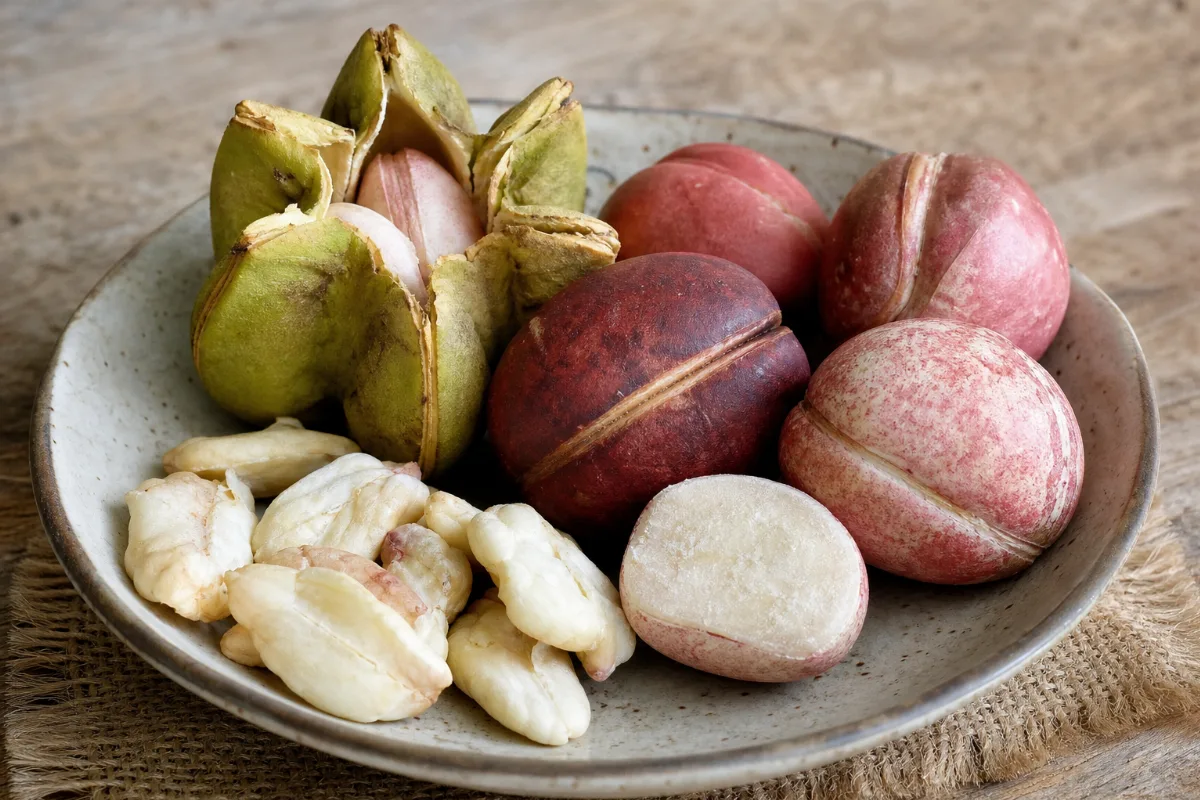
Kola nuts are the seeds of the trees Cola nitida and Cola acuminata (family Malvaceae; older books say Sterculiaceae). They grow inside star-shaped pods, and each pod holds several lobed seeds. The EMA notes the seeds are called "nuts" incorrectly. Fresh seed is bitter and astringent; dried seed is milder.
Fresh seed is chewed, mostly in West Africa. Dried seed has been ground into powders and extracts, and extracts were used to flavour cola-type drinks. Many modern soft drinks no longer use real kola extract, and we did not find a source on current products, so check labels.
What is in it
We found no USDA FoodData Central entry or standard portion for kola nuts, so there is no trustworthy per-serving nutrition table. The caffeine content is 1.5% to 3.8% of the seed by weight (EMA), with traces of theobromine and 5% to 10% tannins, including catechin and epicatechin.
A study of 25 Cola nitida varieties in Ghana found on average about 59% water, 0.47% fat, 2.7% ash and a protein figure of 7.3 (unit not stated). The numbers vary a lot between samples and sources disagree, so treat them as rough. Energy and vitamin values were not found.
What the research shows
The EMA found no clinical trials of kola seed or its preparations. It reasons from trials of pure caffeine that a use for temporary tiredness is plausible, and accepts it as a traditional use only.
Other findings are from animals, cells and computer models. Mice fed kola ate less and lost weight. A 2025 computer study listed kola compounds as possible starting points for cancer drug research. None of this has been tested in people.
Food versus extracts
Most laboratory and animal work uses extracts, not chewed fresh seed. Extracts and powders are concentrated caffeine products and are covered on the herb page. We do not know that chewing fresh seed behaves like an extract.
Amounts
This page gives no amounts to eat. There is no official serving of kola nuts. Caffeine in a chew depends on the piece and the variety. Ask a doctor, pharmacist or dietitian what is right for you, especially in pregnancy, with a heart condition, an ulcer, or if you take regular medicines.
At a glance
Traditional uses history, not proof
- Chewed fresh in West Africa for a stimulating effect and shared in hospitality and ceremonies
- Said by chewers to suppress hunger, thirst and sleep
- Dried seed and extracts once used to flavour cola-type drinks
- Long use as a custom is not proof that it treats any condition
Studied for research
- Tiredness and alertness (through caffeine), insufficient evidence, no trial of kola
- Hunger, thirst and sleepiness (traditional claims), insufficient evidence
- Body weight and appetite, animal studies only, insufficient
- Cancer-cell and computer-model research, lab only, insufficient
- Protein, fibre, minerals and polyphenols, content only, insufficient
Main compounds
- Caffeine
- Theobromine (traces)
- Catechin and epicatechin
- Tannins
- Aliphatic amines
Common forms
- Fresh seed, chewed
- Dried seed, whole or in pieces
- Powder
- Extract used as a food flavouring (a concentrated caffeine product)
Research links: EMA assessment report on Cola nitida and Cola acuminata seed (2011) · Safety assessment of kola nut extract as a food ingredient (2009) · NHS: Foods to avoid in pregnancy (caffeine) · Research Library · Genes & Biomarkers Library
What it is and its history
- Accepted scientific name
- Cola nitida and Cola acuminata
- Naming authority
- (Vent.) Schott & Endl. and (P.Beauv.) Schott & Endl. (GBIF accepted)
- Common names
- Kola nut (English); Cola nut (English); Cola seeds (English (EMA wording)); Nuez de cola (Spanish); Gourou nut, goro, bissy (West African names)
- Family or group
- Malvaceae (GBIF). The EMA report and older books place kola in Sterculiaceae.
- Classification
- Plantae > Tracheophyta > Magnoliopsida > Malvales > Malvaceae > Cola > Cola nitida; Cola acuminata
- Native range
- The EMA report says C. acuminata is native from Nigeria to Gabon and has been widely planted in West Africa, and that C. nitida centres were Sierra Leone, Benin, Ghana and Ivory Coast, with cultivation spreading west to Senegal and Gambia, east to what was Zaire, and to the Caribbean (especially Jamaica). The Cola genus has about 140 species, the report says.
- Habitat
- Not verified from a source read.
- What it looks like
- Roots: Not verified.; Stems: Not verified.; Leaves: Not verified.; Flowers: Not verified.; Fruit: The EMA report, citing a French reference, describes fruits of two to six woody follicles gathered into a star, each 8 to 12 by 4 to 8 cm, with 5 to 10 seeds per follicle. The seeds are "incorrectly called Cola nuts": they have two seed leaves in C. nitida and three to six in C. acuminata. Fresh seeds vary from white to red or crimson. Fresh seed is bitter and astringent; dried seed is milder.
- Cultivation
- Not verified from a source read beyond the EMA range notes above. A Ghanaian research station field-tested 25 C. nitida genotypes.
- Harvest and processing
- The EMA report says follicles are collected before maturity, opened, and the seeds left in a pile or in water for several days so the pulpy coat rots away. Seeds are used fresh, cured (6 months), sun-dried (40 days), or milled and stored. Fresh seed is chewed; dried seed goes into powders and extracts and flavourings for drinks.
- Look-alikes and adulterants
- Name: Bitter kola (Garcinia kola); Note: A different plant with a different history of use. It has its own page.; Name: Gotu kola (Centella asiatica); Note: An unrelated herb that only shares part of the name.; Name: Cola soft drinks; Note: Many modern colas no longer use real kola extract; we did not find a source on current products, so check labels.
- Sustainability and conservation
- Not assessed.
Photographs
Traditional use and history history, not clinical proof
| Tradition or era | Documented use | Source |
|---|---|---|
| West Africa, long-standing custom | The EMA report says traditional hospitality, cultural and social ceremonies are considered incomplete without kola seeds in Nigeria and many other West African countries. The seeds are chewed for a stimulating effect. Consumers say they suppress hunger, thirst and sleep. Traditional medicine uses listed in the report include a tonic, a mild stimulant, an appetite suppressant and remedies for dysentery and for morning sickness. None of these has been shown by a trial. | EMA assessment report 2011 (s-ema-cola); original papers not opened |
| Europe and North America, drinks and medicine | The EMA says kola has been used in Europe for at least 150 years, mainly as a flavouring for drinks and in pharmaceutical products. A 2009 safety review says US consumers have a history of consuming cola-type drinks containing kola extract that dates to at least the late 19th century. The EMA also says dried seeds were shipped around the world for medicines and to extract caffeine. | EMA assessment report 2011 (s-ema-cola); Burdock 2009 abstract (p19394393) |
Traditional use shows how it was used. It does not show that it works or is safe today.
What is inside, and how it may work
What it contains and how those compounds act in cells and animals. Laboratory and animal mechanisms are not proven effects in people.
Main compounds
| Compound | Family | Where it is concentrated | Activity studied | Level of evidence |
|---|---|---|---|---|
| Caffeine PubChem 2519 | methylxanthine (purine alkaloid) | Seed 1.5% to 3.8% of the seed depending on variety and treatment (EMA); 1.5% to 3.2%, average 2.5% in the dried seed in one reference the EMA cites | A mild stimulant that explains most of the expected stimulant effect and the caution list. Part of the caffeine is bound to catechins, so fresh and dried seed may act differently (EMA, from older textbooks). 7 5 | Human (caffeine itself) |
| Theobromine PubChem 5429 | methylxanthine (purine alkaloid) | Seed Traces, 0.02% to 0.08% (EMA); 37 to 1,570 mg per kg in C. nitida accessions in one analysis the EMA cites | A caffeine relative. Considered with caffeine in kola safety reviews. 7 5 | Composition only |
| Catechin and epicatechin PubChem 9064 (catechin); 72276 (epicatechin) | flavan-3-ol polyphenol | Seed Catechin was the main phenolic; total tannins 5% to 10% of the seed (EMA) | No human study of these compounds from kola was found. Computer docking suggested epicatechin could bind a cancer-related protein (lab and computer only). 7 1 | Composition only |
| Tannins (colatin and related) | tannin | Seed 5% to 10% of the seed (EMA) | Tannins are bitter and astringent. No health claim is made here. 7 | Composition only |
| Aliphatic amines (for example dimethylamine, pyrrolidine, ethylamine) | amine | Seed In C. acuminata: dimethylamine about 4 mg/kg, pyrrolidine 7.4 mg/kg, ethylamine 13 mg/kg (EMA, citing Atawodi 1995) | Lab concern: amines could in theory form cancer-causing nitroso compounds in the mouth. See the Safety tab. 7 | Lab |
Mechanisms, receptors and pathways
| Target or pathway | Gene or receptor | What was found | Level |
|---|---|---|---|
| Adenosine-receptor blocking by caffeine (stimulant effect) | Not specified in the sources read | The EMA attributes the expected stimulating effect of the seed to its caffeine content, from caffeine research. It does not test kola in people. Rat studies in the report found kola extract worked more gradually than caffeine alone, and that the extract may also affect muscle tone differently. 7 | Animal research |
| Stomach acid secretion | Muscarinic and histamine receptors (cat study, as summarised by the EMA) | In cats, kola extract raised stomach acid output and the effect was largely blocked by atropine and cimetidine. The authors said caffeine is not the only constituent acting. 7 | Animal research |
| Kinase binding predicted by computer (PI3K alpha) | PI3K alpha (PIK3CA) | In a docking study, several kola seed compounds were predicted to bind PI3K alpha. Computer prediction only. 1 | Lab |
Absorption, metabolism and elimination
- Absorption
- The EMA says no pharmacokinetic data exist for kola seed. It cites older work that caffeine absorbs more slowly from dried seed than from fresh seed, which needs clarification.
- Distribution
- Not found for kola.
- Metabolism
- Not found for kola. Caffeine is cleared by the liver enzyme system, the EMA notes.
- Elimination
- Not found for kola. The EMA notes caffeine is cleared very slowly by newborns.
- Bioavailability
- Not established for kola.
Isolated compounds versus whole extracts
Most laboratory and animal work uses extracts, not chewed fresh seed. The fresh seed is chewed; the dried seed has been ground into powders and extracts, and extracts were used for drink flavouring. Whether chewing the fresh seed behaves like an extract is not known. Caffeine and kola extract appeared to act somewhat differently in rats, which the EMA reports.
Nutritional composition
We found no USDA FoodData Central entry for kola nuts (an earlier check found none; a fresh USDA search was blocked today by a rate limit, so we could not repeat it). There is no standard portion or table, so no per-serving figures are given. What published analyses report (rough, vary between samples): a Ghanaian study of 25 Cola nitida genotypes found on average moisture 58.8% (range 48 to 68%), fat 0.47% (0.15 to 0.79), total ash 2.66% and protein 7.33 (unit not stated), and the study does not say whether values are per fresh or dry weight. The EMA report summarises other work saying the seed has about 8 to 12% protein, 8.1 to 9% fibre, 3.4 to 3.5% total ash and 52.4 to 53.1% carbohydrate, and potassium of 1.01 to 1.47%, and lists B vitamins, ascorbic acid (vitamin C) and beta-carotene as present; its basis (fresh or dry) is not stated. The sources disagree about fat: 0.47% in Ghana, 1.6% in the EMA summary and 15.7% ether extract in an EMA table for dried C. acuminata, so we do not state a fat figure. Energy and vitamin figures were not found. Fresh kola is mostly water and low in fat, so it is unlikely to be energy-dense like most nuts, but we could not find a calorie value. The plant compounds and caffeine matter more than the nutrients.
5 not enough evidence
What was looked at
The 5 benefits and uses checked for Kola Nuts, each with how strong the evidence is. Tap one to open it.
- Tiredness and alertness (through the caffeine in kola)Not enough evidence
- Hunger, thirst and sleepiness (traditional claims)Not enough evidence
- Body weight and appetite (animal studies only)Not enough evidence
- Cancer-cell and computer-model researchNot enough evidence
- Protein, fibre, minerals and plant polyphenols (content only)Not enough evidence
What is Kola Nuts good for?
The studied uses and how strong the evidence is for each. No human trial of kola nuts was found for any of them, so all of the ratings are weak.
Benefits, one by one
Each card is a research question, not a promise. Tap a goal to filter. Open a card to see the studies, doses and limits.
Tiredness and alertness (through the caffeine in kola)
Not enough evidenceKola seed contains caffeine, about 1.5% to 3.8% of its weight according to the European Medicines Agency (EMA). The EMA found no clinical trials of kola seed itself. It calls a use for temporary tiredness plausible because of the caffeine, and accepts it only as a traditional use. Any alertness effect is expected to be that of caffeine.
2 studiesFresh seed chewed as food; dried seed, powder and extracts are other …
Studies, doses and limits
What the trials found
No clinical trials of kola seed or its preparations were found by the EMA ("no data are available"). The EMA reasons from clinical trials of pure caffeine, and from the caffeine content of the seed, that an effect on fatigue is plausible. No trial of kola nuts as a food was found by us either.
Results
Not shown for kola itself. The EMA calls the use plausible and accepts it as a traditional use only.
Why this rating
No human trial of kola seed. The EMA reasons from caffeine trials. That makes an effect plausible, but it is not evidence about kola itself.
Form and dose studied
Fresh seed chewed as food; dried seed, powder and extracts are other forms (see the herb page for extracts).
Who was studied
Adults in West Africa are the main chewers. No studied group.
Limits
No trial of kola. Caffeine content varies a lot between seeds. Whether chewing fresh seed acts like an extract is not known.
Why researchers looked
Kola is chewed in West Africa for a stimulating effect, and cola-type drinks were first flavoured with it. Caffeine is a known stimulant.
Traditional use
In Africa the seeds are traditionally chewed for a stimulating effect. Long use as a custom is not proof that it treats any condition.
Proposed mechanism Authoritative guidance
Caffeine is a mild stimulant. The EMA says the traditional use for tiredness can be explained by the caffeine content. It also reports that caffeine in the seed is partly bound to catechins, which may make dried seed act differently from fresh seed. That idea comes from older textbooks and needs further clarification, the EMA says.
A proposed mechanism does not show that the effect happens in people.
Because the effect is that of caffeine, the caffeine cautions apply. See the Safety tab, especially pregnancy, heart rhythm and medicines.
Hunger, thirst and sleepiness (traditional claims)
Not enough evidencePeople who chew kola say it suppresses hunger, thirst and sleep. The EMA reports these as claims by consumers. No trial of kola for any of them was found.
1 studiesFresh seed chewed.
Studies, doses and limits
Results
Claims only. No human study tested whether kola changes hunger, thirst or sleep.
Why this rating
Traditional claims with no human study.
Form and dose studied
Fresh seed chewed.
Who was studied
Habitual chewers in West Africa (habit, not a study).
Limits
Reports of use by consumers are not tests. No comparison group.
Why researchers looked
These are the reasons people give for chewing kola in West Africa.
Traditional use
The EMA says cola seeds are chewed for their stimulating effect and that consumers claim the seeds suppress hunger, thirst and sleep. Sharing kola is part of hospitality and ceremonies in Nigeria and many other West African countries. This is custom, not evidence of benefit.
Proposed mechanism Authoritative guidance
No mechanism has been shown for hunger or thirst. The sleep-suppressing effect would fit the caffeine in the seed.
A proposed mechanism does not show that the effect happens in people.
The EMA also reports possible harms of habitual chewing. See the Safety tab.
Body weight and appetite (animal studies only)
Not enough evidenceIn mice fed kola seed or caffeine in their food for 28 days, food intake and body weight went down, according to a study the EMA summarises. This is animal research. No human study was found.
1 studiesKola seed mixed into mouse feed; a water extract by mouth in rats.
Studies, doses and limits
Results
In the mouse study (Umoren, as summarised by the EMA), both the kola-seed diet and the caffeine diet reduced food intake and body weight over 28 days. In a different, 18-week rat study of a kola seed water extract, the animals lost weight and also showed signs the report links to methylxanthine toxicity (restlessness, hair loss, enlarged organs). That is a toxicity finding, not a benefit.
Effect sizes as reported
Not given in the EMA summary for the mouse study.
Why this rating
Animal studies only, read second-hand through the EMA report. No human data.
Form and dose studied
Kola seed mixed into mouse feed; a water extract by mouth in rats.
Who was studied
Mice and rats.
Limits
We did not read the original papers. Animal results do not predict what happens in people. The rat study design limits what can be said, the EMA notes.
Why researchers looked
People say kola suppresses hunger, so researchers have checked whether it changes eating and weight in animals.
Traditional use
Kola is said in custom to reduce hunger. The tradition is not evidence.
Proposed mechanism Animal research
Caffeine alone lowers food intake in these mouse tests as well, so the effect is likely to come from caffeine. Whether anything else in the seed contributes was not tested in the study the EMA describes.
A proposed mechanism does not show that the effect happens in people.
The rat study is also a safety signal. See the Safety tab.
Cancer-cell and computer-model research
Not enough evidenceLaboratory work on kola extracts has found effects on cancer cells in dishes, and a 2025 computer study listed kola compounds as possible starting points for drug research. This is lab and computer work only. It does not show that eating kola helps with cancer. A separate safety concern about habitual chewing is covered on the Safety tab.
2 studiesSolvent extracts of the seed. Not food.
Studies, doses and limits
Results
Lab and computer results only. No animal or human cancer trial of kola was found.
Why this rating
Lab and computer research only.
Form and dose studied
Solvent extracts of the seed. Not food.
Who was studied
Cell lines and computer models.
Limits
A compound that binds a protein in a computer model, or kills cells in a dish, usually does not become a medicine. Solvent extracts are not food.
Why researchers looked
Plant seeds are screened for compounds that might lead to medicines.
Traditional use
Not a traditional use.
Proposed mechanism Laboratory research
A computer-docking study of 15 compounds found that squalene, campesterin, epicatechin, yohimbine and scopolin were predicted to bind a cancer-related protein (PI3K alpha). Extracts of Cola acuminata also stopped the growth of some human cancer cell lines in dishes (breast and prostate lines) in work the EMA summarises. These are lab findings.
A proposed mechanism does not show that the effect happens in people.
None from this research.
Protein, fibre, minerals and plant polyphenols (content only)
Not enough evidenceKola seed contains some protein, fibre, minerals and plant polyphenols (catechins). Published analyses differ a lot, and USDA has no entry, so we cannot give a trustworthy per-serving nutrition table. No trial shows a health benefit from these nutrients in kola.
2 studiesRaw seed.
Studies, doses and limits
Results
A Ghanaian field study of 25 Cola nitida varieties found large differences between varieties in the seed contents it measured (sugars, protein, moisture, ash, fat, pH, polyphenols, tannins and flavonoids). See the composition notes for the averages we read.
Effect sizes as reported
See composition notes. The sources disagree on fat and do not state units for some figures.
Why this rating
Composition data only, from a few papers that differ, with no human trial of any benefit.
Form and dose studied
Raw seed.
Limits
Values vary with variety, growing place, curing and whether fresh or dried. Fresh seed is mostly water (about 59% in the Ghanaian study).
Why researchers looked
Researchers have measured what the seeds contain, partly to breed better varieties.
Traditional use
The seed is chewed fresh for its stimulant effect, not as a source of nutrients.
Proposed mechanism Nutrient database
Not a mechanism claim. The EMA summary says the seed is a source of protein, fibre, minerals and polyphenols. A Ghanaian study of 25 Cola nitida varieties measured the seed contents.
A proposed mechanism does not show that the effect happens in people.
The caffeine in the seed matters far more for safety than its nutrients. See the Safety tab.
Connections to the rest of health
How Kola Nuts connects to the rest of our health knowledge graph. Every link says what kind of connection it is. A safety link (for example to the liver) is a warning, not a benefit. A study that merely mentions a topic never creates a benefit link.
Explore every connection: goals, body systems, organs, symptoms, genes
B. Body systems
| Connected to | Kind of connection | Evidence status | Context | Studies |
|---|---|---|---|---|
| Nervous System | Biological association | Not enough evidence | Studied for: Tiredness and alertness (through the caffeine in kola) Studied for: Hunger, thirst and sleepiness (traditional claims) | 7 5 |
| Digestive System | Biological association | Not enough evidence | Studied for: Hunger, thirst and sleepiness (traditional claims) | 7 |
| Metabolism Weight | Biological association | Not enough evidence | Studied for: Body weight and appetite (animal studies only) | 7 |
| Cellular Processes | Biological association | Not enough evidence | Studied for: Cancer-cell and computer-model research | 1 7 |
| Nutrition | Biological association | Not enough evidence | Studied for: Protein, fibre, minerals and plant polyphenols (content only) | 6 7 |
E. Health conditions
| Connected to | Kind of connection | Evidence status | Context | Studies |
|---|---|---|---|---|
| Peptic ulcer | Adverse effect or risk | Documented risk | The EMA lists stomach and duodenal ulcers as contraindications. Preparation or compound: Kola nut |
7 |
| Cardiac arrhythmia | Adverse effect or risk | Documented risk | The EMA names heart rhythm problems and high blood pressure as reasons for caution. Preparation or compound: Kola nut |
7 |
K. Biological pathways
| Connected to | Kind of connection | Evidence status | Context | Studies |
|---|---|---|---|---|
| Caffeine | Preliminary mechanism | Human (caffeine itself) | The main active compound in kola seed. | 7 |
| Polyphenols (catechin, epicatechin) | Preliminary mechanism | Composition only | Plant compounds in the seed; content only. | 7 |
| PI3K alpha (computer prediction) | Preliminary mechanism | Lab | Predicted binding only; no biological test. | 1 |
L. Active compounds
| Connected to | Kind of connection | Evidence status | Context | Studies |
|---|---|---|---|---|
| Caffeine | Biological association | Human (caffeine itself) | A mild stimulant that explains most of the expected stimulant effect and the caution list. Part of the caffeine is bound to catechins, so fresh and dried seed may act differently (EMA, from older textbooks). Preparation or compound: Seed |
7 5 |
| Theobromine | Biological association | Composition only | A caffeine relative. Considered with caffeine in kola safety reviews. Preparation or compound: Seed |
7 5 |
| Catechin and epicatechin | Biological association | Composition only | No human study of these compounds from kola was found. Computer docking suggested epicatechin could bind a cancer-related protein (lab and computer only). Preparation or compound: Seed |
7 1 |
| Tannins (colatin and related) | Biological association | Composition only | Tannins are bitter and astringent. No health claim is made here. Preparation or compound: Seed |
7 |
| Aliphatic amines (for example dimethylamine, pyrrolidine, ethylamine) | Biological association | Lab | Lab concern: amines could in theory form cancer-causing nitroso compounds in the mouth. See the Safety tab. Preparation or compound: Seed |
7 |
Each connection is stored with the ingredient, the connected record, the kind of connection, the evidence status, the supporting studies, the preparation or compound involved, and a review date (last reviewed October 26, 2026).
Evidence at a glance: what the research found for 5 outcomes
Each outcome below is one thing researchers measured. Certainty is how far the evidence can be trusted, not how well it works. The full studies are on the next tab.
The evidence
The research centre for Kola Nuts. Every record here was checked against PubMed or the publisher's page; we never list a study we have not verified.
Evidence by outcome
Bars show how many studies we found for each outcome, not how well it works. People are added up across trials only (reviews are not added, to avoid double counting).
How we rate evidence
High certainty
Several well-run trials or reviews agree; further research is unlikely to change the picture much.
Moderate certainty
Good trials point the same way, but some doubt remains.
Low certainty
Small, short or inconsistent trials. The finding could change with better research.
Very low certainty
Very little or very weak human data. Treat as a possibility only.
Mixed findings
Trials or reviews disagree with each other.
Not enough evidence
Not enough human research to say either way.
Evidence against
Good research found no benefit, or found harm.
We take the reviewers' own risk-of-bias and GRADE statements where they exist, and otherwise judge from study size, design, consistency, directness and whether a product matches what is sold. Many publications do not make evidence high. Method note: We started from our existing kola nut summary, read the full European Medicines Agency assessment report as extracted text, read the NHS and FDA caffeine pages, and searched PubMed for studies, reading their abstracts. The Ghanaian composition paper was read in full through Europe PMC. Items we could not verify are flagged in the research gaps.
Study library: every study we checked 11
| Study | Design | People | Product, dose, length | Result |
|---|---|---|---|---|
| Alshehri 2025 Unveiling bioactive compounds in kola nut seeds: GC-MS identification and computational analysis for anticancer potential. Front Nutr · PMID 41586220 · DOI |
In vitro computational in silico |
Laboratory and computer study of a methanol extract of kola nut seeds; no animals or people | Methanol extract of kola nut seeds (Cola spp.), fractionated and analysed by gas chromatography-mass spectrometry; selected compounds tested by computer docking against the cancer-related protein PI3K alpha Seed |
The analysis identified 78 compounds including alkaloids, flavonoids, fatty acids and carbohydrates. Fifteen were shortlisted for computer docking. Squalene, campesterin, epicatechin, yohimbine and scopolin showed favourable computed binding. Caffeine and theobromine showed weak interactions. The authors say the compounds may serve as starting points for drug development and that experimental validation is needed. Computed binding only; no test on cells, animals or people. (Not applicable.) Methods, limits and fundingOutcomes: Compounds identified in the extract; computed binding of 15 shortlisted compounds Limitations: Computer modelling cannot show a benefit in people. Abstract only was read. Volume year 2025; PubMed lists the electronic date as 9 January 2026. Funding and conflicts: The authors declared no commercial or financial relationships. Read: abstract |
| Amadi 2020 The effects of oral administration of Cola nitida on the pharmacokinetic profile of metoclopramide in rabbits. BMC Pharmacol Toxicol · PMID 31907041 · DOI |
Animal study animal (rabbit) |
5 Five healthy male rabbits, each tested twice with a one-week washout |
Cola nitida given by mouth with the medicine metoclopramide Seed Cola nitida 0.7 mg/kg with metoclopramide 0.5 mg/kg (rabbits) Two single-dose sessions one week apart · vs Metoclopramide alone in the same rabbits |
With kola, blood levels of metoclopramide were lower at all time points except the seventh hour. Area under the curve fell 51%, peak level fell 39% and half-life fell 51%. Clearance rose 98%. The authors conclude there is a possible herb-drug interaction. Area under the curve down 51%; peak concentration down 39%; half-life down 51%; clearance up 98%. (Not given in the abstract.) Methods, limits and fundingOutcomes: Blood levels of metoclopramide measured by HPLC Limitations: Five rabbits only. Animal data. Rabbit dosing does not translate to people and the amount of kola given is not comparable to chewing. Funding and conflicts: The authors declared no competing interests. Read: abstract |
| Atiba 2021 Kola nut from Cola nitida vent. Schott administered to pregnant rats induces histological alterations in pups' cerebellum. PLoS One · PMID 33684143 · DOI |
Animal study animal (rat) |
Pregnant Wistar rats and their pups (group sizes not given in the abstract) | Crude aqueous kola nut (Cola nitida) extract by mouth to pregnant rats Seed 400, 600 or 800 mg/kg body weight (rats) From pregnancy to day 21 after birth · vs Water |
The kola-treated rats' pups had an early drop in body and brain weight, and abnormal development of the cerebellum: fewer Purkinje cells, loss of their dendrites, and signs of damage and inflammation in the white matter. The authors say kola given repeatedly at certain doses to pregnant dams could disrupt normal cerebellar development in the pups, and that the findings suggest possible harm from excessive kola consumption in people that warrants further study. Reduced Purkinje cell density and other structural changes versus control. (Not given in the abstract.) Methods, limits and fundingOutcomes: Pups' brain weight and cerebellum structure at days 1, 7, 14, 21 and 28 Limitations: Rat study with a crude extract at high doses; it cannot be applied to people directly. The abstract says kola is commonly eaten in the first trimester in West Africa against morning sickness, which is why the question was asked. Funding and conflicts: The authors declared no competing interests. Read: abstract |
| Atiba 2024 Dynamic changes in the hippocampal memory index and biochemical indices in Sprague Dawley rats exposed to intrauterine kola nut. Metab Brain Dis · PMID 39546053 · DOI |
Animal study animal (rat) |
Pregnant Sprague Dawley rats and their pups (group sizes not given in the abstract) | Kola nut extract fed to pregnant rats Seed Not given in the abstract From the first day of pregnancy until birth · vs Control pups |
Kola-treated pups scored lower on balance, novel-object recognition and novel-object location, and took longer to complete a radial-arm maze. Levels of acetylcholine and BDNF in the hippocampus were higher in treated pups. The authors conclude that kola nut affects both the biochemical and the memory profile of the hippocampus. Treated pups had significantly reduced behaviour and memory scores versus control (numbers not reproduced). (Not given in the abstract.) Methods, limits and fundingOutcomes: Behaviour and memory tests, and hippocampus levels of BDNF, acetylcholine and a stress marker (MDA), in the pups Limitations: Rat study only. Dose not stated in the abstract. Does not show what happens in people. Funding and conflicts: The authors report no relevant financial or non-financial interests. Read: abstract |
| Burdock 2009 Safety assessment of kola nut extract as a food ingredient. Food Chem Toxicol · PMID 19394393 · DOI |
Narrative review human and animal (review) |
Published safety data on kola nut extract used as a flavouring (the review is for an industry-use extract, not the chewed nut) | Kola nut extract (Cola nitida, Cola acuminata) used as a food flavouring Seed Present-day intake from this use: 0.69 mg/kg a day |
The review says caffeine and theobromine are the two important constituents and that the effects of kola extract should parallel those of a roughly equivalent amount of caffeine. Frank developmental or reproductive effects have not been reported, and changes in offspring cannot be extrapolated to humans. A no-effect level cannot be defined for repeated oral exposure to the extract from the available data. The authors note a history of safe use of cola-type drinks containing the extract back to the late 19th century. Estimated present-day intake of kola nut extract as a flavouring: 0.69 mg/kg a day. (Not given.) Methods, limits and fundingOutcomes: Safety of kola nut extract as a food ingredient Limitations: Abstract only was read. It covers extract used as a flavouring, not chewing the fresh nut. The authors are at an industry consultancy (Burdock Group), and the abstract does not say who paid for the work, so independence cannot be judged. Funding and conflicts: Author affiliation is a food-safety consultancy; funding not stated in the abstract. Read: abstract |
| Nyadanu 2020 Genetic variability of bioactive compounds and selection for nutraceutical quality in kola [Cola nitida (Vent) Schott. and Endl.]. PLoS One · PMID 33270707 · DOI |
Laboratory analysis n/a (plant analysis) |
25 kola (Cola nitida) genotypes grown in a field trial at the Cocoa Research Institute of Ghana; nuts from three replicate blocks analysed in the laboratory | Cola nitida nuts, analysed for sugars, protein, moisture, ash, fat, pH, polyphenols, tannins and flavonoids Nut (seed) |
The abstract reports significant differences between the 25 genotypes in every trait measured. Phenolic traits were more heritable than nutritional traits. The authors grouped the genotypes into four clusters and name some as parents for breeding varieties richer in phenolics or sugars. Table 3 of the full text (read through Europe PMC) gives, across the 25 genotypes, mean moisture 58.76% (range 48.17 to 68.06), mean fat 0.47% (0.15 to 0.79), mean ash 2.66% (0.30 to 4.25) and mean protein 7.33 (3.06 to 13.52, unit not stated). Whether values are per fresh or dry weight is not stated for the nutrients; moisture of about 59% suggests fresh seed. Means across 25 genotypes: moisture 58.76%; fat 0.47%; ash 2.66%; protein 7.33 (unit not stated). (Not applicable.) Methods, limits and fundingOutcomes: Variation in bioactive and nutritional content between genotypes Limitations: Plant-breeding paper from one research station. Units are not stated for every trait and fresh or dry basis is not stated. It does not measure caffeine, vitamins or most minerals. It does not describe health effects. Funding and conflicts: The authors declared no competing interests. Read: full-text |
| s-ema-cola European Medicines Agency (HMPC): Assessment report on Cola nitida and Cola acuminata, semen (EMA/HMPC/722365/2010) · Source |
Health agency n/a |
Methods, limits and fundingRead: full-text | ||
| s-fda-caffeine U.S. FDA: Spilling the beans: how much caffeine is too much? · Source |
Health agency n/a |
Methods, limits and fundingRead: full-text | ||
| s-gbif-cola-acuminata GBIF Backbone: Cola acuminata (P.Beauv.) Schott & Endl. (usageKey 5406685) · Source |
Reference database n/a |
Methods, limits and fundingRead: full-text | ||
| s-gbif-cola-nitida GBIF Backbone: Cola nitida (Vent.) Schott & Endl. (usageKey 5406687) · Source |
Reference database n/a |
Methods, limits and fundingRead: full-text | ||
| s-nhs-caffeine NHS: Foods to avoid in pregnancy (caffeine section) · Source |
Health agency n/a |
Methods, limits and fundingRead: full-text |
What we do not know yet
- No clinical trial of kola nuts was found for any use. The EMA says the same.
- Whether chewing fresh seed acts like caffeine alone, or like an extract, is not known.
- The link between habitual chewing and mouth and gut tumours rests on older reports and has not been tested.
- Allergy, kidney disease, mould, aflatoxin, heavy metals and storage were not found for kola in the sources read.
- No USDA entry exists, and published nutrition figures disagree. Energy and vitamin values were not found.
- A later EMA addendum and the original older papers quoted by the EMA were not read.
How new research is added
New studies are found by a saved PubMed search and placed in a review queue before the page changes.
Lab markers
What changed in blood or saliva tests during trials. A changed number is not the same as feeling or being healthier, and we give no "normal ranges".
Safety
What studies and official sources say about side effects, medicines and who should check first. Each point shows what kind of evidence it comes from.
Main points to know 6
- Kola is a caffeine food, so every caffeine caution applies. The EMA says the caffeine content of the seed ranges from 1.5% to 3.8% depending on variety and how the seed is treated, and that the safety properties of kola extract are roughly those of an equal amount of caffeine. Sleep problems, over-excitability, nervous restlessness and stomach irritation are listed as possible effects. Count kola together with coffee, tea, cola drinks and energy drinks. The FDA has cited 400 mg of caffeine a day as an amount not generally associated with negative effects for most adults, and advises people who are pregnant, trying to become pregnant or breastfeeding, or who have a condition or a medicine, to talk to a health care provider. Kola has no official serving size, and caffeine in a chew depends on the piece and the variety. Authoritative guidance 7 8 5
- Pregnancy and breastfeeding: not recommended; rat studies raise concern. The EMA says kola use in pregnancy and while breastfeeding is not recommended because safety data are lacking, and that no studies of kola in pregnancy exist. It notes that a US herbal trade association lists Cola acuminata among herbs not to be used in pregnancy unless directed by a qualified expert. The NHS tells pregnant women to have no more than 200 mg of caffeine a day from all sources, and says too much caffeine has been linked to a higher chance of miscarriage and stillbirth. In West Africa kola is commonly eaten in early pregnancy against morning sickness, according to two rat-study abstracts. In those studies, pregnant rats given kola extract had pups with changes in cerebellum structure and weaker memory and behaviour test results. These are animal results at the doses tested and cannot be applied directly to people, but they are a reason for caution. Animal research 7 11 3 4
- Heart, blood pressure, thyroid and stomach ulcers. The EMA lists stomach and duodenal ulcers as contraindications, and high blood pressure, heart rhythm problems and an overactive thyroid as reasons for caution. These come from the known effects of caffeine. In animal tests described in the report, kola extract raised stomach acid secretion, and in isolated rat hearts low amounts of extract increased heart rate and force while higher amounts reduced them and, at even higher amounts, caused heart failure. That is animal data, not a human dose. People with these conditions should ask a doctor. Authoritative guidance 7
- Medicines: caffeine interacts with several. The EMA lists caffeine interactions with MAO-inhibitor medicines (large amounts of caffeine may cause dangerous heart rhythm problems or severe high blood pressure; small amounts may cause a fast heart rate and a mild rise in blood pressure). It also says kola may interact with ephedrine, phenelzine, adenosine, clozapine, benzodiazepines, propranolol, metoprolol, phenylpropanolamine and quinolone antibiotics, citing the 2009 safety review. In five rabbits, kola lowered the blood levels of the nausea medicine metoclopramide. That is a possible interaction in animals only. Ask a pharmacist before combining kola with any medicine. Authoritative guidance 7 2
- Chewing kola for years and cancers of the mouth and gut: a concern, not proof. The EMA states that there are more tumours of the mouth and malignancies of the digestive tract in Northern Nigeria, where kola chewing is most common. It also says there are no studies of cancer from kola preparations, that most habitual chewers also smoke, and that lab work found amines in the seed that could in theory form cancer-causing nitrosamides in the mouth. Habitual chewers are described as taking from 50 g to over 200 g of fresh seed a day, which is a description of habit, not advice. This is an association and a laboratory concern, not proof that kola causes cancer. Observational 7
- Children and teens: not recommended. The EMA says use in children and adolescents under 18 is not recommended because data are not sufficient, and quotes a suggested caffeine limit for children of 2.5 mg per kg of body weight a day from a 2003 review. The FDA says caffeinated drinks should be avoided for children younger than 2 and describes the signs of too much caffeine in children and teens. Authoritative guidance 7 8
Side effects 4
| Effect | How often | Severity and recovery | Evidence |
|---|---|---|---|
| Caffeine effects: trouble sleeping, over-excitability, nervous restlessness, stomach irritation Listed by the EMA, citing a herbal reference (Blumenthal 2000). The FDA lists faster heart rate, palpitations, high blood pressure, insomnia, anxiety, jitters, upset stomach, nausea and headache as signs of too much caffeine. | No frequency data for kola nut. | Mild to moderate; higher caffeine amounts add risk Not stated | Authoritative guidance 7 |
| Signs of too much caffeine: fast or pounding heartbeat, high blood pressure, anxiety, nausea, headache FDA list for caffeine from any source. Kola was not named. | Not given for kola. | Mild to serious Not stated | Authoritative guidance 8 |
| More stomach acid (animal tests) The EMA describes rat and cat tests in which kola extract raised stomach acid output. In cats, kola extract raised acid output more than an equal amount of caffeine, so caffeine may not be the only cause. No human data. | Not applicable (animals) | Not stated Not stated | Animal research 7 |
| Weight loss, restlessness and organ changes in rats given kola extract for 18 weeks Summarised in the EMA report from a 1981 study that the report says had design limits. Signs were like those of methylxanthine toxicity. Not applicable to people. | Not applicable (animals) | Not stated Not stated | Animal research 7 |
Liver
No liver injury from eating kola nuts was found. A liver-safety database such as LiverTox was not searched for this food page. The EMA reports a rat study in which liver weight rose and some liver blood tests changed after 18 weeks of kola extract, which is animal data. 7
How often. No frequency was found.
Monitoring. No agency monitoring advice was found.
This is a safety connection. It is not evidence that Kola Nuts supports liver health.
Medicines and supplements 4
| With | Why it matters | Importance | Evidence | What to do |
|---|---|---|---|---|
| MAO-inhibitor medicines (for example phenelzine, selegiline, procarbazine, furazolidone) drug | The EMA, citing a drug reference, says large amounts of caffeine with an MAO inhibitor may produce dangerous heart rhythm problems or severe high blood pressure, and small amounts may produce a fast heart rate and a mild rise in blood pressure. | Applies to caffeine from any source, including kola. Kola content varies so the amount of caffeine in a chew is hard to know. | Authoritative guidance Moderate certainty 7 | If you take an MAO inhibitor, ask your doctor or pharmacist before chewing kola or using products that contain it. |
| Other medicines named by the EMA: ephedrine, adenosine, clozapine, benzodiazepines, propranolol, metoprolol, phenylpropanolamine, quinolone antibiotics drug | The EMA says the potential for kola seeds and extracts to interact with these has been noted, citing the 2009 safety review. The mechanisms are not described in the report. | Not quantified. We did not open the 2009 review beyond its abstract, so which of these interactions are from caffeine in general and which are specific to kola is not clear. | Authoritative guidance Low certainty 7 5 | Ask a pharmacist before combining kola with any of these medicines, and do not change medicines on your own. |
| Metoclopramide (nausea and stomach medicine) drug | Caffeine can switch on transport and metabolism systems that clear some medicines. In five rabbits, kola with metoclopramide lowered the medicine blood levels (AUC down 51%). | Animal data with five rabbits. Unknown for people. | Animal research Very low certainty 2 | If you take metoclopramide, mention kola to your pharmacist. |
| Other caffeine sources (coffee, tea, cola drinks, energy drinks, guarana, caffeine pills) food | Caffeine adds up across sources. The NHS lists caffeine in coffee, tea, cola, energy drinks, chocolate, guarana and some supplements. | More total caffeine raises the chance of the effects above. | Authoritative guidance High certainty 11 8 | Count kola with the rest of your daily caffeine. |
Who should check first 6
| Situation | Advice | Evidence |
|---|---|---|
| Stomach or duodenal ulcer | The EMA lists these as contraindications for kola. Avoid unless a doctor says otherwise. | Authoritative guidance 7 |
| High blood pressure, heart rhythm problems or an overactive thyroid | The EMA lists these as reasons for caution (cardiovascular disorders such as hypertension and arrhythmia, and hyperthyroidism). Ask your doctor before chewing kola. | Authoritative guidance 7 |
| Pregnancy and breastfeeding | The EMA does not recommend kola because safety data are lacking. The NHS limit for caffeine in pregnancy is 200 mg a day from all sources. Breastfeeding infants clear caffeine slowly, the EMA notes. Ask your midwife or doctor. | Authoritative guidance 7 11 |
| Children and adolescents | Not recommended by the EMA (not enough data). Avoid. | Authoritative guidance 7 8 |
| Taking an MAO inhibitor or one of the other medicines named under Interactions | Ask a pharmacist first. | Authoritative guidance 7 |
| Caffeine sensitivity, anxiety or trouble sleeping | Kola can make these worse because of its caffeine. This follows from the caffeine content; no kola-specific study was found. | Authoritative guidance 7 8 |
Overdose, product quality and regulators
Summary. Kola toxicity is mostly that of caffeine. The EMA says it cannot set a no-effect level for repeated oral exposure to kola extract. The EMA also quotes an adult lethal amount of caffeine of about 10 g (death has been reported after 6.5 g), which would be around 667 g of kola seed at 1.5% caffeine. These are worst-case figures from a toxicity review, not guidance for use, and they do not mean smaller amounts are safe for everyone.
Animal. Rat and mouse studies summarised by the EMA report weight loss, restlessness and organ changes with kola extract, and stomach-acid and heart effects. Rat pup studies show brain-development changes after kola in pregnancy (see Pregnancy). The EMA found no studies of acute toxicity of kola extracts.
Human doses studied. The EMA found no clinical studies of kola seed. It says no case of overdose is known in the literature.
High dose or long term signals. Long-term heavy chewing is linked in reports to mouth and gut tumours in Northern Nigeria, where most chewers also smoke. Not proven to be caused by kola. See Key safety.
Overdose response. No case of kola overdose was found by the EMA. For a possible caffeine overdose, call emergency services.
Genotoxicity. The EMA says there are not enough data on genotoxicity of kola. One early test of a "cola extract" in hamster cells reported no chromosome damage. Caffeine tests have been inconclusive.
No source we read described mould, aflatoxin, pesticide residues or heavy metals in kola nuts. The EMA mentions testing for lead as a check for environmental pollution in mineral analysis, without stating a result. A 2009 review of kola extract notes the extract is used as a flavouring. Quality and caffeine content of kola vary with variety, curing and storage.
Variable caffeine content. Caffeine ranges from 1.5% to 3.8% by weight depending on variety and treatment (fresh, cured, sun-dried or milled and stored). In a Ghanaian study of 25 varieties, other contents also differed markedly between varieties. 7 6
| Body | Action | Date |
|---|---|---|
| European Medicines Agency (HMPC) (European Union) | Assessment report on Cola nitida and Cola acuminata seed (traditional use). No clinical studies; use for temporary tiredness plausible from caffeine; use in pregnancy, breastfeeding, children and adolescents not recommended for lack of data; contraindicated in stomach and duodenal ulcers; caution with high blood pressure, heart rhythm problems and an overactive thyroid. The report says a Community list entry could not be set because genotoxicity data were missing. source | 2011-11-22 |
| U.S. Food and Drug Administration (United States) | Consumer update on caffeine: 400 mg a day is an amount not generally associated with negative effects for most adults; pregnant, trying-to-conceive and breastfeeding people should talk to a health care provider about limiting caffeine. Kola seed is not discussed there. The EMA report says kola seed is on the US generally recognized as safe list for food additives, citing the FDA in 2010, which we did not re-check. source | 2024-08-28 |
| NHS (UK) (United Kingdom) | Pregnancy: no more than 200 mg of caffeine a day; too much caffeine linked to a higher chance of miscarriage and stillbirth. Kola is not named; guarana is. source | 2026-06-15 |
When to get medical help
- Racing or irregular heartbeat, chest pain, trouble breathing, severe agitation, repeated vomiting or a seizure after a large amount of caffeine or kola: call emergency services (911 in the US).
- Any severe or worrying symptom after chewing kola, especially with a heart condition, an ulcer or in pregnancy: get medical advice promptly.
Stop using the product and contact a clinician or emergency service. In the US, Poison Control is 1-800-222-1222.
General information only, not medical advice. Ask a clinician or pharmacist before use, especially with medicines, in pregnancy or with a health condition. See the Natural Remedy Safety guide.
Frequently asked questions
What are kola nuts?
They are the seeds of the West African trees Cola nitida and Cola acuminata. They are called nuts but are seeds. They are chewed fresh as a stimulant and were once used to flavour cola-type drinks.
Do kola nuts contain caffeine?
Yes. The EMA says the caffeine content is 1.5% to 3.8% of the seed, depending on variety and how the seed is treated. Treat kola as a caffeine source.
Do kola nuts give energy or fight tiredness?
The EMA found no clinical trials of kola. It says a use for temporary tiredness is plausible because of the caffeine, and accepts it as a traditional use only. Any effect is expected to be that of caffeine.
Do kola nuts help with weight loss?
No human study was found. Mice fed kola seed or caffeine ate less and weighed less, but that is animal research, and caffeine alone did the same in the mouse study.
Are kola nuts safe in pregnancy?
Can children eat kola nuts?
Who should avoid kola nuts?
The EMA lists stomach and duodenal ulcers as contraindications. It lists high blood pressure, heart rhythm problems and an overactive thyroid as reasons for caution. People who are sensitive to caffeine or who take medicines the EMA names (see the medicines answer) should ask a doctor or pharmacist first.
Does kola interact with medicines?
It can, mainly through caffeine. The EMA names MAO-inhibitor medicines and lists ephedrine, phenelzine, adenosine, clozapine, benzodiazepines, propranolol, metoprolol, phenylpropanolamine and quinolone antibiotics. A rabbit study found kola lowered blood levels of metoclopramide. Ask a pharmacist.
Does chewing kola cause cancer?
This is not proven. The EMA reports more mouth and gut tumours in Northern Nigeria, where chewing is most common, and a lab concern about amines in the seed. It also says no studies of cancer from kola preparations exist and that most chewers also smoke.
Is there kola in cola soft drinks?
Is a kola nut extract the same as chewing the nut?
Is there a USDA nutrition table for kola nuts?
We found no USDA FoodData Central entry. A Ghanaian study measured water, fat, ash and protein in 25 Cola nitida varieties, and results varied widely. Energy and vitamin values were not found.
Explore by health goal
Editorial transparency
- Written by
- AlternativeMed editorial team. Research compiled with AI assistance, then checked against the sources listed.
- Medical review
- None. This page has not been reviewed by a physician or pharmacist.
- First published
- 2026-10-26
- Last substantive update
- 2026-10-26
- How we research
- We started from our existing kola nut summary, read the full European Medicines Agency assessment report as extracted text, read the NHS and FDA caffeine pages, and searched PubMed for studies, reading their abstracts. The Ghanaian composition paper was read in full through Europe PMC. Items we could not verify are flagged in the research gaps.
- How we rate evidence
- See "How we rate evidence" in the Evidence tab.
- Independence
- No product is promoted on this page. No affiliate links are shown. The 2009 safety review was written by authors at a food-safety consultancy and the abstract does not say who funded it.
Sources 11
Each source was opened and checked. Where we read only the abstract, it says so. The small numbers in the text point here.
- Alshehri A, Bahaffi S, Rehan M, et al.. Unveiling bioactive compounds in kola nut seeds: GC-MS identification and computational analysis for anticancer potential.. Front Nutr. 2025. PMID 41586220. DOI 10.3389/fnut.2025.1706709. (abstract)
- Amadi CN, Nwachukwu WI.. The effects of oral administration of Cola nitida on the pharmacokinetic profile of metoclopramide in rabbits.. BMC Pharmacol Toxicol. 2020. PMID 31907041. DOI 10.1186/s40360-019-0379-6. (abstract)
- Atiba FA, Fatokun AA, Imosemi IO, Malomo AO.. Kola nut from Cola nitida vent. Schott administered to pregnant rats induces histological alterations in pups' cerebellum.. PLoS One. 2021. PMID 33684143. DOI 10.1371/journal.pone.0247573. (abstract)
- Atiba FA, et al.. Dynamic changes in the hippocampal memory index and biochemical indices in Sprague Dawley rats exposed to intrauterine kola nut.. Metab Brain Dis. 2024. PMID 39546053. DOI 10.1007/s11011-024-01423-7. (abstract)
- Burdock GA, Carabin IG, Crincoli CM.. Safety assessment of kola nut extract as a food ingredient.. Food Chem Toxicol. 2009. PMID 19394393. DOI 10.1016/j.fct.2009.04.019. (abstract)
- Nyadanu D, Lowor ST, Akpertey A, et al.. Genetic variability of bioactive compounds and selection for nutraceutical quality in kola [Cola nitida (Vent) Schott. and Endl.].. PLoS One. 2020. PMID 33270707. DOI 10.1371/journal.pone.0242972. (full-text)
- . European Medicines Agency (HMPC): Assessment report on Cola nitida and Cola acuminata, semen (EMA/HMPC/722365/2010). . . (full-text)
- . U.S. FDA: Spilling the beans: how much caffeine is too much?. . . (full-text)
- . GBIF Backbone: Cola acuminata (P.Beauv.) Schott & Endl. (usageKey 5406685). . . (full-text)
- . GBIF Backbone: Cola nitida (Vent.) Schott & Endl. (usageKey 5406687). . . (full-text)
- . NHS: Foods to avoid in pregnancy (caffeine section). . . (full-text)
Where to buy
Check the label first. Whatever you buy, look for these:
- Raw or roasted, and salted or unsalted
- A best-by date, since nuts and seeds turn rancid
- Tree nut and peanut allergy warnings
- A resealable bag, and cool storage once opened
Talk to a pharmacist or doctor before you start any supplement, especially if you take medicines. See the Safety tab for interactions.
Support our free guides: as an Amazon Associate we earn from qualifying purchases. Full disclosure.


