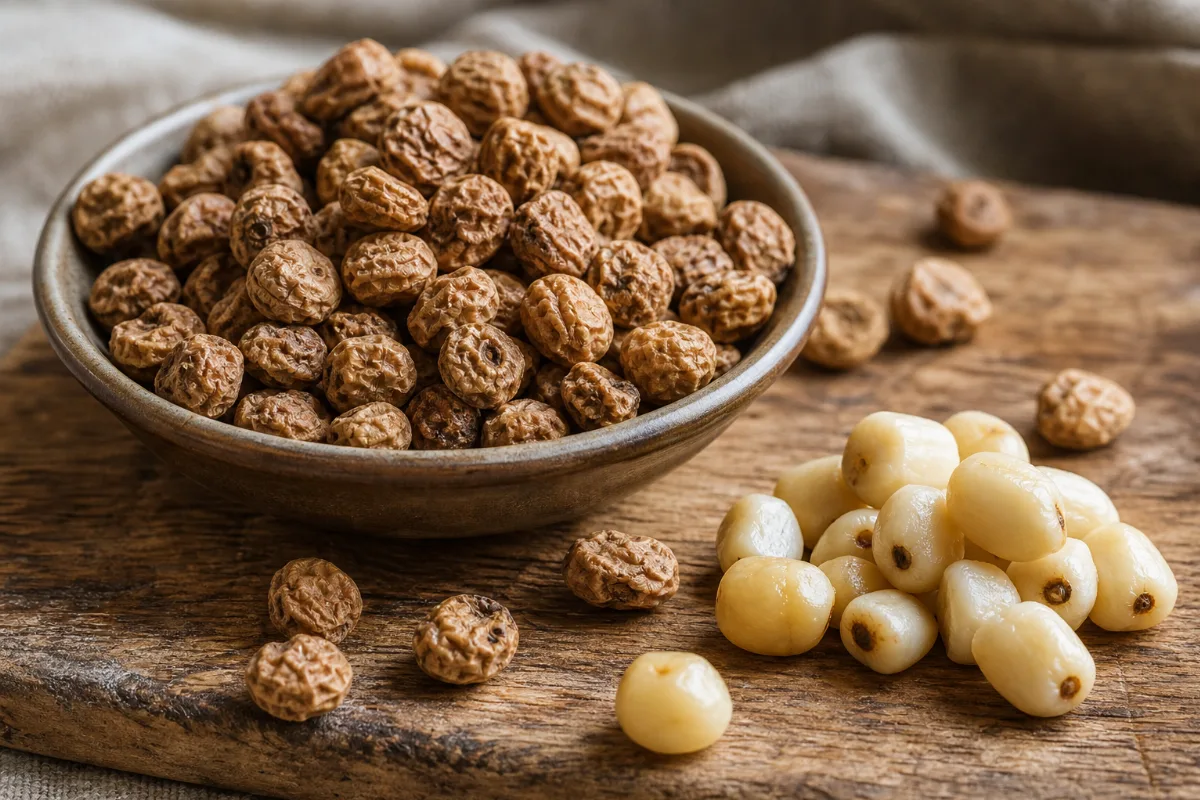
Nuts & Seeds · Nut/tuber
Tigernuts
Cyperus esculentus · also called Tiger nut, chufa, earth almond, yellow nutsedge, horchata de chufa (the drink)
Tigernuts are small, wrinkled tubers of a sedge plant. Despite the name they are not nuts. They are rich in starch, fibre and oleic-acid fat and are eaten dried or soaked, ground into flour, or pressed into the drink horchata de chufa. Research on eating them is thin: one small 3-day study of the drink and some lab work. The main cautions are allergy (rare, but anaphylaxis to tigernut milk has been reported) and mould toxins in some drinks.
General information, not medical advice. Last substantive update · Not medically reviewed. A named clinician has not signed off on this page. How this page is made
About Tigernuts
Tigernuts are small, sweet, nutty-tasting tubers, rich in starch, fibre and oleic-acid fat. They are a food, not a proven remedy, and little human research exists. Allergy is rare but real, and mould toxins have been found in some drinks.
What it is
Tigernuts (Cyperus esculentus) are the small underground tubers of a plant in the sedge family. They are not nuts. They are sold dried, as flour and as oil, and are pressed into horchata de chufa, a milky drink popular in Spain. A review describes them as roasted as a sweet snack in Egypt and grown widely, including as an important crop in the Spanish Mediterranean region.
USDA FoodData Central has no entry for tigernuts, so the numbers here come from a 2022 review. Per 100 g it reports 22.14-44.92 g fat, 23.21-48.12 g starch, 8.26-15.47 g fibre and 3.28-8.45 g protein. For 28 g (one ounce, our arithmetic) that is roughly 6-13 g fat, 6.5-13.5 g starch, 2-4 g fibre and 1-2 g protein. The review's ranges depend on the variety, and the part we read did not say whether they are for fresh or dry tubers. Oleic acid is the main fat, and potassium is the most abundant major mineral.
What the research shows
The firmest facts are about content: tigernuts are high in starch, fibre and oleic-acid fat.
The one human study we found had 31 healthy adults drink 300 mL of unsweetened horchata a day for 3 days. The group as a whole showed no clear change in gut bacteria. When people were sorted by their starting bacteria, some shifted toward profiles linked to butyrate production. There was no control group and no health result was measured.
Everything else is lab work: starch that resists digestion in a test-tube model, fibre that produced short-chain fatty acids in a test-tube gut model, and higher antioxidant activity in unpeeled tubers. One biscuit made mostly of tigernut flour had a glycemic index of 53.81. We found no human trial of blood sugar, cholesterol, weight or digestive symptoms.
Food versus oil, starch and extracts
The EU safety opinion covers cold-pressed tigernut oil only, and found the oil safe under its proposed conditions of use. Its protein was below detection. The lab studies used isolated starch and fibre complexes. None of these results carry over to eating the whole tuber or drinking the milk.
Amounts
This page gives no amounts to eat. Ask a doctor, pharmacist or dietitian what is right for you, especially if you have a food allergy or manage blood sugar.
At a glance
Traditional uses history, not proof
- Eaten dried or soaked, roasted as a sweet snack in Egypt, and pressed into horchata de chufa in Spain
- Long use as food is not proof that it treats any condition
Studied for research
- Fibre, starch and oleic-acid-rich fat in the tuber, moderate certainty for the content
- Gut bacteria (horchata drink), very low certainty
- Plant antioxidants in the peel, lab tests only
- Blood sugar and glycemic index, insufficient
- Fat quality (oleic acid), insufficient
Main compounds
- Starch (including resistant starch)
- Dietary fibre
- Oleic acid
- Phenolic compounds
Common forms
- Dried whole tubers (soaked before eating)
- Horchata (tigernut milk)
- Flour
- Cold-pressed oil (a different product)
Research links: Tiger nut: nutrition, processing, function and applications (2022 review) · Natural tiger nut drink and gut bacteria (2022) · EFSA opinion on tiger nut oil (2024) · Research Library · Genes & Biomarkers Library
What it is and its history
- Accepted scientific name
- Cyperus esculentus
- Naming authority
- L. (GBIF accepted)
- Common names
- Tigernut (English); Tiger nut (English); Chufa (English); Earth almond (English); Yellow nutsedge (English); Chufa (Spanish); Horchata de chufa (the drink) (Spanish)
- Family or group
- Cyperaceae (the sedge family), as given by GBIF.
- Classification
- Plantae > Tracheophyta > Liliopsida > Poales > Cyperaceae > Cyperus > Cyperus esculentus
- Native range
- Not verified from a source read.
- Habitat
- Not verified from a source read.
- What it looks like
- Roots: Not verified.; Stems: Not verified.; Leaves: Not verified.; Flowers: Not verified.; Fruit: The part eaten is the small underground tuber (the Yu 2022 review calls it the tiny tuber of Cyperus esculentus). It is a tuber, not a nut or a seed.
- Cultivation
- The Yu 2022 review says tigernuts are grown widely around the world and are an important crop in the Spanish Mediterranean region, with an annual production of 9000 metric tons (as reported there).
- Harvest and processing
- Eaten dried or soaked; roasted as a sweet snack in Egypt; pressed into horchata de chufa; made into flour, starch, oil, snacks and gluten-free bread (Yu 2022).
- Look-alikes and adulterants
- Name: Tree nuts and peanuts; Note: Tigernuts are tubers of a sedge, not nuts. Allergy to nuts and to tigernuts are different questions, and we found no source linking them.
- Sustainability and conservation
- Not assessed.
Photographs
What is inside, and how it may work
What it contains and how those compounds act in cells and animals. Laboratory and animal mechanisms are not proven effects in people.
Main compounds
| Compound | Family | Where it is concentrated | Activity studied | Level of evidence |
|---|---|---|---|---|
| Starch (including resistant starch) | carbohydrate | Tuber 23.21-48.12% of the tuber (review); resistant starch 33.55-38.31% of isolated starch in a lab digestion model | Resistant starch escapes digestion in a lab model and is fermented to short-chain fatty acids in test tubes. Not shown in people for tigernuts. 10 1 11 | In vitro |
| Oleic acid | fatty acid | Tuber and oil 65-69% of fatty acids in cold-pressed oil (EFSA) | Main fatty acid in tuber and oil; content only. 2 6 | Content only |
| Phenolic compounds | polyphenol | Peel Higher in unpeeled than peeled tubers (no number read) | Antioxidant activity in a test-tube assay only. 6 | In vitro |
Mechanisms, receptors and pathways
| Target or pathway | Gene or receptor | What was found | Level |
|---|---|---|---|
| Fermentation of resistant starch and fibre | Not specified | In lab fermentation, tiger nut starch and fibre complexes produced acetate and butyrate and changed the bacterial community. In 31 adults, 3 days of horchata shifted bacteria profiles in a way that depended on their starting bacteria. The authors link these profiles to butyrate production; this is a suggestion, not shown. 11 8 | In vitro and human uncontrolled |
Absorption, metabolism and elimination
- Absorption
- Not found for tigernut nutrients in the sources read.
- Distribution
- Not found.
- Metabolism
- Not found.
- Elimination
- Not found.
- Bioavailability
- Not established.
Isolated compounds versus whole extracts
Oil, isolated starch and purpose-made starch and fibre complexes were studied in several papers. Their results do not carry over to eating the whole tuber or drinking the milk. EFSA's safety opinion covers the oil only.
Nutritional composition
There is no USDA FoodData Central entry for tigernuts, so no USDA per-portion figures are given. From the Yu 2022 review (Foods; full text read 2026-10-26), per 100 g of tuber the reported ranges are: lipids 22.14-44.92 g, starch 23.21-48.12 g, fibre 8.26-15.47 g, protein 3.28-8.45 g and ash 1.60-2.60 g. The part we read did not say whether this is fresh or dry weight, and the range depends on variety. Per 28 g (one ounce, our arithmetic from the lower and upper ends of those ranges, assuming the figures apply to the dried tuber as sold): about 6.2-12.6 g fat, 6.5-13.5 g starch, 2.3-4.3 g fibre and 0.9-2.4 g protein. A 2026 study found oleic acid the main fatty acid and potassium the most abundant major mineral; other mineral amounts were not extracted. One tigernut biscuit (58.4% tiger nut flour with other ingredients) had 18.95 g fibre and 449.86 kcal per 100 g, which is the biscuit, not the tuber. No energy figure for the plain tuber was read.
1 moderate certainty1 very low certainty3 not enough evidence
What was looked at
The 5 benefits and uses checked for Tigernuts, each with how strong the evidence is. Tap one to open it.
- Fibre, starch and oleic-acid-rich fat in the tuberModerate certainty
- Gut bacteria (horchata drink, 3 days)Very low certainty
- Plant antioxidants in the peel (lab tests)Not enough evidence
- Blood sugar and glycemic indexNot enough evidence
- Fat quality (oleic acid)Not enough evidence
Lab markers tracked in the studies
Gut bacteria profileGlycemic index of a tigernut biscuit
What is Tigernuts good for?
The main studied uses and how strong the human evidence is for each. Research on tigernuts is limited, and much of it is lab work.
Benefits, one by one
Each card is a research question, not a promise. Tap a goal to filter. Open a card to see the studies, doses and limits.
Fibre, starch and oleic-acid-rich fat in the tuber
Moderate certaintyTigernuts are small tubers that are rich in starch, fibre and fat, mostly oleic acid. This is what the food contains. It is not a trial of health effects.
2 studiesDried whole tubers (soaked before eating), flour, and the drink. Valu…
Studies, doses and limits
What the trials found
A 2022 review gives ranges for the tuber: 22.14-44.92% lipids, 23.21-48.12% starch, 8.26-15.47% fibre, 3.28-8.45% protein and 1.60-2.60% ash. A 2026 study of fatty acids in a Valencia tiger nut oil sample and in tubers found oleic acid the main fatty acid, and potassium the most abundant major mineral in the tubers.
Results
Tigernuts are a starchy, fibre-rich, fatty tuber. USDA FoodData Central has no entry for them, so these ranges come from one review and vary by variety and by dry or fresh weight.
Effect sizes as reported
Per 100 g (review ranges): lipids 22.14-44.92 g; starch 23.21-48.12 g; fibre 8.26-15.47 g; protein 3.28-8.45 g.
Why this rating
Moderate for the broad picture that the tuber is high in starch, fibre and fat. The ranges are wide and the part of the review we read did not say whether they are fresh or dry weight.
Form and dose studied
Dried whole tubers (soaked before eating), flour, and the drink. Values differ between them.
Who was studied
General diet.
Limits
A content range is not a health effect. The basis (fresh or dry) was not stated in the part read, and there is no USDA entry to check against.
Why researchers looked
People ask what tigernuts add to the diet, since they are sold as a snack, a flour and a milk.
Traditional use
Tigernuts are eaten dried or soaked, ground into flour, and pressed into horchata de chufa, a milky drink from Spain. Long use as food is not proof that they treat any condition.
Proposed mechanism Nutrient content
Not a mechanism claim. Content only.
A proposed mechanism does not show that the effect happens in people.
Allergy and mould cautions are on the Safety tab.
Gut bacteria (horchata drink, 3 days)
Very low certaintyIn one small study, healthy adults drank tigernut milk for 3 days and their gut bacteria shifted. The shift depended on each person's starting bacteria, and the whole group showed no clear change.
3 studiesUnsweetened horchata (drink); lab studies used isolated starch and fi…
Studies, doses and limits
What the trials found
A 2022 study gave 31 healthy adults 300 mL a day of unsweetened, unprocessed horchata for 3 days. There was no clear change in the group as a whole. When people were sorted by their starting bacteria, the bacteria after the drink formed two groups, one with more Akkermansia, Christensenellaceae and Clostridiales, the other with more Faecalibacterium, Bifidobacterium and Lachnospira. The authors link these profiles to butyrate production. There was no control group and no health outcome was measured. In test tubes, tiger nut starch had 33.55-38.31% resistant starch, and fermenting purpose-made starch and fibre complexes produced acetate and butyrate.
Results
A few days of horchata changed the make-up of gut bacteria in some people, in a way that depended on where they started. No benefit to health was measured.
Effect sizes as reported
No effect overall; sub-group changes only. Lab: resistant starch 33.55-38.31% in a digestion model.
Why this rating
Very low: one small uncontrolled 3-day study of a drink, with no health outcome, plus lab work that is not in people.
Form and dose studied
Unsweetened horchata (drink); lab studies used isolated starch and fibre complexes, not the whole food.
Who was studied
Healthy adults in Spain.
Limits
No control group, only 3 days, 31 people, and bacteria counts are not a health result. The lab work used isolated starch and fibre.
Why researchers looked
Tigernuts are high in fibre and in a starch that is hard to digest. Fibre and this kind of starch can feed gut bacteria, so researchers looked at the gut.
Traditional use
Tigernuts are eaten dried or soaked, ground into flour, and pressed into horchata de chufa, a milky drink from Spain. Long use as food is not proof that they treat any condition.
Proposed mechanism Human uncontrolled and in vitro
The authors suggest the fibre, a high-amylose starch and polyphenols may feed bacteria that make butyrate. Lab fermentation studies of tiger nut starch and fibre made short-chain fatty acids in test tubes. Not shown in people for the whole food.
A proposed mechanism does not show that the effect happens in people.
A fibre-rich food can cause gas or bloating in some people. We found no tigernut study that measured this.
Plant antioxidants in the peel (lab tests)
Not enough evidenceIn a lab test, tigernuts with the peel left on had far more antioxidant activity and plant phenols than peeled ones. This was measured in a test tube, not in people.
2 studiesWhole or peeled tubers in a lab test.
Studies, doses and limits
What the trials found
A 2026 study compared natural and peeled tiger nut tubers and a tiger nut oil. Natural tubers had substantially higher antioxidant activity and total phenolic content than peeled tubers, which suggests the peel holds most of the phenols. The 2022 review also lists radical-scavenging and anti-inflammatory effects from lab and animal work.
Results
Lab antioxidant activity is higher with the peel on. Nothing was measured in people.
Effect sizes as reported
Qualitative lab result (natural tubers higher than peeled).
Why this rating
Insufficient: test-tube assays only, and no human outcome.
Form and dose studied
Whole or peeled tubers in a lab test.
Limits
Test-tube antioxidant scores do not show a health effect in people.
Why researchers looked
Plant phenols are measured because they can mop up reactive molecules in test-tube assays.
Traditional use
Tigernuts are eaten dried or soaked, ground into flour, and pressed into horchata de chufa, a milky drink from Spain. Long use as food is not proof that they treat any condition.
Proposed mechanism Laboratory research
Antioxidant activity was measured with a DPPH colour test and phenols with a Folin-Ciocalteu test. No human effect was measured.
A proposed mechanism does not show that the effect happens in people.
None specific.
Blood sugar and glycemic index
Not enough evidenceNo human trial of tigernuts on blood sugar was found. One biscuit made mostly of tigernut flour tested at a glycemic index of 53.81, and starch from tigernuts resisted digestion in a lab model.
2 studiesA biscuit made of tiger nut flour with other ingredients; isolated st…
Studies, doses and limits
What the trials found
A 2026 product study made a gluten-free biscuit from tiger nut flour (58.4%), dana flour and an avocado-margarine fat. It had a glycemic index of 53.81 (plus or minus 5.48) and glycemic load of 3.4, which the authors call low. A 2026 lab study found 33.55-38.31% resistant starch in starch from three tiger nut varieties.
Results
A tigernut biscuit tested as a medium-to-low glycemic index food. That is a product test, not a study of the tuber or of diabetes.
Effect sizes as reported
Biscuit glycemic index 53.81 plus or minus 5.48; glycemic load 3.4. Resistant starch 33.55-38.31% (lab).
Why this rating
Insufficient: one product test of a mixed biscuit and one lab digestion study. No trial of the tuber in people with or without diabetes.
Form and dose studied
A biscuit made of tiger nut flour with other ingredients; isolated starch in the lab.
Limits
The biscuit contained other ingredients. The abstract does not say how many people were tested. Does not show an effect on blood sugar control.
Why researchers looked
Resistant starch is digested slowly, so people ask whether tigernuts help with blood sugar.
Traditional use
Tigernuts are eaten dried or soaked, ground into flour, and pressed into horchata de chufa, a milky drink from Spain. Long use as food is not proof that they treat any condition.
Proposed mechanism Laboratory research
Resistant starch escapes digestion in the small intestine in lab models. Not tested in people for tigernuts.
A proposed mechanism does not show that the effect happens in people.
People who manage diabetes should ask their care team before changing foods.
Fat quality (oleic acid)
Not enough evidenceThe fat in tigernuts is mostly oleic acid, the main fat in olive oil. Whether eating tigernuts helps the heart has not been studied in people.
2 studiesTubers and cold-pressed oil. The oil is a different product from the …
Studies, doses and limits
What the trials found
A 2026 study found oleic acid the main fatty acid in tubers and oil, and calculated favourable lipid indices (PUFA/SFA above 0.50, low atherogenicity and thrombogenicity). EFSA (2024) reports oleic acid at 65-69% of the fatty acids in cold-pressed tiger nut oil.
Results
The fat is mostly oleic acid. No trial measured cholesterol, blood pressure or heart disease.
Effect sizes as reported
Oleic acid 65-69% of fatty acids in the oil (EFSA).
Why this rating
Insufficient: content figures and calculated indices only; no human outcome.
Form and dose studied
Tubers and cold-pressed oil. The oil is a different product from the tuber.
Limits
Calculated indices are not clinical results. Findings for the oil do not apply to eating the tuber.
Why researchers looked
Oleic-acid-rich fats are linked in general to better fat quality, so people ask about tigernuts and the heart.
Traditional use
Tigernuts are eaten dried or soaked, ground into flour, and pressed into horchata de chufa, a milky drink from Spain. Long use as food is not proof that they treat any condition.
Proposed mechanism Nutrient content
Content only. The 2026 study calculated fat-quality indices from the fatty acid profile.
A proposed mechanism does not show that the effect happens in people.
None specific.
Connections to the rest of health
How Tigernuts connects to the rest of our health knowledge graph. Every link says what kind of connection it is. A safety link (for example to the liver) is a warning, not a benefit. A study that merely mentions a topic never creates a benefit link.
Explore every connection: goals, body systems, organs, symptoms, genes
A. Wellness goals
| Connected to | Kind of connection | Evidence status | Context | Studies |
|---|---|---|---|---|
| Gut Health | Biological association | Very low certainty | Gut bacteria (horchata drink, 3 days): In one small study, healthy adults drank tigernut milk for 3 days and their gut bacteria shifted. The shift depended on each person's starting bacteria, and the whole group showed no clear change. | 8 1 11 |
| Blood Sugar Balance | Biological association | Not enough evidence | Blood sugar and glycemic index: No human trial of tigernuts on blood sugar was found. One biscuit made mostly of tigernut flour tested at a glycemic index of 53.81, and starch from tigernuts resisted digestion in a lab model. | 9 1 |
| Heart Health | Biological association | Not enough evidence | Fat quality (oleic acid): The fat in tigernuts is mostly oleic acid, the main fat in olive oil. Whether eating tigernuts helps the heart has not been studied in people. | 6 2 |
B. Body systems
| Connected to | Kind of connection | Evidence status | Context | Studies |
|---|---|---|---|---|
| Digestive System | Biological association | Moderate certainty | Studied for: Fibre, starch and oleic-acid-rich fat in the tuber Studied for: Gut bacteria (horchata drink, 3 days) | 10 6 8 1 11 |
| Whole Body Balance | Biological association | Not enough evidence | Studied for: Plant antioxidants in the peel (lab tests) | 6 10 |
| Endocrine System | Biological association | Not enough evidence | Studied for: Blood sugar and glycemic index | 9 1 |
| Cardiovascular System | Biological association | Not enough evidence | Studied for: Fat quality (oleic acid) | 6 2 |
E. Health conditions
| Connected to | Kind of connection | Evidence status | Context | Studies |
|---|---|---|---|---|
| Food allergy | Adverse effect or risk | Documented risk | Allergy appears rare but case reports include anaphylaxis to tigernut milk. Tigernut allergy looks rare, but anaphylaxis to tigernut milk has been reported. Preparation or compound: Tigernuts and tigernut milk as food |
2 5 4 3 |
I. Biomarkers
| Connected to | Kind of connection | Evidence status | Context | Studies |
|---|---|---|---|---|
| Gut bacteria profile | Biological association | Very low certainty | Measured in trials: changed. A lab change is not the same as a health benefit. | 8 |
| Glycemic index of a tigernut biscuit | Biological association | Not enough evidence | Measured in trials: measured. A lab change is not the same as a health benefit. | 9 |
K. Biological pathways
L. Active compounds
| Connected to | Kind of connection | Evidence status | Context | Studies |
|---|---|---|---|---|
| Starch (including resistant starch) | Biological association | In vitro | Resistant starch escapes digestion in a lab model and is fermented to short-chain fatty acids in test tubes. Not shown in people for tigernuts. Preparation or compound: Tuber |
10 1 11 |
| Oleic acid | Biological association | Content only | Main fatty acid in tuber and oil; content only. Preparation or compound: Tuber and oil |
2 6 |
| Phenolic compounds | Biological association | In vitro | Antioxidant activity in a test-tube assay only. Preparation or compound: Peel |
6 |
Each connection is stored with the ingredient, the connected record, the kind of connection, the evidence status, the supporting studies, the preparation or compound involved, and a review date (last reviewed October 26, 2026).
Evidence at a glance: what the research found for 5 outcomes
Each outcome below is one thing researchers measured. Certainty is how far the evidence can be trusted, not how well it works. The full studies are on the next tab.
The evidence
The research centre for Tigernuts. Every record here was checked against PubMed or the publisher's page; we never list a study we have not verified.
Evidence by outcome
Bars show how many studies we found for each outcome, not how well it works. People are added up across trials only (reviews are not added, to avoid double counting).
How we rate evidence
High certainty
Several well-run trials or reviews agree; further research is unlikely to change the picture much.
Moderate certainty
Good trials point the same way, but some doubt remains.
Low certainty
Small, short or inconsistent trials. The finding could change with better research.
Very low certainty
Very little or very weak human data. Treat as a possibility only.
Mixed findings
Trials or reviews disagree with each other.
Not enough evidence
Not enough human research to say either way.
Evidence against
Good research found no benefit, or found harm.
We take the reviewers' own risk-of-bias and GRADE statements where they exist, and otherwise judge from study size, design, consistency, directness and whether a product matches what is sold. Many publications do not make evidence high. Method note: We started from our existing tigernut summary, re-opened each paper in PubMed and read its abstract, read the nutrition ranges and the allergy section in the open full texts of the 2022 review and the EFSA opinion, and read the MedlinePlus aflatoxin page. The three allergy case reports had no abstract, so only their titles were read. Items we could not verify are flagged in the research gaps.
Study library: every study we checked 13
| Study | Design | People | Product, dose, length | Result |
|---|---|---|---|---|
| Chen 2026 Starches from Different Tiger Nut Varieties: A Comparative Study of Multi-Scale Structural Characteristics, Functional Properties, and In Vitro Digestibility. Foods · PMID 42279703 · DOI |
Laboratory study in vitro |
Starch isolated from three Chinese tiger nut varieties | Isolated starch Tuber starch In vitro digestion over 120 minutes |
Amylose was 22.82-26.99%. In a test-tube digestion model, starch was digested fast in the first 30 minutes and slowly after. Resistant starch (starch not digested in the model) ranged from 33.55% to 38.31%. Higher amylose and crystallinity went with more resistance to digestion. Resistant starch 33.55-38.31% across the three varieties (lab model). (Not applicable.) Methods, limits and fundingOutcomes: Starch structure, amylose, in vitro digestibility Limitations: Test-tube digestion of isolated starch, not a human study and not the whole tuber. Funding and conflicts: Authors declared no conflicts of interest. Read: abstract |
| EFSA Panel on Nutrition 2024 Safety of Tiger nuts (Cyperus esculentus) oil as a novel food pursuant to Regulation (EU) 2015/2283. EFSA J · PMID 39606089 · DOI |
Regulatory opinion n/a |
EU food-safety opinion on cold-pressed tiger nut oil | Cold-pressed tiger nut oil (not the whole tuber) Oil Proposed uses (not stated here) |
Oleic acid is 65-69% of the oil's fatty acids. The Panel concluded the oil is safe under the proposed conditions of use and that no toxicology studies were required, given the process, composition and history of use of the source. In the allergenicity section it notes that tiger nut allergy seems rare with no prevalence data, cites two case reports, and describes one case of occupational hypersensitivity pneumonitis from tiger nut dust. Protein in the oil was below the limit of quantification (0.5 g/100 g). Not applicable. (Not applicable.) Methods, limits and fundingOutcomes: Safety under proposed conditions of use Limitations: An opinion about the oil only. It does not cover eating the tubers or the milk. Abstract and full text read via Europe PMC. Funding and conflicts: Independent EU agency opinion. Read: abstract + full text (allergenicity section) |
| Galindo Bonilla 2002 Allergy to tiger nut. Allergy · PMID 12359015 · DOI |
Case report |
Allergy case report (Ciudad Real, Spain); record only, no abstract | Tiger nut Tuber |
The PubMed record shows only the title: a report of allergy to tiger nut. No abstract was available. Not applicable. (Not applicable.) Methods, limits and fundingOutcomes: Allergy Limitations: Only the title was available. Funding and conflicts: Not stated. Read: record-only |
| Gonzalez-De-Olano 2013 Pollen-food syndrome involving allergy to tiger nut. J Investig Allergol Clin Immunol · PMID 23967759 |
Case report |
Allergy case report (Spain); record only, no abstract | Tiger nut Tuber |
The PubMed record shows only the title: a case report of pollen-food syndrome with tiger nut allergy. No abstract was available. Not applicable. (Not applicable.) Methods, limits and fundingOutcomes: Allergy Limitations: Only the title was available. Funding and conflicts: Not stated. Read: record-only |
| Juarez Rodriguez 2024 Anaphylaxis to tiger nut milk: Analysis of individual allergens profile. Ann Allergy Asthma Immunol · PMID 38848871 · DOI |
Case report |
Allergy case report (Madrid, Spain); record only, no abstract | Tiger nut milk Drink |
The PubMed record shows only the title: a letter about anaphylaxis to tiger nut milk. No abstract was available, so details were not read. Not applicable. (Not applicable.) Methods, limits and fundingOutcomes: Anaphylaxis, allergen profile Limitations: Only the title was available. Funding and conflicts: Authors declared no conflicts of interest. Read: record-only |
| Knazicka 2026 Biological Properties, Mineral Composition, and Health-Promoting Potential of Tiger Nut Tubers (Cyperus esculentus L.) as a Novel and Underutilized Food Source. Foods · PMID 41596791 · DOI |
Laboratory study in vitro |
Natural and peeled tiger nut tubers, plus Spanish (Valencia) tiger nut oil | Tuber (natural and peeled) and cold-pressed oil Tuber and oil · vs Peeled versus natural tubers |
Natural (unpeeled) tubers had much higher antioxidant activity and total phenolic content than peeled tubers, so the peel holds most of the phenolics. Oleic acid was the main fatty acid. Potassium was the most abundant major mineral. The trace elements found included aluminium, iron, zinc, copper, selenium and arsenic. All the target hazard quotients the authors calculated were below 1, which they read as no appreciable health risk. Hazard quotients below 1 (calculated estimate). (Not given in the abstract.) Methods, limits and fundingOutcomes: Antioxidant activity (DPPH), total phenolics, fatty acids, minerals, estimated health risk from trace elements Limitations: Chemical tests on a few samples; the risk figures are calculations, not measured health outcomes. Antioxidant tests in a tube do not show effects in people. Funding and conflicts: Authors declared no conflicts of interest. Read: abstract |
| Mahmud 2026 Aflatoxins, ochratoxin A and zearalenone in tiger nut drinks in Lagos, Nigeria. Food Addit Contam Part B Surveill · PMID 42374804 · DOI |
Surveillance study n/a |
30 30 tiger nut drink samples from Lagos, Nigeria |
Tiger nut drinks (laboratory measurement of mould toxins) Tuber drink |
Tiger nuts are prone to fungal contamination. Contamination rates were 13.3% for aflatoxin B1, 6.7% for total aflatoxins, 30% for ochratoxin A and 20% for zearalenone. The abstract does not give how many samples were over legal limits. AFB1 13.3%, total aflatoxins 6.7%, OTA 30%, ZEN 20% of 30 samples. (Not applicable.) Methods, limits and fundingOutcomes: Aflatoxins, ochratoxin A, zearalenone Limitations: One city, 30 samples, and the abstract does not state the amounts against legal limits. Cannot be applied to tigernut drinks or tubers elsewhere. Funding and conflicts: Authors from a national food agency laboratory and university; no conflict statement in the abstract. Read: abstract |
| Selma-Royo 2022 Intake of Natural, Unprocessed Tiger Nuts (Cyperus esculentus L.) Drink Significantly Favors Intestinal Beneficial Bacteria in a Short Period of Time. Nutrients · PMID 35565679 · DOI |
Uncontrolled intervention |
31 31 healthy adult volunteers (Valencia, Spain) |
Natural, unprocessed horchata (tiger nut drink), no added sugar Tuber, as a drink 300 mL a day 3 days |
No clear change in the gut bacteria of the whole group. When volunteers were grouped by their starting bacteria (three groups), they ended in two groups, one rich in Akkermansia, Christensenellaceae and Clostridiales and one with more Faecalibacterium, Bifidobacterium and Lachnospira. The effect depended on each person's starting gut bacteria, and the profiles were linked to butyrate production. No overall effect; changes only in sub-groups. (Not reported in the abstract.) Methods, limits and fundingOutcomes: Gut bacteria profiles Limitations: Only 3 days, no control group, small, healthy adults, a drink and not the whole tuber. Changes in bacteria names do not show a health benefit. Funding and conflicts: Authors declared no conflict of interest; funders had no role in design, analysis or publication. Read: abstract |
| Tazoho 2026 Formulation of Gluten-Free Biscuits Based on Tiger Nut, Dana, and Mixture of Avocado and Margarine: Nutritional Composition and Glycemic Index of Optimal Sample. Food Sci Nutr · PMID 42088465 · DOI |
Product development study |
Gluten-free biscuit made with tiger nut flour (58.4%), dana (Dioscorea bulbifera) flour and an avocado-margarine fat | Biscuit containing tiger nut flour Tuber flour in a mixed product Not given in the abstract |
The best biscuit had 18.95 g fibre and 449.86 kcal per 100 g, a glycemic index of 53.81 (plus or minus 5.48) and a glycemic load of 3.4. The authors call it a promising snack for people at risk of diabetes. Glycemic index 53.81 plus or minus 5.48; glycemic load 3.4. (Not applicable.) Methods, limits and fundingOutcomes: Biscuit composition and glycemic index Limitations: A mixed biscuit, not tigernuts alone. The abstract does not say how many people took part in the glycemic index test. It does not show an effect on blood sugar control. Funding and conflicts: Authors declared no conflicts of interest. Read: abstract |
| Yu 2022 Tiger Nut (Cyperus esculentus L.): Nutrition, Processing, Function and Applications. Foods · PMID 35206077 · DOI |
Narrative review mixed |
Narrative review of the composition, processing and uses of tiger nut tubers | Tiger nut tuber (and extracted oil, starch and protein) Tuber |
The review describes tiger nuts as containing lipids, protein, starch, fibre, vitamins, minerals and bioactive factors. Full text gives ranges of 22.14-44.92% lipids, 3.28-8.45% protein, 23.21-48.12% starch, 8.26-15.47% fibre and 1.60-2.60% ash. Tiger nut is made into milk, snacks, drinks and gluten-free bread. The abstract says it has radical-scavenging and anti-inflammatory effects in lab and animal work. Not applicable (descriptive). (Not applicable.) Methods, limits and fundingOutcomes: Composition, processing methods, functional properties, food uses Limitations: A narrative review, not a systematic one. Composition ranges are not on a stated fresh or dry basis in the part read. Health effects named in the abstract come from lab and animal work. Funding and conflicts: Authors declared no conflict of interest. Read: abstract + full text (composition ranges) |
| Zhuang 2026 Short-chain fatty acid and gut microbiota character following synergistic in vitro fermentation of resistant starch-dietary fiber complexes from tiger nuts. J Sci Food Agric · PMID 41830220 · DOI |
Laboratory study in vitro |
Three resistant starch + insoluble fibre complexes made from tiger nuts, fermented in a test-tube gut model | Prepared complexes of resistant starch and fibre Tuber fractions 24 hours of fermentation |
The complex with a resistant starch to fibre ratio of 40/60 produced the most acetate and butyrate in the lab fermentation, with more Prevotella and fewer Proteobacteria and Escherichia-Shigella. Butyrate rose with Faecalibacterium early and Bifidobacterium later. Qualitative lab findings. (Not applicable.) Methods, limits and fundingOutcomes: Short-chain fatty acids, microbial community Limitations: Lab fermentation of purpose-made complexes, not whole tigernuts, and not people. Funding and conflicts: Not stated in the abstract. Read: abstract |
| s-gbif-cyperus-esculentus GBIF Backbone: Cyperus esculentus L. (usageKey 2716226) · Source |
Reference database n/a |
Methods, limits and fundingRead: full-text | ||
| s-medlineplus-aflatoxin MedlinePlus Medical Encyclopedia: Aflatoxin · Source |
Health agency n/a |
Methods, limits and fundingRead: full-text |
What we do not know yet
- No trial of eating whole tigernuts was found for gut symptoms, blood sugar, cholesterol, weight or digestion.
- The only human study lasted 3 days, had no control group and used a drink.
- No USDA entry exists; nutrient ranges come from one review and their fresh or dry basis was not stated.
- Allergy details come from three case-report records (titles only) and the EFSA opinion text.
- Pregnancy, breastfeeding, children, medicine interactions, bloating and levels of mould toxins in tubers sold elsewhere were not researched.
How new research is added
New studies are found by a saved PubMed search and placed in a review queue before the page changes.
Lab markers
What changed in blood or saliva tests during trials. A changed number is not the same as feeling or being healthier, and we give no "normal ranges".
Other 2
Gut bacteria profile
Changed in trials
The mix of bacteria in the gut, measured from a stool sample. A different mix is not by itself good or bad.
Very low certaintyResults and what it means
Why it was measured
Researchers check whether a food changes the gut bacteria that make short-chain fatty acids such as butyrate.
Statistical vs. clinical meaning
A shift in bacteria names was seen in sub-groups. It does not show any benefit to health.
Safety implication
None specific.
| Study | Result | People | Product |
|---|---|---|---|
| 8 | No clear change for the whole group. After drinking horchata, volunteers sorted into two bacteria profiles, one with more Akkermansia, Christensenellaceae and Clostridiales, the other with more Faecalibacterium, Bifidobacterium and Lachnospira. The change depended on each person's starting bacteria. | 31 healthy adults, Spain | 300 mL a day of unsweetened horchata for 3 days, no control group |
Glycemic index of a tigernut biscuit
Measured in trials
A score for how quickly a food raises blood sugar compared with a reference food. Lower scores mean a slower rise.
Not enough evidenceResults and what it means
Why it was measured
The authors wanted a gluten-free snack with a lower blood sugar response.
Statistical vs. clinical meaning
A product score, not a result for the tuber.
Safety implication
None specific.
| Study | Result | People | Product |
|---|---|---|---|
| 9 | Glycemic index 53.81 plus or minus 5.48 and glycemic load 3.4 for a biscuit with 58.4% tiger nut flour, dana flour and an avocado-margarine fat | Not given in the abstract | A mixed biscuit, not tigernuts alone |
Safety
What studies and official sources say about side effects, medicines and who should check first. Each point shows what kind of evidence it comes from.
Main points to know 2
- Allergy to tigernuts looks rare but has been reported, including anaphylaxis to tigernut milk. EFSA says tigernut allergy seems to be rare, with no data on how common it is. Case reports describe allergy to tigernut, pollen-food syndrome with tigernut allergy, and anaphylaxis to tigernut milk. For the three case reports only the PubMed record (title) was available, so we could not read details. A tigernut is a tuber of a sedge, not a tree nut, and we found no source on whether people with tree nut or peanut allergy react to it. Case report 2 5 4 3
- Mould toxins were found in some tigernut drinks in one city. In 30 tigernut drinks from Lagos, Nigeria, aflatoxin B1 was found in 13.3%, total aflatoxins in 6.7%, ochratoxin A in 30% and zearalenone in 20%. The abstract does not say how many were over legal limits. MedlinePlus says aflatoxins come from a mould that grows on nuts, seeds and legumes, and that large amounts may cause acute liver damage. It advises discarding nuts that look mouldy, discoloured or shrivelled. Surveillance study 7 13
Side effects 2
| Effect | How often | Severity and recovery | Evidence |
|---|---|---|---|
| Allergic reactions to tigernut, from mouth and skin symptoms to anaphylaxis Case reports cannot give how common reactions are. | EFSA: allergy seems rare, no prevalence data. | Can be severe (anaphylaxis reported with tigernut milk) Not stated (records only) | Case report 2 5 4 3 |
| Hypersensitivity pneumonitis from breathing tigernut dust at work A work exposure to dust, not from eating. | One case described in the EFSA opinion | Not stated Not stated | Case report 2 |
Liver
No liver injury from eating tigernuts was found in the sources read. LiverTox was not searched for this page. Aflatoxins from mould can harm the liver in large amounts (MedlinePlus), which is why mouldy nuts should be thrown away. 13
How often. No frequency was found.
Monitoring. No agency monitoring advice was found.
This is a safety connection. It is not evidence that Tigernuts supports liver health.
Medicines and supplements 1
| With | Why it matters | Importance | Evidence | What to do |
|---|---|---|---|---|
| Medicines in general drug | No tigernut-medicine interaction was found in the sources read. | Unknown. Absence of a report is not proof that there is no interaction. | None found Not enough evidence | If you take regular medicines, ask your pharmacist if you have questions. |
Who should check first 2
| Situation | Advice | Evidence |
|---|---|---|
| Known or suspected tigernut allergy | Avoid tigernuts and products that contain them (including tigernut milk and flour), and see an allergy specialist. | Case report 5 4 3 |
| Tigernuts that look mouldy, discoloured or shrivelled | Throw them away. MedlinePlus gives this advice for nuts, seeds and legumes in general. | Authoritative guidance 13 |
Overdose, product quality and regulators
Summary. No toxicity from tigernuts as ordinary food was found in the sources read. EFSA considered no toxicology studies necessary for the oil, based on its composition and history of use.
Animal. Not reviewed.
Human doses studied. The horchata study gave 300 mL a day for 3 days to healthy adults; no side effects were mentioned in the abstract.
High dose or long term signals. Not found.
Overdose response. Not found.
Genotoxicity. Not researched.
Toxic or hazardous parts. Not found for the tuber.
Mould toxins were found in some tigernut drinks in one city. Trace elements were measured in tubers in one study. Pesticide residues and other contaminants were not researched.
Mould toxins. 13.3% of 30 tigernut drinks in Lagos had aflatoxin B1, 30% had ochratoxin A and 20% had zearalenone. Amounts against legal limits were not given in the abstract. 7
Trace elements. In tuber samples, trace elements were measured (arsenic is on the list the authors report). The authors' calculated hazard quotients were all below 1, which they read as no appreciable health risk. This is a calculation from a few samples. 6
| Body | Action | Date |
|---|---|---|
| European Food Safety Authority (EU) (European Union) | Concluded that cold-pressed tiger nut oil is safe under the proposed conditions of use as a novel food. The opinion covers the oil only; it notes tiger nut allergy seems rare and that the oil's protein was below detection. source | 2024-11-27 |
| MedlinePlus (US National Library of Medicine) (United States) | General aflatoxin guidance for nuts, seeds and legumes: low levels allowed as unavoidable, large amounts may harm the liver, discard mouldy, discoloured or shrivelled nuts. source | 2026-10-26 |
When to get medical help
- Trouble breathing, swelling of the face or throat, widespread hives, or faintness after eating tigernuts or tigernut milk: call emergency services.
Stop using the product and contact a clinician or emergency service. In the US, Poison Control is 1-800-222-1222.
General information only, not medical advice. Ask a clinician or pharmacist before use, especially with medicines, in pregnancy or with a health condition. See the Natural Remedy Safety guide.
Frequently asked questions
What are tigernuts?
They are small tubers of a sedge plant, Cyperus esculentus, not nuts. They are eaten dried or soaked, ground into flour, or pressed into horchata de chufa.
What are tigernuts good for?
Are tigernuts really nuts?
Are tigernuts good for the gut?
One 3-day study of 31 healthy adults who drank horchata found gut bacteria shifted in some people, depending on their starting bacteria. It had no control group and measured no health result.
Do tigernuts have resistant starch?
In a test-tube digestion model, starch from three varieties was 33.55-38.31% resistant. That is lab work on isolated starch, not a study in people.
Are tigernuts good for blood sugar or diabetes?
No human trial of the tuber was found. A biscuit made mostly of tigernut flour had a glycemic index of 53.81, which is a product test and not proof of an effect.
Do tigernuts have antioxidants?
In lab tests, unpeeled tubers had higher antioxidant activity and phenols than peeled ones. This was not tested in people.
Can you be allergic to tigernuts?
Can tigernut drinks contain mould toxins?
In one survey of 30 tigernut drinks in Lagos, Nigeria, 13.3% had aflatoxin B1 and 30% had ochratoxin A. It is one city, so it cannot show what is true elsewhere.
What does MedlinePlus say about mouldy nuts?
It says aflatoxins grow on nuts, seeds and legumes, that large amounts may harm the liver, and that you should discard any that look mouldy, discoloured or shrivelled. It does not name tigernuts.
Is tigernut oil the same as eating tigernuts?
No. The EU opinion found the cold-pressed oil safe under proposed uses, and the oil had almost no protein. It does not cover the tuber or the milk.
Are tigernuts safe in pregnancy or for children?
We found no official statement or study on tigernuts in pregnancy, breastfeeding or young children. Ask a doctor or pharmacist.
Explore by health goal
Editorial transparency
- Written by
- AlternativeMed editorial team. Research compiled with AI assistance, then checked against the sources listed.
- Medical review
- None. This page has not been reviewed by a physician or pharmacist.
- First published
- 2026-10-26
- Last substantive update
- 2026-10-26
- How we research
- We started from our existing tigernut summary, re-opened each paper in PubMed and read its abstract, read the nutrition ranges and the allergy section in the open full texts of the 2022 review and the EFSA opinion, and read the MedlinePlus aflatoxin page. The three allergy case reports had no abstract, so only their titles were read. Items we could not verify are flagged in the research gaps.
- How we rate evidence
- See "How we rate evidence" in the Evidence tab.
- Independence
- No product is promoted on this page. No affiliate links are shown.
Sources 13
Each source was opened and checked. Where we read only the abstract, it says so. The small numbers in the text point here.
- Chen Y, Liu C, Zhao Z, et al.. Starches from Different Tiger Nut Varieties: A Comparative Study of Multi-Scale Structural Characteristics, Functional Properties, and In Vitro Digestibility.. Foods. 2026. PMID 42279703. DOI 10.3390/foods15111915. (abstract)
- EFSA Panel on Nutrition, Novel Foods and Food Allergens (NDA); Turck D, et al.. Safety of Tiger nuts (Cyperus esculentus) oil as a novel food pursuant to Regulation (EU) 2015/2283.. EFSA J. 2024. PMID 39606089. DOI 10.2903/j.efsa.2024.9102. (abstract + full text (allergenicity section))
- Galindo Bonilla PA, Gomez Torrijos E, Borja Segade J, et al.. Allergy to tiger nut.. Allergy. 2002. PMID 12359015. DOI 10.1034/j.1398-9995.2002.23836_5.x. (record-only)
- Gonzalez-De-Olano D, Gonzalez-Mancebo E, Mohedano-Vicente E, et al.. Pollen-food syndrome involving allergy to tiger nut.. J Investig Allergol Clin Immunol. 2013. PMID 23967759. (record-only)
- Juarez Rodriguez C, Barranco Jimenez R, Valdelvira R, et al.. Anaphylaxis to tiger nut milk: Analysis of individual allergens profile.. Ann Allergy Asthma Immunol. 2024. PMID 38848871. DOI 10.1016/j.anai.2024.05.021. (record-only)
- Knazicka Z, Jurikova T, Kovacikova E, et al.. Biological Properties, Mineral Composition, and Health-Promoting Potential of Tiger Nut Tubers (Cyperus esculentus L.) as a Novel and Underutilized Food Source.. Foods. 2026. PMID 41596791. DOI 10.3390/foods15020191. (abstract)
- Mahmud AA, Kaka MO, Muhammad HL, et al.. Aflatoxins, ochratoxin A and zearalenone in tiger nut drinks in Lagos, Nigeria.. Food Addit Contam Part B Surveill. 2026. PMID 42374804. DOI 10.1080/19393210.2026.2690054. (abstract)
- Selma-Royo M, Garcia-Mantrana I, Collado MC, Perez-Martinez G. Intake of Natural, Unprocessed Tiger Nuts (Cyperus esculentus L.) Drink Significantly Favors Intestinal Beneficial Bacteria in a Short Period of Time.. Nutrients. 2022. PMID 35565679. DOI 10.3390/nu14091709. (abstract)
- Tazoho GM, Tchassi B, Bossi DSD, et al.. Formulation of Gluten-Free Biscuits Based on Tiger Nut, Dana, and Mixture of Avocado and Margarine: Nutritional Composition and Glycemic Index of Optimal Sample.. Food Sci Nutr. 2026. PMID 42088465. DOI 10.1002/fsn3.71852. (abstract)
- Yu Y, Lu X, Zhang T, et al.. Tiger Nut (Cyperus esculentus L.): Nutrition, Processing, Function and Applications.. Foods. 2022. PMID 35206077. DOI 10.3390/foods11040601. (abstract + full text (composition ranges))
- Zhuang M, Ke S, Wang X, et al.. Short-chain fatty acid and gut microbiota character following synergistic in vitro fermentation of resistant starch-dietary fiber complexes from tiger nuts.. J Sci Food Agric. 2026. PMID 41830220. DOI 10.1002/jsfa.70577. (abstract)
- . GBIF Backbone: Cyperus esculentus L. (usageKey 2716226). . . (full-text)
- . MedlinePlus Medical Encyclopedia: Aflatoxin. . . (full-text)
Where to buy
Check the label first. Whatever you buy, look for these:
- Raw or roasted, and salted or unsalted
- A best-by date, since nuts and seeds turn rancid
- Tree nut and peanut allergy warnings
- A resealable bag, and cool storage once opened
Talk to a pharmacist or doctor before you start any supplement, especially if you take medicines. See the Safety tab for interactions.
Support our free guides: as an Amazon Associate we earn from qualifying purchases. Full disclosure.


