Nuts & Seeds · Nut
Pine Nuts
Pinus pinea, Pinus koraiensis · also called Pine nut, stone pine nut, Korean pine nut, pignoli, pinoli, pinones (Spanish)
Pine nuts are small, soft kernels from certain pine trees. They are rich in fat, manganese, copper, vitamin E, magnesium and zinc. We found no trial of eating whole pine nuts for heart disease, weight or blood sugar. The main cautions are severe allergy in some people, a bitter taste called pine mouth that lasts days to weeks, and choking in young children.
General information, not medical advice. Last substantive update · Not medically reviewed. A named clinician has not signed off on this page. How this page is made
About Pine Nuts
Pine nuts are a mineral-rich, energy-dense food. They are not a proven remedy: the appetite results come from oil capsules, and the main cautions are allergy, pine mouth and choking in toddlers.
What it is
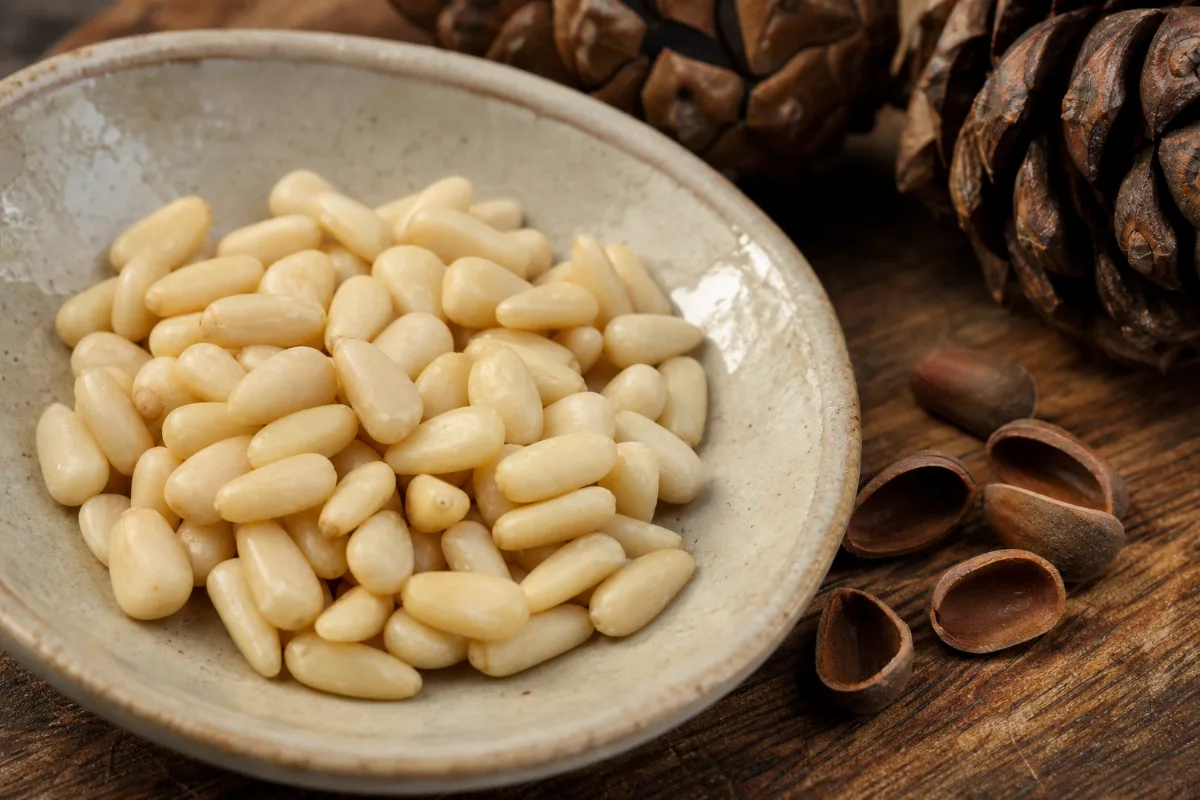
Pine nuts are the small, soft kernels of certain pine trees (family Pinaceae). Two well-known sources are the stone pine (Pinus pinea) and the Korean pine (Pinus koraiensis).
USDA data for dried pine nuts: 673 kcal per 100 g. One ounce (28.35 g, about 167 kernels) has about 191 kcal, 19.4 g fat (1.4 g saturated), 3.9 g protein, 1.0 g fibre, 71 mg magnesium, 1.8 mg zinc, 2.5 mg manganese, 2.6 mg vitamin E and 15 micrograms vitamin K. Pine nuts are mostly unsaturated fat. They are not a selenium food. Values vary with species, growing place and storage.
What the research shows
The firmest facts are about what pine nuts contain. No trial of whole pine nuts for heart disease, weight or blood sugar was found.
Two small test-day studies gave pine nut oil in capsules and found more of the fullness hormone GLP-1 and lower hunger. A pine nut fat in yogurt did not change appetite in 67 women. A 6-week trial of mixed nuts that included pine nuts improved cholesterol in women, but it cannot be credited to pine nuts.
A review of 55 trials found nuts did not change body weight. A review of nuts in kidney disease found four small studies and none on pine nuts.
Pine nut oil versus the nuts
The appetite-hormone findings come from hydrolysed pine nut oil in capsules and a branded pine nut fat. They do not describe eating whole pine nuts. The cholesterol trial used a mix of three nuts.
Amounts
This page gives no amounts to eat. Ask a doctor or pharmacist what is right for you, especially if you take medicine, have a kidney condition or any nut allergy.
At a glance
Traditional uses history, not proof
- Eaten as a food, for example in pesto, salads and baking
- Long use as a food is not proof that pine nuts treat any condition
Studied for research
- Minerals and vitamin E in the food, high certainty for the figures, no health trial
- Appetite and gut hormones (oil capsules), very low certainty
- Blood cholesterol (mixed nuts), insufficient evidence
- Body weight, blood sugar and kidney disease, insufficient evidence
Main compounds
- Unsaturated fats (mostly linoleic and oleic acid, USDA)
- Pinolenic acid (about 20% of the pine nut oil in one trial)
- Manganese, copper, magnesium, zinc, vitamin E
- Vitamin K (53.9 micrograms per 100 g, USDA)
Common forms
- Dried, shelled kernels as food (USDA)
- Hydrolysed pine nut oil in delayed-release capsules (used in trials; not the same as the food)
- A branded Korean pine nut fat in yogurt (used in one trial)
- A mix of walnuts, peanuts and pine nuts (used in one cholesterol trial)
Research links: USDA FoodData Central: pine nuts, dried · FDA: Food allergies · Pine nut allergy review (2015) · Pine mouth in France: over 3000 cases (2011) · Research Library · Genes & Biomarkers Library
What it is and its history
- Accepted scientific name
- Pinus pinea (stone pine) and Pinus koraiensis (Korean pine) are the best-known sources; USDA lists the food as Pinus spp.
- Naming authority
- Pinus pinea L. (GBIF 5285165); Pinus koraiensis Siebold & Zucc. (GBIF 5284979)
- Common names
- Pine nut (English); Pinon / pinones (pine nuts) (Spanish)
- Family or group
- Pinaceae (the pine family).
- Classification
- Plantae > Tracheophyta > Pinopsida > Pinales > Pinaceae > Pinus > Pinus pinea
- Native range
- Not verified from a source read.
- Habitat
- Not verified from a source read.
- What it looks like
- Roots: Not verified.; Stems: Not verified.; Leaves: Not verified.; Flowers: Not verified.; Fruit: The food is the kernel (USDA lists 167 kernels per 28.35 g ounce, about 0.17 g each).
- Cultivation
- Not verified from a source read.
- Harvest and processing
- Sold dried and shelled (USDA). Also eaten toasted or in sauces; trials also used hydrolysed pine nut oil and a branded pine nut fat.
- Look-alikes and adulterants
- Name: Pinus armandii (Chinese white pine) nuts; Note: Not traditionally traded as edible; linked to pine mouth (FDA investigation, Nestle-lab analysis). Packages often do not name the species.; Name: Other pine nuts (Pinus sibirica, P. gerardiana); Note: Named by a 2011 study as traditionally recognised species; not separately checked in GBIF here.; Name: Pine nut oil; Note: Used in trials as capsules; not the same as eating the nuts.
- Sustainability and conservation
- Not assessed.
Photographs
Traditional use and history history, not clinical proof
| Tradition or era | Documented use | Source |
|---|---|---|
| Pine mouth reports, 2008 onward | French poison centres recorded the first calls about lasting bitterness after pine nuts in March 2008, with 3111 cases by January 2010. This is a safety history, not a traditional use. | p21819292 |
Traditional use shows how it was used. It does not show that it works or is safe today.
What is inside, and how it may work
What it contains and how those compounds act in cells and animals. Laboratory and animal mechanisms are not proven effects in people.
Main compounds
| Compound | Family | Where it is concentrated | Activity studied | Level of evidence |
|---|---|---|---|---|
| Pinolenic acid | fatty acid | Seed oil About 20% of the hydrolysed pine nut oil used in a 2021 trial | The authors describe it as a dual activator of fat-sensing gut receptors FFA1 and FFA4, which may release gut hormones. 16 15 | Human data |
| Vitamin K (phylloquinone) | vitamin | Kernel USDA: 53.9 micrograms per 100 g, about 15 micrograms per ounce | Needed for blood clotting; relevant to warfarin. 28 27 | Human data |
| Pin y 2 (vicilin seed storage protein) | protein allergen | Seed (Pinus yunnanensis) | Bound IgE and IgG strongly and was stable to heat and pH change in the lab. 17 | Laboratory research |
Mechanisms, receptors and pathways
| Target or pathway | Gene or receptor | What was found | Level |
|---|---|---|---|
| Gut hormone release (GLP-1, ghrelin) by pinolenic acid | FFA1 and FFA4 (free fatty acid receptors) | Authors propose these receptors explain more GLP-1 and less ghrelin after hydrolysed pine nut oil. Human test-day data support the hormone changes, not the receptor route. 16 15 | Human data |
| Pine mouth taste disturbance | Unknown | Authors suggest an unidentified toxin acting on taste receptors; not proven. 4 13 | Hypothesis |
| Cross-reactive nut allergy | IgE | In mice, sensitisation to peanut, walnut and cashew produced cross-reactivity against other nuts including pine nut. Animal result only. 12 | Animal research |
Absorption, metabolism and elimination
- Absorption
- Not studied for pine nuts.
- Distribution
- Not found.
- Metabolism
- Not found.
- Elimination
- Not found.
- Bioavailability
- Not established.
Isolated compounds versus whole extracts
The appetite and hormone findings come from hydrolysed pine nut oil in delayed-release capsules (3 to 6 g) and a branded pine nut fat in yogurt. They do not describe eating whole pine nuts. The one cholesterol trial used a mix of three nuts. Results from one form do not carry over to another.
Nutritional composition
Nutrition from USDA FoodData Central (Nuts, pine nuts, dried, SR Legacy FDC 170591, published 4/1/2019, read 2026-10-26). Per 100 g: 673 kcal, 68.4 g fat (4.9 g saturated, 18.8 g monounsaturated, 34.1 g polyunsaturated), 13.7 g protein, 13.1 g carbohydrate, 3.7 g fibre, 3.59 g sugars, 251 mg magnesium, 575 mg phosphorus, 597 mg potassium, 6.45 mg zinc, 1.32 mg copper, 8.8 mg manganese, 5.53 mg iron, 9.33 mg vitamin E (alpha-tocopherol), 53.9 micrograms vitamin K, 0.7 micrograms selenium, 2 mg sodium, no cholesterol. One ounce (28.35 g, about 167 kernels, the USDA household portion): about 191 kcal, 19.4 g fat (1.4 g saturated), 3.9 g protein, 3.7 g carbohydrate, 1.0 g fibre, 71 mg magnesium, 1.8 mg zinc, 0.37 mg copper, 2.5 mg manganese, 2.6 mg vitamin E and 15 micrograms vitamin K (USDA per-100 g values scaled by 0.2835). Pine nuts are not a selenium food. Values vary with species, growing place, roasting and storage.
1 high certainty1 very low certainty4 not enough evidence
What was looked at
The 6 benefits and uses checked for Pine Nuts, each with how strong the evidence is. Tap one to open it.
- Appetite and gut hormones (pine nut oil and pine nut fat, not whole nuts)Very low certainty
- Blood cholesterolNot enough evidence
- Body weight (nuts in general; pine nuts not tested)Not enough evidence
- Supplying minerals and vitamin E (nutrient content, not a health trial)High certainty
- Blood sugar after a glucose drink (pine nut oil, one test day)Not enough evidence
- Chronic kidney disease (nuts in general)Not enough evidence
Lab markers tracked in the studies
GLP-1 (a gut hormone that signals fullness)Ghrelin (a hunger hormone)Hunger and fullness ratingsTotal and non-HDL cholesterolBody weight, BMI and waist sizeBlood glucose and insulin during a glucose drink test
What is Pine Nuts good for?
The main studied uses and how strong the human evidence is for each. Several results come from oil capsules or a mix of nuts, not from pine nuts as people eat them.
Benefits, one by one
Each card is a research question, not a promise. Tap a goal to filter. Open a card to see the studies, doses and limits.
Appetite and gut hormones (pine nut oil and pine nut fat, not whole nuts)
Very low certaintyTwo small test-day studies gave people capsules of pine nut oil and found more of a fullness hormone (GLP-1) and less hunger. A third study using a branded pine nut fat in yogurt found no change in appetite. None of these tested pine nuts as people eat them.
3 studiesHydrolysed pine nut oil in delayed-release capsules (3 g and 6 g) and…
Studies, doses and limits
What the trials found
In a 2021 crossover trial of 9 overweight or obese adults, 6 g of hydrolysed pine nut oil in delayed-release capsules raised GLP-1 over 6 hours and lowered hunger (p < 0.01 and p < 0.05). A second 2021 paper reported two small crossover studies (8 and 10 people): hydrolysed pine nut oil raised GLP-1 and lowered ghrelin in the late part of the test (p < 0.001), and in the larger study raised fullness (p < 0.03). A 2011 crossover trial in 67 women gave a branded Korean pine nut fat in yogurt and found no difference in appetite ratings or lunch intake against placebo.
Results
Hormone and appetite changes on a single test day after oil capsules. No change after pine nut fat in yogurt. Nothing was measured over weeks, and no weight change was tested.
Effect sizes as reported
GLP-1 up (p < 0.01 and p < 0.001); ghrelin down (p < 0.001); hunger down (p < 0.05); fullness up (p < 0.03). 2011 trial: no significant difference.
Why this rating
Very small groups, one test day, an oil in special capsules, and a null result in the one trial of pine nut fat. Effects of eating whole pine nuts are untested.
Form and dose studied
Hydrolysed pine nut oil in delayed-release capsules (3 g and 6 g) and a branded pine nut fat in yogurt; trial details, not advice.
Who was studied
Healthy adults and overweight or obese adults; 33 and 34 healthy women in the yogurt trials.
Limits
Not whole nuts. Not long term. Not shown to change weight, and the authors say longer studies are needed.
Why researchers looked
Pine nut oil is rich in an unusual fatty acid called pinolenic acid, which researchers think can switch on gut signals that tell the body it is full.
Traditional use
Pine nuts have been eaten as food for a long time; long use is not proof that they treat any condition.
Proposed mechanism Preliminary mechanism
Pinolenic acid, about 20% of the hydrolysed pine nut oil used, can activate two fat-sensing receptors in the gut (FFA1 and FFA4). The authors propose this raises GLP-1 and lowers ghrelin, a hunger hormone.
A proposed mechanism does not show that the effect happens in people.
Capsule oil is a processed product and not the same as the food. See the Safety tab for allergy, which applies to any pine nut product.
Blood cholesterol
Not enough evidenceOne 6-week trial gave a daily mix of walnuts, peanuts and pine nuts and found better total cholesterol in women. Because it was a mix, the result cannot be credited to pine nuts. A large comparison of tree nuts did not include pine nuts at all.
2 studiesMixed walnuts, peanuts and pine nuts for 6 weeks; trial detail, not a…
Studies, doses and limits
What the trials found
A 2014 randomised trial of 60 Korean adults with metabolic syndrome gave 30 g a day of mixed nuts (walnuts, peanuts and pine nuts) for 6 weeks. Total cholesterol and non-HDL cholesterol improved against control in women (P = .023 and P = .016). Inflammation, oxidative stress and blood vessel markers did not change. A 2020 network meta-analysis of 34 trials (1677 people) compared walnuts, pistachios, hazelnuts, cashews and almonds; pine nuts were not included.
Results
Mixed-nut trial: lower total and non-HDL cholesterol in women. No trial of pine nuts alone was found.
Effect sizes as reported
Total cholesterol P = .023; non-HDL P = .016 (women only).
Why this rating
No trial of pine nuts alone. The one mixed-nut trial is small, short and cannot separate the three nuts.
Form and dose studied
Mixed walnuts, peanuts and pine nuts for 6 weeks; trial detail, not advice.
Who was studied
Korean adults with metabolic syndrome; benefit seen in women.
Limits
Results for other nuts cannot be assumed for pine nuts.
Why researchers looked
Nuts as a group are studied for heart health, so people ask whether pine nuts do the same.
Traditional use
Pine nuts have been eaten as food for a long time; long use is not proof that they treat any condition.
Proposed mechanism Authoritative guidance
Not tested for pine nuts. For nuts in general the unsaturated fats are the usual explanation; USDA lists pine nuts as mostly unsaturated fat (18.8 g monounsaturated and 34.1 g polyunsaturated per 100 g).
A proposed mechanism does not show that the effect happens in people.
Pine nut allergy can be severe; see the Safety tab.
Body weight (nuts in general; pine nuts not tested)
Not enough evidenceA review of 55 trials found that eating nuts daily did not change body weight, BMI or waist size. Pine nuts were not looked at on their own. They are energy dense, so portion size still matters for calories.
2 studiesNuts and nut-based snacks in general; trial detail, not advice.
Studies, doses and limits
What the trials found
A 2021 systematic review and meta-analysis of 55 trials (adults eating nuts daily for more than 3 weeks) found no change in body weight, BMI or waist size, whether or not people were told what to swap out. Body fat percentage fell slightly only when substitution instructions were given (SMD -0.32; 95% CI -0.61 to -0.03).
Results
No weight gain from nuts as a group in trials. Nothing specific to pine nuts.
Effect sizes as reported
Body weight SMD 0.01 (95% CI -0.07 to 0.08) without instructions; -0.01 (-0.11 to 0.09) with.
Why this rating
The general result is for nuts overall; no source read looked at pine nuts alone.
Form and dose studied
Nuts and nut-based snacks in general; trial detail, not advice.
Who was studied
Adults in trials of more than 3 weeks.
Limits
Methods differed between trials and many outcomes were unreported.
Why researchers looked
Nuts are high in calories, so researchers ask whether eating them adds weight.
Traditional use
Pine nuts have been eaten as food for a long time; long use is not proof that they treat any condition.
Proposed mechanism Authoritative guidance
Not tested for pine nuts. USDA lists 673 kcal per 100 g, about 191 kcal in one ounce (28.35 g).
A proposed mechanism does not show that the effect happens in people.
Allergy and choking cautions are on the Safety tab.
Supplying minerals and vitamin E (nutrient content, not a health trial)
High certaintyUSDA lists pine nuts as rich in manganese, and a good source of copper, vitamin E, magnesium and zinc. This tells you what the food contains. It does not show that eating pine nuts improves health.
1 studiesDried pine nuts, shelled.
Studies, doses and limits
What the trials found
No trial was read. USDA values per 100 g: manganese 8.8 mg, magnesium 251 mg, zinc 6.45 mg, copper 1.32 mg, vitamin E (alpha-tocopherol) 9.33 mg, phosphorus 575 mg, iron 5.53 mg. Per 1 ounce (28.35 g): manganese 2.5 mg, magnesium 71 mg, zinc 1.8 mg, copper 0.37 mg and vitamin E 2.6 mg.
Results
Composition facts from a national database.
Effect sizes as reported
Per 100 g, USDA SR Legacy: see figures above.
Why this rating
High for the composition figures themselves (a laboratory-based database). No health outcome is claimed. Values vary with species, growing place and storage.
Form and dose studied
Dried pine nuts, shelled.
Limits
This is nutrient content, not proof of a health effect. USDA lists only 0.7 micrograms of selenium per 100 g, so pine nuts are not a selenium food.
Why researchers looked
Pine nuts are often described as a mineral-rich food, so the actual figures are worth checking.
Traditional use
Pine nuts have been eaten as food for a long time; long use is not proof that they treat any condition.
Proposed mechanism Nutrient database
These are essential nutrients with ordinary roles in the body. Nothing here is specific to pine nuts.
A proposed mechanism does not show that the effect happens in people.
Pine nuts are also energy dense and can cause allergy; see the Safety tab.
Blood sugar after a glucose drink (pine nut oil, one test day)
Not enough evidenceIn one small study, pine nut oil capsules lowered blood sugar and insulin only slightly in the first two hours of a sugar-drink test. No study tested pine nuts for blood sugar over time.
1 studiesPine nut oil capsules; trial detail, not advice.
Studies, doses and limits
What the trials found
In the 2021 Clinical Nutrition paper (two crossover studies, 8 and 10 people), hydrolysed pine nut oil capsules caused only small falls in glucose and insulin in the first 2 hours of a 4-hour oral glucose tolerance test.
Results
Small short-term changes in glucose and insulin on a test day.
Effect sizes as reported
Described as small; no numbers in the abstract.
Why this rating
Tiny groups, one test day, and oil capsules rather than nuts.
Form and dose studied
Pine nut oil capsules; trial detail, not advice.
Who was studied
Healthy lean and overweight or obese adults, not people with diabetes.
Limits
No long-term study; no people with diabetes.
Why researchers looked
Gut hormones such as GLP-1 also help the body handle sugar.
Traditional use
Pine nuts have been eaten as food for a long time; long use is not proof that they treat any condition.
Proposed mechanism Preliminary mechanism
The authors link the oil's effect to gut hormone release (see the appetite section).
A proposed mechanism does not show that the effect happens in people.
People with diabetes should ask their care team before changing their diet.
Chronic kidney disease (nuts in general)
Not enough evidenceA 2025 review found only four small studies of nuts in kidney disease, none on pine nuts, and all at moderate-to-high risk of bias. People on kidney diets should ask their kidney team about nuts, since pine nuts contain phosphorus and potassium.
2 studiesBrazil nuts, baru almond oil, walnuts and total nuts.
Studies, doses and limits
What the trials found
A 2025 systematic review found 4 studies (3 trials, 1 cohort) in 1270 people with chronic kidney disease. Brazil nuts and baru almond oil improved oxidative stress and inflammation markers; walnuts lowered LDL cholesterol and blood pressure with no electrolyte risk; total nut intake was linked to lower all-cause mortality.
Results
Possible benefit for some nuts. Nothing about pine nuts.
Effect sizes as reported
4 studies, all with moderate-to-high risk of bias.
Why this rating
Few, biased studies, none on pine nuts.
Form and dose studied
Brazil nuts, baru almond oil, walnuts and total nuts.
Who was studied
Adults with chronic kidney disease.
Limits
Cannot be applied to pine nuts.
Why researchers looked
Nuts are healthy-fat foods, but they also contain minerals that people on renal diets may need to watch.
Traditional use
Pine nuts have been eaten as food for a long time; long use is not proof that they treat any condition.
Proposed mechanism Nutrient database
Not studied for pine nuts. USDA lists 575 mg phosphorus and 597 mg potassium per 100 g.
A proposed mechanism does not show that the effect happens in people.
Ask a kidney care team before adding mineral-rich nuts to a renal diet.
Connections to the rest of health
How Pine Nuts connects to the rest of our health knowledge graph. Every link says what kind of connection it is. A safety link (for example to the liver) is a warning, not a benefit. A study that merely mentions a topic never creates a benefit link.
Explore every connection: goals, body systems, organs, symptoms, genes
B. Body systems
| Connected to | Kind of connection | Evidence status | Context | Studies |
|---|---|---|---|---|
| Metabolism Weight | Biological association | Very low certainty | Studied for: Appetite and gut hormones (pine nut oil and pine nut fat, not whole nuts) Studied for: Body weight (nuts in general; pine nuts not tested) | 15 16 18 5 28 |
| Digestive System | Biological association | Very low certainty | Studied for: Appetite and gut hormones (pine nut oil and pine nut fat, not whole nuts) | 15 16 18 |
| Cardiovascular System | Biological association | Not enough evidence | Studied for: Blood cholesterol | 10 11 |
| Whole Body | Biological association | High certainty | Studied for: Supplying minerals and vitamin E (nutrient content, not a health trial) | 28 |
| Blood Sugar Support | Biological association | Not enough evidence | Studied for: Blood sugar after a glucose drink (pine nut oil, one test day) | 16 |
| Urinary System | Biological association | Not enough evidence | Studied for: Chronic kidney disease (nuts in general) | 9 28 |
E. Health conditions
| Connected to | Kind of connection | Evidence status | Context | Studies |
|---|---|---|---|---|
| Food allergy | Adverse effect or risk | Documented risk | Pine nut is among eleven plant foods behind 85% of plant-related anaphylaxis cases in a French network. Preparation or compound: Pine nuts |
20 14 |
| Nut hypersensitivity | Adverse effect or risk | Documented risk | Pine nut allergy exists and can be severe; it often occurs without allergy to other nuts. Preparation or compound: Pine nuts |
2 7 |
| Taste disorders | Adverse effect or risk | Documented risk | A bitter or metallic taste for days to weeks after eating affected nuts. A bitter or metallic taste for days to weeks after eating affected pine nuts (pine mouth). Preparation or compound: Certain pine nuts (Pinus armandii implicated) |
4 8 |
| Choking | Adverse effect or risk | Documented risk | A toddler case of an inhaled pine nut shell is reported. Preparation or compound: Whole nuts and shell pieces |
19 |
I. Biomarkers
| Connected to | Kind of connection | Evidence status | Context | Studies |
|---|---|---|---|---|
| GLP-1 (a gut hormone that signals fullness) | Biological association | Very low certainty | Measured in trials: increase. A lab change is not the same as a health benefit. | 15 16 |
| Ghrelin (a hunger hormone) | Biological association | Very low certainty | Measured in trials: decrease. A lab change is not the same as a health benefit. | 16 |
| Hunger and fullness ratings | Biological association | Very low certainty | Measured in trials: mixed. A lab change is not the same as a health benefit. | 15 16 18 |
| Total and non-HDL cholesterol | Biological association | Not enough evidence | Measured in trials: decrease. A lab change is not the same as a health benefit. | 10 |
| Body weight, BMI and waist size | Biological association | Not enough evidence | Measured in trials: no-change. A lab change is not the same as a health benefit. | 5 |
| Blood glucose and insulin during a glucose drink test | Biological association | Not enough evidence | Measured in trials: decrease. A lab change is not the same as a health benefit. | 16 |
K. Biological pathways
| Connected to | Kind of connection | Evidence status | Context | Studies |
|---|---|---|---|---|
| Manganese, copper, magnesium, zinc and vitamin E | Preliminary mechanism | Human | Pine nuts contain notable amounts per ounce; this describes the food, not a proven health effect. | 28 |
| Vitamin K | Preliminary mechanism | Human | Relevant to people taking warfarin. | 28 27 |
L. Active compounds
| Connected to | Kind of connection | Evidence status | Context | Studies |
|---|---|---|---|---|
| Pinolenic acid | Biological association | Human | The authors describe it as a dual activator of fat-sensing gut receptors FFA1 and FFA4, which may release gut hormones. Preparation or compound: Seed oil |
16 15 |
| Vitamin K (phylloquinone) | Biological association | Human | Needed for blood clotting; relevant to warfarin. Preparation or compound: Kernel |
28 27 |
| Pin y 2 (vicilin seed storage protein) | Biological association | In vitro | Bound IgE and IgG strongly and was stable to heat and pH change in the lab. Preparation or compound: Seed (Pinus yunnanensis) |
17 |
Each connection is stored with the ingredient, the connected record, the kind of connection, the evidence status, the supporting studies, the preparation or compound involved, and a review date (last reviewed October 26, 2026).
The evidence
The research centre for Pine Nuts. Every record here was checked against PubMed or the publisher's page; we never list a study we have not verified.
Evidence by outcome
Bars show how many studies we found for each outcome, not how well it works. People are added up across trials only (reviews are not added, to avoid double counting).
How we rate evidence
High certainty
Several well-run trials or reviews agree; further research is unlikely to change the picture much.
Moderate certainty
Good trials point the same way, but some doubt remains.
Low certainty
Small, short or inconsistent trials. The finding could change with better research.
Very low certainty
Very little or very weak human data. Treat as a possibility only.
Mixed findings
Trials or reviews disagree with each other.
Not enough evidence
Not enough human research to say either way.
Evidence against
Good research found no benefit, or found harm.
We take the reviewers' own risk-of-bias and GRADE statements where they exist, and otherwise judge from study size, design, consistency, directness and whether a product matches what is sold. Many publications do not make evidence high. Method note: We started from our existing pine nut summary, re-checked nutrition at USDA FoodData Central and species names at GBIF, and read PubMed abstracts for human trials, reviews, surveillance data and case reports. Only abstracts were read for studies. Items we could not verify are flagged in the research gaps.
Study library: every study we checked 28
| Study | Design | People | Product, dose, length | Result |
|---|---|---|---|---|
| Ballin 2012 A trial investigating the symptoms related to pine nut syndrome. J Med Toxicol · PMID 22351301 · DOI |
Small trial |
6 6 volunteers |
6 to 8 pine nuts suspected to cause taste disturbance (later identified as Pinus armandii) Nut Trial detail, not advice Single exposure |
All six developed symptoms. Four had the classic bitter and metallic taste 1 to 2 days later; two had minor symptoms such as dryness and a feeling of enlarged tonsils. No recurrence after 1 year. 6 of 6 had symptoms Methods, limits and fundingOutcomes: Time to symptoms, symptoms, duration Limitations: Six people, no comparison group. Funding and conflicts: Author works at a Danish government food agency; no funding stated in the abstract. Read: abstract |
| Cabanillas 2015 Allergic Reactions to Pine Nut: A Review. J Investig Allergol Clin Immunol · PMID 26727761 |
Narrative review |
45 45 reported cases of pine nut allergy in the literature |
Pine nut Nut Trial detail, not advice |
Severe anaphylaxis accounted for most of the 45 reported cases. Pine nut allergy seems to show low IgE cross-reactivity with other common nuts and a high rate of monosensitisation (reacting to pine nut but not other nuts). 45 cases Methods, limits and fundingOutcomes: Severity, cross-reactivity, allergens Limitations: 2015 review of case reports; may be out of date. Funding and conflicts: Not stated in the abstract. Read: abstract |
| Destaillats F et al. 2011 Identification of the botanical origin of commercial pine nuts responsible for dysgeusia by gas-liquid chromatography analysis of fatty acid profile. J Toxicol · PMID 21559093 · DOI |
Laboratory analysis n/a |
16 16 pine nut samples from consumers who reported dysgeusia |
Pine nuts from complaint cases Nut Trial detail, not advice |
Pinus armandii nuts were found in all 16 samples, pure or mixed with P. koraiensis. P. armandii is not reported as an edible pine nut by the FAO. The authors advise trading nuts from traditionally recognised species (P. pinea, P. sibirica, P. koraiensis, P. gerardiana). 16 of 16 samples contained P. armandii Methods, limits and fundingOutcomes: Fatty acid profile to identify the pine species Limitations: Samples came from complaints, so this cannot show how common P. armandii is in the market. Funding and conflicts: Authors work at Nestle Research Centre (food industry); funding not stated in the abstract. Flagged as industry-linked. Read: abstract |
| Flesch F et al. 2011 Dysgeusia following consumption of pine nuts: more than 3000 cases in France. Clin Toxicol (Phila) · PMID 21819292 · DOI |
Case series |
3111 3111 cases of bitterness reported to French poison centres, 13 March 2008 to 31 January 2010 |
Pine nuts, raw and cooked or processed (species not identified in the abstract) Nut Trial detail, not advice |
Cases peaked at 697 in August 2009. Median onset 24 hours; lasted less than 14 days in 95% of cases. Raw and cooked or processed nuts were implicated. Median onset 24 hours; under 14 days in 95% Methods, limits and fundingOutcomes: Cases, time to onset and duration of taste disturbance Limitations: Poison-centre call data, not a controlled study. The authors say the cause is an unidentified toxin, possibly in non-edible pine nut varieties. Funding and conflicts: Not stated in the abstract. Read: abstract |
| Guarneiri 2021 Intake of Nuts or Nut Products Does Not Lead to Weight Gain, Independent of Dietary Substitution Instructions: A Systematic Review and Meta-Analysis of Randomized Trials. Adv Nutr · PMID 32945861 · DOI |
Systematic review meta analysis |
55 55 trials of adults eating nuts daily for more than 3 weeks |
Nuts and nut-based foods in general (pine nuts not singled out in the abstract) Nuts Trial detail, not advice More than 3 weeks · vs Control diets |
No change in body weight, BMI or waist whether or not people were told what to swap. Body fat percentage fell slightly only when substitution instructions were given (SMD -0.32; 95% CI -0.61 to -0.03). Body weight SMD 0.01 (no instructions); -0.01 (instructions) (95% CI -0.07 to 0.08; -0.11 to 0.09) Methods, limits and fundingOutcomes: Body weight, BMI, waist, body fat percentage Limitations: Different methods across trials; many outcomes unreported; pine nuts not analysed alone. Funding and conflicts: Not stated in the abstract. Read: abstract |
| Hampton RL et al. 2013 Cacogeusia following pine nut ingestion: a six patient case series. Br J Oral Maxillofac Surg · PMID 22365743 · DOI |
Case series |
6 6 patients with a bad taste after eating pine nuts |
Pine nuts Nut Trial detail, not advice |
The taste always began within 48 hours and went away within 14 days in all but one patient. The authors add that pine nuts can also trigger anaphylaxis. 6 patients Methods, limits and fundingOutcomes: Onset and duration of bad taste Limitations: Six people, retrospective. Funding and conflicts: Not stated in the abstract. Read: abstract |
| Jeong 2025 Update on Tree Nut and Seed Allergies: Prevalence, Clinical Characteristics, Diagnosis, and Management. Allergy Asthma Immunol Res · PMID 41330701 · DOI |
Narrative review |
Review of tree nut and seed allergy | Tree nuts and seeds in general Nuts and seeds Trial detail, not advice |
Tree nut and seed allergies are often severe, usually begin in childhood and may last for life. Many people are sensitised to several nuts, but clinical co-allergy is seen less often; the highest overlap reported is cashew-pistachio and walnut-pecan. Epinephrine by injection is the first treatment for anaphylaxis. n/a Methods, limits and fundingOutcomes: Prevalence, severity, cross-reactivity, management Limitations: Narrative review; pine nuts are not singled out in the abstract. Funding and conflicts: Authors declare no conflict of interest. Read: abstract |
| Kwegyir-Afful EE et al. 2013 An investigational report into the causes of pine mouth events in US consumers. Food Chem Toxicol · PMID 23891758 · DOI |
Surveillance report |
501 501 US consumer reports to the FDA, July 2008 to June 2012; samples tied to 15 complaints analysed |
Pine nuts (species identified in lab work) Nut Trial detail, not advice |
A delayed bitter or metallic taste began hours to days after eating pine nuts and recurred with any food. It lasted up to a few weeks and resolved without serious health consequences. No clear medical cause was found; pine mouth was correlated with the species Pinus armandii. 501 reports Methods, limits and fundingOutcomes: Taste disturbance reports, medical history, pine nut species Limitations: Self-reported complaints; correlation, not proof of cause. Funding and conflicts: Authors are FDA staff; no funding statement in the abstract. Read: abstract |
| Lazzarin T et al. 2025 Nut consumption in chronic kidney disease: a systematic review. Front Nutr · PMID 41293182 · DOI |
Systematic review |
1270 4 studies (3 trials, 1 cohort) in 1270 people with chronic kidney disease |
Brazil nuts, baru almond oil, walnuts and total nuts (pine nuts not named in the abstract) Nuts Trial detail, not advice Varied · vs Varied |
All four studies had moderate-to-high risk of bias. Brazil nuts and baru almond oil improved oxidative stress and inflammation markers; walnuts lowered LDL cholesterol and blood pressure without electrolyte problems; total nut intake was linked to lower all-cause death. The authors call for more studies. 4 studies Methods, limits and fundingOutcomes: Lipids, inflammation, oxidative stress, blood pressure, mortality Limitations: Few, biased studies; pine nuts not covered. Funding and conflicts: Authors declare no commercial conflicts. Registration: PROSPERO CRD42024543880 Read: abstract |
| Lee YJ et al. 2014 Nut consumption has favorable effects on lipid profiles of Korean women with metabolic syndrome. Nutr Res · PMID 25238912 · DOI |
Randomised controlled trial |
60 60 Korean adults with metabolic syndrome and BMI of at least 23 |
30 g a day of mixed nuts (walnuts, peanuts and pine nuts) Nuts, mixed Trial detail, not advice 6 weeks · vs Control group (usual diet) |
Total cholesterol and non-HDL cholesterol improved versus control in women (P = .023 and P = .016). Inflammation, oxidative stress and endothelial markers did not change significantly. Total cholesterol P = .023; non-HDL P = .016 (women) Methods, limits and fundingOutcomes: Metabolic markers, inflammation, oxidative stress, endothelial function Limitations: A mix of three nuts, so the result cannot be credited to pine nuts; women only; 6 weeks; small. Funding and conflicts: Not stated in the abstract. Registration: NCT02023749 Read: abstract |
| Liu K et al. 2020 Comparative effects of different types of tree nut consumption on blood lipids: a network meta-analysis of clinical trials. Am J Clin Nutr · PMID 31773150 · DOI |
Network meta analysis |
1677 34 trials, 1677 participants |
Walnut-, pistachio-, hazelnut-, cashew- and almond-enriched diets Nuts (pine nuts not included) Trial detail, not advice Varied · vs Control diets |
Pistachio-enriched and walnut-enriched diets lowered triglycerides, LDL and total cholesterol compared with control diets. Pine nuts were not among the nuts compared. The authors say the evidence quality is low. Pistachio ranked best (SUCRA 87% for LDL) Methods, limits and fundingOutcomes: Triglycerides, LDL, total and HDL cholesterol Limitations: Did not include pine nuts; low-quality evidence. Funding and conflicts: Not stated in the abstract. Registration: PROSPERO CRD42019131128 Read: abstract |
| Maskey A et al. 2026 Cross-IgE sensitization correlates with cross-anaphylaxis among peanut and multiple tree nuts in a murine model. Front Allergy · PMID 41743428 · DOI |
Animal research mouse |
Mice sensitised to peanut, walnut and cashew | Peanut, walnut, cashew, then eight other nuts including pine nut Nut proteins Trial detail, not advice |
Sensitisation to peanut, walnut and cashew caused cross-reactivity against the other nuts, with raised IgE and anaphylaxis signs on challenge. n/a Methods, limits and fundingOutcomes: IgE levels and anaphylaxis after eating each nut Limitations: Mouse study only; cannot predict what happens in people. Funding and conflicts: Some authors are linked to a nutraceutical company and hold patents; flagged. Read: abstract |
| Munk 2012 Pine mouth (pine nut) syndrome: description of the toxidrome, preliminary case definition, and best evidence regarding an apparent etiology. Semin Neurol · PMID 23677661 · DOI |
Narrative review |
Review of reported cases | Pine nuts (Pinus armandii suspected) Nut Trial detail, not advice |
A case needs a bitter or metallic taste 1 to 3 days after eating affected pine nuts. Affected nuts seem to include nuts from Pinus armandii, but could include other species. The toxin has not been isolated. There are no proven therapies; the only treatment is to stop eating the nuts and wait. Several thousand cases described Methods, limits and fundingOutcomes: Case definition, cause, treatment Limitations: Short review; cause still unproven. Funding and conflicts: Not stated in the abstract. Read: abstract |
| Sabouraud-Leclerc D et al. 2025 Food Anaphylaxis: Eight Food Allergens Without Mandatory Labelling Highlighted by the French Allergy-Vigilance Network. Clin Exp Allergy · PMID 40831263 · DOI |
Case series |
2999 2999 anaphylaxis cases (Ring grades 2 to 4), French network 2002 to 2023 |
Foods not on the EU mandatory allergen list, including pine nut Nut Trial detail, not advice |
Pine nut caused 49 cases (1.6% of all cases). Grade 3 reactions occurred in 49% of pine nut cases; recurrent reactions in 12.2% and hidden exposures in 4.1%. The authors propose adding pine nut to the EU labelling list. 49 pine nut cases; 1.6% Methods, limits and fundingOutcomes: Frequency, severity, recurrence, hidden exposure Limitations: Surveillance data from one country; shows how often pine nut appears among reported cases, not how likely a person is to react. Funding and conflicts: Authors declare no conflicts. Read: abstract |
| Sorensen KV et al. 2021 Effects of Delayed-Release Olive Oil and Hydrolyzed Pine Nut Oil on Glucose Tolerance, Incretin Secretion and Appetite in Humans. Nutrients · PMID 34684407 · DOI |
Randomised crossover trial |
9 9 overweight or obese adults |
Hydrolysed pine nut oil (about 20% pinolenic acid) in delayed-release capsules, alone or with olive oil Oil from seed (not whole nuts) Trial detail, not advice Single 6-hour test, three visits · vs No oil |
Hydrolysed pine nut oil raised GLP-1 over 0 to 360 minutes versus no oil (p < 0.01). Both oil treatments lowered hunger and the wish to eat and raised fullness (p < 0.05). Combining with olive oil gave no extra effect on GLP-1. The authors say long-term studies are needed. GLP-1 higher (p < 0.01); appetite scores better (p < 0.05) Methods, limits and fundingOutcomes: GLP-1, GIP, glucose, insulin, subjective appetite Limitations: Nine people, one test day per arm, an oil in capsules and not the nut as eaten. Funding and conflicts: Authors declare no conflict of interest. Registration: Not given in the abstract Read: abstract |
| Sorensen KV et al. 2021 Acute effects of delayed-release hydrolyzed pine nut oil on glucose tolerance, incretins, ghrelin and appetite in healthy humans. Clin Nutr · PMID 33059911 · DOI |
Randomised crossover trial |
18 Two crossover studies: 8 healthy non-obese people and 10 healthy overweight or obese people |
Pine nut oil, hydrolysed or not, in delayed-release capsules Oil from seed (not whole nuts) Trial detail, not advice Single 4-hour test per arm · vs No oil |
Hydrolysed pine nut oil (3 g in study 1, 6 g in study 2) raised GLP-1 and lowered ghrelin in the last 2 hours of the test (p < 0.001). In study 2 it also raised fullness (p < 0.03) and lowered the wish to eat (p < 0.05). Glucose and insulin fell only slightly in the first 2 hours. GLP-1 up, ghrelin down (p < 0.001 each) Methods, limits and fundingOutcomes: Glucose, insulin, GLP-1, ghrelin, appetite Limitations: Tiny groups, single test days, an oil in capsules; effects on weight not tested. Funding and conflicts: Authors declare no conflict of interest. Registration: NCT03062592 and NCT03305367 Read: abstract |
| Sun Y et al. 2026 Identification, Expression, and Characterization of Pin y 2, a Novel Vicilin Allergen of Pinus yunnanensis. J Agric Food Chem · PMID 41603857 · DOI |
Laboratory study lab (human serum) |
Protein from Pinus yunnanensis seeds; blood tests with serum IgE/IgG | Purified and recombinant vicilin protein Seed protein Trial detail, not advice |
A 50 kDa vicilin protein from Pinus yunnanensis bound IgE and IgG strongly, was stable at 4 to 70 C and pH 3 to 10, and was named Pin y 2. No IgG cross-reactivity was seen with the tested species. n/a Methods, limits and fundingOutcomes: IgE/IgG binding, stability Limitations: Lab study of a species that is not the usual market pine nut; no reaction rates. Funding and conflicts: Not stated in the abstract. Read: abstract |
| Verhoef 2011 No effects of Korean pine nut triacylglycerol on satiety and energy intake. Nutr Metab (Lond) · PMID 22074178 · DOI |
Randomised crossover trial |
67 Two groups: 33 healthy women and 34 healthy women |
Korean pine nut fat (PinnoThin triacylglycerol) in yogurt Fat from seed (not whole nuts) Trial detail, not advice Single breakfast per arm · vs Milk-fat yogurt (placebo) |
Appetite ratings did not differ between conditions. Energy intake was 9.5% lower after 6 g than after 3 g of the pine nut fat, but not different from placebo. The authors conclude 6 g is not enough to lower appetite or intake. No difference from placebo Methods, limits and fundingOutcomes: Appetite ratings over 4 hours; energy intake at lunch Limitations: Single meals; a branded pine nut fat product, not nuts. Funding and conflicts: Not stated in the abstract; the product is a commercial ingredient. Treat as possibly industry-linked. Registration: NCT01034605 Read: abstract |
| Wang D et al. 2026 Rigid-Flexible Bronchoscopy With Holmium Laser Cauterization for Pine Nut Shell Removal and Balloon Dilation for Subsequent Bronchial Stenosis in a 16-Month-Old Girl. Am J Case Rep · PMID 42083277 · DOI |
Case report |
1 A 16-month-old girl |
Accidentally swallowed pine nut (shell found in an airway) Nut shell Trial detail, not advice |
She had cough, breathing trouble, fever, hoarseness and occasional blueness of the skin (cyanosis), starting 6 days after swallowing a pine nut. A pine nut shell was lodged deep in a lung airway; it needed combined rigid and flexible bronchoscopy with laser fragmentation, and later balloon widening of a narrowed airway. Symptoms resolved. 1 case Methods, limits and fundingOutcomes: Symptoms, treatment and recovery Limitations: Single case. Funding and conflicts: No conflicts declared. Read: abstract |
| Wanniang N et al. 2026 Food-induced anaphylaxis to plant allergens in adolescents and adults: Data from the allergy Vigilance Network (2002-2024). World Allergy Organ J · PMID 42633221 · DOI |
Case series |
753 753 plant-allergen anaphylaxis cases in people aged 13 or older, French network 2002 to 2024 |
Plant foods including pine nut Nut Trial detail, not advice |
Eleven allergens (wheat, peanut, buckwheat, soy, hazelnut, sesame, lupin, cashew, pine nut, walnut and almond) accounted for 85% of the plant-related cases. 753 cases Methods, limits and fundingOutcomes: Which foods caused anaphylaxis Limitations: Surveillance reports; no rate per person eating the food; the abstract gives no separate pine nut count. Funding and conflicts: Some authors report fees from pharmaceutical and allergy companies, outside this work. Read: abstract |
| s-cdc-choking CDC: Choking hazards (infant and toddler nutrition) · Source |
Health agency n/a |
Methods, limits and fundingRead: summary-only | ||
| s-fda-food-allergies FDA: Food Allergies · Source |
Regulator n/a |
Methods, limits and fundingRead: full-text | ||
| s-gbif-pinus-koraiensis GBIF species match: Pinus koraiensis Siebold & Zucc. · Source |
Reference database n/a |
Methods, limits and fundingRead: full-text | ||
| s-gbif-pinus-pinea GBIF species match: Pinus pinea L. · Source |
Reference database n/a |
Methods, limits and fundingRead: full-text | ||
| s-medlineplus-aflatoxin MedlinePlus: Aflatoxin · Source |
Health agency n/a |
Methods, limits and fundingRead: full-text | ||
| s-nhs-food-allergy NHS: Food allergy · Source |
Health agency n/a |
Methods, limits and fundingRead: full-text | ||
| s-nhs-warfarin NHS: Warfarin · Source |
Health agency n/a |
Methods, limits and fundingRead: full-text | ||
| s-usda-fdc-170591 USDA FoodData Central: Nuts, pine nuts, dried (FDC 170591) · Source |
Reference database n/a |
Methods, limits and fundingRead: full-text |
What we do not know yet
- No trial has tested whole pine nuts for cholesterol, appetite, weight, blood pressure or blood sugar.
- Appetite studies were one test day with oil capsules or a branded pine nut fat.
- No source read says how common pine nut allergy is in the general population.
- The cause of pine mouth is unproven, and no source on pregnancy, breastfeeding or pine nut rancidity was read.
- The CDC choking guidance could not be re-read.
How new research is added
New studies are found by a saved PubMed search and placed in a review queue before the page changes.
Lab markers
What changed in blood or saliva tests during trials. A changed number is not the same as feeling or being healthier, and we give no "normal ranges".
Metabolic 2
Total and non-HDL cholesterol
Decrease in trials
Total cholesterol is the sum of all cholesterol carried in the blood; non-HDL is everything except the so-called good HDL.
Not enough evidenceResults and what it means
Why it was measured
Used as a stand-in for heart disease risk.
Statistical vs. clinical meaning
A mix of nuts, so not specific to pine nuts.
Safety implication
None specific.
| Study | Result | People | Product |
|---|---|---|---|
| 10 | Lower than control in women (total P = .023; non-HDL P = .016) | 60 adults with metabolic syndrome | 30 g a day of mixed walnuts, peanuts and pine nuts for 6 weeks |
Body weight, BMI and waist size
No clear change in trials
Common measures of body size used in diet trials.
Not enough evidenceResults and what it means
Why it was measured
Used to test whether eating nuts adds weight.
Statistical vs. clinical meaning
General nut result; not about pine nuts.
Safety implication
None specific.
| Study | Result | People | Product |
|---|---|---|---|
| 5 | No change in body weight, BMI or waist size; body fat percentage lower only with substitution instructions | 55 trials of adults eating nuts for more than 3 weeks | Nuts in general (pine nuts not analysed alone) |
Other 4
GLP-1 (a gut hormone that signals fullness)
Increase in trials
A hormone released by the gut after eating that helps signal fullness and handles blood sugar.
Very low certaintyResults and what it means
Why it was measured
Used as a stand-in for the body's fullness signalling.
Statistical vs. clinical meaning
A change in a hormone on one test day is not the same as less eating or weight loss.
Safety implication
None specific.
| Study | Result | People | Product |
|---|---|---|---|
| 15 | Higher over 0 to 360 minutes after hydrolysed pine nut oil than after no oil (p < 0.01) | 9 overweight or obese adults | 6 g hydrolysed pine nut oil in delayed-release capsules, single test day |
| 16 | Markedly higher in the last 2 hours of the test (p < 0.001) | 8 healthy and 10 overweight or obese adults | 3 g or 6 g hydrolysed pine nut oil in capsules, single test day |
Ghrelin (a hunger hormone)
Decrease in trials
A hormone made in the stomach that rises before meals and signals hunger.
Very low certaintyResults and what it means
Why it was measured
Used as a stand-in for hunger signalling.
Statistical vs. clinical meaning
One short test; effect on actual eating not shown.
Safety implication
None specific.
| Study | Result | People | Product |
|---|---|---|---|
| 16 | Lower in the last 2 hours of the test (p < 0.001) | 8 healthy and 10 overweight or obese adults | 3 g or 6 g hydrolysed pine nut oil in capsules, single test day |
Hunger and fullness ratings
Mixed results in trials
Scores people give on a scale for how hungry or full they feel.
Very low certaintyResults and what it means
Why it was measured
Used to see whether a food changes how hungry people feel.
Statistical vs. clinical meaning
Positive in two small oil-capsule studies and null in the pine nut fat yogurt trial.
Safety implication
None specific.
| Study | Result | People | Product |
|---|---|---|---|
| 15 | Hunger and wish to eat lower, fullness higher after pine nut oil (p < 0.05) | 9 overweight or obese adults | 6 g hydrolysed pine nut oil in capsules |
| 16 | Fullness higher (p < 0.03) and wish to eat lower (p < 0.05) in the larger study | 10 overweight or obese adults | 6 g hydrolysed pine nut oil in capsules |
| 18 | Appetite ratings not significantly different from placebo; lunch intake not different from placebo | 33 and 34 healthy women | 3 g or 6 g Korean pine nut fat in yogurt |
Blood glucose and insulin during a glucose drink test
Decrease in trials
Levels measured after drinking a standard sugar solution to see how the body handles sugar.
Not enough evidenceResults and what it means
Why it was measured
A short-term test of sugar handling.
Statistical vs. clinical meaning
Small, short, oil capsules; not shown to matter clinically.
Safety implication
None specific.
| Study | Result | People | Product |
|---|---|---|---|
| 16 | Only small reductions in glucose and insulin in the first 2 hours | 8 healthy and 10 overweight or obese adults | Hydrolysed pine nut oil in capsules, single test day |
Safety
What studies and official sources say about side effects, medicines and who should check first. Each point shows what kind of evidence it comes from.
Main points to know 3
- Pine nut allergy can be severe. Pine nuts can cause serious allergic reactions, including anaphylaxis. In a French surveillance network, pine nut caused 49 of 2999 reported anaphylaxis cases (1.6%), and 49% of the pine nut cases were grade 3 (severe) reactions. A 2015 review found that most of 45 reported pine nut allergy cases were severe anaphylaxis. Pine nut allergy often occurs without allergy to other nuts. Get emergency help for swelling of the lips, mouth or throat, or trouble breathing. Case series 14 20 2 26
- "Pine mouth": a bitter or metallic taste for days to weeks. Some people get a bitter or metallic taste that starts about 1 to 3 days after eating certain pine nuts and fades on its own. French poison centres logged 3111 cases from 2008 to 2010; the median onset was 24 hours and 95% lasted under 14 days. The US FDA received 501 reports in four years and found no serious health consequences. The cause has not been proven. Studies link it to nuts from one species, Pinus armandii, which is not a traditionally traded edible pine nut. Package labels often do not name the species. Case series 4 8 3 1 13 6
- Choking and airway risk in young children. Whole nuts and shell pieces are a choking and inhalation risk for toddlers. A 2026 case report describes a 16-month-old who inhaled a pine nut shell and needed bronchoscopy with laser removal, and later a second procedure to widen a narrowed airway. CDC guidance, as summarised earlier, lists whole or chopped nuts and seeds as choking hazards for young children. Case report 19 21
Side effects 3
| Effect | How often | Severity and recovery | Evidence |
|---|---|---|---|
| Allergic reaction, from hives to anaphylaxis Of the 49 pine nut cases, 12.2% had recurrent reactions and 4.1% had hidden exposure. | 49 of 2999 anaphylaxis cases in one French network (1.6%); no rate per person eating pine nuts found | mild to severe Treated with epinephrine by injection for anaphylaxis (Jeong 2025 review) | Case series 14 20 7 |
| Bitter or metallic taste after eating affected pine nuts (pine mouth) Cause not proven; no treatment other than stopping the nuts and waiting (Munk 2012). | 3111 French poison-centre cases in about two years; 501 US FDA reports in four years | mild Resolved within 14 days in 95% of French cases; up to a few weeks in the US reports | Case series 4 8 6 |
| Inhaled nut or shell in the airway (children) One case; no rate found. | Not established | severe Needed procedures in the case read; symptoms resolved | Case report 19 |
Liver
No liver injury from eating pine nuts was found in the sources read. LiverTox was not checked for pine nuts. Aflatoxins ingested in large amounts can damage the liver, according to MedlinePlus; see Contamination. 25
How often. No frequency was found.
Monitoring. No agency monitoring advice was found.
This is a safety connection. It is not evidence that Pine Nuts supports liver health.
Medicines and supplements 3
| With | Why it matters | Importance | Evidence | What to do |
|---|---|---|---|---|
| Warfarin (blood thinner) prescription | Vitamin K helps blood clot and warfarin works against vitamin K. USDA lists 53.9 micrograms of vitamin K per 100 g of pine nuts, about 15 micrograms per ounce. | The NHS says foods high in vitamin K, such as broccoli, spinach and other green leafy vegetables, can affect warfarin, and that you should talk to your warfarin clinic. The NHS page does not name pine nuts, and no source read tested pine nuts with warfarin. | Authoritative guidance Low certainty 27 28 | Ask your warfarin clinic or pharmacist how nuts fit your diet. Do not change your medicine on your own. |
| Other prescription medicines prescription | No source read describes a pine nut and medicine interaction. | Not found; absence of evidence is not proof of safety. | None found Not enough evidence | If you take regular medicine, ask a pharmacist. |
| Pine nut oil capsules supplement | The trial capsules held hydrolysed pine nut oil. No interaction data were read. | Capsule oil is not the same as the food, and no safety data beyond the short trials were read. | None found Not enough evidence 15 16 | Ask a pharmacist before using pine nut oil products. |
Who should check first 4
| Situation | Advice | Evidence |
|---|---|---|
| Known pine nut or tree nut allergy | Avoid pine nuts unless an allergist says otherwise, and carry any emergency medicine you have been prescribed. Co-sensitisation among nuts is common but true co-allergy is less often seen (Jeong 2025), and pine nut allergy often occurs alone (Cabanillas 2015), so ask an allergist for testing. | Narrative review 7 2 |
| Young children, especially toddlers | Whole nuts and shell pieces can block or enter the airway. Ask a paediatrician before giving nuts. | Case report 19 21 |
| Taking warfarin | Ask your warfarin clinic about vitamin K foods in general, including nuts. | Authoritative guidance 27 28 |
| Kidney disease on a restricted diet | USDA lists 575 mg phosphorus and 597 mg potassium per 100 g of pine nuts. No study of pine nuts in kidney disease was found; ask a kidney care team. | Nutrient database 28 9 |
Overdose, product quality and regulators
Summary. Pine nuts are an ordinary food. The documented problems are allergy, the taste problem called pine mouth, and choking. The toxin behind pine mouth has not been identified.
Animal. One mouse study showed that sensitisation to peanut, walnut and cashew can cross-react with pine nut and other nuts; this is animal research only.
Human doses studied. Trials gave 6 to 8 suspect nuts (pine mouth), 30 g a day of mixed nuts for 6 weeks, or 3 to 6 g of pine nut oil on a test day. None reported serious harm in the abstracts read.
Overdose response. Not found.
Genotoxicity. Not researched.
Toxic or hazardous parts. Pine mouth has been tied to nuts from Pinus armandii. No other toxic part was identified in the sources read.
Pine nuts can be mislabelled for species. Mould toxins (aflatoxins) are a known concern for tree nuts in general; no pine-nut-specific figures were read.
Wrong or unnamed species. A lab study found Pinus armandii nuts in all 16 pine mouth complaint samples, alone or mixed with P. koraiensis. The authors advise trading nuts from traditionally recognised species. 3 8
Aflatoxin (mould toxin). MedlinePlus lists tree nuts, such as pecans, among foods where the mould may be found. It advises buying only major brands of nuts and discarding any that look mouldy, discoloured or shrivelled. Pine nuts are not named on that page. 25
| Body | Action | Date |
|---|---|---|
| FDA (US Food and Drug Administration) (United States) | Food allergies page: tree nuts are one of nine major food allergens; foods containing a major allergen must be labelled with the allergen source name. The page does not mention pine nuts. source | 2026-03-11 |
| NHS (UK) (United Kingdom) | Food allergy page lists tree nuts such as walnuts, almonds, hazelnuts, pecans, cashews, pistachios and Brazil nuts; call 999 for swelling of the lips, mouth, throat or tongue or hard breathing source | 2026-08-20 |
| EU allergen labelling list (as described by a 2025 study) (European Union) | A 2025 French study says pine nut is not currently on the EU mandatory allergen list and proposes adding it source | 2025-08-20 |
| MedlinePlus (US National Library of Medicine) (United States) | Aflatoxin: buy only major brands of nuts and discard nuts that look mouldy, discoloured or shrivelled source | 2025-01-08 |
When to get medical help
- Swelling of the lips, mouth, face or throat, or hard or noisy breathing, after eating pine nuts (call emergency services)
- Widespread hives, repeated vomiting or feeling faint after eating pine nuts
- A child who coughs, chokes or has trouble breathing after eating or handling nuts, or who develops a cough or fever days later
Stop using the product and contact a clinician or emergency service. In the US, Poison Control is 1-800-222-1222.
General information only, not medical advice. Ask a clinician or pharmacist before use, especially with medicines, in pregnancy or with a health condition. See the Natural Remedy Safety guide.
Frequently asked questions
What are pine nuts good for?
They are an energy-dense food that supplies manganese, copper, vitamin E, magnesium and zinc (USDA). No trial of whole pine nuts for heart disease, weight or blood sugar was found.
Do pine nuts lower cholesterol?
Do pine nuts help with weight loss or appetite?
Are pine nuts good for blood sugar?
No study of eating pine nuts for blood sugar was found. Oil capsules lowered glucose only slightly in the first two hours of one test.
What is pine mouth?
A bitter or metallic taste that starts about 1 to 3 days after eating certain pine nuts. In French poison-centre data it lasted under 14 days in 95% of cases, and the US FDA saw no serious health consequences in 501 reports. The cause is not proven; nuts from Pinus armandii are the main suspect.
Can pine nuts cause an allergic reaction?
If I am allergic to other nuts, can I eat pine nuts?
Are pine nuts safe for young children?
Do pine nuts interact with medicines?
Are pine nuts safe in pregnancy or breastfeeding?
No source read covers this. Ask a doctor or midwife, and avoid them if you have a nut allergy.
How do I avoid mouldy or bad pine nuts?
MedlinePlus says to buy nuts from major brands and discard any that look mouldy, discoloured or shrivelled, because aflatoxin mould can occur in tree nuts. It does not name pine nuts specifically.
Explore by health goal
Editorial transparency
- Written by
- AlternativeMed editorial team. Research compiled with AI assistance, then checked against the sources listed.
- Medical review
- None. This page has not been reviewed by a physician or pharmacist.
- First published
- 2026-10-26
- Last substantive update
- 2026-10-26
- How we research
- We started from our existing pine nut summary, re-checked nutrition at USDA FoodData Central and species names at GBIF, and read PubMed abstracts for human trials, reviews, surveillance data and case reports. Only abstracts were read for studies. Items we could not verify are flagged in the research gaps.
- How we rate evidence
- See "How we rate evidence" in the Evidence tab.
- Independence
- No product is promoted on this page. No affiliate links are shown.
Sources 28
Each source was opened and checked. Where we read only the abstract, it says so. The small numbers in the text point here.
- Ballin NZ. A trial investigating the symptoms related to pine nut syndrome.. J Med Toxicol. 2012. PMID 22351301. DOI 10.1007/s13181-012-0216-4. (abstract)
- Cabanillas B, Novak N. Allergic Reactions to Pine Nut: A Review.. J Investig Allergol Clin Immunol. 2015. PMID 26727761. (abstract)
- Destaillats F et al.. Identification of the botanical origin of commercial pine nuts responsible for dysgeusia by gas-liquid chromatography analysis of fatty acid profile.. J Toxicol. 2011. PMID 21559093. DOI 10.1155/2011/316789. (abstract)
- Flesch F et al.. Dysgeusia following consumption of pine nuts: more than 3000 cases in France.. Clin Toxicol (Phila). 2011. PMID 21819292. DOI 10.3109/15563650.2011.595721. (abstract)
- Guarneiri LL, Cooper JA. Intake of Nuts or Nut Products Does Not Lead to Weight Gain, Independent of Dietary Substitution Instructions: A Systematic Review and Meta-Analysis of Randomized Trials.. Adv Nutr. 2021. PMID 32945861. DOI 10.1093/advances/nmaa113. (abstract)
- Hampton RL et al.. Cacogeusia following pine nut ingestion: a six patient case series.. Br J Oral Maxillofac Surg. 2013. PMID 22365743. DOI 10.1016/j.bjoms.2012.01.005. (abstract)
- Jeong K, Lee S. Update on Tree Nut and Seed Allergies: Prevalence, Clinical Characteristics, Diagnosis, and Management.. Allergy Asthma Immunol Res. 2025. PMID 41330701. DOI 10.4168/aair.2025.17.6.672. (abstract)
- Kwegyir-Afful EE et al.. An investigational report into the causes of pine mouth events in US consumers.. Food Chem Toxicol. 2013. PMID 23891758. DOI 10.1016/j.fct.2013.07.038. (abstract)
- Lazzarin T et al.. Nut consumption in chronic kidney disease: a systematic review.. Front Nutr. 2025. PMID 41293182. DOI 10.3389/fnut.2025.1659516. (abstract)
- Lee YJ et al.. Nut consumption has favorable effects on lipid profiles of Korean women with metabolic syndrome.. Nutr Res. 2014. PMID 25238912. DOI 10.1016/j.nutres.2014.08.011. (abstract)
- Liu K et al.. Comparative effects of different types of tree nut consumption on blood lipids: a network meta-analysis of clinical trials.. Am J Clin Nutr. 2020. PMID 31773150. DOI 10.1093/ajcn/nqz280. (abstract)
- Maskey A et al.. Cross-IgE sensitization correlates with cross-anaphylaxis among peanut and multiple tree nuts in a murine model.. Front Allergy. 2026. PMID 41743428. DOI 10.3389/falgy.2025.1720870. (abstract)
- Munk MD. Pine mouth (pine nut) syndrome: description of the toxidrome, preliminary case definition, and best evidence regarding an apparent etiology.. Semin Neurol. 2012. PMID 23677661. DOI 10.1055/s-0033-1334472. (abstract)
- Sabouraud-Leclerc D et al.. Food Anaphylaxis: Eight Food Allergens Without Mandatory Labelling Highlighted by the French Allergy-Vigilance Network.. Clin Exp Allergy. 2025. PMID 40831263. DOI 10.1111/cea.70130. (abstract)
- Sorensen KV et al.. Effects of Delayed-Release Olive Oil and Hydrolyzed Pine Nut Oil on Glucose Tolerance, Incretin Secretion and Appetite in Humans.. Nutrients. 2021. PMID 34684407. DOI 10.3390/nu13103407. (abstract)
- Sorensen KV et al.. Acute effects of delayed-release hydrolyzed pine nut oil on glucose tolerance, incretins, ghrelin and appetite in healthy humans.. Clin Nutr. 2021. PMID 33059911. DOI 10.1016/j.clnu.2020.09.043. (abstract)
- Sun Y et al.. Identification, Expression, and Characterization of Pin y 2, a Novel Vicilin Allergen of Pinus yunnanensis.. J Agric Food Chem. 2026. PMID 41603857. DOI 10.1021/acs.jafc.5c14529. (abstract)
- Verhoef SP, Westerterp KR. No effects of Korean pine nut triacylglycerol on satiety and energy intake.. Nutr Metab (Lond). 2011. PMID 22074178. DOI 10.1186/1743-7075-8-79. (abstract)
- Wang D et al.. Rigid-Flexible Bronchoscopy With Holmium Laser Cauterization for Pine Nut Shell Removal and Balloon Dilation for Subsequent Bronchial Stenosis in a 16-Month-Old Girl.. Am J Case Rep. 2026. PMID 42083277. DOI 10.12659/AJCR.951890. (abstract)
- Wanniang N et al.. Food-induced anaphylaxis to plant allergens in adolescents and adults: Data from the allergy Vigilance Network (2002-2024).. World Allergy Organ J. 2026. PMID 42633221. DOI 10.1016/j.waojou.2026.101448. (abstract)
- . CDC: Choking hazards (infant and toddler nutrition). . . (summary-only)
- . FDA: Food Allergies. . . (full-text)
- . GBIF species match: Pinus koraiensis Siebold & Zucc.. . . (full-text)
- . GBIF species match: Pinus pinea L.. . . (full-text)
- . MedlinePlus: Aflatoxin. . . (full-text)
- . NHS: Food allergy. . . (full-text)
- . NHS: Warfarin. . . (full-text)
- . USDA FoodData Central: Nuts, pine nuts, dried (FDC 170591). . . (full-text)
Where to buy
Check the label first. Whatever you buy, look for these:
- Raw or roasted, and salted or unsalted
- A best-by date, since nuts and seeds turn rancid
- Tree nut and peanut allergy warnings
- A resealable bag, and cool storage once opened
Talk to a pharmacist or doctor before you start any supplement, especially if you take medicines. See the Safety tab for interactions.
Support our free guides: as an Amazon Associate we earn from qualifying purchases. Full disclosure.


