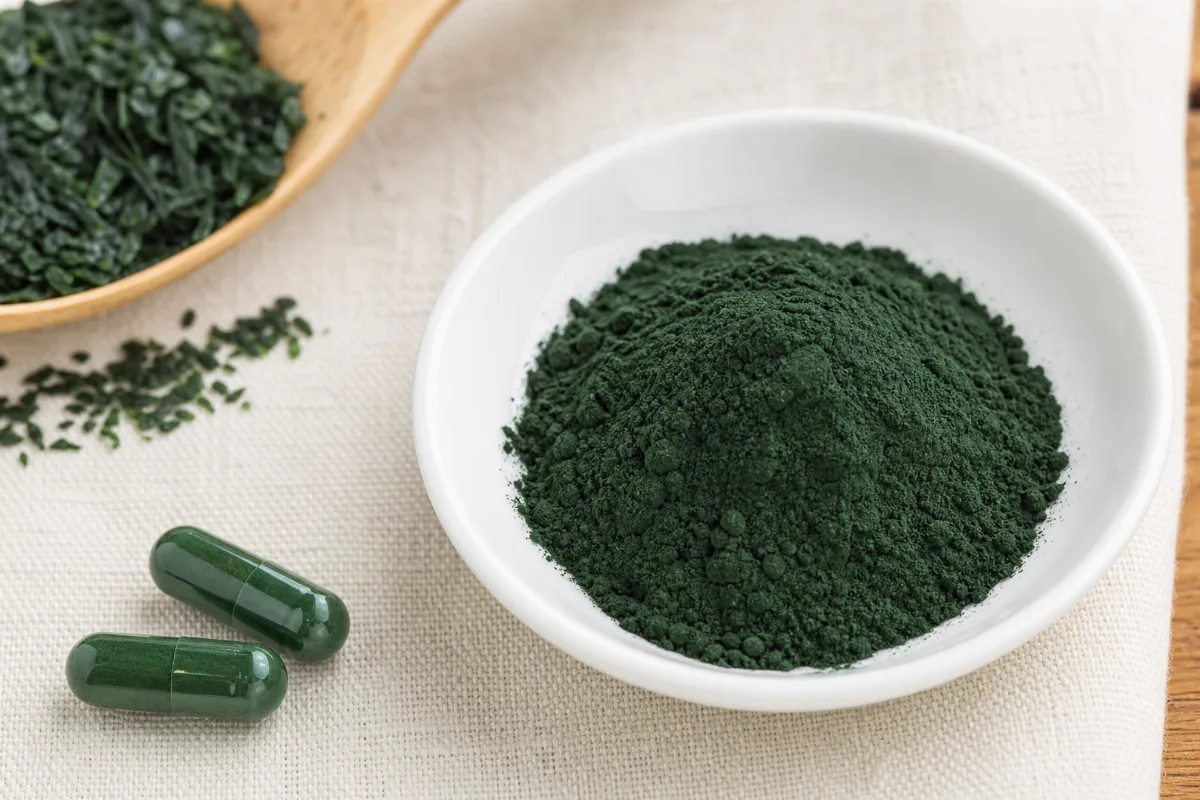
Seaweed & Algae · Blue-green alga
Blue-Green Algae (AFA)
Aphanizomenon flos-aquae · also called AFA, blue-green algae, Klamath AFA
AFA is a blue-green alga (a kind of bacteria that makes its own food from light) harvested from Upper Klamath Lake in Oregon and sold as powder and capsules. Human research is thin: one small 12-week trial of a branded extract in type 2 diabetes, and mostly mouse, rat and cell work. The main caution is contamination: in tests, many blue-green algae products held microcystin, a liver toxin, and serious allergic reactions have been reported.
General information, not medical advice. Last substantive update · Not medically reviewed. A named clinician has not signed off on this page. How this page is made
About Blue-Green Algae (AFA)
AFA is short for Aphanizomenon flos-aquae, a blue-green alga sold as a dried powder or capsule. It is a supplement, not a sea vegetable. The human research is small, and contamination with a liver toxin is the main safety issue.
What it is
Aphanizomenon flos-aquae (AFA) is a cyanobacterium, a kind of bacteria that makes its own food from light. The AFA sold in the US is described as harvested from Upper Klamath Lake in Oregon, dried, and sold as powder or capsules. It is not a seaweed and not a plant.
Its name is unsettled. GBIF matches the name to a synonym entry, and a 2026 genome study says several genomes labelled AFA should be reassessed. Spirulina and chlorella are different algae with their own pages.
What is in it
No USDA FoodData Central entry for AFA was found, so no per-portion values are given here. A 2021 analysis of 15 microalgae powders said AFA and Chlorella may help supply protein with essential amino acids, fibre, omega-3 fats, calcium, iron, magnesium, zinc and vitamins D and E, and that AFA was slightly lowered in value by its saturated fat. The abstract gave no AFA figures.
Vitamin B12: one analysis found it below 0.02 mg per 100 g dry weight in all 15 powders. A 2026 genome study measured about 0.4 to 0.5 microgram per gram in AFA biomass and said it is likely linked to bacteria living with the alga. The two figures differ, and neither tested whether people can use it. Do not rely on AFA as a B12 source.
What the research shows
In people, we found one small randomised trial. In 49 adults with type 2 diabetes, a branded water-soluble AFA extract for 12 weeks lowered fasting glucose and HbA1c compared with placebo. Blood fats, CRP, liver enzymes, IL-6 and TNF-alpha did not differ. The abstract gives no numbers and the product is a commercial brand.
Memorial Sloan Kettering says one study in healthy people showed AFA raised natural killer cells, with no evidence of benefit. Most human studies on its blue-green algae page are of spirulina, not AFA.
Everything else is lab or animal work: weight and blood sugar in obese mice, colitis in rats, human colon tissue in a bath, gene methylation in gut cells, and antioxidant and cancer-cell tests with an extract and C-phycocyanin. Several of these studies come from groups or authors linked to AFA companies.
Powder versus extract
The contamination tests are of whole dried products. The diabetes trial used a branded water-soluble extract in capsules. The mouse, rat, tissue and cell studies used other branded extracts (KlamExtra, AphaMax, Klamin) or the purified pigment C-phycocyanin. None of these results can be read as proof for plain AFA powder.
At a glance
Traditional uses history, not proof
- Sold as a dietary supplement, not eaten as a vegetable
- Long use as a supplement is not proof that it treats any condition
Studied for research
- Blood sugar in type 2 diabetes, low certainty (one small trial of a branded extract)
- Vitamin B12 and nutrients, insufficient evidence for absorption
- Immune cell counts, insufficient evidence
- Weight and metabolism, very low certainty (mice only)
- Gut inflammation, very low certainty (rats and tissue only)
- Antioxidant and cancer-cell effects, insufficient evidence (dishes and test tubes only)
Main compounds
- C-phycocyanin (blue pigment-protein)
- Beta-phenylethylamine (in one branded extract)
- Vitamin B12 (traces, probably from bacteria)
- Protein, fibre, minerals and fats (not quantified here)
Common forms
- Dried wild-harvested powder and capsules (contamination tests read)
- Branded extracts such as Klamin, AphaMax, KlamExtra and Stemtech capsules (studies read, different from plain powder)
- Spirulina and chlorella are different algae and are not covered
Research links: 2000 test: microcystins in blue-green algae products · 2018 test of 51 AFA products · 2015 trial: AFA extract in type 2 diabetes · Memorial Sloan Kettering: blue-green algae · Research Library · Genes & Biomarkers Library
What it is and its history
- Accepted scientific name
- Aphanizomenon flos-aquae (L.) Ralfs
- Naming authority
- (L.) Ralfs. GBIF matched this name as a synonym of its accepted species entry (key 3219153).
- Common names
- AFA (English); Blue-green algae (English); Klamath AFA (English); Alga azul-verde (Spanish)
- Family or group
- Aphanizomenonaceae, a family of cyanobacteria (blue-green algae), as given by GBIF. It is a bacterium that makes its own food from light, not a seaweed and not a plant.
- Classification
- Bacteria (cyanobacteria) > Cyanobacteria > Cyanobacteriia > Cyanobacteriales > Aphanizomenonaceae > Aphanizomenon > Aphanizomenon flos-aquae
- Native range
- Not verified from a source read. The sources describe wild AFA sold in the US as harvested from Upper Klamath Lake in Oregon.
- Habitat
- Fresh water. The genome paper calls the group filamentous, bloom-forming and nitrogen-fixing.
- Cultivation
- Not verified from a source read. Most AFA supplements come from wild harvest, and microcystin-producing Microcystis grows in the same lake.
- Harvest and processing
- Harvested from Upper Klamath Lake, dried, and sold as powder or capsules (2000 and 2018 abstracts). Extracts such as AphaMax and Klamin and water-soluble extract capsules are different products.
- Look-alikes and adulterants
- Name: Spirulina (Arthrospira platensis); Note: A different blue-green alga with its own page. MSK and LactMed discuss it together with AFA, and many human studies are of spirulina.; Name: Microcystis aeruginosa; Note: The toxic alga that grows in the same lake and can contaminate AFA harvests.; Name: Chlorella; Note: A green microalga, not a cyanobacterium.
- Sustainability and conservation
- Not assessed.
Photographs
What is inside, and how it may work
What it contains and how those compounds act in cells and animals. Laboratory and animal mechanisms are not proven effects in people.
Main compounds
| Compound | Family | Where it is concentrated | Activity studied | Level of evidence |
|---|---|---|---|---|
| C-phycocyanin | pigment-protein | Algal cells (extract) Not given in the abstracts read | Scavenged free radicals in a test tube and contributed to cancer-cell death in dishes in the 2025 study. It was also named as an allergen in the related alga Microcystis. 1 3 | Lab |
| Beta-phenylethylamine (beta-PEA) | trace amine | Klamin extract Klamin is described as rich in beta-PEA; AphaMax has less | Linked by the authors to reduced human colon tissue contractions via TAAR1 and serotonin release, in a bath. 2 | Lab |
| Vitamin B12 (cobalamin) | vitamin | Dried biomass About 0.4 to 0.5 microgram per gram dry biomass (genome paper); below 0.02 mg per 100 g (powder analysis) | Probably made by bacteria living with the alga; absorption in people not tested. 13 12 | Lab |
| Microcystins (contaminant, not part of AFA) | cyclic peptide liver toxins | Made by Microcystis, which can contaminate harvests See contamination findings on the Safety tab | Hepatotoxins; microcystin-LR was the main variant in the 2000 test, and MC-LA and MC-LR in the 2018 test. 4 6 | Human exposure risk |
Mechanisms, receptors and pathways
| Target or pathway | Gene or receptor | What was found | Level |
|---|---|---|---|
| Inflammation signalling (NF-kB, COX-2, iNOS, IL-1 beta, IL-6) | NF-kB and others | An AFA extract lowered these markers in rat colitis, per the authors. 15 | Animal research |
| Fat and glucose metabolism genes | FAS, PPAR-gamma, SREBP-1c, FAT-P | An AFA extract normalised expression of these genes in obese mice, per the authors. 14 | Animal research |
| Gut nerve signalling | TAAR1 and serotonin receptors | The authors suggest beta-PEA acts through TAAR1 and serotonin release to reduce colon contractions in human tissue in a bath. Their interpretation. 2 | Lab |
| DNA methylation of interleukin genes | Pro-inflammatory interleukin genes | AFA influenced methylation in human intestinal cells in dishes. 7 | Lab |
Absorption, metabolism and elimination
- Absorption
- Not found for any AFA component in people.
- Distribution
- Not found.
- Metabolism
- Not found.
- Elimination
- Not found.
- Bioavailability
- Not established. The genome paper tested B12 uptake by the algae, not by people.
Isolated compounds versus whole extracts
The diabetes trial used a branded water-soluble extract capsule product. The mouse, rat, tissue and cell results used branded extracts (KlamExtra, AphaMax, Klamin) or a purified pigment. The contamination results are for whole dried products. None of the lab results should be read as evidence for plain AFA powder.
Nutritional composition
No USDA FoodData Central entry for AFA was found, and the public USDA search was rate-limited when checked, so no USDA values and no per-portion numbers are given. A 2021 analysis of 15 microalgae powders (including AFA) says AFA and Chlorella may help supply protein with essential amino acids, fibre, omega-3 fats, calcium, iron, magnesium, zinc and vitamins D and E, and that AFA's value was slightly lowered by a high saturated fat content; its abstract gives no AFA figures. It found vitamin B12 below 0.02 mg per 100 g dry weight in all powders. The 2026 genome paper measured B12 at about 0.4 to 0.5 microgram per gram of dry AFA biomass. The two B12 figures differ and are both reported. Products differ by brand, harvest and extract, so use your own product's label.
1 low certainty2 very low certainty5 not enough evidence
What was looked at
The 8 benefits and uses checked for Blue-Green Algae (AFA), each with how strong the evidence is. Tap one to open it.
- Nutrients and vitamin B12 (what is in it)Not enough evidence
- Blood sugar in type 2 diabetesLow certainty
- Immune cells (natural killer cells)Not enough evidence
- Weight and metabolism (mice only)Very low certainty
- Gut muscle activity (human tissue in a bath)Not enough evidence
- Gut inflammation (rats only)Very low certainty
- Inflammation genes in gut cells (cell study)Not enough evidence
- Antioxidant action and cancer cells in dishesNot enough evidence
Lab markers tracked in the studies
Fasting blood glucoseHbA1c (average blood sugar over about three months)Vitamin B12 content of the productBody weight (in mice)
What is Blue-Green Algae (AFA) good for?
The studied uses and how strong the evidence is. Almost all of it is for branded extracts or comes from animals and cells, not from people eating plain AFA powder.
Benefits, one by one
Each card is a research question, not a promise. Tap a goal to filter. Open a card to see the studies, doses and limits.
Nutrients and vitamin B12 (what is in it)
Not enough evidenceA lab study of AFA strains found about 0.4 to 0.5 micrograms of vitamin B12 per gram of dried biomass and said it probably comes from bacteria living with the alga. A separate analysis of 15 microalgae powders found B12 below 0.02 mg per 100 g dry weight in all of them. Neither test showed that people absorb it.
2 studiesDried AFA biomass and powders. Amounts are not discussed.
Studies, doses and limits
What the trials found
No study in people was read on whether AFA raises B12 levels. The two lab analyses disagree in size (about 0.4 to 0.5 microgram per gram in one, below 0.02 mg per 100 g, which is 0.2 microgram per gram, in the other), probably because they tested different samples and methods, and we state both. The powder analysis also said AFA may help supply protein with essential amino acids, fibre, omega-3 fats, calcium, iron, magnesium, zinc and vitamins D and E, but gave no AFA numbers in its abstract.
Results
AFA contains some nutrients and traces of B12. Whether the body can use that B12 was not tested.
Effect sizes as reported
B12: about 0.4 to 0.5 microgram per gram dry biomass (genome paper); below 0.02 mg per 100 g dry weight in all powders (15-powder analysis).
Why this rating
Only lab analyses of the product. No human absorption or blood-level data, and the two B12 figures differ.
Form and dose studied
Dried AFA biomass and powders. Amounts are not discussed.
Limits
Abstract-only reading. The 2026 genome paper has an author linked to an AFA business. No per-portion nutrition could be read.
Why researchers looked
AFA is marketed as a nutrient-dense 'superfood' and sometimes as a B12 source for people who eat no animal foods.
Traditional use
AFA is sold as a supplement, not eaten as a vegetable. Long use as a supplement is not proof that it treats any condition.
Proposed mechanism Genomic and lab analysis
The B12 is probably made by bacteria living with the alga, per the 2026 genome study authors. This is their interpretation.
A proposed mechanism does not show that the effect happens in people.
Quality and contamination matter more than nutrients; see the Safety tab.
Blood sugar in type 2 diabetes
Low certaintyOne small double-blind trial of 49 adults with type 2 diabetes found that a branded AFA extract product for 12 weeks lowered fasting blood glucose and HbA1c compared with placebo. Blood fats and other markers did not differ. We found no second trial, and the abstract gives no numbers.
1 studiesA branded water-soluble AFA extract in capsules, not the plain powder…
Studies, doses and limits
What the trials found
A 2015 randomised, double-blind, placebo-controlled trial in Iran gave 49 adults aged 20 to 60 with type 2 diabetes and HbA1c at least 7.5% either a water-soluble AFA extract product (Stemtech) or placebo for 12 weeks. Participants kept their usual diet and avoided other supplements. Fasting glucose and HbA1c fell. Triglycerides, total, LDL and HDL cholesterol, CRP, liver enzymes (AST, ALT), BUN, creatinine, CD34+ cells, IL-6 and TNF-alpha did not differ between groups.
Results
A possible lowering of blood glucose markers with one branded extract in one small trial.
Effect sizes as reported
Not given in the abstract (direction only: fasting glucose and HbA1c lower than placebo).
Why this rating
A single small trial, 12 weeks, one branded extract, no numbers in the abstract, funding not stated, and not repeated in a second trial that we read.
Form and dose studied
A branded water-soluble AFA extract in capsules, not the plain powder. Amounts are not discussed here.
Who was studied
Adults aged 20 to 60 with type 2 diabetes and HbA1c at least 7.5%, in Iran.
Limits
Abstract only. No effect sizes read. People with diabetes who take medicines should not change them because of this trial.
Why researchers looked
AFA extracts are marketed for metabolic health, and mouse studies suggested an effect on blood sugar.
Traditional use
AFA is sold as a supplement, not eaten as a vegetable. Long use as a supplement is not proof that it treats any condition.
Proposed mechanism Animal study
Not shown in people. In obese mice an AFA extract changed markers of fat metabolism, inflammation and oxidative stress.
A proposed mechanism does not show that the effect happens in people.
If you take diabetes medicines, ask your clinician before adding any supplement, as glucose could drop. This is a general caution; no hypoglycaemia was reported in the abstract.
Immune cells (natural killer cells)
Not enough evidenceMemorial Sloan Kettering says one study in healthy people showed AFA-algae raised blood levels of natural killer cells. It also says there is no evidence that this helps the body fight infections or stay healthy. We did not open that study.
1 studiesAFA-algae, as described by MSK.
Studies, doses and limits
What the trials found
Only the MSK summary was read. The study it refers to was not named in the page text we read and was not opened.
Results
A change in a blood measure in one study, with no shown health benefit, according to MSK.
Effect sizes as reported
Not available.
Why this rating
Summary-only: the original study was not read, and a rise in one immune cell type is not a health outcome.
Form and dose studied
AFA-algae, as described by MSK.
Who was studied
Healthy adults, per MSK.
Limits
Second-hand. An immune-stimulating product can matter for people with autoimmune disease; see the Safety tab.
Why researchers looked
AFA is sold as an immune-supporting supplement.
Traditional use
AFA is sold as a supplement, not eaten as a vegetable. Long use as a supplement is not proof that it treats any condition.
Proposed mechanism Authoritative guidance
Not stated in the source read.
A proposed mechanism does not show that the effect happens in people.
See the autoimmune and case-report notes on the Safety tab.
Weight and metabolism (mice only)
Very low certaintyIn mice fed a fattening diet, an AFA extract reduced body weight, triglycerides, liver fat and blood sugar. No trial in people was found for weight loss.
2 studiesKlamExtra, an AFA extract, mixed into mouse feed.
Studies, doses and limits
Results
Body weight, triglycerides, liver fat, fat cell size, blood sugar and insulin were lower in obese mice given a branded extract, and glucose control recovered faster after a diet switch.
Effect sizes as reported
Not given in the abstract.
Why this rating
Mouse study only, an extract not the whole powder, no human data; one author is at an AFA-related research centre.
Form and dose studied
KlamExtra, an AFA extract, mixed into mouse feed.
Who was studied
Mice.
Limits
Mouse results often do not carry over to people.
Why researchers looked
AFA extracts are marketed for weight and metabolic health.
Traditional use
AFA is sold as a supplement, not eaten as a vegetable. Long use as a supplement is not proof that it treats any condition.
Proposed mechanism Animal study
In mice the extract changed markers of fat metabolism, inflammation and oxidative stress.
A proposed mechanism does not show that the effect happens in people.
Not assessed in this study.
Gut muscle activity (human tissue in a bath)
Not enough evidenceAn AFA extract rich in a trace amine called beta-PEA reduced the spontaneous contractions of human colon tissue in a lab bath. Another extract with less beta-PEA did not. This does not show relief of any gut symptom.
1 studiesKlamin and AphaMax extracts in a lab bath.
Studies, doses and limits
What the trials found
No study in people. Human colon tissue samples were used in an organ bath.
Results
Contractions fell in a concentration-dependent way with the branded extract Klamin; AphaMax did not change them.
Effect sizes as reported
Not given in the abstract.
Why this rating
Tissue-bath work with a branded extract; no symptom outcome and no people taking AFA.
Form and dose studied
Klamin and AphaMax extracts in a lab bath.
Who was studied
Human colon tissue samples (donors not described in the abstract).
Limits
Cannot say whether eating or taking AFA would have this effect in the body.
Why researchers looked
Researchers asked whether AFA extracts affect the nerves and muscle of the gut.
Traditional use
AFA is sold as a supplement, not eaten as a vegetable. Long use as a supplement is not proof that it treats any condition.
Proposed mechanism Ex vivo laboratory study
The authors suggest the extract acts through beta-PEA, TAAR1 receptors and serotonin release in gut nerves.
A proposed mechanism does not show that the effect happens in people.
None assessed.
Gut inflammation (rats only)
Very low certaintyIn rats with chemically induced colitis, giving an AFA extract before the injury made the colitis less severe. The authors suggest it as a possible add-on for bowel disease, but that has not been tested in people.
1 studiesAphaMax, an AFA aqueous extract, by mouth (amounts not discussed here…
Studies, doses and limits
Results
Less tissue damage and fewer inflammation markers than untreated colitis rats.
Effect sizes as reported
Not given in the abstract.
Why this rating
Rat model, preventive dosing, industry-linked: an author is R&D director of the company that owns the AphaMax patent.
Form and dose studied
AphaMax, an AFA aqueous extract, by mouth (amounts not discussed here).
Who was studied
Rats.
Limits
Prevention in an artificial model is not treatment of bowel disease in people.
Why researchers looked
AFA extracts contain phycocyanins, which have antioxidant and anti-inflammatory activity in lab work.
Traditional use
AFA is sold as a supplement, not eaten as a vegetable. Long use as a supplement is not proof that it treats any condition.
Proposed mechanism Animal study
Reduced NF-kB activation, iNOS and COX-2 and lowered IL-1 beta, IL-6 and oxidative stress markers in rat colon.
A proposed mechanism does not show that the effect happens in people.
People with bowel disease should not use algae supplements in place of treatment.
Inflammation genes in gut cells (cell study)
Not enough evidenceIn human gut cells grown in dishes, an AFA preparation changed the methylation of genes for pro-inflammatory proteins. This is early lab work and does not show a health effect.
1 studiesAn AFA preparation applied to cells.
Studies, doses and limits
Results
AFA influenced methylation of inflammation-related genes in the cells.
Effect sizes as reported
Not given in the abstract.
Why this rating
Cell culture only; a methylation change is not a health outcome.
Form and dose studied
An AFA preparation applied to cells.
Who was studied
Human intestinal cell line.
Limits
Abstract only; no amounts or figures.
Why researchers looked
AFA has been linked to lower inflammation markers in animal work, and researchers asked whether DNA methylation is involved.
Traditional use
AFA is sold as a supplement, not eaten as a vegetable. Long use as a supplement is not proof that it treats any condition.
Proposed mechanism Cell study
Changes in DNA methylation of interleukin genes. The authors call for more work.
A proposed mechanism does not show that the effect happens in people.
None assessed.
Antioxidant action and cancer cells in dishes
Not enough evidenceAn AFA extract and its blue pigment C-phycocyanin neutralised free radicals in a test tube and killed some breast cancer and brain tumour cells in dishes. MSK says blue-green algae have not been shown to prevent or treat cancer in people.
2 studiesA non-purified AFA extract and pure C-phycocyanin.
Studies, doses and limits
Results
The whole extract scavenged 77% of ABTS radicals at 2.4 mg/mL versus 22% for pure C-phycocyanin. Cell death was 29.9% in glioma cells (0.75 mg/mL) and 80.9% in breast cancer cells (1 mg/mL).
Effect sizes as reported
ABTS 77% vs 22%; glioma cell death 29.9%; breast cancer cell death 80.9%.
Why this rating
Test-tube and cell-dish work at lab concentrations, with company-employed authors. It says nothing about effect in people.
Form and dose studied
A non-purified AFA extract and pure C-phycocyanin.
Who was studied
Human cancer cell lines (HCC1806, U-118 MG).
Limits
Killing cells in a dish is not a cancer treatment. No cancer should be treated with an algae supplement in place of medical care.
Why researchers looked
Phycocyanin is a pigment-protein with antioxidant activity, and AFA is a source of it.
Traditional use
AFA is sold as a supplement, not eaten as a vegetable. Long use as a supplement is not proof that it treats any condition.
Proposed mechanism Laboratory study
Radical scavenging in a test tube, and cell death in two human cancer cell lines. The authors link part of it to C-phycocyanin and part to other extract components.
A proposed mechanism does not show that the effect happens in people.
None assessed.
Connections to the rest of health
How Blue-Green Algae (AFA) connects to the rest of our health knowledge graph. Every link says what kind of connection it is. A safety link (for example to the liver) is a warning, not a benefit. A study that merely mentions a topic never creates a benefit link.
Explore every connection: goals, body systems, organs, symptoms, genes
A. Wellness goals
| Connected to | Kind of connection | Evidence status | Context | Studies |
|---|---|---|---|---|
| Preventive Wellness | Not enough evidence | Nutrients and vitamin B12 (what is in it): A lab study of AFA strains found about 0.4 to 0.5 micrograms of vitamin B12 per gram of dried biomass and said it probably comes from bacteria living with the alga. A separate analysis of 15 microalgae powders found B12 below 0.02 mg per 100 g dry weight in all of them. Neither test showed that people absorb it. | 13 12 | |
| Blood Sugar Balance | Low certainty | Blood sugar in type 2 diabetes: One small double-blind trial of 49 adults with type 2 diabetes found that a branded AFA extract product for 12 weeks lowered fasting blood glucose and HbA1c compared with placebo. Blood fats and other markers did not differ. We found no second trial, and the abstract gives no numbers. | 11 | |
| Metabolic Health | Low certainty | Blood sugar in type 2 diabetes: One small double-blind trial of 49 adults with type 2 diabetes found that a branded AFA extract product for 12 weeks lowered fasting blood glucose and HbA1c compared with placebo. Blood fats and other markers did not differ. We found no second trial, and the abstract gives no numbers. | 11 | |
| Immune Support | Not enough evidence | Immune cells (natural killer cells): Memorial Sloan Kettering says one study in healthy people showed AFA-algae raised blood levels of natural killer cells. It also says there is no evidence that this helps the body fight infections or stay healthy. We did not open that study. | 17 | |
| Weight Management | Very low certainty | Weight and metabolism (mice only): In mice fed a fattening diet, an AFA extract reduced body weight, triglycerides, liver fat and blood sugar. No trial in people was found for weight loss. | 14 17 | |
| Metabolic Health | Very low certainty | Weight and metabolism (mice only): In mice fed a fattening diet, an AFA extract reduced body weight, triglycerides, liver fat and blood sugar. No trial in people was found for weight loss. | 14 17 | |
| Digestive Health | Not enough evidence | Gut muscle activity (human tissue in a bath): An AFA extract rich in a trace amine called beta-PEA reduced the spontaneous contractions of human colon tissue in a lab bath. Another extract with less beta-PEA did not. This does not show relief of any gut symptom. | 2 | |
| Digestive Health | Very low certainty | Gut inflammation (rats only): In rats with chemically induced colitis, giving an AFA extract before the injury made the colitis less severe. The authors suggest it as a possible add-on for bowel disease, but that has not been tested in people. | 15 | |
| Inflammation Balance | Very low certainty | Gut inflammation (rats only): In rats with chemically induced colitis, giving an AFA extract before the injury made the colitis less severe. The authors suggest it as a possible add-on for bowel disease, but that has not been tested in people. | 15 | |
| Inflammation Balance | Not enough evidence | Inflammation genes in gut cells (cell study): In human gut cells grown in dishes, an AFA preparation changed the methylation of genes for pro-inflammatory proteins. This is early lab work and does not show a health effect. | 7 | |
| Antioxidant Support | Not enough evidence | Antioxidant action and cancer cells in dishes: An AFA extract and its blue pigment C-phycocyanin neutralised free radicals in a test tube and killed some breast cancer and brain tumour cells in dishes. MSK says blue-green algae have not been shown to prevent or treat cancer in people. | 1 17 |
B. Body systems
| Connected to | Kind of connection | Evidence status | Context | Studies |
|---|---|---|---|---|
| Nervous System | Biological association | Not enough evidence | Studied for: Nutrients and vitamin B12 (what is in it) | 13 12 |
| Endocrine System | Biological association | Low certainty | Studied for: Blood sugar in type 2 diabetes Studied for: Weight and metabolism (mice only) | 11 14 17 |
| Immune System | Biological association | Not enough evidence | Studied for: Immune cells (natural killer cells) Studied for: Gut inflammation (rats only) | 17 15 7 1 |
| Digestive System | Biological association | Very low certainty | Studied for: Weight and metabolism (mice only) Studied for: Gut muscle activity (human tissue in a bath) | 14 17 2 15 7 |
C. Body parts and organs
E. Health conditions
| Connected to | Kind of connection | Evidence status | Context | Studies |
|---|---|---|---|---|
| Food allergy | Adverse effect or risk | Documented risk | Anaphylaxis is listed by MSK for blue-green algae supplements. Preparation or compound: Blue-green algae supplements |
17 3 |
| Type 2 diabetes | Preliminary | One small 12-week trial of a branded AFA extract found lower fasting glucose and HbA1c than placebo; not repeated. Preparation or compound: Branded AFA extract capsules |
11 |
G. Root causes and contributing factors
| Connected to | Kind of connection | Evidence status | Context | Studies |
|---|---|---|---|---|
| Environmental toxins | Adverse effect or risk | Documented risk | Microcystin contamination was found in blue-green algae supplements, including AFA from Klamath Lake. Preparation or compound: Wild-harvested AFA |
4 6 10 |
I. Biomarkers
| Connected to | Kind of connection | Evidence status | Context | Studies |
|---|---|---|---|---|
| Fasting blood glucose | Biological association | Low certainty | Measured in trials: lowered. A lab change is not the same as a health benefit. | 11 |
| HbA1c (average blood sugar over about three months) | Biological association | Low certainty | Measured in trials: lowered. A lab change is not the same as a health benefit. | 11 |
| Vitamin B12 content of the product | Biological association | Not enough evidence | Measured in trials: no-change. A lab change is not the same as a health benefit. | 13 12 |
| Body weight (in mice) | Biological association | Very low certainty | Measured in trials: lowered. A lab change is not the same as a health benefit. | 14 |
K. Biological pathways
| Connected to | Kind of connection | Evidence status | Context | Studies |
|---|---|---|---|---|
| Vitamin B12 | Preliminary mechanism | Lab | Trace amounts in AFA biomass, probably from associated bacteria; absorption in people not tested. | 13 12 |
| NF-kB inflammation signalling | Preliminary mechanism | Animal | Reduced in rat colitis after an AFA extract. | 15 |
L. Active compounds
| Connected to | Kind of connection | Evidence status | Context | Studies |
|---|---|---|---|---|
| C-phycocyanin | Biological association | Lab | Scavenged free radicals in a test tube and contributed to cancer-cell death in dishes in the 2025 study. It was also named as an allergen in the related alga Microcystis. Preparation or compound: Algal cells (extract) |
1 3 |
| Beta-phenylethylamine (beta-PEA) | Biological association | Lab | Linked by the authors to reduced human colon tissue contractions via TAAR1 and serotonin release, in a bath. Preparation or compound: Klamin extract |
2 |
| Vitamin B12 (cobalamin) | Biological association | Lab | Probably made by bacteria living with the alga; absorption in people not tested. Preparation or compound: Dried biomass |
13 12 |
| Microcystins (contaminant, not part of AFA) | Biological association | Human exposure risk | Hepatotoxins; microcystin-LR was the main variant in the 2000 test, and MC-LA and MC-LR in the 2018 test. Preparation or compound: Made by Microcystis, which can contaminate harvests |
4 6 |
Each connection is stored with the ingredient, the connected record, the kind of connection, the evidence status, the supporting studies, the preparation or compound involved, and a review date (last reviewed October 26, 2026).
The evidence
The research centre for Blue-Green Algae (AFA). Every record here was checked against PubMed or the publisher's page; we never list a study we have not verified.
Evidence by outcome
Bars show how many studies we found for each outcome, not how well it works. People are added up across trials only (reviews are not added, to avoid double counting).
How we rate evidence
High certainty
Several well-run trials or reviews agree; further research is unlikely to change the picture much.
Moderate certainty
Good trials point the same way, but some doubt remains.
Low certainty
Small, short or inconsistent trials. The finding could change with better research.
Very low certainty
Very little or very weak human data. Treat as a possibility only.
Mixed findings
Trials or reviews disagree with each other.
Not enough evidence
Not enough human research to say either way.
Evidence against
Good research found no benefit, or found harm.
We take the reviewers' own risk-of-bias and GRADE statements where they exist, and otherwise judge from study size, design, consistency, directness and whether a product matches what is sold. Many publications do not make evidence high. Method note: We started from our earlier AFA summary, re-read the Memorial Sloan Kettering page and the LactMed entry, and re-read PubMed abstracts for the contamination tests, the one human trial, the lab and animal studies and the 2026 genome study. Only abstracts were read for studies, and one case report was read by title only. Items we could not verify are flagged in the research gaps.
Study library: every study we checked 17
| Study | Design | People | Product, dose, length | Result |
|---|---|---|---|---|
| Aguila-Carricondo 2025 Aphanizomenon flos-aquae: A Biorefinery for Health and Energy - Unleashing Phycocyanin's Power and Biogas Potential. Mar Drugs · PMID 40559634 · DOI |
Laboratory study cell lines and test tube |
Test-tube antioxidant assay and two human cancer cell lines (breast HCC1806, brain glioma U-118 MG) | Non-purified AFA extract and purified C-phycocyanin Algae extract · vs Pure C-phycocyanin versus whole extract |
The non-purified extract scavenged 77% of ABTS radicals at 2.4 mg/mL versus 22% for pure C-phycocyanin. In glioma cells the extract at 0.75 mg/mL gave 29.9% total cell death, of which pure C-phycocyanin explained 55.5%. In breast cancer cells the extract at 1 mg/mL killed 80.9%, which the authors attribute to other extract components working together. The rest of the paper is about making biogas from the leftover biomass. ABTS scavenging 77% (extract) vs 22% (pure C-phycocyanin) Methods, limits and fundingOutcomes: Antioxidant capacity and cancer-cell death in dishes; biogas from spent biomass Limitations: Test-tube and cell-dish work only. Killing cancer cells at lab concentrations does not show an anticancer effect in people. Funding and conflicts: Industry link: three authors are employees of Microalgae Solutions, a company; the work is part of an industrial doctorate. Read: abstract |
| Amato 2021 Spasmolytic Effects of Aphanizomenon Flos Aquae (AFA) Extract on the Human Colon Contractility. Nutrients · PMID 34684446 · DOI |
Ex vivo laboratory study human tissue ex vivo |
Samples of human distal colon tissue in an organ bath | Klamin, an AFA extract rich in beta-phenylethylamine (beta-PEA) Algae extract · vs AphaMax, an AFA extract with less beta-PEA |
Klamin reduced the amplitude of spontaneous contractions in a concentration-dependent way. AphaMax, which has less beta-PEA, did not change contractions. Blocking the trace-amine receptor TAAR1 reduced the effect. The authors suggest the extract acts through beta-PEA and serotonin release in gut nerves. Not applicable Methods, limits and fundingOutcomes: Strength of spontaneous colon muscle contractions Limitations: Human tissue in a bath, not people eating AFA. It shows a laboratory effect of one branded extract, not relief of any gut symptom. Funding and conflicts: Authors declare no conflict of interest; one author is at a nutrition research centre in Urbino, Italy. Read: abstract |
| Geh 2015 Identification of Microcystis aeruginosa Peptides Responsible for Allergic Sensitization and Characterization of Functional Interactions between Cyanobacterial Toxins and Immunogenic Peptides. Environ Health Perspect · PMID 25902363 · DOI |
Laboratory study human blood samples and rat cells |
Blood samples from chronic rhinitis patients tested against extracts of Microcystis aeruginosa | Microcystis aeruginosa extracts (a different blue-green alga from AFA) Algae extract · vs Toxin-free and toxin-producing strains |
Phycocyanin and a core-membrane linker peptide were identified as the allergens. Extracts containing them made rat cells release an allergy mediator. Allergic reactions were stronger to the non-toxin strain. Not applicable Methods, limits and fundingOutcomes: IgE (allergy antibody) reactions and allergen identity Limitations: Tested Microcystis, not AFA. It shows blue-green algae proteins can sensitise some people; it does not show how often AFA products cause allergy. Funding and conflicts: No competing financial interests declared. Read: abstract |
| Gilroy 2000 Assessing potential health risks from microcystin toxins in blue-green algae dietary supplements. Environ Health Perspect · PMID 10811570 · DOI |
Laboratory analysis not applicable (product testing) |
87 blue-green algae products tested after Oregon's 1996 Upper Klamath Lake bloom | Blue-green algae products, many containing AFA from Upper Klamath Lake Dried algae products · vs Oregon limit of 1 microgram per gram |
Microcystins were found in 85 of 87 samples. 63 samples (72%) were above the 1 microgram per gram limit set by Oregon's health and agriculture departments. The main toxin type was tentatively identified as microcystin-LR. 85 of 87 samples with microcystins; 63 of 87 (72%) above 1 microgram per gram Methods, limits and fundingOutcomes: Microcystin (liver toxin) in products Limitations: Products from the 1990s; today's products and tests differ. This shows contamination can happen, not how common it is now. Funding and conflicts: Authors at the Oregon Health Division and a university; no industry funding stated in the abstract. Read: abstract |
| Kim 2020 Pemphigus foliaceus following use of herbal supplement containing Aphanizomenon flos-aquae. Int J Dermatol · PMID 31769005 · DOI |
Case report |
One reported patient | Herbal supplement containing AFA Dried algae product Not given in the record read Not given in the record read |
The PubMed record read shows only the title and no abstract: a letter reporting pemphigus foliaceus after use of an herbal supplement containing AFA. Nothing else was read, so the details, the other ingredients and whether the supplement caused the illness are unknown. Not applicable Methods, limits and fundingOutcomes: Autoimmune blistering skin disease (pemphigus foliaceus) Limitations: Title only was read. A single case cannot show cause, and the product held other ingredients as far as the title says ('herbal supplement containing' AFA). Funding and conflicts: Not stated in the record read. Read: title-only |
| Marsan 2018 Evaluation of microcystin contamination in blue-green algal dietary supplements using a protein phosphatase inhibition-based test kit. Heliyon · PMID 29862339 · DOI |
Laboratory analysis not applicable (product testing) |
51 51 distinct AFA blue-green algae supplements sold in the US |
AFA supplements from Upper Klamath Lake Dried algae products · vs Oregon limit of 1 microgram per gram |
26 of 51 products (51%) had microcystin at or above the kit's detection limit of 0.25 microgram per gram. Ten had 0.5 to 1.0 microgram per gram and four exceeded the limit (1.1 to 2.8 microgram per gram). Most were at or below 1.0, which the authors read as manufacturers using that figure as a specification. Serving sizes varied too much to work out how much a person would take in. 26/51 at or above 0.25 microgram per gram; 4/51 above 1.0 (1.1 to 2.8) Methods, limits and fundingOutcomes: Microcystin in products Limitations: Product testing, not a study of harm in people. Brands not named in the abstract. Funding and conflicts: Authors include US FDA scientists; no competing interests stated in the abstract. Read: abstract |
| Naselli 2025 First evidence of epigenetic modulation of human gene methylation by microalga Aphanizomenon flos-aquae (AFA) in inflammation-related pathways in intestinal cells. Clin Epigenetics · PMID 40050990 · DOI |
Cell study human cells |
Human intestinal cells grown in dishes | AFA preparation applied to cells Algae preparation · vs Untreated cells |
AFA influenced the methylation of genes for pro-inflammatory interleukins in the cells. The authors say this is the first such evidence and call for more work on mechanisms. Not applicable Methods, limits and fundingOutcomes: DNA methylation of genes for inflammation-related interleukins Limitations: Cells in a dish. Methylation change does not show a health benefit. The abstract gives no figures or amounts. Funding and conflicts: Authors declare no competing interests; a co-author (G.D. Scoglio) declares a link to the AFA business Nutrigea in a separate 2026 paper. Read: abstract |
| National Institute of Child Health and Human Development 2021 Spirulina (Drugs and Lactation Database, LactMed), entry covering Aphanizomenon sp., Spirulina sp. and others LactMed (NCBI Bookshelf) · PMID 30000909 |
Reference database |
Breastfeeding mothers and infants | Blue-green algae sold as spirulina, which the entry says includes Aphanizomenon Dried algae |
No data exist on excretion of the components into breast milk or on safety and efficacy in nursing mothers or infants. Spirulina is generally well tolerated when grown under controlled conditions. Minor effects listed include diarrhoea, bloating, upset stomach, gas, swelling, headache, muscle pain, flushing and sweating. Products grown in uncontrolled conditions can contain heavy metals and other contaminants, and some can be contaminated with Microcystis aeruginosa, which makes microcystins. Breast milk discolouration (green in one case) has been reported. Not applicable Methods, limits and fundingOutcomes: Safety in breastfeeding Limitations: Entry is titled spirulina; it names Aphanizomenon only in passing, so AFA-specific data are absent. Funding and conflicts: Public reference (US National Library of Medicine). Entry dated 2021-06-21. Read: abstract |
| Rajput 2026 Health risks of cyanotoxin contamination in dietary supplements: Mechanistic insights into organ-specific toxicity. Food Chem Toxicol · PMID 42874982 · DOI |
Narrative review mostly lab and animal |
Published reports of cyanotoxins in Arthrospira (spirulina), Aphanizomenon flos-aquae and Chlorella supplements | Cyanotoxin-contaminated algae supplements Dried algae products |
The review describes how microcystins and other cyanotoxins harm the liver, nerves and other organs in lab and animal work. It says important gaps remain on long-term low-dose exposure, how much is absorbed from supplements, and long-term effects in people. Not applicable Methods, limits and fundingOutcomes: How contamination occurs and how cyanotoxins harm organs Limitations: A narrative review, so it can show what is known about mechanisms but not how often people are harmed. Funding and conflicts: No competing interests stated. Read: abstract |
| Roy-Lachapelle 2017 Detection of Cyanotoxins in Algae Dietary Supplements. Toxins (Basel) · PMID 28245621 · DOI |
Laboratory analysis not applicable (product testing) |
18 18 commercial products containing Spirulina or Aphanizomenon flos-aquae |
Spirulina and AFA supplements (mixed; the abstract does not split the results) Dried algae products · vs Tolerable daily intake values |
Of 18 products, 8 contained some cyanotoxins at levels above the tolerable daily intake values. The authors call for better quality control and consumer awareness. 8 of 18 products above tolerable daily intake values Methods, limits and fundingOutcomes: Microcystins and other cyanotoxins in products Limitations: Spirulina and AFA products are not separated in the abstract, so this is not an AFA-only figure. Small sample. Funding and conflicts: No competing interests stated. Read: abstract |
| Sanaei 2015 Consequences of Aphanizomenon Flos-aquae (AFA) extract (Stemtech) on metabolic profile of patients with type 2 diabetes. J Diabetes Metab Disord · PMID 26131436 · DOI |
Randomised controlled trial |
49 49 adults aged 20 to 60 with type 2 diabetes and HbA1c at least 7.5%, Iran |
Water-soluble AFA extract in a branded capsule product (Stemtech) Algae extract capsules Capsules before and after meals (amounts not discussed here) 12 weeks · vs Placebo capsules |
Fasting blood glucose and HbA1c fell with the AFA product. Blood fats (triglycerides, total, LDL and HDL cholesterol), CRP, liver tests (AST, ALT), BUN, creatinine, CD34+ cells, IL-6 and TNF-alpha showed no considerable differences between groups. The authors concluded the product had a positive effect on blood glucose. Fasting glucose and HbA1c lower than placebo; the abstract gives no numbers Methods, limits and fundingOutcomes: Fasting blood glucose, HbA1c, blood fats, CRP, liver and kidney tests, CD34 cells, IL-6, TNF-alpha Limitations: Small, 12 weeks, one country, one branded extract. The abstract gives no figures and no funding statement. Not repeated in a second trial that we read. Funding and conflicts: Funding and competing interests not stated in the abstract; the product is a commercial brand. Read: abstract |
| Sandgruber 2021 Variability in Macro- and Micronutrients of 15 Commercially Available Microalgae Powders. Mar Drugs · PMID 34071995 · DOI |
Laboratory analysis not applicable (product analysis) |
15 15 commercial microalgae powders, including Aphanizomenon flos-aquae, spirulina, chlorella and others |
Dried microalgae powders Powder · vs Other microalgae |
The authors say AFA and Chlorella may help supply protein with essential amino acids, fibre, omega-3 fats, calcium, iron, magnesium, zinc and vitamins D and E. AFA's nutritional value was slightly lowered by a high content of saturated fat. Vitamin B12 (as cobalamin) was below 0.02 mg per 100 g dry weight in every powder studied. Profiles differ strongly between and within species. B12 below 0.02 mg per 100 g dry weight in all 15 powders Methods, limits and fundingOutcomes: Protein, fats, fibre, vitamins and minerals, heavy metals Limitations: The abstract does not give AFA numbers, so no per-portion values are stated. Powders from one market at one time. Funding and conflicts: No competing interests stated. Read: abstract |
| Scoglio 2026 Genomic insights into the taxonomy, safety and biotechnological potential of Aphanizomenon flos-aquae and related Nostocales. Microb Genom · PMID 42776574 · DOI |
Genomic and laboratory analysis genomes and cultures |
161 Nostocales genomes from NCBI plus three newly sequenced AFA strains, including Klamath AFA | AFA and related filamentous cyanobacteria Algal biomass (dry) |
Genes for cyanotoxins (anatoxin-a, saxitoxin, cylindrospermopsin, microcystin or nodularin) were found in only 7.3% of the genomes. B12 in the AFA strains was about 0.4 to 0.5 micrograms per gram of dry biomass and is likely linked to B12-producing bacteria living with the alga. The authors say their analysis supports reassessing several genomes labelled as AFA. Toxin gene clusters in 7.3% of 161 genomes; B12 about 0.4 to 0.5 microgram per gram dry biomass Methods, limits and fundingOutcomes: Toxin gene clusters, vitamin B12 content Limitations: Genes for toxins are not the same as toxins in a product, and no absorption of B12 in people was tested. The first author is directly involved with Nutrigea, an AFA business. Funding and conflicts: Industry link: G.D. Scoglio is directly involved with Nutrigea s.r.l.; the Scoglio family owns it. Read: abstract |
| Terzo 2023 Positive Impacts of Aphanizomenon Flos Aquae Extract on Obesity-Related Dysmetabolism in Mice with Diet-Induced Obesity. Cells · PMID 38067134 · DOI |
Animal study mouse |
Mice fed a high-fat diet or standard diet | AFA extract (KlamExtra) mixed into feed Algae extract · vs High-fat diet without AFA; standard diet |
In obese mice the extract reduced body weight, triglycerides, liver fat accumulation and fat cell size, lowered blood sugar and insulin, and improved glucose tolerance. It also changed markers of fat metabolism, inflammation and oxidative stress, and sped up the recovery of glucose control after the diet was switched back to normal. Not applicable Methods, limits and fundingOutcomes: Body weight, blood fats, liver fat, blood sugar, insulin and gene or protein markers Limitations: Mice, and an extract rather than the whole powder. It cannot be assumed to work in people. One author is at a nutrition research centre (Centro di Ricerche Nutriterapiche). Funding and conflicts: Authors declare no conflict of interest in the abstract. Read: abstract |
| Zizzo 2020 AphaMax, an Aphanizomenon Flos-Aquae Aqueous Extract, Exerts Intestinal Protective Effects in Experimental Colitis in Rats. Nutrients · PMID 33256017 · DOI |
Animal study rat |
Rats with chemically induced colitis (DNBS) | AphaMax, an AFA aqueous extract high in phycocyanins, given by mouth before colitis was induced Algae extract Three amounts per kg of body weight (not shown here) · vs Untreated colitis rats |
Preventive treatment reduced the severity of colitis, reduced tissue damage, reduced myeloperoxidase activity, NF-kB activation, iNOS and COX-2, and lowered IL-1 beta and IL-6 and oxidative stress markers. The authors call it a candidate as a complementary drug for inflammatory bowel disease. Not applicable Methods, limits and fundingOutcomes: Colon damage and inflammation markers Limitations: Rats given the extract before the injury, so this is prevention in an artificial model. The authors' wording about IBD is a hypothesis, not a finding in people. Funding and conflicts: Industry link: the last-but-one author, S. Scoglio, is R&D Director of the company that owns the AphaMax patent. Read: abstract |
| s-gbif-afa GBIF species match: Aphanizomenon flos-aquae (L.) Ralfs · Source |
Reference database n/a |
Methods, limits and fundingRead: full-text | ||
| s-msk-bga Memorial Sloan Kettering Cancer Center: Blue-green algae (Integrative Medicine herbs) · Source |
Reference database human and lab |
Methods, limits and fundingRead: full-text |
What we do not know yet
- Only one small human trial of an AFA extract was found, and its abstract gives no numbers; no trial of plain AFA powder was found.
- The study MSK cites on natural killer cells was not opened.
- No human study shows that people absorb the B12 in AFA, and two lab analyses disagree on how much there is.
- No USDA entry, per-portion nutrition, heavy-metal figures, storage advice or history source was read.
- No FDA, EFSA or LiverTox statement on AFA was read; safety for pregnancy, children, PKU and autoimmune disease is unknown.
- Many animal and lab studies come from groups linked to AFA businesses.
How new research is added
New studies are found by a saved PubMed search and placed in a review queue before the page changes.
Lab markers
What changed in blood or saliva tests during trials. A changed number is not the same as feeling or being healthier, and we give no "normal ranges".
Metabolic 3
Fasting blood glucose
Lowered in trials
The sugar level in the blood after not eating overnight.
Low certaintyResults and what it means
Why it was measured
It is a basic marker of blood sugar control in diabetes.
Statistical vs. clinical meaning
A direction of change in one small trial, with no numbers read.
Safety implication
If you use glucose-lowering medicines, ask your clinician before adding a supplement.
| Study | Result | People | Product |
|---|---|---|---|
| 11 | Fasting glucose fell with the AFA product (no figures in the abstract) | 49 adults with type 2 diabetes | Branded AFA extract capsules versus placebo, 12 weeks |
HbA1c (average blood sugar over about three months)
Lowered in trials
A blood test showing average blood sugar over roughly the past three months.
Low certaintyResults and what it means
Why it was measured
It is the usual long-term marker of diabetes control.
Statistical vs. clinical meaning
The same single trial; not replicated in the sources we read.
Safety implication
None specific.
| Study | Result | People | Product |
|---|---|---|---|
| 11 | HbA1c fell with the AFA product (no figures in the abstract) | 49 adults with type 2 diabetes, HbA1c at least 7.5% at the start | Branded AFA extract capsules versus placebo, 12 weeks |
Body weight (in mice)
Lowered in trials
How heavy the animal is; here it refers to mice on a high-fat diet.
Very low certaintyResults and what it means
Why it was measured
A basic measure in obesity models.
Statistical vs. clinical meaning
Mouse result only; no human weight trial found.
Safety implication
None specific.
| Study | Result | People | Product |
|---|---|---|---|
| 14 | Body weight, triglycerides and liver fat lower with an AFA extract (no figures in the abstract) | Mice on a high-fat diet | AFA extract (KlamExtra) mixed into feed |
Other 1
Vitamin B12 content of the product
No clear change in trials
How much vitamin B12 a dried algae sample contains (not a blood level in people).
Not enough evidenceResults and what it means
Why it was measured
People who eat no animal foods look for B12 sources.
Statistical vs. clinical meaning
Product content only; no test of absorption or blood B12 in people.
Safety implication
Do not rely on AFA as your only B12 source; ask a clinician or dietitian.
Safety
What studies and official sources say about side effects, medicines and who should check first. Each point shows what kind of evidence it comes from.
Main points to know 4
- Contamination with a liver toxin is the main concern. AFA from Upper Klamath Lake grows beside Microcystis aeruginosa, a toxic alga that makes microcystins (liver toxins). In a 2000 test, 85 of 87 blue-green algae products held microcystins and 63 (72%) were above Oregon's limit of 1 microgram per gram. In a 2018 test of 51 US AFA products, about half had detectable levels and four were above 1 microgram per gram. A 2017 test of 18 spirulina or AFA products found 8 with cyanotoxins above tolerable daily intake values. You cannot see this on a label. Laboratory analysis 4 6 10
- Serious allergic reactions have been reported with blue-green algae supplements. MSK lists anaphylaxis among reported adverse reactions to blue-green algae supplements. Lab work on a related alga, Microcystis, identified phycocyanin and a linker protein as allergens. Whether AFA does the same was not tested in the study we read. Authoritative guidance 17 3
- Immune-stimulating products and autoimmune disease. One case report describes pemphigus foliaceus, an autoimmune blistering skin disease, after use of an herbal supplement containing AFA. Only the title was read, so we do not know what else was in the product or whether it caused the illness. MSK says an AFA study raised natural killer cells, with no proven benefit. If you have an autoimmune disease, ask your specialist first. Case report 5 17
- No safety data for pregnancy, breastfeeding, children or PKU. LactMed says no data exist on blue-green algae components in breast milk or on safety in nursing mothers or infants, and that products grown in uncontrolled conditions can contain heavy metals and other contaminants. We found no AFA-specific statement for pregnancy or children, and no source on phenylalanine content for people with PKU. No data is not the same as proof of safety. Authoritative guidance 8
Side effects 3
| Effect | How often | Severity and recovery | Evidence |
|---|---|---|---|
| Liver damage from microcystin-contaminated products (rare, per MSK) MSK says cyanotoxin contamination may cause liver damage, kidney failure, nerve damage, seizures, respiratory arrest, acute pancreatitis and heart muscle damage, and calls it uncommon. | Not given. Contamination itself was found in 85 of 87 products in 2000 and in about half of 51 AFA products in 2018. | can be severe Not described in the sources read. | Laboratory analysis and authoritative guidance 17 4 6 |
| Allergic reactions, including anaphylaxis MSK's list covers blue-green algae supplements as a group (spirulina and AFA). | Not given. | can be severe (anaphylaxis) Not described. | Authoritative guidance 17 |
| Mild digestive and other effects listed for spirulina-type algae: diarrhoea, bloating, upset stomach, gas, headache, muscle pain, flushing, sweating From the LactMed spirulina entry, which also names Aphanizomenon; not AFA-specific. | Not given. | mild Not described. | Authoritative guidance 8 |
Liver
Microcystins are liver toxins. MSK says contaminated products may cause liver damage. A liver-safety database (such as LiverTox) was not searched for AFA. In the 12-week diabetes trial, liver enzymes (AST, ALT) did not differ between the AFA product and placebo, but that is one small trial of one branded extract. 17 11
How often. No frequency found.
Monitoring. No agency monitoring advice was found.
This is a safety connection. It is not evidence that Blue-Green Algae (AFA) supports liver health.
Medicines and supplements 3
| With | Why it matters | Importance | Evidence | What to do |
|---|---|---|---|---|
| Medicines handled by the liver enzymes CYP1A2 and CYP2E1 prescription | MSK says spirulina inhibits these two enzymes, which could raise levels of drugs they break down. | MSK says the clinical relevance is not known. The finding is for spirulina, and we found nothing equivalent for AFA. | Laboratory study of spirulina Very low certainty 17 | Ask your pharmacist if you take medicines with a narrow safety margin. |
| Immune-suppressing medicines and autoimmune treatment prescription | AFA may raise natural killer cells (MSK) and one case report links an AFA-containing supplement to an autoimmune skin disease. No interaction with immune medicines was found in the sources. | Not established. Raised as a question for your specialist, not as a proven interaction. | Case report and authoritative guidance Very low certainty 5 17 | Ask your specialist before using AFA if you have an autoimmune disease or take immune-suppressing medicine. |
| Diabetes medicines prescription | A small trial of an AFA extract found lower fasting glucose and HbA1c than placebo. The abstract reports no low-sugar episodes. | No interaction was studied. As a general caution, anything that lowers glucose could add to glucose-lowering medicines. | Trial observation Very low certainty 11 | Ask your clinician before adding AFA if you use diabetes medicines. |
Who should check first 6
| Situation | Advice | Evidence |
|---|---|---|
| Liver disease or liver enzyme problems | Ask a clinician first. Microcystin contamination is a liver risk, and we found no safety data in this group. | Authoritative guidance 17 |
| Pregnancy or breastfeeding | We found no AFA-specific safety data. LactMed says no data exist for nursing mothers and infants. Ask your midwife or doctor. | Authoritative guidance 8 |
| Autoimmune disease or immune-suppressing treatment | Ask your specialist first. AFA is sold as immune-stimulating, and one case report links an AFA-containing supplement to pemphigus foliaceus. | Case report 5 17 |
| Phenylketonuria (PKU) | No source on phenylalanine in AFA was found. Ask your metabolic dietitian. | Gap |
| Children | No safety data for children were found. Ask a paediatrician. | Gap |
| Known allergy to blue-green algae, spirulina or phycocyanin | Avoid. Anaphylaxis has been reported with blue-green algae supplements. | Authoritative guidance 17 3 |
Overdose, product quality and regulators
Summary. The toxicity concern is contamination, not the AFA alga itself. A 2026 genome study found toxin gene clusters in only 7.3% of 161 related genomes, so strains differ, but genes are not the same as toxins in a finished product.
Animal. Not reviewed beyond the extract studies, which reported no toxicity findings in their abstracts.
High dose or long term signals. A 2026 review says long-term low-dose exposure to cyanotoxins and absorption from supplements are important gaps.
Overdose response. Not found.
Genotoxicity. Not researched.
Wild-harvested AFA can be contaminated with microcystins from Microcystis, and contamination levels vary between products and years.
Microcystins in 1990s products. 85 of 87 blue-green algae products had microcystins; 63 (72%) were above 1 microgram per gram. 4
Microcystins in 2018 AFA products. 26 of 51 US AFA products had at least 0.25 microgram per gram; four were above 1 (1.1 to 2.8). Most were at or below 1.0. 6
Several cyanotoxins in mixed products. 8 of 18 spirulina or AFA products were above tolerable daily intake values. 10
Heavy metals and other contaminants. LactMed says uncontrolled-condition products can contain heavy metals; no AFA-specific figures were read. 8
| Body | Action | Date |
|---|---|---|
| Oregon Health Division and Oregon Department of Agriculture (United States) | Set a regulatory limit of 1 microgram per gram of microcystins for blue-green algae products after a 1996 bloom in Upper Klamath Lake (1997, per the 2018 abstract). source | 1997 |
| Memorial Sloan Kettering Cancer Center (United States) | Blue-green algae page: lists anaphylaxis and cyanotoxin contamination as risks; says one study in healthy humans showed AFA raised natural killer cells with no proven benefit. source | 2023-06-05 |
| LactMed (US National Library of Medicine) (United States) | Spirulina entry (names Aphanizomenon): no data on safety in nursing mothers or infants; products from uncontrolled conditions may be contaminated. source | 2021-06-21 |
When to get medical help
- Trouble breathing, wheezing, swelling of the lips, face, tongue or throat, widespread hives, repeated vomiting, dizziness or collapse after taking a blue-green algae product (possible anaphylaxis): use epinephrine if prescribed, then call 911 or your local emergency number
- Yellow skin or eyes, dark urine, severe belly pain, repeated vomiting, seizures or unusual weakness after taking a blue-green algae product (general warning signs of liver or nerve toxin harm): stop the product and get urgent medical care
Stop using the product and contact a clinician or emergency service. In the US, Poison Control is 1-800-222-1222.
General information only, not medical advice. Ask a clinician or pharmacist before use, especially with medicines, in pregnancy or with a health condition. See the Natural Remedy Safety guide.
Frequently asked questions
What is AFA?
Is AFA the same as spirulina?
Can blue-green algae supplements be toxic?
Is there proof that AFA helps with blood sugar?
Not proof. One small 12-week trial of 49 adults with type 2 diabetes found lower fasting glucose and HbA1c with a branded extract than placebo. The abstract gives no numbers and we found no second trial.
Does AFA help with weight loss?
Does AFA give me vitamin B12?
Does AFA boost the immune system?
Can AFA treat gut problems or cancer?
Can AFA cause an allergic reaction?
Is AFA safe in pregnancy or while breastfeeding?
We found no AFA-specific safety data. LactMed says no data exist on blue-green algae components in breast milk or on safety in nursing mothers or infants. Ask your midwife or doctor.
Who should ask a doctor before using AFA?
Explore by health goal
Metabolic HealthDigestive HealthInflammation BalancePreventive WellnessBlood Sugar BalanceImmune SupportWeight ManagementAntioxidant Support
Editorial transparency
- Written by
- AlternativeMed editorial team. Research compiled with AI assistance, then checked against the sources listed.
- Medical review
- None. This page has not been reviewed by a physician or pharmacist.
- First published
- 2026-10-26
- Last substantive update
- 2026-10-26
- How we research
- We started from our earlier AFA summary, re-read the Memorial Sloan Kettering page and the LactMed entry, and re-read PubMed abstracts for the contamination tests, the one human trial, the lab and animal studies and the 2026 genome study. Only abstracts were read for studies, and one case report was read by title only. Items we could not verify are flagged in the research gaps.
- How we rate evidence
- See "How we rate evidence" in the Evidence tab.
- Independence
- No product is promoted on this page. No affiliate links are shown. Several cited studies involve authors or companies linked to AFA products (AphaMax, Nutrigea, Microalgae Solutions); this is stated where each study is used.
Sources 17
Each source was opened and checked. Where we read only the abstract, it says so. The small numbers in the text point here.
- Aguila-Carricondo P, Garcia-Garcia R, de la Roche JP, Galan PL, Bautista LF, Espada JJ, Vicente G. Aphanizomenon flos-aquae: A Biorefinery for Health and Energy - Unleashing Phycocyanin's Power and Biogas Potential.. Mar Drugs. 2025. PMID 40559634. DOI 10.3390/md23060225. (abstract)
- Amato A, Terzo S, Marchesa P, Maffongelli A, Martorana M, Scoglio S, Mule F. Spasmolytic Effects of Aphanizomenon Flos Aquae (AFA) Extract on the Human Colon Contractility.. Nutrients. 2021. PMID 34684446. DOI 10.3390/nu13103445. (abstract)
- Geh EN, Ghosh D, McKell M, de la Cruz AA, Stelma G, Bernstein JA. Identification of Microcystis aeruginosa Peptides Responsible for Allergic Sensitization and Characterization of Functional Interactions between Cyanobacterial Toxins and Immunogenic Peptides.. Environ Health Perspect. 2015. PMID 25902363. DOI 10.1289/ehp.1409065. (abstract)
- Gilroy DJ, Kauffman KW, Hall RA, Huang X, Chu FS. Assessing potential health risks from microcystin toxins in blue-green algae dietary supplements.. Environ Health Perspect. 2000. PMID 10811570. DOI 10.1289/ehp.00108435. (abstract)
- Kim J, Condie D, Vasquez R. Pemphigus foliaceus following use of herbal supplement containing Aphanizomenon flos-aquae.. Int J Dermatol. 2020. PMID 31769005. DOI 10.1111/ijd.14740. (title-only)
- Marsan DW, Conrad SM, Stutts WL, Parker CH, Deeds JR. Evaluation of microcystin contamination in blue-green algal dietary supplements using a protein phosphatase inhibition-based test kit.. Heliyon. 2018. PMID 29862339. DOI 10.1016/j.heliyon.2018.e00573. (abstract)
- Naselli F, Volpes S, Cardinale PS, Micheli S, Cicio A, Scoglio GD, Chiarelli R, Zizzo MG, Picone P, Caradonna F, Nuzzo D. First evidence of epigenetic modulation of human gene methylation by microalga Aphanizomenon flos-aquae (AFA) in inflammation-related pathways in intestinal cells.. Clin Epigenetics. 2025. PMID 40050990. DOI 10.1186/s13148-025-01849-5. (abstract)
- National Institute of Child Health and Human Development. Spirulina (Drugs and Lactation Database, LactMed), entry covering Aphanizomenon sp., Spirulina sp. and others. LactMed (NCBI Bookshelf). 2021. PMID 30000909. (abstract)
- Rajput S, Jain S, Mandal N, Mehrotra A, Pandey VK, Upadhyay CP, Koiri RK. Health risks of cyanotoxin contamination in dietary supplements: Mechanistic insights into organ-specific toxicity.. Food Chem Toxicol. 2026. PMID 42874982. DOI 10.1016/j.fct.2026.116449. (abstract)
- Roy-Lachapelle A, Solliec M, Bouchard MF, Sauve S. Detection of Cyanotoxins in Algae Dietary Supplements.. Toxins (Basel). 2017. PMID 28245621. DOI 10.3390/toxins9030076. (abstract)
- Sanaei M, Ebrahimi M, Banazadeh Z, Shafiee G, Khatami F, Ahadi Z, Heshmat R. Consequences of Aphanizomenon Flos-aquae (AFA) extract (Stemtech) on metabolic profile of patients with type 2 diabetes.. J Diabetes Metab Disord. 2015. PMID 26131436. DOI 10.1186/s40200-015-0177-7. (abstract)
- Sandgruber F, Gielsdorf A, Baur AC, Schenz B, Muller SM, Schwerdtle T, Stangl GI, Griehl C, Lorkowski S, Dawczynski C. Variability in Macro- and Micronutrients of 15 Commercially Available Microalgae Powders.. Mar Drugs. 2021. PMID 34071995. DOI 10.3390/md19060310. (abstract)
- Scoglio GD, Green DH, Jackson HO, Purton S. Genomic insights into the taxonomy, safety and biotechnological potential of Aphanizomenon flos-aquae and related Nostocales.. Microb Genom. 2026. PMID 42776574. DOI 10.1099/mgen.0.001832. (abstract)
- Terzo S, Calvi P, Giardina M, Gallizzi G, Di Carlo M, Nuzzo D, Picone P, Puleio R, Mule F, Scoglio S, Amato A. Positive Impacts of Aphanizomenon Flos Aquae Extract on Obesity-Related Dysmetabolism in Mice with Diet-Induced Obesity.. Cells. 2023. PMID 38067134. DOI 10.3390/cells12232706. (abstract)
- Zizzo MG, Caldara G, Bellanca A, Nuzzo D, Di Carlo M, Scoglio S, Serio R. AphaMax, an Aphanizomenon Flos-Aquae Aqueous Extract, Exerts Intestinal Protective Effects in Experimental Colitis in Rats.. Nutrients. 2020. PMID 33256017. DOI 10.3390/nu12123635. (abstract)
- . GBIF species match: Aphanizomenon flos-aquae (L.) Ralfs. . . (full-text)
- . Memorial Sloan Kettering Cancer Center: Blue-green algae (Integrative Medicine herbs). . . (full-text)
Where to buy
Check the label first. Whatever you buy, look for these:
- The iodine amount: seaweed can be very high in iodine, which matters for thyroid conditions
- Heavy metal testing information from the maker
- Origin and harvest area
- Organic or tested labeling
Talk to a pharmacist or doctor before you start any supplement, especially if you take medicines. See the Safety tab for interactions.
Support our free guides: as an Amazon Associate we earn from qualifying purchases. Full disclosure.


