Seaweed & Algae · Microalga
Nannochloropsis
Nannochloropsis spp. · also called Nanno, marine microalga
Nannochloropsis is a tiny single-celled marine alga. It is best known as the source of an omega-3 oil that has EPA and no DHA. In small trials of one branded oil, blood EPA and the Omega-3 Index rose, and VLDL and total cholesterol fell a little. No trial of the whole alga or powder in people was found. Long-term safety, pregnancy and medicine interactions are not studied.
General information, not medical advice. Last substantive update · Not medically reviewed. A named clinician has not signed off on this page. How this page is made
About Nannochloropsis
Nannochloropsis is a single-celled marine alga, grown for feed, for an EPA-rich oil and for powder. It is not a seaweed and not an everyday food. The human research is on one branded oil. It shows modest changes in blood EPA and cholesterol markers, with low certainty. Safety data for the alga and oil come from animals.
What it is
Nannochloropsis is a genus of tiny marine microalgae. GBIF lists it as an accepted genus in the family Monodopsidaceae and places it outside the plant kingdom. Studies use species such as N. oculata, N. gaditana and N. oceanica.
Its main interest is its oil. The oil used in the human trials has more than 25% EPA, an omega-3 fat, and no DHA, plus more than 15% polar lipids. This is unlike algal DHA oil, which comes from other microalgae.
Nutrition
No USDA FoodData Central entry for Nannochloropsis was found, so this page gives no calories, protein or mineral values per portion. The only composition facts read are for the oil: more than 25% EPA, no DHA, and more than 15% polar lipids.
In mice, disrupted whole cells supported normal weight gain and protein use similar to the control diet, but gave no portion values. There is no standard food portion. Read the product label.
What the research shows
In a 12-week trial in Australia, 120 healthy adults with a low Omega-3 Index took the oil or a placebo. The Omega-3 Index rose from 4.96% to 5.75% and red-cell EPA from 0.82% to 1.27%, both more than placebo. VLDL cholesterol fell 25% and total cholesterol about 3%. LDL, HDL and triglycerides did not differ significantly in the main analysis.
A 10-man study found more EPA in the blood after the algal oil than after krill oil, but the EPA amounts were not equal. A 480-person cohort found falling triglycerides over 6 months, with no control group.
Mood vigor and body weight were secondary results in one trial and have not been repeated. Inflammation markers did not change clearly.
The maker, Qualitas Health, funded both main studies and employed some authors. No trial of the whole alga or powder in people was found.
At a glance
Traditional uses history, not proof
- No traditional use was read in the sources
- It is a recent feed, oil and supplement ingredient, not a long-used food
Studied for research
- Blood EPA and Omega-3 Index, low certainty (one 12-week trial and one 10-man study of an oil)
- Cholesterol (VLDL and total), low certainty (one trial in healthy people)
- Triglycerides, mixed (no change in the trial, a fall in an uncontrolled cohort)
- Mood vigor and body weight, very low certainty (secondary results)
- Inflammation markers, no clear effect
Main compounds
- EPA, more than 25% of the oil in the trials, with no DHA
- Polar lipids (phospholipids and glycolipids), more than 15% of the oil
- Protein and other cell nutrients (amounts not read)
Common forms
- EPA-rich oil or extract in capsules (used in all human trials)
- Dried whole-cell powder (tested only in mice)
- Live cells (tested in rats)
Research links: 2020 trial: Nannochloropsis oil, Omega-3 Index and cholesterol (Australia, 120 adults) · 2024 cohort: triglycerides and cholesterol in 480 users · 2013 study: plasma EPA after algal oil vs krill oil · Research Library · Genes & Biomarkers Library
What it is and its history
- Accepted scientific name
- Nannochloropsis D.J.Hibberd (a genus of marine microalgae)
- Naming authority
- Hibberd, 1981 (GBIF accepted genus)
- Common names
- Nannochloropsis (English); Nanno (English); Marine microalga (English)
- Family or group
- Monodopsidaceae, as given by GBIF. A single-celled marine alga, not a seaweed and not a plant in the strict sense.
- Classification
- Chromista (as placed by GBIF) > Ochrophyta > Eustigmatophyceae > Eustigmatales > Monodopsidaceae > Nannochloropsis > Several (N. oculata, N. gaditana, N. oceanica and others)
- Native range
- Not read in the sources.
- Habitat
- Marine (the studies call N. oculata a marine-water microalga).
- Cultivation
- Grown in tanks or photobioreactors for feed, oil and powder. Methods were not read in detail.
- Harvest and processing
- Sold as dried whole-cell powder, as an EPA-rich oil or extract, or as a feed ingredient. A mouse study used ball-mill-disrupted cells.
- Look-alikes and adulterants
- Name: Spirulina and chlorella; Note: Other microalgae sold as powder or tablets; different organisms with their own pages.; Name: Algal DHA oil; Note: Made from other microalgae and gives DHA; Nannochloropsis oil gives EPA and no DHA.; Name: Kelp, nori and other seaweeds; Note: Large multi-celled marine algae eaten as food; Nannochloropsis is a single cell.
- Sustainability and conservation
- Not assessed.
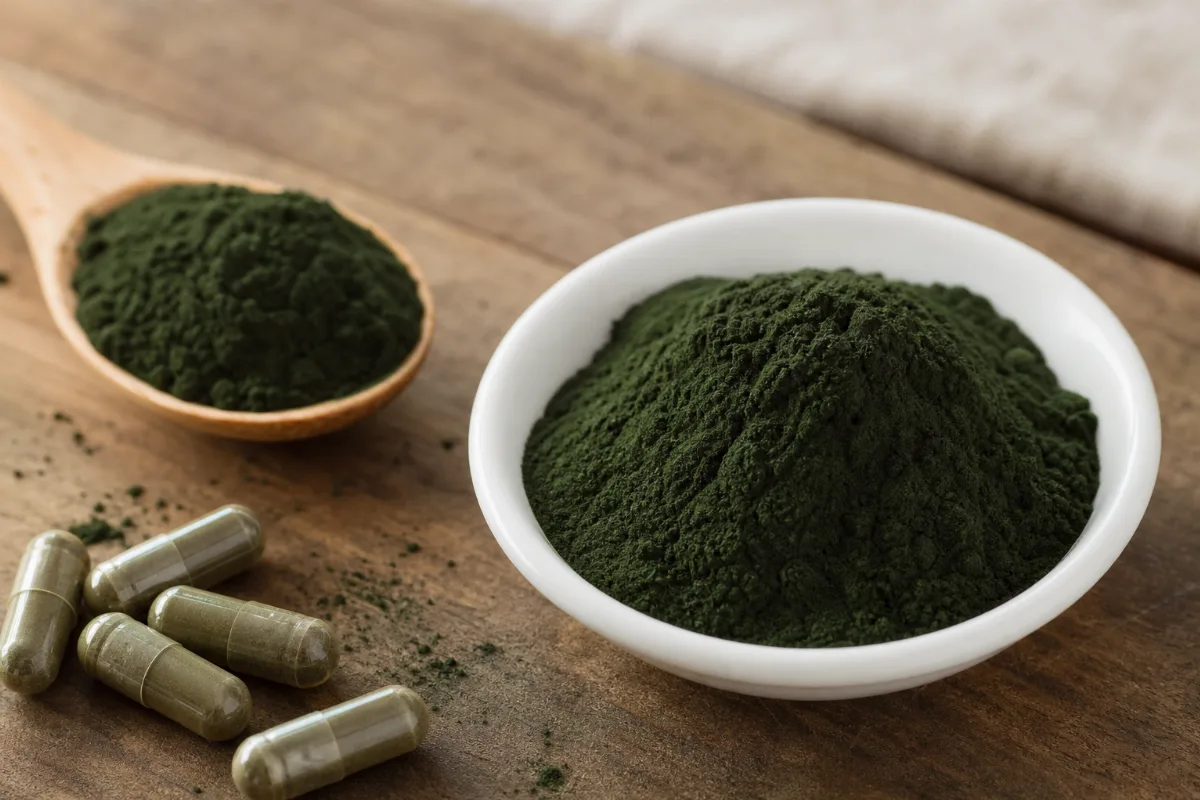
Photographs
What is inside, and how it may work
What it contains and how those compounds act in cells and animals. Laboratory and animal mechanisms are not proven effects in people.
Main compounds
| Compound | Family | Where it is concentrated | Activity studied | Level of evidence |
|---|---|---|---|---|
| EPA (eicosapentaenoic acid) | omega-3 fatty acid | Oil from the cells More than 25% of the polar-lipid-rich oil used in the trials (Almega PL); no DHA | An omega-3 fat; the oil raised blood EPA and the Omega-3 Index in trials. 8 2 | Human data |
| Polar lipids (phospholipids and glycolipids) | lipids | Oil from the cells More than 15% of the oil in the trials; about 15% in the rat study's oil | The form that carries part of the EPA. A rat study found tissue uptake from the algal oil matched krill oil. 8 4 | Animal research |
| Protein and other cell nutrients | macronutrients | Whole cell Not read | In mice, protein use from the whole biomass was similar to the control diet; fat absorption was lower than from soy oil. 6 | Animal research |
Mechanisms, receptors and pathways
| Target or pathway | Gene or receptor | What was found | Level |
|---|---|---|---|
| Omega-3 uptake | Blood and red-cell EPA | The oil raised red-cell EPA and the Omega-3 Index and gave a higher plasma EPA peak than krill oil in 10 men. 8 2 | Human data |
| Tissue deposition | Plasma, brain, liver, fat | In rats, total long-chain omega-3 in most tissues did not differ from krill oil; glycolipids may help uptake (authors' idea). 4 | Animal research |
| Blood-fat handling | VLDL, remnant cholesterol | VLDL and total cholesterol fell in the trial; the mechanism was not tested in these studies. 8 1 | Human data |
| Protein and fat digestion of whole cells | Nutrient absorption | Disrupted whole cells fed to mice gave protein use similar to the control diet and lower but substantial fat absorption. 6 | Animal research |
Absorption, metabolism and elimination
- Absorption
- Plasma EPA rose within hours of a single serving of the algal oil with a high-fat meal, peaking higher than with krill oil (10 men).
- Distribution
- In rats, EPA reached plasma, brain, liver and fat tissue.
- Metabolism
- Not found.
- Elimination
- Not found.
- Bioavailability
- EPA from the algal oil was well absorbed in a small human study; the EPA amounts compared were not equal.
Isolated compounds versus whole extracts
All human trials used a branded EPA-rich oil, not the whole alga or powder. Rat and mouse studies tested the live cells, the whole biomass and the oil separately. Do not assume a result for the oil holds for the powder or the other way round.
Nutritional composition
No USDA FoodData Central entry for Nannochloropsis was found, so this page gives no calories, protein or mineral values per portion. The only composition facts read are for the oil: more than 25% EPA with no DHA and more than 15% polar lipids (Almega PL). A mouse study found that disrupted whole cells supported weight gain and normal organ function, but gave no per-portion amounts. There is no standard food portion; Nannochloropsis is sold mostly as an oil, capsule or powder, so read the label.
2 low certainty3 very low certainty1 not enough evidence1 evidence against
What was looked at
The 7 benefits and uses checked for Nannochloropsis, each with how strong the evidence is. Tap one to open it.
- Blood EPA and the Omega-3 IndexLow certainty
- Cholesterol (VLDL and total cholesterol)Low certainty
- Triglycerides in everyday users (no comparison group)Very low certainty
- Mood and vigor (secondary result)Very low certainty
- Body weight and hip circumference (secondary result)Very low certainty
- Inflammation markers (no clear effect)Evidence against
- How well EPA gets into tissues (rats)Not enough evidence
Lab markers tracked in the studies
Omega-3 IndexPlasma EPA after a single servingVLDL cholesterolTotal cholesterolTriglyceridesBody weightMood vigor score (POMS)Liver blood tests (AST and others)
What is Nannochloropsis good for?
The main studied uses and how strong the human evidence is for each. All human results are for one branded Nannochloropsis oil, not for the whole alga.
Benefits, one by one
Each card is a research question, not a promise. Tap a goal to filter. Open a card to see the studies, doses and limits.
Blood EPA and the Omega-3 Index
Low certaintyIn a 12-week trial of 120 healthy people with a low Omega-3 Index, a Nannochloropsis oil with EPA and no DHA raised red-cell EPA and the Omega-3 Index more than placebo. A single-dose study in 10 men found more EPA in the blood after the algal oil than after krill oil. These are blood markers, not health outcomes, and they test an oil, not the whole algae.
2 studiesPolar-lipid-rich Nannochloropsis oil in capsules (a supplement). Not …
Studies, doses and limits
What the trials found
12-week placebo-controlled trial (Australia, 120 randomised, 104 completed): Almega PL, 1 g a day, raised the Omega-3 Index from 4.96% to 5.75% and red-cell EPA from 0.82% to 1.27%, significantly more than placebo. DHA in red cells did not change. Single-dose crossover (10 healthy men): peak plasma EPA and total EPA exposure over 10 hours were higher with the algal oil (1.5 g EPA) than with krill oil (1.02 g EPA); the doses were not matched.
Results
Both studies found more EPA in the blood with the algal oil. The Omega-3 Index rose by under 1 point, a modest change.
Effect sizes as reported
Omega-3 Index 4.96 to 5.75%; red-cell EPA 0.82 to 1.27% (12 weeks).
Why this rating
One manufacturer-funded 12-week trial, plus a 10-person single-dose study. Marker changes only. The oil is one product, so results do not apply to the whole algae or other products.
Form and dose studied
Polar-lipid-rich Nannochloropsis oil in capsules (a supplement). Not the whole algae as a food.
Who was studied
Healthy adults, in the trial those with a low Omega-3 Index.
Limits
One company's product and trial. Short. Blood markers only. No fish-oil comparison in the 12-week trial.
Why researchers looked
Nannochloropsis makes EPA, an omega-3 fat, and no DHA. Researchers asked whether an oil from it can raise EPA in people who do not eat fish.
Traditional use
No traditional use was read. Nannochloropsis is a marine microalga used in recent years as a feed ingredient, an oil source and a powder.
Proposed mechanism Hypothesis
The oil carries EPA partly bound to polar lipids (phospholipids and glycolipids). A rat study suggests this form is taken up into tissues as well as krill oil. This was not shown in people.
A proposed mechanism does not show that the effect happens in people.
See the Safety tab. Three people in the active group of the 12-week trial left with nausea or abdominal cramping.
Cholesterol (VLDL and total cholesterol)
Low certaintyIn the same 12-week trial, VLDL cholesterol fell 25% and total cholesterol about 3% compared with placebo, while LDL and HDL did not change significantly. The change was small, in healthy people, from one company's oil.
1 studiesPolar-lipid-rich Nannochloropsis oil in capsules (1 g a day in the tr…
Studies, doses and limits
What the trials found
12-week trial (120 randomised, 104 analysed): total cholesterol and VLDL were significantly lower than placebo (VLDL -25%, total cholesterol -3% from baseline). In the main analysis there was no significant difference in LDL, HDL, triglycerides or non-HDL cholesterol. In a sub-group of 76 people with higher starting total cholesterol (over 5.5 mmol/L), the falls were larger (total cholesterol -4%, VLDL -27%) and non-HDL cholesterol also differed.
Results
Small falls in VLDL and total cholesterol; no main-analysis change in LDL, HDL or triglycerides.
Effect sizes as reported
VLDL -25%; total cholesterol -3% (all 104); -4% and -27% in the higher-cholesterol sub-group.
Why this rating
One manufacturer-funded trial in healthy people. The subgroup was chosen after the fact. Cholesterol numbers are a marker, not heart attacks or strokes.
Form and dose studied
Polar-lipid-rich Nannochloropsis oil in capsules (1 g a day in the trial).
Who was studied
Healthy adults in Australia with low Omega-3 Index.
Limits
One trial. Not tested in people with diagnosed high cholesterol. The subgroup result may be chance.
Why researchers looked
EPA oils are studied for effects on blood fats.
Proposed mechanism Hypothesis
Not tested. The authors propose that EPA lowers the fats the liver sends out in VLDL particles.
A proposed mechanism does not show that the effect happens in people.
See the Safety tab.
Triglycerides in everyday users (no comparison group)
Very low certaintyA 6-month follow-up of 480 people who bought the same oil saw triglycerides fall about 14%. There was no placebo group, so this cannot show that the oil caused it. The 12-week placebo trial did not find a significant triglyceride change.
2 studiesCapsules of the same Nannochloropsis oil.
Studies, doses and limits
What the trials found
Post-market cohort (480 enrolled, supplement subscribers, 1,000 to 1,100 mg a day): triglycerides fell 8.0% at month 3 and 14.2% at month 6 (-0.23 mmol/L); total cholesterol fell 5.0%, non-HDL cholesterol 5.5% and remnant cholesterol 14.9% at month 6. LDL did not rise.
Results
Falling triglycerides and remnant cholesterol in uncontrolled data. The placebo-controlled trial's main analysis found no triglyceride difference.
Effect sizes as reported
TG -14.2% at 6 months; remnant cholesterol -14.9%.
Why this rating
No control group, self-selected buyers, manufacturer-run and funded, home test kits. The only controlled trial did not show a triglyceride change.
Form and dose studied
Capsules of the same Nannochloropsis oil.
Who was studied
Mostly women in their early 50s who already bought the supplement.
Limits
No placebo. Could be from diet changes, regression to the mean or other factors.
Why researchers looked
The company followed customers to see if the earlier cholesterol result held in real life.
Proposed mechanism Hypothesis
Not tested.
A proposed mechanism does not show that the effect happens in people.
Ten people withdrew with side effects (bruising or bleeding in 3, abdominal discomfort in 7). See the Safety tab.
Mood and vigor (secondary result)
Very low certaintyIn the 12-week trial, the vigor score on a mood questionnaire was higher with the oil than with placebo. Total mood disturbance was not significantly different. This was one of many secondary outcomes.
1 studiesAlmega PL Nannochloropsis oil capsules, 1 g a day.
Studies, doses and limits
What the trials found
12-week placebo-controlled trial (120 randomised, 104 completed): total mood disturbance fell with the oil at weeks 6 and 12 but not significantly versus placebo. The vigor sub-score was significantly higher than placebo at both weeks (p < 0.05). Tension, anger, fatigue, confusion, esteem and depression sub-scores did not change in either group.
Results
Only the vigor score differed; the main mood measure did not.
Effect sizes as reported
Vigor higher than placebo (p < 0.05); no numbers read.
Why this rating
A secondary outcome in one manufacturer-funded trial, with many outcomes tested at once, so a chance finding is possible.
Form and dose studied
Almega PL Nannochloropsis oil capsules, 1 g a day.
Who was studied
Healthy adults with low Omega-3 Index.
Limits
Many outcomes tested. Not planned as the main result.
Why researchers looked
Omega-3 fats are studied for mood. This trial measured it alongside cholesterol.
Proposed mechanism Hypothesis
Not tested.
A proposed mechanism does not show that the effect happens in people.
See the Safety tab.
Body weight and hip circumference (secondary result)
Very low certaintyIn the 12-week trial, body weight and hip circumference were lower than placebo after adjusting for age and starting BMI. Hip size rose in the placebo group. This is a secondary result from one trial.
1 studiesAlmega PL capsules, 1 g a day.
Studies, doses and limits
What the trials found
12-week placebo-controlled trial: after adjustment for age and baseline BMI, the oil group had a significantly lower body weight and hip circumference than the placebo group. Hip circumference rose from baseline in the placebo group.
Results
Small differences on adjusted analysis. No numbers were read in the text.
Effect sizes as reported
Not read.
Why this rating
Secondary outcome, adjusted analysis, one manufacturer-funded trial, no repeat.
Form and dose studied
Almega PL capsules, 1 g a day.
Who was studied
Healthy adults.
Limits
The trial was not designed to test weight. No dietary or exercise changes were seen between groups.
Why researchers looked
Body measures were recorded as part of the trial's health markers.
Proposed mechanism Hypothesis
Not tested.
A proposed mechanism does not show that the effect happens in people.
None.
Inflammation markers (no clear effect)
Evidence againstInflammation markers (hs-CRP, TNF-alpha, IL-6) stayed in the normal range in both groups. One IL-6 difference disappeared when one outlier was removed. So no clear effect was shown.
2 studiesAlmega PL capsules.
Studies, doses and limits
What the trials found
12-week placebo-controlled trial: inflammatory markers were within the normal range at baseline and at the end in both groups. The IL-6 change differed from placebo on one test, but the difference vanished after one outlier was removed. In the 480-person cohort, hs-CRP was measured; its result is not in the abstract.
Results
No clear effect.
Why this rating
The one controlled trial found no robust difference in healthy people with normal starting values.
Form and dose studied
Almega PL capsules.
Who was studied
Healthy adults.
Limits
Normal starting values leave little room to improve.
Why researchers looked
EPA is studied for effects on inflammation.
Proposed mechanism Hypothesis
Not tested.
A proposed mechanism does not show that the effect happens in people.
None.
How well EPA gets into tissues (rats)
Not enough evidenceIn rats, the algal oil put as much total long-chain omega-3 into plasma, brain, liver and one fat depot as krill oil did, and more into another fat depot. This is an animal result.
1 studiesNannochloropsis oculata polar-lipid-rich oil by gavage in rats.
Studies, doses and limits
Results
No significant difference for most tissues in rats.
Effect sizes as reported
Not given in the abstract.
Why this rating
Rat study only.
Form and dose studied
Nannochloropsis oculata polar-lipid-rich oil by gavage in rats.
Who was studied
Rats.
Limits
Not human evidence.
Why researchers looked
The oil carries EPA in a mix of polar lipids; researchers compared how it spreads in the body with krill oil.
Proposed mechanism Hypothesis
The authors suggest glycolipids form smaller particles during digestion, which may aid uptake.
A proposed mechanism does not show that the effect happens in people.
None.
Connections to the rest of health
How Nannochloropsis connects to the rest of our health knowledge graph. Every link says what kind of connection it is. A safety link (for example to the liver) is a warning, not a benefit. A study that merely mentions a topic never creates a benefit link.
Explore every connection: goals, body systems, organs, symptoms, genes
A. Wellness goals
| Connected to | Kind of connection | Evidence status | Context | Studies |
|---|---|---|---|---|
| Heart Health | Low certainty | Blood EPA and the Omega-3 Index: In a 12-week trial of 120 healthy people with a low Omega-3 Index, a Nannochloropsis oil with EPA and no DHA raised red-cell EPA and the Omega-3 Index more than placebo. A single-dose study in 10 men found more EPA in the blood after the algal oil than after krill oil. These are blood markers, not health outcomes, and they test an oil, not the whole algae. | 8 2 | |
| Cholesterol Balance | Low certainty | Cholesterol (VLDL and total cholesterol): In the same 12-week trial, VLDL cholesterol fell 25% and total cholesterol about 3% compared with placebo, while LDL and HDL did not change significantly. The change was small, in healthy people, from one company's oil. Triglycerides in everyday users (no comparison group): A 6-month follow-up of 480 people who bought the same oil saw triglycerides fall about 14%. There was no placebo group, so this cannot show that the oil caused it. The 12-week placebo trial did not find a significant triglyceride change. | 8 1 | |
| Mood Balance | Very low certainty | Mood and vigor (secondary result): In the 12-week trial, the vigor score on a mood questionnaire was higher with the oil than with placebo. Total mood disturbance was not significantly different. This was one of many secondary outcomes. | 8 | |
| Weight Management | Very low certainty | Body weight and hip circumference (secondary result): In the 12-week trial, body weight and hip circumference were lower than placebo after adjusting for age and starting BMI. Hip size rose in the placebo group. This is a secondary result from one trial. | 8 | |
| Inflammation Balance | Evidence against | Inflammation markers (no clear effect): Inflammation markers (hs-CRP, TNF-alpha, IL-6) stayed in the normal range in both groups. One IL-6 difference disappeared when one outlier was removed. So no clear effect was shown. | 8 1 |
B. Body systems
| Connected to | Kind of connection | Evidence status | Context | Studies |
|---|---|---|---|---|
| Cardiovascular System | Biological association | Low certainty | Studied for: Blood EPA and the Omega-3 Index Studied for: Cholesterol (VLDL and total cholesterol) | 8 2 1 4 |
| Nervous System | Biological association | Very low certainty | Studied for: Mood and vigor (secondary result) | 8 |
| Endocrine System | Biological association | Very low certainty | Studied for: Body weight and hip circumference (secondary result) | 8 |
| Immune System | Biological association | Evidence against | Studied for: Inflammation markers (no clear effect) | 8 1 |
I. Biomarkers
| Connected to | Kind of connection | Evidence status | Context | Studies |
|---|---|---|---|---|
| Omega-3 Index | Preliminary | Rose from 4.96% to 5.75% in a 12-week trial of healthy adults. Preparation or compound: Almega PL Nannochloropsis oil |
8 | |
| VLDL cholesterol | Preliminary | Fell 25% against placebo in one 12-week trial. Preparation or compound: Almega PL Nannochloropsis oil |
8 | |
| Omega-3 Index | Biological association | Low certainty | Measured in trials: increase. A lab change is not the same as a health benefit. | 8 |
| Plasma EPA after a single serving | Biological association | Low certainty | Measured in trials: increase. A lab change is not the same as a health benefit. | 2 |
| VLDL cholesterol | Biological association | Low certainty | Measured in trials: decrease. A lab change is not the same as a health benefit. | 8 |
| Total cholesterol | Biological association | Low certainty | Measured in trials: decrease. A lab change is not the same as a health benefit. | 8 1 |
| Triglycerides | Biological association | Mixed findings | Measured in trials: mixed. A lab change is not the same as a health benefit. | 8 1 |
| Body weight | Biological association | Very low certainty | Measured in trials: decrease. A lab change is not the same as a health benefit. | 8 |
| Mood vigor score (POMS) | Biological association | Very low certainty | Measured in trials: increase. A lab change is not the same as a health benefit. | 8 |
| Liver blood tests (AST and others) | Biological association | Low certainty | Measured in trials: unchanged. A lab change is not the same as a health benefit. | 8 |
K. Biological pathways
L. Active compounds
| Connected to | Kind of connection | Evidence status | Context | Studies |
|---|---|---|---|---|
| EPA (eicosapentaenoic acid) | Biological association | Human | An omega-3 fat; the oil raised blood EPA and the Omega-3 Index in trials. Preparation or compound: Oil from the cells |
8 2 |
| Polar lipids (phospholipids and glycolipids) | Biological association | Animal | The form that carries part of the EPA. A rat study found tissue uptake from the algal oil matched krill oil. Preparation or compound: Oil from the cells |
8 4 |
| Protein and other cell nutrients | Biological association | Animal | In mice, protein use from the whole biomass was similar to the control diet; fat absorption was lower than from soy oil. Preparation or compound: Whole cell |
6 |
Each connection is stored with the ingredient, the connected record, the kind of connection, the evidence status, the supporting studies, the preparation or compound involved, and a review date (last reviewed October 26, 2026).
Evidence at a glance: what changed in 1 lab markers
Tap a number to show only those markers. Counts are markers, not people.
The evidence
The research centre for Nannochloropsis. Every record here was checked against PubMed or the publisher's page; we never list a study we have not verified.
Evidence by outcome
Bars show how many studies we found for each outcome, not how well it works. People are added up across trials only (reviews are not added, to avoid double counting).
How we rate evidence
High certainty
Several well-run trials or reviews agree; further research is unlikely to change the picture much.
Moderate certainty
Good trials point the same way, but some doubt remains.
Low certainty
Small, short or inconsistent trials. The finding could change with better research.
Very low certainty
Very little or very weak human data. Treat as a possibility only.
Mixed findings
Trials or reviews disagree with each other.
Not enough evidence
Not enough human research to say either way.
Evidence against
Good research found no benefit, or found harm.
We take the reviewers' own risk-of-bias and GRADE statements where they exist, and otherwise judge from study size, design, consistency, directness and whether a product matches what is sold. Many publications do not make evidence high. Method note: We started from our existing Nannochloropsis summary, matched the genus in GBIF, and re-read the PubMed abstracts for the trials, animal studies and a review, plus the full text of two trial papers for funding and side-effect details. Items we could not verify are flagged in the research gaps.
Study library: every study we checked 9
| Study | Design | People | Product, dose, length | Result |
|---|---|---|---|---|
| Ganuza 2024 Omega-3 eicosapentaenoic polar-lipid rich extract from microalgae Nannochloropsis decreases plasma triglycerides and cholesterol in a real-world normolipidemic supplement consumer population Frontiers in Nutrition · PMID 38379539 · DOI |
Uncontrolled post market cohort (no placebo group) Nannochloropsis (species not named in the abstract) |
480 Adults who had subscribed to the Almega PL supplement, mostly women in their early 50s (480 enrolled) |
Almega PL capsules (Nannochloropsis polar-lipid EPA oil) Whole cell / oil 1,000 to 1,100 mg a day 6 months (tests at baseline, month 3, month 6) |
Triglycerides fell 8.0% at month 3 and 14.2% at month 6 (-0.23 mmol/L). Total cholesterol fell 5.0% and non-HDL cholesterol 5.5% at 6 months, mainly through a 14.9% fall in remnant cholesterol. LDL did not rise. Ten people withdrew because of side effects: 3 with increased bruising, bleeding or tiny skin bleeds, 7 with abdominal discomfort (pain, nausea, vomiting, heartburn). TG -14.2% at 6 months; remnant cholesterol -14.9% (Not given in the abstract) Methods, limits and fundingOutcomes: Triglycerides (primary), remnant cholesterol, LDL, HDL, total cholesterol, hs-CRP, glucose, HbA1c Limitations: No placebo group, so changes may be from other causes. Home blood-test kits. Self-selected supplement buyers. Same manufacturer as the 2020 trial. Funding and conflicts: Funded by Qualitas Health Inc.; two authors (E.G., E.E.) are Qualitas Health employees. Registration: NCT05267301 Read: full-text (PMC10876867) |
| Kagan 2013 Acute appearance of fatty acids in human plasma - a comparative study between polar-lipid rich oil from the microalgae Nannochloropsis oculata and krill oil in healthy young males Lipids in Health and Disease · PMID 23855409 · DOI |
Randomised crossover, single dose Nannochloropsis oculata |
10 Healthy men aged 18 to 45 |
Nannochloropsis oculata polar-lipid-rich oil (1.5 g EPA, no DHA) after a high-fat breakfast Whole cell / oil Single serving Blood sampled up to 10 hours · vs Krill oil (1.02 g EPA, 0.54 g DHA), 7 days apart |
Plasma EPA rose with both oils. The peak EPA and the area under the curve for EPA were higher with the algal oil (P = 0.010 for peak; P = 0.020 and 0.006 for AUC). DHA did not differ between the oils. The authors conclude the algal oil is a good source of EPA. Peak plasma EPA higher with algal oil (P = 0.010) (Not given in the abstract) Methods, limits and fundingOutcomes: Plasma EPA and DHA over 10 hours Limitations: Ten men, one dose, a blood level after a meal, not a health outcome. The algal oil gave more EPA than the krill oil, so the comparison is not dose-matched. Funding and conflicts: Funding not stated in the abstract; the oil is the Qualitas Health product, and the authors include company-linked researchers per our earlier summary (not re-verified). Read: abstract |
| Kagan 2014 Safety assessment of EPA-rich polar lipid oil produced from the microalgae Nannochloropsis oculata International Journal of Toxicology · PMID 25305242 · DOI |
Animal safety studies (rats) and lab genotoxicity tests Nannochloropsis oculata oil (rat) |
Sprague-Dawley rats; bacteria and hamster cells | Almega PL oil by gavage Whole cell / oil 14-day study 0, 250, 500, 2,500 mg/kg a day; 90-day study 0, 200, 400, 2,000 mg/kg a day 14 and 90 days · vs Control |
No deaths or toxicity. No treatment-related effects. The no-observed-adverse-effect level was 2,000 mg/kg a day. The oil did not cause mutations in bacteria, did not damage chromosomes in hamster cells and had no genotoxic effect in rat bone marrow cells. NOAEL 2,000 mg/kg a day (rat) (Not given) Methods, limits and fundingOutcomes: Deaths, body weight, neurological, eye, blood and urine tests, organ weights, tissue pathology, mutation and chromosome tests Limitations: Animal and lab tests. Not a human study. Funding and conflicts: Research support listed as non-U.S. government; the authors are linked to the oil maker (not re-verified). Read: abstract |
| Kagan 2015 Comparative study of tissue deposition of omega-3 fatty acids from polar-lipid rich oil of the microalgae Nannochloropsis oculata with krill oil in rats Food & Function · PMID 25360534 · DOI |
Animal study (rats) Nannochloropsis oculata (rat) |
Rats on a standard diet | Nannochloropsis oculata polar-lipid-rich oil vs krill oil by gavage Whole cell / oil 5 ml oil per kg body weight a day 7 days · vs Krill oil |
Total long-chain omega-3 did not differ between algal oil and krill oil in plasma, brain, liver or gonadal fat. It was higher in one other fat depot (retroperitoneal) with the algal oil. The authors suggest the sugar-linked fats (glycolipids) may help uptake, which needs further study. No significant difference in most tissues (Not given) Methods, limits and fundingOutcomes: Omega-3 fats (EPA, DPA, DHA) in plasma, brain, liver and two fat depots Limitations: Rats only. A very large dose per body weight. Not human evidence. Funding and conflicts: Funding not stated in the abstract. Read: abstract |
| Kagan 2015 Safety assessment of the microalgae Nannochloropsis oculata Toxicology Reports · PMID 28962397 · DOI |
Animal safety study (rats) Nannochloropsis oculata (rat) |
Male and female Sprague-Dawley rats | Live Nannochloropsis oculata cell suspension by gavage Whole cell / oil 10 mL/kg a day (10^8 viable cells/mL) 14 days · vs 0 mL/kg (control) |
No deaths and no signs of toxicity. No treatment-related effects on body weight, food intake, blood, urine, organ weights or tissue pathology. Some statistically significant differences were judged not toxicologically important. The authors concluded the strain used for the omega-3 oil is not pathogenic when swallowed by rats. No toxicity seen (Not given) Methods, limits and fundingOutcomes: Deaths, body weight, blood and urine tests, organ weights, tissue pathology Limitations: Rats, 14 days. Not a human study. Funding and conflicts: Funding not stated in the abstract; the paper concerns the strain used for the Almega PL oil (authors linked to the oil maker per our earlier summary, not re-verified). Read: abstract |
| Neumann 2018 Bioavailability and Safety of Nutrients from the Microalgae Chlorella vulgaris, Nannochloropsis oceanica and Phaeodactylum tricornutum in C57BL/6 Mice Nutrients · PMID 30049974 · DOI |
Animal feeding study (mice) Nannochloropsis oceanica (mouse) |
C57BL/6 mice | Ball-mill-disrupted whole Nannochloropsis oceanica biomass in feed Whole cell biomass 5%, 15% or 25% of the diet by dry weight 14 days · vs Control diet |
Weight gain was similar to or better than controls. Protein use was similar to the control diet (58% to 77% apparent biological value across the three algae). Fat absorption was lower than with soy oil but still substantial. Liver EPA was high with Nannochloropsis, the algae richest in omega-3. No heart, kidney or liver toxicity was found. No toxicity in mice (Not given) Methods, limits and fundingOutcomes: Weight gain, organ weights, protein use, fat absorption, liver EPA, heart, kidney and liver tests Limitations: Mice, 14 days, three algae pooled in the conclusion. Not a human study. Funding and conflicts: The authors declare no conflict of interest. Read: abstract |
| Qu 2025 Safety evaluation of Nannochloropsis gaditana oil as a novel food Regulatory Toxicology and Pharmacology · PMID 40602521 · DOI |
Animal safety studies (rats) and lab genotoxicity tests Nannochloropsis gaditana oil (rat) |
Rats | Nannochloropsis gaditana oil Whole cell / oil Acute test; pregnancy study; 90-day study up to 2.8 g/kg body weight Acute, pregnancy period and 90 days · vs Control |
Acute LD50 above 8.4 g/kg body weight. Genotoxicity tests (micronucleus, chromosome and Ames) showed no significant change. In pregnant rats no harm to the mother, reproduction or fetuses; NOAEL 2.8 g/kg body weight. The 90-day study also found a NOAEL of 2.8 g/kg body weight. The authors state the findings support the oil as safe for human consumption. NOAEL 2.8 g/kg body weight (rat) (Not given) Methods, limits and fundingOutcomes: Acute toxicity, genotoxicity, birth defects, 90-day toxicity Limitations: Animal and lab tests. Not a human study. A different species (gaditana) and a different oil from the one in the human trials. Funding and conflicts: No funding stated in the abstract. Read: abstract |
| Rao 2020 Omega-3 Eicosapentaenoic Acid (EPA) Rich Extract from the Microalga Nannochloropsis Decreases Cholesterol in Healthy Individuals: A Double-Blind, Randomized, Placebo-Controlled, Three-Month Supplementation Study Nutrients · PMID 32585854 · DOI |
Randomised, double blind, placebo controlled trial Nannochloropsis (species not named in the abstract) |
120 Healthy men and women in Brisbane, Australia, with a low Omega-3 Index (104 completed) |
Almega PL, a polar-lipid-rich Nannochloropsis oil (more than 25% EPA, no DHA), in capsules Whole cell / oil 1 g a day 12 weeks · vs Placebo capsules |
Omega-3 Index rose from 4.96% to 5.75% and red-cell EPA from 0.82% to 1.27% with the oil, both higher than placebo. VLDL cholesterol fell 25% and total cholesterol fell about 3% against placebo. No significant difference in LDL, HDL, triglycerides or non-HDL cholesterol in the main analysis. Body weight and hip circumference were lower than placebo after adjustment. Liver markers stayed in the normal range. Inflammatory markers did not differ after one outlier was removed. Mood vigor score was higher than placebo; total mood disturbance was not significantly different. Omega-3 Index +0.79 points (4.96 to 5.75%); VLDL -25%; total cholesterol -3% (Not given in the text read) Methods, limits and fundingOutcomes: Omega-3 Index, red-cell EPA, cholesterol fractions, body measures, liver markers, inflammation markers, mood Limitations: One product. Short. Healthy people, many with normal cholesterol. 16 of 120 withdrew. Only the abstract and the full text of the PMC copy were read. Funding and conflicts: Funded and supplied by Qualitas Health, which makes the oil; two authors (E.G., J.O.N.) are Qualitas Health employees. Registration: ACTRN12618000275268 Read: full-text (PMC7353404) |
| s-gbif-nannochloropsis GBIF Backbone: Nannochloropsis D.J.Hibberd, 1981 (genus, usageKey 3201505) and Nannochloropsis oculata (Droop) Hibberd, 1981 (usageKey 3201507) · Source |
Reference database n/a |
Methods, limits and fundingRead: full-text |
What we do not know yet
- No human trial of the whole alga or powder was found.
- All human trials are of one manufacturer's oil, and the maker funded the two main studies.
- No human trial longer than 6 months; the longer one had no control group.
- Nothing was found on allergy, pregnancy, breastfeeding, children or medicine interactions in people.
- Contamination (metals, iodine, toxins) and nutrient values per portion were not found.
- EU and US approval status and history were not checked in official sources.
How new research is added
New studies are found by a saved PubMed search and placed in a review queue before the page changes.
Lab markers
What changed in blood or saliva tests during trials. A changed number is not the same as feeling or being healthier, and we give no "normal ranges".
Metabolic 3
Total cholesterol
Decrease in trials
All the cholesterol in the blood.
Low certaintyResults and what it means
Why it was measured
Standard blood test linked to heart risk.
Statistical vs. clinical meaning
Small changes; only one result is placebo-controlled.
Safety implication
None specific.
Triglycerides
Mixed results in trials
A type of fat in the blood.
Mixed findingsResults and what it means
Why it was measured
High levels are linked to heart risk.
Statistical vs. clinical meaning
The controlled trial found no change and the uncontrolled study found a fall.
Safety implication
None specific.
Body weight
Decrease in trials
A person's weight.
Very low certaintyResults and what it means
Other 5
Omega-3 Index
Increase in trials
The share of EPA plus DHA among the fatty acids in red blood cells.
Low certaintyResults and what it means
Why it was measured
A marker of long-term omega-3 intake that is studied in heart research.
Statistical vs. clinical meaning
A modest rise in a marker. No heart outcome was tested.
Safety implication
None specific.
| Study | Result | People | Product |
|---|---|---|---|
| 8 | 4.96% to 5.75% over 12 weeks, significantly more than placebo (red-cell EPA 0.82% to 1.27%; DHA unchanged) | 120 randomised healthy adults with low Omega-3 Index (104 completed) | Almega PL Nannochloropsis oil, 1 g a day, 12 weeks |
Plasma EPA after a single serving
Increase in trials
The amount of EPA in blood plasma in the hours after taking an oil.
Low certaintyResults and what it means
Why it was measured
Shows how well the body takes up EPA from an oil.
Statistical vs. clinical meaning
Shows EPA is absorbed from the oil; the EPA amounts were not equal.
Safety implication
None specific.
| Study | Result | People | Product |
|---|---|---|---|
| 2 | Peak plasma EPA and the area under the curve were higher with the algal oil than with krill oil (P = 0.010 for the peak) | 10 healthy men | Nannochloropsis oculata oil (1.5 g EPA) vs krill oil (1.02 g EPA) with a high-fat breakfast |
VLDL cholesterol
Decrease in trials
Cholesterol carried in very-low-density lipoprotein particles made by the liver.
Low certaintyResults and what it means
Why it was measured
A part of the blood-fat picture that moves with triglycerides.
Statistical vs. clinical meaning
Small, one trial, a marker.
Safety implication
None specific.
| Study | Result | People | Product |
|---|---|---|---|
| 8 | Down 25% from baseline and significantly lower than placebo at 12 weeks (27% in a higher-cholesterol subgroup of 76) | 104 completers | Almega PL, 1 g a day, 12 weeks |
Mood vigor score (POMS)
Increase in trials
The vigor part of a mood questionnaire.
Very low certaintyResults and what it means
Why it was measured
A self-reported measure of energy and liveliness.
Statistical vs. clinical meaning
One subscore among many.
Safety implication
None.
| Study | Result | People | Product |
|---|---|---|---|
| 8 | Higher than placebo at weeks 6 and 12 (p < 0.05); total mood disturbance not significantly different | 104 completers | Almega PL, 1 g a day |
Liver blood tests (AST and others)
Unchanged in trials
Blood tests that show how the liver is working.
Low certaintyResults and what it means
Why it was measured
Safety check in the trial.
Statistical vs. clinical meaning
No sign of liver harm in healthy adults over 12 weeks.
Safety implication
Reassuring for 12 weeks; longer use not tested.
| Study | Result | People | Product |
|---|---|---|---|
| 8 | All liver markers stayed in the normal range; AST was lower than placebo at 12 weeks (p = 0.0127) | 104 completers | Almega PL, 1 g a day |
Safety
What studies and official sources say about side effects, medicines and who should check first. Each point shows what kind of evidence it comes from.
Main points to know 3
- No serious harm was reported in short human trials, but long-term safety in people is unknown. In the 12-week trial (120 randomised) liver tests stayed normal. Three people on the oil and three on placebo left with side effects (nausea, abdominal cramping or diarrhea). In the 6-month cohort of 480 people, 10 left because of mild side effects: 3 with increased bruising or bleeding and 7 with abdominal discomfort. Nothing is known about years of use. Randomized trial and cohort 8 1
- Bruising or bleeding was reported by some users. Three of the 480 users in the 6-month cohort stopped because of more bruising, bleeding or tiny skin bleeds. There was no control group, so the link to the oil is not proven. If you take a blood thinner or have surgery planned, ask your doctor or pharmacist before using an omega-3 oil. Cohort report 1
- Safety data for the whole algae are from animals. Rat studies of the live alga cells, a mouse feeding study of the whole biomass and rat studies of the oil found no toxicity. These are animal studies. No human trial of the whole alga or powder was found. Animal studies 5 6 3 7
Side effects 2
| Effect | How often | Severity and recovery | Evidence |
|---|---|---|---|
| Nausea, abdominal cramping, abdominal pain, vomiting, heartburn or diarrhea Arms were 60 each (53 and 51 completers plus withdrawals). Placebo users had similar stomach effects. | 12-week trial: 3 of 60 on the oil and 3 of 60 on placebo withdrew with stomach effects (nausea and cramping on the oil; nausea and diarrhea on placebo). 6-month cohort: 7 of 480 withdrew with abdominal discomfort. | mild Not stated | Randomized trial and cohort 8 1 |
| Increased bruising, bleeding or petechiae No control group. Users were told to see their doctor. | 3 of 480 in the cohort withdrew for this reason | mild to moderate Not stated | Cohort report 1 |
Liver
In the 12-week placebo-controlled trial, liver markers stayed in the normal range at baseline and at week 12 in both groups, and AST was lower than placebo. No liver case reports were found in the sources read. LiverTox was not searched for this alga. 8
How often. No liver cases reported in the sources read.
Monitoring. Not studied. Ask your doctor if you have liver disease.
This is a safety connection. It is not evidence that Nannochloropsis supports liver health.
Medicines and supplements 3
| With | Why it matters | Importance | Evidence | What to do |
|---|---|---|---|---|
| Blood thinners and other medicines that affect clotting (warfarin, aspirin, clopidogrel and similar) medicine | Not studied for Nannochloropsis. Some users in the cohort reported more bruising or bleeding. | Unknown | Case report level (cohort adverse reports) Not enough evidence 1 | No source read tested this combination. Ask your doctor or pharmacist before combining. |
| Medicines for blood fats (statins, fibrates, other omega-3 products) medicine | The oil lowered VLDL and total cholesterol in healthy people. | Unknown | No interaction study Not enough evidence 8 | No interaction study was found. Tell your doctor if you use the oil with lipid-lowering medicine. |
| Fish, krill and other omega-3 oils supplement | All supply EPA. The algal oil gave more EPA than krill oil in a single-dose study. | Unknown | Human pharmacokinetic Low certainty 2 | Using more than one omega-3 product stacks EPA. Ask your pharmacist. |
Who should check first 4
| Situation | Advice | Evidence |
|---|---|---|
| Pregnancy and breastfeeding | No human data on Nannochloropsis oil or powder were found. One rat study of N. gaditana oil found no harm to mothers or fetuses, but this is not human evidence. Ask your midwife or doctor. | Animal only 7 |
| Children | No studies in children were found. Ask a doctor. | None |
| Planned surgery or a bleeding disorder | Some users reported bruising or bleeding. Ask your doctor before using the oil. | Cohort report 1 |
| Algae or seafood allergy | No allergy reports or tests for Nannochloropsis were found in the sources read. If you have had a reaction to algae products, ask your doctor. | None |
Overdose, product quality and regulators
Summary. Rat studies found no toxic effects, with a highest no-effect level of 2,000 mg/kg a day for one oil (90 days) and 2.8 g/kg for another (90 days and pregnancy study). The live cells and the whole biomass were also tolerated in rats and mice. These are not human data.
Animal. Almega PL oil: no toxicity in 14-day and 90-day rat studies (no-effect level 2,000 mg/kg a day) and no gene or chromosome damage in lab tests. Live N. oculata cells: no toxicity in a 14-day rat study. N. gaditana oil: acute LD50 above 8.4 g/kg; no effect in pregnant rats; no effect level 2.8 g/kg in 90 days. Whole N. oceanica biomass, 5 to 25% of mouse feed, 14 days: no heart, kidney or liver toxicity.
Human doses studied. The human trials used about 1 g a day of the oil for 12 weeks and about 1 to 1.1 g a day for 6 months in an uncontrolled cohort (study facts, not advice).
No source read tested Nannochloropsis products for heavy metals, iodine, marine toxins or microbes. Quality depends on the grower and the maker.
Heavy metals, iodine and toxins. Not found in the sources read. Not tested in the human trials' abstracts.
Strain safety. A 14-day rat study of live N. oculata cells found it was not pathogenic when swallowed by rats. 5
| Body | Action | Date |
|---|
When to get medical help
- Hives, swelling of the lips, face, tongue or throat, trouble breathing, wheezing or collapse after taking a Nannochloropsis product (possible allergic reaction): use epinephrine if you have it, then call 911 or your local emergency number
- Bleeding that will not stop, black or bloody stools, vomiting blood or large unexplained bruises while taking an omega-3 oil: seek medical care
- New yellow skin or eyes, dark urine or severe stomach pain after starting a supplement: stop it and seek medical advice
Stop using the product and contact a clinician or emergency service. In the US, Poison Control is 1-800-222-1222.
General information only, not medical advice. Ask a clinician or pharmacist before use, especially with medicines, in pregnancy or with a health condition. See the Natural Remedy Safety guide.
Frequently asked questions
What is Nannochloropsis?
A genus of tiny single-celled marine algae. It is grown for feed, an EPA-rich oil and powder. It is not a seaweed.
Does Nannochloropsis have DHA?
No. The oil used in the trials has more than 25% EPA and no DHA. Algal DHA oils come from other microalgae.
Does Nannochloropsis raise omega-3 levels?
Does Nannochloropsis lower cholesterol?
In one 12-week trial in healthy adults, VLDL fell 25% and total cholesterol about 3% compared with placebo, with no significant LDL or HDL change. It is one trial funded by the maker, so certainty is low.
Does it lower triglycerides?
Is the whole alga or powder studied in people?
Is Nannochloropsis safe?
What side effects were reported?
Is Nannochloropsis safe in pregnancy or breastfeeding?
Unknown in people. One rat study of N. gaditana oil found no harm in pregnancy, but that is not human evidence. Ask your midwife or doctor.
Does it interact with medicines?
Who funded the studies?
Does Nannochloropsis have nutrition facts?
No USDA entry was found. The only composition facts read are for the oil: more than 25% EPA, no DHA, more than 15% polar lipids.
Explore by health goal
Cholesterol BalanceHeart HealthMood BalanceWeight ManagementInflammation Balance
Editorial transparency
- Written by
- AlternativeMed editorial team. Research compiled with AI assistance, then checked against the sources listed.
- Medical review
- None. This page has not been reviewed by a physician or pharmacist.
- First published
- 2026-10-26
- Last substantive update
- 2026-10-26
- How we research
- We started from our existing Nannochloropsis summary, matched the genus in GBIF, and re-read the PubMed abstracts for the trials, animal studies and a review, plus the full text of two trial papers for funding and side-effect details. Items we could not verify are flagged in the research gaps.
- How we rate evidence
- See "How we rate evidence" in the Evidence tab.
- Independence
- No product is promoted on this page. No affiliate links are shown. The two main human studies were funded by the maker of the oil tested.
Sources 9
Each source was opened and checked. Where we read only the abstract, it says so. The small numbers in the text point here.
- Ganuza E, Etomi EH, Olson M, Whisner CM. Omega-3 eicosapentaenoic polar-lipid rich extract from microalgae Nannochloropsis decreases plasma triglycerides and cholesterol in a real-world normolipidemic supplement consumer population. Frontiers in Nutrition. 2024. PMID 38379539. DOI 10.3389/fnut.2024.1293909. (full-text (PMC10876867))
- Kagan ML, West AL, Zante C, Calder PC. Acute appearance of fatty acids in human plasma - a comparative study between polar-lipid rich oil from the microalgae Nannochloropsis oculata and krill oil in healthy young males. Lipids in Health and Disease. 2013. PMID 23855409. DOI 10.1186/1476-511X-12-102. (abstract)
- Kagan ML, Sullivan DW, Gad SC, Ballou CM. Safety assessment of EPA-rich polar lipid oil produced from the microalgae Nannochloropsis oculata. International Journal of Toxicology. 2014. PMID 25305242. DOI 10.1177/1091581814553453. (abstract)
- Kagan ML, Levy A, Leikin-Frenkel A. Comparative study of tissue deposition of omega-3 fatty acids from polar-lipid rich oil of the microalgae Nannochloropsis oculata with krill oil in rats. Food & Function. 2015. PMID 25360534. DOI 10.1039/c4fo00591k. (abstract)
- Kagan ML, Matulka RA. Safety assessment of the microalgae Nannochloropsis oculata. Toxicology Reports. 2015. PMID 28962397. DOI 10.1016/j.toxrep.2015.03.008. (abstract)
- Neumann U, Derwenskus F, Gille A, Louis S, Schmid-Staiger U, Briviba K, Bischoff SC. Bioavailability and Safety of Nutrients from the Microalgae Chlorella vulgaris, Nannochloropsis oceanica and Phaeodactylum tricornutum in C57BL/6 Mice. Nutrients. 2018. PMID 30049974. DOI 10.3390/nu10080965. (abstract)
- Qu J, Zhu T, Du X, Zhang Y, Tian J, Xia Y, Ke X, Fu S, Fan B. Safety evaluation of Nannochloropsis gaditana oil as a novel food. Regulatory Toxicology and Pharmacology. 2025. PMID 40602521. DOI 10.1016/j.yrtph.2025.105901. (abstract)
- Rao A, Briskey D, Nalley JO, Ganuza E. Omega-3 Eicosapentaenoic Acid (EPA) Rich Extract from the Microalga Nannochloropsis Decreases Cholesterol in Healthy Individuals: A Double-Blind, Randomized, Placebo-Controlled, Three-Month Supplementation Study. Nutrients. 2020. PMID 32585854. DOI 10.3390/nu12061869. (full-text (PMC7353404))
- . GBIF Backbone: Nannochloropsis D.J.Hibberd, 1981 (genus, usageKey 3201505) and Nannochloropsis oculata (Droop) Hibberd, 1981 (usageKey 3201507). . . (full-text)
Where to buy
Check the label first. Whatever you buy, look for these:
- The iodine amount: seaweed can be very high in iodine, which matters for thyroid conditions
- Heavy metal testing information from the maker
- Origin and harvest area
- Organic or tested labeling
Talk to a pharmacist or doctor before you start any supplement, especially if you take medicines. See the Safety tab for interactions.
Support our free guides: as an Amazon Associate we earn from qualifying purchases. Full disclosure.


