Spices · Spice
Poppy Seed
Papaver somniferum · also called Opium poppy seed, mohn (German), khus khus (Hindi), posto (Bengali), semillas de amapola (Spanish)
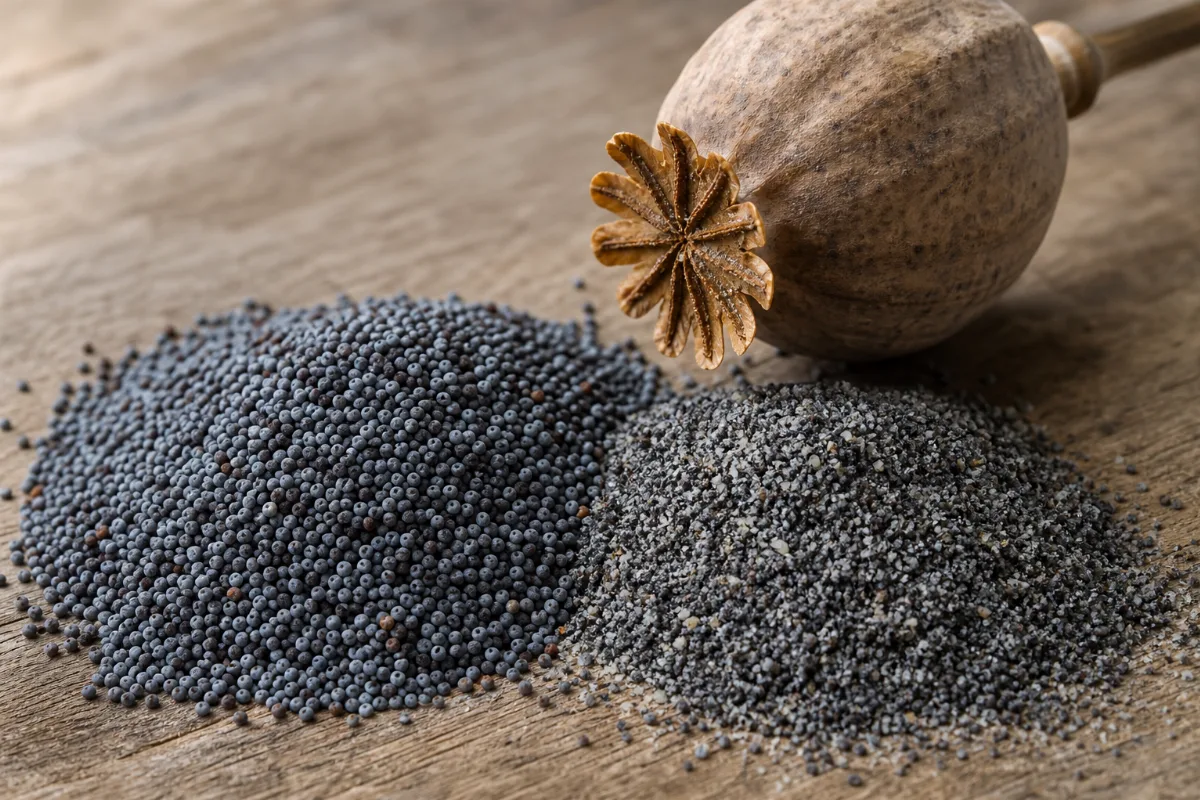
Poppy seed is a small baking spice from the opium poppy, used whole on breads and rolls or ground into fillings and pastes. It is rich in calcium, manganese and fibre per 100 g, but a teaspoon is tiny, and no study shows that eating it treats or prevents a disease. The seeds can carry traces of morphine and codeine from the plant's sap. The main cautions are tea made from unwashed seeds (linked to overdose and death), positive urine drug tests, allergy and young children.
General information, not medical advice. Last substantive update · Not medically reviewed. A named clinician has not signed off on this page. How this page is made
About Poppy Seed
Poppy seed is a mineral-rich baking spice, not a proven remedy. It comes from the plant that makes opium, so the safety facts matter as much as the nutrition: morphine and codeine traces, drug tests, tea, allergy and young children.
What it is
Poppy seed is the tiny seed of the opium poppy (Papaver somniferum, family Papaveraceae). EFSA says the seeds are used as food in many EU countries and to make edible oil, and that unground seeds are sometimes used as a condiment or decoration. In some Central and Eastern European countries they are used in large amounts in bread, fine bakery ware and desserts.
Nutrition, from USDA FoodData Central (earlier read, not re-opened today), per 100 g: 525 kcal, 41.56 g fat, 17.99 g protein, 19.5 g fibre, 1,438 mg calcium, 347 mg magnesium, 9.76 mg iron, 6.707 mg manganese and 1.627 mg copper. USDA lists a teaspoon as 2.8 g. By our calculation one teaspoon gives about 15 kcal, 1.2 g fat, 0.5 g fibre, 40 mg calcium and 0.2 mg manganese. It is richer in minerals than most spices, but a teaspoon is a small amount.
What the research shows
For the nutrients, the evidence is composition data from a national food database. We found no study of eating poppy seed for cholesterol, blood sugar, weight, cancer or brain health.
The lab and animal studies of poppy plants are about plant extracts across the whole genus, not the seed in your kitchen.
What has been measured in people is the effect on drug tests: poppy seed foods can give a positive urine opiate screen.
Spice versus tea and extracts
Seeds baked on a roll are a very different exposure from tea brewed from a large amount of unwashed seed. EFSA says washing, soaking, grinding and cooking may lower alkaloid levels, by up to about 90%, and a laboratory study found heating lowered all the alkaloids it measured. A separate study found normal use of the seeds it tested would not exceed the EFSA level. Levels still vary widely between batches.
Amounts
This page gives no amounts to eat. We did not read an official recommended serving of poppy seed. Ask a doctor, pharmacist or dietitian what is right for you, especially in pregnancy or before a drug test.
At a glance
Traditional uses history, not proof
- Eaten whole on breads and rolls and baked in cakes
- Ground into pastry fillings and pastes, and pressed into an edible oil
- Long use as a spice is not proof that it treats any condition
Studied for research
- Minerals and fibre in the seed, high certainty for the composition, no trial
- Fat make-up (mostly polyunsaturated), high certainty for the composition, no trial
- Cholesterol, heart, blood sugar, weight, cancer and brain health, insufficient evidence (no human study of the seed)
- Urine opiate drug test result after eating seed foods, a measured effect, moderate certainty
Main compounds
- Calcium
- Manganese
- Copper
- Fibre
- Polyunsaturated fat
- Morphine (trace, from sap)
- Codeine (trace, from sap)
- Thebaine (trace, from sap)
Common forms
- Whole seed as a baking ingredient
- Ground seed fillings and pastes
- Poppy seed oil
- Unwashed seed sold for tea (linked to harm; not a food use)
Research links: EFSA: opium alkaloids in poppy seeds (2011) · EFSA update on opium alkaloids in poppy seeds (2018) · Poppy seed tea: a short review and case study · Research Library · Genes & Biomarkers Library
What it is and its history
- Accepted scientific name
- Papaver somniferum
- Naming authority
- L. (GBIF accepted)
- Common names
- Poppy seed (English); Opium poppy seed (English); Mohn (German); Khus khus (Hindi); Posto (Bengali); Semillas de amapola (Spanish)
- Family or group
- Papaveraceae (the poppy family), as given by GBIF.
- Classification
- Plantae > Tracheophyta > Magnoliopsida > Ranunculales > Papaveraceae > Papaver > Papaver somniferum
- Native range
- Not verified from a source read.
- Habitat
- Not verified from a source read.
- What it looks like
- Roots: Not verified.; Stems: Not verified.; Leaves: Not verified.; Flowers: Not verified.; Fruit: EFSA says the plant is grown for opium alkaloids taken from the dried milky latex of the seed capsules; the seeds are used in food.
- Cultivation
- EFSA says the opium poppy is grown mainly for medical uses, with the seeds also used in food in many EU countries. EFSA (2018) separates varieties grown mainly for drug production from food varieties.
- Harvest and processing
- Used whole, ground into fillings, or pressed into an edible oil (EFSA). Washing, soaking, grinding and cooking may lower alkaloids (EFSA 2011).
- Look-alikes and adulterants
- Name: California poppy and other poppies; Note: Different plants with their own pages; research on the opium poppy seed does not carry over.; Name: Poppy seeds in the nuts and seeds section; Note: A companion page covers the same seed as a nut-and-seed food.
- Sustainability and conservation
- Not assessed.
Photographs
What is inside, and how it may work
What it contains and how those compounds act in cells and animals. Laboratory and animal mechanisms are not proven effects in people.
Main compounds
| Compound | Family | Where it is concentrated | Activity studied | Level of evidence |
|---|---|---|---|---|
| Morphine | opium alkaloid | Sap of the plant; traces on the seed coat In seeds bought online: under 1 to 2,788 mg/kg (laboratory study) | Main opium alkaloid and the main safety concern (EFSA). 13 8 | Human data |
| Codeine | opium alkaloid | Sap; traces on the seed coat Under 1 to 247.6 mg/kg in the same study | Counted as 0.2 morphine equivalents by EFSA (2018). 3 8 | Human data |
| Thebaine | opium alkaloid | Sap; traces on the seed coat Under 1 to 124 mg/kg in the same study | EFSA (2018): limited evidence of higher acute lethality than morphine; no risk characterisation possible. 3 8 | Preclinical |
| Noscapine and papaverine | opium alkaloid | Sap; traces on the seed coat | EFSA (2018): comparison with recommended therapeutic doses does not suggest a health concern. 3 | Authoritative guidance |
Mechanisms, receptors and pathways
| Target or pathway | Gene or receptor | What was found | Level |
|---|---|---|---|
| Opioid effects of morphine and codeine | Not specified in the sources read | EFSA lists sleepiness and breathing difficulties as the most prominent side effects of medical morphine and codeine. 13 | Authoritative guidance |
| Urine opiate screening | Not specified | Morphine and codeine from the seeds are excreted in urine and oral fluid and can exceed screening cut-offs. 11 9 10 | Human data |
Absorption, metabolism and elimination
- Absorption
- Not found beyond the urine and oral fluid results.
- Distribution
- Not found.
- Metabolism
- Not found.
- Elimination
- After a roll or raw seeds, urine morphine was measured at 2, 4, 6 and 20 hours; oral fluid was positive up to 3 hours after raw seeds and up to 1.5 hours after the roll.
- Bioavailability
- Not established.
Isolated compounds versus whole extracts
Seeds in cooking, tea from unwashed seeds, plant extracts and opium itself are very different exposures. Seed in a recipe carries little; tea from large amounts of unwashed seed can deliver lethal amounts of morphine. Lab results on poppy plant extracts do not describe eating the seed.
Nutritional composition
Source: USDA FoodData Central, Spices, poppy seed (FDC 171330, SR Legacy). These numbers are from an earlier read of the record; the USDA service refused our request on 2026-10-26 so they were not re-opened today. Per 100 g: 525 kcal, 17.99 g protein, 41.56 g fat (4.517 g saturated, about 28.6 g polyunsaturated), 19.5 g fibre, 1,438 mg calcium, 347 mg magnesium, 870 mg phosphorus, 9.76 mg iron, 7.9 mg zinc, 6.707 mg manganese and 1.627 mg copper. USDA household portions: 1 teaspoon is 2.8 g and 1 tablespoon is 8.8 g. For one teaspoon, our calculation gives about 15 kcal, 1.2 g fat, 0.5 g fibre, 40 mg calcium, 10 mg magnesium and 0.2 mg manganese. Poppy seed is richer in minerals than most spices, but a teaspoon is a small amount. Values vary with variety, growing place and storage.
2 high certainty1 not enough evidence
What was looked at
The 3 benefits and uses checked for Poppy Seed, each with how strong the evidence is. Tap one to open it.
- Minerals and fibre from the seedHigh certainty
- Seed fat: mostly polyunsaturatedHigh certainty
- Cholesterol, heart health, blood sugar, weight, cancer, brain healthNot enough evidence
Lab markers tracked in the studies
Urine opiate drug test result after eating poppy seed foods
What is Poppy Seed good for?
The main studied uses and how strong the human evidence is for each. For the spice there is only composition data; the real research is about safety.
Benefits, one by one
Each card is a research question, not a promise. Tap a goal to filter. Open a card to see the studies, doses and limits.
Minerals and fibre from the seed
High certaintyPoppy seed is among the more mineral-rich spices: per 100 g USDA lists a lot of calcium, manganese, copper and fibre. A teaspoon is only about 3 g, so the amount you get from a spoonful is small. This is a food fact, not a trial.
1 studiesWhole or ground seed as food. Values vary with variety, growing place…
Studies, doses and limits
What the trials found
USDA FoodData Central (earlier read, not re-opened today) lists per 100 g: calcium 1,438 mg, manganese 6.707 mg, copper 1.627 mg, magnesium 347 mg, iron 9.76 mg, zinc 7.9 mg and fibre 19.5 g. For a 2.8 g teaspoon that works out to about 40 mg calcium, 0.19 mg manganese and 0.5 g fibre (our calculation). No trial of poppy seed for a health outcome was found.
Results
The seed is a concentrated source of several minerals and fibre, but spice portions are small. No study shows that eating poppy seed changes a health outcome.
Effect sizes as reported
Per teaspoon (2.8 g): about 40 mg calcium, 0.19 mg manganese, 0.5 g fibre (our calculation from USDA values).
Why this rating
High for the composition fact only (laboratory analysis in a national database). It says nothing about benefit, and the numbers were not re-opened on the day this page was written.
Form and dose studied
Whole or ground seed as food. Values vary with variety, growing place and storage.
Who was studied
Anyone eating it as a spice, topping or filling.
Limits
A composition fact, not a trial. How much of these minerals the body absorbs from the seed was not found.
Why researchers looked
Poppy seed is often named as a mineral-rich seed, so people ask what a sprinkle adds to a meal.
Traditional use
Used whole on breads and rolls, ground into fillings and ground into pastes to thicken curries. Long use as food is not proof that it treats any condition.
Proposed mechanism Reference data
Not a mechanism study. The values come from laboratory analysis of the seed in a national food database.
A proposed mechanism does not show that the effect happens in people.
Read the Safety tab first: opium alkaloid traces, drug tests, tea and allergy.
Seed fat: mostly polyunsaturated
High certaintyAbout two fifths of the seed by weight is fat, mostly polyunsaturated, with a little plant omega-3 (ALA). It describes the food, not a health result, and a teaspoon holds about a gram of fat.
1 studiesWhole or ground seed; pressed oil.
Studies, doses and limits
What the trials found
USDA (earlier read, not re-opened) lists per 100 g: total fat 41.56 g, saturated 4.517 g, about 28.6 g polyunsaturated, ALA 0.273 g and 525 kcal. For a 2.8 g teaspoon: about 15 kcal and 1.2 g fat (our calculation).
Results
Composition only. No study of poppy seed and blood fats or heart outcomes was found.
Effect sizes as reported
Per 100 g: 41.56 g fat, 4.517 g saturated, 0.273 g ALA.
Why this rating
High for the composition fact only; no health outcome is claimed. Numbers not re-opened today.
Form and dose studied
Whole or ground seed; pressed oil.
Who was studied
Anyone eating the seed.
Limits
Composition is not benefit. Fat figures vary with variety and growing place.
Why researchers looked
Seeds are often compared by their fat make-up.
Traditional use
The seeds are also pressed into an edible oil (EFSA).
Proposed mechanism Reference data
Not a mechanism study. Composition from a national food database.
A proposed mechanism does not show that the effect happens in people.
None specific to the fat; see the Safety tab for the alkaloid issues.
Cholesterol, heart health, blood sugar, weight, cancer, brain health
Not enough evidenceWe found no study in people of eating poppy seed for any of these. Claims online come from lab and animal work on poppy plants, not from people eating the seed.
1 studiesNot applicable.
Studies, doses and limits
Results
A review of Papaver plants reports mostly lab and animal findings and is about the genus, not the seed you cook with.
Why this rating
No human study of the eaten seed was found.
Limits
Genus-wide, extract-based review. Not about the seed as a spice.
Why researchers looked
Seeds as a group are studied for heart and blood sugar outcomes, so people ask about poppy seed too.
Traditional use
Traditional medicine uses of poppy plants are mostly of the opium-bearing plant, not the culinary seed.
Proposed mechanism Preclinical
No mechanism was read for the eaten seed. A review of the Papaver genus describes lab and animal work on plant extracts.
A proposed mechanism does not show that the effect happens in people.
Plant extracts are not the same as the seed. Do not use poppy preparations as a remedy.
Connections to the rest of health
How Poppy Seed connects to the rest of our health knowledge graph. Every link says what kind of connection it is. A safety link (for example to the liver) is a warning, not a benefit. A study that merely mentions a topic never creates a benefit link.
Explore every connection: goals, body systems, organs, symptoms, genes
B. Body systems
| Connected to | Kind of connection | Evidence status | Context | Studies |
|---|---|---|---|---|
| Digestive System | Biological association | High certainty | Studied for: Minerals and fibre from the seed | 15 |
| Musculoskeletal System | Biological association | High certainty | Studied for: Minerals and fibre from the seed | 15 |
| Cardiovascular System | Biological association | High certainty | Studied for: Seed fat: mostly polyunsaturated Studied for: Cholesterol, heart health, blood sugar, weight, cancer, brain health | 15 1 |
| Endocrine System | Biological association | Not enough evidence | Studied for: Cholesterol, heart health, blood sugar, weight, cancer, brain health | 1 |
I. Biomarkers
| Connected to | Kind of connection | Evidence status | Context | Studies |
|---|---|---|---|---|
| Urine opiate drug test result after eating poppy seed foods | Biological association | Moderate certainty | Measured in trials: raised. A lab change is not the same as a health benefit. | 11 9 10 |
K. Biological pathways
| Connected to | Kind of connection | Evidence status | Context | Studies |
|---|---|---|---|---|
| Morphine | Preliminary mechanism | Human | Main opium alkaloid on the seed coat. | 13 8 |
| Codeine | Preliminary mechanism | Human | Second main alkaloid; counted at 0.2 morphine by EFSA. | 3 |
| Calcium | Preliminary mechanism | Reference data | Concentrated in the seed (USDA). | 15 |
L. Active compounds
| Connected to | Kind of connection | Evidence status | Context | Studies |
|---|---|---|---|---|
| Morphine | Biological association | Human | Main opium alkaloid and the main safety concern (EFSA). Preparation or compound: Sap of the plant; traces on the seed coat |
13 8 |
| Codeine | Biological association | Human | Counted as 0.2 morphine equivalents by EFSA (2018). Preparation or compound: Sap; traces on the seed coat |
3 8 |
| Thebaine | Biological association | Preclinical | EFSA (2018): limited evidence of higher acute lethality than morphine; no risk characterisation possible. Preparation or compound: Sap; traces on the seed coat |
3 8 |
| Noscapine and papaverine | Biological association | Authoritative guidance | EFSA (2018): comparison with recommended therapeutic doses does not suggest a health concern. Preparation or compound: Sap; traces on the seed coat |
3 |
Each connection is stored with the ingredient, the connected record, the kind of connection, the evidence status, the supporting studies, the preparation or compound involved, and a review date (last reviewed October 26, 2026).
Evidence at a glance: what changed in 1 lab markers
Tap a number to show only those markers. Counts are markers, not people.
The evidence
The research centre for Poppy Seed. Every record here was checked against PubMed or the publisher's page; we never list a study we have not verified.
Evidence by outcome
Bars show how many studies we found for each outcome, not how well it works. People are added up across trials only (reviews are not added, to avoid double counting).
How we rate evidence
High certainty
Several well-run trials or reviews agree; further research is unlikely to change the picture much.
Moderate certainty
Good trials point the same way, but some doubt remains.
Low certainty
Small, short or inconsistent trials. The finding could change with better research.
Very low certainty
Very little or very weak human data. Treat as a possibility only.
Mixed findings
Trials or reviews disagree with each other.
Not enough evidence
Not enough human research to say either way.
Evidence against
Good research found no benefit, or found harm.
We take the reviewers' own risk-of-bias and GRADE statements where they exist, and otherwise judge from study size, design, consistency, directness and whether a product matches what is sold. Many publications do not make evidence high. Method note: We read the EFSA news story, checked the plant name in GBIF, and re-checked every PubMed paper by summary record and abstract. Only abstracts were read for studies. The USDA record could not be re-opened and is flagged in the research gaps.
Study library: every study we checked 15
| Study | Design | People | Product, dose, length | Result |
|---|---|---|---|---|
| Butnariu 2022 Papaver Plants: Current Insights on Phytochemical and Nutritional Composition Along with Biotechnological Applications. Oxidative Medicine and Cellular Longevity · PMID 36824615 · DOI |
Narrative review mixed |
Papaver genus (many species) | Plant extracts and compounds Seeds Study detail, not advice See results |
A review of Papaver plants and their chemistry and nutrition. Health effects it describes come from lab and animal work on plant extracts, not from people eating the seed. Not applicable (Not stated in the abstract) Methods, limits and fundingOutcomes: A review of Papaver plants and their chemistry and nutrition Limitations: Genus-wide, mostly preclinical; not about the eaten seed. Funding and conflicts: Not stated in the abstract. Read: abstract |
| Carlin 2020 Opium Alkaloids in Harvested and Thermally Processed Poppy Seeds. Frontiers in Chemistry · PMID 33195013 · DOI |
Laboratory analysis n/a |
Harvested and heat-processed poppy seeds | Seeds, with and without a food matrix, heated Seeds Study detail, not advice See results |
At normal use levels, the harvested and heat-processed seeds in this study would not exceed the EFSA acute reference dose, and the levels of all alkaloids fell on heat processing compared with untreated seeds. Alkaloids fell with heating (Not stated in the abstract) Methods, limits and fundingOutcomes: At normal use levels, the harvested and heat-processed seeds in this study would not exceed the EFSA acute reference dose, and the levels of all alkaloids fell on heat processing compared with untreated seeds Limitations: Laboratory study of the seeds it tested; levels differ between batches. Funding and conflicts: Not stated in the abstract. Read: abstract |
| EFSA Panel on Contaminants in the Food Chain (CONTAM); Knutsen HK et al. 2018 Update of the Scientific Opinion on opium alkaloids in poppy seeds. EFSA Journal · PMID 32625895 · DOI |
Regulatory opinion |
Poppy seed samples with alkaloid data | Poppy seeds as food Seeds Study detail, not advice See results |
EFSA confirmed an acute reference dose (ARfD) of 10 ug morphine per kg body weight, and said codeine counts as 0.2 morphine equivalents, making it a group value. For seeds from varieties grown mainly for pharmaceutical use, mean and high exposures exceed it in most age groups. For food varieties, some exceedance is seen at high exposure in most surveys. For noscapine and papaverine no concern was suggested. For thebaine, limited evidence suggests higher acute lethality than morphine. ARfD 10 ug morphine/kg body weight (Not stated in the abstract) Methods, limits and fundingOutcomes: EFSA confirmed an acute reference dose (ARfD) of 10 ug morphine per kg body weight, and said codeine counts as 0 Limitations: Abstract read only; consumption and alkaloid data are limited (EFSA says so in its 2011 opinion). Funding and conflicts: Official body, no industry funding stated. Read: abstract |
| Haber 2019 Poppy Seed Tea: A Short Review and Case Study. Pain and Therapy · PMID 30719627 · DOI |
Narrative review with case |
Poppy seed tea users | Tea made from unwashed seeds Seeds Study detail, not advice See results |
The authors say tea from unwashed seeds can have enough opioid to cause psychoactive effects and withdrawal when stopped abruptly, that sale is legal in the US, that some people use it habitually or as a painkiller, and that few cases of intoxication and dependence are reported. One clinical case is given. Narrative review (Not stated in the abstract) Methods, limits and fundingOutcomes: The authors say tea from unwashed seeds can have enough opioid to cause psychoactive effects and withdrawal when stopped abruptly, that sale is legal in the US, that some people use it habitually or as a painkiller, and that few cases of intoxication and dependence are reported Limitations: Little literature exists, by the authors own words. Funding and conflicts: Authors are at a private practice and a research company; funding not stated. Read: abstract |
| Keskin 2006 Poppy seed allergy: a case report and review of the literature. Allergy and Asthma Proceedings · PMID 16948357 · DOI |
Case report |
1 A 16-year-old boy |
Inhaled poppy seed Seeds Study detail, not advice See results |
Redness and swelling of the skin, conjunctivitis and breathlessness after inhaling poppy seed. Skin tests were positive for poppy seed, hazelnut and chickpea; specific IgE was positive for poppy seed, hazelnut and peanut. The authors say reactions to poppy seed are rare, and severe ones mainly affect people allergic to pollens or nuts. One case (Not stated in the abstract) Methods, limits and fundingOutcomes: Redness and swelling of the skin, conjunctivitis and breathlessness after inhaling poppy seed Limitations: Single case. Funding and conflicts: Not stated in the abstract. Read: abstract |
| Oppel 2006 Cross-sensitization between poppy seed and buckwheat in a food-allergic patient with poppy seed anaphylaxis. International Archives of Allergy and Immunology · PMID 16601355 · DOI |
Case report |
1 A 17-year-old woman |
Poppy seed cake Seeds Study detail, not advice See results |
Anaphylaxis after poppy seed cake; testing found a new cross-sensitisation with buckwheat. The authors say poppy seed sensitisation is rare but, when present, symptoms are usually severe, and earlier reports link it with sesame, hazelnut, rye and kiwi. One case (Not stated in the abstract) Methods, limits and fundingOutcomes: Anaphylaxis after poppy seed cake; testing found a new cross-sensitisation with buckwheat Limitations: Single case. Funding and conflicts: Not stated in the abstract. Read: abstract |
| Podzhilkova 2024 Poppy Seed Allergy: Molecular Diagnosis and Cross-Reactivity With Tree Nuts. Journal of Allergy and Clinical Immunology: In Practice · PMID 38734371 · DOI |
Retrospective cohort |
36 36 poppy seed-sensitised patients; 10 with a positive and 26 with a negative food challenge |
Poppy seed extract and its allergens Seeds Study detail, not advice See results |
Four poppy seed allergens were identified. A positive challenge went with higher poppy seed-specific IgE. Poppy seed IgE above 10.00 kUA/L had 90% sensitivity and 73% specificity. Poppy seed vicilin and legumin cross-reacted strongly with hazelnut and buckwheat versions; the alpha-hairpinin cross-reacted with an almond allergen. The authors call it the most extensive study of poppy seed allergy to date. Sensitivity 90%, specificity 73% at IgE >10 kUA/L (Not stated in the abstract) Methods, limits and fundingOutcomes: Four poppy seed allergens were identified Limitations: Retrospective; small numbers. Funding and conflicts: Not stated in the abstract. Read: abstract |
| Powers 2018 Quantification of Morphine, Codeine, and Thebaine in Home-Brewed Poppy Seed Tea by LC-MS/MS. Journal of Forensic Sciences · PMID 28973785 · DOI |
Laboratory analysis n/a |
Poppy seed products bought online | Seeds brewed as tea by four home methods Seeds Study detail, not advice See results |
Medical examiners had reported two men (aged 21 and 24) with high blood morphine, suspected to come from home-brewed poppy seed tea. In the seeds, morphine was under 1 to 2,788 mg/kg, codeine under 1 to 247.6 mg/kg and thebaine under 1 to 124 mg/kg. Whatever the method, lethal amounts of morphine can be rinsed from the seed coats by home-brewing. Morphine in seeds <1 to 2,788 mg/kg (Not stated in the abstract) Methods, limits and fundingOutcomes: Medical examiners had reported two men (aged 21 and 24) with high blood morphine, suspected to come from home-brewed poppy seed tea Limitations: Laboratory analysis of online products; the deaths are described as suspected. Funding and conflicts: Not stated in the abstract. Read: abstract |
| Reisfield 2023 Poppy Seed Consumption May Be Associated with Codeine-Only Urine Drug Test Results. Journal of Analytical Toxicology · PMID 36181466 · DOI |
Dosing study |
11 11 participants |
One of ten different poppy seed food products Seeds Study detail, not advice See results |
Six of 33 non-baseline urine samples (18%), from three food products, were codeine-positive and morphine-negative at 300 ng/mL. The authors conclude seed foods cannot reliably be told apart from codeine use by earlier urine concentrations and ratios. Caveat: in none of these cases did maximum urinary codeine exceed 1,300 ug/g creatinine. 6 of 33 samples (18%) codeine-only positive (Not stated in the abstract) Methods, limits and fundingOutcomes: Six of 33 non-baseline urine samples (18%), from three food products, were codeine-positive and morphine-negative at 300 ng/mL Limitations: Small; products were chosen because of earlier cases. Funding and conflicts: Funding not stated in the abstract; one author is at a drug-testing laboratory. Read: abstract |
| Reisfield 2024 Urine and hair drug test results associated with daily consumption of codeine-predominant poppy seed food products. Journal of Analytical Toxicology · PMID 37987376 · DOI |
Dosing study |
10 10 participants |
One of five poppy seed food products at breakfast for 10 days Seeds Study detail, not advice See results |
Three products gave opiate-negative urine at 300 ng/mL at all time points. Two products gave opiate-positive urine at every non-baseline time point; all 60 of those samples were codeine-positive and 27 (45%) morphine-positive. 39 of 60 (65%) were codeine-positive at 2,000 ng/mL and none reached 15,000 ng/mL. Hair from two participants had quantifiable codeine (41 and 51 pg/mg), below the common 200 pg/mg threshold. 60 of 60 samples codeine-positive at 300 ng/mL for two products (Not stated in the abstract) Methods, limits and fundingOutcomes: Three products gave opiate-negative urine at 300 ng/mL at all time points Limitations: Small; products were presumed to be codeine-predominant. Funding and conflicts: Funding not stated in the abstract; one author is at a drug-testing laboratory. Read: abstract |
| Samano 2015 Concentrations of Morphine and Codeine in Paired Oral Fluid and Urine Specimens Following Ingestion of a Poppy Seed Roll and Raw Poppy Seeds. Journal of Analytical Toxicology · PMID 26378141 · DOI |
Dosing study |
12 12 volunteers |
A poppy seed roll, then an equal amount of raw poppy seeds (about 3.2 mg morphine and 0.6 mg codeine) Seeds Study detail, not advice See results |
Urine morphine was 155 to 1,408 ng/mL after the roll and 294 to 4,213 ng/mL after raw seeds, measured at 2, 4, 6 and 20 hours. Oral fluid was positive for morphine up to 3 hours after raw seeds and up to 1.5 hours after the roll. Urine morphine 155-1,408 (roll) and 294-4,213 ng/mL (raw) (Not stated in the abstract) Methods, limits and fundingOutcomes: Urine morphine was 155 to 1,408 ng/mL after the roll and 294 to 4,213 ng/mL after raw seeds, measured at 2, 4, 6 and 20 hours Limitations: Small study; seeds from one source. Funding and conflicts: All authors are listed with Quest Diagnostics, a drug-testing company (author list). Read: abstract |
| Schuppener 2018 Death Due to Complications of Bowel Obstruction Following Raw Poppy Seed Ingestion. Journal of Forensic Sciences · PMID 28543087 · DOI |
Case report |
1 A 54-year-old woman |
Raw poppy seeds in large quantity Seeds Study detail, not advice See results |
A woman with intractable vomiting was found unresponsive; autopsy showed a cast-like large bowel obstruction made of poppy seeds. Post-mortem blood morphine was under 10 ng/mL, so death was from the obstruction, not opiate toxicity. The authors say deaths from eating the seeds had not been described before. One case (Not stated in the abstract) Methods, limits and fundingOutcomes: A woman with intractable vomiting was found unresponsive; autopsy showed a cast-like large bowel obstruction made of poppy seeds Limitations: Single case. Funding and conflicts: Not stated in the abstract. Read: abstract |
| s-efsa-2011-news EFSA: EFSA assesses public health risks of opium alkaloids in poppy seeds (news story, 8 November 2011) · Source |
Regulatory news n/a |
Methods, limits and fundingRead: full-text | ||
| s-gbif GBIF Backbone: Papaver somniferum L. (usageKey 2888439) · Source |
Reference database n/a |
Methods, limits and fundingRead: full-text | ||
| s-usda-fdc-171330 USDA FoodData Central: Spices, poppy seed (FDC 171330) · Source |
Reference database n/a |
Methods, limits and fundingRead: summary-only |
What we do not know yet
- No human study of eating poppy seed was found for cholesterol, blood sugar, weight, cancer or brain health.
- The USDA record could not be re-opened on the day this page was written (rate limit), so nutrition numbers come from an earlier read.
- No source was read on pregnancy, breastfeeding, mould, heavy metals or pesticides in poppy seed.
- How common poppy seed allergy is was not found, and the allergy reports were read as abstracts only.
- The number of deaths from poppy seed tea was not taken from a primary source, so none is given.
- Current EU legal maximum levels and any US regulator statement were not checked.
How new research is added
New studies are found by a saved PubMed search and placed in a review queue before the page changes.
Lab markers
What changed in blood or saliva tests during trials. A changed number is not the same as feeling or being healthier, and we give no "normal ranges".
Other 1
Urine opiate drug test result after eating poppy seed foods
Raised in trials
Whether a urine drug screen reads positive for opiates (morphine or codeine) at a set cut-off, such as 300 ng/mL.
Moderate certaintyResults and what it means
Why it was measured
Workplace, sports, hospital and court drug tests look for opiates, and poppy seed carries traces of the same chemicals.
Statistical vs. clinical meaning
Small dosing studies agree that poppy seed foods can give a positive screen, but results vary a lot between products. This is a measured effect, not a benefit.
Safety implication
The authors of one study conclude seed foods cannot reliably be told apart from codeine use by earlier urine concentrations and ratios. If you face a drug test, tell the testing program and a medical reviewer.
| Study | Result | People | Product |
|---|---|---|---|
| 11 | Urine morphine 155 to 1,408 ng/mL after a poppy seed roll and 294 to 4,213 ng/mL after raw seeds with about 3.2 mg morphine | 12 volunteers | A poppy seed roll, then raw poppy seeds |
| 9 | 6 of 33 non-baseline urine samples (18%) were codeine-positive and morphine-negative at 300 ng/mL | 11 participants | One of ten different poppy seed food products |
| 10 | Two of five products gave opiate-positive urine at every time point at 300 ng/mL (60 of 60 samples codeine-positive); 65% of those were codeine-positive at 2,000 ng/mL; none reached 15,000 ng/mL | 10 participants | One of five poppy seed foods daily for 10 days |
Safety
What studies and official sources say about side effects, medicines and who should check first. Each point shows what kind of evidence it comes from.
Main points to know 4
- Poppy seed tea from unwashed seeds has been linked to overdose and death. It is not a food or a remedy.. A laboratory study of seeds bought online found morphine from under 1 up to 2,788 mg/kg, and showed that lethal amounts of morphine can be rinsed from the seed coats by home-brewing. It notes two men, aged 21 and 24, whose deaths medical examiners suspected came from home-brewed tea. A clinical review says tea from unwashed seeds can cause psychoactive effects and withdrawal when stopped. If someone is hard to wake, breathes slowly or has blue lips, call emergency services. Laboratory and case report 8 4
- Morphine and codeine traces on the seeds: EFSA says some people could exceed its safe one-day level. EFSA says poppy seeds do not naturally contain opium alkaloids but can be contaminated with plant sap after pest damage or at harvest. It set an acute reference dose of 10 micrograms of morphine per kg body weight (2011) and confirmed it in 2018, counting codeine as 0.2 morphine equivalents. In 2011 it said people who eat foods with large amounts of poppy seed are likely to exceed it on some occasions, and that seeds used as a condiment could rarely exceed it, particularly in young children. In 2018, seeds from varieties grown for drug production gave exposures above it in most age groups, and food varieties also exceeded it at high intakes. Washing, soaking, grinding and cooking may lower the levels. A separate laboratory study found normal use of the seeds it tested would not exceed the dose. Authoritative guidance 13 3 2
- Eating poppy seed foods can make a urine drug test read positive. In 12 volunteers, urine morphine reached 155 to 1,408 ng/mL after a poppy seed roll and 294 to 4,213 ng/mL after raw seeds. In 10 people eating a poppy seed food daily for 10 days, two of five products gave opiate-positive urine at every time point at the 300 ng/mL cut-off. In another study 18% of samples were codeine-positive and morphine-negative, which looks like codeine use. Tell the testing program and a medical reviewer. Dosing study 11 9 10
- Allergy is rare but can be severe, and can cross over to hazelnut, buckwheat and almond. A 2024 study of 36 sensitised patients (10 with a positive food challenge) found poppy seed proteins cross-react with hazelnut and buckwheat proteins and an almond protein. Case reports describe anaphylaxis after poppy seed cake, and swelling and breathlessness from inhaling poppy seed in a teenage boy also sensitised to hazelnut and peanut. Retrospective cohort and case report 7 5 6
Side effects 4
| Effect | How often | Severity and recovery | Evidence |
|---|---|---|---|
| Morphine-like effects such as sleepiness and breathing difficulty from contaminated seeds EFSA says morphine-like effects have been seen in humans after a single meal with contaminated seeds, and lists sleepiness and breathing difficulties as the main effects of morphine and codeine. | Not established | can be life-threatening with tea Not stated | Authoritative guidance 13 8 |
| Dependence and withdrawal with habitual poppy seed tea A clinical review says withdrawal can occur if the tea is stopped abruptly. We found no report of this from culinary use. | Not established | not stated Not stated | Narrative review 4 |
| Allergic reactions including anaphylaxis How common it is was not found. | Not established | can be severe Not stated | Case report 7 5 6 |
| Bowel obstruction from a very large amount of raw seeds A 54-year-old woman; blood morphine was under 10 ng/mL, so the cause was the obstruction, not opiate poisoning. | One case | fatal in the case reported Not applicable | Case report 12 |
Liver
No liver injury from eating poppy seed was found in the sources read. A liver-safety database was not searched.
How often. No frequency was found.
Monitoring. No agency monitoring advice was found.
This is a safety connection. It is not evidence that Poppy Seed supports liver health.
Medicines and supplements 3
| With | Why it matters | Importance | Evidence | What to do |
|---|---|---|---|---|
| Other opioids and sedatives (for example prescription pain medicines) prescription | Morphine and codeine on the seed can add to the effects of other opioids and sedatives, in principle. | We found no study of this for culinary amounts of seed. The concern is for tea or large amounts of unwashed seed. | Theoretical Not enough evidence | Do not use poppy seed tea. Ask a pharmacist before combining any poppy seed product beyond cooking amounts with opioids or sedatives. |
| Urine and hair drug tests (not a medicine) test | Morphine and codeine traces on the seeds pass into urine. | Positive screens after poppy seed foods in three dosing studies; ratios cannot always separate food from codeine use. In the 10-day study, hair from two people had quantifiable codeine, below the common 200 pg/mg threshold. | Dosing study Moderate certainty 11 9 10 | Tell the testing program and a medical reviewer about poppy seed foods. |
| Other prescription medicines prescription | No source read describes an interaction between poppy seed foods and other medicines. | None found Not enough evidence | Ask a pharmacist if you take regular medicines and eat poppy seed often. |
Who should check first 5
| Situation | Advice | Evidence |
|---|---|---|
| Known allergy to poppy seed, or symptoms with hazelnut, buckwheat, almond, sesame or peanut | Ask an allergist before eating poppy seed; cross-reactions have been reported. Call emergency services for trouble breathing or swelling of the face or throat. | Retrospective cohort and case report 7 5 6 |
| Facing a workplace, sports, hospital or court drug test | Poppy seed foods can give a positive opiate screen. Tell the testing program and a medical reviewer. | Dosing study 11 9 10 |
| Pregnancy and breastfeeding | We did not read an official statement on poppy seed in pregnancy or breastfeeding, so we give none. Ask a clinician. | None found |
| Babies and young children | EFSA says young children are the group that could rarely exceed the safe one-day level even with seeds as a bread topping. Ask a clinician before giving foods with a lot of poppy seed. | Authoritative guidance 13 |
| Anyone using poppy seed tea | Do not use it. It is linked to overdose and dependence. | Laboratory and case report 8 4 |
Overdose, product quality and regulators
Summary. The risk is the opium alkaloids (mainly morphine and codeine) on the seed coat, not the seed itself. Washed seed used in cooking carries little; tea from large amounts of unwashed seed can be lethal.
Animal. Not reviewed.
Human doses studied. Volunteers ate a roll or raw seeds with about 3.2 mg morphine in one study; the abstract reports urine levels, not harm.
High dose or long term signals. Dependence and withdrawal with habitual tea (clinical review). Two suspected tea deaths described in a laboratory paper.
Overdose response. Call emergency services if someone is hard to wake, breathes slowly or has blue lips.
Genotoxicity. Not researched.
Toxic or hazardous parts. The plant's milky sap (opium) is the source of morphine and codeine; the seeds are contaminated from the sap (EFSA).
Alkaloid levels differ hugely between batches.
Opium alkaloids. In seeds bought online, morphine ranged from under 1 to 2,788 mg/kg, codeine from under 1 to 247.6 mg/kg and thebaine from under 1 to 124 mg/kg. 8
Variety. EFSA (2018): seeds from varieties grown mainly for drug production gave exposures above the safe one-day level in most age groups; food varieties gave some exceedance at high intakes. For thebaine, limited evidence suggests higher acute lethality than morphine. 3
Cooking and washing. EFSA (2011): washing, soaking, grinding and cooking may lower alkaloids, by up to about 90%. One laboratory study found all alkaloids fell after heat processing. 13 2
Mould, rancidity, heavy metals, pesticides. Not researched for poppy seed in the sources read.
| Body | Action | Date |
|---|---|---|
| EFSA (European Food Safety Authority) (European Union) | Opinion: foods with poppy seeds could be a health concern for some consumers; acute reference dose of 10 micrograms morphine per kg body weight; processing may lower alkaloids source | 2011-11-08 |
| EFSA CONTAM Panel (European Union) | Update: confirmed the acute reference dose, made it a group value for morphine and codeine (codeine x 0.2); exceeded in most age groups for pharmaceutical-variety seeds source | 2018-05-16 |
When to get medical help
- Hard to wake, slow or shallow breathing, or blue lips after poppy seed tea or a large amount of seed
- Trouble breathing, swelling of the lips, face or throat, or widespread hives after eating poppy seed
- Vomiting, severe belly pain and a swollen belly after eating a very large amount of raw seed
- Withdrawal symptoms after stopping poppy seed tea: ask a doctor or call a poison centre
Stop using the product and contact a clinician or emergency service. In the US, Poison Control is 1-800-222-1222.
General information only, not medical advice. Ask a clinician or pharmacist before use, especially with medicines, in pregnancy or with a health condition. See the Natural Remedy Safety guide.
Frequently asked questions
Can poppy seed make me fail a drug test?
Is poppy seed tea safe?
Are poppy seeds on a roll or in a cake dangerous?
Does poppy seed contain opium?
Does cooking or washing remove the morphine?
Can I use poppy seed in pregnancy?
We did not read an official statement on poppy seed in pregnancy, so we give none. Ask a clinician about your situation.
Is poppy seed safe for young children?
EFSA says young children are the group that could rarely exceed its safe one-day level, even with seeds used as a bread topping. Ask a clinician before giving foods with a lot of poppy seed.
Can you be allergic to poppy seed?
Is poppy seed good for you?
Can poppy seed cause addiction?
A clinical review says habitual use of poppy seed tea from unwashed seed can cause dependence and withdrawal when stopped. We found no report of this from cooking use.
Can eating a lot of raw poppy seed be harmful?
One autopsy report describes a woman who died of a bowel blockage made of raw poppy seeds eaten in a very large amount. Her blood morphine was low, so it was not opiate poisoning. It is a single case.
Is poppy seed the same as California poppy?
No. The California poppy is a different plant with its own page. Research on the opium poppy seed does not carry over.
Explore by health goal
Editorial transparency
- Written by
- AlternativeMed editorial team. Research compiled with AI assistance, then checked against the sources listed.
- Medical review
- None. This page has not been reviewed by a physician or pharmacist.
- First published
- 2026-10-26
- Last substantive update
- 2026-10-26
- How we research
- We read the EFSA news story, checked the plant name in GBIF, and re-checked every PubMed paper by summary record and abstract. Only abstracts were read for studies. The USDA record could not be re-opened and is flagged in the research gaps.
- How we rate evidence
- See "How we rate evidence" in the Evidence tab.
- Independence
- No product is promoted on this page. No affiliate links are shown.
Sources 15
Each source was opened and checked. Where we read only the abstract, it says so. The small numbers in the text point here.
- Butnariu M, Quispe C, Herrera-Bravo J et al.. Papaver Plants: Current Insights on Phytochemical and Nutritional Composition Along with Biotechnological Applications.. Oxidative Medicine and Cellular Longevity. 2022. PMID 36824615. DOI 10.1155/2022/2041769. (abstract)
- Carlin MG, Dean JR, Ames JM. Opium Alkaloids in Harvested and Thermally Processed Poppy Seeds.. Frontiers in Chemistry. 2020. PMID 33195013. DOI 10.3389/fchem.2020.00737. (abstract)
- EFSA Panel on Contaminants in the Food Chain (CONTAM); Knutsen HK et al.. Update of the Scientific Opinion on opium alkaloids in poppy seeds.. EFSA Journal. 2018. PMID 32625895. DOI 10.2903/j.efsa.2018.5243. (abstract)
- Haber I, Pergolizzi J Jr, LeQuang JA. Poppy Seed Tea: A Short Review and Case Study.. Pain and Therapy. 2019. PMID 30719627. DOI 10.1007/s40122-019-0113-5. (abstract)
- Keskin O, Sekerel BE. Poppy seed allergy: a case report and review of the literature.. Allergy and Asthma Proceedings. 2006. PMID 16948357. DOI 10.2500/aap.2006.27.2881. (abstract)
- Oppel T, Thomas P, Wollenberg A. Cross-sensitization between poppy seed and buckwheat in a food-allergic patient with poppy seed anaphylaxis.. International Archives of Allergy and Immunology. 2006. PMID 16601355. DOI 10.1159/000092557. (abstract)
- Podzhilkova A, Nagl C, Hummel K, Bindslev-Jensen C, Eller E, Mortz CG, Bublin M, Hoffmann-Sommergruber K. Poppy Seed Allergy: Molecular Diagnosis and Cross-Reactivity With Tree Nuts.. Journal of Allergy and Clinical Immunology: In Practice. 2024. PMID 38734371. DOI 10.1016/j.jaip.2024.05.001. (abstract)
- Powers D, Erickson S, Swortwood MJ. Quantification of Morphine, Codeine, and Thebaine in Home-Brewed Poppy Seed Tea by LC-MS/MS.. Journal of Forensic Sciences. 2018. PMID 28973785. DOI 10.1111/1556-4029.13664. (abstract)
- Reisfield GM, Teitelbaum SA, Jones JT. Poppy Seed Consumption May Be Associated with Codeine-Only Urine Drug Test Results.. Journal of Analytical Toxicology. 2023. PMID 36181466. DOI 10.1093/jat/bkac079. (abstract)
- Reisfield GM, Teitelbaum SA, Jones JT, Mathias K, Lewis B. Urine and hair drug test results associated with daily consumption of codeine-predominant poppy seed food products.. Journal of Analytical Toxicology. 2024. PMID 37987376. DOI 10.1093/jat/bkad083. (abstract)
- Samano KL, Clouette RE, Rowland BJ, Sample RH. Concentrations of Morphine and Codeine in Paired Oral Fluid and Urine Specimens Following Ingestion of a Poppy Seed Roll and Raw Poppy Seeds.. Journal of Analytical Toxicology. 2015. PMID 26378141. DOI 10.1093/jat/bkv081. (abstract)
- Schuppener LM, Corliss RF. Death Due to Complications of Bowel Obstruction Following Raw Poppy Seed Ingestion.. Journal of Forensic Sciences. 2018. PMID 28543087. DOI 10.1111/1556-4029.13562. (abstract)
- . EFSA: EFSA assesses public health risks of opium alkaloids in poppy seeds (news story, 8 November 2011). . . (full-text)
- . GBIF Backbone: Papaver somniferum L. (usageKey 2888439). . . (full-text)
- . USDA FoodData Central: Spices, poppy seed (FDC 171330). . . (summary-only)
Where to buy
Check the label first. Whatever you buy, look for these:
- Whole or ground: whole spices keep their flavor longer
- The origin and a packed-on or best-by date for freshness
- Organic or non-irradiated labeling if that matters to you
- A resealable, airtight container
Talk to a pharmacist or doctor before you start any supplement, especially if you take medicines. See the Safety tab for interactions.
Support our free guides: as an Amazon Associate we earn from qualifying purchases. Full disclosure.


