Vegetables · Vegetable
Nopales (Prickly Pear Pads)
Opuntia ficus-indica · also called Nopal, nopalitos, cactus pads, prickly pear pads, cladodes
Nopales are the flat green pads of the prickly pear cactus, eaten cooked as a vegetable, mostly in Mexican cooking. One small study of 14 adults with type 2 diabetes found a lower blood sugar rise after a meal with steamed nopales, but there is no long-term proof. The main cautions are botulism from home-canned pads, spines that can hurt skin and eyes, and a question to ask your pharmacist if you take diabetes medicine.
General information, not medical advice. Last substantive update · Not medically reviewed. A named clinician has not signed off on this page. How this page is made
About Nopales (Prickly Pear Pads)
Nopales are a low-energy vegetable with fibre, calcium, magnesium and manganese. They are a food, not a proven remedy: the human studies are small and short, and several used fibre powder or other cactus pear products.
What it is
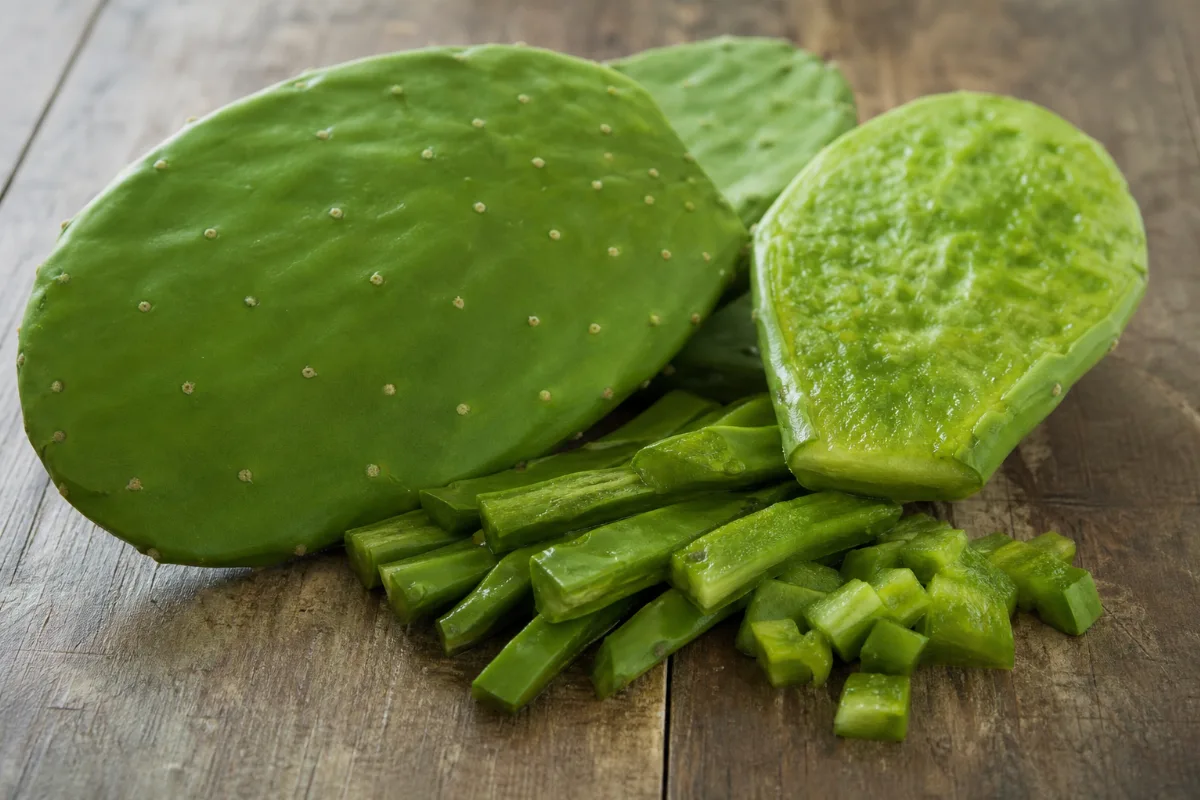
Nopales are the flat, paddle-shaped pads (called cladodes) of the prickly pear cactus, Opuntia ficus-indica, in the cactus family. The pad is eaten as a vegetable, usually cooked. The prickly pear fruit (tuna) and its juice are different foods.
USDA data for raw nopales (values from an earlier reading, not re-opened today): 16 kcal per 100 g. One cup, sliced (86 g) has about 14 kcal, 1.9 g fibre, 1.0 g sugars, 8.0 mg vitamin C, 221 mg potassium, 141 mg calcium, 45 mg magnesium, 0.40 mg manganese and 0.5 mg iron. The pad has soluble fibre, which forms the slippery gel, and insoluble fibre.
What the research shows
Only one human study used the cooked pad: 14 adults with type 2 diabetes had lower blood sugar and insulin after a high-carbohydrate breakfast with 300 g of steamed nopales. It covered single meals. A 2019 review of 20 human studies of prickly pear products found the pad mostly lowered glucose and insulin but rated those studies as high risk of bias.
Extracted nopal fibre powder eased IBS symptoms in a one-week trial of 60 adults. The results on weight, blood pressure and cholesterol are mixed or come from other cactus pear products or food bundles.
Bone and antioxidant findings are from rats and laboratory work only.
Food versus fibre powder, juice and fruit
The IBS trial used extracted fibre powder and the cholesterol trial used dehydrated nopal inside a food bundle. Many cactus pear reviews mix pad, fruit and other products, and fruit and juice behave differently from the pad. A 4-day trial of prickly pear fruit juice in 20 people with type 2 diabetes is not evidence for the pad.
Amounts
This page gives no amounts to eat. Ask a doctor, pharmacist or dietitian what is right for you, especially if you take diabetes medicine or have kidney problems.
At a glance
Traditional uses history, not proof
- Eaten cooked as a vegetable, mostly in Mexican cooking
- Long use as food is not proof that it treats any condition
Studied for research
- Blood sugar after a meal, low certainty (one small study of the cooked pad)
- Longer-term diabetes control, insufficient evidence
- Irritable bowel symptoms, low certainty (extracted fibre powder, one week)
- Weight and blood pressure, mixed (reviews of cactus pear products)
- Cholesterol, insufficient evidence for the pad
- Bones and antioxidants, insufficient (rat and laboratory work only)
Main compounds
- Soluble and insoluble fibre (mucilage)
- Polyphenols
- Caffeic acid and piscidic acid
- Calcium, magnesium and manganese
- Calcium oxalate crystals
Common forms
- Fresh pads, cooked, usually with the spines removed
- Jarred or canned pads, often in brine
- Frozen cut pads
- Dried powder, capsules and extracted fibre (the fibre and powder trials do not apply to the cooked pad)
Research links: CDC: Botulism prevention · CDC outbreak report: home-canned nopales, California 2024 · Nopal and after-meal glucose in type 2 diabetes · Research Library · Genes & Biomarkers Library
What it is and its history
- Accepted scientific name
- Opuntia ficus-indica
- Naming authority
- (L.) Mill. (GBIF accepted)
- Common names
- Nopales (Spanish); Nopal (Spanish); Nopalitos (Spanish); Prickly pear pads (English); Cactus pads (English); Cladodes (English)
- Family or group
- Cactaceae (the cactus family), as given by GBIF.
- Classification
- Plantae > Tracheophyta > Magnoliopsida > Caryophyllales > Cactaceae > Opuntia > Opuntia ficus-indica
- Native range
- Not verified from a source read.
- Habitat
- Not verified from a source read.
- What it looks like
- Roots: Not verified.; Stems: Not verified.; Leaves: The food is the flat, paddle-shaped stem segment (cladode), not a true leaf. USDA gives a household portion of 1 cup sliced (86 g). Glochids (tiny hair-like spines) and larger spines are on the pad.; Flowers: Not verified.; Fruit: The fruit (prickly pear, tuna) is a separate food and is not covered here.
- Cultivation
- A 2021 review abstract says average national consumption of young pads in Mexico is 6.4 kg per person per year. No source read describes how the plant is grown.
- Harvest and processing
- Eaten cooked as a vegetable; also sold jarred or canned in brine, frozen, or as dried powder and capsules (existing nutrient summary). A 2026 laboratory study compared raw and cooked pads.
- Look-alikes and adulterants
- Name: Other Opuntia species and prickly pear fruit; Note: Reviews of 'prickly pear' often mix the pad, the fruit and other products, and the fruit behaves differently for blood fats and glucose. Results for the fruit or juice should not be assumed for the pad.; Name: Other edible cactus or pad products; Note: The cooked pad, extracted fibre and dried powders are different products with different evidence.
- Sustainability and conservation
- Not assessed.
Photographs
What is inside, and how it may work
What it contains and how those compounds act in cells and animals. Laboratory and animal mechanisms are not proven effects in people.
Main compounds
| Compound | Family | Where it is concentrated | Activity studied | Level of evidence |
|---|---|---|---|---|
| Dietary fibre (soluble mucilage and insoluble) | fibre | Pad USDA: 2.2 g total dietary fibre per 100 g raw (not re-opened today) | Soluble part forms a gel (the slippery mucilage). Extracted fibre was used in the IBS trial. 22 13 | Human data |
| Polyphenols (group) | polyphenol | Pad Total phenols 302 mg GAE per g raw vs 239 mg GAE per g cooked (laboratory) | Antioxidant activity in the laboratory (review). 10 11 | Lab |
| Caffeic acid PubChem 689043 | phenolic acid | Pad Not given in the abstract | Fell notably after cooking in the laboratory study. 11 20 | Lab |
| Piscidic acid PubChem 10038020 | phenolic acid | Pad Not given in the abstract | Fell notably after cooking in the laboratory study. 11 21 | Lab |
| Calcium (mineral) | mineral | Pad USDA: 164 mg per 100 g raw (not re-opened today) | Dietary mineral. Calcium oxalate crystals are present in the tissue (laboratory). 22 11 | Lab |
Mechanisms, receptors and pathways
| Target or pathway | Gene or receptor | What was found | Level |
|---|---|---|---|
| After-meal glucose, insulin and gut hormones | GIP and GLP-1 measured; no gene or receptor identified | In people with type 2 diabetes, nopal with a soy-protein breakfast lowered GIP peaks at 30 and 45 minutes and raised antioxidant activity after 2 hours. The glycemic index of dehydrated nopal was about 32. 6 | Human data |
| Calcium absorption from pad fibre | Not identified | In rats, calcium in the soluble fibre extracted from the pad was absorbable and improved bone properties. Not tested in people. 12 7 | Animal research |
| Cooking and cell structure | Not applicable | Cooking broke cell walls, softened tissue, lowered total phenols and changed the density and distribution of calcium oxalate crystals in the laboratory. 11 | Lab |
Absorption, metabolism and elimination
- Absorption
- Calcium in extracted soluble fibre was absorbed in rats; absorption of pad nutrients in people was not found in the sources read.
- Distribution
- Not found.
- Metabolism
- Not found.
- Elimination
- Not found.
- Bioavailability
- Not established for people.
Isolated compounds versus whole extracts
The only meal trial used the steamed pad as food. The IBS trial used extracted fibre powder. Several reviews pool pad, fruit and mixed products, and the cholesterol trial used dehydrated nopal inside a five-food bundle. The fruit and its juice behave differently from the pad. Results for one form should not be assumed for another.
Nutritional composition
Nutrition from USDA FoodData Central (Nopales, raw, FDC 168571, SR Legacy). These values were read from the USDA page on 2026-10-23 and carried from the existing nutrient summary; a re-check through the USDA data feed on 2026-10-26 was blocked by its public rate limit, so they are flagged as not re-opened today. Per 100 g raw: 16 kcal, 2.2 g fibre, 1.15 g total sugars, 9.3 mg vitamin C, 257 mg potassium, 164 mg calcium, 52 mg magnesium, 0.46 mg manganese, 5.3 micrograms vitamin K, 23 micrograms vitamin A (RAE), 3 micrograms folate (DFE), 0.59 mg iron. The USDA household portion is 1 cup, sliced (86 g). Scaled to 86 g: about 14 kcal, 1.9 g fibre, 1.0 g sugars, 8.0 mg vitamin C, 221 mg potassium, 141 mg calcium, 45 mg magnesium, 0.40 mg manganese, 4.6 micrograms vitamin K, 20 micrograms vitamin A, 3 micrograms folate and 0.5 mg iron. Figures vary with variety, ripeness and storage. Jarred and canned pads are often packed in brine; sodium on those labels was not read.
1 mixed findings2 low certainty4 not enough evidence
What was looked at
The 7 benefits and uses checked for Nopales (Prickly Pear Pads), each with how strong the evidence is. Tap one to open it.
- Blood sugar after a mealLow certainty
- Longer-term diabetes controlNot enough evidence
- Irritable bowel symptoms (extracted fibre)Low certainty
- Body weight and blood pressureMixed findings
- Blood cholesterolNot enough evidence
- Calcium and bones (rat studies)Not enough evidence
- Antioxidant plant compounds (polyphenols)Not enough evidence
Lab markers tracked in the studies
Blood glucose after a mealInsulin after a mealBody weight and BMITotal and LDL cholesterol
What is Nopales (Prickly Pear Pads) good for?
The main studied uses and how strong the human evidence is for each. Most results are for extracts, fibre powder or mixed cactus pear products, not for eating the cooked pad.
Benefits, one by one
Each card is a research question, not a promise. Tap a goal to filter. Open a card to see the studies, doses and limits.
Blood sugar after a meal
Low certaintyOne small study of 14 adults with type 2 diabetes found that adding 300 g of steamed nopal to a high-carbohydrate breakfast gave a lower blood sugar and insulin rise than the same breakfast alone. In 7 healthy people dehydrated nopal had a low glycemic index of about 32. This is the only human study found that used the cooked pad as food, and it covered single meals.
2 studiesSteamed whole pad as food (300 g in the meal study); dehydrated pad f…
Studies, doses and limits
What the trials found
Controlled clinical trial (López-Romero 2014). In 14 adults with type 2 diabetes, a high-carbohydrate breakfast with 300 g steamed nopal gave a glucose area under the curve of 287 versus 443 for the breakfast alone, and a lower insulin incremental area under the curve (5,952 versus 7,313). A 2019 systematic review of 20 human studies of prickly pear products found that cladode (pad) and some other products mostly lowered glucose and insulin, but cladode studies had a high risk of bias.
Results
Lower after-meal glucose and insulin with steamed nopal in one 14-person study; the review calls the pad promising but the evidence weak.
Effect sizes as reported
Glycemic index 32.5 (7 healthy adults). Glucose AUC 287 vs 443; insulin iAUC 5,952 vs 7,313 (units not given in the abstract).
Why this rating
Low: one very small single-meal trial of the cooked pad, and a review that rated cladode studies as high risk of bias. No long-term trial of eating the pad was found.
Form and dose studied
Steamed whole pad as food (300 g in the meal study); dehydrated pad for the glycemic index. This is what the study used, not advice.
Who was studied
Mexican adults with type 2 diabetes (14) and healthy adults (7).
Limits
Single meals, 21 people in total, no long-term blood sugar (HbA1c) result. Funding was not stated in the abstract. A 4-day trial of prickly pear fruit juice in 20 people with type 2 diabetes is a different product and its abstract is not fully consistent, so it is not used here.
Why researchers looked
Nopal has a long reputation in Mexico for blood sugar, and the pad has fibre that forms a gel.
Traditional use
Nopales are eaten as a cooked vegetable, mostly in Mexican cooking. Long use as food is not proof that it treats any condition.
Proposed mechanism Human measurement
The trial measured lower peaks of the gut hormone GIP and higher antioxidant activity after a soy-protein breakfast with nopal. The authors suggest nopal could reduce after-meal glucose, insulin and GIP peaks. How it works was not proven.
A proposed mechanism does not show that the effect happens in people.
Nopal is not a replacement for diabetes treatment. If you use medicine that lowers blood sugar, tell your prescriber or pharmacist how often you eat nopales; see the Safety tab.
Longer-term diabetes control
Not enough evidenceNo trial was found that measured long-term blood sugar (HbA1c) after people ate nopales as a regular food. A 2003 review of 108 herb and supplement trials listed nopal among items with positive early results but said the evidence was insufficient for firm conclusions.
2 studiesMixed products and extracts in the reviews; not the food alone.
Studies, doses and limits
What the trials found
The 2003 Diabetes Care review covered 108 trials of 36 herbs and 9 supplements in 4,565 people. It said evidence is insufficient to draw firm conclusions on individual herbs and supplements and listed nopal among items with positive preliminary results. The 2019 review concluded the cladode shows promise that needs further investigation.
Results
Early, positive-leaning signals but no long-term proof.
Effect sizes as reported
Not given for nopal in the abstracts read.
Why this rating
Insufficient: old review, no nopal-specific numbers in the abstract, and no long-term trial of the food found.
Form and dose studied
Mixed products and extracts in the reviews; not the food alone.
Who was studied
People with diabetes or impaired glucose tolerance (review populations).
Limits
The 2003 review is old (searches to 2002). Neither review tested the cooked pad over months.
Why researchers looked
People with type 2 diabetes in Mexico use nopal traditionally, so reviews have looked for longer trials.
Traditional use
Nopales are eaten as a cooked vegetable, mostly in Mexican cooking. Long use as food is not proof that it treats any condition.
Proposed mechanism None found
Not established for long-term control.
A proposed mechanism does not show that the effect happens in people.
Do not stop or change diabetes medicine on your own.
Irritable bowel symptoms (extracted fibre)
Low certaintyIn a one-week trial of 60 adults with irritable bowel syndrome, extracted nopal fibre powder gave more people adequate symptom relief than placebo (87 and 80 percent at two amounts, versus 33 percent). It was fibre powder, not the cooked pad. The highest amount caused more loose stools.
1 studiesExtracted nopal fibre powder, 10 to 30 g per day in the trial arms. T…
Studies, doses and limits
What the trials found
Randomised, double-blind, placebo-controlled trial (Remes-Troche 2021) in 60 people meeting Rome IV criteria for IBS. Nopal fibre 10, 20 or 30 g per day or placebo (30 g dextrose) for one week.
Results
Adequate relief: 87 percent at 20 g per day (p = 0.008) and 80 percent at 30 g per day (p = 0.025) versus 33 percent on placebo. More than a 50 percent drop in the IBS severity score: 67 percent at 20 g per day vs 20 percent on placebo (p = 0.027). The 30 g per day arm had more loose stools. The 10 g arm is not described in the abstract's results.
Effect sizes as reported
87% and 80% vs 33% adequate relief; 67% vs 20% with a severity-score drop over 50%.
Why this rating
Low: one small randomised trial of one week, with an extracted fibre. The authors say a fully powered longer trial is needed.
Form and dose studied
Extracted nopal fibre powder, 10 to 30 g per day in the trial arms. This is what the trial used, not advice. It is not the cooked pad.
Who was studied
Adults with IBS; response rates were similar across IBS subtypes.
Limits
One week, 60 people, fibre powder rather than food. Funding was not stated in the abstract.
Why researchers looked
The pad has both soluble and insoluble fibre, and clinical guidance on fibre in IBS is limited and conflicting.
Traditional use
Nopales are eaten as a cooked vegetable, mostly in Mexican cooking. Long use as food is not proof that it treats any condition.
Proposed mechanism Human trial
Not shown. Breath hydrogen and stool short-chain fatty acids did not differ between groups.
A proposed mechanism does not show that the effect happens in people.
Loose stools at the highest amount. Ask a clinician about fibre if you have IBS.
Body weight and blood pressure
Mixed findingsA 2015 meta-analysis of five trials of prickly pear cactus products found no clear change in body weight, but lower BMI, body fat and blood pressure. A 2023 meta-analysis that pooled nopal with cocoa, avocado and beans in people with obesity found lower BMI but no clear change in weight. Neither tells us about eating the cooked pad.
2 studiesCactus pear products of unstated type (2015); pooled cocoa, nopal, av…
Studies, doses and limits
What the trials found
Onakpoya 2015: five randomised trials of Opuntia ficus-indica products; body weight mean difference -0.83 kg (95% CI -2.49 to 0.83, I2 93%); significant falls in BMI, percent body fat and systolic and diastolic blood pressure. Escutia-Gutierrez 2023: 15 studies, 1,670 people with obesity, pooled with cocoa, avocado and common bean; BMI MD -0.80 (-1.31 to -0.30, I2 92%); weight MD -0.57 (-1.93 to 0.79).
Results
Mixed: no significant weight change in either review, with lower BMI in both and lower body fat and blood pressure in the cactus pear review.
Effect sizes as reported
Weight -0.83 kg (not significant); BMI -0.80 (significant, pooled foods).
Why this rating
Mixed: very high heterogeneity (I2 over 90 percent), uneven trial quality, and products that are not clearly the cooked pad.
Form and dose studied
Cactus pear products of unstated type (2015); pooled cocoa, nopal, avocado and beans (2023). Not the cooked pad on its own.
Who was studied
Adults; people with obesity in the 2023 review.
Limits
Few trials, very different products. The 2023 review cannot separate nopal from the other three foods.
Why researchers looked
Nopal is a low-energy, fibre-containing food that is often promoted for weight.
Traditional use
Nopales are eaten as a cooked vegetable, mostly in Mexican cooking. Long use as food is not proof that it treats any condition.
Proposed mechanism None found
Not established.
A proposed mechanism does not show that the effect happens in people.
The 2015 review lists stomach upset and flu-like symptoms as side effects of the products.
Blood cholesterol
Not enough evidenceFor the pad on its own the results on cholesterol are small. A 2020 systematic review found that prickly pear fruit lowered cholesterol in most studies, but the pad (cladode) had only a small effect. A trial of a food bundle that included dehydrated nopal lowered LDL cholesterol, but nopal's own part cannot be separated.
2 studiesDehydrated nopal inside a five-food bundle (trial); cladode products …
Studies, doses and limits
What the trials found
Gouws 2020: 11 articles (fruit 6, cladode 4, commercial product 1). Fruit was linked to lower total cholesterol; the cladode effect on blood fats was small, with higher HDL in one subgroup over 45 after a patented cladode powder. Vazquez-Manjarrez 2021: in 62 adults with mild high cholesterol, a bundle of dehydrated nopal, soy protein, chia, inulin and oats on a low-saturated-fat diet lowered LDL by 18.05 percent (P = 0.003) and total cholesterol by 17.08 percent (P = 0.02) more than the diet plus placebo, over 2.5 months.
Results
Pad alone: small or unclear. Food bundle with nopal: lower LDL, with nopal's share unknown.
Effect sizes as reported
Food bundle: LDL -18.05%, total cholesterol -17.08% versus control diet.
Why this rating
Insufficient for the pad: the review found small effects for cladode and the only nopal trial combined it with four other foods.
Form and dose studied
Dehydrated nopal inside a five-food bundle (trial); cladode products in the review.
Who was studied
Adults with mild high cholesterol (62); mixed populations in the review.
Limits
The bundle trial cannot show what nopal alone did. Some review authors report an industry grant to their university, not used for the review.
Why researchers looked
Soluble fibre can affect cholesterol, and the pad has soluble fibre.
Traditional use
Nopales are eaten as a cooked vegetable, mostly in Mexican cooking. Long use as food is not proof that it treats any condition.
Proposed mechanism Authors hypothesis
The reviewers suggest the difference between fruit and pad may come from their different fibre.
A proposed mechanism does not show that the effect happens in people.
None specific; ask a clinician before changing cholesterol medicine.
Calcium and bones (rat studies)
Not enough evidenceIn rats, calcium from fibre extracted from the pad was well absorbed and improved bone measures. No human trial was found, so this does not show that eating nopales helps people's bones.
2 studiesPad powder and extracted fibre fed to rats.
Studies, doses and limits
Results
Two rat studies (2020): better bone strength, structure and density with the soluble fibre than with controls or the insoluble fibre.
Effect sizes as reported
Not given in the abstracts.
Why this rating
Animal evidence only, using extracted fibre and powder.
Form and dose studied
Pad powder and extracted fibre fed to rats.
Who was studied
Rats only (ovariectomised females and growing males).
Limits
Rats are not people, and extracted fibre as the only calcium source is not a normal diet.
Why researchers looked
Pads contain calcium and fibre that may help it be absorbed.
Traditional use
Nopales are eaten as a cooked vegetable, mostly in Mexican cooking. Long use as food is not proof that it treats any condition.
Proposed mechanism Lab and animal
Soluble fibre from the pad appeared to make its calcium absorbable in rats. The authors suggest the pad could help prevent bone loss; this was not tested in people.
A proposed mechanism does not show that the effect happens in people.
None specific.
Antioxidant plant compounds (polyphenols)
Not enough evidenceA 2021 review says research suggests pad polyphenols act as antioxidants in the laboratory. A 2026 laboratory study found cooking lowered the measured phenol content by about a fifth. Neither shows an effect in people.
2 studiesRaw and cooked pad samples in the lab.
Studies, doses and limits
Results
Lab evidence only; cooking changes phenol content in the laboratory.
Effect sizes as reported
Total phenols 302 vs 239 mg GAE/g (about 21% lower after cooking).
Why this rating
Laboratory and review evidence only; no trial shows a health effect from pad polyphenols.
Form and dose studied
Raw and cooked pad samples in the lab.
Limits
Chemistry measurements do not show what happens in the body. The abstract does not say whether the figures are per dry weight.
Why researchers looked
The pad contains many polyphenols, and nopal is often called a functional food.
Traditional use
Nopales are eaten as a cooked vegetable, mostly in Mexican cooking. Long use as food is not proof that it treats any condition.
Proposed mechanism Lab or animal
Laboratory antioxidant activity of polyphenols (review). One human trial measured higher blood antioxidant activity after a soy-protein breakfast with nopal.
A proposed mechanism does not show that the effect happens in people.
None specific.
Connections to the rest of health
How Nopales (Prickly Pear Pads) connects to the rest of our health knowledge graph. Every link says what kind of connection it is. A safety link (for example to the liver) is a warning, not a benefit. A study that merely mentions a topic never creates a benefit link.
Explore every connection: goals, body systems, organs, symptoms, genes
B. Body systems
| Connected to | Kind of connection | Evidence status | Context | Studies |
|---|---|---|---|---|
| Blood Sugar Support | Biological association | Low certainty | Studied for: Blood sugar after a meal Studied for: Longer-term diabetes control | 6 4 16 |
| Digestive System | Biological association | Low certainty | Studied for: Irritable bowel symptoms (extracted fibre) | 13 |
| Metabolism Weight | Biological association | Mixed findings | Studied for: Body weight and blood pressure | 9 3 |
| Cardiovascular System | Biological association | Mixed findings | Studied for: Body weight and blood pressure Studied for: Blood cholesterol | 9 3 5 14 |
| Bones Joints Muscles | Biological association | Not enough evidence | Studied for: Calcium and bones (rat studies) | 12 7 |
| Cellular | Biological association | Not enough evidence | Studied for: Antioxidant plant compounds (polyphenols) | 10 11 |
C. Body parts and organs
| Connected to | Kind of connection | Evidence status | Context | Studies |
|---|---|---|---|---|
| Eyes | Adverse effect or risk | Documented risk | Glochids caused eye irritation in most patients in a clinic series. Glochids caused eye irritation and corneal damage in a clinic series. Preparation or compound: Glochids (tiny spines) |
8 |
| Skin | Adverse effect or risk | Documented risk | Spines are linked with local inflammation and allergic contact dermatitis. Preparation or compound: Embedded spines |
2 |
E. Health conditions
| Connected to | Kind of connection | Evidence status | Context | Studies |
|---|---|---|---|---|
| Foodborne botulism | Adverse effect or risk | Documented risk | A 2024 outbreak was linked to home-preserved nopales; commercial products and tested canning methods are the safer route. A 2024 outbreak was linked to home-canned nopales; use tested canning methods or buy commercial products. Preparation or compound: Home-canned nopales |
15 18 |
I. Biomarkers
| Connected to | Kind of connection | Evidence status | Context | Studies |
|---|---|---|---|---|
| Blood glucose after a meal | Biological association | Low certainty | Measured in trials: lowered. A lab change is not the same as a health benefit. | 6 4 |
| Insulin after a meal | Biological association | Low certainty | Measured in trials: lowered. A lab change is not the same as a health benefit. | 6 |
| Body weight and BMI | Biological association | Mixed findings | Measured in trials: mixed. A lab change is not the same as a health benefit. | 9 3 |
| Total and LDL cholesterol | Biological association | Not enough evidence | Measured in trials: mixed. A lab change is not the same as a health benefit. | 14 3 5 |
K. Biological pathways
| Connected to | Kind of connection | Evidence status | Context | Studies |
|---|---|---|---|---|
| Calcium | Preliminary mechanism | Lab | Raw pads contain 164 mg calcium per 100 g (USDA); calcium oxalate crystals are present in the tissue. | 22 11 |
| GIP | Preliminary mechanism | Human | Peaks of the gut hormone GIP were lower after a soy-protein breakfast with nopal in people with type 2 diabetes. | 6 |
L. Active compounds
| Connected to | Kind of connection | Evidence status | Context | Studies |
|---|---|---|---|---|
| Dietary fibre (soluble mucilage and insoluble) | Biological association | Human | Soluble part forms a gel (the slippery mucilage). Extracted fibre was used in the IBS trial. Preparation or compound: Pad |
22 13 |
| Polyphenols (group) | Biological association | Lab | Antioxidant activity in the laboratory (review). Preparation or compound: Pad |
10 11 |
| Caffeic acid | Biological association | Lab | Fell notably after cooking in the laboratory study. Preparation or compound: Pad |
11 20 |
| Piscidic acid | Biological association | Lab | Fell notably after cooking in the laboratory study. Preparation or compound: Pad |
11 21 |
| Calcium (mineral) | Biological association | Lab | Dietary mineral. Calcium oxalate crystals are present in the tissue (laboratory). Preparation or compound: Pad |
22 11 |
Each connection is stored with the ingredient, the connected record, the kind of connection, the evidence status, the supporting studies, the preparation or compound involved, and a review date (last reviewed October 26, 2026).
The evidence
The research centre for Nopales (Prickly Pear Pads). Every record here was checked against PubMed or the publisher's page; we never list a study we have not verified.
Evidence by outcome
Bars show how many studies we found for each outcome, not how well it works. People are added up across trials only (reviews are not added, to avoid double counting).
How we rate evidence
High certainty
Several well-run trials or reviews agree; further research is unlikely to change the picture much.
Moderate certainty
Good trials point the same way, but some doubt remains.
Low certainty
Small, short or inconsistent trials. The finding could change with better research.
Very low certainty
Very little or very weak human data. Treat as a possibility only.
Mixed findings
Trials or reviews disagree with each other.
Not enough evidence
Not enough human research to say either way.
Evidence against
Good research found no benefit, or found harm.
We take the reviewers' own risk-of-bias and GRADE statements where they exist, and otherwise judge from study size, design, consistency, directness and whether a product matches what is sold. Many publications do not make evidence high. Method note: We started from our existing nopales summary, re-opened every cited PubMed study (summary plus abstract), read the CDC botulism pages in full and checked the plant name at GBIF. Only abstracts were read for studies. USDA nutrition values are from an earlier reading and are flagged. Items we could not verify are listed in the research gaps.
Study library: every study we checked 22
| Study | Design | People | Product, dose, length | Result |
|---|---|---|---|---|
| Abedelmalek 2022 Does Opuntia ficus-indica Juice Supplementation Improve Biochemical and Cardiovascular Response to a 6-Minute Walk Test in Type 2 Diabetic Patients? Medicina (Kaunas) · PMID 36363518 · DOI |
Crossover trial |
20 20 people with type 2 diabetes |
Opuntia ficus-indica juice (fruit juice, not the pad) Fruit juice 70 mL per day 4 days · vs Placebo |
HbA1c, total cholesterol, triglycerides, LDL, HDL, blood pressure and walking performance did not change significantly. Glucose and muscle-damage markers changed with the juice. The authors conclude the juice had antioxidant capacity and lowered glucose. Not given in the abstract (Not given in the abstract) Methods, limits and fundingOutcomes: HbA1c, blood fats, blood pressure, glucose, muscle-damage markers, walk performance Limitations: Four days only, 20 people. The abstract is not fully consistent about which measures changed, so it is treated with caution. A juice from the fruit, not the pad. Funding and conflicts: No conflict of interest declared. Read: abstract |
| Elston 2026 Dermatologic Implications of Prickly Pear Cacti (Opuntia). Cutis · PMID 41941578 · DOI |
Narrative review |
Skin conditions linked to prickly pear spines | Prickly pear spines embedded in skin Spines |
Embedded prickly pear spines are associated with local and body-wide inflammatory conditions and allergic contact dermatitis. Preclinical studies suggest extracts may have anti-inflammatory uses. No effect sizes (Not applicable) Methods, limits and fundingOutcomes: Skin complications and possible uses of extracts Limitations: Short narrative review; the abstract gives no numbers or frequencies. Funding and conflicts: Not stated in the abstract. Read: abstract |
| Escutia-Gutierrez 2023 Mexican Ancestral Foods (Theobroma cacao, Opuntia ficus indica, Persea americana and Phaseolus vulgaris) Supplementation on Anthropometric, Lipid and Glycemic Control Variables in Obese Patients: A Systematic Review and Meta-Analysis. Foods · PMID 36981103 · DOI |
Systematic review meta analysis |
1670 1,670 people with obesity in 15 studies (843 intervention, 827 control) |
Cocoa, nopal, avocado or common bean, pooled together Mixed foods Varied Varied · vs Control |
BMI fell significantly after the foods were pooled. Body weight, waist, total cholesterol, triglycerides, fasting glucose and insulin did not change significantly. The authors say more randomised trials are needed. BMI MD -0.80; weight MD -0.57; total cholesterol -5.04; triglycerides -10.11; fasting glucose -0.81; insulin -0.15 (BMI -1.31 to -0.30 (I2 92%); weight -1.93 to 0.79; total cholesterol -11.5 to 1.08; triglycerides -27.87 to 7.64; fasting glucose -5.81 to 4.19; insulin -0.80 to 0.50) Methods, limits and fundingOutcomes: BMI, body weight, waist, cholesterol, triglycerides, fasting glucose, insulin Limitations: Pools four different foods, so it says little about nopal alone. High heterogeneity (I2 92% for BMI). Funding and conflicts: No conflict of interest declared. Read: abstract |
| Gouws 2019 Effects of the Consumption of Prickly Pear Cacti (Opuntia spp.) and its Products on Blood Glucose Levels and Insulin: A Systematic Review. Medicina (Kaunas) · PMID 31096667 · DOI |
Systematic review |
Adults in 20 human intervention studies (healthy, high cholesterol, type 2 diabetes) | Prickly pear fruit (4 studies), cladode (12 studies) and other Opuntia products (4 studies) Fruit, cladode, mixed products Varied Varied · vs Control or placebo |
Cladode and selected Opuntia products mostly showed significant reductions in glucose and insulin. Fruit mostly showed no significant effect. Studies that used the cladode or fruit alone had a high risk of bias; studies of combined products had lower risk. The authors say the cladode shows promise but needs more research, and that there is a lack of evidence to recommend the fruit for type 2 diabetes. No pooled numbers in the abstract (Not applicable) Methods, limits and fundingOutcomes: Glucose and insulin Limitations: Cladode studies had high risk of bias. Studies were mixed in design and product. Not a pooled analysis. Funding and conflicts: Some authors report an industry grant from a health-products company to their university; the funders had no role in the review (abstract). Registration: PROSPERO CRD42018108765 Read: abstract |
| Gouws 2020 The effects of Prickly Pear fruit and cladode (Opuntia spp.) consumption on blood lipids: A systematic review. Complement Ther Med · PMID 32444049 · DOI |
Systematic review |
Healthy, obese and metabolic-illness populations in 11 articles (fruit 6, cladode 4, commercial product 1) | Prickly pear fruit, cladode (pad) or commercial product Fruit and cladode Varied Varied · vs Control |
Fruit was linked to significant falls in total cholesterol in all but one study, and LDL fell in six. The effect of cladode consumption on blood fats was small; one study found higher HDL in a subgroup over 45 after a patented cladode powder. The authors say fruit and cladode differ in fibre and are often confused. No pooled numbers in the abstract (Not applicable) Methods, limits and fundingOutcomes: Total cholesterol, LDL, HDL, triglycerides Limitations: Few and varied studies; the pad and the fruit behave differently. Some authors report an industry grant to their university, not used for this review (abstract). Funding and conflicts: Funders had no role in the review (abstract). Registration: PROSPERO CRD42018110643 Read: abstract |
| Lopez-Romero 2014 The effect of nopal (Opuntia ficus indica) on postprandial blood glucose, incretins, and antioxidant activity in Mexican patients with type 2 diabetes after consumption of two different composition breakfasts. J Acad Nutr Diet · PMID 25132122 · DOI |
Controlled clinical trial |
21 Study 1: 7 healthy adults. Study 2: 14 adults with type 2 diabetes (Mexico) |
Nopal pad as food: 300 g steamed nopal added to a breakfast (study 2); dehydrated nopal supplying 50 g of available carbohydrate (study 1) Pad (cladode) 300 g steamed pad per meal (study 2) Single meals · vs The same breakfast without nopal; glucose for the glycemic index |
Glycemic index of dehydrated nopal was 32.5 (7 healthy people). In 14 people with type 2 diabetes, a high-carbohydrate breakfast with steamed nopal gave a significantly lower glucose area under the curve than the same breakfast alone, and a lower insulin incremental area under the curve. With a high-soy-protein breakfast, nopal avoided after-meal glucose peaks, lowered GIP peaks at 30 and 45 minutes and raised antioxidant activity after 2 hours. Glucose AUC 287 +/- 30 (with nopal) vs 443 +/- 49 (breakfast alone); insulin iAUC 5,952 +/- 833 vs 7,313 +/- 1,090 (units not given in the abstract) (Not given in the abstract (values are mean +/- spread)) Methods, limits and fundingOutcomes: After-meal glucose, insulin, GIP and GLP-1; antioxidant activity; glycemic index Limitations: Very small study of single meals. Short term only. Other studies in this review used extracts or mixed products; this one used the cooked pad. Units of the area-under-the-curve figures are not given in the abstract. Funding and conflicts: Funding not stated in the abstract. Read: abstract |
| Mendoza-Avila 2020 Calcium Bioavailability in the Soluble and Insoluble Fibers Extracted from Opuntia ficus indica at Different Maturity Stages in Growing Rats. Nutrients · PMID 33114068 · DOI |
Animal study rat |
Growing male rats | Soluble and insoluble fibre extracted from pads at early and late maturity, as the only calcium source Pad (cladode) fibre Not given in the abstract Not given in the abstract · vs Control diet |
Rats fed soluble fibre from the pad had better bone properties and higher bone density than controls and than rats fed insoluble fibre. Not given in the abstract (Not applicable) Methods, limits and fundingOutcomes: Bone mineral density and bone properties Limitations: Rats only; extracted fibre as the only calcium source. Not shown in people. Funding and conflicts: No conflict of interest declared. Read: abstract |
| Odat 2014 Prickly pear spine keratoconjunctivitis. Middle East Afr J Ophthalmol · PMID 24669148 · DOI |
Case series |
21 23 eyes of 21 patients with ocular prickly pear spines, Jordan (2011) |
Prickly pear glochids (tiny spines) in the eye Spines of the plant |
Eye irritation was the most common complaint (95.2 percent of patients); pain in 57.1 percent. Erosions or an ulcer of the upper (superior) cornea were found in 33.3 percent, erosions of the lower (inferior) cornea in 19.1 percent and diffuse erosions in 9.5 percent. Glochids were also found on other parts of the body in 38.1 percent. They were removed with forceps under local anaesthetic at a slit lamp. The authors advise farmers in close contact with prickly pear plants to use protective eyeglasses and gloves. Eye irritation 95.2%; pain 57.1%; corneal erosion or ulcer 33.3% (upper) and 19.1% (lower) (Not applicable) Methods, limits and fundingOutcomes: Symptoms, eye findings and treatment Limitations: Small retrospective series from one clinic, mostly people in contact with the growing plant. Funding and conflicts: No conflict of interest declared. Read: abstract |
| Onakpoya 2015 The effect of cactus pear (Opuntia ficus-indica) on body weight and cardiovascular risk factors: a systematic review and meta-analysis of randomized clinical trials. Nutrition · PMID 25837206 · DOI |
Systematic review meta analysis |
Adults in 5 randomised trials of Opuntia ficus-indica products (7 trials eligible, 5 included) | Opuntia ficus-indica (cactus pear) products; not clearly the cooked pad Not separated in the abstract Varied Varied · vs Control |
Body weight did not differ significantly (mean difference -0.83 kg). Significant reductions were seen in BMI, percent body fat, systolic and diastolic blood pressure and total cholesterol. Side effects included stomach upset (gastric intolerance) and flu-like symptoms. The authors say there are few trials and they vary in design and reporting quality. Body weight MD -0.83 kg; I2 93% (Body weight 95% CI -2.49 to 0.83) Methods, limits and fundingOutcomes: Body weight, BMI, body fat, blood pressure, cholesterol Limitations: Only five trials, very high heterogeneity (I2 93% for weight), uneven quality. Products not clearly the cooked pad. Funding and conflicts: Not stated in the abstract. Read: abstract |
| Perucini-Avendano 2021 Cladodes: Chemical and structural properties, biological activity, and polyphenols profile. Food Sci Nutr · PMID 34262754 · DOI |
Narrative review lab |
Laboratory and food-chemistry literature on cladodes | Cladode polyphenols and fibre Pad (cladode) |
The review says nopal is an essential part of the Mexican diet and culture, with average national consumption of young pads of 6.4 kg per person per year, and that research suggests cladode polyphenols act as antioxidants and antidiabetics. It reviews the main phenolic components and methods to identify them. No effect sizes (Not applicable) Methods, limits and fundingOutcomes: Chemistry and biological activity of cladode compounds Limitations: Narrative review of mostly laboratory work. Does not show a benefit in people. Funding and conflicts: No conflict of interest declared. Read: abstract |
| Perucini-Avendano 2026 Effect of cooking process on the structure and composition of cladodes (Opuntia ficus-indica). Food Chem · PMID 41795519 · DOI |
Laboratory study lab |
Raw and cooked pad samples (laboratory) | Raw versus cooked nopal pad Pad (cladode) · vs Raw pad |
Cooking changed colour (chlorophyll loss, softer tissue). Protein fell from 13.74 to 13.36 g per 100 g and lipid from 5.80 to 4.94 g per 100 g. Total phenols were 302 mg GAE per g in raw pad and 239 mg GAE per g in cooked pad. Caffeic acid and piscidic acid fell notably. Microscopy showed cell-wall breakdown and changes in the distribution and density of calcium oxalate crystals. Total phenols 302 vs 239 mg GAE/g (about 21 percent lower after cooking) (Not applicable) Methods, limits and fundingOutcomes: Protein, fat, colour, total phenols, individual phenolic compounds, microstructure Limitations: Laboratory measurement only; it does not show what happens to nutrients in a meal or in the body. The abstract does not say whether figures are per dry weight. Funding and conflicts: Authors declare no competing interests. Read: abstract |
| Quintero-Garcia 2020 Calcium Bioavailability of Opuntia ficus-indica Cladodes in an Ovariectomized Rat Model of Postmenopausal Bone Loss. Nutrients · PMID 32429103 · DOI |
Animal study rat |
35 35 female rats (ovariectomised model of menopause bone loss) |
O. ficus-indica pad powder, soluble fibre and insoluble fibre Pad (cladode) Not given in the abstract Not given in the abstract · vs Calcium citrate, controls |
Calcium in the soluble fibre was bioavailable and improved bone properties in the rats. The authors suggest pads at a late stage of maturity are a good source of absorbable calcium. Not given in the abstract (Not applicable) Methods, limits and fundingOutcomes: Bone physical, density, strength and structure measures Limitations: Rats only; no human data. Extracted fibre and powder, not a cooked vegetable. Funding and conflicts: No conflicts of interest declared. Read: abstract |
| Remes-Troche 2021 Nopal fiber (Opuntia ficus-indica) improves symptoms in irritable bowel syndrome in the short term: a randomized controlled trial. Neurogastroenterol Motil · PMID 32935904 · DOI |
Controlled trial |
60 60 adults with irritable bowel syndrome (Rome IV criteria) |
Extracted nopal fiber powder (not the cooked pad) Pad (cladode), extracted fiber 10, 20 or 30 g per day (trial arms) 1 week · vs Placebo (dextrose) |
More patients reported adequate symptom relief with 20 g per day (87 percent) and 30 g per day (80 percent) of nopal fiber than with placebo (33 percent). More patients on 20 g per day (67 percent) had more than a 50 percent drop in the IBS severity score than on placebo (20 percent). The 30 g per day arm had more loose stools. Breath hydrogen and stool short-chain fatty acids did not differ between groups. Adequate relief: 87% (20 g) and 80% (30 g) vs 33% placebo; severity score drop over 50%: 67% (20 g) vs 20% placebo (p = 0.008 (20 g) and p = 0.025 (30 g) for adequate relief; p = 0.027 for the severity score result) Methods, limits and fundingOutcomes: Adequate relief of symptoms, IBS symptom severity score, stool form, breath hydrogen, stool short-chain fatty acids Limitations: One week only, small groups. Authors call for a fully powered, longer trial. Extracted fiber powder, not food. Funding and conflicts: Funding not stated in the abstract. Read: abstract |
| Vazquez-Manjarrez 2021 Effect of a dietary intervention with functional foods on LDL-C concentrations and lipoprotein subclasses in overweight subjects with hypercholesterolemia: Results of a controlled trial. Clin Nutr · PMID 33932799 · DOI |
Controlled trial |
62 62 adults with mild high cholesterol (47 women, 15 men), Mexico |
A food portfolio: dehydrated nopal plus soy protein, chia seeds, inulin and oats, on a low-saturated-fat diet Dehydrated pad plus other foods Not given in the abstract 2.5 months · vs Low-saturated-fat diet plus placebo |
LDL cholesterol fell 18.05 percent and total cholesterol 17.08 percent more with the food portfolio than with the low-saturated-fat diet plus placebo. Small LDL and small HDL particles also fell. LDL-C -18.05% (P = 0.003); total cholesterol -17.08% (P = 0.02) versus control diet (Not given in the abstract) Methods, limits and fundingOutcomes: LDL cholesterol, total cholesterol, lipoprotein subclasses Limitations: Nopal was one of five foods, so its own part cannot be separated. Dehydrated nopal, not the fresh pad. Funding and conflicts: No conflicts of interest declared. Registration: ClinicalTrials.gov NCT04148976 Read: abstract |
| Vohra 2025 Foodborne Botulism Outbreak After Consumption of Home-Canned Cactus (Nopales) - Fresno County, California, June 2024. MMWR Morb Mortal Wkly Rep · PMID 40608564 · DOI |
Outbreak report |
31 31 people at two related family gatherings, Fresno County, California, June 2024 |
Home-preserved nopales in a homemade salad Pad (cladode) |
Eight of the 31 attendees had symptoms matching botulism and were given antitoxin; 5 of the 8 had botulinum toxin type A in the blood. Hospital stays ran 2 to 42 days, 6 people went to intensive care and 2 needed a breathing machine; all survived. Laboratory testing confirmed the nopales salad as the source of the toxin. The authors call it the first reported botulism outbreak linked to home canning of nopales. 8 of 31 ill; 6 in intensive care; 2 ventilated; all survived (Not applicable) Methods, limits and fundingOutcomes: Illness, hospital care, source of the toxin Limitations: A single outbreak. The danger comes from improper home preservation, not from the pad itself. Funding and conflicts: Authors completed the ICMJE disclosure form; one reported payment for a lecture to a pediatric society; no other conflicts (abstract). Read: abstract |
| Yeh 2003 Systematic review of herbs and dietary supplements for glycemic control in diabetes. Diabetes Care · PMID 12663610 · DOI |
Systematic review |
4565 4,565 people with diabetes or impaired glucose tolerance in 108 trials of 36 herbs and 9 vitamin or mineral supplements |
Herbs and supplements for glucose control; nopal is one of many Mixed Varied Varied · vs Varied |
Of 58 controlled trials, 76 percent (44) leaned positive for glucose control. The authors say evidence is still insufficient for firm conclusions on individual herbs and supplements. They list nopal among items with positive preliminary results. 44 of 58 controlled trials positive in direction (Not applicable) Methods, limits and fundingOutcomes: Glucose control Limitations: Old review (searches to May 2002). Nopal was one of many items and its trials are not described in the abstract. Formal meta-analysis was not possible. Funding and conflicts: Not stated in the abstract. Read: abstract |
| s-cdc-botulism-about CDC: About Botulism · Source |
Health agency n/a |
Methods, limits and fundingRead: full-text | ||
| s-cdc-botulism-prevention CDC: Botulism Prevention · Source |
Health agency n/a |
Methods, limits and fundingRead: full-text | ||
| s-gbif-opuntia-ficus-indica GBIF species match: Opuntia ficus-indica (L.) Mill. · Source |
Database n/a |
Methods, limits and fundingRead: full-text | ||
| s-pubchem-caffeic-acid PubChem: Caffeic acid (CID 689043) · Source |
Database n/a |
Methods, limits and fundingRead: full-text | ||
| s-pubchem-piscidic-acid PubChem: Piscidic acid (CID 10038020) · Source |
Database n/a |
Methods, limits and fundingRead: full-text | ||
| s-usda-fdc-168571 USDA FoodData Central: Nopales, raw (SR Legacy, FDC 168571) · Source |
Nutrient database n/a |
Methods, limits and fundingRead: summary-only |
What we do not know yet
- No trial of eating nopales for weeks or months with long-term blood sugar (HbA1c) as the result was found.
- Only one study used the cooked pad as food, and it covered single meals in 14 people.
- The cactus pear reviews often mix pad, fruit and other products, so pad-only results are limited.
- The oxalate content of nopales, and whether they affect kidney stones, was not found.
- No official statement on pregnancy, breastfeeding, children or food allergy was found; EMA, NCCIH, LactMed and LiverTox were not searched.
- USDA nutrition values were carried from an earlier reading and not re-opened today; cooked, jarred and canned values were not read.
How new research is added
New studies are found by a saved PubMed search and placed in a review queue before the page changes.
Lab markers
What changed in blood or saliva tests during trials. A changed number is not the same as feeling or being healthier, and we give no "normal ranges".
Metabolic 1
Total and LDL cholesterol
Mixed results in trials
Fats in the blood that are linked to heart disease risk.
Not enough evidenceResults and what it means
Why it was measured
High LDL cholesterol is a risk factor for heart disease.
Statistical vs. clinical meaning
The one trial with nopal used a five-food bundle; the pooled analysis showed no significant change.
Safety implication
None specific.
| Study | Result | People | Product |
|---|---|---|---|
| 14 | LDL -18.05% (P = 0.003) and total cholesterol -17.08% (P = 0.02) versus control diet | 62 adults with mild high cholesterol | Food bundle including dehydrated nopal |
| 3 | Total cholesterol MD -5.04 (95% CI -11.5 to 1.08, not significant) | People with obesity | Cocoa, nopal, avocado or common bean pooled |
Other 3
Blood glucose after a meal
Lowered in trials
How high blood sugar rises in the hours after eating.
Low certaintyResults and what it means
Why it was measured
Large after-meal rises are one sign of poor blood sugar control in diabetes.
Statistical vs. clinical meaning
A lower rise after one meal, in one small study. It does not show long-term control.
Safety implication
Ask a pharmacist about eating nopales if you take medicine that lowers blood sugar.
| Study | Result | People | Product |
|---|---|---|---|
| 6 | Glucose area under the curve 287 +/- 30 with nopal vs 443 +/- 49 without, after a high-carbohydrate breakfast | 14 adults with type 2 diabetes | 300 g steamed nopal added to the breakfast |
Insulin after a meal
Lowered in trials
How much insulin the body releases after eating.
Low certaintyResults and what it means
Why it was measured
A lower insulin rise for the same meal can mean the body needs to make less insulin.
Statistical vs. clinical meaning
One small single-meal study. The abstract does not give a separate p value for insulin.
Safety implication
None specific.
| Study | Result | People | Product |
|---|---|---|---|
| 6 | Insulin incremental AUC 5,952 +/- 833 with nopal vs 7,313 +/- 1,090 without (units not given in the abstract) | 14 adults with type 2 diabetes | 300 g steamed nopal added to a high-carbohydrate breakfast |
Body weight and BMI
Mixed results in trials
Body weight, and weight relative to height (body mass index).
Mixed findingsResults and what it means
Why it was measured
Common outcomes in weight trials.
Statistical vs. clinical meaning
Small and uneven changes, with high heterogeneity.
Safety implication
None specific.
| Study | Result | People | Product |
|---|---|---|---|
| 9 | Body weight MD -0.83 kg (95% CI -2.49 to 0.83, not significant); BMI and percent body fat significantly lower | Adults in 5 randomised trials | Opuntia ficus-indica products (not clearly the pad) |
| 3 | BMI MD -0.80 (95% CI -1.31 to -0.30); weight MD -0.57 (-1.93 to 0.79, not significant) | 1,670 people with obesity | Cocoa, nopal, avocado or common bean pooled |
Safety
What studies and official sources say about side effects, medicines and who should check first. Each point shows what kind of evidence it comes from.
Main points to know 4
- Home-canned nopales caused a botulism outbreak: do not eat home-preserved pads unless they were safely canned. In June 2024, 8 of 31 people at two family gatherings in California became ill with suspected botulism after eating a salad made with home-preserved nopales. Five of the eight had botulinum toxin in their blood, six went to intensive care, two needed a breathing machine and all survived. The authors call it the first outbreak linked to home canning of nopales. The CDC says low-acid foods, which include all fresh vegetables, are commonly linked to botulism, that pressure canning is the only recommended method for canning them, and that if you do not know whether a food was safely canned you should not eat it. You cannot see, smell or taste the toxin. Outbreak report 15 18 17
- Spines and tiny hair-like spines (glochids) can injure skin and eyes. Embedded prickly pear spines are linked with local and body-wide inflammation and allergic contact dermatitis (a 2026 dermatology review). In a clinic series of 23 eyes in Jordan, 95.2 percent of patients had eye irritation and about a third had a corneal erosion or ulcer in the upper area; the spines had to be removed with forceps. The authors advise protective glasses and gloves for people in close contact with the plants. Pads sold for cooking are often de-spined, but small spines can remain. Case series 8 2
- Medicines that lower blood sugar: ask your pharmacist. A small study found lower blood sugar after a meal that included steamed nopales. No source read says what this means for people taking diabetes medicines, so no interaction is stated. If you take medicine that lowers blood sugar, tell your prescriber or pharmacist how often you eat nopales. Rct signal 6
- Kidney stones: oxalate content of nopales was not found. A 2026 laboratory study saw calcium oxalate crystals in the pad tissue and found that cooking changed their distribution and density. No source read gives how much oxalate nopales supply or whether eating them changes stone risk. People with a history of calcium oxalate stones can ask their clinician. Lab 11
Side effects 5
| Effect | How often | Severity and recovery | Evidence |
|---|---|---|---|
| Foodborne botulism from improperly home-canned pads The danger is the preservation method, not nopales themselves. CDC calls botulism a medical emergency. | 8 of 31 attendees ill in one 2024 outbreak; 5 of 8 had toxin in the blood | severe All survived; hospital stays 2 to 42 days; 6 needed intensive care, 2 a breathing machine | Outbreak report 15 |
| Eye irritation, pain and corneal damage from glochids Patients had contact with growing prickly pear plants. Glochids were also found elsewhere on the body in 38.1%. | Irritation in 95.2% and pain in 57.1% of 21 patients; corneal erosions or ulcer in about a third (upper) and 19.1% (lower) | moderate Spines removed with forceps at a slit lamp; followed up at one week (outcome not in the abstract) | Case series 8 |
| Skin inflammation and allergic contact dermatitis from embedded spines Narrative review abstract. | No frequency given in the abstract | not stated Not stated | Review 2 |
| Loose stools with extracted nopal fibre at the highest amount Extracted fibre powder, not the cooked pad. | More loose stools at 30 g per day than with placebo (p = 0.027), one week | mild Not stated | Controlled trial 13 |
| Stomach upset and flu-like symptoms with cactus pear products Products in the trials are not clearly the cooked pad. | Not given in the abstract | mild Not stated | Meta-analysis 9 |
Liver
No liver injury linked to eating nopales was found in the sources read. A liver-safety source (such as LiverTox) was not searched for this food page.
How often. No frequency was found.
Monitoring. No agency monitoring advice was found.
This is a safety connection. It is not evidence that Nopales (Prickly Pear Pads) supports liver health.
Medicines and supplements 1
| With | Why it matters | Importance | Evidence | What to do |
|---|---|---|---|---|
| Diabetes medicines (including insulin) prescription | A small trial found lower after-meal glucose with steamed nopales. Whether this adds to the effect of diabetes medicines was not studied in the sources read. | Not established. No source read states an interaction. | Rct signal Not enough evidence 6 | Ask your prescriber or pharmacist. Do not change a medicine on your own. |
Who should check first 6
| Situation | Advice | Evidence |
|---|---|---|
| Home-canned or home-preserved nopales of unknown safety | The CDC says do not eat food if you do not know whether it was safely canned, and that pressure canning is the only recommended method for low-acid foods. Buy commercially canned or jarred nopales if you do not prepare them from tested instructions. | Authoritative guidance 18 15 |
| Handling whole pads with spines | Use thick gloves or buy pads with the spines removed. Protect the eyes. Do not rub your eyes after touching the pads. | Case series 8 2 |
| History of calcium oxalate kidney stones | The oxalate content of nopales was not found. Ask your clinician or a dietitian. | None found 11 |
| Pregnancy and breastfeeding | No official statement or study on eating nopales in pregnancy or breastfeeding was found. A 2021 review notes that young pads are a regular part of the Mexican diet, but that is not a safety study. Ask a clinician. | None found 10 |
| Children | No source read describes nopales for children. Ask a paediatrician. Glochids in the eye or skin are a risk for anyone, including children. | None found |
| Food allergy | A food allergy to nopales is not described in the sources read. The skin reactions found come from the spines. | None found 2 |
Overdose, product quality and regulators
Summary. No toxicity from eating properly prepared cooked pads was found in the sources read. The documented risks are botulism from improper home canning, and injuries from spines.
Animal. Not reviewed.
Human doses studied. A meal trial gave 300 g of steamed pad to 14 adults with type 2 diabetes; the abstract reports glucose results, not harm. An IBS trial gave 10, 20 or 30 g per day of extracted fibre for one week; the highest amount caused more loose stools.
Overdose response. Not found.
Genotoxicity. Not researched.
Toxic or hazardous parts. Spines and glochids injure skin and eyes; they are not eaten.
The documented food-safety problem is botulism from improperly home-canned pads. Pesticide residues, heavy metals and germs on fresh pads were not researched.
Botulism and home canning. The 2024 California outbreak was traced by laboratory testing to a salad of home-preserved nopales. The CDC says C. botulinum can grow in improperly prepared or stored home-canned vegetables, that low-acid foods include all fresh vegetables, and that pressure canning is the only recommended method for them. It adds: if in doubt, throw it out. 15 18
Spines left on the pad. Pads are often sold with the spines removed, but glochids are tiny and can remain. They were the cause of eye injuries in a clinic series. 8
| Body | Action | Date |
|---|---|---|
| CDC (United States) | Botulism prevention: follow safe home-canning instructions; low-acid foods, including all fresh vegetables, are commonly linked to botulism; pressure canning is the only recommended method; do not eat food if you do not know whether it was safely canned; you cannot see, smell or taste the toxin. source | 2026-02-26 |
| CDC (United States) | About botulism: a rare but serious illness caused by a toxin that attacks the nerves and causes difficulty breathing, muscle paralysis and even death; all kinds can be fatal and are medical emergencies. source | 2026-02-26 |
| CDC (MMWR) (United States) | Outbreak report: foodborne botulism after home-canned nopales, Fresno County, California, June 2024; recommends easy-to-access, culturally and linguistically appropriate home canning guidance. source | 2025-07-03 |
When to get medical help
- Difficulty breathing, weakness or paralysis after eating home-preserved vegetables: possible botulism, a medical emergency (CDC). Call emergency services.
- Trouble breathing or swelling of the face or throat after eating any food
- Eye pain, redness or a feeling of something in the eye after touching a cactus pad; do not rub the eye and get it checked
- Spines deep in the skin with spreading redness, heat or swelling
Stop using the product and contact a clinician or emergency service. In the US, Poison Control is 1-800-222-1222.
General information only, not medical advice. Ask a clinician or pharmacist before use, especially with medicines, in pregnancy or with a health condition. See the Natural Remedy Safety guide.
Frequently asked questions
Do nopales lower blood sugar?
In one small study of 14 adults with type 2 diabetes, a breakfast with 300 g of steamed nopales gave a lower blood sugar and insulin rise than the same breakfast without. It was a single-meal study. A 2003 review called the evidence for such products insufficient. Nopales are not a replacement for diabetes treatment.
Are nopales good for diabetes?
Is it safe to can nopales at home?
How do I handle the spines?
Can nopales help irritable bowel syndrome?
One one-week trial in 60 adults found that extracted nopal fibre powder gave more people adequate relief than placebo, but it was fibre powder and the highest amount caused more loose stools. The cooked pad was not tested for IBS.
Do nopales help with weight loss or cholesterol?
Are nopales high in fibre?
Are nopales high in oxalate?
We did not find a source giving oxalate numbers for nopales. A laboratory study saw calcium oxalate crystals in the pad tissue. If you form kidney stones, ask a clinician or dietitian.
Are nopales good for bones because of their calcium?
Does cooking change nopales?
In a laboratory study, cooking lowered total phenols from 302 to 239 mg GAE per g, softened the tissue and changed the pattern of calcium oxalate crystals. What this means for nutrients in a meal was not tested.
Are nopales safe in pregnancy or for children?
No official statement or study was found. Nopales are a normal vegetable in Mexican cooking, but that is not a safety study. Ask a doctor or paediatrician.
Explore by health goal
Editorial transparency
- Written by
- AlternativeMed editorial team. Research compiled with AI assistance, then checked against the sources listed.
- Medical review
- None. This page has not been reviewed by a physician or pharmacist.
- First published
- 2026-10-26
- Last substantive update
- 2026-10-26
- How we research
- We started from our existing nopales summary, re-opened every cited PubMed study (summary plus abstract), read the CDC botulism pages in full and checked the plant name at GBIF. Only abstracts were read for studies. USDA nutrition values are from an earlier reading and are flagged. Items we could not verify are listed in the research gaps.
- How we rate evidence
- See "How we rate evidence" in the Evidence tab.
- Independence
- No product is promoted on this page. No affiliate links are shown.
Sources 22
Each source was opened and checked. Where we read only the abstract, it says so. The small numbers in the text point here.
- Abedelmalek S, Aloui K, Boussetta N, et al.. Does Opuntia ficus-indica Juice Supplementation Improve Biochemical and Cardiovascular Response to a 6-Minute Walk Test in Type 2 Diabetic Patients?. Medicina (Kaunas). 2022. PMID 36363518. DOI 10.3390/medicina58111561. (abstract)
- Elston NC, Elston DM.. Dermatologic Implications of Prickly Pear Cacti (Opuntia).. Cutis. 2026. PMID 41941578. DOI 10.12788/cutis.1334. (abstract)
- Escutia-Gutierrez R, Sandoval-Rodriguez A, Galicia-Moreno M, et al.. Mexican Ancestral Foods (Theobroma cacao, Opuntia ficus indica, Persea americana and Phaseolus vulgaris) Supplementation on Anthropometric, Lipid and Glycemic Control Variables in Obese Patients: A Systematic Review and Meta-Analysis.. Foods. 2023. PMID 36981103. DOI 10.3390/foods12061177. (abstract)
- Gouws CA, Georgousopoulou EN, Mellor DD, et al.. Effects of the Consumption of Prickly Pear Cacti (Opuntia spp.) and its Products on Blood Glucose Levels and Insulin: A Systematic Review.. Medicina (Kaunas). 2019. PMID 31096667. DOI 10.3390/medicina55050138. (abstract)
- Gouws C, Mortazavi R, Mellor D, McKune A, Naumovski N.. The effects of Prickly Pear fruit and cladode (Opuntia spp.) consumption on blood lipids: A systematic review.. Complement Ther Med. 2020. PMID 32444049. DOI 10.1016/j.ctim.2020.102384. (abstract)
- Lopez-Romero P, Pichardo-Ontiveros E, Avila-Nava A, et al.. The effect of nopal (Opuntia ficus indica) on postprandial blood glucose, incretins, and antioxidant activity in Mexican patients with type 2 diabetes after consumption of two different composition breakfasts.. J Acad Nutr Diet. 2014. PMID 25132122. DOI 10.1016/j.jand.2014.06.352. (abstract)
- Mendoza-Avila M, Gutierrez-Cortez E, Quintero-Garcia M, et al.. Calcium Bioavailability in the Soluble and Insoluble Fibers Extracted from Opuntia ficus indica at Different Maturity Stages in Growing Rats.. Nutrients. 2020. PMID 33114068. DOI 10.3390/nu12113250. (abstract)
- Odat TA, Al-Tawara MJ, Hammouri EH.. Prickly pear spine keratoconjunctivitis.. Middle East Afr J Ophthalmol. 2014. PMID 24669148. DOI 10.4103/0974-9233.124100. (abstract)
- Onakpoya IJ, O'Sullivan J, Heneghan CJ.. The effect of cactus pear (Opuntia ficus-indica) on body weight and cardiovascular risk factors: a systematic review and meta-analysis of randomized clinical trials.. Nutrition. 2015. PMID 25837206. DOI 10.1016/j.nut.2014.11.015. (abstract)
- Perucini-Avendano M, Nicolas-Garcia M, Jimenez-Martinez C, et al.. Cladodes: Chemical and structural properties, biological activity, and polyphenols profile.. Food Sci Nutr. 2021. PMID 34262754. DOI 10.1002/fsn3.2388. (abstract)
- Perucini-Avendano M, Nicolas-Garcia M, Perea-Flores MJ, et al.. Effect of cooking process on the structure and composition of cladodes (Opuntia ficus-indica).. Food Chem. 2026. PMID 41795519. DOI 10.1016/j.foodchem.2026.148682. (abstract)
- Quintero-Garcia M, Gutierrez-Cortez E, Rojas-Molina A, et al.. Calcium Bioavailability of Opuntia ficus-indica Cladodes in an Ovariectomized Rat Model of Postmenopausal Bone Loss.. Nutrients. 2020. PMID 32429103. DOI 10.3390/nu12051431. (abstract)
- Remes-Troche JM, Taboada-Liceaga H, Gill S, et al.. Nopal fiber (Opuntia ficus-indica) improves symptoms in irritable bowel syndrome in the short term: a randomized controlled trial.. Neurogastroenterol Motil. 2021. PMID 32935904. DOI 10.1111/nmo.13986. (abstract)
- Vazquez-Manjarrez N, Guevara-Cruz M, Flores-Lopez A, et al.. Effect of a dietary intervention with functional foods on LDL-C concentrations and lipoprotein subclasses in overweight subjects with hypercholesterolemia: Results of a controlled trial.. Clin Nutr. 2021. PMID 33932799. DOI 10.1016/j.clnu.2021.02.048. (abstract)
- Vohra R, Barash JR, Karmarkar EN, et al.. Foodborne Botulism Outbreak After Consumption of Home-Canned Cactus (Nopales) - Fresno County, California, June 2024.. MMWR Morb Mortal Wkly Rep. 2025. PMID 40608564. DOI 10.15585/mmwr.mm7424a1. (abstract)
- Yeh GY, Eisenberg DM, Kaptchuk TJ, Phillips RS.. Systematic review of herbs and dietary supplements for glycemic control in diabetes.. Diabetes Care. 2003. PMID 12663610. DOI 10.2337/diacare.26.4.1277. (abstract)
- . CDC: About Botulism. . . (full-text)
- . CDC: Botulism Prevention. . . (full-text)
- . GBIF species match: Opuntia ficus-indica (L.) Mill.. . . (full-text)
- . PubChem: Caffeic acid (CID 689043). . . (full-text)
- . PubChem: Piscidic acid (CID 10038020). . . (full-text)
- . USDA FoodData Central: Nopales, raw (SR Legacy, FDC 168571). . . (summary-only)


