Vegetables · Vegetable
Green Beans
Phaseolus vulgaris · also called Snap beans, string beans, French beans, haricots verts, judías verdes (Spanish)
Green beans are the young green pods of the common bean, eaten cooked. They give fibre and some vitamin K, vitamin C and folate. Fibre from the whole diet is linked to less heart disease in large studies, but green beans themselves have not been tested. The main cautions are warfarin (because of vitamin K), rare allergy, and botulism from improperly home-canned beans.
General information, not medical advice. Last substantive update · Not medically reviewed. A named clinician has not signed off on this page. How this page is made
About Green Beans
Green beans are an everyday vegetable with fibre, vitamin K, vitamin C and folate. They are a healthy food, not a proven remedy: the health claims come from studies of fibre, vegetables or dry beans in general.
What it is
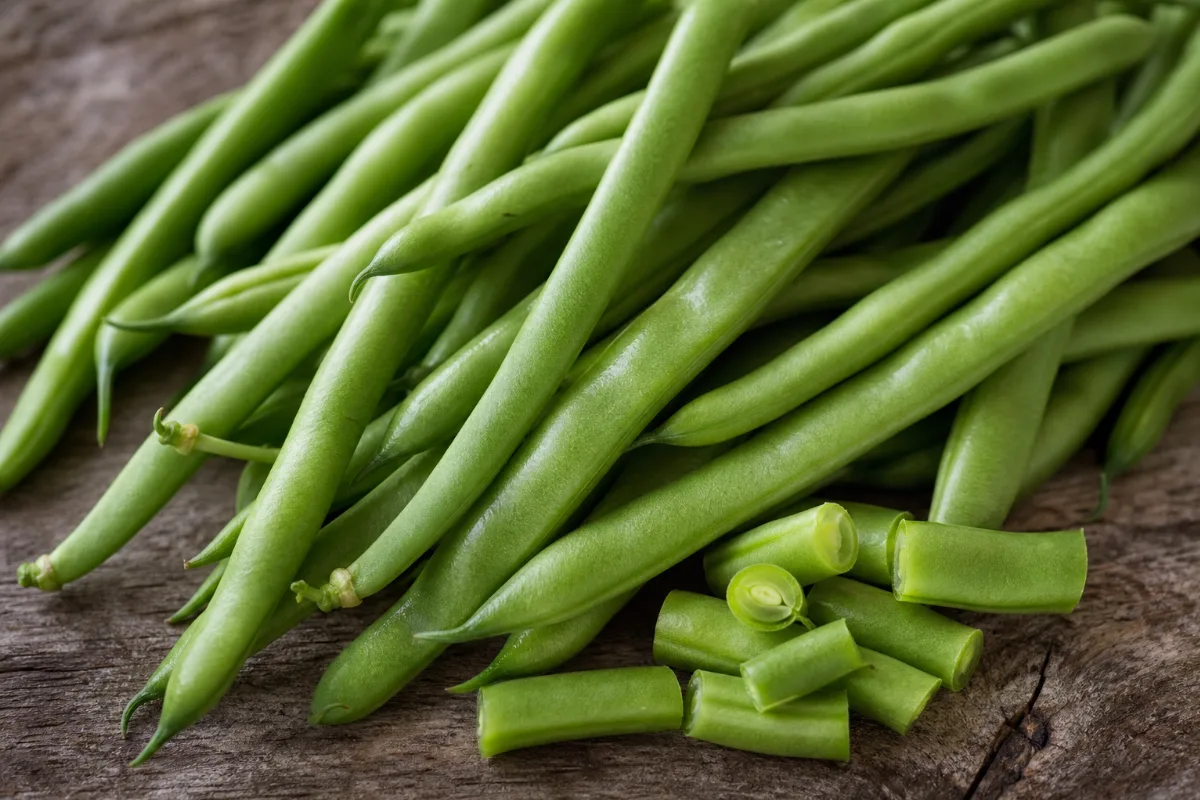
Green beans (Phaseolus vulgaris) are the young pods of the common bean, in the legume family. The pods and the small seeds inside are eaten whole, usually cooked. They are sold fresh, frozen and canned.
USDA data for raw green beans: 31 kcal per 100 g, which is about one cup of half-inch pieces. That portion has 1.83 g protein, 2.7 g fibre, 12.2 mg vitamin C, 33 micrograms folate (DFE), 43 micrograms vitamin K, 211 mg potassium, 37 mg calcium and 6 mg sodium. Ten beans of 4 inches (55 g) have about 17 kcal and 1.5 g fibre. Canned and cooked values were not read.
What the research shows
The firmest facts are about nutrients: vitamin K is needed for blood to clot and folate is a B vitamin. Green beans contain both, but health agencies name leafy greens, not green beans, as the key sources.
Large reviews link a high-fibre diet to less heart disease, stroke, type 2 diabetes and bowel cancer, and a review of fruit and vegetables combined found similar links. These are observational and not about green beans alone.
A 2026 review found dry beans and other legumes lowered LDL cholesterol a little. That does not tell us about the green pod. We found no trial of eating green beans.
Food versus other things called beans
Dry beans, bean extracts and sprouts are different products from green beans. The cholesterol and lectin findings are about dry beans, and FDA sprout warnings are about sprouts. Do not assume they apply to the green pod.
Amounts
We give no amounts to eat. Ask a doctor, pharmacist or dietitian what is right for you, especially if you take warfarin or have kidney problems.
At a glance
Traditional uses history, not proof
- Eaten as a cooked vegetable, fresh, frozen or canned
- Long use as food is not proof that it treats any condition
Studied for research
- Fibre and long-term health, low certainty (fibre in general, observational)
- Vitamin K for normal blood clotting, high certainty for the nutrient, no green bean trial
- Folate, high certainty for the nutrient, a modest source
- Bowel regularity, insufficient evidence for green beans
- Cholesterol, insufficient evidence (dry beans, not green pods)
Main compounds
- Dietary fibre
- Vitamin K (phylloquinone)
- Folate
- Vitamin C
- Lutein and zeaxanthin
- Beta-carotene
- Potassium
Common forms
- Fresh pods, cooked
- Frozen green beans
- Canned green beans, often with added salt
- Home-canned green beans (a botulism hazard if done wrongly)
Research links: NHS: Warfarin · 2019 Lancet review: carbohydrate quality and health · Green bean allergen (Pha v 3) · Research Library · Genes & Biomarkers Library
What it is and its history
- Accepted scientific name
- Phaseolus vulgaris
- Naming authority
- L. (GBIF accepted)
- Common names
- Green beans (English); Snap beans (English); String beans (English); French beans (English); Haricots verts (French); Judías verdes (Spanish)
- Family or group
- Fabaceae (the legume family), as given by GBIF and by a case report that calls green beans legumes of the Fabaceae family.
- Classification
- Plantae > Tracheophyta > Magnoliopsida > Fabales > Fabaceae > Phaseolus > Phaseolus vulgaris
- Native range
- Not verified from a source read.
- Habitat
- Not verified from a source read.
- What it looks like
- Roots: Not verified.; Stems: Not verified.; Leaves: Not verified.; Flowers: Not verified.; Fruit: The young pods are the food. USDA gives household portions of one cup of half-inch pieces as 100 g and 10 beans (4 inches long) as 55 g.
- Cultivation
- Not verified from a source read.
- Harvest and processing
- Eaten fresh, frozen or canned (existing nutrient summary). Canned products are often packed with salt. Cooking effects on nutrients were not read from a source.
- Look-alikes and adulterants
- Name: Dry common beans (kidney, white, pinto and others); Note: Mature seeds of the same species. Evidence about dry beans, such as cholesterol results and the lectin warning for raw kidney beans, should not be assumed to apply to the green pod.; Name: Other pod vegetables (green peas, snow peas); Note: Different plants with their own pages.
- Sustainability and conservation
- Not assessed.
Photographs
What is inside, and how it may work
What it contains and how those compounds act in cells and animals. Laboratory and animal mechanisms are not proven effects in people.
Main compounds
| Compound | Family | Where it is concentrated | Activity studied | Level of evidence |
|---|---|---|---|---|
| Dietary fibre | carbohydrate | Pod USDA: 2.7 g per 100 g raw | Higher fibre intake is linked to lower disease rates in observational studies (Lancet review). Not a single compound, so no PubChem entry. 6 22 | Human data |
| Vitamin K (phylloquinone) PubChem 5284607 | vitamin | Pod USDA: 43 micrograms per 100 g raw | Needed for blood-clotting proteins (MedlinePlus). Affects warfarin. 18 21 22 | Human data |
| Folate (vitamin B9) PubChem 135398658 | vitamin | Pod USDA: 33 micrograms DFE per 100 g raw | B vitamin; helps tissues grow and cells work (MedlinePlus). 16 22 | Human data |
| Vitamin C (ascorbic acid) PubChem 54670067 | vitamin | Pod USDA: 12.2 mg per 100 g raw | Content only; no source read on its role was used for this page. 22 | Human data |
| Lutein and zeaxanthin PubChem 5281243 | carotenoid | Pod USDA: 640 micrograms per 100 g raw | Plant pigments; content only. No trial of green beans for eye health was read. 22 | Human data |
| Beta-carotene PubChem 5280489 | carotenoid | Pod USDA: 379 micrograms per 100 g raw | Orange-yellow plant pigment; content only. 22 | Human data |
| Phytohaemagglutinin (a lectin protein) | lectin | Seeds of common bean Not measured in green bean pods in any source read | Raw or undercooked beans can cause food poisoning (FDA). Measured in dark red kidney beans, not green beans. 14 9 | Human data |
| Lipid transfer protein Pha v 3 | allergen protein | Pod Not measured | Major green bean allergen in 10 Spanish patients; cross-reacts with peach lipid transfer protein in one study. 11 5 | Human data |
Mechanisms, receptors and pathways
| Target or pathway | Gene or receptor | What was found | Level |
|---|---|---|---|
| Vitamin K and blood clotting | Clotting factors II, VII, IX and X (named by MedlinePlus) | Vitamin K is used by the liver to make clotting proteins; warfarin works against this, so vitamin K in food affects the medicine. 18 21 | Human data |
| IgE-mediated allergy to a lipid transfer protein | Pha v 3 (non-specific lipid transfer protein) | A 10 kDa protein in green bean was recognised by 80 percent of sera from 10 allergic patients; peach Pru p 3 blocked IgE binding in another series of five. 11 5 | Human data |
Absorption, metabolism and elimination
- Absorption
- Not found.
- Distribution
- Not found.
- Metabolism
- Not found.
- Elimination
- Not found.
- Bioavailability
- Not established for green bean nutrients in the sources read.
Isolated compounds versus whole extracts
The cholesterol and lectin results are for dry legume seeds, not for the green pod, and the fibre reviews pool fibre from many foods. No capsule or extract of green beans was studied in the sources read.
Nutritional composition
Nutrition from USDA FoodData Central (Beans, snap, green, raw, FDC 169961, SR Legacy, last updated 4/1/2019, read 2026-10-26). Per 100 g, which is about one cup of half-inch pieces: 31 kcal, 1.83 g protein, 0.22 g fat, 6.97 g carbohydrate (3.26 g sugars), 2.7 g fibre, about 90 g water, 37 mg calcium, 1.03 mg iron, 25 mg magnesium, 211 mg potassium, 6 mg sodium, 12.2 mg vitamin C, 33 micrograms folate (DFE), 35 micrograms vitamin A (RAE), 43 micrograms vitamin K, 0.216 mg manganese, 0.141 mg vitamin B6 and 640 micrograms lutein plus zeaxanthin. Ten beans of 4 inches (55 g): about 17 kcal, 1.5 g fibre, 24 micrograms vitamin K, 18 micrograms folate, 6.7 mg vitamin C and 116 mg potassium. Figures vary with variety, ripeness and storage. Canned and cooked values were not read.
2 high certainty1 low certainty2 not enough evidence
What was looked at
The 5 benefits and uses checked for Green Beans, each with how strong the evidence is. Tap one to open it.
- Fibre and long-term healthLow certainty
- Vitamin K for normal blood clottingHigh certainty
- Folate (a B vitamin) from green beansHigh certainty
- Fibre and bowel regularityNot enough evidence
- Cholesterol (dry-bean evidence does not carry over)Not enough evidence
Lab markers tracked in the studies
Heart disease, stroke and deathsLDL cholesterol
What is Green Beans good for?
The main studied uses and how strong the human evidence is for each. Most results are for fibre or legumes in general, or are nutrient facts, not studies of eating green beans.
Benefits, one by one
Each card is a research question, not a promise. Tap a goal to filter. Open a card to see the studies, doses and limits.
Fibre and long-term health
Low certaintyGreen beans give fibre: 2.7 g per 100 g raw (USDA), which is one cup of half-inch pieces. Large reviews link eating more fibre to less heart disease, stroke, type 2 diabetes and bowel cancer. Those reviews are about fibre from the whole diet. They did not test green beans on their own.
4 studiesFresh pods, cooked. Values vary with variety and storage.
Studies, doses and limits
What the trials found
A 2019 Lancet series of reviews (185 prospective studies and 58 trials) found that people with the highest fibre intake had 15 to 30 percent lower rates of death, heart disease, stroke, type 2 diabetes and bowel cancer than people with the lowest. The NHS says eating plenty of fibre is associated with a lower risk of heart disease, stroke, type 2 diabetes and bowel cancer, and uses green beans in a sample high-fibre dinner.
Results
The fibre evidence is fairly strong, but it is about fibre in general. No study read tested green beans alone. A 2017 review of fruit and vegetables combined also found lower heart disease and death with more intake, without naming green beans.
Effect sizes as reported
Fibre, highest vs lowest intake: 15 to 30 percent lower rates (observational). Fruit and vegetables combined per 200 g/day: cardiovascular disease RR 0.92, all-cause death RR 0.90. USDA: 2.7 g fibre per 100 g raw green beans.
Why this rating
The reviewers rated the certainty for dietary fibre as moderate. For green beans it is low, because green beans were not studied alone and most of the evidence is observational.
Form and dose studied
Fresh pods, cooked. Values vary with variety and storage.
Who was studied
Healthy adults; the review excluded people with chronic disease.
Limits
Fibre from many foods is pooled. People who eat more fibre often live differently in other ways. This does not show that green beans lower risk.
Why researchers looked
Green beans are a common everyday vegetable and a fibre food, so people ask whether eating them helps long-term health.
Traditional use
Green beans are the young whole pods of the common bean, eaten as a cooked vegetable. Long use as food is not proof that they treat any condition.
Proposed mechanism Systematic review
Fibre is the part of plant food the body does not digest. How it lowers risk is not settled in the sources read; the review reports associations in people and, in trials, lower body weight, blood pressure and total cholesterol with more fibre.
A proposed mechanism does not show that the effect happens in people.
None specific for the fibre itself. See the Safety tab for warfarin, allergy and canning cautions.
Vitamin K for normal blood clotting
High certaintyVitamin K is needed for blood to clot. USDA lists 43 micrograms in 100 g of raw green beans. That is a real amount, but health agencies name leafy greens, not green beans, as the main sources. This is a nutrient fact, not a green bean trial. If you take warfarin, the same vitamin K matters for another reason: see the Safety tab.
3 studiesRaw pods by USDA analysis; cooking effects were not read.
Studies, doses and limits
What the trials found
MedlinePlus calls vitamin K the clotting vitamin and lists green leafy vegetables, Brussels sprouts, broccoli, cauliflower and cabbage among food sources. The NHS names green leafy vegetables such as broccoli and spinach. Neither page names green beans. USDA gives 43 micrograms of vitamin K (phylloquinone) per 100 g of raw green beans.
Results
The clotting role of vitamin K is well accepted, and green beans contain it. No trial of green beans for clotting was read. The NHS says a varied, balanced diet should supply all the vitamin K needed, and MedlinePlus says deficiency is very rare.
Effect sizes as reported
USDA: 43 micrograms vitamin K per 100 g raw green beans (about 24 micrograms in 10 beans of 4 inches, 55 g).
Why this rating
High for the role of the nutrient (health-agency statements) and for green beans containing it (USDA). There is no green bean trial, and green beans are not named as a key source.
Form and dose studied
Raw pods by USDA analysis; cooking effects were not read.
Who was studied
Anyone eating a varied diet.
Limits
A nutrient fact, not a trial of green beans. It does not show that extra vitamin K adds benefit in someone who already has enough.
Why researchers looked
Green beans are a green vegetable with vitamin K, so people ask what it does and whether it matters with blood thinners.
Traditional use
Green beans are eaten as a cooked vegetable. Long use as food is not proof that they treat any condition.
Proposed mechanism Authoritative guidance
MedlinePlus says the body needs vitamin K to make clotting proteins (factors II, VII, IX and X) in the liver; without it, blood would not clot.
A proposed mechanism does not show that the effect happens in people.
People taking warfarin should keep vitamin K intake steady and ask their clinic; see the Safety tab.
Folate (a B vitamin) from green beans
High certaintyUSDA lists 33 micrograms of folate (DFE) in 100 g of raw green beans, a modest amount. MedlinePlus names dark green leafy vegetables, dried beans and peas, and citrus as folate foods, not green beans. Women thinking about pregnancy are advised to take folic acid because food alone can be hard.
2 studiesRaw pods by USDA analysis; cooking effects were not read.
Studies, doses and limits
What the trials found
MedlinePlus says folate occurs naturally in dark green leafy vegetables, dried beans and peas and citrus fruits, and that taking the right amount of folic acid before and during pregnancy helps prevent neural tube defects such as spina bifida. USDA lists 33 micrograms folate (DFE) per 100 g raw green beans.
Results
The role of folate is well accepted. Green beans contain a modest amount. No trial of green beans for folate status or pregnancy outcomes was read.
Effect sizes as reported
USDA: 33 micrograms folate (DFE) per 100 g raw green beans (about 18 micrograms in 10 beans of 4 inches).
Why this rating
High for the nutrient role (MedlinePlus). Green beans are only a modest source and no green bean study was read.
Form and dose studied
Raw pods by USDA analysis; cooking effects were not read.
Who was studied
General adult diet; women planning pregnancy (folic acid advice).
Limits
A nutrient fact, not a trial. MedlinePlus advice on pregnancy is about folic acid supplements, not about green beans.
Why researchers looked
Green beans are a green vegetable, so people ask if they are a folate food.
Traditional use
Green beans are eaten as a cooked vegetable. Long use as food is not proof that they treat any condition.
Proposed mechanism Authoritative guidance
MedlinePlus says folate helps tissues grow and cells work, helps form red blood cells and helps make DNA.
A proposed mechanism does not show that the effect happens in people.
Ask a doctor about folic acid before pregnancy.
Fibre and bowel regularity
Not enough evidenceThe NHS says choosing fibre foods can help your digestion and prevent constipation, and it uses green beans in a sample high-fibre dinner. Green beans have 2.7 g of fibre per 100 g raw (USDA). Green beans were not tested on their own for constipation.
2 studiesCooked pods as food.
Studies, doses and limits
What the trials found
NHS: there is evidence that eating plenty of fibre is associated with lower risk of heart disease, stroke, type 2 diabetes and bowel cancer, and choosing foods with fibre can help your digestion and prevent constipation. The sample dinner of grilled chicken, baked potato, carrots and green beans is given as about 11.2 g of fibre.
Results
General fibre advice. No trial of green beans for constipation or bowel habit was read.
Effect sizes as reported
USDA: 2.7 g fibre per 100 g raw green beans (about 1.5 g in 10 beans of 4 inches, 55 g).
Why this rating
An agency statement about fibre in general. No study of green beans for this use was read.
Form and dose studied
Cooked pods as food.
Who was studied
General adult diet.
Limits
The fibre content of a food is not proof that the food treats constipation.
Why researchers looked
Fibre foods are widely advised for regular bowels, and green beans are a common fibre vegetable.
Traditional use
Green beans are eaten as a cooked vegetable. Long use as food is not proof that they treat any condition.
Proposed mechanism Authoritative guidance
The NHS links fibre with digestion and with preventing constipation; the how is not explained in the text read.
A proposed mechanism does not show that the effect happens in people.
Long-lasting constipation or blood in the stool needs a doctor.
Cholesterol (dry-bean evidence does not carry over)
Not enough evidenceA 2026 review of 31 trials found that non-soy legumes such as dry beans and lentils lowered total and LDL cholesterol a little. Green beans are eaten as a young green pod, and the abstract does not say they were part of the review. We cannot say green beans do the same.
3 studiesDry legumes in the trials, not green beans.
Studies, doses and limits
What the trials found
The review (Nutrition Reviews, 2026) pooled 31 randomised trials of non-soy legumes. Total cholesterol fell by 5.159 mg/dL and LDL by 3.475 mg/dL on average. Triglycerides did not change significantly overall and HDL did not change. Green beans are the same species as dry beans (Phaseolus vulgaris, as a case report states), but the abstract does not list them.
Results
A small average fall in LDL and total cholesterol with dry legumes. Nothing read tests green bean pods.
Effect sizes as reported
Total cholesterol WMD -5.159 mg/dL (95% CI -7.192 to -3.126); LDL WMD -3.475 mg/dL (-5.321 to -1.530).
Why this rating
The result is for legumes eaten as mature seeds. It should not be assumed for the green pod, which has a different make-up.
Form and dose studied
Dry legumes in the trials, not green beans.
Who was studied
Adults in randomised trials.
Limits
Not about green beans. The average changes are small.
Why researchers looked
Green beans come from the same species as dry beans, so people ask if the cholesterol results apply.
Proposed mechanism Unknown
Not stated in the abstract read.
A proposed mechanism does not show that the effect happens in people.
None specific.
Connections to the rest of health
How Green Beans connects to the rest of our health knowledge graph. Every link says what kind of connection it is. A safety link (for example to the liver) is a warning, not a benefit. A study that merely mentions a topic never creates a benefit link.
Explore every connection: goals, body systems, organs, symptoms, genes
B. Body systems
| Connected to | Kind of connection | Evidence status | Context | Studies |
|---|---|---|---|---|
| Cardiovascular System | Biological association | Low certainty | Studied for: Fibre and long-term health Studied for: Vitamin K for normal blood clotting | 6 19 1 22 18 20 8 7 |
| Digestive System | Biological association | Low certainty | Studied for: Fibre and long-term health Studied for: Fibre and bowel regularity | 6 19 1 22 |
| Blood And Immune | Biological association | High certainty | Studied for: Vitamin K for normal blood clotting Studied for: Folate (a B vitamin) from green beans | 18 20 22 16 |
| Reproductive System | Biological association | High certainty | Studied for: Folate (a B vitamin) from green beans | 16 22 |
E. Health conditions
| Connected to | Kind of connection | Evidence status | Context | Studies |
|---|---|---|---|---|
| Food allergy | Adverse effect or risk | Case reports | Allergy to cooked green beans is described in case reports and small series; cross-reaction with peach was shown in one study. Allergy to cooked green beans is described in case reports and small series. Preparation or compound: Green bean lipid transfer protein (Pha v 3) |
7 11 5 |
I. Biomarkers
| Connected to | Kind of connection | Evidence status | Context | Studies |
|---|---|---|---|---|
| Heart disease, stroke and deaths | Biological association | Low certainty | Measured in trials: lowered. A lab change is not the same as a health benefit. | 6 1 |
| LDL cholesterol | Biological association | Not enough evidence | Measured in trials: lowered. A lab change is not the same as a health benefit. | 8 |
K. Biological pathways
| Connected to | Kind of connection | Evidence status | Context | Studies |
|---|---|---|---|---|
| Vitamin K | Preliminary mechanism | Human | Green beans contain vitamin K; it is needed for clotting and affects warfarin. | 18 21 |
| Dietary fibre | Preliminary mechanism | Human | Green beans are a fibre food; fibre is linked to lower disease rates in observational studies. | 6 19 |
| Folate | Preliminary mechanism | Human | Green beans contain a modest amount of folate. | 16 |
| Potassium | Preliminary mechanism | Human | Moderate amount; relevant for kidney disease. | 17 22 |
L. Active compounds
| Connected to | Kind of connection | Evidence status | Context | Studies |
|---|---|---|---|---|
| Dietary fibre | Biological association | Human | Higher fibre intake is linked to lower disease rates in observational studies (Lancet review). Not a single compound, so no PubChem entry. Preparation or compound: Pod |
6 22 |
| Vitamin K (phylloquinone) | Biological association | Human | Needed for blood-clotting proteins (MedlinePlus). Affects warfarin. Preparation or compound: Pod |
18 21 22 |
| Folate (vitamin B9) | Biological association | Human | B vitamin; helps tissues grow and cells work (MedlinePlus). Preparation or compound: Pod |
16 22 |
| Vitamin C (ascorbic acid) | Biological association | Human | Content only; no source read on its role was used for this page. Preparation or compound: Pod |
22 |
| Lutein and zeaxanthin | Biological association | Human | Plant pigments; content only. No trial of green beans for eye health was read. Preparation or compound: Pod |
22 |
| Beta-carotene | Biological association | Human | Orange-yellow plant pigment; content only. Preparation or compound: Pod |
22 |
| Phytohaemagglutinin (a lectin protein) | Biological association | Human | Raw or undercooked beans can cause food poisoning (FDA). Measured in dark red kidney beans, not green beans. Preparation or compound: Seeds of common bean |
14 9 |
| Lipid transfer protein Pha v 3 | Biological association | Human | Major green bean allergen in 10 Spanish patients; cross-reacts with peach lipid transfer protein in one study. Preparation or compound: Pod |
11 5 |
Each connection is stored with the ingredient, the connected record, the kind of connection, the evidence status, the supporting studies, the preparation or compound involved, and a review date (last reviewed October 26, 2026).
The evidence
The research centre for Green Beans. Every record here was checked against PubMed or the publisher's page; we never list a study we have not verified.
Evidence by outcome
Bars show how many studies we found for each outcome, not how well it works. People are added up across trials only (reviews are not added, to avoid double counting).
How we rate evidence
High certainty
Several well-run trials or reviews agree; further research is unlikely to change the picture much.
Moderate certainty
Good trials point the same way, but some doubt remains.
Low certainty
Small, short or inconsistent trials. The finding could change with better research.
Very low certainty
Very little or very weak human data. Treat as a possibility only.
Mixed findings
Trials or reviews disagree with each other.
Not enough evidence
Not enough human research to say either way.
Evidence against
Good research found no benefit, or found harm.
We take the reviewers' own risk-of-bias and GRADE statements where they exist, and otherwise judge from study size, design, consistency, directness and whether a product matches what is sold. Many publications do not make evidence high. Method note: We started from our existing green bean summary, re-checked nutrition at USDA FoodData Central, read the health agency pages (NHS, MedlinePlus, FDA) and searched PubMed for reviews, case reports and laboratory studies. Only abstracts were read for studies, and one allergy report had no abstract. Items we could not verify are flagged in the research gaps.
Study library: every study we checked 22
| Study | Design | People | Product, dose, length | Result |
|---|---|---|---|---|
| Aune 2017 Fruit and vegetable intake and the risk of cardiovascular disease, total cancer and all-cause mortality-a systematic review and dose-response meta-analysis of prospective studies. Int J Epidemiol · PMID 28338764 · DOI |
Systematic review meta analysis |
Adults in 95 prospective studies (142 publications) | Fruit and vegetable intake as food Fruit and vegetables Per 200 g/day (analysis unit, not advice) Prospective follow-up · vs Lower intake |
For fruits and vegetables combined, each 200 g/day was linked to lower risk of coronary heart disease, stroke, cardiovascular disease, total cancer and death from any cause. The abstract names apples and pears, citrus, green leafy vegetables, cruciferous vegetables and salads for cardiovascular disease and all-cause mortality. Green beans are not named. Per 200 g/day, fruit and vegetables combined: CVD RR 0.92; stroke RR 0.84; all-cause mortality RR 0.90 (CVD RR 0.92 (95% CI 0.90-0.95); stroke 0.84 (0.76-0.92); all-cause mortality 0.90 (0.87-0.93)) Methods, limits and fundingOutcomes: Coronary heart disease, stroke, cardiovascular disease, total cancer, all-cause mortality Limitations: Prospective observational studies cannot show cause; people who eat more vegetables differ in other ways. Combined figures, not for green beans. Funding and conflicts: Not stated in the abstract. Read: abstract |
| Daroca 2000 Asthma and rhinitis induced by exposure to raw green beans and chards. Ann Allergy Asthma Immunol · PMID 11030276 · DOI |
Case report |
3 Three women who developed asthma and rhinitis when handling raw green beans |
Raw green beans (inhaled while handling), raw chard in one Pods · vs Cooked green beans |
Three women had asthma and rhinitis when handling raw green beans in home cooking. Bronchial challenge was positive to raw but not cooked green beans. All three tolerated eating green beans, and oral challenges were negative. 3 of 3 reacted to inhaled raw beans; 0 of 3 reacted to eating (Not applicable) Methods, limits and fundingOutcomes: Asthma and rhinitis on exposure; bronchial challenge; oral challenge Limitations: Three cases. Reaction was to raw bean particles in the air, not to eating. Funding and conflicts: Not stated in the abstract. Read: abstract |
| Hellmich 2018 Foodborne botulism due to ingestion of home-canned green beans: two case reports. J Med Case Rep · PMID 29301587 · DOI |
Case report |
2 A 47-year-old woman and a 51-year-old man |
Home-canned green beans Pods |
About 72 hours after eating home-canned beans, a couple developed paralysis of several cranial nerves with rapidly spreading paralysis. Botulinum toxin type A was found in the woman's blood. Both needed intensive care and ventilation for about 5 months and then recovered completely. Not applicable (Not applicable) Methods, limits and fundingOutcomes: Botulism (paralysis from a bacterial toxin) Limitations: Two cases. Shows the risk of improperly home-canned vegetables; not a rate. The abstract says the beans were home-canned. Funding and conflicts: Authors declare no competing interests. Read: abstract |
| Monda 2020 Contact urticaria caused by occupational exposure to green beans. Australas J Dermatol · PMID 32434268 · DOI |
Case report |
Case report (letter); details not available from the record | Green beans (skin contact at work) Pods |
Only the title and publication type were read; the PubMed record has no abstract. The title reports hives from skin contact with green beans at work. Not available (Not available) Methods, limits and fundingOutcomes: Contact hives Limitations: No abstract to read. Work exposure, not eating. Funding and conflicts: Not stated. Read: title-only |
| Pastorello 2010 Green bean (Phaseolus vulgaris): a new source of IgE-binding lipid transfer protein. J Agric Food Chem · PMID 20222729 · DOI |
Case series laboratory |
5 Five patients with documented reactions to cooked green beans |
Cooked green beans Pods |
Skin tests with raw and cooked green beans were positive in all five patients, and all reacted to one protein of about 9 kDa, a lipid transfer protein. Binding was fully blocked by peach lipid transfer protein Pru p 3, which points to cross-reactivity with peach. 5 of 5 positive (Not applicable) Methods, limits and fundingOutcomes: Skin prick tests and IgE binding Limitations: Five patients; a laboratory and case description. Funding and conflicts: Not stated in the abstract. Read: abstract |
| Reynolds 2019 Carbohydrate quality and human health: a series of systematic reviews and meta-analyses. Lancet · PMID 30638909 · DOI |
Systematic review meta analysis |
Healthy adults: 185 prospective studies and 58 trials (4,635 trial participants) | Dietary fibre as food (supplement trials excluded) Analysis detail, not advice Varied · vs Lower fibre intake |
Observational data linked the highest fibre intakes with a 15 to 30 percent lower rate of all-cause and cardiovascular death, coronary heart disease, stroke, type 2 diabetes and colorectal cancer. Trials showed lower body weight, systolic blood pressure and total cholesterol with higher fibre intake. Certainty was graded moderate for dietary fibre. The review is about fibre in general, not green beans. 15 to 30 percent lower rates (observational, highest vs lowest fibre intake) (Not given in the abstract) Methods, limits and fundingOutcomes: All-cause and cardiovascular death, coronary heart disease, stroke, type 2 diabetes, colorectal cancer, body weight, blood pressure, cholesterol Limitations: Fibre in general, not green beans. A correction to the paper was published (Lancet 2019;393:406). Limited to people without chronic disease. Funding and conflicts: Funded by the Health Research Council of New Zealand, WHO and New Zealand university and research bodies; no industry funder named in the abstract. Read: abstract |
| Rivero 2025 Anaphylaxis due to green beans (Phaseolus vulgaris): a new phenotype? Allergol Immunopathol (Madr) · PMID 39786870 · DOI |
Case report |
1 One 20-year-old woman |
Cooked green beans Pods |
A woman had anaphylaxis after eating cooked green beans and needed emergency treatment. Skin tests with raw and cooked green beans were positive. She tolerated nuts, garlic, chickpeas, peas and soy. A protein of about 10 kDa was recognised in cooked beans. Not applicable (Not applicable) Methods, limits and fundingOutcomes: Severe allergic reaction (anaphylaxis) Limitations: One case: shows it can happen, not how often. Funding and conflicts: The authors declared no conflict of interest. Read: abstract |
| Shaygantabar 2026 Effect of Non-Soy Legumes on Lipid Profile: A Systematic Review and Meta-analysis of Randomized Controlled Trials. Nutr Rev · PMID 41370093 · DOI |
Systematic review meta analysis |
31 randomised controlled trials of non-soy legumes | Non-soy legumes as food Seeds (pulses) Not given in the abstract Varied; some under 8 weeks · vs Control diets |
Non-soy legumes lowered total cholesterol and LDL cholesterol. Triglycerides did not change significantly overall, and HDL did not change. The abstract does not say that green beans were included; the review is about legumes such as dry beans and lentils. Total cholesterol WMD -5.159 mg/dL; LDL WMD -3.475 mg/dL (Total cholesterol -7.192 to -3.126 (P<.001); LDL -5.321 to -1.530 (P=.001)) Methods, limits and fundingOutcomes: Total cholesterol, LDL cholesterol, HDL cholesterol, triglycerides Limitations: Not about green pods. Small average changes. Registered at PROSPERO CRD420250652780. Funding and conflicts: Not stated in the abstract. Registration: PROSPERO CRD420250652780 Read: abstract |
| Thompson 2025 Toward Standardized Measurement of Active Phytohemagglutinin in Common Bean, Phaseolus vulgaris, L. Foods · PMID 41464957 · DOI |
Laboratory analysis n/a |
Laboratory measurement of lectin in dark red kidney bean and canned beans (not green beans) | Phytohaemagglutinin (a bean lectin) Dried bean seeds · vs Raw versus commercially cooked canned beans |
Raw soaked dark red kidney beans carried a large amount of active lectin; commercially cooked canned beans had more than 99 percent less. The abstract says four to five soaked raw dark red kidney beans can cause food poisoning. Green bean pods were not tested. Dark red kidney bean: 223 mg active lectin per g dry weight (ELISA); canned beans >99% lower (Not applicable) Methods, limits and fundingOutcomes: Active lectin content Limitations: About dry kidney beans, not green bean pods. Funding and conflicts: Authors declare no conflicts; funders had no role. Read: abstract |
| Vermeulen 1983 Effect of water rinsing on sodium content of selected foods. J Am Diet Assoc · PMID 6833685 |
Laboratory analysis n/a |
Canned green beans, tuna and cottage cheese (laboratory analysis) | Canned green beans Pods · vs Unrinsed product |
Rinsing had a minimal effect on the sodium in canned beans, but replacing the canning brine with water before heating lowered salt content by 33 percent. Brine replaced with water before heating: 33 percent less salt (Not given) Methods, limits and fundingOutcomes: Sodium content Limitations: Old (1983) laboratory study; current canned products may differ; no health outcome measured. Funding and conflicts: Supported by US public health service funds (research support, P.H.S.); no company named in the abstract. Read: abstract |
| Zoccatelli 2010 Identification and characterization of the major allergen of green bean (Phaseolus vulgaris) as a non-specific lipid transfer protein (Pha v 3). Mol Immunol · PMID 20153058 · DOI |
Case series laboratory |
10 10 Spanish patients reporting reactions to green beans |
Green bean extract and purified proteins Pods |
Oral provocation confirmed green bean allergy. A 10 kDa protein in green bean extract was recognised by 80 percent of the patients' sera and identified as a lipid transfer protein (Pha v 3). The authors say it is a potential risk for people with lipid transfer protein syndrome. 80% of 10 sera recognised the 10 kDa protein (Not applicable) Methods, limits and fundingOutcomes: IgE binding to green bean proteins; skin prick tests; oral provocation Limitations: Ten patients from Spain; not a measure of how common green bean allergy is. Funding and conflicts: Not stated in the abstract. Read: abstract |
| s-fda-outbreaks FDA: Investigations of Foodborne Illness Outbreaks · Source |
Health agency n/a |
Methods, limits and fundingRead: full-text | ||
| s-fda-produce FDA: Selecting and Serving Produce Safely · Source |
Health agency n/a |
Methods, limits and fundingRead: full-text | ||
| s-fda-toxins FDA: Natural Toxins in Food · Source |
Health agency n/a |
Methods, limits and fundingRead: full-text | ||
| s-gbif-phaseolus-vulgaris GBIF Backbone: Phaseolus vulgaris L. (usageKey 5350452) · Source |
Reference database n/a |
Methods, limits and fundingRead: full-text | ||
| s-medlineplus-folate MedlinePlus: Folic acid in the diet · Source |
Health agency n/a |
Methods, limits and fundingRead: full-text | ||
| s-medlineplus-potassium MedlinePlus: Potassium in diet · Source |
Health agency n/a |
Methods, limits and fundingRead: full-text | ||
| s-medlineplus-vitk MedlinePlus: Vitamin K · Source |
Health agency n/a |
Methods, limits and fundingRead: full-text | ||
| s-nhs-fibre NHS: How to get more fibre into your diet · Source |
Health agency n/a |
Methods, limits and fundingRead: full-text | ||
| s-nhs-vitk NHS: Vitamin K · Source |
Health agency n/a |
Methods, limits and fundingRead: full-text | ||
| s-nhs-warfarin NHS: Warfarin · Source |
Health agency n/a |
Methods, limits and fundingRead: full-text | ||
| s-usda-fdc-169961 USDA FoodData Central: Beans, snap, green, raw (FDC 169961) · Source |
Reference database n/a |
Methods, limits and fundingRead: full-text |
What we do not know yet
- No trial of eating green beans themselves was found for heart disease, cholesterol, blood sugar, weight or bowel habit.
- Fibre and vegetable reviews pool many foods; a green bean result was not in the abstracts read.
- How common green bean allergy is was not found; only case reports and small series were read, and one report was read by title only.
- No food-safety agency page on home canning was read, and no source measured lectin in green bean pods.
- Pesticide residues, heavy metals, nitrate, FODMAPs, histamine, breastfeeding, choking risk for young children and the effect of cooking were not researched.
How new research is added
New studies are found by a saved PubMed search and placed in a review queue before the page changes.
Lab markers
What changed in blood or saliva tests during trials. A changed number is not the same as feeling or being healthier, and we give no "normal ranges".
Metabolic 1
LDL cholesterol
Lowered in trials
The cholesterol carried in low-density lipoprotein particles, often called bad cholesterol.
Not enough evidenceResults and what it means
Why it was measured
High LDL is a well-known risk marker for heart disease.
Statistical vs. clinical meaning
A small change with dry legumes; not tested with green beans.
Safety implication
None specific.
| Study | Result | People | Product |
|---|---|---|---|
| 8 | Non-soy legumes lowered LDL by 3.475 mg/dL (95% CI -5.321 to -1.530, P=.001) and total cholesterol by 5.159 mg/dL | Adults in 31 randomised trials | Non-soy legumes as food (dry beans, lentils and similar), not green beans |
Other 1
Heart disease, stroke and deaths
Lowered in trials
How many people in a study develop heart disease or stroke, or die of it.
Low certaintyResults and what it means
Why it was measured
These are the outcomes that matter most to health, so population studies count them.
Statistical vs. clinical meaning
Associations in observational studies, not proof that green beans prevent disease.
Safety implication
None specific.
| Study | Result | People | Product |
|---|---|---|---|
| 6 | Highest vs lowest dietary fibre intake: 15 to 30 percent lower rates of all-cause and cardiovascular death, coronary heart disease and stroke (observational) | Adults without chronic disease in 185 prospective studies | Dietary fibre from food (not green beans alone) |
| 1 | Fruit and vegetables combined, per 200 g/day: cardiovascular disease RR 0.92 (95% CI 0.90-0.95); stroke RR 0.84 (0.76-0.92) | Adults in 95 prospective studies | Fruit and vegetables as food (green beans not named) |
Safety
What studies and official sources say about side effects, medicines and who should check first. Each point shows what kind of evidence it comes from.
Main points to know 5
- Warfarin: green beans contain vitamin K, so keep your intake steady and ask your clinic. USDA lists 43 micrograms of vitamin K in 100 g of raw green beans. The NHS says foods high in vitamin K, such as broccoli, spinach and other green leafy vegetables, can affect how warfarin works; you can still eat them but should talk to your warfarin clinic. MedlinePlus says sudden changes in vitamin K intake can change how the medicine works. Neither page names green beans, so the link rests on the vitamin K content. Do not change a prescribed medicine on your own. Authoritative guidance 21 18 22
- Allergy to green beans is rare but real, and can be severe. Case reports and small series describe allergic reactions to cooked green beans, including one case of anaphylaxis. The main allergen found is a small protein (a lipid transfer protein, Pha v 3). In one study its binding was fully blocked by a peach protein, which points to cross-reaction with peach. Handling raw green beans caused asthma and rhinitis in three women who could still eat them. How common green bean allergy is was not found. Case report 7 11 5 2
- Home-canned green beans have caused botulism. A 2018 report describes a couple who developed paralysis about 72 hours after eating home-canned beans; botulinum toxin was found in the woman's blood. Both needed intensive care and ventilation for about 5 months and recovered completely. This is a case report, not a rate, and we did not read a food-safety agency page on home canning (the CDC page was blocked), so ask a recognised food-safety source before canning at home. Case report 3
- Canned green beans can be salty. A 1983 laboratory study found that replacing the canning liquid with water before heating cut the salt of canned green beans by 33 percent, while rinsing had little effect. Raw green beans have 6 mg sodium per 100 g (USDA). The label shows the amount in a current product. Laboratory 10 22
- Raw or undercooked beans: a lectin can cause food poisoning, but no source read covers green beans. The FDA says a lectin (phytohaemagglutinin) in raw or undercooked beans can cause nausea, severe vomiting and diarrhoea, and describes soaking and boiling for kidney beans. A 2025 laboratory paper measured it in dark red kidney beans. Neither source tested green bean pods or named them. Green beans are normally eaten cooked. Authoritative guidance 14 9
Side effects 3
| Effect | How often | Severity and recovery | Evidence |
|---|---|---|---|
| Allergic reactions to cooked green beans: hives, swelling, anaphylaxis These are case reports and small series. They show it can happen, not how often. | Not stated. 10 patients in one series; 5 in another; 1 anaphylaxis case | can be severe (anaphylaxis) Not stated in the abstracts | Case report 7 11 5 |
| Asthma, rhinitis or skin hives from handling raw green beans In the asthma report all three women could eat green beans, and bronchial challenge reacted to raw but not cooked beans. The hives report was read by title only. | 3 women in one report; one title-only report of contact hives at work | not stated Not stated | Case report 2 4 |
| Botulism from improperly home-canned green beans A hazard of home canning, not of fresh or commercially canned beans; no agency page on canning was read. | 2 people in one report | serious Both recovered completely after about 5 months of intensive care | Case report 3 |
Liver
No liver injury from eating green beans was found. A liver-safety source such as LiverTox was not searched for this food.
How often. No frequency was found.
Monitoring. No agency monitoring advice was found.
This is a safety connection. It is not evidence that Green Beans supports liver health.
Medicines and supplements 3
| With | Why it matters | Importance | Evidence | What to do |
|---|---|---|---|---|
| Warfarin (blood thinner) prescription | Vitamin K helps blood clot, and warfarin works by lowering vitamin K activity. Green beans contain vitamin K (USDA: 43 micrograms per 100 g raw). | The NHS says you can still eat foods high in vitamin K but should ask your warfarin clinic; MedlinePlus says sudden changes in vitamin K intake can change the effect. Neither names green beans. | Authoritative guidance Moderate certainty 21 18 22 | Ask your warfarin clinic. Do not change your medicine on your own. The NHS says not to take vitamin K supplements while on warfarin. |
| Vitamin K supplements supplement | Same vitamin as in green beans, in concentrated form. | The NHS says not to take vitamin K supplements while taking warfarin. | Authoritative guidance High certainty 21 | Ask your clinic before taking any vitamin K supplement if you take warfarin. |
| Medicines that raise blood potassium (ACE inhibitors, ARBs, potassium-sparing diuretics) and kidney disease prescription | MedlinePlus says people with kidney problems, particularly on dialysis, should not eat too many potassium-rich foods. Green beans have 211 mg potassium per 100 g raw (USDA), a moderate amount. | MedlinePlus does not name green beans. This is our reading of two separate facts, and normal food amounts have not been tested. | Authoritative guidance Low certainty 17 22 | If you have kidney disease, ask a clinician or dietitian about potassium in your diet. |
Who should check first 5
| Situation | Advice | Evidence |
|---|---|---|
| Taking warfarin | Keep vitamin K intake steady and follow your warfarin clinic's advice. Do not stop or change medicine on your own. | Authoritative guidance 21 18 |
| Known allergy to green beans, other beans or peach (lipid transfer protein allergy) | Avoid green beans if you reacted to them and ask an allergist. Call emergency services for trouble breathing or swelling of the face or throat. | Case report 7 11 5 |
| Kidney disease, especially on dialysis | Ask a clinician about potassium-rich foods. | Authoritative guidance 17 |
| Pregnancy, young children, older age or weakened immunity (foodborne illness) | The FDA says these groups can be especially vulnerable to foodborne illness. Follow official food-safety advice for fresh produce. | Authoritative guidance 13 |
| Planning a pregnancy (folate) | MedlinePlus says women thinking about becoming pregnant should take folic acid supplements because folate can be hard to get from food alone. Green beans are only a modest folate source. Ask a clinician. | Authoritative guidance 16 22 |
Overdose, product quality and regulators
Summary. No toxicity from green beans as ordinary cooked food was found in the sources read. The cautions are for people on warfarin, people with a bean or peach allergy, and for improperly canned or undercooked product.
Animal. Not reviewed.
Human doses studied. No dose study of green beans was read.
Overdose response. Not found.
Genotoxicity. Not researched.
Toxic or hazardous parts. The FDA describes a lectin in raw or undercooked beans (kidney beans named). Whether green bean pods carry enough to matter was not found in any source read.
Fresh produce can carry germs, and home canning of low-acid vegetables has caused botulism in case reports. The FDA outbreak list read has no green bean entry (it lists sprouts and sprouted beans). Pesticide residues, heavy metals and nitrate levels in green beans were not researched.
Washing and storage. The FDA says to wash all produce under running water, not to use soap, detergent or commercial produce wash, to refrigerate cut or packaged produce at 40 F (4 C) or below, and that pre-washed ready-to-eat packages need no more washing. 13
Outbreak list. A search of the FDA outbreak list text found no entry for green beans. Sprouts and sprouted beans, which are a different product, are listed. 12
Home canning. Two people developed botulism after eating home-canned green beans and recovered after months of intensive care. 3
| Body | Action | Date |
|---|---|---|
| NHS (UK) (United Kingdom) | Warfarin page: foods high in vitamin K such as broccoli, spinach and other green leafy vegetables can affect warfarin; you can still eat them but ask your warfarin clinic; do not take vitamin K supplements source | 2026-02-24 |
| MedlinePlus (US National Library of Medicine) (United States) | Vitamin K page: sudden changes in vitamin K intake can change warfarin's effect source | 2025-01-21 |
| FDA (US) (United States) | Natural toxins page: phytohaemagglutinin in raw or undercooked beans can cause nausea, severe vomiting and diarrhoea; kidney beans named source | 2024-09-26 |
| FDA (US) (United States) | Produce safety page: wash under running water, refrigerate at 40 F or below; pregnant women, older adults and people with weakened immunity are especially vulnerable to foodborne illness source | 2024-03-05 |
| MedlinePlus (US National Library of Medicine) (United States) | Potassium page: people with kidney problems, particularly on dialysis, should not eat too many potassium-rich foods source |
When to get medical help
- Trouble breathing, swelling of the lips, face or throat, or widespread hives after eating green beans
- Signs of serious bleeding while taking warfarin, such as blood in urine or stool, unexplained bruising or nosebleeds (NHS)
- Weakness or paralysis that spreads quickly, especially of the face or eye muscles, after eating home-canned vegetables (the botulism case report describes paralysis of several cranial nerves); call emergency services
- Severe vomiting, diarrhoea or stomach pain after eating raw or undercooked beans or fresh produce
Stop using the product and contact a clinician or emergency service. In the US, Poison Control is 1-800-222-1222.
General information only, not medical advice. Ask a clinician or pharmacist before use, especially with medicines, in pregnancy or with a health condition. See the Natural Remedy Safety guide.
Frequently asked questions
What are green beans good for?
Are green beans safe with warfarin?
Do green beans lower cholesterol?
Not shown. A review of 31 trials found dry beans and other non-soy legumes lowered LDL cholesterol by about 3.5 mg/dL, but green pods were not the subject.
Are green beans good for the heart?
Are green beans good for digestion?
Can I be allergic to green beans?
Can handling raw green beans cause a reaction?
Is it safe to can green beans at home?
Not without proper methods. A report describes a couple who developed botulism after eating home-canned green beans and needed about five months of intensive care. Use a recognised food-safety guide. We did not read an agency page on canning.
Are raw green beans poisonous?
Are canned green beans healthy?
Are green beans safe in pregnancy?
How should I wash fresh green beans?
The FDA says to wash produce under running water, not to use soap or produce wash, and to keep cut produce at 40 F (4 C) or below. Pre-washed ready-to-eat packs need no more washing.
Explore by health goal
Editorial transparency
- Written by
- AlternativeMed editorial team. Research compiled with AI assistance, then checked against the sources listed.
- Medical review
- None. This page has not been reviewed by a physician or pharmacist.
- First published
- 2026-10-26
- Last substantive update
- 2026-10-26
- How we research
- We started from our existing green bean summary, re-checked nutrition at USDA FoodData Central, read the health agency pages (NHS, MedlinePlus, FDA) and searched PubMed for reviews, case reports and laboratory studies. Only abstracts were read for studies, and one allergy report had no abstract. Items we could not verify are flagged in the research gaps.
- How we rate evidence
- See "How we rate evidence" in the Evidence tab.
- Independence
- No product is promoted on this page. No affiliate links are shown.
Sources 22
Each source was opened and checked. Where we read only the abstract, it says so. The small numbers in the text point here.
- Aune D, Giovannucci E, Boffetta P, et al.. Fruit and vegetable intake and the risk of cardiovascular disease, total cancer and all-cause mortality-a systematic review and dose-response meta-analysis of prospective studies.. Int J Epidemiol. 2017. PMID 28338764. DOI 10.1093/ije/dyw319. (abstract)
- Daroca P, Crespo JF, Reaño M, et al.. Asthma and rhinitis induced by exposure to raw green beans and chards.. Ann Allergy Asthma Immunol. 2000. PMID 11030276. DOI 10.1016/S1081-1206(10)62469-6. (abstract)
- Hellmich D, Wartenberg KE, Zierz S, Mueller TJ. Foodborne botulism due to ingestion of home-canned green beans: two case reports.. J Med Case Rep. 2018. PMID 29301587. DOI 10.1186/s13256-017-1523-9. (abstract)
- Monda S, Nixon R. Contact urticaria caused by occupational exposure to green beans.. Australas J Dermatol. 2020. PMID 32434268. DOI 10.1111/ajd.13334. (title-only)
- Pastorello EA, Pravettoni V, Farioli L, et al.. Green bean (Phaseolus vulgaris): a new source of IgE-binding lipid transfer protein.. J Agric Food Chem. 2010. PMID 20222729. DOI 10.1021/jf100213g. (abstract)
- Reynolds A, Mann J, Cummings J, et al.. Carbohydrate quality and human health: a series of systematic reviews and meta-analyses.. Lancet. 2019. PMID 30638909. DOI 10.1016/S0140-6736(18)31809-9. (abstract)
- Rivero EM, Castaño MP, Romero IMD, et al.. Anaphylaxis due to green beans (Phaseolus vulgaris): a new phenotype?. Allergol Immunopathol (Madr). 2025. PMID 39786870. DOI 10.15586/aei.v53i1.1176. (abstract)
- Shaygantabar M, Eslamian G, Hekmatdoost A, et al.. Effect of Non-Soy Legumes on Lipid Profile: A Systematic Review and Meta-analysis of Randomized Controlled Trials.. Nutr Rev. 2026. PMID 41370093. DOI 10.1093/nutrit/nuaf226. (abstract)
- Thompson HJ, Neil ES, McGinley JN, Lutsiv T. Toward Standardized Measurement of Active Phytohemagglutinin in Common Bean, Phaseolus vulgaris, L.. Foods. 2025. PMID 41464957. DOI 10.3390/foods14244247. (abstract)
- Vermeulen RT, Sedor FA, Kimm SY. Effect of water rinsing on sodium content of selected foods.. J Am Diet Assoc. 1983. PMID 6833685. (abstract)
- Zoccatelli G, Pokoj S, Foetisch K, et al.. Identification and characterization of the major allergen of green bean (Phaseolus vulgaris) as a non-specific lipid transfer protein (Pha v 3).. Mol Immunol. 2010. PMID 20153058. DOI 10.1016/j.molimm.2010.01.009. (abstract)
- . FDA: Investigations of Foodborne Illness Outbreaks. . . (full-text)
- . FDA: Selecting and Serving Produce Safely. . . (full-text)
- . FDA: Natural Toxins in Food. . . (full-text)
- . GBIF Backbone: Phaseolus vulgaris L. (usageKey 5350452). . . (full-text)
- . MedlinePlus: Folic acid in the diet. . . (full-text)
- . MedlinePlus: Potassium in diet. . . (full-text)
- . MedlinePlus: Vitamin K. . . (full-text)
- . NHS: How to get more fibre into your diet. . . (full-text)
- . NHS: Vitamin K. . . (full-text)
- . NHS: Warfarin. . . (full-text)
- . USDA FoodData Central: Beans, snap, green, raw (FDC 169961). . . (full-text)


