Recover & Feel More Comfortable
Ease Everyday Muscle Tension
A tight neck, stiff shoulders or an achy upper back after a long day of sitting, screens, carrying or simply holding yourself still is one of the most common physical complaints. This page covers non-exercise tension in the neck, shoulders and back and says plainly which everyday steps have research behind them.
General information, not medical advice. Last updated October 31, 2026. Written by the AlternativeMed editorial team. Not medically reviewed.
Start here
- Break up long stretches in one position: stand, roll your shoulders and move your neck gently every 30 minutes or so, and use a longer movement break when you can.
- Add a short neck-and-shoulder stretching routine most days. In one trial of office workers, doing it at least three times a week brought more benefit than less often.
- When a spot feels tight, a warm pack wrapped in a towel for 20 minutes is a safe, simple comfort measure, and staying gently active usually does more than resting.
Be careful with
- Stop any stretch or movement that makes the pain sharper or worse, and do not force your neck or back into position or crack them hard.
- Heat should never go straight onto the skin: wrap hot-water bottles and packs in a towel, and take extra care if you have reduced feeling in your skin, such as with diabetes, or if you are pregnant.
- Muscle tension that comes with weakness, numbness, pins and needles, fever or a recent fall or accident is not everyday tension: see the red flags below and get checked.
Get help when
- Pain or stiffness that does not go away after a few weeks, or that wakes you at night or is not eased by rest, is worth a visit to a GP or doctor. The NHS lists this for neck and back pain.
- Pins and needles, numbness, a cold or weak arm, or weakness in a leg point to a nerve problem and need a clinician. Pain, tingling, weakness or numbness in both legs, numbness around the genitals or anus, or new bladder or bowel changes with back pain need emergency care (the NHS names 999 in the UK).
- Sudden or severe pain, pain after an accident or fall, chest pain, feeling hot, shivery or generally unwell with back or neck pain, or unexplained weight loss with back pain needs prompt medical care (the NHS names 111 and 999 in the UK).
About Ease Everyday Muscle Tension
What this goal means
This goal is about the everyday tightness, ache and stiffness that builds up in the neck, shoulders and back without an injury or a workout behind it: sitting at a desk, looking down at a phone, driving, carrying a bag, sleeping in an awkward position or standing for long periods. MedlinePlus notes that muscle strain or tension often causes neck pain and that overuse such as sitting at a computer for too long is a usual cause.
It is not about soreness after exercise (see Manage Post-Exercise Muscle Soreness), tension that mainly comes with stress, a clenched jaw or racing thoughts (see Relax Your Body & Release Tension), or posture and movement habits in depth (see Improve Your Posture and Movement Habits).
1,2Common experiences
People describe a tight band across the shoulders, a stiff neck on waking, a dull ache between the shoulder blades or in the lower back at the end of the day, and a feeling that the muscles will not let go. Most neck pain lasts only a few weeks, and back pain often improves on its own within a few weeks.
Pain can also be felt in the shoulder, jaw, head or upper arm, which is one reason tension is hard to pin to a single spot.
2,3,1Contributing factors
The NHS lists common causes of neck pain as the neck locking in an awkward position while sleeping, sitting at a desk for a long time, a pinched nerve and injuries such as whiplash. Staying in one position for a long time, repeated reaching, and slouching or leaning the head forward are common daily contributors.
Work and life stress also matter. A systematic review of 47 longitudinal studies found that low support, low control over work and high job demands were statistically linked to a greater risk and progression of musculoskeletal problems, which are often in the back, neck and shoulders.
Posture is less clear-cut than it sounds. An umbrella review of 41 reviews found both positive and null links between spine postures and low back pain and no consensus that posture causes it. In practice, changing position and moving often seems more useful than holding a perfect posture.
2,4,5Relevant conditions
Everyday tension overlaps with neck pain, back pain, tension headaches, bruxism (jaw clenching), tendon problems and, if widespread and long-lasting, chronic pain conditions. We link those pages instead of repeating them, and nothing here is a diagnosis.
1,6Realistic expectations
Most people improve with simple, regular habits, but the gains are often modest and take weeks. In the stretching trial with 96 office workers who had neck pain for three months or more, pain scores improved by about 1.4 points more than in the comparison group after four weeks.
The NHS says shoulder pain usually needs about 2 weeks of self-care before it starts to ease and that recovery can take 6 months or longer. If nothing has helped after a few weeks, that is useful information and a good time to ask a clinician.
7,6,2Who it applies to
Almost anyone: desk and screen workers, drivers, carers and parents, people on their feet all day, and people who are less active than they used to be. Older adults, pregnant women, people with osteoporosis and people with long-term conditions may need to adjust stretches, heat and massage; see the life-stage notes further down.
2,1Related conditions and symptoms
Neck pain → Back pain → Tension headache → Teeth grinding at night (bruxism) → Tendinitis → Chronic pain → Fibromyalgia →
A manageable starting plan
An educational starting point, not a personal prescription. Adjust it to your own situation and any advice from your clinician.
Your first actions
- Move every 30 minutes or so: stand, walk a few steps, roll the shoulders and turn the head gently.
- Do a short neck-and-shoulder stretching routine at least three days a week, ideally most days.
- Use a wrapped warm pack for 20 minutes on tight spots for comfort, then move gently.
- Check your screen height, bag habits and pillow.
Optional additions
- Add gentle strengthening for the shoulders and upper back, ideally after advice from a physiotherapist.
- Book a massage for short-term relief if you enjoy it.
- Try a short relaxation or body-scan break on busy days.
- Try a yoga, tai chi or Pilates class.
What to track
- Where it is tight, and what time of day it builds up.
- Hours of unbroken sitting and how often you moved.
- Pain rating (0 to 10) at the end of the day, weekly.
- Anything that makes it clearly better or worse.
When to reassess
Give a steady routine about four weeks. If pain or stiffness has not improved after a few weeks, if it is getting worse, or if any warning sign appears, stop trying new things and see a doctor or physiotherapist.
When to seek professional support
- See a GP or doctor if neck or back pain lasts more than a few weeks or limits daily activities.
- Ask a pharmacist about suitable pain relief and whether it is safe with your other medicines.
- In some areas you can refer yourself to physiotherapy or musculoskeletal services; ask your local health service.
- Get urgent help for any warning sign listed on this page.
What helps
Ordered by how well the research supports each step. Evidence strength is shown on every card; precautions sit next to the advice.
Start here
Frequent movement breaks
Moderate certaintyAddresses: Less discomfort during the working day, and a small lift in energy
Why it may help: A systematic review of breaks in office workers found moderate-quality evidence that active breaks with a change of posture reduced pain and discomfort, and that breaks did not harm productivity. A separate meta-analysis of 22 samples (2,335 people) found small but significant gains in vigor and less fatigue from micro-breaks. Break programs varied a lot between studies, so there is no single proven schedule. The NHS advice for neck pain is not to keep the neck in the same position for a long time.
How to apply it: Every 30 minutes or so, stand, walk a few steps, roll the shoulders and turn the head gently from side to side. A set reminder on your phone or computer helps.
Who it may suit: Desk workers, drivers, anyone who sits or stands still for long periods.
Precautions: Do not force any movement into pain. If standing is difficult, change position in your chair instead.
8,9,2A regular neck-and-shoulder stretching routine
Moderate certaintyAddresses: Less neck and shoulder pain and better neck function over a few weeks
Why it may help: In a randomized trial of 96 office workers with neck pain lasting three months or longer, those told to stretch the neck and shoulders twice a day, five days a week for four weeks had greater improvement in pain, neck function and quality of life than those who only received ergonomic advice, and those who did it three or more times a week gained more. In another trial of 142 office workers, a stretching program lowered neck, shoulder and lower back pain scores compared with no treatment, and stayed effective at six months when ergonomic changes alone did not keep improving. A Cochrane review, however, found that stretching alone for chronic neck pain may not change pain or function, and that combined strengthening and stretching worked better.
How to apply it: Choose three or four gentle stretches for the neck, chest and upper back, hold each for 20 to 30 seconds, breathe normally and repeat once or twice a day. The NHS has exercise videos for neck, shoulder and back.
Who it may suit: Adults with ongoing neck, shoulder or upper-back tightness from sitting or screen use.
Precautions: Stop if pain gets worse or you feel pins and needles, and see a clinician. Do not bounce into a stretch or tilt the neck backward sharply.
7,10,11,2A warm pack or hot-water bottle
Moderate certaintyAddresses: Short-term comfort for tight muscles
Why it may help: The NHS suggests heat packs for neck, shoulder and back stiffness or muscle spasm. A Cochrane review found moderate evidence from a small number of trials that heat wrap therapy gave a small short-term reduction in pain and disability for low back pain, and that adding exercise reduced pain more. The evidence base was limited, and the review did not study neck or shoulder tension directly.
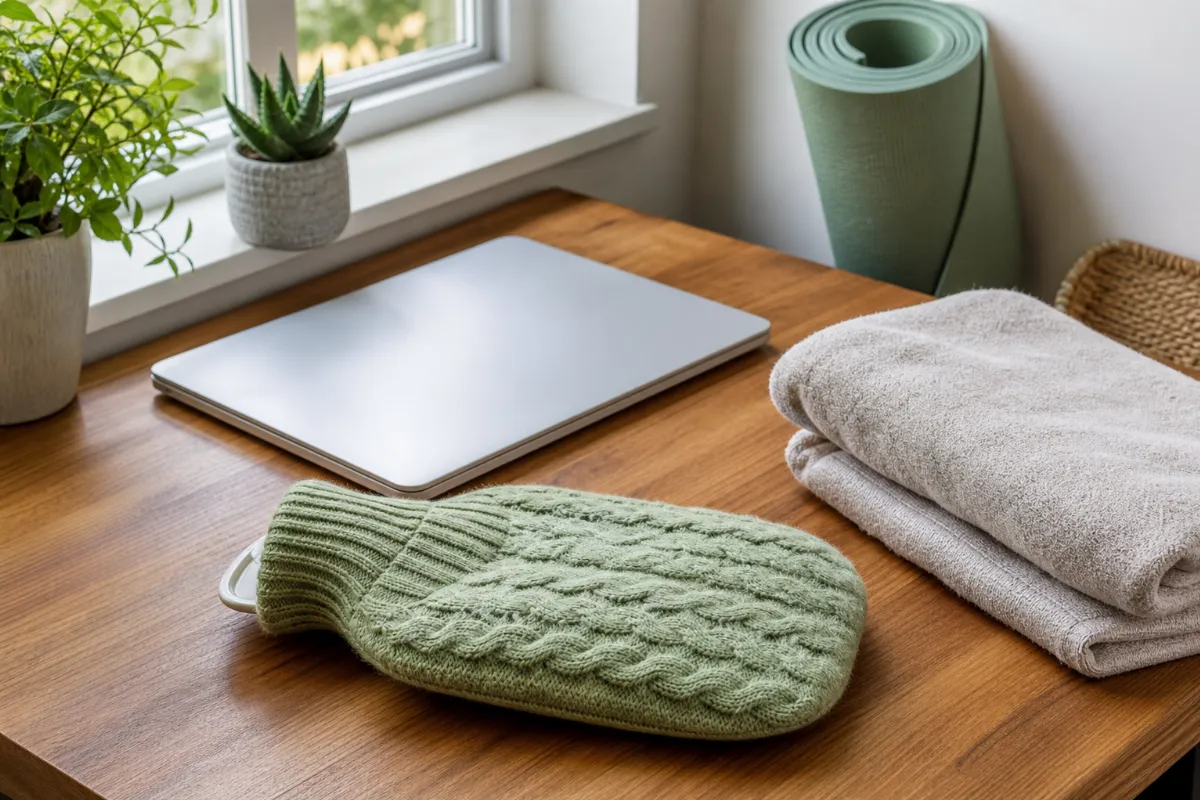
How to apply it: Wrap a hot-water bottle or heat pack in a tea towel and rest it on the tight area for about 20 minutes, 2 to 3 times a day, then follow with gentle movement.
Who it may suit: Most healthy adults with a tight neck, shoulders or back.
Precautions: Never put heat directly on the skin or fall asleep on it. Take extra care with reduced skin sensation (for example diabetes or nerve problems), poor circulation, pregnancy, and in young children and older adults.
2,6,3,12Adjust your workstation, bag and sleep position
Low certaintyAddresses: Fewer positions that load the neck for long periods
Why it may help: Evidence for ergonomic changes is mixed. A Cochrane review of 15 trials in office workers found moderate-quality evidence that an arm support combined with an alternative computer mouse reduced new neck or shoulder disorders, but evidence for other single changes was inconsistent and most studies were at high risk of bias. The NHS advises sleeping with the head at the same height as the rest of the body on a firm mattress, using a low firm pillow, not sleeping on the front and not twisting the neck in bed.
How to apply it: Raise the screen to eye level, let the forearms rest supported, keep feet on the floor or a footrest, carry bags on alternate sides, and use one low, firm pillow.
Who it may suit: Desk workers, long-distance drivers, people who wake with a stiff neck.
Precautions: Ergonomic changes alone are unlikely to be enough: pair them with movement and stretching.
13,2,10Staying gently active instead of resting
Moderate certaintyAddresses: Quicker return to normal movement
Why it may help: The NHS advises against wearing a neck collar and keeping the neck moving unless a doctor says otherwise, says not to stop using a sore shoulder completely, and advises staying active with back pain rather than resting in bed for long periods. Walking, swimming, yoga and Pilates may also help ease back pain.
How to apply it: Carry on with normal daily tasks as comfort allows, walk regularly and move through easy ranges several times a day.
Who it may suit: Almost everyone with ordinary muscular tension.
Precautions: Avoid anything that clearly makes pain worse, and do not drive or cycle if you cannot turn your neck properly.
2,6,3Additional options
Strengthening the neck, shoulder and upper-back muscles
Moderate certaintyAddresses: Less pain and better function if tension keeps coming back
Why it may help: A Cochrane review of 27 trials found moderate-quality evidence that strengthening, and strengthening combined with stretching, helped chronic neck pain. A 2024 review of eight trials in office workers with chronic neck pain found low-certainty evidence that strengthening the neck, shoulder and shoulder-blade muscles reduced pain and disability, with a high risk of bias in every study.
How to apply it: Ask a physiotherapist or qualified trainer for two or three exercises (such as rows with a light band) and build up slowly over weeks.
Who it may suit: Adults with recurring or chronic neck and upper-back tension.
Precautions: Start light and progress gradually. Check first with a clinician if you have had a neck injury, have osteoporosis or have numbness or weakness in the arms.
11,14Massage
Low certaintyAddresses: Short-term relief of tight, sore muscles
Why it may help: NCCIH says massage may help neck or shoulder pain, but benefits may last only a short time and it was not more effective than other active therapies. A Cochrane review of 15 trials rated the evidence as low or very low quality, could not make firm recommendations, and noted that post-treatment soreness was the side effect most often reported and that one study found 22 percent of people had low blood pressure afterward.
How to apply it: Choose a trained massage therapist, tell them about any injuries, medicines and conditions, and ask for moderate pressure rather than very deep work.
Who it may suit: Adults who enjoy massage and want short-term relief.
Precautions: Check first if you take blood thinners, have a clotting problem, bone fragility, skin or nerve problems, or are pregnant. Avoid massage over a hot, swollen or painful calf.
15,16Relaxation and breathing practice
Low certaintyAddresses: May lower background muscle tension, but not shown to relieve neck pain on its own
Why it may help: A randomized trial of 220 adults with chronic neck pain found that an app offering relaxation exercises did not reduce neck pain more than usual care, and only 40 percent were still using it by week 12. In another trial, progressive muscle relaxation reduced chronic neck pain to a small clinically relevant extent over 12 weeks, similar to cupping massage. For tension that mainly follows stress, see the stress page.
How to apply it: Try a short body scan or progressive muscle relaxation for 5 to 10 minutes when you notice the shoulders rising towards the ears.
Who it may suit: People whose tension rises when they are busy or worried.
Precautions: Do not tense muscles hard if you have pain or cramps; use a light squeeze or imagine it.
17,18Still being studied
Kinesiology (elastic) tape on the neck
Low certaintyAddresses: May reduce neck pain in the short term
Why it may help: A 2024 meta-analysis of 10 randomized trials (620 people) found kinesio taping reduced neck pain more than conventional treatment and sham taping, with larger effects after four weeks. It did not look at everyday tension in healthy people.
How to apply it: If you try it, have a physiotherapist show you where and how to apply it.
Who it may suit: Adults with ongoing neck pain.
Precautions: Stop if the skin becomes red, itchy or blistered. Avoid on broken skin.
19Home cupping massage
Low certaintyAddresses: Similar relief to relaxation for chronic neck pain
Why it may help: In a 12-week trial of 61 adults with chronic neck pain, cupping massage was no more effective for pain than progressive muscle relaxation, though it did better for well-being and pressure sensitivity. Both lowered pain a little. The trial was small.
How to apply it: Only with training from a qualified practitioner.
Who it may suit: Adults with chronic non-specific neck pain who want to try it.
Precautions: Cupping can leave marks and bruises. Avoid on broken skin and with blood-thinning medicines unless a clinician says it is fine.
18Food & nutrition
Food, fluids and tight muscles
We did not find trials showing that a particular food or drink relieves everyday neck, shoulder or back tension, so we do not make food claims. General healthy eating and regular fluids support overall wellbeing and recovery.
Heavy caffeine can leave some people feeling jittery and more tense, but we did not find a verified source for the effect on muscle tension, so notice your own response.
- Eat regular meals and drink water through the day (see the hydration page).
- Notice whether more caffeine than usual makes you feel tenser, and cut back if it does.
- Do not rely on supplements for tension; see the remedies section.
Remedies & supplements
Traditional use, laboratory findings and human trials are kept apart. "Natural" does not mean safe.
Warm bath, with or without Epsom salt
Not enough evidenceStudied form and route: A warm bath for 15 to 20 minutes
Intended outcome: Comfort and relaxation; no proven extra effect from the salts
Human evidence: We did not find trials of Epsom salt baths for muscle tension. A Cochrane review of magnesium supplements found no clear benefit for idiopathic muscle cramps.
Traditional use: Soaking in warm water and mineral salts is a long-standing traditional home comfort for aching muscles.
Laboratory findings: We did not verify laboratory work showing that magnesium absorbs through skin in useful amounts.
Limits: No trials for tension, so claims about the salts are unproven; the warmth and relaxation are probably what you notice.
Interactions and precautions: Avoid very hot water with heart disease, low blood pressure, pregnancy or reduced skin sensation, and take care to avoid slips if you are older or unsteady.
20Arnica gel or other topical rubs
Not enough evidenceStudied form and route: Gels, creams and balms rubbed on the skin
Intended outcome: Not established for everyday tension in this review
Human evidence: We did not verify human trials of arnica or other herbal rubs for neck, shoulder or back tension for this page.
Traditional use: Arnica and warming rubs are traditionally used on sore, bruised or stiff muscles.
Laboratory findings: We did not verify laboratory evidence.
Limits: No verified trials for this use; the rubbing action and warmth may help comfort.
Interactions and precautions: Do not use on broken skin. Arnica can cause skin irritation or allergy, especially in people sensitive to daisy-family plants. Do not take arnica by mouth. Ask a pharmacist if you are pregnant or take medicines.
Therapies & care
Persistent or worsening neck, shoulder or back pain deserves a proper assessment by a doctor or physiotherapist, who can rule out nerve or other problems and set up a treatment plan. Established care, such as exercise-based physiotherapy and pain relief, is something to discuss with them; nothing on this page replaces it. Never stop a prescribed medicine because of anything you read here. Pain relievers bought over the counter are not suitable for everyone (for example, because of stomach, kidney or blood-thinner issues), so ask a pharmacist.
Exercise-based physiotherapy
Moderate certaintyRehabilitation A physiotherapist assesses you and teaches stretches and strengthening for the neck, shoulders and back. In many areas of the UK you can self-refer to NHS musculoskeletal services.
Who it may suit: Adults whose tension keeps coming back or lasts more than a few weeks.
Precautions: Tell them about injuries, osteoporosis, pregnancy and numbness or weakness.
11,14,2Massage therapy
Low certaintyHands-on therapy Soft-tissue work by a trained therapist, often chosen for short-term relief of tight neck and shoulder muscles.
Who it may suit: Adults who like hands-on care.
Precautions: Tell the therapist about blood thinners, clotting problems, skin conditions and pregnancy.
15,16Yoga, tai chi and Pilates
Low certaintyGentle movement practice Slow movement classes that build flexibility and strength together. The NHS lists yoga and Pilates among activities that may help ease back pain.
Who it may suit: People who enjoy classes and gentle movement.
Precautions: Learn from a qualified teacher and tell them about injuries, osteoporosis or pregnancy.
3Acupuncture
Not enough evidenceNeedle-based therapy Fine needles placed at points on the body, used by some people for neck and back pain. We did not verify trial evidence for this page.
Who it may suit: Adults who want to try it with a trained practitioner.
Precautions: Use a licensed practitioner with sterile single-use needles. Tell them about blood thinners and pregnancy.
What to avoid
Habits, products and claims that can get in the way. Never stop a prescribed medicine without talking to the professional who prescribed it.
Risks that apply to most people
Staying in one position for hours
Moderate certaintyWhy: The NHS advises against keeping the neck in the same position for a long time, and breaks with a change of posture reduced discomfort in office workers.
Who it applies to: Desk workers, drivers, gamers, anyone absorbed in a screen.
Try instead: Set a reminder to stand and move every half hour or so.
2,8Long bed rest or a neck collar for ordinary tension
Moderate certaintyWhy: The NHS advises against wearing a neck collar unless a doctor says so and against staying in bed for long periods with back pain, as keeping moving is better.
Who it applies to: Anyone with a stiff neck or a sore back.
Try instead: Stay gently active and use heat for comfort.
2,3Ignoring symptoms that last
Moderate certaintyWhy: Neck stiffness or back pain that does not go away after a few weeks, or comes with other symptoms, can have a cause that needs treatment.
Who it applies to: Anyone with long-lasting or worsening pain.
Try instead: See a GP or doctor, or a physiotherapist where self-referral is available.
2,3,6Personal triggers to check
Sleeping on the front or twisting the neck in bed
Low certaintyWhy: The NHS lists sleeping on the front and twisting the neck in bed as things to avoid, and an awkward sleeping position is a common cause of a locked neck.
Who it applies to: People who wake with a stiff neck.
Try instead: Sleep on the back or side with one low, firm pillow that keeps the head level.
2Slouching or leaning the head forward for long periods
Low certaintyWhy: The NHS shoulder pain advice says not to slouch when sitting or bring the neck forward. Keep in mind that research has not shown posture alone to be the cause of back pain.
Who it applies to: People who look down at phones and laptops.
Try instead: Raise the screen and vary your position instead of trying to hold one perfect posture.
6,5Carrying heavy loads on one side
Not enough evidenceWhy: Uneven loading is a common everyday strain on the neck and shoulder. We did not find a trial testing this, so treat it as practical advice.
Who it applies to: Bag, backpack and child carriers.
Try instead: Switch sides, lighten the load or use a bag that spreads the weight.
6Products that need caution
Heating pads and hot-water bottles used directly on the skin or overnight
Moderate certaintyWhy: The NHS advises wrapping hot-water bottles and packs in a tea towel and limiting each use to 20 minutes, to prevent burns.
Who it applies to: Anyone using heat.
Try instead: Wrap, time it and check the skin.
2,6Forceful self-manipulation or very deep massage
Low certaintyWhy: Post-treatment pain was the side effect most often reported in massage trials for neck pain, and one trial reported low blood pressure in 22 percent of people.
Who it applies to: People who press hard on sore spots or crack the neck.
Try instead: Choose moderate pressure or see a trained therapist.
16Unsupported claims
"Poor posture is the cause of your pain"
Low certaintyWhy: An umbrella review of 41 reviews found no consensus that spine posture or physical exposure causes low back pain, and the research is mixed. Moving often is better supported than a rigid posture.
Who it applies to: Posture-correctors and social media advice.
Try instead: Vary your position and move frequently.
5,8"A standing desk or the right chair will fix it"
Low certaintyWhy: A Cochrane review of 10 studies found no significant reduction in back or neck symptoms from sit-stand workstations in the short term (low-quality evidence). Another Cochrane review found only some ergonomic changes, such as an arm support with an alternative mouse, reduced neck and shoulder problems.
Who it applies to: Workplace products and wellness programs.
Try instead: Use any set-up as a prompt to move more, not as a fix on its own.
21,13"Epsom salt baths or magnesium supplements melt muscle tension"
Not enough evidenceWhy: We did not find trials of Epsom salt baths or magnesium for everyday tension. A Cochrane review found magnesium supplements did not clearly reduce idiopathic muscle cramps in older adults. A warm bath may relax you simply through the heat.
Who it applies to: Bath-salt and supplement marketing.
Try instead: Enjoy a warm bath for comfort, and do not expect the salts to be the active ingredient.
20"CBD or cannabis products relax tense muscles"
Not enough evidenceWhy: We did not find verified human trials showing that CBD or cannabis products ease everyday muscle tension. Legality and product quality vary by place, and we give no instructions.
Who it applies to: Online and shop marketing.
Try instead: Use the options with better support, such as movement, stretching and heat.
Common mistakes
Pushing through sharp pain
Moderate certaintyWhy: The NHS back-pain advice says to stop exercises and stretches if the pain gets worse and see a GP.
Who it applies to: People who try to stretch hard for quick relief.
Try instead: Keep stretches gentle and stop if pain increases.
3Doing one big stretch session and then nothing
Moderate certaintyWhy: In the stretching trial, people who exercised three or more times a week improved more than those who did it less often.
Who it applies to: Busy people.
Try instead: Make it short and frequent.
7Evidence & safety
What the research shows
Regular movement, stretching and strengthening are the best-supported approaches to everyday neck, shoulder and back tension, with heat and gentle activity recommended by the NHS for comfort. Massage, taping and cupping have mostly low or very low quality evidence for short-term relief. Ergonomic equipment and standing desks have inconsistent results, and relaxation apps did not reduce neck pain in a large trial. We found no verified trials for Epsom salt baths, arnica or CBD products for everyday tension.
Limits of the evidence
- Most trials are in office workers, many with diagnosed neck pain rather than everyday tension, so results may not carry over to people with mild aches.
- Many studies are small, unblinded, rely on self-rated pain and have a high risk of bias.
- Break and ergonomic programs vary widely, so there is no proven schedule or equipment.
- Heat evidence comes from low back pain trials from older Cochrane reviews.
- We could not read the full text of every review; some details come from the abstracts.
Precautions and interactions
- Stop any exercise or stretch that increases pain, causes pins and needles or weakness.
- Wrap heat in a towel and use it for limited periods.
- Check massage, taping, cupping and topical products with a clinician or pharmacist if you take blood thinners or have skin, clotting or nerve problems.
- Pain relievers bought over the counter are not suitable for everyone; ask a pharmacist.
Life-stage considerations
- Pregnancy and breastfeeding: avoid very hot baths and heat over the abdomen; ask a midwife or doctor before deep massage, new stretches or topical products.
- Older adults: stretch gently, take care with slippery baths and heat packs if skin feeling is reduced, and ask about bone health before strong strengthening or forceful massage. New neck or back pain after a fall needs a medical check.
- Children and teenagers: heavy school bags, long screen use and a stiff neck after sport or a fall should be checked by a clinician if pain lasts or follows an injury.
Warning signs
- Pins and needles, numbness, weakness or a cold arm, or weakness in a leg.
- Pain, tingling, weakness or numbness in both legs, numbness around the genitals or anus, or changes in bladder or bowel control: emergency care.
- Sudden or severe pain, or pain after an accident or fall.
- Back or neck pain with fever, feeling shivery or generally unwell, or unexplained weight loss.
- Pain that is worse at night, does not improve with rest, or comes from between the shoulder blades and does not settle.
- Chest pain or breathlessness with arm, shoulder or jaw pain: emergency care.
- A hot, swollen, painful calf.
Claim checks
Stretching relieves neck and shoulder tension
Moderate certaintySupported for office workers with neck pain in two trials, though a Cochrane review found stretching alone may not change chronic neck pain and combined strengthening and stretching worked better.
7,10,11Regular breaks reduce discomfort from sitting
Moderate certaintyActive breaks with a change of posture were linked to less pain and discomfort in a systematic review, and did not harm productivity, though programs varied and more high-quality studies are needed.
8,9A heat pack helps tight muscles
Moderate certaintyThe NHS recommends it for comfort, and trials in low back pain found a small short-term reduction in pain; evidence is limited.
3,12Massage cures chronic muscle tension
Low certaintyEvidence suggests short-term relief at best, with low or very low quality studies and no firm recommendation from Cochrane reviewers.
15,16Standing desks and ergonomic gear prevent neck and back pain
Low certaintySit-stand desks did not clearly reduce symptoms in a Cochrane review, and only some ergonomic changes showed benefit.
21,13Bad posture causes back pain
Low certaintyAn umbrella review found no consensus that posture or physical exposure causes back pain.
5Kinesiology tape fixes neck pain
Low certaintyA meta-analysis of 10 trials found reduced neck pain in people with neck pain, but it is not proof for everyday tension and studies varied.
19Epsom salt baths or magnesium melt muscle tension
Not enough evidenceNo verified trials for tension; magnesium supplements did not clearly reduce idiopathic cramps in older adults.
20Questions people ask
Why are my neck and shoulders always tight?
Common reasons are long periods in one position, screen use, an awkward sleeping position, carrying loads on one side and stress. Work factors such as high demands and low control are also linked to musculoskeletal problems.
Is it better to rest or keep moving?
The NHS advises staying gently active and not staying in bed for long periods with back pain, and not wearing a neck collar unless a doctor says so.
How often should I take a break from sitting?
There is no proven schedule. Studies used many break patterns, and the NHS says not to keep the neck in one position for long. Moving about every 30 minutes is a practical aim.
Do stretches really work?
In two trials of office workers, regular stretching reduced pain and improved function. A Cochrane review found stretching alone may not change chronic neck pain, so adding strengthening is sensible.
Should I use heat or ice?
The NHS suggests either for neck and shoulder pain, and heat for stiffness or muscle spasm in the back. Wrap them in a towel and limit use to 20 minutes or as directed.
Will a standing desk help?
A Cochrane review found no significant short-term reduction in back or neck symptoms from sit-stand workstations. Use it as a way to change position more often.
Does posture matter?
Posture is linked with discomfort in some studies, but an umbrella review found no consensus that it causes back pain. Changing position often matters more than holding one position.
Is massage worth it?
It may give short-term relief for neck and shoulder tension, but the evidence is low quality. Choose a trained therapist and check first if you take blood thinners or are pregnant.
Do Epsom salt baths work for tight muscles?
We did not find trials. A warm bath may feel good because of the heat and the chance to relax.
What if my tension comes from stress?
See the Relax Your Body & Release Tension page, which covers stress-related tension, jaw clenching and relaxation methods.
When should I see a doctor?
If pain lasts more than a few weeks, is worse at night, or comes with pins and needles, weakness, fever or weight loss. Sudden, severe pain, pain after an accident, or any change in bladder or bowel control needs urgent care.
Can I take pain relievers for tension?
Over-the-counter pain relievers are not suitable for everyone. The NHS says to check with a pharmacist or GP if you are unsure which is suitable. We give no names or amounts.
References
- MedlinePlus. Neck Injuries and Disorders. Read 2026-10-31. source
- NHS. Neck pain (page last reviewed 27 April 2023). Read 2026-10-31. source
- NHS. Back pain (page last reviewed 5 March 2026). Read 2026-10-31. source
- Bezzina A, et al. Workplace psychosocial factors and their association with musculoskeletal disorders: a systematic review of longitudinal studies. Workplace Health Saf. 2023. PMID 37698343. source
- Swain CTV, et al. No consensus on causality of spine postures or physical exposure and low back pain: a systematic review of systematic reviews. J Biomech. 2020. PMID 31451200. source
- NHS. Shoulder pain (page last reviewed 22 May 2023). Read 2026-10-31. source
- Tunwattanapong P, et al. The effectiveness of a neck and shoulder stretching exercise program among office workers with neck pain: a randomized controlled trial. Clin Rehabil. 2016. PMID 25780258. source
- Waongenngarm P, et al. The effects of breaks on low back pain, discomfort, and work productivity in office workers: a systematic review of randomized and non-randomized controlled trials. Appl Ergon. 2018. PMID 29409639. source
- Albulescu P, et al. "Give me a break!" A systematic review and meta-analysis on the efficacy of micro-breaks for increasing well-being and performance. PLoS One. 2022. PMID 36044424. source
- Shariat A, et al. Effects of stretching exercise training and ergonomic modifications on musculoskeletal discomforts of office workers: a randomized controlled trial. Braz J Phys Ther. 2018. PMID 28939263. source
- Gross A, et al. Exercises for mechanical neck disorders. Cochrane Database Syst Rev. 2015. PMID 25629215. source
- French SD, et al. A Cochrane review of superficial heat or cold for low back pain. Spine. 2006. PMID 16641776. source
- Hoe VC, et al. Ergonomic interventions for preventing work-related musculoskeletal disorders of the upper limb and neck among office workers. Cochrane Database Syst Rev. 2018. PMID 30350850. source
- Jones LB, et al. The influence of exercise on pain, disability and quality of life in office workers with chronic neck pain: a systematic review and meta-analysis. Appl Ergon. 2024. PMID 38219373. source
- NCCIH. Massage Therapy: What You Need To Know. Read 2026-10-31. source
- Patel KC, et al. Massage for mechanical neck disorders. Cochrane Database Syst Rev. 2012. PMID 22972078. source
- Pach D, et al. App-based relaxation exercises for patients with chronic neck pain: pragmatic randomized trial. JMIR Mhealth Uhealth. 2022. PMID 34994708. source
- Lauche R, et al. Effectiveness of home-based cupping massage compared to progressive muscle relaxation in patients with chronic neck pain: a randomized controlled trial. PLoS One. 2013. PMID 23762355. source
- Hu Q, et al. Effects of Kinesio Taping on neck pain: a meta-analysis and systematic review of randomized controlled trials. Pain Ther. 2024. PMID 39039345. source
- Garrison SR, et al. Magnesium for skeletal muscle cramps. Cochrane Database Syst Rev. 2020. PMID 32956536. source
- Parry SP, et al. Workplace interventions for increasing standing or walking for decreasing musculoskeletal symptoms in sedentary workers. Cochrane Database Syst Rev. 2019. PMID 31742666. source
Related on AlternativeMed
Related goals
Relax Your Body & Release Tension → Manage Post-Exercise Muscle Soreness → Recover Better After Exercise → Improve Your Posture and Movement Habits → Support Your Back During Everyday Activities → Sit Less & Move More → Improve Your Flexibility → Balance Activity & Rest → Manage Everyday Physical Discomfort → Manage Everyday Stress →
Ingredients, foods and supplements
Epsom salt → Magnesium → Arnica → Cayenne pepper →
Research, safety and claim-check resources
Massage → Yoga → Tai chi → Pilates → Acupuncture → Relaxation techniques → Movement, yoga and tai chi for stress → Medicine interactions →