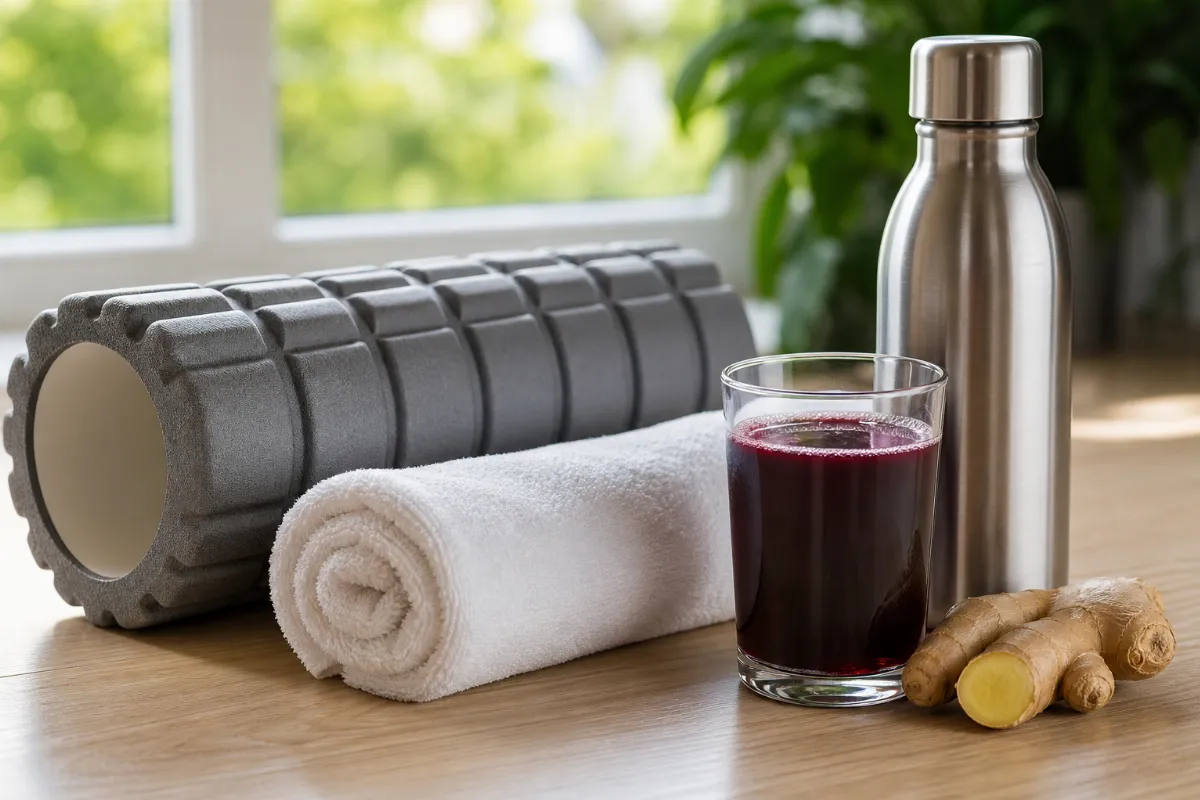
Recover & Feel More Comfortable
Manage Post-Exercise Muscle Soreness
Aching, tender muscles a day or two after unaccustomed or hard exercise are common and usually settle on their own within days. This page is about that kind of soreness and what has, and has not, been shown to ease it; the wider picture of recovering well is on the linked recovery pages.
General information, not medical advice. Last updated October 31, 2026. Written by the AlternativeMed editorial team. Not medically reviewed.
Start here
- Keep moving gently. Easy walking, cycling or light movement is one of the better-supported ways to ease soreness, and hard sessions on the same muscles can wait a day or two.
- If you want something hands-on, try a short massage or self-massage with a foam roller, or a cool soak. Reviews found small to moderate relief, and none of them is a cure.
- Watch for red flags: dark or cola-coloured urine, very severe pain or swelling, a sharp pain with sudden weakness, or a painful swollen calf. These need medical care, not more rubbing or stretching.
Be careful with
- Sharp, sudden pain during exercise, a pop, or an injured joint is not ordinary soreness. Treat it as an injury and get it checked if it is severe, or if you cannot put weight on it.
- Do not push through severe soreness with another hard session on the same muscles. A review noted that returning too soon can raise the risk of further injury.
- Supplements, creams and cannabis products sold for recovery can interact with medicines or be unsuitable in pregnancy and with some conditions. Ask a pharmacist or doctor first, and never stop a prescribed medicine because of sore muscles.
Get help when
- Dark, red or cola-coloured urine, or passing much less urine, with muscle pain, weakness or swelling after hard exertion (MedlinePlus lists these as signs of rhabdomyolysis, which needs urgent treatment).
- Severe pain, pain that is getting worse, a large amount of swelling or bruising, not being able to put weight on a limb, or a limb that feels very stiff (NHS advice for injuries).
- Throbbing pain, swelling and red or darker skin in one calf or thigh, especially with breathlessness or chest pain (possible blood clot).
- Fever, or feeling hot, cold or shivery with a painful, hot swollen area.
- Soreness that is not improving after about a week, keeps returning without obvious cause, or comes with unusual tiredness or weakness.
About Manage Post-Exercise Muscle Soreness
What this goal means
This goal is about delayed onset muscle soreness, often shortened to DOMS: the tenderness and stiffness that builds after exercise your muscles are not used to. A review of treatment strategies describes it as a familiar experience for both elite athletes and beginners, with symptoms ranging from mild tenderness to severe, debilitating pain.
It is different from the pain of a sudden injury, from long-running joint pain, and from general tension that has nothing to do with exercise. Those have their own pages.
1What it can feel like
Typically the muscles feel tender to touch, tight and a bit weak, and stairs, sitting down or reaching can feel awkward. In the trials we read, soreness was measured for up to several days after the exercise (for example 24, 48 and 72 hours).
The review also noted that soreness can reduce range of motion and peak muscle force for a time, which is why the day after a very hard session can feel clumsy.
1,2What contributes to it
The review reports that DOMS is most common at the start of a training season, when returning after a break, and when first trying a new activity. Exercise in which muscles lengthen while working (eccentric actions, such as running downhill or lowering weights) causes micro-injury more often and more severely than other muscle actions, and intensity and duration matter too.
Scientists still do not agree on the exact mechanism. The review lists six proposed explanations, including lactic acid, muscle spasm, connective tissue damage, muscle damage, inflammation and enzyme leakage, and suggests that a combination is the most likely answer.
1Conditions and problems that can look like it
A muscle strain or sprain, a blood clot in the leg, and rhabdomyolysis (a serious breakdown of muscle after extreme exertion or severe dehydration) can all start as aching after activity. The NHS gives urgent-advice signs for injuries, the NHS lists one-sided calf or thigh pain with swelling as a possible sign of deep vein thrombosis, and MedlinePlus lists dark urine and weakness as signs of rhabdomyolysis.
Persistent unexplained tiredness or a crash after even light activity is a different pattern, covered on our page about post-exertional malaise.
3,4,5Realistic expectations
Nothing here makes soreness vanish. In reviews, the best-supported options (massage, active recovery, cold-water immersion, compression) gave small to large reductions in soreness scores, with massage ranking highest in one meta-analysis, but one review reported a high risk of bias in the included studies.
Most of the effect is relief of a few days of discomfort. Treating soreness is also not the same as recovering performance: several methods ease the feeling without clearly restoring strength.
6,7,8Who this applies to
Healthy adults who get sore after unfamiliar or hard exercise. Most of the trials we read were in healthy, mainly young, active men, so results may differ for older adults, women, children and people with medical conditions. Older adults, pregnant people and people with long-term conditions should check with a clinician before using supplements or cold or heat treatments.
6Related conditions and symptoms
ME/CFS and post-exertional malaise → Eating disorders and disordered eating (including exercise compulsion) →
A manageable starting plan
An educational starting point, not a personal prescription. Adjust it to your own situation and any advice from your clinician.
Your first actions
- Day 1 to 2: move gently every day, ease off the sore muscles, and try one hands-on option such as a short massage or foam rolling.
- Day 2 to 4: if you want, try a short cool soak or compression clothing, and add normal foods like tart cherries or ginger if you enjoy them.
- Return to harder sessions on those muscles when tenderness has mostly gone, and build back in small steps.
Optional additions
- Try a topical arnica gel on unbroken skin if you want a topical option.
- Ask a pharmacist before using curcumin or BCAA supplements, especially if you take medicines.
- If you lift weights to build muscle, use cold immersion sparingly.
What to track
- Soreness from 0 to 10 each morning and when it eases.
- What exercise triggered it (new, long, downhill or lowering-heavy).
- Urine colour, swelling and any one-sided leg pain.
When to reassess
If soreness has not clearly eased after about a week, keeps returning with light activity, or you notice weakness, swelling or dark urine, speak to a clinician. If it keeps happening with every session, reduce the jump in new exercise and review your build-up.
When to seek professional support
- Speak to a pharmacist about supplements, creams and pain relievers.
- See a GP or physiotherapist if pain follows an injury or is not settling.
- Seek urgent care for dark urine, a painful swollen calf, severe or worsening pain, or inability to bear weight.
What helps
Ordered by how well the research supports each step. Evidence strength is shown on every card; precautions sit next to the advice.
Start here
Gentle movement and active recovery
Moderate certaintyAddresses: Eases the aching for a while and keeps you moving
Why it may help: A meta-analysis of 99 studies found that active recovery (easy, low-intensity exercise after training) was among the methods that gave a small to large decrease in soreness. The treatment review also reported that exercise is the most effective way to ease pain during DOMS, although the relief is temporary.
How to apply it: Walk, cycle gently, swim easily or do light mobility work for a short time, at an effort where you can talk comfortably. Let the sore muscles have a lighter day before working them hard again.
Who it may suit: Most healthy adults with ordinary post-exercise soreness.
Precautions: Stop if movement causes sharp pain. People with heart or joint problems, older adults and anyone who has been inactive should follow clinician guidance on activity.
6,1Massage
Moderate certaintyAddresses: Reduces soreness and the feeling of fatigue
Why it may help: In the meta-analysis of 99 studies, massage was the most effective method for reducing soreness and perceived fatigue. A separate review of 22 trials found shorter massage tended to work better for recovering performance, with larger effects on short-term recovery after mixed high-intensity exercise, and smaller effects after strength or endurance exercise.
How to apply it: A massage from a trained therapist, or a gentle self-massage with your hands, a massage stick or a foam roller. Light to moderate pressure is enough; it should not cause sharp pain.
Who it may suit: Adults who like hands-on care and have no bleeding problems, skin infection or recent injury over the area.
Precautions: Avoid massage over a newly injured area in the first days after a strain, as the NHS advises, and over areas that are hot, swollen or possibly a blood clot. Ask a clinician first if you take blood thinners, have a clotting disorder or are pregnant.
6,8,3Foam rolling or self-massage tools
Low certaintyAddresses: Slightly less perceived muscle pain
Why it may help: A meta-analysis of 21 studies found that foam rolling after exercise (7 studies) reduced the perception of muscle pain (about 6%, a small to medium effect) and slightly softened the drop in sprint and strength performance. Rolling before exercise had small effects on flexibility.
How to apply it: Roll slowly over the sore muscle group for a few minutes, staying on tender spots without forcing through sharp pain.
Who it may suit: Active adults who want a low-cost self-care option.
Precautions: Do not roll directly over joints, bruises, swollen areas or a painful calf. Few post-exercise studies were included, so treat the findings as early.
9Cold-water immersion (cool soak or cold bath)
Moderate certaintyAddresses: Eases soreness over the next day or two
Why it may help: A meta-analysis of 36 articles found that cooling, especially cold-water immersion, reduced soreness at 24 hours after exercise compared with doing nothing (a moderate-to-large effect, g = -0.75). An updated review of 44 randomised trials found cold-water immersion better than control for soreness, with short and medium immersion times working and longer ones not showing a benefit.
How to apply it: A cool bath or shower for a short time soon after hard exercise. Most studies used brief immersions; we do not give a temperature or a time.
Who it may suit: Healthy adults after very hard endurance or mixed sessions who are not trying to maximise muscle growth.
Precautions: Cold exposure is not suitable for everyone: ask a clinician first if you have heart or circulation problems, high blood pressure, Raynaud's or numbness. Cold-water immersion after strength training reduced gains in muscle size and strength in a 12-week trial (see What to avoid). Many studies had a high risk of bias.
7,10,11Build up gradually and ease back after a break
Low certaintyAddresses: Fewer and milder bouts of soreness
Why it may help: Because DOMS is most common at the start of a season and when trying new activities, and is driven by intensity, duration and eccentric work, sudden jumps are a main trigger. The review advised athletes who must train daily to reduce the intensity and duration when sore.
How to apply it: Add new or lengthening-type exercises (downhill walking, lowering phases of lifts) in small steps over several sessions. After a break, begin below your previous level.
Who it may suit: Everyone, especially beginners and people returning after time off.
Precautions: This advice comes from a narrative review rather than a trial of prevention strategies.
1Return to Exercise After a Break → Start Exercising With Confidence →
Compression clothing
Low certaintyAddresses: Possible small reduction in perceived soreness and swelling
Why it may help: A meta-analysis found compression garments reduced perceived soreness (a small effect from 15 studies) and muscle swelling, and was linked to faster recovery of power and strength, but the results varied a lot between studies and a muscle-damage blood marker (creatine kinase) did not change. The 99-study analysis also found compression gave small to large reductions in soreness.
How to apply it: Wear well-fitting compression sleeves or tights after exercise, as used in the trials. Comfort matters more than tightness.
Who it may suit: Active adults who find compression comfortable.
Precautions: Avoid tight garments if you have poor circulation, a skin condition or leg swelling without a known cause; a swollen painful leg needs medical attention.
12,6Additional options
Tart cherry (as juice or the whole fruit)
Low certaintyAddresses: May shorten recovery and ease soreness after hard exercise
Why it may help: A systematic review of 25 studies of tart cherry and pomegranate found that they appear to help recovery of strength, perceived soreness and inflammation, with benefit more likely when started some days before hard exercise and continued afterwards. An umbrella review of nutrition meta-analyses also listed polyphenols and anthocyanins (the pigments in dark cherries) among the options that reduced muscle soreness with moderate certainty.
How to apply it: As juice or fruit within a normal balanced diet; the pattern in the studies was daily intake around a hard event.
Who it may suit: Active adults who enjoy the taste and have no reason to limit sugar or fruit.
Precautions: Juice adds sugar and calories; people with diabetes should ask their care team. We do not give an amount.
13,14Ginger
Low certaintyAddresses: Modest reduction in muscle pain after hard exercise
Why it may help: In two double-blind placebo-controlled trials (34 and 40 volunteers), 11 days of ginger, raw or heat-treated, reduced pain 24 hours after eccentric elbow exercise by about 25 percent compared with placebo, with smaller effects on other measures.
How to apply it: Ginger as a food or tea within normal meals. The trials used measured ginger daily for 11 days; we do not recommend an amount.
Who it may suit: Adults who like ginger and have no bleeding disorder.
Precautions: Large amounts may upset the stomach; ask a pharmacist if you take blood-thinning medicines or have gallstones, and before using ginger supplements in pregnancy.
15Curcumin (the active pigment in turmeric)
Moderate certaintyAddresses: Small reduction in soreness and in a muscle-damage marker
Why it may help: A meta-analysis of 10 randomised trials found that curcumin supplements reduced soreness scores, creatine kinase (a muscle-damage marker) and TNF-alpha, and slightly improved strength and range of motion. A second meta-analysis agreed on creatine kinase and soreness. An umbrella review listed curcumin among options that reduced muscle soreness with moderate certainty. The trials were small and varied in product and dose.
How to apply it: Turmeric in food is a gentle starting point, but the trials used curcumin extracts, and the amount in food is much smaller.
Who it may suit: Healthy adults who have checked with a pharmacist.
Precautions: We did not review interaction data on this page: ask a pharmacist or doctor before curcumin supplements if you take blood thinners or other medicines, have gallbladder or liver problems, or are pregnant or breastfeeding. Authors noted the need for larger, better trials and long-term safety data.
16,17,14Warmth (warm bath, heat pack)
Not enough evidenceAddresses: Comfort; benefit for soreness not shown by the sources we read
Why it may help: We did not find a human trial or review we could verify that shows heat shortens soreness after exercise, and an umbrella review of physical therapies noted that reviews of such treatments often conflict. Many people find warmth soothing for tight muscles. The NHS advises avoiding heat in the first couple of days after a sprain or strain, which is a different problem.
How to apply it: If it feels good, a warm bath or a warm (not hot) pack is a low-risk comfort measure once you are sure the pain is not a fresh injury.
Who it may suit: Adults with ordinary, non-injury soreness who find warmth soothing.
Precautions: Use warm rather than hot to avoid burns, especially with reduced skin sensation, diabetes or in older adults. Avoid heat over swollen, red or newly injured areas.
18,3Still being studied
Branched-chain amino acids (BCAAs)
Low certaintyAddresses: Possible lower soreness in trained people after moderate muscle damage
Why it may help: A systematic review and meta-analysis of 10 randomised trials found that in 7 studies BCAAs reduced soreness 24 to 72 hours later, but results varied with training status, dose, timing and severity of muscle damage, and the authors could not say whether they work in untrained people. An umbrella review also listed BCAAs among options reducing soreness with moderate certainty.
How to apply it: Supplements used in trials; we do not give an amount. Food protein is covered on the nutrition page.
Who it may suit: Trained adults who are curious and have no kidney or liver concerns.
Precautions: Ask a clinician first with kidney or liver disease, with metabolic conditions, in pregnancy and breastfeeding. Protein powders in general did not clearly reduce soreness in a systematic review.
2,14,19BCAAs: leucine, isoleucine and valine → Support Recovery Through Nutrition →
Magnesium taken by mouth
Not enough evidenceAddresses: Possible reduction in soreness; evidence is thin
Why it may help: A systematic review that found only 4 eligible studies reported that magnesium supplements reduced muscle soreness and gave a protective effect on muscle damage. With so few studies, this is a hint, not a settled answer.
How to apply it: Magnesium from food (nuts, seeds, legumes, whole grains) is the safe baseline. We do not give a supplement dose.
Who it may suit: Adults with a diet low in magnesium, after asking a clinician.
Precautions: People with kidney disease, and people taking certain medicines, should not take magnesium supplements without medical advice, and high amounts can cause diarrhoea.
20Topical arnica gel or cream
Low certaintyAddresses: Possibly less pain a few days later; no effect on strength or muscle-damage markers
Why it may help: In a double-blind placebo-controlled trial of 20 well-trained men after a downhill run, those using topical arnica reported less pain at 72 hours, with no effect on performance, muscle damage or inflammation markers.
How to apply it: A topical product applied to intact skin as directed on the label.
Who it may suit: Adults who want a topical option and have no allergy to plants of the daisy family.
Precautions: Do not apply to broken skin, and stop if a rash appears. We do not recommend swallowing arnica products. Avoid in pregnancy and breastfeeding unless a clinician advises.
21Food & nutrition
Tart cherries and dark-pigmented fruit
A systematic review of 25 studies suggests tart cherry (and pomegranate) can help recovery, with benefit more likely when taken for some days before and after hard muscle damage. An umbrella review listed polyphenols and anthocyanins among options that reduced soreness with moderate certainty. These are small effects with variable products, so treat cherries as a pleasant extra.
- Tart cherry juice or whole tart cherries
- Dark berries, pomegranate
Ginger and turmeric in cooking
Ginger reduced muscle pain after hard exercise in two small placebo-controlled trials, and curcumin from turmeric reduced soreness in meta-analyses. Food amounts are smaller than the doses used in studies, so these are gentle extras, not treatments.
- Fresh ginger tea or grated ginger in meals
- Turmeric in curries, soups and rice dishes
Where protein fits
A systematic review of protein supplements found no clear effect on muscle soreness or recovery of muscle function when consumed before, during or after exercise. Protein still matters for overall recovery and training adaptation; that is covered on the nutrition page, which also covers fluids and timing.
- See Support Recovery Through Nutrition for meals, protein and fluids
Remedies & supplements
Traditional use, laboratory findings and human trials are kept apart. "Natural" does not mean safe.
Tart cherry juice
Low certaintyStudied form and route: Juice, concentrate or fresh or dried fruit
Intended outcome: May ease soreness and speed recovery after hard exercise
Human evidence: A review of 25 studies of tart cherry and pomegranate reported faster recovery of function, less perceived soreness and less inflammation, especially when taken for several days around the exercise. An umbrella review gave moderate certainty for anthocyanins and polyphenols on soreness.
Traditional use: Not used as a traditional muscle remedy in the sources we read.
Laboratory findings: The authors describe antioxidant and anti-inflammatory properties of the fruit's phenolic compounds as the proposed mechanism.
Limits: Study products, timing and participants differed. Effects are modest and the trial quality varies. We do not give an amount.
Interactions and precautions: Extra sugar and calories in juice; ask your care team if you have diabetes. Choose a product without added sugar where possible.
13,14Ginger
Low certaintyStudied form and route: Fresh root, tea or powder
Intended outcome: Modest reduction in muscle pain after hard exercise
Human evidence: Two double-blind placebo-controlled trials (34 and 40 volunteers) found about a 25 percent reduction in pain 24 hours after eccentric exercise with raw or heat-treated ginger over 11 days, with smaller effects on other measures.
Traditional use: Ginger has a long history in food and traditional medicine, but the soreness findings here come from the trials.
Laboratory findings: The trials measured plasma prostaglandin E2 among other markers, and the authors cite animal data on anti-inflammatory effects.
Limits: Small trials in healthy volunteers using one type of exercise. We do not give a dose.
Interactions and precautions: Large amounts can cause heartburn or stomach upset. Ask a pharmacist if you take blood thinners or have gallstones, and before ginger supplements in pregnancy.
15Curcumin (turmeric extract)
Moderate certaintyStudied form and route: Capsules or extracts; turmeric in food
Intended outcome: Small reductions in soreness and a muscle-damage marker
Human evidence: A meta-analysis of 10 randomised trials reported lower soreness, creatine kinase and TNF-alpha with small gains in strength and range of motion; another meta-analysis reported lower creatine kinase and soreness. An umbrella review rated the evidence for soreness as moderate certainty.
Traditional use: Turmeric is used as a food and traditional remedy in several cuisines and healing systems.
Laboratory findings: Authors propose that curcumin stabilises cell membranes and limits free-radical formation.
Limits: Trials were small, products and doses differed, and authors called for larger, better trials and long-term safety data.
Interactions and precautions: Supplement extracts are not the same as turmeric in food. Ask a pharmacist or doctor about interactions (especially blood thinners), liver or gallbladder problems, pregnancy and breastfeeding.
16,17,14Arnica (topical)
Low certaintyStudied form and route: Gel or cream applied to skin
Intended outcome: Possible small reduction in pain a few days after hard exercise
Human evidence: One double-blind placebo-controlled trial of 20 well-trained men reported less pain at 72 hours with topical arnica after downhill running, but no effect on performance or blood markers.
Traditional use: Arnica has traditional use for bruises and sore muscles; the trial is the only human evidence we read for post-exercise soreness.
Laboratory findings: Not assessed here.
Limits: A single small trial in trained men, using one product.
Interactions and precautions: Skin only, never on broken skin, and stop if a rash develops. Avoid in pregnancy and breastfeeding without advice. We do not recommend swallowing arnica.
21Magnesium (oral, topical and bath)
Not enough evidenceStudied form and route: Food, capsules, gels, sprays, Epsom or flake baths
Intended outcome: Oral: possible lower soreness. Topical gel: no benefit in the trial we read
Human evidence: A systematic review that found only 4 eligible studies reported less soreness with oral magnesium. A 35-person trial of a topical magnesium gel found no effect on soreness, creatine kinase or interleukin-6. We did not find trials of Epsom baths for muscle soreness.
Traditional use: Epsom salt baths are widely used for tired muscles; we found no trial evidence for soreness.
Laboratory findings: The review describes magnesium's roles in muscle contraction and energy production.
Limits: Very few trials. The gel trial authors suggested the dose or application might have been too low.
Interactions and precautions: Magnesium supplements can cause diarrhoea and are risky in kidney disease; ask a clinician first, particularly with medicines or in pregnancy.
20,22Branched-chain amino acids (BCAAs)
Low certaintyStudied form and route: Powder or capsules
Intended outcome: Possible lower soreness in trained people
Human evidence: A meta-analysis of randomised trials found BCAAs reduced soreness 24 to 72 hours later in 7 of 10 studies, but effects depended on training status, dose, timing and severity. An umbrella review also found moderate certainty for BCAAs reducing soreness.
Traditional use: Not used as a traditional remedy.
Laboratory findings: Not assessed here.
Limits: Heterogeneous trials; unclear in untrained people. We do not give a dose.
Interactions and precautions: Ask a clinician first with kidney, liver or metabolic conditions, and in pregnancy or breastfeeding. Choose products tested by a third party.
2,14CBD (cannabidiol) oil
Not enough evidenceStudied form and route: Oils or capsules sold as hemp or cannabis products
Intended outcome: No benefit shown for muscle soreness
Human evidence: A double-blind crossover trial of 13 untrained men found no effect of CBD oil on soreness, arm swelling, joint angle or peak torque after hard eccentric exercise.
Traditional use: Cannabis has a long traditional use for pain, but that does not establish an effect on exercise soreness.
Laboratory findings: Not assessed here.
Limits: One small trial in untrained men with a single schedule; the authors did not rule out other effects at other doses.
Interactions and precautions: Legal status differs between countries, product content varies, and cannabis products can interact with medicines and affect driving. We give no instructions.
23Therapies & care
Ordinary soreness usually needs self-care rather than treatment. A clinician, physiotherapist or pharmacist can help when pain is severe, when it follows an injury, or when you are unsure what it is. This page describes care in general terms and does not recommend medicines or doses. Ask a pharmacist or doctor before using pain relievers, especially if you have stomach, kidney or heart problems or take blood thinners, and never stop a prescribed medicine because of sore muscles.
Professional sports or therapeutic massage
Moderate certaintyManual therapy Massage was ranked the most effective recovery method for soreness and perceived fatigue in a meta-analysis of 99 studies. A separate review of 22 trials found small to moderate performance-recovery effects, larger after shorter massages.
Who it may suit: Adults who enjoy massage and have no contraindications.
Precautions: Tell the therapist about injuries, clotting problems, blood thinners, pregnancy and skin conditions. Avoid massage over a fresh strain in the first days.
6,8,3Cold-water immersion or other cooling
Moderate certaintyHydrotherapy Meta-analyses found reduced soreness at 24 hours with cooling, especially cold-water immersion, but the studies had a high risk of bias and regular use after strength training may blunt gains.
Who it may suit: Healthy adults after intense sessions who are not prioritising muscle growth.
Precautions: Ask a clinician first with heart, circulation or blood pressure problems.
7,10,11Physiotherapy or NHS-style musculoskeletal services
Moderate certaintyClinical assessment For a strain that is taking longer than usual to get better, the NHS says physiotherapy may help, and in many areas people can refer themselves to community musculoskeletal services. Physical treatments for soreness itself have conflicting review results.
Who it may suit: Anyone whose pain is not settling, keeps returning or follows an injury.
Precautions: Services and waiting times vary. The NHS lists urgent signs (very painful or worsening pain, a lot of swelling, not being able to put weight on a limb, fever) that need prompt care.
3,18Urgent or emergency medical care
High certaintyEmergency care Rhabdomyolysis needs prompt hospital treatment to protect the kidneys, and MedlinePlus says treatment soon after reduces the risk of permanent kidney damage. A suspected clot with breathlessness or chest pain needs emergency help.
Who it may suit: Anyone with the warning signs listed on this page.
Precautions: Do not wait for it to pass. Do not drive yourself if you have symptoms of a clot with chest pain or breathlessness.
5,4What to avoid
Habits, products and claims that can get in the way. Never stop a prescribed medicine without talking to the professional who prescribed it.
Risks that apply to most people
Another hard session on the same sore muscles
Low certaintyWhy: The treatment review reports that soreness can reduce range of motion and peak muscle force, and that returning to sport too early may increase the risk of further injury. It advised athletes who must train daily to reduce intensity and duration.
Who it applies to: Anyone training on consecutive days.
Try instead: Switch to another muscle group, or take an easy day, until the tenderness fades.
1Treating warning signs as ordinary soreness
High certaintyWhy: Dark or cola-coloured urine with muscle pain, a painful swollen calf, a pop with sudden weakness or pain that is severe or worsening can mean rhabdomyolysis, a clot or an injury, and each needs medical assessment.
Who it applies to: Everyone, especially after extreme exertion, heat, dehydration or a very high-volume first workout.
Try instead: Read the red flags above and get care promptly. If you have symptoms of a clot with breathlessness or chest pain, the NHS says to call 999 or go to A&E; elsewhere use your local emergency number.
5,4,3Personal triggers to check
Sudden jumps in exercise, especially lengthening (eccentric) movements
Moderate certaintyWhy: DOMS is most common when returning after a break or trying a new activity, and eccentric work causes micro-injury more often and more severely than other muscle actions.
Who it applies to: Beginners, people returning after time off, anyone who tries a new sport or adds a lot of downhill or lowering work at once.
Try instead: Add new work in small steps over several sessions.
1Extreme exertion combined with dehydration or heat
Moderate certaintyWhy: MedlinePlus lists severe exertion and severe dehydration among causes of rhabdomyolysis, and lists drinking plenty of fluids after strenuous exercise as part of prevention.
Who it applies to: Endurance events, very hot conditions, a first-ever intense class, or people who stop drinking during long sessions.
Try instead: Pace yourself, keep drinking fluids, and stop if you feel unwell. See the hydration page for everyday fluid habits.
5Products that need caution
Topical magnesium gels and 'magnesium oil' sprays as a recovery fix
Evidence againstWhy: In a randomised double-blind study of 35 active people, a commercial magnesium gel applied before and after a downhill run did not reduce soreness, creatine kinase or interleukin-6 compared with a placebo gel. We did not find trials of Epsom-salt baths for soreness.
Who it applies to: Anyone buying sprays, gels or bath products with recovery claims.
Try instead: If a warm Epsom bath helps you relax, enjoy it as a comfort measure, not as a proven remedy for muscle recovery.
22CBD oil bought for muscle recovery
Not enough evidenceWhy: In a double-blind crossover trial of 13 untrained men, CBD oil after hard eccentric arm exercise had no effect on soreness, swelling, joint angle or strength compared with placebo. Legal status and product quality vary by country.
Who it applies to: Anyone drawn to cannabis products by marketing for athletes.
Try instead: Use the better-supported options above. If you already use cannabis products, tell a doctor or pharmacist, who can check for interactions.
23Anabolic steroids, SARMs and prohormones
Evidence againstWhy: We found no evidence that they help muscle soreness, and they carry serious health risks and are banned in sport. We give no instructions.
Who it applies to: Anyone tempted by quick results or social media claims.
Try instead: Use the gentle, evidence-backed measures on this page. If you already use these products, talk to a doctor. Our muscle-building page describes the risks in more detail.
Unsupported claims
'Stretching stops or cures soreness'
Evidence againstWhy: A Cochrane review of 12 studies (one with 2,377 people) concluded that stretching before, after, or both did not produce clinically important reductions in soreness in healthy adults. Pooled changes were about a point on a 100-point scale in the main analyses, and the one significant result (about 4 points) was very small.
Who it applies to: Anyone stretching hard to fight soreness.
Try instead: Stretch if you enjoy it, but use massage, gentle activity or cooling if you want relief.
24'Lactic acid build-up causes the soreness the next day'
Evidence againstWhy: The treatment review lists lactic acid as only one of six hypothesised mechanisms and says a combination of theories is likely, with the mechanisms still uncertain.
Who it applies to: Anyone told to 'flush lactic acid' to recover.
Try instead: Think in terms of muscle strain from unaccustomed work, and use the measures with some evidence.
1Common mistakes
Using cold-water immersion after every strength session
Moderate certaintyWhy: In a 12-week trial of 21 active men training twice a week, 10 minutes of cold-water immersion after each session led to smaller gains in muscle size and strength than active recovery. A second study in nine men found it blunted muscle-growth signalling. The authors suggested rethinking regular use after training.
Who it applies to: People whose goal is building muscle or strength.
Try instead: Save cold immersion for occasions when soreness or a tight schedule matters more than long-term gains, or use massage or gentle movement instead.
11Expecting a supplement to replace rest, sleep and gradual progression
Moderate certaintyWhy: An umbrella review of nutrition meta-analyses found only some options with moderate certainty, and the effects on soreness were modest. The unsupported or mixed options (for example protein powders for soreness) did not clearly reduce it.
Who it applies to: People spending heavily on powders and capsules.
Try instead: Get the basics right first (see the linked pages), then judge any supplement against the cautions above.
14,19Evidence & safety
What the research shows
The best-supported options for easing soreness are massage, active recovery, cold-water immersion and compression, based on meta-analyses showing small to large reductions in soreness scores (with massage ranking highest in one), though many studies were short with a high risk of bias. Foam rolling shows a small effect. Stretching, in a Cochrane review, did not produce clinically important relief. Foods and supplements have mostly low certainty: curcumin has the strongest meta-analytic support, tart cherry, ginger, BCAAs and topical arnica have limited evidence, topical magnesium and CBD did not help in the trials we read, and protein powders did not clearly reduce soreness.
Limits of the evidence
- Most trials were small and short, in healthy active young men, and used different exercise models, so results may not carry over to older adults, women, children or people with conditions.
- Several reviews reported a moderate or high risk of bias in the included studies, and effect sizes vary widely.
- Several supplement reviews are by groups who call for larger, higher-quality trials; products and doses varied.
- Reducing soreness does not necessarily restore strength or performance.
- We did not read full texts for every study and relied on abstracts for the numbers quoted.
- We found no verified trials for cupping, kinesiology tape or Epsom-salt baths for exercise soreness, so we do not rate them.
Precautions and interactions
- Do not use hands-on treatments or heat over a new injury, swelling or a possible clot.
- Ask a pharmacist or doctor before supplements if you take medicines, have kidney, liver or heart conditions, or are pregnant or breastfeeding.
- Do not stop or change a prescribed medicine because of soreness or a recovery plan.
Life-stage considerations
- Pregnancy and breastfeeding: check with a doctor or midwife before supplements, herbs, arnica or cold or heat treatments.
- Older adults: soreness can come with a higher risk of falls and injury; build up slowly and ask a clinician before supplements.
- Children and teenagers: ordinary soreness is common, but supplements and cold immersion are not studied in the sources we read; ask a doctor.
Warning signs
- Dark, red or cola-coloured urine, passing much less urine, muscle weakness or severe muscle pain and swelling after exertion.
- Throbbing pain, swelling and red or dark skin in one calf or thigh, especially with breathlessness or chest pain.
- Severe or worsening pain, a large amount of swelling or bruising, inability to put weight on a limb, or a limb that is very stiff.
- Fever, or feeling hot, cold or shivery with a painful, hot swollen area.
Claim checks
Stretching prevents or cures muscle soreness
Not supported
24Lactic acid build-up causes next-day soreness
Not supported as the main cause
1Ice baths always help recovery
Mixed
7,10,11Rubbing magnesium gel or soaking in Epsom salts relieves sore muscles
Not supported by trials we found
22,20CBD speeds muscle recovery
Not shown
23Protein powder stops muscle soreness
Not supported for soreness
19Questions people ask
Why do my muscles hurt a day or two after exercise?
This is delayed onset muscle soreness (DOMS). A review reports that it is most common after unaccustomed or intense exercise, particularly movements that lengthen the muscle while it works, and that scientists still debate the exact mechanism.
How long does muscle soreness last?
Trials measured it over roughly the next several days (24, 48 and 72 hours). We did not find a set duration that applies to everyone; if it is not improving after about a week, speak to a clinician.
Is it better to rest or keep moving?
Gentle movement. Active recovery reduced soreness in a large meta-analysis, and a review reported exercise as the most effective way to ease DOMS pain, although the effect is temporary. Avoid hard sessions on the same muscles until they feel better.
Does stretching help sore muscles?
A Cochrane review found that stretching before or after exercise did not produce clinically important reductions in soreness. Stretch if it feels pleasant, but do not expect it to prevent the soreness.
Do foam rollers and massage work?
They helped a little in reviews. Massage ranked as the most effective method in a meta-analysis of 99 studies, and foam rolling after exercise reduced perceived muscle pain in a meta-analysis of 21 studies, although only 7 of them tested rolling after exercise.
Are ice baths worth it?
They reduced soreness in meta-analyses, but a 12-week trial found that using them after every strength session led to smaller muscle and strength gains. They also are not suitable for everyone, so ask a clinician if you have a heart or circulation condition.
Do tart cherry juice, ginger or turmeric really help?
Possibly a little. Tart cherry and ginger have limited evidence, curcumin has meta-analyses showing small benefits, and all work best as extras. Ask a pharmacist before supplements if you take medicines.
Will Epsom salt baths or magnesium sprays help?
We found no trials of Epsom baths for soreness, and a topical magnesium gel did no better than placebo in one trial. A warm bath may still feel relaxing.
When is soreness a medical problem?
See a clinician promptly for dark or cola-coloured urine, severe or worsening pain, a lot of swelling, a painful swollen calf, an inability to put weight on a limb, or fever. Use emergency services for chest pain or breathlessness.
Is this the same as muscle tension or an injury?
No. Muscle tension from stress or posture is covered on separate pages, and a sudden sharp pain during exercise is more likely an injury. We link those pages below.
References
- Cheung K, Hume P, Maxwell L. Delayed onset muscle soreness: treatment strategies and performance factors. Sports Med. 2003. PMID 12617692. source
- Weber MG, Dias SS, de Angelis TR, et al. The use of BCAA to decrease delayed-onset muscle soreness after a single bout of exercise: a systematic review and meta-analysis. Amino Acids. 2021. PMID 34669012. source
- NHS. Sprains and strains: how to treat them yourself, and when to get help. Page read 2026-10-31. source
- NHS. DVT (deep vein thrombosis): symptoms and when to get urgent help. Page read 2026-10-31. source
- MedlinePlus Medical Encyclopedia. Rhabdomyolysis: causes, symptoms, treatment and prevention. Page read 2026-10-31. source
- Dupuy O, Douzi W, Theurot D, Bosquet L, Dugue B. An evidence-based approach for choosing post-exercise recovery techniques to reduce markers of muscle damage, soreness, fatigue, and inflammation: a systematic review with meta-analysis. Front Physiol. 2018. PMID 29755363. source
- Hohenauer E, Taeymans J, Baeyens JP, Clarys P, Clijsen R. The effect of post-exercise cryotherapy on recovery characteristics: a systematic review and meta-analysis. PLoS One. 2015. PMID 26413718. source
- Poppendieck W, Wegmann M, Ferrauti A, Kellmann M, Pfeiffer M, Meyer T. Massage and performance recovery: a meta-analytical review. Sports Med. 2016. PMID 26744335. source
- Wiewelhove T, Doweling A, Schneider C, et al. A meta-analysis of the effects of foam rolling on performance and recovery. Front Physiol. 2019. PMID 31024339. source
- Batista NP, de Carvalho FA, Machado AF, et al. What parameters influence the effect of cold-water immersion on muscle soreness? An updated systematic review and meta-analysis. Clin J Sport Med. 2023. PMID 36399666. source
- Roberts LA, Raastad T, Markworth JF, et al. Post-exercise cold water immersion attenuates acute anabolic signalling and long-term adaptations in muscle to strength training. J Physiol. 2015. PMID 26174323. source
- Marques-Jimenez D, Calleja-Gonzalez J, Arratibel I, Delextrat A, Terrados N. Are compression garments effective for the recovery of exercise-induced muscle damage? A systematic review with meta-analysis. Physiol Behav. 2016. PMID 26522739. source
- Ortega DR, Lopez AM, Amaya HM, de la Rosa FJB. Tart cherry and pomegranate supplementations enhance recovery from exercise-induced muscle damage: a systematic review. Biol Sport. 2021. PMID 33795919. source
- Talebi S, Mohammadi H, Zeraattalab-Motlagh S, et al. Nutritional interventions for exercise-induced muscle damage: an umbrella review of systematic reviews and meta-analyses of randomized trials. Nutr Rev. 2024. PMID 37460208. source
- Black CD, Herring MP, Hurley DJ, O'Connor PJ. Ginger (Zingiber officinale) reduces muscle pain caused by eccentric exercise. J Pain. 2010. PMID 20418184. source
- Beba M, Mohammadi H, Clark CCT, Djafarian K. The effect of curcumin supplementation on delayed-onset muscle soreness, inflammation, muscle strength, and joint flexibility: a systematic review and dose-response meta-analysis of randomized controlled trials. Phytother Res. 2022. PMID 35574627. source
- Fang W, Nasir Y. The effect of curcumin supplementation on recovery following exercise-induced muscle damage and delayed-onset muscle soreness: a systematic review and meta-analysis of randomized controlled trials. Phytother Res. 2021. PMID 33174301. source
- Wiecha S, Cieslinski I, Wisniowski P, et al. Physical therapies for delayed-onset muscle soreness: an umbrella and mapping systematic review with meta-meta-analysis. Sports Med. 2025. PMID 40120073. source
- Pasiakos SM, Lieberman HR, McLellan TM. Effects of protein supplements on muscle damage, soreness and recovery of muscle function and physical performance: a systematic review. Sports Med. 2014. PMID 24435468. source
- Tarsitano MG, Quinzi F, Folino K, et al. Effects of magnesium supplementation on muscle soreness in different type of physical activities: a systematic review. J Transl Med. 2024. PMID 38970118. source
- Pumpa KL, Fallon KE, Bensoussan A, Papalia S. The effects of topical Arnica on performance, pain and muscle damage after intense eccentric exercise. Eur J Sport Sci. 2014. PMID 23947690. source
- Coates AM, Patel DV, Binet ER, et al. No effect of topical application of a commercial magnesium gel on exercise recovery in active individuals. Int J Sport Nutr Exerc Metab. 2025. PMID 40537122. source
- Cochrane-Snyman KC, Cruz C, Morales J, Coles M. The effects of cannabidiol oil on noninvasive measures of muscle damage in men. Med Sci Sports Exerc. 2021. PMID 33481484. source
- Herbert RD, de Noronha M, Kamper SJ. Stretching to prevent or reduce muscle soreness after exercise. Cochrane Database Syst Rev. 2011. PMID 21735398. source
Related on AlternativeMed
Related goals
Recover Better After Exercise → Ease Everyday Muscle Tension → Relax Your Body & Release Tension → Balance Training & Recovery → Build Better Rest Days → Support Recovery Through Nutrition → Support Recovery After Injury → Manage Everyday Physical Discomfort → Pace Activity Without Overdoing It → Return to Exercise After a Break → Improve Joint Comfort →
Ingredients, foods and supplements
Tart cherries and cherry juice → Ginger → Turmeric → Curcumin supplements → Arnica → Magnesium → Epsom salt → BCAAs: leucine, isoleucine and valine →
Research, safety and claim-check resources
Massage therapy → Hydrotherapy → Recovery after exercise and physical stamina → Stay Hydrated for Daily Wellbeing → Sleep hygiene → Physical activity, strength and keeping muscle →