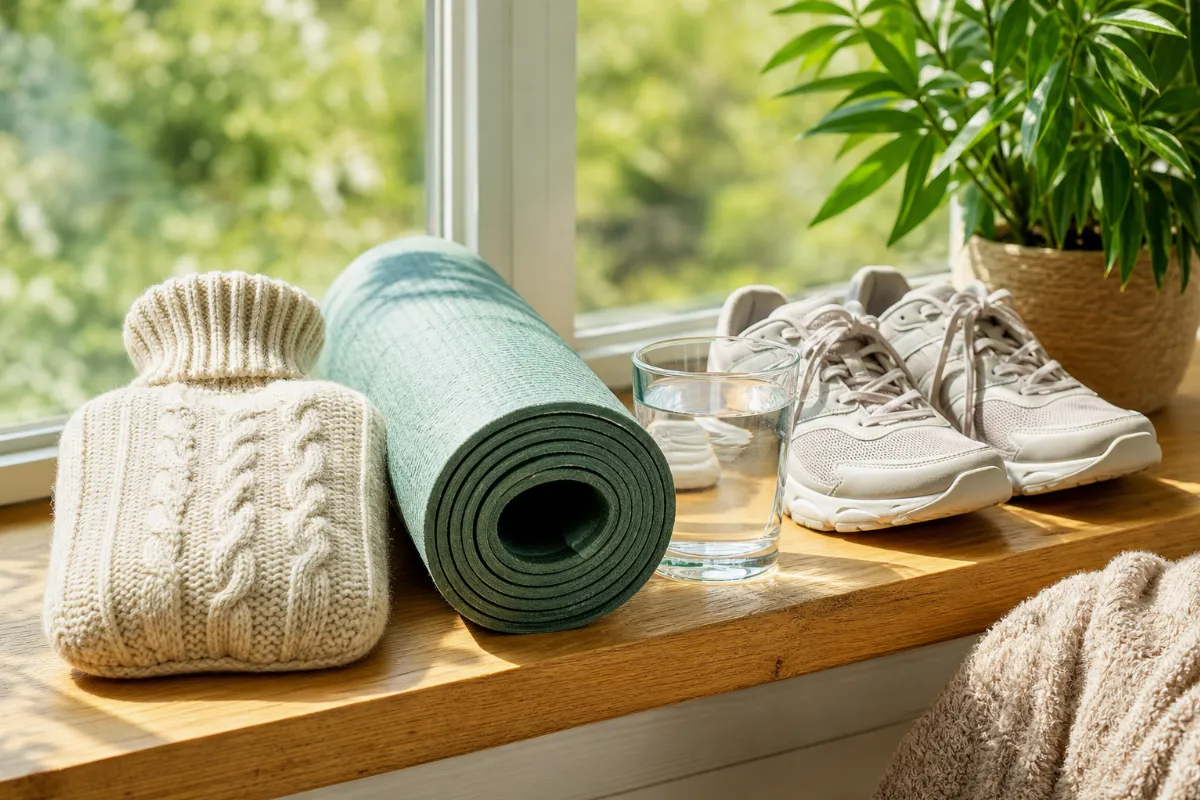
Recover & Feel More Comfortable
Manage Everyday Physical Discomfort
Most everyday aches, such as a stiff back, tight shoulders or sore legs after a busy day, are common and ease with gentle movement, rest, comfort measures and time. This page covers general aches and discomfort, and when to get them checked; exercise soreness, injuries, muscle tension linked with stress and pacing each have their own pages.
General information, not medical advice. Last updated October 31, 2026. Written by the AlternativeMed editorial team. Not medically reviewed.
Start here
- Keep moving gently. Short walks and easy stretching are usually better for common aches than staying still, and long bed rest tends to make stiffness worse.
- Try simple comfort measures: a warm pack wrapped in a towel for tight or stiff muscles, a wrapped cold pack for a fresh sore spot, and a change of position at least once an hour if you sit or stand for long periods.
- Note when the ache started, where it is, what makes it better or worse and any new medicine you began. If it is still there after a few days, or follows a fall, or comes with other symptoms, get it checked rather than waiting.
Be careful with
- Do not push through sharp or worsening pain, and do not ignore an ache that keeps getting worse or does not improve.
- Over-the-counter pain relievers, rub-on gels, herbs and supplements can cause stomach, kidney or bleeding problems or interact with other medicines; ask a pharmacist or doctor first, especially in pregnancy, breastfeeding, older age, or if you have a long-term condition or take blood thinners.
- Never stop a prescribed medicine on your own because you think it is causing aches. Tell your prescriber and they can review it with you.
Get help when
- Pain that follows a fall or injury, a joint or limb that has changed shape or cannot bear weight, or numbness, tingling or pins and needles around the area. The NHS says these need urgent care.
- Pain and swelling in one calf or thigh, especially with red or darkened skin, which can be a blood clot; with breathlessness or chest pain it is an emergency. The NHS names 999 in the UK; use your local emergency number elsewhere.
- A hot, swollen joint or area, or an ache with a high temperature, feeling hot, cold and shivery, or generally unwell; a very stiff neck or high fever with muscle aches.
- Back pain with weakness or numbness in both legs, numbness around the genitals or anus, or changes in bladder or bowel control, or back pain that began after a serious accident.
- Severe or unexplained pain; pain that is worse at night or does not ease with rest; unintentional weight loss; or muscle pain lasting more than 3 days (MedlinePlus), or more than a few weeks for back, neck and joint pain (NHS).
- Muscle aches that began after starting or changing a medicine (MedlinePlus lists some blood-pressure and cholesterol medicines): talk to the prescriber before changing anything.
- Dark urine with severe muscle pain and weakness, which can point to a serious muscle breakdown problem (rhabdomyolysis, which MedlinePlus lists among causes), or sudden weakness, trouble swallowing or breathlessness (MedlinePlus advises emergency help).
About Manage Everyday Physical Discomfort
What this goal means
This goal is about the ordinary aches and stiffness many adults feel from time to time in the back, neck, shoulders, hips, knees and legs. MedlinePlus says muscle aches and pains are common, can involve more than one muscle, and can also be felt in ligaments, tendons and the connective tissue around muscles.
It is about self-care and knowing when an ache is more than ordinary. It does not cover diagnosing the cause of pain, which needs a clinician.
1,2What it can feel like
People describe a dull ache, tightness, soreness after a busy day, stiffness when getting up, or a sore spot that comes and goes. The NHS lists sprain or strain, osteoarthritis, bursitis, rheumatoid arthritis, gout and joint infection among the causes of joint pain, each with a different pattern; this page does not try to tell them apart.
Pain that lasts for several months is called chronic pain. NCCIH notes that it can come with difficulty moving about, disturbed sleep, anxiety and low mood.
2,3What can contribute
MedlinePlus says the most common causes of muscle aches are injury, overuse (using a muscle too much, too soon, before warming up or too often), and tension or stress. Muscle pain can also be linked with some medicines, with infections such as the flu, and with conditions that affect the whole body.
The NHS lists awkward sleeping positions, poor posture over long periods at a desk, a pinched nerve and injury as common causes of neck pain, and notes that perimenopause and menopause can cause aching, painful joints.
1,4,2Conditions that can be behind it
Aches that are widespread, long-lasting or come with poor sleep and tiredness can be linked with fibromyalgia, which the NHS describes as a long-term condition causing pain all over the body. Other possibilities include arthritis, a medicine side effect, an infection or another condition affecting the body as a whole.
We cannot sort these out from a web page. If an ache is not settling, a clinician can examine you and, if needed, order tests.
5,1,2Realistic expectations
The NHS says that after two weeks most sprains and strains feel better, and that back pain often improves on its own within a few weeks. Comfort measures and gentle movement help most when used steadily rather than once.
For longer-lasting aches, a large review of reviews found that exercise reduced pain with moderate-certainty evidence, and that greater effects were seen in lower-intensity, shorter programmes. Do not expect any single product to remove an ache; most natural options studied have small or uncertain effects.
6,7,8Who this applies to
Adults with ordinary, short-lived or recurring aches. Pregnancy, older age, long-term conditions, medicines that affect bleeding, kidneys or the stomach, and a history of falls or fractures all change what is safe and when to be checked, so ask a clinician. For stress-related muscle tension, exercise soreness, injury, joint stiffness and pacing, use the linked goals.
1,3Related conditions and symptoms
Anxiety disorders → ME/CFS and post-exertional malaise → Fatigue: when to get help →
A manageable starting plan
An educational starting point, not a personal prescription. Adjust it to your own situation and any advice from your clinician.
Your first actions
- Keep moving: a short walk or gentle stretching every day, and a change of position at least once an hour if you sit or stand for long periods.
- Use simple comfort measures: a wrapped warm pack for tightness or stiffness, a wrapped cold pack for a fresh sore spot.
- Protect your sleep and give yourself a few minutes of calm each day.
- Check the warning-sign list. If any applies, get care now rather than waiting.
Optional additions
- Try a beginner tai chi or yoga class.
- Add a short guided relaxation or body scan.
- Ask a pharmacist about suitable short-term options for your situation.
- Book a physiotherapy assessment if the ache keeps coming back.
What to track
- Where the ache is, when it happens and what you were doing.
- How well you slept and how stressed you felt.
- Any new medicine, supplement or product and what changed afterwards.
- Whether it is getting better, staying the same or getting worse.
When to reassess
Give gentle movement and comfort measures about two weeks. The NHS says to see a GP for joint pain that has not improved after two weeks of treating it at home, and for back or neck pain that has not improved after a few weeks. MedlinePlus suggests contacting a provider if muscle pain lasts more than 3 days. Get checked sooner if any warning sign appears.
When to seek professional support
- Speak to a pharmacist about suitable options and interactions.
- See a GP for pain that is not settling, is getting worse, is stopping daily activities or is affecting sleep.
- In many areas you can refer yourself to NHS community musculoskeletal (MSK) services without a GP referral; elsewhere ask a doctor about physiotherapy.
What helps
Ordered by how well the research supports each step. Evidence strength is shown on every card; precautions sit next to the advice.
Start here
Keep moving gently and build up slowly
Moderate certaintyAddresses: Less stiffness and, over weeks, less pain
Why it may help: MedlinePlus advises regular exercise, with walking, cycling and swimming as examples, starting slowly and increasing gradually, and gentle stretching after a long rest. The NHS back pain page says to stay active and avoid long periods in bed. A review of 157 reviews (2,736 trials) found exercise reduced pain compared with controls, with moderate-certainty evidence; an earlier Cochrane overview rated the evidence for chronic pain as low quality, with most side effects being short-lived soreness.
How to apply it: Choose something you enjoy, such as walking, swimming, cycling, tai chi or yoga. Start with short sessions and add a little each week. Light soreness that fades within a few days is common when starting.
Who it may suit: Most adults with ordinary aches or stiffness.
Precautions: Stop and get advice if pain gets worse or you have chest pain, fainting or new breathlessness. Check with a clinician first if you are pregnant, have a heart condition, have had a recent injury or surgery, or have been inactive for a long time.
1,7,8,9Change position often and stretch if you sit or stand for long periods
Low certaintyAddresses: Fewer stiff and tight spots
Why it may help: MedlinePlus says that if you work in the same position most of the day, such as sitting at a computer, you should stretch at least every hour. The NHS advises people with neck pain not to keep the neck in one position for a long time, to sit upright, and to keep the neck moving rather than wearing a collar.
How to apply it: Set a gentle reminder to stand, walk for a minute or two and move the neck, shoulders and hips. Keep the head level with the rest of your body when sleeping.
Who it may suit: Desk workers, drivers, and anyone who holds one posture for hours.
Precautions: Stretch gently and stop if it hurts. Sudden neck pain with pins and needles or a cold arm needs a GP visit.
1,4Improve Your Posture & Movement Habits → Support Your Back During Everyday Activities →
Keep a short note of the pattern
Low certaintyAddresses: Makes it easier to spot triggers and to describe the problem to a clinician
Why it may help: When people see a clinician about muscle pain, MedlinePlus lists the questions they will be asked: when it started, how long it lasts, where it is, whether it is all over or in one area, what makes it better or worse, whether other symptoms occur and whether any new medicine was started.
How to apply it: For one to two weeks, write down where the ache is, the time of day, what you were doing, how well you slept and any new medicine or supplement.
Who it may suit: Anyone whose aches come and go or have not settled.
Precautions: A diary does not replace a check: red flags need prompt care whatever the diary shows.
1Additional options
Warmth for stiff or tight muscles; a cold pack for a fresh sore spot
Low certaintyAddresses: Short-term comfort
Why it may help: The NHS back pain page suggests a heat pack or hot water bottle wrapped in a towel for joint stiffness or muscle spasms, and an ice pack wrapped in a towel to reduce pain and swelling; the NHS neck pain page gives 20 minutes of heat 2 to 3 times a day or 5 minutes of cold 3 times a day. A Cochrane review found moderate evidence from a small number of trials that heat wraps gave a small short-term reduction in low back pain, and too little evidence to judge cold. MedlinePlus says ice is best in the first 24 to 72 hours after an injury, and heat often feels more soothing after that.
How to apply it: Wrap any pack in a towel and check your skin often. Use heat for stiffness; use cold for a fresh sore or swollen spot.
Who it may suit: Adults with ordinary muscle tightness or back and neck aches.
Precautions: Never apply heat or cold directly to the skin or fall asleep on a heat pack. Take extra care with numb skin, poor circulation, diabetes or very young or older skin. Avoid heat in the first couple of days after a sprain or strain, as the NHS advises.
7,4,10,1,6Protect your sleep and ease stress
Low certaintyAddresses: Pain often feels easier to bear when you are rested and calmer
Why it may help: MedlinePlus advises plenty of sleep and reducing stress for muscle aches, and lists tension or stress among the most common causes. NCCIH notes chronic pain commonly comes with disturbed sleep, anxiety and low mood, so the problems tend to feed each other.
How to apply it: Keep a steady sleep routine, wind down before bed and add a short daily relaxation practice. Sleep and stress have their own goals.
Who it may suit: Anyone whose aches are worse after poor nights or busy weeks.
Precautions: If low mood, constant worry or panic is part of the picture, speak to a doctor. See the anxiety page.
1,3Improve Your Sleep Quality → Manage Everyday Stress → Relax Your Body & Release Tension → Anxiety disorders →
Ask a pharmacist about short-term over-the-counter options
Moderate certaintyAddresses: Safe, short-term relief that suits your health and medicines
Why it may help: The NHS says that for sprains and strains a pharmacist can advise on tablets, creams or gels; its back pain page says anti-inflammatory medicines may not be suitable for everyone and to check with a pharmacist or GP. A Cochrane overview found moderate or high-quality evidence that several rub-on anti-inflammatory gels and plasters relieve acute strain and sprain pain better than placebo.
How to apply it: Describe the ache, how long you have had it, your other medicines and any health conditions, and ask what is suitable for you. Use it for the shortest time that works and follow the label.
Who it may suit: Adults with a short-lived ache that is not settling with comfort measures.
Precautions: Pain relievers can affect the stomach, kidneys and bleeding, and can interact with blood thinners and other medicines. They may not suit people who are pregnant, older, or who have stomach, kidney, heart or asthma problems. We give no drug names or doses on this site; follow your pharmacist or doctor.
6,7,11Still being studied
Mindfulness and relaxation practices
Low certaintyAddresses: A small reduction in pain and better coping
Why it may help: A meta-analysis of 38 trials found low-quality evidence that mindfulness meditation was linked with a small decrease in pain compared with all types of controls, plus improved depression symptoms and quality of life. NCCIH says mindfulness-based approaches and cognitive behavioural therapy both helped pain intensity and function in studies of chronic pain, and that progressive muscle relaxation gave moderate improvements in low back pain.
How to apply it: Try a guided body scan, slow breathing or progressive muscle relaxation for 10 minutes a day.
Who it may suit: People whose pain is made worse by tension or worry.
Precautions: If body-focused exercises feel distressing, stop and speak to a professional. These practices are not a substitute for a check.
12,3Tai chi and yoga
Low certaintyAddresses: Less pain and better movement, mainly for back pain and osteoarthritis
Why it may help: A 2026 meta-analysis of 38 trials found tai chi was linked with less pain in osteoarthritis and low back pain, but effects were not significant in fibromyalgia and other conditions, and the authors warn of risk of bias; no serious adverse events were reported. NCCIH says yoga helped low back pain in the short and intermediate term, with effects similar to other exercise.
How to apply it: Join a beginner class or follow a gentle recorded session. Move within comfortable limits.
Who it may suit: Adults who like slow, mindful movement.
Precautions: Tell the teacher about injuries, pregnancy, balance problems or osteoporosis and avoid positions that hurt.
13,3Food & nutrition
Food, drink and everyday aches
We did not find a food or diet in the sources we read that was shown to ease everyday aches in general. Staying hydrated, eating regular meals and keeping to a healthy weight are sensible background habits. The NHS joint pain page advises trying to lose weight if you are overweight and eating a balanced diet, and says not to smoke.
MedlinePlus advises drinking plenty of fluids before, during and after exercise to help lower the risk of muscle aches, and lists too little potassium or calcium among causes of muscle pain. Eating a varied diet is the usual way to cover these; if you suspect a deficiency, ask a clinician for a check rather than taking supplements on a guess.
2,1Foods and spices that have been studied
Ginger, turmeric and other root plants have been studied mostly for soreness after hard exercise, not everyday aches. See the remedies section for the ratings.
Ginger
Low certaintyAddresses: Possible lower soreness after hard exercise
Why it may help: A meta-analysis of 25 studies of root plants (curcumin, ginseng, ginger and garlic) found lower muscle soreness and some damage markers at 24 and 48 hours after muscle-damaging exercise, with equivocal effects on performance. It did not test everyday aches.
How to apply it: Using ginger in cooking or tea is a pleasant, low-risk habit. The studies used supplements.
Who it may suit: Adults who enjoy it.
Precautions: Large amounts of supplements may interact with blood thinners; ask a pharmacist.
14Turmeric (curcumin)
Low certaintyAddresses: Possible lower soreness after hard exercise
Why it may help: Curcumin was one of the root plants in the same meta-analysis. Evidence is for exercise soreness, not everyday aches.
How to apply it: Turmeric in cooking is fine. Curcumin supplements are a different matter and are covered in the remedies section.
Who it may suit: Adults who like the flavour.
Precautions: Supplements can interact with blood thinners and other medicines; ask a pharmacist.
14Remedies & supplements
Traditional use, laboratory findings and human trials are kept apart. "Natural" does not mean safe.
Willow bark
Low certaintyStudied form and route: Oral extract, taken by mouth
Intended outcome: Possible relief of low back pain
Human evidence: A systematic review of musculoskeletal pain trials found moderate evidence for effectiveness of an ethanolic willow bark extract in low back pain, with conflicting results in osteoarthritis and an underpowered study in rheumatoid arthritis. NCCIH says white willow bark may help low back pain but the evidence is not as strong as for topical cayenne.
Traditional use: Preparations from willow species have been used for pain since ancient times.
Limits: The review is from 2009 and the number of trials was small. Products differ in strength.
Interactions and precautions: Willow bark contains a salicylate related to aspirin. Avoid it if you are allergic to aspirin or similar pain relievers, are pregnant or breastfeeding, give it to children, or take blood thinners or have stomach, kidney or bleeding problems. Ask a pharmacist.
15,3Cayenne (capsaicin) cream or plaster
Low certaintyStudied form and route: Applied to intact skin
Intended outcome: Possible reduction of back pain
Human evidence: NCCIH says there is evidence that topical products containing cayenne, such as creams and plasters, can reduce low back pain. The Cochrane overview of topical pain treatments judged high-concentration capsaicin to have limited efficacy in nerve pain after shingles, and did not support strong claims for other uses.
Traditional use: Cayenne has a long history in folk use for aches.
Limits: Few trials in everyday aches; products vary.
Interactions and precautions: Keep it off broken skin and away from the eyes, wash hands after use and follow the product label.
3,11Devil's claw
Low certaintyStudied form and route: Oral extract
Intended outcome: Possible relief of back pain
Human evidence: NCCIH lists devil's claw, with white willow bark, as an oral herb that may help low back pain, with evidence not as strong as for topical cayenne.
Traditional use: Used in traditional southern African medicine for aches and pains.
Limits: We did not read the individual trials, so we cannot rate effect size.
Interactions and precautions: Ask a pharmacist before using it with blood thinners or other medicines, or if you are pregnant or breastfeeding.
3Arnica gel
Low certaintyStudied form and route: Topical gel on intact skin
Intended outcome: Possible comfort for hand osteoarthritis pain
Human evidence: One randomised, double-blind study of 204 people with hand osteoarthritis found an arnica gel was not inferior to a 5% anti-inflammatory gel for pain and hand function after 21 days, with similar rates of side effects. It did not test everyday aches or bruises.
Traditional use: Arnica has long been used on bruises and sore muscles.
Limits: A single trial of one preparation, with no placebo group.
Interactions and precautions: Use on unbroken skin only and stop if a rash develops. Do not take arnica by mouth unless a clinician advises.
16Ginger and curcumin supplements
Low certaintyStudied form and route: Oral supplements
Intended outcome: Possibly less soreness after hard exercise
Human evidence: A meta-analysis of 25 studies (353 participants) of curcumin, ginseng, ginger and garlic found lower muscle soreness at 24 and 48 hours after muscle-damaging exercise than placebo, with no clear effect on performance.
Traditional use: Both plants are long used in food and traditional medicine for inflammation and aches.
Limits: Exercise-induced soreness, not everyday aches. Small studies with varied products.
Interactions and precautions: Possible interactions with blood thinners and other medicines. Ask a pharmacist, and avoid in pregnancy unless advised.
14Magnesium (including Epsom salt)
Evidence againstStudied form and route: Oral supplements, sprays or bath salts
Intended outcome: Sometimes marketed for aches and cramps
Human evidence: A Cochrane review of 11 trials found magnesium did not meaningfully reduce cramps in people with cramps of no clear cause. We did not find trials of Epsom salt baths for everyday aches in the sources we read.
Traditional use: Salt baths have a long history as a comfort practice.
Limits: The review covered cramps, not general aches, and oral supplements.
Interactions and precautions: High supplement amounts can cause diarrhoea; kidney disease and some medicines call for advice.
17Cannabis and CBD products
Low certaintyStudied form and route: Oral, oromucosal or topical products
Intended outcome: Studied for chronic pain, not everyday aches
Human evidence: A 2026 systematic review of 25 short-term trials (64% nerve pain) found that some THC-containing products may slightly reduce pain severity, with more dizziness, sedation and nausea, and that CBD on its own may not improve outcomes. NCCIH reports modest benefits for chronic pain and cautions about driving, older adults, adolescents and pregnancy.
Traditional use: Cannabis has a long history of traditional pain use.
Limits: Short trials, varied products, mostly nerve pain.
Interactions and precautions: Do not drive. Avoid in pregnancy, and use extra care in older adults. Legal status varies. Do not use as a substitute for medical care, and talk to a clinician about interactions.
18,19Therapies & care
Established care for aches starts with an assessment of the cause. In many areas the NHS lets people refer themselves to community musculoskeletal (MSK) services for back or joint help, and a physiotherapist can teach exercises. This page does not recommend medicines or doses, and you should not stop a prescribed medicine on your own.
Physiotherapy and exercise guidance
Moderate certaintyPhysical therapy A physiotherapist can assess the problem and teach stretching, strengthening and aerobic exercises. MedlinePlus says a physical therapist or athletic trainer can teach you exercises to feel better and stay pain-free. The NHS lists group exercise sessions and physiotherapy among treatments for back pain that does not improve.
Who it may suit: Aches lasting more than a few weeks, recurring problems, or after an injury.
Precautions: Tell the therapist about all health conditions and medicines; stop if pain gets worse.
1,7,9Massage
Low certaintyHands-on therapy NCCIH says evaluations of massage for low back pain found weak evidence of benefit, and that massage may help neck pain but the benefit may last only a short time. A Cochrane review of massage for neck pain found low-certainty evidence of little or no difference compared with placebo up to 12 weeks, though higher doses (8 or more sessions over four weeks of 30 minutes or more) showed a clinically important difference. MedlinePlus notes muscle aches from overuse often respond well to massage.
Who it may suit: Adults who enjoy it and want short-term comfort.
Precautions: NCCIH says serious harms are rare but include blood clot, nerve injury and bone fracture, with vigorous massage and with elderly people. Avoid deep massage over a suspected clot, a fresh injury, or with bleeding problems; tell the therapist about your conditions and medicines.
20,21,1,3Acupuncture
Moderate certaintyTraditional Chinese medicine technique NCCIH says a large review of individual data found acupuncture was more effective than no treatment or sham acupuncture for back or neck pain, and that guidelines include it as an option. A Cochrane overview found acupuncture probably gave a small improvement in function for chronic low back pain compared with sham acupuncture.
Who it may suit: Adults with persistent back, neck or knee pain who want a drug-free option.
Precautions: Use a trained, licensed practitioner and sterile single-use needles. Tell them if you are pregnant or take blood thinners.
3,22Tai chi and yoga classes
Moderate certaintyMind-body exercise An umbrella review found aerobic exercise, resistance training, yoga, Pilates and tai chi all effective for pain, and NCCIH lists tai chi and yoga among approaches that may help some painful conditions.
Who it may suit: Adults who prefer slow, structured movement.
Precautions: Check with a clinician if you have balance problems, osteoporosis or are pregnant.
8,3,13Talking and coping therapies
Moderate certaintyPsychological therapy NCCIH says cognitive behavioural therapy is the prevailing psychological treatment for chronic pain, and that mindfulness-based approaches and CBT both help pain intensity and function. The NHS lists CBT among the treatments for back pain that does not improve and for fibromyalgia.
Who it may suit: People whose pain has lasted for months or who feel worn down by it.
Precautions: Ask your doctor about local services.
3,7,5Rub-on anti-inflammatory gels and plasters (from a pharmacy)
Moderate certaintyOver-the-counter product class A Cochrane overview found moderate or high-quality evidence that several rub-on anti-inflammatory gels and plasters relieve pain in acute strains and sprains, with weaker, smaller effects in longer-lasting joint pain.
Who it may suit: Short-term use for a sprain or strain, with pharmacist advice.
Precautions: Use on intact skin only; ask a pharmacist if you are pregnant, take blood thinners or have asthma, kidney or stomach problems.
11,6What to avoid
Habits, products and claims that can get in the way. Never stop a prescribed medicine without talking to the professional who prescribed it.
Risks that apply to most people
Long bed rest or avoiding movement altogether
Moderate certaintyWhy: The NHS back pain page says not to stay in bed for long periods, and the joint pain page says not to completely stop moving the affected joint. A Cochrane overview concluded that exercise did not cause negative effects in chronic pain, with only short-lived soreness reported.
Who it applies to: Anyone with common back, neck or joint aches.
Try instead: Rest briefly if you need to, then return to gentle everyday movement.
7,2,9Waiting out warning signs
High certaintyWhy: The NHS lists back pain with weakness or numbness in both legs, loss of feeling around the genitals or anus, changes in bladder or bowel control, or onset after a serious accident as needing 999 or A&E, and severe pain that starts suddenly, or feeling hot and unwell, as needing urgent advice.
Who it applies to: Anyone with pain that is severe, sudden, getting worse or comes with other symptoms.
Try instead: Use the warning-sign list on this page and get care promptly.
7,2,1Personal triggers to check
Holding one position for hours
Low certaintyWhy: MedlinePlus advises stretching at least every hour if you work in one position, and the NHS lists poor posture at a desk and awkward sleeping positions among common causes of neck pain.
Who it applies to: Desk workers, drivers, gamers and phone users.
Try instead: Break up long periods of sitting or standing with a short walk or stretch.
1,4Doing too much too soon, or skipping the warm-up
Low certaintyWhy: MedlinePlus lists overuse, including using a muscle too much, too soon or before warming up, among the most common causes of muscle aches, and the NHS lists not warming up, tired muscles and sport among common causes of sprains and strains.
Who it applies to: Restarting exercise, weekend projects, moving house, gardening.
Try instead: Warm up, increase activity gradually and spread heavy jobs over several days.
1,6Pace Activity Without Overdoing It → Manage Post-Exercise Muscle Soreness →
Poor sleep and a high-stress stretch
Low certaintyWhy: MedlinePlus lists tension or stress as a common cause of muscle aches and advises plenty of sleep and stress reduction.
Who it applies to: Anyone whose aches flare in busy or worrying periods.
Try instead: Protect sleep, take breaks and use relaxation practices.
1Products that need caution
Heat, massage or alcohol on a fresh sprain or strain
Moderate certaintyWhy: The NHS says to avoid heat such as hot baths and heat packs, alcohol and massage for the first couple of days after a sprain or strain, to help prevent swelling.
Who it applies to: A new injury in the first one to three days.
Try instead: Follow the NHS steps for the first days: protect, rest, ice, compress and elevate, then start moving gently.
6A neck collar for ordinary neck pain
Moderate certaintyWhy: The NHS says not to wear a neck collar and that it is better to keep the neck moving, unless a doctor says otherwise.
Who it applies to: Common neck stiffness without injury or a doctor's advice.
Try instead: Gentle neck movement, a low firm pillow and heat or cold packs.
4Cannabis or CBD products as a first step for everyday aches
Low certaintyWhy: A 2026 systematic review of 25 short-term trials (mostly nerve pain) found some products may slightly reduce pain but cause dizziness, sedation and nausea; CBD alone may not help. NCCIH reports modest benefits for chronic pain, an increased risk of motor vehicle crashes and of injury in older adults.
Who it applies to: People considering hemp, CBD or cannabis products. Legal status varies by country and region.
Try instead: Start with movement, comfort measures and sleep; if pain is severe or lasting, talk to a clinician.
18,19Unsupported claims
"Magnesium or Epsom salt stops muscle cramps and aches"
Evidence againstWhy: A Cochrane review of 11 trials found magnesium did not reduce cramp frequency, intensity or duration compared with placebo in people with cramps of no clear cause, with moderate to high-certainty evidence. We did not find trials of Epsom salt baths for everyday aches in the sources we read.
Who it applies to: Magnesium supplements, sprays and bath salts marketed for aches and cramps.
Try instead: Warm baths can still be soothing for comfort; treat them as comfort rather than a treatment.
17"Kinesiology tape, cupping or a gadget will fix aches"
Not enough evidenceWhy: The studies we read did not test these for everyday aches. In an umbrella review of treatments for exercise-induced soreness, evidence for tape and compression was graded class III and for most others class IV (weaker), and 17 of the 29 included reviews were of critically low quality.
Who it applies to: Tapes, cups and devices advertised for pain.
Try instead: Put your effort into movement, sleep and comfort measures that have better support.
23"Natural means safe"
High certaintyWhy: NCCIH reminds readers that natural does not always mean safe and that some dietary supplements have side effects or interact with medicines. The approaches with good safety records are mainly physical and psychological ones, such as massage, yoga and acupuncture, and they are not risk-free for everyone.
Who it applies to: Herbal pain products, creams and supplements.
Try instead: Check with a pharmacist or doctor, especially with other medicines, pregnancy, or kidney, liver or stomach problems.
3Common mistakes
Pushing through sharp or worsening pain
Moderate certaintyWhy: The NHS back pain page says to stop exercises and stretches if pain gets worse and see a GP. Pain that is severe, unexplained or getting worse is on the NHS and MedlinePlus lists for professional help.
Who it applies to: Anyone exercising or doing heavy jobs with an ache.
Try instead: Ease off, reduce the load and get help if it does not settle.
7,1Stopping a prescribed medicine without advice because of aches
High certaintyWhy: MedlinePlus lists some medicines among possible causes of muscle pain and says to contact your provider if muscle pain is linked with starting or changing a medicine. The decision to change a medicine belongs with the prescriber.
Who it applies to: People who notice new aches after a new or changed prescription.
Try instead: Keep taking it unless your prescriber says otherwise and book a review.
1Treating every ache the same way with rest
Moderate certaintyWhy: The right step depends on the cause: ice and protection for a fresh injury, gentle movement for common stiffness, and a check for red flags. The NHS says that after a sprain or strain, once you can move without pain stopping you, you should keep moving so the joint or muscle does not become stiff.
Who it applies to: Anyone choosing between rest and activity.
Try instead: Match the step to the situation, and use the linked injury and joint pages.
6,2Evidence & safety
What the research shows
For ordinary aches, health agencies agree on staying active, avoiding long periods in one position, using heat or cold for comfort, protecting sleep and stress, and getting red flags checked. A large umbrella review of exercise found a moderate-certainty reduction in pain, though the earlier Cochrane overview rated the evidence for chronic pain as low quality. Evidence for massage, mindfulness, tai chi and yoga is low to moderate, and for herbs, supplements and cannabis-based products it is low, mixed or against, and often comes from exercise soreness or specific conditions rather than everyday aches.
Limits of the evidence
- Most trials studied specific conditions (low back pain, osteoarthritis, neck pain, exercise soreness), not 'everyday aches' in general.
- Many trials were small, short, at risk of bias or not blinded, and heat and cold were studied mainly for low back pain, in a 2006 review.
- Pain is self-reported, and placebo responses are large in pain research.
- Herbal and supplement products vary in strength and quality.
- We read abstracts of the systematic reviews and trials cited, not every individual trial inside them.
Precautions and interactions
- Over-the-counter pain relievers, gels, herbs and supplements can interact with other medicines (especially blood thinners) and affect the stomach, kidneys and bleeding. Ask a pharmacist or doctor.
- Do not stop a prescribed medicine because of aches without speaking to the prescriber.
- Avoid heat, alcohol and massage over a fresh injury for the first couple of days, and avoid deep massage over a suspected clot.
- Do not use cannabis or CBD products before driving, and ask a clinician if you are older, pregnant or take other medicines.
Life-stage considerations
- Pregnancy and breastfeeding: avoid herbs, willow bark, devil's claw, arnica by mouth, cannabis and CBD products unless a clinician advises; ask a midwife or doctor about aches, as the NHS has separate advice on back pain in pregnancy.
- Children and teenagers: growing pains, injuries and joint pain in a child need a doctor's advice (the NHS says to see a GP if a child has joint problems); do not give herbs or supplements without advice.
- Older adults: more sensitive to medicine side effects and to falls and fractures; cannabis use is linked with injury in older adults. Review all pain products with a pharmacist.
- Long-term conditions: with arthritis, fibromyalgia, kidney, liver, heart or stomach conditions, or blood thinners, ask your clinician before using any new product.
Warning signs
- Pain after a fall or injury, deformity, inability to bear weight, a crack or pop, or numbness, tingling, or pale, blue, grey or cold skin around the injury.
- Pain and swelling in one leg, especially with redness or darkening; with breathlessness or chest pain call emergency services.
- A hot, swollen joint or area, or any ache with a high temperature or feeling unwell.
- Back pain with weakness or numbness in both legs, loss of feeling around the genitals or anus, or bladder or bowel changes.
- Severe, unexplained or worsening pain; pain worse at night; weight loss you cannot explain; muscle pain that lasts more than 3 days or follows a new medicine.
- Dark urine with severe muscle pain, sudden weight gain or swelling, passing much less urine than usual, trouble swallowing or breathlessness (MedlinePlus advises emergency care).
Claim checks
Exercise makes aches worse, so rest is safer
Moderate certaintyA Cochrane overview found no negative effects of exercise in chronic pain, with mostly short-lived soreness at the start, and a large umbrella review found exercise reduced pain with moderate-certainty evidence. The NHS advises staying active for back pain and not stopping joint movement entirely.
9,8,7,2Heat or ice cures aches
Low certaintyThey give short-term comfort. A Cochrane review found a small short-term benefit of heat wraps for low back pain and too little evidence for cold. Neither treats the cause.
10,7Magnesium or Epsom salt baths stop muscle cramps
Evidence againstA Cochrane review found magnesium did not reduce cramps compared with placebo in cramps of no clear cause, and we found no trials of Epsom baths for everyday aches.
17Massage fixes the cause of muscle pain
Low certaintyThe evidence is weak to low-certainty, with benefits that may be short-lived for neck and back pain, and a better effect seen with higher doses in one review.
20,21,3CBD oil is a proven treatment for aches
Low certaintyA 2026 systematic review found CBD alone may not improve pain outcomes, and products with THC gave only small benefits with side effects, mostly in nerve pain.
18,19Kinesiology tape and cupping treat everyday aches
Not enough evidenceWe did not find evidence in everyday aches from the sources read; in exercise soreness reviews the evidence ranged from limited to weak and many reviews were of critically low quality.
23One painful, swollen calf is just a pulled muscle
High certaintyIt may be, but the NHS lists throbbing pain and swelling in one leg, usually the calf or thigh, with red, blue or darkened skin, as possible signs of a blood clot (DVT) that needs urgent medical help; with breathlessness or chest pain it is an emergency.
24Herbal pain remedies are always safe because they are natural
High certaintyNCCIH says natural does not always mean safe; herbs such as willow bark contain compounds related to aspirin and can interact with medicines.
3,15Questions people ask
When is an ache normal?
MedlinePlus says muscle aches are common and most often linked with tension, overuse or injury from exercise or hard physical work, with pain in specific muscles that starts during or just after the activity. The NHS says most sprains and strains feel better after about two weeks.
Should I rest or keep moving?
For common aches, the NHS advises staying active and not staying in bed for long periods with back pain, and not completely stopping movement with joint pain. After a fresh injury, protect and rest the area for the first days, then start moving it gently.
Is heat or cold better?
The NHS and MedlinePlus describe cold for fresh injuries and swelling and heat for stiffness and muscle spasms. A Cochrane review found a small short-term benefit from heat wraps for low back pain and too little evidence for cold. Always wrap packs in a towel and check your skin.
When should I see a doctor?
MedlinePlus says to contact your provider if muscle pain lasts more than 3 days, is severe and unexplained, shows signs of infection, or is linked with a medicine. The NHS says to see a GP for joint pain that has not improved after two weeks, back pain that has not improved after a few weeks, or any red flag on this page.
Can my medicine be causing the aches?
MedlinePlus lists some blood-pressure and cholesterol medicines among causes of muscle pain. If aches began after starting or changing a medicine, contact the prescriber; do not stop it on your own.
Do magnesium supplements or Epsom salt baths help aches?
A Cochrane review found magnesium did not reduce cramps compared with placebo when there was no clear cause, and we did not find trials of Epsom salt baths for everyday aches. A warm bath can still feel comforting.
Are CBD and cannabis products worth trying?
The evidence we read is for chronic pain, mostly nerve pain, in short trials, with small benefits from THC-containing products and more dizziness, sedation and nausea; CBD on its own may not help. Do not drive, and ask a clinician if you are older, pregnant or take other medicines.
What helps with aches from long periods of sitting?
MedlinePlus advises stretching at least every hour; the NHS advises not keeping the neck in one position for a long time. See Sit Less & Move More and Improve Your Posture & Movement Habits for more.
How is this different from muscle soreness after exercise or injury?
This page is about general everyday aches. Soreness after a hard workout, recovering from an injury, stress-related muscle tension and pacing your activity each have their own pages, linked below.
Can fibromyalgia cause widespread aches?
Yes. The NHS describes fibromyalgia as a long-term condition causing pain all over the body, often with poor sleep and tiredness, and says exercise helps reduce pain. Diagnosis needs a clinician; see a GP if you think it applies.
References
- MedlinePlus. Muscle aches (Medical Encyclopedia). Read 2026-10-31. source
- NHS. Joint pain (page last reviewed 26 February 2026). Read 2026-10-31. source
- NCCIH. Chronic pain and complementary health approaches: usefulness and safety. Read 2026-10-31. source
- NHS. Neck pain. Read 2026-10-31. source
- NHS. Fibromyalgia. Read 2026-10-31. source
- NHS. Sprains and strains (page last reviewed 23 April 2024). Read 2026-10-31. source
- NHS. Back pain. Read 2026-10-31. source
- Singh B, et al. The effect of exercise on clinical pain: a systematic umbrella review and meta-meta-analysis. Pain Rep 2026;11(4):e1455. PubMed PMID 42416555. source
- Geneen LJ, et al. Physical activity and exercise for chronic pain in adults: an overview of Cochrane Reviews. Cochrane Database Syst Rev 2017;1:CD011279. PubMed PMID 28087891. source
- French SD, et al. Superficial heat or cold for low back pain. Cochrane Database Syst Rev 2006;(1):CD004750. PubMed PMID 16437495. source
- Derry S, et al. Topical analgesics for acute and chronic pain in adults: an overview of Cochrane Reviews. Cochrane Database Syst Rev 2017;5:CD008609. PubMed PMID 28497473. source
- Hilton L, et al. Mindfulness meditation for chronic pain: systematic review and meta-analysis. Ann Behav Med 2017;51(2):199-213. PubMed PMID 27658913. source
- Chen S, et al. Efficacy and safety of Tai Chi for chronic musculoskeletal pain: a systematic review and meta-analysis. Front Pain Res 2026;7:1678660. PubMed PMID 41815824. source
- Doma K, et al. Selected root plant supplementation reduces indices of exercise-induced muscle damage: a systematic review and meta-analysis. Int J Vitam Nutr Res 2022;92(5-6):448-468. PubMed PMID 33196371. source
- Vlachojannis JE, Cameron M, Chrubasik S. A systematic review on the effectiveness of willow bark for musculoskeletal pain. Phytother Res 2009;23(7):897-900. PubMed PMID 19140170. source
- Widrig R, et al. Choosing between NSAID and arnica for topical treatment of hand osteoarthritis in a randomised, double-blind study. Rheumatol Int 2007;27(6):585-591. PubMed PMID 17318618. source
- Garrison SR, et al. Magnesium for skeletal muscle cramps. Cochrane Database Syst Rev 2020;9:CD009402. PubMed PMID 32956536. source
- Chou R, et al. Cannabis-based products for chronic pain: an updated systematic review. Ann Intern Med 2026;179(2):230-241. PubMed PMID 41429020. source
- NCCIH. Cannabis (marijuana) and cannabinoids: what you need to know. Read 2026-10-31. source
- NCCIH. Massage therapy: what you need to know. Read 2026-10-31. source
- Gross AR, et al. Massage for neck pain. Cochrane Database Syst Rev 2024;CD004871. PubMed PMID 38415786. source
- Rizzo RR, et al. Non-pharmacological and non-surgical treatments for low back pain in adults: an overview of Cochrane reviews. Cochrane Database Syst Rev 2025;CD014691. PubMed PMID 40139265. source
- Wiecha S, et al. Physical therapies for delayed-onset muscle soreness: an umbrella and mapping systematic review with meta-meta-analysis. Sports Med 2025;55(5):1183-1212. PubMed PMID 40120073. source
- NHS. DVT (deep vein thrombosis) (page last reviewed 30 April 2026). Read 2026-10-31. source
Related on AlternativeMed
Related goals
Recover Better After Exercise → Manage Post-Exercise Muscle Soreness → Ease Everyday Muscle Tension → Balance Training & Recovery → Build Better Rest Days → Support Recovery Through Nutrition → Rebuild Activity After Illness → Support Recovery After Injury → Pace Activity Without Overdoing It → Relax Your Body & Release Tension → Improve Joint Comfort → Manage Joint Stiffness → Support Your Back During Everyday Activities → Balance Activity & Rest →
Ingredients, foods and supplements
Willow bark → Devil's claw → Arnica → Cayenne pepper → Ginger → Turmeric → Magnesium → Curcumin supplements →
Research, safety and claim-check resources
Relaxation techniques → Sit Less & Move More → Improve Your Posture & Movement Habits → Improve Your Sleep Quality → Manage Everyday Stress → Stay Hydrated for Daily Wellbeing → Massage and bodywork → Acupuncture → Tai chi → Yoga → Cannabis and cannabinoids → Medicine interactions →