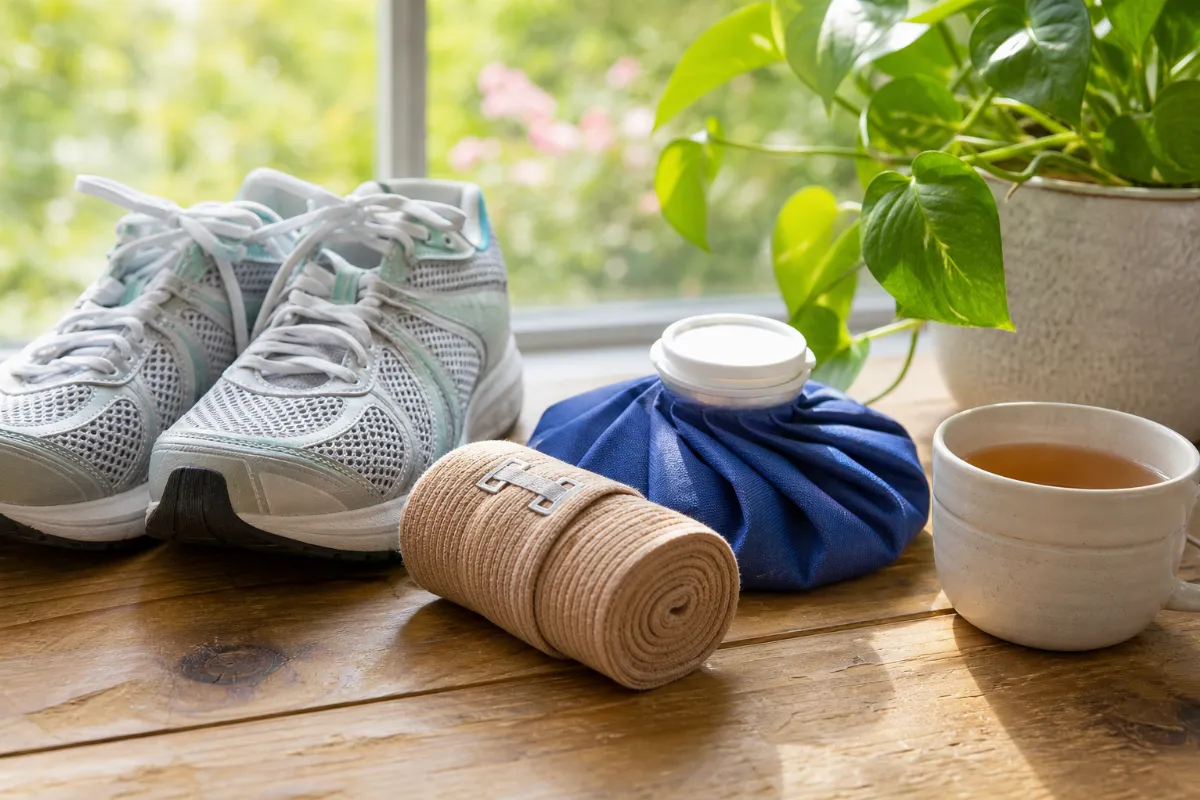
Recover & Feel More Comfortable
Support Recovery After Injury
Most minor knocks, sprains and strains settle with sensible early care and a gradual return to movement. This page is about general care for minor injuries and knowing when an injury needs a clinician; it does not diagnose, and recovery after exercise, illness or everyday aches have their own pages.
General information, not medical advice. Last updated October 31, 2026. Written by the AlternativeMed editorial team. Not medically reviewed.
Start here
- Check first for warning signs: a crack or odd shape, numbness or tingling, being unable to put weight on the limb, a head injury or a hot swollen area with fever all need medical help rather than home care.
- For a minor sprain or strain, protect the area and rest it for the first 2 to 3 days, use a wrapped ice pack for up to 20 minutes at a time, add gentle compression and raise the limb when you can (the NHS calls this PRICE).
- As soon as pain allows, start moving the area gently so it does not stiffen, and book a GP visit if it is getting worse or not improving.
Be careful with
- Do not push through severe or worsening pain, and do not go back to hard exercise too soon. The NHS advises avoiding strenuous exercise such as running for up to 8 weeks after a sprain or strain.
- Painkillers and anti-inflammatory medicines have cautions (stomach, kidney, heart, asthma, blood thinners, pregnancy). Ask a pharmacist before using them and do not stop a prescribed medicine on your own.
- Herbal creams and supplements marketed for bruising and healing are not a replacement for checking a worrying injury.
Get help when
- Call the emergency number (999 in the UK, per the NHS) or go to A&E if you heard a crack, the body part has changed shape or points at an odd angle, the area is numb or tingling, or the skin looks blue or grey or feels cold.
- Get urgent advice (NHS 111 in the UK) if pain is severe or getting worse, swelling or bruising is large or growing, you cannot bear weight or walk more than a few steps, or you have a high temperature or feel hot, cold or shivery.
- After any head injury: loss of consciousness, a fit, vomiting, new numbness or weakness, trouble with balance, speech or vision, clear fluid from the ears or nose, or becoming drowsy or confused needs emergency care.
- Pain, swelling and redness or dark skin in one calf or thigh needs same-day advice; with breathlessness or chest pain, call the emergency number.
- Dark urine with severe muscle pain, or an injury that is not improving after self-care, also needs a clinician.
About Support Recovery After Injury
What this goal means
This goal is about helping the body heal after a minor injury such as a sprain (a stretched or torn ligament), a strain (a stretched or torn muscle or tendon) or a bruise, and about telling these apart from injuries that need a clinician.
MedlinePlus describes sprains and strains as common, with early care that pauses use of the injured area, uses ice and compression, and later adds exercise and physical therapy.
1,2What it can feel like
Sprains typically bring soreness, swelling, discoloration and difficulty moving a joint; strains bring soreness, muscle spasm, swelling and difficulty moving the muscle. Many people also feel worried about moving the injured area again.
1What shapes how well it heals
The NHS notes that keeping an injured joint or muscle moving once pain allows helps prevent stiffness. In an overview of 46 systematic reviews on ankle sprain, early mobilisation was supported by strong evidence for pain, swelling and function, with moderate evidence for exercise and manual therapy.
The same overview found strong evidence for bracing and moderate evidence for balance and coordination (neuromuscular) training in preventing a repeat ankle sprain.
2,3Conditions that can look like a minor injury
Some injuries need examination: a broken bone, a ruptured tendon, a significant head injury, an infected area or a blood clot in the leg. The NHS lists a crack when injured, a changed shape, numbness or tingling, or a blue, grey or cold limb as emergency signs, and describes clot symptoms as throbbing pain and swelling in one leg, often with red, blue or darkened skin.
2,4Realistic expectations
Mild sprains and strains often improve over days to a few weeks, but the NHS says to avoid strenuous exercise such as running for up to 8 weeks to prevent further damage. A head injury can cause symptoms for up to 2 weeks, with concussion lasting a few weeks. Recovery is rarely a straight line, and not everything here is proven: a review of rest, ice, compression and elevation in ankle sprains found insufficient trial evidence to judge their relative effectiveness, even though they are widely advised.
2,5,6Who this applies to
Adults with minor everyday or sports injuries. Children, pregnant people, older adults, people on blood thinners and people with osteoporosis or other chronic conditions are more likely to need a clinician's check sooner. Soreness after normal exercise is covered by the exercise-recovery pages, and recovery after illness has its own pages.
2,5Related conditions and symptoms
Osteoporosis and Bone Health → Falls and balance → ME/CFS and post-exertional malaise →
A manageable starting plan
An educational starting point, not a personal prescription. Adjust it to your own situation and any advice from your clinician.
Your first actions
- Check for warning signs first and get help straight away if any are present.
- For 2 to 3 days: protect, rest, wrapped ice, gentle compression and elevation.
- As soon as pain allows, begin gentle movement and build up gradually.
- Return to normal activity in steps over days to weeks, and avoid strenuous exercise such as running for up to 8 weeks if advised.
Optional additions
- Ask a pharmacist about pain relief that is safe for you.
- Ask a physiotherapist about balance exercises or a brace after an ankle sprain.
- Arrange a lift or help at home while you move less.
What to track
- Pain on a 0 to 10 scale each morning and evening.
- Swelling and bruising: are they shrinking?
- What you can do without pain: walking distance, stairs, work tasks.
When to reassess
If the injury is getting worse or not improving after a few days of self-care, see a GP; after a head injury, see a GP if symptoms last longer than 2 weeks.
When to seek professional support
- Pharmacist: pain relief and wraps.
- GP or urgent care: worsening or unclear injuries.
- Physiotherapist: rehabilitation and return to sport.
- Emergency services for red flags.
What helps
Ordered by how well the research supports each step. Evidence strength is shown on every card; precautions sit next to the advice.
Start here
Protect the area and rest it for the first 2 to 3 days
Low certaintyAddresses: Limits further damage while pain and swelling are at their peak
Why it may help: The NHS advises protection, rest, ice, compression and elevation (PRICE) for the first 2 to 3 days after a sprain or strain. A review of ankle-sprain trials found insufficient randomized evidence to compare these parts of RICE against each other, so they are common-sense first steps rather than proven treatments.
How to apply it: Stop the activity, support the area (a soft wrap or sling if comfortable) and avoid putting load through painful movements for a couple of days.
Who it may suit: Adults with a minor sprain or strain and none of the warning signs.
Precautions: If you cannot bear weight, the shape looks wrong or the area is numb, do not self-treat; get medical help.
2,6Wrapped ice, up to 20 minutes at a time
Low certaintyAddresses: May ease pain and swelling in the first days
Why it may help: The NHS advises applying ice for up to 20 minutes every 2 to 3 hours in the first 2 to 3 days, for example a bag of frozen vegetables wrapped in a tea towel. Trial evidence for ice alone in ankle sprains is thin.
How to apply it: Wrap the ice so it never touches bare skin, and stop if the area goes numb or the skin looks very pale.
Who it may suit: Most adults with a minor sprain or strain.
Precautions: Take care with reduced skin feeling (for example from diabetes or nerve problems) and with circulation problems; ask a clinician first.
2,6Gentle compression and raising the limb
Low certaintyAddresses: Helps keep swelling down
Why it may help: Compression and elevation are part of the NHS PRICE advice. Evidence from trials is limited, but both are low-risk when done gently.
How to apply it: Use a soft elastic wrap that is snug but not tight, and rest the limb raised on cushions when sitting or lying.
Who it may suit: Sprains and strains of the ankle, knee, wrist or limbs.
Precautions: Loosen a wrap that causes tingling, numbness, colour change or throbbing, and seek help if these do not settle.
2,6Start gentle movement as soon as pain allows
Moderate certaintyAddresses: Helps prevent stiffness and supports function
Why it may help: The NHS says to keep moving the area once pain allows so the joint or muscle does not stiffen. The ankle-sprain overview of 46 reviews found strong evidence for early mobilisation for pain, swelling and function after an acute sprain.
How to apply it: Move within comfortable limits several times a day, with small circles, bends or gentle walking as your injury allows, building up slowly.
Who it may suit: Adults with minor sprains and strains.
Precautions: Stop and get advice if movement causes sharp pain, locking, giving way or increasing swelling. Evidence is from ankle sprains and may not apply equally to other injuries.
2,3Avoid heat, alcohol and massage on the injury in the first couple of days
Low certaintyAddresses: Avoids encouraging extra swelling
Why it may help: The NHS advises avoiding heat, alcohol and massage on a fresh sprain or strain for the first couple of days to help prevent swelling.
How to apply it: Skip hot baths, heat packs and rubbing the injured spot early on; reconsider once the swelling is settling.
Who it may suit: Anyone with a fresh sprain or strain.
Precautions: This is agency advice rather than trial-proven.
2Return to activity gradually, not all at once
Moderate certaintyAddresses: Reduces the chance of setting yourself back
Why it may help: The NHS says to avoid strenuous exercise such as running for up to 8 weeks to prevent further damage, and the ankle-sprain overview found moderate evidence for exercise therapy and strong evidence for bracing in preventing repeat sprains.
How to apply it: Go from walking to light activity to your usual sport in steps, with pain staying mild and settling the same day. Consider a clinician's advice on a brace or balance exercises after an ankle sprain.
Who it may suit: People returning to sport or physical work after a sprain or strain.
Precautions: If swelling or pain increases, step back a stage and speak to a clinician if it persists.
2,3Return to Exercise After a Break → Feel More Confident Moving →
Additional options
Balance and coordination training after an ankle sprain
Moderate certaintyAddresses: May lower the chance of spraining it again
Why it may help: An overview of 46 systematic reviews found moderate evidence that neuromuscular training helps prevent recurrence of ankle sprains and strong evidence for bracing. An older review of 23 trials also found moderate evidence that neuromuscular training reduces functional instability and re-injury.
How to apply it: Practise standing on one leg, wobble-board or similar balance tasks once the ankle is comfortable, ideally guided by a physiotherapist.
Who it may suit: People who have sprained an ankle, especially more than once.
Precautions: Start only once weight-bearing is comfortable.
3,7Hands-on manual therapy from a qualified practitioner
Moderate certaintyAddresses: May help movement and symptoms after a sprain
Why it may help: The ankle-sprain overview of 46 reviews found moderate evidence for manual therapy techniques, and the 2008 review of 23 trials found moderate evidence that manual therapy improves ankle dorsiflexion. These were ankle-sprain findings in physiotherapy settings.
How to apply it: Seek a registered physiotherapist or similar practitioner rather than deep massage on a fresh injury.
Who it may suit: People whose recovery is slow or stiff after the first days.
Precautions: Avoid massage over a fresh injury in the first couple of days (NHS) and avoid it over suspected clots or infections.
3,7,2Sleep, fluids and regular meals
Not enough evidenceAddresses: Supports general healing
Why it may help: We did not find trials in the sources read showing that any particular food or sleep pattern speeds healing of a minor sprain or strain. Ordinary good sleep, hydration and regular meals are sensible background care and are covered in the linked pages.
How to apply it: Keep to your usual healthy routine; see the nutrition and hydration pages for more.
Who it may suit: Everyone recovering from an injury.
Precautions: Do not use extreme diets or restrict food while healing.
2Support Recovery Through Nutrition → Stay Hydrated for Daily Wellbeing →
Still being studied
Acupuncture for acute sprains
Mixed findingsAddresses: Unclear
Why it may help: The ankle-sprain overview of 46 reviews found conflicting evidence on acupuncture for acute ankle sprains.
How to apply it: If you try it, use a licensed practitioner and tell them about any injury warning signs first.
Who it may suit: People open to complementary care.
Precautions: It should not delay assessment of an injury with warning signs.
3Electrical and ultrasound devices
Not enough evidenceAddresses: Not shown to help
Why it may help: The 2008 review found no evidence to support electrophysical agents after acute ankle sprain, and the 2017 overview found insufficient evidence for ultrasound.
How to apply it: Spending on such devices is not supported by the trials read.
Who it may suit: People considering therapy-clinic devices.
Precautions: Ask a physiotherapist what is likely to help.
7,3Food & nutrition
Eating while you heal
We did not find trials in the sources read showing that a specific food or supplement speeds recovery from a minor sprain or strain. Regular meals, fluids and a varied diet support general health while you are less active.
The NHS warns that alcohol should be avoided in the first couple of days after a sprain or strain because it may increase swelling, and after a head injury until you feel better.
2,5More on nutrition for recovery
Protein, vitamins and other nutrients for recovery are covered on the nutrition page; this page does not repeat them.
2Remedies & supplements
Traditional use, laboratory findings and human trials are kept apart. "Natural" does not mean safe.
Topical anti-inflammatory gels (a medicine class)
High certaintyStudied form and route: Gel, spray or cream applied to the skin over a sprain or strain
Intended outcome: Short-term pain relief
Human evidence: A Cochrane review of 61 trials found that several topical anti-inflammatory gels, sprays and creams gave clearly more pain relief than placebo in acute sprains, strains and overuse injuries, with mild skin reactions and few body-wide side effects. The NHS lists ibuprofen gel, mousse or spray as a pharmacy option to reduce swelling.
Limits: These are medicines rather than natural remedies; most trials were short.
Interactions and precautions: Ask a pharmacist, especially with asthma, stomach problems, pregnancy or other medicines; do not apply to broken skin.
8,2,9Arnica
Mixed findingsStudied form and route: Creams, gels or homeopathic preparations
Intended outcome: Bruising and pain after trauma
Human evidence: A 2024 systematic review of 42 papers on arnica in traumatic injuries and inflammatory conditions, covering lab, animal and human studies, reported both positive and negative outcomes.
Traditional use: A long-standing traditional bruise remedy.
Limits: Mixed results and varied preparations.
Interactions and precautions: Do not use on broken skin or take arnica by mouth unless a clinician advises; allergy is possible, especially in people sensitive to daisy-family plants. Check with a pharmacist if pregnant or taking medicines.
10Massage and manual therapy
Moderate certaintyStudied form and route: Hands-on therapy from a trained practitioner
Intended outcome: Movement and symptom relief after the early days
Human evidence: The overview of 46 reviews found moderate evidence for manual therapy after acute ankle sprain, and the 2008 review found it improved ankle dorsiflexion in the short term.
Limits: Mostly ankle-sprain studies; not for a fresh injury.
Interactions and precautions: The NHS advises avoiding massage in the first couple of days; avoid over a suspected fracture, clot or infection.
3,7,2Acupuncture
Mixed findingsStudied form and route: Needle therapy from a licensed practitioner
Intended outcome: Pain after sprain
Human evidence: The overview of 46 systematic reviews found conflicting evidence for acupuncture in acute ankle sprains.
Limits: Conflicting results.
Interactions and precautions: Tell the practitioner about blood thinners and any warning signs.
3Therapies & care
Established professional care for injuries starts with an assessment: a pharmacist or GP can advise on pain relief, and a physiotherapist can guide exercises and a return to activity. Urgent care or A&E assesses fractures, head injuries and clots. This page does not recommend medicines or doses and you should not stop a prescribed medicine on your own.
Assessment by a pharmacist or GP
Moderate certaintyClinical assessment The NHS says a pharmacist can help with sprains and strains and advise on pain relief, and to see a GP if it is getting worse or not improving after self-care.
Who it may suit: Anyone unsure whether an injury is minor.
Precautions: Do not delay for emergency signs.
2Emergency or urgent care for possible fractures, head injuries and clots
High certaintyEmergency care A crack, deformity, numbness or cold blue or grey limb, an unwell head injury, or a swollen painful calf with breathlessness or chest pain needs emergency care (999 in the UK, per the NHS).
Who it may suit: Anyone with those signs.
Precautions: Do not drive yourself; bring your medicines.
2,5,4Physiotherapy and rehabilitation exercises
Moderate certaintyExercise and manual therapy Early mobilisation, exercise, bracing and neuromuscular training are supported by systematic reviews in ankle sprain, with moderate to strong evidence depending on the outcome.
Who it may suit: People with stiffness, repeated sprains or slow progress.
Precautions: Evidence is mainly for ankle sprains.
3,7Anti-inflammatory painkillers (a medicine class)
Moderate certaintyMedicine, decided with a pharmacist or doctor A meta-analysis of 28 trials supported short-term use of oral and topical anti-inflammatory medicines for acute ankle sprain, with limited study quality. The NHS lists stomach, kidney, heart, asthma, clotting and pregnancy cautions.
Who it may suit: Adults after checking with a pharmacist.
Precautions: Use the least needed for the shortest time.
11,9What to avoid
Habits, products and claims that can get in the way. Never stop a prescribed medicine without talking to the professional who prescribed it.
Risks that apply to most people
Ignoring warning signs and just resting
High certaintyWhy: The NHS lists a crack when injured, a changed shape, numbness or tingling, or a blue, grey or cold limb as emergency signs, and an inability to bear weight, severe or worsening pain or growing swelling as reasons for urgent advice.
Who it applies to: Anyone with an injury.
Try instead: Get checked; do not drive yourself to A&E.
2Running or hard exercise too soon
Moderate certaintyWhy: The NHS advises avoiding strenuous exercise such as running for up to 8 weeks after a sprain or strain to prevent further damage.
Who it applies to: Active people keen to return.
Try instead: Return in stages and step back if swelling or pain returns.
2Heat, alcohol and massage in the first couple of days
Low certaintyWhy: The NHS advises avoiding them early to help prevent swelling.
Who it applies to: Fresh sprains and strains.
Try instead: Use wrapped ice and gentle compression first.
2Driving yourself after a head injury
High certaintyWhy: The NHS says not to drive until fully recovered after a head injury and not to drive yourself to A&E.
Who it applies to: Anyone with a head knock.
Try instead: Ask someone else to drive you.
5Personal triggers to check
Staying completely still for too long
Moderate certaintyWhy: The NHS advises keeping the area moving once pain allows to avoid stiffness, and early mobilisation had strong supporting evidence in ankle sprains.
Who it applies to: People who fear movement after an injury.
Try instead: Move gently within comfort and ask a physiotherapist if unsure.
2,3Blood-thinning medicines, older age and alcohol with a head injury
High certaintyWhy: The NHS advises calling 111 after a head injury if there is vomiting, dizziness, blood-thinning medicine or alcohol or drug use at the time.
Who it applies to: Older adults, people on blood thinners.
Try instead: Seek advice even if the knock seemed minor.
5,12Long periods of not moving the legs
Moderate certaintyWhy: The NHS lists confinement to bed for 3 days or more and limited movement as risks for DVT.
Who it applies to: People immobilised after a leg injury.
Try instead: Ask your clinician how to keep moving safely and report calf pain and swelling.
4Products that need caution
Anti-inflammatory painkillers used without checking
High certaintyWhy: The NHS lists stomach ulcers, asthma, heart, liver or kidney conditions, clotting problems, stroke history and pregnancy among reasons to check first, and warns of interactions with blood thinners, steroids and some antidepressants and blood pressure medicines.
Who it applies to: Older adults, pregnant people and anyone taking regular medicines.
Try instead: Ask a pharmacist; use the least needed for the shortest time.
9Heavily marketed healing creams, patches and gadgets
Low certaintyWhy: The 2008 review found no evidence for electrophysical agents after ankle sprain; marketing for natural healing products often outpaces trial evidence.
Who it applies to: Anyone buying injury products online.
Try instead: Prefer basic care and a clinician's advice.
7,10Unsupported claims
"Natural creams make bruises and sprains heal in days"
Mixed findingsWhy: A 2024 systematic review of 42 papers on arnica, a popular bruising remedy, reported both positive and negative outcomes, so the claim is not settled.
Who it applies to: Social media and product labels.
Try instead: Treat creams as optional comfort measures, not as treatment.
10"Just rub it out"
Low certaintyWhy: The NHS advises avoiding massage on a fresh sprain or strain for the first couple of days.
Who it applies to: Early injuries.
Try instead: Wait, protect and apply wrapped ice instead.
2Common mistakes
Walking on a limb that may be broken
High certaintyWhy: The NHS lists a crack, changed shape or inability to bear weight as signs needing emergency or urgent care.
Who it applies to: Anyone who just injured a leg, ankle or foot.
Try instead: Stop, support the limb and get assessed.
2Assuming a head knock is harmless
High certaintyWhy: The NHS says most head injuries are not serious, but symptoms such as vomiting or dizziness need advice, and emergency signs need 999.
Who it applies to: Contact sport and falls.
Try instead: Rest, have an adult stay with you for at least 24 hours and follow the NHS red flags.
5,12Pushing through swelling and sharp pain
Moderate certaintyWhy: Increasing pain or swelling suggests the injury is not ready for load; the NHS advises seeing a GP if it is worsening or not improving.
Who it applies to: Keen exercisers.
Try instead: Step back a stage and seek advice.
2Evidence & safety
What the research shows
Health agencies agree on simple early care for minor sprains and strains, gentle movement as pain allows, and clear red flags for urgent care. Trial evidence is stronger for early mobilisation, exercise, bracing, balance training and anti-inflammatory medicines in ankle sprain than for ice, rest, compression or elevation individually, where a review found insufficient evidence. Natural remedies such as arnica have mixed evidence.
Limits of the evidence
- Most trials are on ankle sprains and may not apply to other injuries.
- Several reviews note small trials and variable quality.
- Rest, ice, compression and elevation lack clear trial evidence despite widespread advice.
- Studies on arnica include lab, animal and human work and vary widely.
Precautions and interactions
- Anti-inflammatory medicines can affect the stomach, kidneys, heart and asthma, and interact with blood thinners and other medicines.
- Do not apply ice directly to skin.
- Do not stop a prescribed medicine on your own after an injury.
Life-stage considerations
- Pregnancy and breastfeeding: avoid anti-inflammatory tablets unless a doctor or pharmacist advises; paracetamol is usually preferred, per the NHS ibuprofen page.
- Children and babies: any head injury in babies under 1, or in children under 5 with concerning signs, needs prompt advice.
- Older adults and people on blood thinners: injuries and head knocks need earlier assessment.
- Osteoporosis: a fall may cause a fracture even when it seems minor; get checked.
Warning signs
- A crack, deformity, numbness or tingling, or a blue, grey or cold limb.
- Inability to bear weight or walk more than a few steps.
- Fever with a hot, swollen or red area.
- Head injury with vomiting, drowsiness, confusion, fits or fluid from the ears or nose.
- Calf pain and swelling, especially with breathlessness or chest pain.
Claim checks
Rest, ice, compression and elevation are proven to heal sprains
Low certaintyA review of 11 trials in ankle sprain found insufficient evidence to judge RICE; the NHS still recommends it as practical first aid.
6,2Complete rest until the pain has gone is best
Moderate certaintyThe NHS says to keep the area moving once pain allows, and early mobilisation has strong supporting evidence in ankle sprain.
2,3Anti-inflammatory medicines help sprains
Moderate certaintyMeta-analyses support short-term benefit for pain and swelling in ankle sprain, with the cautions above.
11,8,9Arnica heals bruises quickly
Mixed findingsA 2024 systematic review reported both positive and negative results; the claim is not settled.
10Therapy-clinic ultrasound and electrical devices speed healing
Not enough evidenceThe reviews read found no evidence for electrophysical agents and insufficient evidence for ultrasound after ankle sprain.
7,3Questions people ask
What is the difference between a sprain and a strain?
MedlinePlus describes a sprain as a stretched or torn ligament at a joint, and a strain as a stretched or torn muscle or tendon.
What should I do in the first days after a minor sprain or strain?
The NHS advises PRICE for 2 to 3 days: protection, rest, ice, compression and elevation, then keeping the area moving once pain allows.
How long can I use ice?
The NHS advises up to 20 minutes every 2 to 3 hours, with the ice wrapped, for example a bag of frozen vegetables in a tea towel.
Should I use heat?
Not in the first couple of days. The NHS advises avoiding heat, alcohol and massage early to help prevent swelling.
How do I know it is not broken?
You cannot be sure at home. A crack when injured, a changed shape, numbness or tingling, a blue, grey or cold limb or being unable to put weight on it means emergency or urgent care.
When can I exercise again?
The NHS advises avoiding strenuous exercise such as running for up to 8 weeks after a sprain or strain. Return in steps and ask a physiotherapist if unsure.
Are anti-inflammatory painkillers safe?
They help with short-term pain and swelling in trials, but the NHS lists cautions for stomach ulcers, asthma, heart, liver and kidney conditions, clotting problems and pregnancy, and interactions with blood thinners. Ask a pharmacist.
Does arnica work?
Evidence is mixed. A 2024 systematic review of 42 papers reported both positive and negative findings.
What about a head injury?
The NHS says to call 999 for loss of consciousness, a fit, new weakness or numbness, trouble with balance or speech, clear fluid from the ears or nose, or other emergency signs, and to call 111 for vomiting, dizziness or blood-thinning medicine use.
How can I tell if a calf problem could be a clot?
The NHS describes throbbing pain and swelling in one leg, often with red, blue or darkened skin. Seek same-day advice, and call 999 if you are short of breath or have chest pain.
When should I see a doctor?
See a GP if the injury is getting worse or not improving, and seek urgent advice for severe or worsening pain, growing swelling, not being able to bear weight, or fever.
References
- MedlinePlus. Sprains and Strains. Read 2026-10-31. source
- NHS. Sprains and strains. Read 2026-10-31. source
- Doherty C, et al. Treatment and prevention of acute and recurrent ankle sprain: an overview of systematic reviews with meta-analysis. Br J Sports Med. 2017. PMID 28053200. source
- NHS. Deep vein thrombosis (DVT). Read 2026-10-31. source
- NHS. Head injury and concussion. Read 2026-10-31. source
- van den Bekerom MP, et al. What is the evidence for rest, ice, compression, and elevation therapy in the treatment of ankle sprains in adults? J Athl Train. 2012. PMID 22889660. source
- Bleakley CM, McDonough SM, MacAuley DC. Some conservative strategies are effective when added to controlled mobilisation with external support after acute ankle sprain: a systematic review. Aust J Physiother. 2008. PMID 18298355. source
- Derry S, et al. Topical NSAIDs for acute musculoskeletal pain in adults. Cochrane Database Syst Rev. 2015. PMID 26068955. source
- NHS. Ibuprofen for adults. Read 2026-10-31. source
- Toma CC, et al. Effects of Arnica Phytotherapeutic and Homeopathic Formulations on Traumatic Injuries and Inflammatory Conditions: A Systematic Review. Plants (Basel). 2024. PMID 39520030. source
- van den Bekerom MPJ, et al. Non-steroidal anti-inflammatory drugs (NSAIDs) for treating acute ankle sprains in adults: benefits outweigh adverse events. Knee Surg Sports Traumatol Arthrosc. 2015. PMID 24474583. source
- NHS. Concussion. Read 2026-10-31. source
Related on AlternativeMed
Related goals
Recover Better After Exercise → Manage Post-Exercise Muscle Soreness → Ease Everyday Muscle Tension → Balance Training & Recovery → Build Better Rest Days → Support Recovery Through Nutrition → Rebuild Activity After Illness → Pace Activity Without Overdoing It → Manage Everyday Physical Discomfort → Relax Your Body & Release Tension → Return to Exercise After a Break → Feel More Confident Moving → Improve Your Balance →
Ingredients, foods and supplements
Research, safety and claim-check resources
Massage → Acupuncture → Medicine interactions → Stay Hydrated for Daily Wellbeing → Return to Your Routine After Illness → Support Recovery From Common Illness → Balance Activity & Rest →