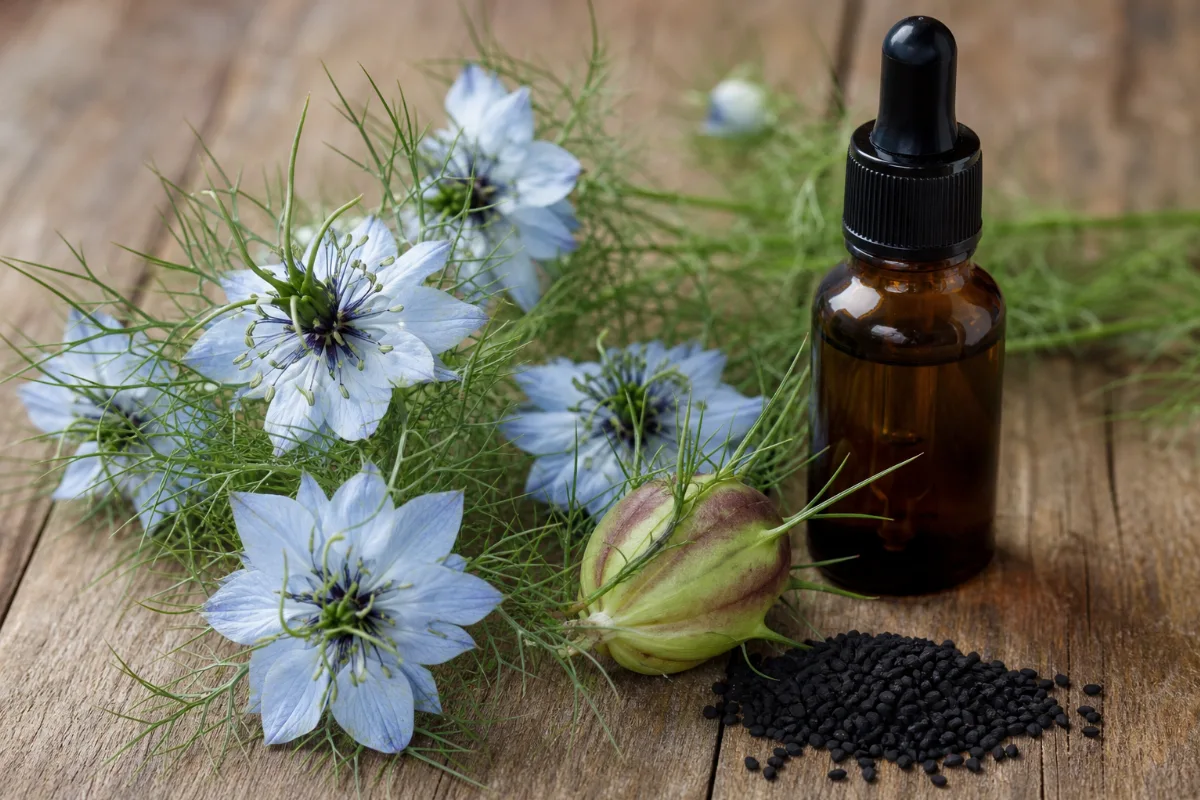
Essential Oils & Aromatherapy · Carrier oil
Black Seed Oil (Nigella)
Nigella sativa (seed oil; main compound thymoquinone) · also called Black cumin oil, Nigella oil, kalonji oil, aceite de comino negro.
Black seed oil is pressed from the seeds of Nigella sativa. It is used on the skin and hair, in food and in capsules. Trials of black seed products found small average drops in blood sugar and blood pressure, and one small trial found better asthma scores, but most trials mix oil with powder and seed. The main caution is the skin: severe allergic and blistering reactions have been reported, and there are medicine cautions.
General information, not medical advice. Last substantive update · Not medically reviewed. A named clinician has not signed off on this page. How this page is made
About Black Seed Oil (Nigella)
Black seed oil is pressed from the seeds of Nigella sativa and used on skin and hair, in food and in capsules. Evidence for benefits is thin to modest and mixes oil with powder and seed. The main caution is skin reactions, which have been severe in case reports.
What it is
Black seed oil comes from the seeds of Nigella sativa L., in the Ranunculaceae family (GBIF accepted name). It is also called black cumin oil. It is not cumin.
The main active compound is thymoquinone. One lab study found the amount differed several-fold between supercritical-extracted and cold-pressed oil.
How it is used
It is sold as a skin and hair oil, a food oil, capsules and as an ingredient in ointments. A 2021 review calls the plant one of the most extensively used traditional medicinal plants. That is a report of use, not a tested benefit.
It is a carrier-type oil, not an essential oil. The seed also has a separate volatile oil. Because of the skin reaction reports, it should not be assumed to be a gentle carrier for diluting other oils.
What the research shows
Blood sugar and blood pressure: several meta-analyses found small average falls, but trials differ a lot, are short, and pool oil with powder and seed. In one analysis oil did better on blood sugar and powder on blood pressure.
Asthma: one small oil capsule trial and a 4-trial meta-analysis found slightly better control scores added to usual treatment.
Skin: one small hand eczema trial, one vitiligo trial against fish oil. Knee osteoarthritis and hay fever: very small evidence. Many meta-analyses share authors from Iranian universities, and funding is not stated in most abstracts.
Forms, quality and buying
Pressed oil, volatile oil, capsules and ointments are different products. Thymoquinone differed several-fold by extraction method in one lab study.
Check the label for Nigella sativa and a single ingredient, and whether it is meant for food or for skin. Do not swallow an oil sold for skin only. We found no study testing shop bottles for blending or contamination.
At a glance
Traditional uses history, not proof
- A 2021 review calls Nigella sativa one of the most extensively used traditional medicinal plants. This is a report of use, not proof.
Studied for research
- Blood sugar, low (swallowed products, forms mixed)
- Blood pressure, low (small average fall, forms mixed)
- Weight and BMI, very low
- Asthma control, low (one small oil capsule trial)
- Hand eczema, very low (one small trial)
- Vitiligo, very low (one small trial)
- Knee osteoarthritis markers, very low
- Allergic rhinitis, very low
- Use in children, insufficient
Main compounds
- Thymoquinone, the main active compound (a skin allergen in a case report)
- Caryophyllene and other terpenes
- Amounts differ with how the oil is made
Common forms
- Pressed (fatty) seed oil for skin, hair and food
- Volatile (essential) oil of the seed, a different product
- Capsules and supplements
- Ointments and gels in trials
Research links: Black seed products and metabolic health, meta-analysis (abstract) · Black seed and blood pressure, meta-analysis (abstract) · Black seed oil capsules and asthma, randomised trial (abstract) · Severe skin reactions to black cumin oil, case series (abstract) · Bleeding case with black seed oil (abstract) · Black seed in children, systematic review (abstract) · Research Library · Genes & Biomarkers Library
What it is and its history
- Accepted scientific name
- Nigella sativa
- Naming authority
- L.
- Common names
- Black seed oil (English); Black cumin oil (English); Nigella oil (English); Kalonji oil (English); Aceite de comino negro (Spanish)
- Family or group
- Ranunculaceae
- Classification
- Plantae > Ranunculaceae > Nigella > Nigella sativa
- Native range
- Not checked in a source we read.
- Habitat
- Not checked.
- What it looks like
- Roots: Not checked.; Stems: Not checked.; Leaves: Not checked.; Flowers: Not checked.; Fruit: Not checked.
- Cultivation
- Not checked.
- Harvest and processing
- One lab study compared oil made by supercritical extraction with cold-pressed oil; thymoquinone differed several-fold. The seed also has a separate volatile (essential) oil, which is a different product.
- Look-alikes and adulterants
- Name: Cumin oil; Note: Different plant (Cuminum cyminum).; Name: Black seed essential (volatile) oil; Note: A different product from the pressed fatty oil; the uterus lab study used the volatile oil.
- Sustainability and conservation
- Not checked.
Traditional use and history history, not clinical proof
| Tradition or era | Documented use | Source |
|---|---|---|
| Traditional medicine | A 2021 review calls Nigella sativa one of the most extensively used traditional medicinal plants. We did not read a source that details which regions or conditions, so we do not list them. | p34649338 |
Traditional use shows how it was used. It does not show that it works or is safe today.
What is inside, and how it may work
What it contains and how those compounds act in cells and animals. Laboratory and animal mechanisms are not proven effects in people.
Main compounds
| Compound | Family | Where it is concentrated | Activity studied | Level of evidence |
|---|---|---|---|---|
| Thymoquinone PubChem 10281 | quinone | Seed oil 6.63 mg/mL in supercritical-extracted oil and 1.56 mg/mL in cold-pressed oil in one lab study. | Main bioactive compound per reviews (lab work). A case report names it as a skin allergen. 24 16 23 | Lab analysis |
| Caryophyllene PubChem 5281515 | terpene | Seed oil 17.47% of the oil's main constituents in one analysis. | No activity tested in the sources read. 24 | Lab analysis |
Mechanisms, receptors and pathways
| Target or pathway | Gene or receptor | What was found | Level |
|---|---|---|---|
| Oxidative stress and inflammation (lab) | Not specified | Reviews say black cumin and thymoquinone reduce oxidative stress and inflammation in lab and animal work. In people, one small knee trial lowered hs-CRP; mechanisms were not tested. 16 4 | Lab and animal |
Absorption, metabolism and elimination
- Absorption
- Not described in the human studies read.
- Distribution
- Not described.
- Metabolism
- Not described.
- Elimination
- Not described.
- Bioavailability
- Not described.
Isolated compounds versus whole extracts
Pressed seed oil, volatile oil, powder, capsules, ointments and thymoquinone are different products. Trials pool them. Where an analysis compared forms, results went both ways: oil lowered fasting glucose more than powder, and powder lowered blood pressure more than oil.
Nutritional composition
Black seed oil is a plant oil used on skin, as a food oil and in capsules. We found no source here giving its calories, vitamin content or fatty acid shares.
3 low certainty5 very low certainty1 not enough evidence
What is Black Seed Oil (Nigella) good for?
What the research shows for each use, and how strong it is. None of it is proven. Most trials mix oil, powder and seed, and many come from a few research groups in Iran. Read the Safety tab too.
Benefits, one by one
Each card is a research question, not a promise. Tap a goal to filter. Open a card to see the studies, doses and limits.
Blood sugar (fasting glucose and HbA1c)
Low certaintyMeta-analyses of many small trials found lower fasting blood sugar and HbA1c on average after taking black seed products. The results differ a lot between trials, and most trials did not use plain oil.
4 studiesTrials used many forms (powder, seed, oil, capsules). Amounts are in …
Studies, doses and limits
What the trials found
Several meta-analyses of randomised trials, mostly in people with type 2 diabetes or metabolic disease. They pool oil, powder, seed and capsules.
Results
Fasting glucose fell by about 10 to 19 mg/dL and HbA1c by about 0.6 percentage points in two meta-analyses. No effect on insulin or insulin resistance. Heterogeneity was over 90% in one.
Effect sizes as reported
Fasting glucose -9.93 and -18.62 mg/dL; HbA1c -0.57 and -0.56 (see studies).
Why this rating
Consistent direction across four meta-analyses, but very high heterogeneity, small short trials, forms pooled, and heavy overlap of Iranian research groups. One meta-analysis found oil lowered fasting glucose more than powder, which is a subgroup finding.
Form and dose studied
Trials used many forms (powder, seed, oil, capsules). Amounts are in the papers and are not given here.
Who was studied
Mostly adults with type 2 diabetes or metabolic disease.
Limits
Mixed forms. Surrogate markers only. Small trials are often published by the same few groups. Not a test of oil on its own.
Why researchers looked
Black seed is used traditionally for diabetes, and the main compound thymoquinone has been studied in the lab.
Traditional use
Black seed oil has been used traditionally for many conditions. These are reports of use, not proof that it works.
Proposed mechanism Pharmacological theory
Not established in the abstracts read.
A proposed mechanism does not show that the effect happens in people.
Not a replacement for diabetes, blood pressure or asthma care. Tell your doctor or pharmacist if you use it. See the Safety tab.
Blood pressure
Low certaintyMeta-analyses found small average falls in blood pressure, about 3 mmHg, after black seed products. The oil did less well than powder in one analysis.
3 studiesTrials used many forms (powder, seed, oil, capsules). Amounts are in …
Studies, doses and limits
What the trials found
Three meta-analyses of randomised trials: 11 trials in 2016, and larger ones in 2023 and 2026 that pool many forms.
Results
Systolic fell about 3.1 to 3.3 mmHg and diastolic about 2.7 to 2.8 mmHg versus control. In the 2016 analysis powder gave a bigger fall than oil.
Effect sizes as reported
Systolic -3.06 to -3.26 mmHg; diastolic -2.69 to -2.80 mmHg (see studies).
Why this rating
Small average effect, very high heterogeneity (I2 up to 97%) in the 2023 analysis, short trials, mixed forms, and overlapping Iranian authors. The one analysis that compared forms favoured powder over oil.
Form and dose studied
Trials used many forms (powder, seed, oil, capsules). Amounts are in the papers and are not given here.
Who was studied
Adults with normal or high blood pressure, or with metabolic disease.
Limits
Blood pressure readings are a marker, not heart attacks or strokes. The effect is small next to blood pressure medicines.
Why researchers looked
Black seed is used traditionally for the heart and blood pressure.
Traditional use
Black seed oil has been used traditionally for many conditions. These are reports of use, not proof that it works.
Proposed mechanism Pharmacological theory
Not established in the abstracts read.
A proposed mechanism does not show that the effect happens in people.
Not a replacement for diabetes, blood pressure or asthma care. Tell your doctor or pharmacist if you use it. See the Safety tab.
Body weight and BMI
Very low certaintyOne meta-analysis of 31 trials found about 1.6 kg lower weight on average. The result was close to no effect and quality varied.
1 studiesTrials used many forms (powder, seed, oil, capsules). Amounts are in …
Studies, doses and limits
What the trials found
A 2026 meta-analysis of 31 trials (2,145 people with metabolic diseases).
Results
Weight and BMI fell on average; waist size and insulin resistance did not change.
Effect sizes as reported
Weight -1.59 kg (95% CI -3.03 to -0.15); BMI -0.51 kg/m2
Why this rating
The weight interval almost touches zero, waist measures did not change, forms were pooled and quality varied.
Form and dose studied
Trials used many forms (powder, seed, oil, capsules). Amounts are in the papers and are not given here.
Who was studied
Adults with metabolic disease.
Limits
Not a trial of oil on its own.
Why researchers looked
Black seed is sold for weight control.
Traditional use
Black seed oil has been used traditionally for many conditions. These are reports of use, not proof that it works.
Proposed mechanism Pharmacological theory
Not established in the abstracts read.
A proposed mechanism does not show that the effect happens in people.
Not a replacement for diabetes, blood pressure or asthma care. Tell your doctor or pharmacist if you use it. See the Safety tab.
Asthma control (added to usual treatment)
Low certaintyOne small trial of black seed oil capsules for 4 weeks improved asthma control scores a little compared with placebo. A meta-analysis of 4 trials agreed, but the evidence is thin.
3 studiesOil capsules in the one trial. Amounts are in the paper and are not g…
Studies, doses and limits
What the trials found
One randomised, placebo-controlled trial of black seed oil capsules in 80 adults with asthma, plus two meta-analyses of 4 trials.
Results
Asthma Control Test score 21.1 vs 19.6 (p=0.044) and lower blood eosinophils. Lung function change was not significant in the trial; the meta-analysis found a small FEV1 gain. Capsules were added to usual treatment.
Effect sizes as reported
ACT 21.1 vs 19.6; eosinophils -50 vs +15 cells/uL
Why this rating
The oil trial was small and short, a quarter of people dropped out, and p values were near 0.05. The two meta-analyses report identical numbers from the same four trials, so they count as one.
Form and dose studied
Oil capsules in the one trial. Amounts are in the paper and are not given here.
Who was studied
Adults with asthma.
Limits
Four weeks only. Extra to usual medicine, not a replacement. Never stop asthma medicines on the basis of this.
Why researchers looked
Black seed oil is used traditionally for asthma and allergies.
Traditional use
Black seed oil has been used traditionally for many conditions. These are reports of use, not proof that it works.
Proposed mechanism Pharmacological theory
Not established. The authors point to inflammation markers, but the trial measured only blood eosinophils and IgE.
A proposed mechanism does not show that the effect happens in people.
Not a replacement for asthma medicines. See the Safety tab.
Hand eczema
Very low certaintyOne small trial in 60 people with hand eczema found a Nigella ointment improved symptoms faster than a plain moisturiser, and about as well as a steroid ointment. It is one small trial, and skin reactions are a real risk.
1 studiesA Nigella ointment twice a day. Amounts are in the paper and are not …
Studies, doses and limits
What the trials found
One randomised, double-blind trial: Nigella ointment versus betamethasone versus Eucerin for 4 weeks.
Results
Nigella and betamethasone improved eczema scores and life-quality scores faster than Eucerin; Nigella and betamethasone did not differ.
Effect sizes as reported
Sizes not in the abstract.
Why this rating
One small trial, short, many missed visits, and the abstract does not say the product was plain seed oil.
Form and dose studied
A Nigella ointment twice a day. Amounts are in the paper and are not given here.
Who was studied
Adults aged 18 to 60 with new hand eczema.
Limits
The product is described as an ointment. Not repeated. Skin reactions to black seed oil are reported elsewhere, including severe ones.
Why researchers looked
Black seed is used traditionally for skin conditions.
Traditional use
Black seed oil has been used traditionally for many conditions. These are reports of use, not proof that it works.
Proposed mechanism Pharmacological theory
Not established.
A proposed mechanism does not show that the effect happens in people.
Black seed oil on the skin has caused severe rashes in case reports. Patch test first and ask a doctor. See the Safety tab.
Vitiligo (patchy loss of skin colour)
Very low certaintyOne small trial of black seed oil on vitiligo patches found a slightly bigger improvement than fish oil after 6 months. There was no placebo, and no strong conclusion is possible.
2 studiesOil on the lesions twice a day for 6 months. Amounts are in the paper…
Studies, doses and limits
What the trials found
One randomised, double-blind trial of 52 people in Ahvaz, Iran, comparing Nigella sativa oil with fish oil. A systematic review lists it without calling it proven.
Results
VASI score fell from 4.98 to 3.75 with Nigella oil and 4.98 to 4.62 with fish oil. No adverse effects were reported by the patients.
Effect sizes as reported
VASI 4.98 to 3.75 vs 4.98 to 4.62
Why this rating
One small trial from one clinic, fish oil as comparison instead of placebo, no p value in the abstract.
Form and dose studied
Oil on the lesions twice a day for 6 months. Amounts are in the paper and are not given here.
Who was studied
Adults with vitiligo.
Limits
Fish oil may itself have an effect. Skin reactions to black seed oil are reported elsewhere.
Why researchers looked
Black seed oil is used traditionally on skin patches.
Traditional use
Black seed oil has been used traditionally for many conditions. These are reports of use, not proof that it works.
Proposed mechanism Pharmacological theory
Not established.
A proposed mechanism does not show that the effect happens in people.
Black seed oil on the skin has caused severe rashes in case reports. Patch test first and ask a doctor. See the Safety tab.
Knee osteoarthritis (inflammation markers and quality of life)
Very low certaintyOne 6-week trial in 45 people with knee osteoarthritis found swallowed black seed oil lowered a blood marker of inflammation and improved some quality-of-life scores compared with placebo.
1 studiesSwallowed oil and oil on the knee were tested. Amounts are in the pap…
Studies, doses and limits
What the trials found
One triple-arm, double-blind randomised trial of swallowed oil, oil on the knee, or placebo.
Results
hs-CRP fell with swallowed oil versus placebo; quality-of-life scores improved with swallowed and applied oil. The abstract does not report pain or joint function.
Effect sizes as reported
hs-CRP adjusted mean difference -0.81 (95% CI -1.45 to -0.19)
Why this rating
Only 45 people, 6 weeks, one trial, a blood marker rather than pain, and no pain scores in the abstract.
Form and dose studied
Swallowed oil and oil on the knee were tested. Amounts are in the paper and are not given here.
Who was studied
Adults with knee osteoarthritis.
Limits
Small, short, not repeated.
Why researchers looked
Black seed oil is used traditionally for joint pain and inflammation.
Traditional use
Black seed oil has been used traditionally for many conditions. These are reports of use, not proof that it works.
Proposed mechanism Pharmacological theory
Not established.
A proposed mechanism does not show that the effect happens in people.
Swallowed oil: see the Safety tab. Do not use instead of arthritis care.
Allergic rhinitis (hay fever type nose symptoms)
Very low certaintyA 2024 meta-analysis of 8 trials found Nigella products helped nasal symptoms more than comparison treatment. The authors say there were few studies of lower design quality.
1 studiesForms and amounts differ between trials and are not given here.
Studies, doses and limits
What the trials found
A meta-analysis of 8 randomised trials; forms of Nigella were pooled.
Results
Higher 'effective rate' (odds ratio 4.24) and better nasal symptom scores. Side effects were transient and no more common than in controls.
Effect sizes as reported
Effective rate OR 4.24 (2.57 to 7.27)
Why this rating
Few studies, lower design quality as the authors say, forms pooled, results not specific to oil.
Form and dose studied
Forms and amounts differ between trials and are not given here.
Who was studied
People with allergic rhinitis.
Limits
Not a test of oil alone.
Why researchers looked
Black seed is used traditionally for allergies.
Traditional use
Black seed oil has been used traditionally for many conditions. These are reports of use, not proof that it works.
Proposed mechanism Pharmacological theory
Not established.
A proposed mechanism does not show that the effect happens in people.
See the Safety tab.
Use in children
Not enough evidenceA 2025 review of 15 trials in children found no statistically significant side effects, but it calls the research limited. It does not show that black seed oil is safe or helpful for children.
1 studiesNot applicable.
Studies, doses and limits
What the trials found
A systematic review of 15 clinical trials in children, with a meta-analysis of side effects.
Results
No statistically significant side effects and no severe adverse effects. Most trials reported improvements.
Effect sizes as reported
Not given in the abstract.
Why this rating
Few trials, different forms and doses, no oil-specific result, and the review asks for better studies.
Form and dose studied
Not applicable.
Who was studied
Children (ages not stated in the abstract).
Limits
No result for plain black seed oil on children's skin. Skin reaction case reports exist (see Safety tab).
Why researchers looked
Black seed products are given to children in some places.
Traditional use
Black seed oil has been used traditionally for many conditions. These are reports of use, not proof that it works.
Proposed mechanism Pharmacological theory
Not applicable.
A proposed mechanism does not show that the effect happens in people.
Ask a children's doctor before using any black seed product on or in a child.
Connections to the rest of health
How Black Seed Oil (Nigella) connects to the rest of our health knowledge graph. Every link says what kind of connection it is. A safety link (for example to the liver) is a warning, not a benefit. A study that merely mentions a topic never creates a benefit link.
Explore every connection: goals, body systems, organs, symptoms, genes
A. Wellness goals
| Connected to | Kind of connection | Evidence status | Context | Studies |
|---|---|---|---|---|
| Blood Sugar Balance | Low certainty | Blood sugar (fasting glucose and HbA1c): Meta-analyses of many small trials found lower fasting blood sugar and HbA1c on average after taking black seed products. The results differ a lot between trials, and most trials did not use plain oil. | 25 7 30 20 | |
| Metabolic Health | Low certainty | Blood sugar (fasting glucose and HbA1c): Meta-analyses of many small trials found lower fasting blood sugar and HbA1c on average after taking black seed products. The results differ a lot between trials, and most trials did not use plain oil. | 25 7 30 20 | |
| Blood Pressure Support | Low certainty | Blood pressure: Meta-analyses found small average falls in blood pressure, about 3 mmHg, after black seed products. The oil did less well than powder in one analysis. | 28 21 25 | |
| Heart Health | Low certainty | Blood pressure: Meta-analyses found small average falls in blood pressure, about 3 mmHg, after black seed products. The oil did less well than powder in one analysis. | 28 21 25 | |
| Weight Management | Very low certainty | Body weight and BMI: One meta-analysis of 31 trials found about 1.6 kg lower weight on average. The result was close to no effect and quality varied. | 25 | |
| Lung Support | Low certainty | Asthma control (added to usual treatment): One small trial of black seed oil capsules for 4 weeks improved asthma control scores a little compared with placebo. A meta-analysis of 4 trials agreed, but the evidence is thin. | 22 17 15 | |
| Breathing Support | Low certainty | Asthma control (added to usual treatment): One small trial of black seed oil capsules for 4 weeks improved asthma control scores a little compared with placebo. A meta-analysis of 4 trials agreed, but the evidence is thin. | 22 17 15 | |
| Healthy Skin | Very low certainty | Hand eczema: One small trial in 60 people with hand eczema found a Nigella ointment improved symptoms faster than a plain moisturiser, and about as well as a steroid ointment. It is one small trial, and skin reactions are a real risk. Vitiligo (patchy loss of skin colour): One small trial of black seed oil on vitiligo patches found a slightly bigger improvement than fish oil after 6 months. There was no placebo, and no strong conclusion is possible. | 31 14 29 | |
| Skin Health | Very low certainty | Hand eczema: One small trial in 60 people with hand eczema found a Nigella ointment improved symptoms faster than a plain moisturiser, and about as well as a steroid ointment. It is one small trial, and skin reactions are a real risk. Vitiligo (patchy loss of skin colour): One small trial of black seed oil on vitiligo patches found a slightly bigger improvement than fish oil after 6 months. There was no placebo, and no strong conclusion is possible. | 31 14 29 | |
| Joint Support | Very low certainty | Knee osteoarthritis (inflammation markers and quality of life): One 6-week trial in 45 people with knee osteoarthritis found swallowed black seed oil lowered a blood marker of inflammation and improved some quality-of-life scores compared with placebo. | 4 | |
| Inflammation Balance | Very low certainty | Knee osteoarthritis (inflammation markers and quality of life): One 6-week trial in 45 people with knee osteoarthritis found swallowed black seed oil lowered a blood marker of inflammation and improved some quality-of-life scores compared with placebo. | 4 | |
| Immune Support | Very low certainty | Allergic rhinitis (hay fever type nose symptoms): A 2024 meta-analysis of 8 trials found Nigella products helped nasal symptoms more than comparison treatment. The authors say there were few studies of lower design quality. | 18 | |
| Seasonal Wellness | Very low certainty | Allergic rhinitis (hay fever type nose symptoms): A 2024 meta-analysis of 8 trials found Nigella products helped nasal symptoms more than comparison treatment. The authors say there were few studies of lower design quality. | 18 | |
| Preventive Wellness | Not enough evidence | Use in children: A 2025 review of 15 trials in children found no statistically significant side effects, but it calls the research limited. It does not show that black seed oil is safe or helpful for children. | 1 |
B. Body systems
| Connected to | Kind of connection | Evidence status | Context | Studies |
|---|---|---|---|---|
| Endocrine System | Biological association | Low certainty | Studied for: Blood sugar (fasting glucose and HbA1c) | 25 7 30 20 |
| Metabolism Weight | Biological association | Low certainty | Studied for: Blood sugar (fasting glucose and HbA1c) Studied for: Body weight and BMI | 25 7 30 20 |
| Cardiovascular System | Biological association | Low certainty | Studied for: Blood pressure | 28 21 25 |
| Respiratory System | Biological association | Low certainty | Studied for: Asthma control (added to usual treatment) Studied for: Allergic rhinitis (hay fever type nose symptoms) | 22 17 15 18 |
| Skin Hair Beauty | Biological association | Very low certainty | Studied for: Hand eczema Studied for: Vitiligo (patchy loss of skin colour) | 31 14 29 |
| Integumentary System | Biological association | Very low certainty | Studied for: Hand eczema Studied for: Vitiligo (patchy loss of skin colour) | 31 14 29 |
| Musculoskeletal System | Biological association | Very low certainty | Studied for: Knee osteoarthritis (inflammation markers and quality of life) | 4 |
| Pain Inflammation | Biological association | Very low certainty | Studied for: Knee osteoarthritis (inflammation markers and quality of life) | 4 |
| Immune System | Biological association | Very low certainty | Studied for: Allergic rhinitis (hay fever type nose symptoms) Studied for: Use in children | 18 1 |
E. Health conditions
| Connected to | Kind of connection | Evidence status | Context | Studies |
|---|---|---|---|---|
| Contact dermatitis | Low certainty | Case series of 8 and single severe cases. Preparation or compound: Black seed oil on skin |
32 13 23 | |
| Hematoma | Not enough evidence | One case report. Preparation or compound: Black seed oil swallowed with blood thinners and chemotherapy |
6 | |
| Asthma | Biological association | Low certainty | One small placebo-controlled trial and a 4-trial meta-analysis. Preparation or compound: Black seed oil capsules |
22 17 |
I. Biomarkers
| Connected to | Kind of connection | Evidence status | Context | Studies |
|---|---|---|---|---|
| Fasting blood glucose and HbA1c | Biological association | Low certainty | Measured in trials: improved (lower). A lab change is not the same as a health benefit. | 25 7 30 |
| Systolic and diastolic blood pressure | Biological association | Low certainty | Measured in trials: improved (slightly lower). A lab change is not the same as a health benefit. | 28 21 25 |
| Asthma Control Test score and blood eosinophils | Biological association | Low certainty | Measured in trials: improved. A lab change is not the same as a health benefit. | 22 17 |
| hs-CRP (inflammation marker) | Biological association | Very low certainty | Measured in trials: improved (lower). A lab change is not the same as a health benefit. | 4 |
L. Active compounds
| Connected to | Kind of connection | Evidence status | Context | Studies |
|---|---|---|---|---|
| Thymoquinone | Biological association | Lab analysis | Main bioactive compound per reviews (lab work). A case report names it as a skin allergen. Preparation or compound: Seed oil |
24 16 23 |
| Caryophyllene | Biological association | Lab analysis | No activity tested in the sources read. Preparation or compound: Seed oil |
24 |
Each connection is stored with the ingredient, the connected record, the kind of connection, the evidence status, the supporting studies, the preparation or compound involved, and a review date (last reviewed October 25, 2026).
The evidence
The research centre for Black Seed Oil (Nigella). Every record here was checked against PubMed or the publisher's page; we never list a study we have not verified.
Evidence by outcome
Bars show how many studies we found for each outcome, not how well it works. People are added up across trials only (reviews are not added, to avoid double counting).
How we rate evidence
High certainty
Several well-run trials or reviews agree; further research is unlikely to change the picture much.
Moderate certainty
Good trials point the same way, but some doubt remains.
Low certainty
Small, short or inconsistent trials. The finding could change with better research.
Very low certainty
Very little or very weak human data. Treat as a possibility only.
Mixed findings
Trials or reviews disagree with each other.
Not enough evidence
Not enough human research to say either way.
Evidence against
Good research found no benefit, or found harm.
We take the reviewers' own risk-of-bias and GRADE statements where they exist, and otherwise judge from study size, design, consistency, directness and whether a product matches what is sold. Many publications do not make evidence high. Method note: We read the PubMed abstracts of 24 papers and the titles of 5 case reports, checked the plant name in GBIF and compounds in PubChem. The breastfeeding database page could not be opened, so it is cited from earlier notes and marked unverified. Certainty ratings are the compiler's own reading. Funding is not stated in most abstracts.
Study library: every study we checked 32
| Study | Design | People | Product, dose, length | Result |
|---|---|---|---|---|
| Abumadini 2025 Clinical Uses of Nigella Sativa in Pediatrics: A Systematic Review and Meta-Analysis of Randomized Controlled Trials. J Pediatr Pharmacol Ther · PMID 41112345 · DOI |
Systematic review |
15 clinical trials in children | Nigella sativa (different forms and doses) seed products Not given here Varied · vs Varied |
No statistically significant side effects and no severe adverse effects. Most studies reported improvements, but the authors say studies are limited and more high-quality work is needed. Not given (Not given) Methods, limits and fundingOutcomes: Safety (side effects) and clinical outcomes Limitations: Limited number of studies. Forms and doses differed. Not specific to oil. Funding and conflicts: Not stated in the abstract. Read: abstract |
| Adiwidjaja 2021 Effect of Nigella sativa oil on pharmacokinetics and pharmacodynamics of gliclazide in rats. Biopharm Drug Dispos · PMID 34327715 · DOI |
Animal pharmacokinetic rat |
10 Healthy and insulin-resistant rats (n=5 per group) |
Nigella sativa oil with the diabetes medicine gliclazide seed oil Not given here Single doses · vs n/a |
With the oil, rats absorbed 29% more gliclazide and cleared it 20% more slowly. Healthy rats had up to 50% more blood-sugar lowering than with gliclazide alone; insulin-resistant rats did not. Methods, limits and fundingOutcomes: Blood levels of gliclazide, blood sugar Limitations: Rat study with 5 animals per group. The authors say the clinical importance 'merits further evaluation'. Funding and conflicts: No conflict of interest declared. Read: abstract |
| Alam 2020 Effect of Nigella sativa and Fenugreek on the Pharmacokinetics and Pharmacodynamics of Amlodipine in Hypertensive Rats. Curr Drug Metab · PMID 32407268 · DOI |
Animal pharmacokinetic rat |
Hypertensive rats | Nigella sativa (form not stated in the abstract) with amlodipine seed oil Not given here Not stated · vs n/a |
Nigella sativa lowered blood pressure and heart rate in rats, and with amlodipine gave better blood pressure control. It did not change amlodipine's main blood levels. Methods, limits and fundingOutcomes: Blood pressure, heart rate, amlodipine blood levels Limitations: Rat study. The product is not described as oil in the abstract. Funding and conflicts: No conflict of interest declared. Read: abstract |
| Amirtaheri Afshar 2023 The efficacy of Nigella sativa L. oil on serum biomarkers of inflammation and oxidative stress and quality of life in patients with knee osteoarthritis: A parallel triple-arm double-blind randomized controlled trial. Food Sci Nutr · PMID 38107142 · DOI |
RCT |
45 45 people with knee osteoarthritis in three groups |
Nigella sativa oil, swallowed in one group and put on the knee in another seed oil Not given here 6 weeks · vs Placebo oils for both routes |
Swallowed oil lowered hs-CRP compared with placebo (adjusted difference -0.81, 95% CI -1.45 to -0.19) and improved some quality-of-life scores; the oil on the skin improved quality of life. The abstract reports the hs-CRP fall for swallowed oil only. hs-CRP adjusted mean difference -0.81 (swallowed oil vs placebo) (-1.45 to -0.19) Methods, limits and fundingOutcomes: hs-CRP, oxidative stress markers, quality of life Limitations: Only 45 people, about 15 per group, 6 weeks. The abstract gives no joint pain or function scores. One trial. Funding and conflicts: No competing interests declared. Read: abstract |
| Aqel 1996 Effects of the volatile oil of Nigella sativa seeds on the uterine smooth muscle of rat and guinea pig. J Ethnopharmacol · PMID 8733115 · DOI |
Lab rat and guinea pig (tissue) |
Isolated rat and guinea pig uterus tissue | Volatile (essential) oil of Nigella sativa seeds, a different product from the pressed oil seed oil Not given here Lab test · vs n/a |
The volatile oil reduced spontaneous uterine movements and those caused by oxytocin, in a way that grew with concentration and reversed on washing. The authors suggest 'anti-oxytocic' potential. Methods, limits and fundingOutcomes: Uterine muscle movement Limitations: Lab tissue from animals, 1996, and the volatile oil rather than pressed black seed oil. It says nothing directly about pregnancy in women. Funding and conflicts: Not stated. Read: abstract |
| Arab 2026 Extensive Subcutaneous Hematoma in a Patient Receiving Nigella sativa Oil, Dual Antiplatelet Therapy, and Oxaliplatin-Based Chemotherapy: A Case Report. Hosp Pharm · PMID 42682876 · DOI |
Case report |
1 A 51-year-old man with colon cancer on FOLFOX plus cetuximab and two antiplatelet medicines, in a trial of the oil for nerve damage from chemotherapy |
Nigella sativa oil swallowed seed oil Not given here Weeks (dose was raised during the trial) · vs n/a |
After the dose was raised he developed a large bruise-like swelling under the skin and a low platelet count (52 x 10^3/uL). All suspect agents were stopped and it cleared in 10 days. He later took a lower amount of the oil without bleeding returning. The authors rated it a 'possible' adverse drug reaction (Naranjo score 4). Methods, limits and fundingOutcomes: Bleeding, platelet count Limitations: One person with several other bleeding risks, so the oil's part is uncertain. Published online Aug 2026. Funding and conflicts: No conflict of interest declared. Read: abstract |
| Askari 2019 Effect of Nigella sativa (black seed) supplementation on glycemic control: A systematic review and meta-analysis of clinical trials. Phytother Res · PMID 30873688 · DOI |
Meta-analysis |
17 randomised trials (number of people not stated in the abstract) | Nigella sativa as oil or powder seed products Not given here Not stated in the abstract · vs Control groups in each trial |
Lower fasting glucose, after-meal glucose and HbA1c on average. In a subgroup, oil lowered fasting glucose more than powder. Fasting glucose -9.93 mg/dl; after-meal glucose -14.79 mg/dl; HbA1c -0.57% (Fasting -13.44 to -6.41; after-meal -24.19 to -5.39; HbA1c -0.77 to -0.37) Methods, limits and fundingOutcomes: Fasting plasma glucose, after-meal glucose, HbA1c Limitations: Trial quality and heterogeneity not given in the abstract. Subgroup finding is not a head-to-head trial. Funding and conflicts: Not stated in the abstract. Read: abstract |
| Burle 2026 Acute Localized Exanthematous Pustulosis-Like Dermatitis Induced by Nigella sativa Seed Oil. Contact Dermatitis · PMID 42896557 · DOI |
Case report |
1 Case report (details not available) |
Nigella sativa seed oil seed oil Not given here n/a · vs n/a |
The title states a pustular skin rash induced by the seed oil. Methods, limits and fundingOutcomes: Pustular skin eruption Limitations: Title only; no abstract. Online ahead of print. Funding and conflicts: Not stated. Read: title-only |
| Chu 2026 Bullous cutaneous reaction mimicking Stevens-Johnson syndrome due to Nigella sativa supplement ingestion. JAAD Case Rep · PMID 42699335 · DOI |
Case report |
1 Case report (details not available) |
Nigella sativa supplement swallowed seed oil Not given here n/a · vs n/a |
The title states a blistering reaction that looked like Stevens-Johnson syndrome after swallowing a Nigella sativa supplement. Methods, limits and fundingOutcomes: Blistering skin reaction Limitations: Title only; no abstract. This was a swallowed supplement, not oil on the skin. Funding and conflicts: No conflict disclosed. Read: title-only |
| Dehavay 2019 Local and systemic adverse skin reactions following the use of herbal products believed to contain Nigella sativa seeds and oil. Contact Dermatitis · PMID 30478848 · DOI |
Case report |
Case reports (details not available) | Herbal products believed to contain Nigella sativa seed oil Not given here n/a · vs n/a |
The title reports local and body-wide skin reactions after herbal products believed to contain black seed and its oil. Methods, limits and fundingOutcomes: Skin reactions, local and body-wide Limitations: Title only; no abstract. Funding and conflicts: No conflict of interest declared. Read: title-only |
| Fargeas 2022 Drug reaction with eosinophilia and systemic symptoms (DRESS) syndrome after topical use of Nigella sativa (black cumin) oil. Contact Dermatitis · PMID 35419842 · DOI |
Case report |
1 Case report (details not available) |
Black cumin oil put on the skin seed oil Not given here n/a · vs n/a |
The title states DRESS syndrome (a serious drug reaction) after putting the oil on the skin. Methods, limits and fundingOutcomes: DRESS syndrome Limitations: Title only; no abstract in PubMed, so no patient details. Funding and conflicts: No conflict of interest declared. Read: title-only |
| GBIF Secretariat 2026 GBIF Backbone Taxonomy: Nigella sativa L. api.gbif.org · Source |
Database record n/a |
n/a | n/a n/a Not given here n/a · vs n/a |
GBIF API match on 2026-10-25: Nigella sativa L. is an ACCEPTED species (key 5371700), exact match, family Ranunculaceae, genus Nigella. Methods, limits and fundingOutcomes: Accepted name and family Limitations: Name check only. Read: full-text |
| Gelot 2012 Bullous drug eruption with Nigella sativa oil. Ann Dermatol Venereol · PMID 22482483 · DOI |
Case report |
1 A 53-year-old woman, hospitalised with fever and blistering rash |
Nigella sativa oil put on the skin and also swallowed for two weeks seed oil Not given here Two weeks · vs n/a |
Fever, red plaques and blisters. Biopsy resembled toxic epidermal necrolysis. Patch tests to the oil were strongly positive. Healing was slow and pale patches persisted three months later. Methods, limits and fundingOutcomes: Rash and skin biopsy Limitations: One case, reported in French. Because she also swallowed the oil, the authors could not rule out a body-wide reaction. Funding and conflicts: No conflict of interest declared. Read: abstract |
| Ghorbanibirgani 2014 Comparing Nigella sativa Oil and Fish Oil in Treatment of Vitiligo. Iran Red Crescent Med J · PMID 25068060 · DOI |
RCT |
52 52 people with vitiligo, two equal groups |
Nigella sativa oil put on the lesions twice a day seed oil Not given here 6 months · vs Fish oil put on the lesions |
VASI fell from 4.98 to 3.75 with Nigella oil and from 4.98 to 4.62 with fish oil. No adverse effect was reported by the patients. VASI 4.98 to 3.75 vs 4.98 to 4.62 (Not given) Methods, limits and fundingOutcomes: Vitiligo Area Scoring Index (VASI) Limitations: Small, one clinic in Ahvaz, Iran. No placebo (fish oil is not an inactive comparison). No p value in the abstract. A systematic review lists it but does not call it proven. Funding and conflicts: Not stated in the abstract. Read: abstract |
| Han 2021 The efficacy of Nigella sativa supplementation for asthma control: a meta-analysis of randomized controlled studies. Postepy Dermatol Alergol · PMID 34658694 · DOI |
Meta-analysis |
4 randomised trials | Nigella sativa supplements (forms pooled) seed products Not given here Not stated in the abstract · vs Control groups in each trial |
Reports the same numbers as the 2020 meta-analysis, with the same 4 trials and the same search date. It is probably a near-duplicate and is not an independent confirmation. ACT SMD 0.50; FEV1 SMD 1.84 (ACT 0.11 to 0.88; FEV1 0.07 to 3.60) Methods, limits and fundingOutcomes: Asthma Control Test, FEV1, PEF, IL-4, interferon-gamma Limitations: Identical abstract numbers to He 2020, so counted once for certainty. Funding and conflicts: No conflict declared in the abstract. Read: abstract |
| Hannan 2021 Black Cumin (Nigella sativa L.): A Comprehensive Review on Phytochemistry, Health Benefits, Molecular Pharmacology, and Safety. Nutrients · PMID 34073784 · DOI |
Review n/a |
n/a | Nigella sativa seed and thymoquinone seed Not given here n/a · vs n/a |
The review calls black cumin a highly valued nutraceutical herb and says thymoquinone is its main bioactive component. It covers lab effects on oxidative stress and inflammation and notes herb-drug interaction and safety issues, but it says the plant is 'far from clinical application'. Methods, limits and fundingOutcomes: Review of lab and clinical research Limitations: Narrative review; the abstract gives no specific safety findings. Funding and conflicts: No conflict declared. Read: abstract |
| He 2020 The influence of Nigella sativa for asthma control: A meta-analysis. Am J Emerg Med · PMID 31892440 · DOI |
Meta-analysis |
4 randomised trials of Nigella sativa for asthma | Nigella sativa supplements (forms pooled) seed products Not given here Not stated in the abstract · vs Control groups in each trial |
Higher Asthma Control Test scores and FEV1; no clear effect on PEF, IL-4 or interferon-gamma. ACT SMD 0.50; FEV1 SMD 1.84; PEF SMD 3.11 (not significant) (ACT 0.11 to 0.88; FEV1 0.07 to 3.60; PEF -1.30 to 7.52) Methods, limits and fundingOutcomes: Asthma Control Test, FEV1, PEF, IL-4, interferon-gamma Limitations: Only 4 trials; FEV1 interval nearly touches zero. Forms and trial sizes not given in the abstract. Funding and conflicts: No conflict declared in the abstract. Read: abstract |
| He 2024 Meta-analysis of randomized controlled trials assessing the efficacy of nigella sativa supplementation for allergic rhinitis treatment. Front Pharmacol · PMID 39372205 · DOI |
Meta-analysis |
8 randomised trials in allergic rhinitis (hay fever type nose symptoms) | Nigella sativa products (forms pooled) seed products Not given here Not stated · vs Control groups in each trial |
Better 'effective rate' (odds ratio 4.24) and nasal symptom scores. Side effects were transient and no more common than in controls. Effective rate OR 4.24; nasal symptoms MD -2.60 (OR 2.57 to 7.27; MD -2.82 to -2.38) Methods, limits and fundingOutcomes: Total effective rate, nasal symptoms, adverse effects Limitations: The authors say few studies and lower quality design may affect stability. Forms pooled and not oil on its own. Funding and conflicts: No conflicts declared. Read: abstract |
| Hossain 2021 A review of ethnobotany, phytochemistry, antimicrobial pharmacology and toxicology of Nigella sativa L. Biomed Pharmacother · PMID 34649338 · DOI |
Review n/a |
n/a | Nigella sativa and thymoquinone seed Not given here n/a · vs n/a |
The review calls Nigella sativa one of the most extensively used traditional medicinal plants and describes lab antimicrobial actions of the plant and thymoquinone. Methods, limits and fundingOutcomes: Traditional use and lab pharmacology Limitations: Lab (antimicrobial) findings only; not evidence of effect in people. Funding and conflicts: No conflict declared. Read: abstract |
| Jafari 2025 Does Nigella sativa supplementation improve cardiovascular disease risk factors? A comprehensive GRADE-assessed systematic review and dose-response meta-analysis of 82 randomized controlled trials. Pharmacol Res · PMID 40714301 · DOI |
Meta-analysis |
5026 82 studies (79 quantitative), 5,026 people |
Nigella sativa supplements (forms pooled) seed products Not given here 1 to 48 weeks · vs Control groups in each trial |
The abstract lists many markers as improved, including blood pressure, fasting glucose, HbA1c, LDL and total cholesterol, triglycerides, CRP, and also ALT, AST, creatinine and urea. It gives no sizes. Not given in the abstract (Not given in the abstract) Methods, limits and fundingOutcomes: Body fat, weight, blood pressure, blood sugar, blood fats, inflammation markers, liver and kidney blood tests Limitations: Abstract has no effect sizes, no GRADE ratings and no heterogeneity. It says only 'promising adjunct'. Forms pooled. One author (Musazadeh V) also wrote the 2026 meta-analysis, and several authors are from Iranian universities. Funding and conflicts: Authors declare no financial interests. Read: abstract |
| Kavyani 2023 Antihypertensive effects of Nigella sativa supplementation: An updated systematic review and meta-analysis of randomized controlled trials. Phytother Res · PMID 37341696 · DOI |
Meta-analysis |
Adults in randomised trials (number of trials and people not stated in the abstract) | Nigella sativa supplements (forms pooled) seed products Not given here Not stated in the abstract · vs Control groups in each trial |
Small average falls in blood pressure with very high heterogeneity between trials. Systolic -3.06 mmHg; diastolic -2.69 mmHg (Systolic -3.89 to -2.22; diastolic -3.72 to -1.66 (I2 84.7% and 97.3%)) Methods, limits and fundingOutcomes: Systolic and diastolic blood pressure Limitations: Very high heterogeneity (I2 up to 97%). The abstract does not give the number of trials or the quality. Authors partly overlap with the other Iranian meta-analyses. Funding and conflicts: Not stated in the abstract. Read: abstract |
| Koshak 2017 Nigella sativa Supplementation Improves Asthma Control and Biomarkers: A Randomized, Double-Blind, Placebo-Controlled Trial. Phytother Res · PMID 28093815 · DOI |
RCT |
80 80 adults with asthma, 40 per group; 10 in each group withdrew |
Nigella sativa oil capsules, added to usual asthma treatment seed oil Not given here 4 weeks · vs Placebo capsules |
Asthma Control Test score was higher with the oil (21.1 vs 19.6, p=0.044) and blood eosinophils fell (-50 vs +15 cells per microlitre, p=0.013). The lung function change was not significant (p=0.170). ACT 21.1 (SD 2.6) vs 19.6 (SD 3.7); eosinophils -50 vs +15 cells/uL; FEV1 % predicted +4 vs +1 (not significant) (Eosinophils -50 (-155 to -1) vs 15 (-60 to 87)) Methods, limits and fundingOutcomes: Asthma Control Test score (primary), lung function, blood eosinophils, IgE Limitations: Small, 4 weeks, a quarter of people dropped out, p values close to 0.05, one trial. The authors call for longer, multicentre trials. Registered NCT02407262. Funding and conflicts: Funding not stated in the abstract. Read: abstract |
| Kurihara 2020 Thymoquinone as a causative allergen in Nigella sativa oil contact dermatitis with cross-reactivity to tert-butylhydroquinone. Contact Dermatitis · PMID 32232855 · DOI |
Case report |
1 Case report (details not available) |
Nigella sativa oil on the skin seed oil Not given here n/a · vs n/a |
The title names thymoquinone as the allergen in black seed oil dermatitis, with cross-reaction to tert-butylhydroquinone (a food preservative chemical). Methods, limits and fundingOutcomes: Contact allergy Limitations: Title only; no abstract. Funding and conflicts: No conflict of interest declared. Read: title-only |
| Mohammed 2016 The Effects of Different Extraction Methods on Antioxidant Properties, Chemical Composition, and Thermal Behavior of Black Seed (Nigella sativa L.) Oil. Evid Based Complement Alternat Med · PMID 27642353 · DOI |
Lab analysis n/a (lab) |
n/a | Nigella sativa seed oil seed Not given here n/a · vs n/a |
Main constituents in the oil were caryophyllene (17.47%), thymoquinone (11.80%), 1,4-cyclohexadiene (7.17%), longifolene (3.5%) and carvacrol (1.82%). Thymoquinone was 6.63 mg/mL in supercritical-extracted oil and 1.56 mg/mL in cold-pressed oil. Supercritical oil had higher antioxidant readings in the lab. Methods, limits and fundingOutcomes: Oil composition by extraction method Limitations: One lab study of one set of samples. Not a test of health effects. Funding and conflicts: No conflict declared. Read: abstract |
| Musazadeh 2026 The Effect of Nigella sativa Supplementation on Cardiometabolic Health in Patients With Metabolic Diseases: A GRADE-Assessed Systematic Review and Meta-Analysis. Endocrinol Diabetes Metab · PMID 41858302 · DOI |
Meta-analysis |
2145 31 trials, 2,145 people with metabolic diseases (such as type 2 diabetes and obesity) |
Nigella sativa supplements (forms pooled; abstract does not split oil from seed or powder) seed products Not given here Varied by trial · vs Control groups in each trial |
Average falls in weight, BMI, blood pressure, fasting glucose and HbA1c. No effect on waist, HOMA-IR or insulin. The authors say to read it cautiously because study quality varied. Weight -1.59 kg; BMI -0.51 kg/m2; systolic BP -3.25 mmHg; diastolic BP -2.75 mmHg; fasting glucose -18.62 mg/dL; HbA1c -0.56 (Weight -3.03 to -0.15; systolic -4.44 to -2.06; diastolic -4.62 to -0.89; fasting glucose -23.30 to -13.95; HbA1c -0.79 to -0.33) Methods, limits and fundingOutcomes: Weight, BMI, blood pressure, fasting glucose, HbA1c, insulin resistance, waist Limitations: Forms pooled, so it is not a result for oil alone. Quality varied. The abstract does not give the risk of bias or the GRADE ratings. Authors are from Iranian universities. Funding and conflicts: No conflict of interest declared in the abstract. Read: abstract |
| National Library of Medicine 2006 Black Seed. Drugs and Lactation Database (LactMed) NCBI Bookshelf NBK501876 · Source |
Database record n/a |
n/a | n/a n/a Not given here n/a · vs n/a |
From our earlier internal summary, not re-opened in this build because the NCBI page showed a bot check: no data on black seed in breast milk or on safety and efficacy in infants; limited information suggests it is generally well tolerated; no valid trials support use for milk supply; it notes the oil can cause allergic contact dermatitis. Methods, limits and fundingOutcomes: Breastfeeding information Limitations: Summary-only. Not read directly in this build. Read: summary-only |
| PubChem (NCBI) 2026 PubChem compound records: thymoquinone and (-)-caryophyllene pubchem.ncbi.nlm.nih.gov · Source |
Database record n/a |
n/a | n/a n/a Not given here n/a · vs n/a |
PubChem API 2026-10-25: thymoquinone CID 10281 (C10H12O2); (-)-caryophyllene CID 5281515 (C15H24). Methods, limits and fundingOutcomes: Compound identity Limitations: Identity check only. Read: full-text |
| Sahebkar 2016 A systematic review and meta-analysis of randomized controlled trials investigating the effects of supplementation with Nigella sativa (black seed) on blood pressure. J Hypertens · PMID 27512971 · DOI |
Meta-analysis |
860 11 randomised trials, 860 people with high or normal blood pressure |
Nigella sativa as powder or oil seed products Not given here Average about 8.3 weeks · vs Placebo in 10 trials, standard treatment in 1 |
Blood pressure fell more than in controls. The authors report that powder and oil gave different results, in favour of powder, and that the conclusion applies to short-term powder treatment. Systolic -3.26 mmHg; diastolic -2.80 mmHg versus control (Systolic -5.10 to -1.42; diastolic -4.28 to -1.32) Methods, limits and fundingOutcomes: Systolic and diastolic blood pressure Limitations: Only 11 trials; moderate heterogeneity (I about 60%). Short treatment. Oil was less effective than powder in this analysis. Authors work in Iran and Italy. Funding and conflicts: Not stated in the abstract. Read: abstract |
| Shakhbazova 2021 A Systematic Review of Nutrition, Supplement, and Herbal-Based Adjunctive Therapies for Vitiligo. J Altern Complement Med · PMID 33337930 · DOI |
Systematic review |
26 clinical studies of diet and supplements in vitiligo | Several supplements, including Nigella sativa oil various Not given here Not stated · vs Not stated |
Nigella sativa oil is listed among the supplements reviewed. The abstract calls the evidence 'promising' overall and names other treatments as most promising (phenylalanine with UVA, Ginkgo biloba, Polypodium leucotomos), not Nigella. Not given (Not given) Methods, limits and fundingOutcomes: Vitiligo symptoms Limitations: Abstract gives no Nigella-specific result. Funding and conflicts: Not stated in the abstract. Read: abstract |
| Shirvani 2024 The effect of Nigella sativa supplementation on glycemic status in adults: An updated systematic review and meta-analysis of randomized controlled trials. Prostaglandins Other Lipid Mediat · PMID 39181437 · DOI |
Meta-analysis |
30 randomised trials in adults (number of people not stated in the abstract) | Nigella sativa supplements (forms pooled) seed products Not given here Not stated in the abstract · vs Control groups in each trial |
Lower fasting glucose and HbA1c, but no effect on insulin or HOMA-IR. Heterogeneity was extremely high. Fasting glucose SMD -1.71; HbA1c SMD -2.16 (standardised, not mg/dL) (Fasting -2.11 to -1.31 (I2 92.7%); HbA1c -3.04 to -1.29 (I2 95.7%)) Methods, limits and fundingOutcomes: Fasting glucose, HbA1c, insulin, HOMA-IR Limitations: Extremely high heterogeneity (I2 over 90%), so the average hides big differences between trials. Forms pooled. Funding and conflicts: Authors declare no competing interests. Read: abstract |
| Yousefi 2013 Comparison of therapeutic effect of topical Nigella with Betamethasone and Eucerin in hand eczema. J Eur Acad Dermatol Venereol · PMID 23198836 · DOI |
RCT |
60 60 people with new hand eczema, 20 per group (aged 18 to 60); 52 attended at least one visit |
Topical Nigella ointment (the abstract does not say whether it was plain seed oil) seed Not given here 4 weeks · vs Betamethasone ointment and Eucerin (moisturiser) |
Nigella and betamethasone improved faster than Eucerin (p=0.003 and p=0.012) and both lowered DLQI more than Eucerin. Nigella and betamethasone did not differ from each other. Not given as sizes in the abstract (Not given) Methods, limits and fundingOutcomes: Hand Eczema Severity Index (HECSI), Dermatology Life Quality Index (DLQI) Limitations: Small, 4 weeks, many people missed visits, and the product is described only as an ointment. Comparison with a steroid does not show Nigella is as safe. Conducted by an Iranian team; funding listed as non-US government support. Funding and conflicts: Research Support, Non-U.S. Gov't (named in PubMed record) Read: abstract |
| Zhivov 2024 Nigella Sativa (Black Cumin) Oil: A Case Report and Analysis Exploring Severe Cutaneous Manifestations and Implications for Patient Care. J Clin Aesthet Dermatol · PMID 39759250 |
Case report |
8 Case series of 8 patients |
Black cumin oil put on the skin seed oil Not given here Not stated · vs n/a |
Eight patients had severe skin reactions after putting the oil on their skin. The authors stress patch testing, asking about herbal use, and stronger regulation. Methods, limits and fundingOutcomes: Severe cutaneous manifestations Limitations: Abstract gives no details of the reactions, how common they are, or the products used. Funding and conflicts: No conflict of interest declared. Read: abstract |
What we do not know yet
- What the evidence supports: low for blood sugar, blood pressure and asthma; very low for weight, skin, knee and hay fever; insufficient for children.
- Most meta-analyses mix oil, powder and seed, and many come from the same few research groups.
- No human study of pregnancy or of medicine interactions; the interaction data are from rats.
- Five skin case reports could be read by title only, and the breastfeeding database could not be opened.
- LiverTox, EFSA, FDA and SCCS were not searched.
How new research is added
New studies are found by a saved PubMed search and placed in a review queue. A person reads each one before it changes any rating or safety wording.
Lab markers
What changed in blood or saliva tests during trials. A changed number is not the same as feeling or being healthier, and we give no "normal ranges".
Inflammatory 1
hs-CRP (inflammation marker)
Improved (lower) in trials
A blood test for general inflammation.
Very low certaintyResults and what it means
Why it was measured
Used as a marker of inflammation in the knee trial.
Statistical vs. clinical meaning
Statistically significant in one small trial.
Safety implication
None reported in the abstract.
| Study | Result | People | Product |
|---|---|---|---|
| 4 | Swallowed oil lowered hs-CRP versus placebo: adjusted difference -0.81 (95% CI -1.45 to -0.19) | 45 adults with knee osteoarthritis | Black seed oil swallowed or applied for 6 weeks |
Other 3
Fasting blood glucose and HbA1c
Improved (lower) in trials
Blood sugar after fasting and the average over about 3 months.
Low certaintyResults and what it means
Why it was measured
Standard markers in diabetes trials.
Statistical vs. clinical meaning
Statistically significant in pooled analyses with very high heterogeneity.
Safety implication
May add to the effect of diabetes medicines; see Safety tab.
Systolic and diastolic blood pressure
Improved (slightly lower) in trials
The pressure of blood in the arteries.
Low certaintyResults and what it means
Why it was measured
A main risk factor for heart disease and stroke.
Statistical vs. clinical meaning
Small average fall, large variation between trials.
Safety implication
May add to blood pressure medicines; see Safety tab.
Asthma Control Test score and blood eosinophils
Improved in trials
A questionnaire score for asthma control, and a type of white blood cell that rises in allergic asthma.
Low certaintyResults and what it means
Why it was measured
The trial's main and a secondary outcome.
Statistical vs. clinical meaning
Statistically significant but small, and the trial was small.
Safety implication
None reported in the abstract.
| Study | Result | People | Product |
|---|---|---|---|
| 22 | ACT 21.1 vs 19.6 (p=0.044); eosinophils -50 vs +15 cells/uL (p=0.013); FEV1 not significant | 80 adults with asthma | Black seed oil capsules versus placebo for 4 weeks |
Safety
What studies and official sources say about side effects, medicines and who should check first. Each point shows what kind of evidence it comes from.
Main points to know 5
- Skin: severe allergic and blistering reactions to black seed oil have been reported. A case series describes eight people with severe skin reactions after putting black cumin oil on their skin. Single reports describe a serious body-wide drug reaction (DRESS), a pustular rash, and a blistering reaction in a woman who put the oil on her skin and also swallowed it for two weeks; her patch test was strongly positive and pale patches lasted three months. One report names thymoquinone, the main active compound, as the allergen. For several of these we could read only the titles. We found no figure for how often it happens. A patch test arranged by a doctor is the way to check. Stop at the first rash, and get medical help for blisters, fever or peeling. Case report 32 11 13 23 10 8
- Swallowed supplements: a blistering reaction and a bleeding report. A 2026 case report describes a blistering reaction that looked like Stevens-Johnson syndrome after swallowing a Nigella sativa supplement (title only). Another case report describes a large bruise-like swelling and low platelets in a man taking black seed oil with two antiplatelet medicines and chemotherapy; it was rated a 'possible' reaction and cleared when the suspect agents were stopped. These are single cases. Tell your doctor or pharmacist about black seed oil before surgery or chemotherapy, or if you take blood thinners. Case report 9 6
- Medicines for diabetes and blood pressure: possible added effect. In trials, black seed products lowered blood sugar and blood pressure a little, so with diabetes or blood pressure medicines the effects could add up. In rats, black seed oil raised the blood level of the diabetes medicine gliclazide and increased its sugar-lowering effect, and black seed lowered blood pressure more when given with amlodipine. These are rat studies. We found no human interaction study. Do not change a medicine because of black seed oil, and tell your doctor or pharmacist you use it. Animal study 2 3 28 25
- Pregnancy and breastfeeding: not enough information. We found no human study of black seed oil in pregnancy. A 1996 lab study found that the volatile (essential) oil of the seeds reduced uterine muscle contractions in rat and guinea pig tissue. That is a different product and says nothing certain about women, but it is a reason to ask a doctor first. A drug database summary (not re-opened by us) says there are no data on black seed in breast milk or in infants. Lab study 5 26
- Not a replacement for medicine. Black seed products lowered blood sugar and blood pressure only a little in trials, and helped asthma scores a little in one small trial. Do not use them in place of diabetes, blood pressure or asthma medicines. Oils sold for skin and oils sold as supplements are different products, and this page cannot advise on swallowing. Meta-analysis 25 22
Side effects 4
| Effect | How often | Severity and recovery | Evidence |
|---|---|---|---|
| Allergic contact dermatitis, blisters or pustules where the oil was applied Reports include a series of eight and single cases; two are title-only. | Not known | moderate to severe Slow healing in one case; pale patches lasted 3 months | Case report 32 13 23 8 |
| Serious body-wide skin reactions (DRESS; a Stevens-Johnson-like blistering reaction) DRESS after skin use and blistering after swallowing a supplement; titles only. | Not known; single reports | severe Not described in the sources read | Case report 11 9 10 |
| Large bruise-like swelling with low platelets Man on two antiplatelet medicines and chemotherapy; rated 'possible' (Naranjo 4). | One case | serious Resolved in 10 days after stopping suspect agents | Case report 6 |
| Side effects in trials Those reviews pool many forms and do not describe oil alone. | Not significantly different from control in a children's review and a hay fever review | mild Transient in the hay fever review | Meta-analysis 1 18 |
Liver
No source read describes liver injury from black seed oil. A 2025 meta-analysis lists ALT and AST among markers that improved, with no sizes in the abstract. LiverTox was not searched. 20
How often. Not known.
Monitoring. None found in the sources read.
This is a safety connection. It is not evidence that Black Seed Oil (Nigella) supports liver health.
Medicines and supplements 4
| With | Why it matters | Importance | Evidence | What to do |
|---|---|---|---|---|
| Diabetes medicines (for example gliclazide) prescription | In rats, black seed oil increased gliclazide exposure (bioavailability up 29%, clearance down 20%) and its sugar-lowering effect in healthy rats. Trials in people show black seed products lower blood sugar a little. | Possible extra low blood sugar; not tested in people. | Animal research Very low certainty 2 25 | Tell your doctor or pharmacist; do not change medicine on your own. |
| Blood pressure medicines (for example amlodipine) prescription | In rats, Nigella sativa lowered blood pressure and gave better control with amlodipine without changing its main blood levels. In people, black seed products lowered blood pressure by about 3 mmHg. | Possible extra drop in blood pressure; not tested in people. | Animal research Very low certainty 3 28 | Tell your doctor or pharmacist; do not change medicine on your own. |
| Blood thinners and chemotherapy prescription | One case report links black seed oil to bleeding and low platelets in a man on two antiplatelet medicines and chemotherapy. | One case; cause uncertain. | Case report Not enough evidence 6 | Tell your surgeon, pharmacist or cancer team before use. |
| Kidney or liver medicines, and other medicines prescription | No source read describes any. | Not known. | Insufficient Not enough evidence | Ask a pharmacist. |
Who should check first 6
| Situation | Advice | Evidence |
|---|---|---|
| Past rash or allergic reaction to black seed oil, black cumin or thymoquinone products | Do not use again. See an allergy or skin doctor. | Case report 23 13 32 |
| Before putting it on skin | Ask a doctor about a patch test first. Do not put it on broken skin or near the eyes. | Case report 32 |
| Pregnancy | Ask a doctor first. No human safety data were found, and a lab study of the volatile oil showed reduced uterine muscle activity. | Lab study 5 |
| Breastfeeding | Ask a doctor first. A drug database summary (not re-opened by us) says there are no data. | Database 26 |
| On diabetes, blood pressure, blood thinner or chemotherapy medicine, or before surgery | Tell the prescriber or pharmacist. | Animal research 2 3 6 |
| Children | A review of 15 trials found no significant side effects but says evidence is limited. Ask a children's doctor. | Systematic review 1 |
Overdose, product quality and regulators
Summary. No poisoning from swallowing black seed oil is described in the sources read, apart from the case reports above. Pets (especially cats), kidney damage and seizure risk were not covered by any source we read.
Animal. The rat studies above were about medicine interactions and uterus tissue, not toxicity.
Human doses studied. Trials ran from 1 to 48 weeks (meta-analysis). Amounts are in the papers and are not given here.
High dose or long term signals. The bleeding case followed a dose increase; details are in the paper.
Overdose response. Not described.
Genotoxicity. Not read.
Toxic or hazardous parts. Not described.
We found no study of contamination or blending of shop bottles. Thymoquinone content differs with how the oil is made.
Thymoquinone content by extraction method. In one lab study of seed oil, thymoquinone was 6.63 mg/mL in oil from supercritical extraction and 1.56 mg/mL in cold-pressed oil, so bottles can differ a lot. 24
| Body | Action | Date |
|---|
When to get medical help
- Blisters, peeling skin, fever, swelling of the face, mouth sores, or a widespread rash after using or swallowing black seed oil: stop and get urgent medical care.
- Swelling of the lips or tongue, wheezing, throat tightness or trouble breathing: call emergency services.
- Large unexplained bruises, nosebleeds that will not stop or black stools while taking it with blood thinners or chemotherapy: contact your doctor now.
Stop using the product and contact a clinician or emergency service. In the US, Poison Control is 1-800-222-1222.
General information only, not medical advice. Ask a clinician or pharmacist before use, especially with medicines, in pregnancy or with a health condition. See the Natural Remedy Safety guide.
Frequently asked questions
Is black seed oil safe on the skin?
Can black seed oil cause an allergy?
Does black seed oil lower blood sugar?
Does black seed oil lower blood pressure?
Does black seed oil help asthma?
Can I take it with my medicines?
Is black seed oil safe in pregnancy or breastfeeding?
Is it safe for children?
A review of 15 trials found no statistically significant side effects, but it says the research is limited. Ask a children's doctor first.
Does it help eczema or vitiligo?
What is thymoquinone?
Is black cumin oil the same as cumin oil?
No. Black cumin is Nigella sativa. Cumin is a different plant.
Explore by health goal
Healthy SkinSkin HealthBlood Sugar BalanceMetabolic HealthBlood Pressure SupportHeart HealthWeight ManagementLung SupportBreathing SupportJoint SupportInflammation BalanceImmune SupportSeasonal WellnessPreventive Wellness
Editorial transparency
- Written by
- AlternativeMed editorial team. Research compiled with AI assistance, then checked against PubMed records.
- Medical review
- None. This page has not been reviewed by a physician or pharmacist.
- First published
- 2026-10-25
- Last substantive update
- 2026-10-25
- How we research
- We read the PubMed abstracts of 24 papers and the titles of 5 case reports, checked the plant name in GBIF and compounds in PubChem. The breastfeeding database page could not be opened, so it is cited from earlier notes and marked unverified. Certainty ratings are the compiler's own reading. Funding is not stated in most abstracts.
- How we rate evidence
- See "How we rate evidence" in the Evidence tab.
- Independence
- No product is promoted on this page. No affiliate links are shown.
Sources 32
Each source was opened and checked. Where we read only the abstract, it says so. The small numbers in the text point here.
- Abumadini MM, Ahmad S, AlYahya W et al. Clinical Uses of Nigella Sativa in Pediatrics: A Systematic Review and Meta-Analysis of Randomized Controlled Trials.. J Pediatr Pharmacol Ther. 2025. PMID 41112345. DOI 10.5863/JPPT-24-00044. (abstract)
- Adiwidjaja J, Sasongko L. Effect of Nigella sativa oil on pharmacokinetics and pharmacodynamics of gliclazide in rats.. Biopharm Drug Dispos. 2021. PMID 34327715. DOI 10.1002/bdd.2300. (abstract)
- Alam MA, Bin Jardan YA, Raish M et al. Effect of Nigella sativa and Fenugreek on the Pharmacokinetics and Pharmacodynamics of Amlodipine in Hypertensive Rats.. Curr Drug Metab. 2020. PMID 32407268. DOI 10.2174/1389200221666200514121501. (abstract)
- Amirtaheri Afshar A, Toopchizadeh V, Dolatkhah N et al. The efficacy of Nigella sativa L. oil on serum biomarkers of inflammation and oxidative stress and quality of life in patients with knee osteoarthritis: A parallel triple-arm double-blind randomized controlled trial.. Food Sci Nutr. 2023. PMID 38107142. DOI 10.1002/fsn3.3708. (abstract)
- Aqel M, Shaheen R. Effects of the volatile oil of Nigella sativa seeds on the uterine smooth muscle of rat and guinea pig.. J Ethnopharmacol. 1996. PMID 8733115. DOI 10.1016/0378-8741(95)01330-x. (abstract)
- Arab A, Ramezaninejad S, Salehifar E. Extensive Subcutaneous Hematoma in a Patient Receiving Nigella sativa Oil, Dual Antiplatelet Therapy, and Oxaliplatin-Based Chemotherapy: A Case Report.. Hosp Pharm. 2026. PMID 42682876. DOI 10.1177/00185787261482136. (abstract)
- Askari G, Rouhani MH, Ghaedi E et al. Effect of Nigella sativa (black seed) supplementation on glycemic control: A systematic review and meta-analysis of clinical trials.. Phytother Res. 2019. PMID 30873688. DOI 10.1002/ptr.6337. (abstract)
- Burle E, Giordano F. Acute Localized Exanthematous Pustulosis-Like Dermatitis Induced by Nigella sativa Seed Oil.. Contact Dermatitis. 2026. PMID 42896557. DOI 10.1111/cod.70276. (title-only)
- Chu B, Kinariwalla N, Elco CP et al. Bullous cutaneous reaction mimicking Stevens-Johnson syndrome due to Nigella sativa supplement ingestion.. JAAD Case Rep. 2026. PMID 42699335. DOI 10.1016/j.jdcr.2026.06.009. (title-only)
- Dehavay F, Kolivras A, Scheers C. Local and systemic adverse skin reactions following the use of herbal products believed to contain Nigella sativa seeds and oil.. Contact Dermatitis. 2019. PMID 30478848. DOI 10.1111/cod.13154. (title-only)
- Fargeas M, Calugareanu A, Ben-Said B. Drug reaction with eosinophilia and systemic symptoms (DRESS) syndrome after topical use of Nigella sativa (black cumin) oil.. Contact Dermatitis. 2022. PMID 35419842. DOI 10.1111/cod.14127. (title-only)
- GBIF Secretariat. GBIF Backbone Taxonomy: Nigella sativa L.. api.gbif.org. 2026. (full-text)
- Gelot P, Bara-Passot C, Gimenez-Arnau E et al. Bullous drug eruption with Nigella sativa oil.. Ann Dermatol Venereol. 2012. PMID 22482483. DOI 10.1016/j.annder.2012.01.025. (abstract)
- Ghorbanibirgani A, Khalili A, Rokhafrooz D. Comparing Nigella sativa Oil and Fish Oil in Treatment of Vitiligo.. Iran Red Crescent Med J. 2014. PMID 25068060. DOI 10.5812/ircmj.4515. (abstract)
- Han A, Shi D. The efficacy of Nigella sativa supplementation for asthma control: a meta-analysis of randomized controlled studies.. Postepy Dermatol Alergol. 2021. PMID 34658694. DOI 10.5114/ada.2020.93220. (abstract)
- Hannan MA, Rahman MA, Sohag AAM et al. Black Cumin (Nigella sativa L.): A Comprehensive Review on Phytochemistry, Health Benefits, Molecular Pharmacology, and Safety.. Nutrients. 2021. PMID 34073784. DOI 10.3390/nu13061784. (abstract)
- He T, Xu X. The influence of Nigella sativa for asthma control: A meta-analysis.. Am J Emerg Med. 2020. PMID 31892440. DOI 10.1016/j.ajem.2019.11.036. (abstract)
- He Y, Hu X, Chang L et al. Meta-analysis of randomized controlled trials assessing the efficacy of nigella sativa supplementation for allergic rhinitis treatment.. Front Pharmacol. 2024. PMID 39372205. DOI 10.3389/fphar.2024.1417013. (abstract)
- Hossain MS, Sharfaraz A, Dutta A et al. A review of ethnobotany, phytochemistry, antimicrobial pharmacology and toxicology of Nigella sativa L.. Biomed Pharmacother. 2021. PMID 34649338. DOI 10.1016/j.biopha.2021.112182. (abstract)
- Jafari A, Mardani H, Faghfouri AH et al. Does Nigella sativa supplementation improve cardiovascular disease risk factors? A comprehensive GRADE-assessed systematic review and dose-response meta-analysis of 82 randomized controlled trials.. Pharmacol Res. 2025. PMID 40714301. DOI 10.1016/j.phrs.2025.107882. (abstract)
- Kavyani Z, Musazadeh V, Safaei E et al. Antihypertensive effects of Nigella sativa supplementation: An updated systematic review and meta-analysis of randomized controlled trials.. Phytother Res. 2023. PMID 37341696. DOI 10.1002/ptr.7891. (abstract)
- Koshak A, Wei L, Koshak E et al. Nigella sativa Supplementation Improves Asthma Control and Biomarkers: A Randomized, Double-Blind, Placebo-Controlled Trial.. Phytother Res. 2017. PMID 28093815. DOI 10.1002/ptr.5761. (abstract)
- Kurihara F, Soria A, Lepoittevin JP et al. Thymoquinone as a causative allergen in Nigella sativa oil contact dermatitis with cross-reactivity to tert-butylhydroquinone.. Contact Dermatitis. 2020. PMID 32232855. DOI 10.1111/cod.13542. (title-only)
- Mohammed NK, Abd Manap MY, Tan CP et al. The Effects of Different Extraction Methods on Antioxidant Properties, Chemical Composition, and Thermal Behavior of Black Seed (Nigella sativa L.) Oil.. Evid Based Complement Alternat Med. 2016. PMID 27642353. DOI 10.1155/2016/6273817. (abstract)
- Musazadeh V, Jahangir M, Mahmoudinezhad M et al. The Effect of Nigella sativa Supplementation on Cardiometabolic Health in Patients With Metabolic Diseases: A GRADE-Assessed Systematic Review and Meta-Analysis.. Endocrinol Diabetes Metab. 2026. PMID 41858302. DOI 10.1002/edm2.70207. (abstract)
- National Library of Medicine. Black Seed. Drugs and Lactation Database (LactMed). NCBI Bookshelf NBK501876. 2006. (summary-only)
- PubChem (NCBI). PubChem compound records: thymoquinone and (-)-caryophyllene. pubchem.ncbi.nlm.nih.gov. 2026. (full-text)
- Sahebkar A, Soranna D, Liu X et al. A systematic review and meta-analysis of randomized controlled trials investigating the effects of supplementation with Nigella sativa (black seed) on blood pressure.. J Hypertens. 2016. PMID 27512971. DOI 10.1097/HJH.0000000000001049. (abstract)
- Shakhbazova A, Wu H, Chambers CJ et al. A Systematic Review of Nutrition, Supplement, and Herbal-Based Adjunctive Therapies for Vitiligo.. J Altern Complement Med. 2021. PMID 33337930. DOI 10.1089/acm.2020.0292. (abstract)
- Shirvani S, Falahatzadeh M, Oveili E et al. The effect of Nigella sativa supplementation on glycemic status in adults: An updated systematic review and meta-analysis of randomized controlled trials.. Prostaglandins Other Lipid Mediat. 2024. PMID 39181437. DOI 10.1016/j.prostaglandins.2024.106885. (abstract)
- Yousefi M, Barikbin B, Kamalinejad M et al. Comparison of therapeutic effect of topical Nigella with Betamethasone and Eucerin in hand eczema.. J Eur Acad Dermatol Venereol. 2013. PMID 23198836. DOI 10.1111/jdv.12033. (abstract)
- Zhivov E, Johnston C, Shangraw S. Nigella Sativa (Black Cumin) Oil: A Case Report and Analysis Exploring Severe Cutaneous Manifestations and Implications for Patient Care.. J Clin Aesthet Dermatol. 2024. PMID 39759250. (abstract)